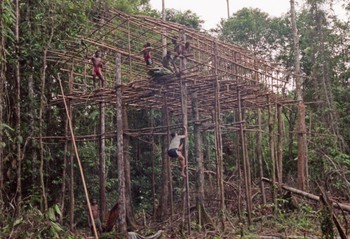
One of the most frequently encountered representations of West Papuan people internationally today is a photographic or video image of a Korowai or Kombai treehouse (Figure 1). Circulation of these images first exploded in the mid-1990s. In 1994, an Arts & Entertainment Channel film about Korowai was broadcast in the United States under the title Treehouse People: Cannibal Justice, and in 1996 National Geographic published a photo essay titled “Irian Jaya's People of the Trees.” Korowai and Kombai treehouses have since been depicted in dozens of magazine and newspaper articles and twenty television productions, made by media professionals from the United States, United Kingdom, France, Germany, Austria, Sweden, Finland, Japan, Australia, Switzerland, Italy, Croatia, Slovakia, the Czech Republic, Vietnam, and recently West Papua itself. Some representations have had mass global distribution through programming partnerships and satellite transmission agreements, and international editions of major magazines. Recently, several reality television programs have been produced about white travelers' stays in treehouses with Korowai or Kombai hosts. These include an episode of Tribe broadcast on BBC and Discovery in 2005, the six episodes of Living with the Kombai Tribe shown on Travel Channel and Discovery International in 2007, and an episode of Rendez-Vous En Terre Inconnue televised to much acclaim on France 2 in 2009. Treehouses were widely seen by Australian audiences in 2006 in the Sixty Minutes segment “The Last Cannibals,” and during a subsequent media firestorm that surrounded a rival show's unsuccessful effort to film their anchor accompanying a supposedly endangered Korowai orphan boy to a safer life in town. In 2009, a BBC film crew filmed Korowai house construction for the forthcoming blockbuster series Human Planet, and in 2010 National Geographic began researching a possible second story on Korowai treehouses. In late June and early July 2010, photos of Korowai treehouses were published by newspapers in Indonesia, Singapore, Malaysia, Vietnam, Paraguay, Spain, Romania, Hungary, Turkey, Finland, Germany, France, the United Kingdom, and other countries, to illustrate stories reporting the Indonesian census bureau's announcement that it had counted Korowai thoroughly for the first time (e.g., Andrade Reference Andrade2010; most stories drew their content from Agence France-Presse). In August 2010, production began for a feature-length Indonesian film about physical and romantic travails of Javanese protagonists who sojourn with Korowai in their jungle home; no filming is being carried out in the Korowai area or with Korowai actors, but treehouses figure prominently in the film's early written and visual publicity.Footnote 1
House (xaim) of Dəlelale Xayaanop and Xondol Malongatun with “dog platform” (mean büax), 1996. The boy is Mendop Malongatun (author's photo).

Television and magazine representations can place a single Korowai dwelling before the eyes of millions of persons, yet images of Korowai treehouses have also entered the global visual imaginary via less centralized paths of circulation.Footnote 2 Several hundred treehouse photographs are posted on the photo-sharing web pages of tourists (representing virtually all European nationalities and most settler colonial ones), professional websites of tour operators (based in Indonesia, the United States, and a dozen European countries), sites promoting commercial television or print representations of Korowai, and others about architectural curiosities. The treehouses also appear in books and newspaper sections directed at children (e.g., Pitzer and Holland Reference Pitzer and Holland1997; Bode, Frey, and Linke Reference Bode, Frey and Linke1999: 10; Nixon and Tomlinson Reference Nixon and Tomlinson2008: 23). Bookstall shoppers in Laos in early 2010 encountered a Korowai treehouse image in a dwelling-themed literacy primer (Stein-Holmes Reference Stein-Holmes2009: 22) at the same time that students in a San Diego elementary school were building a model Korowai dwelling for an annual open house.
This article seeks to explain the purchase Korowai house images have in global visual culture today. The scale and repetitiveness of these images' circulation is itself evidence that they signify a “treehouse idea” in the cultural and fantasy lives of metropolitan publics. The treehouse idea in global visual culture is one element in a larger primitivist understanding of Korowai as fascinating exemplars of a “Stone Age” human condition (Stasch Reference Stasch2011). Here I examine just the treehouse strand of this global primitivist cultural formation, arguing that treehouse images are more foundationally representations of the culture of the photograph makers and viewers than of the culture of the house dwellers.
I examine several forms of evidence offering access to the “mythic” idea carried by treehouse photographs (after Barthes Reference Barthes1972), and to the aesthetic principles that structure how foreigners experience the images. I first sketch associations of treehouses in global popular culture that inform the attractiveness of the Korowai images. I next look at an earlier boom in treehouse photography centered on a different part of New Guinea, which involved many of the same patterns of primitivist meaning-making now structuring Korowai house imaging. I then outline patterns of Korowai people's own understandings of their houses. Finally, drawing on these different layers of historical and ethnographic context, I put the camera and the house in relation to each other—“camera” as it tends to be used in treehouse photography, and “house” as Korowai build and occupy them. Juxtaposing these two objects as comparable technologies of mediation throws into relief contingent assumptions about seeing that are lost to awareness in most experiences of photographs, but which are crucial conditions of those experiences. These include assumptions that sight can be free from time and particularity, and offers direct access to the typical.
The Treehouse as “Other House” in Global Culture
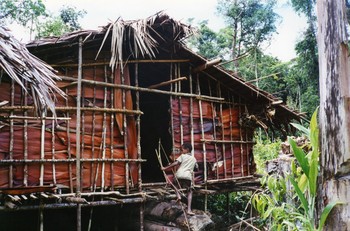
About four thousand Korowai live dispersed across five hundred square miles of lowland forest, just over one hundred miles inland from New Guinea's southwest coast. Kombai live south of Korowai. Historically, both groups built most of their houses elevated on foundations of topped tree trunks and other supporting poles (Figure 2). Both have in recent decades newly entered into relations with missionaries, Papuan church workers, Indonesian and Papuan government personnel, Indonesian traders or other immigrants, and the economy of paper money and mass consumer goods. As part of these new connections, most Kombai and about half of Korowai have begun building ground-level houses in centralized permanent villages. In the northern Kombai lands and across most of the Korowai region, many people also continue to build treehouses away from villages, and alternate between forest and village or live only in the forest. It is these areas that tourists and media professionals have been visiting for two decades in order to photograph treehouses.
New house of Silom Dambol (lower left), 1996, on a day when several youths are helping him to begin thatching the roof (author's photo).

To most people in industrialized countries, any dwelling built by its own occupants without sawn lumber, metal fasteners, and durable roofing is an instance of what Rykwert (Reference Rykwert1981: 140) terms “the ‘other’ house”:
This may be a house which had once existed, before heroic or divine intervention turned it to stone; it may involve a hut still standing, which had “in the first days” been inhabited by god or hero; most commonly it is a rite of building huts which in some way resembled or commemorated those which ancestors or heroes had built at some remote and important time…. In every case they are “other” than the normal dwellings of the time and place. And in every case they incarnate some shadow or memory of that perfect building which was before time began: when man was quite at home in his house, and his house as right as nature itself.
Treehouses take this quality of architectural otherness to a special extreme. Their status as an anti-type to global publics' ideas about normal housing is attested by their prominence in such popular works of imaginative literature and film as The Swiss Family Robinson, Peter Pan, Winnie the Pooh, Tarzan, Return of the Jedi, and Avatar.Footnote 3
In New Guinea treehouse photography, as in many fictional representations, the main idea of the treehouse is its primitive otherworldliness. The house form amplifies depicted people's spatial and temporal remove from white normalcy. In addition to the otherworldliness of living in the “jungle” on a “remote” island, New Guineans withdraw up into the trees. Their tall dwellings are houses out of place, combining the homelike and strange in an exotic deviation from the felt normative repressions and securities of house design in metropolitan modernity. Korowai treehouse images routinely appear in books of the Ripley's Believe It or Not genre (e.g., Hibbert Reference Hibbert2003: 44; Farndon Reference Farndon2007: 32), and in other ways participate in the tradition of exhibiting curiosities that fascinate viewers through incongruous violation of received category structures.
Within this basic primitivist idea, there are more specific axes on which treehouses depart from normal house form. One is the otherness of childhood. In their elevation and small size, children's treehouses simultaneously mimic adult domestic space and signal liberation from adult structures of authority and diminished imagination. “It's every child's dream,” a pharmaceutical chemist said to me about Korowai houses in a 2009 interview in California, by way of explaining why he had visited Korowai four years earlier. A Swiss filmmaker whom I met in the Korowai area in 2007 similarly explained to me the audience appeal of the documentary his crew was making by asserting that the house Korowai were building for the film “is like a dream…. As children we dream of this, and here in this place they actually do it.” About choosing the Korowai area as one of their West Papua filming locations, he repeated the idea: “It's children's dream to see treehouses like this, so it was a sure thing we'd do that place.”Footnote 4
Treehouses are also iconic of the otherness of nature, and of reintegrating humans into it. A house is by definition a vessel segregating people from the surrounding world, but treehouses enact a figurative twist on this expectation: they make a rooted natural body the dominant element of a dwelling's structure. Ideas of closeness to nature strongly color global interest in Korowai dwellings. In the book Treehouses of the World (Nelson Reference Nelson2004), two photographs of men thatching a treehouse are captioned “Korowai is [sic] a fine example of what architect Frank Lloyd Wright called Organic Architecture—a building perfectly in harmony with its site. The poles, taken from the surrounding forest, are held together by rattan—also taken from the immediate surroundings” (p. 164). Association with nature also informs foreigners' frequent comparison of treehouses to bird nests (e.g., O'Neill Reference O'Neill1996: 19; Raffaele Reference Raffaele2006: 51).Footnote 5
Freedom, play, and reentry into nature are among the values of the long tradition of building treehouses for adult use in the West (Henderson and Mornement Reference Henderson and Mornement2005: 12–49). The publication of many picture books about adult treehouses in the last fifteen years might be understood as a late reflection of the boom in this movement inaugurated by the countercultural transformations of the 1960s. Books and websites regularly invoke Korowai houses as an external archaic charter for this sub-cultural departure from industrialized societies' dominant norms. Treehouses of the World juxtaposes five photos depicting Korowai as people who “actually live in treehouses” (Nelson Reference Nelson2004: 164) with images of forty-two individual “great treehouses” in the United States and other industrialized countries (see also Clark Reference Clark2003: 10; Harris Reference Harris2003: 6–7; Henderson and Mornement Reference Henderson and Mornement2005: 54–61; Collins Reference Collins2009: 6). Korowai circulate in the global visual imaginary as the type-case of a Romantic idea of treehouse living as a vernacular architectural form practiced by an entire ethnic group.
There are several other important strands of the metropolitan treehouse idea intertwined with the utopian otherness of childhood and of reintegration with nature, including wildness, animality, primitive archaicness, construction skill, and the dystopian nightmare of war of all against all. Captioners and viewers frequently bring to Korowai treehouses the idea that they are defensive structures, iconic of the savage brutality of life beyond civilization. Wikipedia's English entry on Korowai has since August 2009 stated: “The distinctive high stilt architecture of the Korowai houses, well above flood-water levels, is a form of defensive fortification to disrupt rival clans from capturing people (especially women and children) for slavery or cannibalism. The height and girth of the common ironwood stilts also serves to protect the house from arson attacks in which huts are set alight and the inhabitants smoked out.”Footnote 6
Korowai do not practice slavery or set fire to dwellings while people are inside, and although events of cannibalism have occurred at various places on the landscape within most adults' living memories (as a collective response to male witchcraft), those acts had no direct links to house height. Korowai do sometimes mention security from prowling humans as a motive for house height, but what they emphasize most of all when asked about treehouses is fear of two nonhuman monsters: the “witches” who cause all human deaths, and the “demons” people become after dying. Height's protective character thus involves something invisible in a photograph: the cultural imagining of death, and of death's threatening affinity with domestic space. Yet treehouses' supposed function of defending against human attackers is a spontaneous inference about the dwellings widely made by global publics.
That a myth of the treehouse as other house precedes its application to New Guinea dwellings is also suggested by foreigners' invoking of fictional texts to interpret Korowai or Kombai houses. For example, one episode of Living with the Kombai Tribe centers on hosts' construction of a very tall treehouse for the two British visitors, Mark and Olly (see also Hoesterey n.d.). When Olly ascends for the first time while being filmed from below, his response on reaching the house platform is to cup his hands before his mouth and make a Tarzan call. Here the Tarzan story informs creation of the treehouse image in the first place.
Overrepresentation of Abnormally Tall Houses
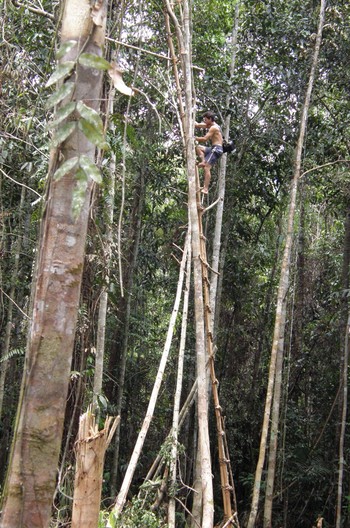
That the core of the treehouse idea is norm-transgressing otherness is also supported by a pattern of photographic overrepresentation of exceptionally high dwellings. The main houses Korowai build are called xaim, and are built on topped tree-trunk foundations, with their floor between ten and thirty feet above ground (as in Figures 1 and 2; and Bogner Reference Bogner1995: 34, 90). Median height is about fifteen feet. Korowai also commonly build dwellings termed xaü that stand about three feet above ground or that are not elevated at all, but these are rarely photographed (Figure 3). The photos most valued by foreigners portray a third type of dwelling termed lu-op (lit. “climbing house”), which Korowai build relatively rarely. This is a house in the upper canopy of a still-living tree, typically at heights of between fifty and one hundred twenty feet above ground. The house in Figures 4 and 5, built in 2007 for the aforementioned Swiss film crew, was one of these (see also Francon and Gentil Reference Francon and Gentil2008: 72–83).Footnote 7
Ground-level dwelling (xaü) of Xanduop Dambol and Nen Xawex, 2002 (author's photo).

Canopy-level house (lu-op) built in March 2007 by Yakop Dayo (author's photo).

Cameraman climbing the ladder of the house shown in Figure 4 (author's photo).

The single most frequently seen photograph of a Korowai house is of a canopy-level house, taken from a helicopter by George Steinmetz in 1995 and published the following year as the first page of an iconographically foundational National Geographic article (Steinmetz Reference Steinmetz1996: 34). A few months later the photo was reprinted in Reader's Digest (Raffaele Reference Raffaele1996: 105), and it has since been reproduced in many other books.Footnote 8 Nelson captions a reprint, “I will never forget this photo that appeared in National Geographic of a treehouse in Irian Jaya, Papua New Guinea [sic], where an entire culture lived in the trees! This aerial view shows one of their creations, one that hovers more than 150 feet off the ground” (2004: 22–23). A slightly different aerial photo of the same house by the same photographer was recently published on the website of Britain's highest-circulation broadsheet newspaper, accompanying a story on the Indonesian census bureau announcement mentioned above (Daily Telegraph 2010).Footnote 9 Since the National Geographic article's appearance in 1996, other journalists, filmmakers, and tourists have regularly sought to photograph houses of this ultra-tall kind, oriented by visual memory of the Steinmetz image.
Foreigners' imaging of these tall houses is out of proportion with their actual presence on the landscape. Korowai remember their life histories as a succession of dwellings, and in these histories about seven in ten houses are xaim on topped tree trunks, while three in ten are ground-level xaü. Only one in fifty is a canopy-level dwelling. Historically, Korowai youths or men occasionally built treetop-level houses to enjoy the extraordinary view they allowed, to project sound across the landscape, and to be “talked about lots” (aup lailai-) by others as being “strong.” But such houses were rarely occupied by families. The house in National Geographic was abandoned by the time it was photographed, its roof and walls having been blown apart by wind soon after completion. Ultra-tall structures have the status of “other houses” to Korowai themselves: they are known as laborious to construct and impractical to live in. Today they are mainly built at the request of film crews and tourists, for fees of between US$300 and $1000. In March 2010, for example, two canopy-level houses were built for tourists: one for a German tour group, and one for a Japanese film crew whose images were broadcast the next month on the Fuji TV variety show Unbelievable!
Overrepresentation of canopy-level dwellings highlights that foreigners' photography is a system of its own. The iconography of an ultra-tall house precedes images taken by specific photographers, and even precedes the building of a house by Korowai, who are routinely hired to make houses for purposes of filming. Even so, to photographers and viewers alike, the feeling around a photograph is that it is a transparent likeness recording an independently existing object.
One reason foreign photographers and viewers might select for canopy-level houses is the understanding that treehouses unify culture and nature. Such hybridization is strongest when a dwelling is integrated into a tree's living branches and foliage. Even more, overrepresentation of canopy-level houses seems motivated by their maximum extremeness, on all dimensions on which treehouses are an anti-type to viewers' expectations. Canopy-level dwellings are more extreme than others in their transgression of the assumption that houses are built near ground level, and that it is animals rather than humans who live in trees. They are also more extreme in evoking admiration of builders' skill, against expectations that forest-dwelling people are technologically unsophisticated. And the houses are more extreme in evoking an idea of defensive retreat from attackers.
The boom in Korowai treehouse imaging across the last twenty years is partly a phenomenon of the present historical moment of the heightened marketability of primitivist representations in visual and print mass media. Causes and conditions of this upsurge include the rise of cable television channels and mass cable viewerships in the United States; the success of Discovery Communications specifically; the rise of satellite television internationally, the increased internationalization of the Discovery and BBC viewerships, and the further internationalization of the well-established visual aesthetics of National Geographic (Lutz and Collins Reference Lutz and Collins1993); the Reality television revolution in audience desires and in the budgeting and production of television programming; centralization and de-funding of journalism institutions; the rise of new popular primitivisms in European countries, comparable to the earlier Nachtkultur movement; and the increasing intensity of media publics' experiences of global connectedness in their own lives, deepening the appeal of the primitivist dream of a life outside international capitalism and mass consumption. Yet there are also levels at which the Korowai phenomenon is not new. Concerning treehouse images specifically, one pressure toward overrepresentation of Korowai canopy-level houses is that a visual idea of what a New Guinea treehouse looks like has already existed in global print culture for over a century, and canopy-level dwellings best match this idea. Present-day Korowai treehouse imaging repeats closely a previous burst of imaging centered not on New Guinea's western half (colonized first by the Netherlands and now Indonesia), but on the island's eastern end. A look at the substantial earlier international life of New Guinea treehouse photographs can further cast into relief the meaning-making processes unfolding through Korowai images today.
The Earlier Boom in New Guinea Treehouse Imaging
New Guinea was linked to treehouses in fiction and in fabricated travel narratives before images of actually encountered dwellings began to circulate. The treehouse-residing heroes of Swiss Family Robinson were shipwrecked on an island near New Guinea. John Coulter, in a justly forgotten voyage narrative, invented a vast population of tree-dwelling New Guineans called “the Horraforas,” one faction of whom followed an escaped Irish convict as their warrior-king (Reference Coulter1847: vol. 2: 170–256; see also Ballard Reference Ballard, Jolly, Tcherkézoff and Tryon2009: 228–29). But the main rise of linking New Guinea to treehouses came in the 1880s, and occurred visually. The “Protectorate of British New Guinea” was declared by British and Australian officials in 1884, and the years after this saw the initial mass dissemination of photographs of the region's people to global audiences. As Quanchi (Reference Quanchi, Barry Craig and Anderson1999; Reference Quanchi2007) has shown, in this early colonial and early photographic moment, a small selection of stereotyped images of persons and material culture quickly became the stock signifiers of New Guinea at large. Treehouse photos were one of these half-dozen iconographic types. For several decades from 1880 onward, treehouse images were standard fixtures in Anglophone publications about New Guinea, such as travelogues and missionary memoirs. This was when treehouse photographs became an integral part of the visual culture of global primitivism. The frequency and compositional uniformity of treehouse illustrations did not reflect actual patterns of architecture in the territory (see for example Thomson Reference Thomson1892: 52; Burns Reference Burns and Company1899: 96; Walker Reference Walker1909: 167; and numerous images discussed in Quanchi Reference Quanchi, Barry Craig and Anderson1999: 226–29). Treehouses were built regularly in only a few areas in British New Guinea, and even in these places they were usually exceptional dwellings.
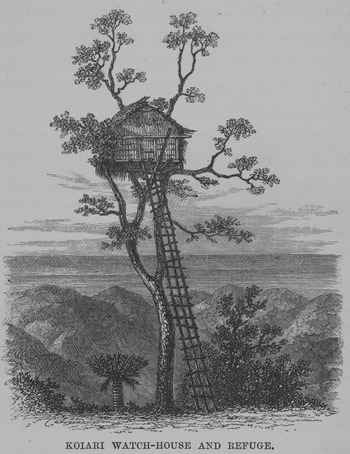
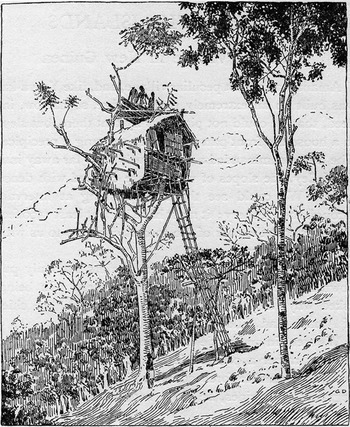
Most treehouse images were based on dwellings built by Koiari people, who lived in ridgetop hamlets just inland of the new mission, trade, and administrative center of Port Moresby. The siting of this London Missionary Society post and then colonial capital in this location was one contingency that led to the figuring of New Guinea as a land of treehouses. The first published images of treehouses in British New Guinea were 1880 and 1885 engravings depicting Koiari houses seen in the 1870s by naturalist Octavius Stone and missionary James Chalmers (Figures 6 and 7). Then, in 1885, the Frankfurt-born Australian photographer J. W. Lindt photographed Koiari houses during a six-week tour of the protectorate accompanying an expedition led by the administration's newly-arriving first commissioner.Footnote 10 Lindt subsequently exhibited, published, and marketed his New Guinea photographs widely in Australia and Europe, with great critical and commercial success (Lindt 1888a: 7–8, 16–23). The images were important to his rise as a leading Australian professional photographer, photography promoter, and dealer of photographic supplies. In 1886, he made a well-received gift to Queen Victoria of albums containing over a hundred New Guinea photos, under the title Picturesque New Guinea (ibid.: 16–17). In the same year, his treehouse photographs were displayed in the New Guinea Court of the Colonial and Indian Exhibition.Footnote 11 Attended by 5.5 million visitors, this six-month London exhibition was explicitly a celebration of the power and unity of the British Empire (MacKenzie Reference MacKenzie1984: 101; Barringer Reference Barringer, Barringer and Flynn1998). Prior to Lindt's travel to New Guinea, a notice in the Sydney Morning Herald had reported that “Mr. Lindt, the photographer to the expedition … intends to take views of New Guinea to be sent home to the exhibition to be held in London next year” (quoted in Lindt Reference Lindt1887: 17), and during his one-night stay with Koiari people Lindt was described to them by intermediaries “as an artist who had come to take pictures of the village to be sent to far off lands beyond the sea” (ibid.: 40). Lindt himself traveled to London in 1887. There he oversaw publication of fifty New Guinea photographs, including three Koiari treehouse images, in a highly successful illustrated travel book, also under the title Picturesque New Guinea (Lindt Reference Lindt1887).Footnote 12 Appearing in Victoria's jubilee year, the book was dedicated to the Queen, an inscription that again inserted photography into a circular performative logic of creating colonial sovereignty. The return to the Queen and her metropolitan subjects of photographed New Guineans was a confirmatory celebration of the truth and correctness of the declaration of rule emanating from her person to begin with.Footnote 13 Also before and during this Europe trip, Lindt circulated New Guinea images in professional photographic circles and exhibitions in Frankfurt, Munich, Paris, and Vienna (Lindt Reference Lindt1888a: 6, 50–53). From his Melbourne studio, he sold New Guinea photos as individual 6” × 8” prints, as a “Complete Set of 120 Subjects” in five albums, and as “A Set of 7 Characteristic Subjects” in oak-framed 48” × 36” enlargements “for Libraries, Museums, and Halls” (ibid.: 7–8).
Illustration from Stone (Reference Stone1880: 121).

Illustration from Chalmers and Gill (Reference Chalmers and Gill1885: 102).

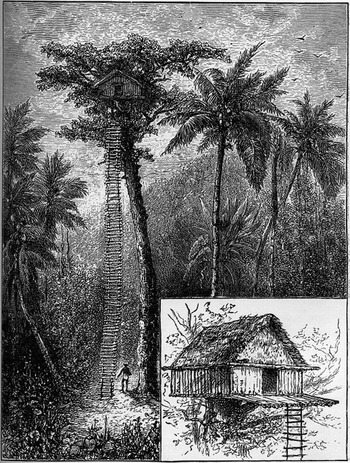
One outcome of Lindt's skills was that for several decades from 1885 forward, the iconography of New Guinean treehouses was dominated by prolific copying and compositional replication of a single one of his photographs (Figure 8). This pattern anticipates by a century the similar domination of contemporary iconography by Steinmetz's 1996 National Geographic image, and by images of other atypical canopy-level houses that most closely match the Lindt and Steinmetz prototypes.Footnote 14 In the Koiari village Lindt visited, four out of twenty structures were in trees (Lindt Reference Lindt1887: 34–35). More than Korowai elevated houses, these Koiari high dwellings were explicitly meant to provide security against organized raids, though Stone also reports Koiari saying the houses were for security against an occult being, and the term he provides for this being is recognizable as a regional word for witchcraft (1880: 121; see Dutton Reference Dutton2003: 211, s.v. voro). In any event, treehouses were exceptional structures within settlements of greater numbers of ground level dwellings.Footnote 15 Nonetheless, it is the treehouses that entered the global visual imagination.
“Tree House, Koiari Village” (Lindt Reference Lindt1887: pl. 14).

The further career of Lindt's most famous treehouse photograph highlights certain ideological underpinnings of the wider explosion in treehouse imaging during his time. While Lindt himself energetically circulated his Koiari photos, the treehouse image took on a life far beyond his agency. It was copied in photographic or drawn form in dozens—possibly hundreds—of publications and ephemera (see Quanchi Reference Quanchi, Barry Craig and Anderson1999: 225–26). Some replicas had a caption including the ethnonym “Koiari,” or even included an attribution to Lindt, but usually the image was copied without attribution and in an unabashedly decontextualizing and generalizing manner.Footnote 16 In August 1886, the Illustrated London News published an engraved copy of Lindt's photo in an article about the New Guinea display at the Colonial and Indian Exhibition, generically captioned “A New Guinea Native Tree House.”Footnote 17 As Quanchi (Reference Quanchi, Barry Craig and Anderson1999) documents, this pattern would be steadily repeated across subsequent months, years, and decades. In June 1912, the Missionary Review of the World included a small photographic copy of Lindt's image on its back cover keyed to the caption “Tree House in New Guinea,” in the center of a collage of eighteen photos together captioned “Some Missionary Scenes in the Pacific Islands.”Footnote 18 In 1915, a travel-writing anthology for young readers juxtaposed an engraved copy of Lindt's treehouse with a short excerpt from an originally unillustrated description of a treehouse seen in 1903 in a different part of New Guinea (Figure 9). Around the same time, the Tobler Chocolate company issued a series of twelve promotional stamps titled “Dwellings of the World,” including a tinted drawing copied from Lindt's photo.Footnote 19
Drawing after Lindt's photo printed in Marsh (Reference Marsh1915: 58) to accompany an originally unillustrated excerpt from Pratt (Reference Pratt1906: 230–33).

One revealing episode in the afterlife of Lindt's treehouse photographs was their pirating in Our Islands and Their People, an 1899 compendium of images of Pacific and Caribbean possessions newly seized by the United States in the Spanish-American War. This publication consists of eight hundred folio pages, presenting twelve hundred photographic illustrations under the prefatory assertion, “The camera cannot be otherwise than candid and truthful” (Olivares and Bryan Reference Olivares and Bryan1899: 6). Produced while the U.S. military was fighting a war against the Philippine independence movement, its first two printings sold four hundred thousand copies.Footnote 20 The Lindt image reproduced above as Figure 8 appears without attribution in the work's second volume, above the caption “A TREEHOUSE IN THE PHILIPPINES: Various tribes, especially in the southern portion of the archipelago, build their houses in trees; and in some instances there are villages of three to five houses in a single tree” (ibid.: 694). A second Lindt photograph of Koiari people and treehouses is reproduced on the same page, and captioned as depicting Tinguiane people (Figure 10). These two photographs are linked to two textual passages some seventy pages earlier in the book (in a chapter on “Wild Races of the Philippine Islands”) which mentions that Tinguiane people built treehouses (ibid.: 615–16, 621). Elsewhere, the authors quote a long excerpt from Alfred Russell Wallace's Malay Archipelago, expounding a contrast between Malay versus Papuan racial types (ibid.: 666–69). It is in support of applying this same racial typology to the Philippines that the compilers insert into their text various illustrations explicitly labeled as depicting New Guinea subject matter.Footnote 21 However, the two treehouse images are among several photographs originating from Lindt in particular that are deceptively captioned to relocate New Guinea subjects to the new American colony, evidently because these images were felt to meet the compilers' hurried need for generic primitivist visual content.Footnote 22 Certain Philippines peoples did sometimes build treehouses, and pictures of these tall houses soon became de rigueur in representations of the new colony for U.S. audiences (e.g., Barrows Reference Barrows1903: 1143; Stuntz Reference Stuntz1904: 43; Grosvenor Reference Grosvenor1905: 176). A replica treehouse was included in the large Philippines exhibit at the 1904 Louisiana Purchase Exposition in St. Louis, and in a derivative permanent installation in the American Museum of Natural History (Sherwood Reference Sherwood1911: 92–93; Fermin Reference Fermin2004: 116).
A Lindt Koiari photograph reproduced in Olivares and Bryan (Reference Olivares and Bryan1899: 694), above the caption “TINGUIANE TREE-DWELLERS. The Tinguianes occupy these houses as a means of protection against their enemies, and when attacked they heave down stones on the heads of the besiegers.”

The pirating of Lindt's treehouse images in an early visual apologia for U.S. takeover of the Philippines underlines that the core meaning of treehouse images in this period was not their apparent documentary truth. Rather, their basic meaning was the mythic idea of racial and evolutionary savagery, connoted by the house form. This idea placed image viewers themselves into a position of superiority, tutelage, adventure-seeking fascination, and legitimacy of colonial appropriation (compare Quanchi Reference Quanchi, Barry Craig and Anderson1999: 226–27).
The Ambivalence of an Anti-Type: Dystopia and Utopia across the Two Booms
From the first burst of New Guinea treehouse imaging in which Koiari houses were the type-case, to the second one in which Korowai houses now occupy that role, treehouse photography followed changing geographic contours of overlap between places where New Guinea people were building the dwellings, and places where whites with cameras were traveling. Koiari stopped building treehouses soon after the structures' initial imaging in the 1880s.Footnote 23 The overlap between colonial reach and treehouse construction elsewhere in New Guinea has also been brief. The exceptionally long run of treehouse photography in the Korowai area, and the huge quantity of images produced, might be attributed to the unusual abundance of treehouses on the Korowai landscape, the ongoing weakness of the Indonesian state (and lack of Indonesian settlers) where Korowai live, and the increased economic and technological power of today's photographers.Footnote 24
When contemporary Korowai photography is seen as continuing a longer history, one issue that comes into focus is the volatility of the treehouse idea's evaluative load. As an “other house” bearing links to childhood, nature, archaicness, and violence, a New Guinea treehouse condenses dystopian horror as well as utopian desire, much as vampires or other monsters often evoke simultaneous feelings of “desire and fear” (Moretti Reference Moretti1983: 100).
One historical tendency is a shift from “hard” to “soft” treehouse primitivism (after Lovejoy and Boas Reference Lovejoy and Boas1935), in line with a wider global turn from evaluating people like Koiari or Korowai as evolutionary and racial inferiors of Europeans, to evaluating them as morally uncorrupted superiors. Such a trajectory can be appreciated in the contrast between treehouse representations in two pedagogical works. In Curious Homes and Their Tenants (Beard Reference Beard1897), a “home reader” produced for U.S. youth, a four-page text on New Guinea treehouses is illustrated with an engraving probably copied after the early Koiari image reproduced above as Figure 7. All further items in the book's section on “Dwelling in Trees” are about animals, and construal of treehouses as animalistic is overt in the text's opening: “The natives of New Guinea climb like monkeys and travel long distances from one tree to another, without descending to the ground. In this country, where birds build little fairylike cabins on the ground [a reference to bowerbirds], the people construct their houses in the tops of the tallest forest trees” (ibid.: 101). Having made New Guinea a topsy-turvy world where humans are bestial while nature is culture-like (see also Stasch Reference Stasch2011), the text offers an equally fabular account of treehouses' construction and purposes. Then the author returns to the bird theme with a closing judgment that the “rude huts” of the “wild men of New Guinea” are inferior to actual bird's nests, in the comforts they offer to vulnerable young offspring (Beard Reference Beard1897: 105).Footnote 25
This portrayal contrasts with the positive evaluation offered in a recent university textbook on Culture and Human Development (Valsiner Reference Valsiner2000: 120–22), which juxtaposes a Korowai treehouse photograph with photos of Buckingham palace and a U.S. suburban dwelling. Addressing cross-culturally the question “What is a home?,” the accompanying text explains that the British and U.S. examples are culturally particular resolutions of a problematic of unification and separation in relation to surrounding people, just as the Korowai house is a culturally particular resolution of a problematic of unity and separation in relation to surrounding nature.
Yet even while the first imaging boom was dominantly framed by an ideology of white racial and evolutionary superiority, treehouses' evaluative load was in the late nineteenth century already complex, in ways that anticipate later trends. The case of Lindt himself is instructive. His New Guinea photographs, including the Koiari treehouse image, were successful due as much to his compositions' aesthetic beauty as to their viewer-transporting documentary magic. The claim to aesthetic value was overt in his titling of New Guinea scenes as “picturesque,” and his prefatory characterization of his role as that of “a competent artist photographer,” conducting “artistic photography,” to produce “artistic views and portraits” illustrating a book of travel (1887: vii–viii). Reception of his New Guinea photos as artworks is firmly registered in critical notices.Footnote 26 Yet Lindt himself linked treehouse architecture to New Guineans' temporal archaicness and to cannibalism. In an official guide to the British New Guinea Court of the Melbourne-hosted Australian Centennial International Exhibition of 1888, he told visitors, “You are among implements and articles produced by primeval man, who, in this newly-acquired territory, is still found in lake-dwellings, in houses on tops of trees, and curiously-shaped terrestrial dwellings, and who, in many places throughout the island, still practises cannibalism. The photographs close to the main entrance bring you face to face with some of the tribes and their aerial architecture” (Lindt Reference Lindt1888b: 7; see also judgments of New Guineans' racial and evolutionary inferiority in Lindt Reference Lindt1887, e.g. pp. 28, 30). Close twinning of deprecation and beauty can also be appreciated in a compositional detail of Lindt's most famous treehouse image (Figure 8), the presence on the house's lookout platform of three men bearing painted shields and military decorations, which Lindt himself arranged: “When Hunter, at my request, asked the men to mount to one of the tree houses, and to group themselves in warlike array on the platform, as if defending their garrison against the attack of a hostile tribe, they ran up the ladders with the ease and agility of monkeys, donned their war coronets and masks, and in full war-paint armed with shields and spears, went through all the evolutions of Papuan defensive fighting” (1887: 44). Here the positive aesthetic effect of the men's ornamented presence in the image, and the negative evolutionary condition of Papuans as living in a state of endemic violence, are the same thing.
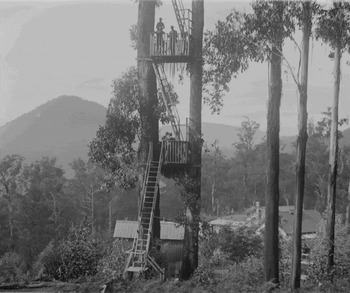
More remarkably still, within ten years of photographing Koiari treehouses and linking them to archaic savagery, Lindt was commissioning treehouses of his own. The three structures he had built were part of the overall aesthetic project of his “Hermitage,” a garden complex, photographic park, and vacation lodge to which he dedicated himself from 1894 on, after closing his Melbourne studio due to the economic depression (Figures 11 and 12; see also Jones Reference Jones1985: 113). Likely named in emulation of the prominent early photographer Nadar's rural retreat in France, the complex was sited on eighty acres of hilly forest in the Yarra Ranges northeast of Melbourne (De Lorenzo and van der Plaat Reference De Lorenzo, and van der Plaat2004: 146, n. 7). Lindt's coauthored regional guidebook affirms: “‘The Hermitage,’ should be visited. Built after the Swiss chalet style, in the midst of the forest, the house itself contains much that will interest the visitor in the way of curios, collected by Mr. Lindt during his travels in New Guinea and the South Sea Islands” (Caire and Lindt Reference Caire and Lindt1904: 52).Footnote 27 In a study linking the Hermitage's design to ideas of Alexander von Humboldt, De Lorenzo and van der Plaat have argued specifically that Lindt's project was influenced by “Humboldt's conviction that the experience and representation of the exotic—best represented by the biodiversity of the temperate rainforests of the new worlds—were able to liberate the common man's imaginative capacity and reveal the sublime unity/divinity of nature” (Reference De Lorenzo, and van der Plaat2004: 133). On their account, the impress of Humboldt's thought could be found in the Hermitage's rustic footbridges, Swiss-modeled main lodge and outbuildings, and exotic garden plantings, as well as in the complex's close juxtaposition of these human creations with established towering eucalyptus and Mountain Ash, and with gullies and understories dense with tree ferns. In Lindt's own lodge promotion and his photography, he emphasized the treehouses' aesthetic utility as platforms from which to obtain panoramic vistas.Footnote 28 But it is likely that he and his guests experienced the structures as integral, sublimely exotic elements of the seen landscape as well. He was evidently explicit in linking his treehouses to the ones he photographed in New Guinea: talking to some guests, he termed his own structures dobo, a Koiari word for “treehouse.”Footnote 29 Lindt transposed the felt culture-nature hybridity of Koiari treehouses to his own plan for an ideal garden. Treehouses of “primeval” New Guineans were experienced as objects of aesthetic desire and admiration, powerfully embodying his project's goal of melding values of wild “sublimity” and created “amenity.”Footnote 30
The lower two platforms of a treehouse at the Hermitage. Detail from photo by Mark James Daniel, 1899 (courtesy State Library of Victoria, H92.200/197).

A roofed, trunk-encircling treehouse at the Hermitage (upper right). Access is by a two-stage ladder and lower picketed platform to the right of the tree trunk. The women also face a log footbridge and road. Undated photo by J. W. Lindt (courtesy State Library of Victoria, H85.40/1, b48369).

A similar twinning of admiration and horror runs through present-day approaches to the treehouse anti-type. Relativistic comparison of treehouses to Buckingham palace in a textbook is echoed by wider contemporary photographic emphasis on the technical and physical prowess of treehouse builders, and their ecological conservationism (e.g., Gentil Reference Gentil2008; Francon and Gentil 2008). The past fifteen years of professional treehouse imaging have seen a trend toward creating lushly colorful compositions and reproductions, shot from technologically hard-won angles. Recent film productions have invested extraordinary labor and money in dramatic aerial and arboreal panning shots, underscoring houses' beauty (e.g., Lopez and Stine Reference Lopez and Stine2009). At the same time, ideas of internecine violence and civilizational inferiority remain central to imaging practices, as in the already-noted regular inference that height functions to protect house residents from tribal warfare. Even more significant is the frequency with which representations of Korowai, alongside characterizing them as treehouse dwellers, also characterize them as cannibals. As the same filmmaker who idealized treehouses as children's dream described to me his relation to this other preexisting stereotype of Korowai society: “We have no choice. We cannot be in the land of cannibalism and not talk about cannibalism.” Routine juxtaposition of treehouses and cannibalism as Korowai people's defining features sets up these two traits as reciprocally iconic images of the otherworldly deviance of primitive life.
Within the cultural and political circuits of Indonesian West Papua itself, the idea of a treehouse has tended somewhat more toward the hard primitivist pole. Following Indonesian takeover in 1963, the leftist Foreign Minister Subandrio (later imprisoned under Suharto) told a journalist that the administration's basic orientation toward Papuans was “getting them down out of the trees even if we have to pull them down” (Hastings Reference Hastings, May and Nelson1982: 159).Footnote 31 West Papuans of the southern lowlands today are heirs and active adopters of the tradition linking treehouses to civilizational inferiority. In certain interethnic contexts, southern lowlanders associate elevated houses (Ind. rumah tinggi) with archaicness, taking up the architectural form as a central figure by which they express consciousness of radical cultural transformations their populations have undergone, or now aspire to. Korowai traveling to towns commonly speak about their treehouses as a way of underlining their own primitivity, when talking with regional ethnic others such as Papuan government officials commanding fiscal resources, or non-Korowai love interests. So too, other southern Papuans of the present senior generations sometimes poignantly identify Korowai architecture with the practices of their own deceased parents and grandparents.
In Korowai people's own lives, though, these emerging primitivist construals of treehouses are dwarfed by very different endogenous understandings of the architectural form, to which I now turn.
On What a Camera Does Not See
Production and reception of Korowai treehouse images today continues the long tradition of selecting and projecting this house form as an anti-type to houses of urban modernity, and as a metonymy through which to imagine a cosmological relation between two opposite kinds of humanity, the civilized and the primitive. Photographic practices have created a visual “place-image” (Shields Reference Shields1991; Thompson Reference Thompson2006) of New Guinea as a land of extraordinarily tall houses, and New Guineans thus as people who are the opposite of metropolitan Westerners. They are primitive, mutually uncivil, free, or beautiful; they are unitary with nature; they live unbelievably and spectacularly outside of normal cultural expectations. The iconographic patterns creating this place-image are a series of part-for-whole substitutions. For the more than one thousand ethnic groups of New Guinea are substituted Koiari or Korowai. For Koiari or Korowai as humans are substituted houses. For the variety of Koiari or Korowai houses are substituted the elevated ones only. For Korowai treehouses at large is substituted an abnormal subtype. Through this chain of substitutions, a plural world is reduced to a single object that speaks powerfully to metropolitan audiences as an extreme departure from their own expectations.
Another substitution wound into each link of this chain is selection of visual experience as the way to know Korowai and their houses, from among all sensory and epistemological modes of contact. Possibly more important than the evaluative load foreigners assign to Korowai architecture are the cultural choices foreigners are constrained to make about their mode of aesthetic engagement with house forms. Benjamin, in his artwork essay, affirmed that “Just as the entire mode of existence of human collectives changes over long historical periods, so too does their mode of perception. The way in which human perception is organized—the medium in which it occurs—is conditioned not only by nature but by history” (2008: 23). Foreigners' engagement with New Guinea treehouses has been primarily visual, and has followed a particular idea of photographic visuality. Jameson aptly describes the dominance of vision in contemporary capitalist consumer culture in these terms: “Were an ontology of this artificial, person-produced universe still possible, it would have to be an ontology of the visual, of being as the visible first and foremost, with the other senses draining off it; all the fights about power and desire have to take place here, between the mastery of the gaze and the illimitable richness of the visual object” (Reference Jameson1992: 1; see also Fabian Reference Fabian1983, and Mitchell Reference Mitchell1988, on the salience of vision in colonization). Lindt's treehouse photographs, as we have seen, came into existence right in the vortex of an important step in the world-historical institutionalization of this mode of visuality: the practices of exhibition and mass spectatorship advanced in the great expositions of the late nineteenth and early twentieth centuries, and the extraordinary rise of photography as a medium of mass aesthetic consumption across the same period.
The centrality of this “ontology of the visual” to the functioning of global treehouse imagery becomes particularly clear if we juxtapose foreigners' imaging with understandings of treehouses held by Korowai themselves (for more details, see Stasch n.d.; and 2009: 45–63). Putting the house on an equal footing with the camera can help throw into greater relief the camera's sensitivities and blindnesses. By “camera” here, I mean the whole technological, social, and communicative process unfolding through this object and its image-fixing media, including the total field of social relations across which camera-produced representations exist, and the semiotic ideologies supporting those representations' uptake (compare Tagg Reference Tagg1988: 3). Korowai people's own experiences of their houses highlight possibilities of an embodied visuality, in which sight coexists densely with evidence of other senses, and with other faculties alongside sensation. These possibilities tend to be lost to the forms of photographic visuality structuring the global circulation of treehouse images. The points I develop here with respect to Korowai houses could also be made about houses in other cultural and historical settings, including the houses of people (like myself) who create treehouse photographs, look at National Geographic, or produce or watch primitivist television programming. I focus on Korowai houses here opportunistically, because ethnographic data on Korowai house experience contrasts so sharply with the meanings of these same houses as they are represented photographically.
One major element in Korowai understanding of houses that is little registered in foreigners' photography is social relations. Korowai experience house space sensorily as qualities of relatedness among persons who belong there, and as qualities of relatedness between those who belong and those who do not. The overall landscape is a patchwork of clan-owned territories, and divisions of landownership color almost all social interaction (Stasch Reference Stasch2009: 25–45). With respect to houses, people are also acutely sensitive to who is an “owner” (giom-anop) and who is not. Related to this sensitivity, a perceptual feature of houses that Korowai understand as an obvious concomitant of height is the distance between dwellings. To them, the treehouse form is an architecture of spatial dispersion and adherence to political values of autonomy and egalitarianism. Korowai build houses singly or in pairs in garden clearings, and it is often a mile between neighboring clearings. People associate dispersed residence in high houses with staying out of each other's way, so that they will not form desires for each other's spouses, food, and wealth that would lead to transgressions and conflicts. Korowai are uncomfortable with entering houses they or close relatives do not own. Within a house, interaction between owners and guests is both valued and marked. Each side strives to signify goodwill and lack of impingement on the other's autonomy, but everyone is also hypersensitive to possible breaches of etiquette. This valuing of separation, as well as the valuing of social cooperation across appropriately respectful and equality-preserving separateness, is a main meaning of treehouse architecture in Korowai eyes.
Foreigners bring to treehouse photography an idea that the visual is the actual, and to see is to know. International circulation of treehouse photographs is often informed by a sense that to have vision of a house is to have the meaning of it, and of the humans whose house it is. Investment in visuality, particularly as a way to reach the minds of audiences, is exemplified by another filmmaker's statement to me that by the time his team and editors finished, “The pictures will look better than the original.” Yet it is difficult to portray experiences of belonging and alienness in relation to house space within a photographic frame. For Korowai as for other people, houses are a kind of second body within which persons share in each other's being through common eating, sleeping, talking, and other activities. Thus the meaning of houses very much exceeds the domain of the visible. Contemporary photographs depicting internal spaces of houses in use by families go some distance toward softening these deficits, as do television productions that join images with occupants' voices, and follow social stories unfolding around houses. But there is a basic conflict between photographic faith in vision and Korowai houses' deep relationality to other spaces and persons beyond the local visual field, as well as houses' relationality to an overall ethic of social relating that is conceptual, political, and bodily, not just visual.
Another crucial presence that photographs generally do not make visible is the prominent link that Korowai draw between house height and two categories of malignant monsters: “witches” (xaxua) and “demons” (laleo). Witches are men in the Korowai population who have ceased to be human (yanop), by acquiring an incurable pathology of wanting to eat human flesh. Their attacks are thought to be the ultimate cause behind all deaths. Witches act without detection, by consuming a solitary victim's body and replacing the victim's body parts with counterfeit materials, then leaving the victim amnesically behind, doomed to die of other apparent causes. “Demons,” meanwhile, are what people become after death. They are zombie-like walking corpses thought to haunt the edges of Korowai social activity out of desire to be reunited with living relatives. Encounters between human and demon would lead to the humans' immediate deaths. The extraordinary grip of these two monsters on everyday Korowai consciousness is exemplified by the fact that all across the landscape, the height of people's houses reflects their hope that this will make them safer from the monsters' nighttime attacks. Ironically, where foreigners experience Korowai houses as aesthetically wild and sublime, for Korowai it is houses that are normal, and this domestic normality is pitched against unseeable, sublimely fearful monsters. These death-imbued monsters are an anti-type to Korowai humanity, much as Korowai treehouses are an anti-type to foreigners' architectural norms.
Monster beliefs—the most basic motivation that Korowai see in house height—are not visible in photographs. The monsters themselves underline the contingent character of global visual culture's identification of visibility with knowing. Witches, for example, are figures of the unreliability of sight and other kinds of sensation. Acting invisibly or in occult forms, they are prototypically associated with “stealth” (nanem). To Korowai, the visible, sensible form of a house is motivated by sight's compromised relation to knowledge. Seeing takes place under conditions of epistemological opacity that require people to join perceptual experience with acts of thought exceeding the evidence of the senses. Korowai subordinate the sense of sight to something they consider even more basic and true—the sense of death.
Even Korowai ideas about strictly visual aspects of houses contrast with foreigners' thought. Korowai emphasize houses' value in organizing visual experience, construing vision as something people deliberately shape rather than as a neutral collecting of knowledge about a preexisting object. They like the quality of visual openness given by house elevation and by the felling of nearby trees, linked to their understanding that domestic space is a project of security and transparency relative to the opaque monster- and stranger-populated world. Qualities of embodied visual experience are also emphasized in people's ideas about canopy-level houses. A standard reason men give for building these exceptional dwellings in the past (before they began to be built for foreigners) is, “I wanted to see the beautiful world” (lamol folul imop). From such a house, “It's open/clear on all sides” (men-men saox-telobo), and this panoramic visibility is pleasurable. People also sometimes deliberately site regular houses next to stands of tall slender palms, so that occupants can watch the rippling fronds. Persons in mourning are routinely moved to tears by shimmering vegetation of a surrounding forest wall, seen from a house's balcony in late afternoon light. These embodied aspects of treehouse visuality are partly what Lindt embraced, in commissioning treehouses himself. But the idea that treehouses could be meaningful as instruments of aesthetic experience for Korowai themselves does not arise readily in foreigners' approaches to treehouse photographs.
Another prominent aspect of house visuality, one linking up with social relations, is the “middle wall” (walüp damon) that divides most houses longitudinally into a separate “women's territory” and “men's territory.” A main purpose of this wall is to obscure and channel sight. The wall helps mothers-in-law and sons-in-law keep out of each other's view, and it obstructs people from forming vision-triggered attractions to new possible sexual partners. Sometimes a wall will be newly installed or improved in an existing house, because a mother-in-law and son-in-law pair are going to be in each other's presence there. In this way, the architectural feature is directly indexical of a social relation, and of a desired organization of vision appropriate to the morality of that relation. Here vision follows from other considerations rather than being the source of knowledge in its own right. In fact, avoidance of sight is experienced as a more powerful path to a social truth than sight itself.
A last sensory aspect of treehouse experience that exceeds vision is time. Treehouses are time-saturated and time-making. Basic here is that houses are transient. People stop using a house within one of two years of its construction, and adults are often able to list a succession of fifty or more houses they have lived in. Transiency is such a prominent feature of houses that the expression “house deterioration” (xaim demun) is a unit of time reckoning, like “year” in other languages. People regularly express how long ago an event took place by speaking of how many “house deteriorations” have elapsed. Speakers also locate events historically by saying what house they were living in when they occurred. Organizing memories around houses is aided by the convention of calling individual houses by the tree species that was the house's main support, joined with the suffix -genop “house.” Korowai build houses on enough different species that this pattern almost amounts to giving houses proper names (within a given network of speakers). A further aspect of houses' temporality is residents' practice of tucking bones and other meal traces into the ceiling, so that visitors will “see the beauty/well-being” (folul imo-) enjoyed there. Viewing a house interior, Korowai see the duration and history of residents' shared lives.
By comparison to the vivid temporal content of houses as Korowai sense them, the time sense in foreigners' photographic experience of treehouses is limited. Creating and looking at treehouse images, foreigners do not usually see the duration of people's dwelling in the house, the relations between a given house and previous ones, the site of the house on an owned territory separated from and oriented toward surrounding territories, the processes of bereavement people have experienced, their anticipation of future deaths, or other basic Korowai acts of house-focused cognition. If for foreigners the visual is the actual, for Korowai the temporal is the actual. Absent from dominant ideologies of the meaning of treehouse photographs is temporality as something that is not present in vision alone, but is made present by a subject's active work of memory and inference in relation to what is seen.
Conclusion: The Treehouse Idea and the Idea of Photography
Patterns in treehouse imaging examined earlier in this article also highlight treehouse photographs' limits as representations of temporality. These photographs hide the conditions of their own making. While there are many subtle, unsettled stories to be told of what defines photography as a technology and idea in different historical locations, one issue is the medium's intense claim to make present a transparently iconic, directly indexical visual duplicate of its subject, across distances of space and time. Travelers and magazine readers centrally understand treehouse photography as making present a past moment of seeing (the “that-has-been” of Barthes Reference Barthes and Howard1981). But this is a temporality attributed to the visually accessible, transparent relation between photographic image and what it depicts, not a temporality in the treehouse itself as something more complicated than what is seen, or a temporality attributed to photographic actions as themselves relational to a history and future of other such actions. A photograph's meaning as a desired connection between viewer and a particular depicted treehouse outpaces the image's ability to convey actual knowledge and experience (compare Batchen Reference Batchen1997). A treehouse photo so strongly provokes an idea that a house portrayed by it has physically existed, and the visual relation between image and house is so full, that other more foundational iconicities of a photograph are usually left in the shadows. These other iconicities include the photograph's likeness to a tradition of other photographs that have come before it repetitively across breaks of time, and the photograph's quality of being iconic of a treehouse idea that seems naturally present in the treehouse form but on examination is an element of the fantasy formations of photograph makers and viewers, preceding their search for houses in New Guinea.
An important contrast between camera and house as overall semiotic phenomena lies in the Korowai emphasis on a house's particularity, as against a photograph's barely-cloaked emphasis on the house as type. Korowai emphasis on particularity is apparent in the practice of individuating houses by the names of tree species; in the understanding of a house as defining a specific temporal era, relational to earlier and later house occupations; in the strong indexical links people draw between dwellings and position on a landscape of environmental features and ownership zones; and in the experience of houses as spaces of belonging and comfort, or non-belonging and edginess. When Korowai themselves look at photos of treehouses, their response is often to try working out what specific house it is, including who owned it, where it stood, and when it existed. Here the house as type is inherently also the house as token. Like linguistic pronouns (Benveniste Reference Benveniste1971) or a living human body, the very idea of a dwelling centrally involves also an idea of its particularity in a given here-and-now of personal ownership and action, looking outward relationally toward other times, places, persons, and events.
By comparison, in the ways users and audiences tend to put cameras into engagement with treehouses, the camera works to create an object dominated by a quality of being typical, as in one earlier-quoted author's linking of a single canopy-level house image seen in National Geographic to the idea of “an entire culture liv[ing] in the trees” (see also Quanchi Reference Quanchi, Barry Craig and Anderson1999: 225 on genericizing language in captions historically). Foreigners' photos compositionally emphasize the separateness of houses, while missing paths by which Korowai understand separateness as relational. A bounded photo, like a visual field divorced from other simultaneous acts of cognition, isolates a house from the wider landscape of owned forest on which the house sits, and from its own time-saturated character as a moment in people's unfolding sequences of movement across the land while living in the midst of death. Around photographic fetishism of certain kinds of visual information, a house is loosed of time, social relations, death, and reflexivity about seeing as embodied social action, turning the structure into something very different than what it is to its makers.
Joined with the patterns of photographic selection, substitution, and repetition sketched in earlier parts of this paper, this stripping of particularity seems also crucial to the production of the New Guinea treehouse as globally famous “other house.” The treehouse needs to be first a type in order to be an anti-type, so to speak. Abstracted into a visual look, the treehouse as disseminated to global audiences can “reach the recipient in his or her own situation” (Benjamin Reference Benjamin, Jennings, Doherty and Levin2008: 22), and more readily come to signify a latent idea of otherworldly difference already present in those recipients' dreams.
There may be an affinity between the mythic idea of the New Guinea treehouse as “other house” and the popularly dominant idea of photography. The experience of treehouse photographs as an immediate indexical and iconic visual duplicate of a separate object is intertwined in global visual culture with an idea of vision as socially free and non-impinging, as far as the relation between photographer and photographed, even as acts of creating or viewing a photograph are thought of as an achievement registering positive social value. These understandings are vividly combined in a June 1886 notice about J. W. Lindt's New Guinea photographs at the Colonial and Indian Exhibition, published in the then new (and today extant) British weekly magazine The Amateur Photographer: “Civilisation has indeed done much, when at a distance of thousands of miles photography places before us exact representations of the customs and habits of these strange races” (quoted in Lindt Reference Lindt1888a: 18). Here the visual power of photos as “exact representations” that can bring New Guinea sights to metropolitan audiences across great distances is testimony to the collective accomplishments of the society of the photographers, but the camera itself is vastly different from “the customs and habits of … strange races” it depicts. Under the ideology that a camera is fundamentally different from a house, a documentary photograph can be experienced as the socially unencumbered transposing of an object from someone else's world into one's own. This ideology is itself persuasively iconic of the notion of the treehouse as the anachronistic, numinous presence of an original form out of step with the current age.
Unsurprisingly, Korowai ideas about photography do not follow this chain of assumptions. Concerning the social content of photographic acts, it is a widely-repeated Korowai idea that tourists take photographs in order to give them to their “big head” back home, who in turn pays the tourists large quantities of money. This representation no doubt reflects canny perceptiveness of the actual economic organization of professional photojournalism and filmmaking. As I hope to describe elsewhere, the representation even more reflects a Korowai sensibility that sight is a form of exchange on a par with other material acts, and that tourists and Korowai live in the same world and owe each other a great deal.