


1. Introduction
The main goal of this paper is twofold: to present series of foreign trade, and to use them in order to address some features of the Mexican economy and society at the time.
There are very few quantitative sources of Mexican origin, and that is the reason why, after using those sources, we had to resort to statistics stemming from the main trade partners of Mexico, which ended up being the basis of the series that will be presented here.Footnote 1 This is the first time that complete foreign-trade series will be provided. Obviously, these numbers will not be exact, but they are estimates based on the best available sources and methods. Those series are then used to analyze some features of the Mexican society and economy at the time. With the new series, the basic indicators of foreign trade will be provided: terms of trade, import capacity, constant values, etcetera.
In 1821 Mexico achieved its Independence from Spain, after three centuries of colonial rule. Spain, in turn, did not recognize Mexico’s Independence, so, after some armed affairs, both countries interrupted their commercial intercourse between 1823 and 1836, and it was modest thereafter, which changed entirely the kind of relationship that they used to have. Also, there were decrees that provided for the expel of Spaniards from the Mexican territory at the end of the 1820s. This was the last in a series of steps that helped shift Spain’s to Great Britain’s influence, which then dominated through trade, lending, some foreign investment, and consular activity. In 1824, there was a “federal pact,” that allowed the survival of the national State, but which restricted it to use the resources stemming from foreign trade as the most important source of its revenue, thus creating a dependence that would last for all of this period. Thus, Mexico began its independent life with a federal government, but shifted to centralism at the end of 1835 and returned to federalism in the 1840s.
In 1836 Texas separated from the territory, and in 1838–1839, the land suffered another foreign threat in the invasion of the French army. In the 1840s, the country had to endure the temporary segregation of Yucatán and, between 1846 and 1848, the Mexican–American war, which ended up with the loss of half of the Mexican territory. A new, liberal Constitution was proclaimed in 1857, but the conservatives did not accept it. For that reason, from the end of 1857 to the beginning of 1861, there was an internal war, known as the War of Reform. Starting in December 1861, Mexico experienced the French invasion, which led to the Maximilian Empire from April 1864 to June 1867. The latter ended with the killing of Maximilian and the so-called Restored Republic, led by Benito Juarez, until the end of our era. Only then started the rule by the liberal party, which continued through the next period, and brought further uniformity in rules, order in the public finances, protection to property rights, more stability, and material progress.
This was a very complex epoch, full of challenges, both internal and external. Regarding the latter, it is clear to us that conditions abroad were not especially propitious to foreign trade, even though we consider them to have been unstable. More importantly, we think internal hindrances were severe enough to make any progress very difficult, and we have the impression that they have not received sufficient attention, so that is what we try to do here. Besides the segregations and the foreign threats already mentioned, there were other significant difficulties. There was severe political instability, which led, among other things, to have 41 presidents in only 34 years (between 1824 and 1858), the insolvency of the government, and its fragility to confront any challenge to its rule. The market was fragmented, mainly because roads were poor and transportation costs were consequently high, but also because regional leaders challenged the national power. Maritime connections were the best communication means available, and yet they were poor, which must be considered along with Mexico’s lack of a merchant marine. There was extreme concentration of income (which was not corrected) and high barriers of entry to investment, which made the situation even more difficult. As the government did not have enough resources to support itself, it was forced to use several measures, that proved insufficient: foreign loans, mainly the so-called “English debt” (whose payment had to suspend soon after getting them and spending the money obtained, taking away even more of its credibility), internal credits, made by local lenders (the so-called “agiotistas”), taxes, high import tariffs, duties to allow the exportation of metals, which was permitted mainly in monetary form (in bullion, it was in general forbidden), the lease of the mints, etc.
The persons who leased the mints together with the money lenders (sometimes were even the same) contributed to the further development of a rich group, made of Mexicans and foreigners as well, which was closely connected to the government, and which received some privileges that were denied to the rest. Also, they had access to money that they could later spend in their own benefit, be it inside, in a country that mainly employed metallic money, as it had no issue banks, or abroad, to save it, to invest it, or to spend it as they wish.
Regarding taxes on foreign trade, tariffs were relatively high. Most of them were imposed upon imports. The income stemming from that source was reduced for several reasons: some duties were paid with the same bonds issued by the government; it also signed the so-called “convenciones” to pay a percentage of the duties collected in the very customs to the countries with whom it had debts, and the like. On the other hand, some duties increased tariffs, as the consumption duty, payable by all foreign goods after entering into the territory.
The government said that duties were so high because it was pursuing industrialization. However, there is some lack of credibility on that, due to the fact that the same government was always in serious need of resources, of which those tariffs were the main source. A part of those resources (20%) was employed to finance the Banco de Avío, an organism founded in 1830 and closed in 1842, aimed at providing credit and machinery to industrialists. That fostered some import substitution, that lasted several years, in which the local production actually replaced a particular type of imports (mostly those of rough cotton stuff). Industrialization did not spread to other sectors, however, not to speak of the rest of the country. That means that the industrial spurt was limited and did not have further effects on the Mexican economy at that time. Even then, the rest of the tariffs, conveniently increased, were used to support the government.Footnote 2 Within a period, there were also prohibitions, which increased starting in 1837, and they seem to have been complemented by some compensatory duties imposed in other goods, because the level of public revenue did not lower. Prohibitions were more credible in terms of protecting industry, but they also had serious shortcomings. For instance, the main consumers of the most important product of the local factories, rough cotton stuff, were the poorest, who also deserved protection. Also, some claimed, with good ground, that prohibitions encouraged smuggling. Finally, not only rough cotton stuff was included in such prohibitions, but also raw cotton, an agricultural good and the main raw material used to produce the rough cotton stuff, which means that with those duties the government was also protecting agriculture. Significantly, the same government granted various entrepreneurs, particularly the most powerful and some of the money lenders, licenses to import this raw material when it was banned.
In the case of exports, much less duties were charged. It should be reminded that Mexico sold commodities and also precious metals, particularly silver, and that the latter were much more abundant than the former, meaning that merchandise exports were relatively scarce and not enough to pay for imports. In this situation, most export duties were imposed on precious metals, the only item relatively successful at the time. Charging tariffs upon them was highly criticized, but, given the extant conditions, it was the only way to take advantage of this source of income. Most of the metallic exported was in the form of specie (as the metallic was of free coinage). Part of it was sold as a commodity in exchange for imports, but a big portion was money, in a world in which prevailed bimetallism, used to pay benefits on investment or interest on debts, as well as to invest, to make deposits, to reimburse private debts (together with bills of exchange), or to buy. In fact, silver was very important in a world where it still circulated as money, which is why it was in high demand.Footnote 3 As for commodities, there were tariffs on only a small number of them, and those occurred only in some years, particularly at the end of the period.
After this introduction, the paper is divided in three sections and the conclusions. The first one addresses the sources and methods used in this work. The second section presents the new series of foreign trade and the indicators built with them. In the third one, we deal with some features of the Mexican economy and society, as the pronounced concentration of income, the limited development of the domestic economy, and the advantages enjoyed by privileged groups amid a permanent weakness of the government. Smuggling and the leasing of the mints to private entrepreneurs are also addressed. Finally, the behavior of international trade is related to the performance of the Mexican economy, indicating that it had to be, generally speaking, relatively modest. The paper is ended with some concluding remarks.
2. Sources and methods
First of all, it is relevant to clarify that throughout the paper we use values rather than quantities, because the latter are heterogeneous and thus cannot be added. So, whether we resort to Mexican or to foreign sources, we consistently employ values in the series that will be presented.
The information stemming from Mexican sources is utterly incomplete. We may use two different procedures with it: one direct, employing the original sources or the available calculations, and one indirect, resorting to duties paid by custom house as a way to estimate the value of trade. There are original data on merchandise trade in the years 1821, 1823–1828, 1856; on the other hand, about metal exports, there is a series made by Lerdo de Tejada, which is undoubtedly affected by contraband, going between 1825 and 1856; one of exports of cochineal up to 1828, and one of production of this item up to 1854. As for the indirect way to estimate the value of foreign trade, which takes as the basis the income received for that concept in each custom house, there are data of duties charged by custom houses in the years, that at times are calendar and at times fiscal, 1825–1837, 1840–1844, 1848–1849, 1850–1851, 1852, 1853, 1853–1854, 1855, 1856 (6 months), 1857–1866, and 1868–1869.
However, there are several shortcomings on a procedure based upon those figures, apart from being clearly affected by smuggling. One is that, as has been seen, this source does not exist for all the years. Another one is that there is much more information on imports than on exports. One more is that this source of data does not allow to estimate the value of those goods that are duty free, and therefore the figure that we calculate as the total is not only approximate but also lacking some important articles.Footnote 4 Finally, there is a weakness that share both procedures if we want to use them as a basis to build foreign trade figures. There is proof that the government augmented the official value of the commodities imported with respect to their invoice value, as a means to increase the duties payed by them and thus revenue. This means that any estimate using the extant data is overstated, and must be lowered, in different proportions, in order to provide more accurate figures (which we have done, in a second estimate made with Mexican data, although we generally do not know how much the data must be reduced).
Because of the unsatisfactory nature of the Mexican figures available, a reconstruction of trade values must be based upon the trading partners’ statistics, that is, upon foreign figures.Footnote 5 It must be recalled that in this case we are talking about the bilateral trade; that is to say, the exports of one particular trade partner are the imports of Mexico coming from that country, and vice versa, the imports of that country are the exports to that partner from Mexico.Footnote 6 Besides, it should be clarified that exports include reexports for Great Britain, the United States, and France, as they are the countries that provide this indicator. It should also be said that, until 1892, the United States authorities were not forced to record the trade with Mexico that was made by land.Footnote 7 To this extent, this part of the exchange with that country may be understated.
For the purpose of this work, the preferred source has been the official records of the trading partners.Footnote 8 However, these records are not always available, be it because by this time they have not started to be published or because the government did it under different criteria and with different aims. We have employed official or semi-officialFootnote 9 sources in the cases of the United Kingdom (UK) or Great Britain (GB), the United States (USA), France (FR), the two most important ports of Germany (GE), Hamburg (HA) and Bremen (BR), Belgium (BE), Spain (SP),Footnote 10 the Netherlands (NE), and Cuba (CU). It has been found that the mentioned countries did not always had trade with Mexico, and most importantly, not in every year, which was relevant to confirm. To reconstruct trade series, we consider all the products provided in the official statistics or in the sources used. On the other hand, there is no guarantee that their official statistics are entirely truthful.Footnote 11 In fact, very few analysis have been made concerning their accuracy specifically in these years.Footnote 12 However, in a study that deals with the period starting in 1890, the trustworthiness of these sources, in the case of advanced (there called “industrialized”) countries, is considerably high.Footnote 13 In any event, there may be some smuggling even in the best official statistics, but that possibility is accepted as a necessary aspect of the reconstruction, something unavoidable, beyond our control, and better than the current situation, that is to say, having no series at all.
When official statistics were not published in a valuable way to this exercise, consular reports were employed. These may not always be used because they are available only for some countries and in certain places (which, when existing, must be added to obtain a national figure). The more advanced countries appointed consuls in every relevant port as well as the capital city, and the said consuls used to write reports to their governments on the affairs of the recipient political unit, including figures on trade of all the countries in the world that were involved. Some of these consular reports are contained in the British Parliamentary Papers. Footnote 14 Using this kind of source, we were able to include the following territories: Italy (Sardinia and Naples, included as Italy even before the unification) (IT), Asia (AS), Brasil (BR), Venezuela (VE), Chili (CH), Ecuador (EC), Guatemala (GU), and Jamaica (JA). In Mexico, there were consuls that left reports which provide significant information of GB, USA, and FR, and also of different parts of Germany.Footnote 15 We also used the accounts of ports in other countries, as San Francisco in the USA. When none of these sources was found and only a few years for particular countries are missing, a statistical procedure has been employed, using the first year available to estimate its percentage share in the total, and then calculating the absolute value of the years missing.
While these sources have been employed with imports and commodity exports, the case for precious metals is somewhat different. Whereas most of the advanced countries recorded the value of those coming from Mexico, the main importer, which was Great Britain, did not include on its official trade statistics the value of precious metals introduced before 1858, and even after that year, Mexico was placed in a group that comprised the West Indies and South America (except Brazil), so they could never be taken into account. Thus, in order to build this series, a search was undertaken in the Observer, the Manchester Guardian, the Economist, some Mexican papers, and many of the newspapers provided in internet by the British Newspaper Archive, along with other sources.Footnote 16 They give details about the arrival of ships to English ports originating from several countries, Mexico among them: the name of the vessel, the date of arrival, the kind and value of the precious metals carried, etc. When some information was missing, we tried to complement it using several sources, like consular reports or other newspapers. By these means, we provide a complete (although always approximated) series of silver exports to GB. It must be said that, even though most of the shipments to this country were made in vessels of war, there were small amounts made in merchant vessels, besides common merchandise. We know that there were not a lot because, among other things, there were several disadvantages on that, like the fact that these metals had to pay internal duties and the market cost of transport, and did not have the protection of the British army.
Great Britain sent part of the metals on its own, after receiving them from Mexico. When the other countries getting them got some precious metals directly, we use their official (or semiofficial) statistics. Here we talk about FR, USA, DE. There were a few scattered shipments sent to Spain, Cuba, and territories of Asia, which were taken from the periodicals and are consider here as “others.”
It should also be noted that the new series of precious metal exports differs from the official coinage figures in most years, as well as from some estimates by Soetbeer, Orozco y Berra, Schneider, and the British consular reports, reproduced by Ibarra Bellon.Footnote 17 This means, among other things, that it is likely that the official coinage figures have to be revised.
Two last items have been considered in order to attain total figures of trade. One is the residual, a percentage of the trade that would go from what we have (coming from the trade statistics of each country) and the total value, and which changes with time and space. It is a percentage that represents, so to speak, the remaining trade, in order to be able to build its total value. In the case of Mexican imports, in our estimation, we have calculated that this residual represented a maximum of 7% of the total value of imports: 4% for the United States, 2% for the Asian territories, and 1% for those countries of the world whose trade may have not been accounted for. As for commodity exports, we estimate that it equals 6% at the top: 2% for the USA, 2% for Asia, and 2% for the rest. In the case of precious metals, in our assessment it represents a maximum of 5% of the total value of trade, when the direct figures are not available, distributed as follows: 1% for GB, 2% for the USA, 1% for AS (until 1850, because afterward it is included in the official statistics of the USA), and 1% for the rest.
The other figure is the cost of transport and insurance. As the actual figures of these costs are not available for this period, in another paper the so-called freight factor has been estimated.Footnote 18 It has been calculated considering actual costs for four countries (GB, USA, FR, BE), and thus including technological advance. It must be said that the latter was very significant during these years, making travels much faster and safer. Just to name one of the improvements, there was the progressive change from sailing to steam ships. In index numbers, changes like this made our calculation go from 100 to 69 in a 50-year period. On the other hand, the costs of insurance has not been calculated for these years, and we did not estimate it either. The absence of the cost of insurance means that the total value of Mexican imports is to this extent underestimated.
We also should remember that the figures used in this reconstruction originate in Mexico’s partners, meaning that what is imports for this country are exports for them, which are thus fob. In this event, the freight factor must be added to the value of Mexico’s imports, as importers pay these costs, to obtain a series of total values. To the contrary, Mexican exports are imports from the perspective of foreign statistics (cif values), and so transportation costs must be (and have been) discounted from these figures. The same should be made with the cost of insurance, which we do not have, and to this extent the resultant figures for Mexican imports are underestimated and for commodity exports are overestimated. Here, a distinction must be made between commodities and precious metals. While the freight factor has been discounted from Mexican commodity exports, precious metals require a further explanation. The sources coincide that most of the metallic sent abroad was carried in British vessels, because it was safer and, by these means, it had some privileges, like not having to pay internal taxes. Also, in its international transfers, it did not pay the market transportation costs, but a 3% tariff on the value of the metals carried to the admirals and captains of the ships taking them. So, while the freight factor is discounted from the total value of commodity exports, the 3% is added to the value of precious metals, as it is considered that this tariff was paid directly in the ports of exit, not at arrival.
Adding everything together, we may, for the first time, arrive to complete series of Mexico’s foreign trade, which are presented in the following section. Before going into that, it would be relevant to recognize the previous attempts that have been made in this matter. We should recall, first, those texts that present partial or more complete evidence but do not add it up to provide totals.Footnote 19 On the other hand, the most important attempt made so far deserves acknowledgement: Kuntz-Ficker and Tena-Junguito have provided a comprehensive first approach to reconstructing a complete series of the trade statistics of the country for this epoch.Footnote 20 To start with, it must be said that this is a very systematic exercise, made with utmost rigor and using the best sources and methods available at the time. For one, we employ the freight factor first presented in that paper. Having said that, it is worthy to name some of the main differences between both exercises. One is that they use in their estimate official figures of around seven commercial partners and additional countries that have a relatively small share on Mexico’s trade, while here we use up to 21 partners (even if, in fact, the share of some of them in Mexico’s trade is small), and, when official sources are not available, we employ consular reports or a statistical procedure to fill the gaps. Another disparity lies in the countries that they consider the main: in the four principal partners they include Belgium, while we here consider Germany. While it is true that the former initiates the official publication of statistics before, Germany (the principal ports, as we consider it before its unification) is by far more significant in quantitative terms, so we use this criterion as more relevant. One further point is that they calculate the residual as a progression from a higher figure at the beginning of the period to a lower figure at the end, whereas we estimate here as residual the share and the country whose figures are missing in each year. Another relevant difference is that we employ alternative sources to fill the gap in the United Kingdom regarding precious metals remittances, whereas those authors resort to the more traditional official sources, which include GB only starting in 1858, or to consular reports that are incomplete and have some deficiencies. Also, they consider precious metal exports as being also commodity trade and thus may present a balance of trade as an aspect of their proposal. In contrast, here we consider that some of them were in fact money remittances, and therefore a component of the capital sheet, which makes unfeasible to build a balance of trade account. Finally, as will be seen later, while the authors offer current prices, we provide also indices for Mexican trade, and therefore are able to present the data in constant values. For all these reasons, despite the value we place on that reconstruction, we consider it necessary to offer a new one, which will be provided here. Additionally, the reader may wonder about the value differences between the series provided by the authors just mentioned and those built here. Both follow the same trend, the main distinction lying in the levels. It may be understood that, for the aforementioned reasons, the series presented here are usually higher than those calculated in that work. With reference to import trade, the only exception was the years 1849–1856 and 1863–1866. With respect to exports, the former estimate was slightly higher than the new series in 1829 and much higher in 1862–1864, this one because, as we explain later in this paper, we “normalized” the value of commodity exports stemming from the official sources in the mentioned years to get it closer to what was really produced in Mexico and discount what we estimate to have been generated by the Confederate states and wrongly attributed to Mexico in the partners’ sources, just because it was exported through Matamoros. In all the remaining years, the figures yielded by this reconstruction are higher than those estimated before.
3. The new series and the main indicators
Using these criteria, we built a new, comprehensive series of Mexico’s foreign trade, presented in Table 1 and illustrated in Figure 1. It is important to say that, with few exceptions (like those years referred by Salvucci and the USA civil war),Footnote 21 dollars and Mexican pesos were at pair 1:1 throughout the period, so we speak indistinctively of either of them.
Total values Mexico’s foreign trade.

Total values of Mexico’s foreign trade 1821–1870

Source: Statistics of foreign trade and estimations of the residual and the freight factor.
As we have said, the figures are not totally accurate, because probably it is not possible to achieve something like that. Notwithstanding it, they give a very good idea of the situation in each moment and of the evolution of every component. It has also been noted that these figures differ from the estimates recently provided by Kuntz-Ficker and Tena-Junguito.Footnote 22 About the values just presented, the first thing to be noticed is that foreign trade looks relatively small, end even more exports of merchandise. According to the information provided by Bulmer-Thomas, up to 1850 the commodity export trade was the smallest of all the countries for which there are figures available in Latin America.Footnote 23 Foreign trade in Mexico was not only small but grew slowly throughout the era. Commodity exports did so at a rate of only .84% per year in average within the entire period. Metallic transfers where higher and grew faster. In fact, it was them what made increase Mexico’s trade throughout these years: the trend of the latter followed the one exhibited by precious metals. Imports were higher in the beginning, maybe because they inherited that inertia from the colonial times and in part because of the optimism that Mexico enjoyed during the 1820s, but diminished and were contained later, with the apparent exception of the Second Empire. Lastly, it may be observed that these indicators performed better after 1850, as if the loss of territory and, sometime later, the liberals’ control, with more uniform rules, respect for private property, openness to foreign investment, etc., had played a role. Needless to say, these figures have significant implications, which will be mentioned later.
Four were the main partners of Mexico during this time: Great Britain, the United States, France, and Germany (of which, as explained before, we take the main ports). Together they concentrated in average 86% of Mexico’s foreign trade. Even without considering precious metals exports, GB was first, USA second, FR third, and DE fourth. The same sequence held in imports and exports, even though there were moments when one could prevail over the others, like the Maximilian regime for France or the Civil War for the USA, but that was the order in average throughout the period. This means that Mexico’s foreign trade was, generally speaking, heavily concentrated in geographic terms. The rest of the world, including Latin America, Asia, Africa, and other European countries, had together the remaining 14% of Mexico’s trade in average.
Even though the reconstruction considers all trade partners and all the commodities, we have payed special attention to the four lands just mentioned. To study the main partners has the utility of being able to look at the composition of trade in each case. By these means we know not only that Great Britain exported to Mexico cotton textiles, France, silk products and wine, and Germany, machinery, but also that the first one sold Mexico home appliances, the second, paper and books, and the third, groceries and cutlery. The source also provides information on each country’s reexports, so, for one, we know the amount of quicksilver Great Britain sold to Mexico each year, originally shipped from Spain to that country. The behavior of the USA is very interesting in this respect. At the beginning of the period, most of the imports that Mexico obtained from that land were products originally made in Europe and Asia: textiles of cotton, linen, and silk, cotton thread, wines, and the like. After 1842, that country sold much more of its own produce, be it agricultural (flour, sugar, tobacco) or (particularly later) industrial products. Starting in 1848, Mexico also began to buy from the USA quicksilver, extracted from Nuevo Almaden.
Regarding the internal distribution of trade, it is worth noting that there was a significant difference between Atlantic and Pacific ports. Veracruz, on the Mexican Gulf, and, with lesser importance, Acapulco, on the Pacific, served as ports since the colonial period and were the main points of transit for Mexico’s foreign trade, although the latter declined sharply in the nineteenth century. Late in the eighteenth century, San Blas, in the Pacific, was opened, in order to avoid some of the challenges imposed by the war with England. To this added Mazatlán in 1820, to end the monopoly exerted by the merchants Consulate, which resorted mostly to Veracruz. In 1827 Tampico, in the Gulf, was opened to external traffic, and, together with Veracruz, were the main places for the extraction of precious metals that existed in the country, in part due to the location of the mines. There were many other smaller ports in both coasts, but, in order to simplify, we refer only to the main ones. The ports of the Pacific developed rapidly, exported also precious metals and led the trade with Asia (which was carried out from Acapulco during the colonial period), becoming even more relevant when Mexico lost half of its territory on behalf of the USA and San Francisco became an important hub after 1848. However, Atlantic ports were always by far more relevant in quantitative terms.
With respect to the goods imported, there were much more consumption goods, mainly luxury, in the basket: textiles (of cotton, silk, linen, or wool), wines, groceries, and the like. It is worth noting that Mexico imported far more consumption goods than production goods during these years, indicating that resources were used primarily to live in comfort rather than to invest in or develop the economy. The articles imported confirm that this was a society in which income was extremely concentrated. The importation of capital goods grew considerably, from 0.02% in 1821 to 24% at the end of the epoch. However, most of these goods were associated with traditional or State-protected activities. More specifically, many of them were meant for the mining sector, particularly quicksilver; some were inputs for the textile sector promoted by the State, like cotton and cotton thread, and practically none of them indicated real modernization of any productive activity. Between 1867 and 1870, when imports of capital goods were somewhat larger, it was due to the fact that inputs for the Mexican Railroad were brought into the country. In sum, this type of purchases was not only somewhat small with respect to consumption items, but it is also noticeable that by no means they reflected that a process of industrialization was underway.
Regarding Mexican commodity exports, let us mention the most relevant products and the countries that import them. Mexico exported cochineal and natural dyes, which mostly went to the UK and FR. The country sold most of its fine woods to UK, the greatest part of its vanilla beans to FR, and a great amount of its animal products (live animals, hide and skins, and the like), and other perishable products to the USA. Unexpectedly, during this period some of its hemp went to UK, and not all to the USA. DE did not specify the articles that came from Mexico, but we can fancy that there were natural dyes, fine woods, small amounts of coffee, and others similar. As for precious metals, the UK concentrated 72% of Mexico’s exports. It is important to keep in mind that the rest of the lands received less metallic directly but could have gotten a lot through British exports, and naturally those countries could use it for their own purposes. The fact that the UK got silver from Mexico and resend it to different countries certainly contributed to make of London the financial center of the world during the nineteenth century.Footnote 24
The theory dealing with the export of precious metals is the quantitative theory of money, inaugurated by David Hume. He proposes that, for producing countries, these metals should be accounted for as merchandise, not as money. This is certainly the case when they are exchanged for goods imported: in this event, we talk about an exchange between commodities. However, there are several ways in which Mexican metallic exports acted as money. Before moving on to external transfers, let us recall that those same metals provided, in the absence of banking institutions, most of the internal money supply (a small share was provided by copper). As for exports, we know most were silver. First, they could act as money as there were particular conjunctures when there was capital flight, like the one connected to the rupture with Spain and the expelling of Spanish citizens, or those related to the Reform War (December 1857 to January 1861) and the Maximilian Empire. Second, if some of the countries where the Mexican silver arrived had a monetary system based on that metal, it could be used as money. Finally, the so-called English debt, contracted in 1825 and whose payment was interrupted soon thereafter, was paid in part, the debt itself or interests, with the same metal, which means it was used as money.
Talking about something else, Mexican imports were highly concentrated within Mexico and less so among countries. So, Veracruz and Tampico received most of the products, and only after them, all the remaining custom houses. Abroad, while the main partners accounted for many of the imports, there was also room for other countries, which sold Mexico little value and perhaps less frequently, but still appeared with something. We have information on direct trade (excluding partners’ reexports) from Belgium, the Netherlands, Spain, Italy, Austria, Cuba, Venezuela, Ecuador, Brazil, Jamaica, Chile, Belize, Peru, Colombia, Guatemala, Costa Rica, Bolivia, and China. If we consider reexports and the residual, the number of countries was still larger.
On the contrary, exports were more diversified inside but far more concentrated abroad. It must be reminded that the information available by custom house is scarcer in the case of exports than for imports. Having that in mind, we have the impression that exports had to do with the productive specialization of each place and the location of the closest custom house, even though there were places of concentration that gathered the production of several locations and sold all of them together. On the other hand, exports were much more centered in the four main partners, as other countries showed very little products (or metals) stemming from Mexico.
There has been discussion about the idea that Mexico industrialized in the 1830s, thanks to the protectionist measures taken by the government and to the subsidies granted by the same through de developmentalist bank founded under the name of Banco de Avío. As we said, there was, indeed, a textile industry that produced basic cotton fabrics, and some import substitution in that kind of products. On the other hand, most of the raw cotton used for that manufacture was not produced in Mexico in sufficient amount, so it had to be imported and also protected. In the end, there was no proper industrialization, as the industry was rather sheltered and it did not spread over the entire society. Certainly, several factories were founded by industrialists and many speculators, who were also frequently lenders to the government and who received some of the licenses to import raw cotton when its importation was prohibited. However, the industry created was very small, was heavily dependent on the protection granted by the government, and, even if there were some other industries, they cannot be said to have grown out of this one.
Although we have been able to achieve complete series of Mexican imports and exports, it is somewhat misleading to make with that information a trade balance, because, as we have seen, there were times in which Mexican metallic transfers were used as money, and there were even periods of capital flight. In this sense, these resources were not part of the commercial account; some, of unknown amount, could have been invested abroad and then became a component of the capital account.
Anyhow, it is possible to state that imports continued to grow in the 1820s, producing a deficit because commodity exports were reduced and because metallic exports were still rather small, as production fell sharply during the 1810s and recovered very slowly thereafter. Starting in the late 1830s, imports expanded less, in large part because their growth was contained and metal exports could finance them, so the deficit was easily covered for the rest of the period (except for a couple of years during the Second Empire).
Instead of a balance of trade, we have estimated several key indicators from these series.Footnote 25 To do that, it was necessary to elaborate price indices that allowed to build constant values out of current prices. As happened with everything here, the outcome is far from perfect, but we used the best sources and methods available to us, which we will try to explain shortly. In both indices, we employ 1840 = 100 as the base year. While the index for Mexico’s imports uses the sources of its main partners, the index for Mexico’s exports is ours. It is newly compiled and includes the prices of its leading exports. Let us first talk about the former. The indices from FR and DE are not presented for these years in the texts we know, so, with respect to Mexico’s imports, we had to employ an index made with data from USA and GB. In the first case, the only suitable information concerns Charleston between 1821 and 1861, which was adopted and considered national.Footnote 26 As for GB, we decided to use Mitchell’s series, as he provides complete figures for a country that was, fortunately for our purposes, also the main exporter to Mexico.Footnote 27 Lastly, the index was weighted by each partner’s share of Mexico’s imports. As for Mexico’s export index, we included the annual prices of gold, silver, cochineal, and Campeche wood, which accounted for the largest share of exports throughout the period.Footnote 28 The index is weighted by the share of each product in the total value of Mexico’s exports.
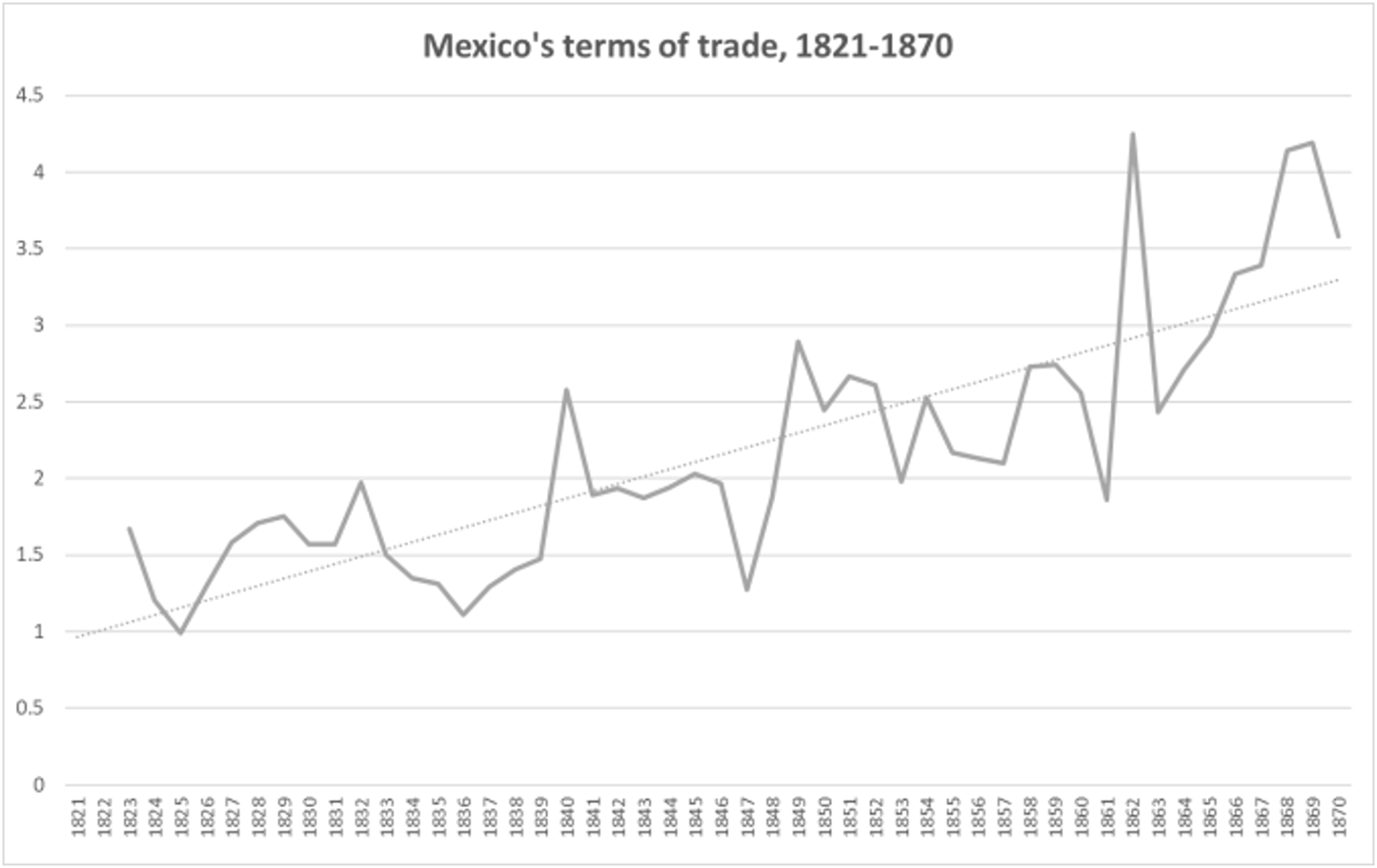
Among the indicators listed are the terms of trade, which represent the price of exports divided by the price of imports, and whose evolution is illustrated in Figure 2. This figure shows that the terms of trade within these years were ascending, even though there were some years of decline in this indicator. The main reason was the decline in import prices, that is, the price of the mix of manufactured goods that Mexico bought from abroad. If we make a price index with it, it goes from a value of 60 to one of 27, meaning a 33 points decline. An important part of this decline was, as mentioned, due to the fall in transportation costs brought about by technological improvements in this realm.Footnote 29 In the meantime, silver prices remained almost stable. In index numbers, the price of silver went from 100 to 103 between 1821 and 1870, with a maximum number of 106.Footnote 30 So, the main reason of the positive terms of trade of Mexico was the continuous fall in import prices.
Mexico’s terms of trade, 1821–1870.

Regarding this trend, our figures differ significantly from those used in one article on the subject.Footnote 31 The authors of that paper, following in this aspect data from Salvucci and Prados de la Escosura, say that terms of trade grew until 1830 but were stable thereafter (slightly upward after midcentury).Footnote 32 As shown in the figure above, we disagree with that perception. The authors go ahead to argue that in that supposed stability of the terms of trade lies Mexican “exceptionalism” with respect to other Latin American countries and to other countries in the world, which held ascendant terms of trade, and it was precisely that feature which made de-industrialization forces weaker in the case of Mexico. Obviously, we do not agree with that either.Footnote 33 In short, we do not consider that terms of trade conditioned the direction of Mexican economic development. We think that terms of trade are a signal from the market that may determine the course of an economy that follows it. However, in the case of Mexico, there were also a lot of indications sent from the political realm, which may have changed that course: tariffs, alcabalas (internal duties payable to the state governments any time that (almost all) goods crossed their territory), the named convenciones, licenses and other privileges granted to some producers, and so on. This kind of factors also played a role in the way capital was invested, in prices, in the allocation of resources, and the like, so they also influenced the course of Mexican economic growth. Thus, we think that all these elements created a context in which de-industrialization was not a probability, and therefore there was no “exceptionalism” in that.
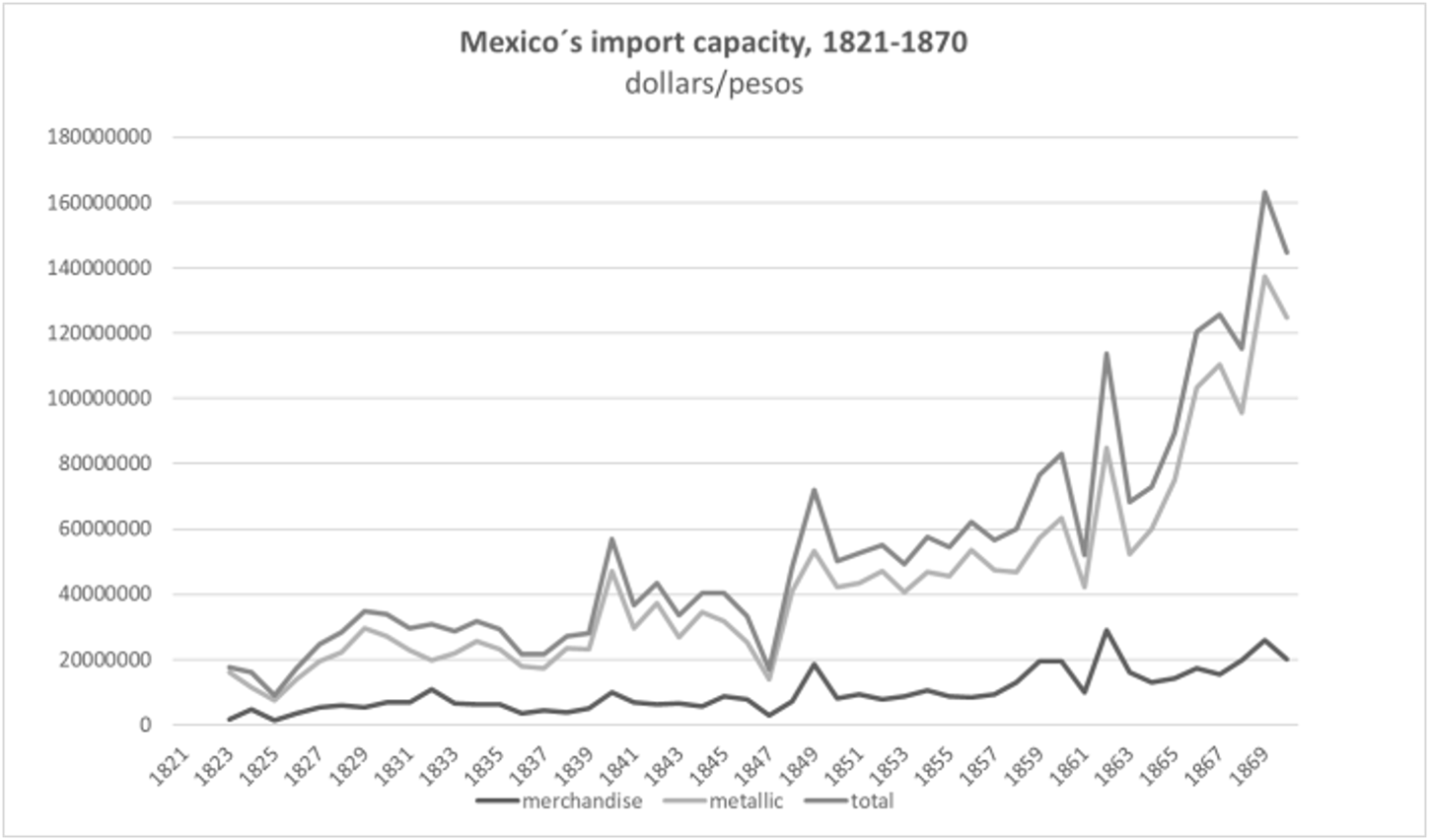
Another indicator is the import capacity provided by exports, that is to say, the mix of exports actually sold by the country with respect to the price index of the imports purchased. The evolution of this indicator is illustrated in Figure 3.
Mexico’s import capacity 1821–1870.

The rate of growth of this indicator was 1.6% in average per year, while in the following 50 years (after 1870) it amounted to 3.9%, which provides an idea of the proportions at stake.Footnote 34 As may be seen, Mexico’s import capacity grew thanks to metallic exports, particularly, as commodity exports were small and grew very slowly.Footnote 35 Also, in that regard, it is apparent that things went better after the war with the USA and the loss of a significant portion of Mexican territory, a phenomenon that deserves further study.
Something similar, in every respect, happened to external trade in constant terms, as may be seen in Figure 4.
Constant values of Mexico’s foreign trade, 1821–1870.

It may be observed that, in real terms, all aspects of Mexico’s foreign trade grew relatively slowly. In average, imports rose 1.3% yearly;by contrast, commodity exports grew at the much slower pace of 0.8% in average per annum, while metallic exports grew at 2.7% per year, a very similar pace than that of total exports (2.3 percent per year).
Finally, we have estimated per capita values, an appraisal made possible by a recent article that calculated Mexico’s population during this period.Footnote 36 The indicator is illustrated in Figure 5.
Per capita values of Mexico’s foreign trade, 1821–1870.

What we see here is that the per capita values of Mexico’s foreign trade are rather low. Imports averaged 2.4 dollars during the period, and commodity exports just 0.5, while metallic exports averaged 2.5 dollars per capita. This contrasts greatly not only with the numbers achieved by the USA and other advanced countries but also with Latin American lands, as can be seen in the figures provided by Bulmer-Thomas.Footnote 37
4. Some features of the Mexican economy and society derived from the trade figures
The availability of complete series of Mexico’s foreign trade tells a lot about the economy and society prevailing at that epoch, and also about some of the traits that were characteristic of those years, as contraband and the leasing of the mints, to name just a few. We also suggest the kind of performance that must have characterized this economy according with foreign trade figures. With these subjects deal the section that follows.
As we said, even though all the partners were used to build trade series, the four more salient (GB, USA, FR, DE) have been studied here in detail, in order to be able to know the composition of foreign commerce and its evolution over time. Similarly, custom houses data were used to analyze the internal distribution of trade, so that we can assess where the imports were entering the country and by which custom houses the exports exited.
Let us talk first about imports. All the goods used at the time and that the Mexican economy was unable to produce in their entirety, whether for personal consumption or for productive activity, had to be imported. This happened with the most widely utilized industrial material, which was the roughest cotton stuff (“manta”), employed to elaborate many of the clothing that wore the poor people. It also was the case with many of the groceries, wines, and garments accessories, consumed by the upper income group. They also imported canned products, olive oil, books and stationary, cutlery, crystal and porcelain articles, drugs and perfumes, liqueurs and beer, cloths and fine accessories of different materials (linen, silk, wool, cotton, etc.), and some other. On average, the consumption goods provided by the four main partners represented 56% of total imports, in spite of the fact that most groceries came from Spain, not from the four partners named, and many commodities stem from other lands (like many agricultural products originating from various countries of Latin America and textile items coming from Asia). There were also production goods, which grew much faster than total exports (17% vs 2% in average), but were always modest, and, as we have mentioned, did not represent a process of modernization, much less industrialization, of the Mexican economy. In average, the mercury imported equaled 61% of the value of Mexico’s productive items. The other articles imported with large relevance in the list of production goods were raw cotton, cotton thread, and raw silk. The first two were inputs for the most protected activity, the cotton textile industry. Moreover, the first one was an agricultural good, meaning that the country was not being able to produce it completely. The last one was also a non-industrial product, in this occasion pointing to the interesting fact that apparently a silk industry was developing in Mexico. Production good importations augmented in the final years of this period, mainly because they were necessary to furnish the Mexican Railroad, which was going to open in January, 1873.
It is time to analyze what these figures mean in terms of the characteristics of the Mexican economy and society of the time. In the first place, they reflect a deeply unequal society. Additionally, many poor people were using the imported manta because the domestic production was not enough to elaborate their clothes. On the other hand, a small elite was consuming the imported luxury goods, which were purchased in smaller quantities, suggesting that only a few could afford them. In the second place, these figures indicate that all the protection given to the rough cotton industry and the importation of some of the main inputs for it were not enough to make the import substitution sufficient to supply the domestic market and to avoid the importation of manta.
There were other industrial activities, like those that produced articles of glass, paper, etc. These activities, generally carried out by provincial entrepreneurs, did not receive special protection from the government, or from the Banco de Avío, and sometimes had to compete with similar goods brought from abroad. They did not disappear throughout the period, but they did not grow considerably either, and certainly they did not expand to make a process of industrialization in the Mexican society.
Regarding exports, we have already told that commodity sales were small and grew rather slowly. Merchandise exports averaged just 4 million dollars, whereas metal exports averaged 21 million dollars within these years. The data are final, in the sense that they consider the residual and transportation costs. The most important commodity exports were cochineal, and together with other dyes (particularly dye sticks, but also indigo and fustic), averaged 900 thousand dollars of the four million that averaged commodity exports in general. Next to dyes were cattle and its sub-products (like hides and skins), averaging 340 thousand dollars within these years, and next, vanilla beans, averaging 82 thousand dollars. By the way, sugar, one of the few items that were sold also in the internal market, represented less than 10 thousand dollars in average. Some products only gained in importance at the end of this period and, of course, in the next one. This was the case of sisal, which just started to be exported in 1843, and only acquired some relevance at the end of the 1850s. This happened also with fine woods, like mahogany, which gained importance only in 1858. Additionally, cotton was sold to GB, particularly smuggled from Texas during the USA civil war and exported through Matamoros, as this was the only port not affected by the blockade by the Union forces. Because of this motive, many commodity exports were attributed in the partners’ sources to Mexico, even though they had been produced in the Confederate states, and it is for this reason that the Mexican figures are inflated for these years. In order to “normalize” as much as possible these figures, we have employed a statistical procedure, averaging among them the previous and the later years, and using the resulting values for 1862–1865. So, the numbers for these years became “normalized” and shorter than the figures showed in the official sources. As for other commodity exports, there were some sales of lesser relevance, because they were more sporadic or very small, like jalapa root and zarzaparrilla, cocoa, copper bars and ore, and the like.
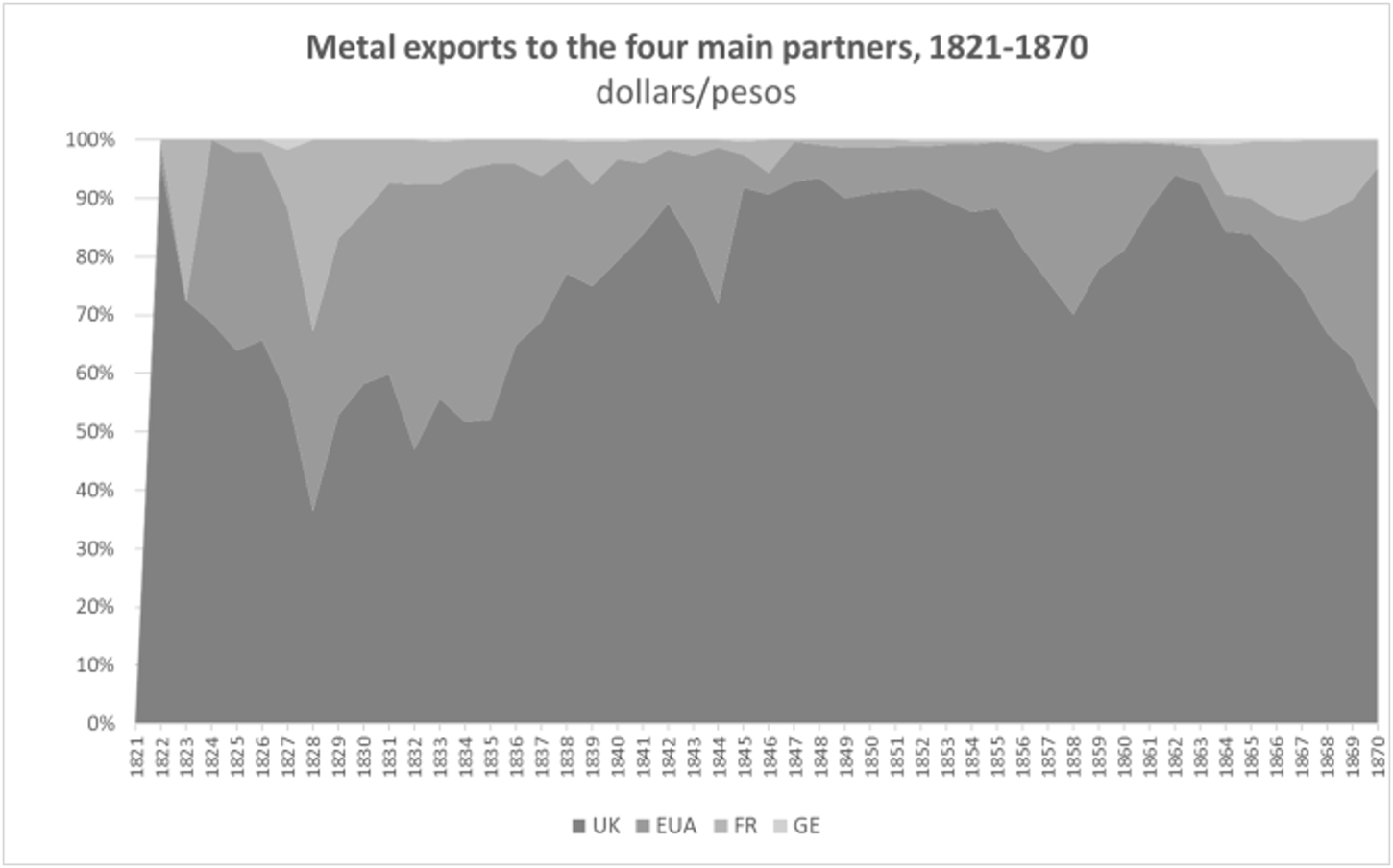
As we said, metal exports, particularly silver, were much more abundant but also concentrated in a few countries. In fact, most of the metal went to GB and, from there, already as British, to many other lands. Figure 6 illustrates precious metal exports to the main partners. It is noteworthy that most of the metals exported went to the GB. What was left was a rather small value, sent to the remaining countries, including the rather exceptional transfers to Spain and Cuba, as well as those to Asia, mainly before 1850.
Metal exports to the four main partners, 1821–1870.

What the exports referred translate is interesting. On the one hand, small commodity sales abroad talk about a little economy, one that was heavily regionalized, mainly due to the high transportation costs. Such economy destined most of its production to the foreign consumer countries, as the internal market was weak and fragmented and also because most of the items produced were not of the taste and purchase capacity of the local consumers. Also, it should be noted that practically all the commodities were exported in a raw state, which gave little aggregate value to them, in part since the more advanced countries preferred to import them like that, and in part because the national economy did not develop an industrial phase that would make them more durable and increase their aggregate value. It was not impossible to create and industrial stage for those commodities. For instance, dyes could be sold in distillates, animal skins could be tanned, vanilla could be sold in essence instead of beans, and the like. Moreover, many of these items were products of mere recollection during this epoch, instead of being cultivated, as happened with most of the dye sticks, the fine woods, and others like them. On the other hand, many exports were of a traditional nature, like jalapa root and zarzaparrilla, or would lower in relevance or even disappear as soon as synthetic substitutes were invented, as happened with dyes. Only a few items had authentic comparative advantage, sometimes regional, like cattle, henequen, vanilla, or precious metals. Some items that enjoyed it but now were exported in a rather rough state, like copper or lead, had to undergo a process of reorganization and technical advance of production (not to speak of the transport revolution that took place) before they could be successful, which happened in the following period.
On the other hand, imports were heavily concentrated in the custom house of Veracruz (an average of 60% in the years that can be calculated), largely because the main markets were located in central Mexico: the named port, the city of Mexico, Puebla, Guanajuato, Morelos, Querétaro. In a far second place was the custom house of Tampico, with 14% in average, as other relevant markets were situated in the north. In any event, it is noteworthy that only two custom houses were responsible for about 75% of the estimated value of imports.
Interestingly, imports were far more distributed outside. According to the available statistics, more than 20 countries provided some products to Mexico. Outside the main partners, which sold (including exports and reexports) 69% of the total value of Mexican imports, the land introduced also articles from different places: nankeens, tea, spices, lacquered furniture, and silk from China, assorted items from other countries in Asia, cocoa from Guayaquil, groceries and some types of wines from Spain.Footnote 38
Regarding exports, they were more disperse inside but more concentrated outside. What we observe in this respect is that there were two types of custom houses: one kind was concentration sites, that is to say, towns where many products were brought, in part because they were produced in places where there was no custom house, and in part because those were locations of higher foreign-trade relevance, like was the case of the cochineal produced in Oaxaca and exported from Veracruz; the other kind was that related to the sites of production of particular items, as mother of pearl exiting from Mazatlán to the foreign market that consumed it. Besides, the quantity of production undertaken on each place depended to a large extent on the particular demand of the country of consumption, and not of the internal market (except for some staples, as sugar). With reference to the outside world, as we just said, exports were clearly much more concentrated in a few commercial partners. About 97% of merchandise exports and 95% of metal remissions were destined to the four main trade associates, while only the small remainder was sent to the rest of the world.Footnote 39
Another important trait of this epoch was smuggling. It is true that it existed before and would exist later, and also that it happened to some extent in every country. The problem is that here it was so conspicuous that it affected severely consumers, finances, and the national industry, and it made impossible to have an accurate account of the foreign trade with domestic sources. The resort to foreign sources allows to solve this problem in a large part. A limitation to it is that, as already mentioned, until 1892 there was no obligation by the USA authorities to make note of the exchange that was undertaken by land, which means that this share of the business was not necessarily registered. There are some caveats in that regard. One is that we have seen statistics of this kind of traffic, which suggests it was recorded at times.Footnote 40 Another one is that, for technological as well as practical reasons, most of the foreign commerce in this epoch was undertaken by sea. This implies that even in Matamoros, which was a terrestrial customs house but also had access to the sea, most trade was conducted by maritime means. This does not mean, of course, that no transactions were carried out, in this and other custom houses, by land.
There were several motives for smuggling. The most frequently mentioned was that tariffs were too high and trade regulations too onerous. That is true. As the government had little sources of income and claimed that it was protecting industry, high duties were charged upon imports. As for exports, as we have seen before, only a few products were burdened with tariffs, and always temporarily, outside from precious metals, which bared a high load. Also, regulations were strict, and violators faced severe punishments. Another motive was distance. There were places located far away from the center of the country, even more so due to the bad roads, and, as there was shortage of many things, they needed to buy them in the nearby area, which often translated into smuggling. The situation got even worse after the loss of territory and the consequent change in the placement of the border, as the inhabitants were used to make transactions with who once were perhaps their neighbors but were now part of another country.
High duties were usual in part because, as we said many times, they were the most important source of income for the government. In the mid-1820s, it requested a couple of loans from Great Britain (the so-called “English debt”), but it fell soon in default. Thus, the administration had to resort to internal money lenders, from which it was dependent up to the 1850s. Besides, several circumstances forced the regime to lease the mints since the years of the wars of Independence, a practice that continued being common and even broader throughout these years. On the other hand, resources in the country apparently were not enough to rehabilitate the mining industry, so a few foreign enterprises came in the 1820s for that purpose, although they failed and abandoned Mexico, mostly in the 1840s. Interestingly, some of the money lenders and some of the foreign investors in mining were also leasers of mints.Footnote 41
By the way, having the mints at disposal had some significant advantages, many of which were related to the fact that it gave the leasers access to precious metals in the form of money. Not only could they buy said metals but could invest them inside or abroad in different endeavors or put them in a bank. As can be imagined, by all these means they obtained leverage facing the government. In fact, the latter gave money lenders positions in the ministry and licenses to import raw cotton, at times when it was otherwise banned.
Besides these resources, the administration also got 12.5 million dollars of the indemnification that the United States payed Mexico between 1847 and 1852 for the territory the latter lost in the war against that country. However, that money did not help alleviating the precarious situation of the government, as most of it was used to pay part of the English debt. Under these conditions, starting in 1847 it imposed a new duty of 3% upon all paste metals,Footnote 42 a tax that of course was lacking in terms of its solvency, so the government continued suffering a poor condition until it was able to reorganize entirely its finances and its position within the country.
Under these circumstances, the economic growth of Mexico must have been meager, even though there were some sites that enjoyed some temporal prosperity, as Morelos, Monterrey, the Yucatecan peninsula, etc. As was to be expected, there are no material signs of development during this period: no banks were opened (save from the Bank of London founded from the English in 1864), the ports were not improved, there were no more and better roads, the population did not grow, etc. The government benefited from the extant system but renounced to its promoting role and somehow accepted its weakness facing private interest groups. The latter profited of their position in economic, political, and social terms, so that they were not interested either in modifying the system. The great sacrificed was Mexico, but that would not change within this period.
5. Recapitulation and some conclusive remarks
In 1821, Mexico achieved its independence, and the dominant position shifted from Spain to Great Britain, whose rule was informal and based on trade, loans, investment, and a diplomatic presence. The period that followed was rather tricky for the newly born country, characterized by internal instability and external threats, which included the loss of half the territory and a foreign government. Roads were bad and, consequently, inland transportation costs very high. The internal market was fragmented and there was a pronounced heterogeneity in rules and very hard conditions to invest, until a liberal Constitution, enacted in 1857, tried to make conditions better. However, the liberals consolidated in power just in 1867, which means that many aspects of it were not immediately enforced.
In this paper, we have estimated and presented complete series of foreign trade within the period 1821–1870, using foreign supplies of information after confirming that Mexican sources are rather incomplete and inaccurate. Imports were high at the beginning but soon contained in their increment. Commodity exports were relatively small and grew slowly, while metal exports, mostly sold in the form of money, were much larger and grew faster during these years. The latter served to pay for imports and, within a bimetallic era, as money to pay debts, to invest or make deposits abroad, etc. Within this situation, we observe that performance was better of starting in the 1850s, and even if the loss of territory and the arrival of the liberals may have played a role, it is hard to divine the exact causes of that. Additionally, after providing import and export indices, we have calculated some of the main indicators conventionally made with those figures: terms of trade, constant values, and the like.
We have also studied the government’s commercial policy, which was very protectionist. It said that the reason for that was the protection of the domestic industry. It is true that there was strong protection and even promotion of some activities, and there was an important process of import substitution in the branch of rough cotton stuff in the textile industry. In spite of this statement, it is a fact that tariffs were also the main support of the administration. In backing of the former intention, prohibitions increased with the tariff law of 1837, probably compensated with higher duties to other products. However, it is apparent that not only the domestic industry was protected, as also the most important input of the textile industry was banned, despite being an agricultural and not an industrial item.
To alleviate its situation, the government requested some loans from England in the 1820s, but as it spent the money (in current spending) and defaulted on their payment, had to resort to internal lenders, continue to lease the mints, and create new taxes. All this gave power to some interest groups, which enjoyed some privileges and strengthened their position facing an always weak central government.
As the second aim of this paper, with the series built we have studied the traits of the Mexican economy at the time. The figures show that there was an intense income concentration, as a good portion of imports was dedicated to bring some luxury consumption items, while another portion was invested in introducing into the country the rough cotton stuff that the poor people employed to elaborate the cheap pieces of “manta” that they used to wear. With respect to exports, they reflect an economy that was small and produced little, with the exception of precious metals, whose coinage was entirely opened to the public. There were some articles that enjoyed comparative advantage, like cochineal and cattle, but most of the exports were of “exotic” products that were consumed as a luxury in the lands that imported them, as happened with mother of pearl, zarzaparrilla, and the like.
These features contributed to foster a situation in which the government was weak and renounce its promoting role, but benefited of a system that perpetuated the meager growth and the backwardness of the economy, while at the same time private interest groups, domestic as well as foreign, thrived. This state would only start to change when the government made credible commitments, respected property rights, and promoted growth, instead of being in practice allied with private individuals that were more interested in their own enrichment than in the enhancement of the country. However, that would happen particularly in the next period.
Acknowledgements
I want to acknowledge Erika Pani and Pablo Yankelevich, former directors of the Centro de Estudios Históricos, for all the support they gave to this investigation. I also want to thank Richard Salvucci and Antonio Tena-Junguito for their contribution with different aspects of the research. The usual disclaimers apply.
Sources and official publications
- Archives
- AMAEF
Archives du Ministère des Affaires Étrangères de France, Archives Diplomatiques, Paris.
- CCC
Commercial and consular correspondence:
Campeche, P15401; P15402
Cantón, s.n.
La Habana, P13684; P13685; P13686; P13688
Mazatlán, P15550
México, Vols. 1, 2, P15552; Vol. 6, P15556, Vol. 7, P15557
Monterey y Los Ángeles, 2 vols., P15558
Tampico, 3 vols., vol. 1 P16117, vol. 2 P16118, vol. 3 P16119 Veracruz, 5 vols., vol. 1 P16314,
vol. 1(sic) P16315, vol. 3 P11418, vol. 4 P16316, vol. 5 P16317
- ANF
Archives Nacionales de France, Paris.
- AHL
Archiv der Hansestadt Lübeck, Lübeck.
- CB, CB
Commerz-Bibliothek, Consulats-Berichte, Hamburg