Introduction
Innovation at an advanced age is a relatively unexplored phenomenon. While the mass media's attention is drawn by adventurous older adults, such as those who climb Mount Everest when aged in the sixties or run a marathon in their seventies, most academic research into older adults' activity patterns has tended to ignore such stories and to focus on continuity and decline. There are several explanations for the neglect of innovation in old age, one being that most evidence suggests that innovation is rather rare. Although older adults have considerable discretionary time in retirement and few parental or other caring responsibilities, they tend not to participate in more activities than before retirement (Janke, Davey and Kleiber Reference Janke, Davey and Kleiber2006; Long Reference Long1987; Nimrod Reference Nimrod2007a), but rather continue to participate in the same activities as they enjoyed before retirement (Iso-Ahola, Jackson and Dunn Reference Iso-Ahola, Jackson and Dunn1994; Levinson Reference Levinson1986; Parker Reference Parker1982; Parnes et al. Reference Parnes, Crowley, Haurin, Less, Morgan, Mott and Nestel1985), or take up again activities in which they were interested or proficient in the past (Atchley Reference Atchley and Kelly1993; Kelly Reference Kelly1987). At most, the consensus holds, they increase their participation in the same activities (Janke, Davey and Kleiber Reference Janke, Davey and Kleiber2006; Robinson and Godbey Reference Robinson and Godbey1997; Rosenkoetter, Garris and Engdahl Reference Rosenkoetter, Garris and Engdahl2001; Verbrugge, Gruber-Baldini and Fozard Reference Verbrugge, Gruber-Baldini and Fozard1996).
Offering an explanation for elderly persons' inclination towards constancy, Atchley (Reference Atchley1989, Reference Atchley and Kelly1993, Reference Atchley1999) proposed ‘continuity theory’, which posits that continuity is a primary adaptive strategy for dealing with the changes associated with normal ageing. It argues that individuals wish for stability in familiar and customary roles, even though their advancing age may bring obstacles that reduce the availability of these roles. Individuals tend to maintain the psychological and social patterns adopted earlier in life (e.g. attitudes, opinions, personality, preferences and behaviour) by developing stable activity patterns that help them preserve continuity. Continuity may also serve as a coping strategy when facing negative events in later life (cf. Kleiber, Hutchinson and Williams Reference Kleiber, Hutchinson and Williams2002). Familiar leisure activities that are personally expressive, as well as continuity in significant past relationships, have great importance in restoring meaning and direction after negative life events. Such activities are also likely to restore perceptions of competence, control and freedom (Hutchinson et al. Reference Hutchinson, Loy, Kleiber and Dattilo2003), qualities that are considered to moderate the impact of stress on one's wellbeing (Coleman and Iso-Ahola Reference Coleman and Iso-Ahola1993).
Another reason for the neglect of innovations in activities in old age is that most evidence on change in activities in later life suggests reduced levels of participation and the substitution of less challenging alternatives. Indeed the main characteristics of leisure in later years can be summarised as: (1) declining participation with greater age and declining health (Armstrong and Morgan Reference Armstrong and Morgan1998; Bennett Reference Bennett1998; Iso-Ahola, Jackson and Dunn Reference Iso-Ahola, Jackson and Dunn1994; Janke, Davey and Kleiber Reference Janke, Davey and Kleiber2006; Katz et al. Reference Katz, Hass, Weitz, Adoni, Gurevitch, Schiff and Goldberg-Anabi2000; Lefrancois, Leclerc and Poulin Reference Lefrancois, Leclerc and Poulin1998; Strain et al. Reference Strain, Grabusic, Searle and Dunn2002; Verbrugge, Gruber-Baldini and Fozard Reference Verbrugge, Gruber-Baldini and Fozard1996); (2) a transition from physical activities to activities that demand less physical effort; and the complement, (3) a transition from outdoor activities to indoor activities (Gordon Reference Gordon1980; Gordon, Gaitz and Scott Reference Gordon, Gaitz, Scott, Binstock and Shanas1976; Lefrancois, Leclerc and Poulin Reference Lefrancois, Leclerc and Poulin1998; Rapoport and Rapoport Reference Rapoport and Rapoport1975; Strain et al. Reference Strain, Grabusic, Searle and Dunn2002; Vail and Berman-Ashcenazi Reference Vail and Berman-Ashcenazi1976). These changes do not apply in all contexts to all subgroups. Their occurrence and intensity are affected by various mediating socio-demographic and health characteristics such as age, gender, marital status, education, employment status, mental health, self-rated health and functional ability (cf. Horgas, Wilms and Baltes Reference Horgas, Wilms and Baltes1998; Janke, Davey and Kleiber Reference Janke, Davey and Kleiber2006; Stanley and Freysinger Reference Stanley and Freysinger1995; Strain et al. Reference Strain, Grabusic, Searle and Dunn2002).
The abandonment of activities in the presence of restrictions and limitations on participation, particularly when they are highly valued, is generally experienced with a sense of loss, but a person may cope with such losses through: (1) the reinterpretation of activities – enhancing the importance of preserved activities and reducing the importance of those that have ceased; and (2) substitution – finding comparable substitutes for desired activities (Rubinstein, Kilbride and Nagy Reference Rubinstein, Kilbride and Nagy1992). The ‘selective optimisation with compensation’ model (SOC) was proposed by Baltes and colleagues as a prerequisite for ‘successful ageing’ (Baltes and Baltes Reference Baltes, Baltes, Baltes and Baltes1990; Baltes and Carstensen Reference Baltes and Carstensen1996; Freund and Baltes Reference Freund and Baltes2002). The SOC model essentially argues that it is adaptive and healthy to respond to the limiting factors that accompany ageing. This adaptation can be done by being selective about the activities chosen, abandoning activities that are less meaningful, and compensating for loss of meaningful activities to optimise the more restricted alternatives. Recently, McGuire and Norman (Reference McGuire, Norman and Jackson2005) suggested that constraints to leisure can be positive factors in successful ageing since they force individuals to initiate the SOC process required for successful ageing.
With regard to adding new activities in old age, it is known that starting a new activity is uncommon, that it occurs more often among women, and that it usually occurs in the following domains: exercise, indoor activities and hobbies (Iso-Ahola, Jackson and Dunn Reference Iso-Ahola, Jackson and Dunn1994). Among men one can add the domestic domain (e.g. cooking, shopping, cleaning), which in many cases was previously dominated by their wives (Gordon, Gaitz and Scott Reference Gordon, Gaitz, Scott, Binstock and Shanas1976; Long Reference Long1987; Parnes et al. Reference Parnes, Crowley, Haurin, Less, Morgan, Mott and Nestel1985). Thompson (Reference Thompson1992) suggested that innovation is more likely after losing a spouse than after retirement, as the individual seeks replacement social involvement to overcome loneliness. Lopata's (Reference Lopata and Kelly1993) investigations of widows also suggested a tendency to ‘blossom’ through new activities subsequent to a husband's death (see also Sharpe and Mannell Reference Sharpe and Mannell1996), but very little published research has studied these patterns.
With regard to the benefits of starting a new activity, Thompson (Reference Thompson1992) reported that those who develop new activities say that these activities bring special enjoyment and happiness to their lives. From their interviews with middle-aged women, Parry and Shaw (Reference Parry and Shaw1999) found that although some leisure activities provided women with a sense of familiarity, security and continuity, other practices allowed them to develop new interests, to focus on themselves, and to improve their self-regard. From an Israeli study, the author found that recent retirees were more likely to reduce than increase their activity despite having more free time (Nimrod Reference Nimrod2007a), and that both an increased number of activities and a raised frequency of participation (‘expanding’ and ‘concentrating’) significantly was associated with higher life satisfaction. A recent study by the author and a colleague focused on the issue of innovation (Nimrod and Kleiber Reference Nimrod and Kleiber2007). This exploratory study, which used a qualitative approach with a ‘high probability’ sample of adult learners, led to the formulation of ‘innovation theory’. This holds that:
1. Innovation may result from various triggers, some internal, and others external, instrumental or even imposed. In most cases, the motivation for innovation is intrinsic or a combination of intrinsic and extrinsic.
2. While in some cases innovation represents an opportunity for renewal, refreshment and growth, that is, has elements of continuity from earlier interests and capacities (self-preservation innovation), in others it represents an opportunity for the reinvention of self (self-reinvention innovation).
3. There is a consistency in the type of innovation that attracts an individual. While some seek different ways to reinvent themselves, others find new ways to preserve their existing sense of self.
4. Innovation has a positive impact on elders' wellbeing.
The author's previous research has suggested that innovation's impact on wellbeing is not direct, and that the most significant role of innovation is in creating an opportunity for broadening and deepening the sense of meaning in life, a sense that leads to greater wellbeing and satisfaction with life. This suggestion, as well as the aforementioned theoretical principles, requires further research with larger and more diverse samples.
The present study
The present study aimed to explore one aspect of innovation theory, namely the posited association with wellbeing. In other words, the study's goal was to explore whether ‘where innovation is possible, post-retirement wellbeing may be enhanced’ (Nimrod and Kleiber Reference Nimrod and Kleiber2007: 17). It has focused on recently retired individuals because the period after retirement is potentially a phase of relatively high innovation. Most employees approaching retirement perceive it as an opportunity for new beginnings (Gee and Baillie Reference Gee and Baillie1999), and the increased free time after retirement creates an opening for new activities. The study was designed to answer the following research questions:
1. Are there differences between innovators (people who take up at least one brand new activity after retiring from work) and non-innovators in their socio-demographic characteristics, self-rated health, work status just before retirement, and personal histories?
2. What background characteristics are associated with innovation?
3. Are there differences in life satisfaction between innovators and non-innovators, and if so, in which components of life satisfaction?
4. If differences in life satisfaction between the groups are found, are they associated with a different inclination towards innovation or different background characteristics?
Data and methods
Data collection
The data were drawn from a study of leisure behaviour among recently retired Israelis that surveyed 383 independent men and women in Israel aged 50 or more years who had retired during the past five years (Nimrod Reference Nimrod2007a, Reference Nimrod2007b). The face-to-face structured interviews were conducted between May and August 2002 in the respondents' homes. Closed and open-ended questions were asked about: (1) brand-new activities (i.e. never engaged in prior to retirement, not even when very young), (2) life satisfaction, and (3) background characteristics.
The sample
The sampling criteria for the sample were: ethnicity (Jewish Israelis), age (50 or more years) and retired less than five years. Respondents who had officially retired but who were working in a full-time job were excluded, whether in the same job as before retirement or a new job. The screening rationale was based on the assumption that as long as individuals worked full time, their leisure behaviour would not significantly change. Retirees who were still working occasionally or part time were included in the sample, and their work status noted as a background characteristic. The respondents were selected using computer software that searched Israel's complete telephone directory, which includes names, addresses and phone numbers. This enabled sampling by geographical area. All areas of Israel and all sizes of cities and settlements were represented, consistent with data from Israel's Central Bureau of Statistics (2000). About 8,000 people were contacted for interviews, and while only around one-in-20 contacts matched the sampling criteria, 98 per cent of those agreed to participate. Out of the 383 interviewees, five did not answer the question regarding post-retirement innovation. Therefore, the total sample size in this investigation was 378.
Measures
Post-retirement innovation
The respondents were asked to report whether or not they had engaged in new activities after retirement. If they had, they were asked to describe the activity or activities (there could be more than one).
Life satisfaction
The full version of the Life Satisfaction Index (LSI) test developed by Neugarten, Havighurst and Tobin (Reference Neugarten, Havighurst and Tobin1961) was used to score each respondent's life satisfaction. Designed specifically for older adults living in the community, this measure has 20 item statements that concern dimensions of subjective life satisfaction at an advanced age, including enjoyment of daily activities, perceiving life as meaningful, sense of success in achieving principal life goals, positive self-image, optimism, and general happiness. The questions included items such as: ‘I am just as happy as when I was younger’, ‘I've gotten pretty much of what I expected out of life', and ‘Most of the things I do are boring or monotonous’. Each question had three possible answers: ‘agree’, ‘disagree’ and ‘don't know/not sure'. LSI scores are computed by giving one point for every ‘agree’ answer to positive statements and a ‘disagree’ answer to negative statements. Other answers did not score any points, so the maximum score is 20 points. This test was translated into Hebrew and validated by Shmotkin (Reference Shmotkin1991). Gerontologists have rated this tool as sensitive, accurate and quite successful in exploring the differences between social groups (Andrews and Inglehart Reference Andrews and Inglehart1979; Herzog and Rodgers Reference Herzog and Rodgers1981). It has been argued that a bias might occur from the required high level of personal exposure, the respondents' fears that their answers might be released into the public domain, and a tendency for responses to be influenced by social desirability (Shmotkin Reference Shmotkin and Lomerantz1998), but it has been shown that controlling individual differences in the realm of social desirability does not enhance the validity of the measures (Diener et al. Reference Diener, Sandvik, Pavot and Gallagher1991; Kozma and Stones Reference Kozma and Stones1987; McCrae Reference McCrae1986).
The background items
The last section of the interview included demographic and socio-demographic questions. The variables examined were: age, gender, marital status, number of children and whether any of them still lived at home, education, household income, religious orientation (secular, traditional, religious and ultra-orthodox), origin country (i.e. place of birth of the respondent and his/her father), residential area (i.e. by telephone area codes), and the size of the city or settlement of residence. Self-rated health was measured with a five-category scale that ranged from ‘1’ (very bad) to ‘5’ (very good). Other questions examined work status just before retirement (i.e. full- or part-time, type of occupation), personal history (i.e. date of immigration to Israel, personal connection to the Holocaust and occurrences of extreme difficulties in the past two years such as spouse's or other family member's illness, death or divorce), present work status (of the respondents and their spouses), retirement duration, and choice in retirement pattern (i.e. whether the respondent was forced to retire or did so by choice).
Data analysis
To identify significant differences between innovators (i.e. retirees who added at least one brand-new activity after retiring from work) and non-innovators in their background characteristics, cross-tabulations and chi-squared tests were employed. In order to examine which of the differentiating characteristics predicted innovation, they were used as independent variables in a stepwise regression with the number of new activities as the dependent variable. For that purpose, variables that were not sequential ordinal scales were transformed into dichotomies. Differences in life satisfaction mean scores between innovators and non-innovators were examined by t tests. In addition, cross-tabulations and chi-squared tests were used to explore differences in rates of agreement to each life satisfaction statement. Similar tests were conducted to explore differences in life satisfaction between the innovators who started exercising and those who started volunteering. At the final step, linear regression was used to explore the differences in life satisfaction between innovators and non-innovators. For that purpose, LSI scores were used as the dependent variable, and all differentiating background characteristics were used as the independent variables along with the number of new activities. Regressions were run for the sample as a whole and separately for the innovators and non-innovators. The decision level was 95 per cent for statistical tests, and only significant findings are presented in this article.
Findings
Sample characteristics
The ages of the 378 sampled retirees ranged from 50 to 85 years. Most (72%) were aged 60–69 years and the mean age was 64.3 years. Fifty-eight per cent were female, 78 per cent were married, 97.9 per cent had children, 49 per cent had at least some post-secondary education, and 40 per cent had a relatively high income (over 8,000 New Israel Shekels a month per household). Fifty-two per cent classified themselves as secular, 64 per cent perceived their health as good or very good, and nine per cent perceived their health as bad or dreadful.
Frequency and background characteristics of innovators and non-innovators
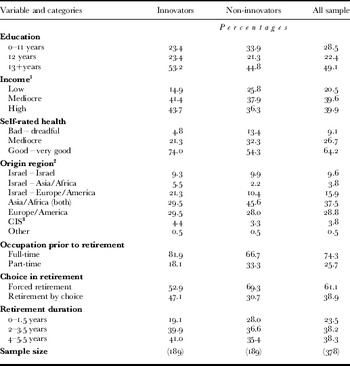
There was a high prevalence of innovation among the 378 respondents, for 50 per cent reported adding at least one brand-new activity (27% just one, 14% two, and 9% three or more). The most frequent new activities were exercising and volunteering, both of which were taken up by 30 per cent of the 189 innovators (five per cent of the innovators added both). Other frequently added activities were hobbies (16% of the innovators), going to lectures (11% of the innovators), classes and table games (each with 8% of the innovators). The chi-squared tests established that seven background characteristics were significantly associated (p<0.05) with adding at least one brand-new activity: education, income, self-rated health, origin country, occupation prior to retirement (full- or part-time), type of retirement, and retirement duration. The frequencies of each significant background characteristic in each segment are presented in Table 1. The innovators had a relatively high level of education, more income, better perceived health, and a high percentage was of Israeli-European or Israeli-American origin. In addition, they were characterised by high percentages of those who had worked full-time prior to retirement, had retired voluntarily, and had a relatively long duration of retirement. The non-innovators were characterised by relatively low education, less income, a high percentage of mediocre and bad self-rated health, and a high percentage of Asian or African origins. In adition, they over-represented those who had worked part-time prior to retirement, had been forced to retire, and with a short retirement duration.
Characteristics of the innovators and non-innovators

Notes: All tabulated differences between innovators and non-innovators are significant at p<0.05 (Pearson chi-squared tests). 1. Income (monthly income per household): Low=up to 4,000 New Israeli Shekels (NIS), Middle=4,001–8,000 NIS, High=more than 8,000 NIS. 2. Origin is classified by (a) respondent's place of birth; (b) respondent's father place of birth. 3. Commonwealth of Independent States (the former Soviet Union).
Background characteristics associated with innovation
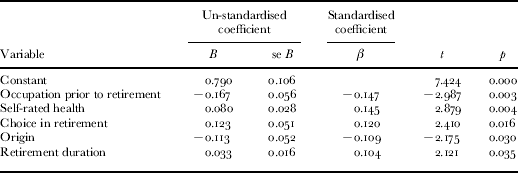
The results of the stepwise regression of the characteristics associated with a high level of innovation are presented in Table 2. The variance explained was relatively low (R 2=0.10, F=8.40), but the results indicate that the level of innovation was significantly associated with the respondents' work and retirement histories. People were more likely to report adding brand-new activities when they worked full-time before retiring, when they had been able to choose when to retire, and when the retirement duration was long. In addition, a strong positive association was found between the level of innovation and self-rated health. When people perceived their health as good or very good, they were more likely to report adding brand-new activities. Asian and African origins were associated with low innovation.
Association of respondents' background with the number of new activities added
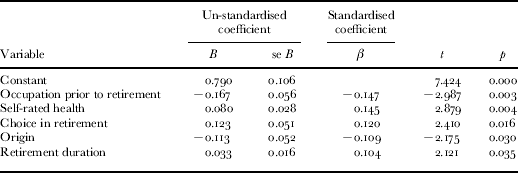
Note: R 2=0.10, F=8.40. se: standard error. Dummy codes. Income: 1=high (more than 8,000 NIS a month), 0=middle and low. Health: 1=good (very good+good), 0=not good (‘so and so’+bad+terrible). Occupation prior to retirement: 1=part time, 0=full time. Choice in retirement: 1=retirement by choice, 0=forced retirement. Origin: 1=Asia/Africa (both the participent and his/her parent), 0=other.
Differences in life satisfaction between innovators and non-innovators
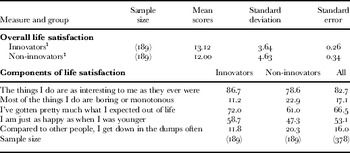
The LSI scores ranged from 0 to 20 for general life satisfaction with a mean of 12.6 (standard deviation=4.2). A t test indicated that the innovators had higher life satisfaction (F=8.85, p=0.003) (Table 3). The LSI includes different dimensions of subjective life satisfaction. Cross-tabulations and chi-squared tests revealed significant differences in three dimensions: enjoyment of daily activities, sense of success in achieving principal life goals, and general happiness. Innovators were more likely than non-innovators to agree that the things they did were as interesting as they ever were, and to disagree that the things they did were boring or monotonous. They were also more likely to agree that they ‘had got pretty much what they expected out of life’ and ‘were as happy as they had been when they were young’, and to disagree that ‘they get depressed too often’ (Table 3). Additional t tests examined the differences in life satisfaction between innovators who started exercising and those who started volunteering. No significant association was found between the type of the new activity and the innovators' life satisfaction. This may suggest that the type of the new activity has no importance, but may be a result of the few new participants in each activity.
Differences in life satisfaction between innovators and non-innovators

Notes: 1. Difference between innovators and non-innovators: F=8.85, p=0.003. For the components, all differences between innovators and non-innovators were significant at p<0.05 (chi-squared tests).
Explanations for differences in post-retirement life satisfaction
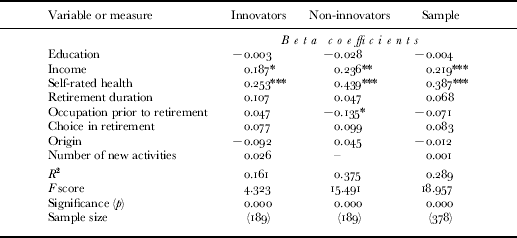
To address the fourth research question, the association between current life satisfaction and the background variables was analysed using linear regression. The results indicate that the higher life satisfaction of the innovators was associated with higher income and better-perceived health (Table 4). For non-innovators, the level of occupation prior to retirement was also associated with life satisfaction, and part-time occupations were associated with lower post-retirement life satisfaction. A central finding, which was consistent for all analyses, was that the number of new activities had no association with post-retirement life satisfaction. In addition, one should note that, while the background characteristics were significantly associated with the non-innovators' life satisfaction (R 2=0.38, F=15.49), their ability to explain innovators' life satisfaction was rather low (R 2=0.16, F=4.32).
Association of respondents' background and post-retirement innovation with life satisfaction scores: summary of linear regression analyses
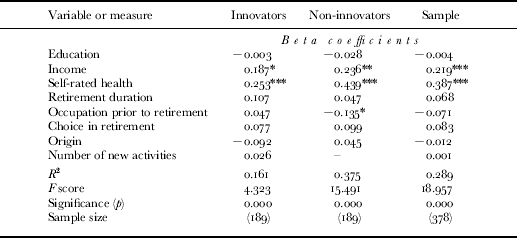
Note: Dummy codes: Income: 1=high (more than 8,000 NIS a month), 0=middle and low. Health: 1=good (very good+good), 0=not good (‘so and so’+bad+terrible). Occupation prior to retirement: 1=part-time, 0=full-time. Choice in retirement: 1=retirement by choice, 0=forced retirement. Origin: 1=Asia/Africa (both the participent and his/her parent), 0=other.
Significance levels: *** p<0.001, ** p<0.01, * p<0.05.
Discussion
Most previous studies of retirees have suggested that innovations in their activities are rather rare. The present study has shown, however, that one-half of a sample of older people in Israel innovated by adding brand-new activities to their leisure repertoire, which provides a rationale for giving the topic more attention in research on older adults' activity patterns. The high rate of innovation suggests that today's older adults are less conservative than stereotypes portray. On the other hand, since only Israeli retirees were investigated, one should be cautious and examine other societies before generalising for all developed countries. Israelis tend to be less involved in leisure activities prior to retirement than people in the United States (Nimrod, Janke and Kleiber Reference Nimrod, Janke and Kleiber2008), and thus might be more likely to change their activities when they retire. In other words, the tendency for innovation may be culture dependent, which also requires further research.
The results indicate that the there are significant differences in the characteristics of innovators and non-innovators, and that the most significant correlates of innovation are pre-retirement occupation and being able to choose the timing of retirement. People who worked full-time prior to retirement had a stronger inclination towards innovation than people who worked part-time. This could be explained by the greater increase of free time after retirement. It is possible that for this group, expanding their existing activities was insufficient, so they added new ones. The association between volitional retirement and innovation may be explained by the more positive attitudes of those who retired by choice. These retirees might perceive retirement as an opportunity to enjoy what leisure has to offer, and to fulfil old desires and dreams; it may even have been the reason why they retired. The fact that innovation was associated with longer retirement durations suggests that it is a process: that initially the retired tend to continue existing activities, and only if they find out that these are insufficiently satisfying do they try new activities.
The only background characteristics that were associated with innovation were self-rated health and area of origin. Good functioning and few physical limitations seem to be prerequisites for innovation. They provide the physical ability as well as the emotional capacity to experience new activities. The fact that African or Asian origin was associated with low innovation suggests a link between cultural background and the inclination to innovate. This strengthens the aforementioned need to examine the cultural background. Innovators seem to be considerably better off than non-innovators. They reported better health and had worked as long as they liked, often full-time (which again probably is a sign of good health), and they were disproportionately not of African or Asian origin. Their background increased the likelihood of starting new activities. One should bear in mind, however, that the explained variance was very low, and that variables not examined in the current study might explain innovation, such as personality, attitudes and constraints.
The significant differences in life satisfaction scores between innovators and non-innovators support Nimrod and Kleiber's (Reference Nimrod, Janke and Kleiber2007) argument that innovation is associated with enhanced wellbeing among older people. Moreover, the fact that one of the differentiating life satisfaction dimensions was the enjoyment of daily activities indicates that the difference is to some extent associated with activity patterns. Since the number of new activities was not associated with respondents' life satisfaction, however, it seems that innovation's impact on older people's wellbeing is indirect, which in turn suggests that the impact is not a matter of quantity. The relatively low explained variance for innovators' life satisfaction, as well as the fact that the number of new activities had no association with post-retirement life satisfaction, indicate the limitations of the study in explaining the association between innovation and wellbeing. Nimrod and Kleiber (Reference Nimrod and Kleiber2007: 17) suggested that, ‘people do not just enjoy the fact that they are doing something new’, and that while doing something new ‘may make them feel active, dynamic, vital, daring, and youthful, the most significant role of innovation seems to be in creating an opportunity for a more challenging and meaningful life’. This hypothesis could not be tested in the current study because the benefits resulting from each new activity were not established.
Without data on the general context of each activity, the study could not distinguish self-preserving from self-reinventing innovation, and so provides no evidence on the similarities or differences between different types of innovation and the ways in which they relate to wellbeing. Moreover, the lack of information about the frequency and duration of participation in new activities has limited examination of the association between quantitative measures of innovation and life satisfaction. It is possible that while the number of new activities has no significance, the time spent on them is associated with life satisfaction. It is also possible that the type of the new activity matters, but there were not enough participants in each type of activity to explore this issue. In addition, it is possible that innovation is affected by wellbeing rather than the other way around, but such causality could not be examined in a cross-sectional study.
The main contribution of the current study has been to provide preliminary quantitative support for Nimrod and Kleiber's (Reference Nimrod, Janke and Kleiber2007) hypothesis (that stemmed from a qualitative study) about the association between innovation and wellbeing. In addition, the study explored the association between background characteristics and the inclination towards innovation, as well as the importance of type of occupation and retirement. Finally, the study showed that post-retirement innovation is not rare but characterises one-half of the retired population. Since the study was conducted in an Israeli population, which has distinct leisure and retirement characteristics, whether similar associations exist in other cultural contexts should be investigated. Even though there is much ground to cover and there are still many questions to answer, the current study has taken a new direction in older-adult activity research. It calls for a new research agenda on the issue of post-retirement activity, an agenda that will explore and encourage innovation.
Acknowledgements
The research was financially supported by: Brookdale Institute of Gerontology and Human Development; Eshel – the Association for the Planning and Development of Services for the Aged in Israel; The Department of Communication and Journalism, The Hebrew University of Jerusalem; The Harvey L. Silbert Center for Israel Studies; Israel's Social Security Institute; The Israeli Local Community Centers' Corporation; The Kama Foundation; The Israeli Ministry of Labor and Social Welfare; The Levi Eshkol Institute for Social, Economic, and Political Research in Israel; The Shaine Center for Research in Social Sciences; The Smart Family Foundation Communications Institute; and the Strauss Group.