Introduction
Zingiber Mill. (Zingiberaceae: Zingibereae) comprises 100–150 species and is widely distributed in tropical to warm-temperate Asia (Bai et al., Reference Bai, Leong-Škorničková and Xia2015a), with its centre of diversity in monsoonal continental Asia. A general introduction to the genus has recently been provided by Bai et al. (Reference Bai, Leong-Škorničková and Xia2015a) and is not repeated here. In the latest comprehensive account of Zingiberaceae, Gagnepain (Reference Gagnepain and Lecomte1908) reported 13 species of Zingiber in the Indochinese region. Although no recent revision of Zingiber exists, in the Checklist of the Vascular Plants of Lao PDR (Newman et al., Reference Newman, Ketphanh, Svengsuksa, Thomas, Sengdala, Lamxay and Armstong2007), 13 species of this genus were reported. Since then, Zingiber jiewhoei Škorničk. (Leong-Škorničková et al., Reference Leong-Škorničková, Šída, Bouamanivong, Souvannakhoummane and Phathavong2014) and Zingiber nitens M.F.Newman (Newman, Reference Newman2015) have been described from the Lao People's Democratic Republic (Laos). The occurrence in Laos of Zingiber isanense Triboun & K.Larsen, described from Thailand, and Zingiber xishuangbannense S.Q.Tong, described from China, has also been reported (Triboun et al., Reference Triboun, Larsen and Chantaranothai2014; Bai et al., Reference Bai, Leong-Škorničková, Xia and Ye2016). Although this brings the number of species in Laos to 17, this number still compares poorly to Thailand, with 56 species (Triboun et al., Reference Triboun, Larsen and Chantaranothai2014), and China, with at least 42 species (Wu & Larsen, Reference Wu, Larsen, Wu and Raven2000, including additional novelties reported by Bai et al., Reference Bai, Leong-Škorničková and Xia2015b, Reference Bai, Leong-Škorničková, Xia and Ye2016). The very low collection density recorded in Laos (Newman et al., Reference Newman, Ketphanh, Svengsuksa, Thomas, Sengdala, Lamxay and Armstong2007), and the low number of Zingiber species so far recorded, certainly reflects a lack of field exploration rather than a lack of diversity, and the number of species is expected to rise sharply in the near future. A similar situation has also been observed in neighbouring Vietnam, from which nine new species have recently been described (Leong-Škorničková et al., Reference Leong-Škorničková, Nguyễn, Trần, Šída, Rybková and Trương2015).
In this paper, we record eight species of Zingiber in the flora of Laos for the first time, namely Z. densissimum S.Q.Tong & Y.M.Xia, Z. kerrii Craib, Z. ligulatum Roxb., Z. nudicarpum D.Fang, Z. orbiculatum S.Q.Tong, Z. parishii Hook.f. subsp. phuphanense Triboun & K.Larsen, Z. recurvatum S.Q.Tong & Y.M.Xia and Z. smilesianum Craib. Notes on their distribution and colour illustrations are provided to facilitate identification of the newly recorded species in the field. Full details of the specimens from Laos that support the new records are also given, along with vernacular names and notes on uses. These records increase the number of species in Laos from 17 to 25. An updated checklist of Zingiber in Laos (Newman et al., Reference Newman, Ketphanh, Svengsuksa, Thomas, Sengdala, Lamxay and Armstong2007) is presented, with an indication of the current sectional placement of each species.
Materials and Methods
Surveys and collections of Zingiberaceae for ex situ conservation were carried out between 2011 and 2015. Herbarium specimens were prepared and deposited in the National Herbarium of Lao P.D.R. (HNL). Duplicates, when available, were distributed to other herbaria (E, HITBC, K, P, QBG and SING). Vernacular names and information on uses were recorded at the time of collection from local people, including local healers, traders and old women, who were shown the living plants or colour photographs. The descriptions and the photographs presented here were prepared from living material in the field, and from living plants cultivated in the nursery of Pha Tad Ke Botanical Garden.
Original descriptions, type material and other collections of all Zingiber species known to occur in Laos and adjacent countries were studied at HITBC, HN, HNL, KUN, QBG, SING and VNMN. In addition, specimens were examined as high-resolution digital images from AAU, E, K and P. Two main publications were used as the baseline against which to determine a new record, namely Gagnepain's revision of the Zingiberaceae of Indochina (Reference Gagnepain and Lecomte1908) and the Checklist of the Vascular Plants of Lao PDR (Newman et al., Reference Newman, Ketphanh, Svengsuksa, Thomas, Sengdala, Lamxay and Armstong2007). All published papers dealing with the genus Zingiber in monsoonal Asia were also checked for the occurrence of new records in Laos.
New Records
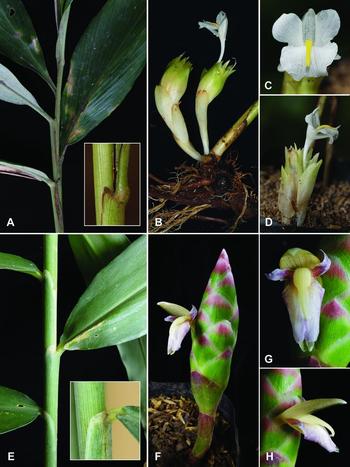
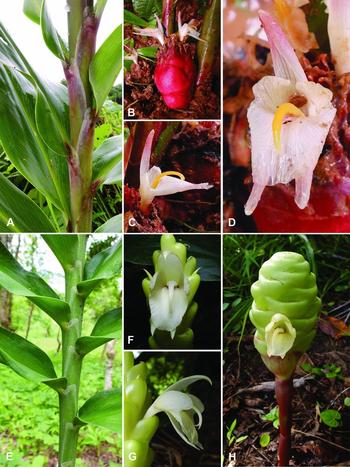
1. Zingiber densissimum S.Q.Tong & Y.M.Xia, Acta Phytotax. Sin. 25(6): 467 (Reference Tong and Xia1987); Fl. Yunnan. 8: 538 (1999); Wu & Larsen, Fl. China 24: 330 (Reference Wu, Larsen, Wu and Raven2000). – Type: China, Yunnan, Menghai, 1400 m, 7 x 1986, S.Q. Tong & Y.M. Xia 24998 (holo HITBC! [as YNTBI in protologue]). Fig. 1A–D.
Zingiber densissimum S.Q.Tong & Y.M.Xia (from Souvannakhoummane et al. KS672): A, part of leafy shoot with ligule in inset; B, inflorescences (side view); C, flower (front view); D, inflorescence and flower (side view). Zingiber kerrii Craib (from Phoutthavong & Souvannakhoummane KP378): E, part of leafy shoot with ligule in inset; F, inflorescence; G, flower (front view); H, flower (side view). (Photographs: A–D, and inset of A and E, K. Souvannakhoummane; E–H, J. Leong-Škorničková.)

Distribution
Known only from Xiengkhouang province in Laos. This species, originally described from southern China by Tong & Xia (Reference Tong and Xia1987), has also been reported from Thailand (Triboun et al., Reference Triboun, Larsen and Chantaranothai2014). Although a specimen collected by A.J.B. Chevalier 38526 (P) from southern Vietnam bears similarities to Zingiber densissimum and was annotated by P. Triboun as such, the distance from other known records is almost 1000 km. This Vietnamese record therefore deserves re-collection and further study to determine the exact identity of this collection.
Ecology and phenology
Growing in dry evergreen forest, deciduous forest mixed with pine forest, and in pine forest with grassland patches, 800–1500 m altitude. Flowering from July to September, flowers open in the afternoon.
Vernacular name and uses
Lao:
 (khing dok khao [white-flowered ginger]; recorded in Xiengkhouang). During the rainy season, this species is found in Nongphet vegetable market in Xiengkhouang. Young inflorescences are eaten boiled or fried.
Additional specimens examined. Laos. Xiengkhouang: Phoukoud district, near the top of Phoukoud mountain, 1332 m altitude, 19°33′23.0″N, 103°02′34.6″E, 23 viii 2014, Souvannakhoummane et al. KS672 (HNL); Bong village, c.700 m altitude, 19°41′41.9″N, 103°07′36.9″E, 23 x 2015, Souvannakhoummane & Luangxai s.n. (HNL); Youdphae village, c.800 m altitude, 19°41′41.9″N, 103°07′36.9″E, 5 ix 2017, Souvannakhoummane & Luangxai KS-Bio 0025 (HNL), Pek district, Or-An village, Phousan mountain, 1845 m altitude, 19°39′26.0″N, 103°21′18.7″E, 7 ix 2017, Souvannakhoummane & Malaiphet KS-Bio 0033 (HNL).
This species is rather rare in Laos. It is similar to Zingiber orbiculatum in having white flowers and bright yellow anthers, but can be recognised by its smaller leafy shoot with leaves arranged in the upper part of the pseudostem, prominently plicate leaves with white villous indumentum on the lower side of the lamina, and bilobed ligules.
2. Zingiber kerrii Craib, Bull. Misc. Inform. Kew 10: 403 (Reference Craib1912); Thongam et al., Taiwania 58(4): 291 (Reference Thongam, Sarangthem and Konsam2013); Bai et al., Gard. Bull. Singapore 67(1): 137 (2015). – Type: Thailand, Chiang Mai province, Doi Sootep, 900–1200 m, 24 vii 1910, A.F. Kerr 1290 (lecto K [K000255235], isolecto K [K000255234], P [P00450941] [digital images seen]). Fig. 1E–H.
Zingiber menghaiense S.Q.Tong, Acta Phytotax. Sin. 25(2): 145–146, pl. 1, f. 2 (Reference Tong and Xia1987); Wu & Larsen in Fl. China. 24: 326 (Reference Wu, Larsen, Wu and Raven2000); Bai et al., Gard. Bull. Singapore 67(1): 137 (2015). – Type: China, Yunnan Province, Xishuangbanna Daizu Zizhizhou, Menghai Xian, Menghai Zhen, under the forest on the roadside, 1200 m, 2 vii 1982, Tong, S.Q. & Li, A.M. 32860 (holo HITBC!, iso KUN!).
Zingiber stipitatum S.Q.Tong, Acta Phytotax. Sin. 25(2): 146–147, pl. 1, f. 3 (Reference Tong and Xia1987); Wu & Larsen in Fl. China. 24: 326 (Reference Wu, Larsen, Wu and Raven2000); Bai et al., Gard. Bull. Singapore 67(1): 137 (2015). – Type: China, Yunnan Province, Dehong Daizu Jingpozu Zizhizhou, Ruili Shi, Mengxiu Xiang, on the way from Mengxiu Cun to Daoba Zhai, 1200 m, 25 vii 1983, S.Q. Tong & C.J. Liao 24836 (holo HITBC! [as YNTBI in protologue]; iso HITBC!, KUN!).
Distribution
Known from Louangphabang province in Laos. This species, originally described from Thailand, has since been reported from India (Thongam et al., Reference Thongam, Sarangthem and Konsam2013; Triboun et al., Reference Triboun, Larsen and Chantaranothai2014), Myanmar and China (Bai et al., Reference Bai, Leong-Škorničková and Xia2015a).
Ecology and phenology
In Laos, this species occurs in deciduous forest and mixed bamboo forest, at about c.600 m altitude. In China, it has been reported to occur in grassy areas at the edge of the forest and in evergreen broadleaved forest at 700–1300 m altitude (Bai et al., Reference Bai, Leong-Škorničková and Xia2015a). Flowering from June to August. The flowers open in the morning.
Vernacular name and uses
Lao:
 (khing khan mak beng [lotus-bud ginger]; recorded in Louangphabang); Khmu:
 (hang ha ve yim [old red inflorescence ginger]; recorded in Louangphabang). This species is used as a vegetable by Khmu people, who harvest the plants from the forest. Young inflorescences and young shoots are boiled or steamed, or fried with chili and dried fish.
Additional specimens examined. Laos. Louangphabang: Xiengngeun district, Houay hia Village, 19°44′16.3″N, 102°12′13.8″E, c.600 m altitude, 11 viii 2013, Phoutthavong & Souvannakhoummane KP378 (HNL and living collection at Pha Tad Ke Botanical Garden).
This species is similar to Zingiber laoticum Gagnep. in the entire plant being glaucous externally (particularly prominent in young shoots, becoming inconspicuous when older), pale green bracts with pink-red margins and rhizomes and pseudostems that are purple-red internally. The labellum and staminodes of Zingiber kerrii Craib are, however, cream-white to pinkish, with a dark red patch at the base of the labellum and staminodes, and the staminodes are narrowly ovate and almost free to the base, whereas the labellum and staminodes of Z. laoticum Gagnep. are pale yellow with dense dark purple-brown mottling throughout, and the staminodes are almost fully adnate to the labellum (see Leong-Škorničková & Newman, Reference Leong-Škorničková and Newman2015: 216).
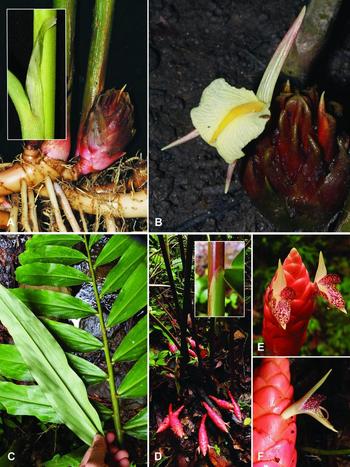
3. Zingiber ligulatum Roxb., Asiat. Res. 11: 348 (1810); Roxb., Fl. Ind. 1: 51 (Reference Roxburgh1820); Baker, Fl. Brit. India 6: 245 (1892); K.Schum., Pflanzenr. IV, 46 (Heft 20): 186 (1904). – Type: Hindostan, pre-dating 1810, Roxburgh (not located; see notes). Fig. 2A, B.
Zingiber ligulatum Roxb. (from Souvannakhoummane et al. KS812): A, basal part of leafy shoot with inflorescence and a ligule in inset; B, detail of flower (semi-side view). Zingiber nudicarpum D.Fang (from Leong-Škorničková et al. JLS-2386): C, part of leafy shoot; D, basal part of leafy shoots with multiple inflorescences and detail of ligule in inset; E, flower (front view); F, flower (side view). (Photographs: A and B, K. Souvannakhoummane; C–F, J. Leong-Škorničková.)

Distribution
This species was originally described from India, and has recently been reported from Myanmar (Romand-Monnier, Reference Romand-Monnier2013) and Thailand (Triboun et al., Reference Triboun, Larsen and Chantaranothai2014). It is known only in cultivation in Laos.
Ecology and phenology
This species has been seen only in cultivation near rice fields and in gardens, in sandy clay mixed with rocks. Flowering occurs from late March to June.
Vernacular name and uses
Khmu:
 (khing khang khao [pungent-smell ginger], recorded in Louangphabang]). The rhizome is used as a laxative and for treatment of stomach ailments. The young inflorescences are eaten as a vegetable.
Additional specimens examined. Laos. Louangphabang: Chomphet district, Chan Tai village, near rice field, 161 m in altitude, 19°52′52.0″N, 102°06′02.7″E, 12 ix 2014, Souvannakhoummane et al. KS812 (HNL, Pha Tad Ke BG).
The exact identity of Zingiber ligulatum has not yet been fully clarified. According to a note in the protologue, the species is “a native of Hindostan where it was first noticed by Colonel Hardwicke”. Roxburgh's original specimen of Zingiber ligulatum has not been located. The original description is brief, consisting of four lines only, but there is a more detailed description and a colour drawing in a later work by Roxburgh (Roxburgh, Reference Roxburgh1820). An identical colour drawing of this species also exists in the Icones Roxburghianae, of which we have seen the copy deposited at K. Our collections are a good match to the description and the colour drawing published by Roxburgh in 1820, and we therefore hesitate to apply a new name to them until the identity of Zingiber ligulatum and other closely related taxa in sect. Cryptanthium are clarified following re-collection of living material in India. Our Lao collections look identical to the material known from Thailand, where this species, as in Laos, also occurs only in cultivation (Triboun, Reference Triboun2006; Dr Pramote Triboun, Thailand Institute of Scientific and Technological Research, personal communication).
4. Zingiber nudicarpum D.Fang, Guihaia 2: 139 (1982); Wu & Larsen, Fl. China 24: 326 (Reference Wu, Larsen, Wu and Raven2000); Lý et al., Bioscience Discovery 8(1): 2 (Reference Lý, Đặng, Đỗ, Trần, Đỗ and Nguyễn2017). – Type: China, Guangxi Province, Baise Xian, Nabi, 340 m, 30 vi 1981, D.H. Qin et R.Z. Huang 36982 (holo GXMI!). Fig. 2C–F.
Distribution
Although we have observed this species widely in Laos, only a few herbarium specimens collected in Houaphan (northern Laos) and Attapeu (southern Laos) exist. The species was originally described from Guangxi (southern China), and has since been reported from five localities in Vietnam (Lý et al., Reference Lý, Đặng, Đỗ, Trần, Đỗ and Nguyễn2017).
Ecology and phenology
Growing in evergreen forests, often near streams and rivers, in clay, sometimes mixed with rocks. Flowering occurs from late March to June.
Vernacular name and uses
Lao:
 (khing pee din [soil flower ginger], recorded in Houaphan). Young inflorescences are eaten as a vegetable. This species is occasionally sold in vegetable markets in Vientiane, although according to the vendors, the species is brought from Houaphan and Phoukhaoukhouay (Vientiane province).
Additional specimens examined. Laos. Attapeu: Dong Ampham National Protected Area, 14°42′27″N, 107°31′25″E, 16 iii 2011, Newman 2442 [cultivated at RBGE, originally from Lamxay et al. VL1967] (E); Houaphan: Vieng Thong district, Nam Et-Phou Louey Natural Protected Area, Tad Hokdon waterfall, 789 m altitude, 20°6′16″N, 103°22′18″E, 07 vi 2013, Leong-Škorničková et al. JLS-2386 (E, QBG, SING, living collection at Pha Tad Ke Botanical Garden).
Zingiber nudicarpum D.Fang is very similar to Zingiber peninsulare Theilade. The differences can be summarised as follows: larger habit up to 3 m tall, villous leaf sheaths, labellum purple-red with yellow mottling toward apices in Zingiber nudicarpum (versus smaller habit 1.2–2 m tall, glabrous leaf sheaths and labellum dark purple with white spots). Further studies across the area of distribution are needed to establish if these two species are distinct or conspecific.
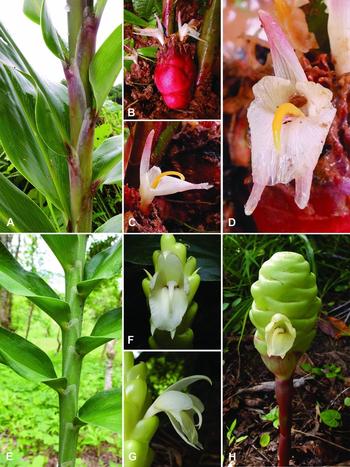
5. Zingiber orbiculatum S.Q.Tong, Acta Phytotax. Sin. 25(6): 463 (Reference Tong and Xia1987); Wu & Larsen, Fl. China 24: 329 (Reference Wu, Larsen, Wu and Raven2000); Aung et al., Bull. Natl. Mus. Nat. Sci., Ser. B, 41(3): 108 (Reference Aung, Tanaka and Miyake2015). – Type: China, Yunnan, Mengla, 620 m, 20 vii 1981, S.Q. Tong 24804 (holo HITBC!; iso HITBC, KUN). Fig. 3A–D.
Zingiber orbiculatum S.Q.Tong (from Leong-Škorničková et al. JLS-1725): A, part of leafy shoot with ligules; B, inflorescence with flowers in side view; C, detail of flower (side view); D, detail of flower (front view). Zingiber parishii Hook.f. subsp. phuphanense Triboun & K.Larsen (from Leong-Škorničková et al. JLS-1753 and Leong-Škorničková et al. JLS-1834): E, part of leafy shoot with ligules; F, flower (front view); G, flower (side view); H, inflorescence with flower in front view. (Photographs by J. Leong-Škorničková.)
Distribution
This species is quite common in northern Laos, being recorded in four provinces to date (Oudomxai, Louangphabang, Xaignabouly and Houaphan). It was originally described from China (Tong & Xia, Reference Tong and Xia1987) and has since been reported from Thailand and Myanmar (Aung et al., Reference Aung, Tanaka and Miyake2015; Triboun et al., Reference Triboun, Larsen and Chantaranothai2014).
Ecology and phenology
Growing in mixed deciduous forest and bamboo forests, occasionally also found in margins of secondary forest. Flowering occurs from late May to July, followed by fruiting from July to September. The flowers open in the afternoon. In Myanmar, it has been reported to grow in shade in semi-evergreen forest at c.865 m altitude (Aung et al., Reference Aung, Tanaka and Miyake2015).
Vernacular name and uses
Hmong:
 (pa khia [flowering ginger]; recorded in Louangphabang, where the local people harvest young inflorescences and young shoots of this species, which is commonly found near rice fields and cultivated in villages. It is usually prepared as a vegetable dish with fresh fish or pork, or with dried chilli and dried fish.
Additional specimens examined. Laos. Oudomxai: Xay district, Ban Faen, 717 m altitude, 20°42′57.5″N, 102°05′06.9″E, 16 vi 2012, Leong-Škorničková et al. JLS-1725 (HNL, SING); Louangphabang: Xiengngeun district, Houy Hia village, 11 viii 2013, Phouttavong & Souvannakhoummane KP328 (HNL); 1866–1868, Thorel s.n. (P, P00289157); Xaignabouly: Tongmixay district, 27 v 2014, Srisanga et al. L2-323 (QSB!); Houaphan: Xam Nuea district, Ban Houa Xieng, 1035 m altitude, 20°28′06.9″N, 103°56′03.2″E, 3 vi 2013, Leong-Škorničková et al. JLS-2266 (E, P, QBG, SING).
Although the white flower resembles that of Zingiber densissimum S.Q.Tong & Y.M.Xia, this species is easily recognised by its broadly ovate to almost orbicular bright red spike and robust leafy shoots composed of glabrous leaves more or less evenly distributed along the pseudostem.
6. Zingiber parishii Hook.f. subsp. phuphanense Triboun & K.Larsen, Thai J. Bot. 6(1): 62 (Reference Triboun, Larsen and Chantaranothai2014). – Type: Thailand, Sakon Nakhon, Phu Phan National Park, 11 vi 2002; P. Triboun & C. Kantachote 3323 (holo BK n.v.; iso AAU n.v., KKU n.v.) Fig. 3E–H.
Distribution
This subspecies, recently described from Thailand (Triboun et al., Reference Triboun, Larsen and Chantaranothai2014), is fairly common in Laos.
Ecology and phenology
Growing in mixed deciduous forest, and at the foot of limestone hills, dipterocarp forest mixed with bamboo and open areas near forest margins, on clay soil mixed with granite soil. Flowering in June to September. The flowers open in the afternoon.
Vernacular name and uses
Lao:
 (khing pa [wild ginger]; recorded in Louangphabang). Young leaves and young inflorescences are favoured by local people for their pleasant smell, and are used as vegetables. Young leaves are cooked with fermented bamboo shoots and Mekong fish soup. Young inflorescences are boiled or fried and eaten with spicy lap (minced meat salad). It is occasionally cultivated in gardens. The rhizome is used to cure stomach ailments.
Additional specimens examined. Laos. Louangphabang: Chomphet district, Pha Tad Ke area, 19 vi 2012, Leong-Škorničková et al. JLS-1753 (HNL, SING); ibidem, 23 viii 2014, Souvannkhoummane KS789 (HNL); Louangphabang district, along road side to Ban Long Lao Mai, 473 m, 19°49′52.87″N, 102°6′39.44″E, 20 vi 2012, Leong-Škorničková et al. JLS-1766 (HNL, SING); Louangphabang district, 3 xi 1965, Vidal 4256 (P, P00507829); Vientiane Capital: Xaythany district, Ban Dong Mak Kay, 190 m altitude, 18°06′35.3″N, 102°41′05.4″E, Leong-Škorničková et al. JLS-1834 (HNL, SING).
This subspecies of Zingiber parishii has only recently been described from Thailand (Triboun et al., Reference Triboun, Larsen and Chantaranothai2014). It is distinguished by its pale-yellow labellum, with only small and sparse dark purple patches at the base compared with mottling throughout the labellum in the nominal variety. Although we have been unable to examine the type material, the species has been identified using the original description, which included illustrations and photographs, and its identity was also confirmed by Dr Pramote Triboun.
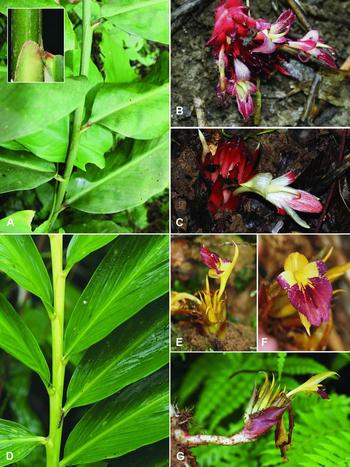
7. Zingiber recurvatum S.Q.Tong & Y.M.Xia, Acta Phytotax. Sin. 25(6): 470 (Reference Tong and Xia1987); Wu & Larsen, Fl. China 24: 329 (Reference Wu, Larsen, Wu and Raven2000). – Type: China, Yunnan Province, Mengla, 700 m, 4 vii 1981, S.Q.Tong (holo HITBC! [as YNTBI in protologue], iso KUN!). Fig. 4A–C.
Zingiber recurvatum S.Q.Tong & Y.M.Xia (from Phoutthavong et al. KP246, KP451 and Souvannakhoummane et al. KS 794): A, part of leafy shoot with ligule in inset; B, inflorescence with flowers in front view; C, detail of inflorescence with flower (semi-side view). Zingiber smilesianum Craib (from Souvannakhoummane & Malaiphet KS-Bio 0024 and Souvannakhoummane & Malaiphet KS-Bio 0031): D, part of leafy shoot with ligules; E, detail of inflorescence partially buried in the ground; F, flower (front view); G, inflorescence with flower (side view). (Photographs: A and C–G, K. Souvannakhoummane; B, K. Phoutthavong.)

Distribution
Known from two locations in Louangphabang province, Laos. The species was originally described from Mengla, Yunnan (Tong & Xia, Reference Tong and Xia1987), about 150 km from the Lao collections.
Ecology and phenology
Growing in evergreen forest, in areas with high moisture and clay soil mixed with small stones, often occurring together with ferns and Piper umbellatum L. Flowering and fruiting from August to November. The flowers open in the morning. In China, it also occurs in moist evergreen forest at c.700 m altitude (Tong & Xia, Reference Tong and Xia1987).
Vernacular name and uses
No vernacular name or uses have been recorded.
Additional specimens examined. Laos. Louangphabang: Louangphabang district, Long Lunh Village, c.1000 m altitude, 19°55′34.5″N, 102°20′50.5″E, 19 ix 2012, Phoutthavong et al. KP246 (HNL); ibidem, 19 ix 2012, Phoutthavong et al. KP244 (HNL); Xiengngeun district, Houy Hia village, c.600 m altitude, 19°44′16.3″N, 102°12′13.8″E, 11 viii 2013, Phoutthavong & Souvannakhoummane KP451 (HNL); Tad Kouangsi waterfall, 24 ix 2014, Souvannakhoummane & Phoutthavong KS794 (HNL).
Zingiber recurvatum appears to be very similar to Zingiber larsenii Theilade, which is somewhat smaller in habit and with ligule lobes that are supposed to be more triangular. The ligule shape in Lao populations seems to vary from triangular to round. The distance between the type localities of the two species is about 300 km, with Lao collections in between. Although yet unreported, the second author has also seen Zingiber recurvatum in several locations in northern Vietnam, suggesting that it is likely to be a widespread species. Further study of the intraspecific variability of Zingiber recurvatum and Z. larsenii and their relationship to each other is needed.
8. Zingiber smilesianum Craib, Bull. Misc. Inform. Kew 10: 403 (Reference Craib1912); Theilade, Nordic J. Bot. 19(4): 406 (Reference Theilade1999). – Type: Thailand, Chiang Mai province, Doi Sootep, on edge of evergreen jungle, 1200–1500 m, 9 ix 1910, Kerr 1311a (lecto K! [K000255228]; isolecto BM! [BM000797146], E! [E00097856]). Fig. 4D–G.
Zingiber teres S.Q.Tong & Y.M.Xia, Acta Phytotax. Sin. 25(6): 468 (Reference Tong and Xia1987); Wu & Larsen, Fl. China 24: 332 (Reference Wu, Larsen, Wu and Raven2000). – Type: China, Yunnan: Menglian, Dai-Lahu-Va Zu Zizhixian, 1170 m, 9 x 1986, S.Q. Tong & Y.M. Xia 42403 (holo HITBC! [as YNTBI in protologue], iso KUN!)
Distribution
This species is rare in Laos and Thailand (Craib, Reference Craib1912: 403–404; Triboun et al., Reference Triboun, Larsen and Chantaranothai2014).
Ecology and phenology
Growing in evergreen montane forest near summits, between 1400 and 1880 m. Flowering occurs from September to October, and the flowers open in the afternoon.
Vernacular name and uses
No vernacular name has been recorded. Young shoots and young inflorescences are used as a green vegetable. Young inflorescences are also used with other vegetables to prepare pork or fish soup.
Additional specimens examined. Laos. Xiengkhouang: Pek district, Or-An Village, along road side to Phousan mountain, 1600 m, 19°63′83.60″N, 103°40′13.37″E, 6 ix 2016, Souvannakhoummane & Malaiphet KS-Bio 0024 (HNL); near summit of Phousan Mountain, 1845 m, 19°67′43.17″N, 103°41′12.16″E, 7 ix 2016, K. Souvannakhoummane & Malaiphet KS-Bio 0031 (HNL).
Triboun et al. (Reference Triboun, Chantaranothai and Larsen2007) placed Zingiber teres in synonymy with Z. smilesianum Craib. Although our Lao collections key out as Zingiber larsenii in Triboun's key to Thai Zingiber (Triboun et al., Reference Triboun, Larsen and Chantaranothai2014), and as Z. teres in the key in the Flora of China (Wu & Larsen, Reference Wu, Larsen, Wu and Raven2000), they are of stouter habit and most of the populations have densely villous lamina abaxially. There are, however, no differences in floral characters. Further studies of Lao collections may justify their recognition as a subspecies.
Updated Checklist for Laos
This updated checklist of Zingiber in Laos follows the format of Newman et al. (Reference Newman, Ketphanh, Svengsuksa, Thomas, Sengdala, Lamxay and Armstong2007). The current sectional placement is given after each name. When the sectional placement is in doubt or is not clear owing to the intermediate nature of the characters, the species is marked with a question mark or a reference to the latest discussion of its placement.
-
Zingiber Mill.
-
Zingiber corallinum Hance (sect. Zingiber) Laos: Vientiane: J.E. Vidal 5915 (P).
-
Zingiber densissimum S.Q.Tong & Y.M.Xia (sect. Cryptanthium)
Laos: Xiengkhouang: K. Souvannakhoummane et al. KS672 (HNL); K. Souvannakhoummane & P. Luangxai KS-Bio 0025 (HNL); K. Souvannakhoummane & Malaiphet KS-Bio 0033 (HNL).
-
Zingiber isanense Triboun & K.Larsen (sect. Cryptanthium?)
Laos: Salavan: V. Lamxay et al. VL1999 (E, SING); V. Lamxay et al. VL2015 (E, SING).
-
Zingiber jiewhoei Škorničk. (sect. Zingiber)
Laos: Vientiane: J. Leong-Škorničková et al. JLS-1807 (holo SING; iso E, HNL).
-
Zingiber junceum Gagnep. (sect. Zingiber?)
Salavan: Thorel 2408 (P [3]).
-
Zingiber kerrii Craib (sect. Zingiber)
Laos: Louangphabang: K. Phoutthavong & K. Souvannakhoummane KP 378 (HNL).
-
Zingiber laoticum Gagnep. (sect. Zingiber)
Laos: Xaignabouly: C. Thorel (P). Xiengkhouang: K. Souvannakhoummane et al. KS406 (HNL).
-
Zingiber ligulatum Roxb. (sect. Cryptanthium)
Laos: Louangphabang: K. Souvannakhoummane et al. KS812 (HNL).
-
Zingiber mekongense Gagnep. (sect. Cryptanthium)
Laos: Xaignabouly: C. Thorel (P). Louangphabang: V. Lamxay et al. VL2028 (E); J. Leong-Škorničková et al. JLS-1691 (E, SING); J. Leong-Škorničková et al. JLS-1674 (E, SING); Vientiane Capital: J. Leong-Škorničková et al. JLS-1851 (HNL, E, SING); Xiengkhouang: J. Leong-Škorničková et al. JLS-2241 (E, SING, QBG); Oudomxai: V. Lamxay et al. VL1169 (E). Vientiane: J.E. Vidal 1807 (P).
-
Zingiber monophyllum Gagnep. (sect. Pleuranthesis)
Laos: Xiengkhouang: C.J. Spire 164 (P).
-
Zingiber montanum (J.Koenig) Link ex A.Dietr. (sect. Zingiber)
Laos: Louangphabang: Somdy s.n. (cultivated at Pha Tad Ke BG; although there is no herbarium specimen supporting this record, the species is occasionally cultivated and was recorded by Newman et al., Reference Newman, Ketphanh, Svengsuksa, Thomas, Sengdala, Lamxay and Armstong2007).
-
Zingiber neotruncatum T.L.Wu, K.Larsen & Turland (sect. Zingiber)
Laos: Champasak: E. Poilane 28360 (P).
-
Zingiber nitens M.F.Newman (sect. Dymczewiczia)
Laos: Bolikhamxai: M.F. Newman 2647 (holo E, incl. spirit).
-
Zingiber niveum Mood & Theilade (sect. Zingiber)
Laos: Salavan: E. Poilane 16187 (P).
-
Zingiber nudicarpum D.Fang (sect. Zingiber)
Laos: Attapeu: V. Lamxay et al. VL1967 (E); Houaphan: J. Leong-Škorničková et al. JLS-2386 (E, SING, QBG).
-
Zingiber officinale Roscoe (sect. Zingiber)
Laos: Xaignabouly: J.E. Vidal 4305 (P).
-
Zingiber orbiculatum S.Q.Tong (sect. Cryptanthium)
Laos: Houaphan: J. Leong-Škorničková et al. JLS-2266 (E, P, SING, QBG); Louangphabang: K. Phoutthavong et al. KP328 (HNL); Thorel s.n. (P00289157); Oudomxai: J. Leong-Škorničková et al. JLS-1725 (HNL, SING); Xaignabouly: P. Srisanga et al. L2-323(QSB); Vientiane: J.E. Vidal 1809 (P).
-
Zingiber ottensii Valeton (sect. Zingiber)
Laos: Louangphabang: K. Souvannakhoummane et al. KS438 (Pha Tad Ke BG).
-
Zingiber parishii subsp. phuphanense Triboun & K.Larsen (sect. Zingiber)
Laos: Louangphabang: J. Leong-Škorničková et al. JLS-1753 (HNL, SING); K. Souvannakhoummane et al. KS789 (HNL); J. Leong-Škorničková et al. JLS-1766 (HNL, SING); J.E. Vidal 4256 (P); Vientiane capital: J. Leong-Škorničková et al. JLS-1834.
-
Zingiber pellitum Gagnep. (sect. Dymczewiczia)
Laos: Champasak: J.F. Maxwell 98–1017 (CMU); C. Thorel 2173 (P[4]).
-
Zingiber recurvatum S.Q.Tong & Y.M.Xia (sect. Cryptanthium)
Laos: Louangphabang: K. Phoutthavong et al. KP246 (HNL); K. Phoutthavong & K. Souvannakhoummane KP451 (HNL).
-
Zingiber smilesianum Craib (sect. Cryptanthium)
Laos: Xiengkhouang: K. Souvannakhoummane et al. KS-Bio 0024 (HNL); K. Souvannakhoummane et al. KS-Bio 0031 (HNL).
-
Zingiber thorelii Gagnep. (sect. Cryptanthium; provisionally accepted in this section by Bai et al., Reference Bai, Leong-Škorničková, Xia and Ye2016)
Laos: Champasak: C. Thorel 2363 (P [2]); V. Lamxay VL1083 (E, [2]). Saravan: E. Poilane 16116 (P); V. Lamxay & S.Chanthavongsa VL1113 (E); C. Thorel 2363(P); V. Lamxay et al. VL1083 (E). Xaisomboun Special Area: J.E. Vidal 5970 (P).
-
Zingiber xishuangbannaense S.Q.Tong (sect. Cryptanthium; provisionally accepted in this section by Bai et al., Reference Bai, Leong-Škorničková, Xia and Ye2016)
Laos: Louangphabang: K. Phoutthavong & K. Souvannakhoummane KP 452 (QBG). Vientiane: J.E. Vidal 5946 (P). J. Leong-Škorničková et al. JLS1705 (Living at Pha Tad Ke BG).
-
Zingiber zerumbet (L.) Roscoe ex Sm. (sect. Zingiber)
Laos: Champasak: J.F. Maxwell 98–881 (CMU); V. Lamxay et al. VL1914 (E). Louangphabang: C. Dupuy 270 (P). Vientiane: J.E. Vidal 1808 (P).
Acknowledgements
The first author is very grateful to Dr Pramote Triboun (Thailand Institute of Scientific and Technological Research) for providing valuable training during the fieldwork and for discussions regarding the identity of some of the material; the Agro-biodiversity Initiative for assistance with the fieldwork; and the World Wildlife Fund's Russell E. Train Education for Nature Program and the National University of Laos for supporting his Master of Science studies. The research of the second author is supported by the National Parks Board, Singapore, and the Czech Science Foundation, GAČR (grant no. P506/14/13541S). Our sincere thanks are due to Mr Rik Gadella, General Director of Pha Tad Ke Botanical Garden, for finding grants to support our work and for providing support for ex situ conservation of Zingiberaceae collections. We thank Dr Prachaya Srisanga and his team at Queen Sirikit Botanical Garden for their assistance during part of the fieldwork, and to the curators and staff of the following herbaria for letting us access specimens in their care or for providing us with high-resolution images: BK, E, HITBC, HN, HNL, K, KUN, P, QSB and SING. We thank Dr Bai Lin (KUN) for discussions and valuable suggestions regarding identities of our various Zingiber collections from Laos. We thank Michael Leong and Mark Newman, as well as the two anonymous reviewers, for linguistic and other suggested improvements to this manuscript.