Introduction
The opium wars of the mid-nineteenth century cast the image of the global narcotics trade as dominated by and dependent on European imperialist hegemony. Western missionaries and social campaigners hoping to shame their governments into action,Footnote 1 as well as Chinese nationalist and communist cadres keen to emphasize their people's victimhood,Footnote 2 contributed to a historiographical focus on the formation and consequences of Western policy. The study of the twentieth-century narcotics trade, centred on the impact of the American-led war on drugs, has been similarly inflected by a focus on bilateral relationships determined and dominated by the West.Footnote 3 The consequence was a long-enduring neglect of Asian agency and inter-Asian interactions in the opium trade, something recent works have sought to revise.Footnote 4 Certainly, the pursuit of profit and imperial expansion by Britain, France, and the Netherlands was central to the nineteenth-century explosion in the production, trade, and consumption of opium, but by the end of the First World War, opinion on the legitimacy of the opium trade had shifted markedly, particularly in the governing circles of the major imperialist powers.Footnote 5 Indeed, the restriction of narcotics commerce was to be written into the new post-war international order envisaged by the signatories of the covenant of the League of Nations, Article 23c of which entrusted ‘the League with the general supervision over the execution of agreements with regard to the traffic in women and children, and the traffic in opium and other dangerous drugs’.Footnote 6 This shifting legal landscape and the accompanying withdrawal of state-sanctioned European opium traders in the first half of the twentieth century provided new opportunities for state and non-state actors across Asia to increase their role, creating new commercial and diplomatic connections that reshaped commerce in the drug. By showing how the citizens and government of the Republic of Turkey, among the most neglected of these actors in the associated literature, continued to supply opium and opiates to East Asia, together with counterparts in the region, this article aims to revise understandings of the geographic extent of the trade and reveal how strategies of circumvention and resistance forged on trans-Asian axes could frustrate the implementation of new norms and legal regimes.
The new state of Turkey emerged from ten years of almost continuous war between the Ottoman imperial government, rival successors, and the European great powers, taking the largest share of the poppy-growing regions of the empire. The birth of the republic was coeval with a major international diplomatic push to prohibit non-medical narcotics. The 1923 Treaty of Lausanne, which conferred international recognition on the new state, demanded that Turkey adopt the earlier 1912 Hague Opium Convention and subsequent 1914 protocol into law. Further agreements were made during the early years of the republic's existence, beginning with the 1925 International Opium Convention (hereafter 1925 Convention) and supplemented by the 1931 Convention for Limiting the Manufacture and Regulating the Distribution of Narcotic Drugs (hereafter 1931 Convention) and 1936 Convention for the Suppression of the Illicit Traffic in Dangerous Drugs.
These treaties created a permanent secretariat for the monitoring of narcotics which has left behind substantial records in Geneva. League documents have been neglected in prior work on the Turkish opium industry,Footnote 7 but offer an important additional source for researching narcotics and other topics of the League's social work, as shown in several studies of such issues in the Middle EastFootnote 8 and East Asia.Footnote 9 When examining the history of narcotics in republican Turkey, such sources are particularly important, given that the relevant records of the Narcotic Products Monopoly (hereafter NPM) and the Ministries of Health and Social Welfare, Public Security, and Foreign Affairs have not been released, while they also give access to the reports of diverse states and colonies in East Asia which imported Turkish opium. Although the figures contained in Japanese reports, in particular, often exaggerated medical requirements in order to avoid accusations of illicit re-exporting, there is little reason to suspect that recorded imports of Turkish opium did not take place, while much more opium from Turkey is likely to have reached East Asia without an archival trace.Footnote 10 Indeed, the deliberate obfuscation and concealment of opium shipments, which only increased as prohibitionist laws multiplied, is one of the principal difficulties in conducting research on opium and other illegal commerce, as researchers on the subject recognize.Footnote 11 The article cites a wide range of additional archival sources, including international newspapers and relevant American, French, British, and Japanese diplomatic correspondence, in order to compensate for deficiencies and absences in individual archives. Time and language constraints on the part of the author and the impossibility of collecting additional aural testimony for the otherwise unwritten deeds of smugglers in the period, aside from that contained in police and court records, makes a comprehensive study of opium flows between Turkey and East Asia an impossible task, however.
The article will show first how the global rise of prohibition stifled European demand and shifted the trajectory of Turkish opium exports towards East Asian markets in the 1920s. It then examines how traders among the diverse populations of urban centres in Turkey and East Asia attempted to navigate growing legal restrictions in order to continue imports of Turkish opium. Thirdly, the article assesses the consequences of the displacement of the opium refinement process from laboratories in Europe to Istanbul, as seen in the establishment of three legal opium refineries in the city, and their role in the supply of heroin and morphine as they grew in popularity in East Asia. Finally, the article shows how the parallel development of state narcotic monopolies in the Japanese empire and Turkish republic brought cooperation between bureaucrats and diplomats in the defence of the opium trade between the two countries until the international security crises of the late 1930s pulled them into different camps and the onset of war disrupted Turkish opium exports.
Recent studies of the opium trade have done much to reveal the complexity of policy formation, demonstrate the significance of drug control to colonial rule and state social intervention, and assert local agency in opium manufacture, distribution, supply, and regulation in South,Footnote 12 Southeast,Footnote 13 and East Asia.Footnote 14 By contrast, the literature on opium in TurkeyFootnote 15 and neighbouring IranFootnote 16 is less extensive, despite their place, after China and India, among the top four global producers of opium for much of the nineteenth and twentieth centuries.Footnote 17 The inclusion of these new geographies complicates the exploitative, bilateral ‘relationship between the West and the East’ that remains the paramount dynamic in popular and academic conceptions of the opium trade.Footnote 18 More broadly, recognizing the agency of Turks and other Middle Easterners in East Asia and vice versa contributes to a growing research agenda that emphasizes multilateral connections in the generation of historical change rather than the transfer from centre to periphery.Footnote 19
As many of the above-cited authors recognize, the opium trade—both legal and illegal—was inherently transnational.Footnote 20 However, research methodologies are rarely as geographically wide-ranging as the pathways of the narcotics they trace, and though numerous studies of the opium trade draw on Japanese, Chinese, and Indian sources,Footnote 21 some show a continued overreliance on British and American archives, even in histories purporting to write a global history of these substances.Footnote 22 As a consequence, the strength of trans-Asian narcotics connections, beyond the tight nexus of the South to East Asian trade which has now been more thoroughly investigated, is often lost. Recent studies in global political thought have tackled the same challenge of a historiography constructed on the basis of individual nations’ dialogue with ‘the West’.Footnote 23 Cultural and political counter-currents between the Middle East and East Asia have been explored by historians, including Selçuk Esenbel,Footnote 24 Renée Worringer,Footnote 25 Cemil Aydin,Footnote 26 and Nile Green.Footnote 27 These recent works, which investigate what Esenbel terms ‘an alternative ambivalent arena of international relations’,Footnote 28 offer a model for further research in narcotics connections on the same axes.
Trade links between Turkey and East Asia have attracted little attention outside the framework and chronology of the Silk Road.Footnote 29 Turkey's economic development is normally analysed either endogenously or with reference to its Middle Eastern and European neighbours,Footnote 30 while investigations of comparisons and connections with Japan and other Asian states have been focused on political rather than economic aspects,Footnote 31 despite Ataturk having promoted Japan as a model of economic development for the new republic to follow.Footnote 32 Economic historians studying late nineteenth- and early twentieth-century trans-Asian trading connections have focused their research on commerce between South, Southeast, and East Asia, demonstrating the rapid growth of such trade before and after the First World War,Footnote 33 but only a small number have cast their eyes as far as Turkey or the Middle East, with few works focused on Japanese exports to the regionFootnote 34 and still fewer on economic flows in the opposite direction, of which opium formed a major portion. By revealing the extent of these connections, this article geographically expands the horizons of scholarship on trans-Asian commercial connections, while demonstrating the importance of a new set of actors in one of the major focuses of this scholarship—the opium trade.
The search for an East Asian market for Turkish opium
As one of the four largest producers of opium at the turn of the twentieth century, the Ottoman empire had long played a significant role in the global trade in the drug, making up some 10 per cent of opium imported to China at the time of the first Opium War.Footnote 35 Most of the Ottoman opium that reached East Asia, however, did so having been re-exported by American and European traders in Istanbul and Izmir, who in turn purchased opium from Ottoman merchants with connections to producers in the interior.Footnote 36 As can be seen in Table 1, the majority of opium leaving the Ottoman empire in the years leading up to the First World War was destined for Britain, France, Switzerland, and Germany, whether for re-export or refinement into pharmaceutical products, which was a popular use of Anatolian opium due to its higher-than-average morphine content.
Ottoman opium exports in kilograms, 1908–1913.Footnote 37

The outbreak of the First World War brought a dramatic shift in such nineteenth-century patterns of production and trade. The mobilization of the peasantry and the blockade of Ottoman ports in the years 1914–1918 and the Greek occupation of Izmir and inland offensives between 1919 and 1922, which ravaged the prime poppy-growing lands of southwestern Anatolia, severely curtailed Ottoman opium production.Footnote 38 Output dropped from 10,500 cases in 1913 to 7,000 cases in 1914 and then hovered between 2,000 and 3,000 cases from 1915 to 1922.Footnote 39 The opium sector was an acute example of the general decline of agricultural output in this tumultuous period, with similar reductions in production seen in other valuable crops such as tobacco, wheat, cotton, and nuts.Footnote 40
These upheavals were accompanied by the emergence of a new vision for the political economy of the empire and later republic, which aimed at the marginalization of European and local non-Muslim companies and merchants, and the consolidation of important sectors of the economy in the hands of a new Turkish-Muslim bourgeoise and, increasingly, state bureaucrats.Footnote 41 In the opium sector, such a transformation was accelerated by pressure on foreign traders from the diplomatic representatives of their home governments as they turned against the trade in the drug. As a result, European trading houses began withdrawing from the opium market even before monopolization of the trade by the Turkish state in 1933.
Responding to the challenge of debts and deficits accrued during years of war, the new republican administration sought ways to revive and expand the production of the cash crops that made up some 60–70 per cent of the value of Turkish exports across the period in question, despite their longer term plans for industrialization.Footnote 42 Though the value of opium in this mix was well below that of tobacco and other leading exports, low exports seen in Table 2 reveal clear room for growth in the sector, as the report of the Istanbul Economic Commission, published in 1925 with the objective of guiding economic strategy for the new state, identified.Footnote 43 The Commissariat for Agriculture paid several visits to the region surrounding Afyonkarahisar, unsurprisingly one of the prime opium-growing areas of the country given its name—Afyon is the Turkish word for opium—and arranged meetings with growers and merchants in the same year.Footnote 44 The expedition resulted in the formation of an association of opium dealers, the first in a string of government interventions intended to increase coordination of opium production and export.Footnote 45 As was the case in all agriculture, the government hoped that credit and cooperatives would see the recrudescence of opium production to pre-war levels and beyond.Footnote 46
Turkish opium exports in kilograms, 1923–1926.Footnote 47

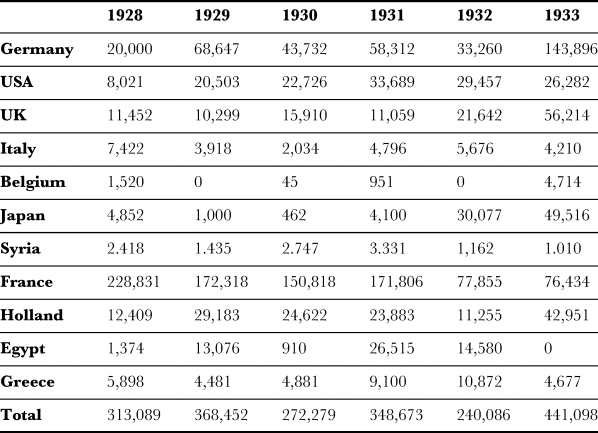
But a lack of production was not the only thing holding back Turkish opium exports. New legal restrictions on opium and its derivatives also had an impact, suppressing demand for Turkish opium in the European states that, as can be seen in Table 3, continued to buy most of its exported product. The 1925 Convention, negotiated in Geneva, called on signatories to provide the newly created Opium Permanent Control Board with regular statistics on the quantity of opium purchased and any derivatives manufactured, and installed extra controls on exports and imports.Footnote 48 Turkey refused to sign it, citing the ‘vital importance of poppy growing’ for the country's peasant farmers.Footnote 49 Objections were also heard from Japanese representatives, concerned that restrictions on imports would damage their budding pharmaceutical industry, but these were finally allayed and, unlike Turkey or, for quite different reasons, China, Japan became a signatory.Footnote 51
Turkish opium exports in kilograms, 1928–1933.Footnote 50

Turkish defiance could not entirely insulate the country's growers and merchants from the effects of the new regime. The price of opium dropped as world demand was curtailed, while the collapse in value of Turkish exports following the Great Depression and the continued obligation to repay Turkey's share of the Ottoman debtFootnote 52 made opium sales an even more crucial source of foreign currency. By turning to East Asia, the most important consumer market for opium, and cutting out European middlemen, who were in any case under tightening regulation at home and monitored by their respective consuls in Turkey, Turkish merchants and economists saw an opportunity to profit.
The benefit of making direct sales to East Asia was most immediately apparent to opium traders in Turkey. On learning that the Taiwan Monopoly Bureau was making purchases of Turkish opium from brokers in London, the firm Summa and Keun wrote to ‘respectfully ask your Government to suggest Messrs. Mitsui & Co to deal directly with exporters of Turkey’, highlighting the potential savings in commission and transport costs.Footnote 53 Mümtaz Ziya, writing in the influential political journal Kadro, advocated a more general shift in Turkey's opium exports from West to East. He complained that the Euro-American market for opium was congested by suppliers, while demand was decreasing following new international restrictions on production and export. Southeast and East Asia, by contrast, presented opportunities for Turkish opium to be sold for recreational purposes; consumption in Asia ‘was equal to four times our nation's production’, Ziya noted.Footnote 54 This was especially promising following Indian steps to restrict opium which culminated in a 1926 agreement to end all opium exports except those destined for medical use.Footnote 55 The Turkish Chamber of Commerce welcomed such developments, calling for increases in production to meet excess demand.Footnote 56
The 1925 Convention requested signatories to monitor levels of opium consumption and make efforts to reduce addiction, but imposed no timetable for the elimination of opium smoking.Footnote 57 Colonial governments in Southeast and East Asia had resisted prohibitionist pressure by promising stronger regulation through the establishment of state monopolies for the supply of opium for personal consumption, providing important buyers for Turkey's opium export. In 1894, the Dutch East Indies Opium Monopoly became the official purchaser, processor, and seller of the islands’ opium,Footnote 58 and would go on to import some 10,000 kilograms of Turkish opium to supplement domestic production in 1928.Footnote 59 The British Straits Settlements Government Opium Monopoly, instituted in 1910,Footnote 60 purchased 20 cases of Turkish opium in 1930.Footnote 61 In Hong Kong, a similar system of selling government-licensed opium to registered addicts had been put in place in 1914.Footnote 62 The continued popularity of opium smoking in such places was well known in Turkey, promoted through news reports and syndicated short stories in the press that exhibited the same Orientalist fascination for scenes of opium smoking that were popular in Western print at the time.Footnote 63
Despite the importance of these sales to European colonies, of still greater significance was Turkey's strengthening political and economic relationship with Japan at a time when the country was becoming an increasingly powerful player in Asian opium commerce. In 1896, Japan instituted a monopoly for the distribution of opium in its newly acquired territory of Taiwan, which began purchasing opium on the Istanbul market from as early as 1905.Footnote 64 In the Japanese lease of Shandong, likewise, confirmed opium addicts were licensed to purchase smoking opium from government-controlled suppliers which made purchases in Turkey.Footnote 65 Of the greatest significance was the Japanese possession of Kwantung, whose Opium Monopoly Bureau, created in 1919, would go on to be the prime recipient of Turkish opium in East Asia, having imported approximately 250,000 kilograms of Turkish opium by the end of the period under study.Footnote 66 Interest in Turkish opium was also evidenced by the production of two guides to the country's opium industry, one by the Japanese Ministry of Foreign AffairsFootnote 67 and the other by Kamada Masatake of the Taiwan Monopoly Bureau,Footnote 68 which included descriptions of the different qualities of Turkish opium and the contact addresses of major opium traders in Istanbul and Izmir.
Japanese representation during the negotiation of the Treaty of Lausanne had initiated formal relations between the two nations, which developed by way of a trade treaty and the exchange of ambassadors in 1925. The Japanese embassy's commercial attaché, Shigeji Moto, oversaw a series of promotional events in Istanbul, beginning with a Japan trade fair and the Near East Trade Conference in 1926 and culminating in the opening of the long-running Japanese commercial exhibition in Istanbul in March 1929.Footnote 69 In the same year, the Japanese Nippon Yusen Kaisha shipping line altered its Yokohama-Liverpool route to include stops in Beirut, Istanbul, and Piraeus, saving Turkish goods destined for Japan and vice versa from the delays of being trans-shipped via Alexandria and Marseilles, where opium cargos were at times intercepted.Footnote 70 In Tokyo and Osaka respectively a Turco-Japanese friendship society, under the honorary presidency of the Turkish chargé d'affairs Nebil (Batu) Bey, and a Turco-Japanese commercial union were established.Footnote 71 In 1931, the Istanbul Chamber of Commerce held an exhibition of Turkish products in Osaka, including samples of opium. Despite a portion of the opium intended for display being misplaced until after the exhibition had closed, such activities were credited with the increase in Turkish-Japanese total trade to two million Turkish Lira in the following year.Footnote 72 Visiting Turkey in 1932, Kamimura Tatsumi, the Japanese Rengo News Agency representative in Turkey, told Istanbul reporters how ‘in recent times in Japan in relation to the Turks a great fondness and feelings of friendship had been heard’.Footnote 73
As can be seen in Table 4, trading relations between the two countries began firmly to Japan's advantage. Until 1933, textiles and other imports from Japan dwarfed trade in the opposite direction, but Turkish exports performed more strongly into the 1930s, thanks in large part to increased sales of opium.
Turkey's trade with Japan (in thousands of Turkish Lira).Footnote 74

In 1928, after four years with no recorded sales, Japan purchased 4,171 kilograms and the Kwantung Monopoly Bureau, 2,898 kilograms of Turkish opium, with similar quantities sold over the following three years.Footnote 75 The year 1932 marked a second major watershed, with Japan, along with its colonies, becoming the third largest buyer of Turkish opium, with imports in the tens of thousands of kilograms thereafter. This new partner, and by extension East Asia as a whole, appeared as a saviour to the otherwise hard-pressed Turkish opium industry. News of a 300,000 Turkish Lira purchase in 1933 with Japan increased market prices and led one trader to report how ‘merchants with stocks of opium in Istanbul and Izmir were to some degree saved from distress and worry’, while others signed letters of thanks praising the Ministry of the Economy.Footnote 76 The strength of Turkish opium sales to Japan was then buoyed by the signing of a clearing agreement in 1934, which stipulated that the quantities of exports and imports between the two countries had to be balanced,Footnote 77 meaning that Japan had to import Turkish products such as opium in order to continue its valuable textile exports.Footnote 78 Japan's budding trading relationship with Turkey was driven by its policy of concerted commercial-diplomatic expansion in the Middle East, the success of which is often overlooked in histories of the foreign and trade policy of the country.Footnote 79
Private merchants and the legal challenges to Turkish opium exports to East Asia
Although Turkish opium exports to East Asia in the 1920s and early 1930s were increasing, sellers had to negotiate an increasingly complex and hostile patchwork of legal regulations governing trade in the product. Chinese imperial and republican government policy alternated between suppression and state control of locally harvested opium during the years in question, but the import of opium to China remained illegal under most conditions during the interwar period. In Japan too, the importation of opium was illegal, with Japanese-purchased opium primarily directed to its colonies.Footnote 80 Thus opium shipments could easily breach the bounds of legality by the slightest deviation of their course. Traders in opium traversed this variegated legal landscape by using a variety of legal and illegal techniques to bring Turkish opium to the consumer centres of East Asia, where, along with increasing quantities of Chinese-, Persian-, and Korean-grown opium, it helped fill the gap left by the withdrawal of Indian opium from the market.
The pathway of the Japanese merchant ship, the Komagata Maru, which arrived off the coast of Shanghai with 10,000 kilograms of Turkish opium in early 1924, reveals how the trading communities of West and East Asian port cities endeavoured to continue their opium commerce in a changing legal environment. The ship had already acquired a degree of notoriety, not for the transfer of narcotics but because it had been turned away carrying Indian migrants to Canada in 1914, a voyage that has attracted major historical attention and whose journey is annually commemorated as a dark mark on Canadian history.Footnote 81 Historians of the interwar narcotics trade in China have provided brief accounts of the ship's arrival in Shanghai ten years later and the investigations that followed,Footnote 82 but these have not prompted a more extensive investigation into the growing importance of Turkey to the East Asian opium trade that was heralded by the voyage.
After being chartered in Kobe, the Komagata Maru left Shanghai on 16 December 1923, stopping in Genoa, where it loaded 25 cases of Swiss-manufactured morphine, and Izmir, where it brought on board significant quantities of salts, before arriving in Istanbul on 24 February 1924. Suspicions that the ship intended to bring opium to China were raised when a ‘Russian Jew’ sought to renew a presumably fraudulent Chinese passport at the Danish consulate in the city, which served Chinese residents in Turkey in the absence of a Chinese embassy.Footnote 83 Uncovering the man's connection to the opium trade, the consul informed Chinese officials in Rome and Geneva, but the ship had already passed back through the Suez canal by the time a warning had been issued to authorities in Egypt, who let the opium pass customs as its stated destination was Vladivostok, where its import would be legal.Footnote 84 Prior smuggling cases had seen opium sent to Vladivostok and smuggled into China from the port, while Dutch authorities had noted that previous shipments of opium destined for the port had disappeared en route.Footnote 85 The Komagata Maru too never reached Soviet waters, and instead arrived off the coast of Shanghai after a stop in Kobe.Footnote 86
The case reached the ears of the Shanghai authorities when two plaintiffs, N. E. B. Ezra and Grigori Dadanashvilli, alleged in January 1925 that three employees of the firm Gwanho and Co., Ye Qinghe (later one of the most notorious opium smugglers in China under the alias Paul Yip), Ye C. K., and Zhong Zemu, had stolen a shipment of opium destined for Vladivostok.Footnote 87 The Shanghai Municipal Police raided the company's premises at 51 Canton Road and uncovered, alongside a portion of the opium, documents revealing an extensive smuggling network linking Turkey, Switzerland, China, and Japan.Footnote 88 Among these were a handbook on opium production in Turkey.Footnote 89 Further correspondence with Swiss pharmacist La Roche suggested ongoing imports of morphine, heroin, and cocaine, with Istanbul merchants asked to transfer opium to the firm for refinement and information requested on the extent of checks on ships passing through the Suez canal.Footnote 90 Other Istanbul traders, including the aforementioned Summa and Keun, had written offering ‘services for your purchasing of opium on the Constantinople and Smyrna markets’.Footnote 91 A certain G. Leonoff, alleged to have arranged the purchases in Istanbul, had visited Shanghai in the months prior to the voyage, while Ye C. K. and a Chinese interpreter had journeyed to Istanbul with the Komagata Maru. A generous expense account in the name of the ship's captain led British investigators to determine that the group had been financed by Japanese capital.Footnote 92 News of the drugs’ origin drew attention to Turkey as a potential player in the East Asian opium trade, with the country coming under scrutiny in later bulletins by the International Anti-Opium Association of Beijing.Footnote 93
Despite having initiated court proceedings, the spotlight soon shifted to Ezra's role in the opium trade, attracted by his celebrity as founder of the Shanghai Zionist Association and editor of its long-standing journal, Israel's Messenger. The mixed court judges rejected Ezra's attempt to withdraw his complaint after facing complications in the case and, since he was unable to pay the security guaranteeing his presence at the trial, he was jailed pending its conclusion.Footnote 94 Ezra resented how he had been ‘treated as if I was an accused person standing on trial instead of being the complainant in this case’.Footnote 95 Rather than theft, the court found Ye Qinghe, Zhong Zemu, and other associates identified during the course of the police's investigations guilty of trading opium, resulting in sentences varying from fines of $500 to 18 months in prison. Ye C. K., the alleged mastermind of the syndicate, however, fled from justice.Footnote 96 The court determined that Dadanashvilli, identified by witnesses as having visited Gwanho and Co.'s premises during previous months, had sold ownership of the opium to the company.Footnote 97 According to Ye Qinghe's statements, Dadanashvilli had been on the Komagata Maru to present the bill of landing as it passed through Port Said.Footnote 98 Throughout the proceedings, Dadanashvilli remained in Vladivostok, beyond the reach of the Shanghai court.Footnote 99 Ezra's complaint of larceny was finally dismissed in January 1926, as was a further civil action he brought against the accused in demand of a security of $1,000,000, and an attempt to sue the China Press for implicating him in the opium trade.Footnote 100 It is unclear to what degree Ezra was either duped by Dadanashvilli or was fully aware of the true nature of his involvement in opium smuggling.Footnote 101
In the biography of N. E. B. Ezra, we see how uncertainties over British and Ottoman imperial citizenship impacted on East Asia as much as they did the eastern Mediterranean.Footnote 102 Born in 1880 in Lahore, Ezra arrived in Shanghai at the age of 18, joining a significant community of Baghdadi Jews who had migrated from the Ottoman empire to East Asia, often by way of India, in the nineteenth and early twentieth centuries and which included Edward Isaac Ezra and his brothers, who also dealt in opium and with whom he has at times been confused in the literature, despite not being a direct relation.Footnote 103 From his arrival in Shanghai until 1911, Ezra was registered at the British consulate.Footnote 104 The timing of his renunciation of British protected status coincided suspiciously with the Sino-British treaty that prohibited British subjects from trading opium in Chia, though Ezra claimed it was related to his divorce that year. Ezra's deliberate rescinding of his British nationality was certainly unusual: other Shanghai Baghdadi Jews, including other Ezras, had pleaded with increasingly reluctant British authorities in the city not to be stripped of their British protected status.Footnote 105 On relinquishing his British nationality, he adopted the Ottoman nationality of his Baghdad-born father. In 1923, he claimed Spanish citizenship on the basis of his Sephardic heritage, a move sanctioned by the Spanish minister at Peking.Footnote 106 When Ezra demanded his extraterritorial privileges as a Spanish citizen during the trial, however, the Chinese authorities rejected his claim, determining him to be a citizen of Turkey, another country Ezra had never visited.
Ezra's claims to nationality, like those of the other Shanghai Jews studied by Sarah Stein, seemed coordinated to have served his interests rather than reflect any shifting personal political allegiances.Footnote 107 Nonetheless, Ezra was keen to emphasize his affinity for both Britain and Spain, at times proud of his Spanish ancestors and at others emphasizing how he had ‘remained true to the traditions and ideals which the British flag stands for’, despite giving up his British nationality. Ezra was not the only one on trial to attempt to avail himself of the advantages of foreign protection, however. During a previous charge of armed robbery, Ye Qinghe had produced a Chilean passport, and had again investigated the possibility of doing the same with a Shanghai lawyer in the case brought against him by Ezra.Footnote 108 While the extraterritorial privileges of foreigners in Turkey had been renounced during the negotiation of the Treaty of Lausanne in 1923—an example that inspired enthusiasm among Chinese campaigners—Footnote 109the legacy of European powers’ extension of protected status to minority merchant families lived on and at times provided opportunities for opium traders working from Turkey.
These obstacles in the administration of justice sparked serious criticisms of the wider system of extraterritoriality that remained in force in China, even after its revocation in neighbouring Japan and, more recently, Turkey. As one witness to the Ezra libel trial stated, ‘there is hardly a case comes up in the Mixed Court in connection with opium where someone doesn't claim he is the protege of some other nationality’.Footnote 110 The critical China Press article that prompted Ezra's libel claim decried how a ‘foreigner could switch his nationality about the map of the world in this way, and do it almost overnight’.Footnote 111 Alfred Sao-ke Sze, the Chinese representative in the Geneva negotiations of the 1925 Convention, which were taking place as the Canton Road opium case first came to light, railed against the extraterritoriality arrangements that inhibited the Chinese state from prosecuting foreign smugglers.Footnote 112 Some months after the conclusion of the negotiations, Sze would travel to Turkey, and later praised the country's successful campaign to lift foreign legal privileges as an example for China to follow.Footnote 113 Much of the English-language press in Shanghai, well aware of the rising voices against extra-territoriality, were keen to isolate Ezra's abuses and castigate his actions for their potential to ‘bring the whole system of extraterritoriality into disrepute’.Footnote 114
The Canton Road opium case is just one particularly well-documented instance, due to Ezra's celebrity, of legally exported Turkish opium crossing the boundary to illegality. The renowned Hoshi Pharmaceutical Company suffered a major blow when Japanese authorities demanded the removal of Turkish opium stocks acquired during a dip in prices in 1922 in Yokohama, unsatisfied that their presence in bonded warehouses exempted them from rules against the import of opium.Footnote 115 A large portion of these stocks were also directed to Vladivostok, with some, like that in the Ezra case, reported to have been intercepted by Shanghai-based smugglers.Footnote 116 Though Hoshi was not convicted, the hugely successful company was bankrupted by court proceedings and the reputational damage of their implication in the opium trade.Footnote 117 In May and June 1927, the S.S. Sphinx and General Metzinger docked in Hong Kong on their way to Shanghai. Customs authorities there found that the ships were carrying 25 cases each of Turkish opium, consigned by one Joseph P. Summa of Istanbul, but allowed it to pass on the basis of certificates made out by the Anti-Opium Bureau of Jiangsu.Footnote 118 The Chinese nationalist government at Nanjing, however, denied that it had issued such certificates, or would ever have done so. Forged and misleading export certificates emanating from Turkish ports continued to concern international authorities, following the interception of opium at multiple quaysides throughout the late 1920s and were one method by which the flow of Turkish opium could be maintained.
In the Komagata Maru and later smuggling cases we see a number of techniques that frustrated the struggle against trafficking throughout the period. First, despite League efforts, opium laws remained highly varied across different states, thus the opium had been allowed to pass controls in Suez, as opium commerce in both the jurisdiction of origin and the stated destination was legal and lightly regulated. Secondly, smugglers were able to forge extensive and informal transcontinental networks, riffing off existing transnational diasporas and communications, while bridging a wide range of cultural, social, political, linguistic, and ethnic divides that the formal mechanisms of inter-state cooperation in the pursuit of smuggling managed with less agility. Thirdly, regimes of extraterritoriality and legal pluralism which continued to thrive in large parts of the globe provided loopholes and protections for those engaged in the opium trade, while the punishments handed out did not deter those from the profits to be made trading an increasingly restricted product.
The Oriental Products Company and the rise of Istanbul as a source of heroin for Asia
The rise of restrictive policies and conventions against the opium trade also targeted its principal derivative products—heroin and morphine—with consequences that heightened the importance of Turkey in the East Asian drugs market. Additional restrictions placed on companies in the established global pharmaceutical business centres of France, Germany, Switzerland, Britain, and the United States provided opportunities for narcotics producers elsewhere. In the early 1920s, firms such as the Hoshi and Taisho pharmaceutical companies in Taiwan and Korea seized the opportunity, helping Japan to become a major player in the licit and illicit markets for morphine and heroin,Footnote 119 produced in part from imported Turkish opium.Footnote 120 In its final 1922 report to the League of Nations, the Ottoman government claimed that no opium refinement whatsoever took place in Turkey.Footnote 121 But by refusing to ratify the 1925 Convention on the grounds that it would harm raw opium exports, Turkey became a relative safe haven that soon attracted the interest of those in the opium-refinement business. By October 1925, discussions were already underway for the relocation of hard-pressed French pharmaceutical companies to Turkey,Footnote 122 where opium could be legally grown, harvested, refined, and exported, as the American consul to Istanbul feared, ‘with practically no control or supervision as to the quantity produced or ultimate destination’.Footnote 123 By the late 1920s three major factories had opened in Istanbul for these purposes. They were integrated into an international commercial network, drawing on multiple sources of capital and expertise that matched the diversity of their clientele. From an exporter of raw opium, Turkey seemed to be transforming into a producer of refined drugs as markets elsewhere were increasingly restricted, much to the alarm of international observers, whose pressure finally forced a change in policy.
The importance of East Asia in the opium refinement venture was again evident. This was no more apparent than in the case of the first of the three factories to open in Istanbul—the aptly named Oriental Products Company. The company drew international concern after reports emerged that it had placed an order for ten cases of opium from the Istanbul-based trader Nesim Taranto in the winter of 1926–1927, himself later to be the manager of a rival opium factory.Footnote 124 The Oriental Products Company was founded by two Japanese brothers, Hidetaro and Kojiro Sakan, in partnership with the Turkish Armenian chemist Hosvep Celalyan.Footnote 125 The brothers had arrived in Turkey after far-flung careers in Europe and America and were thought to be close to the Japanese ambassador and other embassy officials.Footnote 126 Also working for the business were two other Japanese citizens,Footnote 127 while the rest of the workforce, according to British reports, comprised two Turks, four Armenians, and a Jew.Footnote 128
The company began humbly with sufficient equipment to produce small quantities of morphine and heroin in the three to four rooms it occupied in the former Taksim military barracks.Footnote 129 It was ‘not regarded locally as being of any serious importance’, according to British correspondents writing in 1927.Footnote 130 But despite the scale of its operations, it gained international notoriety after its products were discovered to be at the centre of a series of global smuggling cases. In June 1928 Egyptian officials were alerted that Karabet Kurkciyan, an Armenian employee of the company, had embarked for Egypt carrying samples of opium.Footnote 131 When he was arrested in Alexandria, it was in fact 43.5 kilograms of hashish that was found in his possession.Footnote 132 A Japanese representative of the firm, Tsunemasa Kikuchi, travelling with Kurkciyan, paid a 435 Egyptian pound bail for his release, but they were both later arrested and put on trial in Alexandria.Footnote 133 The company had two Greek-Egyptian contacts for the distribution of heroin working at the New Bar in AlexandriaFootnote 134 and one of the Sakan brothers was also reported to have visited the city to collect debts from clients.Footnote 135
But the Oriental Products Company's horizons extended beyond Egypt, which, aside from being an important consumer market, was a vital transit point in the export of Turkish produce to East Asia. In July 1928, a Khedieval Mail Line ship left Istanbul for Alexandria, carrying what appeared to be 20 tins of olive oil, which were transferred to another Egyptian ship bound for Port Said. The cargo was then intended to be transferred to the Nippon Yusen Kaisha Line ship to Shanghai. At Port Said, however, two of the tins were discovered to contain 20 kilograms of heroin, which the shippers traced back to the Oriental Products Company.Footnote 136 The company also seemed to be connected to an independent venture supplying heroin to Saigon, produced by a female chemist by the name of Aperghis, who had received assistance from Celalyan, and sent her products hidden among foodstuffs with the aid of Turkish customs officials.Footnote 137 The British consul in Saigon warned that the local French police had had no success arresting traffickers, despite being aware of the trade with Istanbul.Footnote 138
Istanbul's other factories, though operating with a mixture of European and Turkish capital and staff, had similar interests in East Asian markets. Etkim Limited, established in Eyup in 1929, was owned by the aforementioned opium trader Nesim Taranto and run in association with a consortium of local merchants.Footnote 139 A large amount of the factory's output was directed to France and the United States, purchased by the French smuggler Louis Lyon on his frequent visits to Istanbul.Footnote 140 Etkim Limited products also found their way to East Asia, however, as revealed by the interception of two trunks concealing heroin in Tianjin on 31 October 1931 which had been produced in the factory.Footnote 141 As documents uncovered later revealed, the heroin had been sent by a Greek smuggler Eli Eliopoulos, and was intended for a long-term resident of the city John Voyatzis, another Greek citizen, from whom he had received some 240,000 Egyptian pounds earlier in the year.Footnote 142
When Voyatzis was arrested during a visit to Alexandria in March 1932, Egyptian police seized documents, including correspondence with Eliopoulos and lists of contacts in China and Japan, suggesting that the two men were at the centre of an international smuggling network distributing Istanbul-manufactured narcotics in Asia.Footnote 143 The arrest prompted Eliopoulos to retreat to Athens, from where he called members of the Egyptian Narcotics Information Bureau to present his testimony in an attempt to clear his name. Eliopoulos described how he had met Voyatzis on his second trip to China in November 1927, and that the latter had asked Eliopoulos to supply him with heroin and morphine.Footnote 144 From 1927 to 1930, Eliopoulos resided in Paris and acquired drugs from the French Société Industrielle de Chimie Organique, but increasingly strict French drug laws prompted him and his suppliers to relocate their activities to Istanbul, a city with which he was familiar as a graduate of Robert College. Between August 1930 and May 1931, he made all his purchases of drugs from factories in the city. Eliopoulos's frank description of his smuggling activities, presented to Egyptian and later American authorities, illuminate the functioning of interwar trafficking and the mobility and multitude of relationships it depended on, and have made him an important case study in the associated literature.Footnote 145
Eliopoulos's temporary success was built in part on the continued presence of Greek communities across the post-Ottoman Mediterranean and the further emigration of this already diffuse diaspora. As in the case of Ezra and the Baghdadi Jews of Shanghai, China's significant Greek population, composed of Greek, Ottoman-Turkish, and Russian nationals who, like Voyatzis, had arrived seeking business and working opportunities in major Chinese cities during the early twentieth century,Footnote 146 was another tendril linking East Asia and the eastern Mediterranean. Other Greeks in East Asia also drew the attention of police, such as the former seaman Athanasios Karras, who was suspected of smuggling Turkish and Iranian opium through the Busy Bee grocery shop where he worked in Shanghai.Footnote 147 While such diasporic networks’ contribution to business success and literary culture has been widely investigated, their potential to support illegal trades is too often excluded from what Thomas Gallant labels the ‘celebratory tale’ of the diaspora.Footnote 148
Aside from Etkim Ltd, Eliopoulos also made purchases from the Société Anonyme Turque de Produits Pharmaceutiques et Chemiques, established in the suburb of Kuzguncuk in January 1930 by the French Comptoir Central des Alkaloids and Eliopoulos's previous Paris suppliers, the Société Industrielle de Chimie Organique.Footnote 149 The factory was administered by Krikor and Kevork Çürükdişyan and Acem İsmail Hakki Bey, all Turkish citizens, alongside the French Maurice Lapin and Belgian Paul Mechelare, its director. When working in Paris, Mechelare had established business relations in East Asia, making sales to Katsutoshi Tsunemitsu, a contact of the Sakan brothers, who travelled between Paris, Dairen, and Osaka and also visited Istanbul in March 1930.Footnote 150 By the end of the year, heroin produced in the factory had been confiscated by the China Maritime Customs Service in Shanghai.Footnote 151 Such a multinational and multiconfessional board was typical of consortia working in the opium trade in the period, and indeed was replicated in the make-up of the many small illegal operations for the covert production of heroin that followed in the wake of these larger factories. These working relationships suggest that the diaspora is an insufficient explanation for the flourishing of such businesses; opium entrepreneurs were willing to relocate their lives across continents, and work across ethnic and religious divisions as well as within them. That this should prove successful in the climate of ethnic retrenchment that characterized early republican Turkey, and which was enforced on business life by government decree,Footnote 152 demonstrates the continued flexibility of individuals pursuing their financial interests, particularly those who were already willing to trade in a product with all the opprobrium of heroin.
With all three factories in operation, significant quantities of Turkish opium derivatives began to reach East Asia. On 8 October 1930, over 400 kilograms of heroin produced in Istanbul and hidden in jars of jam on the Hilda was intercepted en route to Shanghai by Hong Kong customs officers.Footnote 153 On 11 November 1930 Shanghai customs police discovered $250,000 worth of heroin on board the Coi de Lana. On the 13th, a larger discovery, estimated at a value of $1,000,000, was made on board the Cracovia, concealed in boxes labelled dried fruit which had been embarked in Istanbul.Footnote 154 And on the 19th, the Claus Rickmer was discovered to be carrying another 100 cases, or some $1,000,000 worth of opium, in containers marked for shipment to Dairen by a Japanese resident in Europe.Footnote 155 The seized drugs, totalling ten piculs, 51 catties, and 14 taels of opium, 13,646 ounces [387 kilograms] of heroin, and 283 kilograms of morphine, were burnt in the Shanghai customs yard on 29 November.Footnote 156 The thick smoke and smell of the burnt drugs acted as an intentional symbol of China's opposition to narcotics which recalled past burnings of opium by state officials in 1919.Footnote 157
All four ships belonged to the Lloyd Triestino line and had sailed from Trieste. Many more shipments carried by the same firm had been intercepted in Egypt, prompting extra control measures on shipping from Istanbul to Trieste.Footnote 158 In their investigations, Italian prosecutors focused on Eli Abu Isak, a Turkish contact of the Taranto family, but failed to arrest him.Footnote 159 It later emerged that he had been sent to Trieste to arrange shipments by other Istanbul based smugglers, and that he was supplied principally with products produced by Etkim Ltd.Footnote 160 Egyptian investigators estimated that between 1,200 and 1,500 kilograms of heroin and morphine produced in Istanbul had arrived in China by the end of 1930.Footnote 161 The trade was such that other firms dealing in opium, such as G. B. E. Keun in Izmir, sought permission to establish a further factory in the city to supply the Dutch East Indies—in this case, unsuccessfully.Footnote 162 The arrival of such refined drugs, easier to smuggle and absent of the traditional social practices that defined opium smoking, was still more alarming to Chinese officials.Footnote 163 As the South China Morning Post summarized, ‘Turkey has become the main source of supply for the East.’Footnote 164
While the three factories continued to function legally in Istanbul, interception by customs officials could only offer brief respite, and concerned parties attempted to pressure Ankara to halt production. With regard to the Oriental Products Company, British diplomats brought pressure to bear on Japanese representatives in Egypt and Turkey, but the Japanese embassy claimed not to be able to find conclusive evidence of smuggling and therefore was unable to take any action against the Sakan brothers.Footnote 165 Malcolme Delevingne, the British representative on the Opium Advisory Committee, made representations to his Japanese counterpart, Naotake Sato, but these also failed to produce any significant result, contributing to general dissatisfaction in Geneva with Japan over its contribution to prohibitionist efforts.Footnote 166 After such private advances failed, Delevingne determined that publicizing the case at the League of Nations might stir the Japanese and Turkish authorities into action.Footnote 167
Istanbul's new position as a manufactory of refined opiates was a major topic of discussion during the preparation of the 1931 Convention. At a preliminary conference in London in 1930, intended to agree a joint policy among countries that refined opium, delegates of both Japan and Turkey refused to consent to a quota system that privileged longer-established manufacturing nations to the prejudice of their developing pharmaceutical industries. The Turkish representative Hasan Hüsnü (Kitapçı) objected to ‘any solution which would impose sacrifices on certain countries to the advantage of others’,Footnote 168 while M. Sawada on behalf of Japan argued that ‘it would be only fair and just to decide that all quantities of drugs manufactured for export should be evenly allocated between all the countries desiring to export’.Footnote 169 During the following year's final rounds of negotiations, Japan's alternative proposals, which allowed any country to export manufactured drugs so long as these did not exceed the stated requirements of the importing nation, received the backing of Turkey and was adopted by the 1931 Convention.Footnote 170 While this was a sufficient victory for the Japanese delegate to sign, Turkey failed to gain support for its additional demand that manufacturers commit to buying opium at fixed prices, and their delegation left without a signature.
Successive months of diplomatic pressure eventually broke Turkish official defiance of the League's opium control regime. In 1932, Eric Einar Ekstrand, head of the Opium Traffic and Social Questions section of the League of Nations, visited Turkey to meet with the prime minister İsmet Pasha (later İsmet İnönü), and the health minister Dr Refik Bey (later Refik Saydam), who reassured him of their commitment to cooperating with League efforts to end smuggling and monitor opium production.Footnote 171 Ekstrand was told that the Oriental Products Company had been closed down the previous year. In fact, its factory had been burnt down, ‘in a rather suspect manner’, according to a contemporary French report,Footnote 172 perhaps in order to receive a payout from insurers. The Sakans departed from Istanbul, with one imprisoned for three months on his return to Japan and fined 100,000 yen for his involvement in trafficking.Footnote 173 Refik further related how the Kuzguncuk factory's director Paul Mechelaere was expelled from the country on 16 November 1931.Footnote 174 Mechelaere was replaced by M. Dupuys, joined by Yunus Nadi, director of Cumhuriyet newspaper, and Nihat Bey on the board of directors, in an apparent move to assuage the negative attention the factory had received.Footnote 175 The Etkim factory was determined to have ‘attempted to deceive the state and found to be selling smuggled goods’ and was ordered to be closed by a governmental decree in May 1931.Footnote 176 Meanwhile, the United States applied further pressure on Turkey to comply with international conventions or risk an embargo, leading the Turkish government to finally agree to implement both the 1925 and 1931 treaties at a cabinet meeting at the end of 1932, shortly after its admittance as a full member of the League of Nations.Footnote 177 As will be seen, the reconciliation would later constrain Turkey's ability to capture the East Asian opium market.
Opium bureaucrats and drug diplomacy
Although the Turkish state was willing to concede to international pressure to cease heroin and morphine production, losing valuable tax revenues in the process, it would not countenance the suppression of raw opium cultivation and export. Opium was a far more established sector of the economy and Turkey's ninth largest export, sales of which had generated 53,000,000 Turkish Lira in the period 1923–1933.Footnote 178 Following the lead of government officials and conscious of the value of this sector, the Turkish press and campaigning groups had railed against smugglingFootnote 179 and narcotic addiction at home as the use of heroin increased in the 1930s, but largely refrained from attacking Turkish opium production and exports. Instead, a third way was sought that would both defend Turkey from the ‘ugly propaganda against our country’ of ‘foreign elements’ while maximizing state revenues.Footnote 180 On 31 May 1933, the Turkish National Assembly passed a law creating the Uyuşturucu Maddeler İnhisarı (NPM), which became the only body licensed to purchase or export processed opium, cocaine, and other narcotics.Footnote 181
In creating a monopoly for opium purchasing, refinement, and export, Turkey followed a precedent set in East Asia. Prior treaties had advocated monopoly control on the import and distribution of smoking opium as an intermediary step on the path to eradication.Footnote 182 By 1930, their use by colonial and national governments to harness opium profits for state capacity-building was widespread as monopolies expanded their remit from local distribution to international exporting.Footnote 183 Japanese-controlled Korea instituted a purchase and export monopoly for the country's opium farmers in 1919, followed by a monopoly on refining opium in 1928, after one too many smuggling scandals involving private producers there,Footnote 184 a policy likewise followed in the Kwantung Leased Territory.Footnote 185 Japan's policy of expanding opium production and refinement found its greatest manifestation in Manchukuo, where new opium-growing regions were developed under a state monopoly instituted in 1934.Footnote 186 Meanwhile, the Kuomintang government in Nanking, despite its early rhetoric in favour of strictly prohibiting opium and its criticism of Japan's role in the opium trade, pursued a similar strategy of monopoly supply in the 1930s.Footnote 187
The United States stood outside this growing consensus, attacking narcotics monopolies in principal,Footnote 188 while more equivocal members of the League's Opium Advisory Committee criticized what were deemed to be unjustifiable sales made by state monopolies in Turkey and the Japanese empire. In response to such criticisms, Turkish and Japanese officials defended their respective monopolies as scientifically minded agencies of state development and salvation from addiction,Footnote 189 despite their financial dependence on the continuation of opium consumption. Texts and speeches in support of domestic consumption, meanwhile, went on the offensive, contrasting their supervised opium industries with those of European powers. In a heated parliamentary session, Turkish Assembly members railed against the European powers who ‘force opium down the throats of the Chinese’.Footnote 190 Texts distributed to the public recounting progress on addiction made under the Manchukuo Opium Monopoly similarly attacked the ‘Opium War and England's East Asia aggression’.Footnote 191 Such statements were part of an anti-Western historical discourse shared by Turkey and Japan, among others,Footnote 192 which could be conveniently put to use defending the supply of opium to Chinese consumers.
These state monopolies brought a new class of individuals into the opium trade sector. Bureaucrats appointed to the NPM had little experience in the opium trade and were instead drawn from other business sectors and government service. Most notable in this regard was Ali Sami Bey (later Ali Sami Yen), who had founded and subsequently managed Galatasaray football club, acted as president of the Turkish Olympic Committee, and then worked briefly as the manager of Türkiye Sanayi Kredi Bankası (Turkey Industrial Credit Bank) before his appointment as the body's first director in June 1933.Footnote 193 Similar figures—favoured bureaucrats tied to ascendant national political projects or colonial officialdom—took charge in the opium sector across Southwest, Southeast, and East Asia. Among the most prominent was the finance ministry official Hoshino Naoki, charged with the organization of the Manchukuo Opium Monopoly in the same year that Ali Sami took up his post.Footnote 194
The bureaucratization of the opium sector allowed Turkey to make a more coordinated effort to penetrate the East Asian market. In May 1934, the NPM began negotiations for sales to Japan, sending samples of opium to the country for assessment.Footnote 195 Their Japanese recipients were evidently pleased, and agreed to the purchase of 1,000 cases of opium, the first 400 of which were shipped from Izmir in October that year.Footnote 196 In January of 1935, a further 800 chests of Turkish opium were sent to the country.Footnote 197 According to the NPM's sole monthly report available at the Turkish Prime Ministerial Archives, Japan placed an order for an additional 10,000 kilograms of opium in March 1935.Footnote 198 The lack of any institutional archive for the NPM makes it difficult to trace the success of this opium diplomacy in detail, but Japan's annual reports to the League of Nations Opium Advisory Committee indicate the importance of Turkish opium imported to Kwantung during the years of monopoly control: 24,668/55,027 kilograms in 1935,Footnote 200 31,848/51,100 kilograms in 1936,Footnote 201 and 31,849/47,343 kilograms in 1937,Footnote 202 a significant improvement over the years prior to the NPM's establishment.Footnote 203
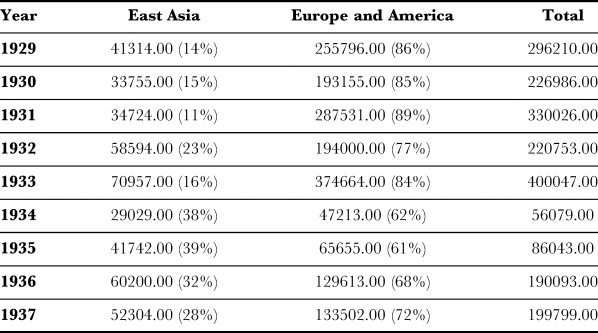
Such sales encouraged further measures for the expansion of Turkey's sales to East Asia, and in 1935 Şefik Feyzi Men was appointed the NPM's ‘Far Eastern representative’. In March 1935 he left Istanbul for Odessa, from where he was to travel to Moscow, Port Arthur, Taiwan, Indo-China, Singapore, and the Dutch East Indies to ‘find new markets, establish agencies, and strengthen our orders with purchasing firms’.Footnote 204 On his return to Turkey in July, Men complained that ‘Turkish opium had been poorly introduced in the far east’Footnote 205 because poor-quality samples had been sent by merchants. Successful meetings in Formosa resulted in a demand for new samples to be sent for assessment.Footnote 206 In the following years, the NPM made notable sales to French Indochina, the Dutch East Indies, and Kwantung, with combined opium exports to East Asia occupying a significantly greater portion of global sales as European markets declined from 1933 onwards, as can be seen in Table 5.Footnote 207
Turkish opium exports to Europe/America and Asia, 1929–1937.Footnote 199

At the same time as centralizing opium commerce under state control, the Turkish state sought to coordinate its export with other opium-producing nations. On the day the Turkish parliament endorsed the creation of the NPM, parliamentarians were asked to approve the joint export partnership negotiated the previous year with Yugoslavia,Footnote 208 which aimed to protect the prices of exports in response to the deflationary impact of the formation of a European pharmaceutical cartel in the early 1930s.Footnote 209 In the following years, Turkish negotiators attempted to expand this producers’ union further, targeting Russia and, most importantly, Iran, where a comparable monopoly had been founded under Reza Shah.Footnote 210 When negotiations were initiated between Iranian, Yugoslavian, and Turkish representatives on 14 January 1935, Ali Sami was hopeful, seeing ‘not one reason’ why the Iranians would not accept an agreement ‘that benefits Iran as much as us’.Footnote 211 It was further hoped that the Soviet Union could also be included in this effort to create a cartel of opium producers in order to maintain higher prices on dwindling exports, a suggestion that the Turkish representative Necmettin Sadak unsuccessfully attempted to push in Geneva.Footnote 212
The negotiations with Iran dragged on until February without result, however, reportedly due to the Iranians’ desire not to limit their opium exports to the degree desired by Turkey and Yugoslavia.Footnote 213 Iranian opium continued to undercut Turco-Yugoslav exports, with a sales price of 9.72–8.96 Turkish Lira per chest compared with 17.24–20.20 Turkish Lira for Turkish opium.Footnote 214 Although Turkish commentators hoped the higher morphine content of their product would sustain demand,Footnote 215 opium with a lower morphine content was often preferred by opium smokers in East Asia. A further effort to revive negotiations took place in September 1936, when a Turkish delegation headed by a Cemal Hüsnü, formerly ambassador at Bern, travelled to Tehran, but this too proved fruitless.Footnote 216
This failed attempt at coordination between opium-producing nations would limit the success of Turkey's push for access to the East Asian market. Iranian opium continued to be a major competitor, providing a source of the drug without the restrictive controls imposed on signatories of the 1912 or 1925 conventions, leaving the country ‘under no obligation’ to not export opium to China or to require import certificates from state authorities for all shipments, as its representative at the League Opium Advisory Committee was keen to remind his Chinese counterpart.Footnote 217 After the Japanese invasion of Shanghai disrupted the circulation of opium in central China, it was accordingly Iranian opium that provided the main substitute, supplying the newly established opium monopolies of the collaborationist government.Footnote 218
The prevailing principles of economic nationalism that had guided the development of the opium industry in the Turkish Republic would likewise constrain demand abroad. Opium production in Korea, developed in line with the Japanese empire's autarchic developmental policies, had risen from 1,400 kilograms in 1930 to 28,000 kilograms by 1937.Footnote 219 As Japan occupied more territory suitable for opium poppy cultivation in Manchuria and Mongolia, production increased still further, though not to the degree that Japan could ever free itself entirely from the need to import opium.Footnote 220
Japanese expansion caused additional diplomatic crises that inhibited Turkey's opium commerce with the country. Admitted as a full member of the League of Nations in the year following the Manchuria crisis, the Turkish government issued a message of support for Chinese territorial integrity, signing a treaty of friendship in 1934 that established Chinese diplomatic representation in Turkey.Footnote 221 Meanwhile, Japanese representatives in Turkey attempted to defend their country's actions in Manchuria, with the success of Japan's diplomatic efforts raising the alarm of the American embassy in Ankara.Footnote 222 In an article in the Turkish daily Vakit which gave Japan's perspective on the origins of the Manchuria crisis, the aforementioned Kamimura cited the strength of Turkey-Japan trade, specifically the 50,000 Turkish Lira of Turkish opium imports to Japan the previous year, in a call for the continued strengthening of the relationship between the two powers.Footnote 223
But though the creation of a new state in northern China under the sway of an established customer seemed promising for Turkish opium exports to the region, Turkey's recent adherence to the opium conventions and admission to the League, just as Japan departed, hamstrung its efforts. Awaiting the advice of the Opium Advisory Committee, refined at length during a series of discussions over whether agreements not to export opium and its derivatives to China should or should not apply to Manchukuo,Footnote 224 Turkey felt compelled to reject requests from the Manchukuo government for the sale of 1,000 chests of opium in 1934 and an order for 600 chests the following year.Footnote 225 Spurned by Turkey, the Manchukuo government turned to Iran, at the same time investing in its domestic production capacities, prompting a Turkish official writing in May 1935 to regret how ‘In this way, a great customer that would bring one million liras in foreign currency annually has entered the position of being our competition. The result has not changed, only Turkey was harmed.’Footnote 226
It seems that this decision was not immutable, however. In the spring and summer of 1935, Şefik Feyzi Men travelled to Japan and twice to Manchukuo in order to negotiate the export of opium.Footnote 227 Back home, Turkish newspaper editorials advocated a League rapprochement with Japan, pointing to its continued cooperation with the Opium Permanent Control Board, despite its expulsion from the League,Footnote 228 while Japan likewise attempted to use the prospect of opium cooperation to secure recognition for Manchukuo.Footnote 229 In Geneva, the Yugoslav representative complained of the unfairness of the fact that signatories to the 1925 Convention were unable to export opium to the new state while others were exempted, leading to a private discussion of whether to permit such sales.Footnote 230 Seemingly, this obstacle was overcome, as figures released by the Manchukuo government showed imports of Turkish narcotics increasing from 504,475 Manchurian yuan in 1935 to 829,156 in 1936 and 926,814 in 1937, more than double the recorded imports from Turkey's Iranian competitors.Footnote 231
Facing a growing cacophony of censure, Japan ended its cooperation with the Opium Advisory Committee and all other League bodies in 1938.Footnote 232 Its trading relationship with Turkey was already on the decline, with a three-year trading agreement between the two nations having expired in 1937 without renewal, followed by the closure of Japan's commercial exhibition in Istanbul.Footnote 233 For the first time in several years, Japan's final 1938 report to the League of Nations’ Opium Advisory Committee did not list any imports of Turkish opium to it or its colonies (Manchukuo was not included in these annual reports).Footnote 234 Turkey's 1939 and 1940 reports to the Opium Advisory Committee likewise list no purchases by Japan, with sales to the soon-to-be-conquered Dutch East Indies and French Indochina among the few remaining exports to the region.Footnote 235 Despite remaining neutral at the outbreak of the war, the spread of the conflict added further obstacles to Turkey's declining exports to East Asia, with fighting in Syria and Iraq blocking a final Japanese attempt at transporting Turkish opium to China in 1941.Footnote 236
Conclusion
The incorporation of Turkey and the continuation of Japanese participation in the international opium regime after 1933 can be judged as a sign of the resilience and the effectiveness of the social work of League bodies.Footnote 237 But this inclusivity came at the cost of greater laxity of narcotics regulations, as both countries repeatedly pushed back against moves towards greater censure and control of the narcotics trade. The struggle to suppress the opium trade between Turkey and East Asia was part of a broader failure to construct a post-war international system in which nations beyond the European liberal democracies had an equal interest. Japanese and Turkish representatives joined together in attacking the hypocrisy of Western nations that had profited from the opium trade but were now seeking to apply stringent regulations to latecomers.Footnote 238
In Turkey's opium trade with China and Japan we see states and individuals negotiating and, at times, defying the imposition of new international norms. However, the acts of peripheral states and their subjects should not be totally subsumed within a narrative of resistance against a Western-led realignment towards a new era of prohibition. Opposition to opium consumption found strong expression among the populations of both TurkeyFootnote 239 and East Asia,Footnote 240 and Turkish, Japanese, and Chinese governments appealed to these constituencies in public statements denouncing trafficking and defending the responsibility of state monopolies in handling opium commerce. Rather, the flourishing of the trans-Asian opium trade in a hostile international climate was the result of the search for profit at a time when acute concerns over national economic development and individual flourishing and survival in two regions undergoing political and economic upheaval often trumped associated diplomatic or personal costs.
Ultimately, however, the Turkish government concluded that its best interests lay in compliance, with whatever level of overt and covert resistance, with the League and its backers. Membership brought with it the power to mitigate the fallout from Turkey's continued opium trade: unfavourable pronouncements that might damage Turkey's reputation could be excised from draft reports at the committee stage, and treaty negotiations pushed in a more favourable direction before the signing of agreements. By contrast, Japan's diplomatic rift with the Western powers allowed and encouraged its government to pursue a more expansive opium policy,Footnote 241 drawing in new partners like Iran when Turkey proved reluctant. Those within the Turkish political spectrum who were attracted to Japanese pan-Asianism or saw it as a potential patron for pan-Islamist and pan-Turanian projects remained on the margins; unable to grasp the reins of Turkish foreign policy, they involved themselves in Japanese-backed plots in Central Asia.Footnote 242 The same cautious conservatism that guided Turkish policy through the MosulFootnote 243 and AlexandrettaFootnote 244 disputes and saw it maintain neutrality at the outbreak of the Second World WarFootnote 245 inhibited the Turkish government from the pursuit of greater opium profits when these came at significant diplomatic cost.