

Introduction
Tuta absoluta (Meyrick) (Lepidoptera: Gelechiidae) was initially recorded in Brazil, the major tomato producer in South America, between 1979 and 1980 on the coast of the southern state of Paraná (Meyrick, Reference Meyrick1917; Muszinski et al., Reference Muszinski, Lavendowski and de Maschio1982). It is now a devastating pest of tomato crops in South America, Europe, Africa and Asia (Tropea Garzia et al., Reference Tropea Garzia, Siscaro, Biondi and Zappalà2012; Zappalà et al., Reference Zappalà, Biondi, Alma, Al-Jboory, Arnò, Bayram, Chailleux, El-Arnaouty, Gerling, Guenaoui, Shaltiel-Harpaz, Siscaro, Stavrinides, Tavella, Vercher Aznar, Urbaneja and Desneux2013). In Iran, tomato cultivation covers about 150,000 ha, mainly located in the south of the country. In June 2011, we set up pheromone traps to cover all the producing areas in the country and identified the pest in 24 different locations, which was the first report of T. absoluta in Iran (Baniameri and Cheraghian, Reference Baniameri and Cheraghian2012). As T. absoluta is a severe pest of tomato, we expected an infestation of this pest during the crop cycle of fall and winter 2011/2012 in southern Iran. The primary host of T. absoluta is tomato, but the potato is also reported to be a host (Galarza, Reference Galarza1984; Notz, Reference Notz1992). It is a severe pest for both outdoor and greenhouse tomato. The insect usually deposits eggs on the underside of leaves, stems and fruit. After hatching, larvae penetrate tomato leaves, stems or fruit on which they feed and can cause losses of up to 100% (Apablaza, Reference Apablaza1992; Picanco et al., Reference Picanço, Bacci, Crespo, Miranda and Martins2007). Tuta absoluta larvae act as leafminers, and in large numbers, they can destroy the plant foliage; however, it is the fruit borer activity that has the significant economic impact. Infestation by the pest can destroy crop production early on by infesting both developing and ripe fruit. Tuta absoluta has a high reproductive potential. Larvae do not enter diapause as long as the food is available, and there may be 10–12 generations per year (five in Argentina) (Barrientos et al., Reference Barrientos, Apablaza, Norero and Estay1998).
Management of the pest can be problematic, mainly when the infestation pressure is high (Siqueira et al., Reference Siqueira, Guedes, Fragoso and Magalhaes2001; Lietti et al., Reference Lietti, Botto and Alzogaray2005; Desneux et al., Reference Desneux, Luna, Guillemaud and Urbaneja2011; Silva et al., Reference Silva, Picanço, Bacci, Crespo, Rosado and Guedes2011). The tomato leafminer is challenging to control, particularly in open-field tomato cultivation where the use of conventional synthetic insecticides has been relied upon for its management (Guedes and Picanço, Reference Guedes and Picanço2012; Guedes and Siqueira, Reference Guedes and Siqueira2012; Tomé et al., Reference Tomé, Cordeiro, Rosado and Guedes2012). However, in several countries, Siqueira et al., (Reference Siqueira, Guedes, Fragoso and Magalhaes2001), Lietti et al. (Reference Lietti, Botto and Alzogaray2005), Roditakis et al. (Reference Roditakis, Papachristos and Roditakis2010), Roditakis and Seraphides (Reference Roditakis and Seraphides2011) and Silva et al. (Reference Silva, Picanço, Bacci, Crespo, Rosado and Guedes2011) have reported resistance against many insecticides from different chemical classes in tomato borer. In another study, insecticide bioassays were used to determine the susceptibility of five T. absoluta strains, obtained from field collections of Europe and Brazil to pyrethroids. Haddi et al. (Reference Haddi, Berger, Bielza, Cifuentes, Field, Gorman, Rapisarda, Williamson and Bass2012) observed high levels of resistance to lambda-cyhalothrin and tau-fluvalinate in all five strains tested.
In this regard, natural products are generally preferred, because of their inherent biodegradability and less harmful compounds that affect non-target organisms (Prabakar and Jebanesan, Reference Prabakar and Jebanesan2004).
The kingdom Plantae contains secondary metabolites and macromolecules resulting from the primary metabolism that can act as defences against microorganisms, insects and herbivores or in response to abiotic stress. Many believe that the primary role of plant secondary metabolites is protecting plants from attack by pathogens or predators (Zhao et al., Reference Zhao, Davis and Verpoorte2005).
In recent years, some plants have been receiving global attention, and their secondary metabolites have been formulated as botanical pesticides for plant protection, since they do not leave residues toxic to the environment, have lower toxicity to mammals, and possess medicinal properties that are beneficial for humans (Duke, Reference Duke1985). Plants have acquired effective defence mechanisms that ensure their survival under adverse environmental conditions. In addition to morphological mechanisms, plants have also developed chemical defence mechanisms towards organisms (such as insects) that affect biochemical and physiological functions (Prakash and Rao, Reference Prakash and Rao1997). Zataria multiflora Boiss (Lamiaceae), which is locally known as ‘Avishan-e-Shirazi’, is an Iranian native plant that grows only in Iran, Pakistan and Afghanistan (Mozzaffarian, Reference Mozzaffarian1998; Ali et al., Reference Ali, Saleem, Ali and Ahmad2000). This plant has several traditional uses, such as antiseptic, anaesthetic and antispasmodic (Zargari, Reference Zargari1993). In the current study, we studied Z. multiflora essential oil (EO) composition and fumigant toxicity of EO on the egg, the second larval instars and adult of T. absoluta.
Materials and methods
Plant materials
Zataria multiflora was purchased from a local grocery store and was authenticated at the Faculty of Agriculture, Shahed University, Tehran, Iran. Aerial parts of Z. multiflora were dried naturally on laboratory benches at room temperature (23–24 °C) for 5 days until crisp. The dried materials were stored in a deep freezer at −24 °C until used. The EO was obtained from the aerial parts by hydrodistillation for 3 hr, using a Clevenger-type apparatus. The EO was dehydrated with anhydrous sodium sulfate and filtered through a 0.22 μm filter (Millipore™, Bedford, USA) and stored at 4 °C for further analysis.
Extraction of essential oil
The method of Negahban et al. (Reference Negahban, Moharramipour and Sefidkon2007), with some modification, was used to isolate the EO. Oil was extracted from the aerial parts of Z. multiflora using a Clevenger-type apparatus where the plant material is subjected to hydrodistillation. Conditions of extraction were 50 g dried leaf, 600 mL distilled water and 4 hr distillation. Anhydrous sodium sulfate was used for removing water after extraction. Extracted oil was kept in a refrigerator at 4 °C until used in experiments.
Gas chromatography–mass spectrometry analysis
The oil was analysed using an Agilent HP-5973 chromatograph (Agilent Technologies). Gas chromatographic analysis was performed with a Shimadzu GC-9A with helium as a carrier gas with a linear velocity of 30 cm/s on DB-5 Column (30 m × 0.25 mm i.d, 0.25 μm film thickness). The oven was programmed to rise to 80 °C (10 min) isotherm, and then to 260 °C at a rate of 20 °C/min. Injector and detector temperatures were 120 °C and 160 °C, respectively. The GC mass analysis was carried out on a Varian 3400 equipped with a DB-5 column with the same characteristics as the one used in GC. The transfer line temperature was 260 °C. The ionization energy was 70 ev with a scan time of 1 s and mass range of 50−500 amu. Unknown EO was identified by comparing its GC retention time to that of the known compounds and by comparing its mass spectra, either with known compounds or with published spectra (Adams, Reference Adams2007).
Insect rearing
Colonies of the tomato leafminer, T. absoluta were originally provided from leaves or leaf parts with larvae from the Entomology Laboratory of the University of Hamedan. After emergence of adults, T. absoluta moths were collected by suction and released into a transparent polyethylene jar containing fresh, detached, composite tomato leaf with the cut end fixed in a vial (4 × 1 cm) filled with sterile water. The insects were reared in a growth chamber at 27 ± 2 °C, 65 ± 5% RH and 16L: 8D h photoperiod. The insects were provided with water and an energy source (10% sucrose solution) and allowed to oviposit for 24–48 hr. If an adequate number of eggs were observed, the infested leaves were placed in an insect-proof rearing cage to allow larval development to the second instar. In particular, the infested tomato leaves were placed gently on a potted tomato plant to ensure adequate food availability. Second instar larvae, eggs and adults were used for bioassay experiments.
Fumigant toxicity assay
The Keita et al. (Reference Kéïta, Vincent, Schmit, Ramaswamy and Bélanger2000) method with some modification was used for the fumigant toxicity bioassay. The egg, the second larval instars and adult of T. absoluta were used to determine the fumigant toxicity of Z. multiflora. The fumigant toxicity of EO on second larvae (inside leaf) and egg were tested in a macro-plastic container volume 1800 mL. The vials included leaves containing larvae mines with 10 larvae (second instars) or 20 eggs, separately. After preliminary dose-setting experiments, the final concentrations of the oil causing 5–95% mortality were obtained based on logarithmic distance (Robertson et al., Reference Robertson, Russell, Preisler and Savin2007). For second instar larvae (outside leaf) and adults, bioassay experiments were done in a glass vial volume 600 mL that contained 10 larvae (second instars) or 10 adults, separately. No. 1 Whatman filter paper discs were attached to the undersurface of vials. Filter paper was impregnated with a series of pure concentrations of EO (ranging from 20, 30, 80, 160, 320 and 640 µL/L for egg; and 2, 4, 6, 8 and 10 µL/L for second instar larvae inside the leaf; and 0.8, 1, 1.5, 2 and 2.5 µL/L for second instar larvae outside the leaf; and 1, 1.2, 1.4, 1.6, 1.8 and 2 µL/L for adults) were used in the main bioassay tests. The control consisted of a similar setup but without EO. This procedure was replicated three times for each concentration. The cultures were maintained in a dark growth chamber, set at 27 ± 2 °C, 65 ± 5% RH and 16L: 8D h photoperiod. Mortality was recorded at 24 hr for second instar larvae and 48 hr for adults) after treatment.
Data analysis
Data were analysed with SAS 9.1 software (SAS Institute, 2004) followed by least significant difference tests to compare effects among treatments. Before analysis of variance, to meet normality and stability of the variances within treatments, the data for fumigant effect of the EO were transformed to arcsine square-root values. The results were expressed as means (±SE) of untransformed data and considered significantly different at P < 0.05. Probit analysis was used for estimation of LC50 and LC90 values by POLO-PC 2002 software.
Results
Chemical composition of essential oil
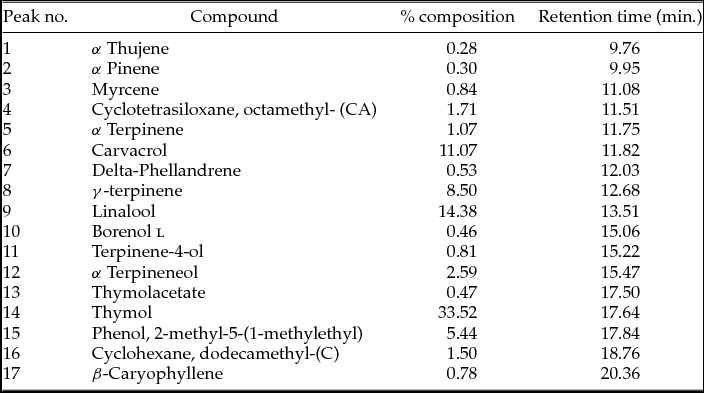
Results of the chemical constituents of Z. multiflora component analyses by gas chromatography–mass spectrometry are summarized in Table 1. The major components were thymol (33.52%), linalool (14.38%), carvacrol (11.07%) and γ-terpinene (8.50%).
Volatile compounds in steam-distilled oil from Zataria multiflora identified by gas chromatography–mass spectrometry

Fumigant toxicity
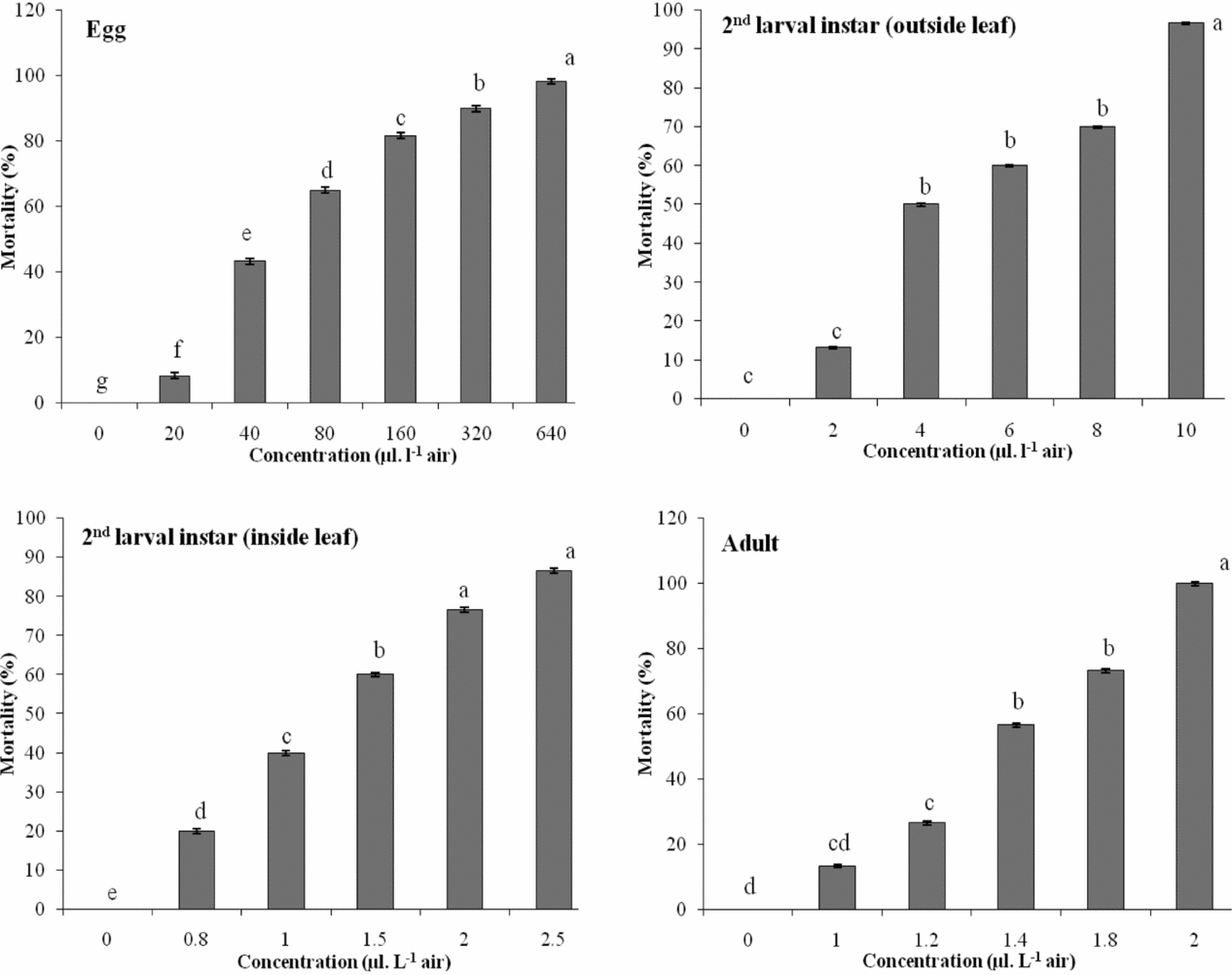
As evident from Table 2, in the EO treatments, mortality of T. absoluta eggs, larvae and adults increased as the concentration of the EO increased. Mortality was proportional to EO concentration. In a bioassay of the EO against T. absoluta eggs (F = 555.14, P < 0.001, df = 6, 14), second instar larvae, inside the leaf (F = 88.26, P < 0.001, df = 5, 12), second instar larvae, outside the leaf (F = 121.16, P < 0.001, df = 5, 12) and adults (F = 60.88, P < 0.001, df = 5, 12), significant differences were observed between mortality of the EO and the control.
Calculated values of LC20, LC50 and LC90 of Zataria multiflora essential oil against the tomato leaf miner, Tuta absoluta

Note: N, number of insects; χ 2, chi-square; df, degree of freedom; +fiducial limits.
Our results show that the adult stage of T. absoluta is more sensitive to Z. multiflora EO than egg stage and second instar larval stage, inside the leaf. The mortality rate of T. absoluta increased with higher concentrations of the EO (Fig. 1).
Mortality of different developmental stages of the tomato leafminer, Tuta absoluta exposed to Zataria multiflora essential oil in different concentrations. Different letters on the bar show significant differences.

Discussion
Monoterpenoids are the main insecticidal constituents of many plant EOs (Regnault-Roger and Hamraoui, Reference Regnault-Roger and Hamraoui1995; Ahn et al., Reference Ahn, Lee, Lee and Kim1998). These compounds are volatile and lipophilic and can penetrate into the insect cuticle rapidly and interfere with their physiological functions. Due to their high volatility, monoterpenoids have fumigant and gaseous actions (Ahn et al., Reference Ahn, Lee, Lee and Kim1998; Lee et al., Reference Lee, Peterson and Coats2003). In the current study, thymol, linalool, carvacrol and γ-terpinene were found to be the key constituents of Z. multiflora EO. Sadeghi et al. (Reference Sadeghi, Robati and Saharkhiz2015) analysed the principal components based on the mean relative amounts of Z. multiflora EO components and identified three chemotypes: carvacrol, thymol and linalool, among which the thymol chemotype is found more often in different parts of Iran. In earlier studies, Rastegar et al. (Reference Rastegar, Moharramipour, Shojai and Abbasipour2011) analysed the composition of the EO of Z. multiflora and found that the major components were thymol (30.72%), carvacrol (29.95%), para-cymene (11.38%) and γ-terpinene (8.86%). Sharififar et al. (Reference Sharififar, Moshafi, Mansouri, Khodashenas and Khoshnoodi2007) obtained similar results after evaluating EO compounds from Z. multiflora. The primary compounds were thymol (37.59%), carvacrol (33.65%), p-Cymene (7.72%) and γ-terpinene (3.88%). At variance with the current study, Misaghi and Akhondzadeh Basti (Reference Misaghi and Akhondzadeh Basti2007) reported carvacrol as the main constituent (71.12%) of the plant. The workers also identified 12 components corresponding to 91.9% of the total oil composition. In addition, according to Ebrahimzadeh et al. (Reference Ebrahimzadeh, Yamini, Sefidkon, Chaloosi and Pourmortazavi2003), the steam-distilled EO obtained from cultivated Z. multiflora in a medicinal plant research station of Alborz (Tehran, Iran) in June 2001, consisted of thymol (44.6%), λ-terpinene (21.5%), p-cymene (13.7%), carvacrol (2.35%) and β-caryophyllene (2.20%). Furthermore, Motazedian et al. (Reference Motazedian, Aleosfoor, Davoodi and Bandani2014) reported that the main constituents of Z. multiflora EOs were carvacrol (62.1%), thymol (7.4%), α-pinene (2.8%) and myrcene (2.0%). However, geographical variation, cultivar differences, time of plant growing and preparation process may have influenced oil compounds either quantitatively or qualitatively.
Many plant species produce various chemical compounds that could be a repellent or deterrent, or even toxic for plant-feeding insects (Ebrahimzadeh et al., Reference Ebrahimzadeh, Yamini, Sefidkon, Chaloosi and Pourmortazavi2003; Misaghi and Akhondzadeh Basti, Reference Misaghi and Akhondzadeh Basti2007). These chemical weapons are aimed against plant-feeding animals. Insecticidal activity of plant EOs varies with insect species, the concentration of the oil, the method of application and the exposure time (Lee et al., Reference Lee, Peterson and Coats2003; Rastegar et al., Reference Rastegar, Moharramipour, Shojai and Abbasipour2011). Additionally, some plant extracts or their constituents can be effective against insecticide-resistant insect pests (Schmutterer, Reference Schmutterer and Talekar1992; Ahn et al., Reference Ahn, Lee, Lee and Kim1998). Mixing carvacrol and thymol with proper proportions may exert the total inhibition that is observable in oregano EO that is due to damage in membrane integrity, which further affects pH homeostasis and equilibrium of inorganic ions (Lambert et al., Reference Lambert, Skandamis, Coote and Nychas2001). Few reports on the insecticidal activity of the EO of Z. multiflora exist. Mahmoudvand et al. (Reference Mahmoudvand, Abbasipour, Basij, Hosseinpour, Rastegar and Nasiri2011) investigated fumigant toxicity of some EOs extracted from different plants, including Z. multiflora, on adults of the stored-product pest, Plodia interpunctella (Hübner). LC50 value of Z. multiflora on P. interpunctella moths was 1.75 μL/L after 24 hr, which is nearly similar to our results. Regnault-Roger and Hamraoui (Reference Regnault-Roger and Hamraoui1995) studied fumigant toxicity of EO from Z. multiflora against adults, different stages of larvae, and eggs of the bean weevil, Acanthoscelides obtectus (Say). The EO showed strong adulticidal, larvicidal and ovicidal activity. In another study, results indicated that Z. multiflora has potential toxicity against the Mediterranean flour moth, Ephestia kuehniella Zeller and could be useful for integrated pest management (Emamjomeh et al., Reference Emamjomeh, Imani, Talebi, Moharramipour and Larijani2014). Probit analysis pointed out that the LC50 values for adults were 0.98 μL/L and for larvae 20.67 μL/L. Evaluation of the EO against the cabbage aphid, Brevicoryne brassicae L. showed an excellent insecticidal activity of the oil with the LC50 value of 21 μL/L (Motazedian et al., Reference Motazedian, Aleosfoor, Davoodi and Bandani2014). Findings of Rastegar et al. (Reference Rastegar, Moharramipour, Shojai and Abbasipour2011) show that EO of Z. multiflora has potent fumigant toxicity against the eggs, larvae and adults of the cowpea seed beetle, Callosobruchus maculatus (F.). Probit analysis showed that the LC50 values for adults were 8.81 μL/L; LC50 values for 1-, 7- and 14-day larvae were 8.47, 10.37, 13.36 μL/L, and LC50 values for 1-, 3- and 6-day eggs were 4.55, 3.63, 3.01 μL/L, respectively.
Our results show that Z. multiflora EO is toxic to T. absoluta larvae and adults. From the LC50 values and the same experimental conditions for larvae, as compared with the result reported by Umpiérre et al. (Reference Umpiérre, Lagreca, Cabrera, Grille and Rossini2012), Z. multiflora demonstrated higher toxicity in comparison with Eupatorium buniifolium Hook. & Arn. and Artemisia absinthium wormwood (Asteraceae). The current study shows that T. absoluta adults (0−24 hr old) are less tolerant than larvae and eggs. Similar results demonstrated that E. kuehniella and C. maculatus adults were less tolerant than larval instars (Rastegar et al., Reference Rastegar, Moharramipour, Shojai and Abbasipour2011; Zandi-Sohani, Reference Zandi-Sohani2012) towards Z. multiflora EO.
Conclusion
Zataria multiflora oil has a potential for use in sustainable pest management in the greenhouse and will have to be recommended purely for safeguarding the environment and health of the user. This is all the more so considering that application of synthetic insecticides causes the development of resistance and environmental pollution.
Acknowledgements
The authors are thankful to Dr Imani, Department of Entomology, Islamic Azad University of Tehran for providing GC–MS facility for the study. This work was supported by a grant from the Shahed University of Iran and carried out in the Faculty of Agricultural Sciences.