Introduction
Purple Haze, Northern Lights, Afghan Black, Thai Stick, Sensi, Reefer, Ganja, Bhang, Skunk, Herbal, Hash, Weed, Green, Pot, Dagga. These are just a few of the names assigned to cannabis by over 143 million users of the drug worldwide (UNODC, 2009). While these names are partly subculturally mediated, some reflect the strengths and compositions of different varieties of cannabis. What biochemically differentiates these different types is likely to be the combinations and quantities of cannabinoids in any strain.
Cannabinoids are compounds unique to the Cannabis sativa plant and around 70 have now been identified (Pertwee, Reference Pertwee2008). The main psychoactive ingredient is Δ9-tetrahydrocannabinol (THC) and this produces the effects that users seek (Curran et al. Reference Curran, Brignell, Fletcher, Middleton and Henry2002). When given intravenously to healthy humans, THC produces psychotic-like and anxiogenic effects (D'Souza et al. Reference D'Souza, Perry, MacDougall, Ammerman, Cooper, Wu, Braley, Gueorguieva and Krystal2004, Reference D'Souza, Ranganathan, Braley, Gueorguieva, Zimolo, Cooper, Perry and Krystal2008). In contrast, cannabidiol (CBD), another major constituent of most strains of cannabis, may have anti-psychotic properties (Zuardi et al. Reference Zuardi, Crippa, Hallak, Moreira and Guimaraes2006), is anxiolytic (Guimares et al. Reference Guimares, Chiaretti and Graeff1990; Bergamaschi et al. Reference Bergamaschi, Queiroz, Chagas, de Oliveira, De Martinis, Kapczinski, Quevedo, Roesler, Schroder, Nardi, Martin-Santos, Hallak, Zuardi and Crippa2011) and may be neuroprotective in humans (Hermann et al. Reference Hermann, Sartorius, Welzel, Walter, Skopp, Ende and Mann2007). The relative THC:CBD ratio in cannabis varies greatly. Levels of CBD can range from virtually none to up to 40% (Hardwick & King, Reference Hardwick and King2008). Higher levels of THC and negligible levels of CBD have been found in varieties grown hydroponically under intense farming conditions. These strains known as ‘skunk’ or sinsemilla are increasingly dominating the market in the UK and other European countries (e.g. Hardwick & King, Reference Hardwick and King2008).
Evidence for an association between cannabis and psychosis continues to accumulate, with a number of longitudinal, population-based studies showing a roughly two-fold increase in psychotic symptoms or psychotic diagnoses in young adults who use cannabis (Henquet et al. Reference Henquet, Murray, Linszen and van Os2005; Di Forti et al. Reference Di Forti, Morrison, Butt and Murray2007; Moore et al. Reference Moore, Zammit, Lingford-Hughes, Barnes, Jones, Burke and Lewis2007). However, clearly not all individuals with psychosis have been exposed to cannabis and only a tiny minority of cannabis users develop psychosis. One factor that may mediate the association between psychosis and cannabis is the type and level of cannabinoids in the cannabis that an individual smokes.
In an opportunistic study, we used hair analysis to explore the impact of smoking different levels of cannabinoids on psychotic-like symptoms in a population of drug users (Morgan & Curran, Reference Morgan and Curran2008). We found that individuals whose hair indicated that they had been habitually smoking cannabis that contained CBD (as well as THC) showed fewer psychotic-like symptoms than those whose hair showed no evidence of CBD. There are two main interpretations of this finding. First, CBD may reduce the capacity of THC to induce psychotic-like symptoms in recreational cannabis users. Second, individuals who are higher in psychosis proneness prefer and selectively chose to smoke cannabis that is higher in THC and lacking CBD. The present study was designed to differentiate between the two interpretations of those findings by also determining preferences for different types of cannabis.
Recently, we investigated the acute impact of different levels of cannabinoids by taking samples of cannabis actually smoked by users and relating these to the acute effects of the drug taken in a naturalistic environment. These studies showed that acutely smoking cannabis with higher levels of CBD protects users against the memory impairing effects of THC (Morgan et al. Reference Morgan, Schafer, Freeman and Curran2010b) and reduces their ‘attentional bias’ – the ability of cannabis-related cues to grab the individual's attention (Morgan et al. Reference Morgan, Freeman, Schafer and Curran2010a). These findings concur with recent preclinical findings that suggest CBD may reduce the salience of drug cues (Ren et al. Reference Ren, Whittard, Higuera-Matas, Morris and Hurd2009) and findings in healthy human volunteers that suggest that CBD and THC may have opposing effects on some of the neural substrates of human memory (Bhattacharyya et al. Reference Bhattacharyya, Morrison, Fusar-Poli, Martin-Santos, Borgwardt, Winton-Brown, Nosarti, O'Carroll, Seal, Allen, Mehta, Stone, Tunstall, Giampietro, Kapur, Murray, Zuardi, Crippa, Atakan and McGuire2010). As memory function can impact on educational and vocational achievement, it was important to determine whether the acute, protective effects we found of CBD on memory might also be seen longer term.
In the current study, we therefore aimed, first, to replicate our previous findings of greater psychotic symptoms in cannabis users with no evidence of CBD in hair (Morgan & Curran, Reference Morgan and Curran2008) and, second, to extend them by investigating the longer-term impact of smoking cannabis with different levels of THC and CBD on memory, psychosis-like symptoms and depression and anxiety. We again used hair analysis as an objective measure to quantify levels of cannabinoids. We predicted that habitually smoking cannabis containing CBD may protect users against longer-term psychotic-like symptoms and cognitive impairment.
Method
Design and participants
An independent groups design compared a convenience sample of 54 recreational and 66 daily cannabis users aged between 16 and 23 years, recruited by word of mouth and ‘snowball sampling’ (Solowij et al. Reference Solowij, Michie and Fox1991). Participants were counted as daily users if they used at least 25 days per month and as recreational users if they had used cannabis at least once per month (and <25 times) for at least 1 year. To be included in the study, participants were required to speak English fluently, be non-dyslexic, have no history of psychotic illnesses (gauged by verbal psychiatric history) and have normal or corrected-to-normal colour vision. Regular users (once per month or more) of any drug other than cannabis, tobacco or alcohol were excluded. All participants provided written, witnessed, informed consent on the test occasion. This study was approved by the UCL Graduate School Ethics Committee and its aims were supported by the UK Home Office.
Procedure
All participants were tested twice, once when non-intoxicated and once when intoxicated in counterbalanced order; only the former data are reported here. Participants were required to abstain from recreational drugs and alcohol for 24 h before the testing session. A saliva sample was taken to confirm abstinence from cannabis. Abstinence from other drugs (opiates, cocaine, amphetamine, benzodiazepines and other related compounds) was verified by urine tests. Participants then completed the self-report questionnaires and assessments described below. In addition to these assessments, a brief psychiatric history and detailed drug histories of the participants were also obtained using a structured interview. They also indicated whether they preferred skunk, resin, traditional herbal cannabis or had no preference. The Wechsler Adult Reading Test (WTAR; Wechsler Reference Wechsler2001) was administered to estimate participants' reading ability as a measure of verbal IQ. These assessments formed part of a larger test battery for which data collection is still underway. Following testing, participants were fully debriefed and compensated for their time and given an information leaflet about cannabis and how to seek help if needed.
Hair analysis
Hair analysis was performed by gas chromatography/mass spectrometry (GC/MS). Following addition of THC-d3 (Concateno Trichotech, UK) as the internal standard, 50 mg of the powdered hair were dissolved in 1 ml of 0.1 mol/l NaOH (100°C for 30 min). The solution was adjusted to a pH of 5.5 with 1.0 mol/l HCl and THC and CBD were extracted into n-hexane and quantified by GC/MS after silyation. The lower limit of detection was 0.025 ng/mg for both THC and CBD.
Assessment of psychotic symptoms
Brief Psychiatric Rating Scale (Overall & Gorham, Reference Overall and Gorham1962)
An abridged version of this scale was used, taken from (Ventura et al. Reference Ventura, Green, Shaner and Liberman1993) in line with Krystal et al. (Reference Krystal, Karper, Bennett, D'Souza, Abi-Dargham, Morrisey and Charney1998), which best assesses psychotic symptoms induced by psychotomimetic drugs.
Schizotypal Personality Questionnaire (SPQ)
This is a 74-item questionnaire designed to assess trait schizotypy (Raine, Reference Raine1991).
Cognitive assessments
Prose recall
This task is commonly used to gain an ecological measure of verbal memory (Wilson et al. Reference Wilson, Cockburn and Baddeley1985). Participants recalled as much as they could of a short prose passage once immediately after hearing it and again after a delay.
Source memory (Wilding & Rugg, Reference Wilding and Rugg1996)
This task was chosen as an index of episodic memory, i.e. awareness of when and where a stimulus was encoded. Stimuli consisted of 80 low frequency words, which were divided randomly into two study lists of 40 words. In each study list, half the words were spoken in a female voice and half in a male voice (allocation was randomly determined). All study words were presented to participants aurally; participants listened to each word, repeated it aloud and then, depending upon the gender of the voice it was presented in, rated the word as either ‘pleasant/unpleasant’ or ‘abstract/concrete’. After a filled delay of 6 min, participants were given a recognition test list, which combined the study list with the non-presented list. Participants indicated with a key press whether each word was one that they had heard before and, if so, whether it had been presented in a male or female voice.
Other self-rated assessments
Spielberger State-Trait Anxiety Inventory (STAI) (Spielberger, Reference Spielberger1983)
The 20 items in the trait anxiety inventory only were completed.
Beck Depression Inventory (BDI) (Beck et al. Reference Beck, Steer, Ball and Ranieri1996)
A 21 item questionnaire indexing depression over the past week.
Statistical analysis
Cognitive and psychotomimetic data were analysed with 2×2×2 univariate analyses of variance (ANOVA) with factors of group (recreational, daily), CBD (present in hair, absent from hair) and THC level in hair (high, low). A median split of THC levels in hair across the sample defined high and low groups. As group differences emerged in WTAR scores, these were covaried in the analyses of cognitive data. However, as the assumption of homogeneity of regression lines was not met for relationship between the WTAR data and other memory variables, these were not covaried for. BDI and STAI data did not correlate with memory scores; thus, these were also not added as covariates. Recognition data were subjected to signal detection analysis. Post-hoc tests were Bonferroni-corrected t tests or Mann–Whitney U tests as appropriate to the data.
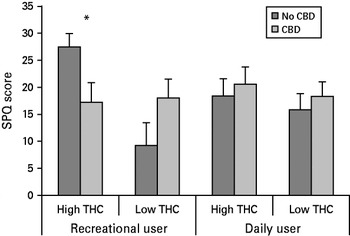
Mean Schizotypal Personality Questionnaire (SPQ) scores of recreational and daily cannabis users whose hair evidenced high or low Δ9-tetrahydrocannabinol (THC) levels and presence or absence of cannabidiol (CBD). Bars depict standard errors.

Results
Participants
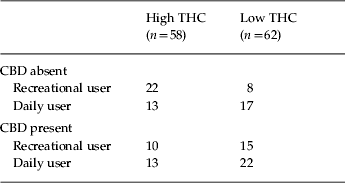
A total of 120 individuals with discernable THC levels in hair were identified from the overall sample of 270 current cannabis smokers. Of these, 54 were recreational cannabis smokers and 66 were daily users. Groups were further subdivided into those showing presence of CBD in hair and those who did not (see Table 1). Counterbalancing was equivalent across the groups, with no difference in whether participants were tested intoxicated or non-intoxicated first.
Cannabidiol (CBD) and Δ9-tetrahydrocannabinol (THC) results across the groups

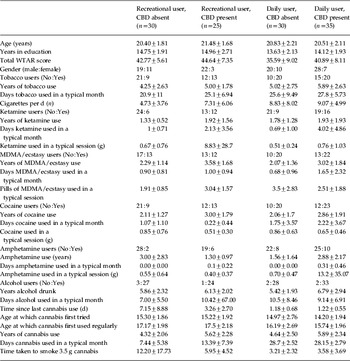
Demographics (Table 2)
The four groups did not differ in age or gender. There was a significant group difference in verbal IQ as estimated by the total WTAR score [F(3, 116)=7.16, p<0.001]. Post-hoc Bonferroni tests revealed that this was attributable to significantly lower WTAR scores in the daily cannabis users with no CBD in their hair when compared with recreational users with no CBD (p=0.003), recreational users with CBD (p<0.001) and daily users with CBD in their hair (p=0.043). There was also a trend for a group difference between the four groups in number of years spent in education [F(3, 116)=2.24, p=0.09] but with no significant differences on post hoc comparisons. There was no history of psychosis in the immediate family of any of the participants.
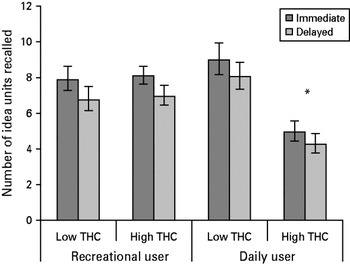
Mean prose recall scores of recreational and daily cannabis users whose hair evidenced high or low Δ9-tetrahydrocannabinol (THC) levels. Bars depict standard errors.

Demographic and drug use data across the sample

CBD, Cannabidiol; WTAR, Wechsler Test of Adult Reading; MDMA, 3,4-methylenedioxymethamphetamine.
Other drug use (Table 2)
Groups did not differ in the numbers of cigarette smokers or the number who had used ecstasy or ketamine. Drug users were defined as those taking a drug at least once per year. Group differences emerged in the number of cocaine users (χ2(3)=8.10, p=0.044), which follow-up Bonferroni-corrected χ2 tests revealed to be attributable to trends for greater numbers of cocaine users in both daily using groups (with CBD, p=0.015; without CBD, p=0.029) compared with recreational users with no CBD in their hair. The groups did not differ on any alcohol use variable.
Cannabis use (Table 2)
As expected, groups differed in when cannabis was last used [Kruskal–Wallis (KW) χ2(3)=48.71, p<0.001], years of cannabis use [F(3, 116)=3.20, p=0.026], the number of days cannabis is used in a typical month [KW χ2(3)=85.31, p<0.001] and the time taken to smoke an eighth [KW χ2(3)=20.65, p<0.001]. Group differences also emerged in the age at which cannabis was first regularly used [F(3, 116)=4.12, p=0.008]. Post-hoc Bonferroni corrected Mann–Whitney U tests revealed no further significant differences between the four groups in the number of years of cannabis use. The two daily using groups did not differ in the time since cannabis was last used, days used/month or the time taken to smoke an eighth of an ounce. Within recreational users, compared with those with CBD in hair, those without smoked cannabis fewer days per month (p=0.004) and there was a trend for them to have smoked cannabis a greater number of days ago than recreational users with CBD in their hair (p=0.02).
The expected differences emerged when comparing each group of recreational users with daily users. Recreational users with CBD in their hair had smoked cannabis a greater number of days ago than both groups of daily cannabis users (both p<0.001) and smoked a fewer number of days per month (both p<0.001), they also took longer to smoke an eighth than either the daily cannabis users without CBD (p=0.004) and those with CBD (p=0.006) in hair. Similarly, recreational users with no CBD in hair had also last smoked cannabis more days ago than daily users with CBD and without CBD in hair (both p<0.001) smoked cannabis a fewer number of days per month (both p<0.001) and took longer to smoke an eighth (both p<0.001).
Recreational users with CBD in their hair had become regular cannabis users significantly later than daily users with CBD present in their hair (p=0.018). However, there were no other group differences in the age at which individuals had become regular cannabis users. There were no differences across the four groups in the age at which cannabis was first tried.
Preference data
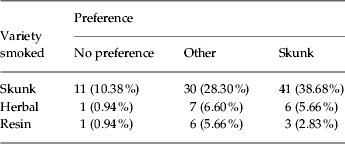
Data on preference was collapsed according to whether participants in each group preferred to smoke ‘skunk’ to other strains revealed a significant user group difference [χ2(3)=16.076, p<0.001]. A priori comparisons demonstrated that this was attributable to greater preference for skunk amongst daily users compared with recreational users (p=0.03), but no difference between the groups with presence (29 preferred skunk, 26 preferred other, five had no preference) or absence (27 preferred skunk, 19 preferred other, 13 had no preference) of CBD in hair. There was also no difference in preference for skunk versus other types of cannabis between the high (33 preferred skunk, 24 preferred other and four had no preference) and low (23 preferred skunk, 21 preferred other, 14 had no preference) THC in hair groups but significantly more participants with low THC had no preference (p=0.018). Stated preference was found to differ from the variety of cannabis that participants actually smoked on the day of testing, with the majority of participants smoking skunk (Table 3).
Reported cannabis preference and variety actually smoked across the sample

Psychotic-like symptoms
Trait psychosis proneness (SPQ)
A 2×2×2 univariate ANOVA showed a significant group×CBD×THC interaction [F(1, 116)=6.18, p=0.014], depicted in Fig. 1. There were also trends for a CBD×THC interaction [F(1, 116)=3.60, p=0.06] and a THC×group interaction [F(1, 116)=3.70, p=0.057]. Post-hoc tests showed a significant difference amongst recreational users with high levels of THC in hair: those with CBD present had significantly lower psychotic-like symptoms following Bonferroni-corrected post-hoc tests than those with no CBD present (p=0.012).
Clinical symptoms of psychosis
A 2×2×2 univariate ANOVA of total Brief Psychiatric Rating Scale (BPRS) symptoms found a trend for a main effect of group [F(1, 116)=3.08, p=0.082], with non-significantly greater scores in the recreational using group [17.6±3.86] compared with the daily using group [16.8±2.47].
Cognitive function
Prose recall
Data were covaried for WTAR score to adjust data for IQ. For immediate prose recall there was a significant group×THC level interaction [F(1, 116)=5.36, p=0.023] and a main effect of THC level [F(1, 116)=4.66, p=0.033]. Similarly for delayed prose recall data, a significant group×THC level interaction emerged [F(1, 116)=5.04, p=0.027] and a main effect of THC level [F(1, 116) 4.40, p=0.038]. Exploration of the group×THC interaction found poorer immediate (p<0.001) and delayed (p<0.001) recall in daily users with high levels of THC in hair. No significant differences between recreational users with differing levels of THC were found (Fig. 2).
Recognition memory
A 2×2×2 univariate ANOVA of d' (discriminability) scores showed a significant main effect of CBD presence [F(1, 112)=4.01, p=0.048] with better recognition memory in individuals who had CBD present in their hair [2.35±0.67] than those who did not have CBD present [2.12±0.65]. Analysis of the bias in recognition memory (C) data showed no main effects or interactions.
Source memory
Proportion correct for the source memory data were analysed and showed a trend for an interaction between THC level and group [F(1, 109)=3.82, p=0.053], reflecting a higher proportion correct in daily cannabis using individuals with a lower level of THC in the hair (mean 0.69±0.16) compared with those with a higher level (p=0.019) (mean 0.58±0.40), but no differences amongst recreational users.
BDI
The 2×2×2 univariate ANOVA found a significant main effect of THC [F(1, 118)=4.55, p=0.035], reflecting higher depression scores in the high THC (10.5±9.19) than the low THC group (6.98±10.5). Two individuals in the recreational group had a history of depression and two in the daily using group. No other participants reported any history of depression.
Trait anxiety
One individual in the daily using group had a history of anxiety disorders. A main effect of THC level [F(91, 113)=7.10, p=0.009] reflected greater anxiety in individuals with high levels of THC in hair (42.7±9.78) than low levels (37.5±9.4). There was also a trend for a main effect of group [F(1, 113)=3.37, p=0.069] with a tendency for higher anxiety in recreational users.
Discussion
Four major findings emerged from the present study. First, we replicated our previous findings of lower psychosis-like symptoms in individuals with CBD in their hair compared with those without, although we further demonstrated that this effect was confined to recreational users with higher levels of THC present in their hair. Second, daily cannabis users expressed greater preference for skunk than recreational cannabis users but there were no differences in the type of cannabis preferred between the CBD present/absent and high/low THC groups. Third, in terms of psychological well-being, higher THC levels in hair were associated with greater depression and anxiety, irrespective of CBD levels. Finally, prose recall and source memory were poorer in daily users with higher levels of THC in their hair while recognition memory was better in individuals who had CBD present in their hair independent of their degree of cannabis use.
The findings of this study support a growing body of evidence suggesting that CBD may modulate the psychotomimetic effects of THC not only acutely in laboratory settings (e.g. Zuardi et al. Reference Zuardi, Crippa, Hallak, Moreira and Guimaraes2006; Bhattacharyya et al. Reference Bhattacharyya, Morrison, Fusar-Poli, Martin-Santos, Borgwardt, Winton-Brown, Nosarti, O'Carroll, Seal, Allen, Mehta, Stone, Tunstall, Giampietro, Kapur, Murray, Zuardi, Crippa, Atakan and McGuire2010) but also chronically in cannabis users (Morgan & Curran, Reference Morgan and Curran2008). We have, however, extended our original findings to suggest that this modulation only occurs in recreational users and only those with high THC levels in their hair. The effect was absent, indeed – albeit non-significantly – reversed in users with low levels of THC in their hair. High THC recreational cannabis users with no CBD present in hair showed much greater levels of psychosis proneness than all other groups.
Our two original interpretations of these findings were that they either represent pre-existing differences that draw individuals with higher psychosis proneness to smoke low CBD cannabis or that they reflect a CBD-related mediation of THC-induced psychotic-like symptoms. Our preference data now allow us to rule out the former interpretation. We found differences only between daily and recreational users in preference for cannabis, with daily users preferring to smoke higher potency strains, which likely reflects the development of tolerance to cannabis and the need to use stronger and more potent forms. In fact, when asked about their preference for different strains, there were no differences between the CBD present and CBD absent groups. Further, recreational users generally showed a greater preference for strains other than the high potency THC, low CBD form of cannabis known as ‘skunk’. Recent findings have demonstrated greater use of skunk in individuals diagnosed with a psychotic disorder (Di Forti et al. Reference Di Forti, Morgan, Dazzan, Pariante, Mondelli, Marques, Handley, Luzi, Russo, Paparelli, Butt, Stilo, Wiffen, Powell and Murray2009). In the current study, individuals with greater psychotic-like symptoms expressed a preference for non-skunk strains. However, worryingly, our usage data suggest that these may not be the strains available to these individuals. Clearly, individuals in the current study were all healthy cannabis users and there are vast differences between individuals with high psychosis proneness and those with a diagnosis of schizophrenia. Indeed, the assessment of clinical psychotic symptoms (BPRS) showed no significant differences between our groups of cannabis users.
Our finding that CBD is offsetting the psychotic-like symptoms induced in recreational cannabis users by THC is consistent with laboratory studies giving THC and CBD to healthy volunteers (e.g. Zuardi et al. Reference Zuardi, Crippa, Hallak, Moreira and Guimaraes2006). In contrast, we recently found in a naturalistic study that CBD in smoked cannabis did not mediate acute psychotic symptoms in cannabis users (Morgan et al. Reference Morgan, Freeman, Schafer and Curran2010a). This suggests that if CBD is indeed mediating the psychotomimetic properties of THC in street cannabis, then this is a cumulative, chronic effect. This interpretation is plausible given the low levels of CBD present both in street cannabis and in hair of cannabis users compared with the high, chronic doses needed for anti-psychotic effects in patients (e.g. Zuardi et al. Reference Zuardi, Crippa, Hallak, Pinto, Chagas, Rodrigues, Dursun and Tumas2009).
The precise mechanism of CBD's modulation of the effects of THC is not clear. Pharmacologically, THC is a partial agonist at CB1 and CB2 receptors while CBD is an antagonist (with even some inverse agonist properties) at those receptors; CBD also inhibits the reuptake and hydrolysis of the endogenous cannabinoid, anandamide. Recent research has demonstrated that CBD does not directly modulate the pharmacokinetics of THC (Karschner et al. Reference Karschner, Darwin, Goodwin, Wright and Huestis2011). However, differences in endocannabinoid levels in patients prodromal for schizophrenia (Koethe et al. Reference Koethe, Giuffrida, Schreiber, Hellmich, Schultze-Lutter, Ruhrmann, Klosterkotter, Piomelli and Leweke2009), together with schizophrenic patients themselves (Leweke et al. Reference Leweke, Giuffrida, Koethe, Schreiber, Nolden, Kranaster, Neatby, Schneider, Gerth, Hellmich, Klosterkotter and Piomelli2007) have been observed. Differences in the endocannabinoid system could theoretically result in different metabolism of cannabinoids, possibly manifesting as different levels in hair. However, why this would be the case for THC and not CBD is unclear and therefore the most plausible explanation remains that CBD is chronically counteracting the induction of psychotic-like symptoms by THC.
Greater psychotic-like symptoms in individuals smoking high THC/low CBD cannabis were confined to recreational users, which complements findings from our previous study, where all individuals were recreational cannabis users. There was also a suggestion of greater drug-free psychotic symptoms on the BPRS in recreational cannabis users compared with daily users. This may also imply that, at least for the majority of cannabis users, those who are more susceptible to the harmful psychotomimetic effects may regulate their drug use accordingly. Although this appears to contrast with meta-analyses that suggest that the risk of psychosis increases with increasing cannabis use (Wilding & Rugg Reference Wilding and Rugg1996; Moore et al. Reference Moore, Zammit, Lingford-Hughes, Barnes, Jones, Burke and Lewis2007), we should bear in mind that, even with the increased risk from smoking cannabis, psychosis afflicts only a tiny minority of cannabis users. This may indeed explain why the majority of cannabis users do not develop psychosis, even those users who score highly on psychosis proneness. These data suggest that those who are more susceptible to the psychotomimetic effects, i.e. those higher in psychosis proneness (Mason et al. Reference Mason, Morgan, Dhiman, Patel, Parti, Patel and Curran2009), may use the drug less frequently and prefer to smoke lower THC strains.
Our findings suggest that both cumulative THC and CBD impact on memory function in different ways. Both prose recall and source memory were more impaired in individuals with higher THC in hair who were smoking cannabis every day; CBD had no impact on performance on these tasks. However, individuals with CBD in hair showed better performance on a recognition memory task, irrespective of either THC level or degree of cannabis use. The literature on cannabis use and memory impairment has been inconsistent with many studies failing to find differences in memory function (for a review, see Gonzalez, Reference Gonzalez2007). The findings of this study suggest that these inconsistencies may, in part at least, be due to the degree of use and the amount of THC ingested. CBD did not mediate performance on the prose recall task, which contrasts with our previous findings that CBD attenuated the acute memory impairing effects of THC on the same task (Morgan et al. Reference Morgan, Freeman, Schafer and Curran2010a), suggesting differences in the acute and chronic memory effects of CBD.
The different pattern of data observed on these memory tasks might be explained by considering the different processes underpinning successful performance on each test. Prose recall and source memory both require retrieval strategies to be initiated, whereas recognition memory does not. Further, this retrieval likely relies on the prefrontal cortex together with the hippocampus, whereas pure recognition memory has less of a prefrontal component (Wilding & Rugg, Reference Wilding and Rugg1996). This interpretation also fits with recent findings in a small-scale study of structural changes in the brains of cannabis users, which found reduced hippocampal grey matter volume in cannabis users but this was inversely correlated with levels of CBD in hair (Gonzalez, Reference Gonzalez2007; Demirakca et al. Reference Demirakca, Sartorius, Ende, Meyer, Welzel, Skopp, Mann and Hermann2010). The former authors interpret their findings in light of research demonstrating the role of the CB1 receptor and the endocannabinoid system in hippocampal neurogenesis and the potential of THC to reduce neurogenesis (e.g. Scallet et al. Reference Scallet, Uemura, Andrews, Ali, McMillan, Paule, Brown and Slikker1987; Gonzalez, Reference Gonzalez2007). Recent research has also demonstrated that CBD can increase hippocampal neurogenesis in mice (Gonzalez, Reference Gonzalez2007; Wolf et al. Reference Wolf, Bick-Sander, Fabel, Leal-Galicia, Tauber, Ramirez-Rodriguez, Muller, Melnik, Waltinger, Ullrich and Kempermann2010), which also partially supports our speculative interpretation.
Highly speculatively, the THC-induced disruption of CB1 receptor mediated hippocampal neurogenesis may also relate to our finding of increased depression and anxiety in people showing evidence of high levels of THC in hair, as it has been suggested that hippocampal neurogenesis is reduced in depression (Gonzalez, Reference Gonzalez2007; Luscher et al. Reference Luscher, Shen and Sahir2010). There has been some debate as to the reason for increased depression often observed in heavy cannabis users as to how much this is to do with life-style and social factors associated with dependent use of any drug or is related to neurochemical changes (Gonzalez, Reference Gonzalez2007). That increased depression was observed in both recreational and daily users showing higher levels of THC in hair supports the notion that neurochemical disruptions to the endocannabinoid system are, at least in part, related to the increased prevalence of depression and anxiety associated with cannabis use. Although CBD is anxiolytic in the laboratory at high doses, it is perhaps not surprising that it did not reduce anxiety chronically in this study, given the low concentrations in street cannabis. However, a limitation of this study is that we did not assess depression prior to cannabis use or proneness to depression; therefore, causality is difficult to establish. Future studies should aim to address this. Other limitations relate to the hair analysis method. The mechanism by which cannabinoids are incorporated into hair is not well understood and exact levels are susceptible to changes by exogenous factors such as composition of the water used to wash hair and materials used to treat hair, such as shampoo, hairspray and hair dyes. For this reason, we did not use the exact levels in the current study, although it would have been interesting to examine the impact of different levels on different psychological symptoms and cognition.
In summary, higher levels of THC in hair were associated with greater recall impairments, depression and anxiety, while recognition memory performance was better in individuals with evidence of CBD in their hair. We replicated our previous finding of a reduction in psychotic-like symptoms in individuals with CBD only in hair and found this was restricted to recreational cannabis users with higher levels of THC. Despite showing higher levels of psychotic symptoms, recreational cannabis users preferred to smoke lower THC/higher CBD strains of cannabis than ‘skunk’. This suggests that CBD modulates the psychotic-like effects of THC, consistent with emerging evidence of the compound's antipsychotic properties. Young people, especially those more likely to be vulnerable to psychosis, should be clearly warned of the greater harms of smoking high potency THC, low CBD strains of cannabis such as ‘skunk’.
Acknowledgements
This work was supported by a grant to H.V.C. and C.J.A.M. from the Medical Research Council (UK). The authors would like to thank the Home Office and the Forensic Science Service for their support of the study. We thank all the participants for their time.
Declaration of Interest
None.