Introduction
The distribution of species in communities can be influenced by deterministic, stochastic or both processes (Arnan et al. Reference Arnan, Cerdá and Retana2015; Leibold et al. Reference Leibold, Holyoak, Mouquet, Amarasekare, Chase, Hoopes, Holt, Shurin, Law, Tilman, Loreau and Gonzalez2004; Leonov Reference Leonov2023; Moreno et al. Reference Moreno, Landeiro and Ferro2016; Sha et al. Reference Sha, Roy, Tiwari and Chattopadhyay2024; Winegardner et al. Reference Winegardner, Jones, Ng, Siqueira and Cottenie2012). Deterministic processes are mainly related to environmental filtering and to species interactions and their relationships to abiotic and biotic factors, corresponding to the niche-based models (Kraft et al. Reference Kraft, Valencia and Ackerly2008; Leonov Reference Leonov2023; Pavoine and Bonsall Reference Pavoine and Bonsall2011). On the other hand, stochastic processes are mainly related to ecological drift, dispersal limitations, random speciation and extinction, and fitness equivalence of all individuals (Hubbell Reference Hubbell2001; Leibold et al. Reference Leibold, Holyoak, Mouquet, Amarasekare, Chase, Hoopes, Holt, Shurin, Law, Tilman, Loreau and Gonzalez2004; Leonov Reference Leonov2023; Pavoine and Bonsall Reference Pavoine and Bonsall2011).
Studies have shed new light on how spatial and environmental processes may shape species diversity at the community scale (Arnan et al. Reference Arnan, Cerdá and Retana2015; Carvalho and Tejerina-Garro Reference Carvalho and Tejerina-Garro2015; Leonov Reference Leonov2023). Both space (related to stochastic forces) and environment (related to deterministic forces) show different results of influence on distinct groups of species, such as habitat generalists and habitat specialists, species that occur in rarity or are common, and groups of species based on their body size and dispersal ability (De Bie et al. Reference De Bie, De Meester, Brendonck, Martens, Goddeeries, Ercken, Hampel, Denys, Vanhecke, Van der Gucht, Van Wichelen, Vyverman and Declerck2012; Gonçalves-Souza et al. Reference Gonçalves-Souza, Romero and Cottenie2014; Moreno et al. Reference Moreno, Landeiro and Ferro2016; Padial et al. Reference Padial, Ceschin, Declerck, De Meester, Bonecker, Lansac-Tôha, Rodrigues, Rodrigues, Train, Velho and Bini2014; Siqueira et al. Reference Siqueira, Bini, Roque, Couceiro, Trivinho-Strixino and Cottenie2012). Thus, the structure of communities can be influenced by species’ functional traits (Arnan et al. Reference Arnan, Cerdá and Retana2015; Carvalho and Tejerina-Garro Reference Carvalho and Tejerina-Garro2015; Siefert et al. Reference Siefert, Ravenscroft, Weiser and Swenson2013; Webb et al. Reference Webb, Ackerly, McPeek and Donoghue2002), which are, in large part, dictated by their phylogenetic history (Arnan et al. Reference Arnan, Cerdá and Retana2015; Gavilanez and Stevens Reference Gavilanez and Stevens2013; Webb et al. Reference Webb, Ackerly, McPeek and Donoghue2002).
Characteristics that affect the growth, reproduction and survival of the individual can be considered as a functional trait (Violle et al. Reference Violle, Navas, Vile, Kazakou, Fortunel, Hummel and Garnier2007), revealing the ecological similarities within communities (Cianciaruso et al. Reference Cianciaruso, Silva and Batalha2009; Pavoine and Bonsall Reference Pavoine and Bonsall2011). Thus, using functional traits information for a given species, instead of their taxonomy alone, can help us to better understand the mechanisms of species distributions within communities (McGill et al. Reference McGill, Enquist, Weiher and Westoby2006). Functional traits can provide critical information that cannot be obtained from scientific nomenclature (Gavilanez and Stevens Reference Gavilanez and Stevens2013; McGill et al. Reference McGill, Enquist, Weiher and Westoby2006), primarily because taxonomic identities offer limited insight into the ecological similarities among species and may not reveal the influence of stochastic and deterministic processes on communities (Pavoine and Bonsall Reference Pavoine and Bonsall2011; Siefert et al. Reference Siefert, Ravenscroft, Weiser and Swenson2013).
Within terrestrial arthropods, there is a lack of information about the influence of stochastic and deterministic processes on their communities (reviews by Soininen Reference Soininen2014, Reference Soininen2016), and the few studies addressing this variation partitioning showed a lower percentage of explanation of the pure deterministic factors (i.e., Baldissera et al. Reference Baldissera, Rodrigues and Hartz2012; Sattler et al. Reference Sattler, Borcard, Arlettaz, Bontadina, Legendre, Obrist and Moretti2010, but see Gonçalves-Souza et al. Reference Gonçalves-Souza, Romero and Cottenie2014; Moreno et al. Reference Moreno, Landeiro and Ferro2016). However, some terrestrial arthropods, such as butterflies and moths, are highly influenced by the environmental conditions of their habitats (Beck et al. Reference Beck, Schulze, Linsenmair and Fiedler2002; Gonçalves-Souza et al. Reference Gonçalves-Souza, Romero and Cottenie2014; Moreno et al. Reference Moreno, Cianciaruso, Sgarbi and Ferro2014; Moreno et al. Reference Moreno, Landeiro and Ferro2016; Panzer and Schwartz Reference Panzer and Schwartz1998; Usher and Keiller Reference Usher and Keiller1998), as they are often closely associated with plant species, in both the larval (i.e., as herbivores) and adult stages (i.e., as pollinators). Here, we analysed one of the richest clades of Lepidoptera, tiger moths (Brehm Reference Brehm2007; Weller et al. Reference Weller, DaCosta, Simmons, Dittmar, Whiting and Conner2009), to answer whether the space or the environment is more important in determining their functional traits structure. About 11,000 species of Arctiinae have been described worldwide (Zahiri et al. Reference Zahiri, Holloway, Kitching, Lafontaine, Mutanen and Whalberg2012), with roughly 6000 occurring in the Neotropics (Watson and Goodger Reference Watson and Goodger1986; Weller et al. Reference Weller, DaCosta, Simmons, Dittmar, Whiting and Conner2009). Arctiinae is comprised of four tribes: Lithosiini, Amerilini, Syntomini and Arctiini (Zaspel et al. Reference Zaspel, Weller, Wardwell, Zahiri and Whalberg2014). Species within tribes Arctiini and Lithosiini have different morphological characteristics and highly divergent feeding habits (Hilt and Fiedler Reference Hilt and Fiedler2006; Singer and Bernays Reference Singer, Bernays and Conner2009; Wagner Reference Wagner and Conner2009). The Neotropical region harbours approximately 1170 species of Lithosiini (Heppner Reference Heppner1991). The vast majority of tribe Lithosiini is composed of relatively small moths (Weller et al. Reference Weller, DaCosta, Simmons, Dittmar, Whiting and Conner2009) that are primarily lichen feeders (diet specialists, Singer and Bernays Reference Singer, Bernays and Conner2009; Wagner Reference Wagner and Conner2009; Weller et al. Reference Weller, DaCosta, Simmons, Dittmar, Whiting and Conner2009) and tend to occur in higher abundances within specialist habitats, such as forested areas (Hilt and Fiedler Reference Hilt and Fiedler2006). Many Lithosiini species are cryptic in the adult phase as an antipredator adaptation (Simmons Reference Simmons and Conner2009). Arctiini are the most diverse tribe (around 4758 species occur in the Neotropic region, Heppner Reference Heppner1991), including species variable in their morphology and life histories. They are small- to medium-sized moths that feed on a variety of plants as larvae, including grasses, herbs, shrubs and trees (most of them are diet generalists, Singer and Bernays Reference Singer, Bernays and Conner2009; Weller et al. Reference Weller, DaCosta, Simmons, Dittmar, Whiting and Conner2009). Because Arctiini are mainly diet and habitat generalists, they inhabit a variety of vegetation types (Hilt and Fiedler Reference Hilt and Fiedler2006), making cryptic colouration an unsuitable option (Simmons Reference Simmons and Conner2009). The majority of Arctiini moths are aposematic, using this adaptation to display their unpalatability to natural enemies (Simmons Reference Simmons and Conner2009). Some Arctiini and Lithosiini species sequester toxic substances from their hosts (mainly pyrrolizidine alkaloids (PAs) and lichen polyphenolics, respectively) that provide them protection against natural enemies (Hartmann Reference Hartmann and Conner2009; Scott et al. Reference Scott, Zaspel, Chialvo and Weller2014; Zaspel et al. Reference Zaspel, Weller, Wardwell, Zahiri and Whalberg2014). Many species warn their natural enemies about their unpalatability with bright colouration and mimicry of unpalatable insects like wasps, beetles and butterflies (Bowers Reference Bowers and Conner2009; Zaspel et al. Reference Zaspel, Weller, Wardwell, Zahiri and Whalberg2014).
Differences in morphology, such as body size, wingspan and patterns of colouration of Arctiini and Lithosiini, could be connected to their higher richness and abundance in specific habitat types (Hilt and Fiedler Reference Hilt and Fiedler2006). Body size can also influence the population growth and the distribution of the species in the environment (De Bie et al. Reference De Bie, De Meester, Brendonck, Martens, Goddeeries, Ercken, Hampel, Denys, Vanhecke, Van der Gucht, Van Wichelen, Vyverman and Declerck2012; Vogt et al. Reference Vogt, Peres-Neto and Beisner2013) and can influence one of the main ecosystem services that is performed by moths in the adult phase (pollination, as described for Sphingidae moths, Agosta and Janzen Reference Agosta and Janzen2005). Other traits, mainly wing-colour pattern, can influence the probability of moths being predated and parasitised, as many Arctiinae moths signal their unpalatability through warning colouration (Simmons Reference Simmons and Conner2009).
Because Arctiini and Lithosiini diverge in several aspects of their ecological niches, it is likely that their functional community structures respond differently to stochastic and deterministic processes. Here, we included other components of biodiversity, the structure of functional traits of moths’ communities, to test which processes play a greater role in shaping their community composition. Specifically, we tested if: (1) stochastic processes have a stronger influence on the functional structure of Arctiini, as these moths are primarily diet and habitat generalists and exhibit high morphological diversity (shaped by their phylogenetic relationships), which enables them to occupy a wide range of habitat types. As a result, their functional structure is less constrained by environmental variables (typically associated with deterministic processes); and (2) deterministic processes more strongly influence the functional structure of Lithosiini, as these moths are primarily diet and habitat specialists and tend to occur in higher abundances within specific habitat types. Consequently, environmental variables (associated with deterministic processes) are likely to play a greater role in shaping their functional structure.
Materials and methods
Study site
We collected tiger moths in Emas National Park (ENP), located in the Cerrado biome (17°49′–18°28′S, 52°39′–53°10′W), which is one of the 25 documented biodiversity hotspots in the world (Myers et al. Reference Myers, Mittermeier, Mittermeier, da Fonseca and Kent2000). The climate of this tropical region is humid, with three dry months in the winter. The annual rainfall varies from 1200 to 2000 mm, and the average annual temperature is around 25 °C (Ramos-Neto and Pivello Reference Ramos-Neto and Pivello2000). This Brazilian savanna encompasses distinct physiognomies that vary from areas without shrubs or trees, composed of 100% of grasses and herbs (called campo limpo), to areas with a very complex structure, with a lot of taller trees and fewer grasses and herbs (forest formations) (Oliveira-Filho and Ratter Reference Oliveira-Filho, Ratter, Oliveira and Marquis2002).
Community data
We sampled 5632 individuals belonging to 147 tiger moth species across 39 plots (10 x 10 m each) using Luiz de Queiroz light traps, with a 15 W black lamp (Silveira-Neto and Silveira Reference Silveira-Neto and Silveira1969). The plots had a minimum distance of 100 m from each other to avoid attracting individuals from other plots (Muirhead-Thompson Reference Muirhead-Thompson1991). We sampled moths over a three-year period during the dry (June 2010, July 2011 and July 2012) and rainy seasons (December 2010, November 2011 and December 2012). We collected only Arctiinae species (tiger moths); all other moths were released alive back into their natural habitat. Specimens were identified to the lowest possible taxonomic level through literature (Hampson Reference Hampson1898, Reference Hampson1900, Reference Hampson1901, Reference Hampson1914; Piñas-Rubio et al. Reference Piñas-Rubio, Rab-Green, Onore and Manzano2000; Piñas-Rubio and Manzano Reference Piñas-Rubio and Manzano2003; Watson and Goodger Reference Watson and Goodger1986). We also compared our specimens with digital images of species deposited in the Becker Collection (Camacan, Bahia, Brazil). Only specimens that were identified to species level were used in the final dataset (S = 107 species). All voucher specimens were deposited in the Zoological Collection of the Universidade Federal de Goiás (Goiânia, Brazil).
Functional trait data
We measured the following four functional traits for each species included in our dataset: wingspan, body length, thorax width and forewing colour. Forewing colour was measured categorically, regardless of the surface area occupied by each colour on the wing. As there might be intraspecific differences in body size, we measured three male individuals of different sizes for each species to obtain values for wingspan, body length and thorax width. We then calculated the mean of each variable per species and used these values in the subsequent analyses. The dataset with the functional traits had 107 species of Arctiinae, in which 91 species belong to tribe Arctiini and 16 to tribe Lithosiini (Table S1).
We performed a Pearson’s correlation between the three traits that reflect the body size (wingspan, body length and thorax width). As these three traits were highly correlated with each other (>82%), we performed a principal component analysis (PCA) and used the first axis of the PCA as the body size variable in the subsequent analysis.
Environmental variables (one of the features of deterministic factors)
In all plots that we sampled tiger moths, 10 environmental variables related to the vegetation were obtained. Host plant data were not included in our dataset. Instead, the information on arboreal and herbaceous refers to the plant species occurring within the 10 × 10 m plots. Nine of these variables were related to the woody plants (richness, density, and since there was more than one individual of the same plant species in each plot, we also calculated the coefficient of variation for the following traits: height, petiole length, tree perimeter, leaf length, leaf toughness, leaf mass and specific leaf area) (see Zava and Cianciaruso Reference Zava and Cianciaruso2014, for more details). The tenth variable was herbaceous cover, measured by the filling of 100 little squares (of 10 x 10 cm) in a square of 1 m2 (mean of two measures in each plot).
We tested for correlations between the environmental variables using the variance inflection factors (VIFs, Satoh Reference Satoh2001) method. The density of woody plants was highly correlated with the richness of woody plants (r = 0.86). Thus, we removed the variable density of woody plants in the analyses due to its higher VIF value. Environmental variables specific to each plot, which were used in the calculations, are detailed in the Supplementary Material.
Spatial variables (related to stochastic factors)
We generated the spatial variables using the principal coordinates of neighbour matrices (PCNM) technique (Borcard and Legendre Reference Borcard and Legendre2002), from the Euclidean distance matrix of the geographical coordinates of each sampled plot. We used all the axes (eigenvectors) with positive eigenvalues resulting from PCNM as the spatial descriptors in the redundancy analyses (Dray et al. Reference Dray, Legendre and Peres-Neto2006).
Functional structure (NTI)
We calculated the nearest taxon index (NTI) for the functional data for each community (each plot). The NTI quantifies the extent of terminal clustering on a functional dendrogram (Webb et al. Reference Webb, Ackerly, McPeek and Donoghue2002). This metric is dependent on the species pool of each community, and its values increase when the species of a community are more related (functional grouping) to each other and become negative when the species are not so related to each other (functional overdispersion) (Webb et al. Reference Webb, Ackerly, McPeek and Donoghue2002).
The traits variables consisted of quantitative and categorical variables. Thus, we calculated the distances matrices with the Gower’s distance (Podani and Schmera Reference Podani and Schmera2006) and the NTI as -1 X ses.mntd using the package Picante (Kembel et al. Reference Kembel, Cowan, Helmus, Cornwell, Morlon, Ackerly, Blomberg and Webb2010) in the statistical software R (R Core Team 2016; Supplementary Material).
Forward selection and variation partitioning
We performed global multiple regressions for functional structure (NTI) with all the spatial and environmental variables. Then, we selected the most important spatial and environmental variables with forward selection, where the adjusted R 2 of the global model and the p-values (≤0.05) of each variable are used as selection criteria (Blanchet et al. Reference Blanchet, Legendre and Borcard2008). We used the environmental and spatial variables selected in the partial multiple regressions, followed by variation partitioning (Borcard et al. Reference Borcard, Legendre and Drapeau1992; Peres-Neto et al. Reference Peres-Neto, Legendre, Dray and Borcard2006) for each dataset separately (functional structure of tribe Arctiini and tribe Lithosiini).
Through variation partitioning, we know the total explained variance (environment, space, shared by environment and space, and residuals); the variance explained exclusively by the environmental variables; the variance explained exclusively by the spatial variables; the variance shared by the environment and space; and the unexplained variance (Peres-Neto et al. Reference Peres-Neto, Legendre, Dray and Borcard2006). All the analyses were performed in the statistical software package R (R Core Team 2016).
Results
The environmental variables selected for the multiple regression models were the richness of woody plants, the herbaceous cover and the coefficient of variation of the leaf mass, leaf toughness and perimeter of woody plants (Table 1). The spatial variables selected represent large, intermediate and small-scale patterns, since the first, intermediate and last Moran’s eigenvector maps (MEMs) were retained for the multiple regression models (Table 1).
Results from partial multiple regressions showing the environmental and spatial variables selected by the forward selection, the percentage of explanation of each component and the p-value of the environment and space

The letters a, b, c and d mean the adjusted R2 values for the environment, shared (between environment and spatial), spatial and error components (respectively). The p (a) and p (c) mean the significance of the environmental and spatial components.
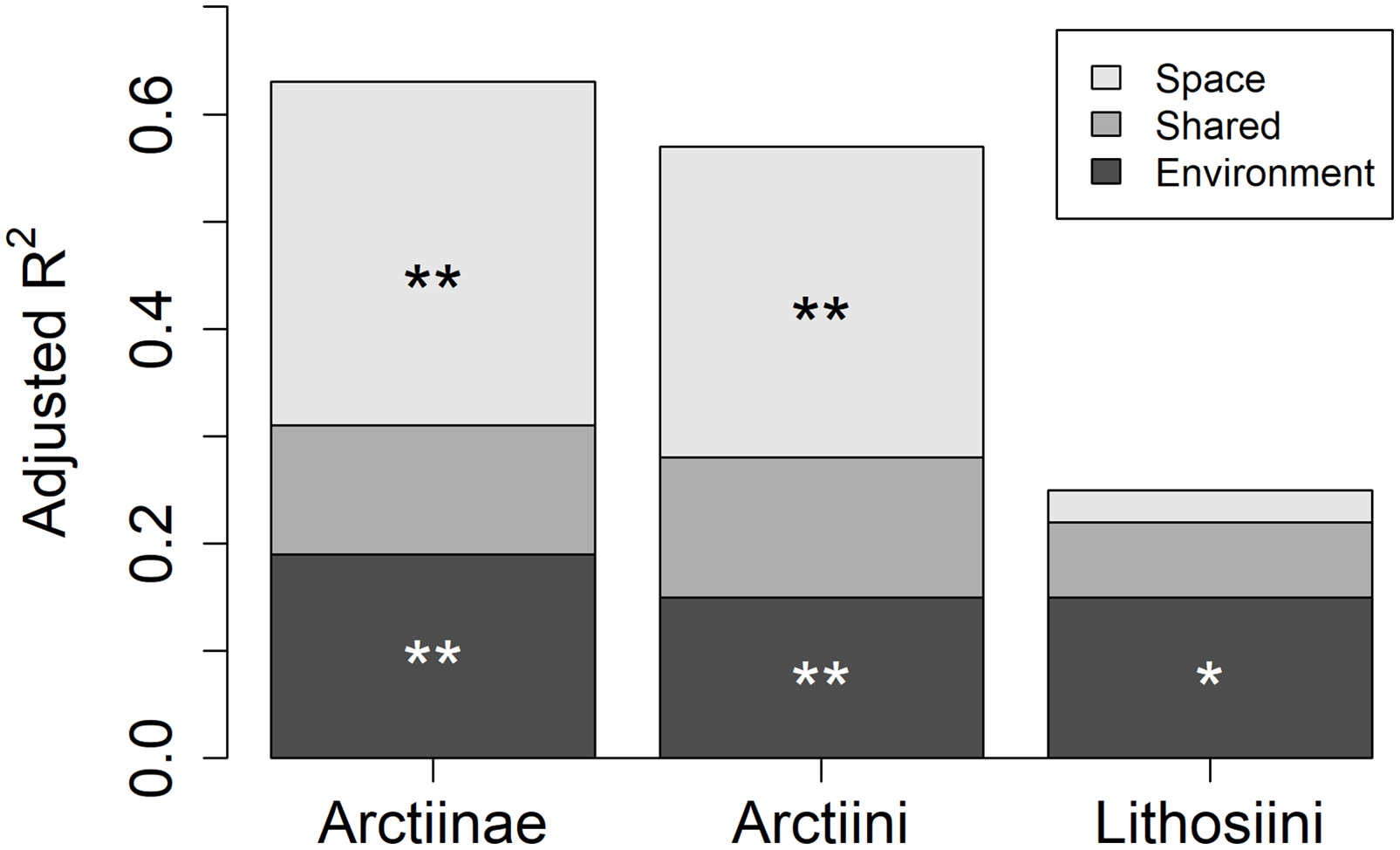
The functional traits of the entire tiger moth dataset were more influenced by space than by the environment (Table 1, Figure 1), even though they were significantly influenced by both (Table 1, Figure 1). The spatial variables (mostly related to stochastic processes) showed a greater importance to the functional structure of the tribe Arctiini (Table 1, Figure 1). Just the environment explained the variance of the functional structure of Lithosiini (Table 1, Figure 1).
Proportion of variation explained by the environment, by space and by the shared variation (space and environment) to the functional structure of tiger moths: subfamily Arctiinae, tribe Arctiini and tribe Lithosiini. The asterisks mean the statistical significance of the variation partitioning. Double asterisks (**) denote p ≤ 0.005, whereas a single asterisk (*) denotes p < 0.05.

Discussion
Both stochastic and deterministic processes are important in dictating the functional structure of Arctiinae moths. However, as predicted by our hypothesis, tribe Arctiini was more influenced by spatial variables (most of them related to stochasticity) and tribe Lithosiini was influenced by environmental variables only.
Environmental variables are related to deterministic processes, like facilitation, competition and environment filtering, which comprehend the niche-based models (Leibold et al. Reference Leibold, Holyoak, Mouquet, Amarasekare, Chase, Hoopes, Holt, Shurin, Law, Tilman, Loreau and Gonzalez2004; Leonov Reference Leonov2023; Pavoine and Bonsall Reference Pavoine and Bonsall2011); thus, species interactions and environmental filters influence the distribution of species considering the functional relationships among species in communities. Lithosiini species do not show many differences in their food resources and occupy similar vegetation types (Hilt and Fiedler Reference Hilt and Fiedler2006; Wagner Reference Wagner and Conner2009; Weller et al. Reference Weller, DaCosta, Simmons, Dittmar, Whiting and Conner2009); thus, this result suggests that the environment might be functioning as a filter to functionally closer species that habit in similar environmental conditions (Keddy Reference Keddy1992; Weiher et al. Reference Weiher, Clarke and Keddy1998). This result was just found for the functional structure and not for the taxonomic diversity (Moreno et al. Reference Moreno, Landeiro and Ferro2016), showing that just the names of species do not show all the ecological patterns along communities. Moreno et al. (Reference Moreno, Landeiro and Ferro2016) showed that Lithosiini species are mainly influenced by space and argued that as they have small size, they might be more stochastically structured mainly due to their limited dispersal capabilities (Hilt and Fiedler Reference Hilt and Fiedler2006; Moreno et al. Reference Moreno, Landeiro and Ferro2016; Soininen et al. Reference Soininen, Korhonen and Luoto2013). However, we showed here that Lithosiini can be environmentally structured if we consider their functional traits.
We showed that tribe Arctiini, which comprehends species that occupy several types of habitats and feed in several types of plants (Hilt and Fiedler Reference Hilt and Fiedler2006; Singer and Bernays Reference Singer, Bernays and Conner2009; Weller et al. Reference Weller, DaCosta, Simmons, Dittmar, Whiting and Conner2009), is mainly influenced by spatial variables (most of them related to stochasticity). Our hypothesis was that if they are diet and habitat generalists, then they might occur in several environmental conditions, and the main limiting factor to them would be their dispersal limitations (which are related to stochastic factors, even though we do not know much about their dispersal capabilities). Neutral processes (Hubbel Reference Hubbell2001), also related to spatially structured factors, such as random speciation, extinction and ecological drift (Leonov Reference Leonov2023; Pavoine and Bonsall Reference Pavoine and Bonsall2011), might be acting on the Arctiini moths as well. Purely stochastic processes can indicate that these species do not present a consistent pattern of evolutionary and ecological similarities (Swenson et al. Reference Swenson, Erickson, Mi, Bourg, Forero-Montaña, Ge, Howe, Lake, Liu, Ma, Pei, Thompson, Uriarte, Wolf, Wright, Ye, Zhang, Zimmerman and Kress2012). Also, stochastic processes can point to intrinsic factors, like biological, ecological and physiological aspects of species that might be more important in response to the functional structure of communities than the environmental variables analysed here (Soininen Reference Soininen2016). But this result can also be due to some spatially structured environmental variables more important to species traits that we did not measure in the field. If this is the case, the functional structure could reveal answers to deterministic processes that are not shown by species diversity alone (Swenson et al. Reference Swenson, Anglada-Cordero and Barone2011).
The main environmental variables selected for the variation partitioning analyses were the richness of woody plants and the herbaceous cover, as already shown for Arctiinae taxonomic composition (Moreno et al. Reference Moreno, Landeiro and Ferro2016). These two variables are the main ones that structure the gradient of vegetation occurring in the Cerrado biome (Oliveira-Filho and Ratter Reference Oliveira-Filho, Ratter, Oliveira and Marquis2002), and they are important in dictating the richness and composition of animal species (Almeida and Louzada Reference Almeida and Louzada2009; Moreno et al. Reference Moreno, Cianciaruso, Sgarbi and Ferro2014; Ribas et al. Reference Ribas, Schoereder, Pic and Soares2003; Rodrigues et al. Reference Rodrigues, Silveira, Jácomo, Carmignotto, Bezerra, Coelho, Garbogini, Pagnozzi and Hass2002). These variables were selected for the functional structure of the tribe Arctiini, but not to the functional structure of Lithosiini. Two different variables were also selected for the functional structure: the coefficients of variation of leaf mass and of perimeter of woody plants. Leaf mass is related to food resources but also might be related to the concentration of PAs in the plant (Hartmann Reference Hartmann1999). PAs are the most studied secondary compounds sequestered by moths of the tribe Arctiini (Zaspel et al. Reference Zaspel, Weller, Wardwell, Zahiri and Whalberg2014) and are involved in protecting them against predation and parasitism (Bezzerides et al. Reference Bezzerides, Yong, Bezzerides, Husseini, Ladau, Eisner and Eisner2004; Bowers Reference Bowers and Conner2009; Singer and Bernays Reference Singer, Bernays and Conner2009). Lithosiini do not sequester PAs (Weller et al. Reference Weller, Jacobson and Conner1999). The main secondary compounds sequestered by Lithosiini are lichen polyphenolics (Scott et al. Reference Scott, Zaspel, Chialvo and Weller2014). The presence of lichens in the plant might be related to the perimeter (diameter) of trees (which was the only variable related to the functional structure of Lithosiini), as larger-diameter trees present more richness of lichens (Hofmeister et al. Reference Hofmeister, Hosek, Malicek, Palice, Syrovatkova, Steinova and Cernajova2016).
Our results showed that we can achieve different results and amplify our understanding of community ecology if we consider more components of diversity (i.e., functional diversity), as already suggested by other authors (i.e., Pavoine and Bonsall Reference Pavoine and Bonsall2011; Swenson et al. Reference Swenson, Anglada-Cordero and Barone2011). We also corroborate that deterministic and stochastic processes can affect in a distinct way different groups of species, for example, common, rare, habitat specialists, habitat generalist species (Moreno et al. Reference Moreno, Landeiro and Ferro2016; Pandit et al. Reference Pandit, Kolasa and Cottenie2009; Siqueira et al. Reference Siqueira, Bini, Roque, Couceiro, Trivinho-Strixino and Cottenie2012) and related clades like tribes Arctiini and Lithosiini (Moreno et al. Reference Moreno, Landeiro and Ferro2016). Thus, stochastic and deterministic processes are important, but they also respond differently to the community structure, depending on the functional relationships among species (Arnan et al. Reference Arnan, Cerdá and Retana2015; Carvalho and Tejerina-Garro Reference Carvalho and Tejerina-Garro2015), as shown by our results.
Supplementary material
To view supplementary material for this article, please visit https://doi.org/10.1017/S0266467425100412
Acknowledgements
We want to thank everyone who helped us in the moths’ samplings: Vanessa Grandolfo, Luciano Sgarbi, Taynara Nascimento (in memoriam), Luiz Rezende, Carolina Caiado, Adriano Jaskulki, Murilo Menezes, Karen Neves, Amanda Honório, Silas Bittencourt, Balwer Pimentel, Verônica Bernadino and Hauanny Oliveira. We thank Marcus Cianciaruso, Livia Laureto and Leandro Maracahipes for the woody plants’ samplings. We also thank Nicolas Dowdy for reviewing the taxonomy of the Arctiinae moths.
Financial support
Carolina Moreno received a student fellowship from the Coordenação de Aperfeiçoamento de Pessoal de Nível Superior (CAPES and CAPES-PDSE). This research was funded by Site 13 (Parque Nacional das Emas) of the Brazilian Long-Term Ecological Research Network (CNPq, grant 441214/2016-9) and by FAPEG.
Competing interests
The authors declare none.