Reform of the European Union (EU) Common Agricultural Policy (CAP), leading to the removal of milk quotas in 2015 is expected to lead to expansion of dairy herds in Ireland (O'Donnell et al. Reference O'Donnell, Shalloo, Butler and Horan2009; DAFF, 2010). It is anticipated that in Ireland dairy farm numbers will continue to decline at the recent historical rate of 2 per cent per year to 15 500 dairy farms in 2018. Dairy cow numbers will increase by 140 000 (1·104 million in 2008 to 1·245 million in 2018) or 1·2% per year. The average herd size will increase from 55 to 80 cows. These changes are consistent with trends observed in many countries within the EU and elsewhere over the past decade (Hemme, Reference Hemme2010).
Milk production will increase as a consequence of expansion leading to a compromise between milk quality and system profitability. Milk quality will increasingly contribute to competitive advantage for a range of reasons relating to health, milk processing and farm profitability. Efficient milking systems, in terms of labour demand, capital investment and cow udder health are critical for successful expansion. Acquiring and applying new skills and knowledge to develop more efficient milk production systems is a necessity as dairy farmers in many countries adapt to the increasing scale of dairy businesses.
Labour associated with milking remains a significant constraint on dairy farms. An Irish study (O'Donovan et al. Reference O'Donovan, O'Brien, Ruane, Kinsella and Gleeson2008) showed that milking was the most time-consuming task in all herd size categories. In the herd size category of 50–80 dairy cows, labour required for milking was the strongest factor influencing farm profitability accounting for 32% of total labour demand or 3·1 cents/l. Relative to international benchmarks, Irish herds have excessive labour input at 29 h/year per cow for the >80 cow herd size category (O'Donovan et al. Reference O'Donovan, O'Brien, Ruane, Kinsella and Gleeson2008) which compares with an average of 20 h/year per cow in New Zealand (Hemme, Reference Hemme2002). An appreciable reduction in the labour associated with milking would allow economic and lifestyle improvements for dairy farmers.
While there are many factors influencing overall milking efficiency and parlour performance, the number of milking units, operator work routine, individual cow production and associated duration of unit attachment to the cow are particularly important. Increasing the number of units reduces herd milking time to a point at which labour becomes limiting (i.e. the operator cannot keep up with the number of milking units and milk-out times). This point is dependent on the operator work routine and individual cow milk production level (assuming one operator in the milking parlour). However, once that point is reached, the number of milking units is no longer the barrier to improved cow throughput. Further improvement can only be achieved by removing or automating elements of the operator work routine of the milking process. Thus, no further gain in efficiency would be achieved by installing larger parlours with more milking units.
Alternatively, further increases in unit numbers (in the absence of automatic cluster removers, ACR) reduce the efficiency of use of capital equipment and cause an increased risk of cow over-milking. Over-milking is defined as the period when teat-cups remain attached to teats after the milk flow rate from an individual cow has fallen below an arbitrary ‘end-point’ of milking e.g. a milk flow-rate of 0·2 kg/min. It is generally accepted that a moderate level of over-milking (up to 2 min) is of relatively minor concern as long as the milking system is functioning correctly. However, over-milking that exceeds 2 min for an extended period of time results in increased thickening of skin at the external teat orifice and teat congestion and oedema, increasing the risk of infection (Hamann, Reference Hamann1987; Osteras & Lund, Reference Osteras and Lund1988; Hamann et al. Reference Hamann, Burvenich, Mayntz, Osteras and Haider1994). The damage to the teat end, in particular, increases the susceptibility of the teat to invasion of mastitis-causing bacteria.
Optimum milking efficiency may be defined as when the number of milking units are appropriate for the operator work routine and the cow milk production level such that both over-milking and idle time (operator waiting time between when cows are ready for cluster attachment and when the cluster becomes available) are minimized. The operator work routine may be intensive, e.g. involving disinfection/washing of teats, fore-stripping and drying of teats, or minimal, where only parts of this routine are applied. While this process largely defines the number of milking units that may be managed by one operator (e.g. full work routine allows one operator to manage fewer clusters), it is also true that a full work routine or pre-milking preparation of cow teats can reduce the time to milk let-down and increase milk flow-rate, thus reducing cluster attachment time. Additionally, legislation (EU, 2004) requires that foremilk be examined and discarded before the milking cluster is attached. Indeed fore-milking is considered the best means of detecting the early signs of mastitis and stimulates milk let-down (Rasmussen, Reference Rasmussen2000).
Finally, cow milk production has a significant influence on cow milking time. Milking time is longer when cows are at peak lactation compared with the later stages of lactation. This is a particularly relevant scenario in both Ireland and New Zealand dairies owing to the seasonal calving pattern in both countries resulting in the complete herd being at a similar stage of lactation at any particular time point.
Thus, milking efficiency is complex and correct sizing of parlours to achieve optimum efficiency, effective use of capital investment, minimization of labour, and good udder health is the ultimate goal. Fundamental questions are currently being asked on dairy farms in Ireland, by people embarking on herd expansion, e.g. milking procedures, equipment and automation, udder health (minimizing milk somatic cell count and clinical mastitis) and time taken to milk the herd (efficiency). Therefore, the objective of this study was to establish the effect of parlour size (number of milking units), pre-milking routine (full and nil) and stage of lactation on milking efficiency (milking characteristics, row time, over-milking duration and operator idle time) of spring-calved cows, in a single-operator side-by-side, swing-over milking parlour.
Materials and Methods
Milking parlour and cows
The experiment was conducted at the Moorepark Research Farm milking parlour (Dairymaster, Causeway, Ireland) which had 30 milking units, ACR and automatic milk recording. The vacuum level was set at 50 kPa and the ACRs set to activate at a milk flow-rate threshold of 0·2 kg/min. Up to 120 cows from the Moorepark spring calving herd were used. The cows were of mixed age and mainly Holstein-Friesian breed with a mean calving date of 16 February 2009 for the late lactation experiment and 24 February 2010 for the peak lactation experiment. The cows were grazed as one herd.
Experimental design
A 5×2 factorial design was used to study the effects of parlour size and pre-milking routine on milking performance. Over-milking duration, operator idle time and milking time were the main variables of interest. Five combinations of parlour size (14, 18, 22, 26 and 30 milking units) were created by only using the appropriate number of units for the treatment, each had two different pre-milking routines [Full: manually apply teat sanitizer (1 part Deosan Super Iodip (2·0% w/v iodine): 4 parts water) by pressurized spray, fore-strip each teat, wipe teats using paper towel, attach clusters, and Nil: attach clusters]. This experiment was repeated when cows were at 221 (late lactation, 2009) and 50 (peak lactation, 2010) DIM (days in milk). Normal milking procedures were employed, i.e. Row-1 cows entered the parlour, the appropriate pre-milking treatment was applied to Row-1 cows and the clusters were attached. A period of 1·5–2 min elapsed after the last cluster was attached in Row 1 before Row 2 was loaded [∼1·5, 1·6, 1·7, 1·8 and 2 min for 14, 18, 22, 26 and 30 units, respectively (estimated from measurements taken prior to commencement of experiment)] in order to simulate teat spraying and exit of a previous row. These time delays were based on previous time measurements for teat spraying and exit of different cow numbers, so this sequence simulated what would happen at a normal milking and allowed the data from Row-2 cows to be included. Row 2 then entered the parlour and the full or nil routine was applied as appropriate. Cluster attachment to Row-2 cows was commenced as soon as cows were ready and as clusters became available from Row 1. When all clusters were swung-over and attached to the second row, cows in Row 1 were teat-sprayed post-milking and released, and the next row (Row 3) entered. The procedure was repeated for Rows 3 and 4. With nil pre-milking routine, clusters were normally attached to cows in sequence starting at cluster 1. With full pre-milking routine, the cows were sprayed, fore-stripped and wiped in that order. The full row of cows was sprayed first to ensure adequate contact time for the disinfectant product to be effective. Then foremilk was drawn, teats were wiped and clusters attached in groups of 6–7, starting at cluster 1. The ACRs were not deactivated as this could have resulted in severe over-milking and teat damage and it was not the objective of this experiment to investigate the effects of over-milking on teat condition.
The trial was carried out over 40 milking sessions at late and again in peak lactation. The cows were randomly assigned to groups before each milking session. Four rows of cows were milked at each session (the number of cows varied depending on parlour size; n=14, 18, 22, 26, 30) giving three data points from each milking session. Each combination of parlour size and pre-milking routine (Full, Nil) were tested at both morning (AM) and evening (PM) milking sessions. The same treatment combination was used at consecutive AM and PM milkings. Thus, each combination of routine and parlour size was tested at four milking sessions (two AM, two PM) giving a total of 12 values for each combination. Three experienced operators carried out the milkings, spread evenly across the combinations of parlour size, pre-milking routine and milking times. They were briefed regarding the routines required for the study to ensure consistency between operators. Night and day milking intervals were 16 and 8 h, respectively.
Data recording
Milking performance data including individual cow measurements and milking characteristics were recorded automatically by an electronic Milk Manager Programme (Dairymaster Milk Monitor, Dairymaster, Causeway, Co. Kerry, Ireland). Individual cow measurements included time of entry and exit from the parlour and time of cluster attachment. Individual cow milking characteristics measured included time to milk let-down (time taken for milk flow-rate to reach 0·20 kg/min) milk yield (kg), peak milk flow-rate (kg/min) and milking duration (min).
Some data were collected manually including time to complete the pre-milking routine, time of attachment of last milking unit in row and start and finish times of post-milking teat disinfection.
Data analysis and calculations
Automatic cluster removers were used to avoid over-milking and to ensure that a consistent end-point for milking was achieved. The hypothetical over-milking duration was calculated as the time difference between ACR activation and swing-over of a milking unit (to the next cow). Operator idle time was recorded as the time difference between the last cow of a milking row having entered the parlour or been prepared for milking and when the first cluster became available for changeover from the previous row of cows, or duration of waiting for a cluster to become available for changeover during the transfer of units to the subsequent row of cows. Further calculations included row times [time difference between the first cow of subsequent rows (on same side) entering the parlour], pre-milking preparation time (time from start to finish), post-milking teat disinfection (time from start to finish).
The data were analysed with a mixed model using GenStat 13.2. For each stage of lactation, the mixed model included the fixed effects of feeding level (for cow measurements), session (AM/PM), number of clusters, routine and their interactions and the random effects of day (with each session a different milking unit number was used), time within day (i.e. milking), row within milking and cow (for cow measurements).
Results
Milking characteristics
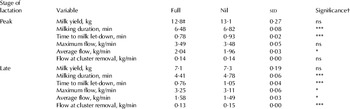
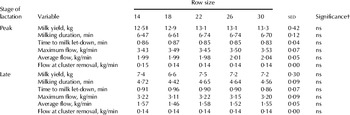
The milking characteristics of cows milked with full and nil pre-milking routines at the peak and late stages of lactation are shown in Table 1. Cow milk yield was not affected by pre-milking routine (P>0·05) at either peak or late lactation. However, the full pre-milking routine resulted in a shorter milking duration (cluster-on time) (P<0·001), shorter milk let-down time (P<0·001) and higher average milk flow-rate (P<0·05) compared with the nil pre-milking routine at both peak and late lactation stages. The full pre-milking routine shortened milking duration by 5 and 8%, respectively, in peak and late lactation. Time to milk let-down as a proportion of milking duration was influenced by pre-milking routine. Time to milk let-down represented 12 and 14%, respectively, of milking duration when full and nil routines were applied in peak lactation, while the respective proportions were 17 and 22% in late lactation. There was no effect (P>0·05) of pre-milking routine on maximum milk flow-rate or milk flow-rate at cluster removal in peak lactation; however, in late lactation maximum flow-rate was greater (P<0·05) and flow-rate at cluster removal was lower (P<0·001) following a full pre-milking routine. Milking duration, milk let-down time, maximum and average milk flow-rate as well as milk yield were not affected by milking unit number or parlour size at either peak or late lactation (Table 2). Total cow entry time, pre-spray time and time taken for cows to exit all increased (P<0·001) in duration as parlour size increased from 14 to 30 milking units in peak lactation (ranges: 0·7–1·4, 0·7–1·6 and 0·8–1·6 min, respectively). This trend was also observed in late lactation (ranges: 0·9–2·0, 0·8–1·9 and 0·6–1·4 min, respectively).
Milking characteristics of cows milked using two different pre-milking routines, (Full: spray, strip, wipe, average 1-min delay, milking cluster attachment and Nil: milking cluster attachment), when cows were an average of 50 (peak lactation) or 221 (late lactation) days in milk

† ***=P<0·001, *=P<0·05, ns=P>0·05
‡ =Least square means
Milking characteristics of cows milked in a parlour with 14, 18, 22, 26 or 30 milking units when cows were an average of 50 (peak lactation) or 221 (late lactation) days in milk

† ns=P>0·05
‡ =least square means
Milking row times
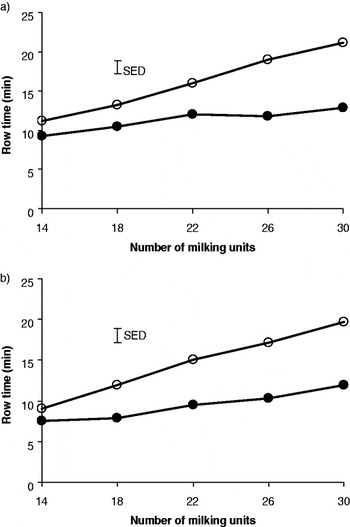
Row time increased as the number of milking units increased (P<0·001) and was longer following full compared with nil pre-milking routines (P<0·001), at both peak and late lactation (Fig. 1). There was an interaction between unit number and pre-milking routine (P<0·01). Milking row time increased from 9·2 to 12·9 min as unit numbers increased from 14 to 30, when nil pre-milking routine was applied. The corresponding row times were 11·1 to 21·1 min when full routine was applied. Shorter row times were observed in late lactation with similar trends regarding unit number and pre-milking routine.
Row duration for cows milked in a parlour with 14, 18, 22, 26 or 30 milking units and two different pre-milking routines (Full: spray, strip, wipe, milking cluster attachment [◯] and Nil: milking cluster attachment [●]), when cows were an average of (a) 50 (peak lactation) or (b) 221 (late lactation) days in milk.

Over-milking duration and operator idle time
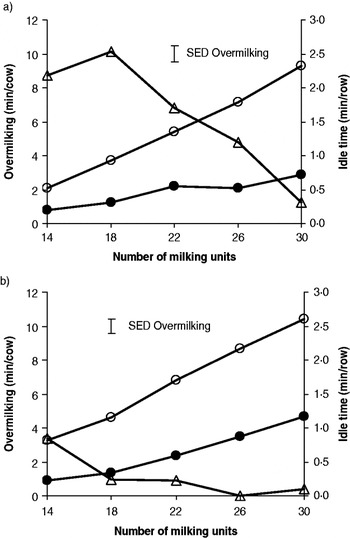
Over-milking time (without use of ACR) increased with more milking units (P<0·001) and was longer with full compared with nil pre-milking routine (P<0·001) at both peak and late lactation (Fig. 2). There was also an interaction between cluster number and over-milking time (P<0·001). Using the nil pre-milking routine, over-milking duration increased from 0·8 to 2·9 min as milking unit numbers increased from 14 to 30 at peak lactation. Using a full routine the corresponding over-milking times were 2·1 to 9·3 min. The duration of over-milking was extended in late lactation with increases of 0·9 to 4·7 and 3·3 to 10·4 min observed with nil and full pre-milking routines, respectively. A similar trend in operator idle time per row was observed with the nil pre-milking routine in both peak and late lactation; operator idle time ranged from 2·2 to 0·3 min and from 0·9 to 0·1 min, respectively, generally decreasing as milking unit number (row size) increased from 14 to 30. When a full pre-milking routine was applied, operator idle time was recorded only with a row size of 14 units in peak lactation (1·1 min) and was not recorded at any row size in late lactation.
Derived over-milking time (the time between ACR detachment and attachment of that cluster to the next row) and operator idle time (△) for cows milked in a parlour with 14, 18, 22, 26 or 30 milking units, and two different pre-milking routines, (Full: spray, strip, wipe, milking cluster attachment [◯] and Nil: milking cluster attachment [●]), when cows were an average of (a) 50 (peak lactation) or (b) 221 (late lactation) days in milk.

Discussion
The observed effects of a full compared with a nil pre-milking routine in decreasing milking duration and milk let-down time and increasing average milk flow-rate were not unexpected. The studies of both Mayer et al. (Reference Mayer, Schams, Worstorff and Prokopp1984) and Bruckmaier & Blum (Reference Bruckmaier and Blum1996) have shown that milking without pre-stimulation of the cow causes prolonged milking times and reduced milk flow-rates but does not consistently affect total milk yield. Before milking, less than 20% of the milk yielded by the cow is stored within the udder cistern, where it is immediately available for removal. Most of the milk is available for removal only after milk ejection, which occurs in response to tactile teat stimulation and oxytocin release. The benefit of pre-stimulation is, therefore, that alveolar milk is already flowing to the cisternal cavities when the milking machine is attached, thus influencing milking time and milk-flow. Kaskous & Bruckmaier (Reference Kaskous and Bruckmaier2011) showed that when udder filling was <40%, milking time was decreased with the duration of a latency period up to 45 s, independent of pre-stimulation for up to 45 s. Rasmussen et al. (Reference Rasmussen, Frimer, Horvath and Jensen1990, Reference Rasmussen, Frimer, Galton and Petersson1992) also showed that different pre-milking teat preparation routines, e.g. duration of teat wiping, vigorousness of teat stripping and delay of machine attachment affected milking performance. Those authors suggested that a 1·3-min delay (from beginning of pre-milking teat preparation until machine attachment) could be generally recommended for optimum milking characteristics. The average delay time in the current study between manual stimulation of the teat and cluster attachment was 1·0 min. The increase in duration of cow group associated tasks, e.g. entry, pre-spraying and exit with increase in cow number was expected. In fact one recognized feature of a relatively high milking unit number in swing-over parlours is the length of time taken for cow entry and exit; cow exit can have a significant effect on performance since the row needs to be emptied to make it available for the next group of cows (McFarland, Reference McFarland2001).
Rasmussen et al. (Reference Rasmussen, Frimer, Galton and Petersson1992) also showed that advanced days in lactation delayed steady milk flow. The observed greater need of pre-stimulation as lactation progresses might be an effect of the degree of udder fill. Bruckmaier & Hilger (Reference Bruckmaier and Hilger2001) reported a significant relationship between the degree of udder filling and the milk let-down time. Bruckmaier et al. (Reference Bruckmaier, Schams and Blum1994) found that milk ejection in response to oxytocin was delayed when less milk was stored in the alveolar tissue. Rasmussen et al. (Reference Rasmussen, Frimer, Galton and Petersson1992) implied that cows may have to be conditioned to stimulation for some effects, such as milk yield to be observed. While the cows in the current study were conditioned to stimulation through a full pre-milking routine, as this was standard practice in this parlour, cows responded to the full and nil routines immediately and different effects were obvious directly after the treatment was applied. The effect of pre-milking routine on milk flow at cluster removal was different at peak and late lactation. Bruckmaier & Blum (Reference Bruckmaier and Blum1998) and Bruckmaier & Hilger (Reference Bruckmaier and Hilger2001) showed that absence of teat stimulation and oxytocin release pre-cluster attachment is associated with a longer period of low milk-flow at the end of milking and the current study shows that this is more pronounced in late lactation.
Milking row time increased as milking unit numbers increased. However, the rate of increase was faster when the full compared with the nil pre-milking routine was applied; average increases in row time between 14 and 30 clusters were 11·9 and 4·1 min, for full and nil routines, respectively. This may be a consequence of a greater proportion of row time being associated with cow group activity when a nil routine was applied, e.g. cow entry and exit. Alternatively, all of the different full routine tasks were applied on an individual cow basis and so contributed to a greater proportion of row time. Even though milking duration per cow was significantly faster when a full pre-milking routine was carried out in both early and late lactation, the row time was considerably longer compared with when a nil routine was applied. This effect was also observed at the different stages of lactation; milking duration per cow in late lactation was approximately 70% of that in early lactation but this difference was not reflected in milking row time differences between the lactation stages [average milking row time was shorter with nil pre-milking routine by just 1·8 min (16%) in late lactation]. Milking row time was increased to a similar extent by full compared with nil pre-milking routine in early (4·8 min) and late (5·2 min) lactation. Thus, cow milking duration is not the primary factor influencing overall milking performance when pre-milking routines are applied; lower milking duration may be counteracted by increased time elements of pre-milking routine and/or consistent time elements of cow movement in and out of the parlour. This is exemplified in the study of Clarke et al. (Reference Clarke, Cuthbertson, Greenall, Hannah, Jongman and Shoesmith2004) which showed that pre-milking teat stimulation together with a raised ACR setting resulted in reduced average milking duration but the extra labour required for the pre-milking stimulation grossly exceeded the milking time saved.
During over-milking, the milk-flow to the teat cistern is less than the flow out of the teat canal. The avoidance of over milking was considered important by Hillerton et al. (Reference Hillerton, Pankey and Pankey2002) because of associated teat condition changes, such as discolouration, abnormal firmness or thickened rings of tissue. Such teat condition deterioration may pose a risk to an increased probability of intramammary infection (IDF, 1994). Additionally, measurements within the teat cistern have shown that within 10 pulsations of emptying of the quarter, reverse pressure gradients across the teat canal may pose a risk factor for bacterial invasion of the teat cistern (Rasmussen et al. Reference Rasmussen, Frimer and Decker1994; Rasmussen, Reference Rasmussen2004). The degree of over-milking is influenced by pre-milking routine, parlour size and stage of lactation. Over-milking of greater than 2 min after milk flow-rate has reached 0·2 kg/min can be largely avoided in a parlour with up to 26 milking clusters, in early lactation and when a nil routine is applied, while parlour size needs to be reduced to 14 units when a full pre-milking routine is applied. The corresponding parlour sizes required to minimize over-milking to 2 min in late lactation were 22 and <14, respectively. Thus, an extended milking time for individual cows, due to full routine and/ or high milk yield in early lactation may allow one operator to handle more cows. The corollary of increasing over-milking time with increased milking unit numbers, full pre-milking routine and late lactation stage was less operator idle time in these scenarios.
The milking performance influencing factors examined here included number of milking units, pre-milking routine and stage of lactation, and the measured parameters were milking characteristics, milking row time, over-milking and operator idle time. As the number of milking units increased, row time and duration of over-milking were increased and the operator idle time was reduced. The type of routine practised largely dictates the number of milking units one operator can handle and the overall efficiency of the milking operation (CowTime Guidelines, Reference Klindworth, Greenall and Cambell2003). It may be appropriate to change routines as the season advances in the Irish situation. It may be prudent to clean the teats as well as inspecting foremilk when weather conditions are less favourable in early spring or cows may be housed for part of the day and while cows are still quite vulnerable to infection in very early lactation. However, as lactation progresses, weather generally improves (and cows move to a completely outdoor situation), it may not be necessary to clean at every milking if the other farm conditions prevail which allow the cows to present clean for milking [however, legislation (EU, 2004) requires that foremilk be examined and discarded before each milking]. When nil preparation is used, the milking operator can manage more milking units, particularly so at peak lactation when cow milking duration is longer owing to higher milk yield. Thus, parlours could be sized for that scenario, while also taking account of total cow numbers and target time spent milking. Alternatively, milking with the same numbers of milking units in winter when cows are housed, when cows may require a full pre-milking routine and coinciding with low milk yields, will result in over-milking as a feature of the milking operation. The use of automation in the form of ACRs may be used to eliminate over-milking during that period.
While over-milking can be eliminated by ACRs, it is still beneficial to examine overall efficiency in milking, since capital investment needs to be prudent. Thus, the parameters of row time, idle time and total milking time need to be examined to establish the minimum number of units that would lead to efficient milking at peak lactation. If this number of units then leads to over-milking in late lactation, ACRs may be used.
Choices of alternative milking infrastructures exist depending on herd size, preferred pre-milking routine, desired milking time and capital available for investment. For example, in a one-person milking process, when a nil pre-milking routine is applied throughout lactation, 22 milking clusters may be operated without over-milking of longer than ∼2 min, in the absence of ACRs, resulting in a milking time of 2 and 1·6 h in early and late lactation, respectively, for a herd of 220 cows (e.g. 10 rows, 9·5-min milking row time). The use of ACRs would allow up to 26 clusters to be managed owing to the ACR effect in eliminating over-milking in late lactation, thus enabling a 260-cow herd to be milked in 2 and 1·8 h in peak and late lactation, respectively, (e.g. 10 rows, 11·8-min milking row time). Alternatively, when a full pre-milking routine is applied throughout lactation, milking cluster numbers of 14 (peak lactation) or less (late lactation) may be operated without experiencing over-milking of longer than ∼2 min in the absence of ACR. While ACR prevent over-milking when using more milking clusters, such additional units in this scenario will not allow significantly more cows to be milked within a specified time e.g. 2 h, as the pre-milking routine is the limiting factor. The remaining alternative of applying a nil and full routine in peak and late lactation, respectively, is limited by the full routine in late lactation, and therefore ACR are required to prevent over-milking. While minimum unit numbers reduce capital investment, this approach can have the negative effect of increasing overall milking time. Vostrikov (Reference Vostrikov1995) reported that after 2 h of uninterrupted work, the efficiency of even highly trained and experienced operators can decrease because of physical tiredness, resulting in interruptions and errors which adversely affect productivity.
In conclusion, the full pre-milking routine resulted in a shorter milking duration, shorter time to milk flow and higher average milk flow-rate compared with the nil pre-milking routine at both peak and late lactation stages. However, this was not reflected in overall milking efficiency since milking row time was increased with the full pre-milking routine. Increasing milking unit number can reduce overall milking time but is limited by the increase in row time, which is influenced by both pre-milking routine and stage of lactation and which, in turn, influences cow over-milking. These results have implications for milking management generally including rotary parlours, and particularly in seasonally calved herds in both Ireland and New Zealand.
The authors wish to acknowledge the assistance of the milking staff at Moorepark. The financial support of the dairy industry is also acknowledged. J. Jago was supported by DairyNZ Inc. while on sabbatical during the completion of this study.