Mental ill health can be a life-changing problem for those directly affected, and also a major economic cost for society, mainly due to its direct and indirect connections with work-related problems. According to the Organization for Economic Co-operation and Development (OECD, 2012), mental disorders are the biggest single cause of disability benefit claims in Western countries. Work disability occurs when a health condition limits the ability of a worker to participate in paid employment, and is by definition the main underlying cause of sickness absence and disability pension. However, work ability has been defined as the balance between human resources and the demands of work, and thus takes into consideration that mental and/or physical illness is not equivalent to work disability.
The most commonly used measure of work ability is the Work Ability Index (WAI; Ilmarinen et al., Reference Ilmarinen, Tuomi, Eskelinen, Nygård, Huuhtanen and Klockars1991; Tuomi et al., Reference Tuomi, Ilmarinen, Eskelinen, Järvinen, Toikkanen and Klockars1991; Tuomi et al., Reference Tuomi, Ilmarinen, Seitsamo, Huuhtanen, Martikainen, Nygård and Klockars1997). The WAI measures seven dimensions: (1) current work ability compared with lifetime best, (2) work ability in relation to job demands, (3) number of current diseases diagnosed by a physician, (4) estimated work impairment due to those illnesses or injuries, (5) number of days on sickness absence during the past 12 months, (6) own prognosis of working ability two years from now, and (7) mental resources in general. The WAI has good predictive validity and is associated with frequent short-term absence (taking sick leave three or more times a year; Notenbomer, Groothoff, van Rhenen, & Roelen, Reference Notenbomer, Groothoff, van Rhenen and Roelen2015), long-term sickness absence and disability pension (Ahlstrom, Grimby-Ekman, Hagberg, & Dellve, Reference Ahlstrom, Grimby-Ekman, Hagberg and Dellve2010; Alavinia, Berg, Duivenbooden, Elders, & Burdorf, Reference Alavinia, Van Den Berg, Van Duivenbooden, Elders and Burdorf2009; Bethge, Spanier, Peters, Michel, & Radoschewski, Reference Bethge, Spanier, Peters, Michel and Radoschewski2017; Kujala et al., Reference Kujala, Tammelin, Remes, Vammavaara, Ek and Laitinen2006; Lindberg, Josephson, Alfredsson, & Vingård, Reference Lindberg, Josephson, Alfredsson and Vingård2009; Lundin, Leijon, Vaez, Hallgren, & Torgen, Reference Lundin, Leijon, Vaez, Hallgren and Torgén2017; Reeuwijk et al., Reference Reeuwijk, Robroek, Niessen, Kraaijenhagen, Vergouwe and Burdorf2015; Sell, Reference Sell2009). It is associated with unemployment (Bethge, Radoschewski, & Gutenbrunner, Reference Bethge, Radoschewski and Gutenbrunner2012), and can also be used to identify mid-life workers at risk of premature exit from work (Roelen et al., Reference Roelen, Heymans, Twisk, van der Klink, Groothoff and van Rhenen2014).
The WAI has been criticised on theoretical grounds, as it consists of a combination of factors that do not seem to form a single dimension of work ability as intended (Martus, Jakob, Rose, Seibt, & Freude, Reference Martus, Jakob, Rose, Seibt and Freude2010; Radkiewicz, Widerszal-Bazyl, & NEXT-Study Group, Reference Radkiewicz and Widerszal-Bazyl2005). However, several studies have shown that using single items from the WAI offer reliable indicators of work ability and have approximately the same predictive validity as the whole scale (Ahlstrom et al., Reference Ahlstrom, Grimby-Ekman, Hagberg and Dellve2010; Kinnunen & Nätti, Reference Kinnunen and Nätti2018; Leijon et al., Reference Leijon, Balliu, Lundin, Vaez, Kjellberg and Hemmingsson2017; Lindberg et al., Reference Lindberg, Josephson, Alfredsson and Vingård2009; Lundin et al., Reference Lundin, Leijon, Vaez, Hallgren and Torgén2017; Roelen et al., Reference Roelen, Van Rhenen, Groothoff, Van der Klink, Twisk and Heymans2014). Among its items, the item on individuals’ own evaluation of their work ability compared with lifetime best (work ability scale; WAS) is most commonly used. In addition to the WAS, one's own prognosis of working ability two years from now (future work ability; FWA) has been recommended singly for use in general health studies as it predicted both disability pension and long-term sick leave over a subsequent three-year period, and is less dependent on working conditions than the WAS (Kinnunen & Nätti, Reference Kinnunen and Nätti2018). In line with this notion, FWA has shown predictive validity for disability pensions, long-term sickness absence and recurrent unemployment (Lundin, Kjellberg, Leijon, Punnett, & Hemmingsson, Reference Lundin, Kjellberg, Leijon, Punnett and Hemmingsson2016; Lindberg et al., Reference Lindberg, Josephson, Alfredsson and Vingård2009).
As self-assessed present and future work ability is related to short- and long-term sickness absence and disability pension, there is a need to identify the psychological determinants of work ability with a view to developing interventions that can have an impact on them, thus increasing work ability and helping to improve return to work and good occupational functioning. While psychosocial work factors such as conflicting role expectations (Emberland & Knardahl, Reference Emberland and Knardahl2015) and decreased job control (Boström, Sluiter, & Hagberg, Reference Boström, Sluiter and Hagberg2012) are of particular relevance to level of work ability, there is also evidence suggesting that individual factors such as mental ill health independently contribute (e.g., Leijon et al., Reference Leijon, Balliu, Lundin, Vaez, Kjellberg and Hemmingsson2017). In particular, common mental disorders (CMD) such as anxiety and depression constitute major public health and economic challenges as they are associated with an increased risk of becoming unemployed, are related to high incidence of sickness absence (Rai et al., Reference Rai, Kosidou, Lundberg, Araya, Lewis and Magnusson2012; van Rijn, Robroek, Brouwer & Burdorf, Reference van Rijn, Robroek, Brouwer and Burdorf2014; Wittchen et al., Reference Wittchen, Jacobi, Rehm, Gustavsson, Svensson, Jönsson and Fratiglioni2011) and are the biggest single cause of disability benefit claims in Western countries (OECD, 2012). Regardless of occupation, workers with CMDs have lower work ability compared to controls (Boschman, van der Molen, Frings-Dresen & Sluiter, Reference Boschman, Van der Molen, Frings-Dresen and Sluiter2014; Gärtner, Nieuwenhuijsen, van Dijk, & Sluiter, Reference Gärtner, Nieuwenhuijsen, van Dijk and Sluiter2010). Levels of self-reported work ability are associated with return to work among these individuals (Ekberg, Wåhlin, Persson, Bernfort, & Öberg, Reference Ekberg, Wåhlin, Persson, Bernfort and Öberg2015; Hensing, Bertilsson, Ahlborg, Waern, & Vaez, Reference Hensing, Bertilsson, Ahlborg, Waern and Vaez2013; Victor, Lau, & Ruud, Reference Victor, Lau and Ruud2017, Reference Victor, Lau and Ruud2018). Therefore, understanding determinants of work ability is of particular importance among those with CMDs.
One model that recently has advanced understanding of CMD is the metacognitive model (Wells, Reference Wells2009). The metacognitive model is based on a theoretical framework, the Self-Regulatory Executive Function (S-REF) model (Wells & Matthews, Reference Wells and Matthews1994, Reference Wells and Matthews1996), which emphasises biased metacognitive knowledge (e.g., beliefs about thinking) as a key factor underlying psychological disorder. According to this model, metacognitive beliefs (e.g., ‘I cannot stop worrying’ or ‘I cannot trust my memory’) give rise to a perseverative negative thinking style called the cognitive attentional syndrome (CAS; Wells, Reference Wells2009), consisting of worry/rumination, threat monitoring (e.g., memory checking) and other maladaptive coping behaviours. Together, these metacognitions and processes cause mental management strategies that are counterproductive in reducing distress or in enhancing confidence in performance. The metacognitive model differs substantially from other psychopathology models in its emphasis on the factors that control cognitive styles, and could potentially advance understanding of intrapsychic factors (e.g., metacognitive beliefs) contributing to work ability. For example, dysfunctional beliefs about the controllability and effectiveness of cognition are likely to undermine a sense of ability to work as they will undermine an individual's expectation of mastery and ability to cope with demands in the workplace.
Consistent with an application of the metacognitive model in the work context, metacognitive beliefs have been reported to be associated with self-reported work status. In one study, beliefs about the need for control of thoughts (e.g., ‘I should be in control of my thoughts all the time’) was negatively associated with work status after controlling for the presence of a mental disorder and trait-anxiety (Nordahl & Wells, Reference Nordahl and Wells2018). In another study, stronger negative metacognitive beliefs about uncontrollability and danger of thoughts was associated with lower work status in high socially anxious individuals above symptom severity and factors emphasised in cognitive-behavioural therapy (Nordahl & Wells, Reference Nordahl and Wells2017).
Despite these two previous studies on work status and metacognitions, to the authors’ knowledge, the relation between maladaptive metacognitive beliefs and the construct of work ability has not been previously investigated. The primary aim of the present study was therefore to explore predictors of self-assessed present and future work ability in a sample of individuals with common mental disorders by testing the capacity of metacognitive beliefs to explain additional and unique variance in them. To provide a more stringent test of the contribution of metacognitions, several variables were controlled before exploring the relative contribution of metacognitive beliefs. Gender and age were controlled, as female gender and older age are associated with lower work ability (Stansfeld & Candy, Reference Stansfeld and Candy2006; Kooij, De Lange, Jansen, & Dikkers, Reference Kooij, De Lange, Jansen and Dikkers2008). Physical health is a marker of work ability in itself and ‘number of diagnoses by a physician’ has shown excellent ability to predict long-term sickness absence in the subsequent year (Lundin et al., Reference Lundin, Leijon, Vaez, Hallgren and Torgén2017). Moreover, severity of psychological distress is associated with lower work ability (Leijon et al., Reference Leijon, Balliu, Lundin, Vaez, Kjellberg and Hemmingsson2017), and it is necessary to control for the overlap between metacognitive beliefs and distress, as a potential association between metacognitive beliefs and work ability might merely reflect elevated psychopathology (Wells, Reference Wells2009). Our hypotheses were as follows: (a) current work ability will positively correlated with future work ability; (b) present and future work ability will be negatively correlated with number of physical disorders; (c) present and future work ability will be negatively correlated with anxiety and depression symptoms; (d) metacognitions will be negatively correlated with present and future work ability; (e) number of physical disorders and emotional distress will account for independent variance in present and future work ability; and (f) metacognitive beliefs will account for additional variance in present and future work ability when controlling for age, gender, physical disorders and emotional distress.
Methods
Participants and Procedure
Participants were invited to participate in a survey of mental health through advertisements on social media. Voluntary organisations for mental health in Norway distributed information about the survey to their social media followers. The study was approved by the regional committees for medical and health research ethics (ref. no. 2017/906/REK midt). Seven hundred and seventy-three participants were recruited at convenience using an online survey program and completed a battery of self-report measures. Of the 773 individuals, 177 reported that they were of working age, not currently studying, and had been diagnosed with a common mental disorder such as an anxiety disorder or major depression, and therefore met eligibility for the current study.
In the total sample, one hundred and forty-eight (83.6%) were female, and the mean age was 36.05 (SD = 9.10). In terms of civil status, the sample consisted of 57 (32.2%) singles, 16 (9.0%) in a relationship, 93 (52.5%) cohabitant/married, and 11 (6.2%) divorced/separated. In terms of work status, 58 (32.8%) reported they were working full time, 20 (11.3%) reported working part time, and 99 (56.0%) were on short- or long-term sick leave. Fifty-eight (32.8%) had completed higher education; at least three years at a university or equivalent. In terms of physical disorders diagnosed by a physician, 40 (22.6%) reported zero disorders, 60 (33.9%) reported that they had 1 physical disorder, and 77 (43.5%) reported that they had been diagnosed with 2 or more physical disorders. On average, the participants reported that they were diagnosed with 1.2 (SD = 0.79) physical disorders by a physician. The most common reported physical disorders were musculoskeletal disease (n = 58), neurological and sensory disease (n = 38), respiratory disease (n = 24), and cardiovascular disease (n = 22).
Measures
Work Ability Index
(WAI; Ilmarinen et al., Reference Ilmarinen, Tuomi, Eskelinen, Nygård, Huuhtanen and Klockars1991; Tuomi et al., Reference Tuomi, Ilmarinen, Eskelinen, Järvinen, Toikkanen and Klockars1991; Tuomi et al., Reference Tuomi, Ilmarinen, Seitsamo, Huuhtanen, Martikainen, Nygård and Klockars1997). The WAI comprises seven items intended to capture the work ability of employees as described in the introduction. In the current study, the WAI was used to gather information about health status, and we used items 1 (self-assessed present work ability; WAS) and 6 (self-assessed future work ability; FWA). These subscales are measured with single items; self-assessed present work ability compared with the lifetime best is measured on an 11-point Likert-type scale from 0 (cannot currently work at all) to 10 (work ability at its best). Self-assessed own prognosis of work ability measured two years from now is measured on a 3-point scale from 1 (unlikely) to 3 (relatively certain).
Generalised Anxiety Disorder-7
(GAD-7; Spitzer, Kroenke, Williams, & Löwe, Reference Spitzer, Kroenke, Williams and Löwe2006). The GAD is a seven-item self-report tool assessing severity of generalised anxiety disorder symptoms. The respondent is asked to indicate how often during the past two weeks he or she has been bothered by the listed problems (e.g., ‘Feeling nervous, anxious or on the edge’, ‘Trouble relaxing’) on a 4-point scale from 0 (not at all) to 4 (nearly every day). Total scores range from 0 to 28; higher scores indicate higher levels of generalised anxiety symptoms. The instrument has shown excellent internal consistency (α = .92) and good test–retest reliability (r = .83) (Spitzer et al., Reference Spitzer, Kroenke, Williams and Löwe2006). In the current study the internal consistency was good (α = .85).
Patient Health Questionnaire
(PHQ-9; Kroenke, Spitzer, & Williams, Reference Kroenke, Spitzer and Williams2001). The PHQ-9 is a nine-item self-report tool, based on the nine criteria for diagnosing depression in the Diagnostic and Statistical Manual of Manual Health (4th ed., text rev.; DSM-IV-TR; American Psychiatric Association, 2000). Each item is scored on a scale from 0 (not at all) to 3 (nearly every day). Total scores range from 0 to 27, higher scores indicate higher levels of depression symptoms. Evidence supports the PHQ-9 as a valid instrument for measuring depression (Kroenke, Spitzer, Williams, & Löwe, Reference Kroenke, Spitzer, Williams and Löwe2010). In this study, the internal consistency was good (α = .88).
Metacognitions Questionnaire 30
(MCQ-30; Wells & Cartwright-Hatton, Reference Wells and Cartwright-Hatton2004). This is a 30-item self-report scale measuring beliefs about thinking. Responses are required on a 4-point scale ranging from 1 (do not agree) to 4 (agree very much). The MCQ-30 has a replicable five-factor structure concerning: (1) positive beliefs about worry (e.g., ‘Worrying helps me cope’); (2) negative beliefs about the uncontrollability and danger of worry (e.g., ‘My worrying could make me go mad’); (3) cognitive confidence (e.g., ‘I have a poor memory’); (4) need to control thoughts (e.g., ‘It is bad to think certain thoughts’); and (5) cognitive self-consciousness (e.g., ‘I am constantly aware of my thinking’). Higher scores reflect stronger endorsements of the beliefs in question. The five-factor structure of the MCQ-30 has been reported as reliable (Nordahl, Hjemdal, Hagen, Nordahl, & Wells, Reference Nordahl, Hjemdal, Hagen, Nordahl and Wells2019; Spada, Mohiyeddini, & Wells, Reference Spada, Mohiyeddini and Wells2008;) and can account for individual variance in distress beyond ‘a general metacognition factor’ (Fergus & Bardeen, Reference Fergus and Bardeen2017). The measure has shown good internal consistency, with alphas for the subscales ranging from .72 to .93 and a retest correlation for the total scale of .75 (Wells & Cartwright-Hatton, Reference Wells and Cartwright-Hatton2004). In the current study, the internal consistency of subscales ranged from .80 to .88.
Overview of Statistical Analyses
Pearson bivariate correlations were used to explore relationships between the variables. Two hierarchical multiple regression analyses were run to test the potential contribution of metacognitive beliefs in explaining variance in present and future work ability. In the first regression analysis, present work ability was used as the dependent variable, while future work ability was the dependent in the second regression analysis. In both regressions, gender and age were controlled in step 1, number of physical disorders entered in step 2, symptoms of generalised anxiety and depression in step 3, and metacognitions in step 4. Only metacognitive belief domains that showed a significant bivariate correlation with present and/or future work ability were entered in the regression models in the final step.
Results
Correlational analyses
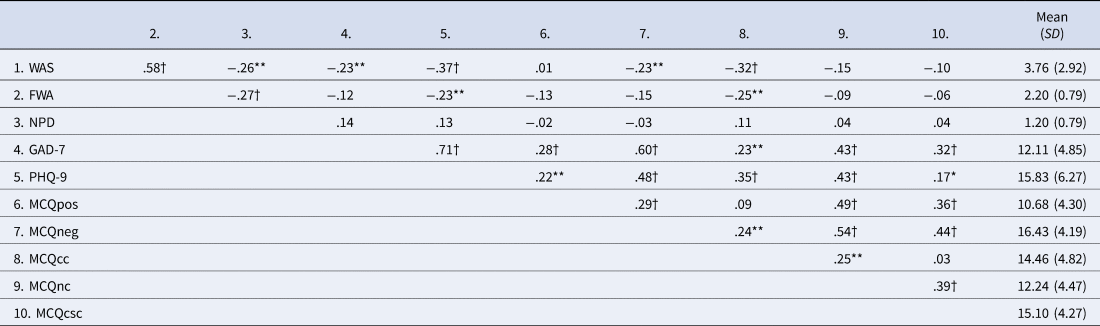
Work ability and future work ability were positively and significantly correlated with each other. Generalised anxiety symptoms were negatively and significantly correlated with present work ability, but not associated with future work ability. Depression symptoms were negatively and significantly associated with both present and future work ability. Among the metacognitive belief domains, significant negative correlations were found between negative metacognitive beliefs concerning uncontrollability and danger and present work ability, and between cognitive confidence and both present and future work ability. The other domains of metacognitions were not associated with present or future work ability. The correlations are presented in Table 1.
Mean values and standard deviations for all variables, and bivariate correlations between them (N = 177).

Note: SD = standard deviation, WAS = work ability, FWA = future work ability, NPD = Number of physical disorders, GAD-7 = Generalised Disorder Scale, PHQ-9 = Patient Health Questionnaire, MCQpos = positive metacognitive beliefs, MCQneg = negative metacognitive beliefs, MCQcc = cognitive confidence, MCQnc = need for control, MCQcsc = cognitive self-consciousness.
* p < .05, ** p < .01, †p < .001
Linear Regression Analyses
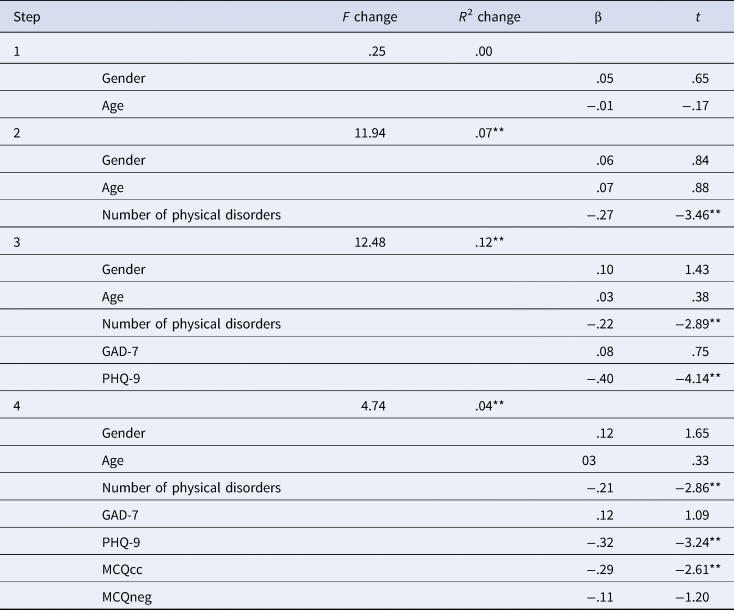
In the first regression analysis, self-assessed present work ability was used as the dependent variable. In the first step of the regression, gender and age were non-significant predictors. In the second step, number of physical disorders was a significant predictor of work ability, and accounted for 6.5% of the variance. In the third step, anxiety and depression symptoms were significant predictors as a block, accounting for 12.1% of the variance. In the fourth step, cognitive confidence and negative metacognitive beliefs were entered in the model, and together they were significant predictors of work ability and accounted for an additional 4.4% of the variance. In the final equation, number of physical disorders, depression symptoms and cognitive confidence were independent significant predictors of work ability, while age/gender, generalised anxiety symptoms and negative metacognitive beliefs were non-significant. These results indicate that a higher number of physical disorders, higher levels of depression symptoms, and lower cognitive confidence were independently associated with lower self-assessed present work ability. The regression summary statistics are presented in Table 2.
Statistics for each step of the regressions and betas on the final step with WAS as the dependent variable and gender/age, number of physical disorders, GAD-7, PHQ-9, and MCQ-30 cognitive confidence and negative metacognitive beliefs as predictors (N = 177).

Note: GAD-7 = Generalized Disorder Scale, PHQ-9 = Patient Health Questionnaire, MCQcc = cognitive confidence, MCQneg = negative metacognitive beliefs.
*p < .05, **p < .01.
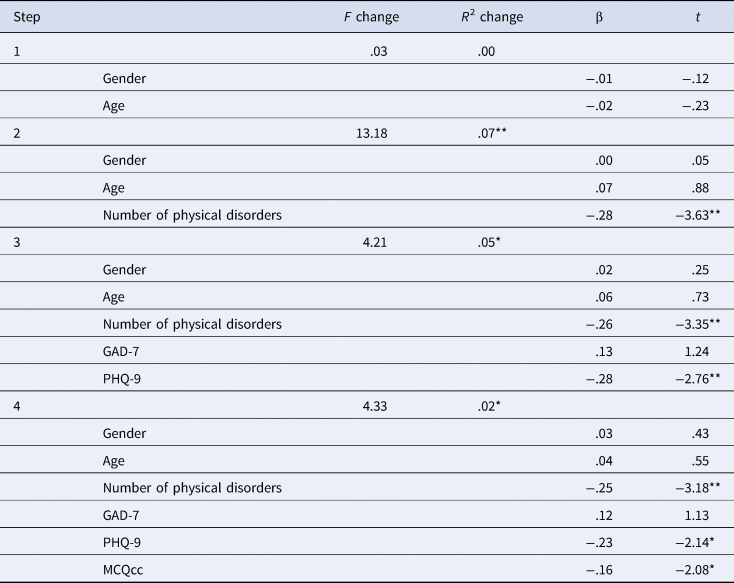
In the second regression analysis, self-assessed future work ability was the dependent variable. In the first step of the regression, gender and age were non-significant predictors. In the second step, number of physical disorders was a significant predictor, and accounted for 7.2% of the variance. In the third step, anxiety and depression symptoms were significant predictors of work ability as a block, accounting for 4.5% of the variance. In the fourth step, cognitive confidence was entered in the model and was a significant predictor of future work ability, explaining an additional 2.2% of the variance. In the final equation, number of physical disorders, depression symptoms and cognitive confidence were independent significant predictors of future work ability, while age/gender, and generalised anxiety symptoms were non-significant as predictors. These results indicate that a higher number of physical disorders, higher levels of depression symptoms and lower cognitive confidence were independently associated with lower self-assed future work ability. The regression summary statistics are presented in Table 3.
Statistics for each step of the regressions and betas on the final step with FWA as the dependent variable and gender/age, number of physical disorders, GAD-7, PHQ-9, and MCQ-30 cognitive confidence as predictors (N = 177).

Note: GAD-7 = Generalized Disorder Scale, PHQ-9 = Patient Health Questionnaire, MCQcc = cognitive confidence.
*p < .05, **p < .01.
Discussion
In the present study we set out to explore the correlates of work ability and whether metacognitive beliefs could account for variance in self-assessed present and future work ability among individuals with CMDs when controlling for gender/age, number of physical disorders diagnosed by a physician, and anxiety and depression symptoms.
As expected, we found a positive and significant correlation between self-assessed present and future work ability, and a negative and significant correlation between number of physical disorders and domains of work ability. Among the metacognitive belief domains, negative metacognitive beliefs were significantly and negatively correlated with present work ability, while cognitive confidence was significantly and negatively correlated with both present and future work ability. When controlling for the overlap between the predictors, we found that number of physical disorders, depression symptoms and judgments of confidence in memory were independent and unique predictors of both present and future work ability, while age/gender, anxiety symptoms and negative metacognitive beliefs were not. These results indicate that a higher number of physical disorders, greater severity of depression symptoms, and a specific metacognition — lower confidence in memory — are uniquely associated with lower self-assessed present and future work ability among individuals with CMDs.
It was somewhat surprising to find that anxiety did not account for independent variance in present and future work ability. However, this finding could be explained by the fact that we used the GAD-7, which is a measure of generalised anxiety symptoms, and thus might not have captured more specific forms of anxiety such as those involving interpersonal situations, which might be more disruptive to some types of work. However, using the GAD-7 could also be viewed as a strength of the study, as some of the metacognitive belief domains assessed by the MCQ-30 directly refer to worrying, and using the GAD-7 thus allowed us to control the overlap between these beliefs and worry-related anxiety.
Our findings are important because they suggest that the contribution of metacognitions to work ability is not simply an artefact of the correlation between emotion disorder symptoms and metacognition or the effects of depression symptom levels on functioning and metacognition. From a clinical perspective, they present implications that metacognitive therapy (MCT; Wells, Reference Wells2009), which is aimed at modifying biased metacognitive knowledge and its corresponding negative thinking styles, may be especially useful in improving self-appraised present and future work ability. Furthermore, such a treatment approach might pay closer attention to cognitive confidence (beliefs about memory functioning) in those individuals with CMDs showing compromised work ability scores.
The present results show consistencies with other studies. We found that number of physical disorders diagnosed by a physician predicted present and future work ability (e.g., van der Vijfeijke et al., Reference van de Vijfeijke, Leijten, Ybema, van den Heuvel, Robroek, van der Beek and Taris2013) and that emotional distress is an independent factor associated with work ability (e.g., Leijon et al., Reference Leijon, Balliu, Lundin, Vaez, Kjellberg and Hemmingsson2017; Martimo, Varonen, Husman, & Viikari-Juntura, Reference Martimo, Varonen, Husman and Viikari-Juntura2007). Specifically, we found that depression symptoms predicted present and future work ability. Depression severity has been linked to more unemployment, absences and at-work performance deficits, indicating that depression symptoms have a particularly negative effect (Lagerveld et al., Reference Lagerveld, Bültmann, Franche, Van Dijk, Vlasveld, Van der Feltz-Cornelis and Nieuwenhuijsen2010; Lerner & Henke, Reference Lerner and Henke2008; Mykletun et al., Reference Mykletun, Overland, Dahl, Krokstad, Bjerkeset, Glozier and Prince2006).
The unique contribution of the present study is the finding that specific metacognitions make an individual contribution to present and future work ability. According to the metacognitive model (Wells & Matthews, Reference Wells and Matthews1994), dysfunctional metacognitive beliefs lead to a persistent and negative orientation towards internal cognitive experiences such as worry and cognitive functioning, compromising mental self-regulation efforts, which could bias perceived ability to deal with workplace stress and demands. For example, beliefs contributing to low confidence in memory (e.g., ‘I cannot trust my memory’) are likely to lead to internal monitoring of mental functioning and to unhelpful compensatory behaviours. These strategies constitute a pattern of self-focus and over-thinking that is likely to have paradoxical effects, such as increasing awareness of thoughts and mental performance, and may divert attention away from task focused aspects of work. The present findings add to other data that demonstrates that metacognitive beliefs are associated with actual work status above the presence of a mental disorder and proneness to react with emotional distress (Nordahl & Wells, Reference Nordahl and Wells2018), and above symptom severity among high socially anxious individuals (Nordahl & Wells, Reference Nordahl and Wells2017).
The current study has several limitations. A cross-sectional design was used, and therefore no causal inferences can be made. All the data relied on self-report, which could threaten the validity of the study. The GAD-7 was used to assess anxiety and might be too specific to capture anxiety related to other anxiety disorders. There were substantially more females than males in our sample, which compromises the generalisability of our findings. Moreover, we used no formal assessment of diagnosis, but used the WAI to select eligible participants who reported having been diagnosed with a common mental disorder. Moreover, number of physical disorders may not be the best way to account for physical ill health in relation to work ability, as illness severity is not accounted for. However, a strength is that we controlled for general anxiety and depression symptoms that are relevant for work ability, over the general vulnerability of having a mental disorder. We suggest further research to replicate this study with a longitudinal design, including more detailed information concerning physical and mental disorders, and to overcome the issues associated with self-report questionnaires. In addition, further studies should investigate the role of metacognitions in work ability in other populations and under different levels of workplace factors such as work demands and type of work. The effectiveness of MCT (Wells, Reference Wells2009) using work ability and return to work as outcome variables should be evaluated.
In conclusion, the current study supports a contribution of specific metacognitions (i.e. confidence in memory) to self-assessed present and future work ability among individuals with common mental disorders. This relationship was independent of number of physical disorders and anxiety- and depression-symptom severity. The contributions of depression symptoms and cognitive confidence offer the implication that the metacognitive model and therapy for treating depression may be especially useful in the amelioration of low work ability in individuals with common mental health problems.