Introduction
In Argentina, the overall prevalence of dementia in people aged over 65 years is estimated to be 12.18% (5.85% for Alzheimer-type and 3.86% for vascular dementia) (Pagés Larraya et al., Reference Pagés Larraya, Grasso and Mari2004). No prevalence studies of frontotemporal dementia have yet been published in Argentina. A population epidemiological study conducted at Cañuelas City (Buenos Aires, Argentina) in people aged over 60 years showed a prevalence of cognitive impairment of 23.3%, ranging from 16.9% in subjects aged between 60 and 69 years to 42.5% in subjects older than 80 years (Arizaga et al., Reference Arizaga2005).
The economic costs of dementia are well documented in many studies from developed countries (Wimo et al., Reference Wimo, Winblad and Jönsson2007). However, very little data are available from developing countries (Shah et al., Reference Shah, Murthy and Suh2002; Allegri et al., Reference Allegri2007), and only one study that addresses Alzheimer's disease (AD) has been published in South America (Allegri et al., Reference Allegri2007). In Argentina, the annual direct costs of dementia of Alzheimer-type (DAT) for 2001 ranged from US$3420 in mild cases to US$9657 in severe ones. Annual direct costs of drug treatment in AD were US$1800 (Allegri et al., Reference Allegri2007). In the U.S.A., the annual cost per patient with mild DAT is estimated at US$14408, amounting to US$36132 in those with severe impairment. This involves a domestic cost of US$50 billion (Leon et al., Reference Leon, Cheng and Neumann1998). A few studies have examined clinical predictors of cost differences in dementia (Moore et al., Reference Moore, Zhu and Clipp2001; Kavanagh and Knapp, Reference Kavanagh and Knapp2002; Zhu et al., Reference Zhu2006). However, costs of the subtypes of dementia have not been compared separately and frontotemporal dementia has not previously been included in the analysis.
The aim of this paper was to analyze direct costs among the different subtypes of dementia (Alzheimer's, frontotemporal, and vascular dementia) in Buenos Aires, and their variation in relation to demographic, cognitive, social and neuropsychiatric variables.
Methods
Participants
One hundred and four patients with a diagnosis of dementia (according to DSM-IV criteria; American Psychiatric Association, 1994) and their respective primary caregivers were evaluated. Probable dementia of Alzheimer-type (NINCDS-ADRDA criteria; McKhann et al., Reference McKhann, Drachman, Folstein, Katzman, Price and Stadlin1984), frontotemporal dementia (Lund and Manchester criteria; Brun et al., Reference Brun1994), and probable vascular dementia (NINDS AIREN criteria; Román et al., Reference Román1993) were selected for analysis. In the period from January 2002 to April 2008 the patients had presented to a public hospital in the city of Buenos Aires, the Centro de Investigación de la Memoria, Hospital Abel Zubizarreta. A group of normal subjects matched by age and educational level was selected from the general population to facilitate qualitative comparison of dementia-specific costs.
All recruited patients had primary caregivers, i.e. people who provided the patient with more unpaid hours of care than anyone else. They did not receive compensation and had the responsibility of helping the patients with their activities of daily living (ADL) and instrumental activities of daily living (IADL).
This research was performed in accordance with Good Clinical Practice ICH Rules, the latest revision of the 1964 Helsinki Declaration and the amendments of Tokyo 1975, Venice 1983 and Hong Kong 1989 and the Buenos Aires Government Health Authorities.
Procedure
A retrospective, observational and cross-sectional study was performed by interviewing patients and their caregivers. Clinical information and economic data for the previous three-month period were collected during these interviews. The results are presented as average costs over the previous three months and multiplied by 4 to calculate annual costs.
Instruments
The interview included the following items and questionnaires:
1. An informed consent form: prior to the interview, all patients and their caregivers were informed of the study's scope, given written information, and asked to sign an approved informed consent form.
2. Social and demographic data of patients and their caregivers including age, gender, educational level, occupation, nationality, marital status, income (origin and amount), and residence (type and costs).
3. Cognitive assessment: Mini-mental State Examination (MMSE, Folstein et al., Reference Folstein, Folstein and McHugh1975) and global IQ (Wechsler, Reference Wechsler1999).
4. Evolutional stage/severity of impairment: Clinical Dementia Rating (CDR; Hughes et al., Reference Hughes, Berg, Danziger, Coben and Martin1982).
5. Caregiver burden questionnaire: Zarit Questionnaire (ZQ; Zarit et al., Reference Zarit, Orr and Zarit1985).
6. Behavioral examination: the Neuropsychiatric Inventory (NPI-Q; Cummings et al., Reference Cummings, Mega, Gray, Rosenberg-Thompson, Carusi and Gornbein1994) and Beck Depression Inventory (BDI; Beck et al., Reference Beck, Ward, Mendelson, Mock and Erbaugh1961).
7. Instrumental activities of daily living (IADL): Lawton Inventory (LI; Lawton and Brody, Reference Lawton and Brody1969).
8. Direct cost evaluation structured questionnaire (Allegri et al., Reference Allegri2007).
Direct costs are costs relating to the care of the patient, including services and materials for which money is explicitly exchanged. Costs to the health system are the direct medical costs (expenditures for hospital and nursing, home care, physician services, medications, etc). Direct non-medical costs are related to the other items or services used by the person's caregiver as a result of dementia. The deduction of the healthy subjects' costs from the patients' costs was operationalized as the direct cost measure specific for dementia. Physicians' visits and payments to institutions were estimated with social security health system values (the lowest in the Argentinean system), which are also the values that public hospitals use for administration. Non-medical direct costs are family out-of-pocket disease-related expenses. Payment for medication was estimated at 100% drugstore sale price (date 1 March 2009) for each registered active ingredient. The information was collected from prices published in Alfabeta (2009). Costs and incomes were calculated in US dollars (average exchange rate in 2008 was US$1 = AR$3).
Statistical analysis
Means and standard deviations for quantitative variables and frequency distribution for qualitative variables were obtained. Differences among dementia subtypes were estimated using ANOVA and Kruskal-Wallis (for non-Gaussian data). Post-hoc Bonferroni tests and post-hoc Mann-Whitney tests were used as appropriate. Sex and marital status were evaluated using χ2. In those data with skewed left distribution, a log-normal transformation was applied in order to use parametric tests.
“Total direct cost over three months” was chosen as the dependent variable for the predictive analysis and a multivariate analysis was performed. Covariates included in the model were age, education, cognitive status (MMSE and global IQ), level of disease (CDR), behavioral involvement (NPI and BDI), functional status (LI), and caregiver burden (ZQ). Because the cost variable shows a skewed right distribution, the estimation was also done with its natural log (log-transformed costs) with a linear regression model equation:

where B = standardized regression coefficients.
In all the analyses, p < 0.05 was considered significant. Results were analyzed using statistical software packages SPSS version 13 and Medcalc.
Results
Patients' profile
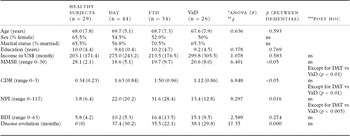
Demographic and clinical characteristics of the patients are summarized in Table 1. Forty-four patients with a diagnosis of dementia of Alzheimer type (DAT), 34 with frontotemporal dementia (FTD), and 26 with vascular dementia (VaD) were evaluated and matched by age and educational level with 29 healthy subjects. No significant differences in age, gender, education and disease evolution were found among the dementias. Global tests (CDR and MMSE) showed mild differences between DAT and VaD. However, most patients exhibited mild disease. Neuropsychiatric symptoms were higher in FTD patients than in VaD patients.
Patients' demographic characteristics

DAT = dementia of Alzheimer type; FTD = frontotemporal dementia; VaD = vascular dementia; MMSE = Mini-mental State Examination; CDR = Clinical Dementia Rating; NPI = Neuropsychiatric Inventory; BDI = Beck Depression Inventory. Except for gender and marital status, the remaining values are expressed as means (standard deviation). Differences between dementias by (*) ANOVA and (**) Kruskal-Wallis for non-Gaussian data. (***) Post hoc Bonferroni test and post hoc Mann-Whitney test as appropriate. Gender and marital status were assessed using χ2. ns = not significant.
Primary caregivers' profile
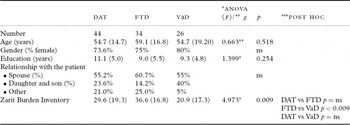
The characteristics of primary caregivers are summarized in Table 2. There were no significant differences in age and gender (% females), education (years), and relationship to the patient among dementias. Caregivers of FTD patients exhibited a higher rate of burden than caregivers of VaD patients (F = 4.97; p < 0.01). No differences among remaining dementias were seen.
Caregivers' demographic characteristics

DAT = dementia of Alzheimer type; FTD = frontotemporal dementia; VaD = vascular dementia. Except for gender and relationship with the patient, the remaining values are expressed as means (standard deviation). na = not applicable in controls. Differences between dementias by (*) ANOVA and (**) Kruskal-Wallis for non-Gaussian data. (***) Post hoc Bonferroni test and post hoc Mann-Whitney test as appropriate. Gender and marital status assessed using χ2. ns = not significant.
Costs analysis
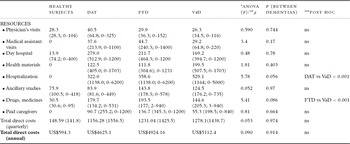
Mean cost by subtype of dementia in terms of resource utilization is summarized in Table 3. The annual direct cost was US$4625 for DAT, US$4924 for FTD, and US$5112 for VaD (p < 0.05 between groups). A post hoc analysis comparing DAT and FTD showed no significant differences. Patients with VaD had higher hospitalization costs than DAT patients (p < 0.001). VaD patients had lower drug expenses than FTD patients (p < 0.001). There were no significant differences in quarterly direct costs.
Costs of resource utilization according to diagnosis

DAT = dementia of Alzheimer type; FTD = frontotemporal dementia; VaD = vascular dementia. Values are expressed as means (standard deviation; range) in dollars (US$1 = AR$3 as of November 2008). Differences between dementias by (*) ANOVA and (**) Kruskal-Wallis for non-Gaussian data. (***) Post hoc Bonferroni test and post hoc Mann-Whitney test as appropriate. Gender and marital status were assessed using χ2. ns = not significant.
Drug-medicines cost analysis
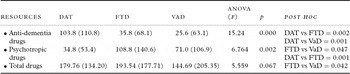
Statistical analyses of drug costs for the various dementias are summarized in Table 4. DAT patients spent more on anti-dementia drugs (cholinesterase inhibitors and memantine) than the other dementias; FTD patients spent more on psychotropic drugs than other dementias, and VaD patients spent less on medications than the other dementias. Medication-drug expenses represented 15.5%, 15.7%, and 11.3% of total direct costs in DAT, FTD, and VaD, respectively. The proportion of anti-dementia drug costs for the various dementias were 8.8% for DAT and 2.7% for FTD, and 2% for VaD, while the proportion of costs for psychotropic drugs were 2.9%, 8.2% and 5.5%, respectively.
Utilization of drugs (quarterly values, US$)

DAT = dementia of Alzheimer type; FTD = frontotemporal dementia; VaD = vascular dementia. Values are expressed as means (standard deviation; range) in dollars (1US$ = AR$3 as of November 2008). (*) ANOVA with post hoc Bonferroni test (only those statistically significant are listed).
Predictors of direct costs
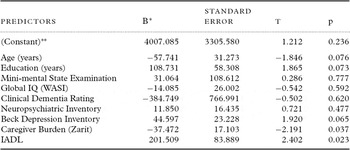
The first analysis was a multivariate analysis of total dementias. Table 5 exhibits a regression analysis (r 2 = 0.76). Covariates showing a significant increase in cost were: caregiver burden (Zarit Inventory) (p < 0.05) and total IADL (p < 0.05). Depression showed a trend (p = 0.06). The sensitivity analysis using the log-transformed cost variable removed caregiver burden (p = 0.23) from the model but increased the significance of depression (p < 0.05) and education level (p < 0.05). For each point in the Beck Depression Inventory, costs increased annually by US$176. For each point in IADL, costs increased annually by US$804.
Multiple linear regression equation for all dementias

*B = estimated coefficient. **Constant: y-intercept tells us that if all predictors had a “0” value for an individual, quarterly direct cost would be US$4000.
Non-log-transformed coefficients are shown.
IADL = instrumental activities of daily living.
This same analysis was then performed for each dementia type. For DAT, a significant association with involvement in IADL (B = 62.519; p < 0.05) and education (B = 81.900; p < 0.01) is highlighted in this group. For each IADL item, costs were increased annually by US$248.
For FTD, an association with depression (B = 74.408; p < 0.05) and age was seen (B = ‒222.195; p < 0.05). With the log-transformed cost variable, significance with CDR (B = ‒1800.357; p < 0.05), Beck (B = 74408.357; p < 0.05), and MMSE (B = ‒128.728; p < 0.05) was shown.
For VaD, no significance in linear regression coefficients was shown.
Discussion
This is the first study conducted in South America to compare direct costs according to dementia type. Allegri et al. (Reference Allegri2007) published a cost study of dementia of Alzheimer-type, with an annual direct cost of US$3189 for 2001. In our current study, the cost of DAT was US$4625; the costs of US$4924 for FTD and US$5112 for VaD have also been added (values hitherto unknown). The slightly higher cost for VaD was probably due to the higher hospitalization cost for this subgroup. The cost of VaD has been reported to be higher than that of DAT (Fillit and Hill, Reference Fillit and Hill2002). We found no significant differences with regard to the annual direct cost in our study. Hospitalization represented the highest expense for all subtypes. In this study, inpatient costs have not been further differentiated as this was outside the scope of this work.
Therefore, unlike the study by Allegri et al. (Reference Allegri2007), where drug-medicine costs were calculated to represent 56.4% of the total costs, our study of costs in DAT showed that the drug costs represented only 15.4% of total costs for all dementia types, yet patients showed less deterioration. I n a previous paper, we described how inappropriate use of drugs may increase health costs in developing countries. In our sample, we found a lack of appropriate use of anti-dementia drugs and psychotropic agents (Rojas et al., Reference Rojas, Serrano, Dillon, Bartoloni, Iturry and Allegri2010).
FTD had the highest drug costs, as this dementia is often associated with increased psychotropic prescription, more behavioral disorders (higher NPI), and more caregiver burden. Of course, anti-dementia drug costs were higher for the DAT subgroup, although these drugs were also used “off label” in FTD and VaD, as shown in Table 4. Drug costs for VaD were lower (fewer psychotropic and anti-dementia drugs).
Few studies have examined clinical predictors of cost increases in dementia (Moore et al., 2001; Zhu et al., Reference Zhu2006). A one-point increment in the NPI has been reported to result in a monthly cost increase of US$30 (Herrmann et al., Reference Herrmann2006). No significant correlation between NPI and any subtype of dementia has been shown in our sample. However, a correlation with the Beck Inventory not previously reported in dementia has been found. For each Beck Inventory point, the annual costs of dementia increased by US$176, and for each IADL point, costs increased by US$804 for dementias and US$248 only for Alzheimer's.
Unlike other studies (Zhu et al., Reference Zhu2006), overall performance tests (MMSE and CDR) have not significantly contributed to cost increases in this model, except for FTD, probably due to sample size and because most cases were mild dementia.
The importance of the neuropsychological assessment in decision-making for these patients and their family guidance is emphasized. Other more specific cognitive tests (such as memory, language, and executive tests) have not been evaluated. The fact that most patients exhibited mild dementia and cost of dementia increases with severity must be highlighted (Allegri et al., Reference Allegri2007).
The costs of dementia to society are the value of all goods and services that are given up to prevent, diagnose, treat and otherwise cope with dementia. Economic costs are significant for health systems. In Argentina, total expenditure on health is 9.6% of the gross domestic income (GDI). This percentage is similar to that for developed countries but the distribution is unequal: 43% of the population (more than 17 million people) have access only to the Public Health System which receives only 28% of the total health resources (World Health Organization, 2008). The fact that 91% of people aged 65 and over (4,065,000 people) receive Social Security Support (PAMI, 2010) is theoretically ideal but, in practice, sanitary resources could be improved and better distributed throughout the country. If we could fix the more general health service deficiencies we would probably find increased dementia costs.
Based on the above, we can conclude that actions and therapies adopted to delay or avoid institutionalization of patients and improve drug coverage (mainly psychotropics) are crucial to generate savings in the healthcare system. Likewise, controlling depression and maintaining patients in the mild stages will prove to be important. We can infer that indirect costs could be reduced by controlling these variables through the reduction of care-time needed in these patients.
This study contributes helpfully to the wider literature on the economic impact of dementia. The small sample size is a weakness of the study. Other limiting factors of this study are that the rural population is not represented, the analysis has not differentiated between inpatients and outpatients, and the results depend on the current peso/dollar exchange rate (this exchange rate has remained approximately 3:1 during the 2002–2008 evaluation periods, but the basic costs increased in Argentine pesos over the same period).
In summary, this is the first study to compare direct costs in AD, FTD and VaD in Argentina. With an increasing aging population in our country, analyses of health resource distribution in dementia patients and the resultant healthcare policies become indispensable.
Conflict of interest
None.
Description of authors' roles
GR and RFA conceived the project, designed the study, supervised data collection, performed statistical analysis on the collected data and wrote the paper. LB, CD, CS, MI, GR, RFA and were involved in data collection and writing assistance. All authors have read and approved the final paper.
Acknowledgments
This research study has been made possible by a research grant from the Ministry of Health – “Ramón Carrillo-Arturo Oñativia” Fellowship (GR, CD, LB), National Research Council – CONICET (RFA, GR y CD) and the Research Council from the Ministry of Health of Buenos Aires City- CIS-GCBA (RFA, CMS). We wish to acknowledge the interest and advice of Dr. Anders Wimo. The opinions expressed in this paper are those of the authors and do not necessarily reflect those of the Ministry of Health or the organizations to which the authors are affiliated.