


Introduction
Military sexual trauma (MST) is frequently endorsed by veterans, with approximately 28% of female and 1.5% of male veterans accessing services at Veterans Affairs Medical Centers endorsing a history of MST (Military Sexual Trauma Support Team, 2017). While posttraumatic stress disorder (PTSD) is one of the most frequently studied potential consequences of MST, MST is also associated with greater depressive symptoms, alcohol use, bodily pain as well as poorer social functioning and quality of life (Surís and Lind, Reference Surís and Lind2008). Cognitive processing therapy (CPT) is the only treatment validated for veterans diagnosed with MST-related PTSD (Surís et al., Reference Surís, Link-Malcolm, Chard, Ahn and North2013) and has been identified as one of the most effective psychotherapeutic treatments for PTSD (Haagen et al., Reference Haagen, Smid, Knipscheer and Kleber2015). During CPT, PTSD is conceptualized as a ‘non-recovery from trauma’, with individuals experiencing ‘stuck points’ post-trauma that inhibit their natural recovery process (Resick et al., Reference Resick, Monson and Chard2017). To address this, CPT uses psychoeducation and cognitive restructuring to facilitate reframing of distorted trauma-related beliefs (Resick et al., Reference Resick, Monson and Chard2017).
Despite the established efficacy of CPT, few studies have explored the characteristic pattern of symptom criterion remission during CPT. Using a sample of civilian survivors of sexual assault, Nishith et al. (Reference Nishith, Resick and Griffin2002) noted that the pattern of symptom resolution differed between PTSD symptom criteria following CPT, with re-experiencing and hyperarousal symptoms improving in a quadratic pattern and avoidance symptoms improving in a linear fashion. However, Macdonald et al. (Reference Macdonald, Monson, Doron-Lamarca, Resick and Palfai2011) identified a logarithmic pattern of change as the best fit for all symptom criteria in a sample of veterans with diverse index traumas. These differences in symptom reduction patterns are important for distinguishing whether patients may experience an initial increase in symptom severity (quadratic), a steady resolution in symptoms (linear), or an early reduction in symptoms (logarithmic). However, the description of these patterns does assess the potential temporal relationship between changes in PTSD symptom criteria.
No studies to date have investigated the temporal relationship between PTSD symptom criteria during CPT; however, two studies have assessed this relationship in other treatments for PTSD. During both virtual reality exposure therapy and venlafaxine ER pharmacotherapy, changes in re-experiencing symptoms predicted change in other PTSD symptom criteria (Maples-Keller et al., Reference Maples-Keller, Price, Rauch, Gerardi and Rothbaum2017; Stein et al., Reference Stein, Pedersen, Rothbaum, Baldwin, Ahmed, Musgnung and Davidson2009), suggesting that the mechanism of change in these specific treatments is through improvement in re-experiencing symptoms. However, it remains unclear if re-experiencing symptoms represent a common mechanism of PTSD symptom change regardless of treatment modality or if this mechanism is specific to these treatments.
The purpose of the current study was to investigate the pattern and temporal precedence of change in symptom criteria during and after CPT. Consistent with previous research in other treatments (Maples-Keller et al., Reference Maples-Keller, Price, Rauch, Gerardi and Rothbaum2017; Stein et al., Reference Stein, Pedersen, Rothbaum, Baldwin, Ahmed, Musgnung and Davidson2009), we hypothesized that re-experiencing symptoms would predict and temporally precede change in hyperarousal and avoidance symptoms during CPT for MST-related PTSD.
Method
Participants
Data for the current study were collected during a randomized clinical trial (RCT) examining the effectiveness of CPT in treating MST-related PTSD (Surís et al., Reference Surís, Link-Malcolm, Chard, Ahn and North2013). At a large, southwestern Veterans Affairs Medical Center, veterans were recruited via clinician referral, posted advertisements, and recruitment letters. PTSD diagnosis was established using the Clinician Administered PTSD Scale (Blake et al., Reference Blake, Weathers, Nagy, Kaloupek, Gusman and Charney1995) For complete inclusion and exclusion criteria, see Surís et al. (Reference Surís, Link-Malcolm, Chard, Ahn and North2013). Each veteran provided informed consent before participation, and the study was approved by the local Institutional Review Board.
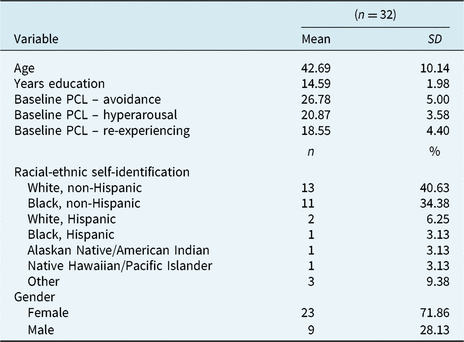
Of veterans randomized in the RCT (n = 129), 72 male and female veterans were randomly assigned to receive CPT. However, due to fidelity concerns (see Holder et al., Reference Holder, Holliday, Williams, Mullen and Surís2018a), 40 participants were excluded from data analyses due to ‘below average’ psychotherapist treatment fidelity that significantly reduced CPT treatment effectiveness. The final sample for the current analysis included 32 veterans (n = 23 female, n = 9 male) who received CPT from a therapist with acceptable fidelity.
Measures
PTSD symptom severity was assessed using the PTSD Checklist (PCL; Weathers et al., Reference Weathers, Litz, Herman, Huska and Keane1993), a 17-item self-report measure that describes a patient’s perceived intensity of each of the Diagnostic and Statistical Manual for Mental Disorders (4th edition, text revision: DSM-IV-TR; American Psychiatric Association, 2000) PTSD symptoms. The psychometric reliability and validity of the PCL has been demonstrated across a variety of versions and populations (Wilkins et al., Reference Wilkins, Lang and Norman2011). When subdivided to reflect re-experiencing, avoidance and hyperarousal scores, the PCL has been shown to maintain adequate psychometric properties (Wilkins et al., Reference Wilkins, Lang and Norman2011).
Procedure
Following a baseline assessment that included administration of the PCL, a sociodemographic form and additional measures, participants were randomized to receive CPT or present centred therapy [PCT; see Surís et al. (Reference Surís, Link-Malcolm, Chard, Ahn and North2013) for details regarding study procedures]. In the RCT, CPT consisted of 12 1-hour, weekly, individual psychotherapy sessions, and included a written trauma account, a version now referred to as ‘CPT+A’ (Resick et al., Reference Resick, Monson and Chard2017). The PCL was again administered at odd psychotherapy sessions (i.e. 1, 3, 5, 7, 9 and 11), and at four follow-up sessions (1 week, as well as 2, 4 and 6 months post-treatment).
Analytic plan
Cross-lagged panel analyses were conducted using a hierarchical linear modelling (HLM) approach in HLM 7.0 software (Raudenbush et al., Reference Raudenbush, Bryk, Cheong, Congdon and du Toit2011). Due to modest level-2 sample size (i.e. n = 32), a restricted maximum likelihood estimation approach was utilized to reduce statistical bias and provide adequate statistical power (McCoach, Reference McCoach, Hancock and Mueller2010). For each symptom criterion (i.e. re-experiencing, avoidance, hyperarousal), change scores were calculated as the variable of interest by determining the difference between the current (e.g. baseline) and subsequent time point (e.g. session 1). The temporal precedence between change in symptom criteria was then modelled, with auto-correlational effects and the effect of time accounted for within the model. To identify the pattern of change with the most parsimonious fit, three unconditional growth curves were calculated (i.e. linear, quadratic, logarithmic). In the cross-lagged panel analyses, change in each symptom criterion was entered as a predictive mediator of change in the other symptom criteria. Additionally, to establish temporal precedence, reverse mediation analyses were conducted to ensure that reverse mediation did not occur.
Results
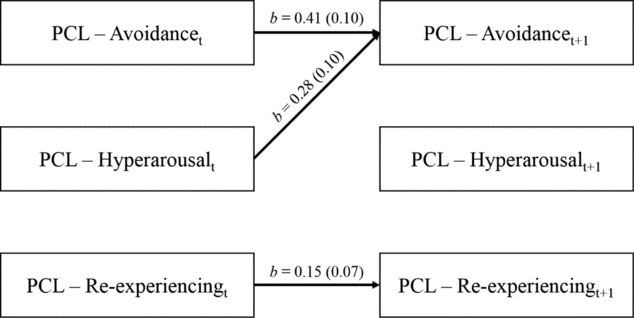
Sociodemographic characteristics of the sample and baseline PTSD symptom criteria severity are presented in Table 1. For all criteria, a logarithmic pattern of change was identified as the strongest model fit (McCoach, Reference McCoach, Hancock and Mueller2010). None of the symptom criteria was found to predict subsequent change in hyperarousal symptoms during treatment and follow-up, even hyperarousal symptoms themselves (see Fig. 1). Re-experiencing symptoms at earlier time points predicted change in re-experiencing symptoms at subsequent time points, b = 0.15, t(30) = 2.30, p = .029 (see Fig. 1); however, avoidance and hyperarousal symptoms did not predict subsequent change in re-experiencing symptoms (p > .05). Avoidance symptoms, b = 0.41, t(30) = 4.05, p < .001, and hyperarousal symptoms, b = 0.28, t(30) = 2.83, p = .008, were found to predict change in avoidance symptoms (see Fig. 1). Re-experiencing symptoms did not predict subsequent change in avoidance symptoms (p > .05). Reverse mediation was not observed for any model, indicating that the effects were unidirectional (p > .05; see Fig. 1)
Baseline characteristics of the sample

PCL, Posttraumatic Stress Disorder Checklist.
Cross-lagged panel models examining significant relationships (p < .05) between PTSD symptom criteria. PCL, Posttraumatic Stress Disorder Checklist.

Discussion
Consistent with previous research (Macdonald et al., Reference Macdonald, Monson, Doron-Lamarca, Resick and Palfai2011), all symptom criteria followed a logarithmic pattern of change over the course of CPT treatment and follow-up. This finding indicates that symptoms were likely to reduce rapidly early in therapy with modest gains later in therapy, and is inconsistent with previous research indicating initial symptom worsening (i.e. quadratic change; Nishith et al., Reference Nishith, Resick and Griffin2002). Additionally, hyperarousal symptoms were found to both predict and temporally precede change in avoidance symptoms, but not re-experiencing symptoms. Inconsistent with prior research (Maples-Keller et al., Reference Maples-Keller, Price, Rauch, Gerardi and Rothbaum2017; Stein et al., Reference Stein, Pedersen, Rothbaum, Baldwin, Ahmed, Musgnung and Davidson2009), neither re-experiencing nor avoidance symptoms predicted change in other symptom criteria. These results provide tentative evidence that changes in hyperarousal symptoms may represent a mechanism of change in avoidance symptoms during CPT for MST-related PTSD. Given that reduction in PTSD symptom severity following CPT is smaller for MST-related PTSD than other clinical populations (Surís et al., Reference Surís, Link-Malcolm, Chard, Ahn and North2013; Zalta et al., Reference Zalta, Held, Smith, Klassen, Lofgreen and Normand2018), understanding this change process has the potential to inform research on optimizing treatment for this clinical population.
In CPT, PTSD is conceptualized as a ‘non-recovery’ from trauma where distressing emotional and arousal symptoms lead to avoidance (Resick et al., Reference Resick, Monson and Chard2017). This avoidance impairs cognitive processing of the trauma and prevents natural resolution of emotional and arousal symptoms, leading to the development of PTSD (Resick et al., Reference Resick, Monson and Chard2017). As a result, avoidance is considered to be a crucial symptom that is actively targeted and addressed during treatment (Resick et al., Reference Resick, Monson and Chard2017). While avoidance is thought to be integral in developing PTSD, hyperarousal has been shown to be the strongest predictor of maintaining the other symptom criteria (i.e. avoidance and re-experiencing symptoms) over time (Schell et al., Reference Schell, Marshall and Jaycox2004). These studies and the theoretical description of the importance of hyperarousal support the relationship identified in the current study between reduction in hyperarousal symptoms and subsequent reduction in avoidance symptoms. However, no relationship was identified between re-experiencing symptoms and the other symptom criteria, which is inconsistent with previous research (Maples-Keller et al., Reference Maples-Keller, Price, Rauch, Gerardi and Rothbaum2017; Schell et al., Reference Schell, Marshall and Jaycox2004; Stein et al., Reference Stein, Pedersen, Rothbaum, Baldwin, Ahmed, Musgnung and Davidson2009) and theory (Resick et al., Reference Resick, Monson and Chard2017). This finding may suggest that the mechanism of change in re-experiencing symptoms is separate from the mechanism of change in hyperarousal/avoidance symptoms. This also suggests a need to investigate whether specific elements of CPT may differentially affect change symptom criteria. Understanding this mechanism of change and how it applies to specific elements of CPT may provide the opportunity to continue to optimize CPT treatment.
These findings hold implications for both clinicians using and patients participating in CPT. With replication of this finding, clinicians may be able to prepare patients and manage treatment expectations by providing patients with information on this anticipated pattern of change. Furthermore, these results highlight the importance of serial measurement (i.e. assessment before each session) of PTSD symptoms during treatment so that providers can assess for a characteristic pattern of symptom change. Additionally, as measuring weekly symptom change is recommended by the current CPT treatment manual (Resick et al., Reference Resick, Monson and Chard2017), it may be important for clinicians to assess change in specific symptom criteria during treatment rather than only assess total PTSD symptom severity.
The current study has several limitations. First, a level-2 sample size of greater than 30 units has been shown to adequately limit statistical bias in regression slope parameter estimates and standard errors for level-1 variance components (McCoach, Reference McCoach, Hancock and Mueller2010); however, future studies would benefit from larger samples and more assessment points to further reduce statistical bias. Although cross-lag analysis provides more information about an effect (i.e. temporal precedence) than a correlational analysis, it is important to note that it does not determine causation. Additional research is needed to identify whether earlier changes in hyperarousal symptoms are the cause of subsequent reductions in avoidance symptoms. Results are specific to a sample of veterans with MST-related PTSD. As survivors of MST have been shown to have greater symptom severity (Holder et al., Reference Holder, Holliday, Williams and Surís2018b) and poorer treatment response to CPT (Zalta et al., Reference Zalta, Held, Smith, Klassen, Lofgreen and Normand2018) compared with survivors of combat trauma, results may not generalize to survivors of other trauma types. Future studies would benefit from samples with greater diversity (e.g. trauma type, racial-ethnic self-identification) to increase generalizability and/or identify differences in mechanism between subgroups. As a session-by-session analysis was conducted, measures administered at each session were limited, and additional potential mechanisms of change could not be investigated. Finally, current analyses were conducted using DSM-IV-TR symptom criteria. Negative alterations in mood and trauma-related cognitions have been separated as an additional PTSD symptom criterion in DSM-5 (American Psychiatric Association, 2013). Targeting trauma-related cognitions is an important aspect of CPT treatment (Resick et al., Reference Resick, Monson and Chard2017), and changes in certain trauma-related cognitions have been shown to temporally precede and predict changes in total PTSD symptom severity (Holliday et al., Reference Holliday, Holder and Surís2018; Schumm et al., Reference Schumm, Dickstein, Walter, Owens and Chard2015). However, it remains unclear how cognitive symptoms fit into the more complex picture of change in specific PTSD symptom criteria.
Despite these limitations, the current study was the first to examine the pattern and relationship of change in PTSD symptom criteria during and after CPT. Results suggest that changes in hyperarousal may represent a mechanism of change in avoidance criterion symptoms, symptoms that are thought to influence PTSD diagnosis most strongly. Knowledge of the mechanism of change can help patients to better prepare for treatment and help clinicians to identify the characteristic pattern of change with serial measurement. Further research is needed to understand the generalizability of this treatment mechanism (e.g. trauma types, CPT versions). Additionally, researchers should continue to describe how change in symptom criteria is elicited by specific therapeutic elements of CPT. Examination of which elements of CPT affect hyperarousal symptoms may assist with developing interventions that can differentially emphasize treatment of specific symptom clusters and help to identify whether reductions in hyperarousal symptoms are the cause of subsequent reductions in avoidance symptoms.
Author ORCIDs
Nicholas Holder, 0000-0001-5440-3698; Jessica Wiblin, 0000-0002-2723-9092
Acknowledgements
The authors would like to thank Dr Gloria Emmett, Dr James LePage, Dr E. Ellen Morris and Dr Anushka Pai for their advice in constructing this manuscript.
Conflicts of interest
The authors have no conflicts of interest with respect to this publication.
Ethical statement
The authors have abided by the Ethical Principles of Psychologists and Code of Conduct as set out by the American Psychological Association.
Financial support
This work was supported by the Veterans Administration Rehabilitation Research and Development Service, grant number: D4445-R; NCT00371644 at clinicaltrials.gov. N.H. is currently supported by the Office of Academic Affiliations, Advanced Fellowship Program in Mental Illness Research and Treatment, Department of Veterans Affairs; San Francisco Veterans Affairs Health Care System; Sierra Pacific Mental Illness Research, Education, and Clinical Center; and the University of California San Francisco. R.H. is currently supported by the Office of Academic Affiliations, Advanced Fellowship Program in Mental Illness Research and Treatment, Department of Veterans Affairs; Rocky Mountain Mental Illness Research, Education, and Clinical Center; and the University of Colorado Anschutz Medical Campus. The views expressed are those of the authors and do not necessarily represent the views or policy of the Department of Veterans Affairs or the United States Government.



Comments
No Comments have been published for this article.