


1 Presidential Campaign Communication Tactics in the Social Media Era
In 1987, at the height of his initial fame as a New York real estate developer, Donald Trump released The Art of the Deal, a book that spent forty-eight weeks on the New York Times Best Seller List, thirteen of those at number one (Mayer Reference Mayer2016). Composed with ghostwriter Tony Schwartz, who did extensive interviews with Trump, it describes the communication strategies that Trump would largely stick with for the rest of his life:
One thing I’ve learned about the press is they’re always hungry for a good story, and the more sensational the better. It’s in the nature of the job, and I understand that. The point is that if you are a little different, or a little outrageous, or if you do things that are bold or controversial, the press is going to write about you. I’ve always done things a little differently, I don’t mind controversy… The result is that the press has always wanted to write about me…
The final key to the way I promote is bravado… People may not always think big themselves, but they can still get very excited by those who do. That’s why a little hyperbole never hurts… I call it truthful hyperbole. It’s an innocent form of exaggeration – and a very effective form of promotion.”
By the time Trump captured the Republican nomination in 2016 for the first of three consecutive cycles, he had so much practice using this strategy that it was likely partially instinct and only partially a conscious choice.
Steve Bannon was the CEO of Trump’s 2016 presidential campaign, and after his inauguration, White House Chief Strategist and Senior Counselor to the President. In a 2018 interview, Bannon summarized his political communication philosophy: “The real opposition is the media. And the way to deal with them is to flood the zone with shit” (Lewis Reference Lewis2018). The amount of political information Americans can absorb from the media system is indeed a limited “zone” that modern presidents and presidential nominees try to fill.
Trump was successful in dominating attention in his presidential campaigns, even though it often didn’t produce favorable coverage of him. In high-quality news outlets, we find that Trump was the subject of 85% more stories than Clinton during the 2016 campaign and over 250% more stories than Biden in the 2020 campaign. When our surveys asked people if they could remember recent news about the candidates, more people remembered news about Trump than about his opponent at almost every point in the 2016 and 2020 campaigns.
This Element examines the successes and failures of Donald Trump’s attention-grabbing campaign tactics and what they reveal about America’s media system. Over the last fifteen years, American presidential campaigns have fully transitioned into the social media era, where capturing people’s attention has become a crucial force in politics. Attention is essential, not just on social media itself, which an increasing proportion of people use as a primary information source, but also on other types of media organizations that now must operate in an environment dominated by social media. Campaign news has become part of what some refer to as the “attention economy.”
Political communication scholars have long observed that, while the mass media may not tell people what to think, they often influence what people think about. The most well-documented media effects that work this way are agenda setting and priming. (e.g., Hillygus Reference Hillygus and Jan2010; Iyengar and Kinder Reference Iyengar and Kinder1987; McCombs and Valenzuela Reference McCombs and Valenzuela2021). In previous eras, researchers described how news media organizations created these effects. Only rarely did presidents and presidential candidates play the primary causal role.
In the social media era, this balance of power has shifted. Donald Trump led the way in exploiting this new dynamic. In this era, candidates have substantially more power than before to determine what stories the public thinks about. In his first two presidential campaigns, Donald Trump demonstrated the influence a presidential candidate can have on what the public pays attention to, as well as the limits of that influence.
The Two Theses of This Element
This Element examines data on media content and the public’s perceptions of that media coverage during the 2016 and 2020 presidential election campaigns. We present the following two fairly simple thesis statements. First, Donald Trump demonstrated how a presidential candidate in the social media era can manipulate the attention of the media system and the public to their benefit. From the moment he first gained local and national fame as a real estate developer, Trump had been adept at managing the news media and garnering attention for himself and his projects. As a political communicator, Trump is skilled at garnering attention for himself while also shifting the topics he regularly promotes. This reduces the time the media system spends covering the numerous negative stories about him during a campaign, and thus prevents much of the public from dwelling too long on any single dominant negative story.Footnote 1 However, we don’t think Trump is the only person who can execute this strategy. Instead, it illustrates the opportunities available to other skilled politicians in the social media era. In this era, which stories voters pay attention to is more important than ever, and skilled candidates have more power than ever to influence the media system to shift attention onto their preferred stories.
On the other hand, if Donald Trump failed to get more attention than his opponents, despite having more experience than any other imaginable candidate getting media attention before capturing a major party nomination, that would be inconsistent with this thesis.
Yet our second thesis concerns the limits of attention-seeking. It is: The ability of candidates and other political actors to influence national attention is still limited by two factors: (1) the continued tendency of the media system to focus on the incumbent president’s performance and (2) the editorial judgments of journalists and news organizations about which stories are accurate and important. When you are the incumbent president, the media system will inevitably focus on your handling of major national problems. As we show in this Element, Trump’s ability to change the subject and distract from negative stories about him was substantially diminished in 2020. The COVID-19 pandemic was, in many ways, unique in American history. Still, we believe it illustrates a type of limit that other candidates will also face in the social media era. The campaign media system is not infinitely manipulable. The system still strongly tends to focus on current national conditions when covering a presidential campaign.
We also find that editorial judgment has consequences for which stories get attention, especially from high-quality media sources. The end of the 2020 campaign provided a clear illustration of this. As we document in Section 6, high-quality news organizations could have covered a story focused on potential corruption by the President’s son, Hunter Biden, in the last weeks of the campaign, but it seems that they made an editorial decision not to. This is an example of how, especially in the short term and in the crucial final weeks of the campaign, journalists still have the power to use their own judgment to decide which stories are worthy of attention.
If, instead of this, Trump were reliably able to change the subject away from negative stories about him and his record in both these campaigns, that would contradict this thesis. And if, when high-quality news outlets don’t cover a story because they doubt its accuracy or importance, that story still gets heavy attention from the public, that would contradict our thesis. This would be especially true at crucial times in the campaign, when prestigious journalists and editors are most careful about the consequences of their decisions.
Finally, the reader should be cautious about our conclusions because we arrived at these theses inductively, not deductively. In other words, we admit we had no set theses or hypotheses before beginning this project. These two theses were not the result of preregistered research questions. We came to them after a careful analysis of the data. As a result, some readers might fairly call our conclusions “exploratory,” and we would not object to that. Our claim is simply that these accurately summarize the data we have. We hope that future researchers will test these ideas with data in future elections.Footnote 2
Prominent Existing Theories Explaining Presidential Campaign Media Coverage
It’s helpful to consider our thesis statements in light of previous major political science theories that have attempted to explain variation in media coverage of American presidential campaigns. We don’t think our work in this Element is a definitive test that proves any of these theories correct or incorrect in the way advocated by Karl Popper (Magee Reference Magee1985), because we don’t think these theories are mutually exclusive with our theses or with each other. But we believe it is helpful to consider how our theses and findings suggest ways these theories might be updated, or our overall understanding of the causes of campaign coverage might be amended in the new social media era.
Campaigns as Retrospective Evaluations of the Incumbent Party
Throughout American history, the incumbent party has performed better in presidential election years when the economy performed better (Bartels and Zaller Reference Bartels and Zaller2001; Guntermann, Lenz, and Myers Reference Guntermann, Lenz and Myers2021; Hibbs Reference Hibbs, Barry and Wittman2007; Rosenstone Reference Rosenstone1983). Voters tend to learn more about national conditions, such as the economy, over the course of the campaign (Anderson, Tilley, and Heath Reference Anderson, Tilley and Heath2005; Arceneaux Reference Arceneaux2006). This pattern could occur because the party holding the presidency and its record handling national conditions gets more media scrutiny than is applied to the opposition party (Hetherington Reference Hetherington1996; Sides, Tesler, and Vavreck Reference Sides, Tesler and Vavreck2019; Vavreck Reference Vavreck2009).Footnote 3 If this is correct, it means there is a natural tendency for the media system to focus more on the Democratic Party’s record in 2016 and the Republican Party’s (and thus Donald Trump’s) record in 2020.
Cascading Activation and Resonant News Frames
Some political communication scholars, such as Entman (Reference Entman2004), have argued that certain media “frames” spread in political media coverage because they resonate with the existing preconceptions of journalists and the public. These more “culturally resonant” frames spread through the media system, as different actors repeat the resonant frame or copy it from others, in a process called “cascading activation.”Footnote 4
If this is correct, media coverage that proliferated about Clinton in 2016, Biden in 2020, and Trump in both campaigns might reflect the reputations these politicians had built among journalists and the public over their long careers in public life. And it might disproportionately reflect common stereotypes society holds about these types of politicians.
The Alarm/Patrol Hybrid Model of News
In her “alarm/patrol hybrid model” of news attention, Boydstun (Reference Boydstun2013) argues that the media system’s coverage of political issues alternates between three modes. When the media cover an issue in “alarm mode,” it receives heavy (sometimes overwhelming) coverage across a wide range of media outlets.Footnote 5 Coverage in this mode is likely to reach people who follow political news, as well as many who typically don’t. When the media cover an issue in “patrol mode,” they give a moderate (or routine) amount of attention to the issue over an extended period. Finally, for many issues, “neither mode is fully engaged, producing low (or no) levels of coverage” (64).
If campaign coverage in 2016 and 2020 followed this model, we would expect many political issues to receive almost no coverage, even during presidential campaigns. Other issues would receive consistent but modest media attention (patrol mode). And “triggering events” (Boydstun’s term) sometimes cause specific issues to dominate the media landscape (alarm mode) for short to extended periods.
The Rule of Anticipated Importance
Several political communication scholars have argued that journalists cover politicians more critically who are famous, important, and/or are expected to win elections in the future. Searles and Banda (Reference Searles and Banda2019) argue that it is rational for news organizations (based on both economic incentives and journalistic norms) to give more attention to scandals involving presidential candidates who are favored to win.Footnote 6 And they use evidence that Clinton’s email scandal received more coverage than Trump’s scandals in 2016 as support for this. Zaller (Reference Zaller1999) refers to this journalistic tendency as the “rule of anticipated importance,” a label we will use in this Element.
If this type of theory is correct, we agree that one would expect Clinton to receive more negative coverage than Trump in 2016, when she led in the polls and was widely expected to win. And it would also lead to a prediction that both candidates would receive considerable attention and negative coverage in 2020, when Trump was the incumbent president (and thus a plausible winner), but Biden was leading him in the polls all year.
Market Incentives for Negativity and Scandal Coverage
Market incentives influence political coverage because most news organizations need an audience (Dunaway Reference 82Dunaway2008; Hamilton Reference Hamilton2004; Mullainathan and Shleifer Reference Mullainathan and Shleifer2005). Negative news coverage more effectively draws an audience, leading the media to produce more of it (Searles and Banda Reference Searles and Banda2019; Smith and Searles Reference Smith and Searles2014; Trussler and Soroka Reference Trussler and Soroka2014). News organizations also have a preference for covering “unusual” or “deviant” events like scandals, because these stories both tend to be negative (attracting an audience) and constitute important news according to journalistic professional norms, especially when the scandal involves an important figure (Lamberson and Soroka Reference Lamberson and Soroka2018; Shoemaker Reference Shoemaker1996; Zaller Reference Zaller1999). Some have argued further that, because uncovering and/or investigating a new scandal is costly, news organizations have the financial incentive to extend coverage of existing scandals, especially if they involve well-known figures and thus will still draw an audience (Hamilton Reference Hamilton2004; Searles and Banda Reference Searles and Banda2019). Nyhan (Reference Nyhan2015) finds that the American media is more likely to cover scandals about a political figure who is unpopular with the opposition (creating a market demand) and when there are fewer competing stories for journalists to cover.
If correct, this literature leads one to expect more negative than favorable campaign coverage in general, including scandal coverage. Also, one would expect more coverage of preexisting scandals than new ones. Finally, one would expect more coverage of scandals involving unpopular candidates and when fewer other stories are competing with the scandal for attention.
Three Eras of the American Media System
The Low Choice, Broadcast Media Era
The way campaign information reaches voters has undergone significant changes over the last 100 years (Epstein Reference Epstein2018). The broadcast era of the mid-twentieth century was dominated by a relatively small number of national radio and television networks, as well as a select group of prestigious newspapers (Emery, Emery, and Roberts Reference Emery, Emery and Roberts2000, 289). Key (Reference Key1961, 394) wrote that news outlets presented “a fairly uniform picture of the political world.” The most prestigious morning newspapers set the agenda for evening news broadcasts on the three major television networks (Epstein Reference Epstein2000; Gans Reference Gans2004), contributing to the uniformity of content. Presidential campaign journalists traveled together, often on the same bus or plane provided by the campaign at cost, giving rise to “pack journalism” (Crouse Reference Crouse1973). As a result of all this, much of the way that candidates and campaigns communicated with the public was mediated through these major national prestigious media outlets.
The High-Choice Cable and Internet Media Era
Starting in the late 1970s and 1980s, cable television, internet information sources, and political talk radio widened the number of media choices available to the typical American. People had a wider variety of political news sources to choose from, including different styles (highbrow, middlebrow, and lowbrow) and partisan slants, as well as more tabloid news and numerous non-news entertainment options (Berry and Sobieraj Reference Berry and Sobieraj2016; Jamieson and Cappella Reference Jamieson and Cappella2008; Prior Reference Prior2007; Stroud Reference Stroud2011).Footnote 7 This era produced substantial self-sorting in media consumption in two ways. First, people selected their media diet according to their interest in political news. While there were differences between people who sought out more versus less political information even in the broadcast era (Converse Reference Converse and Apter1964; Krupnikov and Ryan Reference Krupnikov and Barry Ryan2022; Zaller Reference Zaller1992), the cable and internet era allowed those interested in politics to choose to get much more politically informed, and those uninterested in politics to avoid political content more thoroughly (Prior Reference Prior2007).
Second, people selected their media diet according to their ideological predispositions. While measurement issues hampered research on ideological selective exposure for years (Prior Reference Prior2013), eventually evidence emerged that liberals and conservatives consumed different news diets (Brookman and Kalla Reference Brookman and Kalla2023; Muise et al. Reference Muise, Hosseinmardi, Howland, Mobius, Rothschild and Watts2022; Stroud Reference Stroud2011; Tyler, Grimmer, and Iyengar Reference Tyler, Grimmer and Iyengar2022). Ideological selective exposure can reduce the amount of mass media persuasion because people tend to consume information they already agree with (Arceneaux and Johnson Reference Arceneaux and Johnson2013), yet for the same reason, it can intensify partisanship and polarized opinions.Footnote 8
The Social Media Era and Donald Trump
In the current media era, social media platforms play a major role. As social media and other algorithmically driven media platforms (e.g., Facebook, Instagram, Twitter, YouTube, and TikTok) have gained popularity, politicians and other political actors have an incentive to adapt their communication strategies to what works on these platforms. As with other new technologies, it took years for the full effect to transform the political system, a process that is still ongoing.
As more people, especially younger generations, exclusively consume social media, they may have less conscious agency over their media consumption than they did in the high-choice era. Instead, the information they encounter will be shaped by what the accounts they follow or “friend” post, as well as by algorithms that show them posts that are popular with others and/or are similar to posts they have previously engaged with (Auxier and Anderson Reference Auxier and Anderson2021; Bail Reference Bail2022; Settle Reference Settle2018; Walker and Matsa Reference Walker and Eva Matsa2021). Some social media users have become less purposeful in searching for news, especially about politics, in the belief that “news finds me” (Gil de Zúñiga, Weeks, and Ardèvol-Abreu Reference Gil de Zúñiga, Weeks and Ardèvol-Abreu2017). Instead of news consumers making conscious choices, social media and other activities increasingly compete for people’s attention, to make money and/or influence their views, in what some have called the “attention economy” (Falkinger Reference Falkinger2007; Goldhaber Reference Goldhaber1997; Hayes Reference Hayes2025; Lanham Reference Lanham2006; Simon Reference Simon and Greenberger1971). While scholars have noted the social and economic importance of competition for the public’s attention at least as far back as Simon (Reference Simon and Greenberger1971), the “news finds me” social media era has increased its importance.
Unlike the broadcast era, elite journalists and news organizations have much less control over which stories get coverage. And unlike the high-choice internet media era, media consumers themselves have less conscious control over the information they consume. In the social media era, politicians and their campaigns must themselves get attention for their messages. Their success in this endeavor will depend on their ability to navigate this media system effectively. The key dynamic now is that messages that people react to are often amplified by social media algorithms, making them the most successful.
New media technologies never completely replace the old. America still has a hybrid media system, even in the social media era (Chadwick Reference Chadwick2017; Scacco and Coe Reference 89Scacco and Coe2021). Broadcast television news, cable channels, blogs, and other static news websites, and even a few national newspapers, still exist. Yet, they now coexist with social media, whose broad reach often shapes what stories most people hear about and, consequently, what stories they want to hear more about on even older media platforms (see Scacco and Coe Reference 89Scacco and Coe2021).
The emergence of social media has also lowered the barriers to entry for news media producers (Anderson Reference Anderson2013). This change, which held the promise to democratize information access online, also allowed low-quality and low-credibility news producers to disseminate their content easily (Allcott and Gentzkow Reference Allcott and Gentzkow2017). This concern has led scholars to examine the role of news producer quality in shaping what types of content are generated (Budak Reference Budak2019; Budak et al. Reference Budak, Bozarth, Bond, Margolin, Jones and Kelly Garrett2025; Vargo and Guo Reference Vargo and Guo2017; Vargo, Guo, and Amazeen Reference Vargo, Guo and Amazeen2018), how information is disseminated (Grinberg et al. Reference Grinberg, Joseph, Friedland, Swire-Thompson and Lazer2019; Vosoughi, Roy, and Aral Reference Vosoughi, Roy and Aral2018), and what the consequences may be. A common approach in scholarship is to use a dichotomous lens, focusing on two groups: high- and low-quality (e.g., Grinberg et al. Reference Grinberg, Joseph, Friedland, Swire-Thompson and Lazer2019; Pennycook and Rand Reference Pennycook and Rand2019), following a seminal paper in the field (Lazer et al. Reference Lazer, Baum, Benkler, Berinsky, Greenhill, Menczer and Metzger2018). Past work signals that such an approach has merits. While there are some exceptions to this distinction, in style and substance (Paul and Matthews Reference Paul and Matthews2016), various studies document differences in accuracy, sourcing practices, and adherence to journalistic norms between these two groups (Benkler, Faris, and Roberts Reference Benkler, Faris and Roberts2018; Budak et al. Reference Budak, Bozarth, Bond, Margolin, Jones and Kelly Garrett2025; Eldridge II Reference Eldridge II2019; Elswah and Howard Reference Elswah and Howard2020). These distinctions have significant implications. Scholars have found that citizens who consume low-quality news content are more likely to be misinformed, hold polarized attitudes, and distrust mainstream institutions (Guess et al. Reference Guess, Lockett, Lyons, Montgomery, Nyhan and Reifler2020; Guess, Nyhan, and Reifler Reference 84Guess, Nyhan and Reifler2020). Furthermore, low-quality news is found to be playing powerful agenda-setting roles in today’s news ecosystem (Vargo and Guo Reference Vargo and Guo2017; Vargo, Guo, and Amazeen Reference Vargo, Guo and Amazeen2018).
Relatedly, this era is also characterized by low popular trust in mainstream national media sources, largely due to criticism of those sources by partisan outlets, pundits, and politicians (Beavers Reference Beavers2025; Ladd Reference Ladd2012; Ladd and Podkul Reference Ladd, Podkul, Grofman, Suhay and Trechsel2020). This criticism and the resulting decline in media trust have been ongoing for decades, but accelerated further under Trump’s extreme media criticism (Carlson, Robinson, and Lewis Reference Carlson, Robinson and Lewis2021). Low trust in the mainstream media is correlated with greater use of partisan news sources and holding more partisan political beliefs (Ladd Reference Ladd2012).
Another characteristic of this era is the continued growth of what Scacco and Coe (Reference 89Scacco and Coe2021) call the “ubiquitous presidency.” While the conventional wisdom among campaign professionals and many academics of previous generations was that the content of presidential rhetoric could influence government and the public (e.g., Kernell Reference Kernell2007; Neustadt Reference Neustadt1960),Footnote 9 over the decades, presidents have increasingly used less conventional and more personal methods to get attention. Scacco and Coe show how presidents have increasingly presented themselves in nonpolitical settings, produced content in the format of popular entertainment media of the day, and revealed personal details about themselves to get media attention and try to persuade the public.Footnote 10
Among potential presidential candidates, Donald Trump was unusually well suited to capitalize on these aspects of the social media era. He was the first president to transition directly from entertainment fame to a successful presidential campaign. Trump’s pre-political career was already focused on garnering attention, arguably more so than most businessmen.
In stages, Trump transitioned from a celebrity to a social influencer, a national political figure, the Republican nominee, and, ultimately, President (Schroeder Reference Schroeder2018). By the time he announced his presidential candidacy in 2015, he had amassed nearly three million Twitter followers (Gold Reference Gold2016). Even before winning the presidency, Trump used a variant of Kernell’s (Reference Kernell2007) presidential strategy of “going public” – cultivating a direct relationship with the public, working around journalists, the Republican Party establishment, Congress, and even his own staff. He appears to have established a considerable parasocial following, leading to close bonds between the candidate and his supporters (Cohen and Holbert Reference Cohen and Lance Holbert2021; Gabriel et al. Reference Gabriel, Paravati, Green and Flomsbee2018; Kim and Patterson, Jr Reference Kim and Patterson2025).Footnote 11 Trump’s most powerful communication skill in his campaigns and presidential terms has been his ability to use social media to set the agenda for the mainstream media (see Bode et al. Reference Bode, Budak, Ladd, Newport, Pasek, Singh, Soroka and Traugott2020; Wells et al. Reference 91Wells, Shah, Lukito, Pelled, C. W. Pevehouse and Yang2020).
Trump’s presidential campaigns provide a good illustration of the power and limitations of attention-grabbing strategies in the social media era, as his preexisting media skills made him well adapted to it. As we show in this Element, Donald Trump has consistently dominated media and public attention in his presidential campaigns. That has sometimes contributed to his success. In the 2016 campaign, he was able to repeatedly change the subject, preventing the media from focusing too long on any one of a long series of negative stories about him.
But dominating attention in all of his presidential campaigns did not guarantee favorable coverage. Most of the information people got about Trump in both 2016 and 2020 was negative. His ability to dominate attention was also limited by the power of incumbency and what political scientists call “retrospective” considerations. The political media system still tends to focus on the state of the country and the incumbent administration’s handling of major national problems. Thus, once Trump was the incumbent in the 2020 campaign, his ability to change the subject during the presidential campaign was much more limited. He was not able to distract the media and the public from focusing on his handling of the COVID-19 pandemic.
Key Differences in Context between the 2016 and 2020 Election Campaigns
Our datasets come from the 2016 and 2020 campaigns, which were different in several ways. For convenience and accessibility, we call these differences in the “context.” This overlaps with, but is not equivalent to, what political scientists call “the fundamentals” or “structural variables.” Political scientists have varying definitions of even these more technical terms,Footnote 12 so it is necessary to provide our own definition to clarify what we mean by context.Footnote 13 We define the context of a presidential campaign as all the things that are true before the campaign begins, as well as events that occur during the campaign season that are beyond the control of the campaigns and the media. The campaigns and the media respond to this context during the campaign, but they can’t change it.
In our view, the three most critical contextual differences between these two campaigns were (1) the backgrounds of the Democratic candidates, (2) which party held the presidency, and (3) national conditions in the United States, especially the presence of a pandemic in 2020. It is worth considering how all three might have altered the effectiveness of Trump’s media tactics.
The first major difference in context between these campaigns was the identity of the Democratic candidate. Since becoming a national political figure when her husband was elected president in 1992, Hillary Clinton has been the frequent subject of false conspiracy theories and negative media coverage.Footnote 14 Her favorability ratings were relatively high during her 2008 presidential campaign, but took a hit in 2015 and onward (Bode et al. Reference Bode, Budak, Ladd, Newport, Pasek, Singh, Soroka and Traugott2020; Jeffrey Reference Jeffrey2017). In contrast, Joe Biden, who had served a remarkable forty-four previous years in elected federal office, was generally more well-liked. Clinton’s unfavorable ratings exceeded her favorable ratings in 2016, whereas the opposite was true for Biden in 2020 (Bode et al. Reference Bode, Budak, Ladd, Newport, Pasek, Singh, Soroka and Traugott2020; Jacobson Reference Jacobson2020). Coverage of Clinton and Biden, as well as voters’ reactions to it, could also have been influenced by gender. Research shows that voters react differently to candidates of different genders and some studies find that voters are less willing to vote for women (Badas and Stauffer Reference Badas and Stauffer2019; Sapiro Reference Sapiro1981).Footnote 15
The second and third contextual differences are connected. The second is the change in incumbency. And the third is the pandemic that struck while Trump was the incumbent in 2020. In 2016, Trump was an outsider and thus not responsible for national conditions. This made it much easier for him to influence media coverage by changing the stories he focused on in his social media feed and other public statements.
Many campaign observers noted how the 2016 campaign media agenda went from one outrageous tabloid story to another – from Trump calling a former Miss USA fat, to a tape surfacing where he bragged about grabbing women’s genitals, to a last-minute story about a laptop just discovered by the FBI and believed to contain hidden emails from Hillary Clinton (Bode et al. Reference Bode, Budak, Ladd, Newport, Pasek, Singh, Soroka and Traugott2020). In contrast, in 2020, Trump faced the longstanding journalistic tendency to focus heavily on the incumbent president’s record and national conditions more generally.
The most important national news story in 2020 was the COVID-19 pandemic. In March 2020, the World Health Organization officially declared COVID-19 a global pandemic, and the Centers for Disease Control declared a public health emergency (Centers for Disease Control and Prevention 2023; World Health Organization 2020). As of June 2024, over 775 million cases of the novel coronavirus would be tracked worldwide, with more than 103 million in the United States.Footnote 16 As we show in this Element, Trump struggled to influence media coverage in this environment. The administration held only sporadic official press briefings, forgoing one avenue for influencing reporters.Footnote 17 Yet Trump continued to post frequently on social media and make other outlandish statements – tactics that usually dominated media attention. Yet polls showed that the public remained overwhelmingly focused on the pandemic throughout 2020.Footnote 18
We want to highlight the limitations that come with looking closely at just two elections (four campaigns, two by the same person). These are essentially two case studies, and thus, we must be cautious about our conclusions. Yet, we believe our extensive data on these two elections sheds light on the dynamics of media coverage and attention during the social media era.Footnote 19
The Data
A Politically Influential Social Media Platform
Our data collection and analysis reflect the current media environment. We tracked Twitter content as a measure of one of the most influential social media networks in these two elections. (Twitter is now known as X, but we will refer to by its name in 2016 and 2020 throughout this Element.) While Twitter was not the most popular social media platform among the general public in 2016 and 2020 (Gottfried Reference Gottfried2024), it was widely used by campaigns, journalists, and, notably, by Donald Trump personally. Its content was heavily consumed by other journalists, who often got their sense of social media discourse from their Twitter feeds. Prior to its purchase by Elon Musk in 2022, for these reasons, Twitter often influenced the agenda of the broader American news media system (see Scacco and Coe Reference 89Scacco and Coe2021).
High- and Low-Quality Conventional Media Sources
Additionally, we analyze headlines from a large dataset of news sources throughout the campaign. Our data includes headlines of news stories mentioning either of the two presidential nominees in 1,134 high-quality news sources and 393 low-quality news sources.Footnote 20 Our high-quality outlets tended to be large news organizations that operate with the professional norms of mainstream journalism, including the goal of nonpartisan, unbiased coverage. Our low-quality news outlets reported in a more partisan manner and did not aspire to follow the norms of conventional journalism.
Given concerns about the increasingly partisan nature of news and the potential for individuals to seek out ideologically congruent information,Footnote 21 we also attempt to classify these sources by ideological slant. We do this by identifying the subset of news headlines in sources that we classify as either liberal or conservative using bias ratings from Media Bias Fact Check when available.Footnote 22
We expected that the existing major theories of campaign communication outlined earlier would apply more to high-quality outlets than to low-quality ones. And that is what we often find. Our evidence suggests that media fragmentation and more partisan news diets matter (Arceneaux and Johnson Reference Arceneaux and Johnson2013; Brookman and Kalla Reference Brookman and Kalla2023; Muise et al. Reference Muise, Hosseinmardi, Howland, Mobius, Rothschild and Watts2022; Stroud Reference Stroud2011; Tyler, Grimmer, and Iyengar Reference Tyler, Grimmer and Iyengar2022) because most of the patterns we find below are confined to high-quality news sources, as we will explain. We also sometimes look at the intersection of news organizations’ quality and slant because recent work shows that low-quality news production (Budak et al. Reference Budak, Bozarth, Bond, Margolin, Jones and Kelly Garrett2025) and consumption (Budak Reference Budak2019; Guess, Nyhan, and Reifler Reference Guess, Nyhan and Reifler2018) are highly ideologically asymmetrical.Footnote 23
A Survey Measure of News Reception
These media content datasets cannot capture all the information people consume during a campaign, nor can they tell us which campaign information available in the media system people accepted into their minds and could recall later. To improve the situation, we augment the media data with survey data measuring what information the public could recall encountering during the campaign. Throughout each campaign, we repeatedly asked nationally representative samples of Americans the following: “Did you read, hear or see anything about [Trump/Clinton/Harris] in the last few days?” If they said yes, they were asked a second question: “What specifically do you recall reading, hearing or seeing about [Trump/Clinton/Harris] in the last day or two?” We recorded the open-ended responses to the second question. In each presidential campaign, respondents were asked this for both candidates in every survey. There were no constraints placed on response length, but the majority of responses were a single short phrase or sentence.
The sampling strategies differed somewhat between the two campaigns. In 2016, we partnered with Gallup, which drew a rolling cross-sectional sample of 500 new phone respondents daily from July 11 through Election Day. Respondents were sampled through random digit dialing and interviewed by phone, approximately 60% cellphone and 40% landline numbers in each day’s sample, with responses weighted. In 2020, we partnered with SSRS and drew respondents from the SSRS Opinion Panel Omnibus, who were initially selected through address-based random sampling. A new sample of 1,000 respondents from that panel was interviewed every week from June 29 through election day, with responses weighted.Footnote 24 Approximately 70% of interviews were conducted via cellphone and 30% via landline.
These open-ended responses reveal what people retained from the information they had encountered recently, whether through social media, conventional media, advertisements, direct contact from campaigns, or interpersonal conversations. We use natural language processing to analyze their answers and subsequently compare these responses with tweets and conventional media campaign content.
The Plan for This Element
In the sections that follow, we examine the information that was transmitted on Twitter, across high- and low-quality news outlets, and finally, which messages were received and remembered by the public. Examining patterns of attention (Section 2), the tone of coverage (Section 3), and the particularly important words and stories within these information streams (Section 4), we can gain insight into how the contemporary political campaigning environment puts information into citizens’ hands.
We then further interrogate the processes involved by directly examining some of the most prominent news stories in the two campaigns. In the latter half of Section 4, we compare two issues that consistently dominated the two campaigns: Hillary Clinton’s emails in 2016 and Donald Trump’s management of the COVID-19 pandemic in 2020. In Section 5, we compare events that could have triggered heavy coverage very late in the campaign and consider why they unfolded differently. Finally, in Section 6, we briefly revisit our two theses and previous theories of campaign content in light of the evidence.
2 Variation in Total Media Attention
Political campaigns are noisy affairs. This was literally true in the nineteenth century, when entreaties to vote were accompanied by booming parades and public rabble-rousing. And this remained functionally the case as electioneering shifted from Main Street to Americans’ televisions, computers, and phones (McGerr Reference McGerr1986; Schudson Reference Schudson1999). With the rise of cable and internet news and later social media, inevitably, only a small portion of the available political information will be heard by a broad audience. Some messages break through to the public more than others.
As a result, attention is a critical currency for a political campaign. Campaign messages are designed to convince voters to support their candidate over the opponent(s) and to encourage their supporters to turn out at the polls (Bartels Reference Bartels and John1998; Brady and Johnston Reference Brady, Johnston, Henry and Johnson2006). To accomplish these goals, campaigns must grab voters’ attention.
Contemporary campaigns solicit attention in various ways. Candidates hold rallies and news conferences, sit down for media interviews, participate in conventions and debates, and issue press releases – all to garner attention through “earned” media. They also run many paid advertisements.Footnote 25 Finally, candidates and their campaigns post directly on their own social media accounts. Through all these channels, campaigns aim to convey their chosen messages. Sometimes they even court controversy to get journalists or social media algorithms to pay more attention to them. In all these cases, the goal is to reach people who have many competing demands on their time and attention. In this section, we examine variation in attention from the media and the public during the 2016 and 2020 campaigns.
Measuring the Volume of Media Coverage
To make sense of what Americans were hearing about the candidates in these two campaigns, we conducted textual analyses of mentions of the major party nominees across high- and low-quality conventional media sources, the social media platform Twitter, and responses in nationally representative surveys where we asked people what they had recently “seen, read, or heard” about each candidate, recording their answers verbatim (see Section 1 for more details on these datasets). We separate out the news recalled about the candidates among survey respondents who identify as Democrats or Republicans, including those who said they leaned toward one of these major parties.
First, we examine how the number of stories, tweets, or mentions on a given day compares to other days within the same media content stream. Second, we examine each topic as a share of all the coverage mentioning that candidate in each media stream. In combination, this allows us to see how attention varied over the campaign in each media content stream and the differences between coverage of the major party nominees.
A Caution about Differences in the Data Generating Process across Information Streams
Underlying the different types of data we track are four distinct data-generating processes. Editors and reporters usually produce the headlines in high-quality sources. There are also constraints on the overall quantity of content. The amount of content they produce is constrained by reporters’ working schedules and news judgment, as well as their organizations’ ability to disseminate their content. For instance, audiovisual news programs are typically of fixed duration, and both newspapers and online news remain relatively consistent in size from one day to the next. Reporters are often assigned to cover a certain candidate and are expected to produce regular stories about them (Dunaway and Graber Reference Dunaway and Graber2022; Gans Reference Gans2004). Thus, the norms of news production and the relatively steady supply of non-campaign news typically result in a relatively stable total amount of candidate news throughout the campaign. Increases in attention to a particular topic in traditional news are therefore likely to come at the cost of decreased attention to something else (Zhu Reference Zhu1992).
The decisions of high-quality outlets about which campaign stories to cover were traditionally fairly consistent and well understood: The decisions of larger, more prestigious outlets, such as The New York Times and The Wall Street Journal, shaped the coverage decisions of smaller news organizations (Gans Reference Gans2004). However, these norms have decayed in recent decades (Dunaway and Graber Reference Dunaway and Graber2022). More partisan and lower-quality news sources, especially on cable, the internet and social media, have increasingly been willing to adopt a partisan bent. While the impact of this trend is most prominent for lower-quality sources, it has been true of some high-quality outlets as well. Partisan outlets can release selective information or even misinformation to sway opinions.
In general, it is unclear whether the same factors influence lower-quality news sources as influence more traditional newsrooms. Sites designed to peddle misinformation or serve purely partisan goals may develop and broadcast their content strategically, releasing stories when they are poised to have the greatest virality or the largest potential impact on traditional media or the public. We therefore expect considerable variability over time in the quantity and content of information about candidates coming from low-quality sources.
Our social media data is somewhat similar to this. The number of tweets that can be generated about a particular candidate is essentially unlimited (Jang and Park Reference Jang and Jin Park2017; Jang and Pasek Reference Jang and Pasek2015). Because ordinary individuals are deciding whether and how much to tweet about a particular topic of their own volition, more tweets about the candidates do not imply fewer tweets about anything else. There is enormous potential for the volume of information on Twitter to fluctuate when external events prompt users to post heavily about one candidate or another. And many Twitter accounts may be motivated to post so that they achieve virality or partisan influence.
Finally, the public’s proclivity to talk about things they’ve “seen, read, or heard” recently about the candidates in open-ended survey responses has different attributes than our media datasets. Survey questions about media usage often overlook personal conversations with friends and family, where people can inadvertently hear media messages secondhand (Katz Reference 86Katz1957). Our survey questions, which simply ask what people have “seen, read or heard,” can capture campaign information from all sources that people have consumed and remembered. We see this as a key advantage.
On the other hand, it has limitations. Decades of research in survey methodology suggest that respondents are motivated to reply to survey prompts, even when they know little about the topic (Bishop, Oldendick, and Tuchfarber Reference Bishop, Oldendick and Tuchfarber1984; Kalton and Schuman Reference Kalton and Schuman1982; Zaller and Feldman Reference Zaller and Feldman1992). As a result, despite significant differences in the amount of political news people consume (Krupnikov and Ryan Reference Krupnikov and Barry Ryan2022; Zaller Reference Zaller1992), the format of the question leads most people to mention at least something about both candidates most of the time, although the length of their responses varies.
In conclusion, differences in the data-generating processes across these different datasets should caution readers against interpreting them identically. Tweets differ from open-ended survey responses, which in turn differ from news reports in high- and low-quality outlets.
Attention to the Candidates in the Media Information Streams
News Headlines in High-Quality Sources
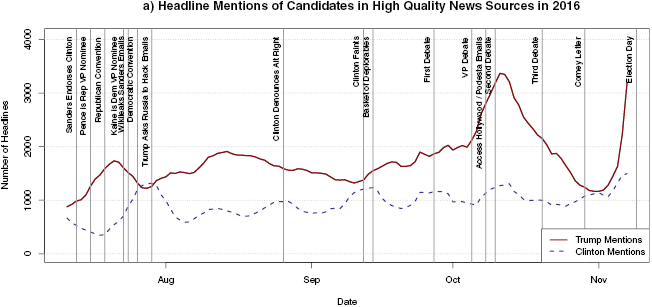
Across the 2016 campaign, high-quality news outlets paid more attention to Donald Trump than to Hillary Clinton (Figure 1a). On any given day, the 1,048 high-quality sources that published stories in 2016 yielded between 612 and 4,561 headlines mentioning Donald Trump and between 230 and 2,092 stories mentioning Hillary Clinton. On average, Trump was mentioned 85% more often in headlines than Clinton, with Trump appearing in an average of 1,721 stories per day compared to 929 for his opponent.Footnote 26 Trump stories outnumbered Clinton stories on 111 days, with mentions of Clinton only surpassing Trump mentions on nine days.
Trends in News Mentions of Candidates in 2016 (seven-day rolling averages)
Headline mentions of candidate in high-quality news sources in 2016;
Headline mentions of candidate in low-quality sources in 2016.
Clinton received more high-quality news coverage than Trump on a few notable occasions. These were: when primary opponent Bernie Sanders first endorsed Clinton (July 12th), around the Democratic National Convention (July 27th, 29th, and 30th), when Clinton fainted from pneumonia during a September 11th commemoration event (September 12th and 13th), and on the last three days of October, as the FBI resumed an investigation into whether classified information had been improperly shared in her emails.Footnote 27 The tendency to cover Trump more in 2016, unless there was a significant event thrusting Clinton into the news, may reflect journalists’ sense that Trump’s campaign was more unusual and newsworthy than Clinton’s.
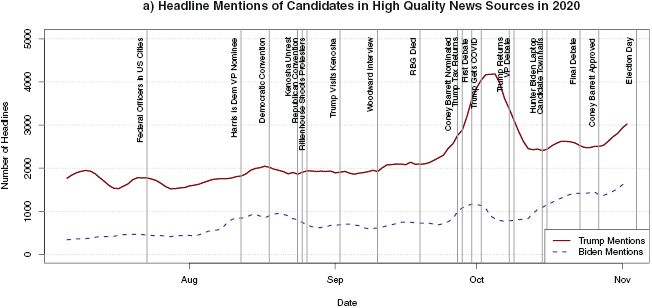
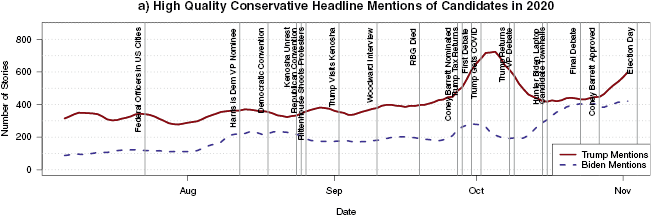
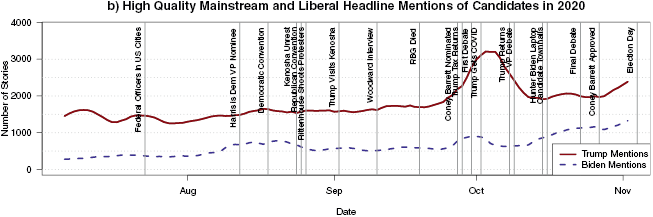
In 2020, the difference between Trump and Biden was even larger. Biden’s coverage in high-quality news outlets never approached that of Trump (Figure 2a). Even though we tracked a slightly smaller number of high-quality sources in 2020 (919 total outlets), Trump received a larger number of headline mentions than he had four years earlier, averaging 2,207 mentions per day. On the Democratic side, Biden received less coverage than Clinton had, averaging 792 mentions per day. Overall, Trump was mentioned more than two and a half times as frequently as Biden. Coverage of Trump peaked on the first few days of October when he was diagnosed with COVID after the first debate, reaching more than 5,000 daily headlines. He never fell below 1,412 daily headline mentions. Biden’s mentions only surpassed Trump’s lowest day ten times and reached its absolute maximum on October 23rd, following the final debate, with 1,945 headlines. On a relative basis, Biden’s coverage peaked at 82% of Trump’s mentions on August 12th, when he named Kamala Harris as his Vice-Presidential Nominee, and did not otherwise surpass three-quarters of the volume of Trump’s mentions.
Trends in News Mentions of Candidates in 2020 (seven-day rolling averages)
Headline mentions of candidate in high-quality news sources in 2020;
Headline mentions of candidate in low-quality sources in 2020.
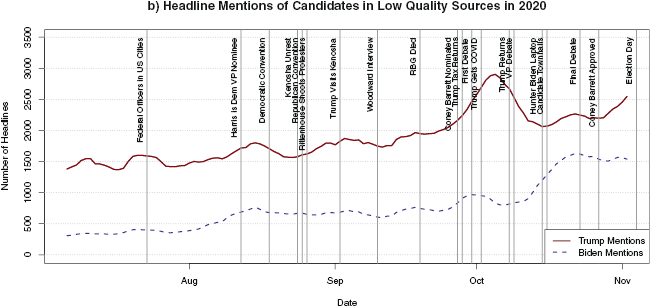
Figure 2(b) Long description
The panel shows the same, but in low-quality sources. There are two lines showing trends, one for each candidate (Biden and Trump). Trump is mentioned more in high-quality sources, but there is very little candidate difference in low-quality sources.
Some of the gap in news attention in 2020 could be the result of Trump being a sitting president and thus attracting news coverage for presidential actions outside of the campaign. It may also reflect differences between Biden’s and Trump’s campaigns amid the Coronavirus pandemic. Biden’s COVID-cautious strategy meant that he limited travel and held relatively few campaign rallies, which likely decreased coverage. But when you consider 2016 and 2020 together, Trump consistently gets more attention from high-quality news sources than his opponents. Given that both Clinton and Biden led Trump in the polls during their campaigns (and thus were both favorites to win), this pattern contradicts Zaller’s (Reference Zaller1999) “rule of anticipated importance.”
In campaigns, we find a general increase in news coverage of the candidates over time, punctuated with spikes in attention around salient political events, such as the nominating conventions, debates, and immediately before election day. We also see bumps that appear to correspond with other developments, such as the release of the Access Hollywood tape in 2016, where Trump boasted about sexually assaulting women, and when Hillary Clinton fainted from pneumonia during a September 11th memorial event (see Bode et al. Reference Bode, Budak, Ladd, Newport, Pasek, Singh, Soroka and Traugott2020) and when Trump contracted COVID in 2020.
News Headlines in Low-Quality Sources
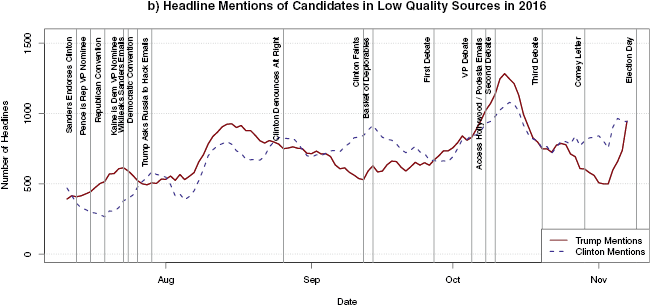
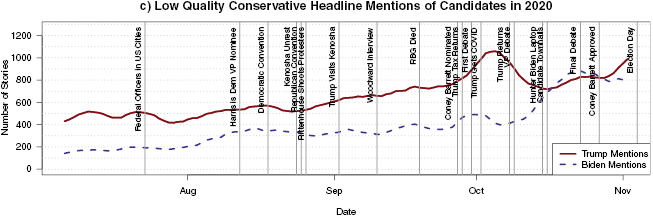
Headlines from low-quality sources (338 in 2016 and 393 in 2020) tended to mention the presidential candidates in ways that were relatively similar to those from high-quality sources (Figures 1b and 2b). If anything, low-quality headlines were slightly less sensitive to campaign events and other developments. However, Trump and Clinton were mentioned with almost exactly the same frequency in low-quality sources in 2016 (averaging 702 daily headlines about Trump and 704 about Clinton). Trump’s dominance of campaign news in 2016 came primarily from high-quality sources. In 2020, the gap in candidate attention was present in both high-quality and low-quality sources. Trump was the subject of 1,880 low-quality stories compared to 764 for Biden in 2020. These differences appeared in media sources with different ideological leanings, as noted below.
The responsiveness of high- and low-quality sources to campaign events was also more similar in 2020 than it had been in 2016, but this appears to be primarily driven by Clinton coverage. To assess these patterns, we calculate measures akin to Pearson correlations between the data streams that are designed to be robust to lag differences and to periodic effects in news production.Footnote 28 These reveal that high- and low-quality sources varied similarly in their mentions of Trump (r=.80 in 2016 and .91 in 2020). Coverage of Biden in high- and low-quality sources was also highly correlated (r=.92) in 2020.
Coverage of Clinton in 2016 stands out in the disconnect between high- and low-quality sources, as they were only correlated at r=.59. For instance, mentions of Clinton appeared to only increase in low-quality headlines following the release of campaign manager John Podesta’s hacked emails on WikiLeaks in October. The volume of high-quality coverage barely reacted at all to that story.
Partisan Sources
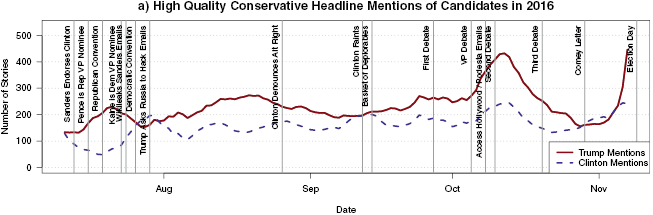
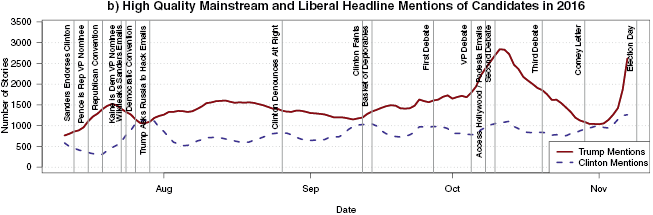
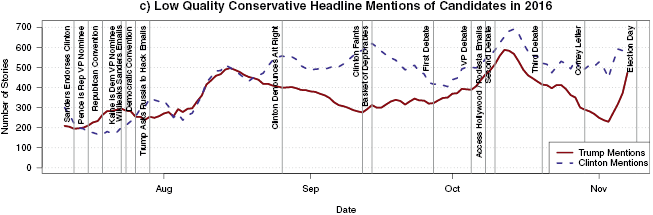
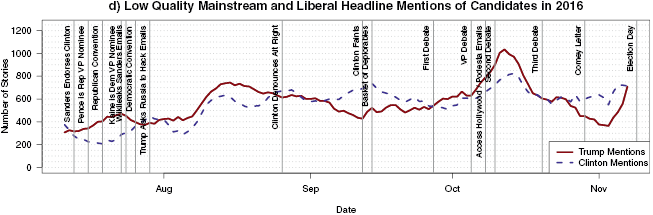
Prior work suggests that liberal and mainstream outlets overlap considerably in their content and audiences, yet conservative content and audiences are distinct (Benkler, Faris, and Roberts Reference Benkler, Faris and Roberts2018; Levendusky et al. Reference 87Levendusky, Josh Pasek, Hardy, Kenski, Ophir and Renninger2023; Stroud Reference Stroud2011).Footnote 29 Thus, we compare conservative-leaning outlets with those that are either liberal or mainstream. In 2020, the story was simple: Figure 4 shows that Trump received substantially more coverage in all four types of news sources, regardless of ideology or quality level. In 2016, the story was more complicated, as shown in Figure 3. Trump consistently received more coverage in the high-quality sources only. The low-quality sources focused relatively more on Clinton. The mainstream and liberal low-quality sources covered the two candidates roughly equally. In contrast, the conservative low-quality sources actually covered Clinton more than Trump from the end of August through election day. Clinton was mentioned 1.3 times as often as Trump in low-quality conservative sources in 2016.
Trends in Candidate Headlines by Outlet Quality and Orientation in 2016 (7-day rolling averages)
High-Quality Conservative Headline Mentions of Candidates in 2016
High-Quality Mainstream and Liberal Headline Mentions of Candidates in 2016
Low-Quality Conservative Headline Mentions of Candidates in 2016
Low-Quality Mainstream and Liberal Headline Mentions of Candidates in 2016.
Trends in Candidate Headlines by Outlet Quality and Orientation in 2020 (7-day rolling averages)
High-Quality Conservative Headline Mentions of Candidates in 2020
High-Quality Mainstream and Liberal Headline Mentions of Candidates in 2020
Low-Quality Conservative Headline Mentions of Candidates in 2020
Low-Quality Mainstream and Liberal Headline Mentions of Candidates in 2020
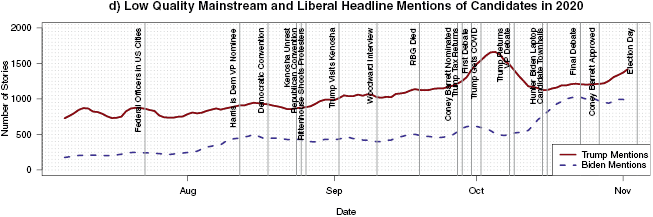
We can also look at how much these time series vary together over time. In 2016, variation over time in mentions of Trump were similar regardless of outlet quality or orientation (correlations ranged from .82 to .98 across categories; see trends shown with solid lines in Figure 3). In contrast, this was not true for Clinton coverage. Our lowest correlation between any of these headline streams was between Clinton headlines in low- and high-quality sources, which were correlated at only .61 (correlations ranged from .61 to .83). We did not find this in 2020, where patterns of mentioning each of the candidates were similar regardless of outlet quality and orientation (correlations >.92).
Taken altogether, Trump dominated attention in both elections. Overall, those producing news content were often twice as likely to mention Trump in a headline as his opponents. With this data alone, we cannot diagnose the reasons why news sources paid far more attention to Trump; however, this story resonates with claims that Trump was particularly effective in using tactics honed throughout his long career to attract news coverage (Bode et al. Reference Bode, Budak, Ladd, Newport, Pasek, Singh, Soroka and Traugott2020).
The only place where coverage of the Democratic candidates rivaled that of Mr. Trump was in conservative, low-quality outlets in 2016. This coverage was surely not favorable, as illustrated by its increase when Clinton fainted on September 11, the Comey letter was released, and in 2020 following the New York Post’s Hunter Biden laptop story.
Attention to the Candidates on Twitter
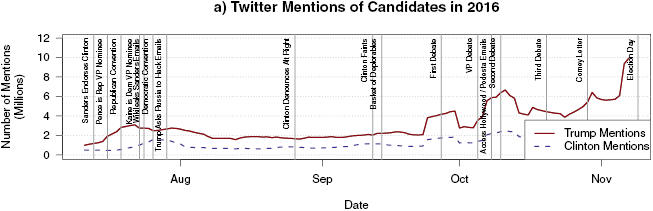
The party nominees were frequently discussed on Twitter in both years (Figure 5), with substantially more Tweets about the candidates in 2020 than in 2016. In 2016, over the 120 days preceding the election, approximately 366 million tweets mentioned Trump, and 160 million mentioned Clinton.Footnote 30 Mentions of the candidates generally increased over that campaign, ranging from 656,000 to 14.6 million daily mentions of Trump and 344,000 to 5.5 million daily mentions of Clinton.
Attention to Candidates on Twitter
Twitter Mentions of Candidates in 2016
Twitter Mentions of Candidates in 2020
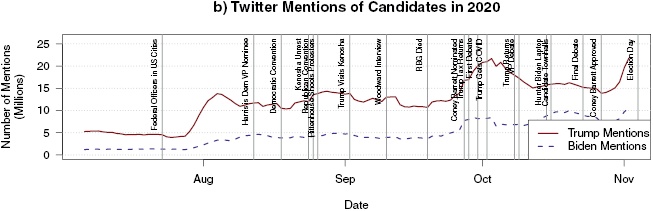
In 2020, we observed 1.5 billion tweets mentioning Trump (ranging from 1 million to 32 million per day) and 569 million mentioning Biden (ranging from 887,950 to 20 million daily). A typical day in 2020 yielded 5.4 times as many tweets about Trump as had been the case in 2016, and 4.3 times as many tweets about Biden as there were tweets about Clinton in 2016. This is surprising considering that the percentage of Americans using Twitter only grew from 20% to 23% between 2016 and 2020 (Auxier and Anderson Reference Auxier and Anderson2021).
Figure 5 shows that, as in other media, the campaigns became more prominent on social media around focusing events (including conventions and debates) and as election day drew nearer. Also, in other media, Donald Trump was far more likely than his opponents to receive attention in both 2016 and 2020. Overall, on Twitter, Trump received 69.6% of the attention allocated to the two major-party candidates in 2016 and 71.9% of the attention allocated to the major-party candidates in 2020. In 2016, Clinton was never mentioned more than Trump. Trump’s proportion of campaign tweets vacillated between 53% and 89%, reaching its highest point during the Republican convention. Clinton surpassed 40% of the candidates’ collective Twitter attention only during the Democratic convention and when she fainted on September 11th. In 2020, the gap between Biden and Trump was even larger. Biden’s attention on Twitter only very briefly surpassed Trump’s on July 28th, but the lines do not cross when we use weekly averages. Trump dominated social media attention in both years.
How Much Did People Remember Hearing and Seeing About the Candidates?
Attention to candidates on conventional or Twitter does not guarantee the public will notice (Pasek, McClain, et al. Reference Pasek, McClain, Newport and Marken2020). Social media’s relevance stems not from serving as a window into public opinion, but from its role as a source of information for journalists and some members of the public, and a reflection of the salience of that information. To see which stories broke through to the public, we asked people during the campaign what information they encountered recently and could recall about each candidate.
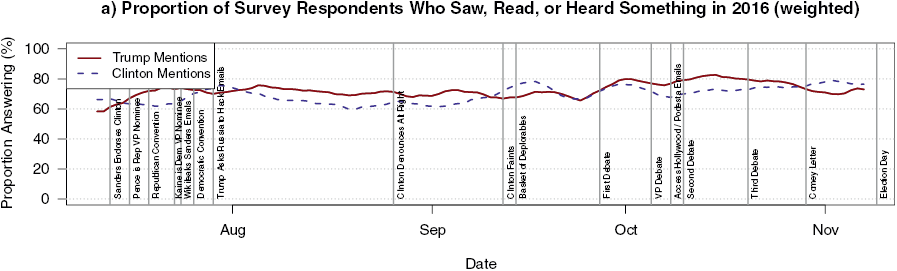
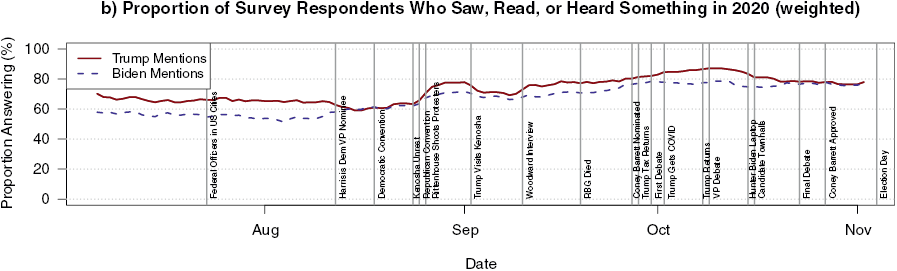
Figure 6 illustrates that most survey respondents could recall some information about the presidential candidates. In 2016, between 57% and 87% of respondents in our surveys recalled something about Trump in any given weekly period (averaging 73%), and between 55% and 87% recalled something about Clinton (averaging 70%). The pattern was similar but slightly more variable in 2020, with an average of 73% providing an answer to the Trump question (range: 52% to 90%) and 67% responding to the question about Biden (range: 43% to 89%).Footnote 31
Attention to Candidates in Survey Responses
Proportion of Survey Respondents Who Saw, Read, or Heard Something in 2016 (weighted)
Proportion of Survey Respondents Who Saw, Read, or Heard Something in 2020 (weighted)
People sometimes responded to the question, saying they had heard something about the candidates, but couldn’t remember exactly what it was. We included these responses. But we excluded people who responded only to say they “had not heard anything” or the equivalent. Some respondents provided a general evaluation of the candidate they were asked about rather than a direct answer to our prompt, which asked for recent news (e.g., “I don’t like him”). Given the somewhat subjective nature of interpreting these answers and the fact that even these answers might reflect something individuals had recently heard, we included responses like this. We excluded only answers that asserted a lack of knowledge or memory (e.g. “I don’t recall”).
People reported hearing more about the candidates over the length of the campaign, as the campaign became more salient in the media and paid campaign messages increased. While recalled information about Clinton in 2016 vacillated across events, it increased from just over 60% at the beginning of the survey period to consistently more than 70% throughout October, as shown in Figure 6a. In contrast, attention to Trump in 2016 was steadier. The source of this difference is not entirely clear. It may have something to do with his tendency throughout 2016 to manufacture controversy whenever attention to him dipped (Bode et al. Reference Bode, Budak, Ladd, Newport, Pasek, Singh, Soroka and Traugott2020), a strategy that was especially successful that year. Figure 6b shows that, in 2020, respondents’ comments increased following the conventions from a relatively steady 55% for Biden and 65% for Trump to more than 75% for each candidate in the last month of the campaign. In both years, people remembered more news about the candidates following their respective conventions, around debates, and following other notable events, such as when Clinton fainted from pneumonia in 2016 and when Trump announced that he had COVID in 2020. This reflects the patterns in media coverage documented above.
We saw few party differences in how much people recalled about the candidates (see Figure 7). Members of both parties recalled more about the candidates around major campaign events. And both parties remembered more news about Trump than about the Democratic nominee in both 2016 and 2020. Both parties paid more attention to Trump in both years, even though this gap was smaller than the coverage gap we found in the media content data. There were party differences in the reception of news about the Democratic nominees. Democrats were slightly less likely than Republicans to recall things about Clinton throughout the entire 2016 campaign. Yet in 2020, Republicans often had less to say about Biden than did Democrats, including during the events in Kenosha, Wisconsin, and around the time of the first debate.
Attention to Candidates in Survey Responses by Party
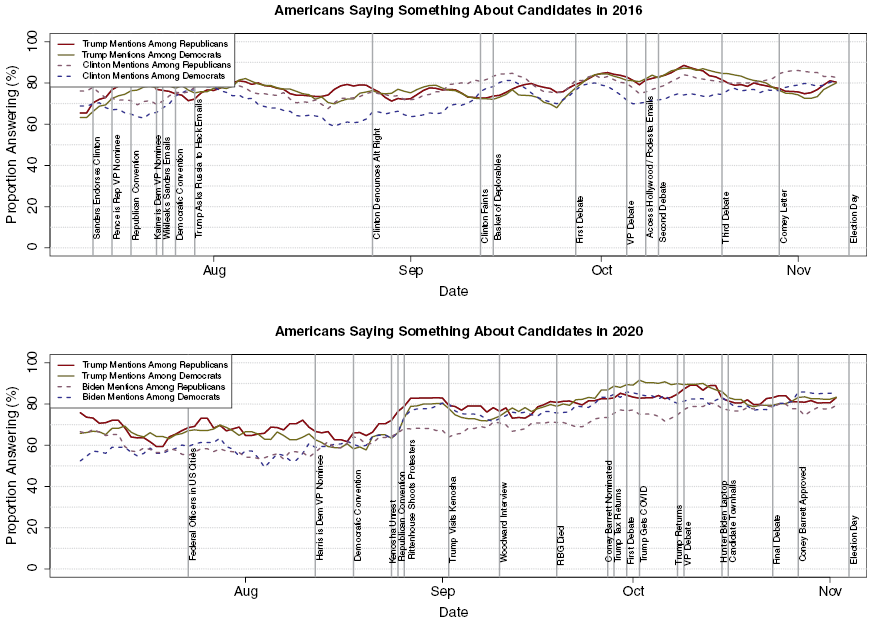
Figure 7 Long description
Panel (a) shows the prevalence of mentions of the two candidates in open-ended survey responses over the course of the 2016 campaign, with the numbers separated out by Democratic respondents and Republican respondents. Panel (b) shows the same, but over the course of the 2020 campaign. See the main text for an analysis of the results.
Associations between the Volume of Coverage in the Information Streams
Finally, we examine the correlations in the quantity of candidate news over time between different types of media content and the perceptions of survey respondents. The left side of Figure 8 shows the correlations across trends in the various information streams for both candidates in each election, using weekly averages. Most correlations are relatively high.Footnote 32 This partly reflects the fact that attention to candidates across all streams tends to increase as the election draws nearer.
Correlations Between Streams in Candidate Mentions
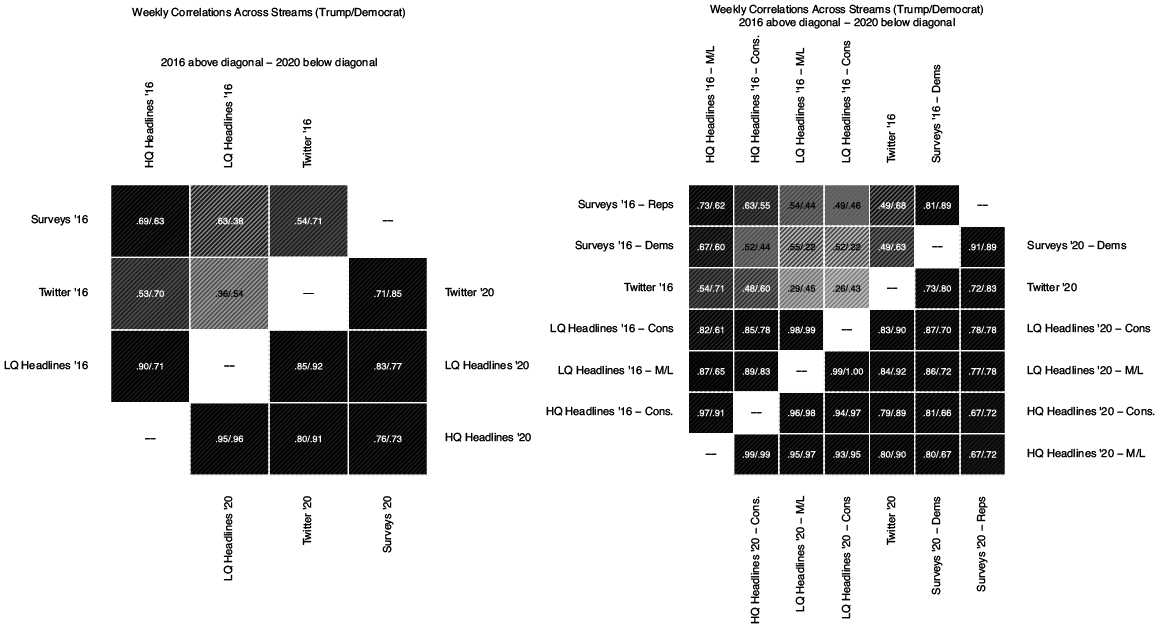
Figure 8 Long description
Panel (a) is a correlation matrix, which shows all the possible correlations over the course of the campaign between the different information streams (i.e., open-ended surveys, low-quality headlines, high-quality headlines, and Twitter posts) in both 2016 and 2020. Panel (b) shows the same information, except that the high and low-quality headlines are also separated into conservative sources versus mainstream and liberal sources. And the survey responses are separated into those from Republicans and those from Democrats. See the main text for an analysis of the results.
But a few other patterns are apparent. In most cases, the correlations across streams for different candidates were of similar strength. The media’s attention and the public’s attention move together. For instance, the correspondence between the surveys and the headlines in high-quality outlets in 2016 was .69 for Trump and .63 for Clinton. Survey content aligns more closely with low-quality headline mentions for Trump than for Clinton (.63 vs. .38), but these differences were generally modest. In contrast, mentions of both candidates on Twitter and in low-quality headlines were more distinct, implying that Twitter and low-quality news sources were likely not drawing large amounts of content from each other.
All these information streams were more correlated over time in 2020. The differences in headline volume between low- and high-quality sources were negligible, and trends in Twitter volume were far more likely to echo corresponding trends in headlines. In a more worrisome development, survey recall of the candidate news and Twitter candidate mentions in 2020 more closely mirrored candidate mentions in low-quality headlines than in high-quality headlines, indicating that low-quality sources may have become more consequential over time.
Breaking down these relationships by source orientation and survey respondents’ partisanship further illustrates the increasingly central role of low-quality news sources (Right side of Figure 8). Comparing across the diagonal reveals large increases between 2016 and 2020 in the correlation between low-quality conservative headlines and both Twitter and survey responses. Tweets about both candidates in 2020 were closely linked to the quantity of low-quality conservative media coverage. Even more significantly, survey respondents from both parties mentioned the candidates in 2020 at rates that tracked low-quality conservative headlines more closely than other media sources, even though they had been the least related to survey responses in 2016.
Making Sense of the Patterns in Attention
This section focused on patterns in the total quantity of candidate attention across these two campaigns: how much different types of media covered these candidates and how much the public noticed. In general, the media and the public’s attention to candidates increases over the course of the campaign, and is punctuated by notable spikes around key campaign events.
Another pattern is the changing role of low-quality conservative news outlets. In 2016, low-quality conservative news mentions of Hillary Clinton were an outlier, with the Democratic nominee receiving much more attention from these sources than elsewhere on several occasions. By 2020, attention patterns in low-quality conservative news were much more closely correlated with other media sources and with the information the public consumed.
However, the second and most notable pattern is a disproportionate focus on Donald Trump across various information streams and years. Trump received more attention than his opponent in both campaigns, as evidenced by headlines from high- and low-quality news sites, Twitter mentions, and open-ended survey responses. This imbalance in attention was even more pronounced in 2020 than it had been in 2016.
The theory that campaigns tend to be retrospective evaluations of the incumbent party might explain why the gap between Trump and the Democratic nominee was wider in 2020, but it doesn’t explain Trump’s consistent dominance of attention. Also, since Trump was behind in the polls in both election years, and his win was a surprise to many in 2016, we don’t think the rule of anticipated importance can explain this pattern either.
One can interpret this pattern as suggesting that coverage of Trump is more “resonant” with journalists (at high- and low-quality outlets) and the public because he is a longtime media celebrity, consistent with Entman’s (Reference Entman2004) ideas. Alternatively, you could interpret the pattern by suggesting that the media system treats Trump’s outlandish behavior compared to other politicians as warranting constant “fire alarm” mode coverage (Boydstun Reference Boydstun2013). We can’t rule this out.
However, we believe that Trump’s domination of the media system’s attention is such a significant pattern, so unusual in American politics, and has persisted for so long that an additional explanation is also needed. Campaign tactics matter. Trump appears to have used his media skills (conscious and instinctual, but all developed over his pre-political career) to exploit the opportunities of the new social media environment. In this environment, whether the candidate and their campaign are heavy social media users or not, the public’s attention is highly variable and uncertain. Candidates whose behavior stands out and who are good at generating compelling stories will get much more attention than others.
Of course, the volume of media attention to the candidates, while important, is only part of the story. One would expect positive or neutral attention to benefit its recipient, whereas negative attention may hurt public impressions of a candidate. In subsequent sections, we examine the tone of the information being transmitted (Section 3) and the specific stories garnering attention across these various information streams (Sections 4–5).
3 Variation in the Tone of Candidate Coverage
The volume of media coverage is our primary focus. Yet to understand the implications of this coverage, we need to know the content of these messages. In this section, we look at the tone of the information about each candidate in our various media content streams and in our open-ended survey responses.
One Campaign Awash in Negativity, and One Less So
Media coverage of, and public opinion toward, the candidates were unusually negative during the 2016 campaign (see Bode et al. Reference Bode, Budak, Ladd, Newport, Pasek, Singh, Soroka and Traugott2020). Views of opposition party members and political candidates have become increasingly negative for decades, a phenomenon that political scientists call “affective polarization” (e.g., Iyengar et al. Reference Iyengar, Lelkes, Levendusky, Malhotra and Westwood2019; Iyengar, Sood, and Lelkes Reference Iyengar, Sood and Lelkes2012) and “negative partisanship” (e.g., Abramowitz and Webster Reference Abramowitz and Webster2016; Lelkes Reference Lelkes2021). But even accounting for this, attitudes toward the major party nominees were anomalously negative in 2016. Trump and Clinton emerged from the 2016 campaign with an absolute majority of survey respondents expressing unfavorable views of each of them (Saad Reference Saad2016).
Was the public’s disapproval of the 2016 candidates an aberration or a new normal?
The answer from our 2020 data is ambiguous. Both candidates were still unpopular in 2020 by historical standards, but not as unpopular as Clinton and Trump were in 2016. Views of Trump remained net negative, although slightly better than in 2016. Biden was substantially more popular in 2020 than Clinton was in 2016, with about equal numbers of Americans viewing him favorably and unfavorably.
The Tone of Coverage in the Media Information Streams
This section tries to understand the tone of media coverage in these elections. We calculate positive-to-negative “sentiment” scores for each of our information streams. (We will use “sentiment” and “tone” interchangeably.) Like Section 2, the data comprise news headlines from high- and low-quality media sources that mention the candidates, tweets mentioning the candidates, and responses to open-ended survey questions asking what people had “seen, read, or heard” about each candidate in the past few days. Sentiment was calculated using the Lexicoder scores for the words in our data (Young and Soroka Reference Young and Soroka2012a, Reference Young and Soroka2012b).Footnote 33 We compared the proportions of positive versus negative words in the units of each information stream, which were then averaged across a 7-day rolling period, with the contribution of each day weighted by the amount of data available. Scores below 0 indicate that negative words were used more frequently than positive words, whereas scores above 0 indicate that positive words appeared more often.
Figure 9 shows the tone over time of tweets about the candidates, headlines about the candidates in high- and low-quality news sources, and the open-ended survey responses. Information about both candidates was almost always negative in all information streams in 2016, which fits with previous research on public opinion and media content in 2016. For both Democratic candidates, coverage was more negative in low-quality sources, especially for Clinton.
Tone of 4 Information Streams Across the 2 Campaigns
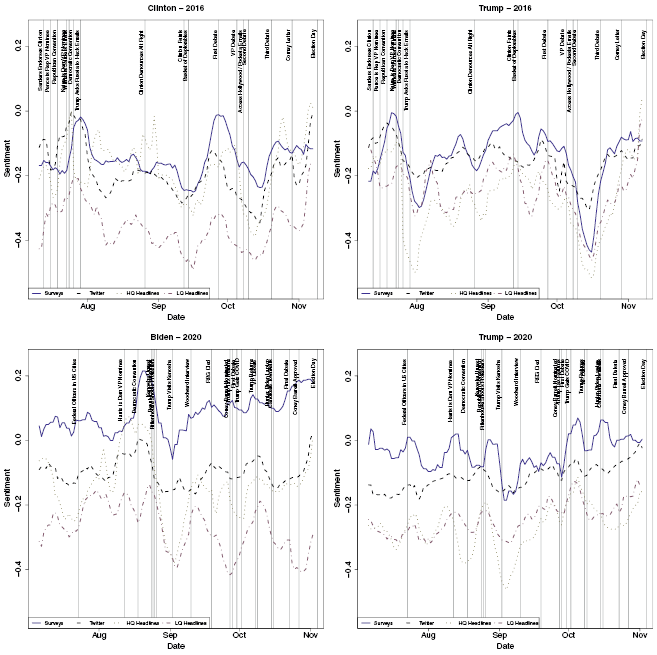
Figure 9 Long description
There are four panels. Panel (a) shows the positive-to-negative tone of content focused on Clinton in four information streams over the course of the 2016 campaign. Each panel includes four lines, corresponding to surveys, Twitter posts, High-Quality News Headlines and Low-quality news headlines. The four information streams are open-ended surveys, low-quality headlines, high-quality headlines, and Twitter posts. Panel (b) shows the same thing, but for the tone of content focused on Trump in the 2016 campaign. Panel (c) shows the same thing, but for the tone of content focused on Biden in the 2020 campaign. Panel (d) shows the same thing, but for the tone of content focused on Trump in the 2020 campaign. See the main text for an analysis of the results.
For Trump, coverage was more negative in high-quality sources in both years. Trump’s coverage in high-quality sources was especially negative at the end of July 2016 after the Democratic Convention, when he asked Russia to hack into Clinton’s emails, and later in 2016 when the Access Hollywood tape became public, where he bragged about sexually assaulting women. But even in these dramatic cases, the tone of what people remembered about Trump in the survey responses recovered relatively quickly from these shocks. It returned to the baseline level (which was still usually net negative). The effect of these negative events dissipated rapidly.Footnote 34 The pattern of reversion is present in all four information streams for all the candidates, but it is most dramatic for Trump in 2016. By the week before the election, coverage of Trump in high-quality sources had recovered from even the large negative shock of the Access Hollywood tape.
In 2020, Biden’s coverage in high-quality sources and on Twitter was more positive than in low-quality sources, a gap similar to what Clinton experienced in 2016, but not as large. In general, there were no campaign events that caused big declines in the tone of Biden news coverage that broke through to the public. Biden experienced a positive bump in coverage in high-quality outlets and on Twitter following the 2020 Democratic National Convention; still, it returned to prior levels by the end of the Republican National Convention.Footnote 35 Coverage of Biden in low-quality sources was often negative, but unlike for Clinton, this was not reflected in other media streams or in 2020 survey responses. And significantly, as we will return to in later sections, there was a minimal drop in the tone of high-quality headlines, or in what people heard about Biden, after the “Hunter Biden laptop” story broke in the New York Post on October 14.
As in 2016, coverage of Trump in 2020 was more negative in high-quality sources than in other media streams, in contrast to the pattern for both Democrats. The biggest temporary drop in the tone of Trump’s coverage was when he visited Kenosha, Wisconsin, after the Republican Convention. Yet at no point in 2020 was there a drop in tone across all streams of Trump coverage comparable to what happened after the Access Hollywood tape was released in 2016. The tone of Trump coverage in both high- and low-quality sources was much more consistent in 2020 than it had been in 2016. But unfortunately for Trump, it was consistently negative.
The Tone of the News that People Heard and Remembered
While the information we tracked in all information streams was mostly negative in these two campaigns, the survey responses were the least negative. In 2016, however, the number of negative words mentioned by survey respondents outpaced the number of positive words on 108 of 114 days for Clinton and on 109 of 114 days for Trump. In 2020, the number of words mentioned when recalling news about Trump was negative for 67 of 102 days. Biden was the only candidate for whom people recalled mostly positive news – the words mentioned in recalled news were net positive for 87 of 102 days in 2020.
The tone of what people recalled about the candidates improved at a few key points during the campaigns. For example, news about Clinton was the most positive across all our information streams following the Democratic Convention and around the time of the first debate. But the survey responses were the most positive, rising all the way to neutral. In 2016, Trump experienced a positive bump in the media information streams and in the survey responses following the Republican Convention and during the window in September when Clinton was criticized because of health concerns and for a statement in which she referred to some Trump supporters as a “basket of deplorables” (Reilly Reference Reilly2016). Similar to Clinton, the tone of survey responses about Biden in 2020 increased temporarily after the Democratic Convention before reverting to its previous level.
The tone of what people reported hearing about Trump decreased dramatically when news coverage of him got more negative, especially in high-quality outlets: when he openly asked Russia to hack Clinton’s emails in 2016, following the release of the Access Hollywood tape in 2016, and when he visited Kenosha in 2020. However, perceptions of Trump were resilient. The tone of survey responses about Trump reverted to previous levels relatively quickly after these events.
When the “Hunter Biden laptop” story became public on October 14, 2020, the tone of news people reported hearing about Biden declined only modestly. It then recovered to its previous levels before the second presidential debate on October 22. That story had a small and short-lived effect on the tone of news people remembered about Biden.
Associations between the Tone of the Information Streams
Figure 10 shows correlations for the tone of information streams over time (using the same weekly aggregation strategy as in Section 2). Tone across the four information streams was closely related for Trump in 2016, but less so for Clinton. The net tone of information about Trump was correlated between surveys, tweets, and both types of headlines at or above .70. In contrast, although tweets and low-quality headlines yielded similar stories for Clinton, trends in the surveys were only moderately related to the other streams (correlations ranging between .41 and .63). As in our analysis of the volume of coverage in Section 2, we again see the importance of coverage of Clinton in 2016 in low-quality outlets. The tone of what people remembered hearing about Clinton was most closely correlated with headlines about her in low-quality outlets (.63), followed by the correlation with the tone of tweets about her (.54), and was least strongly correlated with the tone of headlines about her in high-quality outlets (.41).
Weekly Correlations in Tone Across Streams
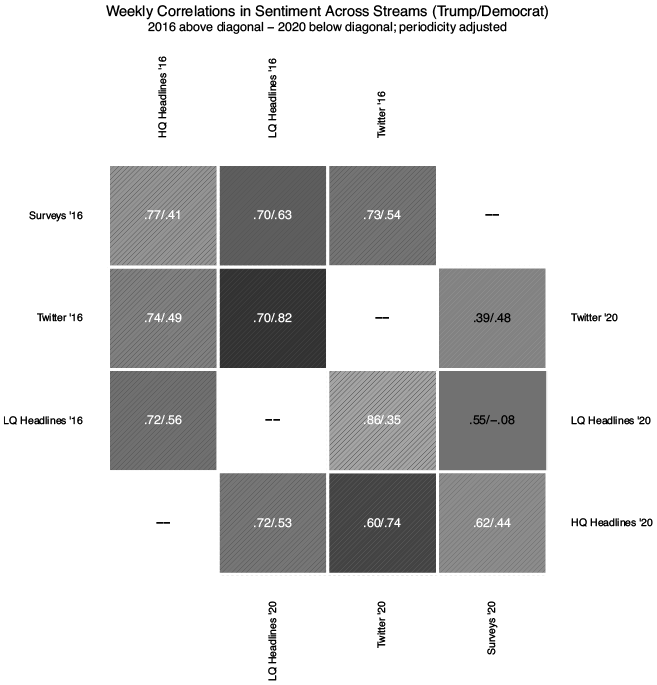
Figure 10 Long description
This is a correlation matrix, which shows all the possible correlations over the course of the campaign between the positive-to-negative tone of content focused on the four nominees (Trump twice) in different information streams (i.e., open-ended surveys, low-quality headlines, high-quality headlines, and Twitter posts) in both 2016 and 2020. See the main text for an analysis of the results.
In our team’s previous book (Bode et al. Reference Bode, Budak, Ladd, Newport, Pasek, Singh, Soroka and Traugott2020) and in Section 4 below, we show that one story consistently dominated the public’s memory and media messages about Clinton in 2016: her “email” scandal. In contrast, a series of negative stories about Trump in 2016 faded quickly from media content and the public’s memory. The central role of low-quality news sources and social media in shaping perceptions of Clinton may have been linked to the prominence of this story.
Interestingly, the correlations across streams were generally lower in 2020, but, as in 2016, sentiment was more strongly correlated across streams for Trump than for his Democratic opponent. For example, Biden’s convention bump in sentiment was evident in high-quality headlines, survey responses, and tweets, but not in low-quality headlines. Overall, the tone of what people recalled about Biden in surveys was moderately correlated with his coverage in high-quality headlines (.44) and not at all with low-quality headlines (−0.08). In sharp contrast to Clinton, for Biden in 2020, the tone of what people heard and remembered about him had little relation to coverage in low-quality outlets.
The sentiment of what people recalled about Trump in surveys in 2020 was correlated with his coverage in high-quality headlines at 0.62 and with low-quality headlines at 0.55. The tone of information in high-quality outlets and survey responses about Trump was overall very negative. The nadir of the tone of survey responses about Trump following his visit to Kenosha was reflected in the high-quality headlines, but not in tweets or low-quality headlines.
Overall, while the volume of candidate coverage became more correlated across media streams from 2016 to 2020, the tone of the information became less correlated. The most likely explanation for this tone pattern was the increased coverage of Democratic candidates and the reduced importance of low-quality news outlets in 2020. The differences between Clinton and Biden were stark. In particular, what people heard about Biden was much less correlated with low-quality headlines than was the case for Clinton (-.08 vs. .63). In 2016, the tone of coverage of Clinton in low-quality sources was well correlated with the tone that people reported hearing about her. In 2020, the tone of coverage of Biden by low-quality sources was largely irrelevant to the broader public.
Interpreting the Patterns in Tone of Coverage
Despite Trump dominating the media’s attention in both 2016 and 2020, that did not lead to favorable coverage. In this section, we showed that people consistently encountered negative coverage of Trump in both these campaigns. In 2016, this was matched by negative coverage of his opponent. However, in 2020, when coverage of Biden was generally positive, this put Trump at a disadvantage.
As in the last section, the rule of anticipated importance does a poor job of explaining our findings. Both candidates led Trump in the polls for most of the election year, and Biden’s lead was larger. Biden was a probable future president, yet he did not receive the same negative scrutiny as Clinton.
The tendency to focus on the incumbent administration’s record during the presidential campaign could explain Trump’s negative coverage in 2000. While yearly real personal income growth after taxes and transfers was positive due to the U.S. government’s aggressive pandemic fiscal and monetary response,Footnote 36 the country was suffering through a global pandemic that led to slow GDP growth and massive social and psychological hardships. And as we will see in the next section, much of this negative coverage of Trump focused on his handling of the pandemic. But this idea does not explain why Trump’s coverage was also negative in 2016.
Market incentives tend to favor negative coverage and more coverage of preexisting scandals and storylines (Searles and Banda Reference Searles and Banda2019). From this perspective, it is easier to get attention if you don’t mind much that the attention is negative. We should expect many attention-grabbing candidate strategies to produce negative coverage. Creating lots of positive coverage is much harder. Journalists may have seen Trump’s unorthodox background and behavior in all his campaigns as a “fire alarm” (Boydstun Reference Boydstun2013), drawing attention but the negative variety. It is also plausible that the media treated the entire coronavirus pandemic as a fire alarm during 2020.
The difference in the coverage of Clinton and Biden could be explained by culturally resonant frames (Entman Reference Entman2004). Clinton and her husband had a long, contentious relationship with the elite political press corps (Ladd Reference Ladd2015), and she was unpopular by the beginning of the 2016 campaign. While Biden had been a senator and vice president for many decades, he had never been a national cultural lightning rod or a symbol of the Democratic Party as Bill and Hillary Clinton had been. Negative news about Clinton might have resonated with the preexisting views of reporters and the public in ways that negative news about Biden did not.
As you can see, the patterns in tone are consistent with many existing theories. The major exception is the rule of anticipated importance. In the next section, we delve beyond the overall tone of media coverage to examine specifically which stories garnered attention.
4 The Stories in the Campaign Information Environment
The media environment of a presidential campaign plays a crucial role in informing potential voters about candidates’ political positions, past record, and their personal suitability for office (such as their skills and ethics, broadly defined).Footnote 37 It matters which stories the media system focuses on during a presidential campaign. The stories that get attention can influence political preferences by providing information and by increasing the salience of some stories over others (i.e., agenda-setting and priming).Footnote 38
In a previous book, our team looked at the over-time dynamics of attention to different stories in our 2016 open-ended survey responses, asking what new people had “read, seen, or heard” across the campaign (Bode et al. Reference Bode, Budak, Ladd, Newport, Pasek, Singh, Soroka and Traugott2020). We found that,
… the recollections of [news] about Trump were more varied and less consistent across the campaign, reactive to what was happening at that point in the campaign. There was much less of a cognitively dominant motif in perceptions of Trump than there was in perceptions of Clinton. Americans’ recollection of what they had read, seen, or heard about Trump moved from initial recall of convention-related topics – including his selection of Mike Pence as his vice presidential candidate and the convention itself – to his criticism of a GoldStar Muslim family that spoke during the Democratic Convention, his trip to Mexico and discussion of immigration, the debates, and to coverage of the infamous Access Hollywood tape. Americans often recalled Trump’s criticisms of Hillary Clinton, just as Americans often recalled Clinton’s attacks on Trump.
The lack of a dominant theme in recall about Trump in part reflects the lack of a conventionally remembered catchphrase or summary term that encapsulated his campaign – in contrast to the easily remembered “email” so readily associated with Clinton. There were so many dramatic stories about Trump during the campaign that didn’t fit into one narrative. People’s attention moved from one Trump story to the next, and the next
This section compares the stories that appeared in our campaign information streams in 2016 and 2020. As in prior sections, our goal is to assess whether the data support our two theses about the advantages and limits of Trump’s ability to control media attention, as well as whether the data align with existing major theories of campaign media content.
Making Sense of Campaign Messages
We begin by examining the words that people mention in response to our open-ended survey questions.Footnote 40 While examining word counts is a relatively simple approach, its simplicity lends it face validity, as will be clear when we examine the most frequent words in both campaigns. This straightforward method is particularly well-suited to these two campaigns because the major issues in them were widely described with the same one or two words. As you will see, words like “email,” “coronavirus,” and “women” play large roles in media content in these campaigns, and each straightforwardly connects to a major theme in campaign news.Footnote 41 While this simple method might not fit well with the dominant stories in every presidential campaign, in these two campaigns, we are lucky that the major stories could be described in a few words.Footnote 42
The Words People Heard
To give you a sense of the stories that dominated these two campaigns, Figure 11 shows the words that appeared most frequently in our open-ended survey responses in 2016 and 2020.Footnote 43 These words are arranged based on whether they were mentioned more frequently in relation to the Democratic nominee or Trump, and by whether they appeared more often in 2016 or 2020. The size of each term indicates the total number of times it was mentioned. Terms toward the left side of the graph were mentioned almost exclusively in 2016. Terms on the right were mentioned almost exclusively in 2020. For example, mentions of coronavirus and masking were unique to the 2020 election. Terms near the bottom of the graph were mentioned disproportionately in response to questions about the Democratic nominees. In contrast, terms near the top appeared more frequently in response to questions about Trump.
Proportions Comparing Mentions of Words by Candidate and Year
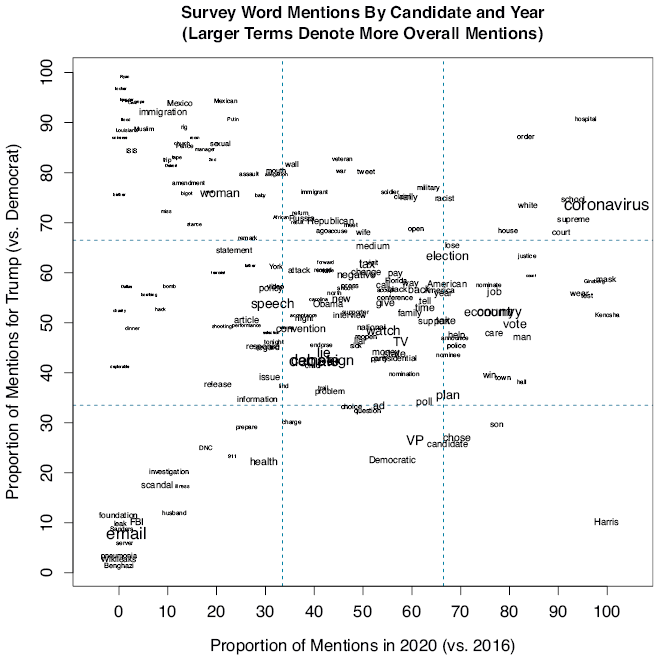
Figure 11 Long description
This figure is a crosstabulation where the data points are words. The words appear in the crosstab according to their value on the x- and y-axes. The x-axis is the proportion of all mentions of that word in our open-ended surveys that were in the 2020 surveys rather than the 2016 surveys. The y-axis represents the proportion of all mentions of that word in our open-ended surveys from both years that were in questions about Trump, rather than questions about the Democratic nominee. The words also vary in size. The size of each word indicates the total number of times it was mentioned. This is a correlation matrix, which shows all the possible correlations over the course of the campaign between the positive-to negative tone of content focused on the four nominees (Trump twice) in different information streams (i.e., open-ended surveys, low-quality headlines, high-quality headlines, and Twitter posts) in both 2016 and 2020. See the main text for an analysis of the results.
A large group of terms tended to appear with similar frequency across both candidates and years (located near the center of the figure). These were mainly words like debates, conventions, television, speech, and election, which reflect regular aspects of a political campaign without providing much information about specific details. Terms that appeared in one of the four corners of the figure reflect concepts that were associated with only one of the candidates in a given year. Of these, two stand out far more than the rest: mentions of email for Clinton in 2016 and mentions of coronavirus for Trump in 2020.
The dominance of these two issues is astounding. In 2016, 24.7% of those saying something about Hillary Clinton mentioned email, compared to under 7% of respondents mentioning debates or women in relation to Trump, which were his most common topics.Footnote 44 Similarly, in 2020, 23.9% of those who mentioned Trump also mentioned the coronavirus, far outpacing “good,” the second most common word mentioned about him (8.1%), and “vice president,” which was the most common thing mentioned about Biden (9.3%). Voters perceived a clear dominant story in each campaign. In 2016, that was Clinton and her emails. In 2020, it was Trump and the coronavirus.
Stories in Different Information Streams in 2016
Figure 12a through d show the relative frequencies of the most common words across information streams. All three of our media content datasets in 2016 focused more heavily on terms related to specific election events and less on email than the survey responses did. With the average word in each figure given a value of 1, we can see how common different terms were relative to one another, as well as how their prevalence varied across streams.
Frequency of Top 25 Words Across Media Streams and Surveys in 2016.
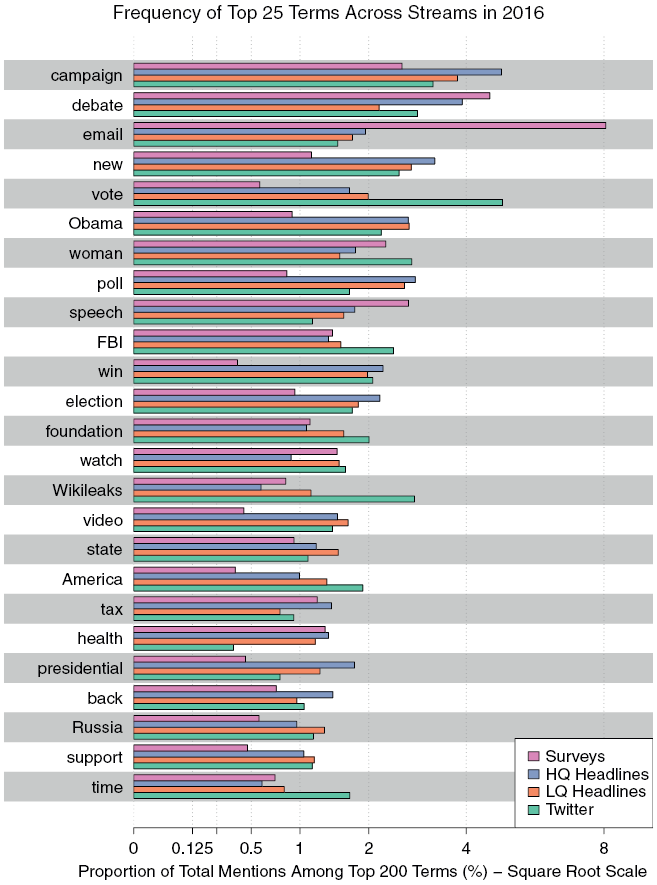
Figure 12(a) Long description
This is a bar graph that shows the relative frequencies of the top 25 terms in 2016 across the four information streams (i.e., open-ended surveys, low-quality headlines, high-quality headlines, and Twitter posts). The length of the bar for each word and stream represents the proportion of total mentions for that word among all the mentions of the top 200 words. See the main text for an analysis of the results.
Frequency of Top 26–50 Words Across Media Streams and Surveys in 2016.
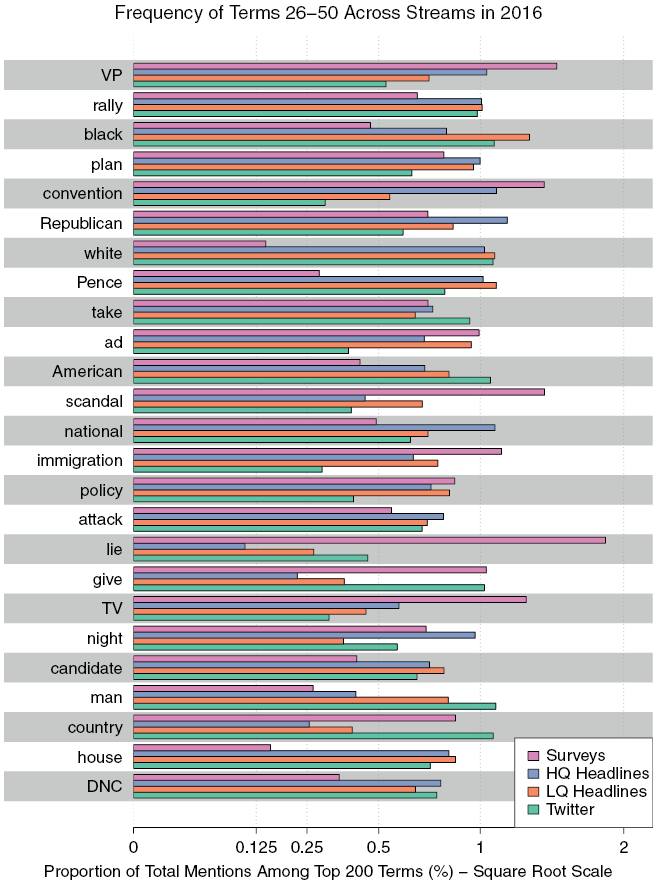
Figure 12(b) Long description
This is a bar graph that shows the relative frequencies of the top 26-50th most common terms in 2016 across the four information streams (i.e., open-ended surveys, low-quality headlines, high-quality headlines, and Twitter posts). The length of the bar for each word and stream represents the proportion of total mentions for that word among all the mentions of the top 200 words. See the main text for an analysis of the results.
Frequency of Top 25 Words Across Media Streams and Surveys in 2020.
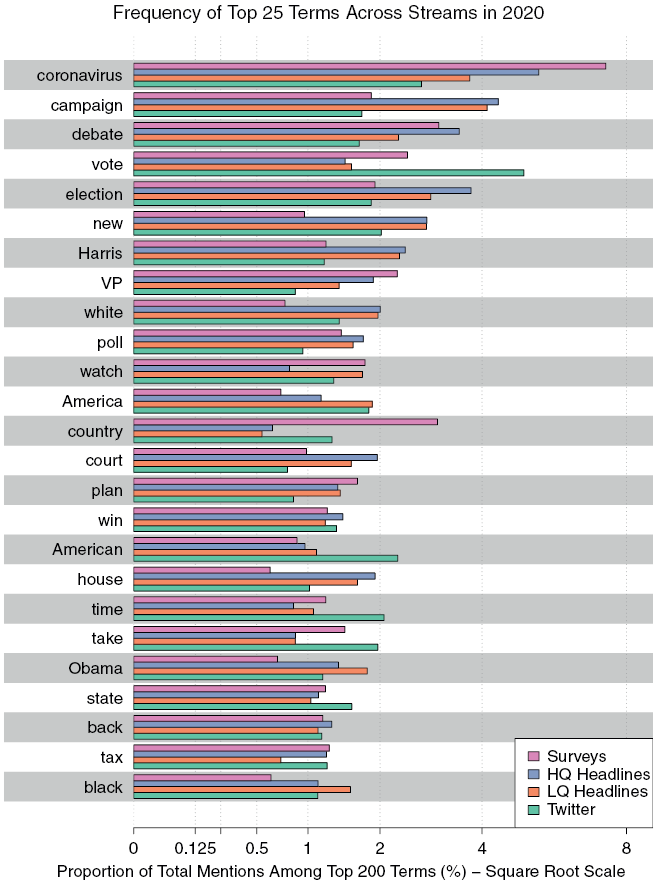
Figure 12(c) Long description
This is a bar graph that shows the relative frequencies of the top 25 terms in 2020 across the four information streams (i.e., open-ended surveys, low-quality headlines, high-quality headlines, and Twitter posts). The length of the bar for each word and stream represents the proportion of total mentions for that word among all the mentions of the top 200 words. See the main text for an analysis of the results.
Frequency of Top 26–50 Words Across Media Streams and Surveys in 2020.
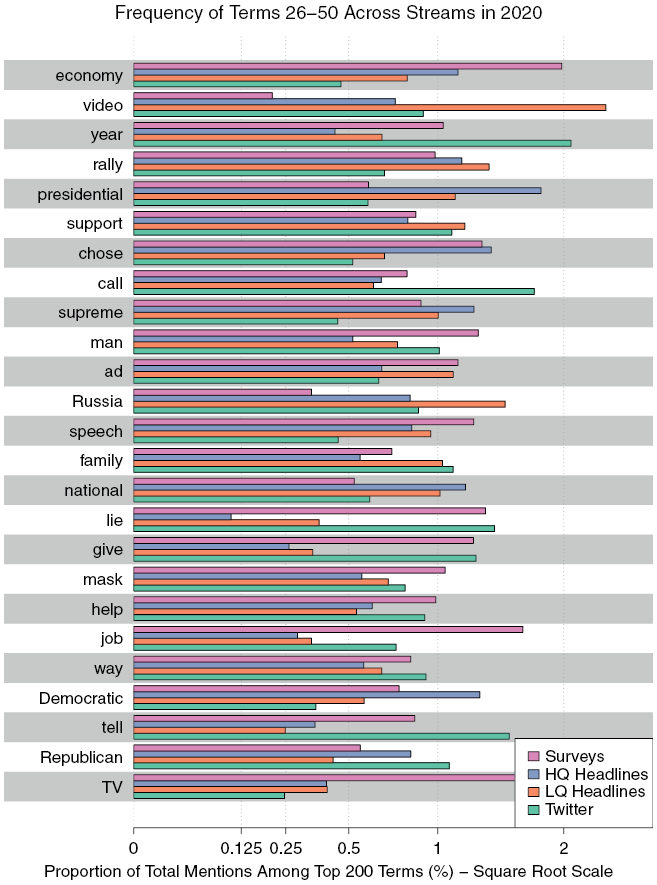
Among the 50 words most frequently mentioned in 2016 (Figures 18a and b), only a handful were relatively more common in survey responses than in the other streams. Among these, none approached the prevalence of email. Mentions of email accounted for more than 8% of the total mentions of the top 200 terms in the surveys in 2016. In the other streams, mentions of email comprised less than a quarter of that proportion. Survey respondents also mentioned “debate,” “speech,” “vice president,” “convention,” “scandal,” “immigration,” “lying,” and “television” at higher rates than these terms appeared in other streams. However, the difference was smaller than for email.
Not all scandals were mentioned more in the survey responses than they were mentioned in the media data. The “email” term was special. Even other incidents related to the email scandal but using different words were less common in survey responses than in media content. Mentions of the “FBI,” “Wikileaks,” and the “Clinton Foundation” – all connected in different ways to concerns about Clinton’s emailsFootnote 45 – were found more frequently in news stories and on Twitter than in survey responses. Compared to their frequency in media content, people better recalled generic concepts in our open-ended responses. The word “email” became a catchall for this series of Clinton-related controversies, and other terms like “scandal” and “lie” were also more prevalent in the survey responses than specific aspects of the story because they better captured people’s feelings or impressions of that scandal.
Terms related to controversies springing from specific campaign events were more common on Twitter and in low-quality news headlines than elsewhere. This pattern was apparent for terms connected with Clinton like the “FBI,” the Clinton “Foundation,” and “Wikileaks,” and terms connected to Trump, like his treatment of “Women,” which was the strongest Trump-related theme in 2016, was about equally apparent in Twitter and in surveys.Footnote 46 Finally, consistent with previous criticism of elite media campaign coverage (Patterson Reference Patterson2016), high-quality headlines in 2016 tended to prioritize “game schema” coverage more than the other streams, highlighting terms such as “campaign,” “poll,” “win,” and “election.”
Stories in Different Information Streams in 2020
Although Coronavirus/COVID-19 was among the most prominent words mentioned in every stream in 2020, yet again survey attention to the largest story heavily outpaced that story’s attention in other sources. As with the email story in 2016, only a few other top 50 terms received disproportionate attention in surveys versus the other streams (country, economy, speech, job, and television; Figure 18), and none by the margin of the coronavirus.
It is interesting to consider why the most prominent issues in both campaigns received a much higher proportion of attention in survey responses than in media content. It could be because popular attention is inherently different from media attention. Perhaps the way people remember information about candidates is simply different than the way stories appear in different parts of the media system. In contrast to most types of national media, people may only be able to remember a limited number of stories about a candidate at any one time.Footnote 47 It could also be a function of measurement.
In Section 1, we discussed some differences in the data-generating process across these information streams, which make the datasets not perfectly comparable. In this case, people may feel limited in how long they want to talk and how many different stories they want to mention in their open-ended survey responses. Tweets may have different natural constraints. We collected all tweets from a 10% sample of the entire Twitter corpus (known as the “decahose”) that mentioned the candidates during the campaign. Social media users may naturally mention a wider range of things in connection with candidates than news outlets with limited space do, where editors make some attempt to employ editorial judgment about what topics are important and/or what people want to read. In summary, although we can only offer informed speculation about why, there is a recurring pattern in which the most prominent stories account for a much higher proportion of words in survey responses than in the media content datasets.
Nevertheless, the pattern that ordinary people viewing the campaign link certain prominent terms to certain candidates more often than to other term-candidate pairs indicates that there is something special about these term-candidate connections. The pattern of dominant-negative terms being associated with the losing candidate each year suggests that these stories may have cost those candidates votes. Given the outsized importance of these two issues, we dedicate the next section to a more in-depth examination of them.
As in 2016, words that reflect coverage of the campaign process and possibly the campaign in a “game schema” frame were prominent in the 2000 news and Twitter datasets: “campaign,” “debate,” “vote,” “election,” and “polling.” The vice-presidential candidates, the Supreme Court, taxes, and the economy also received attention (see Figure 12c and d). Most of these stories were more closely associated with Trump than with Biden. In fact, the sole issue that received notable attention in Biden coverage was his nomination of Kamala Harris as Vice President. Every other substantive issue was either candidate-neutral or mainly appeared in Trump coverage.
A Closer Look at the 2016 E-mail Story Versus the 2020 Coronavirus Story
The campaign media information environments in 2016 and 2020 were each dominated by one topic over all others. In 2016, the story that gathered the most attention across all sources was Hillary Clinton’s email scandal, while in 2020, it was the coronavirus pandemic.Footnote 48 In this section, we dig deeper into both phenomena.
Both major stories had multiple components. Mentions of Clinton’s emails consisted of news about a private email server that Clinton used while Secretary of State, unrelated emails from Clinton’s campaign that were hacked and leaked online, an FBI investigation into the aforementioned server, and various other threads. All these might have been mixed together in the public’s thinking, but they were actually quite distinct. Similarly, the coronavirus discussion included information about the disease, questions about mask use, the virus’s economic and social impacts, and the development of a vaccine.
To better assess how coverage of these issues trended over time, we take a more inclusive measurement approach than in the previous subsection, which focused on individual words. Here, we combine mentions of a series of related words that encompass aspects of this topic as it was covered throughout the campaign. This allows us to capture a broader sense of what media outlets and ordinary Americans were attending to.
The topics of email and coronavirus have important similarities. Each was the most frequently mentioned campaign topic by Americans (as measured in our open-ended responses), yet received different levels of attention in various types of media. This made us especially curious about the coverage of these topics in low-quality outlets, given that previous sections found that they played a disproportionate role in media coverage in 2016 compared with 2020.
| Information Stream Type | Email (in 2016) | Coronavirus (in 2020) |
|---|---|---|
| High-quality/Left/Center | 6.2% | 20.0% |
| High-quality /Right | 7.5% | 16.8% |
| Low-quality /Left/Center | 5.5% | 19.3% |
| Low-quality /Right | 11.5% | 12.7% |
| 7.2% | 8.6% | |
| Democratic Survey Responses | 9.3% | 21.5% |
| Independent Survey Responses | 11.0% | 15.8% |
| Republican Survey Responses | 14.4% | 14.9% |
Note: The table shows the prevalence in the average “day” for the different types of media outlets, for Twitter posts, and for open-ended survey responses. Each “day” is not that day alone, but is a rolling average of the 7 days, that is, the given day and 3 days before it and 3 days after it. In all datasets, the percentages were calculated as the percentage of all headlines/tweets/survey responses that contained a dictionary word from the specialized dictionaries constructed for these two topics (email in 2016 and coronavirus in 2020).
Table 1 presents the average percentages of all the information in each communication stream that was related to the email (in 2016) and coronavirus (in 2020) topics. The coronavirus was featured in more conventional media campaign coverage in 2020 than Clinton’s email scandal was in 2016. This holds for all media information streams, although the gap was smallest in low-quality right-wing outlets and on Twitter. The biggest difference between the two stories lies in high-quality left- and center-leaning news outlets, which paid more than three times the level of attention to COVID-19 in 2020 (19.3%) compared to the email scandal in 2016 (5.5%).
The difference in the attention the two stories received was smaller in the survey responses. The gap in attention in the surveys was primarily driven by Democrats’ recollections (9.3% mentioning email, 21.5% mentioning coronavirus), possibly reflecting the disparity in attention from high-quality left- and center-leaning outlets. Among Republican survey respondents, the percentages mentioning the two stories are essentially indistinguishable (14.4% vs. 14.9%). Even among Independent respondents, the gap in attention to these stories is not large. Eleven percent of Independents mentioned hearing about the email story in 2016, and 15.8% mentioned the coronavirus in 2020.
Overall, each story was covered and remembered more by the side of the political spectrum that benefited from it. In 2016, right-leaning news outlets (especially low-quality ones) covered the email scandal more than other media outlets, and Republicans discussed the story more than other people did. Analogously, in 2020, left-leaning and centrist media outlets covered the coronavirus pandemic more than other outlets, and Democrats discussed the story more than others did.
Coronavirus coverage was generally higher in low-quality news sources than in high-quality ones, while low-quality conservative outlets primarily drove coverage of the email story. This is consistent with Section 3’s finding that low-quality conservative outlets led the overall negative coverage of Clinton. Opponents of Clinton drove the email story. Yet no such pattern is present for the coronavirus in 2020, in which both high- and low-quality liberal outlets gave it comparably heavy coverage.
The Leading Stories Over Time
Next, we look at changes over the course of the campaigns. Erikson and Wlezien (Reference Erikson and Wlezien2012, 44–46) make a very useful distinction between two different ways an event can affect the state of a presidential race: a “bounce” versus a “bump.” A bounce is a temporary change to the state of the race which entirely fades, while bump produces a change in the race that never wholly dissipates. In their words: “As a series of short-term bounces, the campaign-induced shocks to the electorate’s collective choice over the campaign have little net impact on the final outcome…. If campaign effects are bumps, conversely, they persist and affect the outcome” (45–46). Erikson and Wlezien’s book examined horse race polls. Our focus in this Element is different: media content and information reception. But these concepts are still valuable for us. It is illuminating to determine whether events affecting attention to these stories are bounces or bumps.Footnote 49
| Event Title | Date | Description |
|---|---|---|
| Wikileaks Sanders Emails | 07-23 | Leaked DNC emails show DNC officials critical of Bernie Sanders, who was Clinton’s rival for the Democratic Party nomination. |
| Trump Asks Russia to Hack Emails | 07-28 | During a press conference, Trump says: “Russia, if you are listening, I hope you are able to find the 33,000 emails that are missing…” |
| FBI releases Clinton email report | 09-02 | The FBI releases its report on the Clinton email investigation. |
| FBI releases notes from the Clinton investigation | 09-23 | The FBI releases roughly 200 pages of notes from its Clinton email investigation |
| Wikileaks Podesta Emails | 10-07 | Wikileaks releases hacked emails from the accounts used Podesta, the Clinton campaign chairman. |
| Comey Letter | 10-28 | FBI Director Comey releases a statement saying FBI is going to continue the previously closed investigation into Clinton’s emails. |
| Election Day | 11-08 | The 2016 U.S. Election Day |
| Event Title | Date | Description |
|---|---|---|
| Woodward Interview | 09-09 | On the record interviews of President Trump conducted by journalist Bob Woodward become public. The interviews reveal Trump being more concerned about COVID-19 than publicly depicted. |
| Trump Gets COVID | 10-01 | President Trump gets COVID-19. |
| Trump Returns to White House | 10-07 | President Trump returns to the White House after spending three nights at the Walter Reed medical center for COVID-19 treatment. |
| Election Day | 11-03 | The 2020 U.S. Election Day |
Tables 2 and 3 list some major events related to these stories during the campaigns.Footnote 50 Figures 13 and 14 show that the prevalence of the email and coronavirus stories varied over time, with these events highlighted. Real-world campaign events seemed to increase news attention to both stories, but these spikes look like temporary “bounces” rather than “bumps.” The overall level of attention and the height of the peaks are greater for the coronavirus. Both stories had their highest peak close to Election Day, but the peak for email was much closer to the end of the campaign because of James Comey’s announcement and letter (see Section 6 here, and Bode et al. Reference Bode, Budak, Ladd, Newport, Pasek, Singh, Soroka and Traugott2020, Chapter 7). As a result, both topics were likely top of mind for voters as they headed to the polls, especially the email story.Footnote 51
Email Story Prevalence over Time across Different Online News Producers
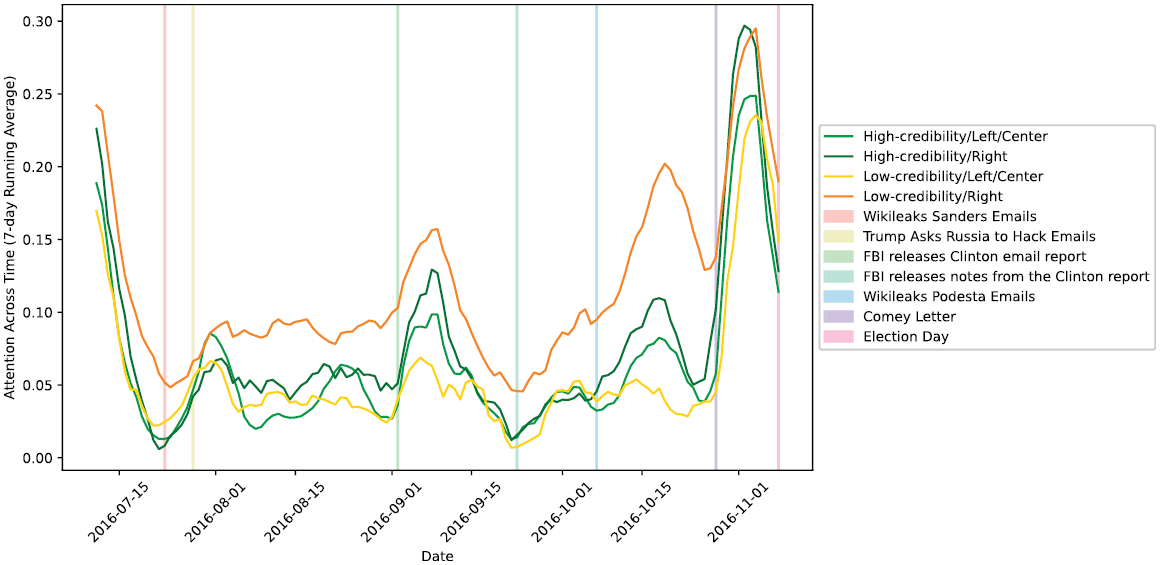
Figure 13 Long description
This is a line graph that shows relative attention to the email story (on the y-axis) across time (on the x-axis) during the 2016 campaign. There are separate lines for high-quality mainstream and liberal sources, high-quality conservative sources, low-quality mainstream and liberal sources, and low-quality conservative sources. See the main text for an analysis of the results.
Coronavirus Story Prevalence over Time across Different Online News Producers
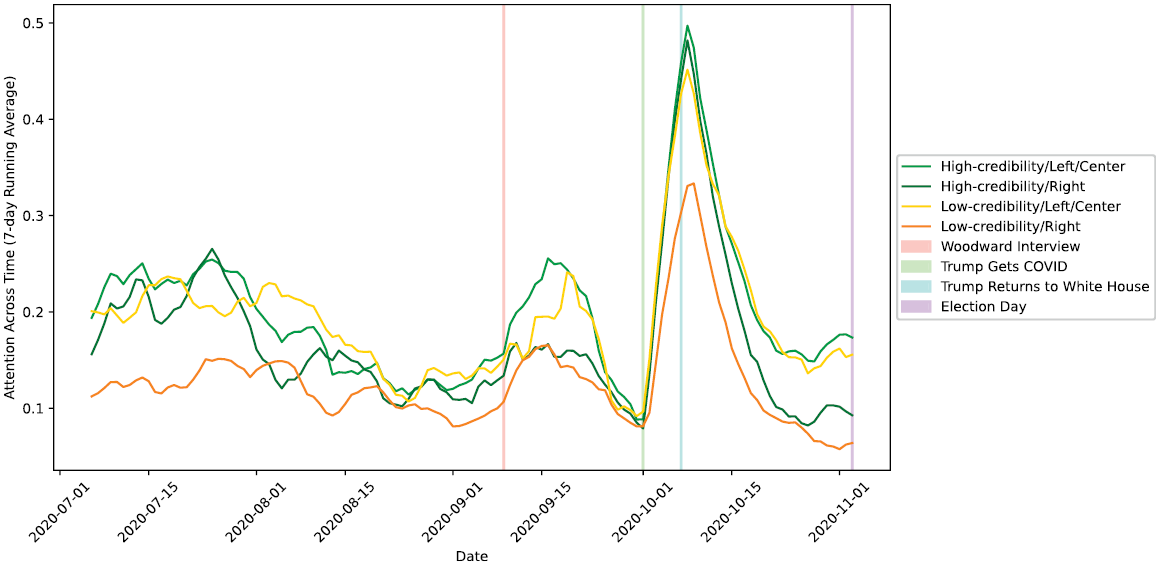
Figure 14 Long description
This is a line graph that shows relative attention to the coronavirus story (on the y-axis) across time (on the x-axis) during the 2020 campaign. There are separate lines for high-quality mainstream and liberal sources, high-quality conservative sources, low-quality mainstream and liberal sources, and low-quality conservative sources. See the main text for an analysis of the results.
How Did the Public Receive These Two Dominant Stories?
How much did absorbing these major news stories depend on people’s partisanship? As noted above and in Table 1, there were partisan differences. In 2016, the email story was prominent in low-quality, right-leaning outlets and was mentioned most frequently by Republicans. And in 2020, the pandemic was covered most in high-quality left-leaning and centrist outlets and mentioned most by Democrats.
Figures 15 and 16 illustrate the prevalence of these two stories in survey responses over time, alongside other information streams. All the information streams are generally more correlated with each other in 2016 (correlation coefficients ranging from 0.67 to 0.98) than they are in 2020 (ranging from 0.37 to 0.95). However, there are many similarities. The highest peaks of these major stories (the Comey letter in 2016 and Trump getting COVID in 2020) move all streams in similar magnitudes. For instance, at its peak after the Comey letter, the email topic accounted for roughly 33% of all Republican survey responses. This number is lower among Democrats but remains at an impressive level of approximately 29%. The difference between the parties after the WikiLeaks Podesta emails revelation earlier in the campaign is much larger – 25% vs 14%. In other words, events with mid-level prominence seem to drive divergence and weakened correlations. There are also differences in how the time series reverts to normal levels after events. While we see a reverse u-shape after events like the Wikileaks Podesta emails, some even seem to change attention levels more permanently. For instance, the increase in attention after the Wikileaks Sanders emails is not followed by a reversion back to low levels for low-credibility right-leaning news and Republican responses. They continue to focus on this story longer than other information streams do.
Email Story Prevalence Over Time Across Information Streams
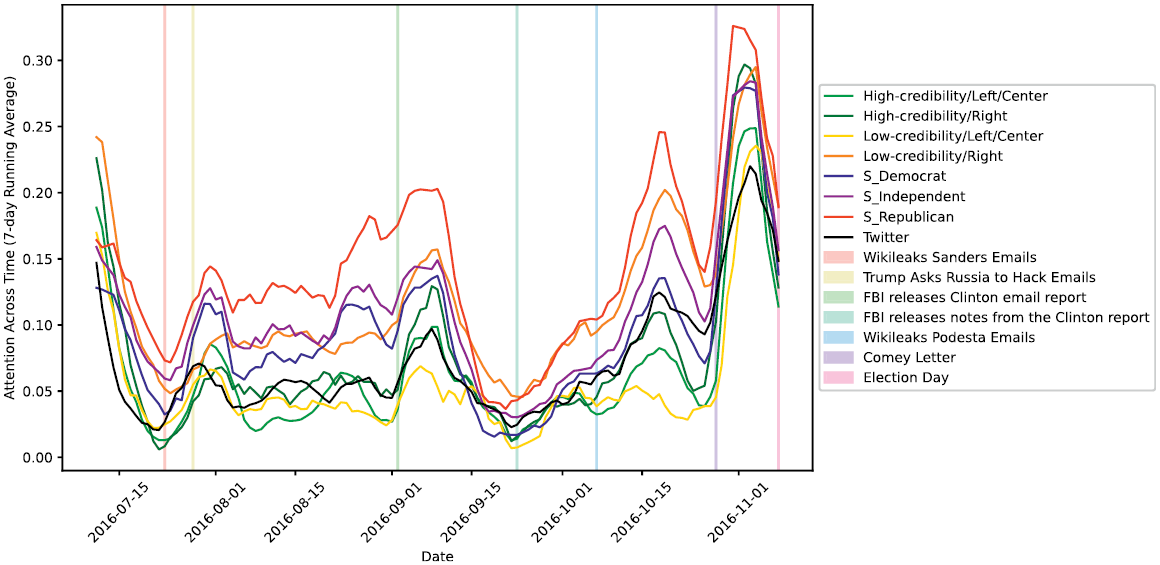
Figure 15 Long description
This is a line graph that shows the relative attention to the email story (on the y-axis) across time (on the x-axis) during the 2016 campaign in eight separate information streams, each represented by a line on the graph. The streams are high-quality mainstream and liberal news sources, high-quality conservative news sources, low-quality mainstream and liberal news sources, low-quality conservative news sources, survey responses from Democrats, survey responses from independents, survey responses from Republicans, and Twitter posts. See the main text for an analysis of the results.
Coronavirus Story Prevalence Over Time Across Information Streams
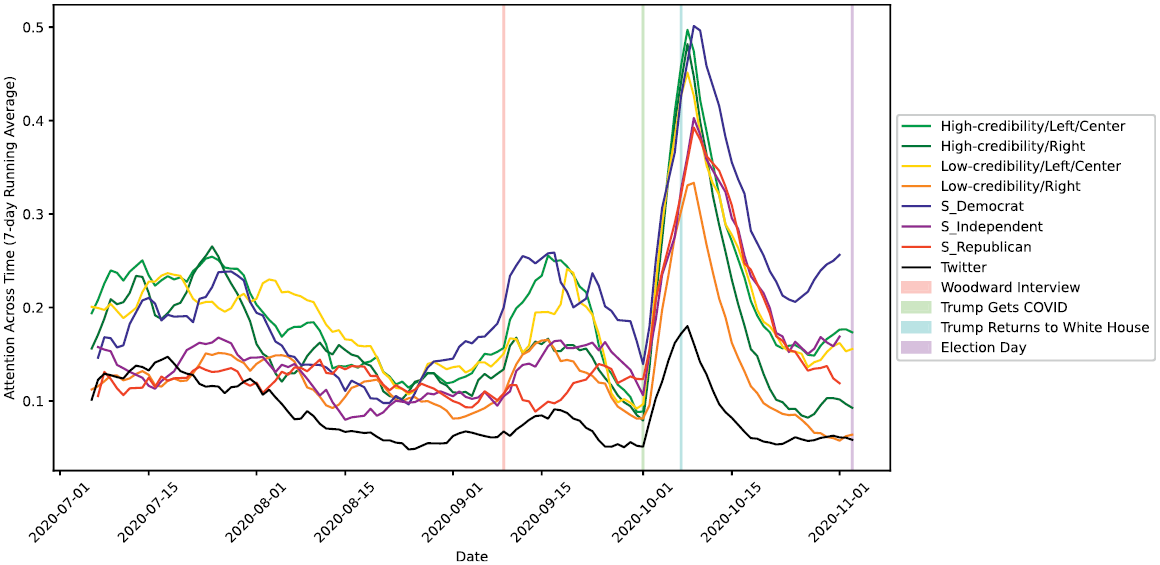
Figure 16 Long description
This is a line graph that shows the relative attention to the coronavirus story (on the y-axis) over time (on the x axis) during the 2020 campaign across eight separate information streams, each represented by a line on the graph. The streams are high-quality mainstream and liberal news sources, high-quality conservative news sources, low-quality mainstream and liberal news sources, low-quality conservative news sources, survey responses from Democrats, survey responses from independents, survey responses from Republicans, and Twitter posts. See the main text for an analysis of the results.
In summary, a closer look at these two stories indicates that, while they were very different events in the real world, they had some similarities in how they dominated attention during the campaign. They both constitute a remarkably large percentage of news during the campaign. Attention to both spiked after major campaign events connected to them. All these spikes were temporary “bounces,” not permanent “bumps” in attention, although the time it took for the bounces to fade out differed across types of media. And for both, there was some evidence of partisan selective coverage and perception. Stories that hurt your party were covered less by sympathetic partisan media and were mentioned less by partisans in surveys.
However, there were two big differences. The coronavirus pandemic was covered more extensively overall, although the gap in attention was larger in the news headlines than in public perceptions (as measured by survey responses). Also, among the news sources, coverage of the email story was heaviest in the low-quality outlets, while coverage of the coronavirus pandemic was heaviest in the high-quality outlets.
Why Do Certain Stories Dominate Coverage of Certain Candidates? Some Possible Explanations
Donald Trump’s ability to capture media attention and shift the communication environment’s focus away from specific negative stories about him encountered a major limitation in 2020. In the two campaigns we examined, a few issues stuck to their associated candidates, while others had less staying power in the media system or with the public. Two issue-candidate pairs stand out: email and Clinton in 2016, and the coronavirus and Trump in 2020. One could argue that the coronavirus story was unique. It was so prominent in media coverage and in what people recalled hearing about Trump because he was the incumbent during a once-in-a-generation pandemic that affected almost all aspects of Americans’ lives. But given that the email story was also so prominent in Clinton coverage in 2016, despite it not being tied to a global catastrophe, it raises questions about what types of issues stick to candidates in this way. This phenomenon may be a recurring feature of the social media era.
How do these two major stories fit with the campaign media coverage theories we have utilized in this Element? Taken together, they did not provide good coverage to facilitate retrospective voting. The email and coronavirus stories were indeed both scandals of the nominee of the incumbent party. However, the email scandal had little to do with the incumbent administration’s overall record and essentially nothing to do with national conditions in 2016. The law of anticipated importance is a better fit here than with the evidence in previous sections, but still imperfect at best. Clinton was favored to win in 2016, yet Biden was ahead in the polls and favored to win throughout 2020, and he did not receive consistent campaign coverage of any similarly negative story.
You could see the coronavirus as an example of the “alarm/patrol hybrid model,” in which the beginning of the pandemic served as an “alarm,” and “aftershock” events all year led coverage to persist.Footnote 52 However, the prominence of the email scandal in Clinton coverage is more puzzling from this perspective. This story also received “alarm mode” levels of attention throughout the campaign, despite its lack of a triggering event of the seriousness of a pandemic outbreak that temporarily shut down much of the economy and social activity.
Other theories more plausibly fit this evidence. Hillary Clinton’s long history of negative press coverage over decades and her connection in the public mind to elite Democratic politics and liberal causes may have made the email scandal more “culturally resonant” with journalists and the public. It also could be that sexism led a story that depicted a woman as unlikable or untrustworthy to be more resonant with these groups. Coverage of both the email and coronavirus stories is consistent with market incentives, which lead to a preference for repeatedly covering scandals or other negative stories that have previously received heavy coverage, as well as scandals involving less popular politicians. All of these conditions seem to fit both the email and coronavirus stories.
Whatever the ultimate reason, in the social media era, an issue can be connected to a candidate early in the campaign cycle, and that connection then becomes self-reinforcing. Past coverage of the story and its prominence in the public’s thinking lead the media system to continue covering it.
Donald Trump avoided this dynamic in 2016. Despite many negative stories that could have received sustained coverage throughout the campaign, none did (Bode et al. Reference Bode, Budak, Ladd, Newport, Pasek, Singh, Soroka and Traugott2020). One Trump campaign story after another faded in attention, replaced by another (also negative) story. But in 2020, he could not escape the global pandemic. His role as the incumbent connected him to that story. He could not divert the media system’s attention to something else.
5 Two Potentially “October Surprises”
In Section 4 and in our previous book (Bode et al. Reference Bode, Budak, Ladd, Newport, Pasek, Singh, Soroka and Traugott2020), we found that events in 2016 and 2020 produced temporary “bounces” in attention, but permanent “bumps” that persist until election day. However, as you approach election day, this distinction breaks down. As Erikson and Wlezien (Reference Erikson and Wlezien2012, 166) note, “Except for the period immediately before the election, only the bumps last to election day.” But what about that period immediately before the election? Bounces in these days can have considerable consequences in close elections.
In this section, we look more closely at how two events at the very end of these campaigns were covered. Each event had the potential to be an “October Surprise”: a surprising major event at the end of the presidential campaign that remains at the top of voters’ minds through Election Day. The first involved James Comey, the FBI Director at the time of the 2016 election. Earlier in the year, the FBI had investigated whether Clinton had compromised U.S. security by using a private email server when she was Secretary of State. In July 2016, Comey announced that Clinton had been “extremely careless” but that the FBI was not charging her with a crime in the matter. Yet on October 18 (eleven days before the election), Comey sent a letter to Congress stating that the FBI had begun investigating a cache of newly discovered emails, bringing the issue back to the forefront of campaign coverage. Finally, on November 6 (two days before the election), he sent a second letter to Congress stating that this new investigation had concluded and no charges would be brought. These two letters from Comey to Congress generated massive publicity about the email investigation in the final days of the 2016 campaign (see Bode et al. Reference Bode, Budak, Ladd, Newport, Pasek, Singh, Soroka and Traugott2020, chapter 7; Silver Reference Silver2017).
In 2020, a different event could have played a similar role: Like the Comey letters, events earlier in the year provide background. Journalists and Republican critics had previously raised questions about Joe Biden’s son, Hunter Biden’s investments around the world, including in China and Ukraine. On September 23, 2020, a Republican-led congressional investigation into Hunter Biden’s dealings in China concluded that Joe Biden had committed no wrongdoing (Fandos Reference Fandos2020). Some low-credibility right-leaning online news sources and some of Donald Trump’s campaign speeches had also spread a conspiracy theory that, when he was Vice President, Joe Biden had pressured the Ukrainian government to fire a prosecutor who was investigating corruption by Hunter Biden (Kiely Reference Kiely2020).Footnote 53 The New York Post published an article on Oct 14 (20 days before the election), claiming that they had obtained a laptop owned by Hunter Biden and abandoned at a Delaware computer store, which contained an email on its hard drive that implicated Joe Biden the previously alleged Ukraine corruption cover-up (Cheney and Bertrand Reference Cheney and Bertrand2020; Kiely Reference Kiely2020).
The events that triggered attention to these topics at the end of the campaigns were not directly initiated by Donald Trump, Hillary Clinton, Joe Biden, or their campaigns. There is no consensus among politicians, journalists, or scholars about why FBI Director James Comey decided to reopen his investigation into Clinton’s email security protocols and send two letters to Congress about it. Neither is there any consensus about what happened that led the owner of a Delaware repair shop to say he had Hunter Biden’s laptop hard drive and the New York Post to report on it.
However, while we have no evidence that these events were the result of electioneering by Donald Trump or anyone else, they are valuable examples of how the media system allocates attention in the heat of a campaign’s final weeks. Both had the potential to trigger last-minute media attention that could damage the Democratic candidate. However, as we will see below, the media system responded very differently to the two events, particularly the high-quality outlets, which may have led to significant differences in the salience of the topics in the survey responses just before election day. Thus, while these examples may not speak to how media attention responds to candidate strategies, they do illustrate two different ways that the media system can allocate attention in the crucial final weeks of the campaign. Specifically, they show that high-quality outlets can use their editorial judgment to decline to give a topic heavy coverage, even in the presence of a triggering event. They seem to have done this in 2020.
Table 4 presents the coverage of these two topics (James Comey and Hunter Biden) as a percentage of all weekly coverage throughout the entire campaign. There are some essential similarities. Given that coverage of both was triggered by events at the end of the campaign, these overall percentages are low. In both cases, right-leaning news sources give it more attention, especially low-quality right-leaning outlets.
| Information Stream Type | Comey (in 2016) | Hunter Biden (in 2020) |
|---|---|---|
| High-quality/Left/Center | 2.4% | 0.4% |
| High-quality/Right | 3.0% | 1.3% |
| Low-quality/Left/Center | 2.0% | 0.5% |
| Low-quality/Right | 4.0% | 2.9% |
| 2.4% | 1.2% | |
| Democratic Survey Responses | 1.7% | 0.2% |
| Independent Survey Responses | 2.1% | 0.2% |
| Republican Survey Responses | 2.5% | 0.4% |
Note: These averages are constructed similarly to those in Table 1. See the note for that table for details.
Yet, the differences between the topics are interesting as well. Overall, the 2020 Hunter Biden story received much less attention, especially in high-quality outlets and among survey respondents. High-quality news organizations made a more substantial effort to curb the spread of misinformation and rumors in the 2020 campaign following their own concerns about the level of misinformation in the 2016 campaign (Juarez Miro and Anderson Reference Juarez Miro and Anderson2024; Kiely Reference Kiely2020; Knight Foundation 2018). These numbers indicate they were successful at exercising more caution, at least in the case of Hunter Biden-related rumors.
For both topics, there was a triggering event close to election day (the first letter to Congress on October 18 for the Comey topic, and the New York Post article on October 14 for the Hunter topic). Figure 17 shows the frequency of the Comey topic in our media datasets in 2016, while Figure 18 shows the frequency of the Hunter Biden story in our media datasets in 2020. The x-axis gives time (covering 120 days before each election), and the y-axis gives the proportion of all articles that mention either candidate that include that topic each day (using a smoothed 7-day rolling average, as in previous sections).
Comey Topic Prevalence over Time across Different Categories of News Producers.
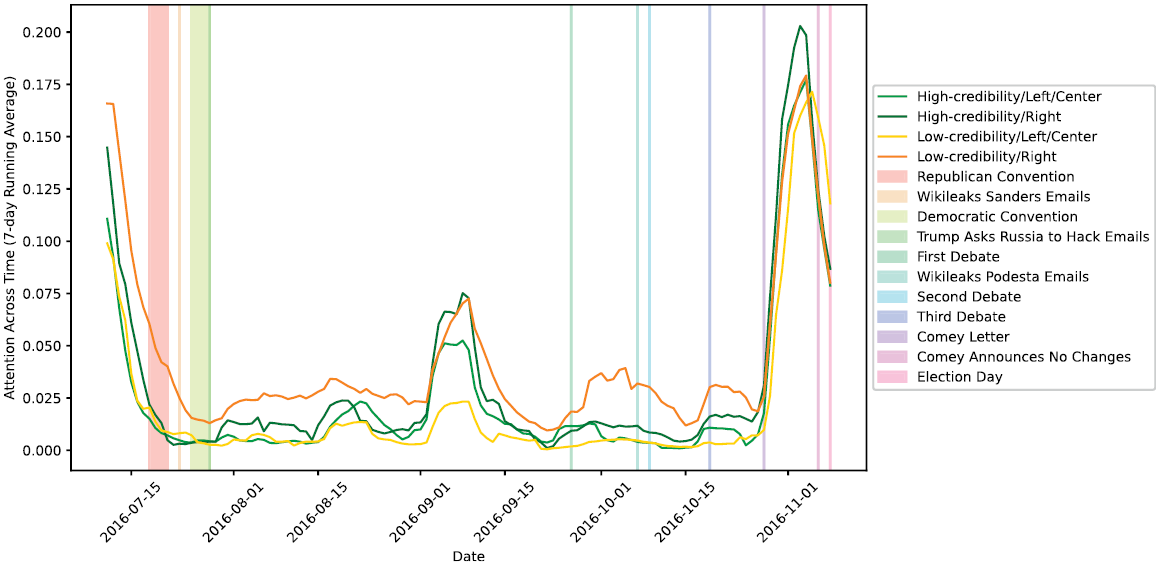
Figure 17 Long description
This is a line graph that shows relative attention to the “Comey letters” topic (on the y-axis) across time (on the x-axis) during the 2016 campaign. There are separate lines for high-quality mainstream and liberal sources, high-quality conservative sources, low-quality mainstream and liberal sources, and low-quality conservative sources. See the main text for an analysis of the results.
Hunter Topic Prevalence over Time across Different Categories of News Producers
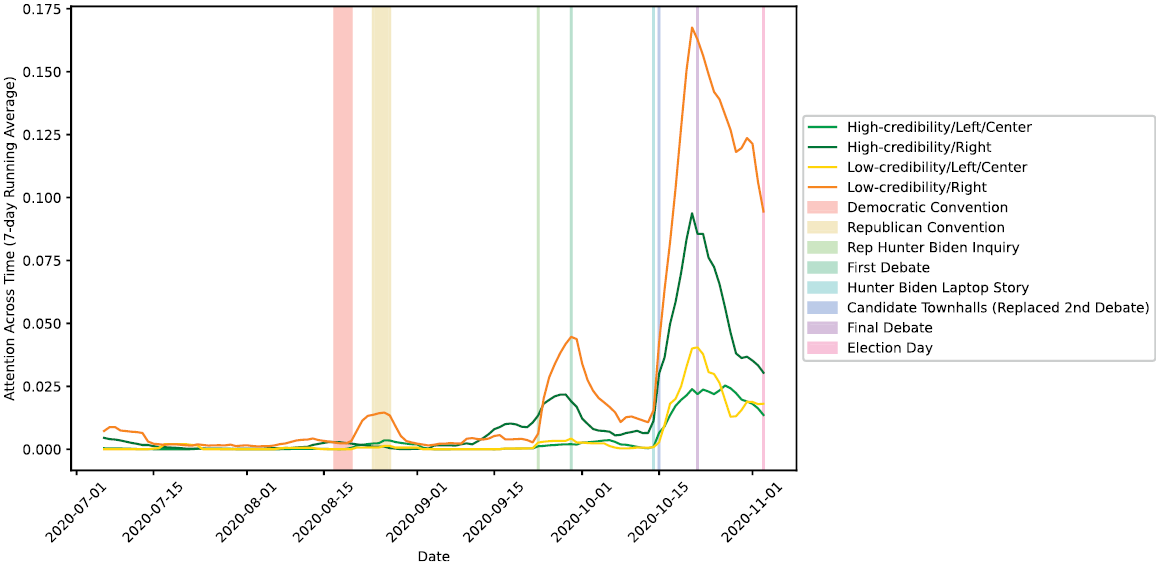
Figure 18 Long description
This is a line graph that shows relative attention to the “Hunter Biden” topic (on the y-axis) across time (on the x-axis) during the 2020 campaign. There are separate lines for high-quality mainstream and liberal sources, high-quality conservative sources, low-quality mainstream and liberal sources, and low-quality conservative sources. See the main text for an analysis of the results.
Consistent with Table 4, the right-leaning low-credibility sites (dark orange lines) pay the most attention to both topics. But there are also important distinctions. The Comey issue was covered almost equally by different types of news outlets in the last two weeks of the 2016 campaign. The Hunter Biden story in 2020 was covered differently. At its peak, right-leaning low-quality news is almost twice as likely to cover the Hunter Biden story compared to right-leaning high-quality news, and eight times as likely as left-leaning outlets. Left-leaning outlets, especially high-quality ones, barely responded to Hunter Biden-related events at all.
Public Responses to the October Surprises
How did such coverage percolate to the public? We investigate this by comparing survey responses and Twitter content with the news information streams. Figure 19 provides the time series of the degree to which the Comey topic was mentioned across different streams. The peaks in public attention and news attention are generally aligned, although the increase in news attention is more pronounced. Among the public, the highest emphasis is among Republican survey respondents, followed by Independents and Democrats. This is particularly clear at the peak, right after the first Comey letter was released. Public attention is generally lower than news attention, which is encouraging, given that the event had minimal to no policy implications. Yet this might be a measurement difference. If this were the fourth or fifth most important issue in the public’s mind, it might be hardly mentioned in survey responses because people do not want to provide a very long answer. Yet, it could be seen in a long list of headlines if it were the fourth or fifth most-covered story on the national news agenda.
The Degree to Which Different Information Streams Focus on the Comey Story over Time
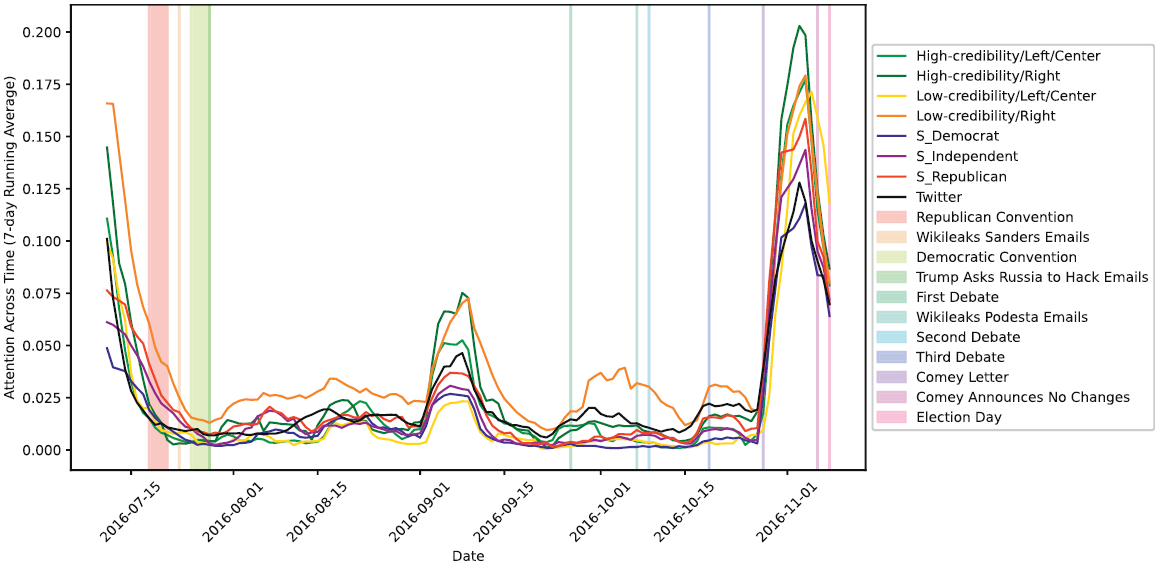
Figure 19 Long description
This is a line graph that shows the relative attention to the “Comey letters” topic (on the y-axis) across time (on the x-axis) during the 2016 campaign in eight separate information streams, each represented by a line on the graph. The streams are high-quality mainstream and liberal news sources, high quality conservative news sources, low-quality mainstream and liberal news sources, low-quality conservative news sources, survey responses from Democrats, survey responses from independents, survey responses from Republicans, and Twitter posts. See the main text for an analysis of the results.
Figure 20 shows that the Hunter Biden story in 2020 had some similarities with the Comey story. The attention from survey respondents mimics the 2016 patterns in important ways. Much like 2016, Republican respondents were more likely to recall the Hunter Biden topic and mention it in their responses, followed by Independents, and then by Democrats, who recalled it the least.
The Degree to Which Different Information Streams Focus on the Hunter Biden Topic over Time
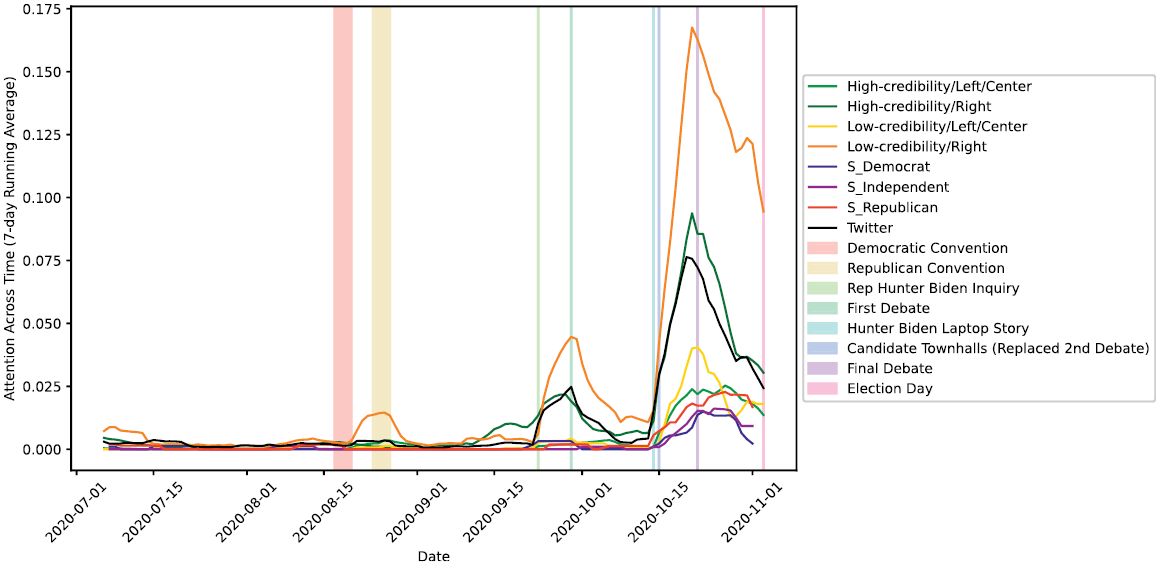
Figure 20 Long description
This is a line graph that shows the relative attention to the “Hunter Biden” topic (on the y-axis) over time (on the x-axis) during the 2020 campaign across eight separate information streams, each represented by a line on the graph. The streams are high-quality mainstream and liberal news sources, high-quality conservative news sources, low-quality mainstream and liberal news sources, low-quality conservative news sources, survey responses from Democrats, survey responses from independents, survey responses from Republicans, and Twitter posts. See the main text for an analysis of the results.
Unlike the reaction to the Comey letter, the differences in attention between the public and the media are stark here. Low-quality right-leaning domains are intensely focused on the Hunter Biden story. This focus is somewhat matched by attention from right-leaning high-quality outlets. But unlike in 2016, left and center-leaning outlets cover this last-minute story much less than their right-leaning counterparts. And public attention never comes close. In fact, public attention among Republicans appears to be more aligned with that of left-leaning outlets.
Our analyses thus far focus on the alignment between the public and the media’s timing of attention. Next, we turn to the language. We aggregate all headlines and survey responses that are related to these stories and compute a KL Divergence measure across streams. KL Divergence ranges from 0 to 1, and is commonly used to measure similarities and differences in language. The lower the value of this measure, the more similar the two distributions representing text are. Figure 21 summarizes our findings.
KL divergence between Comey (in 2016) and Hunter (in 2020) Related Headlines and Survey Responses
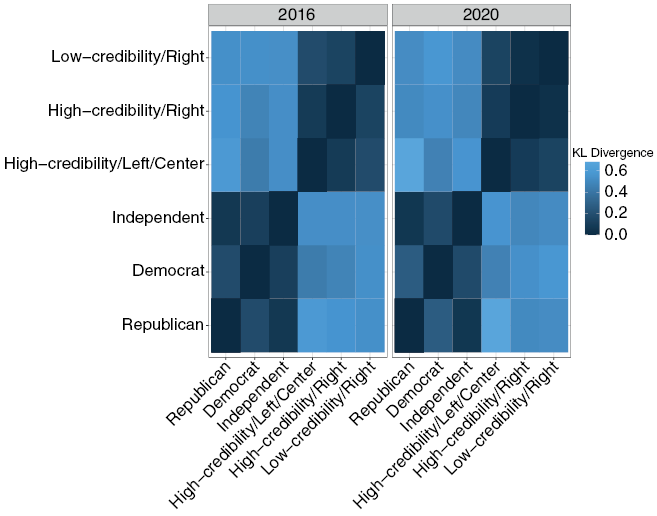
Figure 21 Long description
This figure has two panels. Each of these panels is a crosstabulation that shows the KL Divergence between different information streams. The cells are shaded to indicate the level of KL divergence for each pair of information streams. KL Divergence varies between 0 and 1 and is commonly used to measure similarities and differences in language. The lower the value of this measure, the more similar the two distributions representing text are. Panel (a) shows the KL divergences for all possible combinations of six information streams in coverage of the “Comey letters” topic in the 2016 campaign. Panel (b) shows the KL divergences for all possible combinations of six information streams in coverage of the “Hunter Biden” topic in the 2020 campaign. The information streams used in both Panels (a) and (b) are: high-quality mainstream and liberal news sources, high quality conservative news sources, low-quality conservative news sources, survey responses from Republicans, survey responses from Democrats, and survey responses from independents. See the main text for an analysis of the results.
Our primary concern is the differences between the two years.Footnote 54 First, coverage of Comey by high-credibility left- and right-leaning outlets was more similar to each other. In 2020, high-quality right-leaning outlets were more similar to low-credibility right-leaning outlets than to their left-leaning high-credibility counterparts. A similar pattern appears for high-quality left-leaning outlets. While they are closer to high-quality right-leaning outlets in 2016, their alignment in 2020 is closer to low-credibility outlets with similar ideological leanings.
A similar pattern of alignment appears across survey groups. Independents look more similar to Republicans in both years compared to Democrats. Furthermore, the divergence between Democrats and Republicans in 2020 is greater than in 2016 (as indicated by the lighter color in the corresponding cells).
Next, we look at the alignment between the public and the media. In 2016, Democrats are most aligned with all the media streams, except for low-credibility right-leaning outlets (signified by the darker colors). This is not the case in 2020, when they are more closely aligned with high-credibility left-leaning outlets, but not the others. The divergence between Republicans and Democrats also grew by 2020.
Editorial Decisions by News Organizations Are Still Important
These two “October Surprises” had commonalities. Both could have served as “triggering events” that led the media system into a heightened “alarm mode” (Boydstun Reference Boydstun2013). Because both in some ways reflected and amplified preexisting rumors about the candidate, they might have been easier for news organizations to cover (Searles and Banda Reference Searles and Banda2019) and “resonant” frames that spread through a media system and public that was already primed to accept them (Entman Reference Entman2004). For these reasons, both events could have led to negative coverage of the Democratic candidate’s character through election day. The differences in how they were treated in 2016 versus 2020 suggest limits in how much external events can grab the attention of the campaign media system.
These two case studies demonstrate that the editorial decisions of high-quality news outlets matter, even in the social media era. In 2016, when traditional media reacted strongly to James Comey’s letter about Clinton’s emails, focusing on it heavily, the public followed. In 2020, low-quality media behaved similarly in covering the Hunter Biden story. If low-quality media had strong agenda-setting power, we would expect a similar public reaction. We do not see that.
This is a good reminder of the enduring agenda-setting power of traditional high-quality media outlets (Chen et al. Reference Chen, Liu, Singh and Budak2024). These results align with recent scholarship arguing that social media is not the primary mechanism creating political harm and spreading misinformation (e.g., Guess et al. Reference Guess, Malhotra, Pan, Barberá, Allcott, Brown and Crespo-Tenorio2023).Footnote 55 This is also a good reminder that we should hold traditional media sources accountable and demand policy-relevant, informative coverage, which remains crucial to the health of American democracy.
6 The Power and Limits of Attention-Grabbing Political Strategies
Donald Trump has been a highly unusual presidential nominee and president. This Element examines how the American media system responded to his political tactics and covered his campaigns. Trump’s communication style, developed over his decades-long pre-political career, involves making outrageous statements, sometimes followed by outlandish actions, and communicating directly with the public through wild speeches and social media posts (Carlson, Robinson, and Lewis Reference Carlson, Robinson and Lewis2021; Hart Reference Hart2020).
We now live in the social media era. Competition for the attention of the media system, and through it the public, is more economically and politically significant than ever. For all his other faults, Donald Trump was skilled at garnering national media attention his entire adult life, a talent that is particularly potent in the social media era. As someone unusually well-suited to this era, Trump’s communication successes and failures in presidential campaigns demonstrate how dominating attention can lead to political success, but also has limitations.
In the broadcast era, presidential candidates were forced to communicate with the mass public in a mediated manner. Messages needed to go through national television networks, newspapers, or local television stations to reach the wider public. Then, in the “high choice” media era, political messages were mediated through a much wider variety of outlets. People could choose to consume political news using a long list of possible sources: major television networks, newspapers, cable channels, political talk radio programs, or internet news sites. In doing so, people could select sources that aligned with their preexisting ideological and partisan views, or avoid political content altogether by consuming other forms of entertainment. People had considerable control over their political information diet. But that control receded.
The rise of social media, on top of an even more fragmented media landscape, once again changed the relationship between candidates, the media, and the public. For several reasons, social media users lost much of their ability to control their political information consumption. In some platforms, people can choose to “follow” or “friend” other accounts. They may make these choices for nonpolitical reasons and then be exposed to the political perspectives of these accounts (e.g., Settle Reference Settle2018). Additionally, social media messages are now primarily delivered through algorithms, rather than people simply consuming content from sources they choose to connect with. Political messages that perform well in social media algorithms reach the public, even if many of the people consuming them never consciously decided to see this type of message.Footnote 56
The social media era incentivizes candidates to use new tactics. They can make unorthodox or outrageous statements (on social media or elsewhere) or stage other publicity stunts, hoping these stories will perform well in social media algorithms (i.e., go viral). These types of stories are often covered by journalists as well, because social media virality can be both a cause and a consequence of coverage by journalists. Thus, while media consumers have less control in this era, candidates have more. Candidates have more influence over who consumes their messages, because attention-grabbing tactics can reach a wide swath of the public, even those who may not have chosen to receive them. This Element has illustrated both the power and limitations of these tactics in this era.
The Power and Limitations of Grabbing Attention
Consistent with prior studies (Carlson, Robinson, and Lewis Reference Carlson, Robinson and Lewis2021, chapter 2; Patterson Reference Patterson2016), we find that Trump dominated attention in both the 2016 and 2020 campaigns, as measured by media content and the public’s perceptions. However, this high volume of coverage was not positive. In both campaigns, media coverage of Trump that reached the public was mostly negative.
In 2016, this led to him winning the Electoral College and becoming president. A major reason was that none of the specific negative stories about Trump were covered for an extended period of time or at the very end of the campaign. Trump was able to change the subject frequently, from one story to the next, even though most of them reflected negatively on him. The week before the election, the dominant story in America was James Comey’s letters to Congress and his reopening of the FBI investigation of Hillary Clinton.
Trump’s 2016 opponent received less media attention, and the coverage she received was predominantly negative, similar to Trump’s. The negative information about Clinton in high-quality news sources and survey responses largely mirrored her coverage in low-quality conservative news sources. She was also dogged throughout the year by various iterations of the email scandal, which the Trump campaign could highlight in its campaign messages, and which the Comey letters reinvigorated in the final days before the election. Overall, this evidence was consistent with our first thesis: “Donald Trump demonstrated how a presidential candidate in the social media era can manipulate the attention of the media system and the public to their benefit.”
Yet in 2020, Trump’s ability to dominate campaign attention led him to less success for two main reasons. First, the media system still has a bias toward focusing on the incumbent’s record and national conditions generally – the sort of coverage that facilitates retrospective voting. This pattern, long highlighted in the academic literature on presidential campaigns, persists in the social media era. In 2020, the coronavirus pandemic was the dominant story of the campaign by a wide margin. Much of this constituted negative coverage of Trump. As the incumbent, it was much more difficult for Trump to use his attention-grabbing tactics to change the subject.
Second, high-quality media outlets seem to have exerted more editorial judgment in 2020 in a few crucial ways. Their coverage diverged more from what was covered in low-quality outlets than it did in 2016. And when a major event occurred several weeks before the election that could have triggered large quantities of negative coverage of the Democratic candidate, high-quality outlets decided it wasn’t accurate and/or newsworthy, giving it little attention. Likely as a result, coverage of that topic (Hunter Biden) did not dominate the public’s thinking in the last week of the campaign. Thus, the evidence is also consistent with the second thesis that we introduced in Section 1: “The ability of candidates and other political actors to influence national attention is still limited by two factors: 1) the continued tendency of the media system to focus on the incumbent president’s performance and 2) the editorial judgments of journalists and news organizations about which stories are accurate and important.”
Lessons for the Political Communication Literature in the Social Media Era
Our findings indicate that the “rule of anticipated importance” (Zaller Reference Zaller1999) does poorly in explaining campaign attention in the social media era. Trump consistently trailed in the polls in both campaigns. Yet he still received the majority of media attention.
However, other patterns can be seen as illustrations of existing theories of political media coverage. As noted above, there remains a tendency for the media system to focus on the incumbent president’s record (Hetherington Reference Hetherington1996; Sides, Tesler, and Vavreck Reference Sides, Tesler and Vavreck2019; Vavreck Reference Vavreck2009). One could argue that some stories proliferated in the media because they were more “culturally resonant” (Entman Reference Entman2004). Hillary Clinton’s email scandal could fit this pattern. Was it the dominant story of 2016 because Clinton had already been depicted as untrustworthy and worse by the press for decades, or because this story fit preexisting negative stereotypes about powerful women? We can’t prove that either way, but it is certainly possible. Broadly, the patterns we found are also consistent with a general media system preference for negative news, and for more coverage of scandals that are preexisting, aren’t currently competing for attention with other major stories, and involve less popular participants (Nyhan Reference Nyhan2015; Searles and Banda Reference Searles and Banda2019).
“Triggering events” can cause the entire media system to shift its focus to a given topic, temporarily dominating media and public attention (Boydstun Reference Boydstun2013). This remains an essential dynamic in the social media era. If anything, it is enhanced by social media algorithms and the attention economy. One could view Trump’s outrageous statements and actions as attempts to create triggering events that distract from other recent stories while holding the media’s attention on himself. You could also see the Comey letters to Congress at the end of the 2016 campaign as some of the most important media-triggering events in American history.
However, the New York Post’s 2020 story about the Hunter Biden laptop shows the limits of this phenomenon. Coverage in low-quality right-leaning news outlets spiked after the initial Post story. However, high-quality outlets (even to some degree right-leaning high-quality outlets) were wary of the story, giving it little attention. While we cannot be sure of their motivations, high-quality outlets may have made the journalistic judgment that the convoluted tale of how the laptop hard drive found its way to journalists cast doubt on the story’s accuracy. Alternatively, they questioned the importance of this story in relation to other news in the weeks leading up to the election. Or, it was some combination of both. As a result of this editorial caution, unlike the email story following the Comey letters, the Hunter Biden story had low salience for most people on election day.
Lessons for Politicians and Journalists
The primary purpose of this Element is to advance the academic literature on campaign communication, the media system, and the attention economy, rather than making recommendations. However, in these final few paragraphs, we conclude by offering a few lessons for politicians and journalists.
Politicians and those designing presidential campaign strategy should know that using unusual and sometimes outrageous behavior and rhetoric to dominate media attention can lead to political success, but does not guarantee it. It is more likely to be successful if neither candidate is an incumbent and there is no national crisis during the campaign. When an incumbent is running, the media system tends naturally to focus more on their record, especially if that record includes a major calamity or crisis. In this circumstance, no campaign tactic will divert attention from these issues.
On the other hand, if you are running in a race where neither candidate is the incumbent or closely tied to them (such as the sitting Vice President), and the nation is not facing a major national problem like a pandemic, economic downturn, national security crises, or overseas war with casualties, the situation is different. In the absence of these things, the media system will be more open to focusing on whatever stories the competing candidates can draw its attention to, as it was in 2016. In an election year like this, campaigns must be skilled at diverting attention from negative stories about their candidate and highlighting those that harm their opponent.
Journalists, editors, and management at high-quality news outlets should know that they have more power and autonomy than they might think, especially at the very end of presidential campaigns. The editorial decisions made by those at high-quality outlets still matter. And with this power should come responsibility. Throughout the campaign, but especially in its final weeks, those trying to influence the election will inevitably attempt to draw the public’s attention to stories that benefit their favored candidate or harm the opposing candidate. However, as we saw in 2020, high-quality news organizations can decide that they cannot confirm a story’s accuracy and/or doubt its importance, and therefore choose not to focus on it. If they do, social media and the public will follow their lead.
There is no guarantee that journalists and news organizations will always make the right decisions. There is never a guarantee that any human institution will. There have always been major debates among journalists about what the best moral standards are for making editorial judgments (e.g., Carlson, Robinson, and Lewis Reference Carlson, Robinson and Lewis2021, chapter 5). Yet at their best, high-quality news organizations don’t just produce whatever content generates the most profit, but also follow a set of professional norms that include providing the electorate with the verified information it needs to make good decisions (Schudson Reference Schudson1978; Stensaas Reference Stensaas, Hoyer and Pottker2005; Streckfuss Reference Streckfuss1990; Tuchman Reference Tuchman1972). High-quality news organizations together constitute a key institution in a democratic system (Cook Reference Cook1998; Ladd Reference Ladd2012; Schudson Reference Schudson2002). It is hard to have a healthy democracy without also having a healthy news media system, where influential decision-makers prioritize spreading accurate and useful political information.
Even in the social media era, journalism still has the power to draw more attention to accurate and essential stories, and less to others. If they choose to, journalists and news organizations can improve the quality of voters’ decision-making. We think they should.
R. Michael Alvarez
California Institute of Technology
R. Michael Alvarez is Professor of Political and Computational Social Science at Caltech. His current research focuses on election administration and technology, campaigns and elections, and computational modeling.
Emily Beaulieu Bacchus
University of Kentucky
Emily Beaulieu Bacchus is Associate Professor of Political Science and Director of International Studies at the University of Kentucky. She is an expert in political institutions and contentious politics—focusing much of her work on perceptions of election fraud and electoral protests. Electoral Protest and Democracy in the Developing World was published with Cambridge University Press in 2014.
Charles Stewart III
Massachusetts Institute of Technology
Charles Stewart III is the Kenan Sahin Distinguished Professor of Political Science at MIT. His research and teaching focus on American politics, election administration, and legislative politics.
About the Series
Broadly focused, covering electoral campaigns and strategies, voting behavior, and electoral institutions, this Elements series offers the opportunity to publish work from new and emerging fields, especially those at the interface of technology, elections, and global electoral trends.
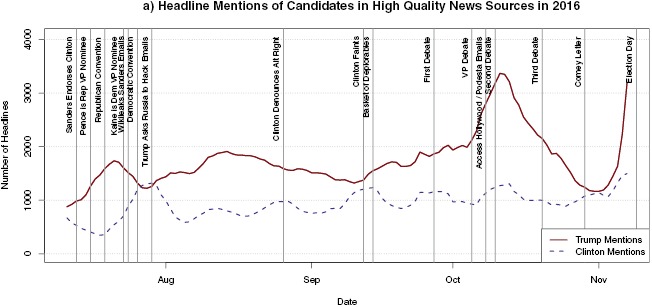
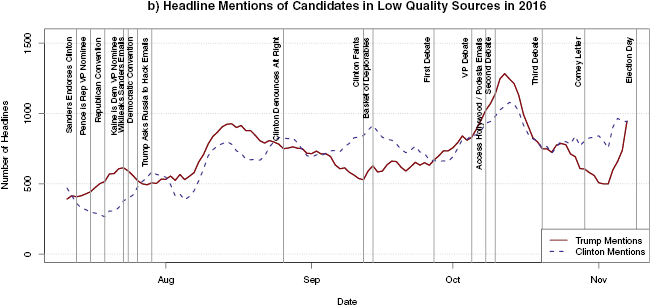
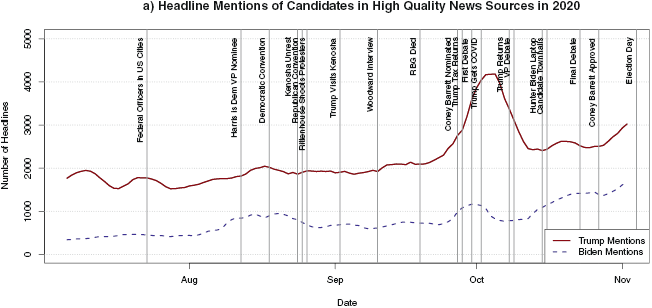
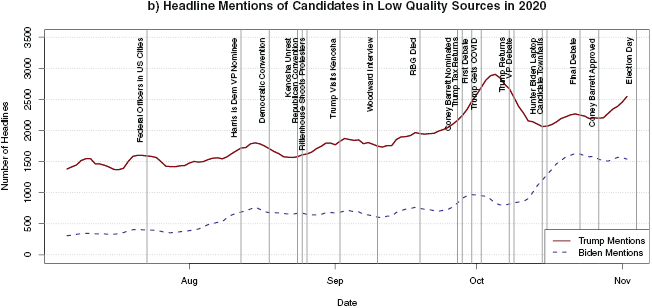
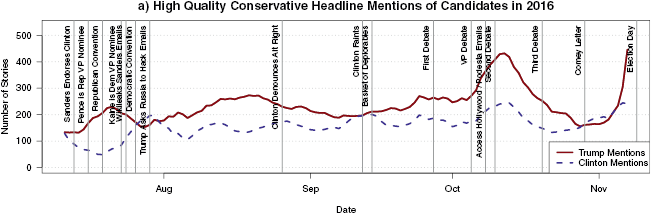
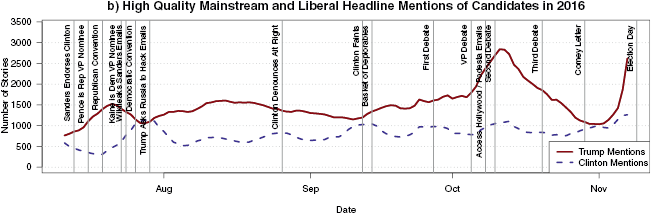
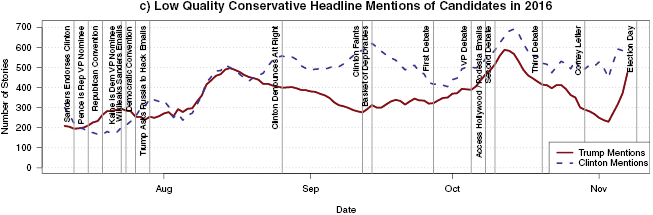
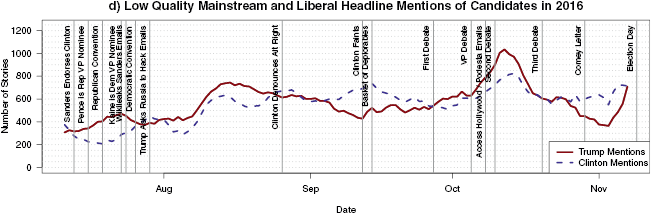
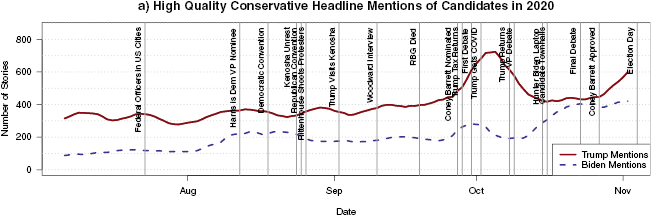
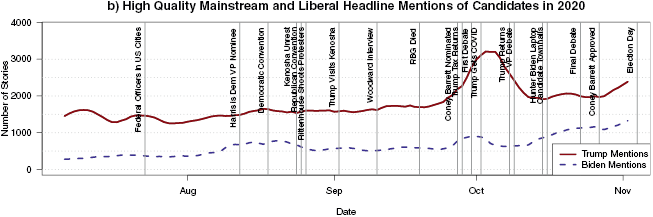
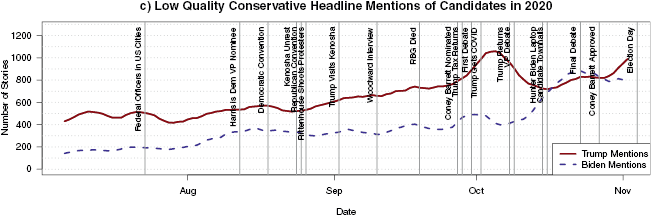
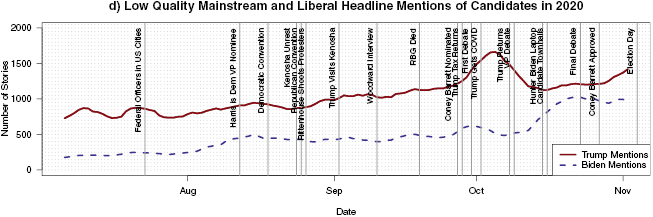
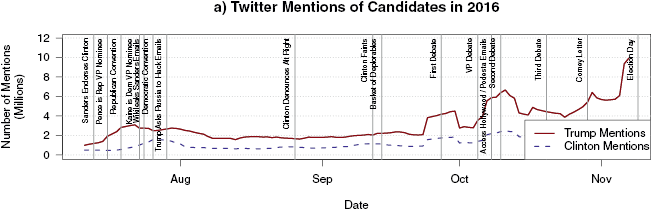
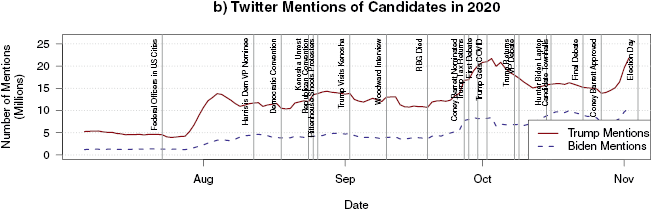
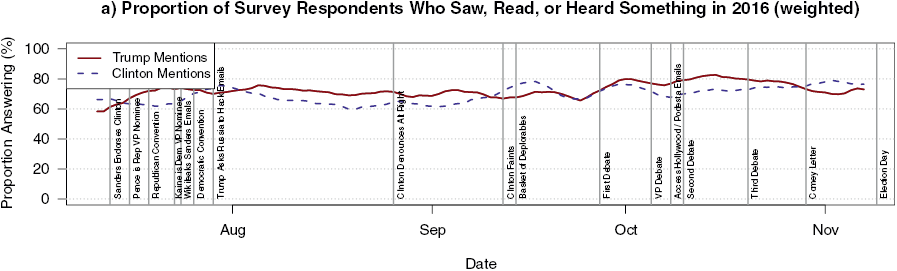
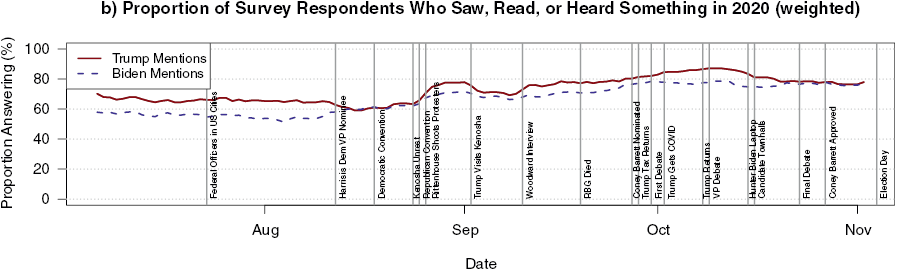
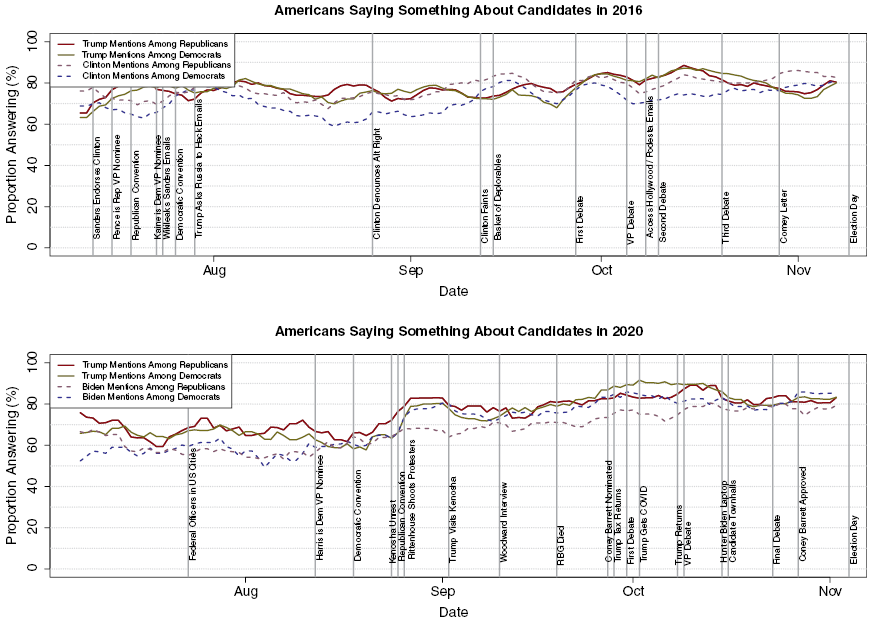
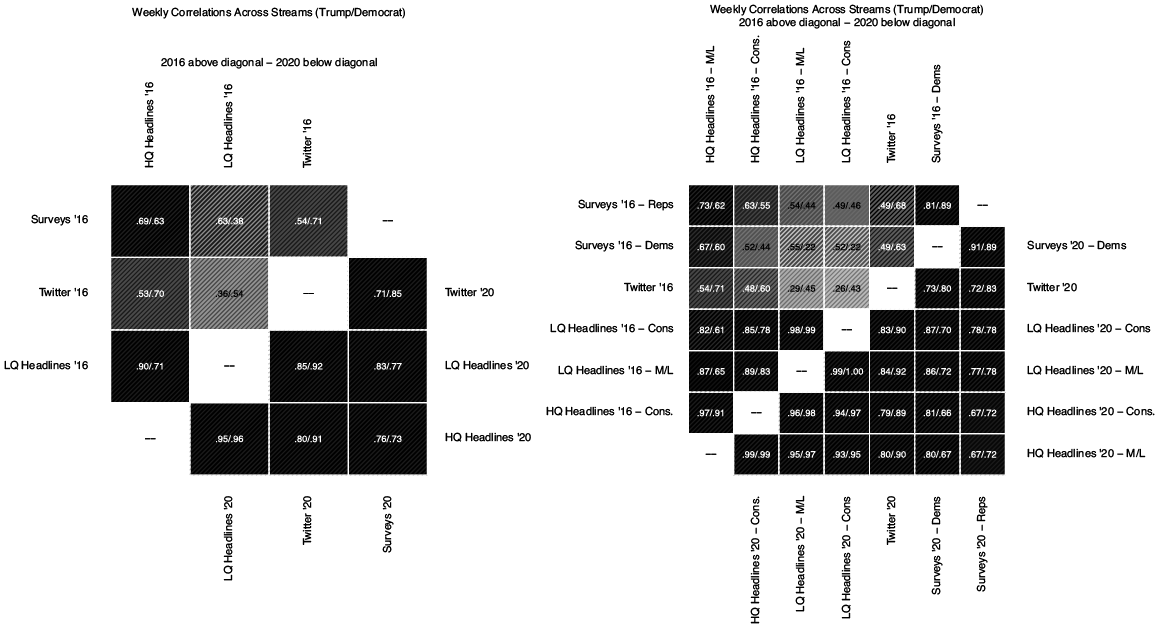
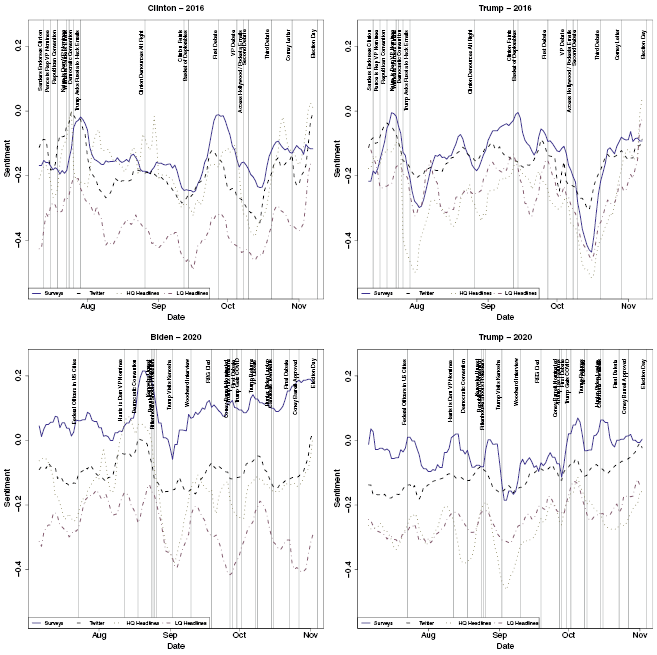
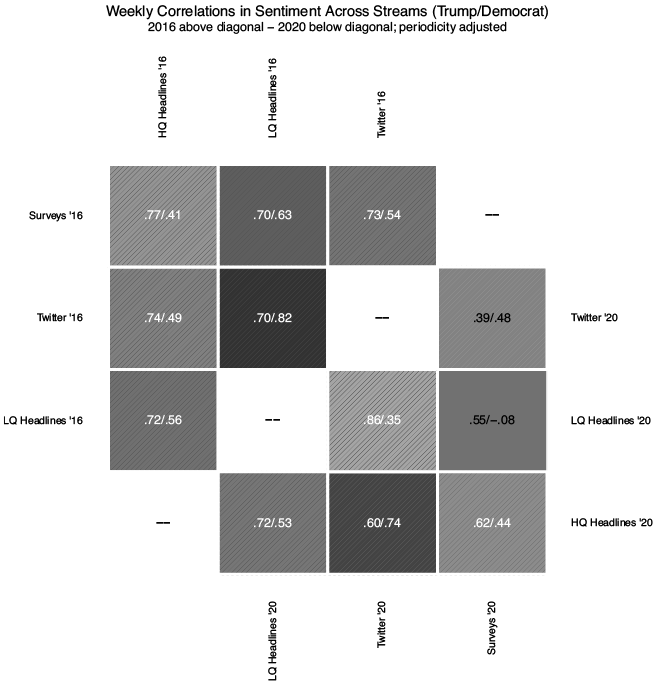
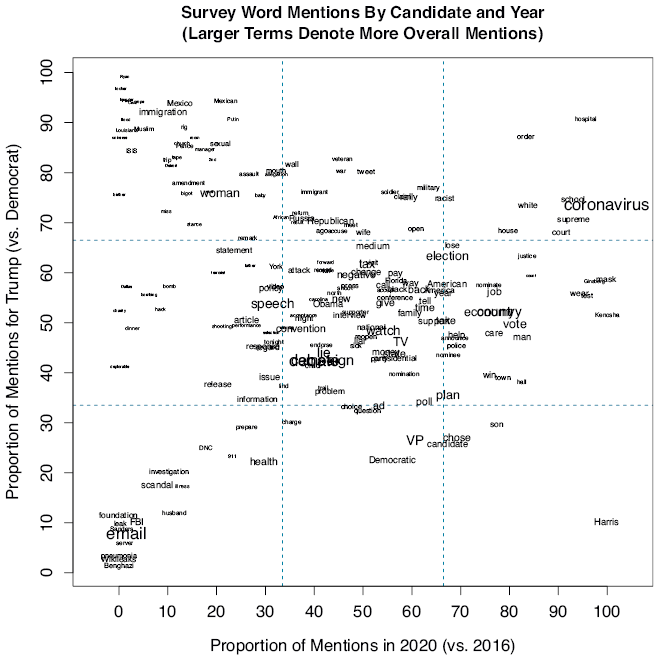
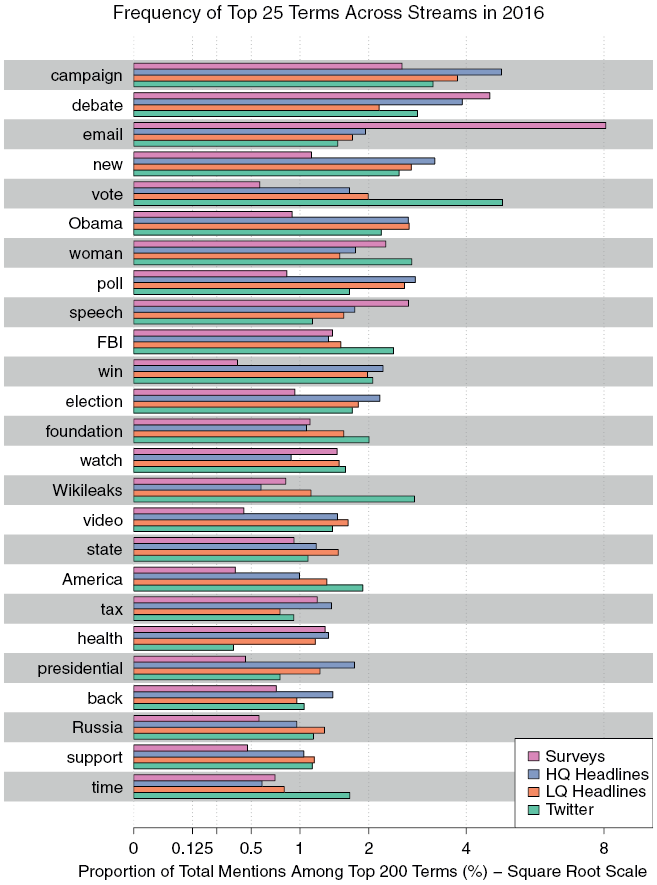
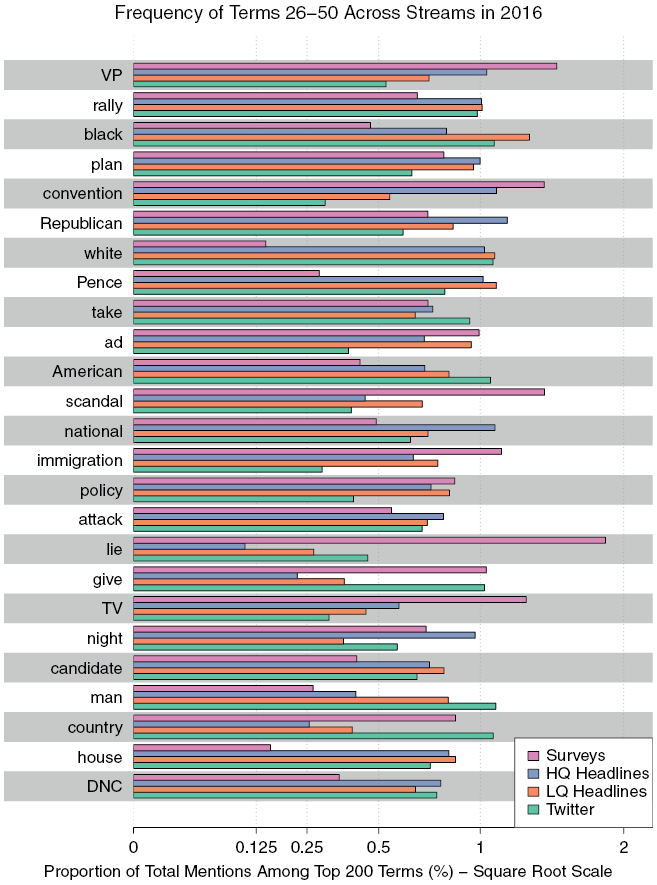
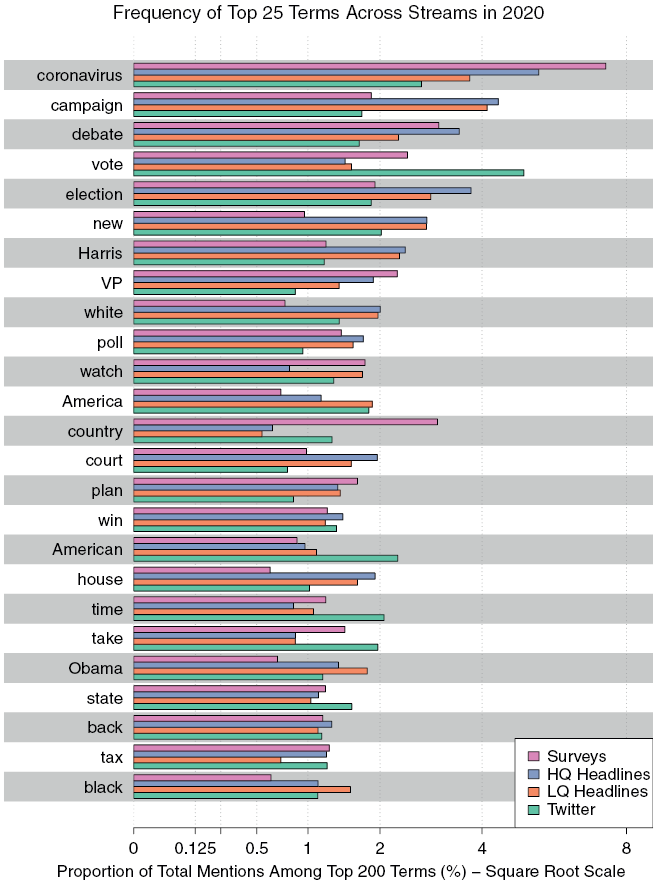
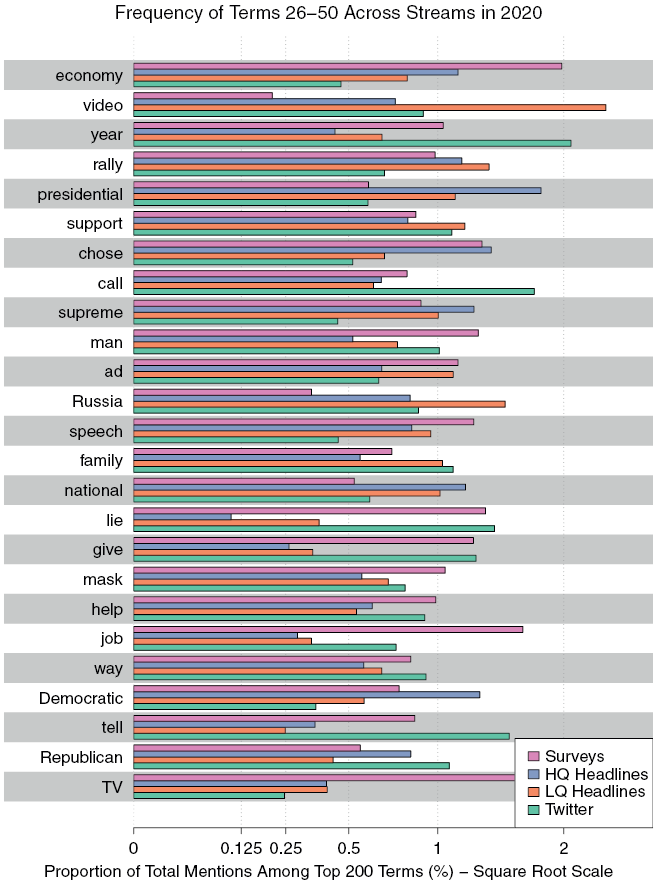
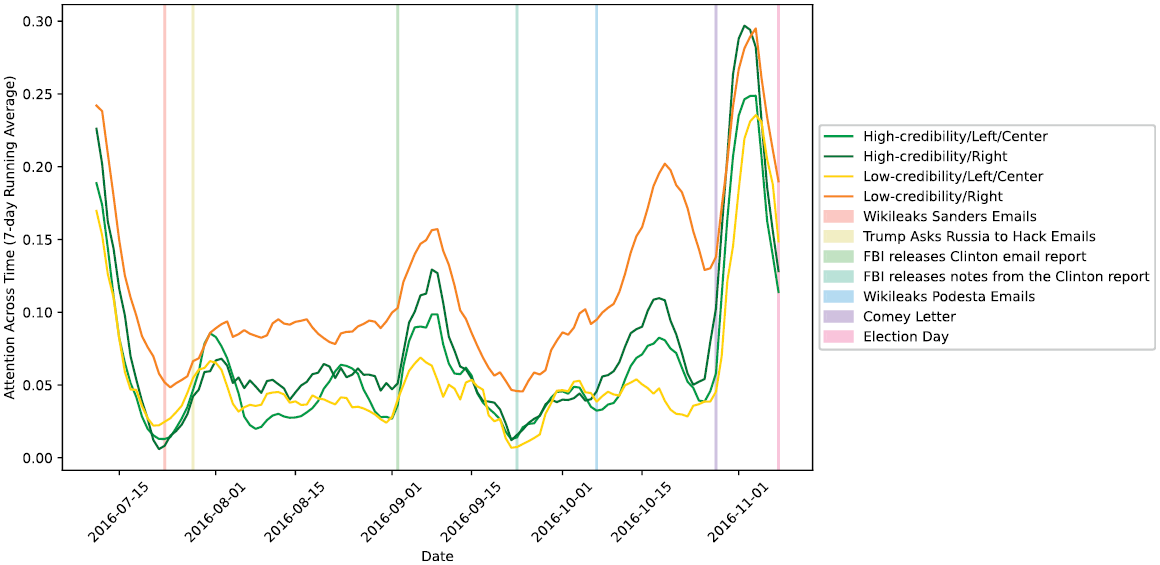
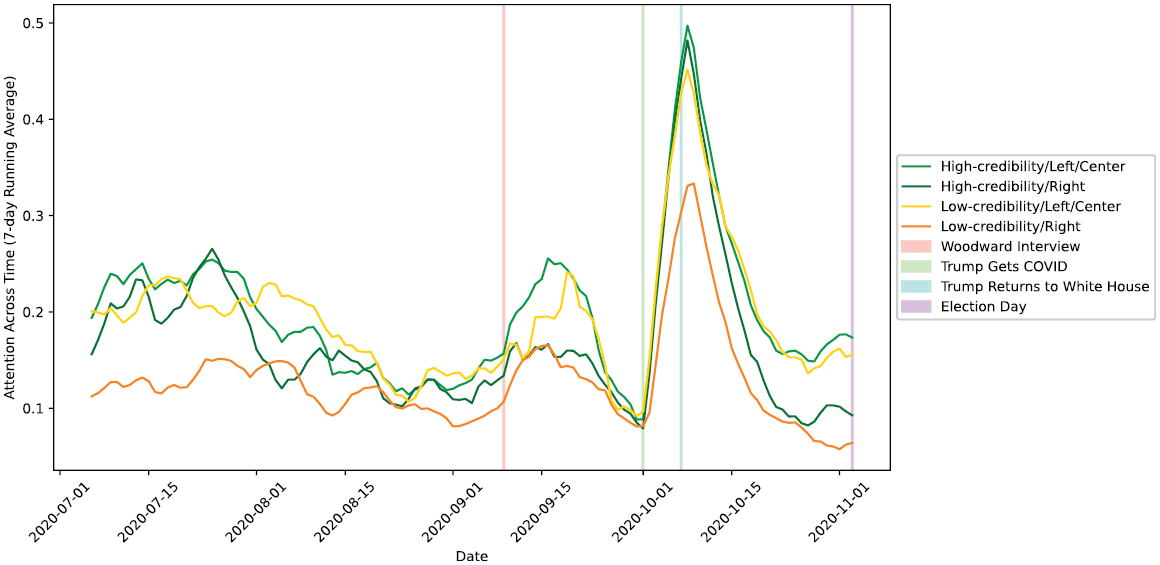
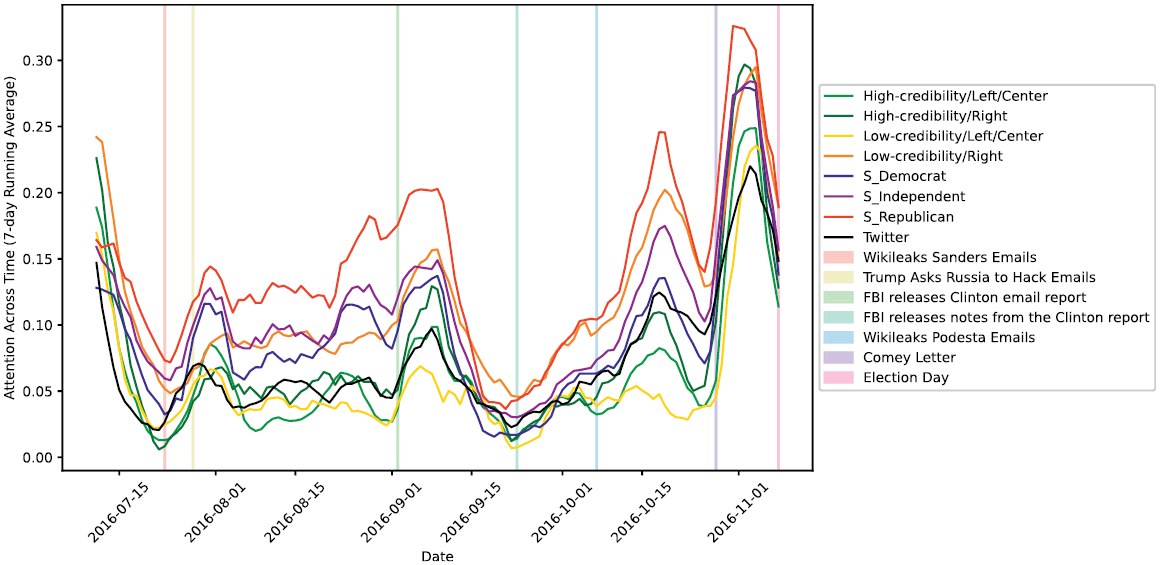
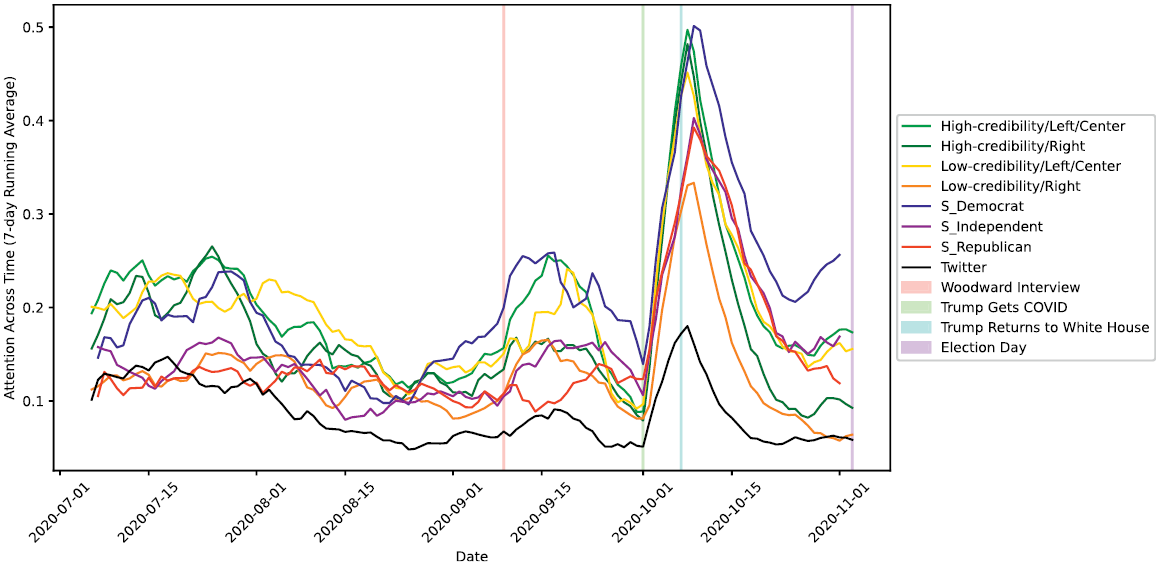
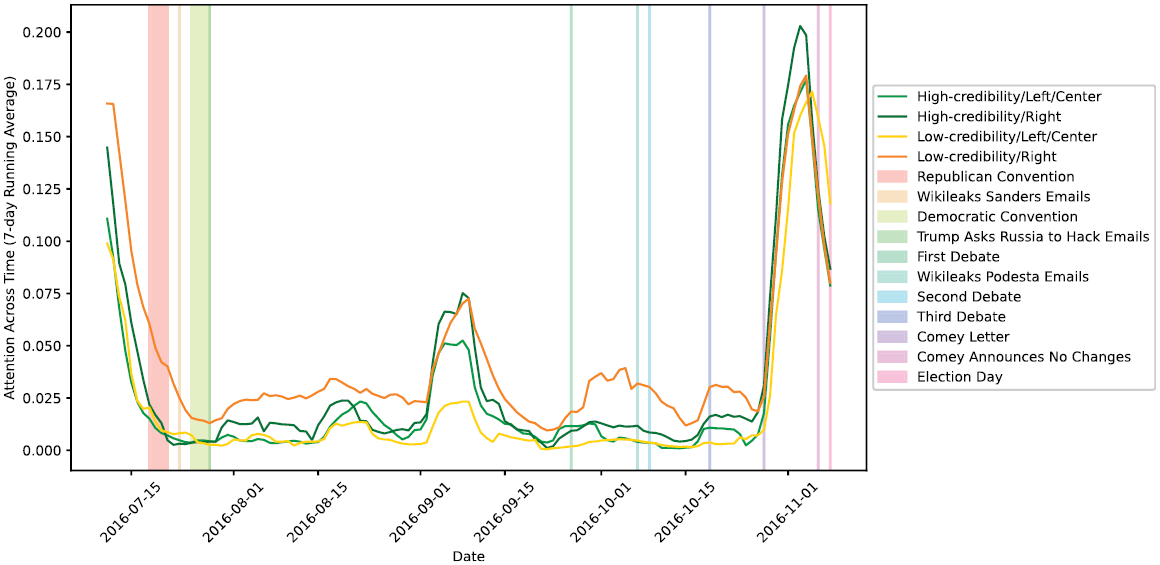
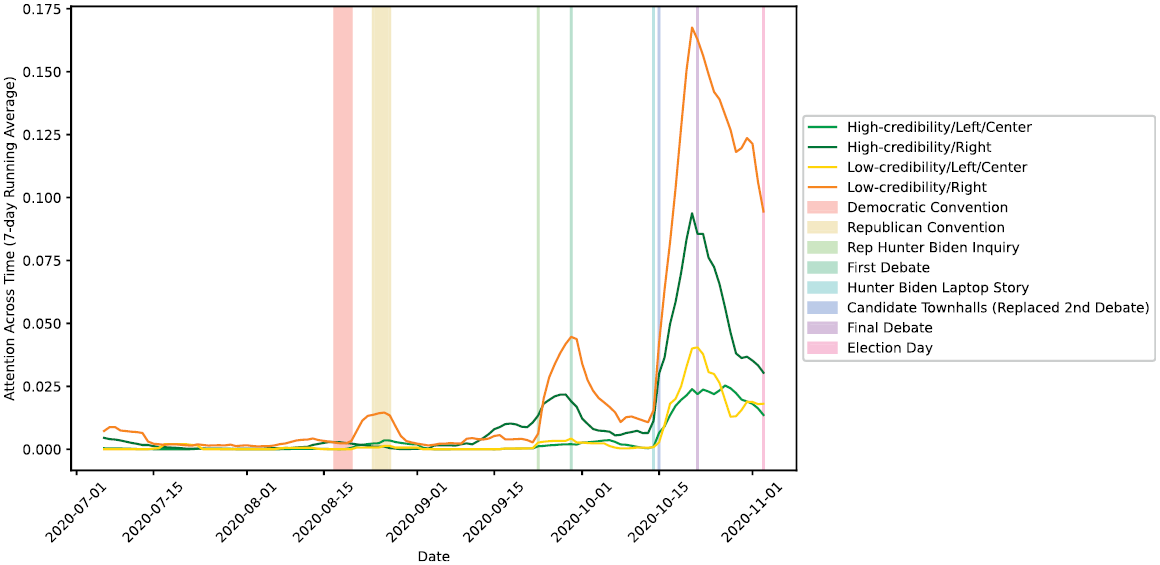
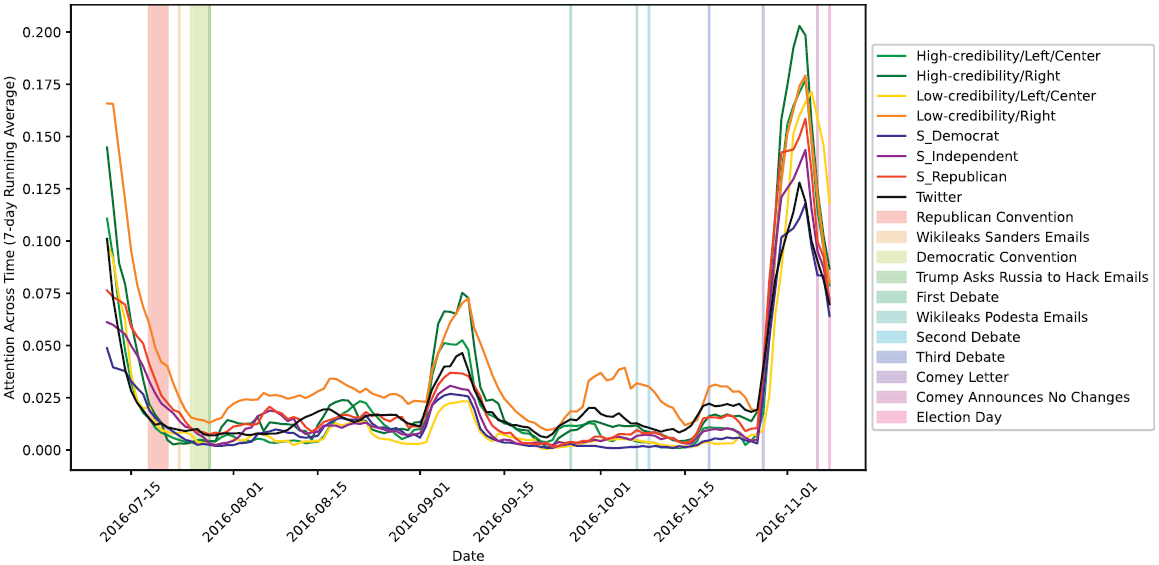
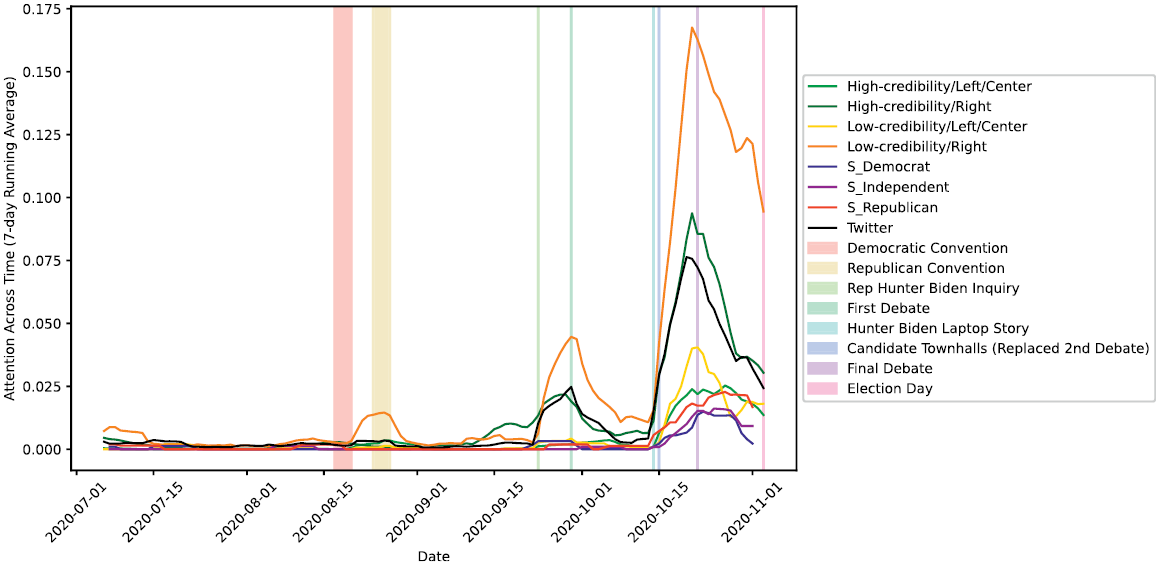
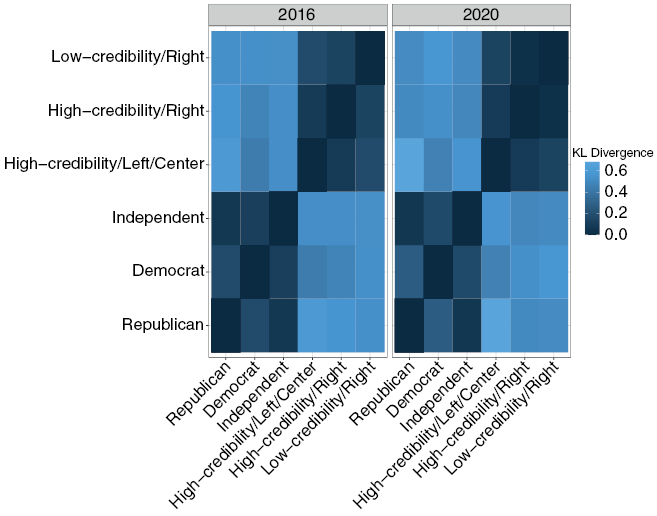

 Open access