Civil wars are violent by definition but the character of violence varies considerably across conflicts—particularly the extent to which rebel groups carry out violent attacks against civilians. Some groups, like the Lord's Resistance Army in Uganda, the Revolutionary United Front in Sierra Leone, or the Islamic State in Iraq and Syria, murder, rape, and abduct civilians, and destroy civilian homes and property.Footnote 1 Other rebel groups, such as the Kurdistan Workers’ Party in Turkey, deliberately target civilians by exploding bombs in public places.Footnote 2
Many rebel groups, however, rarely attack civilians and primarily attack the government's military forces. Fretilin, which fought to gain independence for East Timor, and the Free Aceh Movement, which fought for Acehnese independence, did not attack civilians but regularly attacked Indonesian military targets.Footnote 3 Liberians United for Reconciliation and Democracy committed some human rights abuses, including forcibly conscripting civilians, but did not deliberately kill civilians.Footnote 4
A significant body of literature has examined the causes of this variation in rebel group violence against civilians.Footnote 5 Less is known about the consequences of this variation in violence—in particular, the consequences for civil war outcomes. Does rebel group violence or restraint toward civilians affect the group's prospects for success?
I argue that rebel group behavior toward civilians does affect civil war outcomes; understanding why requires attention to the role that international actors play in negotiating and implementing agreements to end civil wars, and how civil war atrocities shape this international involvement in civil war termination. Existing research emphasizes domestic backlash in response to rebel group violence and the impact this can have on a rebel group's ability to achieve its goals.Footnote 6 However, this literature has largely overlooked the crucial role that international actors play in civil war termination, as well as how the interaction between government and rebel group behavior shapes international involvement.Footnote 7
International involvement in ending civil war expanded dramatically following the Cold War, with international peacekeeping contributing to a rise in negotiated settlements and a decline in military victories.Footnote 8 During the Cold War, about 75 percent of civil wars ended with military victory for one side, but since the end of the Cold War, more than 70 percent of civil wars have terminated in a negotiated settlement—most mediated and implemented with assistance from Western governments and intergovernmental organizations.Footnote 9
Within this international context, rebel groups can gain leverage by winning diplomatic backing from Western international actors. Rebel groups who do not target civilians can frame their behavior as consistent with international humanitarian legal standards to appeal for diplomatic support from Western governments and intergovernmental organizations. Demonstrating adherence to international humanitarian norms is one way that rebel groups can assert themselves as legitimate actors, signaling to international audiences their intention to abide by international rules.Footnote 10
However, rebel groups vary in both their need and their ability to win diplomatic assistance from Western international constituencies. Winning international support is difficult for rebel groups. The international context favors states. International law prioritizes state sovereignty, prohibits the use of force against states’ territorial integrity or independence, and discourages political intervention in states’ internal affairs. However, when a clear contrast exists between belligerents’ behavior—when the rebel group exercises restraint in the face of government atrocities—international law provides a focal point encouraging diplomatic efforts in support of the rebel group.Footnote 11 International law does not obligate international actors to intervene diplomatically in such circumstances. In fact, international actors have failed to intervene in many cases involving severe atrocities. However, international law gives international actors the authority to intervene. Increased diplomatic support can significantly alter the rebel group's bargaining position, helping rebel groups that do not target civilians despite government abuses to secure more favorable political outcomes.
In what follows, I argue that rebel groups that can contrast their own restraint toward civilians with government abuses are more likely to secure diplomatic support from Western international audiences and can use this support to win more favorable conflict outcomes. I focus on the conflict's political outcome: the extent to which the rebel group achieves its political objectives through military victory or negotiated settlement. Using cross-national data measuring rebel group violence against civilians in all civil wars from 1989 to 2010, I show that rebel groups that exercise restraint toward civilians in the face of government violence are more likely to secure favorable political outcomes. Finally, I probe the causal mechanism linking behavior to conflict outcomes: when rebel groups refrain from attacking civilians, but their government opponent commits abuses, Western governments and intergovernmental organizations are more likely to impose sanctions or publicly condemn the government, leading to government concessions.
Determinants of Civil War Outcomes
Most civil wars end in one of three ways: military victory for the government, military victory for the rebel group, or negotiated settlement.Footnote 12 In the post-Cold War era military victory is rare.Footnote 13 According to data from Toft, 100 percent of civil wars that concluded during the 1980s ended with a government or rebel group military victory, whereas during the 1990s only about 40 percent of civil wars terminated in military victory.Footnote 14 Using slightly different data, DeRouen and Sobek find that military victories ended about 75 percent of civil wars from 1944 to 1989, but in the post-Cold War period, more than 70 percent of conflicts ended in negotiated settlements.Footnote 15
Existing research shows that conflict costs and belligerent capabilities affect whether a conflict ends in military victory or negotiated settlement. Rising conflict costs undermine the government's base of support and ability to prosecute the war, making rebel victory possible.Footnote 16 As conflict costs rise, war weariness or stalemate sets in, increasing the likelihood of negotiated settlement.Footnote 17 Belligerent capabilities also affect the prospects for victory: contraband financing facilitates insurgency;Footnote 18 governments with strong bureaucratic institutions or large armies can more rapidly defeat an insurgency;Footnote 19 militarily strong rebel groups are more likely to win;Footnote 20 and belligerents receiving third-party military backing are more likely to win.Footnote 21
Many posit that the conduct of war also influences civil war outcomes. Government violence against an insurgency's civilian constituents can be counterproductive, encouraging stronger resistance from civilians.Footnote 22 This insight underlies the common claim that counterinsurgency operations ought to prioritize winning hearts and minds. Other studies show, however, that government violence against civilians can be effective, impeding rebel operations in the short term,Footnote 23 deterring civilians from aiding the insurgency if insurgents cannot protect civilians,Footnote 24 or eliminating civilian supporters who are geographically concentrated.Footnote 25
More recently, scholars have examined the impact of insurgent violence against civilians. Fortna finds that rebel groups using terrorist tactics in civil wars are less likely to secure an outright military victory or a negotiated settlement than rebel groups that do not.Footnote 26 Abrahms similarly finds that insurgencies that attack civilian targets are less likely to achieve their political objectives.Footnote 27 Thomas, however, finds that in African conflicts, rebel groups that use terrorist violence are more likely to participate in negotiations and to win political concessions from the government.Footnote 28 Wood and Kathman show that in African conflicts, civilian victimization—defined to include terrorist bombing and other forms of violence—increases the probability of a negotiated settlement.Footnote 29 However, very high levels of civilian victimization are counterproductive.
These studies rightly emphasize how rebel group violence against civilians can affect the domestic strategic environment and the maintenance of support from domestic constituencies—for example, by deterring civilians from aiding the government or imposing costs on the government that elicit political concessions. The existing literature, however, overlooks several important factors. First, and most crucially, the existing literature pays insufficient attention to international involvement in civil war termination, and thus fails to identify a key pathway through which belligerent behavior shapes civil war outcomes. International involvement in civil war termination increased dramatically following the Cold War, contributing to a rise in negotiated settlements and a decline in military victories; international peacekeeping helped belligerents resolve commitment problems, facilitating settlements that would not have been possible otherwise.Footnote 30 International intervention affects the likelihood of settlement and influences the terms of settlement, shaping the political outcome of civil wars.
Second, recent studies focus primarily on how rebel group behavior influences conflict outcomes without examining the interaction between rebel group and government behavior.Footnote 31 Rebel groups compete with governments for support from international constituencies, in part by contrasting their own restraint toward civilians—and respect for international law—with government abuses. These rebel groups can then use international diplomatic support to secure favorable settlements.
Finally, most existing studies treat negotiated settlements as a single category, analyzing why some conflicts end in settlement rather than military victory. However, the content of negotiated settlements varies considerably; some settlements favor the government, others favor the rebel group, and still others demand considerable concessions from both sides. Examining the content of negotiated settlements allows for a nuanced analysis of the extent to which rebel groups achieve their political goals.
Understanding civil war outcomes in the post-Cold War period thus requires an analysis of how belligerents achieve their objectives through negotiated settlements, with particular attention to the role of international actors. Negotiated settlements occur when warring parties reach an agreement that is preferable to continued conflict. Bargaining approaches to war demonstrate that this may occur because fighting reveals information, allowing the warring parties to more accurately estimate one another's capabilities and resolve. However, information revelation may be insufficient to facilitate agreement; commitment problems may make belligerents worry that the other side will break the agreement.Footnote 32 International involvement is often essential in addressing commitment problems.Footnote 33 International mediation shortens the duration of civil warFootnote 34 and, when combined with peacekeeping, reduces the likelihood of conflict recurrence.Footnote 35 Through intervention, international actors shape the character of political settlements. Rebel groups compete with governments for international diplomatic support—in part, by highlighting their compliance with international humanitarian standards—and use this support to improve their bargaining position.
Violence and Restraint Toward Civilians in Civil Wars
Civilians are intimately involved in civil war. They are political constituents in whose name belligerents fight. Civilians also provide material support and intelligence to belligerents. Consequently, rebel groups often have strategic incentives to attack civilians to deter them from aiding the government or to cleanse government constituents from disputed territory.Footnote 36 Some rebel groups target civilians to increase conflict costs, coercing the government into making concessions.Footnote 37
According to some scholars, rebel groups that are weak militarily or that face high conflict costs perceive greater benefits to violence. Unable to confront the government militarily, these groups instead attack the government's constituents.Footnote 38 Weak groups may also have difficulty securing voluntary civilian cooperation, increasing their incentives to use violence against civilians.Footnote 39 Alternatively, territorial contestation incentivizes rebel groups to use violence to deter civilians from aiding the government.Footnote 40 Others contend that the greater the government's perceived sensitivity to civilian losses, the stronger the rebel group's incentives to target government constituents in an effort to elicit concessions.Footnote 41
The Costs of Violence and Incentives for Restraint
Although rebel groups often face strong incentives to target civilians, violence can lead to greater resistance from the domestic civilian population,Footnote 42 while restraint can help rebel groups broaden their support among domestic constituencies.Footnote 43 Greater domestic support may increase the group's perceived power or legitimacy, strengthening its bargaining position; but increased domestic support is unlikely to produce dramatic shifts at the negotiating table, compared to the leverage gained by winning international support. For this reason, I focus on international incentives for restraint.
Rebel groups often use restraint deliberately—avoiding direct attacks on civilians in an effort to win diplomatic backing from Western governments and Western-dominated intergovernmental organizations. However, rebel groups vary in their need for diplomatic assistance from international audiences, and thus in their incentives to exercise restraint. Rebel groups receiving backing from powerful foreign governments unconcerned with the group's treatment of civilians can rely on their foreign supporters for leverage in negotiations; these groups are less likely to appeal to Western international constituencies for diplomatic assistance. Other rebel groups calculate that the benefits of violence outweigh the incentives for restraint.
Rebel Group Appeals for International Support
In seeking international support, rebel groups use multiple strategies, including making formal statements before the United Nations or during media interviews, lobbying foreign governments, and urging NGOs to publicize government human rights abuses.Footnote 44 Rebel groups often make explicit reference to international humanitarian law, using international standards to frame their behavior and that of their government opponent.
International humanitarian legal instruments applicable during civil war—the 1949 Geneva Conventions, the 1977 Second Additional Protocols to the Geneva Conventions, and the 1998 Rome Statute of the International Criminal Court (ICC)—outlaw a range of violence against noncombatants, including murder, torture, rape, and forced relocation.Footnote 45 Certain civilian protections constitute customary international law: all combatants must abide by these rules, regardless of whether they have ratified relevant treaties.Footnote 46
Formal treaties codifying international humanitarian law clarify international expectations regarding wartime treatment of civilians, providing rebel groups with information about Western preferences regarding acceptable behavior.Footnote 47 Rebel groups use the standards set out in international agreements to frame their behavior and to differentiate government atrocities from “normal” wartime violence. Demonstrating their willingness to abide by international humanitarian law is one way—though certainly not the only way—that rebel groups signal their legitimacy to international actors.Footnote 48 By referencing international humanitarian law, rebel groups may even raise the costs of future violation, signaling their commitment to continued restraint.Footnote 49 In their appeals, rebel groups urge foreign governments and intergovernmental organizations to take action against the government, such as imposing sanctions, withholding aid, exerting diplomatic pressure, mediating peace negotiations, or even threatening military intervention.
For example, during its fight for East Timorese independence, the Fretilin insurgency sought support from foreign governments, NGOs, and the UN.Footnote 50 Fretilin accused the Indonesian government of grave human rights abuses in East Timor, arguing that the government violated the 1951 Genocide Convention.Footnote 51 Fretilin raised these concerns with the UN Commission on Human Rights, urging other governments to cut aid to Indonesia.Footnote 52 José Ramos-Horta, who served as Fretilin's representative abroad, outlined this logic:
Most wars of national liberation end in negotiations. There is almost no precedent of a guerrilla movement defeating an established government by military means alone … East Timor is in fact one case in which the West could play an effective and constructive role … A combined effort by the US and Great Britain, with which Australia could be associated, would certainly persuade the Indonesian generals to seriously negotiate an end to the war.Footnote 53
The separatist Free Aceh Movement (Gerakan Aceh Merdeka, GAM) in Indonesia adopted a similar strategy, appealing to international actors by contrasting its restraint toward civilians with the Suharto government's human rights abuses.Footnote 54 In 1993, a GAM representative testified before the UN Commission on Human Rights that Indonesia's “reign of terror imposed on the Acehnese was akin to the ethnic cleansing practiced in Bosnia and Herzegovina”Footnote 55 and called for UN investigations.Footnote 56 GAM's military commander made a similar appeal during an interview with The Guardian, asking “Why doesn't the world open its eyes to the atrocities here? … If it can intervene in Kosovo, why can't it do the same here? … Without outside help there will never be peace in Aceh.”Footnote 57
The International Politics of Civil War Termination
Restraint will not always increase a rebel group's chances of winning international support. Rebel groups make strategic calculations about using violence or restraint toward civilians in a context characterized by great uncertainty. Sometimes the chosen strategy does not improve the rebel group's bargaining position or chances of success as it expected.
Existing research offers insight into the conditions under which international actors are likely to intervene in civil wars. However, much of it focuses on interventions providing material support to belligerents—financing, weapons, or military personnel. In many cases, foreign governments provide material support for strategic reasons—for example, to bolster allies or prevent conflict from spreading to neighboring statesFootnote 58—without concern for belligerents’ behavior toward civilians. However, states sometimes face pressure from domestic interest groups or domestic and international NGOs to respond to human rights and humanitarian law violations,Footnote 59 encouraging states to impose sanctions or intervene militarily.Footnote 60 Research shows that democratic governments—especially those with strong human rights lobbies—are less likely than nondemocratic governments to provide material assistance to rebel groups that commit serious human rights abuses.Footnote 61
Like other types of intervention, international diplomatic intervention is most likely when the intervening state has a link to the civil war state: when the civil war state is an ally, former colony, or neighbor.Footnote 62 For example, former colonial powers may face domestic pressure to respond to human rights violations occurring in their former colonies, leading to diplomatic action—as when France facilitated negotiations to end the civil war in Côte d'Ivoire and pressured the abusive Gbagbo government to make political concessions.Footnote 63 Regional powers may confront similar pressure to respond to violence in neighboring countries, or may view such intervention as strategically beneficial. As Australians’ calls for action escalated in the 1990s in response to atrocities in nearby East Timor, Australia reversed its long-standing support for Indonesia, and pressed Indonesia to negotiate.Footnote 64 However, the multilateral nature of many diplomatic interventions means that a single state's interests rarely dominate.
Why might belligerent behavior matter to international actors’ decisions to intervene diplomatically, and how might international law play a role? International legal norms—and rebel groups’ ability to appeal to such norms—influence international involvement in civil war termination. It can be difficult, however, to distinguish international law's impact from the impact of other factors relevant during the post-Cold War period—for example, the power of human-rights-oriented civil society actors, the strength of political ideology emphasizing protections for individual rights and freedoms, or the precedent set by prior humanitarian action.
Much of the scholarly debate about international law focuses on compliance with international agreements.Footnote 65 In this case, however, the question is not about whether states abide by their own international legal commitments but about the conditions under which international actors respond to other actors’ violations of international humanitarian law. The main instruments of international humanitarian law are silent with regard to third parties’ obligations to respond to violations of international humanitarian law occurring elsewhere. States do not have any formal legal obligation to intervene diplomatically or otherwise to prevent or halt atrocities. The exception is the Genocide Convention, which requires states parties “to prevent and to punish” genocide.Footnote 66
The UN Security Council, however, has interpreted violations of international humanitarian law as threats to international peace and security,Footnote 67 imposing economic sanctions and arms embargoes against offending parties; incorporating the protection of civilians into UN peacekeeping mandates; and establishing war crimes tribunals in the former Yugoslavia, Rwanda, Sierra Leone, and Cambodia.Footnote 68 Through articulating the responsibility to protect (RtoP), states asserted that if a government fails to protect its citizens from war crimes, crimes against humanity, genocide, or ethnic cleansing, the international community ought to act through the UN Security Council to prevent these crimes.
Although RtoP established guidelines for international intervention, most scholars agree that it did not create any new legal obligations on states to respond to atrocities occurring beyond their borders.Footnote 69 RtoP guidelines also did not alter the legal prohibition on the use of force codified in the UN Charter, which proscribes military intervention without UN Security Council authorization.Footnote 70 However, as Orford points out, RtoP confers power or authority on states to take action, and emphasizes nonmilitary forms of intervention.Footnote 71 Hurd, too, highlights international law's legitimating role: states justify their behavior in terms of international law precisely because “lawfulness confers political legitimation.”Footnote 72 Thus, Western international actors invoked RtoP as justification for intervention in civil wars in Côte d'Ivoire and Libya.Footnote 73 And yet, Western responses to atrocities remain uneven, with international actors failing to intervene in cases involving clear violations of international humanitarian law, as in Darfur and Syria.
Although international law does not obligate third-party responses to wartime violence, it can help international actors agree on appropriate responses to complex conflicts. Research shows that international institutions and law can provide focal points to help states coordinate their actionsFootnote 74 or identify acceptable bargains,Footnote 75 even when conflict exists over the nature of the settlement.Footnote 76 This is particularly important with regard to international interventions, which are often multilateral.Footnote 77 International actors may agree on the need to resolve a particular civil war, but may have different preferences regarding the political outcome, complicating efforts to reach a settlement.Footnote 78
In research on territorial disputes, Huth, Croco, and Appel contend that international law can serve as a focal point for settlement when two conditions hold: (a) the international legal principles at stake are clear, and (b) one side in the dispute has a distinct legal advantage.Footnote 79 When these same conditions hold, international humanitarian law can provide a focal point to guide international intervention in civil wars. Formal treaties outline clear international legal principles prohibiting deliberate attacks against civilians, thus meeting the first condition. To meet the second condition, asymmetry in the belligerents’ behavior is essential: one side must abide by international humanitarian legal standards, while the other side violates these standards, giving the compliant side a legal advantage.
Identifying violations of international humanitarian law can be difficult. Military targets are often located near civilians, and armed groups frequently intermingle with civilians, complicating efforts to distinguish between deliberate civilian targeting and collateral damage resulting from attacks on military targets. Moreover, civil wars traditionally fall within a state's domestic jurisdiction, with political or military interventions interpreted as violations of state sovereignty prohibited under the UN Charter.Footnote 80
Without asymmetry in belligerents’ behavior—when both sides exercise restraint—international actors are likely to accept the government's authority to pursue its preferred counterinsurgency strategies and to resist political concessions. International actors may intervene diplomatically if the government consents but are unlikely to lobby for settlements favoring the rebel group. The conflict between Algeria and the AIS/FIS offers an example: international actors deferred to the government and the political settlement ending the war did not concede to any of the rebels’ political demands.
When both sides commit international humanitarian law violations, external actors are likely to face difficulty disentangling the two sides’ behavior, and distinguishing intentional from unintentional violence against civilians. International actors may try to mediate a resolution, but without a focal point, are unlikely to lobby strongly for either side. In Burundi, for example, government and rebel forces both targeted civilians, prompting international actors to impose sanctions as a means of pressuring the government to negotiate. However, during negotiations, international actors did not push for terms of settlement favorable to the rebels.Footnote 81
When a clear disparity exists between belligerents’ behavior, international law provides a focal point to guide a response: international actors can intervene in support of the actor complying with international legal standards. However, intervention differs depending on which side exercises restraint. When the government exercises restraint while the rebel group commits atrocities, international actors are likely to defer to principles of sovereignty—intervening only if the government chooses. Many governments prefer to defeat insurgencies outright. Governments that accept international diplomatic overtures—aware that they are entering negotiations from a strong bargaining position—are unlikely to make significant concessions. In Uganda, for example, external actors attempted to mediate a resolution to the conflict with the Lord's Resistance Army (LRA)—a group that committed heinous atrocities against civilians in Northern Uganda. However, the Ugandan government repeatedly broke off negotiations and returned to military operations, refusing to make concessions.
In contrast, when the rebel group exercises restraint in the face of government atrocities, international law provides a focal point for international diplomatic intervention favoring the rebel group. Governments may still appeal to sovereignty protections, as Omar al-Bashir did in resisting international intervention in Darfur. However, as RtoP clarified, governments that commit severe violations of international humanitarian law are no longer entitled to sovereignty protections. International actors do not have an obligation to intervene diplomatically. Nor do they always feel compelled to do so. Rather, international actors have the authority to act to protect populations outside their borders.Footnote 82 Thus, government atrocities create an opportunity for rebel groups to appeal for international support by contrasting their restraint with government abuses. When international actors do intervene diplomatically on rebels’ behalf, they affect bargaining, increasing the likelihood of a favorable outcome for the rebel group.
In multiparty conflicts involving government atrocities, international law can still serve as a focal point for international diplomatic intervention if at least one rebel group exercises restraint. In such cases, a rebel group that targets civilians may benefit from a rival group's restraint—for example, if negotiations with the group exercising restraint resolve key political disputes. However, peace processes—and their international facilitators—often differentiate among rebel groups, engaging in separate negotiations with each group, excluding some groups from negotiations, or offering groups different concessions.Footnote 83 Thus, when rebel groups fighting in multiparty conflicts behave differently toward civilians, international actors are likely to differentiate among these groups, urging more favorable terms of settlement for groups exercising restraint and opposing concessions that would benefit abusive groups.
In Burundi, for example, the government as well as the two main rebel groups targeted civilians. Some opposition members then broke away from the rebel groups, eschewing violence and distancing themselves from wartime atrocities. International actors successfully used sanctions to force the government to negotiate. During the initial round of negotiations, however, international mediators excluded the rebel groups, inviting only the groups opposed to violence. The government later agreed to negotiate with the rebel groups, but refused to make significant concessions, insisting that they had already granted major concessions to the opposition—including positions in a new power-sharing government.Footnote 84
International Diplomatic Intervention and Civil War Outcomes
Not all diplomatic interventions will advantage the rebels, as the Burundi example illustrates. However, international actors often help to secure outcomes favorable to the rebel group by (a) pressuring governments to participate in negotiations and (b) pushing for terms of political settlement that favor the rebel group.
International diplomatic efforts—such as public pressure or formal sanctions—may force governments to the negotiating table who otherwise would have continued fighting. Foreign governments can advocate for the rebel group in public forums that rebel groups have difficulty reaching, sometimes mobilizing a broader coalition of support. Portugal, for example, urged European governments to pressure Indonesia to negotiate over East Timor's status.Footnote 85 International actors can propose sanctions against the abusive government, limiting its ability to obtain weapons or financing, as in Burundi; they can also press for cuts in aid to the abusive regime, as many did following Sudanese government violence in Darfur.
In many cases, foreign governments or the UN become directly involved in peace negotiations, as a mediator or in a contact group of concerned states. This direct involvement provides opportunities to push for terms of settlement favoring the rebel group and urge the government and its backers to make concessions. For example, France facilitated negotiations to end the conflict in Côte d'Ivoire where the government was heavily criticized for its human rights abuses.Footnote 86 The French president and the UN Secretary General met personally with Ivoirian president Laurent Gbagbo, urging him to accept the peace deal, although the terms favored the rebel group.Footnote 87 They also organized a large diplomatic conference to coincide with the signing of the agreement, making clear that donor support was contingent on the Gbagbo government's acquiescence to the deal. The UN played a similar role in East Timor. UN Secretary General Kofi Annan appointed a special representative to facilitate negotiations between Indonesia and Portugal and formed a contact group of concerned states to pressure the two sides.Footnote 88
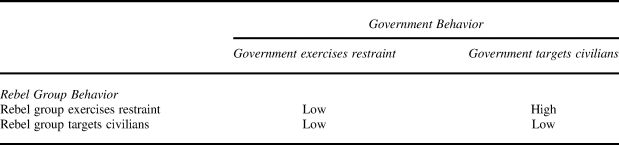
International support is valuable because most rebel groups are at a distinct military disadvantage compared to their government opponents; of the 102 rebel groups that fought in civil wars between 1989 and 2010, only eleven had more troops than the government.Footnote 89 Military weakness makes it difficult for rebel groups to have enough leverage during peace negotiations to force significant government concessions and makes rebel group military victory unlikely in most cases. Diplomatic support from international actors can significantly alter rebel groups’ ability to exert pressure on the government, thereby securing greater concessions and leading to more favorable conflict outcomes. Table 1 illustrates the theoretical argument's predictions.
Theoretical expectations regarding the likelihood of a political outcome favoring the rebel group

H1 Rebel groups that do not target civilians when faced with a government opponent that targets civilians should be more likely than other rebel groups to secure a favorable political resolution to the conflict.
Conflicts in Indonesia and Liberia illustrate how belligerent behavior can shape international involvement in civil wars, influencing conflict outcomes. The East Timor conflict highlights the shift that took place at the end of the Cold War as international actors increasingly became involved in negotiating agreements to end civil wars. In 1975, a harsh Indonesian counterinsurgency campaign killed an estimated 200,000 Timorese—about one-third of East Timor's population.Footnote 90 During the Cold War, however, international actors eager to maintain Indonesia as a Western ally in the fight against communism did not pressure Suharto on East Timor.
In the 1990s, foreign governments began raising questions about Indonesia's human rights practices—particularly following the 1991 Dili massacre where Indonesian forces fired into a crowd of Timorese demonstrators, killing between seventy-five and 200.Footnote 91 Fretilin intensified its international lobbying, calling on the UN Security Council to address the Dili massacre and urging foreign governments to impose an arms embargo on Indonesia.Footnote 92 In response, the European Parliament passed a resolution recommending that the European Community and the UN ban arms sales to Indonesia.Footnote 93 The Netherlands halted official aid to Indonesia, while Canada cut its official development assistance.Footnote 94 In October 1992, the United States ended its military training assistance to Indonesia in response to persistent human rights abuses in East Timor.Footnote 95 Australia—one of the few countries that had formally recognized Indonesia's annexation of East Timor—conceded to a high-level meeting with Timorese representatives, withdrawing its long-standing support of Indonesia.Footnote 96 In December 1992, Indonesia agreed to take part in UN-mediated talks with Portugal over East Timor's status.Footnote 97 Talks progressed slowly, but when the Suharto regime fell in 1998, pressure on the new transitional government mounted. The US, EU, Australia, and the UN—and Fretilin—urged Indonesia to alter its policy toward East Timor.Footnote 98 Indonesia finally relented, agreeing through the UN-mediated talks to a referendum that led to East Timor's independence.
In Liberia, multiple international actors were involved in ending the 2000–2003 conflict in which Liberians United for Reconciliation and Democracy (LURD) and the Movement for Democracy in Liberia (MODEL) fought to overthrow Charles Taylor's regime. Human Rights Watch reported that Taylor's forces tortured, raped, and killed civilians believed to be sympathetic to the insurgency, and looted and burned civilian homes.Footnote 99 Taylor also backed the RUF in Sierra Leone—a group responsible for extreme atrocities against civilians. The UN Security Council imposed economic sanctions, an arms embargo, and a travel ban against the Liberian government,Footnote 100 and the Special Court for Sierra Leone launched investigations into Taylor's involvement in Sierra LeoneFootnote 101—investigations that the US and the UK hoped would undermine Taylor's authority.Footnote 102
Although LURD was responsible for some human rights abuses—most notably, forcibly conscripting civilians—Human Rights Watch reported that “rebel abuses appear to be less widespread and systematic than those committed by government forces.”Footnote 103 LURD also tried to protect civilians—allowing them to leave contested areas, instructing soldiers to avoid violence against civilians, and disciplining soldiers who violated these rules.Footnote 104
LURD sought international support by emphasizing the group's commitment to democratization,Footnote 105 and by contrasting LURD's behavior toward civilians with the behavior of Taylor's forces. In a media interview in May 2002, a LURD spokesman said the group wanted to turn Taylor “over to an international court to have him tried for the crimes he has committed against the people of Liberia, Sierra Leone and the camps in Guinea … This is not a war we are fighting against any group in Liberia … We'll protect all the civilians, they don't have to fear.”Footnote 106 LURD leader Sekou Conneh “claimed LURD did not want to go against the international community, and that LURD was constrained by international opinion.”Footnote 107 After June 2001, LURD attempted to minimize civilian casualties and looting through better troop trainingFootnote 108 out of concern for international opinion.Footnote 109
In early 2003, as LURD and MODEL advanced on Monrovia, and under heavy domestic and international pressure to end the war, Taylor agreed to negotiations mediated by the Economic Community of West African States (ECOWAS).Footnote 110 Many were skeptical of the prospects for settlement. However, the Special Court for Sierra Leone intervened, unsealing its indictment of Taylor for war crimes and crimes against humanity on the morning that peace talks were to begin. The prosecutor admitted his intention to discredit Taylor,Footnote 111 declaring, “the timing of this announcement was carefully considered in light of the important peace process begun this week … It is imperative that the attendees know they are dealing with an indicted war criminal.”Footnote 112
US officials opposed the court's decision, believing it might complicate Taylor's removal from power.Footnote 113 However, many individuals involved in negotiations later admitted that the indictment “helped LURD to delegitimize him [Taylor].”Footnote 114 In media interviews, LURD insisted that it would not negotiate with a government “led by an indicted war criminal.”Footnote 115 Ultimately, Taylor conceded to a ceasefire and the establishment of a transitional government overseen by ECOWAS, the UN, and the African Union. When Taylor threatened to renege, international actors stepped up diplomatic pressure and US President George Bush publicly called for Taylor's resignation.Footnote 116 With the UK and others urging action, the US sent troops to back the ECOWAS peacekeeping mission, and helped to negotiate Taylor's asylum in Nigeria.
Methodology
To examine the relationship between belligerent behavior and conflict outcomes, I use an original data set on violence against civilians in all civil wars from 1989 to 2010. The cases are drawn from the UCDP/PRIO Armed Conflict Dataset, which defines internal armed conflict as “a contested incompatibility that concerns government or territory or both where the use of armed force between two parties results in at least twenty-five battle-related deaths” and “occurs between the government of a state and internal opposition groups.”Footnote 117 The unit of analysis is the conflict dyad; if a government fought against multiple rebel groups simultaneously, each group is a distinct conflict dyad. Following standard definitions of civil war, I focus on conflict dyads in which fighting led to at least 1,000 battle-related deaths.Footnote 118 The data set includes 110 cases of civil war.
My argument is unlikely to apply during the Cold War because international involvement in civil wars differed dramatically during this period. Ideology drove foreign governments’ diplomatic support for belligerents, while superpower involvement impeded political settlement in many conflicts. In the post-Cold War period, however, international involvement in peace negotiations and peacekeeping has facilitated negotiated settlements.Footnote 119 In this international context, I argue, belligerent behavior and respect for international humanitarian law influences international diplomatic intervention, affecting civil war outcomes.
The international context may have shifted further. With the adoption of the Rome Statute and the articulation of RtoP, international actors increased the precision and strengthened the enforcement of international humanitarian law, perhaps expanding opportunities for rebel groups to use restraint to appeal to Western international constituencies. Western international actors may also be more likely to intervene diplomatically in response to civil war atrocities, giving rebel groups greater leverage to win political concessions. I return to this issue later.
Conflict Outcomes
To code conflict outcomes, I begin with the Non-State Actor Data that Cunningham Gleditsch, and Salehyan compiled, which distinguish between conflicts that end in government victory, rebel group victory, formal agreement (either ceasefire or peace agreement), or subside after periods of low activity.Footnote 120 However, evaluating my main hypothesis requires a coding of conflict outcomes that differentiates between negotiated settlements based on their content—whether the terms of the settlement favor the government or the rebel group.
For cases coded in Cunningham, Gleditsch, and Salehyan as ending in formal agreement or periods of low activity, I examine the written terms of political settlement (cases ending with formal agreement) or the de facto terms of political settlement (cases ending through low activity) and code whether the terms favored the government, the rebel group, or neither side. For example, the civil war in Algeria began after the military refused to honor 1991 parliamentary election results favoring the Islamic Salvation Front (Front Islamique du Salut, FIS). The FIS formed an armed wing, the Islamic Salvation Army (Armée Islamique du Salut, AIS). The conflict ended in 1997 when the AIS announced a unilateral ceasefire and disbanded; in later negotiations, the government granted an amnesty to AIS members, but banned the political wing, the FIS, from participating in government. Cunningham, Gleditsch, and Salehyan code this conflict as ending with a formal agreement. I code this as an outcome favorable to the government because the FIS/AIS did not achieve their initial political objectives and the government did not make political concessions.
The separatist conflict in East Timor provides an example of a formal agreement favoring the rebel group. East Timorese insurgents won independence from Indonesia. Negotiations between Portugal and Indonesia resulted in a 1999 referendum on East Timor's independence, after which the UN supervised the transition to independence.
The separatist conflict between the Free Aceh Movement (Gerakan Aceh Merdeka, GAM) and the Indonesian government provides an example of a negotiated settlement involving significant concessions by both sides. GAM signed a peace agreement with Indonesia in 2005, granting Aceh regional autonomy and permitting former GAM members to participate in elections for Aceh's regional government. But GAM did not win independence for Aceh as it had demanded.
Using this coding scheme, I construct a categorical dependent variable, conflict outcome, with three categories: (a) outcomes favorable to the government—government military victories and negotiated settlements favorable to the government (coded as 0); (b) outcomes favorable to the rebel group—rebel group military victories and negotiated settlements favorable to the rebel group (coded as 2); and (c) outcomes involving significant concessions from each side (coded as 1).Footnote 121 I code ongoing conflicts as missing, leaving seventy-seven civil wars that terminated between 1989 and 2010. Of these, thirty-three (42.9 percent) ended with an outcome favorable to the rebel group, twenty-five (32.5 percent) ended with an outcome involving concessions from both sides, and nineteen (24.7 percent) ended with an outcome favorable to the government.
In research on leader responsibility and civil war outcomes, Prorok similarly differentiates among negotiated settlements based on which side the terms favor.Footnote 122 Prorok's measure of civil war outcomes nevertheless differs in two important ways from the measure used here. First, Prorok codes conflict outcomes separately for each side in the conflict; I compare the two sides’ war aims to code a single outcome for each conflict dyad. Second, Prorok examines extreme victory or defeat and thus her coding incorporates the conflict's military outcome. I focus on the political outcome. In robustness tests, I replicate the analyses using Prorok's data; the results are similar to those I report.Footnote 123
Civilian Targeting
The theoretical argument focuses on the strategic use of violence and restraint toward civilians, and the consequences such behavior has for conflict outcomes. To identify cases of intentional violence against civilians—civilian targeting—existing work uses measures of the number of civilians killed.Footnote 124 Obtaining reliable data on civilian deaths in civil war is difficult, however; the quality and depth of reporting varies widely, raising questions about the feasibility of using count data as a basis for cross-country comparison.Footnote 125 To address this issue, this data set identifies cases of civilian targeting by examining forms of violence against civilians.Footnote 126 Rebel group civilian targeting and government civilian targeting are dichotomous variables measuring whether each government and each rebel group carried out any of the following forms of violence against civilians: massacres, scorched-earth campaigns, cleansing of a particular ethnic or religious group, or deliberate bombing and shelling of populated civilian targets.
I do not code as civilian targeting incidents of collateral damage—civilian deaths and property destruction during military engagements. I am interested in capturing patterns of behavior, and thus code as civilian targeting only repeated intentional attacks against civilians. Massacres involve the killing of five or more civilians at the same place and time, through direct contact of armed forces with civilians—for example, by shooting or beating to death. I code only those groups responsible for more than five massacres as using this form of violence. Scorched-earth strategies involve the intentional burning or destruction of villages and/or agricultural land. Cleansing is the forced, permanent removal of civilians from territory. Because belligerents often claim that aerial bombardment or artillery shelling is aimed at military targets, only mistakenly hitting civilians, I focus on sustained bombing or shelling of civilian targets such as residential areas and bomb attacks on populated civilian targets such as buses, restaurants, or public markets.
For each conflict, I consulted the following sources: US Department of State annual Country Reports on Human Rights Practices for every year of the conflict, as well as every relevant annual report and in-depth report published by Amnesty International, Human Rights Watch, International Crisis Group, and the United Nations. I supplemented this with secondary historical sources and newspaper reports.
The main hypothesis emphasizes the interaction between government and rebel group behavior: rebel groups that exercise restraint in the face of government violence are more likely than other rebel groups to achieve a favorable conflict outcome. Rebel group restraint is the inverse of rebel group civilian targeting, representing cases in which the rebel group did not intentionally target civilians. Using these measures, I construct an interaction term, rebel group restraint * government civilian targeting, which allows for a direct test of the hypothesis regarding the interaction between rebel group and government behavior.
Intentional violence against civilians is common during civil war. Slightly more than half of all governments and about 58 percent of rebel groups targeted civilians by using massacres, scorched-earth policies, forced expulsion, or bombing and shelling of populated civilian targets.
Endogeneity Concerns
Some scholars argue that rebel groups at a military disadvantage relative to the government are more likely to target civilians. If true, this could complicate assessing the relationship between violence and conflict outcomes. Rebel groups that target civilians might be less likely to secure favorable outcomes because they are weaker in comparison to their government opponents, not because they attacked civilians. However, research differentiating among types of violence shows that although weak rebel groups are more likely to use terrorist violence, they are not more likely to use violence against civilians overall.Footnote 127 Still, to address this issue, I use several measures to control for belligerent strength.
Control Variables
First, relative strength is a ratio of average government troop strength to average rebel group troop strength, constructed using data from The Military Balance and the SIPRI Yearbooks.Footnote 128 The median government has 14.9 times the troop strength of its rebel opponent. Substituting an alternate measure of relative military capacity from the Non-State Actor Data does not alter significantly the results.Footnote 129
Second, I control for material assistance from foreign governments.Footnote 130 Dichotomous variables measuring intervention on the government side and intervention on the rebel group side indicate whether any foreign government provided military troops to either side.Footnote 131 Foreign governments intervened militarily to aid insurgencies in thirteen of the 103 civil wars in the data set, and to aid governments in twenty-four civil wars.
Third, to account for government capacity more broadly, I control for per capita gdp,Footnote 132 and in robustness checks, include alternate measures of state capacity.Footnote 133 Finally, I capture conflict intensity by examining the conflict's overall military intensity as measured by average annual battle-related deaths; this variable is logged.Footnote 134
Additional controls include separatist rebel group, which measures whether the rebel group was fighting to gain autonomy or independence for a particular region.Footnote 135 Governments often resist granting concessions to separatist groups—particularly if they believe that this will encourage other groups to demand autonomy.Footnote 136 However, the issues at stake may be more easily divisible in separatist conflicts than in revolutionary conflicts.Footnote 137 Multiparty conflict is a dichotomous variable measuring whether the conflict involved multiple rebel groups fighting the government simultaneously.Footnote 138 Multiparty conflicts tend to last longer than two-party conflicts,Footnote 139 are less likely to end in negotiated settlement or government victory, and are more likely to end in rebel victory.Footnote 140 Rebel groups fighting in multiparty conflicts may also have greater leverage to press for government concessions.Footnote 141 Conflict duration measures the duration of the conflict in months.Footnote 142 Research suggests that government victories may become less likely as a conflict wears on.Footnote 143 Finally, non-western aid to rebel group measures whether the rebel group received financing, weapons, or troops from a non-Western government in the first year of the conflict.Footnote 144 Rebel groups receiving aid from non-Western governments are less likely to seek diplomatic support from Western international constituencies.
Data Analysis
Descriptive Statistics
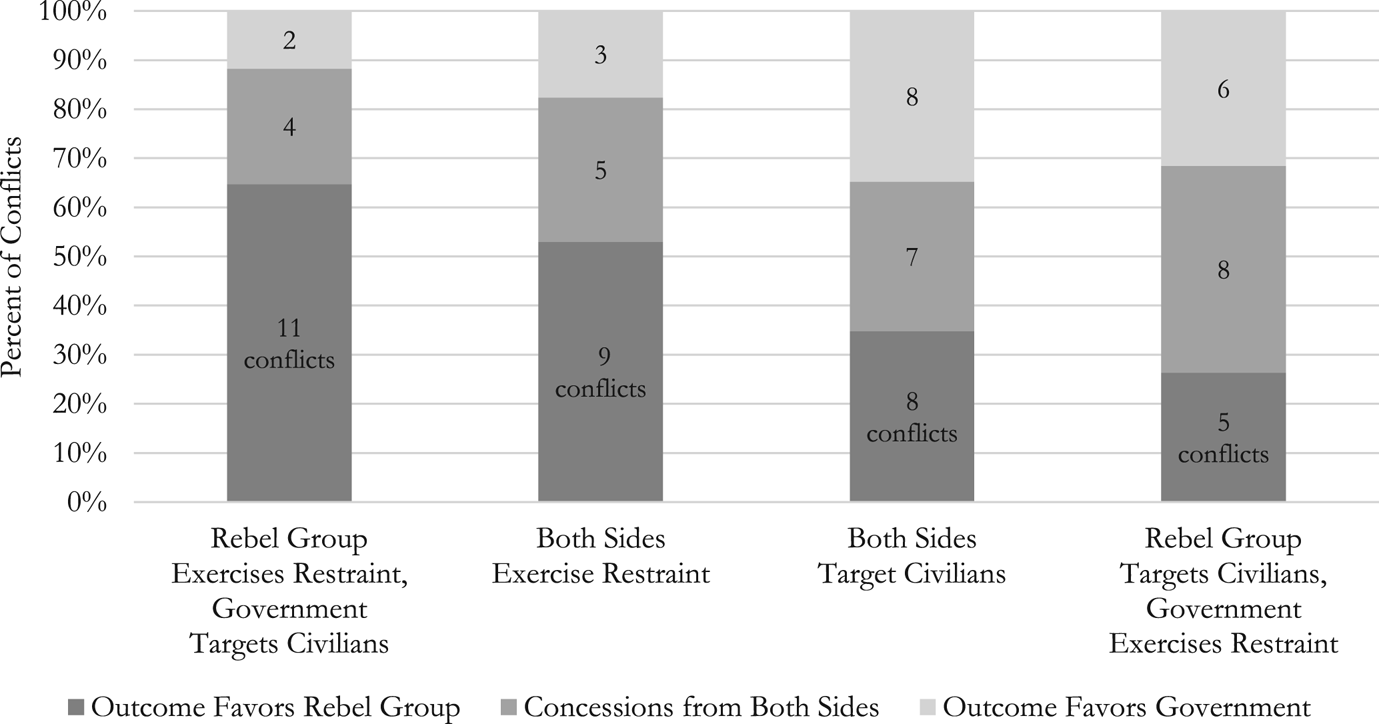
Figure 1 shows the distribution of cases by belligerent behavior and conflict outcome. Consistent with the main hypothesis, political outcomes favoring the rebel group are most common in conflicts where the rebel group can contrast its restraint toward civilians with the government's abuses (left-most column in Figure 1). Of the seventeen conflicts in which the rebel group exercised restraint while the government abused civilians, eleven ended with a political outcome favoring the rebel group. In East Timor, for example, the Indonesian government destroyed vegetation, crops, and villages through aerial and naval bombardment and forcibly moved civilian population to resettlement areas.Footnote 145 Fretilin rebels avoided attacks on civilians, winning independence for East Timor following many years of international lobbying. In the seventeen conflicts in which both sides exercised restraint toward civilians, nine ended in an outcome favoring the rebel group. During the civil war in Cambodia, for example, the government and two rebel groups—FUNCINPEC and the KPNLF—exercised restraint toward civilians, primarily attacking one another's military forces. The political settlement ending the war favored FUNCINPEC and the KPNLF, installing a more democratic government they participated in as legal political parties. Outcomes favoring the rebel group are much less common where rebel groups target civilians. The LRA in Uganda, for example, deliberately targeted civilians in Northern Uganda, while the Ugandan government did not; the LRA was marginalized internationally, and never won significant concessions from the Ugandan government.
Conflict outcomes, by belligerent behavior

Statistical Analyses
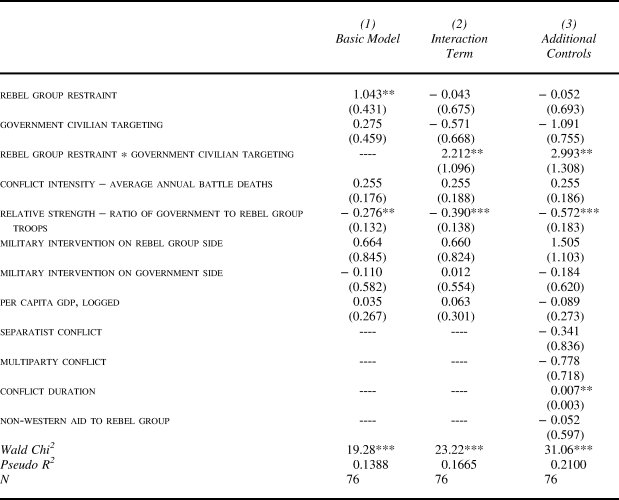
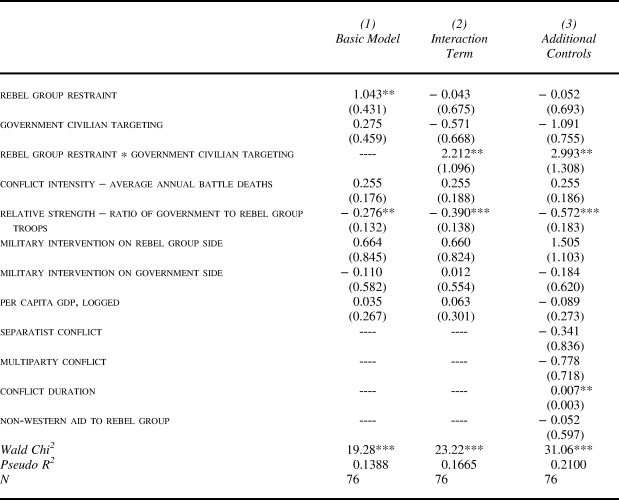
Table 2 reports the results of ordered logit analyses, which treat the dependent variable—conflict outcome—as an ordered variable. The ordered logit model assumes that the effects of the coefficients are the same across outcomes; likelihood-ratio and Wald tests confirm that the models do not violate this proportional odds assumption.Footnote 146 I report robust standard errors for all of the statistical analyses, clustering cases by country. One conflict drops out of the analysis because of missing data, leaving seventy-six observations of civil wars that ended between 1989 and 2010. The small number of observations warrants caution in interpreting the statistical results and urges particular attention to the consistency of these findings in robustness checks.
Ordered logit analyses—conflict outcome
Note: Robust standard errors in parentheses; * p < .10; ** p < .05; *** p < .01.
The results provide strong support for the primary hypothesis, which posits an interactive effect between rebel group and government behavior. Consistent with expectations, the interaction term, rebel group restraint * government civilian targeting, is positive and statistically significant at the 0.05 level in model 2 and remains so following the inclusion of additional control variables in model 3. These results indicate an increased likelihood of an outcome favoring the rebel group in conflicts where the government targets civilians, but the rebel group exercises restraint. Importantly, given endogeneity concerns, the results for rebel group restraint * government civilian targeting hold after including direct and indirect measures of belligerent military strength.Footnote 147
When the interaction term is included, the coefficient for rebel group restraint represents the likelihood of an outcome favoring the rebel group when the government also exercises restraint (government civilian targeting = 0); the coefficient for government civilian targeting represents the likelihood of an outcome favoring the rebel group when both sides target civilians (rebel group restraint = 0).Footnote 148 These coefficients do not reach statistical significance in models 2 or 3. The results for rebel group restraint indicate that conflicts involving restraint by both sides are not associated with a greater likelihood of rebel group success, consistent with the argument's emphasis on differentiation between rebel group and government behavior.
Greater specificity in international humanitarian norms—as expressed, for example, by the signing of the Rome Statute in 1998—should create greater opportunities for rebel groups exercising restraint to appeal for international diplomatic support, and thus to secure favorable conflict outcomes. Testing this statistically is difficult; among conflicts that began in 1998 or later, only eleven have ended. However, an overview of these cases provides some support for this claim. In the two conflicts where the rebel group exercised restraint in the face of government abuses, the rebel group secured a favorable conflict outcome. In the other nine cases, only four rebel groups obtained a favorable outcome.
The results are consistent with key findings in the literature on civil war outcomes. First, several studies find that stronger rebel groups are more likely to win outright military victories. The results here show that stronger rebel groups are also more likely to secure favorable political outcomes. The negative and statistically significant coefficients for relative strength—a ratio of government to rebel group troop strength—indicate that rebel groups that are weak compared to their government opponents are less likely than strong rebel groups to achieve a favorable conflict outcome. Second, research has found that longer conflicts are associated with a decline in the likelihood of a government victory. The positive and statistically significant coefficient for conflict duration in model 3 indicates that longer conflicts are also associated with an increased likelihood of a political outcome favoring the rebel group.
However, the findings also point to several important refinements of hypotheses on civil war outcomes. Studies show that as the costs of a conflict increase, the likelihood of negotiated settlement increases, but the results here indicate that conflict costs may not have as strong an impact on the terms of settlement. The coefficient for conflict intensity is positive but falls short of statistical significance. Studies find a strong positive relationship between biased military intervention and the likelihood of military victory. However, the lack of a strong relationship between military intervention and outcomes favoring the rebel group suggests that military intervention may not aid rebel groups in winning favorable terms of settlement at the negotiating table. Additionally, separatist rebel groups and rebel groups fighting in multiparty conflicts are no more (or less) likely than other groups to secure favorable terms of settlement.
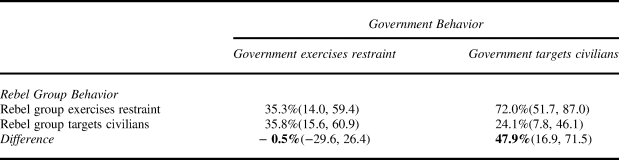
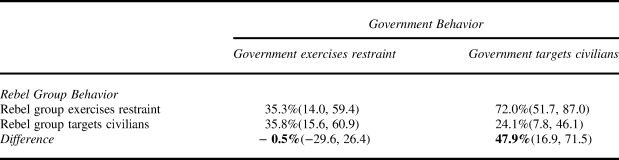
Table 3 shows the calculated probability of an outcome favoring the rebel group (conflict outcome = 2) for all combinations of government and rebel group civilian targeting.Footnote 149 To calculate the probabilities, I use Table 2, model 2, holding the other independent variables at their mean value (continuous variables) or their modal value (dichotomous variables). These probabilities estimate the likelihood of an outcome favoring the rebel group for a conflict without foreign military intervention and with mean levels of belligerent troop strength, conflict intensity, and per capita GDP.
Percent likelihood of outcome favoring rebel group
Note: 95% confidence interval shown in parentheses.
These probability estimates show that government and rebel group behavior have a substantively large impact on conflict outcomes. The likelihood of an outcome favorable to the rebel group is highest—at 72 percent—when the rebel group exercises restraint while the government targets civilians. In all other cases, the likelihood of a favorable outcome is dramatically lower. For example, when both sides target civilians, the rebel group has only a 24.1 percent likelihood of achieving a favorable conflict outcome—a difference of nearly 48 percentage points.
When the government exercises restraint toward civilians, the likelihood of a favorable conflict outcome does not differ significantly for rebel groups that target civilians compared with those exercising restraint. This finding is consistent with the argument that when the government exercises restraint, international actors are unlikely to intervene diplomatically on behalf of the rebel group, even if the group exercises restraint.
Robustness Tests
I conduct five sets of robustness tests (see appendix), probing how well the findings hold—particularly in light of the small number of observations. The first set estimates an alternate model specification: a multinomial logit. The second set tests two alternate measures of conflict outcomes—a dichotomous measure and an alternate categorical measure, constructed using data from Prorok.Footnote 150 In the third set, I drop each case in succession, rerunning the analyses to test whether specific cases might be driving the results. The fourth set analyzes alternate measures of key independent variables: (1) government and rebel group violence against civilians (using UCDP One-Sided Violence data);Footnote 151 (2) relative strength (from the Non-State Actor Data);Footnote 152 and (3) state capacity.Footnote 153 The final set incorporates controls for factors that might affect the rebel group's ability to appeal to Western audiences: whether the rebel group was fighting to install an Islamic form of government and whether the government had a formal alliance with a Western power. These tests demonstrate that the findings regarding belligerent behavior and conflict outcomes are remarkably robust.
Analyzing the Causal Mechanism
The analysis demonstrates that rebel groups that exercise restraint while fighting against a government that targets civilians are more likely to secure favorable conflict outcomes. The causal mechanism driving this relationship is rebel groups’ ability to use their respect for civilian immunity to win diplomatic support from Western international constituencies and leverage that support to obtain more favorable conflict outcomes. Directly measuring diplomatic support for an insurgency is challenging, but it is possible to measure international diplomatic actions against governments. Most of the diplomatic tools available to international actors are aimed at influencing government behavior—mainly, restricting government participation in the international community. International support for rebel groups should be evident in sanctioning the rebel group's government opponent.
I measure international diplomatic action against the government in two ways. First, sanctions measures whether Western governments or Western-dominated intergovernmental organizationsFootnote 154 imposed economic sanctions or arms embargoes on the government in response to government human rights abuses in the civil war.Footnote 155 The measure does not include trade-related economic sanctions. Western governments or intergovernmental organizations imposed sanctions or arms embargoes in forty-one of the 103 civil wars (39.8 percent) occurring between 1989 and 2010. Often international actors exert diplomatic pressure in ways that do not involve economic or military sanctions—for example, publicly shaming belligerents.Footnote 156 The second measure of international diplomatic sanctioning, un condemnation, captures this by examining the content of all UN Security Council resolutions passed from 1989 to 2010 to identify resolutions explicitly condemning government violence against civilians.Footnote 157
Descriptive Statistics on International Diplomatic Action
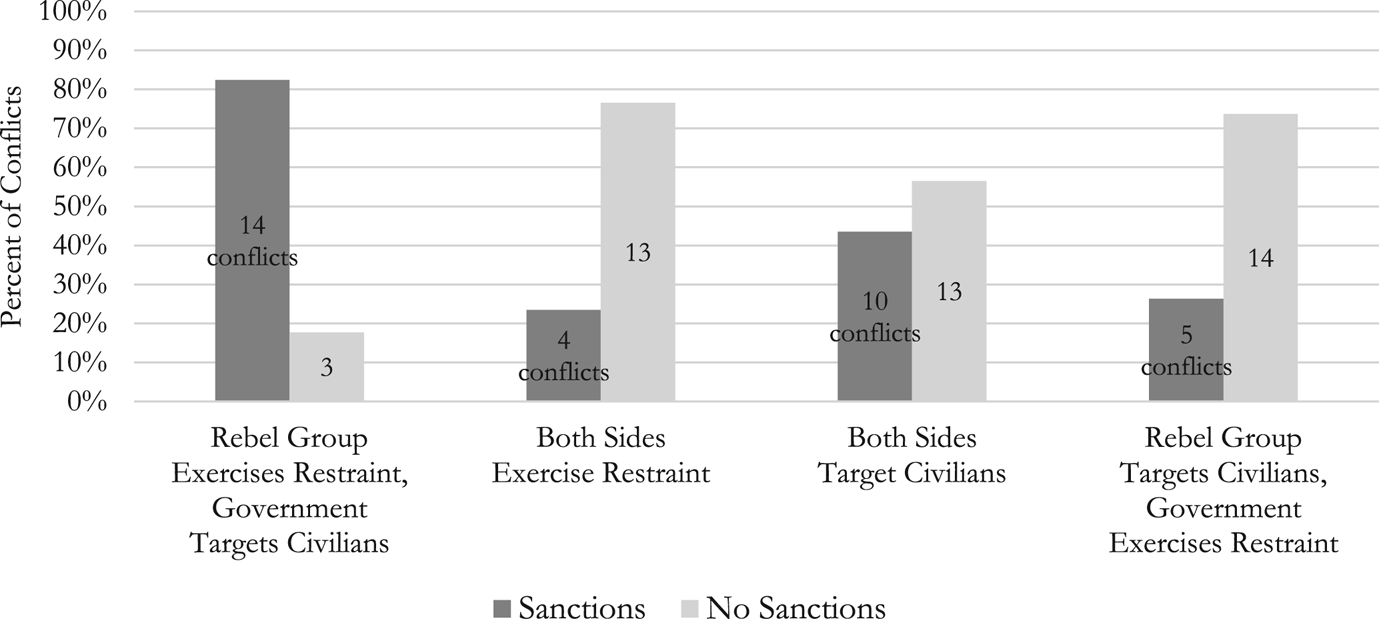
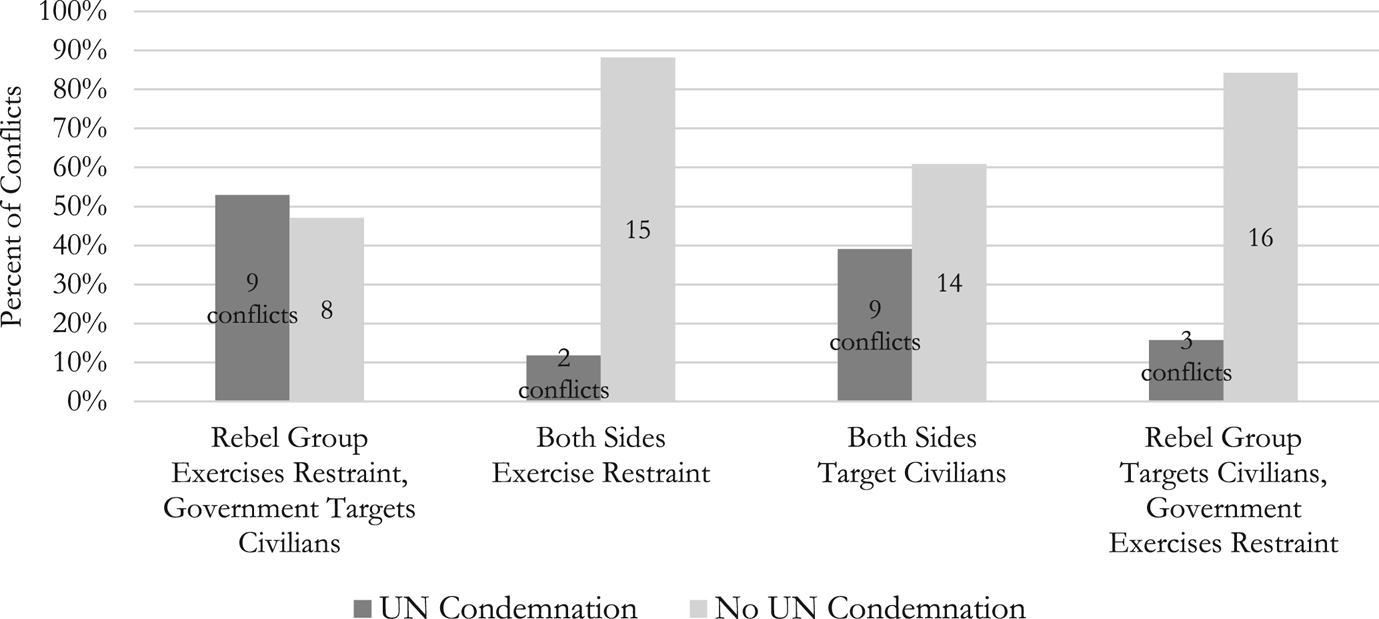
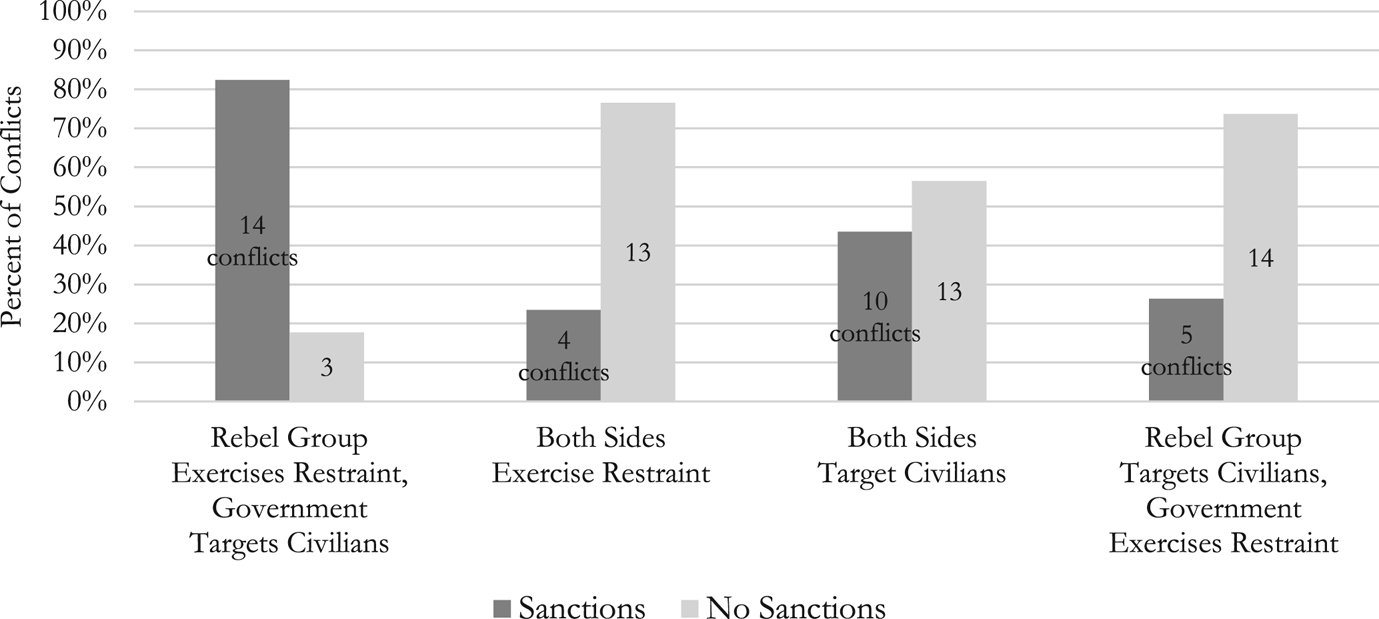
Figures 2 and 3 show the percent of conflicts that have terminated in which international actors took formal diplomatic action against the government in response to civil war violence. Not surprisingly, Western international actors are most likely to impose economic sanctions or arms embargoes against the government in cases involving severe government atrocities. But as Figure 2 shows, among conflicts involving government atrocities, sanctions are far more common when the rebel group exercises restraint toward civilians. For example, at the height of violence in Darfur in 2004 and 2005—a period when government forces committed extreme atrocities, while rebel forces largely avoided attacks against civilians—the UN Security Council passed a series of resolutions condemning the Sudanese government's atrocities, and imposing sanctions on Sudan.Footnote 158 International actors imposed sanctions on the government in fourteen of the seventeen conflicts involving government violence and rebel group restraint, but only ten of the twenty-three conflicts in which both sides committed atrocities. As Figure 3 shows, UN Security Council condemnations of the government follow a similar pattern. In the fourteen conflicts where international actors sanctioned or publicly condemned a government committing atrocities against civilians while the rebel group exercised restraint, ten conflicts ended with a settlement favoring the rebel group and an additional two ended with concessions from both sides. Only two of these conflicts ended with an outcome favorable to the government, and in both cases, long-term diplomatic pressure on the government continued after the conflict ended, ultimately leading to the government's demise.Footnote 159
Percent of terminated conflicts involving sanctions against the government, by belligerent behavior
Percent of terminated conflicts involving UN condemnation of the government, by belligerent behavior

Statistical Analyses
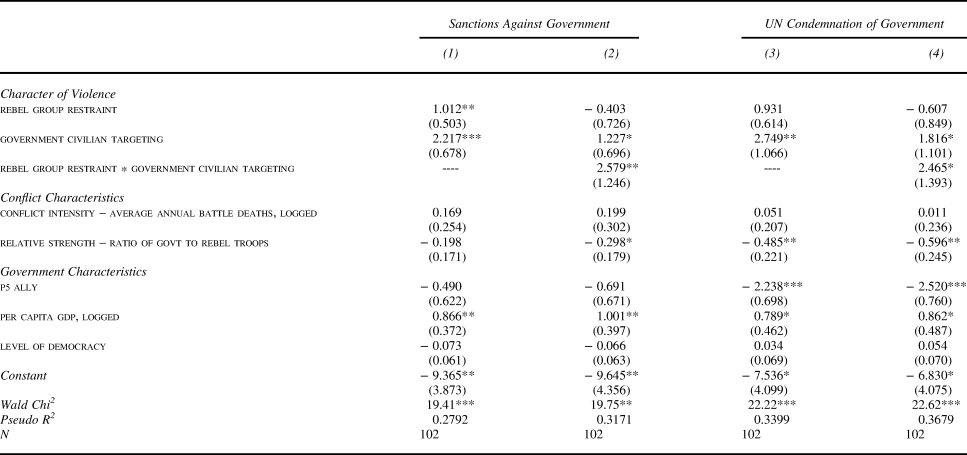
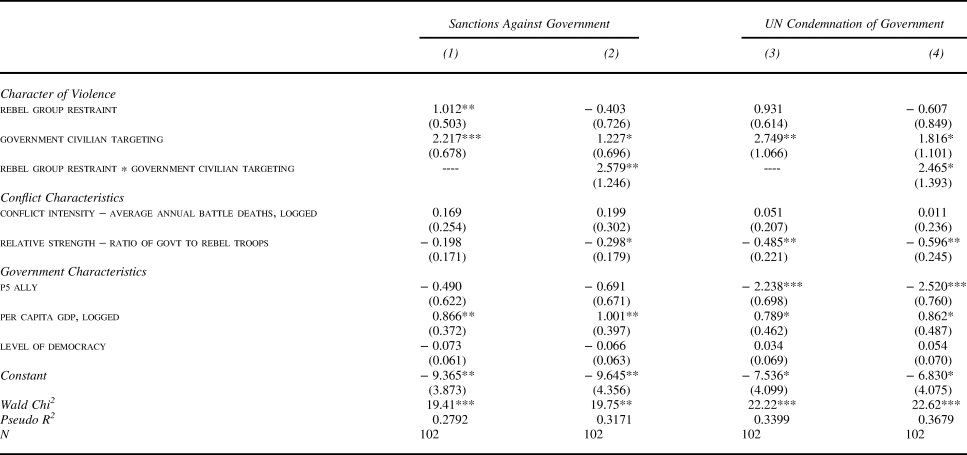
Table 4 shows the results of binary logit analyses; robust standard errors are shown in parentheses, with cases clustered by country. Sanctions is the dependent variable in models 1 and 2; while un condemnation is the dependent variable in models 3 and 4. The measures of rebel group restraint, government civilian targeting, as well as the interaction term, rebel group restraint * government civilian targeting, are the same measures described earlier. The analyses also control for variables that scholars have found to be associated with the imposition of sanctions or other forms of diplomatic pressure. International actors may be less likely to pressure strategically or geopolitically important countries.Footnote 160 Per capita gdp thus controls for the size of the target country's economy,Footnote 161 while p5 ally captures whether any of the five permanent members of the UN Security Council had an alliance with the target government during the civil war.Footnote 162 International actors may be more likely to exert diplomatic pressure when they believe such pressure will have an impact—for example, against democratic governments.Footnote 163 Level of democracy relies on Polity IV data.Footnote 164 International actors may be more likely to take action when a conflict is intense or the insurgency is powerful. Conflict intensity measures average annual battle-related deaths in the conflict, while relative strength measures the government's strength relative to the rebel group.
Binary logit analyses—international diplomatic actions against government
Note: Robust standard errors in parentheses; * p < .10; ** p < .05; *** p < .01.
Not surprisingly, in the models that do not include the interaction term, the results indicate a strong positive and statistically significant relationship between government violence and the likelihood of international sanctions against the government (model 1) or UN Security Council condemnation of the government's behavior (model 3). These results are consistent with existing research: following the end of the Cold War, more repressive governments were more likely to be publicly shamed by the UN Commission on Human RightsFootnote 165 as well as more likely to be the subject of reporting by international NGOs like Amnesty International.Footnote 166
When the interaction term, rebel group restraint * government civilian targeting, is included in the model, however, a more nuanced picture emerges. The interaction term is positive and statistically significant in both models, indicating that conflicts in which the government targets civilians, but the rebel group does not, are associated with a higher likelihood of international diplomatic action against the government. With the interaction term included in the model, the coefficient for government civilian targeting shows the relationship between government violence and the likelihood of sanctions or UN condemnation when the rebel group targets civilians (rebel group restraint = 0). The coefficient for government civilian targeting remains positive in these models but is substantively smaller. Consistent with the theoretical argument, the strengthening of international humanitarian norms—evident with the signing of the Rome Statute—is associated with an even stronger relationship between belligerent behavior and international diplomatic activity (see appendix).
These findings provide strong evidence that rebel group behavior influences the likelihood of international diplomatic action against governments. Government violence is associated with an increased likelihood of international diplomatic action, but this relationship is strongest when the rebel group exercises restraint. When both sides in the civil war target civilians, the calculated probability that Western actors will impose sanctions on the government is 46.6 percent, while the probability that the UN Security Council will publicly condemn the government is 49.2 percent.Footnote 167 The likelihood of international diplomatic action against the government increases dramatically, however, when the rebel group exercises restraint; the probability of sanctions increases by about 37 percentage points to 83.8 percent, while the probability of UN condemnation increases by about 34 percentage points to 83.7 percent.
Robustness Tests
The findings remain consistent through the following robustness tests (results appear in appendix): (1) employing an alternate measure of economic sanctions; (2) dropping conflicts in Russia and the United Kingdom, both permanent members of the UN Security Council; (3) stratifying the data by time period to account for potential strengthening of international humanitarian law; (4) controlling for multiparty conflicts; and (5) dropping each case in succession to ensure that no single case is driving the results.
Two other tests further probe the posited causal mechanism. First, I examine whether belligerent behavior is associated with other types of diplomatic involvement in civil wars, such as mediation. My argument posits that conflicts involving government atrocities and rebel group restraint are associated with international diplomatic intervention against the government (and in favor of rebels), but should not necessarily be associated with other forms of international diplomatic intervention. Indeed, consistent with expectations, belligerent behavior is not strongly associated with Western mediation in civil wars. Second, I rerun the analyses of conflict outcomes, including international diplomatic action against the government as an independent variable. The results are consistent with the posited causal mechanism linking behavior to outcomes through international diplomatic action: Western diplomatic action against the government is associated with an increased likelihood of an outcome favoring the rebel group, even when controlling for other factors that affect conflict outcomes.
Conclusion
Differences in how civil wars are fought—and in particular, differences in the extent of violence directed at civilians—have important implications for conflict outcomes. Rebel groups that exercise restraint toward civilians can use the framework of international humanitarian law to appeal for diplomatic support from Western international actors. However, these appeals are most effective when the rebel group can contrast its own restraint toward civilians with government abuses. When belligerents’ behavior is asymmetric, international law provides a focal point to guide international diplomatic intervention. International law is not the only factor driving international responses to civil war atrocities. Although it is difficult to isolate international law's impact from the impact of other factors, such as pressure from human rights NGOs, both rebel groups and international actors explicitly reference international law in framing civil war atrocities.
International diplomatic intervention in favor of a rebel group exercising restraint can dramatically alter the rebel group's bargaining position, helping the group to win favorable settlement terms. Consistent with this posited causal mechanism, an analysis of international diplomatic action in civil wars from 1989 to 2010 shows that in conflicts involving a government that targets civilians pitted against a rebel group that exercises restraint, Western international actors are 1.8 times more likely to impose sanctions against the government and 1.7 times more likely to issue public condemnations of the government. Moreover, original data on government and rebel group violence against civilians and conflict outcomes in civil wars from 1989 to 2010 indicate that rebel groups can use international diplomatic support to obtain more favorable conflict outcomes. Indeed, rebel groups who exercise restraint while the government commits atrocities are two to three times more likely to secure a favorable political resolution to the conflict than other rebel groups.
These findings may also have implications for the duration of peace after civil war. Studies show that outright military victories are more stable than other conflict outcomes. If victories obtained through negotiated settlements are also associated with greater stability, and if rebel groups that abide by international humanitarian law are more likely to achieve victories through negotiated settlements, then the duration of peace may be longer following these civil wars. Future research, therefore, might consider a broad range of questions regarding the relationship between the character of civil war violence and civil war outcomes, looking at the impact of civil war violence on the establishment of stable political institutions, the reconciliation of the warring sides, and long-term prospects for peace.
Data Availability Statement
Replication files for this article may be found at <https://doi.org/10.7910/DVN/5PEDGW>.
Supplementary Material
Supplementary material for this article is available at <https://doi.org/10.1017/S0020818320000090>.
Acknowledgments
I am grateful to a number of people for their feedback on earlier versions of this article, including two anonymous reviewers, the editors, Sarah Bush, Alexander de la Paz, Page Fortna, Julia Gray, Yonatan Lupu, Tamar Mitts, Jack Snyder, and Alex Weisiger, as well as participants in seminars at City College of New York, Columbia University, Cornell University, George Washington University, Temple University, University of Colorado Boulder, University of Minnesota, University of Notre Dame, University of Pennsylvania, and University of Virginia. Andrew Levin and Max Margulies provided valuable research assistance.