Introduction
The approach set out in this paper builds on our understanding of the perception of vision, i.e. the ways in which human beings see, and draws on both Western and non-Western visual traditions in allowing us to challenge accepted ‘ways of seeing’. The result is a new way of interpreting prehistoric art, one which addresses the role of the intentionality of the artist. It is argued that it is this intentionality which gives structure and meaning to the visual narratives we encounter in prehistoric art, and that the nature of this intentionality arises from the social context of the culture within which the art was created. This way of understanding prehistoric art allows us to use modes of communication which are familiar to us in the modern world to make sense of the creations of ancient artists about whom we have no written records but who have left us an intriguing and beguiling artistic record. It is an approach that requires us to accept that ancient visual traditions were independent entities in their own right, and that those who created these traditions imbued their artworks with their own intentionality. This, I suggest, is of greater significance than just for studies of rock art, as it has implications for the way we understand art as a phenomenon, its development, and its importance in human history.
The paper draws on examples from around the world, including contemporary conceptual art. Although the specific case study that forms the focus of the analysis is from Zalavruga in Russian Karelia, and forms part of the broader Scandinavian prehistoric rock art tradition, the paper is intended as a contribution to understanding visual aspects of prehistoric expression in general, rather than being of relevance only to northern European rock art. Through the presentation of a visual interpretation of a specific panel of prehistoric rock art from north-eastern Europe, the paper builds an approach to visual understanding based on art-historical approaches to the analysis of visual imagery, drawing on the concepts of station point and picture plane. In order to achieve this, reference is made to specific examples of Medieval, Renaissance, Cubist and contemporary Western art, as well to ancient Egyptian and Japanese imagery.
The visual narrative
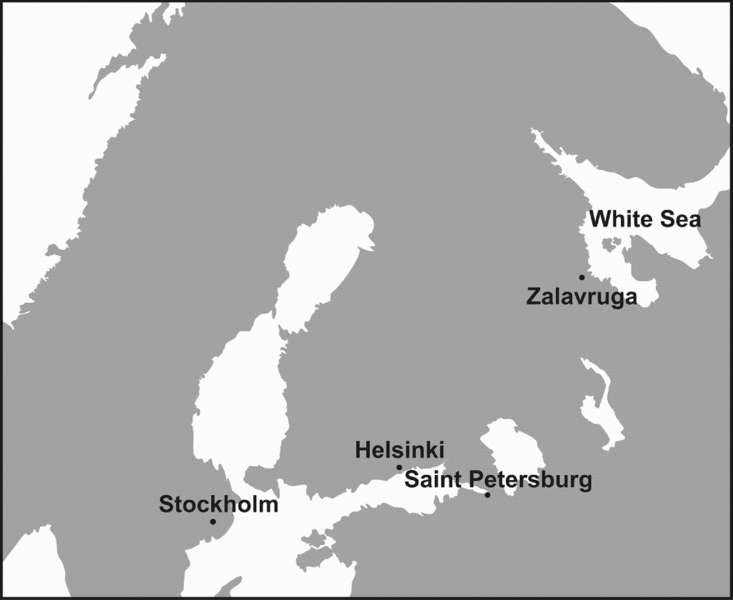
The case study discussed in this paper is part of the major northern European rock art tradition that stretches from the great Scandinavian scholars of the past like G. Hallström to groundbreaking contemporary researchers like K. Helskog, J.-M. Gjedre, A. Lahelma, T. Lødøen, N. Lobanova, G. Mandt, K. Sognnes and many others. The rock art carvings in Karelia were first discovered in the nineteenth century and are located on the shore of Lake Onega (figure 1). A second concentration of carvings was discovered close to the White Sea by Linevsky in 1926. Since then, research and discoveries have been ongoing (Janik, Roughley and Szczęsna Reference Janik, Roughley and Szczęsna2007; Janik Reference Janik, Seglie, Otte, Oosterbeek and Remacle2009; Reference Janik2010; Reference Helskog2012; Lobanova Reference Lobanova2007). During the 1935–36 research season, Ravdanikas discovered more petroglyphs by Lake Onega, and defined the Old Zalavruga complex, beside the Vyg river oxbow, which runs into the White Sea. In the 1960s, Savvateev discovered more carvings close by, which today are called the New Zalavruga complex. The naming of ‘old’ and ‘new’ indicates the time of their discoveries, rather than the date of their execution, since the Old Zalavruga complex has been dated by seawater-level fluctuations as younger than the New Zalavruga complex. In subsequent years N. Lubanova, together with L. Janik and J.-M. Gjedre, discovered more carvings in the White Sea rock art complexes. Today, the estimate of the numbers of known carvings has reached a total of over 2,300 depictions. They date from the beginning of the 6th millennium B.P. and last to the 4th millennium B.P., namely the Early Bronze Age in this region (Janik Reference Janik2010).
Map of Europe with the location of Zalavruga.

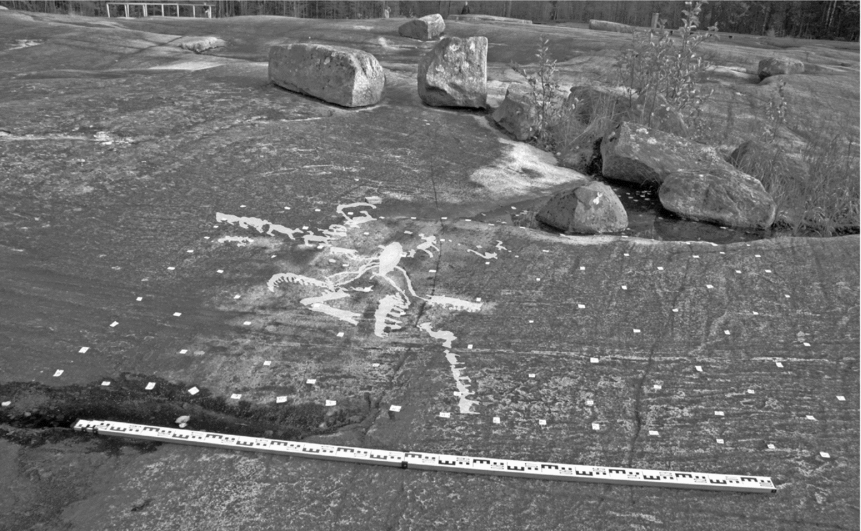
The morphology of the rock surfaces into which the carvings were pecked, namely the series of terraces as seen today, gives a strong impression (figure 3) of the intention on the part of the carvers to create a viewing gallery, from which the carvings could be seen by members of the fisher-gatherer-hunter communities of which the artists were a part. Over time, as the level of the White Sea became lower, the land rose and new carvings were added to the newly exposed dry rocks, creating the complex known as New Zalavruga. While discussing the complex of New Zalavruga here, the compositions from this rock art complex are also useful more broadly as an illustration of the method that can be used for interpreting any other prehistoric art. Therefore each particular composition is treated here as an independent visual narrative, an approach which allows us to concentrate on the carvings in their final form, rather than discussing the possible phases of carving and alteration in visual narrative by different carvers. The focus here is on Group VIII, dating to the third phase of the chronology of the Zalavruga rock art complex, ca 4688 not Cal. B.P. to ca 4340 not Cal. B.P. (3460 Cal. B.C.–2900 Cal. B.C.) (Janik Reference Janik2010).
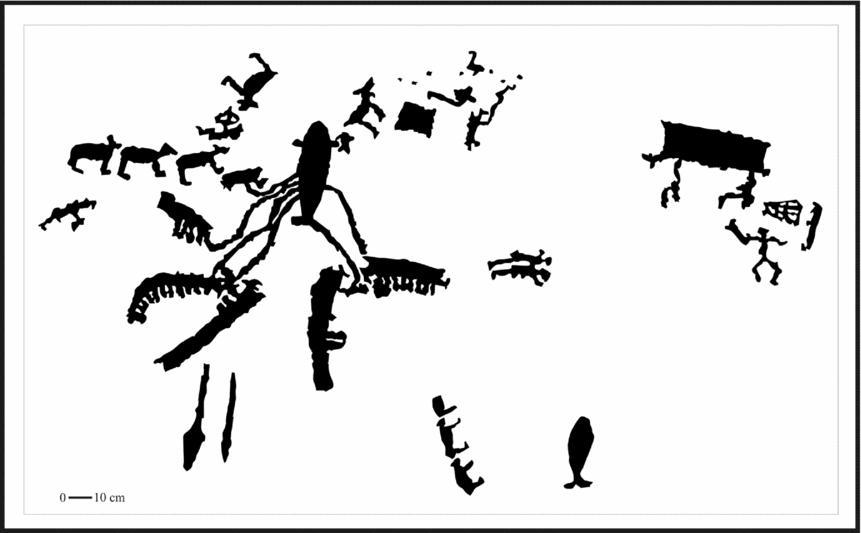
Using the rubbing technique, Savvateev prepared and published drawings of Group VIII (Savvateev Reference Savvateev1970, 244) (figure 2). The main part of Composition VIII at New Zalavruga extends across a smooth rock slope. The adjoining topography provides the onlooker with a perfect platform for viewing the carvings. The centre of the composition is occupied by a scene of marine hunting, with a giant whale being hunted by six boats, each of which is attached to the whale by harpoon. The boats differ in size and carry various numbers of people. In the lower part of the composition, below the boats, there are two carvings on the left side, probably representations of spears, and on the right side are two complete depictions and one partial depiction of bears. Further to the right we see a single whale. Moving up, between the bears and the whale, just above the boat on the furthest right, there are carvings of two humans, one of whom seems to be standing behind the other. Slightly above and further to the right of the marine hunting scene, we see a single boat containing two people, to the right of which is a geometric figure. Just below this figure is a carved human being, just above whose right hand is another small boat. In the furthest-right part of the composition, near the geometric figure, is a small but long boat.
New Zalavruga, Group VIII, redrawn and adjusted after Savvateev (Reference Savvateev1970, 244).
Returning to the large whale in the centre of the composition, we can see by its upper right fin another, smaller, whale which seems to be swimming alongside the larger one. Above this there is a young elk with an almost square figure carved to the right. Two waterbirds, probably swans, judging by their long necks, and their footprints were carved nearby. Very close to the whale we can recognize the shape of a small, long boat from which extends a harpoon line. On the other side of the upper part of the big whale we can recognize two humans, one with a bow and arrow, the other also apparently holding something. The remainder of the scene comprises three bears placed one after another, and a deer carved above the human with bow and arrows.
The scene has been described by Russian archaeologists as an important example of a marine hunting scene (Savvateev Reference Savvateev1967). Gjerde (Reference Gjerde, Barndon, Innselset, Kristoffersen and Lødøen2010), on the basis of the water flowing down from above and covering the carvings, has interpreted Group VIII as a reference to a place or area where the actual hunt occurred. He suggests that it depicts a female whale with her calf swimming up the river estuary while being hunted, the river represented by running water. While this interpretation is interesting, pointing towards real locations and activities that took place in the surrounding landscape, it does not address other elements of the composition such as bears or deer; he just states that they are there. Further, the water does not run down the slope all or every season, for example last year was a dry year and the rock surface was dry almost all summer.
Gjerde's understanding of the rock as a visual narrative providing a guiding principle in rock art interpretation has been influenced by the work of Helskog (Reference Helskog1999; Reference Helskog, Blundell, Chippindale and Smith2010a; Reference Helskog2010b; Reference Helskog2012). Helskog has analysed a number of rock art compositions from this region as well as the carvings of northern Norway, in particular Alta, Berghelm and Kåfjord. He suggests that by following the depictions of, for instance, bear, elk or humans and their relationships with the morphology of the rock, we can move between the three worlds, upper (sky), middle (earth) and lower (underground and water) as defined in historical ethnographic records from Europe and the Siberian Arctic. The best examples showing this approach are the bear carvings from Kåfjord (Helskog Reference Helskog1999), where the bear is seen in its den. By following the bear's carved paw prints to the upper part of the composition above the den, we see the movement of the bear into the upper world, while the bear prints leading down towards the crevasse indicate the bear's travel to the lower world. When part of the middle, or human, world, the bear is depicted sleeping in its den, or having its pawprints carved in the same areas of the composition as elk, deer and humans. In his interpretation of the depictions in Group VIII at New Zalavruga, Helskog (Reference Helskog2012) follows the suggestion made by Gjerde (Reference Gjerde, Barndon, Innselset, Kristoffersen and Lødøen2010). Discussing the bears in this composition he proposes that
there is some ‘earthly’ reality behind the number of bears, as if bears were waiting around for the catch, competing with the hunters. Alternatively, the bears symbolize a power that participates, or it is simply a story of a hunt. Perhaps bears congregated at the lower parts of the river or the river mouth as it runs into the sea in order to catch salmon in much the same way as they do today in Alaskan rivers; or they may have been scavenging scraps from the hunt or even killing an occasional whale (Helskog (Reference Helskog2012, 228).
The combination of the marine and terrestrial scenes can at first sight be confusing: it suggests that both realistic and mythological features are being represented at once, as is also found in other panels (Janik et al. Reference Janik, Roughley and Szczęsna2007). The composition was perhaps created over a long period of time, being built up through the addition of different elements, although it could just as easily have been created all at one time. As stated above, however, I here discuss the composition as the record left by the last artist: if he or she made any alterations by adding new figures, then they rearranged the visual narrative in the fashion in which they intended, to ‘tell’ the story. And it is on that final version of the ‘story’ that we shall concentrate.
In the past, in order to view the carvings one had to approach the rocks from the water's edge, moving further and further from the carvings due to the general drop of the water level in the region caused by isostatic movement and the regression of the White Sea.
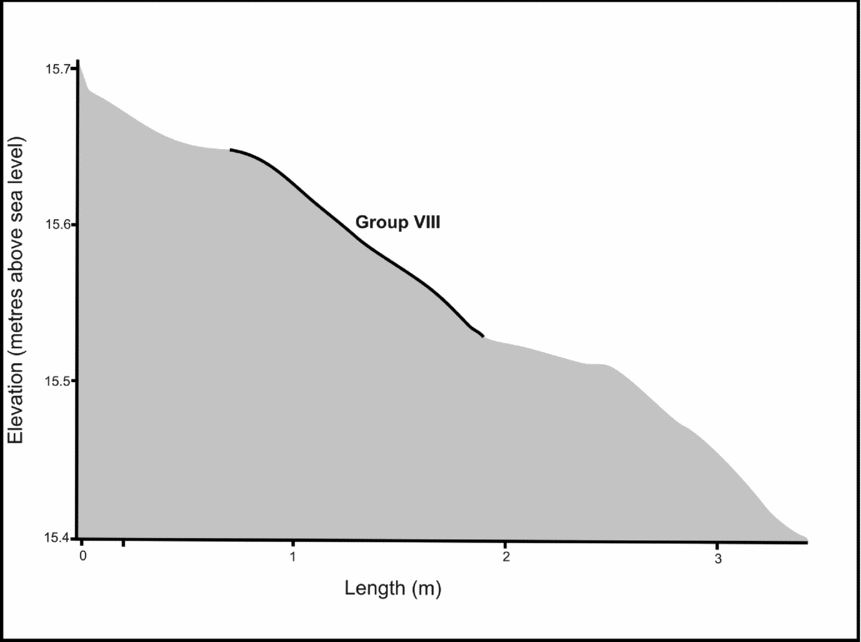
The morphology of the carved rock surface itself was used as a viewing platform by the prehistoric artist(s) (figure 3). The whale is the centre of the composition around which all visual narrative is unveiled: it is located on the slope clearly demarcated by the rock morphology, creating the perfect platform for seeing the image (figure 4). While the slope declines towards the right, the eye is led down towards the whale by the bears, indicating movement from left to right. The rock morphology is used to ‘invite’ the viewer to approach the composition, in terms of physical direction, from the right rather than the left, as if ‘moving towards’ the whale in the same way as most other depictions. Such directionality could also be important when we consider the direction from which boats would approach the rocks, or the direction of approach on foot when water levels subsided sufficiently to make this possible.
Views of Group VIII. The carvings are filled with white chalk.
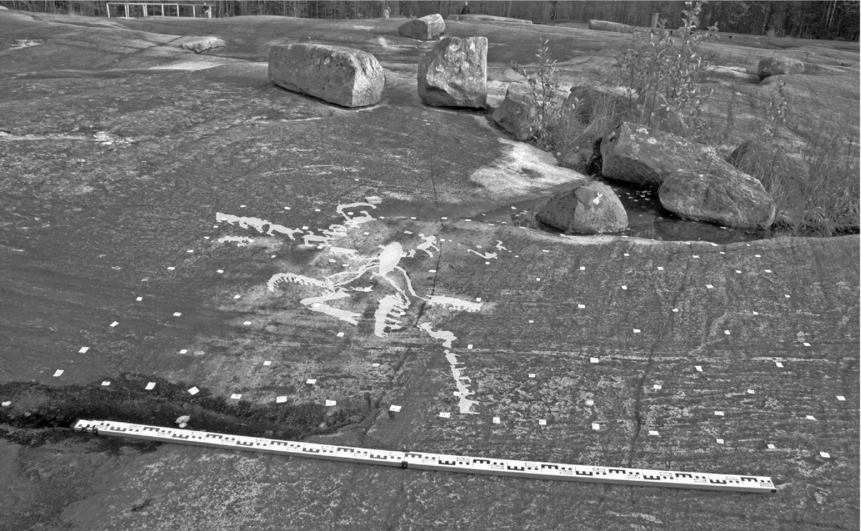
The morphology of the carved rock surface, a viewing platform.
In one way, the methodology of seeing proposed here engages with the carvings in a similar way to Helskog. In another way, however, it goes beyond his approach by looking at the rock surface not only as a surface where ‘things are happening’ (e.g. bears are moving) but also as a viewing platform, where the artist intentionally engages with the viewer for the purpose of seeing. The approach adopted here is thus just as concerned with how the artist communicates the visual narrative to the viewer, as with what is being communicated.
Methodology of seeing
In trying to explain prehistoric art visually, a good place to begin is with our own visual traditions, as these are the visual paradigms that we understand and feel most familiar with. To achieve this I propose to move backwards from the present to the past. Along the way I will consider two milestones in the understanding of visual expression (station points and picture planes), which are of great potential in communicating prehistoric art to the contemporary viewer. These milestones provide cardinal visual clues which assist us in recognizing universal aspects of visual expression and which can be used to describe any visual composition. They are also the perfect indicators of motion based on the relationship between the observer and the observed.
Station points
The first of these milestones is the so-called the station point (SP), the position from which the artist views the subject being depicted while creating the composition (Hagen Reference Hagen1986). Station points are determined by the direction in which the artist was looking at the object or landscape and conveyed the representation of it onto canvas or rock. Understanding this allows us to follow the artist in how to look at the picture, as if we were being guided by historical and prehistoric artists as we view their creations. It is as if we were guided through a particular space and time, the ‘moment captured’ on rocks or canvas or by a photographic camera.
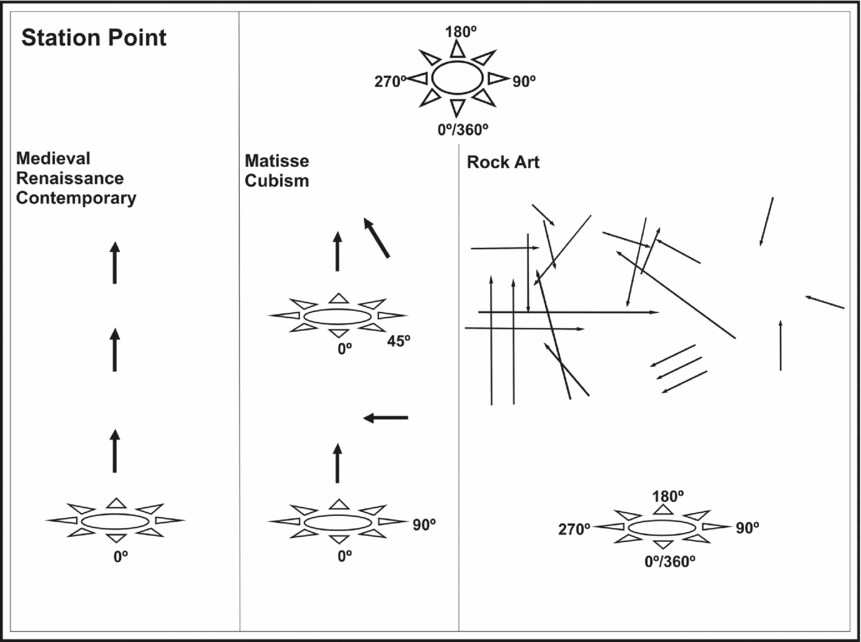
In the following images, a thick black arrow indicates the viewing direction from a particular station point. If there are several station points but they are all coming from one direction, i.e. if we are standing in front of the picture and all that we see in the painting is seen as if it were in front of us, then just one arrow is used. The star above the picture in such cases indicates the angle of the station point(s), where forward is zero degrees. In cases of multiple station points or viewing directions, the number of arrows indicates the painting or carving points, and in these cases a star indicates the variety of angle points.
Before cubism, most pictures were presented from one station point: ‘the paintings are nearly single-station-point construction’ (Hagen Reference Hagen1986, 170). Although Hagen writes about art from the Renaissance (15th century) to the present, what she says is also correct for medieval depictions.
Medieval
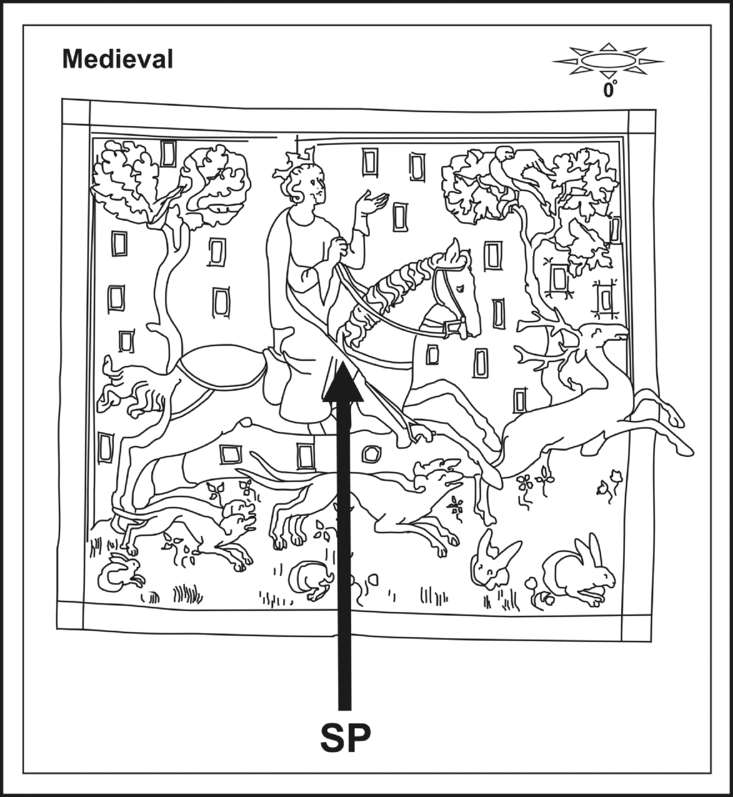
The medieval depiction of King John hunting in the Royal Forest (figure 5) shows the king on a horse (we know that he is the king since he is wearing a crown). The horse is in motion following a deer; alongside the king on the horse we see the two pairs of dogs in pursuit of the stag. Further, the depictions of hares in the lower part of the picture show them in the process of hiding in their holes. The whole picture emphasizes movement and action: the two trees behind the rear of the horse and stag frame the position and the king, indicating the ‘capture of the moment’.
King John of England ca 15th century.
Renaissance
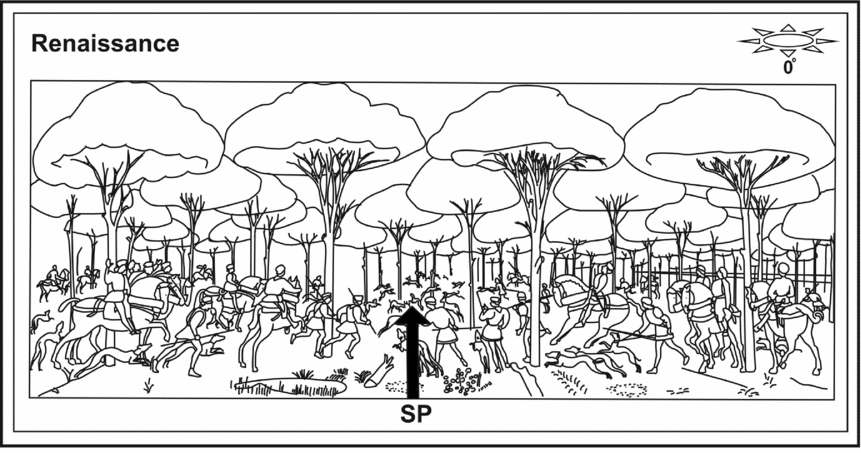
Similarly, in the Renaissance picture (figure 6), as in the medieval image, the movement in the moment is captured; the hunting party is in the process of pursuing the animal. It is not important that we do not see the hunted creature; what is significant is the urgency of the hunters, horses and dogs that indicate action.
Paolo Uccello, The Hunt in the Forest, ca 1465–70.
Contemporary
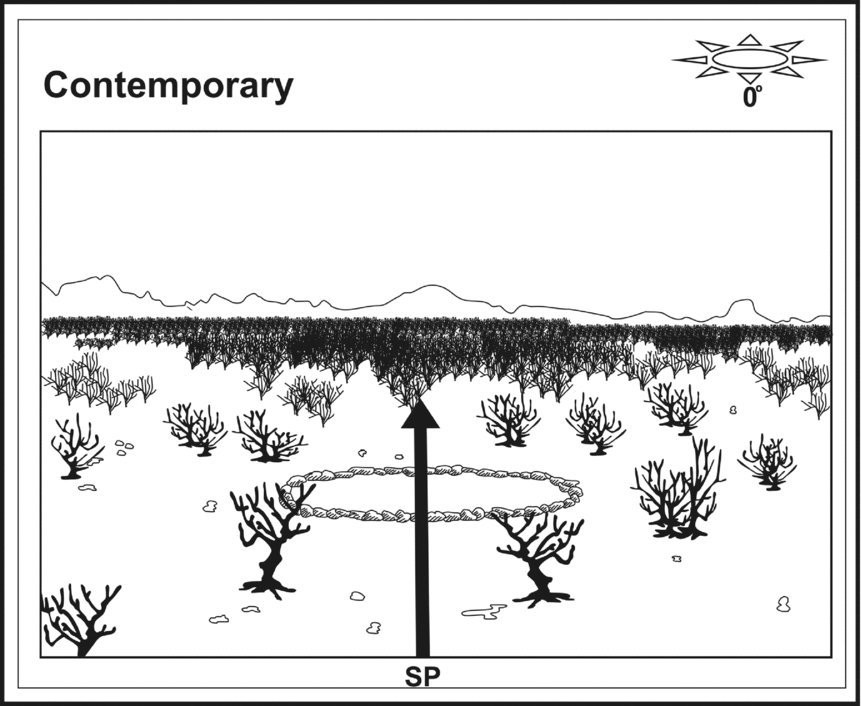
In contemporary art a variety of artists still use a single station point in their work, reinforcing the ‘capture of the moment’ from the single viewpoint of the stationary observer. What we see in Long's picture (figure 7) is a serene scene of the small empty circular feature enclosed by the stones in the centre, with the dry-looking bushes stretched to the horizon that is marked by the mountain peaks. Looking at this image we are again caught in the ‘moment captured’.
Richard Long, Silence Circle Big Bend Texas, 1990.
The perception of vision reflected in the examples provided above echoes the cultural need of telling a story by one person about the event witnessed. There is one visual story told by the artist, and the viewer is guided to see the particular ‘moment captured’. The dynamic relationship between the viewer and the scene they see reflecting motion is explicitly restricted to one particular snapshot, created in a such way that only one voice is represented in the visual narrative.
Matisse
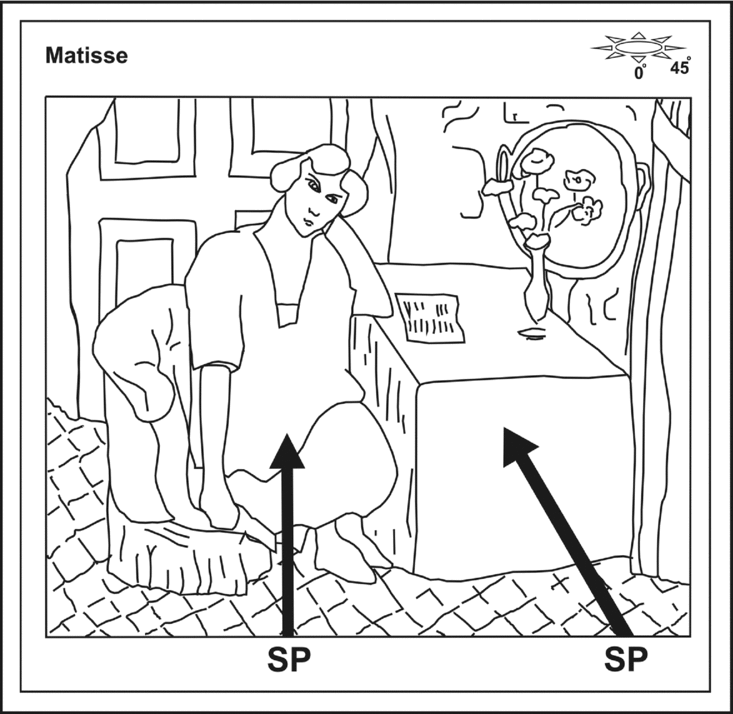
The Inattentive Reader (figure 8) is a static picture where there is no motion in the action taken by the ‘Reader’. However, the picture is not quite static; the artist/viewer relationship with the object seen has changed. Matisse achieves the impression of multiple station points for the composition, as if we were looking at the objects represented from different station points at the same time. This is achieved by tilting the angle of the visual projection from one station point against the other. The line of the floor reinforces the illusion of looking from another station point. We are facing the woman, while the table is tilted, creating the impression of a different station point to that of the woman. In reality, however, it is the same. The cultural and social norms of how we show what we see has altered, and that influences the perception of vision. We are in two places at once.
Henri Matisse, The Inattentive Reader (La liseuse distraite), 1919.
Cubism
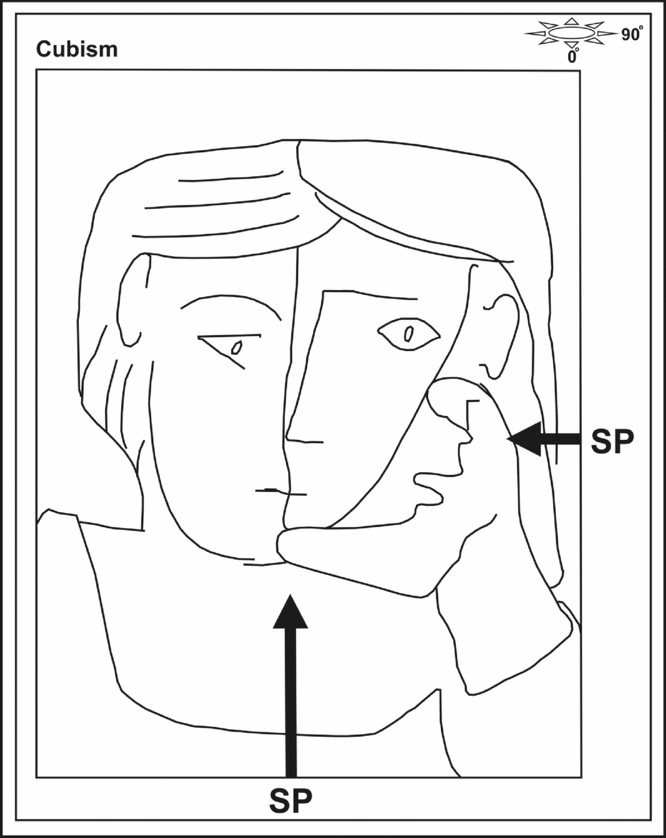
Cubism exposes the viewer to a challenging visual experience with regard to station points. It also represents the last major breakthrough in the visual projection of the so-called ‘real’ world. From this period the Western tradition of visual perception was altered forever. Pablo Picasso and Georges Braque are the artists who developed cubism at the beginning of the twentieth century. Visually, cubism explored and established new possibilities of representing three-dimensional objects on a two-dimensional surface. In other words, when viewing a cubist work, we are able to see the object represented from different viewpoints (e.g. front, back and sides) simultaneously. Cubism created the impression that the viewer was standing in different places at the same time with respect to the object. It used the method of dismantling an object into its constituent parts and then reconstructing them on the canvas in accordance with a redefinition of perspective, one of the most important principles in the visual arts. In a visual sense we are in several places at once when looking at a cubist picture.
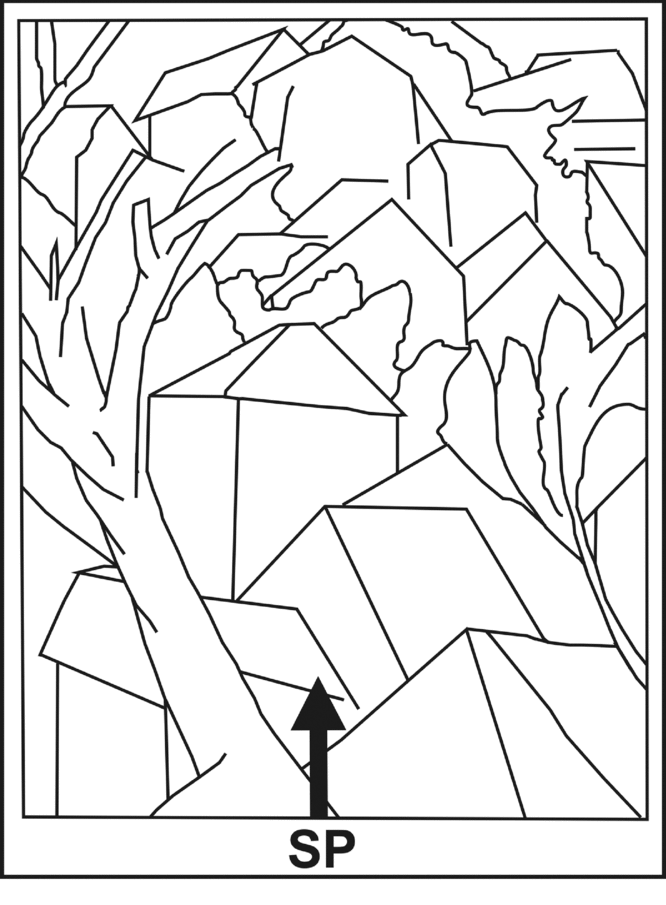
Picasso's painting Head of a Woman (figure 9) reflects well the cubist principle where we see simultaneously from multiple station points. This particular picture has been chosen to illustrate the principle, although there are often more than only two station points. This clue, however, while working for the depiction of objects, does not work when landscape is depicted. I suggest that cubism did not work out the way natural landscapes can be seen from various station points in similar ways to objects. It is possible that this is due to too much information being presented for the brain to be capable of working with and making sense of at the same time. Since only 10 per cent of visual stimuli enter our brains through the eyes, and since our vision is restricted by the setting of our eyes in our head, our brains are not prepared to see ‘behind’. Therefore the difference between depicting objects and depicting a landscape lies in the quantity and quality of information combined: the number of objects in a landscape is vast and the number of station points per object has to be at least two to comply with cubism, and the objects themselves need to be placed in the landscape in relation to each other and then viewed from various station points. Looking at the cubist landscape painted by Braque in 1908 called Houses at L'Estaque (figure 10), we see a composition that follows the almost Renaissance linear principle of elements arranged in visual narrative. While elements of this are within the cubist tradition, the depiction of landscape is therefore treated by art historians as cubist (hence also the artist per se). However, looking from the point of view of station points, there is only one station point for the whole composition, the landscape. I suggest that the complexity of a landscape, with all its elements, and the amount of information entering our brains made it an impossible task for cubist artists to paint a landscape as an image itself. This was only solved in the Western tradition of seeing by the introduction of a new technology, namely moving pictures or film. In other visual traditions this particular characteristic of the perception of vision was solved by introducing a variety of different station points to the visual narrative.
Pablo Picasso, Head of a Woman, 1924.
G. Braque, Houses at L'Estaque, 1908.
Station points and prehistoric rock art
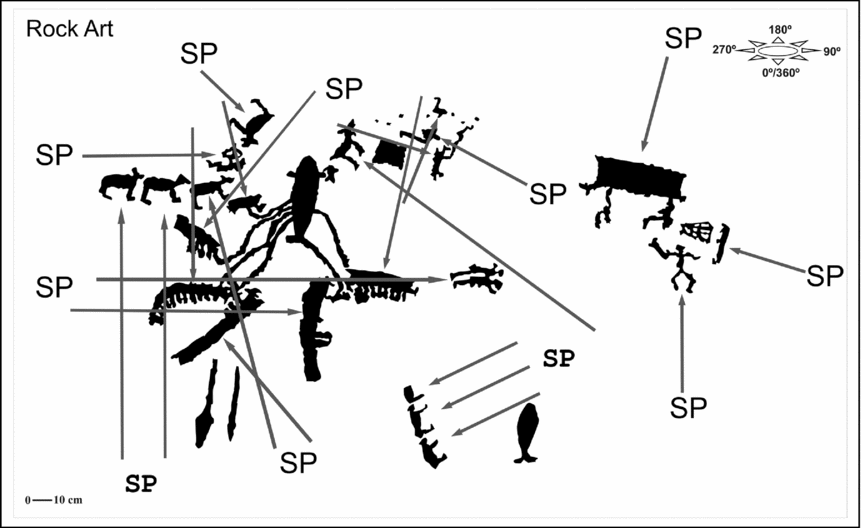
Adding our familiar black arrows indicating the direction of looking from particular station points to depictions of prehistoric rock art carvings, we realize how many station points appear in the picture, creating a complex multiple-station-point composition only comparable to the cubist picture depicting an object. We can see how the artist alters the station points by moving from one position to another so that the location from which each depiction was intended to be seen can be traced. Keeping up with those moving station points while creating the visual narrative, we end up with the projections most common in the visual depictions from rock art. Keeping all of this in mind, and now able to visually comprehend the station points, let us look at some prehistoric rock carvings (figure 11).
New Zalavruga, Group VIII.
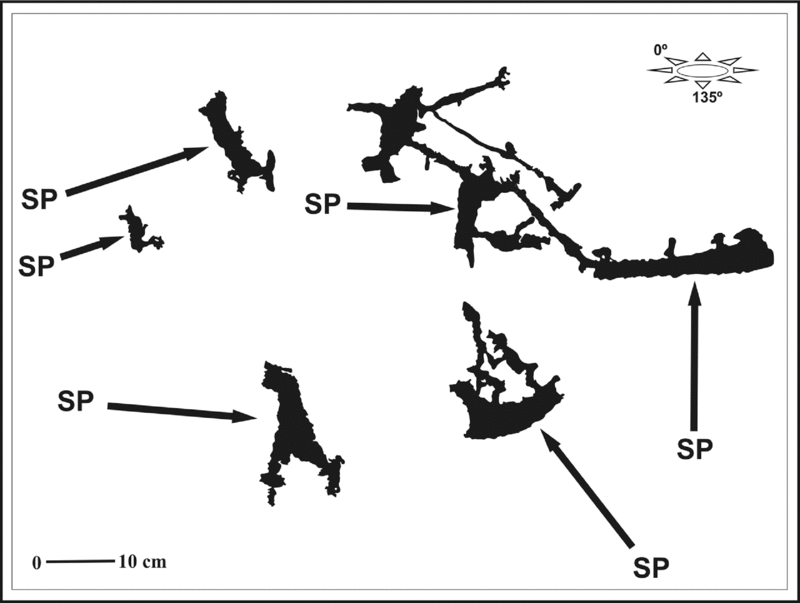
If we take a composition from its rock location context, what is perhaps most significant for present purposes is that there appears to be no set place from which the viewer is intended to begin looking at the composition. In such a way the perception of vision introduces an independent medium in communicating what we see. The station points encourage us to view the composition in 360 degrees at once. This is in marked contrast to the composition of Group XXI at Zalavruga, where there does appear to be a particular order or sequence in which the visual narrative is intended to be viewed, represented by the direction in which the boats are moving as well as station points that span only 135 degrees (figure 12). In Group XXI we can see two boats as if one is following the other, on the right of the second boat we see another boat with two people standing in it. It looks as if one is holding a club. Above them we see a whale-hunting scene with a number of lines linked with the whale body. One particular line is connected to the boat, in which we see a person standing and holding a long object in their hand. The object is linked with another, this time a longer boat.
New Zalavruga, Group XXI, redrawn and adjusted after Savvateev (Reference Savvateev1970, 369).
Of course it is possible that the various elements of both compositions were added at different times, perhaps even by different artists. Alternatively, the composition could have been made by just one single artist. The present study is of just the final phase of the composition, if the composition was indeed created over an extended period of time, as visualized by the last artist to work on it, and so takes in all the elements of the composition and treats them all as contemporary. In this way the composition is treated as ‘complete’, either as the result of the actions of the last artist to add any elements, or as the vision of the one artist who carved all the images.
In either scenario, as argued above, cubism is the movement in modern Western art which produces the closest visual parallels to prehistoric rock art (figure 13). The perception of vision in this context goes beyond the traditional understanding of what and how we see. In such a way the prehistoric (in this case Karelian) rock art challenges our norms and customs in projecting images in action, leading us to acknowledge the independent tradition of perception of vision in projecting and seeing motion in the past.
Summary of station points.
As we tried to visualize what is going on in Group VIII, we found that we were only really able to make sense of it as contemporary viewers through the medium of film. This is because there is no other medium that will allow the viewer to be stationary while the visual narrative unveils itself before our eyes. The movie is shown as if the scenes from the carvings are unveiled in front of us (figure 14). For the purposes of this paper I have modified the image slightly to provide as clear a reconstruction as possible. To do this, the bird footprints and square carvings have not been included. One of the sides of the images is coloured in black and this is the side visible in the carvings; the station points are related to that side of the images.
Four still frames from the first visualization (created by K. Szczȩsna)
We can see during the attached visualization/short movie, that if we try to ‘see’ it according to the precepts of our own visual tradition, the scenes and the action confined in the composition are not clearly visible. To see it better we have to introduce the particular way that prehistoric fisher-gatherer-hunters depicted specific elements in the composition, and in order to do this we need to refer to a non-Western visual tradition.
Picture plane
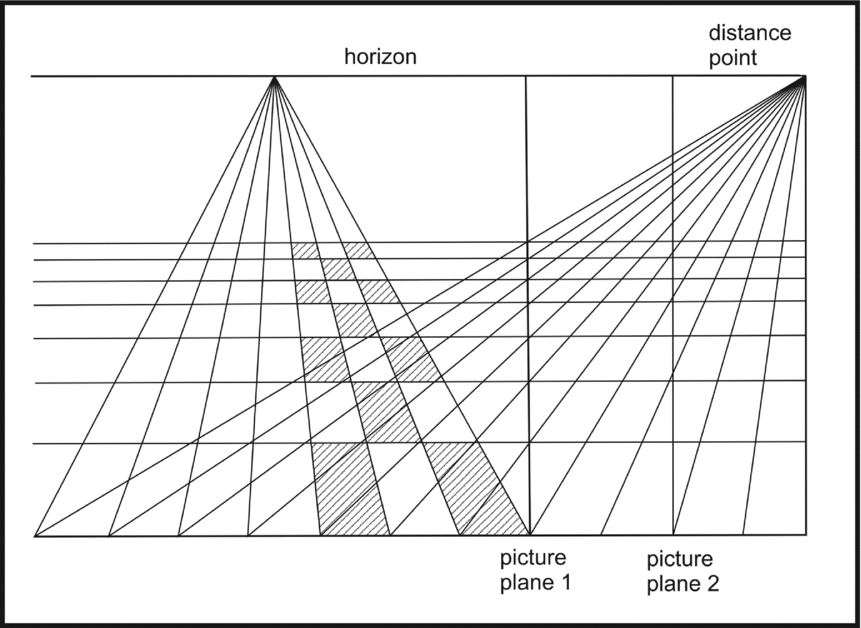
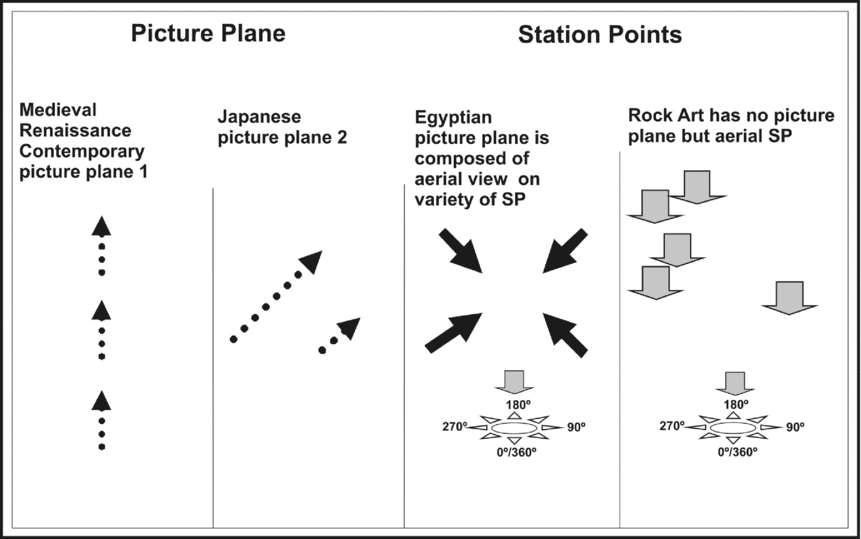
Before that, however, I propose to turn to the second cardinal visual clue, the picture plane (PP). The picture plane is a pretend surface in the picture on which the action and the participants are located. Hagen (Reference Hagen1986, 121) provides us with a simple drawing that reflects two examples of different picture planes. The station point, however, remains singular (figure 15). Picture plane gradients are marked by broken arrows.
After Hagen, ‘Construction showing trace line, horizon, distance point and two picture planes’ (Reference Hagen1986, 121).
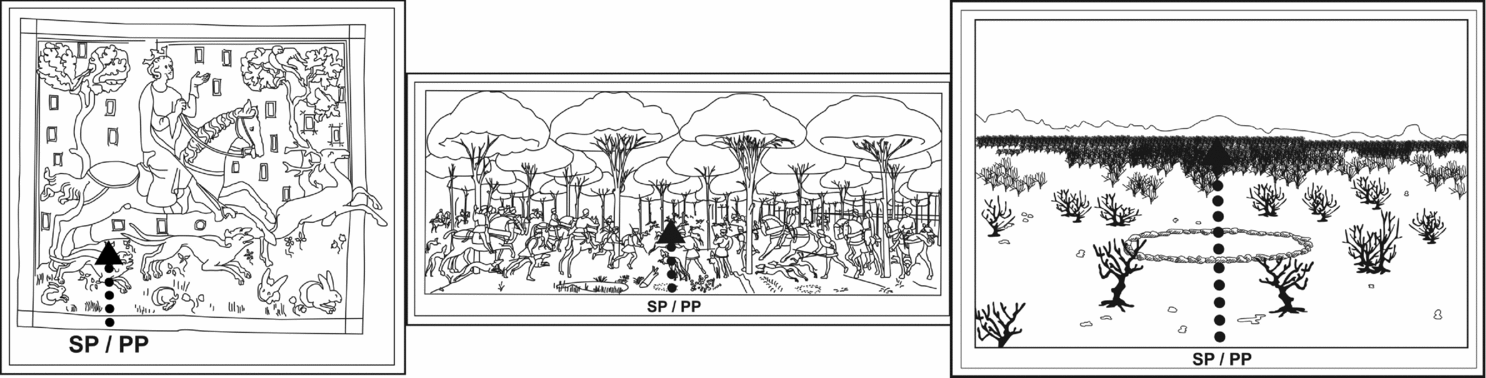
Looking at the picture planes and the examples from medieval, Renaissance and contemporary art (figure 16), it can be argued that the central picture plane gradient reflects the single station point and provides us with an overlap between both of the cardinal visual clues so strong in the Western visual tradition.
King John of England, ca 15th century; Paolo Uccello, The Hunt in the Forest, ca 1465–70; Richard Long, Silence Circle Big Bend Texas, 1990.
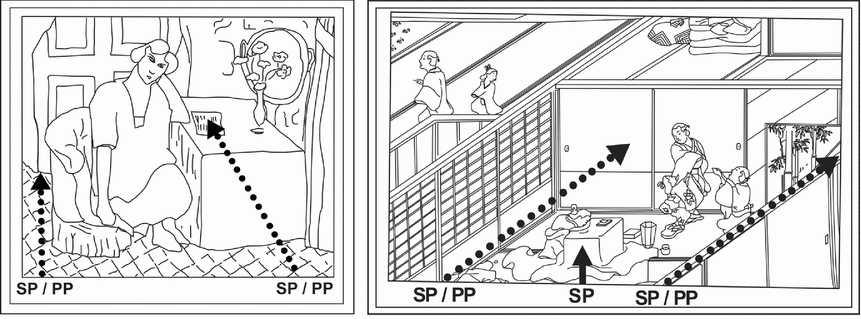
However, the picture plane in Matisse's The Inattentive Reader does not follow previous examples, and is described by Hagen in terms of the angulation of the picture plane. It is depicted here as the table and floor (figure 17). They both are angulated, the floor squares as well as the table on which the ‘Reader’ is resting her elbow.
Henri Matisse, The Inattentive Reader (La liseuse distraite), 1919; fragment of Amusements in a Mansion, ca 1640s, a pair of six-panel folding screens, ink, colour and gold on paper, the Osaka Municipal Museum of Art.
Interesting in the Japanese case (figure 17) is that the elements that constitute the picture plane are tilted, in much the same way as objects in Matisse's picture create the illusion of two station points. One is in front of us, from which we look at the people, while the second is slightly angled, from which we look at the picture plane.
Looking at these depictions we can see all the activities that have been depicted by the artists from one station point. The action in the pictures is shown from one station point, where the viewer is standing at the same point as the artist. We do not need to be in different ‘places’ at the same time, as in the Cubist picture.
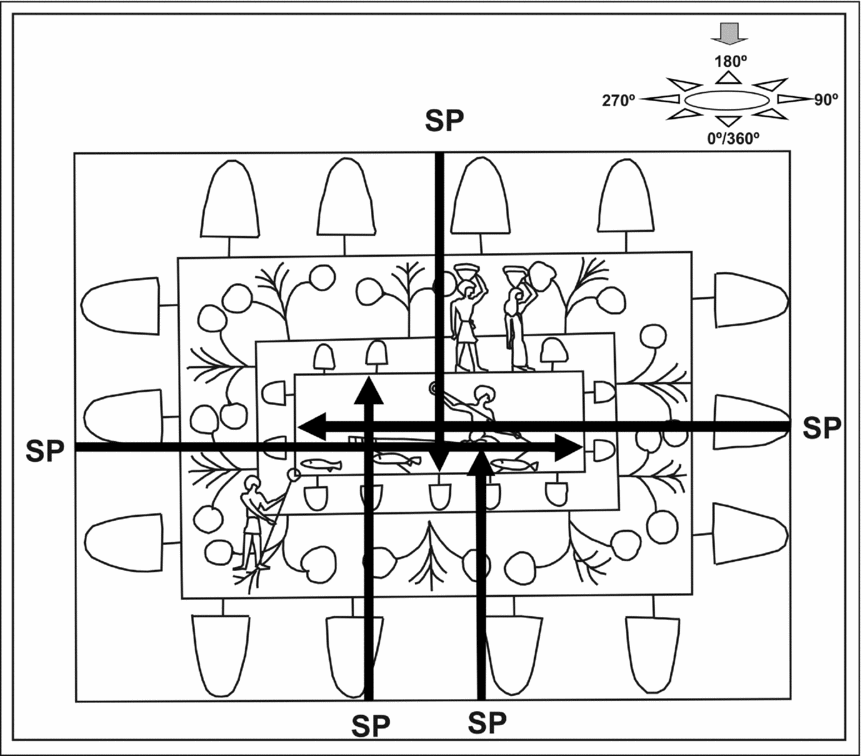
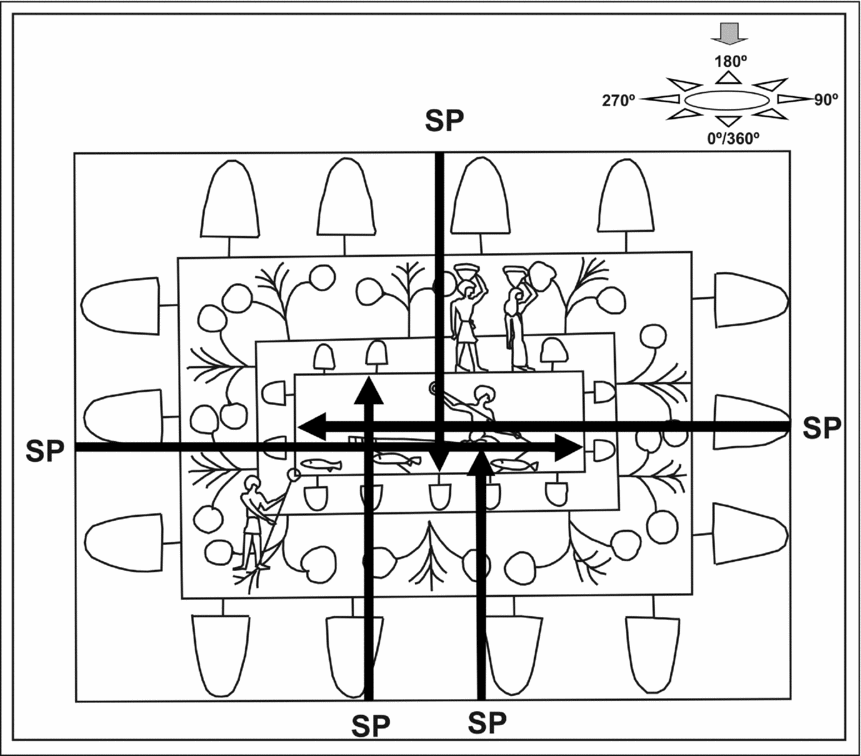
Ancient Egyptian art challenges our visual understanding between the station points and the picture plane. The elements here are seen from the station point located at the front, as in the Western tradition, but the picture plane is something completely different. It is seen from the top and all sides at the same time, as if the picture had been flattened. The station point for elements like humans, fish or boats is zero degrees on the star. The elements of the picture plane, such as trees or shrubs, however, equal 360 degrees. With the addition of one more station points located above we can see the shape of the pond where the fishing is taking place. Ancient Egyptian artists (figure 18) worked out this projection by introducing a station point located above the seen object (the aerial station point), rather than by tilting the picture plane as in the Western visual tradition. The perception of vision in this case reflects a separate tradition that again only allows us to create the seeing of different picture planes at once through the medium of film.
After Hagen (Reference Hagen1986, 173), drawing by Hagen after Capart (1923).
Picture planes and prehistoric rock art
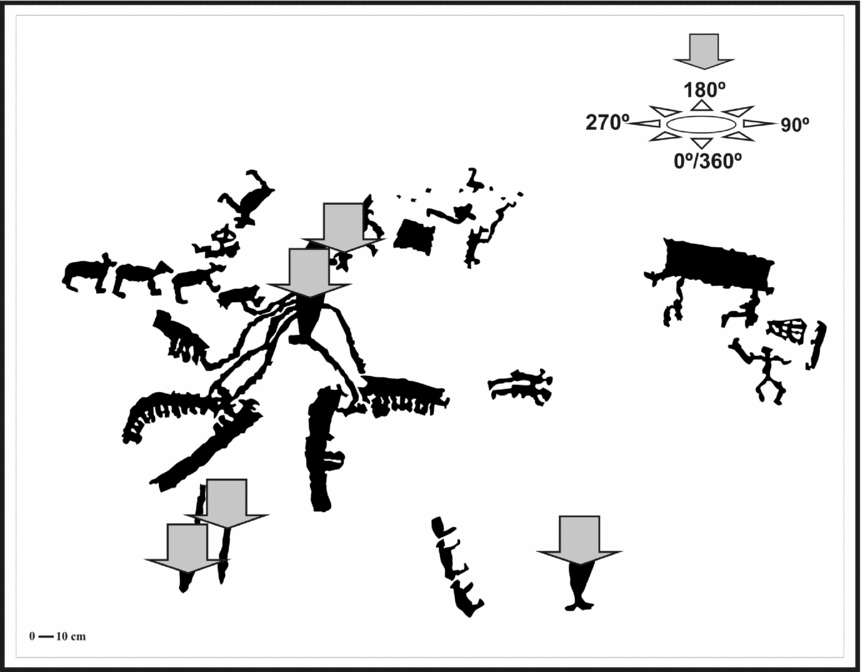
Returning to the Karelian rock art and looking at the prehistoric composition of Group VIII (figure 19), what becomes apparent is that the picture plane is nonexistent and that some elements, such as whales, are seen from above (grey short arrows) as in ancient Egyptian art, creating a new dimension in prehistoric art. Adding that dimension to the visualization already presented enables us to see what the prehistoric carvers are presenting to us much more clearly, even as we adhere to our own visual paradigms (figure 20).
New Zalavruga, Group VIII.
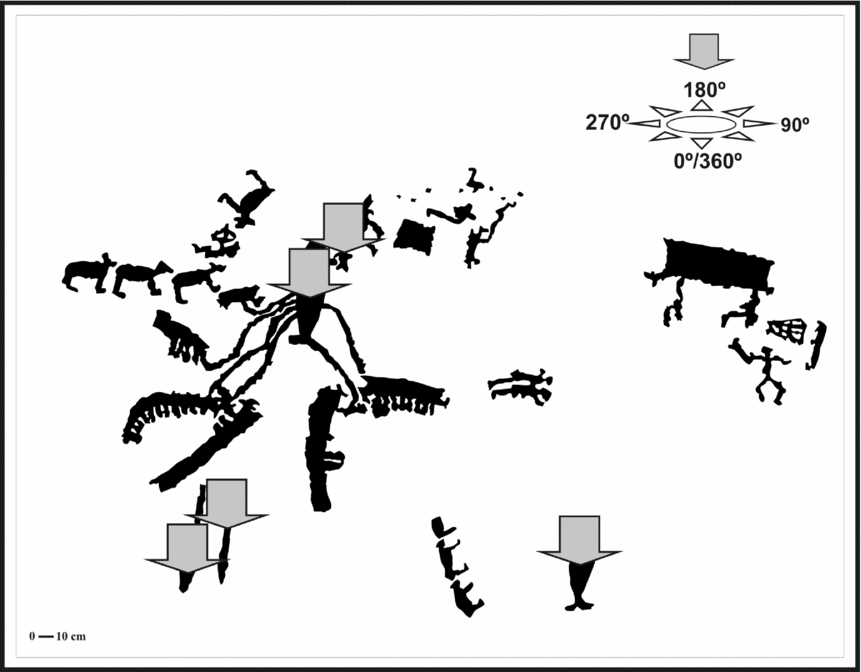
Summary of picture plane (PP).
Through the medium employed in the second visualization, we enter the visual narrative of the rock art through our own paradigm of the moving image, which guides us through the narrative in the manner the prehistoric artist intended, in a way that it was not possible to re-create without modern technology.
The second visualization was constructed with the introduction of an aerial station point, which allowed us to incorporate non-Western ways of constructing a visual composition (figure 21). I suggest that this short movie is successful in allowing us to follow the prehistoric visual narrative by permitting us to see more elements of the composition at once. The film has altered the participation of storytelling: there are multiple voices/station points, allowing us to see the same event at the same time. For each it is a slightly different story since during the ‘moment captured’ they observed the event from various positions. Theirs is a story about the same subject, but as seen by others. In such a light the culturally defined way the visual narrative is conveyed changes, allowing different participants to contribute, so that participation is not restricted to just one person.
Four still frames from the second visualization (created by K. Szczȩsna).
This visualization was achieved by employing the ideas of station point and picture plane fundamental to the Western visual tradition, yet at the same time a ‘non-Western way’ has also been employed. Ancient Egyptian art challenges the way we communicate visually and in turn allows us to see the prehistoric composition as part of a unique visual tradition, different to ours, yet one that can be visually transformed into a visual paradigm recognizable to us through the medium of the movie. It is at this point in looking at Group VIII, the point at which we have established how to see the composition, that we can start to assess the visual narrative and possibly access the storytelling. There are many participants in the visual narrative and many station points, through which the multivocality of the storytelling in the image is seen.
Seeing visual narrative
Using the methodology presented above that combines Western and non-Western ways of constructing visual narratives with the understanding of the perception of vision makes it possible to access prehistoric visual narratives and develop an appreciation of the implications of seeing the story unveiling in front of our eyes.
The amalgamation of station points and picture plane represents the visual capture of an instant in a particular space and time. In the case of the rock art presented here, what we are witnessing is an expression of being present at the same time in different places, just as carved by the artist, telling the visual story of different people, animals and whales at the same moment in time. We see at first and at once the most important image that arrests our attention: the most eye-catching element is the whale in the middle. The other elements of the visual narrative, such as the humans who are depicted as just part of marine or terrestrial hunting scenes, have been given by the artist(s) an equal right to be seen as equal participants in the visual storytelling, and they have equal ownership of the story, as if there were no one human more important than another, and everyone were equal. The visual story is about the whale and the boats, not the people who are towing the whale. The humans both on the boats and outside them, and the bears, elk, deer and birds, are of equal visual standing. It is the moment captured in the rock art where different elements in the landscape are brought together in one instant, and it can be compared with the cubist depiction of an object or a person. I suggest that it is the moment when the visual narrative focuses the storytelling on the whale. The narrative then moves on either to the right or left, depending on who is telling the story or about whom the story is told. But the story is only relevant if the whale is at the centre, and when it creates the axis for the stories told since it is the focus of the visual narrative. By standing in front of the rock we can see how all the other elements are visually ‘suspended’ around it, and at the same time we implicitly acknowledge orientation of these elements via the station point. This separates the event not in time but in space, which in turn allows everyone to be involved in the event, including those who were doing other things and were not involved in towing the whale, just as the person standing above the carvings can enter the narrative by adding their story, creating the plurality or multivocality of the event. Thus the viewer can recall the depicted moment as an equal participant in time, which allows them to tell each separate story with equal importance, each story focused on the whale, and each tale told by different members of the community.
Such an appreciation is vital when we ask questions such as who this story is about and who took part in the story. Or whom society focuses upon and who is most important in society. In narratives like that in Group VIII, the people who took part in the terrestrial or marine hunt are equal participants in the visual narrative, both taking part and telling the story. This is in contrast to the conventional Western visual tradition, where the story has a singular visual narrative, even when we consider cubism, as shown above.
This approach to prehistoric art is new in two ways. The first is methodological and the second interpretative. In terms of methodology, two issues are significant: how we look at prehistoric art, and how, on the basis of the construction of the composition, the artist leads the visual narrative, for both the ancient and the contemporary viewer. In this way we can trace the tangible aspects of intentionality in prehistoric art. In terms of interpretation, the approach adopted here allows us to see the contribution of participants in the story to the telling of the story.
The plurality/multivocality of visual narrative lies outside the traditional Western visual tradition, which focuses on the singularity of visual narrative. This singularity is also present in prehistoric carvings of Zalavruga and can be compared to any picture we take today by camera or mobile phone. This also can be visually interpreted by the methodology presented in this paper. However, since it does not contradict our own visual tradition we implicitly understand what we see: time has stopped and there is only one visual narrative.
Conclusion
This paper has presented a new approach to the interpretation of prehistoric rock art. Based on a case study from Zalavruga, part of the little-known complex of rock art on the White Sea in northern Russia, I have proposed how essential it is for archaeologists to understand ways of seeing in the past. It has drawn inspiration from art-historical analyses ranging from ancient Egypt to the revolutionary aesthetics of cubism and demonstrated the importance of cultivating a critical distance from our own traditions of visual representation.
The implication of such an approach lies in refocusing archaeological interpretation on the intentionality of the prehistoric artist by focusing on the way compositions are visually structured from the perspective of those who create them and those who non-verbally have communicated with past and present viewers. This, in turn, brings us to acknowledge the possibility of building archaeological interpretation while being guided by the past artist as an integral part of the understanding of the past in the present.
As I have argued in previous papers (Janik et al. Reference Janik, Roughley and Szczęsna2007), one of the most remarkable aspects of the Zalavruga rock art is the way in which it conveys movement. The visualization of motion in prehistory speaks to the sophisticated appreciation of the potential of the rock surfaces as a milieu for expression on the part of prehistoric artists. And yet it is more than this. Whether this expression was discursive or practical, what the artists were able to achieve was the engagement of viewers in the moment being depicted. These scenes represent the materialization of memories of extreme experience. Whale hunting must have been one of the most dangerous and exhilarating experiences the communities which inhabited the White Sea coast engaged in. And the artists who depicted these events intended that their stories be experienced as fully as possible. We see the whale hunt from a variety of viewpoints: standing in one place we are transported to a special place, from which we can see the whole story unveiled through the visual narrative. The closest analogy is that of film, and yet the technology of the moving image took a further five millennia to develop.
The approach developed in this paper argues for a reassessment of much of our archaeological interpretative ‘comfort zone’ with regard to art. At Zalavruga the rock art transcends myth and reality to create a viewing experience which draws all of the observers in and makes them all participants in the hunt. We know from the ethnographic record that whale hunting is a hugely emotive activity, comprising and surrounded by complex sets of practices and beliefs. While we cannot access the details of these events, we can deepen our understanding of them through an approach to the art which privileges an appreciation of how it was intended to be seen. In this, both the prehistoric artists and contemporary viewers share a thoroughly modern perception of vision. And through this we can understand a little more about how the creation of art such as this adds to what it means to be human.
The potential of this methodology for enabling us to ‘see’ the rock art in a new way is of great significance. The methodology of seeing makes a difference to the way archaeologists interpret visual narrative as well as engaging with the participants in it. Knowing what and how we see influences the interpretation and understanding of particular compositions, and is a fundamental requirement whatever particular theoretical standpoint we take with regard to interpretation. This innovative approach combines different visual traditions that span millennia, providing a tool that not only helps us in following the intentionality of prehistoric artists, seeing a visual story they conveyed to the viewer, but also focuses interpretation of prehistoric art on the image itself.
Acknowledgements
I owe particular gratitude to S. Kaner, R. Layton, J. Robb, K. Szczęsna and R. Woudhysen-Keller for their critical reading, stimulating suggestions and improvement of this paper. I am also grateful to J. Goldhahn and an unknown referee for their constructive comments. Last but by no means least my thanks go to M. Sapwell. I remain responsible for any errors. This research was sponsored by the British Academy and the McDonald Institute for Archaeological Research.