

Labor is a foundational element in structuring archaeological practice, shaping not only who undertakes the work but also who interprets findings and receives recognition as a knowledge producer. These arrangements are not neutral given that they play a central role in shaping archaeological epistemology by governing the processes of evidence generation, validation, and circulation (Holley-Kline and Mickel Reference Holley-Kline and Mickel2024; Leighton Reference Leighton2015; Mickel Reference Mickel2019; Mickel and Byrd Reference Mickel2021). Persistent global issues—including racialized divisions of labor, disparities in worker expertise, authorship politics, precarious employment, and the erasure of local contributors—underscore the centrality of labor dynamics in archaeological knowledge production (Holley-Kline and Mickel Reference Holley-Kline and Mickel2024).
A central insight in these debates is that the division between “manual” and “intellectual” labor is historically constructed (Schlanger Reference Schlanger, Koerner and Russell2010). Studies of field-based archaeological methodologies demonstrate that labor organization and recording systems jointly determine who is trusted to observe, interpret, and make decisions in the field. Research in colonial and postcolonial contexts further indicates that local and Indigenous workers often possess essential practical, environmental, linguistic, and historical knowledge, yet they are excluded from publication, professional recognition, and institutional authority (Schmidt and Pikirayi Reference Schmidt and Pikirayi2016). For this reason, recent scholarship has shifted the focus from viewing labor as mere background support to recognizing it as a central mechanism in the production of archaeological knowledge (Mickel Reference Mickel and Byrd2021).
Zimbabwe provides a significant context for advancing these debates. The development of archaeology in Zimbabwe was closely linked to colonial rule, particularly through research at Great Zimbabwe and other drystone-walled sites, where questions of origin, civilization, and political legitimacy were deeply intertwined with the labor arrangements underpinning archaeological knowledge production (Mahachi and Ndoro Reference Mahachi, Ndoro and Pwiti1997; Ndoro Reference Ndoro2001). From its genesis, archaeological practice operated within a racialized hierarchy in the country. Despite their extensive knowledge of landscapes, local histories, site locations, sacred spaces, and material traces, locals had no opportunity to contribute to the interpretation of their past. Instead, they only did laborious work—such as digging, transportation, clearance, and site maintenance—while Europeans or settler professionals exerted authority over interpretation and publication (Mahachi and Ndoro Reference Mahachi, Ndoro and Pwiti1997; Shepherd Reference Shepherd2003).
These evolving but persistent divisions form the backdrop for understanding postindependence archaeological labor in Zimbabwe. Although political independence in 1980 and the training of African archaeologists changed the profession’s composition, the deeper split between field practice and recognized knowledge production largely endured. Consequently, the Zimbabwe case is crucial for contributing to wider debates on the coloniality of knowledge and epistemic injustice in archaeology, directly linking current labor systems to historical hierarchies and highlighting the need for fundamental change. This case also fills a regional gap especially in relation to labor histories in Africa outside Egypt and South Africa (Wong and Gutierrez Reference Wong and Palá Gutiérrez2025).
Despite political change, the underlying structure of archaeological labor has remained remarkably consistent. The division between those who generate data through fieldwork and those who interpret and author archaeological knowledge continues to shape research practice. As a result, many of the hierarchies established under colonial rule persist in modified form, influencing not only labor relations but also the production and validation of archaeological knowledge (Shenjere-Nyabezi et al. Reference Shenjere-Nyabezi, Pwiti and Sagiya2024). This persistence reflects what decolonial scholars describe as the “coloniality of knowledge” (Mignolo Reference Mignolo2007; Quijano Reference Quijano2000) in which colonial patterns of authority endure beyond formal colonialism.
Recent work on archaeological labor has begun to foreground these issues globally, demonstrating how employment structures, field hierarchies, and regimes of recognition shape both data and interpretation (Bowes Reference Bowes2023; Doyon Reference Doyon2021; van Oeveren Reference van Oeveren2025). Decolonial scholarship further deepens this analysis by showing that such structures are historically rooted in imperial systems that privileged European epistemologies while marginalizing Indigenous and African knowledge systems (Maldonado-Torres Reference Maldonado-Torres2007; Ndlovu-Gatsheni and Schramm Reference Ndlovu-Gatsheni and Schramm2024; De Sousa Santos Reference De Sousa Santos2016). Within this framework, the marginalization of locals in archaeology can be understood not simply as economic exploitation but as a form of epistemic denial or epistemicide, where knowledge contributions are systematically excluded from recognition.
Although these critiques are now well established, a significant gap remains between diagnosing the problem and transforming practice. Much of the existing literature, including work in African contexts, has focused on exposing inequality without sufficiently articulating what more equitable archaeological labor systems might look like in practice (Carruthers et al. Reference Carruthers, Niala, Davis, Challis, Schiappacasse, Dixon and Milosavljević2021; Shepherd Reference Shepherd2003). This gap is particularly evident in Zimbabwe, where discussions of community participation, heritage management, and decolonization have not been matched by systematic rethinking of labor structures within archaeological projects.
This article addresses this gap by examining the historical formation and contemporary persistence of archaeological labor hierarchies in Zimbabwe and by proposing a framework for reconfiguring these relations in practice. Three central questions guide the article: (1) How were archaeological labor roles defined and maintained during the colonial period, and what assumptions underpinned these structures? (2) To what extent have these labor hierarchies persisted in the postcolonial era? (3) How might archaeological labor be reorganized to support more inclusive, ethical, and contextually grounded forms of knowledge production? We argue that transforming archaeological practice in Zimbabwe requires not just critique but a reconfiguration of labor itself as a site of knowledge production. By tracing the historical development of labor hierarchies and demonstrating their ongoing effects, we show how current practices continue to reproduce inequalities in authority, recognition, and participation. We then move beyond critique to outline practical approaches to labor organization that foreground inclusivity, equitable recognition, and collaborative knowledge production between archaeologists and local communities.
The article contributes to current debates in two ways. First, we offer a historically grounded Zimbabwean case study that places African archaeology in direct conversation with emerging global scholarship on labor, expertise, and epistemic injustice (Lane Reference Lane2011; Schumaker Reference Schumaker2001; Thondhlana et al. Reference Thondhlana, Lyaya and Mtetwa2022). Second, we move beyond critique by proposing practical principles for reconfiguring archaeological labor, which include recognition of intellectual labor, inclusive participation in decision-making, transparent systems of attribution, and project-based capacity building. In doing so, we argue that decolonizing archaeology requires attention not only to interpretation and representation but also to the everyday organization of work through which archaeological knowledge is made (Holley-Kline and Mickel Reference Holley-Kline and Mickel2024). Although this analysis focuses primarily on colonial and postcolonial divisions between local labor and interpretive authority, we acknowledge that archaeological labor is also shaped by gender, class, age, and other intersecting social hierarchies that warrant dedicated investigation in future work.
Archaeological Labor Regimes in Zimbabwe: Formation, Continuity, and Practice
Colonial Formation of Archaeological Labor
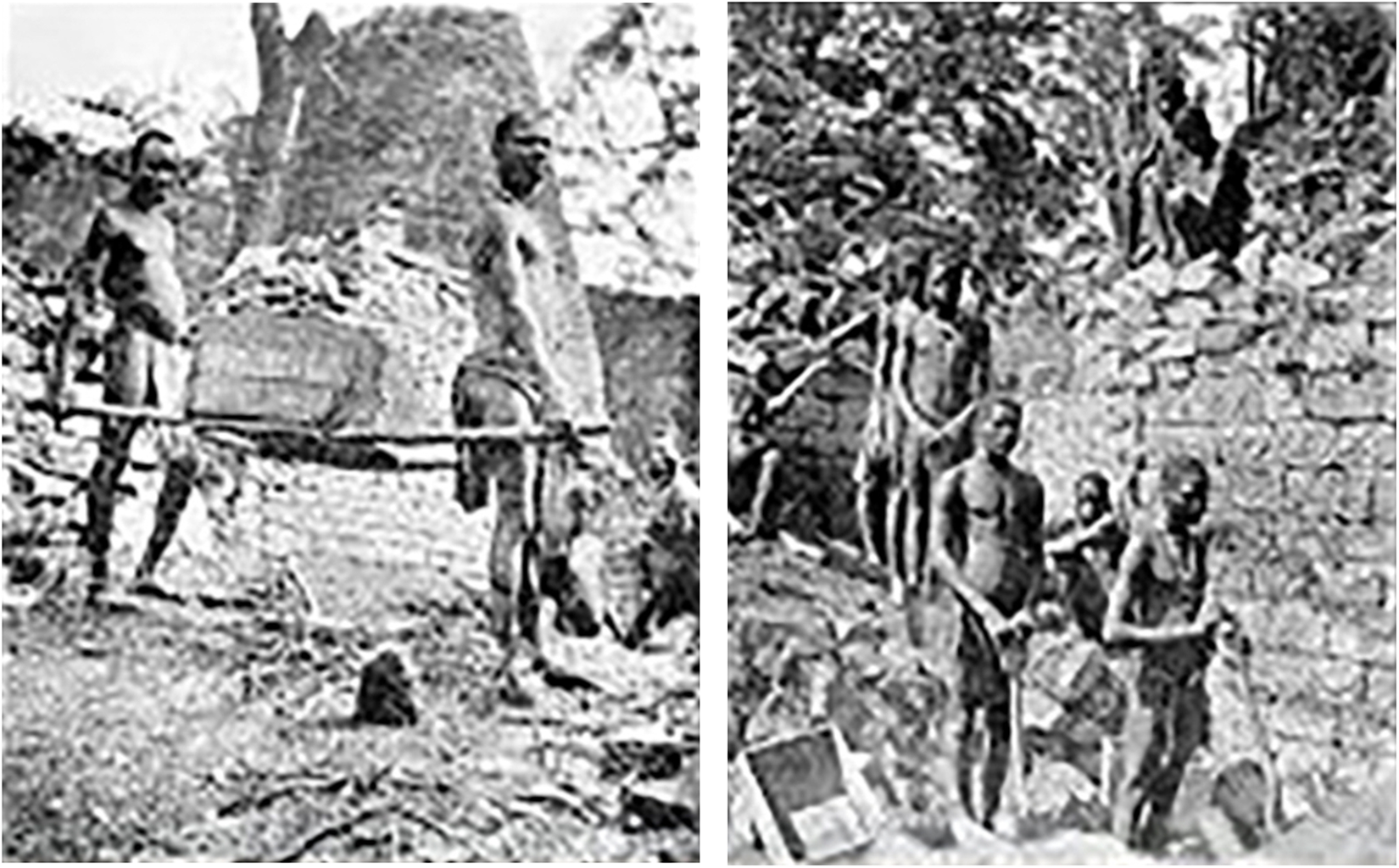
During the colonial period in Southern Rhodesia, archaeological practice was structured through a markedly racialized division of labor. African workers undertook the bulk of excavation, site clearance, transportation, and maintenance activities (Figure 1), whereas responsibilities for research design, interpretation, and publication were reserved for white settlers, museum personnel, and visiting European specialists. This division was already evident in some of the earliest investigations at Great Zimbabwe. Excavators such as Theodore Bent, Richard Hall, and (later) David Randall-MacIver relied extensively on African labor for field operations, yet interpretive authority remained firmly concentrated in European hands, as reflected in authorship and scholarly output.
Antiquarian excavations at Great Zimbabwe in the late 1890s showing (left) locals removing archaeological debris and (right) excavating the Great Enclosure. (Images reproduced from Hall [Reference Hall1905]. The image quality is constrained by the resolution of the original historical source.)

The marginalization of African knowledge in these research settings had direct consequences for archaeological interpretation. Bent (Reference Bent1892), for instance, framed Great Zimbabwe within diffusionist theories that attributed the monument to Phoenicians. These interpretations drew heavily on biblical and classical sources but disregarded local historical knowledge and oral traditions associated with the site. Such conclusions emerged within a research environment in which locals, many of whom possessed intimate familiarity with the landscape and its histories, were seldom engaged as knowledge contributors. The systematic exclusion of local perspectives therefore reinforced interpretive models privileging externals over Indigenous agency, generating narratives increasingly detached from the social and historical realities of the region (Ndoro Reference Ndoro2001).
Although these labor arrangements were not unique to Zimbabwe and mirrored patterns observed across colonial archaeological contexts, the Zimbabwean case is distinctive in its entanglement with settler efforts to control the historical interpretation of Great Zimbabwe and related stone-built sites. Labor organization therefore formed part of a broader political project of historical authority (Mahachi and Ndoro Reference Mahachi, Ndoro and Pwiti1997). Subsequent investigations continued to depend heavily on African excavation crews responsible for systematic digging, sieving, and site clearance under European supervision. While Gertrude Caton-Thompson’s (Reference Caton-Thompson1931) work marked a critical departure in affirming the Indigenous origins of Great Zimbabwe, the organization of fieldwork nevertheless maintained African participants within roles defined primarily as manual rather than intellectual.
Colonial archaeological projects also depended on African knowledge in ways that were only partially acknowledged in official publications. Local workers and informants contributed crucial insights into site locations, access routes, oral traditions, and landscape dynamics. Most of the laborers were drawn from communities residing in adjacent areas, and they possessed detailed knowledge of terrain, seasonal variability, and local histories—all of which shaped field practices and interpretive processes. Despite this, such contributions were rarely accorded status equivalent to the interpretive authority of colonial archaeologists (Chirikure Reference Chirikure2020). In terms of contemporary labor scholarship, this dynamic reflects a broader condition of epistemic asymmetry, where local knowledge materially informed archaeological practice without translating into authorship or disciplinary recognition.
This exclusion was not incidental but was embedded within wider colonial labor regimes that systematically positioned African workers as providers of physical labor rather than as intellectual agents. These arrangements intersected with institutional structures, including the Historic Monuments Commission, which regulated research permits, site management, and the circulation of archaeological knowledge. Archaeological labor systems therefore operated as mechanisms of epistemic control, shaping not only the organization of work but also the validation of knowledge. Local labor remained indispensable to archaeological production, yet it was consistently excluded from formal recognition (Carruthers et al. Reference Carruthers, Niala, Davis, Challis, Schiappacasse, Dixon and Milosavljević2021). Consequently, labor organization did not merely structure field practice; it also influenced the epistemological foundations of the discipline, determining which interpretations gained legitimacy and which forms of knowledge remained marginal within the archaeological record.
Institutionalization and Postcolonial Continuities
These labor divisions were further consolidated through the institutionalization of archaeology during the twentieth century. With the emergence of formal heritage structures, particularly those that later evolved into the National Museums and Monuments of Zimbabwe, archaeological practice became increasingly bureaucratized and standardized. In the Rhodesian period, this process was closely associated with the establishment and expansion of institutions such as the National Museums of Southern Rhodesia and the Historic Monuments Commission, which formalized the management of archaeological sites and research activities (Ndoro Reference Ndoro2001). These bodies introduced regulatory frameworks governing excavation permits, site access, and artifact curation, thereby consolidating control over archaeological knowledge within state-sanctioned institutions. Rather than transforming existing labor relations, however, institutionalization served to entrench them.
Fieldwork continued to operate through a hierarchical structure in which hired laborers undertook excavation and logistical tasks under the supervision of trained professionals. Within these institutional contexts, African workers were typically employed on a temporary or seasonal basis through museum or government projects, often attached to excavations at sites such as Great Zimbabwe and Khami, where they performed the majority of field-based work. Institutional protocols reinforced distinctions between “skilled” and “unskilled” labor, and authority over interpretation, documentation, and publication remained centralized. Curatorial and research positions within institutions such as the National Museum in Bulawayo and the Queen Victoria Museum in Salisbury (now Harare) were overwhelmingly occupied by white professionals during the colonial period, reflecting broader racialized patterns in knowledge production and heritage governance (Mahachi and Ndoro Reference Mahachi, Ndoro and Pwiti1997). Consequently, even as archaeology became more formalized, the division between manual and intellectual labor persisted as a defining feature of practice.
The attainment of Zimbabwe’s national independence in 1980 marked a significant institutional and demographic shift in Zimbabwean archaeology, particularly through the training of African archaeologists and the expansion of university- and museum-based research. Key developments included the strengthening of the University of Zimbabwe’s archaeology programs, which emerged as an important center for training local professionals and reshaping the discipline (Pikirayi Reference Pikirayi2012; Tevera Reference Tevera2024). This transformation altered access to the profession and challenged the overtly exclusionary racial structures characteristic of Rhodesian archaeology. However, the political transition did not fully dismantle the underlying division between those engaged in field-based data recovery and those exercising sustained authority over interpretation, authorship, and institutional decision-making. In this respect, postindependence archaeology in Zimbabwe reflects a combination of substantive Africanization and enduring structural continuity in labor relations.
This continuity suggests that the central issue extends beyond racial exclusion to the persistence of a deeper structural divide between the production of data and the production of knowledge. Postcolonial archaeology in Zimbabwe has therefore not fully displaced colonial labor hierarchies; instead, it has reproduced them in modified forms. Consequently, patterns of authority, recognition, and participation remain uneven despite the transformation of the broader political context.
Archaeological Labor Practice in Contemporary Zimbabwe
Contemporary archaeological practice in Zimbabwe continues to reflect historically embedded structural patterns, particularly in the organization of fieldwork. Labor is typically structured through a differentiated allocation of roles and responsibilities. Project directors and trained archaeologists formulate research questions, design excavation strategies, interpret findings, and produce scholarly outputs. These professionals also participate directly in field activities—including excavation, sieving, recording, and material processing—working alongside students, field assistants, and other contributors.
The central issue, therefore, is not the presence of manual labor, nor who performs it, but the organization of authority within the research process. Nonprofessional participants, including field assistants and local community members, are generally engaged in task-specific roles such as excavation support, sieving, material handling, and site preparation. Although these contributions are essential to the success of archaeological work, they rarely extend into the conceptual and interpretive domains of research, including the formulation of research questions, analytical decision-making, and authorship. This results in a persistent asymmetry in which participation in fieldwork does not translate into participation in knowledge production. Consequently, those involved in the recovery of archaeological data are seldom positioned to influence how that data is interpreted, contextualized, or incorporated into broader historical narratives.
This asymmetry is particularly evident in the context of long-term research at major archaeological sites in Zimbabwe. Great Zimbabwe, for instance, has been the focus of sustained archaeological investigation for over a century, producing an extensive body of scholarship on architecture, chronology, material culture, and regional interaction (e.g., Chirikure Reference Chirikure2020; Huffman Reference Huffman2007). These projects have involved repeated excavation campaigns and the continued participation of local field assistants drawn from surrounding communities. Despite this prolonged and consistent engagement, published outputs rarely demonstrate substantive forms of knowledge coproduction between professional archaeologists and local participants. Authorship, analytical framing, and interpretive authority remain largely concentrated among formally trained archaeologists. Field assistants, notwithstanding their accumulated experience and familiarity with the site, are typically absent from processes of interpretation, synthesis, and publication. This pattern suggests that, although archaeological fieldwork is collaborative in practice, it has not translated into collaborative knowledge production in systematic or visible ways. The absence of coproduced outputs reflects not a lack of contribution, but the persistence of structural boundaries separating field participation from interpretive authority. Collaboration therefore remains primarily operational rather than epistemic, confined to the execution of fieldwork rather than extending into the domains where meaning is produced and validated.
One of the enduring legacies of earlier labor structures is the limited development of formalized pathways for field assistants and other nondegreed participants. Although postindependence archaeology has expanded the training of professional archaeologists, there has been comparatively little effort to establish certification systems, progression routes, or technical career tracks for those engaged in fieldwork and related support roles. As a result, assistants are typically recruited for project-specific tasks, with limited access to long-term professional mobility. Nonetheless, there have been important—albeit relatively constrained—initiatives aimed at addressing this gap. The annual Khami Restoration Project, for example, brought together university students and young people from communities with dry stone-walled heritage to develop practical conservation skills, thereby extending participation beyond routine labor (Sinamai Reference Sinamai2018). Similarly, Great Zimbabwe has served as a veritable ground for capacitating locals and students in various aspects related to drystone wall management, such as the Great Zimbabwe Development Project (Manyanga et al. Reference Manyanga, Rukara, Tevera, Mukwende, Chiripanhura, Mubaya, Thondhlana, Sibanda, Nyawo and Dombo2025). These initiatives represent deliberate efforts to build locally grounded technical and interpretive capacity, and they signal an emerging recognition that sustainable heritage management depends on the development of embedded expertise rather than exclusive reliance on externally defined professional hierarchies. Individual trajectories also illustrate the possibility of upward mobility within the system. There are a few cases in which locally recruited site custodians and other entry-level personnel have progressed into professional careers as archaeologists, heritage managers, surveyors, and other specialists through sustained training and professional development. This demonstrates that such pathways, although viable, remain exceptional rather than institutionalized.
Comparative scholarship suggests that the absence of structured pathways is consequential, because it sustains the separation between labor and recognition even where the demographic composition of the professional class has shifted (Mekonnen et al. Reference Mekonnen, Khaleel, Nyambiya and Maringa2025; Mickel Reference Mickel and Byrd2021; Rivera Prince et al. Reference Rivera Prince, Blackwood, Brough, Landázuri, Leclerc, Barnes and Douglass2022; Thondhlana et al. Reference Thondhlana, Lyaya and Mtetwa2022; van Oeveren Reference van Oeveren2025). Evidence from Zimbabwean field practice reinforces this observation. Local workers have long contributed to excavation processes, site identification, and landscape interpretation, often drawing on detailed knowledge of terrain, material distributions, and oral traditions (Chirikure Reference Chirikure2020; Ndoro Reference Ndoro2001; Robinson Reference Robinson1959). In contemporary projects, field assistants are routinely recruited from surrounding communities and work alongside professional archaeologists in excavation and recording activities. However, their involvement typically concludes at the stage of data recovery, reinforcing a structural pattern in which participation is spatially and temporally confined to the field, instead of extending into post-excavation analysis and interpretive work. These dynamics demonstrate that labor structures shape not only participation in archaeological practice but also the production, validation, and attribution of knowledge. Although fieldwork is inherently collaborative, interpretive authority remains concentrated within a relatively narrow cohort of trained professionals. The separation between data production and interpretation is therefore not merely procedural but constitutive of the discipline’s epistemic organization. In this sense, archaeological knowledge is both collaboratively generated and selectively formalized, with only certain contributions entering the domain of recognized expertise and authorship. What appears as a collective process at the level of fieldwork is filtered through institutional and disciplinary mechanisms that determine which forms of knowledge are preserved, circulated, and legitimized.
Emerging collaborative initiatives, such as the Bvumavaranda excavations at Great Zimbabwe, point to alternative ways of organizing archaeological labor and authority (Tevera Reference Tevera2024). These projects demonstrate the potential for more dialogical forms of engagement, in which spiritual authorities, community representatives, and professional archaeologists participate in shared processes of decision-making and interpretation. However, such cases remain limited in scale and are better understood as experimental rather than indicative of a broader transformation within the field. Their significance lies in demonstrating that the separation between labor and knowledge is historically contingent—not inevitable. Nonetheless, the prevailing pattern indicates that archaeological practice in Zimbabwe continues to operate within a framework in which those who contribute to the production of archaeological data are systematically separated from those who control its interpretation and dissemination. This division is not only organizational but epistemic, shaping what is knowable, how knowledge is constructed, and whose perspectives are ultimately recognized within archaeological narratives.
Reframing Labor as a Site of Knowledge Production
The preceding analysis has demonstrated that archaeological labor in Zimbabwe is not simply an organizational or logistical concern but a structuring condition of knowledge production. Labor arrangements determine who participates in fieldwork, who is positioned to interpret archaeological material, and who is ultimately recognized as producing knowledge. For this reason, labor is not external to archaeological epistemology; instead, it is one of its foundational conditions. In this case, then, efforts to decolonize archaeology cannot be confined to interpretive frameworks or representational politics alone (Cruz Reference Cruz2023; Smith and Wobst Reference Smith and Wobst2004). Although important, such interventions leave intact the underlying structures through which archaeological knowledge is produced. A meaningful transformation of the discipline requires a shift in focus toward the organization of field practice itself—specifically, how labor is recruited, structured, valued, and acknowledged within archaeological projects.
Reframing labor in this way requires moving beyond a binary distinction between manual and intellectual work. As demonstrated in the Zimbabwean context, the production of archaeological data is inseparable from forms of situated knowledge, including familiarity with landscapes, materials, and cultural meanings. These contributions should not be viewed as supplementary to archaeological interpretation. Instead, they actively shape it. Recognizing these challenges, the conventional allocation of authority within archaeological practice opens up the possibility of more inclusive and collaborative forms of knowledge production (Chirikure Reference Chirikure2020; Schmidt and Pikirayi Reference Schmidt and Pikirayi2016; Thondhlana et al. Reference Thondhlana, Lyaya and Mtetwa2022).
This section therefore builds on this reframing by proposing a practical framework for reorganizing archaeological labor in Zimbabwe. Rather than treating labor as a fixed background condition, it approaches it as a site of intervention through which more equitable, contextually grounded, and epistemically inclusive practices can be developed.
Reconfiguring Archaeological Labor Practices in Zimbabwe: Some Core Principles
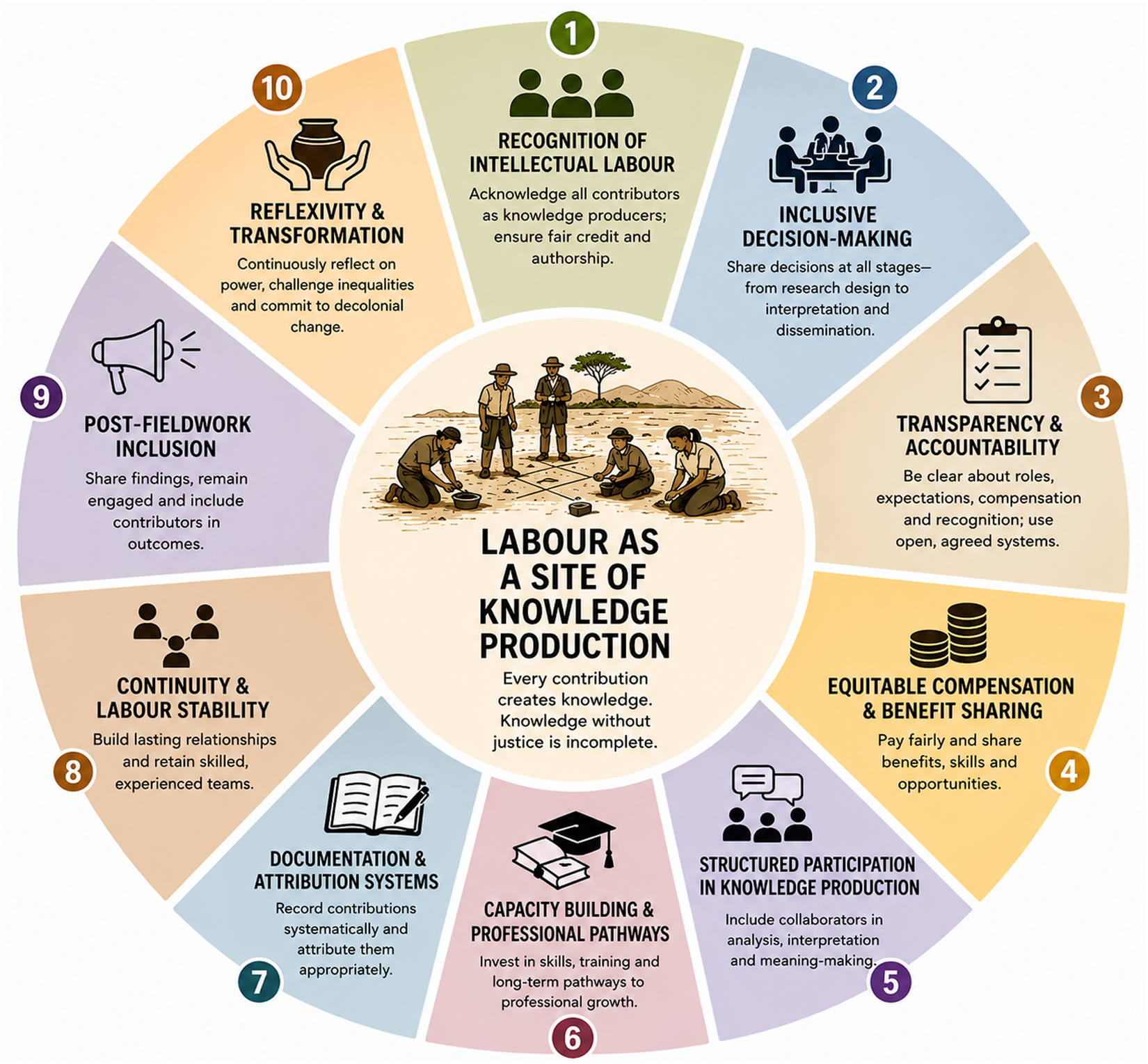
Reconfiguring archaeological labor in Zimbabwe requires moving beyond abstract critique and toward the articulation of practical, context-sensitive principles capable of reshaping how knowledge is produced, recognized, and disseminated. Central to this reorientation is the recognition that archaeological practice is not the exclusive domain of formally trained specialists but a collaborative endeavor grounded in multiple forms of knowledge (Manyanga and Chirikure Reference Manyanga and Chirikure2017). Local participants and field assistants contribute significant intellectual labor through their familiarity with landscapes, cultural histories, and material contexts. Acknowledging these contributions necessitates deliberate efforts to document, integrate, and appropriately credit such knowledge within interpretation, reporting, and— where appropriate—coauthorship. This ensures that insights generated through field engagement are not rendered invisible within formal scholarly outputs. In the Zimbabwean context, these principles (Figure 2) must operate within existing institutional frameworks, including the National Museums and Monuments of Zimbabwe, the Zimbabwe Association of Professional Archaeologists and Related Disciplines, university-based research programs, and other regional and international heritage bodies. Consequently, proposed approaches must remain both theoretically grounded and responsive to regulatory structures, funding constraints, and the practical realities of field-based research.
Proposed core principles in archaeological labor practice.

Figure 2 Long description
The diagram presents nine principles of archaeological labor practice arranged in a circular format around a central theme: ′Labour as a Site of Knowledge Production.′ Each principle is represented with an icon and a brief description. 1. Recognition of Intellectual Labour: Acknowledge all contributors as co-creators of knowledge. 2. Inclusive Decision-Making: Share decision-making and foster an inclusive environment. 3. Transparency & Accountability: Be clear about roles, expectations and accountability. 4. Equitable Compensation & Benefit Sharing: Ensure fair compensation and sharing of benefits. 5. Structured Part icipation in Knowledge Production: Involve all stakeholders in knowledge production. 6. Capacity Building & Professional Pathways: Provide training and career development opportunities. 7. Documentation & Attribution Systems: Record contributions and ensure proper attribution. 8. Continuity & Labour Stability: Maintain stable and continuous labor practices. 9. Post-Fieldwork Inclusion: Include all contributors in post-fieldwork processes. The central theme emphasizes that every contribution is essential for complete knowledge production.
A decolonial orientation further requires the development of more inclusive and structured forms of participation in decision-making processes. Although professional expertise remains essential, it must be situated within dialogical frameworks that enable local communities to shape research trajectories meaningfully, particularly in areas of cultural and heritage significance (Atalay Reference Atalay2007, Reference Atalay2010; Schmidt and Pikirayi Reference Schmidt and Pikirayi2016). This entails embedding consultation and collaboration at multiple stages of archaeological work—from project design through field implementation—while ensuring that participation is substantive rather than symbolic (Smith and Wobst Reference Smith and Wobst2004). In practical terms, this may involve the inclusion of designated community representatives or experienced field assistants in project planning meetings, site selection processes, and the identification of culturally sensitive areas. Such engagement should be systematic and iterative, rather than ad hoc, ensuring that local perspectives inform decision-making throughout the research process.
Transparency constitutes a further critical component of equitable labor relations (Nicholson et al. Reference Nicholson, Kansa, Gupta and Fernandez2023). Clearly articulated roles, expectations, compensation structures, and mechanisms of recognition help to reduce ambiguity and establish accountability among all participants. Formalizing these elements through written agreements, procedural guidelines, and consistent communication ensures that contributors understand both their responsibilities and the terms under which their labor—including intellectual contributions—will be acknowledged in project outputs. Practical measures may include the use of field agreements, regular briefing sessions, and end-of-season reporting processes that explicitly document individual and collective contributions.
Equity in compensation expands this framework by recognizing that archaeological labor extends beyond physical tasks to include intellectual and experiential contributions. Fair remuneration should therefore be accompanied by broader forms of benefit-sharing, including access to research findings, opportunities for skills development, and participation in heritage-related initiatives. Such an approach aligns compensation with the full spectrum of contributions, addressing long-standing disparities in how labor is valued. In contexts characterized by limited financial resources, particularly within university-led projects, nonmonetary forms of support such as transport provision, meals, training certification, and opportunities for continued engagement can play a supplementary role. However, these measures should complement rather than substitute for fair wages.
Finally, sustained commitment to capacity building is essential for fostering more inclusive and durable forms of archaeological practice (Atalay Reference Atalay2012; Thondhlana et al. Reference Thondhlana, Lyaya and Mtetwa2022). Integrating training, mentorship, and skills development into project design enables local participants to move beyond temporary roles toward greater professional mobility. Although broader institutional reforms remain necessary, project-based initiatives can begin to establish pathways that bridge the divide between field assistance and professional archaeology. In Zimbabwe, where formal employment opportunities in the discipline remain limited, capacity building must be approached as both an immediate intervention and a long-term strategy. This includes, where possible, linking project-based training to institutional structures through collaboration with universities, heritage authorities, and emerging training programs.
Collectively, these principles position archaeological labor as central to processes of decolonial transformation, in which authority, recognition, and opportunity are more equitably distributed. They offer a flexible yet grounded framework for the coproduction of knowledge with local communities while remaining attentive to the practical constraints that shape archaeological research in Zimbabwe.
Practical Instruments for Equitable Archaeological Labor: From Project Design to Knowledge Production
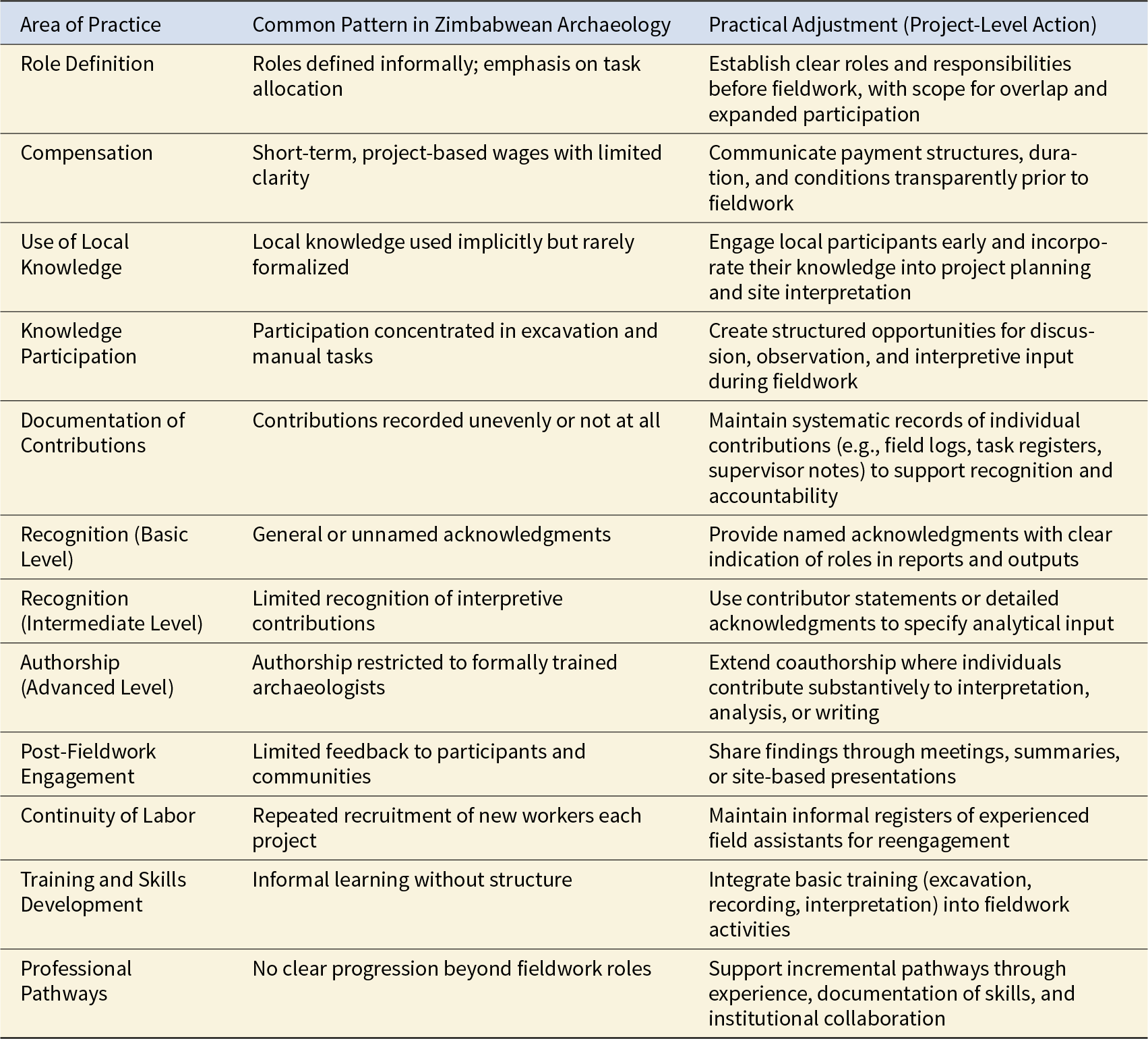
Translating principles into practice requires embedding clear, adaptable mechanisms within archaeological project cycles, ensuring that labor organization, recognition, training, and community engagement are addressed systematically rather than rhetorically. As illustrated in Table 1, at the project-design stage, teams should establish transparent foundations by clearly defining roles, responsibilities, and expectations, including how logistical and interpretive contributions may intersect. Compensation structures must be agreed upon in advance, specifying wages, duration, and any additional forms of support, and local participants should be engaged early not only as laborers but as knowledge holders whose insights can shape site selection, research priorities, and culturally sensitive approaches. At the same time, projects need explicit protocols governing how knowledge will be documented, used, and shared, including clarity on ownership, access, and the handling of sensitive information. Expectations around recognition and authorship should also be articulated from the outset to ensure that contributions are acknowledged consistently and transparently. Responsibility for implementing these measures should be clearly assigned within the project team, ensuring that commitments to inclusion and transparency are actively managed rather than assumed.
Reconfiguring Archaeological Labor in Zimbabwe: Linking Common Practices with Practical Project-Level Adjustments.

Table 1 Long description
The table compares current labor practices in Zimbabwean archaeology with project-level actions to make participation clearer, fairer, and more collaborative. It covers role definition, compensation, use of local knowledge, participation in interpretation, documentation, recognition, authorship, post-fieldwork engagement, continuity of labor, training, and professional pathways. Common patterns include informal role assignment, unclear short-term wages, local knowledge used without being formally credited, and participation focused on excavation and other manual tasks. Proposed adjustments emphasize setting roles and responsibilities before fieldwork, explaining pay terms in advance, and engaging local participants early so their knowledge informs planning and site interpretation. Several rows focus on accountability and credit: keeping systematic records of individual contributions, moving from unnamed to named acknowledgments, and using contributor statements to specify analytical input. At the most advanced level, the table recommends extending coauthorship when individuals contribute substantially to interpretation, analysis, or writing, rather than limiting authorship to formally trained archaeologists. It also highlights longer-term improvements such as sharing findings back with participants, reengaging experienced assistants through informal registers, integrating structured training, and supporting progression through documented skills and institutional collaboration. The table presents recommended practices rather than measured outcomes, so it does not indicate how often these adjustments are currently implemented or their effectiveness.
During fieldwork, these commitments must take practical form through everyday practices that redistribute participation and authority. Training should be integrated into routine activities, enabling participants to develop excavation, recording, and basic interpretive skills while contributing to project outcomes. Regular spaces for collaborative interpretation, whether through informal discussions or structured briefings, allow multiple perspectives to inform emerging understandings. Equitable working conditions—including safety, workload distribution, and access to resources—must be actively maintained, and systematic documentation of contributions ensures that intellectual and practical inputs are made visible. Although roles may be predefined, a degree of flexibility should be retained to accommodate participants who demonstrate additional skills or insights, allowing for more responsive and context-sensitive engagement. Where possible, projects should incorporate rotational or shadowing opportunities that allow participants to engage with different aspects of archaeological work, including basic recording and interpretive processes.
Post-fieldwork processes are equally critical, given that they determine how labor translates into recognition and longer-term opportunity. Contributions should be reflected in formal outputs through a transparent and differentiated system that aligns credit with demonstrable input: named acknowledgment for participation and logistical support, collaborative credit for interpretive or data-generating contributions, and coauthorship in cases where individuals play a substantive role in analysis and argumentation. Research findings must also be shared with participating communities in accessible formats, reinforcing accountability and sustaining relationships beyond the life of the project. Projects should incorporate reflective evaluation of labor practices to identify areas for improvement, creating feedback loops that inform future work. Where possible, pathways for continued engagement should be supported through training opportunities, repeat participation, or links to educational and heritage institutions. Where feasible, selected participants may also be invited to contribute to aspects of post-excavation work, including artifact processing or preliminary interpretation, particularly where they have demonstrated sustained engagement during fieldwork.
Capacity building straddles all stages as both a practical tool and a longer-term investment in more inclusive archaeological practice. Fieldwork-based training, supported by certification such as documented records of skills or letters of participation, provides a realistic starting point in contexts where formal employment opportunities remain limited. Over time, building networks of experienced field assistants can improve continuity and reduce the need for repetitive training. Crucially, capacity building should extend beyond technical skills to include participation in interpretation and knowledge production, helping to bridge the persistent divide between those who generate data and those who are recognized as producers of knowledge.
To ensure that these instruments move beyond aspirational commitments, projects should incorporate mechanisms for monitoring and accountability. This may include end-of-season evaluations, participant feedback sessions, and internal reviews that assess whether stated principles have been implemented in practice. Such processes help to identify gaps between intention and execution and create opportunities for iterative improvement.
Together, these instruments offer a flexible but concrete framework for integrating equity into archaeological practice, ensuring that inclusivity is operationalized through everyday decisions about labor, recognition, and collaboration rather than remaining an aspirational goal. Importantly, their effectiveness will depend on consistent application across projects rather than isolated implementation, given that sustained change requires broader institutional uptake within Zimbabwean archaeology.
Conclusion
This article has examined how archaeological practice in Zimbabwe remains structured by historical divisions that separate participation in fieldwork from authority in knowledge production. Although independence facilitated the expansion of professional archaeology and the inclusion of African practitioners, the organization of labor and knowledge-production structure has remained largely unchanged. Fieldwork continues to rely on collaborative engagement across different categories of participants, yet recognition, interpretation, and authorship remain concentrated within a relatively narrow group of formally trained specialists. By foregrounding labor as a central analytical lens, this study has shown that the question is not simply who participates in archaeological work but how participation is translated or not translated into knowledge production and recognition. The persistence of these structures highlights the limits of transformation that focuses solely on representation without addressing the underlying organization of archaeological practice.
Moving beyond critique, the article has proposed a set of practical interventions through which archaeological labor can be reconfigured. These include the integration of clearer role definitions, more inclusive forms of participation in interpretation, transparent systems of recognition, and the incorporation of training and capacity-building measures within fieldwork. Rather than presenting these as prescriptive solutions, they are offered as adaptable guidelines that can be implemented within the constraints of Zimbabwean archaeological practice.
Importantly, we argue that recognition and capacity building should be understood as interconnected processes. Expanding acknowledgment and authorship without creating pathways for continued engagement runs the risk of remaining symbolic, whereas training without recognition fails to address the distribution of authority in knowledge production. Addressing both dimensions together provides a more coherent basis for rethinking archaeological labor.
The implications of this study, however, extend beyond Zimbabwe. Similar labor structures are evident across many archaeological contexts shaped by colonial histories, suggesting that the issues identified here are not unique but part of a broader disciplinary pattern. At the same time, the Zimbabwean case demonstrates the importance of grounding such discussions in specific institutional, economic, and cultural contexts.
Ultimately, reconfiguring archaeological labor is not only a matter of equity but also of epistemic quality. Making visible the contributions of a wider range of participants, and creating conditions under which these contributions can inform interpretation, has the potential to produce more robust, contextually grounded, and socially relevant archaeological knowledge. In this sense, labor is not peripheral to archaeology; it is fundamental to how the discipline understands and represents the past.
Acknowledgments
We thank the three anonymous reviewers for their insightful comments.
Funding Statement
No funding was received for this research.
Data Availability Statement
No original data is presented in this article.
Competing Interests
The authors declare none.

 Open access

