Although environmental conditions have always driven displacement of populations,Footnote 1 climate change has increasingly been perceived as a significant factor in migration.Footnote 2 Nonetheless, alarmist estimates of 250 million “environmental refugees” by 2050, proposed by the late Norman Myers,Footnote 3 were rejected by most authors as simplistic. This is because environmental factors are only one in a cluster of causes,Footnote 4 making it difficult to distinguish environmentally induced migrants amongst other economic migrants.Footnote 5 Struggling with the one-dimensional notion of “environmental refugees”, Kälin distinguished five scenarios of environmental migration:
(1) “Sudden-onset disasters, such as flooding [and] windstorms”;
(2) “Slow-onset environmental degradation caused, inter alia, by rising sea levels, increased salinization of groundwater and soil, long-term effects of recurrent flooding, thawing of permafrost, as well as droughts and desertification”;
(3) “So-called ‘sinking’ small island states”;
(4) Areas designated by governments as “high-risk zones too dangerous for human habitation on account of environmental dangers”; and
(5) Displacement following environmentally triggered conflicts.Footnote 6
Kälin's typology reflects the great diversity of the situations covered by the concept of environmental migration. Gemenne suggested the model of a triple continuum, differentiating between environmental migrants depending on the duration, coercion, and preparedness of their migration.Footnote 7
Building on this premise, Western academics have released several governance proposals in the course of the 2000s. They quickly assumed that current legal frameworks and governance practices are ill-equipped to deal with environmental migration.Footnote 8 I have identified elsewhere three different narratives upon which a governance framework on migration induced by climate change or (more broadly) by environmental factors could be based: “solidarity”, “responsibility”, and “sustainability” (or “security”).Footnote 9 In addition, according to McAdam, legal approaches to tackle climate migration should reconcile a “plethora of existing as well as potential governance mechanisms, processes, and institutions … across the fields of migration, environment, development, human rights, disaster management, and humanitarian relief”.Footnote 10 If there is no consensus on the form of governance, it appears to most researchers that at least some forms of action should be carried out at the international level.Footnote 11
In contrast to the growing Western concern of environmental migration, this article looks at the development of a specific international legal approach towards environmental migration within the Asia-Pacific region. In criticizing the post-colonial drift in the discourse on the global governance of environmental migration, I argue that a multilateral forum of best practices would be a fairer and more efficient process for developing rules on the issue. Establishing and participating in this forum is a unique opportunity for the rising countries in Asia and the Pacific to affirm their aspirations towards playing a more prominent role in the international community, and, in particular, to demonstrate how the discourse on “Asian values” could also trigger a liberal normative framework.
As a brief introduction to the regional context, Part I emphasizes the relevance of discussing environmental migration in the Asia-Pacific region. Part II shows that global approaches towards regulating environmental migration are unlikely to provide much protection to environmental migrants in Asia and the Pacific. Part III identifies a Western bias in the policy-oriented research on environmental migration and criticizes current research on the governance of environmental migration. Part IV identifies alternative forms of regional resistance vis-à-vis global or Western constructions and describes the Asia-Pacific region's own endeavours to address environmental migration. Lastly, Part V assesses the prospects for a regional normative framework on environmental migration in the Asia-Pacific region.
This contribution to the debate does not deal in depth with the content of possible supranational normative frameworks on environmental migration in the Asia-Pacific region. Instead, it focuses on the preliminary issue of defining the respective roles of international and regional institutions (possibly) dealing with environmental migration in the Asia-Pacific region. In so doing, it confronts the ongoing debate on environmental migration with the perspectives known as Third World Approaches to International Law (TWAIL). Thus, the question here is not so much “what” should be done, but rather “who” should decide what should be done.
I. Evidence of Environmental Migration in Regions of Asia and the Pacific
The decision to focus on the Asia-Pacific region in this article may seem somewhat arbitrary. I do not deny that some of the arguments developed in the following sections may apply, mutadis mutandis, to other regions of the Third World (e.g. Africa, Latin America, and the Caribbean). I am also duly aware that “Asia and the Pacific” does not exist as a coherent regional entity. It includes more than half of the world's population, with no real geographical, cultural, or political homogeneity, and therefore it might be that the “Asia-Pacific” means hardly anything more than “east of Europe”. Nonetheless, I believe that such a focus makes sense here for two reasons. The first reason is simply to adopt the term “Asia-Pacific region” as a starting point for the discussion (although not, of course, to limit the discussion). Rightly or wrongly—and, I would say, somewhat arbitrarily—international politics has often dealt with the “Asia-Pacific region” as if it was a coherent part of the world. Examples are numerous, from the United Nations Economic and Social Commission for Asia and the Pacific (ESCAP), to the recent report published by the Asian Development Bank (ADB) on “Addressing Climate Change and Migration in Asia and the Pacific”.Footnote 12 Second, most of the debates on environmental migration have focused mainly (although not exclusively) on countries of the Pacific (the small developing island states) and of Asia (e.g. Bangladesh and Vietnam).
Indeed, despite significant differences, the countries of Asia and the Pacific do generally have some common features that make them prone to environmental migration, as compared to other parts of the world. First, migration has often been described as “an established structural feature of the region”.Footnote 13 Statistics indicate a lower frequency of international migrants in Asia and the Pacific than elsewhere in the world, but statistics may not be entirely reliable, for irregular migration is not taken into account and may be frequent in the Asia-Pacific region.Footnote 14 It is also well established that, despite a lack of data, internal migration is a significant phenomenon in the Asia-Pacific region, especially in large countries with significant regional inequalities, like China and India.Footnote 15 In the Pacific, studies have continuously highlighted the interconnectedness of the islands and the constant movement of people both within and across state borders.Footnote 16 While migration in Asia and the Pacific generally “remains a highly sensitive issue and the movement of workers … remains highly restricted”,Footnote 17 Hugo explained that the factors of “globalization, increased levels of education, proliferation of international media, improved transport systems and the internationalization of business and labour markets” account for the rapid increase of regional flows during the last decade.Footnote 18 Beyond social, political, and demographic factors, historical and cultural ties (including past migration flows) are other factors contributing towards internal and international displacements.Footnote 19
Second, except for Africa, no other part of the world is as exposed to climate change as Asia and the Pacific. According to the Fourth Assessment Report of the Intergovernmental Panel on Climate Change (IPCC), “new evidences show that climate change has affected many sectors in Asia”, has increased the “risk of hunger and water resource scarcity”, and “is likely to continue to adversely affect human health in Asia”.Footnote 20 Extreme weather events are already becoming more frequent and more intense.Footnote 21 According to the IPCC, “[a]pproximately 1 billion people in South, South-East, and East Asia will face increased risks from reduced water supplies, decreased agricultural productivity, and increased risks of floods, droughts and cholera”.Footnote 22 Regarding “small islands” in the Pacific, the IPCC expressed “very high confidence” that the rise in sea levels will “exacerbate inundation, storm surge, erosion and other coastal hazards, thus threatening vital infrastructure, settlements and facilities that support the livelihood of island communities”,Footnote 23 in particular compromising fresh water resources. Accordingly, “[t]he long-term sustainability [of these] societies is at great risk from climate change”.Footnote 24
Third, the low adaptive capacity of many populations in Asia and the Pacific renders such societies more particularly vulnerable to climate change.Footnote 25 Moreover, while economic development is generally conceived to facilitate adaptation to climate change, Asian economic development has often come hand in hand with “increased stresses on the environment”Footnote 26 and greater social vulnerability. Industrial activity has also caused major environmental disasters from Bhopal to Fukushima, and major development projects, such as the building of hydroelectric dams (e.g. the Three Gorges project in China, the Narmada Valley project in India, and, most recently, the Bakun dam in Malaysia), have had considerable environmental and human consequences. Lastly, high demographic density exacerbates environmental migrationFootnote 27 in many regions of Asia and the Pacific (e.g. coastal regions,Footnote 28 megacities,Footnote 29 mega-deltas,Footnote 30 and small, low-lying islandsFootnote 31), much more than in any other part of the world.
Thus, environmental migration is frequent in Asia and the Pacific because of the combination of high mobility with great environmental exposure and a significant social vulnerability. EACH-FOR, a research programme funded by the European Commission between 2007 and 2009, carried out case-studies, which showed that environmental change directly or indirectly induced displacement within and without Bangladesh, China, Kazakhstan, Kyrgyzstan, Tajikistan, Tuvalu, and Vietnam.Footnote 32 Similarly, the Internal Displacement Monitoring Centre has examined global estimates on the number of people displaced by disasters induced by natural hazards, starting in 2008. These estimates show that “Asia was consistently the continent most affected in terms of the absolute and relative numbers of people displaced” and accounted “for at least three quarters (between 77% and 87%) of all displacement each year”.Footnote 33 Concomitantly, seventy-four percent of the funds that the International Organization for Migration (IOM) spent on projects relating to environmental migration over the last decade flowed to Asia and the Pacific.Footnote 34
Specific countries have come to be associated with the debate on environmental migration. In particular, Bangladesh, a low-lying, densely populated, and disaster-prone country, has attracted much attention after Myers estimated that fifteen,Footnote 35 or even twenty-six, million “environmental refugees” of that country could be displaced by the mid century.Footnote 36 While India's reaction has been to fence 4,000 kilometres of its borders, further studies have shown that most environmentally displaced persons moved within Bangladesh.Footnote 37 Low-lying small island developing states (SIDSs) in the Indian and Pacific oceans, such as Kiribati, the Maldives, and Tuvalu, have also come to be known as “sinking islands” and to symbolize climate migration.
Yet the debate on environmentally driven displacement tends to forget that such phenomena are not new—in Asia and the Pacific as probably elsewhere.Footnote 38 They have certainly occurred in early human settlements, although only some of the most recent displacements have been documented. An example of this is the resettlement of the village of Naikeleyaga in Kabara, eastern Fiji, two kilometres further from the sea, after a cyclone partially destroyed it; this was in 1936.Footnote 39 Similarly, Indonesia's transmigration programme (started in 1903, but most vigorously carried out by Suharto's government in the 1970s and 1980s), which was partly justified by environmental concerns, resettled close to five million people from overpopulated Java to less-populated peripheral islands, with controversial human and environmental costs and benefits.Footnote 40 Although this is less documented, spontaneous migration has also been constantly induced by environmental factors.Footnote 41 While climate change—as a global, anthropogenic environmental change—is a new phenomenon, its consequence—the human adaptation to environmental changes through migratory strategies—is a recurrent phenomenon. Rather than creating a new type of “refugee”, climate change is likely to exacerbate existing phenomena and their ramifications, which reinforces the need to urgently address the structural causes of migration.
Despite being and having been more largely affected by environmental migration, the states of the Asia-Pacific region have, so far, shown little willingness to adopt compulsory normative frameworks to mitigate climate change and to protect environmental migrants, in stark contrast to Western countries and some countries of the Third World.Footnote 42 Of course, climate change is less pressing an issue for states facing immediate development challenges. Only three states in Asia and the Pacific currently have mandatory commitments under the Kyoto Protocol to the United Nations Framework Convention on Climate Change.Footnote 43 Although there are strong ethical reasons to argue that developed countries with the largest financial capacities should take the lead in mitigating climate change, this should not prevent states in Asia and the Pacific from being concerned with mitigation, adaptation, and the protection of human beings.
II. The Deadlocks: Why Global Approaches To Environmental Migration Do Not Work
A. The Limits of Global Institutions
Several international organizations have expressed concerns about environmental migration and shown their readiness to take action to combat it. Conceived as an informal platform for co-ordination, the Climate Change, Environment, and Migration Alliance put together international organizations (the International Organization for Migration, the United Nations Environment Programme (UNEP), and the United Nations Office for the Coordination of Humanitarian Affairs (OCHA)), research centres (the United Nations University Institute for Environment and Human Security (UNU-EHS) and the University of Sussex), and non-governmental organizations (NGOs) (the Munich Re Foundation, the Stockholm Environment Institute, and the WWF).Footnote 44
For international organizations, migration generally appears as a last resort for coping with a degraded environment, and very rarely as an early preventive adaptation strategy. IOM has made significant efforts in terms of generating awareness. In particular, it published a study in 2010 to support migration as an adaptation to climate change.Footnote 45 Yet IOM did not include many programmes that really promoted migration in a compendium of its activities on migration, climate change, and the environment published in 2009.Footnote 46 Instead, its actions generally seem to aim to prevent or avoid migration, rather than facilitate it. Thus, numerous projects of the IOM in Asia and the Pacific aim at building resilience to climate changeFootnote 47 and developing disaster risk reduction, management and preparedness,Footnote 48 rehabilitation,Footnote 49 and “human security and stabilization”.Footnote 50 “Adaptation”, in this context, is sometimes conceived as an antonym of “migration”, the latter being considered at best as a solution of last resort—a necessary ill. On the other hand, IOM has often put forward the Colombian Temporary and Circular Labour Migration (TCLM) as an example of its actions, although this example is not representative of other scenarios. The TCLM allowed a few hundred individuals to work temporarily and receive training in Spain to “bolster their capacity as potential agents of development”.Footnote 51 The underlying idea seemed to be that controlled migration, through remittances and development, would avoid larger or longer displacements, hence reinforcing the conception of sedentariness as the norm. In only one country (Bangladesh), a programme conducted by IOM aimed at “[a]dvocating for a policy framework”.Footnote 52
In addition, both the United Nations High Commissioner for Refugees (UNHCR) and IOM carried out more conventional humanitarian operations to rescue individuals displaced by natural disasters.Footnote 53 For the UNHCR, these actions were taken on pragmatic grounds, despite the fact that it has no formal mandate with respect to people affected by natural disasters; the commissioner intervened simply because of its capacity to act.Footnote 54 Thus, at the time of the 2004 tsunami, UNHCR was already present in Sri Lanka as part of its mandate on conflict-induced displacement, while IOM was carrying out missions in Myanmar and Aceh; therefore, both organizations could quickly respond to the disaster in those areas.Footnote 55
The climate change negotiations were no more successful than migration organizations in promoting normative frameworks on climate migration. For the first time, in 2010, state representatives at the sixteenth session of the Conference of the Parties to the United Nations Framework Convention on Climate Change (UNFCCC) in Cancun called for “[m]easures to enhance understanding, coordination and cooperation with regard to climate change induced displacement, migration and planned relocation, where appropriate, at the national, regional and international levels”.Footnote 56 With such vague language and without further clarification, the eligibility of migration or resettlement programmes to adaptation funding remains uncertain.
Although no single organization is in charge of regulating climate migration, existing institutions with relevant know-how, such as IOM and UNHCR, may come to play a role as long as there is some political will to support them. Yet the practice of the international community of states, through IOM, UNHCR, and UNFCCC, reflects a reluctance to allow environmental migration. International action has been limited to either purely humanitarian programmes, or programmes aiming at avoiding migration, excluding actions aimed at ensuring the dignity of the potential migrant. The greatest hurdle to global regulation of environmental migration does not lie in institutional flaws, which could be corrected if there was political will, but precisely in the global hostility towards migration in general. In the dominant paradigm of migration control, “migration” and “law” just do not go together, and climate change has not (yet) fundamentally changed this notion.
B. The Deadlock of Universal Standards
Existing international legal standards are also part of the problem. For lack of a “well-founded fear of being persecuted for reasons of race, religion, nationality, membership of a particular social group or political opinion”, and, in most cases, for lack of cross-border displacement, environmentally displaced persons generally do not fall within the scope of the 1951 Convention Relating to the Status of Refugees (Refugee Convention) and its protocol.Footnote 57 On the other hand, the international status of stateless persons could conceivably apply to environmentally displaced persons leaving the sinking islands of a disappearing state, even though such a hypothesis raises many legal issues.Footnote 58
Of more immediate practical importance, however, it has been argued that international human rights law may protect environmentally displaced persons. At stake for internal migrants is the freedom of movement within one's own state, and, for international migrants, state prohibition “from sending people back to places where they risk being tortured, exposed to cruel, inhuman, or degrading treatment or punishment, or subjected to the death penalty or arbitrary deprivation of life”.Footnote 59 Alternatively, “soft” legal instruments, such as the Guiding Principles on Internally Displaced Persons, are relevant in guiding domestic policies.Footnote 60 In addition, many Western scholars and activists have pleaded for new rights-protecting instruments to be adopted specifically for environmental migrants.Footnote 61
Yet many states in Asia and the Pacific remain outside the geographical scope of existing “universal standards”—and the same would probably apply to any new such standards. For instance, no state in South Asia is among the 145 parties to the Refugee Convention or its protocol.Footnote 62 Among the ten Member States of the Association of Southeast Asian Nations (ASEAN), this treaty was only ratified by the Philippines and Cambodia, with the latter repeatedly failing to comply with its obligations.Footnote 63 As for the 1954 Convention Relating to the Status of Stateless Persons,Footnote 64 the only state parties in Asia and the Pacific are Australia, Fiji, Kiribati, South Korea, and, most recently, the Philippines.Footnote 65 The International Covenant on Civil and Political RightsFootnote 66 has been more widely ratified in Asia and the Pacific, although exceptions remain, including China, Myanmar, Malaysia, and Singapore.Footnote 67 Some have argued that international standards on refugees, stateless persons, and human rights have become part of customary international law, thus applying to defiant states as well.Footnote 68 However, the sole reluctance to ratify these instruments, let alone implement them, reflects their limited influence in Asia and the Pacific. This reluctance by states in the Asia-Pacific region to follow rights standards is a major hurdle to normative arguments for the global governance of environmental migration through some form of existing or new universal standards.
In this context, the debate on the governance of environmental migration cannot ignore the region's perspectives on international law. For instance, theoretical works on “Asian values” typically conceptualize the emphasis by Asian states on sovereignty in the discourse on international human rights norms,Footnote 69 the importance of economic and social rights,Footnote 70 and the need to balance rights with the promotion of social harmony, traditional order, and growth.Footnote 71 In this debate, however, it increasingly appeared that culture-centrism, political discourses, and, perhaps, regionalist prides, have led to extreme positions on both sides. According to Tay, Asia's distinctiveness regarding human rights does not stem from an essential cultural particularism, but rather from the region's “will to differ” and to “evolv[e] on its own path”,Footnote 72 or even a certain “public mood … of disgruntlement with the west”.Footnote 73 In contrast, the Western side, as Panikkar argued in 1982, claimed that universalism
would appear, once again, as a continuation of the colonial syndrome, namely the belief that the construct of one particular culture (God, Church, Empire, Western civilization, science, modern technology, etc.) have, if not the monopoly, at least the privilege of possessing a universal value which entitles them to be spread over all the Earth.Footnote 74
The reader may or may not agree with the argument on “Asian values”, and would probably disagree with the way it might have been used to justify certain illiberal policies, but the development of this discourse and its relative success in regional political spheres reflect a certain regional defiance vis-à-vis “universal standards” developed by the West. This defiance at the root of the “Asian values” may impede any global, “top-down” normative approach towards environmental migration. Therefore, if such rules are to be respected by the states of the Asia-Pacific region, they probably have to be created by these states themselves.
III. The Western Bias of Environmental Migration Studies
A. “Anyone from the South”? A Predominantly Western Concept
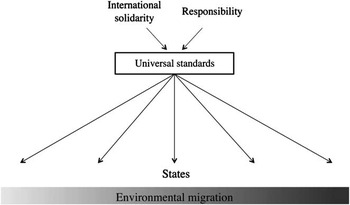
Legal reasoning, generally, is based on the implementation of general rules to specific circumstances.Footnote 75 If rules are deemed inadequate with regard to paralegal criteria (ethical norms, or dominant interests), law may be changed; here again, law provides for specific processes to amend the law. The governance debate on environmental migration has generally been conceived within such a framework. If international institutions are not appropriate, new institutions should be established; if universal standards are not appropriate, new universal standards should be found. Two distinct ethical notions, in particular, have influenced calls for new international norms, namely solidarity between wealthy states with those populations affected by climate change, and the responsibility of polluting states towards people suffering from climate change.Footnote 76Figure 1 shows the idealized process through which law would adapt to the new challenges brought by environmental migration.
Compliance Model

Following the simplicity of this approach to law in isolation from social and political processes, identifying law-making institutions is not necessary. After all, it seems, rights-based approaches towards environmental migration do not aim at doing anything other than help environmental migrants. Critical approaches to law, however, show that who makes law does matter, because it has a decisive influence on how laws are made and, finally, on what laws are made.
Chimni recently highlighted “the problems of doing research in the poor world” and “the academic domination of Northern academic institutions”.Footnote 77 In many fields, Western institutions—American, European, and Australian universities, research institutes, and NGOs—are defining the world's research agenda. This gap is obvious within studies concerning environmental migration. As one example out of many, a top Western researcher, having recently edited a significant book, circulated an email amongst fellow researchers asking if anyone knew “anyone from the South” knowledgeable about environmental migration to participate in a public event.Footnote 78 The Asian Development Bank Regional Conference on Policy Responses to Climate-Induced Migration in Asia and the Pacific, held in Manila in September 2011, was important at least because it was probably the first time such a major international event on environmental migration was organized in a developing country; however, once again, the overwhelming majority of the participants came to represent European, American, and Australian institutions. This reflects a system-wide vicious circle, whereby lack of research capacities impedes the recognition of Third World researchers in the global West, thus limiting access to resources that would develop capacity.
This is paradoxical—to say the least—for environmental migration is, or is perceived as, a phenomenon that concerns the developing world almost exclusively. Lack of development certainly impedes in situ adaptation—living under the sea level is not much of an issue for the Netherlands, but low elevation leads to much more critical situations in Bangladesh. Even when people are massively displaced by a hurricane in Louisiana or by a nuclear accident in Japan, researchers rarely perceive these displacements to be similar to those occurring in Bangladesh or in Ethiopia. An artificial dichotomy is assumed between “survivors” of environmental disasters in the West and “environmental refugees” in the Third World.
This geographical distance has led to a Western bias because it came hand in hand with an intellectual isolation. Western researchers working on environmental migration have generally been isolated from their “objects” of study; some of them have never visited any of the affected countries. Here, the asymmetrical posture of Western institutions looking at the Third World means that researchers may start with flawed preconceptions leading to wrong analyses. Several authors have recently identified the foreseeable consequence of this geographical gap—the construction of the environmental “refugee” as a poor, dark-skinned, and vulnerable, but dangerous, “other”,Footnote 79 leading to certain forms of securitization of the discourse on environmental migration. While the recent emphasis of Western research institutions on empirical research is important, it is probably not enough to correct fundamentally flawed perceptions, especially for legal or other policy-relevant research, which has often remained isolated from empirical elements. For instance, suggesting the ratification of a convention on “climate refugees” does not make much sense when dealing with countries that are not willing to ratify the Refugee Convention;Footnote 80 by contrast, the possibility of India extending its own (generous) refugee protection regime to international environmental migrants has rarely, if ever, been explored. In addition, the fact that most studies on migration, development, and security are written in the West has also impeded the development of transdisciplinary and holistic approaches to migration, security, and development.Footnote 81 Thus, geographical isolation has also led to disciplinary isolation. For instance, legal analyses of environmental migration that suggest a status for the “climate refugees” have paid little attention to the many works on migration studies highlighting, from the early 1990s, that environmental factors can rarely be isolated from other factors that cause environmental migration.Footnote 82
Also, the emphasis in the normative debate on theoretical questions with little immediate relevance is another symptom of the intellectual isolation from descriptive studies. Despite the fact that most environmental migrants are displaced within national borders, relatively little research has yet been carried out on the application of the guiding principles on internal displacement,Footnote 83 or, with regards to African countries, the role of the African Union Convention for the Protection and Assistance of Internally Displaced Persons in Africa, adopted in 2009.Footnote 84 In contrast, the sensational scenario of a whole state submerged by a rising sea, thus disappearing as a state, recalling legends such as Atlantis, has attracted much curiosity on the legal status of possible “stateless” islanders.Footnote 85 This is in spite of the obvious fact that all inhabitants of such a state would hopefully have left (or, if not, would have drowned) well before the total disappearance of the whole national territory. The (political) organization of a resettlement would, therefore, precede—and in practical terms at least contribute to solving—the (legal) issues of climate-induced statelessness.
B. Three Grounds for a Post-Colonialist Critique of the Governance of Environmental Migration
The disconnect between the normative research carried out in Western institutions and the reality of environmental migration mostly occurring in the Third World has impeded the policy-oriented debate to date. I am certainly not arguing that Western researchers intended to establish a post-colonial structure of governance. Rather, my argument is that certain elements in the debate reflect a drift towards favouring post-colonial structures of law and governance.
A few authors have already suggested post-colonial critiques of governance proposals relating to environmental or climate migration. Responding to Biermann and Boas's “case for a global protocol”,Footnote 86 Hulme submitted that, “[e]stablishing a protocol that would be supervised by an international executive committee would open up a new front in the emerging debate about green neo-colonialism”.Footnote 87 He argued that an exogenous management of environmental migration would likely be “paternalistic and centralizing”.Footnote 88 Similarly, Kolmannskog recognized the possibility of a post-colonialist critique
in the context of north-south discourse where ‘environmental security’ is seen as a colonisation of the environmental problems, suggesting that the underdeveloped south poses a physical threat to the prosperous north by population explosions, resource scarcity, violent conflict and mass migration.Footnote 89
I can see at least three points of entry to a post-colonialist critique of the current normative debate; namely, the notion of the “environmental refugee”, the growing influence of security-based approaches, and the policy priority given to preventing displacement.
First, the “climate refugee” has been constructed by the Western media and some NGOs as a vulnerable, passive “other”, unable to leave his (more often than “her”) “sinking islands”.Footnote 90 Gemenne and Shen showed that this construction of islanders ran the risk of “enclos[ing] them into a relativist trap and prevent[ing] them from developing adequate adaptation strategies”.Footnote 91 Gayoom also underscored that this perception could deny the willingness of most Pacific islanders to “stand up and fight”.Footnote 92 Additionally, little was made of the islanders’ unreadiness to be called “refugees”.Footnote 93 Often, Western environmentalists have used the image of sinking islands to push for actions to mitigate climate change; exotic “environmental refugees” were called to play the role of a canary in the coalmine.Footnote 94
A symptom of a post-colonial construct, the very term “refugee” is reserved for people of the Third World.Footnote 95 Following Dalby, Barnett showed that the perception of environmental change as a security issue relies on the discourse of “barbaric Southern Others residing in decaying natural environs (over there)”.Footnote 96 In contrast to the discourse on Pacific islanders, the term “refugee” “was unanimously rejected when 1.2 million New Orleanians were displaced by Hurricane Katrina in 2005, and the victims insisted on being called ‘evacuees’ or ‘survivors’”.Footnote 97 Former US President Bush had to intervene in the debate to assess that the displaced New Orleanians “are not refugees. They are Americans, and they need the help and love and compassion of our fellow citizens.”Footnote 98
Also, the term “refugee” conveys an inexact conception of people displaced by environmental change. It seems to imply an international, forced movement, which is at odds with the reality of environmental migration. On the one hand, most environmental migrants are displaced within their state,Footnote 99 and this prevalence of internal migrants is not likely to change even in worst-case scenarios of global environmental change.Footnote 100 On the other hand, environmental inducement to migration has increasingly been described as spanning a long continuum between forcedness and voluntariness. As explained above, in most circumstances, environmental factors are only one in a cluster of causes.Footnote 101 The notion of “climate refugee” is a symptom of an isolation of normative research from more descriptive research on environmental migration. Further, “refugee” has a connotation of internationality and violence that reflects and further conveys the dominant perspective on environmental migration: the “environmental refugee” is essentially constructed as a threat to the highly guarded and yet fragile prosperity of the global West.
Second, the securitization of environmental migration also reflects a post-colonialist drift in normative studies.Footnote 102 Ideally, international law, if it purports to convey “neutral” norms, should take the interests of all states into account. Yet the discourse on security is mainly focused on the interests of dominant states where this discourse is developed. The focus is generally on the possible risks that transnational crime, human trafficking or terrorism, and failing states could pose for Australia, the United States, and (perhaps to a lesser extent) Europe. Replacing the solidarity or responsibility-based narratives, “security” concerns have become more and more influential, and the fear of a human tide of “environmental refugees” in Western countries became the single most influential argument for political action. Countries of the Third World may have concerns of a similar nature, but what is at stake in most Western literature on environmental migration is the security of the West. Here again, however, the securitization of environmental migration relies on an alarmist discourse denounced by contemporary descriptive research;Footnote 103 in particular, it is based on the misleading assumption that environmental migrants will try to cross borders and “invade” developed countries. Such security-based perspectives displace the assumed neutrality of “universal standards”, as the security agenda looks at developing states exclusively with the interests of the developed world in mind.
Third, the Western bias in normative discussions on environmental migration has been reflected in an oft-heard hostility towards any form of displacement, as Western states perceived that they had much to lose and little to gain in allowing any form of migration. Far from searching for a sustainable solution for environmental migration, many policy-makers consider all forms of migration to be wrong.Footnote 104 Therefore, the emphasis has often been put on increasing resilience to avoid migration. As shown above, the action of the IOM in the Third World aimed mainly at building resilience and helping populations to face natural disasters without displacement, or at providing humanitarian support to those who had already moved, but not much at ensuring the dignity of potential migrants. To this extent, the IOM distances itself from its purpose, as defined by its constitution, which is to facilitate “orderly migration”, not to avoid migration.Footnote 105
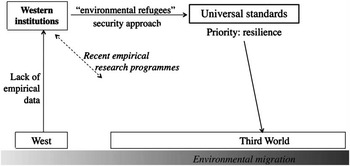
While migration is a constant adaptation strategy, the dominant paradigm on migration “management” (i.e. control) is certainly the greatest hurdle to successful adaptation to climate change. Indeed, it is often because they cannot migrate that vulnerable populations cannot adapt. The paradigm of migration management, which depicts the immigrant as an economic burden and a threat to national identity,Footnote 106 aims at protecting Western interests in a fundamentally unequal world. This paradigm can accommodate certain forms of migration only when those forms of migration are considered as a lesser evil. In this context, the rapid development of a discourse on migration as adaptationFootnote 107 may not have been entirely emancipated from the structural influence of this paradigm. On the one hand, internal or South-South migration may be perceived as a means to avoid mal-development and international migration. The Nansen Principles, reflecting a consensus amongst researchers, adopted the goal of “preventing displacement” before “assisting and protecting people and communities affected by such displacement” and “finding durable solutions”.Footnote 108 On the other hand, the development of temporary and circular migration provides cheap labour to Western countriesFootnote 109 (cf. Figure 2 for a representation of the post-colonial model).
Post-Colonial Model

IV. Resistance in Asia and the Pacific
A. A Theory of Resistance
Chimni fairly insists that a critique of the dominant ideology in order to defend the interests of Third World peoples “has to go hand in hand with a theory of resistance”.Footnote 110 Accordingly, “we need to study and suggest concrete changes in existing international legal regimes”.Footnote 111 Two different avenues can be followed in order to re-empower the Third World in general, and Asia and the Pacific in particular, with the legal frameworks applicable to the issue of environmental migration. The first option would be for the Third World to oppose Western domination and establish a symmetrical Southern or Eastern domination. The second, “softer” option would be to build up the capacity of states of the Third World to develop regional normative frameworks, which can apply to environmental migration.
The first option is unlikely to succeed in the foreseeable future. While some states in Africa, Asia, the Pacific, and Latin America may wish to push for global co-operation regarding environmental migration, the West has no such direct incentive, and would likely oppose any exogenous “universal standards”. Also, this option is impeded by the lack of political unity amongst states of the Third World and, as a consequence, by their lack of influence over the global political agenda. Experience highlights the striking differences between central and peripheral states regarding their ability to define issues and to impose a global agenda, in particular, regarding the issue of migration. In 1990, developing countries succeeded in having the General Assembly adopt the International Convention on the Protection of the Rights of All Migrant Workers and Members of their Families.Footnote 112 The main innovation of the treaty consisted in recalling the fundamental rights of undocumented migrants and the treaty does not contain any right to migrate. Twenty-one years after its adoption, the convention is now ratified by forty-five states, mostly sending countries in Latin America and Western Africa; no Western state and few significant countries of destination have ratified it.Footnote 113 To this extent, it is highly unlikely that some peripheral states would succeed in imposing any form of international governance regarding environmental migration globally or even upon other developing countries. International efforts on climate change mitigation or adaptation are supported by powerful civil society organizations, but even these organizations may be unable to affect state behaviour over the control of their borders. To this extent, global adoption of any binding instrument on environmental migration is unlikely,Footnote 114 even if it is supported by a significant number of states from the Third World.
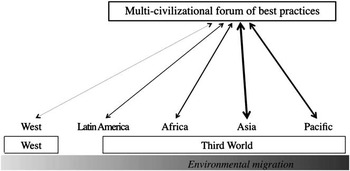
In comparison, the second option is more realistic. It consists of building up the capacities of states of the Third World to develop regional legal frameworks which can apply to environmental migration. While climate change is a global phenomenon, environmental migration, given that it occurs mainly within states and, at times, in a regional context,Footnote 115 does not necessarily justify a globally harmonized normative response. Overall, global regulation would be impeded by the isolation of normative research from empirical understanding of environmental migration. A bottom-up collection of best practices and an interregional forum, which may foster innovative policies, should be preferred to a top-down application of standards developed in disconnection from empirical experience. In such a bottom-up approach of regional best practices, actors in Asia and the Pacific are likely to play a major role, as this region is largely affected by environmental migration and has a growing research capacity in this area (cf. Figure 3 for a representation of the participative model).
Participative Model

Several normative studies on environmental migration have submitted that regional negotiations are more likely to succeed at pushing states to co-operate and take action than global negotiations.Footnote 116 This is not only because global engagement seems unfeasible at this stage, but also because past experience of legal development in the fields of migration and environmental protection have shown regional co-operation to be more efficient in establishing normative frameworks.
In migration matters, in particular, regional law has often proven to be an efficient tool for peripheral states to develop further co-operation and higher standards of protection in legal fields where the West has been reluctant to improve “universal standards”. Famously, instruments broadening the definition of the refugee were adopted in both Latin America and Africa.Footnote 117 Moreover, the 2009 African Union Convention for the Protection and Assistance of Internally Displaced Persons in Africa will give a binding force to a set of norms similar to the UN Guiding Principles on Internal Displacement.Footnote 118 Similarly, in 2007, ASEAN adopted the Declaration on the Protection and Promotion of the Rights of Migrant Workers (Cebu Declaration) and established a committee on its implementation.Footnote 119 Although this has not yet led to any binding instrument, this step may be of more significance than the International Convention on the Protection of the Rights of All Migrant Workers and Members of their Families, ratified by only one state (the Philippines) among the ten Member States of ASEAN.Footnote 120 Last, but not least, many states in Asia and the Pacific have engaged in regional consultative processes on migration organized by IOM, in particular the Colombo ProcessFootnote 121 and some local academic events,Footnote 122 with a view to facilitating regional co-operation between researchers, states and local authorities, and potential donors.
Similarly, on environmental matters, strong arguments have been developed in favour of regional governance. Tay highlighted that the incentive to co-operate may be stronger within a regional community of proximate and interdependent states with a relatively homogenous level of development.Footnote 123 Again, the Centre for Strategic and International Studies (CSIS) emphasized the ability of regional co-operation in Asia to “shar[e] and coordinat[e] physical infrastructure”, to “harmoniz[e] standards and policies”, and to “establish … norms and expectations for regional policies”.Footnote 124 Overall, the CSIS argued that regional organizations may “develop … networks of cooperation” where “officials and leaders from nearby countries who have to interact on border issues or other common problems are more likely to develop close working relationships than those whose home countries are distant and very different”.Footnote 125
Nonetheless, regional negotiations are certainly not the panacea. They may be an obstacle to financial contribution from the polluting developed states to the affected, developing states as should follow from the principle of a common but differentiated responsibility.Footnote 126 Furthermore, even at the regional level, states may be unwilling to adopt binding instruments. However, the flexibility of regional governance is desirable when dealing with environmental migration, where new policies need to be invented, evaluated, and circulated, and where excessive reliance on Western research capacities can be avoided. Moreover, no general definition of “environmental migrants” has been agreed upon that could be used to define a specific legal category of individuals.Footnote 127 Due to the complex causes of migration, applying such an abstract definition would face major practical hurdles.Footnote 128 Yet without a legal definition, there is a need for international co-operation. Therefore, a regional forum of decision-makers sharing good practices and agreeing upon non-binding principles could raise awareness, foster intraregional and interregional debates on specific issues, and thus contribute in substantially improving the lot of environmental migrants.
Besides, the regional normative debate on environmental migration in the Third World needs to steer clear of Western discourse on the issue. Admittedly, many regional initiatives in the Third World do not differ significantly from the dominant Western discourse. For instance, many rights advocates and state representatives from Bangladesh support the idea of a convention on “climate refugees”, which is often inspired by Western normative works.Footnote 129 There are three ways of explaining this. First, some leaders and researchers in the Third World have close links with the West; they may, for instance, be influenced by their Western education when analyzing local issues. This may explain their resort to security-based approaches towards environmental migration or preventive approaches towards migration that are similar to those developed in the West. Second, local researchers lacking access to research tools may have no choice but to rely on simplistic conceptions of environmental migration in the dominant Western scholarship. Third, Floremont showed that national authorities might have used Western security language to put environmental migration issues on the forefront as part of fund-seeking strategies.Footnote 130
Thus, the disconnect between research and empirical studies may be replicated within the Third World under the influence of Western education, the domination of Western research, and the demands of Western donors. Therefore, normative research needs to be carried out with a constant view of defending the interests of the Third World. A theory of resistance needs to take these important obstacles into account. Yet it would be wrong to conclude, in view of these difficulties, that scholarship on environmental migration should continue to be developed almost exclusively in the West, as this would only result in perpetuating the unfairness and inefficiency of post-colonial forms of governance. Due to geographical proximity, researchers and leaders of the Third World in general are more likely to understand the phenomenon and its challenges, and to identify possible solutions for the benefit of those affected, as compared to their Western counterparts. In the long term, increasing the capacity of research in the Third World can help avoid over-dependence on Western research institutions and enable the development of much-needed critical scholarship in the Third World.
B. Regional Endeavours in the Asia-Pacific Region
While there is no legal or governance framework applicable to environmental migration in the Asia-Pacific region as yet, the situation may be changing. First, a transnational civil society is progressively emerging and playing an increasing role in fostering regional debate and pushing for different kinds of formal or informal regional co-operation.Footnote 131 The Asian Disaster Preparedness Centre, for instance, aims at pushing for “safer communities and sustainable development through disaster risk reduction”.Footnote 132 Two Christian organizations have also been among the few civil society organizations that have actively addressed the issue of environmental migration at the regional level. They are the Pacific Conference of Churches and the World Council of Churches (Oikumene).Footnote 133 Elliott recently highlighted that
[t]he impetus for governments to respond regionally to environmental challenges has … been generated by a growing regional activism and agency on the part of domestic non-governmental organizations … and transnational civil society groups, some endogenous to the region and others represented by local offices of global organizations.Footnote 134
In a step by state authorities, the Asia Pacific Forum of National Human Rights Institutions, established in 1996, is currently implementing an advocacy programme on the rights of migrant workers.Footnote 135 It may soon push further to formulate public policies on environmental migration.
Regional legal frameworks on environmental migration or regional governance require that states accept certain restrictions on their sovereignty. In this regard, the South Asian Association for Regional Cooperation (SAARC) and ASEAN are two models of regional organizations that could open the way to normative discussions on environmental migration. SAARC started committing itself to environmental issues as early as 1991, when it recognized that the “region's ecology is such that it makes it one of the most disaster-prone regions in the world, exposed to a substantial share of the world's floods, droughts, cyclones, landslides, and earthquakes”.Footnote 136 Later, in April 2010, the Thimphu Statement on Climate Change took note of the region's particular vulnerability to “climate change and related disasters making the need for a regional response to meet the challenge of climate change more urgent and compelling”.Footnote 137 Accordingly, a regional programme could consist of “cooperative regional initiatives and approaches, exchange of experiences, knowledge, transfer of technology, [and] best practices to address the challenges posed by climate change”.Footnote 138
ASEAN is another possible normative framework. As an “imagined community”Footnote 139 in the making, ASEAN has gone further than any other regional organization in Asia and the Pacific in dealing with the rights of migrant workers or with the protection of the environment.Footnote 140 However, progress has been limited; no binding agreement has yet been adopted on the rights of migrant workers,Footnote 141 and the Agreement on Trans-boundary Haze Pollution was not ratified by Indonesia, which is the main regional source of haze pollution.Footnote 142 Generally speaking, ASEAN Member States have been reluctant to accept significant restrictions on their sovereignty, thus significantly limiting the prospects of an approach based on compulsory rights-based standards.Footnote 143 Nonetheless, Koh and Robinson highlighted that “ASEAN has emphasized programmatic cooperation”.Footnote 144 Accordingly, “ASEAN appears to have sustained a regional system for collaboration” and “has been remarkably successful in shaping a common regional environmental policy framework”.Footnote 145 Indeed, the possibility of a regional dialogue on migration is itself an achievement, as discussing the issue of state control on its borders within ASEAN could not have been imagined two or three decades ago.Footnote 146
Yet some degree of international funding may also be necessary for successful negotiations on environmental migration in the Asia-Pacific region. If not for its own sake—after all, some Asian countries are becoming increasingly wealthy, while Western states are facing financial difficulties—international funding is at least a moral responsibility as developed states which bear historical responsibility for climate change should pay for the consequences of climate change incurred by developed countries. In some cases, the apparently insurmountable financial obstacles to regional co-operation have led regional leaders to turn away from regional governance, and regional co-operation has at times been reduced to a fund-seeking strategy. For instance, despite the promising project of a regional governance through SAARC, Bangladesh Prime Minister Hasina proposed in September 2012 to use South Asian co-operation only to co-ordinate a “united call … to consider and adopt a new legal regime under the UNFCCC Protocol to ensure social, cultural and economic rehabilitation” for environmentally displaced persons.Footnote 147 Regional co-operation is, in this proposal, only to plead for an international regime that can channel North-South financial flows through a climate change fund.
Prime Minister Hasina's proposal for a united call contrasts with the statement by the Pacific Islands Forum in 2008, which seemed to expect more from regional co-operation. This statement encouraged “the Pacific's Development Partners to increase their technical and financial support for climate change action on adaptation, mitigation and, if necessary, relocation … and to ensure their assistance aligns with regional and national priorities and supports existing regional and national delivery mechanisms”.Footnote 148 Thus, while regional co-operation remains contingent to external funding, the statement by the Pacific Islands Forum implies that its regional co-operation could extend to defining the necessity of migration policies. Other groups of states merely aim at pushing the international community to act. Thus, the Declaration of the Climate Vulnerable Forum, adopted just before the Copenhagen Climate Change Conference, expressed the determination of those states most vulnerable to climate change, exhorting them “as low-emitting countries that are acutely vulnerable to climate change, to show moral leadership on climate change through actions as well as words, by acting now to commence greening our economies as [their] contribution towards achieving carbon neutrality”.Footnote 149
In this context, the involvement of the Asian Development Bank (ADB) is particularly promising. In 2010, the ADB launched a preliminary research programme, the goal of which was to identify the “policy options to support climate-induced migration”.Footnote 150 This programme consisted of an effort to improve empirical research and to realize a financial feasibility study, while developing a regional dialogue and raising awareness.Footnote 151 Although the programme was initially not presented as preparation for a further role for the ADB in financing national policies,Footnote 152 Dobias, a senior advisor to the programme, admitted that the ADB might nonetheless consider “enter[ing] into partnerships”Footnote 153 with other organizations. In particular, Dobias insisted that the ADB could “provide financial expertise and capacity [and] use [its] convening power [to] support programs and projects”.Footnote 154 The final report of the project, presented in March 2012, announced the establishment of an “Asia-Pacific Migration and Environment Network of researchers”,Footnote 155 but did not provide for international funding on specific actions.
The ADB may become an essential element of a regional approach towards environmental migration in the Asia Pacific region, as it has the institutional capacity and know-how to channel funds from its nineteen non-regional members to its forty-eight “regional” members through loans, grants, and technical assistance.Footnote 156 Its broad geographical scope, however, lacks coherence; developing member countries (DMCs) as distant as Kazakhstan and Fiji are unlikely to shape any form of imagined community. Yet this may be a necessary drawback of any organization which is able to channel multilateral funds on a global scale, and it can be mitigated by the capacity of the ADB to enter partnerships with other subregional organizations such as the SAARC, ASEAN, and the Pacific Islands Forum. However, developed states are unlikely to fund substantial programmes without having control over them, especially since donor countries do keep close control over the activities funded by the ADB.Footnote 157 Here again, subregional partnerships might contribute to reducing the asymmetrical power relations between the donors and receivers of international funds if groups of Asia-Pacific states succeed in co-ordinating a coherent position.
V. Towards a Regional Governance of Environmental Migration in the Asia-Pacific Region
A. “Asian Values” and Third World Approaches to International Law
The impediments to regional co-operation on environmental migration policies in Asia and the Pacific are well known. Both Third World Approaches to International Law on the liberal side and the argument based on “Asian values” on a more conservative side have traditionally put a strong emphasis on state sovereignty.Footnote 158 Such a theoretical posture generally resulted in, or, perhaps, was used to justify a lack of, international or regional co-operation amongst Asian countries. As a result, it was often argued that the “Asian way” is based on pragmatism and use of consensus, the avoidance of conflicts, non-intervention in the domestic affairs of other countries, and, until recently, an emphasis on the protection of states’ sovereignty.Footnote 159
However, descriptive arguments on Asian values and the “Asian way” tend to artificially reduce a complex set of civilizations to a few simple features. In the words of Amartya Sen,
there are no quintessential values that separate the Asians as a group from people in the rest of the world and which fit all parts of this immensely large and heterogeneous population. The temptation to see Asia as a single unit reveals a distinctly Eurocentric perspective.Footnote 160
For instance, while the Charter of the Association of Southeast Asian States underscores the principle of sovereignty as a limitation of the mandate of ASEAN,Footnote 161 so do, for instance, the Charter of the United NationsFootnote 162 and the Consolidated Version of the Treaty on European Union.Footnote 163 The principle of state sovereignty is a constitutive feature of Westphalian international law and it is not unique to Asia. At most, it may be argued that Asian states have generally invoked sovereignty with greater insistence than states of other regions.Footnote 164
Moreover, the causes for a lack of regional co-operation in the Asia-Pacific region are not to be found in any essential civilizational feature, but in contingent circumstances. On the geopolitical perspective, Weatherbee argued, “Southeast Asia is not analytically sui generis. It is a regional setting for an international relations regime that is a part of a global international order.”Footnote 165 On a more sociological perspective, Tay argued that ASEAN's inability to generate broad co-operation on environmental matters stems from the fact that “[t]ies between the peoples of the region have not received much attention, whether as regards environmental concerns or other issues”.Footnote 166 Accordingly, instead of an Asian civilizational particularism, the little regional co-operation within Asia may be explained by the “lack of a sense of regional community”.Footnote 167
Similarly, in the debate on Third World Approaches to International Law, a recent turn has somewhat nuanced the emphasis on the notion of sovereignty. According to Anghie and Chimni,
while recognizing the fundamental importance of the doctrine of sovereignty for advancing third world interests and for protecting and preserving third world states against various forms of intervention, TWAIL II scholars have developed powerful critiques of the third world nation-state, of the processes of its formation and its resort to violence and authoritarianism.Footnote 168
Today, “TWAIL II” theorists argue that the protection of the individual may, and should, justify interference with sovereign states.Footnote 169 Therefore, protecting environmental migrants through self-determined regional co-operation is one of the circumstances where “TWAIL II” proponents would, I believe, agree that limiting state sovereignty is in the interests of the Third World.
B. The Prospects of the Regional Governance of Environmental Migration in Asia and the Pacific
Another consequence of the concentration of normative studies on environmental migration within the West is with regard to the forms of governance considered. Already, Panikkar has warned against the mistake of assessing the “progress” of Asia from a Western standpoint.Footnote 170 More specifically, Alvarez has argued that the “modern” Western ideal of international law as consisting of obligations, precision, and delegation is not necessarily the only way of thinking about relations between peoples, nor even the only way of conceiving of international law.Footnote 171 Evaluating institutions of regional co-operation in Asia and the Pacific using the benchmark of international co-operation as carried out, say, by European institutions, is a wrong approach. According to Elliott and Breslin, “there is no single approach to regional cooperation and governance”.Footnote 172 Instead, they argued,
there is a multiplicity of intergovernmental regional environmental efforts, some highly institutionalized and others not; some embedded in broader regional efforts and others specific only to environmental policy; some fragmented and some coherent; some constrained by the efforts or demands of individual regional powers—hegemonic regionalism—and others more equitable or balanced.Footnote 173
Any definitive statement on what an Asian or Pacific conception of international law should be like would readily fall into the “trap of cultural essentialism in characterizing and discussing the features of different civilizations”,Footnote 174 not least because Asia and the Pacific, and each state within the region, have extremely little civilizational homogeneity.Footnote 175 Flirting with such essentialism, however, Chimni argued that the “Asian exceptionalism … in the area of refugee protection”, in particular the lack of ratification of the Refugee Convention,Footnote 176 may result from the civilizational fact that “law is not perceived as the principal response and solution to safeguarding the dignity of strangers”.Footnote 177 As reflected by Chimni, “Asian cultures arguably tend to rely instead on societal values and traditional practices to ensure protection” for forced migrants.Footnote 178
Even though one should refrain from generalized statements about civilizations, the recognition of their specificity is instrumental in the achievement of a “just world under law”.Footnote 179 Therefore, instead of the top-down approach towards compliance of international law, Chimni has argued that civilizations should “draw … on the best practice[s]” of each other.Footnote 180 In the constitution of this “multi-civilizational approach to international law”,Footnote 181 imports from other civilizations are legitimate as long as they “advance the cause of a peaceful, democratic, and just world order”.Footnote 182 Thus, Chimni underscores that “in the absence of a law on the status of refugees, it may be difficult to effectively protect the rights of refugees”.Footnote 183 However, the contrary is also true, at least in theory—the most comprehensive international treaty may not be able to force the state parties to implement their obligations. All state parties to the Refugee Convention do not systematically provide better treatment to refugees than non-party states. In circumstances such as environmental migration, where the ratification of a treaty is unrealistic, international governance can only be found through a subtle mix of legal norms, political governance, and social norms—what Chimni called a “multi-civilizational … conversation on the ideal and optimal mix of legal and societal values and practices”.Footnote 184
Empirical research is needed to identify the existing best practices in Asia-Pacific states. For instance, it may appear while reading Tay that one of the best practices of Southeast Asia is transnationalism, a form of governance which can be defined as “the complex web of national, local and international actors that bring attention to issues like the Bakun dam construction in Malaysia”.Footnote 185 Instead of conceiving of international law as a monolithic pyramid of norms, there are many practices in Southeast Asia, in particular, with regard to the protection of migrants and the environment, whereby a plurality of public and non-public actors collaborate in the negotiation and implementation of pluralistic and hybrid systems of governance.Footnote 186 It may be to the benefit of environmental migrants to develop this practice of transnational governance and share it with other regions. In this sense, the Asia-Pacific region may be more than a canary in the coalmine or a laboratory for environmental migration policies.Footnote 187 The Asia-Pacific region, incentivized by a “will to differ”Footnote 188 and to affirm its role in a new global order, may participate in a multi-civilizational forum where normative approaches to environmental migration are shared.
Indeed, Asian scholars’ take on the challenges brought by environmental migration may fill some of the gaps of a Western perspective. The Western notion of individualistic human rights and the emphasis on law and states as assistance providers (to the exclusion of communities) do not suffice to tackle all of the challenges raised by environmental migration. Thus, defining a category of environmental migrants may be difficult because of the complex causes of displacement.Footnote 189 Similarly, a state may be unable to protect its population when affected by a vast natural disaster. In this context, something is needed beyond human rights. The so-called “Asian values” may precisely invite such a constructive discussion with the human rights regime, for instance, through its emphasis on the role and rights of communities. The importance that “Asian values” places on social and economic rights also makes sense in addressing the causes of environmental migration driven by slow-onset environmental changes, where migration is often induced by the social and economic consequences of environmental changes. Thus, if “Asian values” is something more than a pretext for some governments not to implement some generally recognized human rights standards, it should also lead to its own form of protection and assistance. Indeed, one can hardly imagine a better opportunity for the participation of the rising states in the Asia-Pacific region in the international law-making community and the affirmation of alternative positive values.
VI. Conclusion
This article has shown that there are two main reasons why the Asia-Pacific region should feel concerned by environmental migration. One is obvious—exposure to environmental change, a low level of development, and high population density, coupled with migration as a regional “structural feature”, explain why a large proportion of global environmentally induced migration is occurring and will continue to occur within Asia and the Pacific. Yet this article has also shown another reason why researchers and decision-makers in Asia and the Pacific are concerned with environmental migration. From a normative perspective, protecting millions of people on the move, often without the necessary preparations, is a real challenge. Ambitious standards of protection for climate migrants are unlikely to be adopted any time soon. The Western-led debate tends to impose a post-colonial discourse that constructs “environmental refugees” as passive victims, and international law as an instrument to roll back migrants in the perceived interest of Western states, instead of protecting them for their own sake. This debate would lead to an impasse. Instead, intra-regional and interregional discussions would certainly be able to invent a new form of governance, and the Asia-Pacific region, with its rapid pace of development and growing research capacity, is the ideal place for legal innovation on this issue.
Thus, the Asia-Pacific region should continue to enhance new research capacities in order to address environmental migration from within. Since 1985, when a UNEP report on “environmental refugees” was published,Footnote 190 Western researchers have published many reports, books, and articles on the subject, but very little research has come from the Third World. Too often, Third World researchers and research institutions have seemed unaware of or disinterested in the issue of environmental migration. Today, the development of regional governance structures to address environmental migration may express the will of Asia-Pacific states to differ and to demonstrate the capacity of their regional values to contribute positively to the conduct of global affairs.
Some regional fora already exist in the Asia-Pacific region that may take the lead at the regional or subregional level, and a transnational civil society is developing. There is no existing law that is directly applicable to instruments for transnational governance or legal frameworks to date. A multilateral convention seems unlikely to be ratified, but other possible routes include, for instance, discussion, planning, co-operation, and regulation. A home-grown approach towards environmental migration governance does not need to reinvent the wheel, but it does need to decide how the vehicle will be used in the most efficient manner, and quickly. Regional and subregional engagement is necessary and urgent. At stake are the lives and the dignity of millions, most of whom are in the Asia and Pacific region.