Sargent Shriver, the first director of the Peace Corps in the 1960s, believed American colleges and universities were ideal places for training prospective Peace Corps volunteers. Faculty members had the expertise to introduce volunteers to the history, culture, and language of host countries and campus facilities had the capacity to accommodate large groups of volunteers during the summer months. Over the course of the 1960s, eighty-four colleges and universities in thirty-two states held Peace Corps training programs. At decade's end, these campus-based trainings involved close to fourteen hundred faculty members and trained around sixty thousand Americans for service abroad.Footnote 1
The partnership reflected not only what historian Christopher Loss sees as the postwar marriage of the federal government with American higher education but also the triumph of science as democratic polity. Postwar development efforts were rooted in two theories that emerged out of the university: modernization and community development. On the one hand, the Peace Corps was a direct reflection of modernization theory, in which the volunteer was defined as “mid-level” manpower who represented the missing link in the “take off” of emerging countries. The assumption of the modernization theory was that Western forms of knowledge and technology would help countries “develop” along the same path as the United States. On the other hand, the volunteer was also defined as an astute observer who exchanged ideas and traditions through community-development projects. The university's conception of citizenship education linked these two different ideas of development in the Peace Corps. Sociologist William Talcott argues that the embrace of science as the primary organizing principle in American higher education led to the “eventual dominance—especially in research universities—of a modernist model of citizenship.”Footnote 2 This model recast citizenship education as a method of inquiry, rather than a mode of social action. In the early 1960s, campus-based trainings largely adopted this model, bringing in expert lecturers to educate modernist citizens who shared American “know-how” around the world.Footnote 3
But Peace Corps staff and volunteers challenged these approaches to education and the resulting gap they saw between training and the Peace Corps experience. As historians Fritz Fischer, Jonathan Zimmerman, and others have rightly noted, the Peace Corps experience led volunteers to reevaluate liberal development ideas and the cultural assumptions underlying postwar development efforts more broadly. And as this article seeks to show, the evolution of Peace Corps training demonstrates that many volunteers’ observations went a step further, connecting their criticisms of development practices to the “what” and “how” of their educations on campus. Peace Corps staff and volunteers argued that the modernist model of citizenship education in the university—in particular the emphasis on disinterested judgment, rationality, and objectivity—marginalized moral, experiential, and humanistic forms of inquiry. Staff and returned volunteers emphasized that the latter forms of learning were vital to developing knowledge about the self and the world.Footnote 4
Volunteers and staff, however, disagreed on the meaning of field experiences in relation to education. Some volunteers critiqued what they saw as the gap between theory and application. Their training had exposed them to theories and ideas but provided very little opportunity to put them into practice. Returning home, they pushed for more opportunities to work in communities or teach in classrooms in the United States as a means to better prepare future volunteers for community-development work overseas. Other volunteers and staff argued that the problem wasn't merely the application of theories (or lack thereof). Rather, they argued that the “knowledge”—that is, content—they were taught on campus was wholly inaccurate to the worlds they experienced. They argued that their volunteer experience demonstrated that learning was an experiential process embedded in community interaction and exchange, just as much as in the classroom. A contingent of volunteers argued that what they learned through their volunteer experiences directly challenged the underlying assumptions of promoting American development and volunteerism abroad.
The critiques Peace Corps volunteers raised adds to a rich scholarly field on the interactions and tensions between student social activism and the university in the 1960s. Scholars such as Martha Biondi, Robert Cohen, and Joy-Ann Williamson, among others, have illuminated the ways that student activists challenged the perceived neutrality of the university, called out the racial and gender biases embedded in the college curricula, and insisted that public universities do more to serve the community. Other scholars, such as Matthew Levin, have looked at the ways modern state universities came under attack for their relation to the federal government and the Vietnam War.Footnote 5 The Peace Corps–university partnership overlapped with these efforts. At the 1966 Education Reform Conference sponsored by the National Student Association, Michael Rossman, a Free Speech Movement activist, argued that the Peace Corps “suggests definite models for radical reform of the university.” He explained that the Peace Corps “came to the university for help” but, like college students in the late 1960s, “found its curriculum basically irrelevant and its methods pernicious.”Footnote 6 The Peace Corps–university partnership sheds light on one side of a broad-based campus movement in the 1960s that sought to rethink prevailing educational trends and the place of experience in higher education.
But the Peace Corps’ efforts were also limited by ideas of development rooted in the assumptions about knowledge and education in the modern university. In response to volunteer criticisms, Peace Corps training staff integrated field experiences into volunteer training. The dominant method to emerge served as a means to bridge the theory–application divide and give prospective volunteers “cross-cultural” experiences before going overseas. In this model, the “field” was regarded as a space for testing theories on the world. Although the field experiences provided a method by which volunteers could interact with their training, they nonetheless maintained the underlying logic of the university and development—the training of modernist citizens who imparted American expertise to the world.
Organized in four sections, this article examines the origins of the Peace Corps’ partnership with colleges and universities, the agency's evolving pedagogies and complex relationship to American higher education, the new training methods, and the legacy of the Peace Corps on campus. The debates and disagreements that arose in campus-based Peace Corps training reflected deeper questions that went to the heart of education, in particular educational content versus experience, local versus expert knowledge, and objective versus subjective judgment. Volunteers argued that the three elements that made the Peace Corps powerful—experiential learning, mechanisms for personal involvement in decision-making responsibilities, and a world view—were lacking in the American university. Over the course of the 1960s, Peace Corps staff and volunteers developed new ideas of education on campus, especially the emphasis on experiential learning. But the assumptions about development constrained the broader visions of the Peace Corps’ education in the 1960s. The legacy of this endeavor was “service learning,” which reflected the hallmarks of the experiential, but marginalized the underlying challenge to modernist citizenship and postwar development—the assumption that applied expert knowledge was all that was needed to develop communities.
Founding Ideas: Educating Americans for Public Service
On October 14, 1960, presidential candidate John F. Kennedy made a late-night stop at the University of Michigan. Met by a crowd of students, Kennedy proposed what later became the Peace Corps. During his short speech, he made a direct connection between students’ education and their role in the world. He challenged the students to use their education as doctors and engineers and “contribute part of your life to this country.”Footnote 7 Kennedy believed that an international “youth corps” held the potential to connect young people's education to a broader public service mission. Shriver also believed that such experiences abroad were important for a young person's self-development. When Shriver met with Prime Minister Jawaharlal Nehru in India to promote the new program, he underscored the potential benefits for American volunteers. “By permitting American Peace Corps volunteers to participate in India's development efforts,” he explained to Nehru, “they would be giving the volunteers a chance to find themselves.”Footnote 8 Kennedy and Shriver believed that the Peace Corps held immense educational possibilities, both in the sense of public service and individual growth.Footnote 9
The references to education Kennedy and Shriver made reflected the ways education had become a key tenet of America's Cold War policy-making. Study abroad and cultural exchange programs had been around since the first part of the twentieth century. After World War II, these programs grew in number, sparked by increased federal funding. New federally-sponsored initiatives like the Fulbright Exchange program developed under President Harry Truman connected and expanded existing efforts. As much as these programs were devised to cultivate more globally aware American citizens and internationalize the college campus, they were also designed to win the “hearts and minds” of people in the decolonizing world.
The geopolitics of cultural exchange and postwar development ideas shaped the three core goals of the Peace Corps. The second and third goals underscored how the program would help promote better understanding between Americans and countries in the decolonizing world. Rhetorically speaking, the Peace Corps couched this goal in a language of cultural exchange and understanding but, in actuality, the goal much more closely paralleled Cold War ends to align the decolonized world with the United States. The Peace Corps also embraced the assumptions of knowledge and education in the postwar university. The task of the Peace Corps was to prepare modernist citizens who could offer expert advice and objective observations on the problems of a particular community. As explained in its first goal, the Peace Corps helps “the people of interested countries in meeting their need for trained men and women.”Footnote 10
In his final report written in early 1961, Shriver connected the educational and knowledge resources of the modern university to Cold War ideas of cultural exchange. “The Peace Corps is in fact a great venture in the education of Americans,” Shriver explained to Kennedy. Shriver turned to American colleges and universities to achieve the educational goals of the Peace Corps. “As a high educational venture,” Shriver wrote, “its proper carriers are our traditional institutions of higher education.” He explained that American colleges and universities offered several advantages for training Peace Corps volunteers, such as recruitment, campus facilities, and expert knowledge. At the same time, Shriver also believed the agency could, in turn, help internationalize the curriculum. A partnership with American higher education, he explained, will help “American education expand its horizon—its research and curriculum—to the whole world.” He hoped that such efforts could influence the way students saw their education and political roles. “With colleges and universities carrying a large part of the program, and with students looking toward Peace Corps service,” he wrote, “there will be an impact on educational curriculum and student seriousness.” Shriver ultimately saw the training partnership with American colleges and universities as a way to internationalize the college curriculum, link university content to experiences in the world, and realize the public service ethos of American higher education. The Peace Corps, in other words, was just as much an experiment in education as it was a new endeavor in technical aid.Footnote 11
Academic leaders and faculty were receptive to the Peace Corps. Lawrence E. Dennis, Vice President for Academic Affairs at Pennsylvania State University, believed that universities should be the “co-pilots of the program” because when “we speak of concepts of ‘public service’ and ‘public responsibility’ we are in the realm of education—for those are value concepts that denote an attitude toward one's fellow man.”Footnote 12 In a letter to the New York Times, New York University Professor of Education Frederick L. Redefer also argued that universities had an important role to play in the program because the new agency represented a way to realize the public service mission of American higher education. He argued that “the colleges of this country, with the student and public interest in an ideal of service, must adopt more than an ‘interested but passive’ attitude. They need to contribute constructively and vitally to the idea” of the Peace Corps program.Footnote 13 George H. T. Kimble, chair of the Geography Department at Indiana University, believed, like Shriver, that the program could educate America about the decolonizing world. Writing in the New York Times Magazine, he argued that “the ‘receiving’ countries have much to give our Western World. Some of them could instruct us in the business of living in multi-racial societies” while other countries could teach Americans about “the false values of materialism.” He saw in the Peace Corps an opportunity to develop “a multilateral organization in which the emphasis is placed on reciprocal, rather than one-way service.”Footnote 14
In early 1961, the Conference of University Presidents publicly endorsed the new program. The gathering brought together thirty university presidents and representatives from across higher education, including such institutions as Harvard, Fisk, Michigan State, and Howard Universities. Like others in academia, they supported the program because of its emphasis on educating young Americans. All agreed that the new program held the potential to benefit the university by broadening its educational horizons to Asian, African, and Latin American cultures, developing new area studies programs, and establishing relationships with institutions abroad. The partnership also brought with it a financial benefit to colleges and universities involved. At the peak of the Peace Corps–higher education partnership, the agency spent more than fifteen million dollars on its training efforts for the 1967 financial year.Footnote 15
The positive response among academic leaders and the significant scale of financial investment reflected the growing role of higher education in national and economic policy-making in the United States. Beginning with the Truman Commission report in 1947 and culminating with the National Defense Education Act in 1958, American policymakers developed an expansive partnership with institutes of American higher education. In the case of the Peace Corps, American colleges and universities served as a key administrative arm of the new agency through research, recruiting, and training. The partnership also illuminated the shared belief among postwar policymakers and academic leaders that higher education was vital in the defense and spread of American democracy. Those involved in the Peace Corps—on and off campus—saw campus training as a way to fully realize the democratic visions of higher education. “Peace, mutual understanding and international service are the goals sought after by the Peace Corps,” wrote John J. Simons from the Peace Corps’ Office of University Relations. “They are also goals of universities and other educational institutions.”Footnote 16 But as the Peace Corps and American higher education embarked on its partnership in the 1960s, issues quickly arose as the first volunteers were sent abroad. Despite the resources on campus and faculty expertise, many young Americans discovered they were ill-equipped for their service abroad. The issues that volunteers encountered led many within the Peace Corps to examine the educational assumptions of American colleges and universities.Footnote 17
Designing Peace Corps Training
Preparing volunteers for international service wasn't new to the United States. Programs such as the American Friends Service Committee, the American Red Cross, and other nongovernmental organizations had long histories of developing strategies and techniques to prepare Americans for work outside the United States. These efforts, however, were largely on the periphery of American education and had little to no relation to American higher education. At its inception, the Peace Corps was different. The Peace Corps tasked American colleges and universities with the responsibility of preparing young, mostly white, middle-class Americans to work in Asia, Africa, and Latin America. As the table “College and Universities Involved in Peace Corps Training 1960–1970 (by region)” brings to light, the partnership brought the question of how to prepare a young person for community development to the heart of formal education.Footnote 18
The goal of the training program was ambitious. According to Robert Iversen, head of training programs in the early 1960s, the aim of Peace Corps training was to make the volunteer “comfortable in two cultures” and one who is able to “function within a broad ‘work situation’ rather than only in a single specified job.”Footnote 19 The Peace Corps also wanted to ensure that the volunteers had the necessary skill sets for their positions abroad. Most prospective volunteers were considered generalists, in that many volunteers had liberal arts degrees and a number had only completed high school or some college. The Peace Corps faced a threefold challenge: how to develop effective pedagogical techniques for an educationally diverse group of prospective volunteers, how to make students adaptable to a range of experiences, and how to equip the volunteers with skills to provide technical support.Footnote 20
Although Peace Corps staff described the new training program as “more than a standard college course” with a “mixture of academic, technical, and cross-cultural studies,” most training guides for the Peace Corps were based on and presented in the idiom of college coursework.Footnote 21 The Peace Corps gave universities a set of guidelines for the training, but the format and content were largely left to the university and chosen faculty. The training program at Michigan State University, for instance, looked impressive on paper. It included the history, geography, and politics of the host country; language and cultural studies; American studies; world affairs, health and medical training; and physical education. However, each subject was treated separately as a freestanding course, with its own set of lectures by a faculty member. Albeit with a bit more rigor from physical education, the training was largely an extension of the undergraduate or high school experience. American colleges and universities largely applied the modernist model of education to the Peace Corps.Footnote 22 The Peace Corps–university partnership assumed that a range of courses on history, culture, and technical training was enough to prepare mid-level experts for development work around the world.
Colleges and Universities Involved in Peace Corps Training, 1960–1970 (By Region)

Sources: Data from Peace Corps Division of University Relations and Training, “Training Sites for Peace Corps Volunteers,” Report, June 1961- Dec. 1964, box 3, VISTA Training Files, 1964–1965 (P/5), Records of the Corporation for National and Community Service, 1964 – 1993 (RG 362), NARA; “College and University Training Sites,” November 1962, box 3, Subject Files of the Office of the Director, 1961–1966, Records of the Peace Corps (RG 490), NARA; “Training: Shaping of Volunteers Is an Ever-Changing Process,” Peace Corps Volunteer, 2, No. 4 (Feb. 1964), 13.
Officials in the Peace Corps, however, quickly learned the limits of simply replicating the predominant model of higher education for training in international service. An episode abroad involving Peace Corps volunteer Marjorie Michelmore is illustrative. A Smith College graduate, Michelmore was one of the first Peace Corps volunteers abroad and served with the first group in Ghana. After a couple months, she wrote home about her first encounters in Ghana, much of which she found shocking to her American mind. In her postcard home, she wrote, “We had no idea what ‘underdeveloped’ meant,” in particular, the “squalor and absolutely primitive living conditions rampant both in the city and in the bush.”Footnote 23 Such descriptions were harmless in the context of a personal letter home, but the card never made it home. On her way to work, she dropped the card, which was later found by a Ghanaian student. To Ghanaians, such descriptions of their home country ignored the legacy of colonialism and its impact on the social and economic life of locals. Within a week of the card's discovery, thousands of Ghanaian students gathered on the main campus in Accra and called for the end of the Peace Corps in Ghana.Footnote 24
The Ghanaian response to the postcard illuminated the underlying assumptions of the Peace Corps. When the Peace Corps began, many supporters assumed that the very “American-ness” of young people was enough to provide aid abroad. Ray Olpin, University of Utah President and a Peace Corps supporter, believed that “millions of Americans are already oriented and experienced in the elements of education, technology, sanitary living, wholesome eating, and related activities” and “is a great resource ready to be tapped.” Olpin argued that “many of these might be taught how to share their know-how with those lacking it.”Footnote 25 Yet, despite the fact that Michelmore was a summa cum laude graduate of Smith College and, in the words of Olpin, “oriented” in the American way of life, her card reflected a complete misunderstanding about the world and the complex issues presented by “development.” Michelmore directly connected her shock to her training on campus. “With all the training we had,” Marjorie wrote, “we really were not prepared.”Footnote 26
Michelmore wasn't alone in citing problems with campus-based training. Many volunteers criticized their training in two major areas. Some argued that the method—in particular the lecture model—did not provide volunteers with the opportunity to develop the practical and emotional skills necessary for their work overseas. In training evaluations completed while overseas, volunteers complained about the lectures and the overemphasis on theory. The evaluation on the training program at the University of California, Berkeley noted that most volunteers found the university's training as “dreadfully theoretical, and not very ‘practical.’”Footnote 27 Lawrence Dobson, a Peace Corps volunteer who later became a trainer, summarized what many volunteers found as the central problem with training. He explained that his training program had left him “intellectually detached.” After the training, he and others had “learned very little of the subtler aspect of the experience we were about to undergo, because there was little physical and emotional involvement.”Footnote 28 Returning home, many volunteers contended that experiential components needed to be integrated into the training. As the evaluators at Pennsylvania State University concluded, the basic problem in campus-based training is integrating the “emotional experiences of Peace Corps training with the intellectual experience” of the university.Footnote 29
Other volunteers connected their criticisms of the method with what they saw as the inaccuracies and, more broadly, inadequacy of content. After being placed overseas, many realized that what they had been taught did not reflect the worlds they experienced. Volunteers trained at Syracuse University connected their critiques of the method to what they saw as the irrelevancy of the content. They concluded that “with a few exceptions, the lectures have been incredibly dull, the material has been unrelated to Liberia, and it has been presented so poorly that most of us have lost interest.”Footnote 30 At the Ohio State training, the report quoted volunteers who found that faculty only offered disconnected, academic knowledge of the host country. The volunteers believed that this was a result of the separation between the work of the academic and that of the community. The volunteers explained that based on their experiences it became clear that the instructors had spent very little time in India and “were out of date and out of touch.” The volunteers noted that even those professors who had traveled there “had obviously spent it teaching in universities and not out in the field under conditions which the volunteers will face.”Footnote 31 Such criticisms show that many volunteers believed that the material taught was detached and irrelevant to Peace Corps service.
Most volunteers had only known education through schools and universities, but the Peace Corps enabled them to learn outside the context of the classroom. Returned volunteer David Schickele described the Peace Corps experience as a “total education, a bonding of the active and contemplative in which experience is made meaningful and books become experience.”Footnote 32 Two years after returning home from Nigeria, Schickele wrote an essay about his experience in the student newspaper of his alma mater, the Swarthmore College Bulletin. While Schickele's task as a Peace Corps volunteer was to teach, his 1965 essay revealed that he felt that he had learned just as much, finding in many ways that he “was more alive intellectually at Nsukka” than at Swarthmore.Footnote 33
While training evaluations illuminated underlying critiques concerning the approaches to and content of training, the Close of Service reports revealed that many volunteers went further by underscoring that the service experience itself represented an alternative model of education. After their service abroad, the Peace Corps conducted what they called Close of Service Conferences, where they asked the volunteers what they learned and how they changed overseas, among other questions. The Close of Service report for Chilean volunteers made clear that volunteers saw their experience as a way of learning and knowing the world that contrasted with what they had been previously taught. The authors noted how the volunteers became “conscious of new alternatives” as a result of the experience and “more aware of their pre-Peace Corps conformity.” The author of the report also noted that “the kind of personal and intellectual awakening described by many of these volunteers suggests the possibility that the Peace Corps experience has done more for them, and others, what their college training had failed to do.”Footnote 34
Underlying what some volunteers described as the personal and intellectual awakening of their experience was a deeper critique concerning the assumptions of the Peace Corps and community-development work. Over the course of the 1960s, many volunteers were troubled by their presence overseas and their work as a volunteer more generally. Paul Cowan, a volunteer in South America, believed that the overseas experience influenced the politics and outlooks of the volunteers. “Volunteers feel their loyalty shifting while they are stationed abroad,” Cowan wrote, “shifting away from the United States government and toward the host country nationals.”Footnote 35 In the process, volunteers realized a discomforting truth about their volunteerism. David Bragin, a three-year Peace Corps volunteer in Ecuador, connected the limitations of his work to the problems of larger society. He had set up an agricultural cooperative in Ecuador but eventually realized that it was impossible to set up a “nonexploitive” organization in a society “based on exploitation.” He ultimately concluded, “What this comes down to is a very naïve concept that volunteer service can be a-political while, in reality it always is in support of the status quo not only of the oligarchy in power, but actually of the political party that is in power.”Footnote 36
Many of these critiques lay at the core of the Committee of Returned Volunteers (CRV). Started in 1966, the CRV was made up of a thousand returned Peace Corps volunteers. The organization challenged the underlying assumptions of the Peace Corps and pushed for new policies that promoted what returned volunteer John McAuliff called “equitable development.” The CRV and other efforts by returned volunteers reflected the potential of the volunteer experience as a means to rethink ideas of development.Footnote 37
In the context of the Peace Corps training, however, staff tended to reframe these criticisms more as the result of culture shock. Peace Corps staff made changes to the training without necessarily reconsidering the assumptions underlying volunteer and development work. The staff distilled criticisms into what they saw as three key issues related to Peace Corps training: the lecture model, the lack of applied experience, and the paternalistic atmosphere of the campus. Lawrence Dennis and Joseph F. Kauffmann, two staff members in the Division of Training, argued that the “traditional didactic approaches” of the lecture did not “introduce affective as well as cognitive goals into the training process.”Footnote 38 Jules Pagano, another staff member in Peace Corps training, concluded that the early efforts were “rigid, lacked variation, and held us to the kind of educated provincialism which is difficult to break away from,” referring to the staid practices in the university.Footnote 39 Lawrence Fuchs, the director of the Peace Corps in the Philippines, concluded that the Peace Corps ultimately had to move away from the undergraduate model. He wrote, “Make [training] less like the undergraduate experience, as it affects the qualities of resourcefulness and self-reliance which are so important to the volunteers in the field.”Footnote 40
Such reflections by Peace Corps staff make clear that the agency had to reconsider its approaches to training education. From 1962 to 1967, the Peace Corps began to experiment with new educational approaches. The new training models that emerged reflected the ways that volunteer experiences affected educational practices in the Peace Corps. But these new education strategies failed to address many of the critiques volunteers raised concerning the agency's ideas and assumptions about development. Modernist assumptions of knowledge and development continued to constrain the practice of education in the Peace Corps.
New Training Models
Training staff and returned volunteers developed two new approaches. The first and most widely adopted approach moved away from the lecture model and integrated field experience as a way to apply theory. The content and the assumptions largely remained the same, but now prospective volunteers had an opportunity to test and experiment with those ideas through work in various US communities. The second, largely marginal, approach also integrated “field experiences.” This approach drew on the liberal arts tradition and, in contrast to the first, encouraged the volunteers to think more critically about their experience as a means for individual growth. The key difference between the two “field” experiences came down to how the field experience was defined and how this experiential component was viewed in the educational process. The more widely adopted approach defined the field as an opportunity for applied learning—a view not unlike the general practices of the university. The liberal arts approach defined the field as a means to learn from the community and saw the field as another component of learning, rather than just a mode of application.
Both approaches shared some commonalities. Each moved away from the lecture model to seminars in order to encourage trainees to actively engage with the content. The approaches also extended the time devoted to language instruction, and the agency developed a new model of language instruction—later known as the Rassias Method—that emphasized dialogue and conversation as more effective ways of learning a language over grammar and reading. International students were recruited at a higher rate to serve as language partners and cultural instructors. The Peace Corps believed these students offered more nuanced portraits of cultural practices than faculty members.Footnote 41 Along with international students, the new trainings also brought in returned volunteers, underscoring that their experiences offered important insights to volunteer work. All of these changes attempted to make the training a more interactive experience. Language dialogues, seminars, and discussions with returned volunteers all promoted a trainee's agency, diverging from traditional approaches in the academy where students were regarded as passive receivers of knowledge.
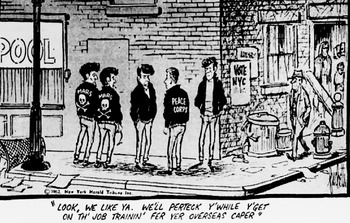
The most prominent innovation was integrating fieldwork as part of training, with most university training programs adopting this fieldwork model as a way to respond to initial criticisms and concerns. One of the first field training programs was started at Columbia University in New York, in which volunteers attended seminars part-time on history, international relations, and language, and then worked with various New York social service agencies. As Figure 1 reflects, a comic in The New York Herald satirized the presence of Peace Corps volunteers in New York City streets and neighborhoods. In New York, the Peace Corps also recruited thirty social workers from Colombia, who worked alongside their American counterparts. Volunteers worked in social service agencies and communities between three and six weeks. Drawing on the theories and techniques taught in seminars, the volunteers then wrote reports on how certain techniques worked in the community and possible solutions to poverty and community fracture. The Peace Corps’ two main training sites—Puerto Rico and Hawaii—were key sites for field experiences, while university sites also developed partnerships with local agencies.Footnote 42
Columbia University Peace Corps field training in Harlem, New York. Reprinted in Peace Corps Volunteer 1, no. 1 (Nov. 1962), 3.

The fieldwork in these programs was devised to offer the experiential and emotional components that volunteers found lacking in early trainings, but this approach largely maintained the same assumptions of volunteer service and development practices. The field approach most trainings implemented didn't question the volunteers’ role in the community. Moreover, the Peace Corps also assumed that applying these techniques in minority communities in the United States would be the same as those in India, Africa, or other overseas Peace Corps sites. Pagano's forty-page report, Education in the Peace Corps, reflected these assumptions. The field training, he wrote, allows a volunteer to “practice using the skills he would need to operate successfully in his future location,” explaining that “if men and women volunteers were to be of practical use in the ‘barrios’ of Latin America, they should have a test of ‘barrio’ living first.” Each component—the orientation, the assignments, and the home life—created what Pagano believed was a “total experience” in “live cross-cultural contact for both volunteers and supervisors.”Footnote 43 Training staff believed these field experiences not only helped develop individual skills but also aided the local community in the process. As Bill McKinstry, a community-development consultant, explained, the goal was to use the field experience as a “training ground to practice application of Community Development principles” and “to provide a service to the community itself.”Footnote 44 As such, these changes addressed the experiential shortcomings of earlier training programs but didn't question the underlying logic of the Peace Corps and its approach to development.
In 1965, another model for Peace Corps training attempted to challenge some of the assumptions embedded in volunteer and development work. This field training approach also grew out of the critiques of lecture models and overemphasis on theory. It drew a different lesson from these criticisms, however, and responded to a contingent of returned volunteers and Peace Corps staff who argued that the combination of study and action represented a different way to learn and develop relevant knowledge about the world. In a document that outlined the Peace Corps’ idea of education in 1965, Harris Wofford, the associate director of the Peace Corps, explained that the Peace Corps represented one way to close what they saw as “the gap between thought and action, academic education and experiential education, education and work.”Footnote 45 In contrast to more technical field experiences, a contingent of volunteers and staff saw the volunteer experience—both the fieldwork in training and the work abroad—as a way of rethinking the liberal arts in the world.
Wofford turned to St. John's College to develop this experimental approach to training. A small liberal arts college in Annapolis, Maryland, St. John's was known for its use of the Great Books, a curriculum structured around a four-year study of what the college believed were the essential books of the Western canon. Traditionally, the readings begin with Homer's Iliad, moving chronologically to include works by St. Augustine, Leonardo da Vinci, Henry David Thoreau, and Karl Max. The idea of the Great Books curriculum gained currency among Victorian-era literature professors, but by the mid-twentieth century, most universities had moved away from it. The University of Chicago and St. John's were two prominent exceptions to this trend.Footnote 46
Wofford's interest in St. John's grew out of experiences as a high school and college student. In the late 1940s, Wofford participated in the World Federalist Movement, a postwar effort to promote peace and justice by establishing international democratic institutions and law. As a key student leader, he met Scott Buchanan, who introduced him to the Great Books idea. Although Wofford never attended St. John's, his meeting with Buchanan laid the foundation of a lifelong interest in the Great Books approach to education. In addition to appreciating the Great Books, Wofford was also well traveled and saw the importance of experiences as a vital part of learning. In the 1950s, he traveled around the world, both with his family and the World Federalist Movement. He traveled widely in India and played a key role in bringing Martin Luther King Jr. and other civil rights leaders in contact with prominent Indian figures such as Ram Manohar Lohia.Footnote 47
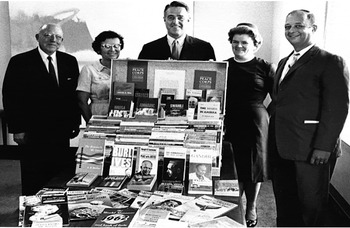
Wofford's appreciation for the intellectual tradition of the Great Books and the importance of international experience shaped the way he directed the Peace Corps, both as the country director and associate director. When he became Peace Corps director in Ethiopia, he attempted to realize a vision for education that combined his interest in the Great Books with Peace Corps volunteer service. Early on, Wofford pushed for what became popularly known as “book lockers” sent with each volunteer or groups of volunteers. As Figure 2 shows, the lockers contained a wide range of books, including American classics like Mark Twain's Huckleberry Finn and Henry David Thoreau's Walden as well as more contemporary works of the time, such as John Dewey's Freedom and Culture, Martin Luther King's Stride Toward Freedom, and Jawaharlal Nehru's Discovery of India. Wofford used the book lockers as the Peace Corps Ethiopia director in the early 1960s to implement what he called “free ranging seminars.” Meeting every month, the volunteers and staff would discuss a particular book from the locker and use it as a lens onto their experiences in Ethiopia. Reflecting on these seminars, he explained that Peace Corps volunteers are “forming a university of their own,” in which “they are dispersed around the world and yet they see themselves as a learning body.”Footnote 48 Wofford believed deeply that the Peace Corps represented a different kind of university unto itself.Footnote 49
Sargent Shriver and Others Examine Books for Peace Corps Volunteers. (Reprinted from the Peace Corps 1962: July-Dec., Papers of John F. Kennedy, Presidential Papers, President's Office Files.)

Wofford's friend and Great Books defender Buchanan also believed the Peace Corps represented a way to adapt the liberal arts to the modern world. At the 1965 Returned Peace Corps Volunteer Conference, a gathering that brought together a thousand returned volunteers and representatives across the public and private sectors, Buchanan presented on “The Peace Corps and the American College.” He believed that American universities operated without a social and moral purpose and saw in the Peace Corps a way to provide an organizing principle for the university and liberal arts college. “It is possible to see the Peace Corps supplying the missing purpose and essential program to the liberal college,” he explained, in which “the two years of service abroad would supply material to satisfy and deepen the curiosity and concern developed by the first two years and open up the world problems that the preparations promised.” This combination, he believed, had a “double aim,” which was to “revive the liberal college, and to give good training and proper attention to the Peace Corps Volunteer after he has returned.”Footnote 50
Wofford, returned volunteer David Schimmel, and Peace Corps training staff made clear to the prospective volunteers that the St. John's approach was unique among training programs. In a memo sent to staff and later shared with the volunteers, the training staff called the new program “Training for Revolution,” a reference to what they believed was the program's potential to transform the educational world and the Peace Corps’ approach to training. The goal of the training was to push volunteers to question what they read and discussed and evaluate their position as outside volunteers. During the training, volunteers spent one weekend meeting with and living with local residents of Baltimore. Prior to arriving in India, they also lived and worked on a kibbutz in Israel. Both experiences were meant to expose volunteers to different community perspectives. In contrast to the first model of fieldwork implemented by revised Peace Corps trainings, the purpose of the field experience at St. John's was to learn from the community. In this way, the community setting was an additional source of learning. After their field experiences in Baltimore, students returned to the seminar, where they were asked what they had learned about themselves, what they had learned about social issues, and what conclusions they could draw from the experiences.Footnote 51
The questioning of experience—in particular the “outside presence” of the volunteers—was directly connected to volunteers’ deep reading of selected texts. During the seminar on the Bhagavad Gita, the tutors encouraged the group to parse out ideas from the book and connect them to their preparation as a volunteer. A dialogic text on ideas of liberation in Hinduism, the Bhagavad Gita pushed the volunteers to consider the issues and implications of their roles working in rural communities in India. These comparisons were key for Francis Hutchins, a young political science scholar who led the India portion of the training. When he facilitated the seminars, he pushed the volunteers to think beyond a Western world view, arguing that the traditional Great Books programs tended to be “narrow and claustrophobic.” The goal of the seminars was to enable the volunteers to see these different forms of knowledge as interacting and informing the ways volunteers saw themselves and the world.Footnote 52 Peter Larkin, a volunteer, found the seminar approach enriching because it “pulled out new ideas that he never thought about before” and put the volunteers “on solid ground in terms of philosophical issues.”Footnote 53
The program seemed successful. Eugene Lichtenstein, in his evaluation report on the program, saw the questions concerning the relationship between John Locke and poultry farming as vital to the volunteer's “own development.” He believed the interaction between the two enabled volunteers to see the relationship between “practical” and “intellectual” knowledge.” Lichtenstein concluded that the program held potential for American higher education more generally. He wrote that “the Peace Corps, in planning its experimental training programs, could get together with a number of academicians on curricula reform committees” and create a new type of education program that departs from “traditional approaches that the colleges themselves have agreed are unsatisfactory.” He expanded further that the Peace Corps was the ideal experimental model for the curricular reformers in the university because it represented a “split program” in which “students attend classes part of the term (or week) and also embark upon work projects—the idea being to relate the course work to the work projects.”Footnote 54
Yet, even as Lichtenstein celebrated the St. John's model, he also acknowledged a range of problems, some of which seemed to undercut what he valued in the program. Most of the questions the faculty put forward, he noted, were descriptive inquiries. Many questions instructors posed, he argued, “are removed from the experience of the people the volunteers will encounter.” For instance, they would ask about the structure of a government, rather than getting to issues of local perspectives. He argued that “the seminar almost has to start from the inside, and work its way out. For example, who collects the taxes in local villages, and why, and what does that have to do with the national government.”Footnote 55
The Peace Corps moved away from components of this program that challenged education and development fairly quickly. When the Peace Corps again partnered with St. John's in 1966, the excitement and potential was muted as a result of its evaluation report. While evaluators of the program believed that the books could be used to illuminate the Peace Corps volunteers’ experiences and stimulate the trainees to learn more about those experiences, they deemphasized the links that volunteers were drawing between experience and text. Instead, St. John's professors largely presented condensed versions of their normal semester-length classes. In this way, its second iteration largely reflected the same problem early trainings had presented: the program operated largely as an extension of prevailing models of liberal arts education.Footnote 56
Even in its inception, the experimental training program at St. Johns had limitations. It tended to overemphasize the personal rather than the relational dynamics of volunteer service. It focused on the volunteer's individual and intellectual development, rather than the critical thought derived from the collective knowledge of the community in which volunteers served. Jim White remembers that the training was “all about personal growth” and how the seminar could be used to “stretch the experience.”Footnote 57 Charmazel Dudt, an international student at Ohio State University and “cultural instructor,” also found the seminars powerful because the questions were always connected to experience, an approach that made the “literature become personal for them.”Footnote 58 The St. John's model made the liberal arts more relevant by making it personal. But this focus was limited in its ability to push volunteers to think critically about development approaches and the position of a volunteer in a given community.Footnote 59
Both models of Peace Corps training that emerged as a result of early volunteer criticisms and reflections represent the ways the Peace Corps developed its education approach in the first part of the 1960s. However, the Peace Corps’ training programs and underlying logic tended to filter these experiences through practical skill application, on the one hand, and modernist ideas of citizenship, on the other. The field experience didn't necessarily encourage the volunteers to question their work (or presence) in US communities as part of their preparation. The limitations inherent in the trainings also reflected the tensions contained in the modern university, such as the relationship between practical and academic education and the role of values. As a result, the debates within the Peace Corps mirrored those that emerged among administrators and faculty. In the late 1960s, as Peace Corps staff attempted to push university administrators to more widely adopt their efforts, and the new programs that emerged in response unearthed deeper questions regarding how the university conceptualized knowledge and education.
The Legacy of the Peace Corps on Campus
The Peace Corps’ vision of education sparked an “experiential learning” movement on campus. In its early years, many saw the Peace Corps as a capstone opportunity in a student's undergraduate career, but by the mid-1960s, Peace Corps staff believed their new training approaches represented an alternative model of higher education. Beginning in 1965—with the return of close to five thousand volunteers—staff members and former volunteers called on American colleges and universities to integrate the experiential learning of volunteer service into the undergraduate curriculum. Wofford believed American colleges and universities “must be willing to take the Peace Corps from the periphery of the college and university into the center, and take the college and university out from its campus into the world of overseas volunteers.”Footnote 60 Fuchs agreed with Wofford. “If the Peace Corps teaches the educational establishment in the United States anything about the nature of learning,” he reflected, “it is that the most powerful and personally meaningful learnings about human behavior for Americans occur when they are trying to solve difficult human problems in the accomplishment of some task.”Footnote 61
Peace Corps staff proposals on campus accommodated both revised training models. Shriver combined the “applied learning” aspect of field training with the idea that volunteers also learn from the world. In a speech at Western Michigan University, Shriver argued that, from the standpoint of the university, the Peace Corps provided the means to extend a student's college education “beyond the walls,” by enabling the student “to go from theory into practice, to test ideas in action.” At the same time, he believed that the Peace Corps experience represented a way of learning new ideas, what he identified as the “stuff of real academic content as well as feelings.”Footnote 62
Similarly, Warren Wiggins, one of the architects of the Peace Corps, also emphasized its applied learning but put forth a view of education that more closely drew from the St. John's experimental model of training. At Hanover College in 1966, Wiggins distinguished the volunteer service experience from traditional academic life. “For many students, education is simply the memorization of what has been called ‘cepts,’” Wiggins explained, referring to the study of concepts and theories that “contain little human emotion.” He saw in the Peace Corps room for students to “question the values that underlie our current society.”Footnote 63 Both Wiggins and Shriver conflated the different models of experiential learning, promoting both applied learning and individual growth. They believed that the Peace Corps offered an experiential model of education that contrasted with what they saw as the static, content-focused courses prevalent in higher education.
These ideas were interpreted in different ways among faculty and administrators who supported the Peace Corps. Some university officials were receptive to experiential learning to the extent it could enhance students’ technical and academic skills. As early as 1963, Maurice Albertson, a professor of civil engineering at Colorado State University, believed that the Peace Corps presented a way to move the campus “out of the ivory tower and into contact with hard realities of the world about us,” creating what he believed was a “New Academic Man.”Footnote 64 Leonard Gernant, the director of Academic Affairs at Western Michigan University, understood the Peace Corps experience as another extension of other practical on-the-job training programs, such as the training of occupational therapists in hospitals.Footnote 65 Mary Bunting, the president of Radcliffe College, agreed with Gernant. She believed the Peace Corps experience was an important supplemental activity, much like the science laboratory. “As a scientist quite used to giving credit for laboratory,” Bunting believed, “credit for the Peace Corps seems to be analogous.”Footnote 66
Other supporters of the Peace Corps’ education believed the experiential learning components represented a new model for liberal arts education, similar to that developed at St. John's. Sister Jacqueline Grennan, the president of Webster College, argued that “the Peace Corps learning experience shouts out that knowledge is not an accumulation of facts or a demonstration of PhD expertise, but a deepening insight and power to synthesize in new situations whether they be abroad or next door.”Footnote 67 Rev. Theodore Hesburgh, the president of Notre Dame, believed that the Peace Corps experience had given young Americans and students a much deeper sense of the challenges in the world than when the volunteer “was reading books and talking in the unreal world of the campus.”Footnote 68 In response to shifts in education that prioritized disciplinary specialization, liberal arts college presidents like Hesburgh and Grennan believed the Peace Corps offered a way to remake the liberal arts central to the university.
A minority in academia questioned the premise that “experiential learning” had a place in the university altogether. Robert Maher, a social science professor at Western Michigan University, was skeptical of the new Peace Corps program on campus. While he believed that it was a “generally good thing for young people to break the fixed pace of formal education and to involve themselves for a time in what are to them new and active environments,” he didn't believe that this suggested “that the university involve itself in facilitating such new experiences.” Maher's concern was whether such experiences were “academically relevant.” If not, he argued, “then, however laudable it may be, it belongs someplace else.”Footnote 69
The debate prompted by the Peace Corps on campus highlights fundamental differences about the appropriate means and meaning of education among college and university administrators and faculty. In part, the debate rested in a perceived incompatibility between Peace Corps notions of education and that of the academy. The evaluation report on the new program at Michigan State University, for example, concluded that “the university's attitude led trainees into just those artificial distinctions between ‘academic’ and ‘practical’ work that we are trying to destroy overseas, and at home by the new union with the universities.”Footnote 70 A 1964 study on the Peace Corps’ relationship to the University of Hawaii concluded that the problems in Peace Corps training came down to different priorities between the university and the agency. “The university gives priority to research and publication and less to community involvement and teaching,” the authors of the report noted, “while the Peace Corps gives priority in the reverse order.”Footnote 71 The disagreement seemed to come down to differences between practical and academic education.
As the views of Hesburgh and Grennan point to, the debate also concerned a deeper question regarding the place of values on campus and in education. In 1967, two American psychologists—Roger Harrison and Richard Hopkins—published a report on the differences between American higher education and the Peace Corps. A key theme in their report was the role of emotions and values. In the university, Harrison and Hopkins wrote, “feelings and values may be discussed but rarely acted upon.” By contrast, they argued that in the Peace Corps “values and feelings have action consequences, and action must be taken.”Footnote 72
As had Shriver and Wiggins, the new campus programs accommodated these different perspectives on experiential learning. At Western Michigan, Gernant developed a new Peace Corps academic program for interested students. The program combined two years of coursework with two years in the Peace Corps. Upon completing the two-year service, the students returned to campus to write a thesis that synthesized their intellectual work and experiences abroad.Footnote 73 President Bunting at Radcliffe College implemented a similar model, albeit on a smaller scale. Students applied for small grants, which allowed them to work as “Peace Corps interns” during the summer months. The goal of the program was to provide public service internships for students at Harvard and Radcliffe.Footnote 74 Both programs advertised the experiential components as an opportunity for self-growth but, in practice, focused on academic, professional, or disciplinary development.
The value of these new programs lay in their ability to integrate experience into students’ academic education, but the emphasis on individual growth masked the limitations of volunteer work. Robert Lee Gaudino, a professor of political science at Williams College and a Peace Corps trainer, believed the volunteer experience exemplified a new kind of learning, what he deemed “uncomfortable learning.” He was instrumental in starting a new program at Williams College called “Williams-in-India,” which allowed Williams College students to live and work in India as part of their undergraduate experience. In his book, The Uncomfortable Learning: Some Americans in India, Gaudino described “uncomfortable learning” as the immersive experiences that created a “basic dialectic” between the “authority of the subject matter versus the independent growth of the trainee.”Footnote 75 Anecdotes in his book emphasized this point. As one volunteer noted in a letter to Gaudino, “Experience here constantly puts you in a situation where you have to confront yourself.”Footnote 76 But even as Gaudino celebrated the Peace Corps experience, volunteer reflections cited in his book brought out the problems with making volunteerism a new form of education. “I think you over-rate the Peace Corps experience,” one volunteer wrote to Gaudino, “as well as the volunteers’ ability to cope with it and learn amidst the confusion and frustration.”Footnote 77 The volunteers’ “uncomfortable learning,” in other words, was rooted in their inability to provide any form of aid for the Indian village.
The tension between the educational growth of the volunteer and the limits of volunteerism lay at the core of a new pedagogy developed out of federal volunteer programs in the 1960s. At a 1969 conference in Atlanta, Georgia, sponsored by the Peace Corps and Volunteers in Service to America (VISTA), university leaders and representatives from federal volunteer programs defined a new concept of education rooted in the service work of the Peace Corps and other volunteer programs. They called it “service learning,” which they defined as “the integration of the accomplishment of a needed task with educational growth.”Footnote 78 Representatives explained that service learning aimed to provide “breadth and depth and relevance to students’ learning” and “assist in assuring disciplined learning as part of this service.”Footnote 79
The definition accommodated two core elements of Peace Corps education. First, it maintained the “applied learning” elements of field training. In particular, it put forth how service would allow students to test ideas learned on campus while helping to “accomplish needed public services.”Footnote 80 Second, it echoed the St. John's model and placed emphasis on the educational growth of the individual student, especially in terms of public service. Service learning ultimately represented a compromise between those pushing the university to develop a broader conception of the liberal arts rooted in the Peace Corps and those resisting such a drastic change. The result was a middle course in which the university retained its structure and emphasis on objective inquiry but “added on” experiential components for students.
Conclusion
By the early 1970s, the Nixon administration consolidated the Peace Corps, VISTA, and other volunteer programs into one agency within the Department of State. In the process, the new administration ended the Peace Corps’ autonomy and pushed the agency to recruit more technical volunteers, ultimately moving away from its liberal arts focus. While these policy shifts contributed to the end of the program's “marriage” with American colleges and universities, many within the Peace Corps also believed that the end was inevitable. By this time, staff saw in-country training as a much more effective way of exposing prospective volunteers to the conditions of the host country, its language, and culture. Beginning in the 1970s, the Peace Corps abandoned university training and conducted volunteer preparation in host countries.
Despite the end of the partnership, the history of Peace Corps training on campus illuminates an important, but often overlooked, component of campus reform in the 1960s: the emergence of experiential learning and community service programs in American higher education. Prompted initially by early volunteer reflections and criticisms, Peace Corps training staff and volunteers eventually extended their critiques to the didactic approaches of the academy and evolved new techniques that connected field experiences with seminars. The 1969 conference is a poignant illustration of how the program left its mark on the academy in the form of service learning. This practice was adopted almost immediately across higher education. Beginning in the 1970s, American colleges and universities implemented a range of new service-learning programs on campus. A 1972 report by the National Student Volunteer program, a new initiative by the Nixon administration, listed 565 programs that combined volunteer service with education at both small liberal arts colleges and large state universities.Footnote 81
The Peace Corps’ education efforts in the 1960s shed light both on the possibilities and inherent limitations of service learning. Some volunteers saw the new training approaches in the Peace Corps as the staff had envisioned: opportunities for self-growth and to give aid to communities at home and around the world. But the increasing emphasis on education tended to mask the inherent limitations of volunteer service in tackling social inequality and the assumptions of prevailing development models. Without addressing broader social and economic structures, some volunteers argued that “development” tended to go in only one direction—that of the individual volunteer. Although the Peace Corps developed new methods of education on campus, the agency's legacy in the form of service learning inevitably perpetuated the same assumptions of modernist citizenship education and postwar development, that is, the perceived superiority of expert knowledge in the university, on the one hand, and the assumption that a trained volunteer was vital to community mobilization, on the other hand. Staff and supporters of the Peace Corps and service learning ultimately adapted elements of experience to prevailing models of education rather than rethink epistemologies of the modern university.