The Ross aortic valve replacement procedure offers a durable aortic valve replacement in children that avoids anticoagulation and allows for future growth.Reference Ross1 However, right ventricular outflow tract reintervention remains the most common reason for reintervention after the Ross procedure.Reference Pasquali, Shera and Wernovsky2–Reference Schneider, Putter and Klautz4 Choosing a durable right ventricle to pulmonary artery conduit is critical to the long-term success of the Ross operation.
Multiple options for right ventricular outflow tract reconstruction exist, and each has a different profile of durability, long-term function, and freedom from complications. Valved right ventricular-to-pulmonary artery conduits have been a part of congenital cardiac surgery since the 1960s.Reference Wallace, Rastelli, Ongley, Titus and McGoon5,Reference Fuller, Marchand, Zion and Zwi6 The pulmonary homograft was introduced in the 1980s; however, there have been reports of valve degeneration with time.Reference Wells, Arroyo, Bremner, Wood and Starnes7,Reference Karamlou, Blackstone and Hawkins8 More recently, the introduction of xenografts with alternative valve preparation has led to improved longer term results.Reference Prior, Alphonso and Arnold9–Reference Konuma, Devaney and Bove15 The bovine jugular vein conduit has been commercially available since the late 1990s. At our institution, we have preferentially used the bovine jugular vein conduit for reconstruction of the right ventricular outflow tract for children younger than 7 years since 1999. In this study, we aimed to compare the outcomes of younger patients who underwent Ross aortic valve replacement and right ventricular outflow tract reconstruction with either the bovine jugular vein conduit or the pulmonary homograft.
Materials and methods
This study was approved by the Indiana University Institutional Review Board committee as an exempt study. Inclusion criteria included patients 0–18 years old who underwent Ross aortic valve replacement with right ventricular outflow tract reconstruction using either bovine jugular vein conduit or pulmonary homograft at our institution between July 1998 and June 2016. These were the two most frequently used conduits for right ventricular outflow tract reconstruction for the Ross operation during this time period. Surgeon preference and availability of an appropriately sized conduit dictated which of the two conduits were utilised. Patient demographics and clinical details were collected retrospectively. Operative details including size of conduit, type of operation, any concomitant procedures and post-operative events including early and late complications, repeat operations, and last follow-up including the most recent echocardiograms were also collected.
The Ross-Pulmonary Homograft patients were age-matched to the Ross-Bovine Jugular Vein Conduit patients. Primary endpoints included survival and freedom from left- or right-sided reoperations. Secondary endpoints included rate of endocarditis, conduit haemodynamics, and incidence of early and late complications.
Statistical analysis
Categorical data were analysed with chi square test. Student’s t-test was used to compare continuous data. Survival curves were generated using the Kaplan–Meier formula. The alpha value for this study was 0.05. All data were analysed using SPSS 24 (IBM Corporation, Armonk, NY, United States of America).
Results
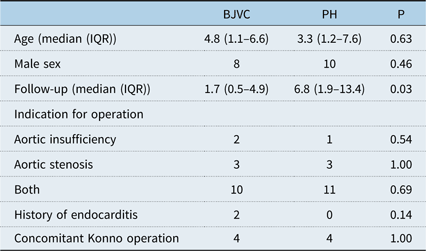
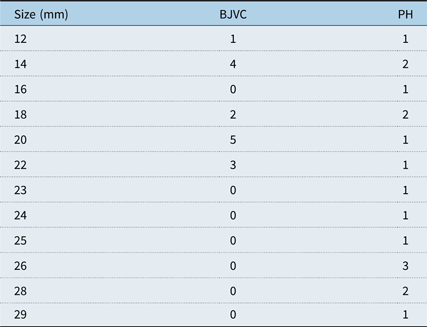
Fifteen patients underwent the Ross operation with bovine jugular vein conduit implantation, and during that time period, 56 patients have undergone Ross operation with pulmonary homograft implantation. A total of 30 patients were met inclusion criteria in this study. Table 1 lists the patient demographics and indications for the Ross procedure. The median age at operation was similar between the groups (Table 1). The mean follow-up time was significantly longer for the Ross-Pulmonary Homograft group at 6.8 years (inner quartile range 1.9–13.4) versus 1.7 years (inner quartile range 0.5–4.9) for the Ross-Bovine Jugular Vein Conduit group (p = 0.03). Table 2 lists the size of the bovine jugular vein conduit or pulmonary homograft used for each patient. Bovine jugular vein conduit size ranged from 12 to 22 mm, and pulmonary homograft conduit size ranged from 12 to 29 mm.
Patient demographics, all values are presented as counts

BJVC = bovine jugular vein conduit; IQR = inner quartile range; PH = pulmonary homograft
Conduit size distribution between BJVC and PH

BJVC = bovine jugular vein conduit; mm = millimeter; PH = pulmonary homograft
Mortality
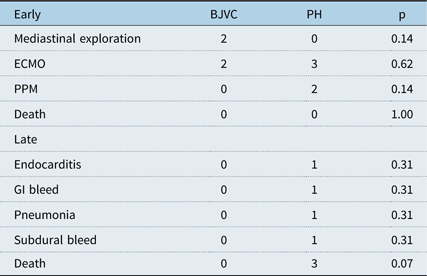
There were no early deaths in either cohort. At last follow-up, there have been no (0%) late deaths in the Ross-Bovine Jugular Vein Conduit cohort and three (20%) late deaths in the Ross-Pulmonary Homograft cohort. The causes of death in these patients included sepsis from meningitis, subdural haemorrhage leading to anoxic brain injury, and recurrent aspiration pneumonia.
Early complications
Two (13%) bovine jugular vein conduit patients and three (20%) pulmonary homograft patients required extracorporeal membranous oxygenator support post-operatively. All five of these patients required extracorporeal membranous oxygenator support for post-operative low cardiac output syndrome. Four of these patients required extracorporeal membranous oxygenator support after a Ross–Konno procedure and one after standard Ross-Pulmonary Homograft. This last patient had an inherent dilated cardiomyopathy and underwent heart transplantation 2.5 years later. Both bovine jugular vein conduit patients and two of three pulmonary homograft patients were less than 1 year old with the last pulmonary homograft patient being 13 months old. Two (13%) Ross-Pulmonary Homograft patients had post-operative conduction issues and required permanent pacemakers after undergoing concomitant Ross–Konno procedure or subaortic myotomy/myectomy (Table 3).
Early and late complications, all values presented as counts

BJVC = bovine jugular vein conduit; ECMO = extracorporeal membranous oxygenation; GI = gastrointestinal; PH = pulmonary homograft; PPM = permanent pacemaker
Late complications
Four (27%) Ross-Pulmonary Homograft patients suffered late complications including endocarditis, gastrointestinal bleeding, pneumonia requiring admission, and subdural haemorrhage (Table 3). The patient who suffered endocarditis required redo aortic valve replacement and pulmonary valve replacement and subsequently suffered from prosthetic valve endocarditis, which was treated medically.
Reoperations on the autograft
Table 4 lists late reoperations after the Ross procedure. None (0%) of the Ross-Bovine Jugular Vein Conduit Patients have required reoperation for their autograft. Two (13%) Ross-Pulmonary Homograft patients have required reoperation on their autograft. One of these patients required a valve sparing root replacement 9.9 years post-operatively and the other required valve and root replacement 6.8 years post-operatively. One (7%) pulmonary homograft patient required a heart transplant for dilated cardiomyopathy.
Reoperations for both cohorts

AVR = aortic valve replacement, Aortic Root Replacement; AVSRR = aortic valve sparing root replacement; BJVC = bovine jugular vein conduit; PH = pulmonary homograft
Right ventricular outflow tract reintervention
One (7%) patient who underwent Ross aortic valve replacement at 8 months of age with bovine jugular vein conduit required right-sided reinterventions. This patient underwent pulmonary artery balloon angioplasty for distal conduit anastomosis stenosis 9 months post-operatively and right ventricle to pulmonary artery conduit replacement 10.5 years post-operatively with bovine jugular vein conduit for combined valve stenosis and regurgitation (Table 4). Five (33%) Ross-Pulmonary Homograft patients have required pulmonary valve replacement performed independently or with concomitant aortic valve reoperation. Two patients required pulmonary valve replacement for right ventricular outflow tract obstruction, one for valve insufficiency, one for mixed obstruction and insufficiency, and one because the pulmonary homograft was explanted to facilitate repair of a residual ventricular septal defect. The patient who had mixed stenosis and regurgitation did so because of a bout of endocarditis. In this patient, the pulmonary homograft was replaced with a bovine jugular vein conduit which required transcatheter valve replacement 9 years later. One of the patients who required pulmonary valve replacement for pulmonary homograft stenosis underwent balloon dilation 1 year prior to valve replacement. At 5 years, survival without pulmonary valve replacement was 100% for the Ross-Bovine Jugular Vein Conduit cohort and 80% for the Ross-Pulmonary Homograft cohort (p = 0.2; Table 4).
Echocardiographic analysis
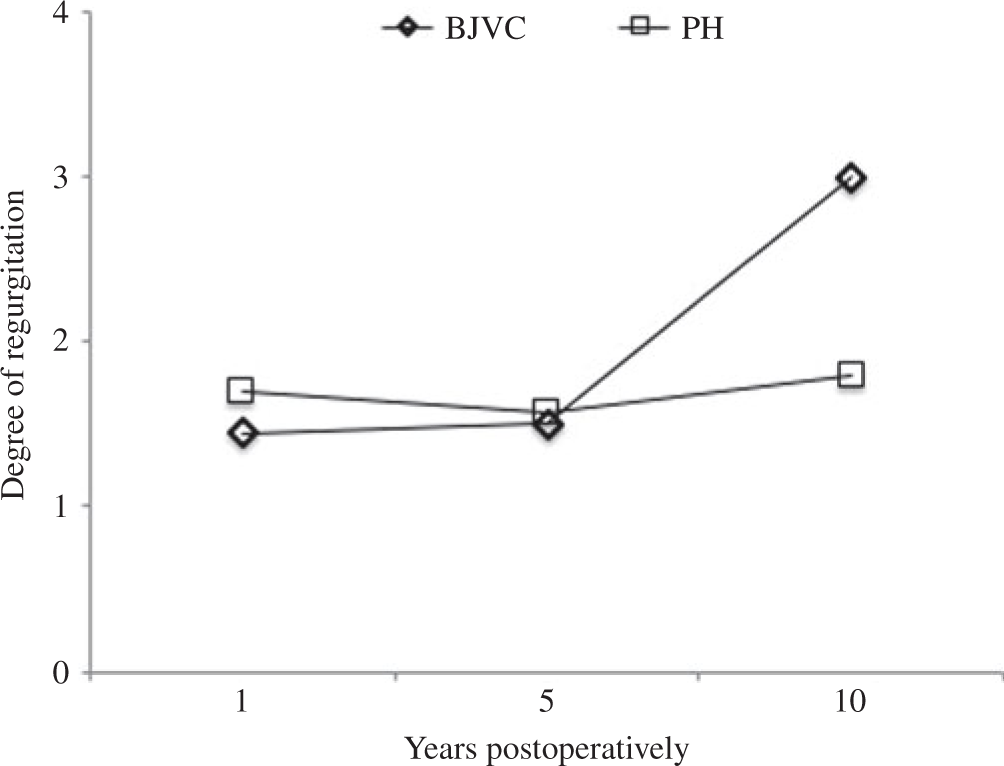
Interval echocardiography showed that the mean gradient across the bovine jugular vein conduit at 1, 5, and 10 years post-operatively were 14.6, 27.4, and 40.5 mmHg, respectively. The mean gradient across the pulmonary homograft were 16.7, 25.7, and 38.4 mmHg at 1, 5, and 10 years, respectively (p = 0.7, 0.8, and 0.9, respectively) (Fig 1). The mean degree of regurgitation across the bovine jugular vein conduit and the pulmonary homograft over a 10-year span was not significantly different at 1, 5, and 10 years, respectively (p = 0.6, 0.9, and 0.4) (Fig 2).
Mean peak gradient across the right ventricle to pulmonary artery conduit with time based on the available echocardiographs. p > 0.05 for all times. BJVC = bovine jugular vein conduit; PH = pulmonary homograft.

Mean degree of regurgitation across the right ventricle to pulmonary artery conduit with time based on the available echocardiographs. p > 0.05 for all times. BJVC = bovine jugular vein conduit; PH = pulmonary homograft.

Discussion
In this study, we compared our outcomes using the bovine jugular vein conduit to the pulmonary homograft for right outflow tract reconstruction in younger patients undergoing the Ross operation. There was no statistically significant difference between the two in this small study. However, there were trends towards the bovine jugular vein conduit having higher freedom from reintervention and lower rates of endocarditis.
In our study in 2008, we hypothesised that pulmonary homograft and decellularised pulmonary homografts fared better during the Ross procedure versus other operations where these conduits are used.Reference Brown, Ruzmetov, Rodefeld and Turrentine16 We felt that this could be due to orthotopic positioning of the conduit, older age at implantation, and oversizing the right ventricle to pulmonary artery conduit.Reference Brown, Ruzmetov, Rodefeld and Turrentine16 We continue to place the right ventricle to pulmonary artery conduit, whether bovine jugular vein conduit or pulmonary homograft, in an orthotopic manner to ensure laminar flow.
Right ventricle to pulmonary artery conduit dysfunction remains a major cause for reintervention as we and others have found.Reference Pasquali, Shera and Wernovsky2–Reference Schneider, Putter and Klautz4 We routinely oversized the right ventricle to pulmonary artery conduit during the Ross operations since we found the smaller conduit size to be an independent risk factor in the right ventricle to pulmonary artery conduit replacement across all etiologies of initial right ventricular outflow tract surgery.Reference Rodefeld, Ruzmetov, Turrentine and Brown17,Reference Patel, Tan and Srivastava18 Horer et al showed this specifically in the Ross population.Reference Horer, Stierle and Bogers19 Whether oversizing the right ventricle to pulmonary artery conduit leads to increased freedom from replacement is debated in literature. Karamlou et al found that oversizing the right ventricle to pulmonary artery conduit did not lead to increased freedom from conduit failure.Reference Karamlou, Ungerleider and Alsoufi20 This study, however, specifically excluded patients who underwent the Ross operation and only included patients who had homografts placed.Reference Karamlou, Ungerleider and Alsoufi20 We continue to recommend oversizing the right ventricle to pulmonary artery conduit, regardless of choice of conduit, given our current and previous findings. Our data showed a 5-year freedom from explantation for the pulmonary homograft at 80%. This rate was only for the 15 patients selected for the age-matching and not our entire Ross with pulmonary homograft series. Horer et al showed a freedom from reoperation on the right-sided homograft at 89% at 5 years.Reference Horer, Stierle and Bogers19 Freedom from reintervention in the Pasquali study at 8 years was 81%.Reference Pasquali, Shera and Wernovsky2 These outcomes may compare favourably to our outcomes given the older median ages of patients in these studies of 10.1 and 8.2 years, respectively.
Reports of the bovine jugular vein conduit endocarditis have ranged from 6 to 10% in the literature.Reference Mery, Guzman-Pruneda and De Leon21–Reference Ugaki, Rutledge, Al Aklabi, Ross, Adatia and Rebeyka23 We have observed an incidence of bovine jugular vein conduit endocarditis at our institution of approximately 7%, and half of these patients have been successfully treated with antibiotics alone.Reference Patel, Tan and Srivastava18 Beckerman et al in their study noted a 10% incidence of endocarditis with 92% of those patients requiring surgical intervention.Reference Beckerman, De Leon, Zea-Vera, Mery and Fraser22 Zimmerman et al found that the use of bovine jugular vein was an independent risk factor for right-sided reoperation after the Ross operation.Reference Zimmermann, Attenhofer Jost and Pretre24 In the present study, we observed a 5-year freedom from reoperation for the Ross–Bovine Jugular Vein Conduit group of 100%. Longer follow-up is needed to determine how this trend will continue as more patients who had a Ross operation with a bovine jugular vein conduit age.
Limitations of this study include its retrospective, single institutional nature. There were disparities in the eras in which each conduit was in dominant use, which leads to differences in length of follow-up for each cohort. Finally, the small cohorts may be underpowered for detecting statistically significant differences.
Orthotopic placement of the pulmonary valve conduit in the Ross operation lends to longer freedom from reoperation. The bovine jugular vein conduit has so far shown to be a promising right ventricle to pulmonary artery conduit for patients undergoing the Ross operation. Further longitudinal study with a larger patient group will be needed to determine which conduit choice for right ventricular outflow tract reconstruction in children undergoing the Ross procedure is superior.
Acknowledgements
We would like to acknowledge the support of the Riley Clinical Data and Outcomes Center.
Financial Support
This research received no specific grant from any funding agency, commercial or not-for-profit sectors.
Conflicts of Interest
J.W.B.: Teaching honoraria from CryoLife, Inc. (Kennesaw, GA, United States of America) and Medtronic, Inc. (Minneapolis, MN, United States of America).