Introduction
The Antarctic Treaty was adopted in Washington in 1959 to establish the Antarctic as a region of peace and cooperation, and to address contemporary sovereignty claims (see Rothwell Reference Rothwell1996 for details). The treaty was signed by the 12 countries whose scientists had been active in and around Antarctica during the International Geophysical Year (IGY) of 1957–1958, and entered into force in 1961; the total number of parties to the treaty is now 48 (as of 2011). The Antarctic Treaty, associated separate international treaties and measures in effect under these, form what is now known as the Antarctic Treaty System (ATS). The other international treaties comprising the ATS, with their year of adoption are:
Convention on the Conservation of Antarctic Seals (1972)
Convention on the Conservation of Antarctic Marine Living Resources (1980)
Protocol on Environmental Protection to the Antarctic Treaty (1991).
The protection of the Antarctic environment has been a central theme in cooperation among Antarctic Treaty parties (Hemmings Reference Hemmings, Bosselmann, Fogel and Ruhl2011). In 1964, the Antarctic Treaty Consultative Meeting (ATCM) adopted the Agreed Measures for the Conservation of Antarctic Fauna and Flora and these measures formed the basis for a regulatory system that provided extra protection in designated specially protected areas. The adoption of the Protocol on Environmental Protection to the Antarctic Treaty in 1991 (hereafter the Madrid Protocol), in which the parties, ‘commit themselves to the comprehensive protection of the Antarctic environment and dependent and associated ecosystems and designate Antarctica as a natural reserve, devoted to peace and science’, established the current framework for conservation measures in the Antarctic Treaty area that is south of 60°S.
The Madrid Protocol arose from international efforts to prevent commercial mineral extraction activities in the Antarctic. The protocol prohibits all activities relating to mineral resources, except for scientific research. It includes six technical Annexes and establishes a comprehensive set of basic principles and detailed mandatory rules applicable to all human activities in the Antarctic. As of April 2011, five of six annexes to the protocol have entered into force (ATS 2011):
Annex I. Environmental Impact Assessment (adopted in 1991, effective in 1998)
Annex II. Conservation of Antarctic Flora and Fauna (adopted with the protocol in 1991, in force in 1998; an amended version of this annex was adopted as Measure 16 in 2009, but it is not yet in force. (Until the revised Annex II enters into force, the original version remains effective)
Annex III. Waste Disposal and Waste Management (adopted with the protocol in 1991, in force 1998)
Annex IV. Prevention of Marine Pollution (adopted with the protocol in 1991, in force 1998)
Annex V. Area Protection and Management (adopted as Recommendation XVI-10 in 1991, in force 2002).
The only Annex that has not entered into force is Annex VI. Liability Arising From Environmental Emergencies. It was adopted by the treaty parties as Measure 1 in June 2005 and now requires approval from all consultative parties before it enters into force (ATS 2011).
Recent reviews have identified the broad range of threats to the Antarctic environment and its wildlife from the increasing human presence in the Antarctic (Tin and others Reference Tin, Fleming, Hughes, Ainley, Convey, Moreno, Pfeiffer, Scott and Snape2009; Aronson and others Reference Aronson, Thatje, McClintock and Hughes2011; Woehler and others in press). One potential threat to wildlife is that arising from the increasing use of aircraft and vessels, and the concomitant storage of fuel oils and lubricants etc. to support some of these operations at coastal sites around the continent and sub-Antarctic islands (for example Harris Reference Harris1991; Woehler and others in press). As the number of visitors (whether as research, research support, commercial tourist, autonomous adventurers, marine harvesters, whalers and whaling protesters, and crews on transit voyages) and the range and intensity of activities undertaken in the Antarctic increases, so do the demands for logistic support. There has been a rapid increase in the number of vessels in the Antarctic in the last two to three decades for fishing, research and tourism (for example Haase Reference Haase2005, Reference Haase2008; Liggett and others Reference Liggett, McIntosh, Thompson, Gilbert and Storey2011). Large vessels are used for fishing and to transport the bulk supplies (annual food and fuel supplies) to research stations, and large vessels are now being used for fishing and commercial tourism activities (for example the 110,000 tonne Golden Princess carries 3800 passengers and crew to the Antarctic (Bertram and others Reference Bertram, Gunn and Stonehouse2007; Wright Reference Wright2008)).
A number of legally binding and some other hortatory resolutions over a period now spanning more than 30 years have addressed the issue of potential oil pollution and planned response to an oil spill in the Antarctic. Whilst some legal measures applying in Antarctica arise through globally applicable instruments such as the International Maritime Organisation's (IMO) International Convention for the Prevention of Pollution from Ships (MARPOL 1973), or, the more recent IMO discussion around a polar code, reflect the attention of global bodies, most attention has arisen within the ATS. In turn, ATS attention has been largely grounded in the legal capacities inherent in the Antarctic Treaty and the Madrid Protocol, including:
1. Recommendation XV-4 (ATCM 1989): Human impact on the Antarctic environment. Prevention, control and response to marine pollution
2. Resolution XXII-6 (ATCM 1998): Emergency Response Action and Contingency Planning
3. Resolution XXVIII-3 (ATCM 2005a): Fuel Storage and Handling
4. Decision XXVIII-8 (ATCM 2005b): Use of Heavy Fuel Oil (HFO) in Antarctica.
In concert, these responses have led to the revision of the four fuel related guidelines of the Council of Managers of National Antarctic Programs (COMNAP), which operationally controls the respective national activities in Antarctica (COMNAP 1992a, 1992b, 1992c, 1993). This has in turn spurred the development of the COMNAP Fuel Manual (COMNAP 2008) that describes a number of measures to alleviate and combat the pollution of Antarctic waters. The COMNAP measures are generic and provide a framework for operator-specific guidelines and protocols for the development of individual location and national programme plans. To a considerable degree, the COMNAP measures are the operational guide to present (that is 2010) best-practice in Antarctica.
Because the Antarctic Treaty and Madrid Protocol do not in practice regulate fishing, whaling (or indeed sealing were it to be restarted), the responses generated at the annual Antarctic Treaty Consultative Meetings, (ATCMs) at which their obligations are given attention, in fact apply directly only to national programmes and tourist and non-governmental activities (including tourism). Accordingly, this not inconsiderable subset of human activity in Antarctica is the focus of attention of the present study. Its aims are to investigate the extent of operators’ implementation of the COMNAP measures, and the development of any operator-specific guidelines compliant with COMNAP measures, and to develop a chronicle of actual and potential oil spill events in the Southern Ocean to March 2011 as a context for assessing the adequacy of response strategies and the preparedness of national programs and tourist operators to the increasing probability of a significant oil spill affecting wildlife in the Antarctic.
Here, we present our analyses of the responses to a questionnaire we sent to national operators, COMNAP and the International Association of Antarctica Tour Operators (IAATO), the tourist industry coordinating body, with respect to oil spills. We did not approach individual ship operators (despite their presumed role of first responders to their own spills) and relied on IAATO to provide a response from the tourism industry as a whole, excluding non-IAATO member companies. We analyse their responses with a focus on the preparedness for oil spill events involving wildlife in the Antarctic. We examine two oil spill events in which wildlife were oiled that provide insights to the potential response by operators to a spill event in the Antarctic, identify the critical constraints to any oil spill response in the Antarctic, and offer recommendations that address some of the critical constraints identified herein.
Questionnaire of national Antarctic operators, COMNAP and IAATO
A questionnaire comprising six questions was sent to 33 national Antarctic operators, via the nominated ATS Committee for Environmental Protection (CEP) authorities and contact points listed at http://www.ats.aq/devAS/cep_authorities.aspx. In addition, the questionnaire was also sent to COMNAP and IAATO. 25 responses were received (Australia, Belgium, Canada, Chile, China, the Czech Republic, Ecuador, Estonia, Finland, France, IAATO, India, Italy, Japan, New Zealand, Norway, Peru, Russia, South Africa, Spain, Sweden, Ukraine, United Kingdom, Uruguay, USA). No responses were received from Argentina, Belarus, Brazil, Bulgaria, COMNAP, Germany, Greece, Korea, Netherlands, Poland (n = 10) despite three approaches. COMNAP may have felt it was procedurally inappropriate for it to respond, given that the questionnaire had gone directly to its members. Not all responses addressed all questions. Here we provide annotated synopses of the responses received to each of the six questions.
1. How are (COUNTRY's) Antarctic oil spill responsibilities administered? Which agency is responsible for their development and implementation?
Oil spill responsibilities are universally administered by government agencies. Every operator identified the responsible department(s), institute(s) and ministries responsible for their national oil spill response plan development and implementation (not applicable for IAATO), and described their efforts in the Antarctic related to the administration of oil spill responses.
2: Does (COUNTRY) have specific oil spill response contingency plans for the Antarctic? If so, when was it last reviewed and/or revised? Can these plans be made available to us for this review?
There are at least 22 countries with oil spill contingency plans in existence as of September 2009, with most having been reviewed within the last five years (Australia, Belgium, Chile, Ecuador, France, Italy, New Zealand, South Africa, United Kingdom, Uruguay, IAATO). The plans of the Scandinavian countries and Japan are more than 10 years old (note that Norway, Sweden and Finland share one plan). Some operators did not report a date on which their plans had been last reviewed. Some operators noted the existence of the COMNAP Fuel Manual. It should be noted that there is an obligation for operators to adopt or implement the COMNAP guidelines. Plans were received from Chile, China (three plans), Ecuador, Finland, IAATO, Italy, Norway, New Zealand, South Africa, Spain, Sweden, United Kingdom, Uruguay; it is unclear why most are presently unavailable from operators’ web sites.
3: If these plans exist, are there any particular references to potential impacts on wildlife specifically addressed in the plan(s)? This may include risk analyses and the identification of sensitive areas or species.
Few plans made specific references to wildlife or to specific sites such as Antarctic Specially Protected Areas (ASPAs). These were mentioned in the plans of Australia, Belgium, Italy, France, New Zealand, South Africa). Based on the responses, there is a clear absence of contingency plans that specifically address oil spills adversely affecting wildlife within ASPAs, except for Ecuador, New Zealand, Norway, United Kingdom. The current contingency plans are typified by general response strategies to oil spills but with no specific mention of oiled wildlife response strategies. Typically, the plans adopted general principles (adopted from oil spill response plans applicable elsewhere), and there was considerable use of ‘motherhood’ statements rather than specific and explicit details regarding Antarctic weather conditions (including sea-ice) and wildlife. Most plans acknowledge the presence of wildlife in the vicinity of the operators’ station(s). This is not applicable for IAATO.
4: If these plans do not exist, is a specific oil spill response contingency plan for the Antarctic region planned or under development?
Oil spill contingency plans exist for all but one of the operators (Estonia) that replied to the questionnaire (n = 25: see list of responders at Question 1, above). The Estonian response indicated that Estonia did not undertake activities in the Antarctic (but see Kaup and Tammiksaar 2011).
5: Does (COUNTRY) have any existing contingency plan(s) specific to oiled wildlife in the Antarctic? If so, can these plans be made available to us?
As of the survey, only New Zealand had developed draft plans to respond to oiled wildlife on their sub-Antarctic islands (Auckland, Antipodes, Bounty, Snares and Campbell Islands). Italy's plan describes the effects of oil on Antarctic wildlife, and details the required procedures to care for oiled wildlife, following the COMNAP Fuel Manual (COMNAP 2008), but omits the key role of the identification of relevant personnel with expertise in the rehabilitation of oiled wildlife. The Australian response cited a project currently underway that would provide guidance on an oiled wildlife response strategy for the Australian Antarctic and sub-Antarctic islands. All other operators have no specific oiled wildlife plans for the Antarctic or the sub-Antarctic islands under their responsibility. Despite the COMNAP guidelines requiring prior identification of specialists with expertise and advice for spills affecting Antarctic wildlife (COMNAP 2008), only New Zealand has implemented this key requirement. China and Uruguay recognise the need to address wildlife issues arising from oil spills, but no further action to implement the COMNAP Guidelines have been taken by them or other operators.
6: Has (COUNTRY) been involved in any historic oil spill responses in the Antarctic region, either real or potential? If so, were wildlife affected during these responses? Can you provide us with details of the response and the wildlife affected?
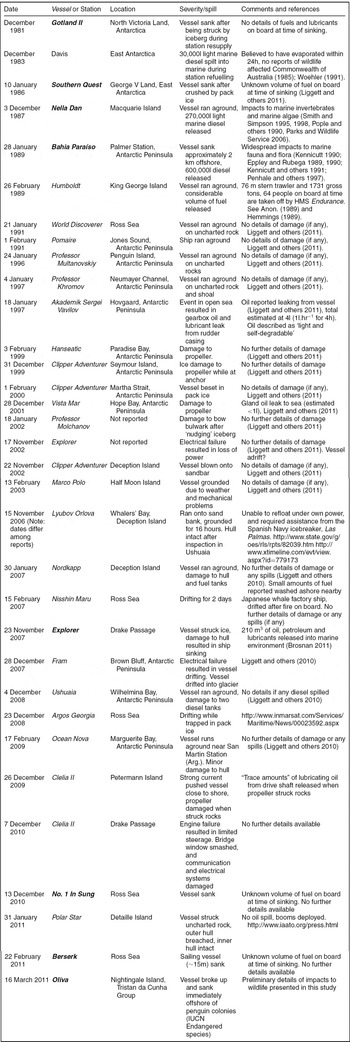
References to the sinking of Bahia Paraíso were present in the responses from Chile, Netherlands and the USA. The Nordkapp incident was mentioned in the responses from Norway, Spain and IAATO and the IAATO response cited the Ushuaia incident. None of the responses mentioned the most recent incidents at the time of the survey, which were the sinking of Explorer and the grounding of Ocean Nova (Table 1). The French and IAATO responses mentioned the minor loss of lubricants from vessels at sea (Table 1), and the IAATO response also acknowledged ‘minor’ losses from ‘several incidents’ involving tourist vessels, but no details were supplied. Only two responses acknowledged spills at stations (Australia and the United Kingdom), despite numerous spills at stations having been previously reported in the scientific literature: for example Croxall Reference Croxall1987 and references therein; Harris Reference Harris1991 and references therein; Green and Nichols Reference Green and Nichols1995; Aislabie and others Reference Aislabie, Balks, Astoric, Stevenson and Symons1999, Reference Aislabie, Balks, Foght and Waterhouse2004; Snape and others Reference Snape, Harvey, Ferguson, Rayner and Revill2005; Rayner and others Reference Rayner, Snape, Walworth, Harvey and Ferguson2007; Revill and others Reference Revill, Snape, Lucieer and Guille2007; Schafer and others Reference Schafer, Snape and Siciliano2007; Harvey Reference Harvey2011.
Chronology of events in the Antarctic and sub-Antarctic 1980–1981 to 2010–2011 that have resulted in spills or had the potential to release petrochemicals into the marine or near-shore environments. Events before 1980/81 and events involving aircraft are listed in Liggett and others (Reference Liggett, McIntosh, Thompson, Gilbert and Storey2011). Instances of vessels sinking are highlighted in bold text (n = 8).

Chronicle of oil spills in the Southern Ocean
To date, the largest oil spill in the Antarctic and the sub-Antarctic (and the best documented), is that of Bahia Paraíso, an Argentine resupply vessel that grounded and sank less than 2 km from Palmer Station on the Antarctic Peninsula on 28 January 1989 (Table 1). With a 10m tear in the vessel's hull, 600,000l of diesel were released into the marine environment. At the time the vessel was carrying diesel fuel Arctic (DFA), Jet fuel (JP1), light marine diesel fuel, lubricating oils and compressed gas bottles, and 316 passengers and crew (Penhale and others Reference Penhale, Coosen, Marschoff, Battaglia, Valencia and Walton1997). Containment booms had been initially deployed by the Chilean and Argentine Navies immediately after the spill. The US National Science Foundation (NSF) deployed a quick response team comprising US, Chilean and Argentine personnel that arrived 10 days after the spill (7 February 1989). Extensive research efforts were directed towards assessing the effects of the spill on local fauna and flora, with wide ranging impacts to inter-tidal and sub-tidal/benthic invertebrates and resident breeding seabirds reported (for example Eppley and Rubega Reference Eppley and Rubega1989, Reference Eppley and Rubega1990; Kennicutt Reference Kennicutt1990; Kennicutt and Sweet Reference Kennicutt and Sweet1992; Kennicutt and others Reference Kennicutt, Sweet, Fraser, Stockton and Culvert1991a, Reference Kennicutt, Sweet, Fraser, Stockton and Culver1991b, Reference Kennicutt, McDonald, Denoux and McDonald1992a, Reference Kennicutt, McDonald, Denoux and McDonald1992b, Reference Kennicutt, McDonald, Sericano, Boothe, Oliver, Safe, Presley, Liu, Wolfe, Wade, Crockett and Bockus1995; McDonald and others Reference McDonald, Kennicutt and Brooks1992, Reference McDonald, Kennicutt, Sericano, Wade, Lui and Safe1994; Penhale and others Reference Penhale, Coosen, Marschoff, Battaglia, Valencia and Walton1997).
At least five other vessels are known to have sunk around the Antarctic and in the sub-Antarctic since 1980–1981 (Table 1). Second to the Bahia Paraíso in the volume of fuel spilled to the environment, the Nella Dan ran aground on Macquarie Island and released 270,000l of light marine diesel into near-shore waters before efforts to re-float the vessel in preparation for scuttling commenced (Smith and Simpson Reference Smith and Simpson1995, Reference Smith and Simpson1998). Adverse effects on benthic communities and marine algae were reported, similar to those reported from the Bahia Paraíso spill, but no oiled vertebrate wildlife were reported, despite the proximity of the grounded vessel to breeding colonies of seabirds and seals within 1km (Parks and Wildlife Service 2006). Macquarie Island is well north of the Antarctic Treaty Area, and operations there are not subject to the environmental protocols established for the Antarctic. The Nella Dan incident, together with the Oliva (see below), provides useful guidance regarding the potential for accidents to release large volumes of fuel to near-shore environments in the Antarctic.
Two vessels have sunk in the Ross Sea since 1980–1981 (No. 1 In Sung and the sailing vessel Berserk), one off East Antarctica (Southern Quest), one off Northern Victoria Land (Gotland II) and one approximately 20 nautical miles from King George Island just north of the Antarctic Peninsula (Explorer). Details of the types and volumes of fuel oils, lubricants etc present on the vessels at the times of their sinking are typically unknown or have not been documented (but see Brosnan Reference Brosnan2011 and Republic of Liberia 2009 for details regarding the Explorer). Both the Ross Sea and the Antarctic Peninsula have concentrations and diversities of seabird and seal breeding populations, and the adverse effects of the spills or releases to wildlife associated with these sinkings cannot be presently assessed. Details regarding the impacts to wildlife associated with the Oliva sinking at Tristan da Cunha in March 2011 are presented below. To date, the spills in the Southern Ocean are relatively small compared to previous spills elsewhere involving wildlife (for example Treasure, Cape Town, South Africa on 23 June 2000: 1400t oil spilled with more than 19,000 African penguins Spheniscus demersus oiled), but this should not be seen as reducing the need for responses to an event in the Antarctic, particularly given the wildlife concentrations present.
Potential interactions with seabirds and marine mammals in the Southern Ocean
With the exception of Nella Dan (which ran aground and was re-floated before being scuttled), the five other vessels that are known to have sunk in the Southern Ocean have done so either in close proximity to wildlife concentrations or have sunk within foraging ranges of breeding Antarctic penguins from their colonies (Fig. 1), within the known pelagic distributions of marine mammals (van Franeker Reference van Franeker2002) and within the foraging areas of sub-Antarctic or temperate seabird species that feed in the Southern Ocean close to the Antarctic Continent (for example Ainley and others Reference Ainley, O'Connor and Boekelheide1984; Woehler and others Reference Woehler, Hodges and Watts1990, Reference Woehler, Raymond and Watts2006; Patterson and others Reference Patterson, Woehler, Croxall, Cooper, Poncet, Peter, Hunter and Fraser2008; Ribic and others Reference Ribic, Ainley, Ford, Fraser, Tynan and Woehler2011).
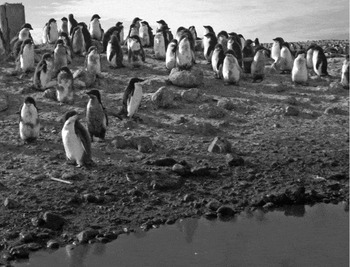
A number of oiled Adélie penguin chicks next to one of several oil-contaminated melt ponds at Cape Hallett, Ross Sea in January 2001 (see Table 2). The oil pits originated from abandoned equipment (H. Nevins, personal communication, October 2010).

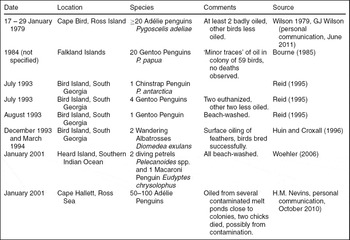
To date, the only documented instances of oiled wildlife reported from the grounding or sinking of the five vessels in the Southern Ocean (that is not including Nella Dan at Macquarie Island) were those at Anvers Island following Bahia Paraíso (Eppley and Rubega Reference Eppley and Rubega1989, Reference Eppley and Rubega1990) and the subsequent population level responses (Woehler and others Reference Woehler, Cooper, Croxall, Fraser, Kooyman, Miller, Nel, Patterson, Peter, Ribic, Salwicka, Trivelpiece and Weimerskirch2001), and those following the sinking of Oliva at Tristan da Cunha (see below). Oiled wildlife has not been reported in the vicinity of grounded vessels, but spills of various volumes have been reported from a number of incidents (Table 1) and it is possible that the absence of independent observers on the ground and the concomitant lack of dedicated searches for oiled wildlife are responsible for the absence of oiled wildlife reports from spills and vessels sinking, rather than there being an actual absence of effects. Anecdotal reports, for example from passengers on cruise vessels, would be unlikely to be accepted by the industry despite their legitimacy. A number of other records of oiled seabirds have been made elsewhere in the Southern Ocean, but the sources of the responsible spills are presently unknown in most cases (see Table 2).
Other reports of oiled seabirds in the Southern Ocean.

A future worst-case scenario might involve a vessel sinking close to breeding colonies during the middle of the Antarctic summer breeding season, releasing fuel oils and lubricants to the environment that persist for several weeks, providing an extended period during which wildlife encounter these products and become oiled. Low air and seawater temperatures extend the persistence of fuel oil in the marine environment (evaporation and dispersal times are increased), prolonging the potential for interactions with wildlife, as demonstrated in the Exxon Valdez spill in Prince William Sound in March 1989 (for example Irvine and others Reference Irvine, Mann and Short1999; Venosa and Zhu Reference Venosa and Zhu2003; ATME 2009a; Li and Boufadel Reference Li and Boufadel2010).
This scenario has some similarities to the Bahia Paraíso event, but perhaps more enlightening is the Oliva spill, where the ship released fuel oils close to penguin breeding colonies and moulting sites (see below). We note also that there are many parallels between the commercial tourism operations in the Arctic and Antarctic, including an increasing concern for oil spills and their potential impact to wildlife in both regions (see Brosnan Reference Brosnan2011).
Lessons learnt from Oliva (Tristan da Cunha Group, South Atlantic Ocean, March 2011)
The Greek owned, Maltese registered cargo vessel Oliva (75,300 tonnes, 225 m length) ran aground on the coast of Nightingale Island, Tristan da Cunha Group on 16 March 2011, then broke in two during rough weather two days later, approximately 100 m offshore from northern rockhopper penguin (Eudyptes moseleyi) breeding colonies and moulting sites. Approximately 1500 tonnes of bunker fuel spilled into nearshore waters and onto landing sites used by the penguins (see Tristan da Cunha 2011 for further details of this event).
The Tristan da Cunha group of islands are World Heritage listed for the natural values with extensive and diverse wildlife (UNESCO 2011). Between 20,000 and 30,000 pairs of northern rockhopper penguins breed at Tristan da Cunha (BirdLife International 2011) and many (estimated in the thousands) were ashore to moult after the breeding season at the time of the spill. Several landing sites used by northern rockhopper penguins were covered in oil and approximately 3800 northern rockhopper penguins were captured for rehabilitation; more were reported to be covered in oil to some extent but not captured before they left the islands after moulting. Other species observed to be oiled comprised Atlantic yellow-nosed albatross (Thalassarche chlororhynchus), great shearwater (Puffinus gravis) and sub-Antarctic fur seals (Arctocephalus tropicalis).
A small resident human population is present on Tristan da Cunha, and there is no runway on the islands; the islands are too remote for helicopter operations from continental bases. Consequently, all equipment required for the oiled wildlife rescue mission had to be brought to the islands by vessel. Compiling the response team, the requisite equipment and locating a vessel that was suitable took 10 days. Following a period of poor weather en route from Cape Town, the Southern African Foundation for the Conservation of Coastal Birds (SANCCOB) team arrived at Tristan da Cunha on 5 April 2011, 20 days after the spill. By then, there were more than 3650 penguins and one albatross in holding pens, 373 penguins had already died, and the volunteers on the island had reached their capacity to feed and hold the oiled penguins. The clean-up operation was paid for by the vessel's insurer.
There are considerable similarities between the Oliva and Bahia Paraíso events. In particular, the limited logistic access to a relatively remote area with extensive and diverse (and in the case of Tristan da Cunha, endangered) species of wildlife in contact with the oil, and the critically limited capacity of people, equipment and infrastructure on site to deal with the situation before the specialist teams arrived. In no way should these comments be seen as criticisms of the personnel and their remarkable efforts under challenging circumstances. Rather, these two events serve as useful examples and predictors of the consequences of a similar event in the Antarctic.
Critical constraints to responses to a future oiled wildlife event in the Southern Ocean
We identify five critical constraints for any response to an oiled wildlife event in the Southern Ocean:
1. Remoteness of the site. A spill and associated oiling of wildlife on the Antarctic Continent, the Antarctic Peninsula or the peri-Antarctic islands, will be remote from transport infrastructure. There are very few sites with air transport facilities that could be used to transport experienced personnel and their equipment rapidly to the site, as the majority of research stations and tourist support facilities are dependent on shipping for resupply and delivery of personnel. The responses to Bahia Paraíso at Palmer and Oliva at Tristan da Cunha took 10 and 20 days respectively, to arrive, and access to most other areas in the Antarctic is likely to take longer. The remoteness also affects the ability to re-supply personnel and equipment during extended operations, and poses a high risk for the health and safety of injured personnel should treatment or evacuation be required.
2. Capacity. With the exception of McMurdo Station in the southern Ross Sea, all of the more than 100 research stations in the Antarctic region have low numbers of people present at any one time (typically fewer than 40), and of these few, if any, personnel could be expected to have had any experience or training in oiled wildlife response and handling. The stations’ population maxima are during the summer months (typically October to March, inclusive), coincident with tourism and re-supply operations. It is likely that the station/field camps will be constrained in the number of personnel that can be accommodated for an oiled wildlife response.
3. Facilities on site. Similarly, all research stations in the Antarctic region are unlikely to have any facilities to deal with oiled wildlife (capture and holding), feeding and rehabilitation of oiled wildlife. Further, the stations will not have the facilities for holding of waste water which is oily and soapy, and its appropriate treatment and disposal.
4. Weather. This will determine any response time, largely through enforcing delays to flights or shipping. The Southern Ocean is renowned for poor weather and sea conditions, even in summer, and response efforts will almost certainly be adversely affected at some point during the lifetime of the event. We predict that it is likely to require at least 10 days before teams with relevant expertise and equipment arrive on site.
5. Costs. At present, there is no mechanism to pay for any clean up and rehabilitation efforts should an oil spill occur involving Antarctic wildlife when the source of the oil is unidentified. In the case of Bahia Paraiso, the costs associated with the clean up were met by national operators involved in the response, clean-up and monitoring. In the event of a commercial tourist vessel, it is reasonable to expect the operator and/or owner of the vessel to pay for the costs, as is the practice elsewhere (IMO 2011a; IOPC Funds 2011). Antarctic wildlife oiled with no apparent or acknowledged source of oil would probably be dependent on national operators of nearby research stations for their rehabilitation and the associated costs.
Recommendations for overcoming these critical constraints
Given the increasing frequency of ships and human activities in the Antarctic and sub-Antarctic, including commercial tourism, fishing, scientific research (Jabour in press; Woehler and others in press; Lamers and others Reference Lamers, Haase and Amelung2008), there is an increasing probability of a major oil spill event in Antarctica, likely to affect wildlife. Thus, an oil spill in the Antarctic affecting wildlife is a matter of when, not if. Almost all research stations in the Antarctic are coastal and close to wildlife concentrations. Commercial tourist vessels and operators specifically target wildlife concentrations for their operations. Together, they are increasing the number and sizes of vessels operating within foraging zones of breeding and migratory seabirds and marine mammals in the Antarctic.
The greatest intensity of human activity in the Antarctic occurs during the summer months (October to March), coincident with the breeding season and/or moult periods of all species of Antarctic seabirds, and numerous species of marine mammals, including seals, fur-seals and whales. These activities are concentrated spatially in the South Atlantic Ocean and around the Antarctic Peninsula, sites of high numbers and high diversities of breeding seabirds and seals (for example Croxall and others Reference Croxall, Prince, Hunter, McInnes, Copestake, Croxall, Evans and Schreiber1984; Woehler Reference Woehler1993; Woehler and Croxall Reference Woehler and Croxall1997).
Limited additional efforts have been made regarding oil spills and the environment and wildlife in the Southern Ocean. The IMO established the Antarctic as a special area in 1990, in which a higher level of protection is afforded to the Southern Ocean than other areas of the sea (IMO 2011b). The IMO also introduced a ban on heavy fuel oils in Antarctic vessels after 1 August 2011 through a new regulation in MARPOL Annex I. An exception is envisaged for vessels engaged in securing the safety of ships or in search-and-rescue operations (IMO 2011c). The Scientific Committee on Antarctic Research (SCAR) established an Action Group on Antarctic Fuel Spills (AGAFS) following the sinking of Explorer in 2007 (SCAR 2011). In 2010, Antarctic Treaty Decision 4, ATCM XXXIII - CEP XIII, Punta del Este, was adopted on 14 May 2010, in which preliminary steps were initiated to address the potential liability arising from environmental emergencies in the treaty area (ATCM 2010).
The Bahia Paraíso and Oliva events provide clear examples of the current capacity of national operators to respond to oiled wildlife events in remote areas, with very limited human resources on site, and with restricted logistical access (nil for some times of the year). It is very clear that there could be considerable mortalities of oiled wildlife before response teams arrive on site if the spill occurs close to wildlife colonies. In addition, it is likely that there will be long term environmental damage to shoreline and benthic environments. How can this ecological damage be prevented or minimised? Clearly, the preference is that an oil spill does not occur, but given the history of spills to date as documented here (Table 1), this is no longer a viable expectation. What preparations for a future spill in the Antarctic can be implemented, and how well do the current oil spill response plans (of any national operator, and those of COMNAP and IAATO) address the critical constraints identified here?
Based on questionnaire responses (see above), it is clear that national operators and IAATO are manifestly unprepared for an oiled wildlife event, and there is a clear and urgent need to address the concerns identified here. We conclude with a brief summary of recommended requirements that are critically overdue, under three broad headings.
Prevention and preparation
A number of international efforts are required to reduce the likelihood of an oil spill involving Antarctic wildlife. Ideally, these preparations would minimise the threat to wildlife from a spill event. Antarctic vessel operators and managers must develop international cooperative agreements for sharing their resources, and for developing training and stockpiling equipment specifically for Antarctic and sub-Antarctic wildlife and their environments. In concert with these agreements, operators and managers would mandate the implementation of comprehensive assessment protocols to assess long term adverse effects to oiled wildlife (for example Nel and Whittington Reference Nel and Whittington2003; Wolfaardt Reference Wolfaardt2009) in the event of a spill. Existing national oil spill contingency plans have to be reformulated specifically to address the response needs of oiled Antarctic and sub-Antarctic wildlife. Oiled wildlife contingency plans need to be developed for all operators in the Antarctic, based on the five constraints identified herein, and the near complete lack of progress by national operators to date. These contingency plans must include the regular training of personnel and the identification of suitable facilities that could be used in the event of a spill, as undertaken elsewhere in the world (including practice exercises to test the efficacy of all aspects of plans).
Operators and managers should investigate the potential for establishing stockpiles of equipment for an oiled wildlife event, including the potential use of a dedicated response vessel as suggested by ATME (2009b), particularly for high risk areas such as the Antarctic Peninsula. Operators should also update any national contingency plans that are more than 10 years old as these are clearly out of date, and in need of urgent review and revision. National managers and vessel operators should mandate the publication of all lubricants, fuel volumes etc. on board when a vessel sinks to allow for a comprehensive and fully transparent assessment of the potential impacts to wildlife, and the potential dispersion of the products involved, and investigate the potential for agreements that specify immediate responses from professional oiled wildlife rescue organisations.
Certification and training
Field staff and ships’ crews will be the first to respond in the event of a spill involving Antarctic or sub-Antarctic wildlife. This first response is critical to the survival of oiled wildlife, and poorly or untrained responders will result in significant mortalities. National operators should develop and implement oiled wildlife response strategies, and establish benchmarks and criteria to measure the efficacy of all aspects of any response efforts involving wildlife in the Antarctic, in particular against the five critical constraints identified here, and against other responses in cold climate regions. Operators should investigate the potential for multi-operator collaborative oiled wildlife response plans prepared and resourced with best-practice equipment and consumables; this is particularly relevant for operators active on the Antarctic Peninsula, and on the sub-Antarctic islands.
International agreements
There are numerous existing international agreements that could improve the current status were they to be adopted and implemented. Treaty members should implement the Liability Annex under the Madrid Protocol as soon as possible to ensure that all operators’ responsibilities are acknowledged and enforced. In addition, operators should adopt and implement the COMNAP Oil Spill Reporting Procedure that will allow rigorous independent assessment of all spills, including cumulative impacts. All national operators’ plans must comply with the COMNAP Fuel Manual as an absolute minimum, including the condition that experienced personnel be involved in all aspects of the rehabilitation and management of oiled wildlife, in particular the efforts on-site. This is in recognition that stockpiles of equipment in themselves are insufficient in the event of a spill involving wildlife, and that relevant expertise is critical to any rehabilitation efforts. Operators should ensure congruency between the IAATO Vessel Emergency Contingency Plan and the COMNAP Fuel Manual. Of particular urgency is the need to establish an emergency fund that can be used to resource response in the absence of a responsible party. Finally, operators and managers need to consider the implications of SCAR Recommendation XXIV-3 Concerning re-introduction of indigenous species (SCAR 1999) with respect to the potential rehabilitation of oiled seabirds off-site (that away from the Antarctic).
Conclusion
The current complacency of all but a few operators in the Antarctic with regard to preparation for an oil spill event involving wildlife, especially seabirds and marine mammals, is unacceptable in light of the Bahia Paraíso and Oliva events. Experience from the Exxon Valdez spill in sub-Arctic Alaska reinforces our concerns for the likely long term impacts on wildlife of an oil spill in the Antarctic. The increasing number of vessels operating in the Southern Ocean close to wildlife concentrations requires a rapid and strategic response from treaty nations. Preparation of a response strategy will reduce the likelihood of a catastrophic spill involving iconic Antarctic species, a spill that would leave a legacy of a contaminated environment that will take decades to recover.
Acknowledgements
We thank Jay Holcomb and Barbara Callahan (International Bird Rescue, USA) for their comments, support and encouragement. In addition, we thank David Ainley, Louise Blight, Alan Hemmings, Hannah Nevins, Ian Snape and Michael Short for their constructive and insightful comments on an earlier draft. Hannah Nevins and Kerry-Jayne Wilson generously allowed us the use of their photographs.
We thank all of the responders most sincerely for their efforts in answering the questionnaire: Leslie Frost (Australia), Alexandre de Lichtervelde, Annick Wilmotte (Belgium), Jean-Noël Melotte (Canada), Veronica Vallejos Marchant (Chile), Chen Danhong (China), Zdenek Venera (Czech Republic), Hernan Moreano (Ecuador), Mart Saarso (Estonia), Mika Kalakoski (Finland), Yves Frenot (France), Steve Wellmeier (IAATO), Anoop Kumar Tiwari (India), Sandro Torcini (Italy), Meguru Akimoto (Japan), Hosung Chung (South Korea), Vincent van Zeijst (Netherlands), Birgit Njåstad (Norway), Dayne Maxwell, Alison Lane (New Zealand), Patricia Irene Gagliuffi Flores (Peru), Victor N. Pomelov (Russian Federation), Carol Jacobs (South Africa), Manuel Catalan (Spain), Cecilia Selberg (Sweden), Rob Bowman, Rod Downie (UK), Valery Lytvynov (Ukraine), Albert Lluberas (Uruguay), Polly A. Penhale (USA).