Introduction
The tropical bed bug Cimex hemipterus (Hemiptera: Cimicidae) is distributed mainly in tropical and subtropical regions (Doggett et al., Reference Doggett, Miller, Lee, Doggett, Miller and Lee2018a). This bloodsucking pest of significant health importance feeds on humans and birds. Bites by bed bugs may cause skin reactions including the formation of papular lesions with associated itch (Doggett et al., Reference Doggett, Miller and Lee2018b), and the resulting scratching may further lead to secondary infections including cellulitis, ecthyma, impetigo and lymphangitis (Lai et al., Reference Lai, Ho, Glick and Jagdeo2016; Doggett et al., Reference Doggett, Dwyer, Peñas and Russell2012, Reference Doggett, Miller, Lee, Doggett, Miller and Lee2018a, Reference Doggett, Miller and Lee2018b). In addition to the direct effects of bites and secondary infections, bed bug infestations impose substantial social, mental, and financial distresses (Yoon et al., Reference Yoon, Kwon, Strycharz, Hollingsworth, Lee and Clark2008).
Over the last 15–20 years, bed bugs have been undergoing a dramatic global resurgence with many infestation reports around the world (Davies et al., Reference Davies, Field and Williamson2012; Dang et al., Reference Dang, Doggett, Singham and Lee2017; Naylor et al., Reference Naylor, Balvín, Delaunay, Akhoundi, Doggett, Miller and Lee2018). The reappearance or introduction of the tropical bed bug has been documented in tropical and subtropical regions (Davies et al., Reference Davies, Field and Williamson2012; Campbell et al., Reference Campbell, Koehler, Buss and Baldwin2016; Naylor et al., Reference Naylor, Balvín, Delaunay, Akhoundi, Doggett, Miller and Lee2018). Although several factors, such as an increase in global travel and trade, have been suspected to be attributable to the resurgence of bed bugs, the evolution of insecticide resistance has largely been incriminated as the main factor for the resurgence of this pest (Romero et al., Reference Romero, Potter, Potter and Haynes2007; Lai et al., Reference Lai, Ho, Glick and Jagdeo2016; Dang et al., Reference Dang, Doggett, Singham and Lee2017).
With the extensive use of pyrethroids, resistance to this chemical group has been documented in C. hemipterus (Myamba et al., Reference Myamba, Maxwel, Asidi and Curtis2002; Karunaratne et al., Reference Karunaratne, Damayanthi, Fareena, Imbuldeniya and Hemingway2007; Tawatsin et al., Reference Tawatsin, Thavara, Chompoosri, Phusup, Jonjang, Khumsawads, Bhakdeenuan, Sawanpanyalert, Asavadachanukorn, Mullar, Siriyasatien and Debboun2011; Dang et al., Reference Dang, Toi, Lilly, Lee, Naylor, Tawatsin, Thavara, Bu and Doggett2015). Knockdown resistance, which is caused by non-synonymous mutations within the voltage-gated sodium channel (VGSC) gene, is an important mechanism of pyrethroid and DDT in the bed bugs. So far, four mutations (L899V, M918I, D953G, and L1014F) were identified in the VGSC gene of C. hemipterus collected from multiple countries (Dang et al., Reference Dang, Toi, Lilly, Lee, Naylor, Tawatsin, Thavara, Bu and Doggett2015). Similar to observations from Musca domestica, the M918I mutation was always found together with the L1014F mutation (Dang et al., Reference Dang, Toi, Lilly, Lee, Naylor, Tawatsin, Thavara, Bu and Doggett2015). Strains of C. hemipterus carrying the two mutations (M918I and L1014F) were reported to be associated with higher resistance to d-allethrin than that those with just the L1014F mutation (Dang et al., Reference Dang, Toi, Lilly, Lee, Naylor, Tawatsin, Thavara, Bu and Doggett2015). A causal link between one or both of the mutations at sites 918 and 1014 with pyrethroid resistance was reported in several other insects (Williamson et al., Reference Williamson, Martines-Torres, Hick and Devonshire1996; Vais et al., Reference Vais, Atkinson, Pluteanu, Goodson, Devonshire, Williamson and Usherwood2003; Usherwood et al., Reference Usherwood, Davies, Mellor, O'Reilly, Peng, Vais, Khambay, Field and Williamson2007; Sonoda, Reference Sonoda2010; Sonoda et al., Reference Sonoda, Shi, Song, Zhang, Li, Wu, Liu, Li, Liang, Wari, Matsumura, Miakuchi, Tanaka, Miyata and Gao2012; Dong et al., Reference Dong, Du, Rinkevich, Nomura, Xu, Wang, Silver and Zhorov2014). However, the role of the conserved mutations L899V and D953G within the VGSC gene in insecticide resistance has yet to be evaluated (Dang et al., Reference Dang, Toi, Lilly, Lee, Naylor, Tawatsin, Thavara, Bu and Doggett2015).
Although many studies addressing kdr mechanisms have been conducted on common bed bugs (C. lectularius) (Zhu et al., Reference Zhu, Wigginton, Romero, Moore, Ferguson, Palli, Potter, Haynes and Palli2010; Dang et al., Reference Dang, Doggett, Singham and Lee2017), few reports on the tropical bed bug are available. The presence of possible kdr mutations has been investigated in tropical bed bugs collected from Australia, India, Malaysia, Kenya, and Thailand (Dang et al., Reference Dang, Toi, Lilly, Lee, Naylor, Tawatsin, Thavara, Bu and Doggett2015). However, to our knowledge, no study on kdr mutation in Chinese tropical bed bug populations has been reported.
Guangxi is located in a subtropical monsoon climate zone with high average annual temperatures, which is suitable for bed bug occurrence. Moreover, control failure of bed bugs using pyrethroids in the field was reported by local pest control operators. In this context, we attempted to investigate the presence, distribution, and frequency of kdr mutations of tropical bed bugs in Guangxi of China, through the application of DNA sequencing. Such information will be useful for monitoring and managing insecticide resistance.
Materials and methods
Sample collection
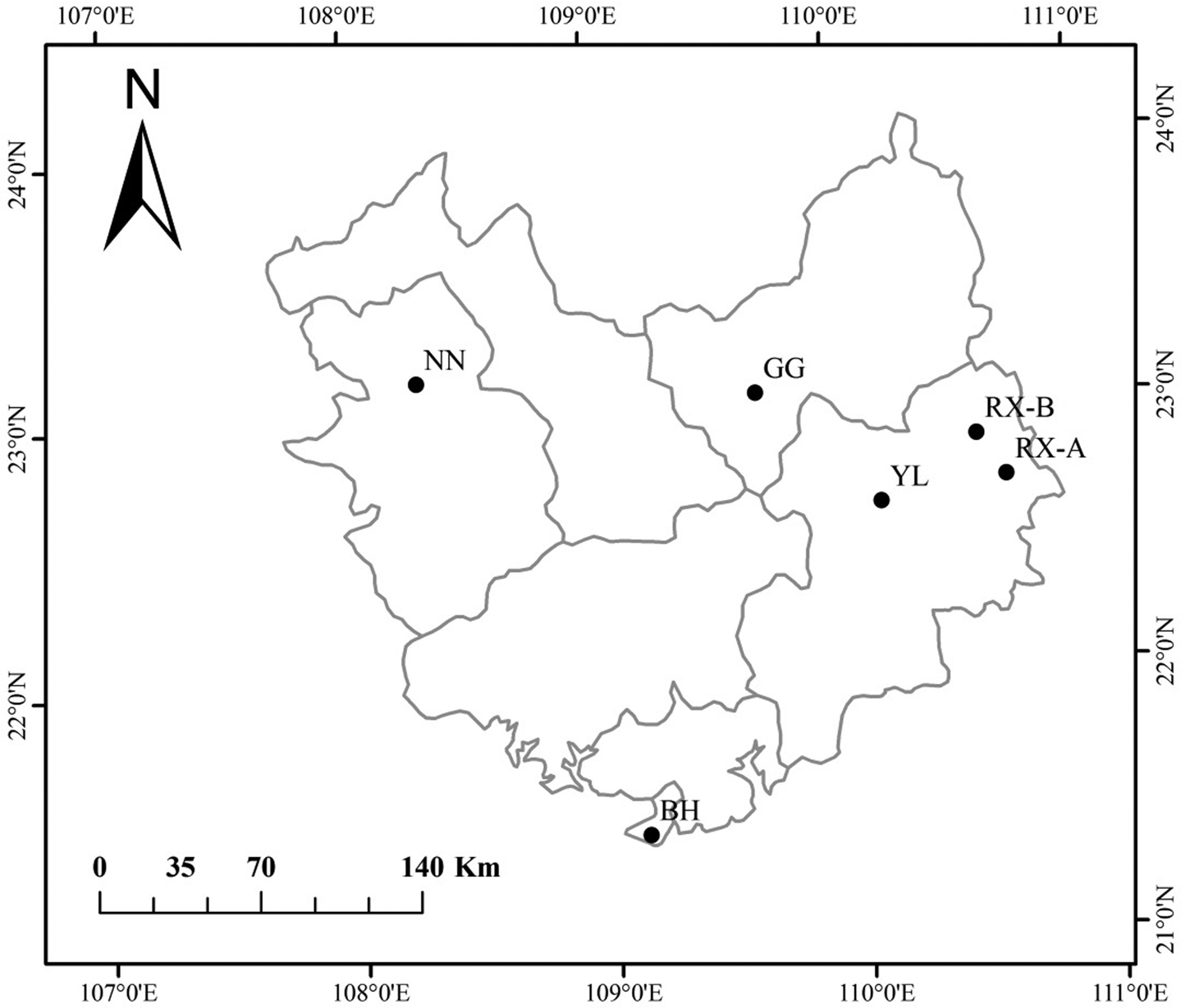
The bed bugs were collected from six different locations in Guangxi, China (fig. 1, table 1). RXA and RXB samples were caught in 2014, and the others were collected in 2018. The bed bugs were placed in 95% ethanol and stored at −20°C until use.
Map of the sampling locations for Cimex hemipterus, Guangxi Zhuang Autonomous Region, China. NN, Nanning; GG, Guigang; YL, Yulin; RX, Rongxian; BH, Beihai.

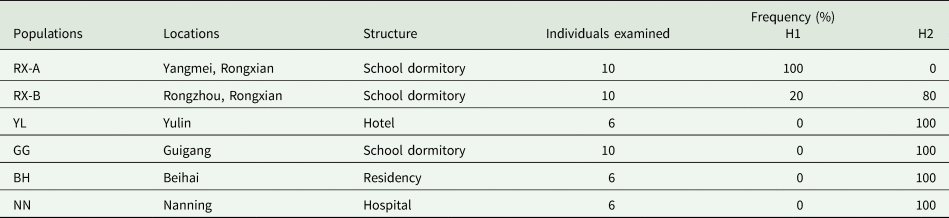
COI haplotypes identified in the tropical bed bugs from Guangxi, China

Note: The GenBank accession numbers are MK883766 and MK883767 for H1 and H2, respectively
DNA extraction and gene sequencing
The genomic DNA from individual bed bugs was extracted by the method of Rinkevich et al. (Reference Rinkevich, Zhang, Hamm, Brady, Lazzaro and Scott2006), and stored at −18°C until use.
A fragment (~550 bp) of the cytochrome c oxidase I (COI) gene was amplified using primers CHCOI-F (5′-TATTCGGAATGTGGGCAGGG-3′) and CHCOI-R (5′-CACCCGCTAA TACAGGTAGGA-3). The PCR mixture in a total volume of 25 μl, containing 12.5 μl of 2 × Taq MASTER MIX(Tiangen Co., Beijing),0.2 μM each primer,and 100–200 ng of DNA as a template. The thermal cycling profile was: an initial step of denaturation at 95°C for 2 min, followed by 34 cycles of 94°C for 30 s, 52°C for 30 s, 72°C for 50 s, and a final extension step at 72°C for 5 min. The PCR products were gel-purified and directly sequenced using the forward primer CHCOI-F.
Similarly, a fragment of the VGSC gene, encoding for the domain IIS4–IIS6 region and encompassing five putative kdr mutation sites (M918, L925, T929, L932, and L1014), was amplified using primers CHVG-SC-F and CHVG-SC-R (Dang et al., Reference Dang, Toi, Lilly, Lee, Naylor, Tawatsin, Thavara, Bu and Doggett2015). The PCR products were sequenced using the reverse primer CHVG-SC-R.
Bioinformatics analysis
Data from DNA sequencing were checked and cleaned manually. All confirmed DNA sequences were aligned by using Muscle 3.8 (Edgar, Reference Edgar2004), and variable sites were identified. NCBI resources (https://www.ncbi.nlm.nih.gov/) including databases and software indicated in the following text were used for bioinformatics analysis.
Results
COI haplotypes
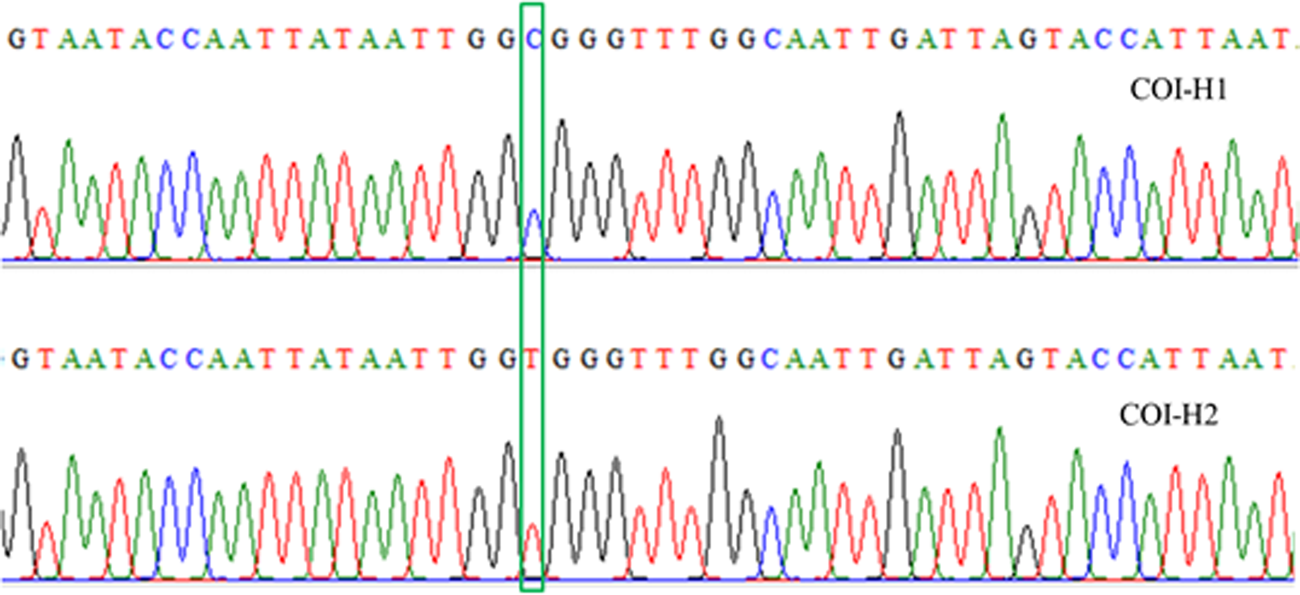
PCR products of the COI gene fragment were amplified from 48 individuals collected from six locations. Sequence alignment (472 bp in length) identified two haplotypes (H1 and H2, table 1). Chromatograms revealed only one haplotype within an individual, and only one synonymous nucleotide variation was observed between the two haplotypes (fig. 2). H1 was detected in two populations, while H2 was widely distributed in five of the six populations (table 1). Blast search revealed that H2 was shorter than, but 100% identical to the corresponding region of several COI sequences of tropical bed bugs from other Asian countries, such as MH607404 (Bangladesh), MG770889 (Iran), and KF018754 (Malaysia.).
Chromatograms showing the nucleotide variation in the COI gene detected in the tropical bed bugs from Guangxi, China. The base variation is boxed.

kdr mutations
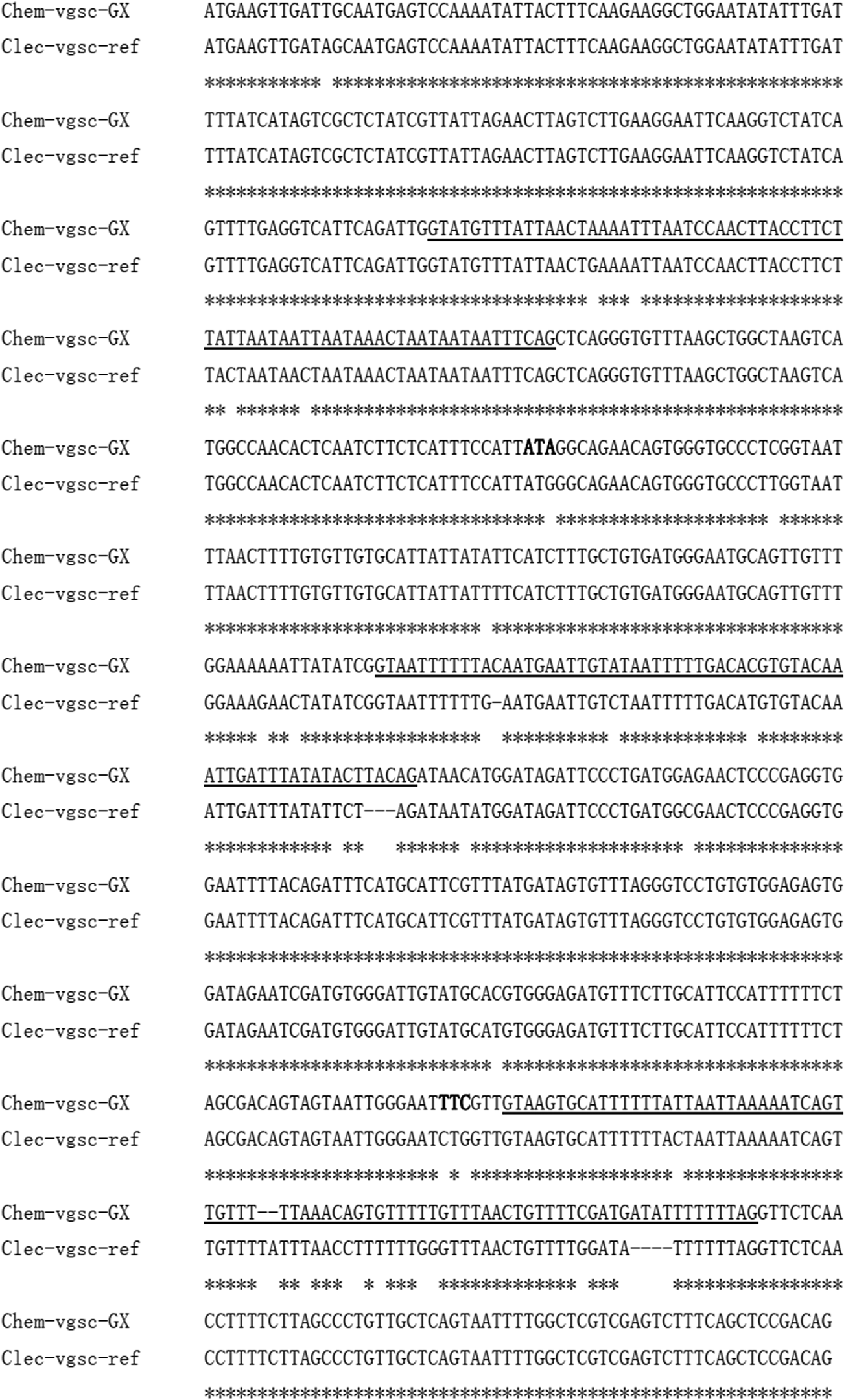
PCR products of the VGSC gene from each bed bug with a size of around 800 bp were sequenced. The DNA sequences excluding ambiguous terminal regions (with a length of 776 bp) were processed for further analysis. Sequence alignment indicated that all the VGSC sequences were identical and occurred in the homozygous form in the 44 examined individuals. This fragment (GenBank accession: MK883768) included three introns and four exons, with a sequence identity of 95.26% to the corresponding region of the common bed bug VGSC gene (GenBank No. JRLE01000129.1) (fig. 3). We notice that the length of exon 19 was 188 bp, rather than 190 bp as described in Dang et al. (Reference Dang, Toi, Lilly, Lee, Naylor, Tawatsin, Thavara, Bu and Doggett2015). The result was confirmed by re-sequencing two randomly selected samples using the forward primer CHVG-SC-F.
Exon–intron structure of the amplified genomic fragment of the VGSC genes from C. hemipterus, aligned with the corresponding region from the common bed bug C. lectularius (JRLE01000129.1). The two codons for M918I (ATA) and L1014F (TTC) mutations were indicated in bold. The introns are underlined.

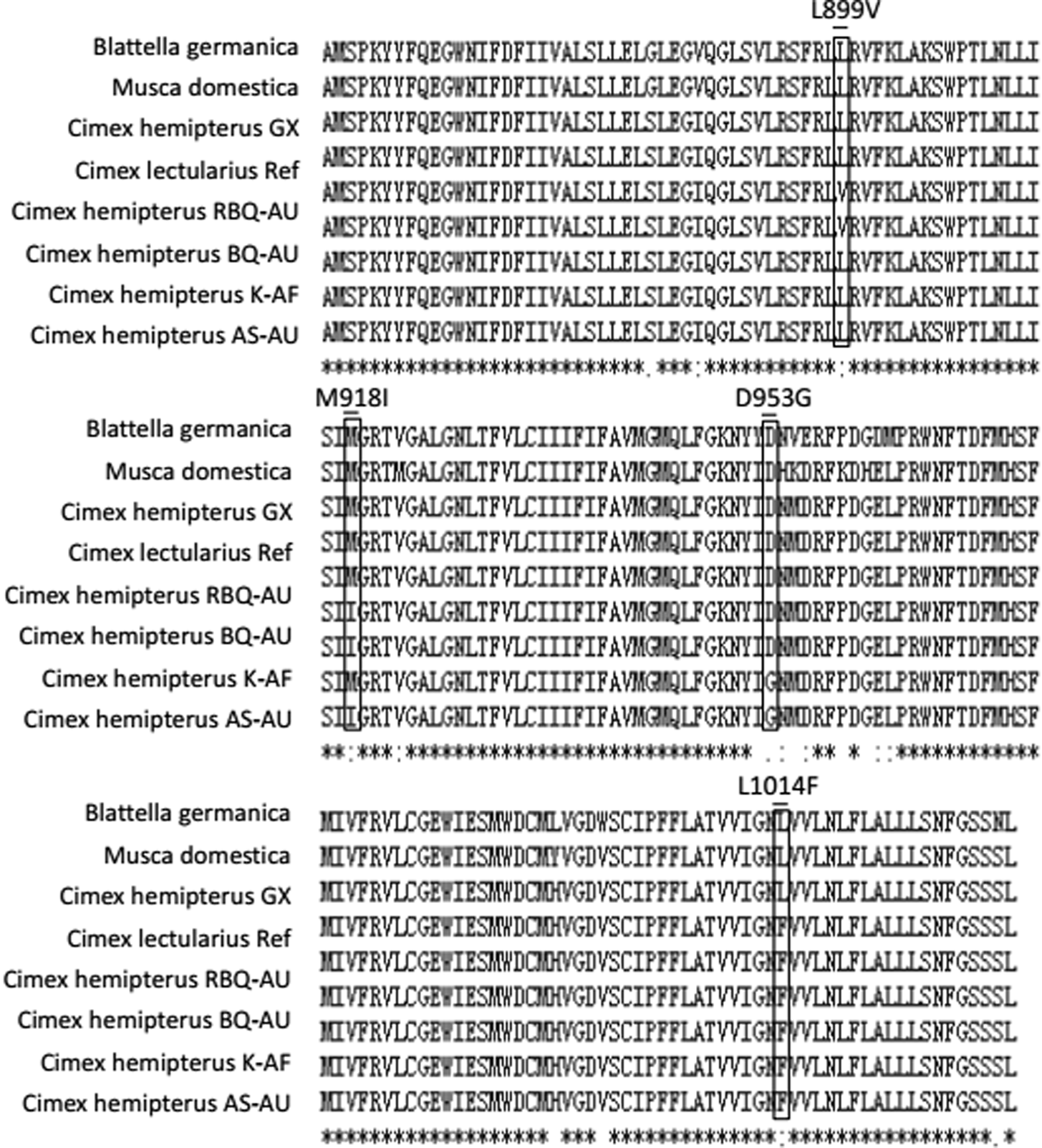
To identify possible mutations within these exon regions, the deduced protein sequence was compared with those from the common bed bug C. lectularius, housefly M. domestica, and German cockroach Blattella germanica (fig. 4). Two non-synonymous variations, respectively, at sites 918 (ATA) and 1014 (TTC) were observed, resulting in M918I (ATG to ATA) and L1014F (CTG to TTC) substitutions. The previously reported L899V and D953G (Dang et al., Reference Dang, Toi, Lilly, Lee, Naylor, Tawatsin, Thavara, Bu and Doggett2015) were not detected in our samples.
Alignments of the partial protein sequence of the VGSC gene from C. hemipterus (this study and those in Dang et al., Reference Dang, Toi, Lilly, Lee, Naylor, Tawatsin, Thavara, Bu and Doggett2015) with those from the common bed bug C. lectularius Ref (FJ031996), housefly Musca domestica (U38813), and German cockroach Blattella germanica (U71083). Asterisks (*), colons (:), and black dots (⋅) indicate identical, conserved, and weakly conserved sites, respectively.

Discussion
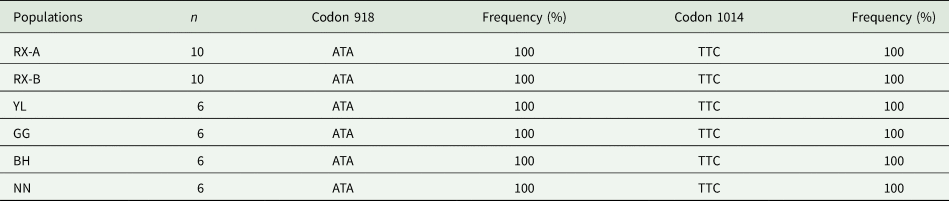
This study is the first detection to date of the putative kdr mutations in Chinese tropical bed bug populations. We found that all the investigated bed bugs carried both M918I and L1014F mutations (table 2). Based on the findings of Dang et al. and others (Williamson et al., Reference Williamson, Martines-Torres, Hick and Devonshire1996; Vais et al., Reference Vais, Atkinson, Pluteanu, Goodson, Devonshire, Williamson and Usherwood2003; Usherwood et al., Reference Usherwood, Davies, Mellor, O'Reilly, Peng, Vais, Khambay, Field and Williamson2007; Sonoda, Reference Sonoda2010; Sonoda et al., Reference Sonoda, Shi, Song, Zhang, Li, Wu, Liu, Li, Liang, Wari, Matsumura, Miakuchi, Tanaka, Miyata and Gao2012; Dong et al., Reference Dong, Du, Rinkevich, Nomura, Xu, Wang, Silver and Zhorov2014; Dang et al., Reference Dang, Toi, Lilly, Lee, Naylor, Tawatsin, Thavara, Bu and Doggett2015), we predict that these bed bug populations in Guangxi exhibit a high level of resistance to pyrethroids. This result provides an explanation for the control failure of bed bugs reported by local pest control operators in the field. This situation also calls for a decrease in reliance on pyrethroids, and highlights the need of alternative insecticides with different modes of action or alternative approaches such as heat treatments or fumigation in order to make bed bug control more effective.
kdr mutations and their frequencies detected in the tropical bed bug populations of Guangxi, China

Notably, all these examined bed bugs that were collected in different locations share an identical VGSC haplotype. Moreover, VGSC exists in homozygous forms in these samples. In addition, while two COI haplotypes exist, they differ by only one synonymous nucleotide variation. These data reveal a very low genetic diversity within and among these populations. The limited diversity within each population may be explained by observations that bed bug populations are often highly inbred. The low genetic diversity among these six populations, which were collected from different locations (fig. 3), probably is a consequence of strong anthropogenic selection by synthetic insecticides and followed by a founder effect. It is very likely that these populations in this study have a single origin, then establish through the introduction of singly mated female or a small group of extremely related individuals carrying the M918I + L1014F allele, and spread due to human-mediated movement. Although the M918I + L1014F alleles were found in populations from Australia, India, and Thailand (Dang et al., Reference Dang, Toi, Lilly, Lee, Naylor, Tawatsin, Thavara, Bu and Doggett2015), we are not sure if these alleles have a common origin, because the corresponding genomic DNA sequences of the VGSC gene in these samples used by Dang et al. (Reference Dang, Toi, Lilly, Lee, Naylor, Tawatsin, Thavara, Bu and Doggett2015) are not publicly available.
The two haplotypes (H1 and H2) of COI identified from a total of 48 individuals differ from each other at a single nucleotide (fig. 2). Interestingly, H2 is distributed in five of the six locations, while only sites RX-A and RX-B contain individuals of H1, and RX-B is the only location sampled which contains both H1 and H2 (table 1). A Blast search using H2 against the GenBank nucleotide collection (non-redundant) database (on 14 November 2019) yielded 12 entries with 100% identity and 100% coverage from C. hemipterus individuals sampled from Bangladesh, Indonesia, Iran, and Malaysia, demonstrating a wide distribution of H2. By contrast, no hit that is 100% identical to H1 was retrieved. This observation makes us propose that H1 may be a newly evolved haplotype. Further studies are required in order to clarify this hypothesis via investigating more samples from different locations. The coexistence of both H1 and H2 in RX-B implies that the bed bugs carrying H1 are spreading from RX-A to nearby RX-B. Taking action to limit the potential migration of bed bugs across locations is recommended.
This work focused on the investigation of kdr mutations. Based on lessons from studies on the related common bed bug C. lectularius, in which multiple resistance mechanisms have been identified (Yoon et al., Reference Yoon, Kwon, Strycharz, Hollingsworth, Lee and Clark2008; Mamidala et al., Reference Mamidala, Wijeratne, Wijeratne, Kornacker, Sudhamalla, RiveraVega, Haelmer, Meulia, Jones and Mittapalli2012; Zhu et al., Reference Zhu, Gujar, Gordon, Haynes, Potter and Palli2013), it is possible that other resistance mechanisms such as increased metabolism or reduced penetration are also present in C. hemipterus. Further work is required to gain a full understanding of the genetics of insecticide resistance in C. hemipterus populations.
Conclusion
This study represents the first effort to investigate the kdr-type resistance in the tropical bed bugs in China. Two putative and conserved kdr point mutations (M918I and L1014F) were detected and this double-mutation allele was found to be fixed in the six examined C. hemipterus populations across Guangxi of China. Our results strongly question the efficacy of pyrethroids for C. hemipterus control. Therefore, employing alternative tactics such as physical treatment (e.g. heat, cold, vacuuming), or using insecticides with an alternative mode of action are recommended in these regions.
Acknowledgements
This work was supported by the State Key Laboratory of Integrated Management of Pest Insects and Rodents. The funders had no role in the study design, data collection, analysis, decision to publish or preparation of the manuscript.
Author contribution
Conceived and designed the experiments: XHQ and XYF. Performed the experiments: YHZ and ML. Analyzed the data: XHQ and YHZ. Contributed reagents/materials/analysis tool: ML and XYF. Wrote the paper: XHQ and YHZ. All authors read and approved the final manuscript.
Conflict of interest
The author(s) declare that they have no competing interests.