Introduction
The ‘new’ Indian middle classes have attracted significant political, media and marketing attention in the past two decades. Accounts of a greatly expanded Indian middle class who have profited immensely from the new opportunities for education, jobs and consumption are pervasive. The new middle classes have in many ways become a sign of the promise of a new global model of development and thus a vehicle for the hopes of the Indian nation. Recent scholarly accounts have challenged these representations of the Indian middle classes by questioning the newness of this class sector and the extent to which they have benefited from the liberalization of the Indian economy.Footnote 1 It has been suggested that, rather than new entrants to middle-class status, the novelty might lie more in new (private sector rather than state) employment aspirations,Footnote 2 practices of credit-based consumption,Footnote 3 the software industry's production of transnational Indian worker-consumers,Footnote 4 and the emergence in the major Indian cities of deterritorialized ‘globalized cocoons’—apartment complexes, international schools, campuses of software companies and malls catering to the middle class and social elite.Footnote 5
Whilst the newness of the Indian middle classes has been a topic of debate, there appears to be agreement on their important symbolic role as representatives of an increasingly global India and proponents of a global nationalism. This positioning as simultaneously global and Indian is reflected in accounts that highlight the complex balancing acts performed by the Indian middle classes as they strive to find ‘appropriately Indian’Footnote 6 or ‘suitably modern traditionally Indian’Footnote 7 ways of being. Although concerned with the middle classes of Kathmandu, Nepal, Mark Liechty's work addresses many of the same tensions experienced by India's middle classes when he describes Kathmandu's middle classes as striving for a ‘tradition’ distinct from that of the urban poor, who are perceived as provincial and vulgar, and a modest and restrained ‘modernity’ distinct from elite lifestyles, which are perceived as excessive and foreign.Footnote 8 For Liechty's informants, this necessitates a daily balancing of the constraints and opportunities presented by a changing social and material context on the one hand, and established systems of prestige and notions of propriety on the other.
Many scholars working in South Asia have noted that the primary burden of this compulsion to achieve a good balance falls on women, who are expected to both embody and pass on a reified ‘tradition’.Footnote 9 The close association between the Indian woman and ‘Indian culture’ or ‘tradition’ that emerged during the colonial period has been well documented. According to Partha Chatterjee, women's nurturance of the national culture in the home came to be understood as an important compensation for the increasingly ‘modern’ public world of men.Footnote 10 Women's engagement with the ‘modern’, the Western, or the global (as well as with the public sphere), thus had to be more carefully managed than did men's engagement, and the maintenance of ways of being understood to be ‘Indian’ was seen as fundamental to appropriate femininity, but less so to appropriate masculinity.
In Radhakrishnan's analysis of contemporary transnational Information Technology (IT) workers, we see that these long-standing associations between the domestic sphere, femininity and the national culture remain important for women who increasingly participate in the public sphere through education and employment. Respectable femininity for Radhakrishnan's IT professionals involves preserving ‘good families’ whilst also engaging in a ‘global work culture’. Whilst Radhakrishnan's informants speak positively about women's empowerment and equal opportunity in the work place, they suggest that ‘this empowerment could go too far, just as becoming “global” becomes undesirable when it mimics the West or threatens existing notions of a good woman and a good family’.Footnote 11 According to Radhakrishnan, notions of the ‘right’ balance or the ‘right’ amount of freedom comprise the dominant model of femininity in India's transnational class and inform ‘the “appropriate difference” of the Indian family—cosmopolitan due to appropriate levels of “exposure” to the world, but also restrained and grounded in a cultural identity that maintains the sanctity of a woman's sexual purity’.Footnote 12
Strong themes of balance and limited engagement with the ‘global’ or the ‘modern’ emerge from the literature on female Indian professionals, for whom prioritizing family over work appears to be central to notions of appropriate femininity and appropriate Indianness.Footnote 13 Such themes have also been explored in relation to urban middle-class housewives who balance the demands of cosmopolitanism and consumer citizenship with expectations of ‘traditional’ self-sacrifice and devotion associated with the ‘Indian’ wife and mother.Footnote 14 Balancing acts are perhaps the most precarious for younger unmarried women whose sexuality and honour are perceived as vulnerable and in need of strict control, but who also face pressure to engage in a public consumption-based youth culture.
The work of Mark Liechty in Kathmandu and Ritty Lukose in Kerala highlights the pressures young women in urban South Asia face to restrict their movement in public space, to balance fashion and respectability in their dress, and to engage in commodified romance without damaging their honour or that of their family. Very similar practices were evident in suburban middle-class Hyderabad where my research was conducted, suggesting the emergence of a sub-continental youth culture, albeit with some regional variations. The purpose of this paper, then, is neither to challenge existing literature on the middle-class modesty of South Asian women, nor to argue for the distinctiveness of young female Hyderabadi's use of public space. Instead, I seek to draw this material together to provide a coherent picture of young middle-class women's use of public space; add to the depth of discussion by providing some insight into the complexity and variation in practices of appropriate femininity for women of different sections of the middle class; and to highlight the significance of new spaces of commodified leisure to distinctions between sections of the middle class.
Whilst all the above accounts of the balancing acts performed by middle-class Indian women are sensitive to the diversity of India's middle classes, they do not fully address the issue of different notions of a ‘good balance’ in different sections of the middle class. Different ideas about femininity and Indianness, fashion, respectability and the global mean that what for some is a good balance, for others is either ‘backward’ or an indecent mimicry of the West. Disparate notions of a ‘good balance’ place additional pressures on young women as they strive to display both an appropriate ‘Indian’ femininity and a suitable awareness of the global in a variety of contexts.
This paper explores the double binds experienced by middle-class young women as they attempt to balance the demands of respectability and fashion in three contexts—movement through public space, clothing and other forms of adornment, and pre-marital relationships with young men. For middle-class women, respectability requires purposeful movement, demure posture and modest clothing when in public as well as avoidance of lower-class spaces where men congregate. Status can, however, also be achieved through more revealing fashionable clothing and consumption in elite public spaces. It is in these privatized exclusive public spaces that women can engage in fashionable forms of public leisure and dress with less risk to their respectability. Pre-marital courtship is an important feature of Hyderabad's new spaces of leisure consumption, and another arena in which intra-class differences in notions of respectability and values of open-mindedness are evident. Although respectability for some sections of the middle class necessitates avoidance of even platonic relationships with the opposite sex, platonic heterosociality has become an important means of positioning oneself as a progressive, open-minded middle-class individual, and pre-marital ‘romance’ is emerging as a form of ‘fashion’ among middle-class youth due to its location within high-status forms of leisure consumption. In these contexts young women seek to appear respectable but not backward, conservative or orthodox; open-minded and ‘in touch’ with global trends, but not too ‘fast’ or overly ‘Westernized’. The tensions described in this paper reveal the fragmentation of Hyderabad's middle class and the barriers to social mobility experienced by women for whom the relationship between legitimate cultural capital and feminine modesty is becoming increasingly complex.
Suburban middle-class Hyderabad
Hyderabad, the capital of the south-eastern Indian state of Andhra Pradesh, was a relatively quiet town until the 1990s when it began to attract investment from the IT industry. As Bangalore, Mumbai and Chennai began to establish themselves as IT hubs, the government of Andhra Pradesh decided to invest in infrastructure to lure IT companies to the area resulting in the construction of Hyderabad Information Technology Engineering Consultancy (HITEC) City in the late 1990s. The growth of the IT industry in this outer suburb of Hyderabad led to significant and rapid development in areas yet more distant from the city centre. Along with HITEC City itself, these areas have come to be known as Cyberabad and are home to many of Hyderabad's newly middle-class, or at least newly-urban, families.
Between August 2009 and October 2010 I conducted research in residential areas of similar standing around the Cyberabad suburbs of Miyapur, Kukatpally and Kukatpally Housing Board which are located on the north-western edge of the city, approximately 10 kilometres from HITEC City and 20 kilometres from Charminar at the centre of the Old City. Most middle-class families live in apartment blocks of varying sizes and states of disrepair. There are also gated communities of much taller, more expensive apartment buildings, often with sports facilities (including gyms, tennis courts and swimming pools) catering for upper middle-class and elite families. Both areas are home to a range of small retail and service businesses, such as banks, tailors, clothing shops, homeware shops, ladies’ ‘fancy’ shops selling bangles and other goods, stationery shops, sweet shops and ‘Kirana’ (general, corner) stores. There are no large air-conditioned malls or upmarket cafés, such as Café Coffee Day or Barrista, in these relatively new and not particularly affluent areas. Upper middle-class families living in Miyapur and Kukatpally/Kukatpally Housing Board have to travel into the more up-market, central suburbs for such consumer experiences.
Research was based around two secondary schools because of the easy access to people of different generations that such institutions provide. Working from a list of schools acquired from the Rangareddy District Education Office, I visited a number of schools in the area and chose one that appeared to cater primarily for upper middle-class families and one that appeared to cater primarily for lower middle-class families. My judgements about the class positions of the students catered for by each school were made primarily on the basis of facilities. The facilities of Miyapur High School were not substantially better than those of a government school—a sandy outdoor area, a simple concrete block of classrooms, a small number of poorly maintained toilets that most teachers avoided using, peeling paint, stained walls, and well-worn furniture and blackboards—but as a private, fee-charging, English medium school it attracted mostly lower middle-class, rather than poor, families. The facilities of some schools suggested they catered primarily for the elite—marble floors, air-conditioned classrooms and buses, lush green sports fields and well-equipped computer rooms. Riversdale facilities spoke of significantly greater wealth than those at Miyapur High School—two freshly painted multi-storey buildings, a swimming pool, a large grassed field for sports, tennis and basketball courts—but they were not of quite the same level of luxury as the elite institutions.Footnote 15 In choosing the schools, my judgements about class positions were also informed by many of the same criteria that middle-class Hyderabadis use to determine the relative status of new acquaintances, particularly how well clothes fitted and were maintained, and fluency in the English language.
During my time in Hyderabad I stayed with families of students from the schools—two months each with two families from Riversdale and then the remaining time with a Miyapur High School family. I employed two fieldwork methods—participant observation and semi-structured interviews—with teachers, students, parents, and college students and young professionals recruited through school networks, in relation to topics ranging from school education to love and marriage. My research was mostly conducted in English and I employed a local translator for interviews with informants who did not speak English.
Middle-class families were identifiable by a range of characteristics including occupation, material possessions and education. However, like other researchers, I found middle-class identities to be primarily formed through the daily performance of ‘middleclassness’ which included the expression of moral discourses of propriety and restraint, as well as forms of ‘respectable’ behaviour such as the maintenance of a ‘neat’ and ‘decent’ appearance, investment in private English-medium education and engagement in certain kinds of consumption.Footnote 16 A broad overview of the student/parent demographics at Riversdale and Miyapur High School provides some of the context in which the cultural project of middleclassness, described in the following sections, plays out.
The vast majority of mothers at both Riversdale and Miyapur High School are housewives and almost all who work are teachers. Riversdale fathers work as engineers (many are software engineers), managers, successful businessmen, defence officers and in other similarly paid occupations. Examples of Miyapur High School fathers’ occupations include auto-rickshaw and bus driver, shopkeeper, plumber and electrician. Whilst nearly half of Miyapur High School fathers for whom I have data had not completed secondary school and only 14 per cent had a degree, the vast majority of Riversdale fathers had an undergraduate or postgraduate degree. Over 70 per cent of Riversdale mothers who responded to a questionnaire or were interviewed had an undergraduate or post-graduate degree whereas 20 per cent of Miyapur High School mothers had received no education and 80 per cent had not been educated beyond junior college (A-level equivalent). All parents expected their children to go to college and expressed desires for both sons and daughters to become doctors and engineers. Whereas for Riversdale parents this education was necessary for the maintenance of class position, Miyapur High School parents’ aspirations for their children's education were a significant jump from their own education levels and represented the promise of a more securely middle-class future. The stated incomes of those parents I interviewed or who responded to a questionnaire were mostly between Rs. 50,000 (£620) and Rs. 150,000 (£1,850) per month for Riversdale parents and between Rs. 10,000 (£120) and Rs. 20,000 (£240) per month for Miyapur High School parents.Footnote 17 Most Miyapur High School and Riversdale parents were the first generation of their families to be living in the city and in most cases their parents were still living in natal villages. Although the families I conducted research among had been patrilocal in the past, most are now living in nuclear family households. They had one, two or (at Miyapur High School) three children.
Almost all students at Riversdale are Hindu, but at Miyapur High School there is a large Muslim population—33 per cent in the classes for which I have data—which reflects the fact that the school is part of a chain run by a Muslim family. Muslim parents did not, however, respond to requests for interviews. Although I spoke to a few Christian teachers and parents, the material that follows overwhelmingly reflects opinions held by Hindus. Over 80 per cent of students at Riversdale identify as ‘Other’ or ‘Forward’ Castes (i.e. castes for which there are no reservations), whereas over a quarter of Miyapur High School students identify as OBC (Other Backward Classes) and only a third as ‘Other’ or ‘Forward’ Castes. Throughout this paper, I focus on class rather than caste distinctions. The suburban middle-class Hyderabadis I studied, like the professional middle-class intelligentsia studied by Béteille,Footnote 18 see caste origin as increasingly irrelevant in many areas of life, and make status distinctions more frequently on the basis of education, occupation, and income than on the basis of caste. However, informants’ narratives, along with other research,Footnote 19 indicate that processes of class (re)production are inextricably shaped by caste. The strong correlation between caste and class (most middle-class families are upper caste), and the extent to which middle-class Hyderabadis conflate the two, ensure that lower castes rank poorly in both secular and religious hierarchies. It is for this reason that I occasionally refer to ‘those of low caste-class status’. Unfortunately, the extent to which caste was denied, submerged, and delegitimized, particularly in public life, along with the lack of lower-caste middle-class families in my circle of acquaintances, mean that I am not able to comment in this paper on caste variations in middle-class modesty.
Constructing middle-class modesty
Before considering the specific ways in which young women seek to achieve a balance between middle-class ‘Indian’ respectability and a global consumer cool, it is necessary to examine the reference points in relation to which notions of middle-class modesty are formed. Mark Liechty suggests that, for his middle-class informants in Kathmandu, the modern and the traditional, the Western and the Nepali, the elite and the poor, were the key reference points.Footnote 20 He argues that middle-class women in Nepal ‘find themselves stuck in a bind between needing to claim modernity in order to distinguish themselves from those “below” them on the social scale, and needing to critique modernity as it is associated with elite lifestyles which the middle class views as corrupted by foreignness and consumer excess’.Footnote 21 In suburban middle-class Hyderabad, debates about social change are pervasive, but these debates are framed primarily in terms of ‘Indian culture’ and the problem of ‘Westernization’, rather than ‘the modern’.
Informants told me that the influence of the West is the primary source of change in Hyderabad. They talked about changes in clothing (jeans, ‘pant-shirt’ and skirts), food (‘pizza-burger’) and language (English) as well as increasing consumption of alcohol and drugs and the rise of smoking, ‘pub culture’, dating, divorce and, for women, putting ‘ego’ and career before family. Young people were described as particularly influenced, attracted by something new and different and the ‘fashion’ of Western consumables and practices. But it was the elite who were believed to be leading the charge in terms of Westernization. As a middle middle-class Riversdale mother told me, ‘Rich people they adopt new culture, new things very easily. So that way they don't care about the tradition or culture’.
Some aspects of social change were discussed positively. My middle-class friends and acquaintances in Hyderabad talked frequently of the need to be ‘open-minded’ and presented this as something that distinguished them from conservatism, backwardness and blind adherence to ‘tradition’ associated with the past, the old, the poor and the rural. Even more important than ‘open-mindedness’ to middle-class discourses of cultural capital was ‘exposure’, a term defined by Fuller and Narasimham as ‘the process of enhancing social skills and cultural knowledge through new opportunities, experiences, social contacts and sources of information, as well as the enhanced state that ensues’.Footnote 22 Middle-class Hyderabadis contrasted exposure with lives lived with no knowledge of the world beyond the immediate locality—again something associated with the poor, the rural and the old. Employers talked about the need for exposure, a key component of which is ‘communication skills’, in occupations like software engineering and teaching in an ‘international’ school. Whilst open-mindedness and exposure were generally presented as aspects of a globally-oriented cosmopolitanism rather than as an inherent part of Western or elite culture, they were also loosely associated with the West and the elite.
The elite are thus seen as overly Westernized and lacking in proper Indian family values and concern for propriety but also open-minded and having good ‘exposure’. The elite are also emulated to some extent because their lifestyles, like those of Westerners, are seen as prestigiously and fashionably luxurious. Status can therefore be achieved through display of expensive, elite, Western consumer goods and engagement in expensive, elite, Western activities such as drinking in pubs, but for the middle-classes these sources of status must be balanced with adherence to ‘Indian morality’ and ‘Indian culture’. The simultaneous attraction to and rejection of Western and elite culture was reflected in informants’ assertion that adoption of such culture should be ‘within the limits’:
It [Indian culture] is changing in every sphere, in every aspect—dressing, food habits, living, everything. People are going to clubs, they also started dating. As long as you are in your limits, nothing can change you…. Instead of chapattis they are eating pizza and burgers, but boys and girls are still in their limits (Middle middle-class female Riversdale teacher).
As long as it's under the limits it [change] is good. Cross the limits, it's not good. Spending long nights in the pubs—I don't think that's good culture (Upper middle-class female Riversdale teacher).
The need for ‘limits’ or a good balance is most salient in the lives of women as ‘open-mindedness’ is expressed in large part through liberal attitudes to female education and employment,Footnote 23 ‘Indianness’ is expressed most saliently through women's commitment to the family, and attributes associated with the West including Western fashions, pubs, parties, drinking, smoking and pre-marital relationships are much more frequently described as problematic for women than for men.
Whilst a significant portion of distancing from the elite was achieved discursively—by constructing middle-class behaviour as less Westernized and more modest, moderate and moral—distancing from the poor was achieved primarily through simple physical avoidance. Middle-class Hyderabadis avoided places where those of low caste-class status were likely to be present and where congestion made physical proximity unavoidable (such as public transport, the street and markets); by remaining in/on their vehicles; and by inhabiting exclusive public spaces that those of low caste-class status could not enter.Footnote 24 When talking about those of low caste-class status, informants tended to focus on a stereotype of lower class men's rough and impolite language, alcoholism, and a propensity towards domestic violence and other uncontrolled outbursts of anger. The lower caste-class woman, then, formed a negative point of contrast primarily as a product of what was presented as an outdated form of patriarchy: limited education for women, lack of exposure to the world beyond the home and family, early marriage and an inability to think for herself.
The strength of the Western-Indian comparison in shaping notions of appropriate femininity is perhaps reflected in the lack of reference to regional, religious or ethnic differences in femininity. Whilst specifically Bengali identities and culture were important to Donner's and Ganguly-Scrase and Scrase's informants, and old Maharashtrian patriotisms inform the contemporary Indian nationalism of Bénéï's informants, my informants presented themselves as Indians.Footnote 25 There was a distinct lack of talk about regional or linguistic identities in Hyderabad, although some sense of regional differences emerged in discussions of cities such as Mumbai and Bangalore, being much ‘faster’ than Hyderabad, i.e., characterized by busy lifestyles and quick adoption of new goods and practices. In describing Hyderabad as less ‘fast’ than other places, informants acknowledged and generally commended the fact that their city does not have quite the same ‘metro’ culture as other major centres, but this did not appear to form the basis for a strong regional identity or ideas of Andhra or Telugu femininity.
The lack of reference to religious identities is in some ways surprising considering Hyderabad's history of Muslim rule, the significant number of Muslims in the city and, particularly, the high proportion of Muslims at one of the schools. As already mentioned, I did not have many significant interactions with Muslims and as a result I cannot comment in this paper about Muslim ideas about femininity formed in opposition to notions of a Hindu femininity. Strong stereotypes about Muslims were evident in the talk of Hindu informants. This focused particularly on large numbers of children and a lack of education and paid employment among women. Informants suggested that Muslim women were less emancipated, less progressive and open-minded than Hindu women. Thus, Muslim women formed a similar point of contrast as did those of low caste-class status—as representatives of an outdated form of patriarchy. Muslim women were, however, relatively absent from discussions of appropriate femininity, which focused, as discussed above, in large part on Western women and Westernized elites.
Women in public space
Recent research in India has highlighted the sexualization of women's presence in public and the extent to which a woman's status as ‘respectable’ depends on a very controlled use of public space. Ritty Lukose, for example, describes how young female college students in Kerala frequently experience comment adi (being ‘hit’ with sexualized comments) and sexual touching, particularly on public transport. She contrasts the aimless wandering (chettu) of young men with women's goal-oriented movement through public space, and contends that ‘respectable’ women do not walk with their bodies ‘open’—head up and looking around—and instead adopt a more ‘contained’ position—looking ahead and slightly down, bags and books clutched to the body.Footnote 26 According to Lukose,
The demure female body enables a young woman to enter the public, but in ways that circumscribe her movements. She must be goal-oriented and contained as she traverses a public that is also occupied by young men, whose movements and trajectories are different—aimless and wandering…. A demure femininity in public retains its interiority, which is what allows it to enter the public in the first place.Footnote 27
Similarly, Steve Derné suggests that a shy, ashamed, modest, docile and inconspicuous comportment is expected by husbands of their wives throughout North India.Footnote 28 The men he spoke to in Banaras limited women's public activities to those that are useful for the house, and reserved the joys of aimless wandering for themselves. In the Uttar Pradesh town of Meerut, Craig Jeffrey found that young male college students passed their time by eve teasing and watching young women who were imagined as objectified goods or features in the campus landscape. In this context, ‘respectable’ young women were expected to avoid the tea stalls in which young men most commonly congregate and to confine their public leisure to the more appropriately feminine spaces of sweet shops and confectionary stores.Footnote 29 Such practices—modest comportment, purposeful movement and avoidance of certain spaces—also characterized the use of public space by young middle-class women in Hyderabad.
Middle-class parents in Hyderabad are very protective of their daughters. Whilst boys often attend movies and frequent bakeries, cafés and tea stalls without adult supervision, teenage girls almost never leave the house unless in the company of family members, except to attend school. Female school friends who live more than a couple of blocks from each other are reliant upon their parents to transport them to each other's homes, rather than making use of cheap and readily available public transport. Adult women are also believed to be vulnerable on public transport. They travel alone reluctantly during the day and not at all after dark. Incessant newspaper reports about attacks on and abduction of young women, along with popular urban myths about cunning strategies to lure young women into the hands of dangerous strangers (spread orally and via SMS, email and social networking sites) contribute to the notion that the public realm is a dangerous place for women. Women who enter public space have to contend with illicit sexual touching, sexual comments, male gazes, suspicion and gossip.
It was through my own transgressions that I was made acutely aware of the rules governing women's movement within the public sphere. When I first arrived, the stares and comments of male onlookers made me feel uncomfortable when walking around Miyapur and Kukatpally Housing Board. Whilst my novelty as the only foreigner in the area is likely to have contributed to the attention I attracted, the frequency with which local women complained about ‘eve teasing’ suggested that they too were subjected to such treatment. My response was to walk with my head down—if I could not see the stares they did not bother me. With time I became aware that I was no longer attracting quite so many stares or jeers. Whilst some may have simply become habituated to my presence, there were new people on the streets every day. It appeared that by adopting this contained and demure posture I was no longer perceived to be inviting comment.
This experience became the topic of conversation in class at Miyapur High School, the lower middle-class high school where I was conducting research. I had asked a group of Tenth Class students (ages 14 to 16) to debate whether boys or girls get better treatment in society. The boys argued that girls get more respect in India because they have places reserved for them on buses and trains. Hoping to generate a more intense discussion and stimulate students away from rehearsed responses, I told the boys that when I walked down the road in Hyderabad I looked at the ground because boys and men stared at me and ‘passed comments’. I asked whether this was respect. The girls interjected excitedly with support for this question stating that they shared my experience. The boys attempted to construct the ‘eve teasers’ as exceptional and socially deviant, but the girls argued that these boys were themselves prone to ‘passing comments’. Finally, one of the boys recommended I wear a burqa so as not to attract commentary and the class erupted into laughter. Although this comment was made in jest, it is indicative of a widespread belief that it is the woman's responsibility to adjust her self-presentation to ensure that she is ‘respected’ in the public domain.Footnote 30
The subject of ‘eve teasing’ came up again in a conversation with two recently married lower middle-class teachers at Miyapur High School, Meghana and Tejitha. Meghana had asked why I wore churidaar and I replied that it was comfortable, respectable, and a means of minimizing unwanted male attention when walking down the street.Footnote 31 Meghana explained that I was particularly targeted because, by looking at my skin colour, men would assume that I have no support. She noted that men know that she has familial support because she is Indian, although they still watch her closely to see if anything is out of place with her dress, any skin showing that should not be. So she ensures that she gives male onlookers nothing to comment on. Meghana noted that there are all sorts of people in India, so men make their women cover up and restrict their activities to protect them from harm. She observed that Indian men believe that women are fragile, and therefore try to protect them from everything. To illustrate the point, Tejitha interjected: ‘Don't climb on that bench! Don't laugh too much!’, whilst Meghana cupped her hands as if holding something very delicate. Meghana and Tejitha explained that because girls are brought up always being told they are fragile, they will feel that they are and that there are certain things they cannot do. Tejitha stated that these ideas exist because a girl is seen as the representative for the family. If she is shamed, the honour of her entire family is affected. My experiences and subsequent conversations with middle-class Hyderabadis suggest that women and teenage girls in Hyderabad are expected to adopt particularly demure body language when in public. Although not physically separated from the public sphere, women's adoption of contained and closed body language acts as a boundary between themselves and potential threats to their (and their families’) honour.
Young men in Hyderabad frequently move somewhat aimlessly from one public establishment to another as a form of ‘timepass’. It appeared in contrast that women's movement had to be extremely purposeful, so as not to give the impression of being in public unnecessarily and therefore not to be seen as inviting censure. Middle-class Hyderabadis’ use of the word ‘roam’ to denote young people's public pursuit of leisure evoked an aimlessness that seemed only legitimate for men, and many people mentioned young women's ‘roaming’ when talking about the contemporary deterioration of Indian culture and values. Women's ability to ‘roam’ is also limited by the fact that the inexpensive bakeries and road-side ‘hotels’ serving tea, coffee and snacks that can be found in every neighbourhood are out of bounds for ‘respectable’ women in Hyderabad. This was made particularly clear one day when a teenage girl I was staying with decided to get take-away ‘tiffins’ for breakfast whilst the other family members were away. My young friend insisted that we get her male cousin, who lived nearby, to collect and deliver our breakfast tiffins, despite the significant inconvenience for both ourselves and the cousin.
These experiences illustrate that in Hyderabad the street and other public spaces are not neutral as the male gaze serves to claim these spaces. As Henrike Donner has observed, ‘eve teasing’ often functions as a statement about control of public space, a means by which men from low income families can assert status in the neighbourhood.Footnote 32 Thus, when I enter these spaces I am transgressing gender-defined boundaries and the gazes and comments of men alert me to my transgression and lack of control over public space. ‘Eve teasing’ and the threat of sexual attack serve as evidence that women, particularly unmarried daughters, require active ‘protection’. This is imperative to ensure women's safety and personal honour, as well as the honour of the wider family unit. Women's vulnerability in public justifies their confinement to the home, and consolidates the authority of male relatives to control their activities and sexuality.Footnote 33 Women cannot go to certain places, nor can they go out at certain times. They cannot be seen to be out of the house without a specific and respectable purpose. Their status has to be maintained in public through an appropriate destination and appropriate body language.
Ideas and practices relating to women's movement through public space are by no means uniform, however. They vary according to age and marital status—young girls and young women are not permitted to wander in public without adult supervision, but mothers have many reasons to enter the public sphere including transporting children to and from school and getting supplies for the household, and older women are relatively free to roam should they wish to as concerns about sexuality are less relevant for them.Footnote 34 Concerns about women's use of public space also vary significantly according to context. For example, whilst living with a middle middle-class family in a small apartment block in Kukatpally Housing Board I was strongly discouraged from jogging the 100 metres down the road to the bus stop, but in the less public, more exclusively upper middle-class gated communities I subsequently lived in, I was given permission by the families I lived with to jog around the gated community (as long as it was early in the morning and I did not go beyond the gates of the housing complex) and to swim in the pool located in a particularly prestigious gated community (as long as I wore a costume that covered my thighs and avoided swimming when there were adult men in the pool). It was the relative class homogeneity of these gated communities that allowed greater freedom of movement. Modesty is thus most important in the most public of contexts—in the street—but less so in contexts where class others can be excluded.
Ideas about women's use of public space also differed from family to family and appeared to be related to some extent to class position. At one point I considered riding a bicycle to Miyapur High School as this would have been the most convenient mode of transport from the house I was living in at the time. Whilst the upper middle-class men and women I discussed this with encouraged me to go ahead with my plans, lower middle-class men and women were universally discouraging, arguing that bicycles are thoroughly inappropriate for a woman, particularly one in the respected role of teacher. Upper middle-class families appeared in general to be less concerned than lower middle-class families about young women's public leisure as they talked less frequently about young women's increased mobility as a negative aspect of a changing Hyderabad. Upper middle-class families may have been less concerned about respectability due to their more secure middle-class position and their ability to effectively communicate their middle-class status through material goods. Perhaps most significant, however, is the upper middle class's greater access to exclusive privatized public places like malls, cafes and restaurants, and their increased ability to avoid the street through use of private transport.
Greater flexibility of movement is more readily available to upper middle-class and elite women who have access to gleaming air-conditioned malls and expensive coffee houses. In these spaces, practices of high-status consumption, along with the exclusion of lower-class young men believed to be primarily responsible for sexualized gazes and comments, mitigates the potentially damaging effects of public leisure for women. As Donner has observed, these segregated middle-class spaces are ‘often seen as modern and empowering for middle-class women precisely because working class subjects have no access’.Footnote 35 Lower middle-class women are thus significantly more restricted in their ability to engage in public ‘timepass’ than are upper middle-class females. They cannot ‘roam’ like the men of their class, nor can they afford access to the elite spaces deemed suitable for female leisure. Whereas the elite are isolated from the rest of the world as they move in their cars from one elite space to another, lower and middle middle-class women are made to feel ‘out of place’ in public and avoid such spaces whenever possible.
Fashionable and respectable clothing
During fieldwork in suburban Hyderabad I moved between distinct social worlds—that of Riversdale, the upper middle-class school in which I was conducting research, that of lower middle-class Miyapur High School, and the elite world of friends I had met through mutual overseas acquaintances. In each world I wore different clothing to fit in—at Miyapur High School I wore loose churidaar and salwaar kameez that had been sewn for me by local tailors; at Riversdale I wore elastane leggings and more fitted kurta, sometimes sleeveless, bought ready-made from malls; when socializing with my elite friends I wore Western clothing such as jeans and T-shirts. Travelling from one world to another often involved a clandestine costume change. Travelling on foot and on public transport from the suburbs in which I lived into the city centre in a Western outfit was likely to attract unwelcome attention from men as well as comments from Miyapur High School students the following school day. My initial attempts at wearing a kurta out with my elite friends left me feeling like a ‘dowdy hick’ (or a confused tourist) and I quickly decided to conform to their dressing styles. Discussions of social change in Hyderabad often centred on changing dress styles, from sari to churidaar to jeans. For many the miniskirt appeared to represent all that is amiss in present-day India. However, what informants identified as appropriate varied greatly according to context and an outfit deemed appropriate by one social group was liable to be thought backward and shabby by another. Again class appeared to play a central role in determining what was and was not condoned.
Scholars who have explored the relationship between dress and social position in urban middle-class India have described a complex mix of factors involved in assessing a person's sartorial status. In Kanpur, Kathinka Frøystad found that judgements about whether strangers were ‘good people’ or ‘small people’ were made by looking at the degree to which their clothes were fashionable (especially important for young unmarried girls), the degree to which they fit, and the degree to which they were maintained (the extent to which clothes appeared new, clean, and ironed).Footnote 36 Nevertheless, even when the ‘small people’ in the suburb of Frøystad's research dressed up in their best clothes for a wedding, her upper caste informants ‘found the menswear too shiny and the women's choice of colour and textiles too gaudy’.Footnote 37
Other researchers have focused on the role of fashion in notions of feminine modesty and patriotism. Mark Liechty's work in Kathmandu focuses on the importance for the middle class of ‘doing fashion’ to a suitable, moderate level and not engaging in the ‘over fashion’ associated with the elite. In order to be deemed suitable to the middle class, dress in Kathmandu ‘must be both modern (that is, fashionable and thereby distinctive from the dress of the lower classes) and somehow Nepali, or at least suitable to Nepal (that is, not too beholden to international styles)’. Fashion excess was portrayed not just as a sign of elite ‘arrogance’ but also of fundamental moral shortcomings.Footnote 38 Liechty argues that, for women, ‘fashion practice often pits class interests against gender interests’. Whilst middle-class men ‘bask in fashion's signification of material prosperity’, women risk moral condemnation for their fashion practice—they are simultaneously targeted as the primary objects of fashion and saddled with the burden of maintaining ‘traditional morality’.Footnote 39
Ritty Lukose provides further examples of such sartorial balancing acts in the context of a Keralan college, describing the salwaar kameez/churidaar as a ‘demure modern’ middle ground between the pavada (long skirt and blouse), associated with tradition and the village, and sexualized, Western, overly modern jeans and minis-skirts.Footnote 40 Margit van Wessel complicates this image of the salwaar kameez by describing how, in Baroda, a young woman in a salwaar kameez may be called modern or forward if it is fashionably cut, and she wears make-up and cuts her hair short, but may be described as simple and assumed to be lacking in desire for independence and career ambition if her clothes are unfashionably cut and she has a heavily oiled braid of hair. A young woman wearing jeans might be seen in some contexts as modern and cool but in other contexts as carelessly putting her honour at risk.Footnote 41
All these factors were a feature of the sartorial landscape of suburban middle-class Hyderabad. Clothing was a key way in which a person's social standing was assessed and, for women, the right balance of fashion and modesty was required to communicate an appropriately Indian morality. ‘Fashion’ in Hyderabad was said to be the purview of the upper classes to the extent that several people suggested that anything worn by a ‘posh’ or ‘hi-fi’ person, no matter how ridiculous, would be assumed to be stylish by others. However, although the elite might be fashionable, they were not always ‘decent’. Below a middle middle-class Riversdale teacher explains the concerns for decency and ‘comfort’ that motivate families like hers, as opposed to elite families, to limit their engagement in fashion:
Usually in our families we don't prefer the minis and all. We’re to the extent only we limit ourselves to jeans, not more than that. The short tops we don't prefer—short, showing the belly and all. It's OK if it is quite comfortable for the people who are with them. Otherwise we go for the long tops, to the knee, which covers our thighs and bad part. It should not be over-exposed.
It was assumed that standards of decency are obvious, but that the elite knowingly shun these standards, as they lack a middle-class concern for the opinion of others.
The standards of decency were by no means obvious to me, however. Through my observations of women's dress, in combination with the commentary and discussion that this often aroused, I gradually developed a crude outline of what currently constitutes respectable attire for whom in Hyderabad. Older women are unlikely to cause anyone offence in a sari, and young girls generally wear Western style dresses or jeans and T-shirts. It is post-pubescent girls and married women under 40 for whom ‘appropriate’ dress is contentious. Common forms of dress for a young unmarried woman can be placed on a gradient of respectability, with the churidaar or salwaar kameez lying at the safer end of the scale. These are followed by an outfit of jeans and a kurta, which is in turn followed by jeans with a short top (to the hips), as somewhat less respectable, but nevertheless acceptable attire for an unmarried woman. Married women appear to have a primary choice between churidaar or salwaar kameez and sari, but young and slim married women may also dress in jeans and may wear formal trousers, skirts and shirts to work.
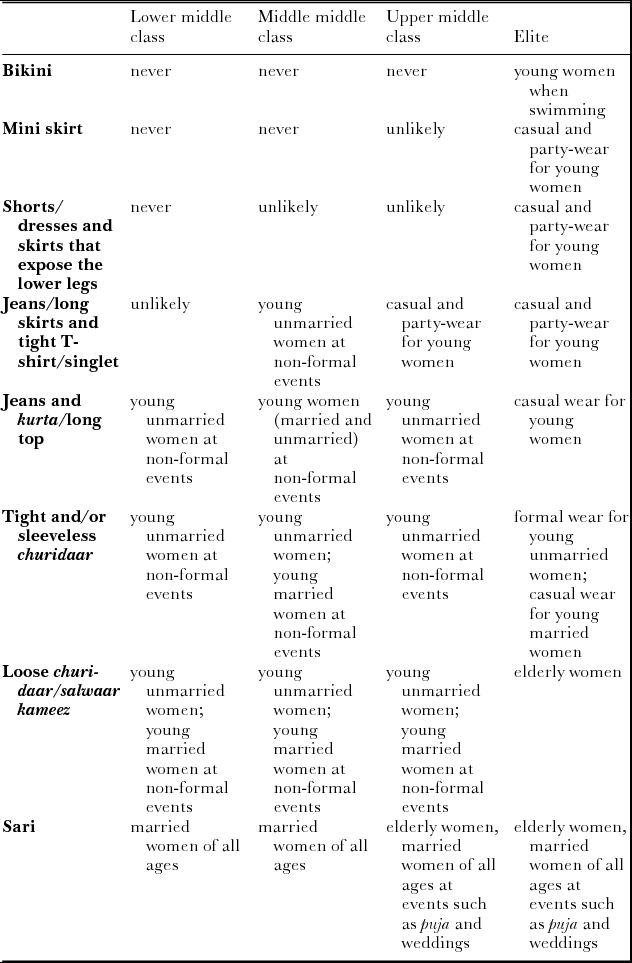
Table 1 below documents the styles of clothing that are deemed appropriate for each category of women for different classes in Hyderabad. Although a highly simplified representation of the nuances of class sections, contexts and dressing styles, it illustrates the complexity of establishing what is appropriate wear for whom at which occasion as well as the range of norms across classes. The majority of middle-class women have two broad categories of clothing style—everyday wear and more formal outfits suitable for special events such as family gatherings, puja (religious rituals) and weddings. For the upper middle class and elite, who attend private parties and patronize pubs and clubs, a third category of ‘party wear’ is included. Table 1 demonstrates how difficult it is, particularly for young lower-class women, to appear respectable to their class peers without straying too far from the current and less conservative fashion, set by the elite and upper middle class.
Standard and respectable modes of dress, by class membership

This table in no way represents the full extent of the complexity of dress in Hyderabad. For one thing, it does not encompass the full range of variability across contexts, the variety of factors that inform a woman's choice of clothing and the diversity of messages she may wish to convey through her dress. The example of Padma illustrates the communicative potential of clothing for women. Padma is a Brahman software worker who had had a love marriage to an OBC man she had met at college and had returned to full-time work long before her daughter's first birthday. Unlike her friends, mostly also young female software workers, Padma displayed all the ‘traditional’ signs of a married woman in her dress and adornment—sari, a bindi (mark on the forehead), vermillion along her hair parting, and a mangalsutra (marriage necklace). In doing so Padma asserts her appropriate Indian femininity and counteracts any assumptions others may make on the basis of her deviation from the norms of this identity in her marriage, work and childcare decisions.
Furthermore, what is deemed appropriate is also far from static. Like Liechty's informants in Kathmandu, my informants paid close attention to the rapidly changing fashions of stars on television and in movies and also learned about fashion simply by observing others. When I first visited Hyderabad in April 2009, elestane leggings had just started to be worn by the elite and upper middle-class in place of churidaar or salwaar trousers, but were regarded as indecent by most middle middle-class women, one of whom told me they were underwear. By the time I returned to Hyderabad in August of the same year to begin fieldwork, elastane leggings were very common among middle middle-class young women but were still relatively rare among lower middle-class young women. ‘Fashionable’ styles of salwaar kameez, churidaar and kurta also changed rapidly with gauze sleeves, empire cut and A-line kurta all coming in and out of fashion during the course of my research.
Along with constant change, further complexity was added by differences in cut, fabric, ways of wearing items of clothing, and whether clothes were bought readymade or fabric was purchased and then sewn to individual requirements by a tailor. For example, one way in which middle-class women distinguished themselves from working-class or poor women was by wearing their saris to the ground, rather than at ankle-length, despite the fact, or perhaps because, this made walking and working much more difficult.Footnote 42 My lower and middle middle-class informants and those with stronger connections to the village (usually recent migrants with lots of rural relatives) preferred tailormade clothing, elaborate details in cut and pattern, and matching of all aspects of an outfit and adornment. Whilst these informants saw this style as distinguishing them from the lower middle-class's ill-fitting, unadorned clothes made from cheap fabrics, this middle middle-class style was occasionally mocked for its fastidiousness, earnestness and gaudiness by my upper middle-class and more thoroughly urbanized informants who preferred simpler, readymade outfits.
Participants’ narratives suggested lower middle-class college girls were judged by their clothing and excluded from upper-class social networks. Middle-class college students I spoke with explained that the term errabus, referring to the red (erra) buses used in rural areas, was used in relation to poor and lower middle-class girls who present themselves in an unfashionable manner through not only wearing conservative clothing, but also pinning their dupatta/chuni (shawl/scarf) to their kurta, oiling their hair, tying it into tight braids, and wearing a large bindi. Margit van Wessel describes a similar category in Baroda, where young middle-class women who fail to groom themselves in accordance with contemporary fashions may be referred to as ‘Maniben’, a name associated with the village and a village look of unfashionable clothes and a long oiled braid.Footnote 43
The young women I knew in Hyderabad appeared to experience significant anxiety in relation to seemingly trivial matters of styling. They agonized over one plait or two; whether to get a ‘flint’ (a shorter piece of hair at the front, just long enough to be tucked behind the ear), or perhaps a ‘step’ (layered) cut; whether or not to wear a bindi. Their anxious uncertainty surrounding these decisions appeared to stem from two significant risks attached to any fashionable adjustment to their appearance—that they might be seen as ‘fast’ (i.e., open to indecent levels of man-woman interaction), or arrogant.Footnote 44 An ‘overly’ fashionable girl was vulnerable to being perceived as ‘stuck up’ or a ‘show off’ in her adoption of the trends set by the upper classes. For example, a young male software worker told me:
There are some girls who want to show that they are really posh or that they are some high range people or whatever. They want to wear like the heroines in the movies or whatever culture they have seen something different, they want to show it here. But you see she is a girl, anyway she's a girl…if someone is commenting, so what she feels? It's not good for them actually.
Parent and student discussions of staff dress styles within Riversdale, the upper middle-class school where I conducted research, provide an illustration of this issue. The Riversdale principal encouraged teaching staff to wear churidaar and Western style-trousers, rather than the more conservative saris usually associated with the teacher role. She explained this in terms of comfort and greater ease of movement, but a number of parents and students identified the clothing of particularly ‘fashionable’ teachers–sleeveless kurta and jeans, for example–as a sign of haughty overconfidence, both of the individual offending teachers and of the school body in general. A single outfit choice of Roja, a Miyapur High School Tenth Class girl, provides a second example of this issue. Roja wore a pair of elastane leggings and a T-shirt to a school function, an outfit that would have been fashionable at Riversdale, but stood out at Miyapur High School where all the other girls wore loose churidaar and ghagra (long skirt and blouse). Teachers and students were still talking about Roja's outfit days later. Most simply stated that she ‘did not look good’, some said it looked like something to sleep in, but there were also several suggestions that the outfit had been a foolish attempt to mimic upper classes.
The examples provided above have highlighted the importance of audience to women's dress choices. As Tarlo has also observed, as Indian women's movements become less restricted than in the past, and as classes become increasingly fragmented, women must contend with increasingly diverse audiences with varied expectations.Footnote 45 The sartorial difficulties of navigating different contexts were identified by some informants:
It is OK for a lower middle-class girl to wear jeans as long as she is wearing an oversized T-shirt that covers everything, the jeans are three sizes too big and you’re wearing jewellery that says ‘I’m from a respectable family’. It's OK. That's modern enough. That's as modern as you’re allowed to be. But if you’re going to travel by bus you have to wear a dowdy salwaar kameez and you have to sit in the ladies’ section (Upper middle-class female young professional).
Whilst the elite were seen as liable to expose themselves inappropriately, context-appropriate clothing was something the lower classes were more likely to fail at. Upper-class cultural capital, then, is not just about being able to afford fashionable clothes, but also about knowing what kinds of clothes are appropriate to each occasion.
In Hyderabad a woman's appearance—her dress, hairstyle, make-up, comportment and modes of speech—are interpreted as signs of her class background, her and her family's ideals regarding male-female relationships, and her degree of ‘exposure’. In a highly fragmented middle-class landscape, constructing a ‘successful’ presentation of self requires negotiating tensions between respectability (defined primarily in terms of a suitably ‘Indian’ control of women's sexuality) and fashion.Footnote 46 As Lukose argues, in India ‘decisions about different clothing styles are structured by a politics of culture tied to debates about Westernization and cultural authenticity that is highly gendered’.Footnote 47 Because women are expected to embody Indian ‘tradition’ and ‘culture’, to retain an essential Indiannness that compensates for men's involvement in a material world defined by foreign values,Footnote 48 because women's modesty is central to notions of middle-class decency, their clothing becomes a site for the expression of patriotic respectability. In Hyderabad, for a woman to be ‘modern’ or ‘fast’ is not a compliment. Such labels suggest her clothing and conduct are insufficiently demure, overly Westernized. She is not the kind of good Telugu ammayi (girl) that in-laws would welcome into their home.
With class distinctions cutting across scales of respectability in relation to dress and other aspects of styling, it becomes near impossible for women to be simultaneously fashionable and respectable. Lower middle-class women are disadvantaged in sartorial distinction projects by a lack of economic and cultural capital, i.e., knowledge of what is fashionable and the means to buy it. It would be a mistake, however, to interpret this too simplistically as an example of the greater freedom and autonomy of the upper middle-class and elite. As with women's use of public space, central to the ‘freedom’ of upper middle-class women is their access to exclusive privatized publics such as the mall and, essential to pushing the boundaries of appropriate fashions, car travel. Private vehicles enable upper middle-class women to control the audience to their fashion choices to some extent and, by creating boundaries between themselves and class-caste others, enhance their ability to be both fashionable and respectable.
Passion, fashion and the distinction of heterosociality
Recent studies among India's urban middle classes and elite suggest the emergence of new ideas about choice and consent in relation to marriage,Footnote 49 as well as a nascent culture of pre-marital relationships.Footnote 50 Premarital and extramarital relationships, self-chosen marriages, divorce and remarriage have long been accepted among the lower castes, among whom upward mobility usually implies stricter gender segregation and marriage practices.Footnote 51 For the upper castes, love has long been a cultural ideal, albeit a hidden practice largely kept separate from marriage.Footnote 52 What is new, then, in urban middle-class India is the emergence of a positive discourse of (some forms of) self-chosen marriage in a predominantly upper-caste context, the view that ‘love’ is a primary purpose of marriage, the much more open performance of ‘love’ by some married and unmarried couples, and the open encouragement of contact between boys and girls in some contexts in the interests of ‘open-mindedness’. My intention in this paper is not to provide a detailed description of the prevalence and nature of pre-marital relationships in middle-class Hyderabad, but rather to locate such relationship practices within class projects. I assert that relationships between young men and women have not arisen solely from a relaxing of sexual restrictions, but in large part from a growing youth consumer culture, of which ‘dating’ forms an important part. As certain forms of public heterosociality and romance become ‘fashion’, young women face further challenges in their efforts to appear respectable without being deemed backward and overly conservative.
Susan Seymour writes that, in 1980s Orissa, girls and boys had little contact with each other even in co-educational schools: ‘They sit on opposite sides of the classroom even in graduate school, and for a young woman to maintain her reputation she cannot be seen talking with young men, let alone socializing with them outside the classroom’.Footnote 53 In contrast, in Hyderabad, all participants reported that contact between young people of the opposite sex had increased since they were at school themselves. Many observed that, when they were young, boys and girls had not even been allowed to speak to each other, whereas today young people have many opportunities to interact at school, college and in the workplace.Footnote 54 Upper middle-class participants showed active support of regular interaction and friendships between young people of the opposite sex.Footnote 55 They constructed strict gender segregation as backward and irrational:
Girls and boys should be more open to each other so they can be friends. If they sit next to each other they feel uncomfortable and are teased. I try to educate my daughter that it is OK to call a boy a friend. It doesn't mean you are having a relationship (Upper middle-class Riversdale teacher).
At Riversdale efforts were made to discourage the belief that heterosociality was immoral. Although classroom seating arrangements and friendship groups remained largely gender segregated (as they were at Miyapur High School), girls and boys were encouraged by teachers to sit and work with each other. A negative view of strict gender separation was also evident in upper middle-class informants’ descriptions of all-girl junior colleges and colleges as overly conservative and narrow-minded.
In discussions of groups or ‘gangs’ on campus, junior college and college students often contrasted ‘mass’ (poor and lower middle-class), studious churidaar-wearing girls with ‘posh’, ‘hi-fi’ or ‘ostentatious’ girls, who wear sleeveless and skin tight kurta and frequently skip class. These groups were also characterized by their attitude towards male-female interaction:
So when it comes to hi-fi, they would have experienced it already and mass people would not know where, when, what to talk…. One such act that made me feel very embarrassed was in a dancing group. When I went and talked to a few girls and I started teaching them, I found some girls very uncomfortable and hesitant. Later I found out they felt uncomfortable dancing with a guy. Others just want to dance and show talent and don't care whether they’re dancing with guys (Upper middle-class female college student).
One student referred to a particularly conservative group of young women as the behenjis: ‘there's the cool crowd, the geeks, the losers, the behenjis…. It's a Hindi term, it means “sisters”—like the typical Indian crowd. They’d never wear a T-shirt and denim…they come in typical Indian dress. The girls that don't even look at boys and work really hard’. A blog post on ‘The Behenji Syndrome’ tells us a little more about the meaning of the term.Footnote 56 The author had suggested to a male friend that he go on a date with a female friend, who she knew was interested in him. The author's male friend refused saying that if he went out on a date with a behenji who ‘always dresses in a tent of a salwaar suit’, he would lose his ‘cool dude status’ and become a ‘loser’. This stereotyping of ‘girls that don't even look at boys’ suggests that male-female interaction has become an arena for the construction of class identity among urban young people.
Courting couples were visible in many parts of Hyderabad—embracing in dark corners of parks, walking hand-in-hand through malls, or sharing secrets in Café Coffee Day and Barrista. Within the school environment there were ongoing rumours of ‘crushes’, although these were discouraged by parents and teachers, and often denied by students. As students move into junior college they are more likely to act upon their crushes and by college many students are, according to informants and supported by my own observations of college-going friends and acquaintances, engaged in romantic liaisons of some kind. Participants’ estimations of the prevalence and nature of premarital relationships in Hyderabad were highly variable. For example, estimates of the number of college students involved in a romantic relationship varied from zero to 95 per cent and whilst some thought romantically involved couples only talked on the telephone, others described casual sex as part of an emerging dating culture.Footnote 57 What is significant about informants’ talk about ‘dating’ was their strong suggestion that this is a predominantly upper middle-class and elite practice.
Participants talked about ‘posh’ colleges where staff and parents did little to prevent relationships developing, and those who attended colleges with a wealthier student population reported higher rates of dating. Upper middle-class Ramya, for instance, believed that almost everyone in her course was dating, but thought that the percentage was around 60 per cent across Hyderabad colleges, with dating almost non-existent at some lower middle-class colleges. She described her ‘posh’ friends as ‘serial daters’ and noted that a few had had casual sex with people they met in bars and clubs. Whilst this talk about the increased romantic and sexual activity of the upper middle-class and elite is consistent with the fact that I observed far more dating among upper middle-class and elite informants, taking such talk at face value overlooks the very real possibility that lower middle-class premarital relationships are simply more covert. When informants associated premarital relationship with those above them on the class spectrum, they distanced themselves from this improper behaviour and constructed themselves and their class peers as more moral. When upper middle-class informants talked about the prevalence of dating and sexual activity among their peers and their ‘posh’ acquaintances, they sought to locate their own premarital relationships as more modest and moderate, to locate themselves in the moral middle between what they presented as the overly conservative lower middle-class and the unrestrained practices of the elite.
Participants were notably less positive about the increase in (openly displayed) romantic liaisons between young men and women than they were about platonic hetereosociality, although the two practices cannot be unrelated. Informants over 30 years of age were uniformly critical of pre-marital relationships and seemed very (perhaps deliberately) unaware that girls and boys all around them were romantically involved. Young people were more informed and more ambivalent. They talked positively about choosing their own spouse and most seemed in favour of a single premarital ‘true love’ relationship. However, whilst most young people presented their own relationships as ‘true love’, they tended to view all other relationships quite negatively as merely ‘timepass.’
The notion of a series of romantic attachments designed to find the person uniquely suited to one's individual personality was foreign to all but the wealthiest of my acquaintances. Instead, like middle-class people in other parts of India,Footnote 58 people in Hyderabad described relationships that do not end in marriage as merely timepass or transitory fun in contrast to ‘true love’ relationships that ideally end in marriage:Footnote 59
Some they just do it for timepass. It's not true love; everybody just wants to pass their time. Girls they fall in love very easily and they actually want to get married, but the guys don't fall in love (Upper middle-class male junior college student).
Most of them fall in love for timepass—to have one girlfriend or boyfriend. But after that they’ll forget very easily. They’re taking the relationships very easily (Middle middle-class female Miyapur High School teacher).
My informants strongly associated timepass relationships with the upper middle-class and elite and asserted that young people engage in such relationships because they are ‘fashion’ and thus a source of status:
It's becoming more nowadays in the generation who are in teenage, who are not yet married, those who are working for BPOs and software, those who have that exposure actually.… They feel that it is status, that it's culture. They feel that because lower-grade people and the middle-class people would not have that experience, they feel, ‘Great that we have that experience. Actually we are outgoing kind of people, outgoing in all the terms—in the thinking, in financial thing or in attending many parties, the rich parties and all’…. It happens mostly in the above average people and in higher-class people, not in middle class (Middle middle-class female Riversdale teacher).
I think a person without a boyfriend or a girlfriend would be down market in the crowd. To have a boyfriend or girlfriend is more than understanding or love or anything like that; it's like a status. Like some boys will say they have two or three girls at a time and the girls don't mind it (Upper middle-class male junior college student).
This generation feel that having a boyfriend or a girlfriend is fashion. Having a boyfriend or a girlfriend is the same as having a good dress (Young male software worker).
There was thus a tension between the perceived inappropriateness of timepass relationships and their association with fashion and elite status.
The elite and upper middle-class make pre-marital relationships ‘fashion’ by performing them in high-status spaces of consumption, such as expensive movie theatres, cafés and malls. Whilst lower classes also consume in comparable ways—eating out at stalls, shopping and buying trinkets, such practices lack the status attached to middle and upper-class consumption, and therefore do not turn ‘indecent’ relationships into ‘fashion’. Participants talked about the importance of boys having a car or motorbike to attract girls. They also highlighted the expense of romance for boys, who are expected to buy movie tickets, gifts and other consumables. These consumption practices were sufficient to distance the ‘dating’ of the upper classes from the promiscuity (both pre and extra-marital) associated with lower caste-class groups. The clearest evidence of this was the invisibility of ‘romance’ in all public spaces except for the most exclusive—malls and expensive cafes, restaurants, bars, and movie theatres. It was only in these exclusive spaces that courtship and romance became a performance of fashion rather than something to be hidden. Whilst for Twamley's middle-class informants in Baroda high-status consumption in movie complexes, malls and cafés was part of distinguishing respectable long-term relationships from ‘cheap’ temporary ones, in Hyderabad, such consumption worked to legitimate even temporary relationships in some class circles on the basis of ‘fashion’.Footnote 60
The status effects of pre-marital relationships were, however, highly gendered. Informants tended to focus on the ability of timepass relationships to enhance the self-image and masculine identity of young men. In contrast, as Abraham has also noted, because female sexuality is closely linked to personal and family honour, girls in timepass relationships are seen as liberal, of bad character, sexually available to any man, and as coming from a family that transgresses social norms.Footnote 61 These double standards were evident in the common perception among my informants that girls who engage in premarital affairs are not the type of ‘homely’ girls from good families that one would want to marry. Informants suggested that young men date ‘modern’ girls for pleasure, but want a more conservative bride whose previous and future fidelity they feel assured of. A male middle middle-class junior college student explained, ‘In the teen age they would like to enjoy. The modern girls will be better. But they prefer to marry homely girls. Modern girls are better for enjoyment and traditional girls are better for marriage because they are stable and secure’. This attitude appears to be widespread among postcolonial middle classes. Margit van Wessel's middle-class informants in Baroda reported that boys like ‘modern’ girls before marriage, but after marriage want a housewife, not a ‘show-off wife’.Footnote 62 James Ferguson similarly found in the Zambian Copperbelt that elite men ‘liked to have fashionable girlfriends but were less happy to see the same characteristics in a wife’.Footnote 63
Simmons and Illouz assert that dating practices first emerged in 1920s America as part of the growth of a new world of commercial leisure and consumption, and others have noted a similar correlation between public pre-marital ‘love’ and consumerism across the developing world.Footnote 64 In post-liberalization India this correlation is also evident. Interconnections between dating, leisure and consumption contribute not only to the view of relationships as sustained by fun and enjoyment between people with common tastes and recreational activities, but also to the notion, expressed in Hyderabad, that dating is the ‘fashion’. As Ritty Lukose has observed of Keralan college life, romance ‘is a very public form of consumer behaviour’ and has to be understood in terms of ‘the expansion and commodification of leisure, the emergence of heterosocial interactions and their commodification, the reworking of public consumer spaces as spaces of romance, and the reworking of class and gender relations in the context of a commodified romantic’.Footnote 65 In Hyderabad the lack of differentiation between ‘f’ and ‘p’ sounds in Telugu results in frequent pronunciation of ‘fashion’ as ‘passion’ and vice versa. A more appropriate slip of the tongue is difficult to imagine.
Middle-class women must carefully negotiate the moral perils of fashionable, but potentially dishonourable, relationships with men, without conveying a ‘narrow-minded’ low-status avoidance of the opposite sex. As Margit van Wessel notes,
Young single women live with contradictory images of ideal girlhood: present standards of attractiveness, current among youth, include a bold and extravert sexuality, and ideals of modern womanhood include confidence and the ability to interact with men. On the other hand, from other quarters, the same young women are expected to comply with standards of women's honour, which demands concealment and modest conduct.Footnote 66
Young women are concerned about appearing too ‘fast’ for marriage, but also do not want to be thought boring, overly conservative and unable to appreciate contemporary urban lifestyles.
Conclusion
When middle-class people in Hyderabad talked to me about the ‘bad’ changes they had observed in their city, they frequently focused on the increased mobility and visibility of girls and women in public spaces. Participants often described the ‘bad clothes’ worn by some young women and exclaimed that even girls are now smoking, drinking, going to pubs, and ‘roaming’. These activities were presented as foreign to Indian culture, and therefore inherently problematic, particularly when engaged in by girls and women. As in the rhetoric of Indian nationalists,Footnote 67 women's rightful place in the home was constructed as central to Indian culture and their excessive or unmanaged presence in public life was construed as threatening to this culture.
However, young women in Hyderabad face an opposing pressure to mingle with men in high-status spaces of leisure consumption, in order to identify themselves as fashionable global citizens rather than backward behenjis. On the one hand they are expected to embody authentic Indianness in their demure comportment, ‘traditional’ attire and commitment to ‘Indian’ family values that prohibit premarital relations. On the other they are judged according to a new standard of global consumer cool. As Radhakrishnan observes, ‘the “new” woman has become the subject of capitalist desire as a consumer, as well as the subject of a middle-class panic about changing sexual norms’.Footnote 68 Females from all sections of the middle class struggle to adopt a self-presentation that appropriately balances fashion and respectability.Footnote 69 Maintaining a respectable and fashionable middle-class femininity in Hyderabad requires constant self-regulation and monitoring. The intersection of class and gender creates a double bind, in which the approval of one group generally comes at the expense of disapproval from another group. Women are judged either for being arrogant, loose and dishonorable, or for being backward and lacking in a global cosmopolitanism described as ‘open-mindedness’ and ‘exposure’. This balance of respectability and fashion is particularly challenging for lower middle-class girls and women, who are excluded from lower-class public spaces by their gender and from elite public spaces by their class.
Throughout this paper I have emphasized the need for respectability among lower and middle middle-class women, and have focused on fashionable public leisure as a feature of upper middle-class femininity. However, this should not be interpreted as a sign of different forms of femininity operating according to entirely different logics. Overt markers of wealth allow respectable middle-class status to be assumed to some extent and mitigate the loss of status that results from women's greater mobility and visibility, and more revealing clothing. It is, however, not the display of wealth alone that protects the fashionable woman's honour, but also her ability to confine herself to the privatized publics of the upper middle class and elite. The upper middle-class and elite woman is in fact less ‘mobile’ in terms of her presence in the most public of spaces, those understood to ‘belong’ to the lower caste-class male—the street, the bazaar, the roadside tea stall or ‘hotel’. Upper middle-class and elite femininity does not radically alter the logic of female difference and vulnerability, then. It merely secludes women from the most ‘dangerous’ features of public life—lower class-caste men—while providing prescribed ‘safe’ spaces for them to enjoy newfound freedoms.
The importance of boundary maintenance to feminine respectability is particularly clear in Susan Seizer's ethnographic account of travelling actresses in Tamil Nadu. Seizer argues that because the ‘good woman’ is defined by the virtues of domesticity, actresses vigilantly create confined domestic spaces whilst on the road to counteract the negative status effects of the very public nature of their work.Footnote 70 In this paper I have described how middle-class women in Hyderabad create a similar closed, contained ‘interiority’ through their clothing and demeanour when in public. Elite and upper middle-class uses of public space have not resulted in a claiming of the streets, a breaking down of boundaries, but a retreat into increasingly privatized and exclusive public spaces. It is through these new boundaries that ‘fashionable’ women maintain interiority and thus respectability in public.
The significance to the Indian middle classes of constructing boundaries between self and other has been noted by several other scholars. Honour is linked to these boundaries such that the integrity of the inside—the body, the home, the community—has to be protected from the outside. Chakrabarty, for example, argues that in contrast to the ritually enclosed inside, the outside has a deeply ambiguous character, associated with dirt and disorder: ‘It is exposed and therefore malevolent. It is not subject to a single set of (enclosing) rules and ritual defining a community…. All that do not belong to the “inside” (family/community) lie there…. It is, in other words, a place against which one needs protection’.Footnote 71 Fernandes, too, has observed that the middle-class family is represented as a purified, self-contained and carefully bounded space, sanitized from the chaos of outdoor life.Footnote 72 Respectability, therefore, requires either limits to movement, overt display of respectability in terms of dress or comportment, or the ability to physically separate oneself from the dirt and disorder of the outside.
Indian cities have not historically been divided into strictly class-segregated spaces.Footnote 73 There are poor in every area of Hyderabad—working as servants in the homes of the elite, operating road-side stalls, living in temporary shelters adjacent to building sites. As middle and upper class families are generally reliant on the labour of the lower classes for household work, street entrepreneurs are located in all neighbourhoods to provide these services. However, Hyderabad and other Indian cities are being transformed by the rapid growth in the number of exclusive spaces such as international schools, pristine gated housing developments with names invoking a bucolic European paradise, enormous air-conditioned malls housing shops, restaurants and cinemas, and prohibitively expensive bars, pubs and cafés. The proliferation of segregated and protected upper-class lifestyle spaces has produced ‘a new aesthetics of class purity’Footnote 74 that relies on the construction of a form of purified interior in the public sphere.Footnote 75 Christiane Brosius describes this as a ‘privatopia’ in which gated zones of residential living, consumption and work enable ‘ordinary India’ to be excluded from ‘New India’.Footnote 76
In Hyderabad, the upper middle class and the elite are able to avoid poor and lower middle-class spaces almost entirely. As Carol Upadhya writes of Bangalore, the elite circulate through ‘spaces between home, work and the new sites of consumption in cocooned transport vehicles along designated arteries, engaging directly with the rest of the population only through casual and fleeting encounters with the working poor who provide essential services to the middle class and the city’.Footnote 77 Or in the words of a Riversdale father: ‘They [upper classes] will go in AC [air conditioned] cars. They don't have to have any contact with outside people. They mingle only with those in their status’. It is this highly privatized world of the upper classes that enables them to engage in practices that lower classes deem morally dubious. A Miyapur High School father observed: ‘Rich people have many facilities. They are always safe. They travel by cars. But if a middle-class girl goes out for pub, people in society will watch her. They gossip, comment and talk badly about our children. So that's why middle-class people don't encourage this culture’.
As Clarinda Still has argued, ‘Honour and shame are linked to boundaries and their violation…. The more boundaries and self-control a woman has (through veiling, seclusions, restricted movement and interaction), and the more she guards her shame, the more honour she brings to the family’.Footnote 78 While middle-class young women in Hyderabad have to employ the forms of boundary maintenance as described by Still in the performance of respectable femininity, they must also carefully test the limits of these boundaries in order to develop a sufficiently cosmopolitan or ‘fashionable’ feminine identity. The careful balance of these two demands is a particular challenge for lower and middle middle-class young women, whose ability to enact a ‘fashionable’ identity within the limits of ‘respectably’ is severely hampered by their inability to afford the requisite level of seclusion within designated spaces of feminine consumption.
This paper has shown how class boundaries are reproduced through women's practices of feminine respectability and fashion in the contexts of movement through public space, clothing and pre-marital relationships. I argue that expectations of modesty and respectability are not fixed and uniform for all women. Indeed, expectations of modesty and respectability are a key mechanism in the production of new distinctions between different sections of an increasingly fragmented middle class.