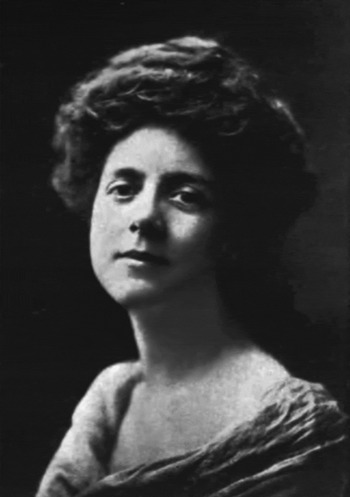
Patience Worth, a British Puritan girl who lived and died sometime in the seventeenth century, produced a prolific four million words in the form of novels, plays, poems, prayers, and short stories. “Produced” is the best word for what she did; we certainly can't say she “wrote” them. We can't, in fact, say that Patience Worth existed at all. But neither can we comfortably say that Pearl Pollard Curran (1883–1937) wrote the material in question, though she is usually credited as its author. Between 1913 and 1937, Curran (Fig. 1), a St. Louis, Missouri, housewife, spoke these four million words aloud (often in an idiosyncratic, pseudo-Shakespearean dialect) with the aid of a Ouija board and a planchette. A series of secretaries transcribed what she said: Curran claimed that Worth was a thwarted authoress who had long been searching from beyond the grave for a suitable host and that she had selected Curran as her channel. Some of the material she (they?) generated was ultimately published with the assistance of Casper S. Yost (1863–1941), editor of the St. Louis Globe-Democrat and founder of the American Society of Newspaper Editors. Intrepid librarians have cataloged this perplexing material in ways that attempt to account for its convoluted provenance: “Hope Trueblood, by Patience Worth, communicated through Mrs. John H. Curran, edited by Casper S. Yost, published by Henry Holt and Company, 1918.” Questions of authorship, ownership, and voice are central to this perplexing body of work.
Pearl Lenore Pollard Curran (Mrs. John H. Curran). Photo reproduced from The Bookman: Illustrated Magazine of Literature and Life April (1916): 127.

Patience Worth became a minor sensation in the early decades of the twentieth century, inspiring a handful of books that defended or debunked her existence. Notable figures such as Edgar Lee Masters were persuaded that she had to be real; equally notable figures such as Harry Houdini were not. Regardless, as Worth's star rose, so did Curran's, who began to move in ever-higher social circuits in St. Louis and Chicago and Los Angeles, where she was invited to parties to channel Worth for guests, including Ethel Barrymore and Douglas Fairbanks Jr. In 1918, Curran's husband, John, published a short-lived magazine, aptly titled Patience Worth's, to disseminate Worth's writing. And Curran herself took to the platform and lecture circuit, where, in Worth's voice, she extemporaneously produced poetry and aphorisms on a wide variety of topics requested by audience members. At the Illinois Athletic Club on 19 April 1930, for example, her impromptu poetry included a grab-bag mix of subjects that included Easter, Erasmus, Happiness, Hollyhocks Beside a Wicket Fence, Twilight, Reality, Art, the Taj Mahal, Immortality, Hope, Eventide, Kismet, Christian Science, Spiritual Love, Music, Youth, Grief, Dreams, Feet, Bubbles, Fear, Life After Death, Religion, Spirit, Time, All Our Efforts, Ships Upon the Sea, Anticipation, Ambition, and Television.Footnote 1
Throughout all this, the Currans, Casper Yost, and close family members and friends met for regular evening gatherings at the Curran household. During these more private times, Patience Worth would carry on conversations with those present, offer advice, and dictate portions of her books or plays. While she would communicate generic messages of love and support from those on “the other side,” she studiously refused to answer questions aimed at predicting the future or clarifying major events from the past. Sometimes, however, Patience Worth would make very specific requests of her immediate circle. On 16 August 1916, for example, she declared her desire to have a child; John and Pearl Curran, themselves unable to conceive, duly delivered upon this request by visiting local orphanages to seek a child that fit Worth's physical specifications. Ultimately, they recruited a young, pregnant widow with red hair and arranged to adopt her child (as long as it was a girl). The Currans named the child Patience Worth “Wee” Curran.
Truth, we say, is always stranger than fiction. This particular cast of characters and sequence of events—redolent as they are with charlatanism, delusion, ambition, and manipulation—practically begs to be taken onto the stage. In my capacity as joint artistic director of the for/word company (www.for-word-company.net), I have been investigating the Patience Worth Collection, held at the Missouri History Museum Archives in St. Louis, as the source material for our next performance.Footnote 2 This is to say, I have been digging around in archives in my capacity as a playwright who works in found text, not as a historian of performance (although the collection could hold great interest in this context). The question is: What does that mean where historical truth is concerned?
The Patience Worth Collection features, among other things, thirty bizarre volumes of typewritten transcripts that chronicle Pearl Curran's private and public channelings of Patience Worth over a twenty-year period. Until Pearl Curran's husband, John, died (quite mysteriously) in 1922, he made most of these transcripts. As the first person to put pen to paper here, he is, in some ways, the actual “author” of the Patience/Pearl material. Pearl Curran described John's centrality as her amanuensis in the January 1918 issue of Patience Worth's:
One does not pick up a newspaper and turn to book reviews to find this announcement: Pencil or Pen Produces New Volume. I do it.... I write with the board faster than an experienced penman can write. I have not yet found the person who could keep up with my dictation in long hand. I have been known to write as many as eighty words to the minute, calling each letter aloud and sometimes pronouncing short words. My husband has devised a system of abbreviation whereby he may almost keep pace.Footnote 3
These purported shorthand notes are no longer extant; the thirty-volume collection consists of typewritten elucidations of them. This is to say, they are not merely transcriptions of what Patience Worth said through Pearl Curran (though they are that). They are also laced with commentary on and exegesis of the words spoken as well as narrative descriptions of the reactions of those present to hearing them.
Each entry begins with its own cast of characters in a list of those present. Most of the entries unfold in a hybrid of theatrical dialogue and narrative explication. In the 16 August 1916 entry (vol. 4), which details the moment when Patience Worth requests that the Currans adopt a child for her, Patience's idiolect is apparent: “Look ye, this be athin thy hands, this ministering. See ye, this be a goodish trick.” Yet the voice of John Curran, as the transcriber, dominates as the narrator of the event. He opens the transcription with a setup: “We had expected this evening to go ahead with at least part of ‘Sorry Tale.’” The group had assembled, he tells us, to witness Curran channel Worth. They expected her to write more of what would become, in 1917, Worth's first publication, The Sorry Tale, a chronicle of life in the time of Jesus. Instead, Worth said, cryptically, “Ye shall seek ye a one, a wee bit, one who hath not.” According to John, Pearl immediately stopped channeling Worth to clarify for the room: “She wants us to get a baby.”
The 16 August entry goes on to detail Worth's very clear plan for adopting the child. The Currans, she says, should pay for upkeep of the child by drawing from “her own earnings” from the publication of her writings. She demands that the Currans always dress the child like her “mother”: “bonneted o'white like unto thy damie. Yea and kerchief. A wee, wee. Ye shall set it gray caped.” After requesting that they call Casper Yost to tell him the good news, Worth went on to dictate “about 750 words of the Sorry Tale.” Significantly, Pearl Curran's own voice in all this is severely limited: after saying “She wants us to get a baby,” everything else in the entry is either the recounted voice of Patience Worth or the narrative voice of John Curran.
After John Curran's death in 1922, Pearl Curran's mother, Mary E. Pollard, stepped in briefly as stenographer until her own death later that year. The thirty-volume set continues on for fifteen more years, through two more marriages, to Pearl's death in 1937. Over that time, the job of transcription was passed among friends and hosts, and the record becomes less descriptive, more sporadic, and more fragmentary. Eventually, it consists only of Patience Worth's most pithy quotes.
Much of what is in the Patience Worth Collection is, for a historian, troublingly suspect as evidence. Because it exists only in transcription, it is not even clear that this work is Pearl Curran's own. It is more than possible that much of what was “transcribed” by John Curran was his own writing or (as was suggested even in Pearl's lifetime) the writing of a cohort of (forgive me) ghostwriters who together collaborated to create the Patience Worth fiction. Moreover, the adoption of Patience Worth “Wee” Curran just before publication of Worth's first novel seems loaded with possible motivations. Was it a cunningly cynical publicity stunt masterminded by John Curran? Was it a desperate and sublimated attempt by childless Pearl Curran to become a mother? Was it both?
If I were turning to the Patience Worth collection as source material for a microhistory (or even a biography) about Pearl Curran, a nondescript housewife in early twentieth-century St. Louis, a mountain of lacunae awaits explication. But because I am building a play, those mysteries, the suspect quality of the archival material, actually become the story itself. As I build it, the play is becoming a piece about doubt and credulity, because that is what the archive most clearly expresses. I can allow the confusion of the archive, the questions it raises, directly onto the stage as the narrative thrust of the piece. For example, the tension between transcription and commentary, the very fact that Patience's (or is it Pearl's?) voice comes to us only through the mediation and adjudication of the men around her (and is, in her later years, stripped of all context) will inform a series of staging choices, not least of which are these questions: Will one woman or two play the role of Patience and Pearl? And how much of what is attributed to Patience will actually come out of John's mouth?
In addition, the moments of surprising discovery in the archive—which any historian knows—do more than simply give me crucial pieces of information. They tell me something about how to structure the play. For example, Pearl Curran gave birth to Eileen Curran, her first and only biological child, six months after the death of John Curran. The couple had been unable to conceive for years, and he had been very ill, in Barnes Hospital, for several months prior to his death. Whose biological child, I wondered as I read the transcription, is Eileen? And what was it like for her to grow up alongside of Patience Worth Wee? I want to retain for my audience a similar sense of incredulous surprise and a creeping suspicion about some of the central male figures in the story.
Similarly, the further into the material I got, the more I began to wonder how to unravel the complex relationship between Pearl Curran and Casper Yost. When channeling Patience Worth, Curran often referred to Yost as “my beloved,” and most of the poetry she extemporized for him was decidedly suggestive in nature, including, for example, “We Shall Commune” on 22 June 1921:
My job as a playwright working with archival material is not, in fact, so far away from my job as a historian. I deduce, I discover, I intuit. I still feel bound by the burden of proof, but I get the distinct pleasure of allowing unanswered (or unanswerable) questions to be at the core of the final product that I am building. Because of this, I am able to linger in the frisson of discovery.
The Patience Worth Collection is particularly rich material for the for/word company because we are focused on what we call “dynamic stagings and innovative interpretations of material from the historical record.” We build our pieces exclusively out of archival and historical material, from which we reimagine, recreate, or (in Charles Mee's parlance) remake a particular world. So, we say, “[W]e're not interested in historical reconstruction, documentary theatre, or biographical drama. We are finding a way to get beautiful words and the fascinating people who wrote them onstage in vibrant, physical, and textured ways.”Footnote 4
We know we're far from the first or only artists to work in found text. However, creating work with for/word allows me to interrogate my own position as a historian and an artist. It highlights the kinds of struggles that Charles Mee articulated between the writing of narrative history and performing history.Footnote 5 It makes tangible a collusion of the archive and the repertoire. Most importantly, it provides me with a fresh way of engaging with Van Wyck Brooks's call for a “usable past.”Footnote 6
So although we work with the archive and with transcripts, interviews, and newspaper articles, we are not creating what Attilio Favorini would call “documentary theatre.”Footnote 7 And although we are working with historical events, we are not “performing history,” in Freddie Rokem's sense, which retains a certain political valencing and, especially, a notion of the actor as the “hyper-historian,” serving as a surrogate “witness of the events vis-à-vis the spectators.”Footnote 8 It is perhaps more useful to think about what for/word does along the lines of how Joseph Roach articulates the tension between memory and forgetting in Cities of the Dead: “To perform also means, though often more secretly, to reinvent.”Footnote 9
In a 2009 interview with Humanities, Jill Lepore, the David Woods Kemper '41 Professor of American History at Harvard University and a staff writer at the New Yorker, confessed her inclination toward writing biography and her discomfort with how that form is viewed in the field of academic history:
Interest in character is to some degree unusual among scholarly historians. It is something I resisted because I was trained to believe that character does not contain explanations; character is incidental. There are large historical forces and structures; there are ideas; there are economic circumstances; there are theories of knowing, materiality, ideology, epistemology, economy. With these, you can analyze the past and understand it, but the very last approach you would ever resort to as an academically trained historian would be biographical. Unfortunately, all I ever really wanted to do was figure people out. In graduate school, that looked like a liability, and I took note.... But I got to be very uncomfortable with what I was trained to study versus how I wanted to write.
So, I wrote my second book, a book of character sketches, and it felt like an apostasy.Footnote 10
In some ways, for someone like me, who was trained as a theatre historian, drawing from the archive to create a play, not a book, is my own sort of apostasy. And, as in Lepore's case, the pull toward character within history is a strong one. For me, this pull translates into theatricalizing the source material for the writing of history: to take the archive onto the stage, not onto the page.