Evan S. Connell's Bridge novels – Mrs. Bridge (1959) and Mr. Bridge (1969) – trace the domestic and social drama of an upper-class Kansas City family from the mid-1920s to the early 1940s. The novels' plots proceed chronologically, layering upon one another as they describe and redescribe many of the same key moments in the lives of Mr. and Mrs. Bridge (Walter and India) and their children (Ruth, Carolyn, and Douglas), forming what Gerald Shapiro calls “a curious double exposure, like a photograph taken once in shadow, once in light.”Footnote 1 This “double exposure,” which operates clearly on the formal levels of character and plot, can serve for us as the key metaphor by which we can describe the presentation of history in the two novels. If the Bridge novels, when paired, fall into the “novel as social history” genre, as has been claimed, then the historical frame for that social history proves difficult to pin down.Footnote 2 In what follows, we will see that this difficulty, which is endemic to readings of the Bridge novels, directly indicates the key problem of the novels' presentation of social history: the historical separation between the moments of the novels' publication and their setting allows the novels to map the Bridges' social and class standing onto the social geography of Kansas City between World War I and World War II, while simultaneously mapping the problematic relationships between the Bridge parents and their children onto a more generalized sense of post-World War II suburban ennui and dissatisfaction.Footnote 3 An example might help clarify. Charles Thomas Samuels, in his review of Mr. Bridge, claims that the novel “which is laid in the thirties, strives … for a historical dimension, but despite the appearance of brand names and contemporary radio shows, the action, with its frequent emphasis on race relations and youth rebellion, has the feel of the sixties.”Footnote 4 It seems clear that both novels invoke a “historical dimension,” one that is clearly centered on Kansas City, a city that “seethes when Evan Connell writes,” so rooted are the novels in the specificity of Kansas City life between the wars.Footnote 5 However, Samuels has it right: the Bridge novels also undeniably participate in the culture of the 1950s and 1960s. This historical layering invites a tempting historical flattening, one which erroneously reads an upper-class family living in an affluent district of Kansas City with later, postwar novels which are read as indictments of the growing suburban middle class.Footnote 6
In an attempt to correct for the tempting conflation of the dual historical moments of the Bridge novels, I argue that these novels pointedly articulate their historical disjunction – remaining firmly planted in a carefully articulated history and geography of pre-World War II Kansas City and simultaneously representing the alienation and dissipation of postwar suburban life – both in the presentation of racial and social geography in Kansas City between the wars and in the gap between the novels' two generations of Bridges. The persistent layering of narratives, geographies, histories, and generations in these novels complicates a simple reading of any one of these dimensions. In what follows I will take up the Bridge novels on two fronts, addressing their historical, geographic, and social settings before showing how the novels simultaneously remain critical of a postwar, suburban culture. First, I will take up the novels' initial and subsequent critical receptions, then turn to the position of the Bridges within the social and geographic landscape of Kansas City between World War I and World War II, finally turning to the generational tension within the Bridge family as a mapping of a postwar critique of suburban culture.
Reading the Bridge novels
Released ten years apart, the Bridge novels were oddly received. Reviewers seemed split on how to take Mrs. Bridge as featured in her novel, especially in identifying her social position and significance. Some reviewers, like Florence Crowther, writing in the New York Times Book Review, correctly identify Mrs. Bridge's social position: “a lady from Kansas City with a house in the best residential section, one full-time maid, one mink coat and a Lincoln for her very own.”Footnote 7 Similarly, Charles Poore in a daily New York Times article writes that “we see Mrs. Bridge struggling with what we are given to understand are the perils of too much wealth and too much leisure.”Footnote 8 However, Mrs. Bridge is just as often held up as a late-1950s everywoman: Fanny Butcher, in the Chicago Daily Tribune, views Mrs. Bridge as “a composite picture of hundreds of thousands of women,” one whose life has “no broad pattern to it,” and in whose story “nearly any woman would find at least a fleeting image of herself.”Footnote 9 On the one hand, Mrs. Bridge is the well-to-do matriarch, wanting for nothing; on the other, she is the symbolic everywoman, a character both generalized and specific to each female reader, circa 1959.
Ten years later, Mr. Bridge would occupy a similarly split role in reviews of Mr. Bridge. Guy Davenport writes in the New York Times Book Review that “Mr. Bridge is the traditional American male” but that the novel itself is “openly interested in the tragedy of success.”Footnote 10 In the same vein, Webster Schott, writing in Time, claims that “the Bridge novels achieve an understanding of provincial upper-middle-class U.S. life beyond anything in our literature,” “penetrat[ing] the monotony barrier of suburban Kansas City … to lay open the quietly desperate, secret life of Midwestern noninvolvement.”Footnote 11 For some, like John Goss, writing in the New York Review of Books, the question of realism in Mr. Bridge is precisely the problem of the novel's critical social history: “Mr. Bridge is flesh and blood, a not-altogether-predictable individual rather than a social critic's stereotype or the representative of a mythical booboisie.”Footnote 12 These reviewers – split as they are over whether the Bridges figure in the Bridge novels as specific, upper-class figures or generic, middle-class ones – have it exactly right. The significant question of the Bridges' social status, coupled with their role as socially symbolic characters, must be answered with a carefully couched “both/and”: the Bridges (especially Mr. and Mrs. Bridge) are both upper-class, country-club socialites with a historically specific class position within the social and economic world of Kansas City in the 1920s and 1930s and, at the same time, the Bridges stage (via the problematic relationships between the Bridge parents and their children) a series of social crises drawn from the 1950s and 1960s, specifically those focussed on the problems of the growing suburban middle class and the seemingly increasing generational gap, problems exacerbated by the growth of the Organized system and consumer culture.
Later commentaries on the Bridge novels often ignore the novels' historical setting, instead addressing them as distinctly postwar in theme and structure. For example, in her book Family Plots: The De-Oedipalization of Popular Culture, Dana Heller distances the historical setting of Mrs. Bridge:
The novel's publication in 1959 suggests that Connell may have appropriated the modern period in order to displace his critique of emerging postwar, postmodern cultural and aesthetic developments. Indeed, if the Bridges seem somewhat out of place in relation to their setting, it stands to reason that such displacements afford Connell the distance he might have needed to construct this bitter referendum on the grand narratives of white, bourgeois, American patriarchy and its mixture of idealization and contempt toward motherhood.Footnote 13
From this formulation, Heller reads Mrs. Bridge as “a character overdetermined by spatial politics that harness her to epistemological assumptions at odds with her own inarticulate desires,” “suffer[ing] from some nameless malaise, an inarticulate longing, much like the future ‘everywoman’ of Betty Friedan's The Feminine Mystique (1963).”Footnote 14 Mrs. Bridge, who at times suffers from a “nameless panic,”Footnote 15 may indeed sound familiar in light of Friedan's formulation of the feminine mystique, which “says that the highest value and the only commitment for women is the fulfillment of their own femininity” and is “so powerful that women grow up no longer knowing that they have the desires and capacities the mystique forbids.”Footnote 16 However, Friedan's critique focusses on the inner lives of women in postwar America, specifically the emptying-out of those lives that comes with the rise of consumer culture, which does not align with the “spatial politics” that constrain Mrs. Bridge. Instead, if there are indeed “spatial politics” in the Bridge novels, they are distinctly prewar, lacking the suburban, consumer-culture base that underlies Friedan's critique. Historical flattening of this kind may be tempting because the novels formally and structurally help obscure the very distinctions I am trying to draw; before considering the content of the novels, then, allow me to clarify their form.
The Bridge novels progress through a series of chronologically ordered, but unevenly spaced, numbered and named vignettes (117 in Mrs. Bridge, 141 in Mr. Bridge). Mrs. Bridge opens with a very brief hint of Walter and India's courtship just after World War I (when she was 26) and closes in the early 1940s with Mrs. Bridge trapped in her stalled Lincoln half-in/half-out of the garage. In between, the Bridges raise three children who rebel in various ways and leave home. Throughout her novel, Mrs. Bridge appears as a somewhat distractible matriarch who spends some time with her children, attempts to take up a series of hobbies, follows the prescriptions of her upper-class social circle, and often defers to her husband. Mr. Bridge, largely absent in Mrs. Bridge, appears as a stoic, distant father in the model of “the late Victorian pater familias,” and dies of a heart attack in his law office.Footnote 17
Mr. Bridge, on the other hand, features Walter Bridge's perspective on many of the same episodes, while also introducing a number of new ones, of which Mrs. Bridge seems unaware. The narrative follows Mr. Bridge to his law office (where we meet his legal secretary, Julia) and the world of his business associates, and presents much more of Mr. Bridge's interactions with the three Bridge children. His story closes just before Carolyn's wedding – and thus before his eventual death in Mrs. Bridge – with a meditative passage in a church on the nature of “joy.” Mrs. Bridge appears throughout Mr. Bridge, though often as a figure of derision and consternation.
Importantly, the Bridge novels are synchronized by their common referents: vignettes from Mrs. Bridge are given new resonance when they are taken up from Mr. Bridge's perspective; the new information presented in Mr. Bridge helps stitch together the earlier, more fragmentary novel. The layering of the two Bridges' focalized narratives on one another – the “double exposure,” as it were – serves as a model for the histories that the novels present. Between the two plots there is little emphasis on a comprehensive, causal narrative.Footnote 18 However, the completeness missing between the Bridges' narratives manifests itself between the two novel's treatments of history – the incomplete “double exposure” of the novels' fictional narratives helps us map the “double exposure” of history presented in the novels. So let us first turn to one side of the historical equation – the Bridges' specific social, economic, and geographic location in Kansas City between the wars.
The Bridges in Kansas City, 1920–40
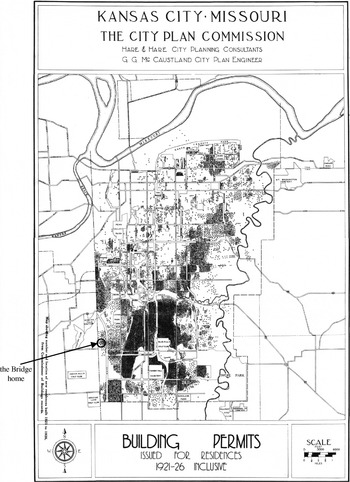
The novels quite clearly indicate where the Bridges live: “a large home just off Ward Parkway,”Footnote 19 “in the Mission Hills district,”Footnote 20 on what is later identified as Crescent Heights Drive.Footnote 21 The degree of specificity here is quite important: Ward Parkway was built between 1909 and 1914 as part of Kansas City's City Beautiful movement (1881–1914), which added a series of green spaces and parkways, including some 1,992·25 acres of parks, 676 parkway acres and 90 miles of drives and boulevards.Footnote 22 These expansions, along with an increase in the city limits (in 1909), facilitated the affluent districts that would come to dominate the southern area of the city. Thus Ward Parkway became the central thoroughfare of the Mission Hills district, which lies on the southwestern edge of the city, and comprises part of what the upper-class characters of the Bridge novels call the “country-club district.”Footnote 23 The completion of the City Beautiful movement created a new market for homes during and after World War I, specifically in the southern part of the city, which was primarily zoned for single-family homes. This expansion and zoning led to a spate of new construction in districts like Mission Hills, especially as the economy of Kansas City began to boom in the 1920s as indicated in Figure 1, which shows the distribution of building permits issued between 1921 and 1926.Footnote 24 As can clearly be seen, in the southern districts of the city hundreds of large homes were built; in the fictive world of the Bridge novels, around 1927 the Bridges bought one of these homes just inside the Missouri–Kansas state line, quite near the up-scale Mission Hills Country Club, as marked (approximately) on Figure 1.Footnote 25
Building Permits Issued for Residences, 1921–26 Inclusive.

The Bridge home is no small affair, requiring the Bridges to hire “a young colored girl named Harriet to do the cooking and cleaning.”Footnote 26 This largesse seems to be in keeping with the Bridges' social scene: most of the Bridges' neighbors and country-club friends have one or more servants as well. Marked by her social and economic position as well as by her skin color, Harriet – the first of two prominent black characters in the books – allows the Bridge novels access to the racial and geographic division in Kansas City in this period. As a character, she penetrates the insular community that surrounds the Bridge home, and helps reveal Mr. and Mrs. Bridge's attitudes on what constitutes the “proper” relationships of certain groups within the city.
This articulation is shown most clearly through two vignettes in Mr. Bridge: “Trouble in the Road Ahead” and “Marijuana.” In the first, Harriet asks to borrow twenty-five dollars from Mr. Bridge, which offends his sense of proper economic relations:
Borrowing was hateful and degrading, and as a rule the people who wanted to borrow money were just too lazy to earn it. In a nation as prosperous as the United States almost anybody who was willing to work should be able to earn enough to live on.Footnote 27
When Harriet reveals that the money is really for her dead-beat boyfriend, Couperin Talbot, and that the real figure would be closer to a hundred dollars, Mr. Bridge refuses. After she leaves his study, “he thought about the problem; and he thought about Lester [a black garage attendant Mr. Bridge had known who had recently been arrested after a knife fight], and a number of other experiences with Negroes.”Footnote 28 Later, Mr. Bridge bails Harriet out of jail after she and Couperin have been picked up for possession of marijuana.Footnote 29 These experiences help focus Mr. Bridge's generalizations about blacks and their relation to the social order: he variously opines that they probably are responsible for putting glass shards in meat to feed to local dogs, that they can certainly apply to schools like Harvard but do “not necessarily have the ‘right’ to attend Harvard,” that they ought to know when and where they will cause problems and stay away.Footnote 30 These views will become aligned geographically as well as socially if we look to the other prominent black character in the novels, Alice Jones.
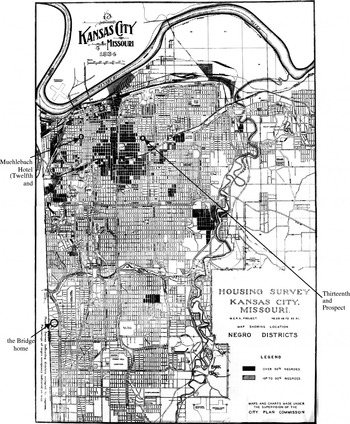
The daughter of a black gardener who worked near the Bridge home, Alice Jones connects the Bridge home much more fully to the whole of Kansas City proper. Alice, who quickly befriends Carolyn, lives at Thirteenth and Prospect, firmly in the north end of town, just on the edge of a “mixed neighborhood” (as Mrs. Bridge rightly puts it), which is marked on Figure 2 (the map delineates the “Negro districts” in Kansas City in 1934).Footnote 31 Though Mrs. Bridge is initially “pleased that Carolyn was not conscious of the difference between them,” she quickly becomes more diffident about the situation, assuming that Alice stole a piece of clothesline that she turns up with, and then advising her daughter that she should not go to a party Alice is hosting.Footnote 32 Mrs. Bridge then asks her husband if she has done the right thing:
“Would it be safe for Carolyn to go down there for an hour or so?”
“Yes, of course it would be safe, as long as that colored girl invited her. However, I don't want her fooling around in that neighborhood. I have no objection to the girl visiting Carolyn here at the house when her father is working next door, but that's the extent of it. These situations get worse, not better. I don't want Carolyn to get in the habit of visiting that end of town.”
“I'm sure she wouldn't make it a habit. This was a special occasion.”
“It makes no difference. Carolyn doesn't belong at Thirteenth and Prospect any more than you or I do. Those people resent us.”Footnote 33
The social, economic and geographical distinctions are quite clear here: it is fine for selected, named individuals to invite one another in. But “those people” (from the north end of town) have a distinct feeling for “us” (those in the country-club districts); they resent the distances – geographic, economic, social, and otherwise – between one end of town and the other. Mr. Bridge, then, is quite willing to equate geographic and urban distance with social and racial separation. As we will immediately see, his reaction to Mrs. Bridge's question pointedly encodes a historical condition present within Kansas City in the 1930s.
Negro Districts, 1934.

The invitation to the party at Thirteenth and Prospect occurs in the spring of 1932 (when Carolyn is in the third grade), at a time when the urban geography of Kansas City had been effectively codified along racial lines for at least two decades:
The beginnings of racial residential segregation and the promulgation of a segregationist real estate ideology coincided with the emergence of a new discourse and way of thinking about the connection between place, race, and culture. Before the advent of segregated living environments, there is no evidence that local residents in Kansas City “racialized” urban space, for example, identified places where specific racial groups lived with culturally specific behavior. However, during the first two decades of the twentieth century, local social workers, public officials, and other elites, began to associate the presence of Blacks living in a particular area of the city with deteriorating neighborhoods, poor schools, high crime, and other negative characteristics.Footnote 34
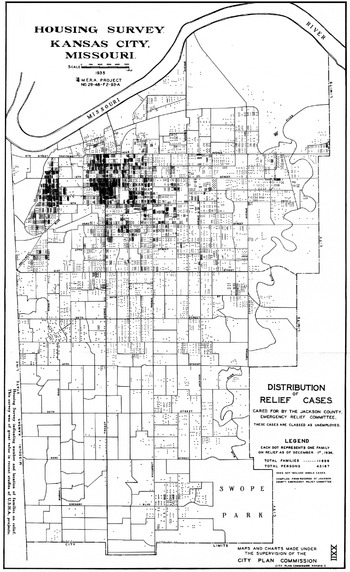
By 1930 the black population of Kansas City was 9·7 percent of some 399,746 residents,Footnote 35 having increased some 25 percent since 1920.Footnote 36 However, that population was quite unevenly distributed, much of it confined to the north end in so-called Negro districts (Figure 2).Footnote 37 This racial and spatial separation was exacerbated by the simultaneous movement south by affluent whites and the condensation of blacks and other ethnicities (in the Bridge novels, Jews and Italians) in the north. With that condensation came not only a series of expectations about the kind of people on the north end – heightened by the identification of “relief cases,” mostly concentrated in the Negro districts (Figure 3)Footnote 38 – but also violence (in the form of bombing and arson) based around those expectations, which coincided with the glut of home construction: “the bombing of black householders began in Kansas City in 1923, near the peak in a period of unprecedented home construction, and the bombings ended in 1927, shortly after homes construction began to decline.”Footnote 39
Distribution of Relief Cases, 1935.

So not only does the Bridge home on Ward Parkway and the tension around characters like Harriet and Alice highlight the position and isolation of the Bridges within the social geography of Kansas City, it also expresses the after-effects of two decades of social and geographic realignment while simultaneously suppressing any specific connection to that history.Footnote 40 Instead, the Bridges imagine the “north end” as variously containing gangsters,Footnote 41 women who cannot or will not dress as ladies,Footnote 42 burlesque dancers,Footnote 43 tramps,Footnote 44 Mrs. Bridge's occasional charity work (presumably aligned with the relief cases concentrated on the north end – see Figure 3),Footnote 45 and Negroes who “could be a great deal of trouble” if an ill-gotten gun fell into their hands.Footnote 46 Years after Carolyn's initial attempt to get her parents' permission to go to the north end, Mr. Bridge rebukes his daughter again (this time much older, home during her first year in college in 1940): “You are not to go poking your nose into affairs that do not concern you, and what goes on in the north end of Kansas City has nothing to do with you.”Footnote 47 While there may be safe havens on the north end of town, like the Muehlebach Hotel where Mr. Bridge often lunches – situated squarely within the downtown area, on the corner of Twelfth and Baltimore (marked on Figure 2) – they are few and far between, constrained by social custom and the Bridge family adage, “old friends are best.”Footnote 48 These selection criteria, sticking to one's high-school sorority and fraternity friends, holding close to the same social circle (seemingly dictated more by social class than location), permeates the Bridge parenting style.
Central to the myth of safety within the Bridges' upper-class social sphere is the necessity of the mythic danger of the north end, specifically housed in its dangerous ethnic types, which of course disturbs Mr. Bridge:
“I have seen enough, believe you me! Those Italians and Jews on the north side of Kansas City are dangerous, and don't you ever forget it.”
“Italians and Jews, you say?” [Carolyn] reached for a cigarette. “Why ‘Italians and Jews’?”
“Because that is what most of those hoodlums happen to be. I am not expressing prejudice. I am reporting a fact.”Footnote 49
Mr. Bridge's position is stark and unforgiving, organized around those he cannot imagine enacting the “fleur-de-lis” of virtues he hopes to instill in others: “financial security, independence, and self-respect.”Footnote 50 His sense of economic and personal propriety, while crystallizing the social history underlying the novels, also helps reinforce the status quo.Footnote 51 On this front, Mrs. Bridge avoids the problem of even articulating the social geography of the city: she “had never known any Negroes socially; not that she avoided it, just that there weren't any in the neighborhood, or at the country club, or in the Auxiliary. There just weren't any for her to meet, that was all.”Footnote 52
This, then, is the social ethic of Mr. and Mrs. Bridge, refined and codified in the affluent Mission Hills district, intentionally isolated from the politics and people of the rest of the city. Mrs. Bridge is what one character refers to as “bona-fide country-club matron,” and in many ways the standards of the Bridges are country-club standards.Footnote 53 When Mrs. Bridge invokes the mythic figure of “everyone” (as in, “Do you want to be different from everyone else?”) in the place of her husband's north end “other,” it is a quite specific invocation.Footnote 54 She means nothing less than “everyone” as defined by social standing and affiliations that are tied together by country club and Auxiliary memberships, and friends made through family and high-school connections. The Bridges' partial image of the larger city outside Mission Hills is bolstered by social and geographic structures in Kansas City between the wars.
However, as we will see in the next section, the social geography of Kansas City changed substantially after World War II, this time as part of a larger national trend – the rise of suburbia, bolstered by the expanding middle class. The Bridge novels deal with this historical condition quite distinctly from what we have just elaborated; instead the Bridge novels address the era of their composition, the 1950s and 1960s, on the level of family politics, with what Diana Heller calls a “Freudian formulation of family romance.”Footnote 55 It is within the family romance of the Bridge novels that we see the clearest articulation of the 1950s concerns with the raising of children and family cohesion under the growing Organized system and consumer culture.
The Bridge novels in the 1950s and 1960s
By the time the Bridge novels were published, tracts of homes in middle- and upper-middle-class suburbs had sprung up to the north, west, and south of Kansas City proper – including Mission Hills, Kansas, just over the state line from the Bridges' home. With that construction came “the demise of Kansas City, Missouri as the traditional political and economic anchor for metropolitan development and investment [as well as] the eclipse of the central city by suburban cities that [became] home to the vast majority of the region's jobs, income and wealth.”Footnote 56 While this de-centered city, with its social and economic power lying outside the city limits, certainly does not fit Mr. and Mrs. Bridge's conception of Kansas City, it is the model of suburbia that comes to play in the second layer of the novels' social history – namely the “family romance” between the Bridge parents and the Bridge children. As we will see, the generation gap between the Bridge parents and children (mother–son, father–daughter) helps articulate the failure of the prewar generation to coexist with the postwar one on the newly shifted social geography, leaving the younger generation with a clear sense of disaffection and alienation.
At times, the Bridge novels have deep shades of what would later be thought of as suburban, middle-class anomie. Here, for example, we catch a snippet from Mrs. Bridge's fellow socialite Grace Barron (which Mrs. Bridge recalls after Grace commits suicide): “Have you ever felt like those people in the Grimm fairy tale – the ones who were all hollowed out in the back?”Footnote 57 The specific figure of the hollowed-out housewife recalls Dana Heller's reading of Mrs. Bridge: “Mrs. Bridge builds its maternal critique around the moral and spiritual isolation of the domestic sphere and the structural equation of this sphere with the abstract figure of the American mother and housewife.”Footnote 58 Heller then extends this analysis to conclude,
Thus, the novel challenges and at the same time recuperates the cultural status quo, forming a flash point of confluence where discursive possibilities are positioned to collide and compete with one another, while conserving yet questioning our cultural fantasies of familial unity and consensus. In this sense, Mrs. Bridge is a narrative true to the Freudian formulation of family romance, a cultural allegory of patriarchal loss and recuperation.Footnote 59
I wholly agree that the Freudian romance – which I will examine below – is a key component of both novels. But the figure of the hollowed-out housewife, a figure of Betty Friedan's feminine mystique, operates around Mrs. Bridge, not through her. If anything, Grace Barron and Mrs. Bridge are caught on either side of the Friedanian blade (and thus the pre-/postwar divide). When Friedan describes the “strange discrepancy between the reality of our lives as women and the image to which we were trying to conform,” an image in which the “feminine mystique permits, even encourages, women to ignore the question of their identity,” the Bridge novels offer up the figure of Grace Barron.Footnote 60
Just as Harriet and Alice serve to articulate the novels' presentation of prewar social and geographic distinction, Grace Barron stands in for a critique of the hollow inner lives of her country-club friends. After Grace commits suicide by taking fifty sleeping pills, we are told that “in many ways, Grace Barron was indistinguishable from anyone among them. Their problems had been hers, their position, their wealth, and the love they knew, these also had belonged to her.”Footnote 61 The parallel to Friedan's feminine mystique is clear: in the Friedanian model, the “end of the road is togetherness,” or loss of individual identity, as a woman fully immersed in the feminine mystique “exists only for and through her husband and children.”Footnote 62 This, however, is the world of Grace Barron, not of Mrs. Bridge, who exists not for her family at home, but for her upper-class friends, united by “position” and “wealth.”
Grace Barron, a version of the troubled, 1960s everywoman, is held at a distance by the Bridges. Mr. Bridge, always angered by weakness, “knew he had been correct to feel nothing at the news of her death. What she had done was cowardly. What such a woman deserved was scorn and contempt.”Footnote 63 Mrs. Bridge, unable to take in Grace's warning, passes off Grace's suicide as a tragic domestic foible:
she wrote to Ruth that there was some doubt as to what had been the cause of Mrs. Baron's death but it was presumed she had accidentally eaten some tuna-fish salad which had been left out of the refrigerator overnight and had become contaminated, and this was what she told Douglas and Carolyn.Footnote 64
Though she feels a kind of solidarity with Grace, Mrs. Bridge inscribes her death inside a homemaker's failure rather than give Grace any agency. This distortion of social relations and their consequences will be central to the troubling mother–son relationship between Mrs. Bridge and Douglas and the father–daughter relationship between Mr. Bridge and Ruth.
The family relations in the novels are indeed what Heller describes as “Freudian formulations of family romance,” but these parent–child relationships are quite specifically presented with a sense of generational alienation. Social theorists of the 1960s like Paul Goodman, Kenneth Keniston, and Edgar Z. Friedenberg attempted to address the problem of youthful alienation, specifically in the generation being raised under the suburban, middle-class, Organized system. Keniston, in The Uncommitted (1965), points to Western culture's “obsess[ion] with breakdown, splintering, disintegration, and destruction,” which has led to a new alienation, “intimately bound up with the technological society in which we live.”Footnote 65 The “technological society” stands here for the Organized system, most expansively detailed by William H. Whyte in The Organization Man (1956), which operates by imposing a communal social imperative: “a belief in the group as the source of creativity; a belief in ‘belongingness’ as the ultimate need of the individual; and a belief in the application of science to achieve the belongingness.”Footnote 66 This communal control is held together by the economic system itself and especially by the homogenized geography provided by the suburbs.Footnote 67
However, the Organized system actively eviscerates the individual; it is “the kind of conformity that abandons the experience of the individual,” says Friedenberg, in Coming of Age in America (1965), leaving the average child without “a sense of personal authority, even over himself.”Footnote 68 Missing for these children, in Paul Goodman's oft-invoked Freudian terms, are proper objects: “Growth, like any ongoing function, requires adequate objects in the environment to meet the needs and capacities of the growing child, boy, youth, and young man, until he can better choose and make his own environment.”Footnote 69 Freudian terms recur throughout these critiques of the Organized system – the family romance of the 1950s and 1960s no longer provides objects fitting to the development of youths, who will replace the role forsaken by the family by turning to destructive external activities.
Thus, returning to the novels, we see Douglas as a character stunted by the absence of a proper model, his father, and left instead with his mother's vague sense of “everyone.” Though Mr. Bridge strives to instill his three virtues – financial security, independence, and self-respect – he cannot think himself responsible for his children's lives:
It seemed to him that the existence of the family was a mysterious accomplishment to which he had contributed very little. She had done this, somehow, almost by herself. He had provided the money and he had made decisions, but these things appeared insignificant when he compared them to what she had done.Footnote 70
However, “what she had done” was to admonish the children – especially Douglas – with phrases like “Do you want to be different from everyone else?” She had “trained her children to be courteous no matter what occurred, for she valued courtesy as highly as she valued cleanliness, honesty, thrift, consideration, and other such qualities.”Footnote 71 Denied individuality, the Bridge children learn about their social presence, but they are, in the language of theorists like Goodman, denied any real connection to their parents; in short, “Children do not just grow up, they must be brought up” to function properly in an Organized society.Footnote 72
As the novels make clear, Douglas proves difficult to bring up. When he is “depantsed” by his classmates, solely because he “was on the bottom” of a pile of children, Mrs. Bridge is put off by the implication that her son was violated for his physically subordinate position.Footnote 73 When he is late coming home because he had to wait out a bully with a BB gun, she is positively aghast that Douglas might have been involved in such a situation. With no frame of reference, she literally cannot understand how such a situation could arise, finding “something nightmarish about the whole affair,” and “becom[ing] so confused that she could not even begin to understand” Douglas's attempt to demonstrate the danger he was in.Footnote 74 The failed connection between Douglas and his mother is no better than the abortive attempts to connect with his father: baseball in the street at which Mr. Bridge fails, a sailboat race at which Douglas's boat founders. Even Douglas's external projections – a tower of garbage in the backyard and a cave in a vacant lot – fail. The phallic monument, composed of detritus from the neighborhood, is destroyed by his mother's command, for the sake of propriety; the yonic cave is filled in so that another upper-class home can be built. Neither externalized object is allowed to remain within the world of Mr. and Mrs. Bridge, thus perpetuating a system with which Douglas cannot connect.
The converse of the failed relationship between Mrs. Bridge and Douglas is the one between Mr. Bridge and Ruth. Shunned early on by her mother for exposing her nude body as a child to the eyes of “everyone,” Ruth becomes entwined with her father, who understands her both too much and not at all. Ruth's body, and specifically her ability to leverage her body, becomes the key to her presence in the novels. This is crystallized in the section titled “In the Garden,” which is worth quoting at length:
Saturday morning [Mr. Bridge] saw Ruth in the back yard getting ready for a sun bath. … She was as brown as a Mexican from loitering around the pool at the country club, but evidently she did not think she was brown enough. She untied the straps of her bathing suit, opened a bottle of suntan oil, and began smearing oil on her arms and legs while he watched from the bedroom window. He noticed for the first time that she had become a woman; her body had lengthened and softened. He watched attentively while she poured oil into the palm of her hand and stroked the oil on her skin. Her flesh gleamed in the morning sunlight like varnished cherrywood. Presently she finished oiling herself and lay down on the towel with her arms outstretched as if she had been dancing and fallen exhausted in that position.
Just then Mrs. Bridge entered the bedroom. He turned from the window, caught her by the shoulders and kissed her, forcing his tongue between her teeth. She pulled away. He caught her again and pushed her toward the bed while she murmured doubtfully.Footnote 75
Mr. Bridge's voyeuristic gaze at his sixteen-year-old daughter's oiled body is transferred to a moment of physical passion with his wife, who remains reluctant and doubtful. Compare this with another moment of transference, which plays out the other side of the Electra complex. In the section titled “Juliet,” Ruth needs a rehearsal partner to practice her lines from Romeo and Juliet for an upcoming audition: Mr. Bridge volunteers. The scene at hand is appropriately the balcony scene (Act 2, Scene 2). While Mr. Bridge woodenly delivers his lines as Romeo, Ruth, as Juliet, “moaned and swayed,” “She tossed her hair and sighed.”Footnote 76 After her final line, “Ruth was gazing up at him, but he saw that she did not recognize him. Her eyes were luminous, her lips carried a sensual smile. She hardly seemed to breathe. He was alarmed, and wondered who she thought he was.”Footnote 77 These moments of “romance” between father and daughter set up Ruth's later provocations, which Mr. and Mrs. Bridge seem at a loss to understand.
Just as Douglas externalizes a phallic tower and yonic cave, Ruth uses her own body and sexuality as external objects, much to the consternation of her parents. Twice she is “caught” with a boy late at night, once by each parent, then is “caught” twice again, first being a friend of, then living with, a homosexual man. We are even presented with a full scene in which Ruth answers a letter to her mother while playing on a bed with a man named Dowdey before they have sex.Footnote 78 In line with Friedenberg, we can note that the missing or incorrect objects within the family itself cause both Douglas and Ruth to create external projections which are either foreclosed or considered failures by the Bridge parents. The Bridge children's projections, along with Mr. and Mrs. Bridge's reactions, sharply mark the generational break that the novels present, one steeped in the rhetoric of the dangers of childhood alienation of the 1950s and 1960s.
Though the three Bridge children grow up in the 1920s and 1930s, they are brought up as children of the 1950s and 1960s. They rebel against an Organized system and eventually each leave the world of Kansas City proper: Ruth to New York City, Carolyn with her husband to Parallel, Kansas, Douglas to the Army. Through the Bridge children, we see the problems of the 1950s and 1960s most clearly articulated, and the Bridge family recast as one fraught with postwar family dynamics. This second layer of social history within the Bridge novels thus completes the model of layered presentation that we have been tracing. On the one hand, the Bridge novels map the social geography of Kansas City between the wars onto the inner lives and social relations of Mr. and Mrs. Bridge; on the other, they map a more general, less geographically bound postwar critique of family relations through the troubled relationships between the Bridge parents and their children. This layering is unique in its specificity, signaled on a narrative level when the two Bridge novels are read in conjunction, and mapped only by careful attention to the concrete presentation of history and social geography within these books. Without this attention, the Bridge novels have too often been read as narratives only about their moment of composition; with it, however, we can see the rich and layered portrait of Kansas City in two distinct historical moments, a result we can only come to by teasing out the intricacies of the novels read together, against one another, and across their “double exposure” of history.