Mammary growth is a major determinant of milk yield and longevity in dairy animals. For goats, the fastest prepubertal mammary growth, relative to body growth, occurs from 2 to 7 months of age at a body weight (BW) between 15 and 35 kg. This is potentially a critical period during which the mammary growth of a goat kid can be influenced by nutrition. Consequently, the nutritional status between birth and puberty could exert a permanent effect on the ability of the adult to produce milk.
Advances in animal genetic and better knowledge in nutritional requirements have hastened the growth rate. Moreover, genetic selection for high milk yield has been accompanied by a higher growth capacity, hence, increasing nutritional inputs were required. On the one hand, rapid rearing by feeding high energy or high concentrate diets not only reduces the age at puberty but also lowers the age at first mating in heifers. On the other hand, increased prepubertal average daily gain delays mammary development in heifers (Sejrsen et al., Reference Sejrsen, Huber, Tucker and Akers1982), a symptom sometimes referred to as the fatty udder syndrome, thereby affecting future first lactation milk yield potential of cows (Radcliff et al., Reference Radcliff, Vandehaar, Chapin, Pilbeam, Beede, Stanisiewski and Tucker2000). However, concerning milk yield potential, the data are not consistent. Moreover, accelerated postpubertal growth resulted in earlier calving at a similar parturition BW, but in this case, heifers had a smaller stature and reduced milk production during first lactation.
Currently, only one study in goat kids has examined the impact of prepubertal feeding on mammary development (Bowden et al., Reference Bowden, Plaut, Maple and Caler1995). Prepubertal goats were fed either ad libitum or a restricted diet of cow milk, and received low quality grass hay. At 4 months of age, the weight of the mammary gland was 55% higher and the amount of adipose tissue in the mammary gland was 68% higher in ad libitum goats than in restricted goats. In France, goats are weaned at approximately 2 months of age and therefore start to receive a solid diet between the ages of 2 and 4 months. It appears necessary to determine the impact of a high level of feeding of concentrate on mammary development in dairy goats. Recently, we have shown that the level of concentrate supplied after early weaning affected the growth of goat kids (Panzuti et al., Reference Panzuti, Duvaux-Ponter and Dessauge2018a). Here, we hypothesize that the development of parenchyma would be reduced by increasing the amount of concentrate offered and our objective was to determine whether different levels of concentrate offered in the prepubertal phase after early weaning at 10 kg would affect mammogenesis.
Materials and methods
All animal procedures were approved by CNREEA No. 7 (Local Ethics Committee on Animal Experiments of Rennes) in accordance with the European directive (Directive 2010/63/EU) and French regulations (Decree No. 2013-118, of 7 February 2013).
Animals and treatments
Thirty female French Alpine goat kids born between 31st January and 19th February were used for 10 months. The treatment details are shown diagrammatically in online Supplementary Fig. S1. Immediately after birth, the kids were separated from their dam and received 100 ml/kg of body weight (BW) of good-quality colostrum. The goat kids were selected based on their birth weight (over 2.8 kg). Until weaning, the kids were housed in the same straw bedded pen and fed milk replacer ad libitum by an automatic feeder. Concentrate, hay and water were available ad libitum from 2 weeks of age. The kids were weaned early at 9.8 ± 0.18 kg of BW on average (32 ± 0.9 d of age). After weaning, the kids were randomly assigned to control, low or high feeding management groups (n = 10 per group), balancing the groups according to birth weight, average daily gain (ADG) between birth and 30 d of age, and weaning weight. More precisely, those values were, respectively, 4.2 (±0.21) kg, 210.0 (±11.31) g/day and 9.8 (±0.35) kg for the L group; 4.3 (±0.26) kg, 204.9 (±8.03) g/day and 9.8 (±0.40) kg for the C group; and 4.3 (±0.16) kg, 206.1 (±10.37) g/day and 9.7 (±0.21) kg for the H group. The feeding treatments are described in Panzuti et al. (Reference Panzuti, Duvaux-Ponter and Dessauge2018a). During the entire experiment, the animals were housed on straw bedding in three pens (one pen per group). Hay was provided ad libitum.
Blood samples
From 110 (± 0.5) to 240 (± 0.6) days of age, blood samples were taken every 10 d to estimate the age at first estrus by the determination of plasma progesterone level as described in Panzuti et al. (Reference Panzuti, Mandrile, Duvaux-Ponter and Dessauge2018b). Before puberty and at midgestation, blood samples were taken from the jugular vein using Monovette syringes coated with EDTA (Sarstedt, Nümbrecht, Germany). The plasma was immediately separated by centrifugation at 3000 × g for 15 min at 4 °C and was stored at −20 °C until assayed. Plasma prolactin concentration was measured by enzyme immunoassay (EIA) (Duhau et al., Reference Duhau, Grassi, Grouselle, Enjalbert and Grognet1991). Insulin-like growth factor was measured as described in Vicari et al. (Reference Vicari, van den Borne, Gerrits, Zbinden and Blum2008).
Mammary gland sampling
Half of the goat kids (n = 5 kids in each group) were slaughtered (by intravenous injection of Ketamine) before puberty (208 ± 0.8 d of age), and the remainder were slaughtered at midgestation (308 ± 1.4 d of age and 70 ± 1.2 d of gestation). The mammary glands were removed immediately after confirmation of death. The mammary parenchyma was dissected by two incisions above teats.
Histological analysis
The mammary tissue samples used for histological analysis were fixed in 4% paraformaldehyde (pH 7.4) for 2 h and embedded in paraffin using standard protocols. The tissue sections (8 µm thickness) were mounted on Polysine® (VWR, Fontenay-sous-Bois, France), deparaffinized in 3 baths of xylene and rehydrated in a graded ethanol-water bath series. After rehydration, the tissue sections were stained with hematoxylin and eosin. The slides were scanned with a Nanozoomer NDP (Hamamatsu Photonics K.K., Japan). Three tissue sections per animal were analyzed at 1.25 × magnification using ImageJ software (NIH, USA) to quantify the proportion of each kind of tissue (ducts, epithelium, fat and stroma). Macros were developed to quantify each kind of tissue.
Quantification of the proliferation rate in the parenchyma
The MEC proliferation rate was determined by immunohistochemical labeling using Ki67. For each goat, on a slide with 6 sections of frozen mammary parenchyma (8 µm thick), 4 were stained for detection of proliferating cells. The remaining two sections were labeled with only the secondary antibody and were used to validate labeling. Subsequently, a secondary antibody coupled to a fluorochrome was applied to all sections. All references for the antibodies and concentrations are presented in the supplementary file. The proliferation rate was measured as described in Yart et al. (Reference Yart, Finot, Marnet and Dessauge2012).
Quantification of DNA, protein expression and matrix metalloproteinases
For each animal, samples of approximately 0.5 mm3 of mammary parenchyma were frozen in liquid nitrogen to preserve proteins. The samples were ground in liquid nitrogen using a grinder (A11 IKA, VWR) and stored as powder at −80 °C until biochemical analyses were performed. DNA quantification was performed by a fluorometric assay using the Hoechst method as described in Yart et al. (Reference Yart, Finot, Marnet and Dessauge2012). Protein expression was quantified by Western blot analysis as described in Yart et al. (Reference Yart, Finot, Marnet and Dessauge2012). The primary antibodies are given in online Supplementary Table S1. Tissue remodeling was evaluated by quantifying the enzymatic activity of matrix metalloproteinases (MMP) in the secretory tissue, which was performed using zymography as described in Yart et al. (Reference Yart, Finot, Marnet and Dessauge2012).
Statistical analysis
Data are presented as the mean ± sem. All statistical analyses were performed using R software. Udder weight, protein expression, the amount of DNA, and prolactin and IGF-I concentrations at puberty and midgestation were analyzed by one-way analysis of variance (ANOVA) followed by a Tukey's post hoc test. For midgestation udder weight, the number of fetuses was added as a covariate to the model. The proportion of each tissue and the proportion of cells expressing Ki67 were analyzed with the Imer function of the ImerTest package. The model used for the proportion of each tissue and the rate of proliferation was a mixed model with a random effect of the individual within the group. The random effect of the individual was significant (P < 0.05), except for the proportion of stroma and the proportion of lumen and ducts before puberty. The means presented in the tables are the means estimated by the statistical model.
Results and discussion
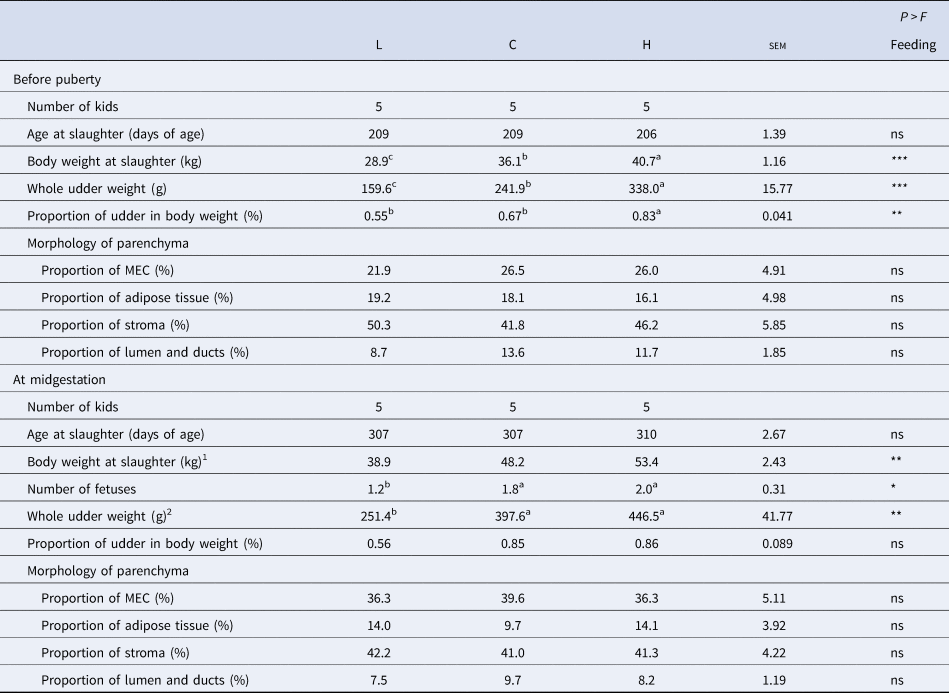
The age at first estrus was not different between the 3 groups and was respectively 231 ± 1.9, 232 ± 1.5 and 227 ± 1.2 d for group L, C and H groups. Before puberty, the average udder weight in group L was 35% lower than in group C and 53% lower than in group H (P < 0.01; Table 1). However, the parenchyma morphology was similar in the three groups (P > 0.1; Table 1). Acini buds were observed within the parenchyma sections (online Supplementary Fig. S2). The parenchyma was not organized into lobes and lobules, however, secretions were observed in the alveolar lumen. The MEC represented approximately 25% of the total area occupied by the different tissues (Table 1). Support tissues represented 50.3% for group L, 41.8% for group C and 46.2% for group H (Table 1). Our hypothesis, which was that the development of parenchyma would be reduced by increasing the amount of concentrate offered, was not verified. Our results show that udder weight was affected by feeding management, so we could hypothesize that mammary parenchymal weights would be affected. However, we were unable to measure the weight of the parenchyma within the entire mammary gland. Indeed, as the mammary parenchyma of the prepubertal goats was diffuse in the adipose tissue, the separation of the two tissues remained difficult even based on color. Increasing the amount of concentrate offered during the rearing phase did not seem to have a negative impact on the structure of the mammary parenchyma.
Udder weight and morphology of the mammary parenchyma in goat kids fed a low (L), control (C) or high (H) level of concentrate between weaning (30 d of age) and 235 d of age

sem, standard error of the mean; MEC, mammary epithelial cells.
P-value: P > 0.05: not significant (ns); *P < 0.05; **P < 0.01; ***P < 0.001.
a–b Averages within the same line with different exponents are significantly different (P < 0.05).
1Trend for the number of fetuses by weight at slaughter (P = 0.094).
2Effect of the number of fetuses on udder weight (P < 0.05).
At midgestation, the average weights of the mammary glands in groups C and H were similar and more than 1.5 times greater than the weight of the mammary gland in group L (Table 1). The average weight of the mammary glands of the goats increased with litter size (P < 0.05). Organization into lobes and lobules was observed in the parenchyma gland sections in the three groups, suggesting development and modification of the organization of the mammary gland between puberty and midgestation (online Supplementary Fig. S2). The proportion of mammary parenchyma was similar in the three groups (P > 0.1; Table 1). Parenchyma represented between 35 and 40% of the tissues present (P > 0.1; Table 1). Stroma and adipose tissue together represented 56.2, 50.7 and 55.4% of the tissue for groups L, C and H, respectively (Table 1). In some goats, secretions were visible in the lumen and ducts. The mammary weight appeared to be related to the litter size (Hayden et al., Reference Hayden, Thomas and Forsyth1979). Our observations seem to show that prepubertal feeding management did not influence mammogenesis during gestation, which is different from the results of Aubry et al. (Reference Aubry, Finot, Wiart, Yart, Siroux, Chorho, Lassalas and Dessauge2012) in goats weaned at 60 d of age and slaughtered at midgestation. At midgestation, Aubry et al. (Reference Aubry, Finot, Wiart, Yart, Siroux, Chorho, Lassalas and Dessauge2012) observed that goats fed ad libitum from weaning (60 d of age) to midgestation- had less fat tissue and more secretory tissue in the udder than restricted goats.
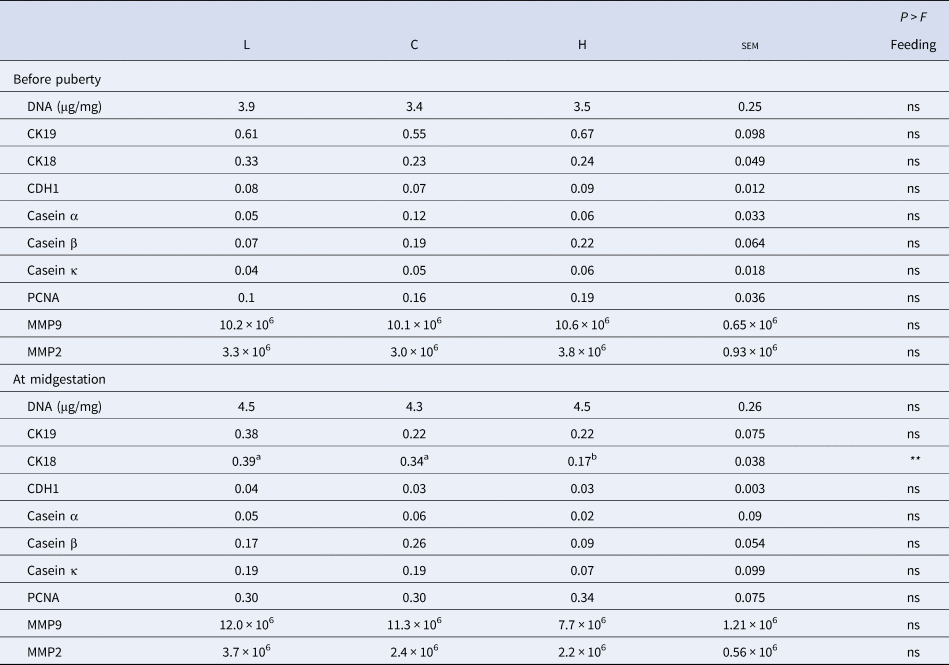
Following the observation of secretions in the mammary gland before puberty, plasma prolactin concentration was measured. The prepubertal prolactin concentration was three times higher in groups C and H than in group L (online Supplementary Fig. S3). Before puberty, during dissection of the mammary glands, secretions were observed in 4 goats: 2 from group C and 2 from group H. These 4 goats were from the groups with the highest circulating prolactin concentration which was on average 90 ng/ml. Logistic regression analysis of the data showed a positive correlation between milk in the udder and prolactin level (data not presented). Subsequently, caseins were detected in the secretions (data not presented). Some milk proteins are, therefore, already synthesized by the parenchyma before puberty. However, in the parenchyma, casein expression did not appear to be affected by the amount of concentrate offered before puberty (Table 2). The presence of caseins shows that parenchyma contains mature cells able to produce milk and, therefore, differentiated. These cells are luminal cells expressing CK18 and CK19 proteins. The expression of CK18 and CK19 was similar in the three groups before puberty (P > 0.1; Table 2). At midgestation, the proportion of CK18-expressing cells was twice as high in groups L and C than in group H (Table 2). It would seem that prolactin has an effect on the development and maturation of the mammary parenchyma in prepubescent goat kids.
DNA quantification, protein expression (proportion of total protein in the test sample) and levels of matrix metalloproteinases in the parenchyma of goats fed a low (L), control (C) or high (H) level of concentrate between weaning (30 d of age) and 235 d of age

sem, standard error of the mean; CK, cytokeratin; CDH1, E-cadherin; PCNA, proliferating cell nuclear antigen; MMP, matrix metalloproteinase.
P-value: P > 0.05: not significant (ns); *P < 0.05; **P < 0.01; ***P < 0.001.
a–b Averages within the same line with different superscripts are significantly different (P < 0.05).
Due to the hyperplastic role of prolactin, the proliferation of MEC and the expression of proteins involved in tissue remodeling were quantified. The proportions of cells expressing Ki67 protein (online Supplementary Fig. S4) as well as PCNA expression and the amount of DNA in the mammary parenchyma were not affected by prepubertal feeding management (P > 0.1; Table 2). At midgestation, the proportion of cells expressing Ki67 protein, PCNA expression and the amount of DNA in the mammary parenchyma were similar in the three groups (P > 0.1; Table 2). CDH1 expression was not affected by concentrate intake levels regardless of the sampling period (Table 2). Moreover, the expression of MMPs, enzymes involved in the degradation of the extracellular matrix, was not modified by prepubertal feeding management.
The plasma level of IGF-I was impacted by the level of concentrate intake regardless of the observation period (online Supplementary Fig. 5). Before puberty, the concentration of IGF-I in group L was 41% lower than in group C and 56% lower than in group H. At midgestation, the concentration of IGF-I in group L was approximately 40% lower than in groups C and H. The concentrations of IGF-I in groups C and H were similar. In prepubertal heifers, an increase in circulating IGF-I was also observed with increased dietary intake (Weller et al., Reference Weller, Albino, Marcondes, Silva, Daniels, Campos, Duarte, Mescouto, Silva and Guimaraes2016). Plasma IGF-I is produced largely by the liver, and IGF-I synthesis by the liver is controlled by growth hormone (GH) and insulin. However, it has been shown that circulating GH concentration decreases with increasing dietary intake, while plasma insulin concentration increases (Phillips et al., Reference Phillips, Goldstein and Pao1991). IGF-I synthesis appears to be stimulated by insulin secretion with increasing dietary intake (Weller et al., Reference Weller, Albino, Marcondes, Silva, Daniels, Campos, Duarte, Mescouto, Silva and Guimaraes2016). Measuring insulin concentration would be necessary to confirm the link between insulin and IGF-I. Moreover, in our study, despite the increase in IGF-I concentration with the increase in dietary intake, no modification in the structure of the mammary parenchyma was observed. However, the involvement of IGF-binding proteins (IGFBP) has not been studied and appears to play a role in the mammogenic action of IGF-I (Weller et al., Reference Weller, Albino, Marcondes, Silva, Daniels, Campos, Duarte, Mescouto, Silva and Guimaraes2016). Indeed, increased dietary intake would increase the expression of IGFBP3 in the liver (Weller et al., Reference Weller, Albino, Marcondes, Silva, Daniels, Campos, Duarte, Mescouto, Silva and Guimaraes2016). IGFBP3 reduces the mitogen action of IGF-I by forming a complex with it. The formation of this complex blocks the transfer of IGF-I from the blood to tissues and retains the protein in the blood. Therefore, Weller et al. (Reference Weller, Albino, Marcondes, Silva, Daniels, Campos, Duarte, Mescouto, Silva and Guimaraes2016) suggested that increasing IGFBP3 would reduce the bioavailability of IGF-I to stimulate mammary development. Further studies are necessary to understand the action of IGF-I on the development of mammary parenchyma in goats.
In conclusion, in early-weaned goat kids prepubertal feeding management did not impact the development of the parenchyma before puberty. Furthermore, no negative effects were observed at midgestation. It would seem that accelerating growth during the prepubertal phase by increasing the intake of concentrate did not affect the development of parenchyma before puberty, contrary to what was observed in heifers. In goats, it seems possible to modulate feed intake, with the objective of modulating growth, without reducing the development of the parenchyma and, therefore, potentially milk production during first lactation. Since underfeeding during rearing period may impair reproductive parameters such as prolificacy, this observation has considerable importance for management systems that employ early-weaning.
Supplementary material
The supplementary material for this article can be found at https://doi.org/10.1017/S0022029919000505
Acknowledgements
We gratefully acknowledge IEPL (Domaine de Méjusseaume, Le Rheu, France) for supporting this work, the staff at the experimental farm, as well as Laurent Drouet (MixScience, France), Jessie Guyader (Neovia, France), Cédric Faure (CCPA, France), Romain Bidaux (Cargill, France) and Christophe Granier (Techna, France) for their help and financial support of this study.