Kawasaki disease is an acute acquired vasculitis disease that involves the coronary arteries. It is the most common acquired heart disease in children in developed countries. Reference Newburger, Takahashi and Burns1 The first-line therapy for acute Kawasaki disease according to the American Heart Association guidelines Reference McCrindle, Rowley and Newburger2 has remained largely unchanged in the past three decades. Reference Newburger, Takahashi and Gerber3 It includes high-dose intravenous immunoglobulin infusion and aspirin. Timely treatment initiation is aimed to prevent or stop the inflammatory process in the coronary vascular wall and prevent long-term coronary artery pathology. Response to therapy is measured by monitoring fever and markers of systemic inflammation. Resistance to therapy, defined by persistence or recurrence of fever that occurs in 10%-20% of patients, Reference McCrindle, Rowley and Newburger2 conveys an increased risk for development and progression of coronary disease. Several second-line biological drugs are suggested to treat resistance to intravenous immunoglobulin after it manifests, targeting inflammatory pathways that were found dominant in the propagation of disease process in Kawasaki disease. Reference Agarwal and Agrawal4 The potential for biological therapies to prevent resistance to first-line therapy and lower the prevalence of coronary artery disease, or to minimise its extent in patients who already have coronary aneurysms at diagnosis, is under active investigation. Reference Yamaji, da Silva Lopes and Shoda5
Tumor necrosis factor-α is a proinflammatory cytokine that exhibits a significant rise in its circulating levels during acute Kawasaki disease. It is implicated not only in the generalised disease process but also specifically in the pathogenesis of coronary artery wall changes and aneurysms. Reference Zhang, Liu and Huang6–Reference Li, Li and Hu8 In 2019, we published the results of the Etanercept as Adjunctive Treatment for Acute Kawasaki Disease study: a phase 3 multi-centred clinical trial that was conducted between May 2009 and April 2016. Reference Portman, Olson and Soriano9,Reference Portman, Dahdah and Slee10 The study showed that treatment with Etanercept in addition to intravenous immunoglobulin and aspirin in patients with Kawasaki disease (with or without coronary involvement) reduced the rates of IVIg-resistance from 22 to 13% as compared to the placebo group (non-significant) and from 23 to 11% in patients > 1 year of age (odds ratio 0.4, CI 0.17, 0.94). While etanercept did not lead to improved average coronary artery size measurement for all patients, it showed a benefit to patients who presented with coronary dilation, defined by a z-score ≥ 2.5. For these patients, treatment with etanercept leads to a lower maximal artery size, lower variability in artery size z-score within the group, and reduced progression of artery dilation in the 2- and 6- week clinic follow-up visits. In this current study, we evaluate coronary artery size regression in patients who presented with coronary artery dilation in a long-term follow-up of 1 year or more. The goal was to evaluate the long-term benefit of early short-term adjuvant treatment with etanercept at the onset of the disease.
Methods
Patients and data
The Etanercept as Adjunctive Treatment for Acute Kawasaki Disease study was a phase 3, multicentre, double-blind placebo-controlled trial (NCT00841789). The approval by institutional review board of each of the 8 participating centres encompassed the long-term follow-up of electronic medical records and imaging results of participating patients. Enrollment occurred between June 2009 and April 2016. The complete study protocol can be found in a former publication. Reference Portman, Dahdah and Slee10 In short, patients at age 2 months to 18 years were included in the study if they met the Kawasaki disease diagnostic criteria by the 2004 American Heart Association guidelines, Reference Newburger, Takahashi and Burns1 intravenous immunoglobulins infusion was initiated within 10 days from the onset of fever and they did not receive corticosteroids or other biological therapies prior to the study. Patients received etanercept (0.8 mg/kg) or a comparable placebo volume subcutaneously shortly after immunoglobulins infusion. Patients received 2 more weekly doses for a total of three doses. Follow-up surveillance for patients with dilated coronary arteries was planned as part of the initial protocol in addition to standard care. Whereas the investigators were unblinded after the initial acute portion of the study was completed, the echocardiograms were read by cardiologists who were unaware of the patients’ treatment arm assignment.
The current follow-up study was done in collaboration of 3 out of 8 of the participating centers that were the most dominant in recruitment in the initial trial (184 of 205 patients, 89.8%): Seattle Children’s Hospital, Seattle, WA; Saint Justine University Hospital Center, Montreal, QC; and Montefiore Children’s Hospital, Bronx, NY. Study patients who had at least one dilated coronary artery (z-score ≥ 2.5) during the first two weeks from acute diagnosis were identified in each participating centre. All available echocardiogram reports from follow-up visits were retrieved, and the measurements for all three coronary arteries were recorded.
Definitions and statistical analyses
Baseline coronary artery measurement was defined as the maximal measurement for each artery from the first 14 days since initial diagnosis. Follow-up echocardiogram reports were reviewed and measurements were grouped according to the time they were obtained from the initial diagnosis, divided into 3 visit periods: ‘convalescence’ (2–9 months), ‘intermediate’ (10 months- 23 months), and ‘closing’ (24 months or more). For patients who had more than one study available for review per visit period, a single echocardiogram was evaluated, closest to 6 months for the convalescence visit, to 1 year for the intermediate visit, and to 2 years for the closing visit. Patients were excluded if no follow-up data for either the intermediate or closing visit periods were available. The average duration from the time of diagnosis to each visit and patients’ body surface area at each visit were recorded and compared between the two treatment arms. Differences between the groups were assessed using the Student’s t-test for continuous variables and Fisher’s exact test for categorical variables.
Our primary hypothesis was that patients who were treated with etanercept at the acute phase of illness will have a benefit beyond the subacute phase with improved reduction in coronary artery size. Coronary artery size measurements at each visit were recorded and analysed in two ways: adjusted to z-score (based on body surface area) using the open-access online calculator Reference McCrindle, Li and Minich11 and by calculating the percent change from baseline of the unadjusted measurement. Anticipating a bias from variation in patients’ somatic growth, we present both analyses. For a univariate analysis, an unpaired Student’s t-test was performed to compare the means (z-score or percent change) of all coronary arteries that were dilated at diagnosis at each visit. Similar testing was then repeated for the subgroup of coronary arteries with giant aneurysms (z-score ≥ 10) at the time of initial diagnosis.
Next, we applied a generalised estimating equation (GEE regression model to test the same outcomes. The generalised estimating equation model is a standard multivariate approach that is used in studies on coronary arteries and was used and described in our report of the early trial results. Reference Portman, Dahdah and Slee10,Reference Gardiner, Luo and Roman12 It adjusts for interdependence in the event that 2 or 3 coronary arteries in the same individual are evaluated. The model also adjusts for repeat observations on the same individual at multiple time points as fixed effects. Reference Liang and Zeger13 Applying the model for size z-score failed to produce meaningful results due to very high data variability (data are not shown). We estimate that this is secondary to the Gaussian nature of z-score that yields exponentially increasing values for size differences above the norms. z-score adjustment for nomograms based on body surface area in paediatric patients was suggested by others before to increase the variability of echocardiographic size measurements. Reference Ronai, Hamaoka-Okamoto and Baker14 We found improved model fit when analysing for percent change in absolute size as the dependent variable for each visit and adding the change in patients’ body surface area (from baseline to the respective visit) as a covariate. Model fit was not improved by adjusting for the specific time from diagnosis for each individual patient’s visit (not shown). An autoregressive correlation structure was used for the variance/covariance matrix, which assumes that adjacent visits have higher correlation compared to those separated by more time. The means and 95% confidence interval were calculated for each treatment arm at each visit, and p value for their contrast was reported. In all calculations, a 2-sided p-value of 0.05 was used as criterion for statistical significance. Calculations were performed using SAS version 9.4 (SAS Institute, Inc, Cary, NC) and Excel version 16.43 (Microsoft, Inc, Redmond, WA).
Results
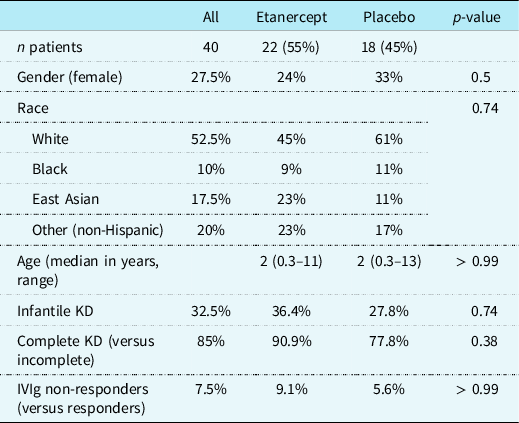
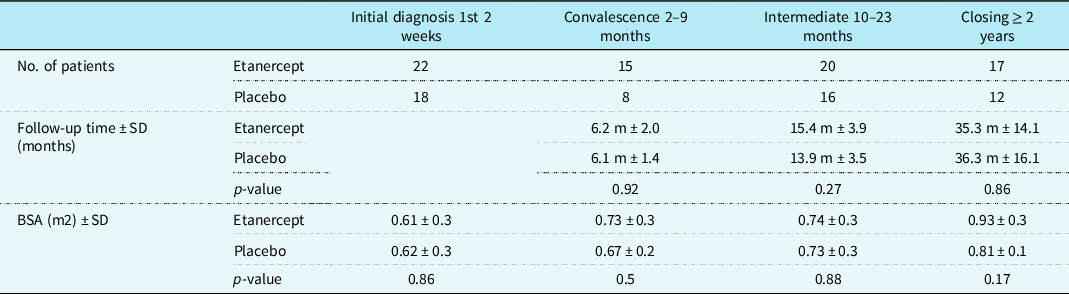
Out of 46 participating patients with coronary artery dilation reported in the initial Etanercept as Adjunctive Treatment for Acute Kawasaki Disease trial, 40 (87%) patients entered this current study with at least one available echocardiogram to review ≥ 10 months after presentation. Of these, 22 patients were on the etanercept treatment arm and 18 patients were on the placebo arm. None of the patients in this cohort suffered myocardial infarction secondary to coronary artery thrombosis, death, or transplant. The demographics and clinical characteristics of patients on both treatment arms are presented in Table 1. No significant differences in gender, race, ethnicity, or age were noted between the groups. Similarly, differences in the rates of incomplete clinical criteria for Kawasaki disease or non-responders to intravenous immunoglobulins between the two study groups were not statistically significant. In total (across treatment arms), 23 patients had an eligible ‘convalescence’ visit to review, 36 patients had an ‘intermediate follow-up’ visit, and 29 patients had ‘closing’ visit. The average duration of each visit from initial diagnosis and patients’ body surface area in each treatment arm are presented in Table 2, with no significant differences between the group in either parameter.
Patients’ demographics and clinical characteristics

n = number of patients; KD, Kawasaki disease; IVIg, intravenous immunoglobulins. p-value is calculated using Fisher exact test (or Student t-test of the means for age) to test the difference between the treatment groups.
Patients’ data at follow-up visits

n = number of patients; SD, standard deviation; BSA, body surface area. p-value is calculated using Student t-test of the means to test the difference between the treatment arms at each visit.
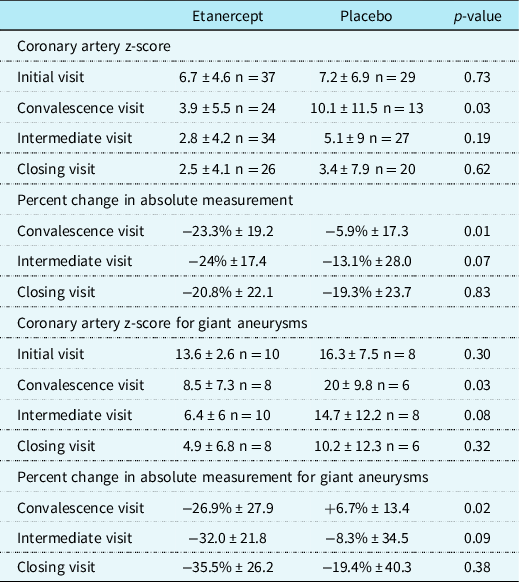
In both treatment arms, follow-up measurements of dilated coronary arteries demonstrated a trend of continued size reduction (Table 3). A univariate analysis did not find a significant difference in the average artery z-score and percent change in size between the treatment groups in the intermediate (10–23 months) and closing (≥ 24 months) visits. However, in the early convalescence visit, 2 to 9 months after diagnosis, the average z-score was lower (p = 0.03) and percent change from baseline higher (p = 0.01) for patients on the etanercept arm compared to placebo. Similar results were seen when comparing average z-score measurements and percent change for coronary arteries with giant aneurysms only (p = 0.03 and p = 0.02 at the convalescence visit, with no significant differences at the later visits). Overall, complete resolution of dilation to z-score < 2 was seen in 25 out of 37 (67.5%) arteries on the etanercept arm versus 18 of 29 (62%) on the placebo arm (p = 0.8). For coronary arteries with giant aneurysms at presentation, 8 of 10 (80%) showed improvement to z-score < 10 on the etanercept arm compared to 4 out of 8 (50%) on the placebo arm (p = 0.32). Only 2 out of 10 arteries (20%) on the etanercept arm and 2 out of 8 (25%) arteries on the placebo arm normalised on follow-up to z-score < 2 (non-significant).
Long-term resolution of coronary artery dilation

Long-term follow-up of coronary artery size z-scores and percent change are presented for all events of coronary arteries that were dilated (z ≥ 2.5) or with giant aneurysms (z ≥ 10) at diagnosis. Mean values are presented ± standard deviations and the number of arteries observed (n). p-value is calculated using unpaired Student t-test of the means to test the difference between the treatment arms. Initial visit – maximal measurement within the first two weeks of diagnosis; convalescence visit – 2- to 9 months from diagnosis; intermediate visit – 10 to 23 months; closing visit – ≥ 2 years from diagnosis.
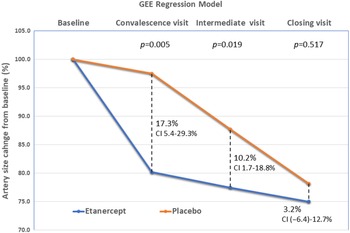
The multivariate analysis for the percent change in coronary artery size through the follow-up visits is shown in Figure 1. Adjusting for repeat measurements for the same patients over time, for including ≥ 1 artery per patient, and for somatic growth, the model confirmed the findings as above: late resolution of coronary artery dilation over time was achieved in both treatment arms and to a similar degree of resolution by the closing visit. However, through the first two years of follow-up, patients who received etanercept had a higher percent change, or faster resolution of coronary artery dilation, with a difference of 17.3% in the convalescence visit (p = 0.005) and 10.2% in the intermediate (p = 0.019) visit.
Generalized estimation equation (GEE) regression model for percent reduction in coronary artery size. Initial visit – maximal measurement within the first two weeks of diagnosis; convalescence visit – 2- to 9 months from diagnosis; intermediate visit – 10 to 23 months; closing visit – ≥ 2 years from diagnosis. Outcomes (y-axis) are presented in percent change compared to the size at initial diagnosis. Dotted lines show the mean differences (percentage points) between the treatment arms and 95% confidence intervals (CIs) at each visit.

Discussion
This study evaluates the long-term benefit of treating children with acute Kawasaki disease and dilated coronary arteries with the etanercept, an antagonist to tumour necrosis factor-α, in addition to intravenous immunoglobulins and aspirin. Our results reject the primary hypothesis and show a common long-term outcome of reduction of coronary artery dilation to a similar degree between patients who received etanercept versus placebo. These results remain consistent with previous observations that most coronary arteries with mild to moderate dilation or aneurysms return to normal size by 6–18 months after the acute diagnosis. Reference Kato, Sugimura and Akagi15,Reference McCrindle, Manlhiot and Newburger16 This study suggests, however, that treatment with etanercept results in a faster size reduction of dilated coronary arteries through the first 1–2 years when compared with placebo. The small number of patients with dilated coronary arteries, and even smaller with giant aneurysms, did not allow to evaluate for adverse outcomes from coronary dilation, yet we hypothesise that earlier size reduction may lower the risk of vascular wall damage and serious coronary events or ischaemic heart failure years after childhood Kawasaki disease.
Antagonists to tumour necrosis factor-α are a well-established therapies for various vasculitis conditions and their role in Kawasaki disease is still studied. Reference Yamaji, da Silva Lopes and Shoda5 The chimeric monoclonal antibody, infliximab, is an effective second-line therapy for acute Kawasaki disease that is resistant to intravenous immunoglobulins, studied as an adjunct or single therapy. Reference Crayne, Mitchell and Beukelman17–Reference Roberts, Jain and Tremoulet19 In a recent multicentre randomised clinical trial of 103 patients, infliximab showed a benefit in treating patients who were non-responders to first immunoglobulins dose compared to a second infusion. Despite its efficacy in resolving acute inflammation, there was no appreciable difference in measures of coronary artery outcomes. Reference Burns, Roberts and Tremoulet20 As a first-line therapy, in a phase-3 placebo-controlled trial that included 196 patients, infliximab showed no significant benefit in preventing resistance to first-line therapy or coronary artery involvement. Reference Tremoulet, Jain and Jaggi21 In a retrospective study of 69 patients with Kawasaki disease and coronary artery dilation, patients who received infliximab with intravenous immunoglobulins had a lower rate of resistance to first-line therapy, but again, no benefit in resolution of coronary artery dilation. Reference Jone, Anderson and Mulvahill22 Infliximab has several potential disadvantages as compared to etanercept. Etanercept is a soluble protein that can bind the circulating ligand. It can be administered subcutaneously and so repeating doses through the subacute phase of the disease can be tested. In this trial, weekly administration of etanercept for 3 doses was shown to benefit patient who presented with coronary artery disease, in preventive progressive dilation. Reference Portman, Dahdah and Slee10 The current analysis offers and added benefit for this high-risk group of patients with faster resolution of dilation through the convalescence period as well. For safety profile, etanercept, a fully humanised protein, has a lower risk for developing drug-targeted autoantibodies and transfusion reaction and has faster clearance. The early trial results showed no safety concerns for the use of etanercept in Kawasaki patients, similar to the experience from treating other pediatric rheumatologic conditions. Reference Armaroli, Klein and Ganser23 Most adverse events for etanercept are reported after long-term treatment, extending from several months to years.
The primary goal of aggressive treatment of coronary artery involvement in Kawasaki disease is lowering the risk of myocardial ischaemia and ventricular dysfunction in young adults who had Kawasaki disease earlier in life. Reference Gordon, Kahn and Burns24 Recent literature suggests that the process of coronary vascular wall changes after Kawasaki disease is chronic rather than acute. Iemura et al showed increased medication-induced vasoconstriction response in individuals with personal history of Kawasaki with coronary involvement at over 10 years follow-up. Reference Iemura, Ishii and Sugimura25 Orenstein et al. Reference Orenstein, Shulman and Fox26 reviewed vascular wall histopathologies from 41 patients with Kawasaki disease and defined the long-term evolution of coronary disease. Following the acute inflammation, all patients showed a subacute/chronic phase that begins in the first 2 weeks after the initial diagnosis and extends for months to years, in previously aneurysmal or non-dilated vessels. These changes may lead to ongoing dilation that is followed by the chronic stage of neointimal hyperplasia and coronary artery stenosis. Using optical coherence tomography, Dionne et al. Reference Dionne, Ibrahim and Gebhard27 described intracoronary vascular wall imaging in 18 patients with Kawasaki-related coronary disease during cardiac catheterisation at an average of 9 years after the acute illness. They found similar findings of chronic changes in the vascular wall structure consistent with the sequela of chronic inflammation: disappearance of the media and hyperplasia of the intima in all vessels, but significantly more striking in previously aneurysmal segments. Benovoy et al. Reference Benovoy, Dionne and McCrindle28 showed that detectable changes on optical coherence tomography imaging correlated with decreased CA distensibility, a measure of vascular wall dysfunction. In a long-term follow-up, children who had Kawasaki disease, and especially those who had coronary aneurysms, showed a persistent decrease in vascular wall distensibility that peaked at 1 year after the acute diagnosis, supporting our hypothesis that there is a benefit to faster resolution of dilation though the convalescence period. Reference Orenstein, Shulman and Fox26
Limitations
In this follow-up study, after the conclusion of the initial phase of the Etanercept as Adjunctive Treatment for Acute Kawasaki Disease trial, the investigators were unblinded to the treatment arms that patients received, risking an observer bias. The small patient cohort, focusing on a subgroup of patients from the initial trial who presented with coronary artery dilation, lowers the power of the study and does not allow statistical analyses for modifying factors. Specifically, we recognise a possible bias from not testing for specific coronary arteries and their response to treatment, as previous studies showed differences their long-term recovery. Reference McCrindle, Manlhiot and Newburger16 It should also be noted that the initial report of the trial suggested an added benefit of etanercept to African American patients in preventing resistance to first-line therapy. Long-term benefit for this group could not be assessed as only 4 patients met the inclusion criteria for this follow-up study. The challenges of long-term follow-up of coronary artery size in growing patients, with a significant variability in growth rates between age groups and individual patients, are discussed in the methods section. This was accounted for by reporting both z-score and change in absolute size of the arteries and adding change in body surface area as a covariate in the regression model, yet each analysis method carries inherent inaccuracies.
Conclusions
The addition of etanercept to the first-line therapy for the subpopulation of children with acute Kawasaki disease who present with coronary artery dilation may be beneficial in promoting earlier resolution of dilation in the acute and convalescence phases of their illness. The benefit of etanercept and other antagonists of tumour necrosis factor-α should be further evaluated in an attempt to prevent the rare but grave late complications of Kawasaki-related coronary disease.
Acknowledgements
None.
Financial support
This work was funded by the US Food and Drug Administration Office of Orphan Product Development R01-FD-003526 to Dr Portman. Amgen supplied supplementary funding through an investigator-initiated grant. Amgen also supplied commercial-grade drugs and placebos for this trial. Amgen had no role in the trial conduct, data analyses, interpretation, or manuscript preparation.
Conflicts of interest
None.
Ethical standards
This is a report from the EATAK clinical trial: NCT00841789. The authors assert that all procedures contributing to this work comply with the ethical standards of the Helsinki Declaration of 1975, as revised in 2008, and has been approved by the Institutional Review Boards at each participating centre: Seattle Children’s Hospital, Saint Justine University Hospital Center, and Montefiore Children’s Hospital.