Introduction: The Logical Fallacy
Professor Blustein's primary argument in Part I of our debate (CQ Vol. 18, No. 3, July 2009) can be described by the following syllogism:
Premise 1: Adults with decisionmaking capacity have the right to accept or refuse effective medical treatment.
Premise 2: Some adolescents are mature and have decisionmaking capacity.
Conclusion: Therefore, some adolescents should have the right to accept or refuse effective medical treatment.Footnote 1
Even if we assume that both premises are true, the conclusion does not necessarily follow. Decisionmaking capacity is necessary but not sufficient for healthcare autonomy for adolescents even if it is both necessary and sufficient for adults.Footnote 2
Why the difference? First, the syllogism ignores the fact that most adolescents live with at least one parent with whom he or she has an intimate relationship. Parents have rights and responsibilities to promote their children's well-being. Therefore parents can impose healthcare treatments on their mature children on the grounds that (1) this particular decision is immature or (2) to promote the parents’ perspective of their child's best interest, even if the minor believes that a refusal is in his best interest. Second, the syllogism ignores the fact that the state, in loco parentis, has rights and responsibilities for children. This is particularly true when parents are abusive or neglectful. It is medically neglectful to withhold effective life-saving medical care for adolescents. Therefore, even if his parents accept the adolescent's claim that refusal is in his best interest, the state should reject it. Blustein's arguments might work for the adolescent who lives in a world in which no one can claim responsibility for the adolescent's actions or well-being. Fortunately, we live in a society in which most adolescents are embedded in families, communities, and states, each of which has responsibilities toward them.
Despite the logical fallacy, Professors Blustein and Clayton raise four issues to which I will respond: (1) the bright line of 18 years; (2) the bright line of high and low efficacy; (3) whether reasons, particularly religious reasons, matter; and (4) the role of the state in treatment enforcement.
Age as a Bright Line
Blustein is disturbed because “the developmental literature tells us that adolescents, especially late adolescents, are significantly variable in [their capacities for autonomous decisionmaking].”Footnote 3
I fully agree that development is variable. I myself have questioned whether the age of 18 is the correct cutoff.Footnote 4 Twenty-one was the cutoff for most legal rights throughout most of 20th century America, whereas it was 16 for many of these same rights in 20th century Europe. Arguments can be made for both positions. Given the increasing complexity of skills that one needs to achieve some degree of competency in today's world, there are reasons why we may want to delay the age of emancipation. Alternatively, the fact that many older teenagers have been shown to make decisions on par with adults (at least in hypothetical vignettesFootnote 5) suggests that we may want to lower the age of emancipation. Elsewhere I have written that
The specific age at which emancipation should be granted is a political and not a moral question. Any age cut-off will liberate some immature individuals and will delay the liberation of some mature children. I do not argue for any particular age because I believe that the age should be chosen by societal consensus, and may differ in different cultures and different eras.Footnote 6
However, I do believe that if we allow “older adolescents” to make healthcare decisions, then we need to think about other areas where we continue to maintain more paternalistic authority: motor vehicle licenses, marriage licenses, access to cigarettes and alcohol, the right to drop out of school, and the right to be held responsible for a financial contract. I am not convinced that a teenager should be presumed to have the ability to refuse life-saving healthcare but not be able to decide to invest his money in the stock market or to be dependent on adults to drive him to either his physician or financial adviser! To be consistent, if adolescents are permitted to make healthcare decisions, we may need to allow them to engage in these other activities as well.
The easy response against my position for a single age of emancipation is that each adolescent matures at different rates psychologically, physically, cognitively, emotionally, and socially. Blustein, Clayton, and Ross all agree. Where we disagree is how we can make the determination that a particular adolescent is sufficiently mature to make a particular decision. Blustein is frustrated that I do not account for the fact that young people's capacities develop over time. He seeks “an individualized assessment of the adolescent” and rejects the claim that such an assessment “is too difficult, unrealistic, or problematic in some other way.”Footnote 7 But he offers us no specifics on what this assessment entails. I did not learn that tool in either my pediatric residency or in my philosophical training. What I did learn was that my assessments were colored by my own values, my own experiences, and my own culture. And the same was true of the other healthcare professionals who were asked to make these assessments and the legal scholars whose analyses have led to conflicting results in similar cases. Thus, although the age of 18 is arbitrary, it is not capricious.Footnote 8 I prefer a bright line over an individualized assessment for which there are no standards. And it is not surprising that I do. The literature is replete with examples that boys and men are viewed as more mature than their female counterparts. While Billy Best was running to Texas and was hailed as a mature adolescent, Child Protective Services was searching for Lor Lee, a Hmong adolescent, in order to force chemotherapy because she was immaturely following her parents’ religious beliefs.Footnote 9 Even parents, at least in the research context, are more willing to respect decisions by their adolescent sons than daughters.Footnote 10
In the move from adolescence to adulthood, the same trends are seen. Miles and August have shown that men who refuse life-saving treatment are characterized as brave and women as mistaken.Footnote 11 And the early court rulings about Jehovah's Witnesses prohibited women from refusing treatment because of their role as mothers.Footnote 12 Thus, when the choice is between (1) decisionmaking authority determined by a specific age cutoff versus (2) decisionmaking authority determined by legal and medical systems dominated by Christian white men, many women might agree with me, Clayton excepted. That is, females may have a better chance of having their decisions respected if an objective age cutoff were employed rather than having their decisions judged by the idiosyncratic and possibly whimsical values of a male judge, who may or may not share their culture or values.
One way Blustein wants to draw the line is to claim that an adolescent should have decisional capacity when he or she can articulate “an expression of who I am in a moral sense, of what kind of person I am, of what is really important to me.”Footnote 13 Blustein must explain why this assessment is restricted to adolescents, because some young children can have this moral sense. Blustein claims that what is important to a young child may look drastically different from what is important to his older sibling or parent, but that is only a reflection of changing values. But it need not be. Robert Coles writes about his work with children in the South in the 1960s during school integration and his failure to be able to see the “moral content” of the ideas expressed by the young children with whom he worked.Footnote 14 He argues that if he had been able to truly engage with these children, he would have realized what a rich moral life they had.Footnote 15
One reason that Blustein might want to restrict this assessment to older adolescents is that he does not want to emancipate young children (and I agree). Even if Ruby Bridges, one of the youngsters who first entered the all-White New Orleans Public schools, was a moral hero, and I believe that she was, it seems that Blustein would have to argue that this moral sense of self should not be sufficient to give her sole decisionmaking authority in her pedagogical pursuits or in her health pursuits. And I would agree. To the extent that Blustein criticizes me for drawing the line at 18 years (young adults), then, Blustein should at least question whether he can write so decisively that we only need to focus on “older adolescents” or provide a justification for the bright line between adolescents and younger children.
Efficacy as a Bright Line
A second reason that Blustein rejects my guidelines is that “the effectiveness of a proposed life-saving treatment is not the only morally relevant variable here.”Footnote 16 As he writes, “Some treatments may be effective, according to Ross’s definition of the term, and yet extraordinarily burdensome for the child, not only because of their painful side effects or the complicated course of care, but also because of their negative impact on the minor's ability to lead something like a normal life.”Footnote 17
Professor Blustein makes a very important point, one with which I agree: Efficacy is not the only morally relevant variable. He argues that the burdensomeness of a treatment is morally relevant and should be considered in my algorithm.
This is a point made most clearly by the case history of Dax Cowart.Footnote 18 Dax was a 25-year-old Vietnam War veteran who suffered serious burns over most of his body from a propane gas explosion. Immediately, he requested that treatment be withheld and that he be allowed to die. He was ignored, treatment was provided, and he survived. And he continues to argue that he should have been allowed to die. When questioned about why he does not kill himself now, Dax points out that he never said he did not want to live, he just did not believe that the means (burn treatment) would justify the ends (survival albeit survival with disabilities): As Dax himself explains,
Even though I am glad to be alive and believe myself to be happier than most other people, my physicians were still wrong [in saving my life] because, despite my current benefits associated with being alive, the price I had to pay in terms of pain and suffering in order to be alive today was simply too great.Footnote 19
I do not deny that some life-saving treatments are extraordinarily burdensome, current burn treatment continuing to be one such example, though hopefully we provide better pain management than Dax received. Although it was wrong to continue to treat Dax over his objections, it would not have been wrong had Dax been 16 years old and the prognosis excellent. As the likelihood of survival decreases, the burdensomeness of the treatment becomes more significant in determining whose voice should be determinative. So if a treatment has 90% survival, I would argue that the court should impose treatment over the objections of the parents, the adolescent, or both, regardless of the degree of burden caused by the treatment because it would be neglectful not to provide effective life-saving treatment to a 16-year-old Dax.
In contrast, if the treatment is experimental and has 10% survival, I would argue that the court should not impose treatment over the objections of either the parent or the adolescent, regardless of whether the treatment is without burdens or entails significant burdens. But if the treatment is in the “gray zone,” say 40% efficacious, then the degree of burden, the chronicity of the disease and treatment, and the invasiveness of the intervention should be incorporated into the benefit–risk calculation. All of these factors influence the decisionmaking and the willingness of the physicians to respect a refusal.
Reasons Matter
Professor Clayton writes:
The topic of what deference should be given to religious beliefs regarding the medical care of children is complex. Although a full exploration of that topic is beyond the scope of this commentary, the fact that this issue is not mentioned at all seems odd, particularly in light of the heated debate about the role of religion in our culture as well as in the physician–patient relationship. And although I recognize that the Committee on Bioethics of the American Academy of Pediatrics came out strongly a decade ago against religious objections to medical treatment of children, there is something disquieting about saying that Dennis should have been transfused, probably repeatedly, given the nature of leukemia, preserving his life at the cost of his soul.Footnote 20
Reasons matter. Surely one gives greater credence to a teenager's strongly held religious beliefs regarding a treatment refusal than one gives to a teenager who refuses because of a fear that he will lose his hair. But greater credence does not lead me to support respecting the adolescent's refusal. Hence, the lack of discussion of reasons in my essay.
Professor Clayton is correct that the American Academy of Pediatrics (AAP) Committee on Bioethics came out strongly against religious objections to medical treatment of children, but that position was a rejection of the authority of parental objections based on religion.Footnote 21 With respect to mature minors, the religious objection statement reads: “Disputes may be avoided when a minor has the capacity to make an independent decision in light of religious values and recommended medical therapy.”Footnote 22 That is, the AAP claimed to be willing to support the decision of a mature minor based on a religious objection. In fact, in its statement on informed consent, parental permission, and assent, the AAP claims to be willing to support the decision of a mature minor based on any reasons and explained that parental permission was encouraged but not mandatory.Footnote 23 Of note, Professor Clayton was on that committee at the time that the consent document was written.
The AAP consent document, however, is not as decisive as it ought to be. Interestingly, the only example of a decision regarding life-saving treatment involved a 19-year-old and the decision of whether to have a surgical intervention for a bone tumor.Footnote 24 In fact, in its discussion of adolescents and young adults, even the example of consent for recurrent headaches involved an 18-year-old. The AAP used examples below the age of majority for conditions covered under the specialized consent statutes (performance of a pelvic exam in a 16-year-old and prescribing oral contraceptives to a 17-year-old), but this is beyond the scope of this discussion.Footnote 25 As Professor Clayton writes, the statutes are “designed to protect physicians and nurses who provide teenagers with healthcare they need, not as paeans to the wisdom of youth.”Footnote 26 So in some ways, the AAP statement can be read as affirming the need for specialized consent statutes and affirming the right of older adolescents (defined as adults) to make healthcare decisions, but not asserting the rights of the older adolescent to accept or refuse life-saving treatment. Their examples weaken their claim that physicians ought to respect the decisions of the maturing adolescent.
If one took the AAP consent statement as promoting the position that maturity not age should determine decisionmaking authority, then this would hold for a mature adolescent regardless of the reasons for the decisions. So reasons based on religion would not have a special place. In both documents, maturity and decisional capacity are the basis for respecting the adolescent's autonomy. To override an adolescent's autonomous refusal, then, is to disrespect his interest in making decisions for himself, whether he views this as a violation of his interest to determine his own life course (consent document) or a violation of his interest to act according to his religious beliefs (religious objections document).
Elsewhere I have argued why the AAP consent document is flawed.Footnote 27 In brief, the adolescent's interest in acting autonomously is not a right; it is an interest that can be overridden by his right to have his basic needs promoted, and his health is one of those basic needs.Footnote 28 As a child, neither his parents nor his religion can hold him morally responsible for those acts that are imposed upon him. The benefits and burdens of childhood!
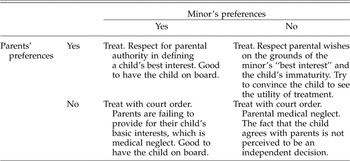
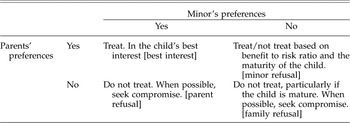
The State's Role in Imposing Treatment and the Move from Table 4 to Table 7
Clayton makes an important point when she claims that state coercion is a “step that should be taken with fear and trembling.”Footnote 29 I agree, and the data support our concern. In a review of court publications, Ridgway found that physicians prevailed at the initial decision in 44 (88%) of 50 cases and in the final decision in 40 disputes (80%).Footnote 30 Given the high likelihood that the court will side with the physician, the physician should restrict court involvement to cases in which there is a very high likelihood of efficacy.Footnote 31
Interestingly, physicians were more likely to prevail in religion-based disputes than in other cases (27 of 30 vs. 13 of 20 [p < .05]). One possible explanation for this difference is the case of Prince v. Massachusetts, which upheld the conviction of Sarah Prince, who permitted her 9-year-old niece to sell publications of the Jehovah's Witness church at night in violation of the state child labor laws.Footnote 32 Justice Rutledge said, “Parents may be free to become martyrs themselves. But it does not follow they are free, in identical circumstances, to make martyrs of their children before they have reached the age of full and legal discretion when they make choices for themselves.”Footnote 33 Thus, cases involving a religious reason can be overturned based on this Supreme Court decision whereas cases based on other philosophical beliefs or holistic world views do not have a Supreme Court ruling to serve as the grounding for the parental override.
Let me be clear, then, that the algorithm in Table 4 of my original article for highly efficacious treatment is meant to refer to very highly efficacious treatment and that I would move from Table 4 to Table 7 of that article quite quickly precisely because state coercion should only be taken “with fear and trembling.”
Decisionmaking with and on Behalf of Children with Respect to Effective Life-Saving Therapies

Decisionmaking with and on Behalf of Minors with Life-Threatening Illnesses When Only Low Efficacy or Experimental Life-Saving Treatment Exists

Modified and reprinted with cell titles from Ross LF. Against the tide: Arguments against respecting a minor's refusal of efficacious life-saving treatment. Cambridge Quarterly of Healthcare Ethics 2009;18(3):302–315 at p. 312.
Concluding Thoughts: Adolescent Autonomy Reconsidered
Blustein writes, “If parents do a good job raising their child, she becomes increasingly independent and less dominated by them and so acquires greater authority to direct her own life.”Footnote 34 Laura Purdy argues that not only should parents be willing to listen to their mature children, but that parents also probably deserve some credit for their children's maturity:
It would in any case be important to urge parents of such [mature] children to recognize their maturity and treat them accordingly. It would be surprising if this were not often done already, as it is plausible to think that children's maturity is not completely unrelated to parental good sense.Footnote 35
I share the value of adolescent independence expressed by Blustein and Purdy, and I hope in the years to come that they will judge that I did a “good job” in raising my children. However, there are parents who do not agree with our goal. There are parents who are more firmly committed to certain beliefs and values and they do not want their children to stray far from home or from these values. The result may be that my children will become independent earlier than children from more traditional homes and, not surprisingly, that I will be more willing to accept their authority over their own bodies. But it is not clear whether these liberal values are better or worse for my children and society in the long run, nor what criteria we would use to determine the degree of benefit and harm derived from these disparate parenting styles. Just as we should be wary about permitting the state to impose treatment on adolescents when they disagree with their physicians, so, too, we should be wary of permitting physicians to impose their liberal values about adolescents on parents.
However Blustein, Purdy, and Clayton may judge my parenting methods does not change the fact that the mature adolescent should not have the authority to refuse effective life-saving treatments. Even the most strongly held convictions of adolescents are subject to change, but unless we protect the adolescents’ well-being, they may never have the opportunity to reevaluate those convictions. Adolescents, even mature adolescents, have a right to be protected from “bad” decisions, even if those decisions are supported by their parents. Let me quote again from Laura Purdy:
Even liberationists, after all, lament the mistakes and immorality of adults. It seems to me that instead of asserting children's rights to be equally silly and weak, it would be at least plausible to argue for the overriding importance of helping children develop the self-control and other enabling virtues necessary for living more satisfying and moral lives.Footnote 36
This is not to say that the maturity of the adolescent and the strength of her convictions are irrelevant. It is only to state that these factors do not justify giving her the authority to refuse effective life-saving therapy. These factors should motivate her clinicians to try to convince her to accept the therapy and to petition the court only as a last resort. It is also the case that these factors demand a greater role for the adolescent when the healthcare decision can be categorized as minor or when the issue is life threatening but the efficacy of treatment is low or the only available therapy is experimental.