Disasters continue to impact societies worldwide, destroying infrastructure, lives, and livelihoods. In 2019, 43 separate socio-natural disaster were reported within Australia, 1 including bushfires, floods, storms, cyclones, and heatwaves, with 1 cyclone costing the Australian economy more than 5 billion dollars. 1,2 The impact of the additional 390 significant socio-natural disasters globally is difficult to quantify. 3
In Australia, many hospitals in large population centers are within high-risk cyclone, flood, and fire areas. 4 These events have major personal, economic, and political impact, and can cause serious health system disruption. Reference Rockenschaub and Harbou5 Health-care systems play an essential role in the delivery of life-saving services far beyond a disaster impact zone. Reference Rockenschaub and Harbou5,Reference Djalali, Castren and Khankeh6 Hospitals and health systems with strong and robust infrastructure provide emergency health care, shelter, safety, and reassurance to disaster-impacted communities. Reference Albanese, Birnbaum and Cannon7
Failed health facility infrastructure is unable to provide safe, sustainable, and effective emergency and routine care, which may result in the need for patient and employee evacuation. Reference Little, Stone and Stone8,Reference Rojek and Little9 Hospital evacuation carries significant health, financial, and logistical risk and directly results in diminished capacity for patient care, increased demand on transport and retrieval services and the need to establish temporary health facilities. Reference Rojek and Little9,Reference Johnson, Hayes and Gray10 Investing in the creation and maintenance of disaster-resilient health facilities should relegate evacuation to being a last resort following overwhelming impact and system disruption.
Hospital infrastructure resilience is integral to community self-sufficiency. The protection of buildings and physical structures and maintenance of robust systems ensures continuity of clinical service delivery. Maintaining hospital resilience must include workforce training and regular exercising of staff and systems to ensure facilities can remain operational during disasters. Reference Wulff, Donato and Lurie11,Reference Kruk, Myers and Varpilah12
Assessment of hospital vulnerability involves identification of likely hazards and associated impacts to hospital infrastructure and systems. Assessments are frequently and inadvertently conducted by individual departments, missing the benefits and shared insights inherent in multi-disciplinary collaboration. Collating a review of infrastructure, workforce, and service continuity risks provides a more wholesome assessment of a disaster-impacted facilities capacity to maintain service delivery capability, with the added benefit of identifying opportunities for and focusing resources on improvement. Reference Albanese, Birnbaum and Cannon7
The Australian hospital accreditation and design Standards aim to build and maintain health facilities that provide high quality health care and that are resilient to disaster and climate change-induced impact. We have previously identified deficits in the literature for evaluating methods to assess facility resilience and continuous improvement strategies within Australia, while highlighting the comprehensive nature of the World Health Organization (WHO) Hospital Safety Index (HSI) and its potential applicability in the Asia Pacific region. Reference Zhong, Clark and Hou13,Reference Luke, Franklin and Aitken14 This low-cost, high-impact assessment tool provides a comprehensive checklist and forms part of the United Nations (UN) International Strategy for Disaster Reduction; Safer Hospital program 15 through objective evaluation of structural, non-structural, and functional safety of hospitals. It is useful for the comparison of hospitals within a district, showing potential need for investment of resources required to improve the overall functioning of the health system. 16
It has been highlighted previously about the benefits of engaging multi-disciplinary hospital teams to perform facility assessments. Reference Luke, Franklin and Aitken14 This collaborative approach is an invaluable educational exercise in developing disaster capacity, promoting ownership, and driving motivation for improvements. The overarching goal is to assist the health system to improve overall resilience.
This study aims to: undertake a practical evaluation of health facility resilience within a defined geographical health service, and understand the current resilience of hospitals within this service and provide hospital management with key areas for improvement
Methods
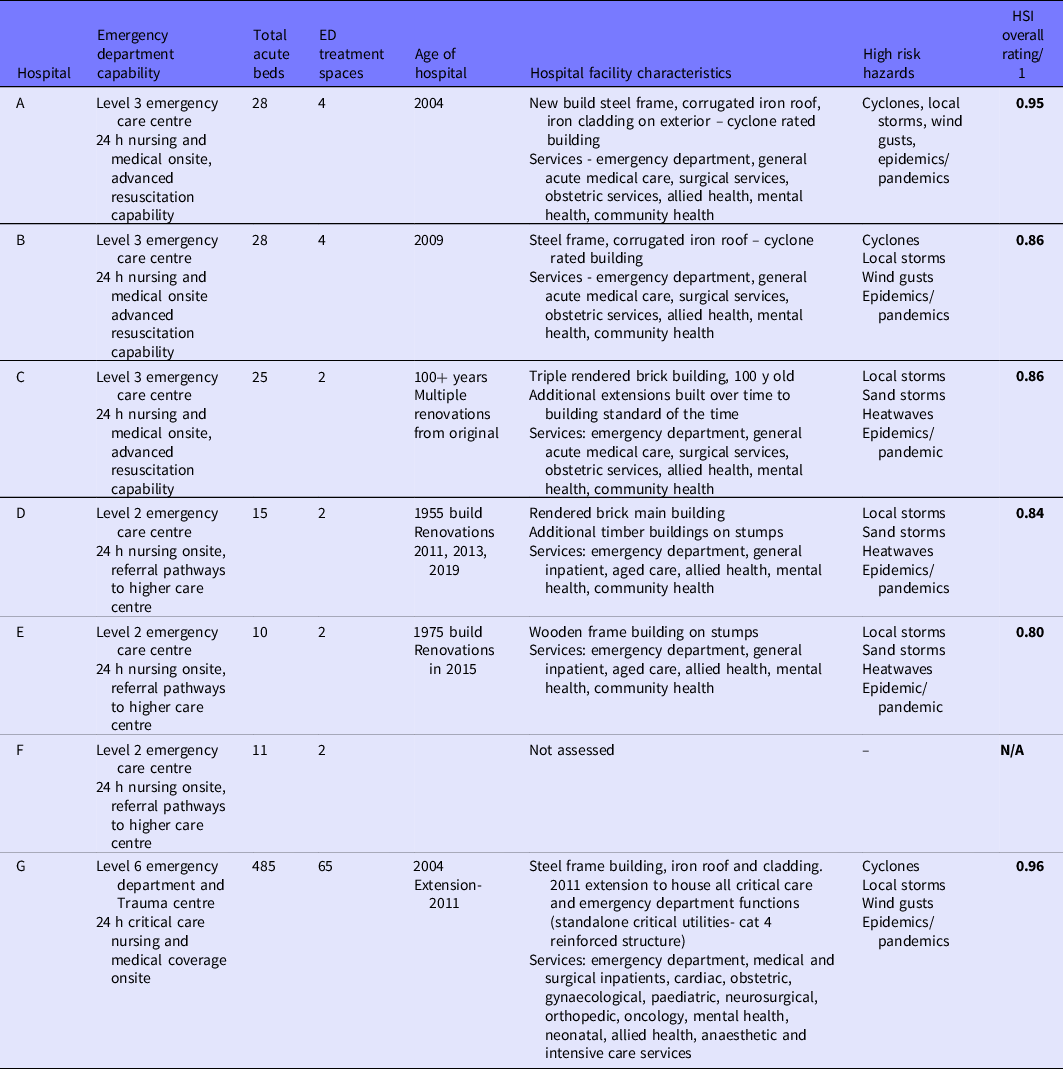
This was a cross-sectional descriptive study of selected health facilities within a public Hospital and Health Service area located in North Queensland, Australia, during 2019. The Hospital and Health Service studied is a statutory body being the principal provider of public sector health services. Servicing a geographically dispersed catchment comprising a total of 8 facilities providing acute care, supporting a population of approximately 250,000 people. Seven facilities providing inpatient care were assessed, with private hospital facilities and those not providing 24-h emergency department care excluded from the study. All hospitals were assigned a numerical identification (A-G) within the results. One facility (F) withdrew due to logistical challenges in undertaking the assessment.
The assessment was undertaken using the HSI, 2015 version 2. 16 This comprises an introduction to hospital capacity, and 4 modules with a total of 151 criteria covering hazard assessment, structural, nonstructural, and functional safety.
A self-assessment was initially undertaken by emergency management committees within each facility as described in the HSI evaluation guide. This was followed by an independent evaluation of self-assessment outcomes by panel members that have completed the United Nations HSI evaluation training and included qualified engineers. The independent evaluation focused on confirming engineering standards were met and developing an understanding of facility plans and their application in an emergency. In some cases, this resulted in a higher level of achievement being allocated for the hospital on specific questions. In other cases, it highlights aspects not previously considered by staff. Study data were collected through desktop analysis, direct observation, and interviews with results presented in this study being from the independent evaluation.
Hospital Safety Index Calculator
The HSI calculator provided with the checklist and corresponding excel spreadsheets was used to collate all data. 16
Module 1 describes specific high- or medium-risk external and internal hazards or dangers that may affect the safety or functioning of the hospital. The module may also identify hazards that do not directly impact the facility, but that the Hospital and Health Service should reasonably be expected to respond to. The provision of this information to the hospital assists staff and management understanding of hazards and risks that should underpin individual facility disaster and emergency management plans. Elements of modules 2-4 are assessed through the lens of the hazards identified as high or medium risk.
Module 2 evaluates the structural safety of the hospital, through assessment of the type of structure and materials used to construct the building/s and impacts of previous natural and other hazards. 16 Determining if structures meet contemporary building standards and if the structural integrity and function could be adversely affected by a major emergency or disaster.
Module 3 critically analyses the functioning of the hospital through architectural elements, including emergency access and exit routes to and from the hospital, critical systems (eg, electricity, water supply, waste management, fire protection), medical, laboratory, and office equipment (whether fixed or mobile), supplies used for analysis and treatment. 16
Module 4 evaluates a hospital’s personnel and essential operational capacity to function during and after a disaster. The organizations plans and response to an event are considered in terms of its capacity to provide patient-care services through mass casualty management, triage, and human, financial, and logistical resources. 16
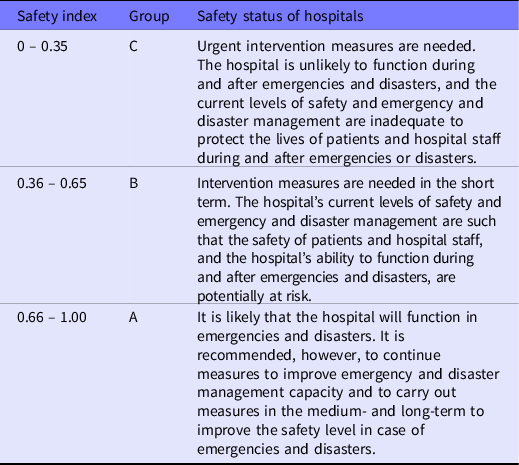
Elements in modules 2, 3, and 4 are scored 0, 1, or 2 according to a low, medium, or high safety rating. All scores within each module were summed and calculated as a fraction of the sum of the total elements, then expressed as decimal: sub-totals are calculated for each module. Each module was then summed and weighted equally (33.3%). The sums of the weighted results were determined to express the probability (percentage) that a facility will be able to function in an emergency or disaster situation. This hospital safety rating was categorized into low, average, and high safety groups according to the WHO’s indices (Table 1). 16
Definition of HSI levels based on WHO guidelines

Results
This study assessed 6 facilities of a total of 7 initially identified as suitable for the study. All facilities received an “A” rating, which means each had a score greater than 65%. The most common hazards identified for the region include: pandemics to all facilities equally, with cyclones, local severe storms, and heatwaves affecting 4 of the 6 facilities (Table 2).
Module 1: Assessed hospital characteristics and overall safety rating

The highest overall safety score was 96% and the lowest 80%. The average score was 88% for the 6 facilities assessed.
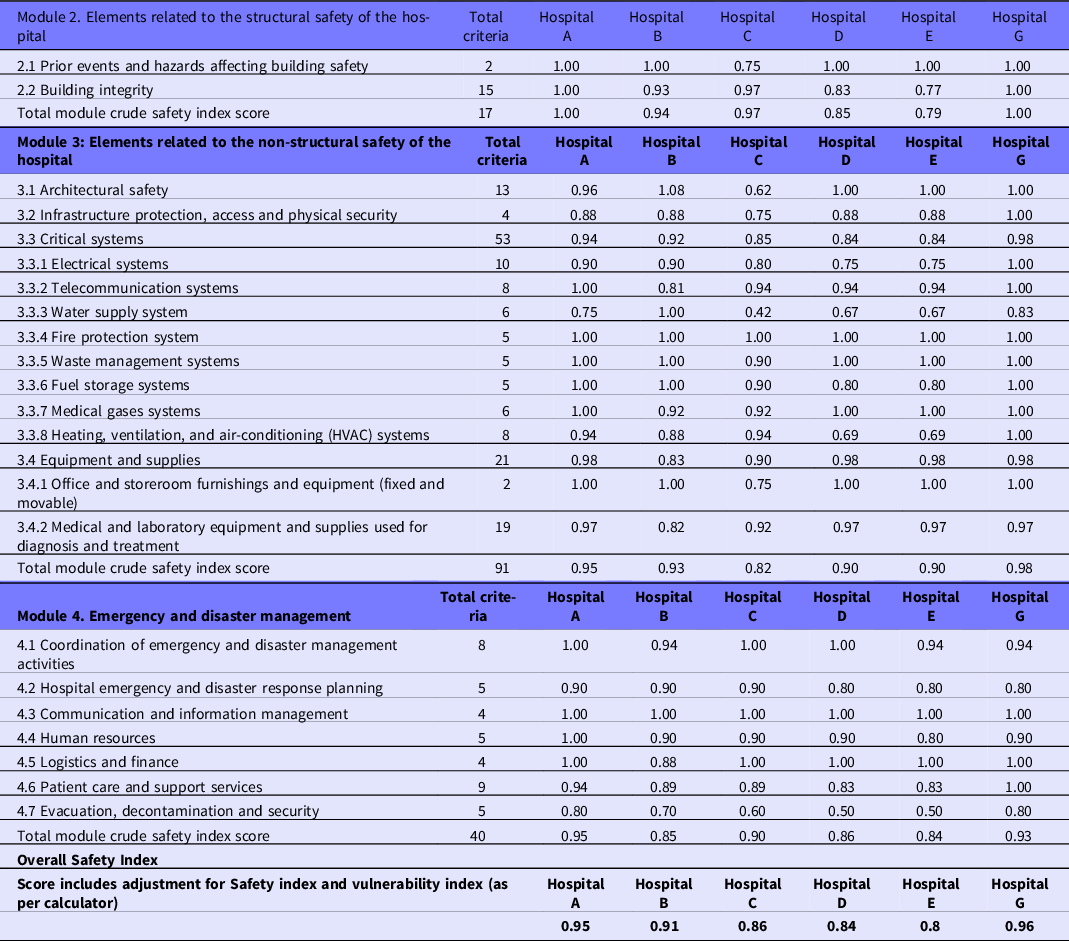
The structural assessment (module 2) resulted in highest score of 1.00 being achieved by hospitals A and G. The lowest score was 0.79 by hospital E (Table 3).
HSI assessment results: all facilities, modules 2-4

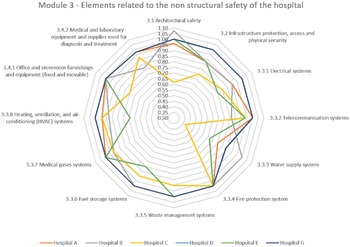
Nonstructural assessments yielded results between 0.82 (hospital C) and 0.98 (hospital G) for all hospitals. Facilities architectural aspects may not impede the delivery of health services after an event; however, sub-modules identified areas for improvement including physical security, access, and egress (hospitals A-F). Sub-module 3.1, architectural safety (13 elements), indicates highest scores in hospitals D, E, and G with scores of 1.00 (Table 3; Figure 1).
HSI assessment results relating to non-structural safety of hospitals (module 3).

For sub-module 3.3, critical systems, the element 3.3.3 (water supply systems; 6 criteria) scored lower for all but 1 hospital, 0.42 for hospital C, and the highest 1.00 for hospital B.
Electrical systems and heating, ventilation and air conditioning (HVAC) systems were identified as the next critical area for improvement in majority of hospitals, scoring a range 0.75-1.00.
Equipment and supplies resulted in all facilities scoring 1.00 in 3.4.1 office equipment safety except for hospital C (scored 0.75).
All facilities scored 0.97 in 3.4.2, medical and lab supplies, other than hospital B with a score of 0.82 and hospital C with 0.92.
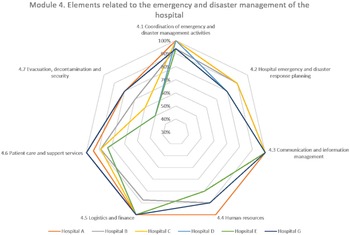
The highest score in module 4, emergency and disaster management, was 0.95 by hospital A and the lowest 0.84 for hospitals B and E (Figure 2; Table 3).
HSI assessment results relating to emergency and disaster management of the hospital (module 4).

The lowest scoring sub-module in module 4 for all hospitals was element 4.7, evacuation, decontamination, and security (range 0.50-0.80).
The lowest score of 0.50 was for hospitals D and E and the highest score of 0.8 0 was for hospitals A and G (Table 3).
Limitations
This is the first use of the HSI within the Australian context, providing a unique opportunity to determine hospital resilience in the region; however, the limited number of hospitals assessed has limited the studies statistical significance. Increased facility assessment numbers would provide increased statistical analysis and determination of validity. This study, however, has shown it is possible to use the HSI in Australia to provide a snap shot in time of hospital resilience and to determine facility requirements, the next step would be to incorporate HSI into quality and safety improvement projects.
A further strength of this study is the use of independent evaluation of each hospital’s responses to the HSI survey, thereby limiting reporting bias and improving accuracy and objective indications of hospital capacity to maintain services post disaster.
The removal of 1 facility due to logistical challenges may subject the study to selection bias; however, the resulting conclusions should not be impacted, and with more time and resources an independent evaluation of this site would be possible.
A limitation of the study is the single point in time assessment and there should be an ongoing process of assessment, which could be incorporated into the accreditation cycle. The hospital (and hence the HSI) also needs to be tested against actual disaster events and reassessed to ensure validity.
Discussion
To the author’s knowledge, this is the first time the HSI has been used within the Australian hospital environment. Its application resulted in all hospitals being rated as “A,” the highest ranking of resilience the checklist describes; however, each facility management noted further improvements were required. This result indicates all facilities would most likely continue to operate during a disaster and postimpact, although more testing postimpact is required to validate this result. The assessment does, however, identify areas requiring improvement, most notably in the areas of critical system supply and continuity, decontamination, safety, and security capacity.
While this is the first known instance the HSI has been used among the 1350 hospitals in Australia, 17 it has been used internationally, predominately in lower- and middle-income countries with only Sweden the only high-income country using the tool as a comparator. Reference Djalali, Castren and Khankeh6,Reference Djalali, Ardalan and Ohlen18 This pilot study provides an opportunity to undertake hospital facility resilience assessments using a checklist recently updated by the WHO (2015) to make it more applicable to all hospitals. 16
The assessment of each hospital provided information on hospital disaster processes, identified areas of strengths and vulnerabilities and substantially increased the staff and executive’s knowledge of the facility and emergency processes within the hospital. The comprehensive questioning in all modules allowed the participants to explore many facets of the facility’s functions considering the relevant hazards. This confirms other research reporting that extensive questionnaires have highlighted areas of concern and assisted in preparedness actions post a disaster event. Reference Asefzadeh, Varyani and Gholami19–Reference Djalali, Massumi and Ohlén23
The HSI checklist assessment results highlighted threats not previously considered, allowing management and employees to identify improvement strategies to enhance resilience. For example, in hospitals D and E, the assessment highlighted the need to further consider transportation of patients out of area for more specialized care where resources are limited (eg, burns, infectious diseases). This is relevant in a pandemic where the current facility capabilities cannot sustain treatment and infection control procedures indefinitely.
The power of this checklist to improve disaster literacy, individual attitudes, and personal preparedness has not been investigated. However, this study shows early indications this may be an unintended benefit of the self-assessment study design. Other hospital resilience studies support the use of the HSI as a self-learning method for hospitals, exposing all employees including clinical, executive, and administrative alike, to disaster preparedness and resilience concepts and plans. The promotion of these assessments highlights the need for shared understanding and resourcing to develop whole of system disaster leadership and resilience. Reference Der-Martirosian, Radcliff and Gable22,Reference Ardalan, Keleh and Saberinia24,Reference Dobalian, Stein and Radcliff25
There are some areas where the HSI could be considered limited in determining the resilience of a facility to a specific identified hazard. For example, pandemic preparedness elements are minimal and safety ratings may not identify specific facility capacity needs during a pandemic. Elements within modules 3 and 4 relating to the ability to isolate air handling (HVAC systems) or the provision of negative pressure areas could be considered inadequate, as they do not provide a rating based on capacity, but rather safety. Other elements relating to pandemic capacity and staff infection control procedures are more generalized within the assessment including hazardous waste systems, life-support equipment, medicines, supplies, workforce capacities, and mobilization and hospital recovery planning.
The HSI provides an easy-to-use assessment and scoring system; however, there does appear to be a ceiling effect in more tertiary and newer facilities, with perfect scores being derived. The achievement of an A rating can occur with a score of only 66%, which may be considered very low and relatively easy to achieve in developed countries. This scoring requires hospital managers to ensure they consider the score in context (including looking at the sub-elements) and invest in further improvements. Hospital G, for example, received an “A,” scoring perfectly in some areas. However, with further scrutiny of the results, improvement is required to critical system supply, hospital decontamination, hospital recovery, and business continuity. As with all assessments, the aim is to highlight best practice, but also indicate areas for improvement. There is opportunity to increase the depth of the HSI to help those hospitals in high-income countries continue to improve resilience even though an A rating is achieved.
The objective nature of the checklist provides managers with evidence to prioritize improvement projects. This is useful and relevant where competing demands for resources exist and where critical systems are required to ensure the hospital continues to function during a disaster. The use of the HSI to conduct both an internal assessment and independent evaluation of the facility has advantages. It is relatively quick and inexpensive way to provide a macroscopic view to management, potentially to warrant further in-depth investigation by engineering or other expert surveyors. This is highlighted in hospital C results where several structural and nonstructural elements of the building design and architecture reduce the facility’s overall resilience and may be unsafe in the event of a disaster impact.
Previous studies have supported the notion that countries with higher socioeconomic status have a higher level of preparedness and resilience. Reference Djalali, Ardalan and Ohlen18 The results of this study indicate that, despite a high degree of resilience in all facilities, there are areas where improvements can be made. The requirement for functional critical systems and utilities is essential to the ability of a hospital to maintain services. Reference Alexakis, Codreanu and Stratton26–Reference Mulyasari, Inoue and Prashar28 This study shows that improvements in redundancy of water and electricity systems are still required. Even in this developed setting where primary supplies may be adequate on a daily basis, the loss of these during a disaster would have significant impacts. Reference Achour, Miyajima and Pascale27,Reference Labarda, Labarda and Lamberte29 Similarly, the need to ensure business continuity planning for consumables, staffing, and equipment is important and fundamental to disaster planning in any setting. Reference Devlen30,Reference Blake31 Developing and implementing these plans within all hospitals of this study is a substantial recommendation to the health service’s administration.
The results from this study also suggest that newer buildings, built to the standard of the day, offer a higher degree of hospital resilience. Hospitals A, B, and G are the newest within the cohort, displaying consistently higher scores in structural and nonstructural (architectural) elements when compared with hospital C, D, and E, characterized as older buildings. Hospital B scored a lower structural safety rating due to assessors indicating a lower degree of structural redundancy (as per the guide) 16 and some minor damage being evident in concrete. It should be noted, however, that this building has been tested in a cyclonic event and has remained operational, with damage sustained being repaired quickly.
Module 1 has benefit to all hospital management and those charged with disaster management functions within the health service. In this study, the obvious cyclone and local storms featured as the highest threat to hospitals; however, not previously considered hazards such as heatwaves, and pandemics/epidemics featured as high risks also. The comprehensive hazard identification questionnaire also has considered the broader socio-natural disasters as well as human-made technical hazards such as transport incidents, or chemical spills. Both hazards were considered as medium risk hazards across all facilities. For example, an incident in Ravenshoe in North Queensland, 2017, where an explosion caused by a vehicle striking a gas cylinder caused 21 people to be injured and 2 deaths. 32 This mass casualty incident occurred in a rural area, where the closest hospital was 50 km away. 32 The review of this event has resulted in health services considering mass casualty planning in a broader sense to improve resilience and operational redundancy.
Another example for broader health service planning impacts is the resulting patient cohort from transport incidents involving chemical spillage. 33 The derailment of a transport train in Julia creek and spillage of sulfuric acid, although not resulting in injury, identified the potential for human exposure and injury in similar events requiring response plans, particularly in rural and remote areas. 34 An example in metropolitan areas includes an incident in Melbourne where a dropped package in a freight depot in Tullamarine, Victoria, released toxic vapors. This incident resulted in 400 workers being evacuated and 28 people being injured. 34 The consideration of these incidents for several elements in modules 3 and 4 have resulted in a reduction in safety for all facilities, in particular element 4.7, evacuation, decontamination, and security.
Disaster managers and hospital management should use this hazard analysis in conjunction with the outcomes of module 3-4 to develop hazard specific plans to mitigate against these hazards. Reviews and development of plans and arrangements should focus on all areas where improvements have been highlighted as required. Implementing these improvements, alongside existing plans and arrangements, will create a comprehensive disaster management system within facilities and across the health service.
Conclusions
This research showed the hospitals in this study are highly resilient as measured by the HSI. However, areas for improvements were identified, especially in the sustained supply of water and electricity. The results of this study support all hospital authorities to use the HSI to develop specific disaster and hazard specific plans including business continuity and disaster recovery plans. The use of the HSI as a collaborative assessment tool to assist facility managers and health workers to understand and explore areas of improvement is recommended to all Australian health facilities. This study supports the incorporation of the HSI into long-term quality improvement processes to support disaster preparedness and resilience.
Author contributions
The authors confirm contribution to the study as follows: study conception and design: J. Luke, P. Aitken, R. C. Franklin; data collection: J. Luke, J. Dyson; analysis and interpretation of results: J. Luke, R. C. Franklin; draft manuscript preparation: J. Luke, J. Dyson, R. C. Franklin. All authors reviewed the results and approved the final version of the manuscript.
Ethical standards
Approval for this research was obtained from the relevant Human Research Ethics Committee/s LNR/2018/QTHS/46888 and deemed a Low Negligible Risk Ethics research activity. Site Specific Application (SSA) approvals were also granted for each hospital for the purpose of the research.