Introduction
The success of fertilization and embryonic development is highly influenced by appropriate oocyte maturation (Keefe et al., Reference Keefe, Kumar and Kalmbach2015). During folliculogenesis, crosstalk between somatic and germ cells, global chromatin remodelling, intense RNA synthesis and storage, and protein translation, progressively promote nuclear and cytoplasmic maturation of the oocyte (Susor et al., Reference Susor, Jansova, Cerna, Danylevska, Anger, Toralova, Malik, Supolikova, Cook, Oh and Kubelka2015; Dumdie et al., Reference Dumdie, Cho, Ramaiah, Skarbrevik, Mora-Castilla, Stumpo, Lykke-Andersen, Laurent, Blackshear, Wilkinson and Cook-Andersen2018). The acquisition of oocyte competence is characterized by the ability to complete the maturation into metaphase II (MII) oocyte, achieving its potential to be fertilized, and perform the first cleavages during early embryo development, before embryonic genome activation (EGA) (De La Fuente et al., Reference De La Fuente, Viveiros, Burns, Adashi, Matzuk and Eppig2004; Evsikov and de Evsikova, Reference Evsikov and de Evsikova2009). In reproductive treatments, oocyte competence is acquired by in vitro manipulation during assisted reproductive technologies (ARTs) that may lead to maturation arrest and chromosomal abnormalities in the oocytes (MacLennan et al., Reference MacLennan, Crichton, Playfoot and Adams2015). Moreover, in combination with the impaired fertility and the in vitro culture of preimplantation embryos, ARTs have been associated with altered epigenetic reprogramming in newborns (Hattori et al., Reference Hattori, Hiura, Kitamura, Miyauchi, Kobayashi, Takahashi, Okae, Kyono, Kagami, Ogata and Arima2019).
In vivo maturation of oocytes through controlled ovarian stimulation (COS) is a widely used strategy to obtain a great number of matured oocytes in human reproductive treatment. Conversely, the in vitro maturation (IVM) of germinal vesicles or metaphase I (MI) oocytes, is mainly used for in vitro production of domestic animals, such as bovine and ovine, to obtain MII oocytes to be in vitro fertilized. In humans, IVM might be used to assist health-risk patients with polycystic ovary syndrome (PCOS) with an increased risk of ovarian hyperstimulation syndrome (OHSS) and during cancer treatment in fertility preservation programmes (De Vos et al., Reference De Vos, Smitz and Woodruff2014; Langbeen et al., Reference Langbeen, De Porte, Bartholomeus, Leroy and Bols2015; Sánchez et al., Reference Sánchez, Romero, De Vos, Verheyen and Smitz2015). These technologies have different implications for oocyte competence, zona pellucida (ZP) formation, cumulus cell interaction (Walker and Biase, Reference Walker and Biase2020), as well as for transcriptional and translational regulation during meiotic maturation, an essential event for oocyte-to-zygote transition as, in the early stages of embryo development, these proceed without transcription and the embryo depends exclusively on post-transcriptional regulation of maternal transcripts (Jansova et al., Reference Jansova, Tetkova, Koncicka, Kubelka and Susor2018).
Well controlled gene expression during oocyte competence is essential for maturation, fertilization, and embryo development. Environmentally induced epigenetic changes during ARTs are related to aberrant reprogramming of the oocyte transcriptome (Gao et al., Reference Gao, Jia, Li, Ma, Huang, Zhu, Hou and Fu2017; Yu et al., Reference Yu, Doni Jayavelu, Battle, Mar, Schimmel, Cohen and Hawkins2020), leading to an increase in the incidence of developmental disorders and birth defects in both humans and animals (Gomes et al., Reference Gomes, Gomes, Pinto and Ramos2007; Duranthon and Chavatte-Palmer, Reference Duranthon and Chavatte-Palmer2018; Luke et al., Reference Luke, Brown, Nichols, Schymura, Browne, Fisher, Forestieri, Rao, Yazdy, Gershman, Ethen, Canfield, Williams, Wantman, Oehninger, Doody, Eisenberg, Baker and Lupo2020). In the bovine model, it has been shown that nuclear maturation is not always accompanied by cytoplasmatic maturation during IVM. Different transcript abundance was observed in cumulus cells from different maturation methods in bovine (Watson, Reference Watson2007; Tesfaye et al., Reference Tesfaye, Ghanem, Carter, Fair, Sirard, Hoelker, Schellander and Lonergan2009). Looking for better outcomes, oestrus synchronization with exogenous hormones, optimum medium for oocyte maturation and embryo culture, laser-assisted hatching and, cryopreservation procedures have improved the in vitro production of bovine embryos (Ferré et al., Reference Ferré, Kjelland, Strøbech, Hyttel, Mermillod and Ross2020).
COS and IVM are important techniques to achieve MII oocytes for reproductive treatment and in vitro production of embryos. Nevertheless, these technologies affect oocyte transcriptome differently and the results of ARTs as reduced fertility, poor embryo quality, and higher miscarriage rates (Heinzmann et al., Reference Heinzmann, Mattern, Aldag, Bernal-Ulloa, Schneider, Haaf and Niemann2015; Adona et al., Reference Adona, Leal, Biase, De Bem, Mesquita, Meirelles, Ferraz, Furlan, Monzani and Guemra2016). However, studies are controversial on whether the IVM procedure or the ART itself is responsible for some of the unfavourable reproductive outcomes such as the higher prevalence of imprinting disorders and other genetic abnormalities. According to Buckett et al. (Reference Buckett, Chian, Holzer, Dean, Usher and Tan2007), when comparing reproductive results in cycles of IVF, ICSI or IVM, ART pregnancies, in general, are associated with an increased risk of congenital abnormality and, when compared with IVF and ICSI, IVM is not associated with any additional risk. In another study from the same group the miscarriage rates were higher in IVM cycles than in conventional ART procedures (IVF and ICSI). However, this seems to be related more to the patient population with PCOS, once there were similar miscarriage rates among IVM PCOS pregnancies and IVF/ICSI PCOS pregnancies, which were higher than in the no PCOS couples submitted to IVF/ICSI (Buckett et al., Reference Buckett, Chian, Dean, Sylvestre, Holzer and Tan2008).
As the oocytes are responsible for initiating embryo development, altered transcriptional activity may lead to impaired embryo development and many diseases in the offspring. Considering the importance of transcriptional levels during oocyte maturation, we evaluated the expression of genes related to meiotic competence in in vivo and in vitro matured single-cell oocytes from bovine, to provide a better understanding of the molecular pathways involved in the oocyte maturation process for future clinical applications.
Materials and methods
Ethics statement
The present study was approved by the Bioethics Commission on Animal Experiments of the Ribeirão Preto Medical School, University of São Paulo (protocol number 073/2012), which complies with the ethical principles of animal research.
Estrous synchronization and in vivo maturation of the oocyte
In total, 52 healthy Nelore cows of reproductive age (3–6 years old) had their ovarian follicular growth wave synchronized to obtain in vivo matured oocytes throughout COS. The emergence of a new follicular wave was induced and synchronized among the cows by follicular ablation (Day 0) and insertion of an intravaginal progesterone (1 g) releasing device (Sincrogest®, Ourofino Saúde Animal, São Paulo, Brazil). On the sixth day, prostaglandin analogous was administered intramuscularly (500 µg of sodium cloprostenol; Sincrocio®, Ourofino Saúde Animal, São Paulo, Brazil) and, after 12 h, the intravaginal progesterone was removed. Ovulation was induced on the eighth day with the gonadotropin-releasing hormone (GnRH) analogue buserelin acetate (10 μg) (Sincroforte®, Ourofino Saúde Animal, São Paulo, Brazil) and, after 25 h, before natural ovulation, ovum pick-up (OPU) was performed.
To collect the oocytes, an epidural anaesthetic of 2% lidocaine hydrochloride (3–4 ml) was given immediately before follicle aspiration to block eventual pain during the procedure and facilitate the transrectal ovarian manipulation. Follicle aspiration was performed using an ultrasound device (MyLab30 Vet Gold, Esaote, Genova, Italy), equipped with a micro-convex 7.5 MHz transducer connected to a needle-guide system and vacuum pump (Diapump; FANEM, São Paulo). A single lumen 19-gauge 60-cm long sterile needle and a vacuum pressure of 100 mmHg was used during the follicle puncture on each session by the same operator. Periovulatory follicles (>11 mm in diameter) were punctured and the follicular fluid was collected in a 50-ml Falcon tube containing 10 ml of Dulbecco’s phosphate-buffered saline (DPBS) supplemented with 50 IU/ml heparin (Hepamax-S) and kept at a temperature of 37ºC in a bath. The contents of the tube were placed in a Petri plate and searched for oocytes under a stereomicroscope (Stemi 1000/2000/2000-C, Carl Zeiss, Germany). Only those oocytes with a visible first polar body [metaphase II (MII) oocytes] were selected (20 oocytes from different animals). The oocytes were denuded in a maturation medium supplemented with 0.2% hyaluronidase (Sigma-Aldrich, USA), washed in phosphate-buffered saline (PBS) and stored individually in RNAlater®/PBS (1:3) for gene expression analysis.
In vitro maturation of oocytes
Bovine ovaries obtained in a slaughterhouse were transported to the laboratory in 0.9% physiological saline solution supplemented with 0.05 g/L streptomycin at 35–37ºC. In total, 20 ovaries were used for oocyte selection and in vitro maturation. Viable follicles measuring between 2 and 8 mm in diameter were aspirated using 18G needles adapted to 20 ml syringes. Cumulus–oocyte complexes (COCs) were recovered from the follicular fluid of ovaries and evaluated under a stereomicroscope. Oocytes with a homogeneous cytoplasm and sufficient surrounding cumulus cells (three layers or more) (category I and II) were selected (Leibfried and First, Reference Leibfried and First1979). COCs from the same cow (both ovaries) were randomly assigned to in vitro maturation (IVM) in HEPES-buffered tissue culture medium-199 (TCM-199, Gibco/BRL, Grand Island, NY, USA) supplemented with 10% fetal calf serum (FCS; Invitrogen Gibco/BRL), 0.2 M sodium pyruvate, 100 IU/ml penicillin G, 100 μg/ml streptomycin, 0.5 μg/ml follicle-stimulating hormone (FSH; Folltropin-Bioniche, Canada), 5 μg/ml luteinizing hormone (LH; Lutropin-Bioniche, Canada), and 1 μg/ml 17β-estradiol.
Maturation was carried out throughout 22–24 h, at 38.5ºC, with high humidity and 5% CO2. After IVM, the oocytes were denuded in a maturation medium supplemented with 0.2% hyaluronidase (Sigma-Aldrich, USA), under a stereomicroscope and only those oocytes with a visible first polar body (MII oocytes) were selected. These were washed in PBS and stored individually in RNAlater®/PBS (1:3) for gene expression analysis.
Gene expression analysis
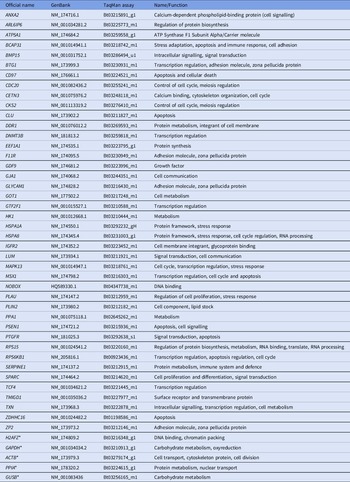
In total, 42 genes related to oocyte development and competence were selected according to previous studies (Table 1). Total RNA from each sample (single oocyte) was extracted using the RNeasy® Micro kit (Qiagen, Valencia, California, USA) according to the manufacturer’s instructions. All samples were treated with an RNase-Free DNase Set (Qiagen, Valencia, California, USA) and RNA concentration and purity were determined using a NanoDrop 2000 spectrophotometer (Thermo Fisher Scientific, Massachusetts, USA). Complementary DNA (cDNA) was synthesized using a High-Capacity cDNA Reverse Transcription kit (Applied Biosystems, Foster City, California, USA) according to the manufacturer’s protocol. Oocyte cDNA was preamplified using a TaqMan PreAmp Master Mix kit (Applied Biosystems, Foster City, California, USA) following the manufacturer’s recommendations with modifications as follows: 1× TaqMan PreAmp Master Mix, 0.05× of each assay in a pooled assay mix (0.2×), and 62.5 ng of cDNA in 20 µl of the final volume. Preamplification cycles were 95°C for 15 min and 20 cycles of 95°C for 15 s and 60°C for 4 min. The resulting material was diluted 20× and stored at −20°C.
Genes selected, TaqMan assay and molecular function

* Reference genes.
Gene expression analyses were performed using TaqMan Low-Density Arrays (TLDA) (ThermoFisher Scientific, Massachusetts, USA). A custom TLDA was manufactured into the 384-well cards that included 48 genes (format 48 – part no. 4342253). In total, 42 target genes were evaluated and the following reference genes GAPDH, ACTB, H2AFZ, PPIA and GUSB were selected based on our previous study (Caetano et al., Reference Caetano, Miranda-Furtado, Batista, Pitangui-Molina, Higa, Padovan and Rosa-e-Silva2019); 18S RNA was used as an internal control for amplification. Quantification was performed using 5 ml of preamplified cDNA, 45 ml of nuclease-free water (1:20) and 50 ml of TaqMan Universal PCR Master Mix (ThermoFisher Scientific, Massachusetts, USA). The mixture was transferred into a TLDA card and centrifuged for 2 min at 1000 g to distribute the samples into each well. Quantification was performed using the ViiA-7 Real time PCR system (Applied Biosystems) and the thermal cycling conditions were 2 min at 50ºC and 10 min at 95ºC, followed by 40 cycles of 15s at 95ºC and 1 min at 60ºC. Ten random in vivo matured oocytes were pooled and used as a reference sample for gene expression normalization. Relative quantification (RQ) of gene expression was obtained using the 2-ΔΔCq method (where Cq is the cycle of quantification) (Livak and Schmittgen, Reference Livak and Schmittgen2001). Fold changes are reported by the number of times that each gene was expressed in vivo compared with the in vitro matured oocytes (in vivo/IVM).
In silico analysis of protein–protein interaction and pathways
Protein–protein interactions between the analyzed targets were predicted using the STRING database (https://string-db.org, version 11.0) (Szklarczyk et al., Reference Szklarczyk, Morris, Cook, Kuhn, Wyder, Simonovic, Santos, Doncheva, Roth, Bork, Jensen and von Mering2017). Network interactions were built with a score of 0.4 or more, using multiple proteins, selecting Bos taurus as an organism and an initial input of 42 proteins. A comprehensive analysis of the function and pathways of the differentially expressed genes was obtained using the PANTHER Classification System (www.pantherdb.org, version 16.0) (Mi et al., Reference Mi, Muruganujan, Huang, Ebert, Mills, Guo and Thomas2019), based on Gene Ontology (GO) terms and the UniProtKB protein data bank (www.uniprot.org). Based on the main biological process and molecular function observed on PANTHER, a Venn diagram was created using the Venn diagram R package with the differentially targets and the three main pathways related.
Statistical analysis
The values are presented in the median and interquartile ranges. The gene expression analysis was performed using the non-parametric univariate Mann–Whitney test to compare the distribution of two independent groups. A heatmap showing differential expression levels between in vitro and in vivo matured oocytes generated from the median values of gene expression using the heatmap.2 function from the R gplots package (Warnes et al., Reference Warnes, Bolker, Bonebakker, Gentleman, Huber, Liaw, Lumley, Maechler, Magnusson, Moeller, Schwartz, Venables and Galili2015). The Spearman’s correlation coefficient was used to correlate the gene expression of in vivo matured oocytes and the age of the cows. All results were obtained using SAS 9.0 software (SAS Institute), with the level of significance set at 5% (P < 0.05).
Results
Of the 42 genes analyzed in in vitro and in vivo matured oocytes, expression of the following GLYCAM-1, HSPA1A, LUM, PLAU, PTGFR and SPARC genes was not detected in the single-cell gene expression analysis. Therefore, 35 were evaluated and an individual variability within the same group (in vivo or in vitro) was observed in the relative gene expression, as MAPK13 was expressed only in a few samples, including 29.41% (n = 5) for IVM and 31.58% (n = 6) for in vivo matured groups. Although the RQ value was decreased in the IVM group (0.162 ± 0.22) when compared with the in vivo matured group (3.28 ± 3.67), statistical analysis was not performed.
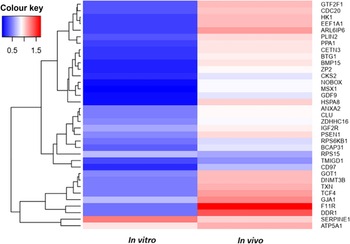
From 35 genes related to oocyte growth and competence, 24 showed reduced expression levels in IVM oocytes when compared with the in vivo maturated ones (Table 2). The expression levels of ANXA2, ATP5A1, BCAP31, DDR1, F11R, GJA1, RPS15, SERPINE, TMIGD1, TXN and ZDHHC16 did not differ between the groups analyzed (Table 2). Median values of normalized relative gene expression were used to generate a heatmap for differential gene expression of the 35 genes analyzed (Figure 1), showing a distinct gene expression pattern observed between in vitro and in vivo matured oocytes.
Relative quantification of all genes analyzed on oocytes matured in vitro and in vivo

* In bold: P < 0.05.
Heatmap showing differential expression of 35 genes between in vitro and in vivo matured oocytes. Red shading indicates higher expression levels and blue shading indicates lower expression levels. The colour key indicates the intensity associated with the normalized gene expression median values.

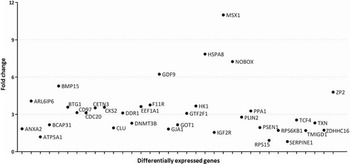
Among the differentially expressed genes, most of them showed a fold change varying from 1.5 and 2.8 (IGF2R, RPS6KB1, CLU, PSEN1, GOT1, DNMT3B, TCF4 and PLIN2) and from 3.0 to 4.8 (GTF2F1, CDC20, CD97, PPA1, CETN3, CKS2, BTG1, EEF1A1, HK1, ARL6IP6 and ZP2) times higher in the in vivo than in vitro matured oocytes. However, the genes displaying the greatest fold change were BMP15 (5.28), GDF9 (6.23), NOBOX (7.25) and HSPA8 (7.85) and MSX1 (11.00), which showed higher fold differences between the studied groups (Figure 2). Considering age influence on gene expression, Spearman correlation analysis showed a strong negative correlation between ANXA2 (r 2 = −0.91; P < 0.01) gene expression and age, and a moderate negative correlation considering the CD97 gene (r 2 = −0.59; P < 0.04) (Supporting information Table S1). However, ANXA2 was not differentially expressed in the studied groups.
Fold change of gene expression differences in in vivo/in vitro matured bovine oocytes.

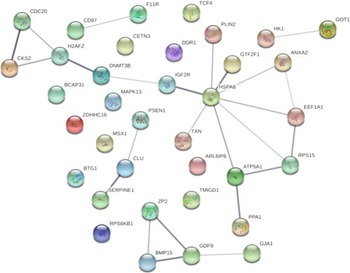
Based on the targets evaluated, a functional network of protein interactions was performed using the STRING database (https://string-db.org, version 11.0). The network of interactions considered a score of 0.4 or more, using multiple proteins, selecting Bos taurus as an organism. The input of 36 proteins and the scores obtained for each interaction are summarized in Table S2. The strongest interaction was observed between CDC20 and CKS2 (score 0.991) followed by DNMT3B and H2AFZ (score 0.937), CLU and SERPINE1 (score 0.915) and HSPA8 and IGF2R (score 0.906) (Figure 3 and Table S2). The network had more interactions than expected for a random set of proteins of similar size, drawn from the bovine genome [protein interactions (PPI) enrichment P-value 0.00625]. This enrichment indicated that the proteins are biologically connected. The main five functional enrichments in the interacting proteins network based on the lowest false discovery rate are presented in Table S3.
Protein–protein interactions (PPI) network of 36 genes evaluated in single-cell gene expression. Stronger interactions are shown in the thickest lines and lower interactions are shown in the thinnest lines.

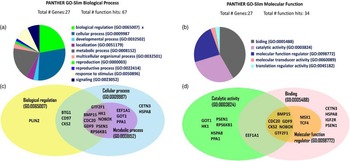
Considering the differentially expressed genes in in vivo and in vitro matured oocytes a GO term enrichment was carried out using PANTHER GO-Slim. These genes participated in specific biological processes and molecular functions related to cell growth, differentiation, metabolism and signalling, as well as binding proteins, transcriptional and catalytic activities (Figure 4a,b). The most representative pathways are presented in the Venn diagram. For biological processes, genes BMP15, CDC20, GDF9, GTF2F1, HK1, NOBOX, PSEN1 and RPS6KB1 were involved in all ‘Cellular Processes’, ‘Biological Regulation’ and ‘Metabolic Processes’ (Figure 4c). For molecular function, BMP15, GDF9, NOBOX, GTF2F1, CDC20 and CKS2 participated in all representative GO functional enrichment: ‘binding’, ‘catalytic activity’ and ‘molecular function regulator’ (Figure 4d). CDC20 seems to be the main gene behind this functional enrichment.
PANTHER-Slim Gene Ontology analysis of functional enrichment of the differentially expressed genes in in vivo and in vitro matured bovine oocytes displaying Biological Process (a) and Molecular Function (b) and a Venn diagram showing the genes related to the most representative biological process (c) and molecular function (d).

Discussion
In this study in vivo and in vitro matured oocytes showed a different pattern of gene expression, in which reduced transcription levels of several genes involved in oocyte metabolism, competence, cell signalling, and apoptosis were observed in IVM oocytes. Differently, in the study by Jones et al. (Reference Jones, Cram, Song, Magli, Gianaroli, Lacham-Kaplan, Findlay, Jenkin and Trounson2008) more than 2000 genes were identified as expressed at more than two-fold higher levels in oocytes matured in vitro than those matured in vivo (Jones et al., Reference Jones, Cram, Song, Magli, Gianaroli, Lacham-Kaplan, Findlay, Jenkin and Trounson2008), with 162 genes with overexpression levels of more than 10-fold higher in the in vitro matured oocytes. These results may be due to dysregulation in either transcription or post-transcriptional regulation, leading to changes during early embryo development. When comparing our list of upregulated genes with Jones’ list there was no overlap, although the processes with which the genes have been associated are similar (transcription regulation, cell metabolism, intracellular signalling and others).
Oocyte maturation and competence is a crucial period for female gametogenesis, with changes in the nucleus and cytoplasm, increase in chromatin accessibility and transcriptional activity, and production of cellular components necessary for the maintenance of the embryo prior to EGA. Proper oocyte maturation affects fertilization rates and embryo development, directly impacting reproductive outcomes (Landim-Alvarenga and Maziero, Reference Landim-Alvarenga and Maziero2014; Gilchrist et al., Reference Gilchrist, Tscherner, Nalpathamkalam, Merico and LaMarre2016). Although IVM oocytes can promote the first stages of embryo development, a higher rate of miscarriage was observed in IVM cycles when compared with COS (De Vos et al., Reference De Vos, Grynberg, Ho, Yuan, Albertini and Gilchrist2021). Once removed from the context of the follicle, the meiosis process was spontaneously resumed and, in many mammals, the majority of oocytes achieved the MII stages, although in humans this is less frequent (Edwards, Reference Edwards1965). In addition, nuclear maturation is not necessarily accompanied by cytoplasmatic maturation (De Vos et al., Reference De Vos, Grynberg, Ho, Yuan, Albertini and Gilchrist2021).
Oogenesis is a coordinated and complex biological process in which the primordial germ cells undergo differentiation and the germinal vesicle (GV) breaks down and resumes cellular division to the matured MII oocytes able to be fertilized (Yu et al., Reference Yu, Doni Jayavelu, Battle, Mar, Schimmel, Cohen and Hawkins2020). In the growing oocyte, increased transcriptional activity is required for the oocyte-specific process, growth and maturation, and stored RNA is needed for early embryo development (Lonergan et al., Reference Lonergan, Rizos, Gutierrez-Adan, Fair and Boland2003; Gandolfi et al., Reference Gandolfi, Brevini, Cillo and Antonini2005; Sirard et al., Reference Sirard, Richard, Blondin and Robert2006; Gennari Verruma et al., Reference Gennari Verruma, Credendio Eiras, Fernandes, Vila, Libardi Miranda Furtado, Silveira Ramos and Barbosa Lôbo2021). The regulation of gene expression is controlled in the oocyte after the GV phase, almost exclusively by mRNA translation and post-translational modifications in the synthesized proteins (Susor et al., Reference Susor, Jansova, Cerna, Danylevska, Anger, Toralova, Malik, Supolikova, Cook, Oh and Kubelka2015; Dumdie et al., Reference Dumdie, Cho, Ramaiah, Skarbrevik, Mora-Castilla, Stumpo, Lykke-Andersen, Laurent, Blackshear, Wilkinson and Cook-Andersen2018). During the differentiation of primordial germ cells and gametogenesis, a genome-wide epigenetic reprogramming is responsible for the establishment of oocyte-specific gene expression patterns, as well as maternal genomic imprinting, essential for reproductive success and proper embryo development (Fassnacht and Ciosk, Reference Fassnacht and Ciosk2017).
Aberrant epigenetic reprogramming and developmental disorders are frequently related to ART. Hattori and colleagues (Reference Fauser2019) showed, in an epidemiologic study in Japan, an increase in the incidence of imprinting disorders such as Beckwith–Wiedemann (BWS), Silver–Russel (SRS) and Prader–Willy (PWS) syndromes in ART-conceived children. Nevertheless, the authors recruited a great number of participants with all four imprinting disorders and did not access the causes of infertility and the indication for treatment, which is also related to aberrant imprinting reprogramming (Kopca and Tulay, Reference Kopca and Tulay2021). The ESHRE Capri Workshop Group showed that newborns spontaneously conceived by subfertile couples present 29% of congenital abnormalities, and the risk is further increased to 34% with ART. Probably the increased risk of birth defects may be more related to infertility than ART itself (ESHRE Capri Workshop Group, 2014). Although many chromosomal anomalies and mutations have evolved to implantation failure or spontaneous miscarriages, IVF, especially ICSI may favour the transmission of these anomalies by artificially enhancing fertility (Wang et al., Reference Wang, Fan, Behr and Quake2012). However, after more than 40 years of ARTs, up to 2019 over 8 million children have been born using IVF (Fauser, Reference Fauser2019), and the benefit of treatment is greater than the changes expected.
In the oocytes, epigenetic reprogramming starts after sexual maturation during oocyte growth that is arrested in the diplotene stage from meiosis, with the establishment of gametic markers and maternal genomic imprinting (Reik et al., Reference Reik, Dean and Walter2001; Lucifero et al., Reference Lucifero, Mertineit, Clarke, Bestor and Trasler2002; Hajkova et al., Reference Hajkova, Erhardt, Lane, Haaf, El-Maarri, Reik, Walter and Surani2002). As induced maturation of oocytes is necessary for fertility treatment, maternal epigenetic reprogramming can be affected by environmental changes during ARTs, which directly affects the cell epigenetic landscape, as well as the imprinting acquisition necessary for proper embryo development (Sato et al., Reference Sato, Otsu, Negishi, Utsunomiya and Arima2007; Owen and Segars, Reference Owen and Segars2009). As maternal imprinting is completed late in the female epigenome, the time of fertilization seems to be a critical step for imprinting disorders. One cannot forget that the male factor may also be responsible for imprinting disorders. Differently from the oocyte, imprinting acquisition in the male genome is established early in diploid gonocytes before the meiosis stage (Lucifero et al., Reference Lucifero, Mertineit, Clarke, Bestor and Trasler2002). Tang et al. (Reference Tang, Pan, Yang, Fu, Lu, Wu, Han, Chen, Lu, Xia, Wang and Wu2018) showed that idiopathic male infertility is associated with aberrant methylation in imprinted loci, with loss of imprinting in the paternally methylated H19DMR and maternally methylated GNAS and DIRAS3 DMR in spermatozoa. In a study of genome-wide mutation, the authors found that the father’s age at conception was related to a diversity mutation rate of single nucleotide polymorphisms (SNP) (Kong et al., Reference Kong, Frigge, Masson, Besenbacher, Sulem, Magnusson, Gudjonsson, Sigurdsson, Jonasdottir, Jonasdottir, Wong, Sigurdsson, Walters, Steinberg, Helgason, Thorleifsson, Gudbjartsson, Helgason, Magnusson, Thorsteinsdottir and Stefansson2012).
In the bovine model, IVM is the most used procedure to obtain MII oocytes during in vitro production of embryos (IVP), with an oocyte maturation rate of 80% (Luciano and Sirard, Reference Luciano and Sirard2018). As observed in the present study, despite this success, IVM oocytes presented a reduced gene expression when compared with in vivo matured oocytes, especially for the genes related to metabolism (EEF1A1, GOT1 and PPA1), apoptosis (CD97, CLU and PSEN1), cell cycle (CDC20, CETN3 and CKC2) and de novo DNA methylation (DNMT3b). Mouse oocytes appear to be capable of maintaining their epigenetics marks during IVM (Anckaert et al., Reference Anckaert, De Rycke and Smitz2013). However, Borghol et al. (Reference Borghol, Lornage, Blachère, Sophie Garret and Lefèvre2006) demonstrated that in humans this could be different and that IVM may lead to aberrant DNA methylation status on H19/IGF2 DMR. In addition, patients with PCOS have shown higher arrest and lower embryo production after oocyte IVM when compared with patients who had undergone COS treatment (Walls et al., Reference Walls, Ryan, Keelan and Hart2015). Although IVM is not common in humans, the establishment of a better culture medium to obtain MII oocytes with minimal stimulation represents a safe alternative for women with health problems, such as PCOS, poor responders, oocyte maturation defects and fertility preservation in cancer treatment (Li et al., Reference Li, Xu, Zhou, Guo and Xin2011; De Vos et al., Reference De Vos, Smitz and Woodruff2014; Walls et al., Reference Walls, Ryan, Keelan and Hart2015; Vuong et al., Reference Vuong, Ho, Gilchrist and Smitz2019). Using low hormone concentrations, followed by proper IVM medium to obtain mature oocytes, important results have been reported in promoting the completion of nuclear and cytoplasmic maturation of cumulus–oocyte complexes, with an increase in the quality of 3-day preimplantation embryos (Sánchez et al., Reference Sánchez, Romero, De Vos, Verheyen and Smitz2015, Reference Sanchez, Le, Ho, Romero, Van Ranst, De Vos, Gilchrist, Ho, Vuong and Smitz2019).
Controlled gene expression regulation is fundamental for oocyte maturation, cumulus cell expansion, first polar body (PB) extrusion and cytoplasmatic changes, and characteristics of meiotic maturation in a fertilizable oocyte (Biase et al., Reference Biase, Everts, Oliveira, Santos-Biase, Fonseca Merighe, Smith, Martelli, Lewin and Meirelles2014). The CDC20 gene co-activated by anaphase-promoting complex/cyclosome (APC/C) is an essential regulator of the cell cycle, playing an important role in the transition from meiosis I to meiosis II, influencing the first PB extrusion and chromosomal segregation (Jin et al., Reference Jin, Hamada, Malureanu, Jeganathan, Zhou, Morbeck and van Deursen2010; Yang et al., Reference Yang, Li, An and Lei2014a). In this study, there was a clear reduction in CDC20 expression in vitro compared with the in vivo matured oocytes. Changes in CDC20 expression or genomic mutations are related to aneuploid gametes, female infertility and chromosomal abnormalities in the embryo (Yang et al., Reference Yang, Li, An and Lei2014a; Zhao et al., Reference Zhao, Xue, Yao, Shi, Chen, Wu, Sun, Xu, Yan, Li, Mao, Fu, Zhang, Mu, Wang, Du, Liu, Dong, Wang, Li, He, Jin, Liang, Kuang, Sun, Wamg and Sang2020). Similar to CDC20, CETN3 and CKS2 are both cell cycle regulators, with an essential role in centrosome duplication, segregation and genomic stability (Giotti et al., Reference Giotti, Chen, Barnett, Regan, Ly, Wiemann, Hume and Freeman2019); these two genes were also expressed less in the in vitro matured oocytes.
Most genes presented a large fold difference, varying from 1.5 to 4 times higher in the in vivo matured oocytes. Interestingly, BMP15, GDF9, NOBOX, HSPA8 and MSX1 showed the highest fold changes, from 5 to 11 times higher in the in vivo matured oocytes. BMP15 and GDF9 members of the TGF-β superfamily are essential in the process of folliculogenesis and oogenesis, through endocrine and paracrine signalling that promotes cell differentiation (De Resende et al., Reference De Resende, Vireque, Santana, Moreno, de Sá Rosa e Silva, Ferriani, Scrideli and Reis2012). These genes are co-expressed in human oocytes, and the reduced expression is related to reproductive disorders (Wei et al., Reference Wei, Liang, Fang and Zhang2011, Reference Wei, Huang, Li, Fang, Li and Liang2014), impaired oocyte quality and developmental competence, altered cumulus cells function and embryo development. NOBOX, HSPA8 and MSX1 genes are important modulators of cell fate and differentiation (Yang et al., Reference Yang, Chang and Rana2014b). NOBOX and MSX1 homeobox transcription factors regulate oocyte-specific genes, with increased expression throughout oocyte growth, especially in MII oocytes (Le Bouffant et al., Reference Le Bouffant, Souquet, Duval, Duquenne, Hervé, Frydman, Robert, Habert and Livera2011; Belli et al., Reference Belli, Cimadomo, Merico, Redi, Garagna and Zuccotti2013). HSPA8 regulates mRNA stability and the transcriptional level in mature oocytes (Marei et al., Reference Marei, Van Raemdonck, Baggerman, Bols and Leroy2019).
The evaluated genes participate in an intricate network of interactions that indicates a biological connection. The proteins with the higher scores of interactions showed reduced transcriptional levels and some of them had higher fold differences including CDC20 (3.12), CKS2 (3.57), HSPA8 (7.85) and IGF2R (1.55). IGF2R is an imprinted maternally expressed gene, with implications in the large offspring syndrome (LOS), a fetal overgrowth alteration similar to BWS in humans due to loss of imprinting (LOI) in a specific locus that could be induced by ARTs (Chen et al., Reference Chen, Hagen, Elsik, Ji, Morris, Moon and Rivera2015). A recent study reported that LOS can occur spontaneously, and the epigenetic changes observed are similar to those conceived by ARTs (Li et al., Reference Li, Sena Lopes, Fuster and Rivera2022). PANTHER GO analysis of functional enrichment showed important biological processes and molecular functions, in which the main genes involved were BMP15, CDC20, GDF9, GTF2F1, HK1, NOBOX, PSEN1 and RPS6KB1 for Biological Process, and BMP15, GDF9, NOBOX, GTF2F1, CDC20 and CKS2 genes for Molecular Function. However, CDC20, due to its key role in cell cycle control, seems to be an important molecular marker for oocyte growth and development.
Fewer studies have evaluated single-cell oocyte gene expression due to the low amount of material. Although gene expression analysis and MII oocyte production were carefully designed, this study has some limitations. First, we did not evaluate the embryo production rate after IVM or COS. Rizos and colleagues (Reference Rizos, Ward, Duffy, Boland and Lonergan2002) showed that in vivo matured oocytes present a higher embryo production rate at day 7 when compared with blastocysts from IVM oocytes. Also, we did not evaluate protein levels to confirm the changes in gene expression. However, a recent study using single-cell proteomics showed that IVM human oocytes are heterogeneous in terms of proteome level, and 45 differentially expressed proteins were observed in comparison with in vivo matured oocytes, with most of them (40) overlapping with mRNA levels, including TRIM28 maternal effect protein (Guo et al., Reference Guo, Cai, Liu, Ma, Zhang, Wang, Qi, Liu, Diao, Sha and Guo2022). This altered gene expression may also be related to previous impaired fertility, however we did not measure mRNA levels in GV oocytes. Finally, we used bovine oocytes instead of human oocytes, mainly because of the difficulty in obtaining in vivo matured oocytes from women undergoing IVF, once these gametes are available for embryo production and transfer, and rarely donated by our patients. However, animal models are often used to better understand the molecular mechanisms involved in human gametogenesis, fertilization, early embryo development, and the molecular mechanisms that regulate these processes, such as epigenetic reprogramming and developmental disorders. Regarding the implications for human reproductive studies, bovine material has many physiological and genetic similarities, including the overgrowth syndrome related to ARTs (Adams et al., Reference Adams, Singh and Baerwald2012; Chen et al., Reference Chen, Robbins, Wells and Rivera2013; Abedal-Majed and Cupp, Reference Abedal-Majed and Cupp2019).
In conclusion, IVM of bovine oocytes presented reduced expression of important genes related to oocyte competency and fertilization when compared with in vivo matured ones, suggesting that, although nuclear maturation is achieved, alterations in the transcript level may contribute to the impaired reproductive outcomes. These downregulated genes participate in several biological processes and molecular functions, including cell cycle control, transcriptional and catalytic activity, signal transduction, and oocyte growth and differentiation. Furthermore, our results pointed out that CDC20 might be an important molecular marker for oocyte quality for clinical application, but further studies in human oocytes are necessary to confirm this hypothesis. Despite these changes, important results have been achieved using IVM to obtain preimplantation embryos in both humans and animals. However, transcriptional changes in matured oocytes give an important overview of the processes during maturation and mRNA storage to support embryo development, as the time of translational activation of maternal mRNAs is spatially and temporally regulated after fertilization (Esencan et al., Reference Esencan, Kallen, Zhang and Seli2019). However further studies, including the epigenetic control of gene expression and protein levels in both IVM and COS MII oocytes may increase our knowledge of the mechanisms behind the altered gene expression and the implications for ART in genomic reprogramming during oogenesis and early development.
Supplementary material
To view supplementary material for this article, please visit https://doi.org/10.1017/S0967199422000478
Acknowledgements
The authors are extremely grateful to the members of the Department of Veterinary Medicine, School of Animal Science and Food Engineering, the University of São Paulo and the members of the Human Reproduction Division at the Department of Gynecology and Obstetrics of the Ribeirão Preto Medical School, the University of São Paulo, especially Caroline Pitangui Palmieri Molina, Cristiana C. Padovan Ribas and Luciene Aparecida Batista for technical assistance.
Financial support
This study was supported by Fundação de Amparo à Pesquisa do Estado de São Paulo (FAPESP) with the grant 2012/06068-3 (ACJSRS), fellowship 2012/06006-8 (LCC) and 2012/11069-9 (CLMF); Conselho Nacional de Desenvolvimento Científico e Tecnológico (CNPq); Coordenação de Aperfeiçoamento de Pessoal de Nível Superior (CAPES) and the Institutos Nacionais de Ciência e Tecnologia (INCT).
Declaration of interest
We have no conflict of interest in this study.
Ethics statement
The present study was approved by the Bioethics Commission on Animal Experiments of the Ribeirão Preto Medical School, University of São Paulo (protocol number 073/2012), which complies with the ethical principles of animal research.