




No CrossRef data available.
Article contents
Posthodiplostomum cuticola (Digenea: Diplostomatidae) in intermediate fish hosts: factors contributing to the parasite infection and prey selection by the definitive bird host
Published online by Cambridge University Press: 18 November 2004
Abstract
Infection parameters of Posthodiplostomum cuticola, a digenean parasite with a complex life-cycle, were investigated in fish (the second intermediate host) from 6 floodplain water bodies over 2 years. A broad range of factors related to abiotic characteristics of localities, density of the first intermediate (planorbid snails) and definitive (wading birds) hosts and fish community structure were tested for their effects on P. cuticola infection in juvenile and adult fish. Characters of the littoral zone and flood duration were found to be important factors for the presence of the first intermediate and definitive hosts. Visitation time of definitive bird hosts was also related to adult fish host density. Localities with P. cuticola infected fish were visited by a higher number of bird species. Infection of P. cuticola in fish and similarities in infection among fish host assemblages were correlated with fish host density and fish species composition. Parasite infection in both adult and juvenile fishes was associated with the slope of the bank and the bottom type, in particular in juvenile fish assemblages with snail host density. We conclude that habitat characteristics, snail host density and fish community structure contribute significantly to P. cuticola infection in fish hosts.
Information
- Type
- Research Article
- Information
- Copyright
- © 2004 Cambridge University Press
INTRODUCTION
Posthodiplostomum cuticola (Digenea: Diplostomatidae) is a common parasite of freshwater fishes, that has been found in over 70 fish species in Palearctic region (Sonin, 1986). In fish intermediate hosts, this parasite is known as the agent of black-spot disease. The externally visible black-spot cysts located in the skin, fins and muscles are caused by melanin surrounded metacercariae (Kurochkin & Biserova, 1996). The life-cycle of P. cuticola involves three hosts. The adult parasites infect the digestive tract of piscivorous birds. Parasite eggs are shed with the host's faeces into freshwater where they hatch into miracidia. Free-swimming miracidia penetrate the first intermediate host (planorbid snails: Planorbis planorbis, Planorbarius corneus) where they produce sporocysts. Sporocysts develop into furcocercariae that are released from the snail and penetrate the skin of the second intermediate host (fishes: Cyprinidae, Cobitidae) where they develop into metacercariae. The metacercaria is the last larval stage and is transmitted after ingestion of infected fish by the definitive bird hosts, typically herons or bitterns (Dönges, 1964).
In parasites with complex life-cycles, occurrence and density of intermediate hosts and environmental conditions favouring occurrence of both intermediate and definitive hosts in water reservoir surroundings are essential for the successful completion of the life-cycle (Espinosa et al. 1996). Parasite transmission is therefore potentially affected by both biotic and abiotic conditions. The majority of studies concerning abiotic factors related to digenean infections have focused on the effects of water temperature (Chubb, 1979; Sandland, Goater & Danylchuk, 2001) or the water flow rate (Stables & Chappell, 1986; Janovy, Snyder & Clopton, 1997). Other factors, such a flooding, may be related to given climatic conditions. Kadlec et al. (2003) demonstrated that an extensive summer flood caused major changes in metazoan parasite community structure and increased abundance of digenean species. Moreover, habitat characteristics contributed to the abundance of Diplostomum spp. in the fish intermediate host (Marcogliese et al. 2001) or the prevalence of Rhipidocotyle fennica infecting bivalves (Taskinen & Valtonen, 1995).
In closed water systems, where migration of intermediate hosts is not possible, the success of parasite transmission depends on the properties of the particular habitat. Although P. cuticola is a common parasite widely distributed in its distribution area, its occurrence in similar localities (i.e. small ponds surrounded by floodplain meadows) showed different results in the infection of fish hosts (Bartošová et al. 1999). In the present study we attempt to clarify the effect of local habitat characteristics and structure of both intermediate host communities on the successful completion of P. cuticola life-cycle. We tested which abiotic factors affect the presence of the first intermediate hosts and which abiotic factors influenced the infection of P. cuticola in juvenile and adult fish assemblages.
We also investigated whether the structure of the fish community has an effect on the P. cuticola infection and whether similarity in infection of P. cuticola is related to the quantitative and qualitative similarities in structure of both juvenile and adult fish assemblages. Parasite infections of young-of-the-year (0+) juvenile fish, which are free of parasites when they enter the habitat, are probably the best indicator for successful parasite transmission. Thus, the best way to determine the impact of the factors contributing to the parasite infection in the fish intermediate host is to study 0+ juvenile fish. In adult fishes, although the infection of larval digeneans may be affected by older infections, the changes in infection rate among years caused by overwinter mortality or re-infection in the following year have been found in many studies (Kennedy & Burrough, 1977; Sandland et al. 2001; Shukhgalter & Chukalova, 2002). Because the juvenile fish do not use the same habitat as adult fish (Baruš & Oliva, 1995), the effect of habitat characteristics on the parasite infection could be manifested differently.
Finally, successful completion of digenean life-cycle depends on the transmission of infected fish to the suitable definitive host. We thereby observed whether the abundance of definitive hosts facilitate the life-cycle of P. cuticola and whether the presence of the bird host is related to abiotic factors or to prey selection by birds.
MATERIALS AND METHODS
To investigate the presence and abundance of Posthodiplostomum cuticola metacercariae, fishes from 6 water bodies in Morava River basin (Czech Republic) were collected between May and October in 2001 to 2002; water bodies were artificial ponds created during dyke construction 30 years ago. Fishes were caught using a 5 m long (for juvenile fish, one sample per month) or 40 m long beach seine net (for adult fish, one sample in May and October). Captured fish were preserved in 4% formaldehyde and later identified, measured for standard length and weighed, and the number of P. cuticola cysts was counted. The structure of fish assemblages in studied water bodies was evaluated each study-year using a quantitative beach seine sampling (Jurajda, Ondračková & Reichard, 2004). Habitat conditions varied considerably within the same 6 water bodies between 2001 and 2002, resulting in a strong variation in fish recruitment between years (Jurajda et al. 2004). Consequently, we assumed that the effects of abiotic factors on parasite infection were largely independent. This was also confirmed by Spearman correlation analysis for categorical abiotic variables (flood duration, character of the littoral zone, water transparency, density of snail intermediate host and number of bird definitive hosts) between host samples of 2001 and 2002 (P>0·05). Moreover, Spearman correlation analyses were applied in investigating the independence of variables on juvenile and adult fish assemblages (number of fish species found in samples, fish density, species dominance and diversity) and parasite infection (number of infected fish species, parasite abundance and prevalence). There was no significant correlation among all the parameters considered (P>0·05). Therefore, each host sample was treated as an independent replicate in the analysis and a total of 12 replicates (fish assemblages) were used. They are referred to as localities henceforth. Fish individuals were separated into juvenile (young-of-the-year fish) and adult (1- year-old and older fish, i.e. including subadults) groups and all analyses of parasite infection were performed separately for juvenile and adult fish assemblages.
Fish communities
Only potential hosts of P. cuticola (i.e. fish species from Cyprinidae and Cobitidae) were included in calculations of the number of host fish species and the total number of host fish individuals for each fish assemblage. Shannon-Weiner index of diversity and Simpson's index of dominance were calculated for each host fish assemblage according to Magurran (1983). Similarities between fish assemblages were also calculated. For a qualitative comparison of fish assemblages, Jaccard's index of similarity, J=100 c/(a+b+c) was used where a is the number of species in the first fish assemblage, b is the number of species in the second fish assemblage, c is the number of fish species that are present in both fish assemblages. For quantitative comparisons between fish assemblages, Steinhaus coefficient S=2 W∗(A+B) was used, where A and B are the sums of the abundances of all species at each of the two compared localities (i.e. the total number of specimens observed at each locality) and W is the sum of the minimum abundances of the various species. The minimum is defined as the abundance of particular species at the locality where this species is rarest (Legendre & Legendre, 1998).
In addition, the total number of fish species and the number of individuals were calculated for each fish assemblage including all fish species encountered in the locality (i.e. including also those species that are not potential hosts of P. cuticola as Percidae, Siluridae, Esocidae, Gobiidae). Species diversity and dominance was also calculated as described above. These data were used because there is not any available evidence of prey selection between cyprinids/cobitids and other fishes by piscivorous birds and also because only the factors influencing visitation time by definitive hosts were considered in the analysis.
Parasite infection
The number of host species infected by P. cuticola in each fish assemblage was recorded. The level of parasite infection was estimated according to Bush et al. (1997). Total prevalence was calculated as the percentage of all hosts (including all host species) infected by P. cuticola. The mean parasite abundance is the average abundance of P. cuticola among all potential host individuals in one fish assemblage. The similarity between fish assemblages in the number of P. cuticola metacercariae was computed. Abundance of P. cuticola among host individuals of each potential species in each fish assemblage was calculated as the average abundance when the similarity between localities using parasite abundance was computed using the Steinhaus coefficient (see above for calculation details). Using similarity coefficients such Steinhaus coefficient permits evaluation of the associations between objects, i.e. between particular fish species of different fish assemblages in our case. The analysis of similarity allows inclusion of the abundance of P. cuticola in each fish species and calculation of the matrix of associations based on of P. cuticola abundance in each fish species (this matrix is finally integrated in regression analyses using a permutation method). Similarity analysis leads to the evaluation of the relationships among qualitative (Jaccard index) and quantitative similarity (Steinhaus coefficient) in fish assemblages on the one hand and quantitative similarity (Steinhaus coefficient) in fish assemblages according to parasite infection on the other hand. All calculations of similarities using fish presence or their relative proportion and parasite (abundance) were performed in R Package 4 written by Philippe Casgrain and available at http://www.fas.umontreal.ca/BIOL/Casgrain/en/.
Abiotic and biotic factors influencing P. cuticola infection
The following abiotic factors were tested for their influence on P. cuticola infection: area of locality (given in ha, from Halačka, Lusk & Lusková, 1998), island presence or absence, flood duration (number of days when at least the immediate surroundings of a given locality was flooded), littoral zone character (proportion of vegetation, branches, trees), bottom type (gravel, silted gravel, mud), slope of the bank (gentle, steep) and water transparency (measured by Secchi disc in May when cercariae production starts).
Presence of the first intermediate (snail) and definitive (bird) hosts were also considered as factors affecting P. cuticola infection. Point abundance sampling strategy was used to estimate snail density, with snails (Planorbis spp., Planorbarius corneus) counted at 20 independent points (area of 960 cm2) in each locality. Data for semiquantitative comparison (number of specimens per sampled point) were treated as Catch Per Unit Effort (CPUE). Visitation time of piscivorous birds that are potential definitive hosts of P. cuticola was recorded by direct field observation monthly from April until August, with 3 censuses a day (morning, midday, evening) at each locality every month and the number of bird host species observed in each locality was recorded. Values of abiotic factors, density of snail intermediate host and bird host presence are given in Table 1.
Table 1. Factors describing abiotic character of localities and presence of intermediate snail and definitive bird hosts (Locality area (in ha), island presence (1 – present, 0 – absent), flood duration (in days), character of the littoral zone (in % of shoreline), bottom type (1 – gravel, 2 – silted gravel, 3 – mud), slope of the bank (1 – gentle, 2 – steep), water transparency (Secchi disc reading, in cm), CPUE of planorbid snails (number of individuals per m2) and bird visitation time (number of individuals per one hour observing, with number of bird species observed in parentheses) are presented.)

Factors affecting the parasite infection
The factors that potentially determine parasite infections in the total host fish sample (i.e. the number of infected fish species, total parasite prevalence and total abundance), and the similarity in P. cuticola infection between localities (using measures of abundance in each host species from each locality) were analysed by a multiple regression on distance matrices as proposed by Legendre, Lapoinge & Casgrain (1994). This method compares matrices containing plain distances, dendrograms or cladograms and is useful for testing the correlation including variables presenting values between pairs of species (Jaccard index and Steinhaus index in the present study). Variables entered in the analysis for each fish assemblage were transformed into a distance matrix by computing the “distance” among size values (the absolute value of the difference, which is equal to the Euclidean distance between values). Coefficient of determination of the multiple regression and partial regression coefficients are tested for statistical significance through permutation methods appropriate for each type of dependent-matrix variable. Probabilities were computed after 999 random permutations of the dependent matrix. Backward elimination procedure with Bonferonni correction was applied using Permute 3.4 written by Philippe Casgrain and available at http://www.fas.umontreal.ca/BIOL/Casgrain/en/.
RESULTS
Parasite infection
Localities sampled varied in their abiotic characteristics, extent of flooding and host density (Table 1). Descriptors of the fish assemblages (total number of host fish species, relative number of host fishes, Shannon-Weiner index of diversity and Simpson index of dominance) calculated for juvenile and adult fishes for complete fish assemblages and fish assemblages of potential host species, as well as the descriptors of total P. cuticola infection in all host fish species (expressed by prevalence and mean abundance) varied among localities and between years and are shown in Table 2.
Table 2. The descriptors of adult and juvenile fish assemblages and descriptors for total Posthodiplostomum cuticola infection (Species richness, fish density (adult individuals per 100 m2 and juvenile individuals per 1 m), Shannon-Weiner index of diversity, Simpson index of dominance, number of infected fish species, prevalence (in %) and abundance (with S.D. in parentheses) and mean intensity of infection (with S.D. in parentheses) are shown. First values are calculated for potential hosts of P. cuticola (fish of Cyprinidae and Cobitidae); second values given in parentheses are calculated for all fish species.)

The infection of P. cuticola (as expressed by each of the 3 infection descriptors) was found to be greater for adults than for juveniles (except for Melanbon 02 where no adult fish captured was infected). Parasite infection for the adult fish assemblage reached the highest prevalence (77·2%) and mean abundance (5·3±11·65) in Stredni 01. Conversely, juvenile fish assemblage reached the highest prevalence (32·4%) and mean abundance (0·93±1·93) in Horni 01 (Table 2).
Fish communities and P. cuticola infection
The highest value of species diversity in host fish assemblages was found in Dolni 01 for adults and in Melanbon 02 for juveniles. The species dominance expressed by the Simpson index was highest in Strosflek 02 for adults and Stredni 02 for juveniles (Table 2).
The occurrence of different fish species in the localities and presence of P. cuticola metacercariae in the fish are detailed in Table 3. Adult Rutilus rutilus, juvenile Alburnus alburnus and juvenile Scardinius erythrophthalmus were recorded in all localities. Four other species (Abramis brama, Abramis bjoerkna, Carassius auratus, Rhodeus sericeus) were considered as common (i.e. present at >50% of localities) in both adult and juvenile assemblages when 3 species (Leucaspius delineatus, Leuciscus idus, Pseudorasbora parva) were common in juvenile fish assemblages (Table 3).

Factors affecting the presence of snail intermediate host
A regression model revealed that the occurrence of intermediate snail hosts was higher at localities with a higher proportion of vegetation (b=0·370, P=0·012) and branches (b=0·457, P=0·036) in their littoral zone (Regression model; r2=0·320, P=0·021).
Factors influencing Posthodiplostomum cuticola infection in juvenile and adult fishes
Multiple regression revealed that the key-factor associated with a higher infection of P. cuticola was host fish species richness in adult fish and fish density in juvenile fish (Table 4). Further, total parasite prevalence and total abundance of infection were also related to bottom type (Table 4). Decreasing slope of the bank was correlated with the number of infected species in both juvenile and adult fish, and with parasite prevalence and abundance in juvenile fish (Table 4). Further, we found a positive relationship between the number of infected fish species and adult fish host density as well as a positive relationship between the number of infected fish species and the juvenile fish species richness. This suggests that fish host density and species composition are the main factors affecting P. cuticola infection in both adult and juvenile fish. Prevalence and abundance of P. cuticola in juveniles also depended on the density of intermediate snail hosts and water transparency (Table 4).
Table 4. Results of multiple regression analyses on distance matrices to explain the effect of variables related to abiotic character of localities, presence of intermediate snail hosts and fish assemblage structure on the parasite infection in adult and juvenile fishes (Independent variables considered in the model were: locality area, island presence, flood duration, character of the littoral zone (vegetation, branches, trees), bottom type, slope of the bank, water transparency, first intermediate host density, host fish species richness, relative number of host fish, host fish diversity (Shannon index of diversity) and host fish dominance (Simpson index of dominance). Values for b represent a partial regression coefficient for each variable and their significance is given, R2 is coefficient of determination. Significances of the total regression model are given in parentheses and were derived from 999 random permutations and are given in parentheses.)

Factors influencing the similarity in parasite infection between localities
The similarity in P. cuticola abundance between adult fish assemblages was related to the fish density. Further, the parasite abundance was associated with locality area and island presence for adult fish and water transparency for juveniles. In juvenile fish, a preference of P. cuticola for particular fish species was indicated by a positive relationship between similarities in host fish presence and P. cuticola abundance (Table 5).
Table 5. Results of multiple regression analyses on distance matrices to explain the effect of variables related to abiotic character of localities and similarity in host fish assemblages on the similarity in P. cuticola abundance (similarity expressed by Steinhaus coefficient) in adult and juvenile fishes (Independent variables considered in the model were: locality area, island presence, flood duration, character of the littoral zone (vegetation, branches, trees), bottom type, slope of the bank, water transparency, first intermediate host density, quantitative similarity in fish presence (Jaccard index) and qualitative similarity in fish density (Steinhaus coefficient). Values b represent a partial regression coefficient for each variable and their significance is given, R2 is coefficient of determination. Significances of the total regression model are given in parentheses and were derived from 999 random permutations and are given in parentheses.)

Habitat selection by definitive hosts
Habitat variables, fish assemblage characteristics and parasite infection measures were related to bird visitation time (Table 6). Flood duration, water transparency and finer bottom substrate were found to correlate with both bird visitation time and the number of bird species observed (potential hosts for P. cuticola) in the locality. Fish assemblage structure in terms of adult fish density and juvenile species richness was significantly associated with the presence of definitive host. Number of bird species positively correlated with P. cuticola abundance in adult fish hosts.
Table 6. Results of multiple regression analyses on distance matrices to determine the effect of total Posthodilplostomum cuticola infection and abiotic factors on the definitive host visitation time (time spent by definitive hosts in the localities) and number of definitive bird species (potential hosts for P. cuticola) (Values b represent a partial regression coefficient for each variable and their significance is given, R2 is coefficient of determination. Significances of the total regression model are given in parentheses and were derived from 999 random permutations and are given in parentheses.)

DISCUSSION
In the present study, we considered several biotic and abiotic factors with a potential to influence the infection of P. cuticola in fish intermediate host, for which data were obtained from 6 artificial ponds in the Morava River basin during 2 years 2001 and 2002. Between the years, habitat conditions varied considerably within the same 6 ponds, resulting in a strong variation in fish recruitment between years (Jurajda et al. 2004). Also, no significant relationships were found between variables on juvenile and adult fish assemblages and parasite infection. Consequently, the data from different years were used as independent samples.
In larval digeneans infecting fish hosts, snail density and visitation of bird definitive host often play important roles (Janovy et al. 1997; Marcogliese et al. 2001; Sandland et al. 2001). As shown in previous studies, abiotic conditions such as water flow rate or temperature may affect the probability of fish host infection by cercariae (Stables & Chappell, 1986; Janovy et al. 1997). Locality area was positively related to prevalence of larval diplostomatids in Poecilia gilli (Chandler, Chapman & Chapman, 1995) and the character of the bottom and presence of macrophyte vegetation have been suggested to contribute to abundance of Diplostomum spp. in fish hosts (Marcogliese et al. 2001). However, until now, no complex study including the presence of the first intermediate and definitive host, fish host community structure and habitat characteristics related to parasite infection of the fish intermediate host has been performed.
Our study sites represented a mosaic of different floodplain forest and meadow habitats with numerous canals, ditches and small water bodies, mostly artificially created to preserve the floodplain after river regulation. At present, the annual floods are supported by a controlled flooding of the extensive floodplain. Ponds surrounded by meadows are inundated for prolonged periods and constitute appropriate wetland habitats for wading birds, aquatic invertebrates and spawning of many fish species. The flood period affected mainly the character of the littoral zone that is mostly composed of vegetation and willow branches during this period. The proportion of vegetation in the littoral zone is correlated with the occurrence of snail intermediate hosts and is the only critical factor affecting the snail density in our study. Prevalence and abundance of P. cuticola infection in juvenile fishes were correlated with the presence of the first intermediate host, water transparency and gentle bank. Shallow banks, often with the presence of vegetation, represent typical habitats for many juvenile cyprinids and are also the most suitable habitat for aquatic snails. Generally, fish are attracted by denser aquatic macrophytes which takes them to a closer proximity of snails that are also abundant in this habitat (Steedman, 1991) and results in facilitation of the life-cycle of digeneans (Kadlec et al. 2003).
When fish community structure was taken into account as a biotic factor affecting the parasite infection level, slightly different results between juvenile and adult fish assemblages have been recorded. Fish density was the most essential factor affecting the parasite prevalence and abundance in juvenile fishes, whilst fish species composition correlated to P. cuticola infection in adult fishes. On the other hand, when we tested for the effect of all factors on the similarity in P. cuticola abundance between host fish assemblages, significant correlation with the similarity in fish presence (ponds with similar qualitative composition) was found in juvenile fish assemblages and significant correlation with the similarity in fish density was found in adult fish assemblages. These patterns indicate that P. cuticola abundance in juvenile fish increased in ponds with high fish density. A similar result was uncovered in ponds with similar fish species composition. In adult fishes, increased abundance of P. cuticola was found in ponds with higher fish species richness, and parasite infection was similar in ponds with similar fish density. Though, both fish host density and fish species composition were found to be important factors contributing to P. cuticola infection. Because P. cuticola is a generalist, infecting many cyprinids (Sonin, 1986), habitats with higher numbers of potential fish hosts may support a wider distribution of the parasite in the area. Similarly, host density can be related to the opportunity of a parasite to invade a population of hosts (Dobson, 1989).
Predation of infected fish by the definitive bird host is essential for successful completion of P. cuticola life-cycle. Diseases caused by larval digeneans in fish also have a strong impact on changes in habitat use and may also affect the distribution, abundance, and feeding behaviour of definitive bird hosts (Valtonen & Gibson, 1997). They demonstrated that differences in diplostomid metacercarial infection in fishes correlated with differences in abundance of the piscivorous bird fauna. In our study, from 9 bird species (potential definitive hosts for P. cuticola) observed, the registered birds were mainly herons (Ardea cinerea 63%, Ardea alba 30%) (Ondračková, unpublished data). Shallow ponds with sparse vegetation are typical foraging habitats of herons (Hudec et al. 1972). This is confirmed by our finding that bird visitation time was significantly related to the duration of flood, water transparency, proportion of vegetation in the littoral zone and bottom type (Table 6). Fasola (1994) found that herons were partially selective for prey size, but opportunistically tended to use similar habitats and prey types, presumably the most profitable and locally abundant. We also found that the time spent by piscivorous birds at different localities was significantly affected by the density of adult fish hosts. Selective predation on parasitized fish has been documented in many host–parasite systems, even in cases where the predator does not serve as a definitive host for the parasite (Lafferty & Morris, 1996; Glahn & Dorr, 2000; Museth, 2001). We hypothesized that fish infected by P. cuticola may be an easier prey for piscivorous birds due to their increased visibility (black spots) and/or decreased mobility (especially for juvenile specimens) and, consequently, habitats with high parasite infection may be selected by birds. As we found, localities with higher P. cuticola abundance in adult fishes attracted more bird host species. On the other hand, no single descriptor of parasite infection did affect the time spent by birds in the locality. We suggest that abiotic conditions including duration of the flood, when foraging habitat enlarges several times, or water transparency, which may help in finding prey are the most likely factors affecting the wading bird choice. Indeed, herons, especially Ardea cinerea, prefer shallow banks appropriate for wading (Hudec et al. 1972), which also has been found as a central factor affecting the bird choice.
In wild populations, with a complex interaction at various levels, it is challenging to isolate and quantify the effects of any single factor. Even so, habitat characteristics such as flood duration and character of the littoral zone were found to be main factors for the presence of the first intermediate and definitive hosts. Fish host density and fish species composition, snail host density, slope of the bank and bottom type therefore contribute to P. cuticola infection in the fish intermediate host. However, certain results should be interpreted with some caution due to some abiotic factors (those expressed by categorical variables in our analyses) that do not change within the locality between different years. We conclude that the life-cycle of P. cuticola is influenced directly or indirectly by several abiotic factors, but also by the density of the first intermediate hosts (planorbid snails), the community structure of the second intermediate hosts (cyprinid and cobitid fishes) and by the abundance of definitive hosts (piscivorous birds). They all have been found to play a significant role in parasite transmission and development.
This study was supported by the Grant Agency of CR, project No. 524/02/0924 and Research Project of Masaryk University No. MSM 143-1000-10. Aš was founded by the Grant Agency of CR, project No. 524/03/P108. We would like to thank Martin Reichard and Carl Smith for their most valuable critical comments on the first version of the manuscript, Serge Morand for help with statistical analysis and many colleges and friends for help with data collection.
References
REFERENCES
BARTOšOVÁ, š.,
JURAJDA, P. &
ONDRAČKOVÁ, M. (
1999).
Posthodiplostomosis of 0+ juvenile cyprinid fish.
Helminthologia
36,
123–136.Google Scholar
BARUš, V. &
OLIVA, O. (
1995).
Fauna of the Czech and Slovak Republics. Lampreys and Fishes II.
Academia,
Prague.
BUSH, A. O.,
LAFFERTY, K. D.,
LOTZ, J. M. &
SHOSTACK, A. W. (
1997).
Parasitology meets ecology on its own terms: Margolis et al. revised.
Journal of Parasitology
83,
575–583.CrossRefGoogle Scholar
CHANDLER, M.,
CHAPMAN, L. J. &
CHAPMAN, C. A. (
1995).
Patchiness in the abundance of metacercariae parasitizing Poecilia gillii (Poeciliidae) isolated in pools of an intermittent tropical stream.
Environmental Biology of Fishes
42,
313–321.CrossRefGoogle Scholar
CHUBB, J. C. (
1979).
Seasonal occurrence of helminths in freshwater fishes. Part II. Trematoda.
Advances in Parasitology
17,
141–313.Google Scholar
DOBSON, A. P. (
1989).
The population biology of parasitic helminths in animal populations. In
Applied Mathematical Ecology (
ed. Levin, S. A., Hallam, T. G. & Gross, L. J.), pp.
145–175.
Springer-Verlag,
Berlin.CrossRef
DÖNGES, J. (
1964).
The life cycle of Posthodiplostomum cuticola (V. Nordmann 1831) Dubois 1936 (Trematoda, Diplostomatidae).
Zeitschrift für Parasitenkunde
24,
160–248.Google Scholar
ESPINOSA HUERTA, E.,
GARCIA PRIETO, L. &
DE LEON, G. P. P. (
1996).
Helminth community structure of Chirostoma attenuatum (Ostheichtyhyes: Atherinidae) in two Mexican lakes.
Southwestern Naturalist
41,
288–292.Google Scholar
FASOLA, M. (
1994).
Opportunistic use of foraging resources by heron communities in southern Europe.
Ecography
17,
113–123.CrossRefGoogle Scholar
GLAHN, J. F. &
DORR, B. (
2000).
Captive Great Blue Heron predation on farmed channel catfish fingerlings.
North American Journal of Aquaculture
62,
149–156.2.0.CO;2>CrossRefGoogle Scholar
HALAČKA, K.,
LUSK, S. &
LUSKOVÁ, V. (
1998).
Fish communities in artificial pools in the floodplain along the lower reaches of the River Dyje.
Folia Zoologica
47,
125–134.Google Scholar
HUDEC, K.,
ČERNÝ, W., et al. (
1972).
Fauna of CSSR, Birds-Aves, I.
Academia,
Prague.
JANOVY, J.,
SNYDER, S. D. &
CLOPTON, R. E. (
1997).
Evolutionary constraints on population structure: the parasites of Fundulus zebrinus (Pisces: Cyprinodontidae) in the South Platte River of Nebraska.
Journal of Parasitology
83,
584–592.CrossRefGoogle Scholar
JURAJDA, P.,
ONDRAČKOVÁ, M. &
REICHARD, M. (
2004).
Managed flooding as a tool for supporting natural fish reproduction in man-made lentic watebodies.
Fisheries Management and Ecology
11,
237–242.CrossRefGoogle Scholar
KADLEC, D.,
šIMKOVÁ, A.,
JARKOVSKÝ, J. &
GELNAR, M. (
2003).
Parasite communities of freshwater fishes under flood conditions.
Parasitology Research
89,
272–282.Google Scholar
KENNEDY, C. R. &
BURROUGH, R. (
1977).
The population biology of two species of eyefluke, Diplostomum gasterostei and Tylodelphys clavata, in perch.
Journal of Fish Biology
11,
619–633.CrossRefGoogle Scholar
KUROCHKIN, J. V. &
BISEROVA, L. I. (
1996).
On the ethiology and diagnostics of “black-spot disease” in fish.
Parazitologija
30,
117–125.Google Scholar
LAFFERTY, K. D. &
MORRIS, A. K. (
1996).
Altered behaviour of parasitized killifish increases susceptibility to predation by bird final hosts.
Ecology
77,
1390–1397.CrossRefGoogle Scholar
LEGENDRE, P. &
LEGENDRE, L. (
1998).
Numerical Ecology, 2nd. English edition.
Elsevier,
Amsterdam.
LEGENDRE, P.,
LAPOINTE, F. J. &
CASGRAIN, P. (
1994).
Modelling brain evolution from behaviour: a permutational regression approach.
Evolution
48,
1487–1499.CrossRefGoogle Scholar
MAGURRAN, A. (
1983).
Ecological Diversity and its Measurement.
Croom Helm.,
London.
MARCOGLIESE, D. J.,
DUMONT, P.,
GENDRON, A. D.,
MAILHOT, Y.,
BERGERON, E. &
McLAUGHLIN, J. D. (
2001).
Spatial and temporal variation in abundance of Diplostomum spp. in walleye (Stizostedion vitreum) and white suckers (Catostomus commersoni) from the St. Lawrence River.
Canadian Journal of Zoology
79,
355–369.Google Scholar
MUSETH, J. (
2001).
Effects of Ligula intestinalis on habitat use, predation risk and catchability in European minnows.
Journal of Fish Biology
59,
1070–1080.CrossRefGoogle Scholar
SANDLAND, G. J.,
GOATER, C. P. &
DANYLCHUK, A. J. (
2001).
Population dynamics of Ornithodiplostomum ptychocheilus metacercariae in fathead minnows (Pimephales promelas) from four northern-Alberta lakes.
Journal of Parasitology
87,
744–748.CrossRefGoogle Scholar
SHUKHGALTER, O. &
CHUKALOVA, N. (
2002).
An investigation of “black spot” disease of bream (Abramis brama) from the Curonian Lagoon, south-eastern Baltic Sea.
Bulletin of the European Associations of Fish Pathologists
22,
218–221.Google Scholar
SONIN, M. D. (
1986).
Key to the Trematode Parasites of Fish- Eating Birds in Palearctic Region.
Nauka,
Moscow.
STABLES, J. N. &
CHAPPELL, L. H. (
1986).
Diplostomum spathaceum (Rud. 1819): effects of physical factors on the infection of rainbow trout (Salmo gairdneri) by cercariae.
Parasitology
93,
71–79.Google Scholar
STEEDMAN, R. J. (
1991).
Occurrence and environmental correlates of black spot disease in stream fishes near Toronto, Ontario.
Transactions of the American Fisheries Society
120,
494–499.2.3.CO;2>CrossRefGoogle Scholar
TASKINEN, J. &
VALTONEN, E. T. (
1995).
Age-specific, size-specific, and sex-specific infection of Anodonta piscinalis (Bivalvia, Unionidae) with Rhipidocotyle fennica (Digenea, Bucephalidae) and its influence on host reproduction.
Canadian Journal of Zoology
73,
887–897.CrossRefGoogle Scholar
VALTONEN, E. T. &
GIBSON, D. I. (
1997).
Aspects of the biology of diplostomid metacercarial (Digenea) populations occurring in fishes in different localities of northern Finland.
Annales Zoologici Fennici
34,
47–59.Google Scholar

Table 1. Factors describing abiotic character of localities and presence of intermediate snail and definitive bird hosts

Table 2. The descriptors of adult and juvenile fish assemblages and descriptors for total Posthodiplostomum cuticola infection

Table 3. The absence (—) or presence (0 and 1) of fish species in the localities investigated and absence (0) or presence (1) of Postttthodiplostomum cuticola in juveniles and adults of fish species

Table 4. Results of multiple regression analyses on distance matrices to explain the effect of variables related to abiotic character of localities, presence of intermediate snail hosts and fish assemblage structure on the parasite infection in adult and juvenile fishes
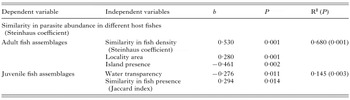
Table 5. Results of multiple regression analyses on distance matrices to explain the effect of variables related to abiotic character of localities and similarity in host fish assemblages on the similarity in P. cuticola abundance (similarity expressed by Steinhaus coefficient) in adult and juvenile fishes

Table 6. Results of multiple regression analyses on distance matrices to determine the effect of total Posthodilplostomum cuticola infection and abiotic factors on the definitive host visitation time (time spent by definitive hosts in the localities) and number of definitive bird species (potential hosts for P. cuticola)
 You have
Access
- 36
- Cited by