Ventilator-associated pneumonia (VAP) is one of the most common healthcare-associated infections in pediatric and adult intensive care unit (ICU) patients and has been associated with increased morbidity, length of stay, and broad-spectrum antibiotic usage.Reference Foglia, Meier and Elward 1 – 3 However, a definitive diagnosis of VAP remains controversial. 3
For surveillance purposes, the traditional Centers for Disease Control and Prevention (CDC) algorithm for clinically defined pneumonia in mechanically ventilated children (PNEU-VAP) has been widely acceptable and used in pediatric patient populations (pediatric PNEU-VAP). However, this traditional algorithm has significant difficulties, including reliance on subjective clinical signs and symptoms. 3 For this reason, a new surveillance module for the diagnosis of ventilator-associated events (VAE) including VAP (VAE-VAP) has been developed by CDC but is currently used only in adult ICUs (adult CDC VAE-VAP).Reference Magill, Klompas and Balk 4
The aim of this study was to evaluate the new adult CDC VAE-VAP module and criteria for VAE in critically ill children and compare it with the traditionally used pediatric CDC PNEU-VAP definition.
METHODS
This study was conducted in a multidisciplinary 8-bed pediatric ICU (PICU) located in a tertiary care general hospital. Both medical and surgical pediatric patients, including hematology/oncology as well as liver and kidney transplant patients, are admitted.
In 2013, after the implementation (National Healthcare Safety Network) of the new CDC approach for VAP surveillance in adult patients, we conducted this retrospective study in a cohort of patients hospitalized in the period January 1-December 31, 2011, in our PICU. Patients from this cohort were previously enrolled in a step-wise assessment for the traditional CDC PNEU-VAP criteria using a group of investigators, including 2 independent assessors of the radiological criteria.Reference Iosifidis, Stabouli and Tsolaki 5 In this study we used adult VAE module criteria published by CDC in 2013. 6
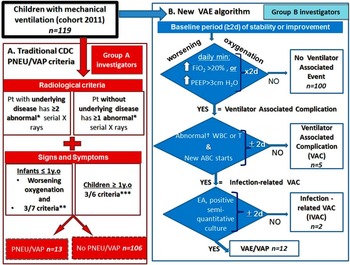
In detail, this module includes 3 definition tiers: ventilator-associated condition (VAC), infection-related VAC (IVAC), and possible/probable VAP (VAE-VAP). We applied the proposed diagnostic algorithm for these 3 tiers in ventilated children as depicted in Figure 1.
Application of 2 diagnostic algorithms of ventilator-associated pneumonia (VAP) in ventilated children: All patients’ medical records were assessed independently by 2 different groups of investigators (groups A and B) who applied (A) the traditional Centers for Disease Control and Prevention (CDC) Pneumonia-VAP protocol for clinically defined pneumonia in mechanically ventilated patients (PNEU-VAP), where PNEU-VAP is identified using imaging as well as clinical and laboratory criteria for children (adapted from reference 3), (B) the new ventilator-associated event (VAE) algorithm with 3 definition tiers, including ventilator-associated complication (VAC), infection-related VAC (IVAC), and VAE–VAP. ABC, antimicrobial agent; EA, endotracheal aspirate (semiquantitative culture corresponding to >105 colony-forming units/mL); FiO2, fraction of inspired oxygen; PEEP, positive end-expiratory pressure; WBC, white blood cells. * New or progressive and persistent infiltrate, consolidation, cavitation, pneumatoceles in <1 year of age. ** 3 of the following 7 criteria: (1) temperature instability, (2) leukopenia (<4,000 WBC/mm3) or leukocytosis (≥15,000 WBC/mm3) and left shift (≥10% band forms), (3) new onset of purulent sputum, or change in character of sputum, or increased respiratory secretions, or increased suctioning requirements, (4) apnea, tachypnea, nasal flaring with retraction of chest wall or grunting, (5) wheezing, rales, or rhonchi, (6) cough, (7) bradycardia (<100 beats/min) or tachycardia (>170 beats/min). *** 3 of the following 6 criteria: (1) fever (>38.4°C) or hypothermia (<36.5°C), (2) leukopenia (<4,000 WBC/mm3) or leukocytosis (≥15,000 WBC/mm3, (3) new onset of purulent sputum, or change in character of sputum, or increased respiratory secretions, or increased suctioning requirements, (4) new onset of worsening cough or dyspnea, apnea, or tachypnea, (5) rales, or bronchial breath sounds, (6) worsening gas exchange (eg, O2 desaturation, eg, pulse oximetry <94%, increased requirements for oxygen, or increased ventilation demand). † Abnormal WBC: ≥12,000 cells/mm3 or ≤4,000 cells/mm3, temperature >38°C or <36°C.

Results of this new CDC algorithm were compared with traditional CDC criteria for clinically defined pneumonia in mechanically ventilated children (PNEU-VAP), which require radiographic findings in addition to clinical and laboratory evidence of pneumonia. As mentioned before, this approach for the diagnosis of VAP according to the traditional CDC criteria in our 2011 cohort has been recently published and is depicted in summary in Figure 1.Reference Iosifidis, Stabouli and Tsolaki 5
All patients were independently assessed for these 2 (PNEU-VAP and VAE-VAP) CDC algorithms by 2 different groups of investigators. In detail, a total of 4 investigators (group A investigators) were involved for the assessment of PNEU-VAP in all pediatric patients. All investigators were educated according to CDC PNEU definitions. In 2013, a second group of investigators (group B investigators, including 2 different intensivists who were not group A members) was educated by infection control physicians. Final results of both PNEU-VAP and VAE-VAP were compared and analyzed by infectious disease specialists.
The following characteristics of mechanically ventilated children were recorded: Pediatric Risk of Mortality score at admission (PRISM III), number of ventilator-days, and outcome.
Prevalence and incidence of VAE-VAP and PNEU-VAP were calculated by dividing the number of defined VAE-VAP and PNEU-VAP episodes by the number of total ventilator-days. Agreement between the 2 different algorithms was calculated using the kappa score. The t test or Mann-Whitney test was used for comparison of continuous variables, whereas the Fisher exact test was used for statistical significance of categorical variables. Statistical analyses were performed with SPSS, version 17.0 (IBM), and P<.05 was considered statistically significant.
The Hippokration Hospital Ethics Committee approved the study. No informed consent was required to be signed by the parents because it was a retrospective study.
RESULTS
A total of 127 children were included in this analysis (median [range] PRISM III score, 8 [8–35]), of whom almost all (119) received mechanical ventilation (median [range], 7 [1–183] ventilator-days). Among 119 children on mechanical ventilation, 53% were boys, 62% had medical conditions, and 38% had surgical underlying diseases. The median (range) age was 30 (2–204) months. Two children had been premature infants; one of these had chronic lung disease.
According to the new CDC VAE module, 19 patients (16%) were classified as having VAC, 14 (12%) IVAC, and 12 (10%) possible/probable VAE-VAP. Neither of the 2 children who had been premature infants developed VAC. The incidence of VAC was 11.2 episodes per 1,000 ventilator-days.
Patients diagnosed as having an episode of VAC spent longer time on mechanical ventilation than patients without VAC (median, 16.5 days vs 5 days, P=.0006) despite the fact that both groups had similar PRISM III scores (9 vs 8, P>.05). Overall ICU mortality of children with VAC did not differ from that of children without VAC (6/19 vs 15/100, P=.1).
Children who received a diagnosis of IVAC were on mechanical ventilation for a longer time than children without IVAC (16.5 vs 5 days, P=.011). These children with IVAC had a PRISM III score similar to those without IVAC (9 vs 8) but had higher risk for death (6/14 vs 15/105, P=.012).
Further, children who received a diagnosis of VAE-VAP according to the new adult definition had more days on mechanical ventilation (18 vs 5 days, P<.0001) than patients without the VAE-VAP. The median PRISM III score was similar in both groups (9 and 8, respectively), but ICU mortality was higher in patients with VAE-VAP, 50% (6/12), than in patients without VAE-VAP, 14% (15 /107) (P=.007).
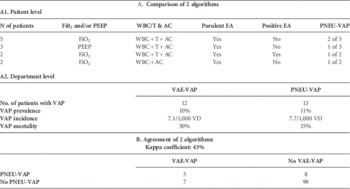
According to traditional pediatric CDC criteria during the same period, 18 (15%) of 119 children fulfilled radiological criteria and 13 of them (11%) were classified as PNEU-VAP (8 of them had positive tracheal aspirate cultures).Reference Iosifidis, Stabouli and Tsolaki 5 Only 5 patients were classified by both algorithms to have VAP (Table 1). Actually, VAE-VAP definition was fulfilled in 5 (38%) of 13 patients with PNEU-VAP. Agreement between the 2 CDC sets of criteria was moderate (kappa coefficient, 43%, Table 1). Of note, 3 of 8 patients with PNEU-VAP but not VAE-VAP were allocated as having VAC (2 with IVAC). This means that 8 (62%) of 13 patients with PNEU-VAP were captured in the new definition as VACs. Mortality of patients with PNEU-VAP (15%) did not differ from that of patients without PNEU-VAP.
Comparison at Patient Level (Plan A1) and Department Level (Plan A2), and Agreement (Panel B) Between the Traditional (PNEU-VAP) and New (VAE-VAP) Algorithm

NOTE. AC, antimicrobial change (antimicrobial is started and continued for >4 days); EA, endotracheal aspirate (semiquantitative culture corresponding to >105 colony-forming units/mL); FiO2, fraction of inspired oxygen; PEEP, positive end-expiratory pressure; PNEU-VAP, traditional Centers for Disease Control and Prevention algorithm for clinically defined pneumonia in mechanically ventilated children; Purulent EA, >25 neutrophils and <10 squamous epithelial cells per low-power field (×100); T, temperature >38°C or <36°C; VAE, ventilator-associated event; VAP, ventilator-associated pneumonia; VD, ventilation-days; WBC, white blood cell count (≥12,000 cells/mm3 or ≤4,000 cells/mm3).
DISCUSSION
This is the first study that compares the new adult CDC criteria for the diagnosis of VAC in children with traditional pediatric CDC criteria for VAP in terms of morbidity and mortality in critically ill children with mechanical ventilation. We found that almost two-thirds of VACs in this setting were included in the new definition for VAE-VAP. Children with either VAC or VAE-VAP with the new definition had significantly more days on ventilation than patients without these conditions, whereas PRISM III score was not different between them. Mortality was significant higher in patients with the new VAE-VAP definition than patients without this condition. In contrast, in patients with or without VAC there was no significant difference in mortality. Although the incidence of PNEU-VAP and VAE-VAP were similar, the agreement between these 2 definitions was poor.
In this study, for the first time we used the new definition of the adult CDC VAE-VAP module and applied it to all mechanically ventilated critically ill children. The only published study that has used the same method of the new adult CDC VAE-VAP module in children was targeted only to a very specific pediatric population—that is, patients with already positive sputum cultures.Reference Taylor, Noronha, Wichman and Varman 7 However, both the PNEU-VAP and the new VAC tier do not require a positive sputum culture in their definition. Thus, the agreement of the 2 definitions cannot be generalized to all mechanically ventilated patients (including those without positive sputum cultures). In most adult patients, these 2 different definitions have been compared in all mechanically ventilated patients.Reference Klein Klouwenberg, van Mourik and Ong 8 – Reference Damas, Frippiat and Ancion 12 However, one of these adult studies targeted only those patients who were ventilated for more than 5 days before the VAP and compared these 2 VAP definitions.Reference Bouadma, Sonneville and Garrouste-Orgeas 13
In this study the incidence of VAC was higher than that observed in a recently published pediatric study.Reference Cocoros, Kleinman and Priebe 14 This study tested 12 alternative definitions for the VAC tier and applied it in children from pediatric, cardiac, and neonatal ICUs of 5 US hospitals. For the definition of oxygen worsening, they used a range of different minimum daily fraction of inspired oxygen (FIO2) and they replaced positive end-expiratory pressure with mean airway pressure (MAP). For the proposed pediatric VAC tier (FIO2 0.25/MAP 4 definition [ie, increase in minimum daily FIO2 by 0.25 or MAP by 4]), they found rates ranging from 2.9 to 3.2 per 1,000 ventilator-days depending on ICU type. In adult studies, the incidence of VAC ranges between 3.6 and 10 episodes per 1,000 ventilator-days, respectively.Reference Klein Klouwenberg, van Mourik and Ong 8 , Reference Boyer, Schoenberg, Babcock, McMullen, Micek and Kollef 9 Moreover, in adult studies as much as 50% of VAC episodes met the criteria for the new VAE-VAP definition.Reference Boyer, Schoenberg, Babcock, McMullen, Micek and Kollef 9 , Reference Muscedere, Sinuff and Heyland 10 In our study this percentage was higher: 63% of VAC episodes were allocated as new VAE-VAP. Differences in incidence and prevalence of VACs among the aforementioned studies may represent differences in algorithm adaptation or targeted populations.
Children with either VAC or VAE-VAP had significantly more days in ventilation than patients without these conditions. This is in line with most adult studies that have used the new definition as well as one of the pediatric studies, which found that VAC and/or VAE-VAP were correlated to significant longer duration of patients in mechanical ventilation and hospitalization.Reference Muscedere, Sinuff and Heyland 10 , Reference Bouadma, Sonneville and Garrouste-Orgeas 13 – Reference Stoeppel, Eriksson and Diaz-Flores 15
In terms of mortality, we found that patients with the new VAE-VAP definition but not those with VAC had a significant excess of death. Cocoros et alReference Cocoros, Kleinman and Priebe 14 found that VAC both in neonates and children was correlated with poor outcome. In addition, in most adults’ studies conducted in Europe and North America, VACs and IVACs were correlated to poor outcome.Reference Klein Klouwenberg, van Mourik and Ong 8 , Reference Muscedere, Sinuff and Heyland 10 , Reference Damas, Frippiat and Ancion 12 , Reference Bouadma, Sonneville and Garrouste-Orgeas 13 , Reference Prospero, Illuminati and Marigliano 16 In a retrospective study conducted in adult patients in Australia, there was no correlation between VACs and ICU mortality.Reference Hayashi, Morisawa and Klompas 17 However, this study used a lower threshold for oxygen deterioration than CDC criteria.Reference Hayashi, Morisawa and Klompas 17
We found that the agreement between the 2 VAP algorithms (traditional or PNEU-VAP and new or VAE-VAP) was poor in our patients. This is in agreement almost with all studies that have compared these 2 modules in adults.Reference Klein Klouwenberg, van Mourik and Ong 8 – Reference Muscedere, Sinuff and Heyland 10 , Reference Hayashi, Morisawa and Klompas 17 The only published pediatric study that compared the 2 VAP approaches found the same number of patients with both approaches.Reference Taylor, Noronha, Wichman and Varman 7 However, they found low agreement between these approaches in critically ill children with positive sputum aspirates (60% of patients with traditional VAP fulfilled criteria for the new VAP definition).
Of note, patients with traditional pediatric PNEU-VAP in our study did not have excess risk for death; whereas, children with the new adult VAE-VAP definition had. In most pediatric studies where the traditional PNEU-VAP definition was used, the true attributable mortality (if any) to this definition could not be assessed.Reference Foglia, Meier and Elward 1 This may have impact on prevention strategies.Reference Klompas 18 KlompasReference Klompas 18 has emphasized that preventive studies for traditional PNEU-VAP have resulted in reduced incidence rates but without impact on patient outcomes. This is in line with the results of a recent randomized clinical trial in which subglottic secretion suctioning reduced traditional PNEU-VAP rates and antibiotic consumption but not mortality.Reference Damas, Frippiat and Ancion 12
Our results are derived from a single center with a small number of patients and this is a limitation of this study. However, there is a paucity of data regarding the application of adult VAE-VAP criteria in pediatric patients and the conclusions are in line with adult data. Another limitation of our study is the relevant high VAP rates found in this PICU. A significant variability in prevalence and incidence of VAP has been documented around the world and may represent the problems of VAP diagnosis and the lack of a gold standard. Our VAP rates are much higher than VAP rates in US PICUs (0.7 episodes/1,000 VD)Reference Dudeck, Edwards and Allen-Bridson 19 but more relevant to those reported outside the US PICUs (pooled mean, 6.5 [95% CI, 5.9–7.1] episodes/1,000 ventilator-days).Reference Rosenthal, Bijie and Maki 20 However, audits of actions to prevent VAP have been initiated since 2011 (mainly hand hygiene, patients’ semirecumbent position, and oral care).
In conclusion, this is the first study utilizing the new adult CDC VAE-VAP module and criteria in children. Although both CDC criteria for VAP surveillance found similar prevalence, a significant discordance exists between them. In this study mortality was associated with VAE-VAP but not with PNEU-VAP. Therefore, there is a need for a better definition of VAP in children as well as implementation of prevention bundles for the prevention of VAP.
ACKNOWLEDGMENTS
The dedication of the personnel of the PICU for the care of the patients studied is highly acknowledged.
Financial support. 2011–2013 European Society for Pediatric Infectious Diseases fellowship (to E.Ι.).
Potential conflicts of interest. All authors report no conflicts of interest relevant to this article.