INTRODUCTION
Systematic recording of stranded cetaceans offers a cost-effective and efficient method of collecting data on the patterns of occurrence (Siebert et al., Reference Siebert, Gilles, Lucke, Ludwig, Benke, Kock and Scheidat2006; Canning et al., Reference Canning, Begoña Santos, Reid, Evans, Sabin, Bailey and Pierce2008), population structure (Mirimin et al., Reference Mirimin, Westgate, Rogan, Rosel, Read, Coughlan and Cross2009), distribution (Mitchell, Reference Mitchell1968; Norman et al., Reference Norman, Bowlby, Brancato, Calambokidis, Duffield, Gearin, Gornall, Gosho, Hanson, Hodder, Jeffries, Lagerquist, Lambourn, Mate, Norberg, Osborne, Rash, Riemer and Scordino2004), species diversity (Pyenson, Reference Pyenson2011), anthropogenic threats (Panigada et al., Reference Panigada, Pesante, Zanardelli, Capoulade, Gannier and Weinrich2006; D'Amico et al., Reference D'Amico, Gisiner, Ketten, Hammock, Johnson, Tyack and Mead2009; Jepson et al., Reference Jepson, Deaville, Acevedo-Whitehouse, Barnett, Brownlow, Brownell, Clare, Davison, Law, Loveridge, Macgregor, Morris, Murphy, Penrose, Perkins, Pinn, Seibel, Siebert, Sierra, Simpson, Tasker, Tregenza, Cunningham and Fernández2013; Allen et al., Reference Allen, Tyne, Kobryn, Bejder, Pollock and Loneragan2014), disease prevalence (Greig et al., Reference Greig, Gulland and Kreuder2005; Davison et al., Reference Davison, Brownlow, McGovern, Dagleish, Perrett, Dale, Koylass and Foster2015), life history (Rogan et al., Reference Rogan, Baker, Jepson, Berrow and Kiely1997; Westgate & Read, Reference Westgate and Read2007) and diet (Canning et al., Reference Canning, Begoña Santos, Reid, Evans, Sabin, Bailey and Pierce2008; Begońa Santos et al., Reference Begońa Santos, Monteiro, Vingada, Ferreira, López, Cedeira, Reid, Brownlow and Pierse2014). For many rarely sighted species (e.g. Ziphiids), stranded individuals represent the primary source of information on all aspects of their ecology (Dalebout et al., Reference Dalebout, Mead, Baker, Baker and van Helden2002; Constantine et al., Reference Constantine, Carroll, Stewart, Neale and Van Helden2014).
A stranding event can refer to single or multiple animals that may be alive or dead when they make landfall. The most frequently recorded stranding events worldwide are single dead individuals (Norman et al., Reference Norman, Bowlby, Brancato, Calambokidis, Duffield, Gearin, Gornall, Gosho, Hanson, Hodder, Jeffries, Lagerquist, Lambourn, Mate, Norberg, Osborne, Rash, Riemer and Scordino2004) and the cause of death is generally thought to be a result of natural occurrences such as disease, illness, parasitism or injury (Brabyn & McLean, Reference Brabyn and McLean1992; Mazzuca et al., Reference Mazzuca, Atkinson, Keating and Nitta1999). Anthropogenic causes do account for a certain number of single strandings and in some instances can be the primary cause of death, for example, minke whales (Balaenoptera acutorostrata) in Scotland (Northridge et al., Reference Northridge, Cargill, Coram, Mandleberg, Calderan and Reid2010) and common dolphins (Delphinus delphis) in Cornwall (Leeney et al., Reference Leeney, Amies, Broderick, Witt, Loveridge, Doyle and Godley2008). A live stranding event (LSE) occurs when an animal is found alive on the shore or when post-mortem examination determined the animal(s) to have stranded alive. A mass stranding event (MSE) occurs when two, or more, individuals of the same species, that are not mother and calf, are found, dead or alive, while coinciding both spatially and temporally (Rogan et al., Reference Rogan, Baker, Jepson, Berrow and Kiely1997; Geraci & Lounsbury, Reference Geraci and Lounsbury2005). A MSE generally consists of pelagic, odontocete species and can range from two to hundreds of individuals (Mazzuca et al., Reference Mazzuca, Atkinson, Keating and Nitta1999). These events generate huge interest from both scientists and the general public. The cause of MSEs are poorly understood; several suggestions as to why they might occur naturally include: navigational errors due to geomagnetic anomalies (Klinowska, Reference Klinowska1985; Walker et al., Reference Walker, Kirschvink, Ahmed and Diction1992; Brabyn & Frew, Reference Brabyn and Frew1994), large-scale climate and oceanographic variation (Mignucci-Giannoni et al., Reference Mignucci-Giannoni, Toyos-González, Pérez-Padilla, Rodríguez-López and Overing2000; Evans et al., Reference Evans, Thresher, Warneke, Bradshaw, Pook, Thiele and Hindell2005; Bradshaw et al., Reference Bradshaw, Evans and Hindell2006) and as a consequence of tight social bonds (Connor, Reference Connor, Mann, Connor, Tyack and Whitehead2000), or a combination of the above. Several anthropogenic effects have also been linked with MSEs, including fisheries interactions (Kinas, Reference Kinas2002; Leeney et al., Reference Leeney, Amies, Broderick, Witt, Loveridge, Doyle and Godley2008; Allen et al., Reference Allen, Tyne, Kobryn, Bejder, Pollock and Loneragan2014), naval exercises (Parsons et al., Reference Parsons, Dolman, Wright, Rose and Burns2008; D'Amico et al., Reference D'Amico, Gisiner, Ketten, Hammock, Johnson, Tyack and Mead2009; Jepson et al., Reference Jepson, Deaville, Acevedo-Whitehouse, Barnett, Brownlow, Brownell, Clare, Davison, Law, Loveridge, Macgregor, Morris, Murphy, Penrose, Perkins, Pinn, Seibel, Siebert, Sierra, Simpson, Tasker, Tregenza, Cunningham and Fernández2013) and seismic surveys (Simmonds & Mayer, Reference Simmonds and Mayer1997). Geographic locations where clusters of strandings have occurred have been documented in New Zealand, (Brabyn, Reference Brabyn1991; Brabyn & McLean, Reference Brabyn and McLean1992), Australia (Bradshaw et al., Reference Bradshaw, Evans and Hindell2006) and Hawaii (Mazzuca et al., Reference Mazzuca, Atkinson, Keating and Nitta1999). These areas are often referred to as stranding hotspots; where two or more MSEs or three or more single strandings have occurred (Brabyn, Reference Brabyn1991). It is thought that some of these areas may contain oceanographic features that are indirectly influencing strandings patterns (Bradshaw et al., Reference Bradshaw, Evans and Hindell2006), such as discontinuities in the geomagnetic fields, bathymetric topography or unusual current patterns (Brabyn & McLean, Reference Brabyn and McLean1992; Walker et al., Reference Walker, Kirschvink, Ahmed and Diction1992; Brabyn & Frew, Reference Brabyn and Frew1994; Bradshaw et al., Reference Bradshaw, Evans and Hindell2006).
Irish waters are some of the most important for cetaceans in Europe, with 24 species recorded to date (Reid et al., Reference Reid, Evans and Northridge2003; O'Brien et al., Reference O'Brien, Berrow, Ryan, McGrath, O'Connor, Pesante, Burrows, Massett, Klötzer and Whooley2009; Wall et al., Reference Wall, Murray, O'Brien, Kavanagh, Wilson, Ryan, Glanville, Williams, Enlander, O'Connor, McGrath, Whooley and Berrow2013). All species, and their resting and breeding sites, are protected by national legislation (Wildlife Act 1976, Amended 2000). Under the EU Habitats Directive, Ireland is obliged to protect all cetacean species and their habitats within the Exclusive Economic Zone, which extends up to 200 nautical miles offshore. Further to this legislation there is a requirement to undergo surveillance to ensure that all cetacean populations are maintained at a ‘favourable conservation status’ as outlined in the conservation measures and management plans (EC, 2002). One of the more financially viable approaches for obtaining data on cetacean populations is to record information from stranded animals. Strandings have been recorded in Ireland since 1753, though there are historical records that date as far back as 652 AD (Fairley, Reference Fairley1981), which makes the Irish strandings database one of the most temporally comprehensive cetacean datasets in existence (Pierce et al., Reference Pierce, Santos, Smeenk, Saveliev and Zuur2007). Historically, records up to 1976 were collected as part of the British and Irish Whale Stranding Scheme coordinated by the Natural History Museum in London. Since the 1970s, records were published in the Irish Naturalists' Journal, but these were collected on an ad hoc basis and not recorded systematically. The most recent review of cetacean strandings in Ireland was carried out by Berrow & Rogan (Reference Berrow and Rogan1997) and covered the period from 1901–1995; however, inconsistencies with reporting effort during this time frame meant that records were only useful for identifying unusual stranding events and not for trend analysis. Since 1991, the Irish Whale and Dolphin Group (IWDG) have collected data on cetacean strandings and established a publicly accessible strandings database. The recording scheme has been further developed since 2002 under an initiative called the Irish Scheme for Cetacean Observation and Public Education (ISCOPE) in an attempt to raise public interest in biological recording and to improve coverage (Berrow et al., Reference Berrow, Whooley, O'Connell and Wall2010). The recording scheme is a good example of ‘citizen science’ with most records being collected by amateur recorders and the public, with the IWDG ensuring each record is validated, thus providing a measure of quality control.
The present study aims to identify whether or not, and to what extent, temporal and spatial trends in cetacean strandings occur in Ireland and if any locations should be considered as stranding hotspots. Broadly, this will contribute to our knowledge on patterns in cetacean strandings obtained from long-term datasets, whilst more locally, it will provide a better understanding of cetacean populations and their ecology within Ireland. The study will also provide information that can assist Ireland in fulfilling its legal requirements under the Habitats Directive.
METHODS
All records from 2002–2014 from the Republic and Northern Ireland in the IWDG strandings database were examined, prior to analysis. The data prior to 2002 was omitted in order to minimize any bias in reporting effort due to increased promotion of the strandings network under the ISCOPE initiative. The data, collated by the IWDG, consists of public records which were submitted via the website (www.iwdg.ie) and were published in the Irish Naturalists' Journal (O'Connell & Berrow, Reference O'Connell and Berrow2008, Reference O'Connell and Berrow2009, Reference O'Connell and Berrow2010, Reference O'Connell and Berrow2013, Reference O'Connell and Berrow2014a, Reference O'Connell and Berrowb, Reference O'Connell and Berrow2015). Where possible, each stranding record consists of date of stranding, date of recording, location, species, gender, length, body condition and the name of the recorder. Most (~80%) of the records were submitted online or via email and ~90% of these had accompanying images, which assisted in verifying species’ identity and gender. The IWDG have a network of people around the coast who are available to visit stranded animals and ensure relevant data are collected; between 2002 and 2014 ~60% of reported strandings were visited by members of the IWDG network. These data are then subject to verification and the record is then confirmed by the IWDG prior to being uploaded onto the online database. Unless stated otherwise, ‘strandings’ refers to an event and does not take into account the number of individual animals stranded.
Statistical analysis
Seasonal and annual trends were investigated using counts for all strandings identified to species-level and for the five most frequently reported species: common dolphin, harbour porpoise (Phocoena phocoena), long-finned pilot whale (Globicephala melas), striped dolphin (Stenella coeruleoalba) and bottlenose dolphin (Tursiops truncatus). Chi-squared tests were used to determine whether or not the temporal distribution of strandings differed significantly from an even spread between each year and each month. For each of the five most frequently reported species the number of strandings as a proportion of the total of all strandings identified to species-level was calculated; a Pearson's correlation statistic was used to determine if there was a significant linear increase in strandings over the 13 years. Chi-squared tests were also used to determine if there were any significant differences in the sex ratio of all species, whilst additional analysis on the seasonal difference and the mean body length of sexes were investigated, using a Kruskal–Wallis test, for the two most commonly reported species (common dolphin and harbour porpoise). Only single strandings were used for the sex ratio analysis as not all individuals involved in a MSE were sexed. Data on body length was only used from those carcasses from which exact measurements were submitted, any estimated lengths were omitted from the analysis. The spatial distribution of all strandings identified to species-level, the five most frequently reported species and LSEs and MSEs were investigated. Initial screening highlighted 18 entries from the 1772 in the database that did not have accurate coordinates; however, detailed addresses were available so rather than eliminating these points from the dataset, the closest points on the coast from these were used to plot these data. Two entries were deleted due to inaccurate information provided.
To identify stranding hotspots, the ‘hotspot analysis’ tool in ArcGIS v. 10.2 was used. This tool calculates the Getis-Ord Gi* statistic for the features in a dataset producing a Z score which explains where features with high or low values cluster. It then calculates whether the cluster is significantly high or low by calculating the proportion the cluster represents within the sum of all features, giving statistically significant (P = 0.05) ‘hot’ and ‘cold’ spots. Areas that are identified as focused hotspots can then be interpreted as stranding hotspots. All statistical analysis was conducted using R version 3.1.1 (R Core Team, 2015).
RESULTS
Trends in stranding records
Overview of all species
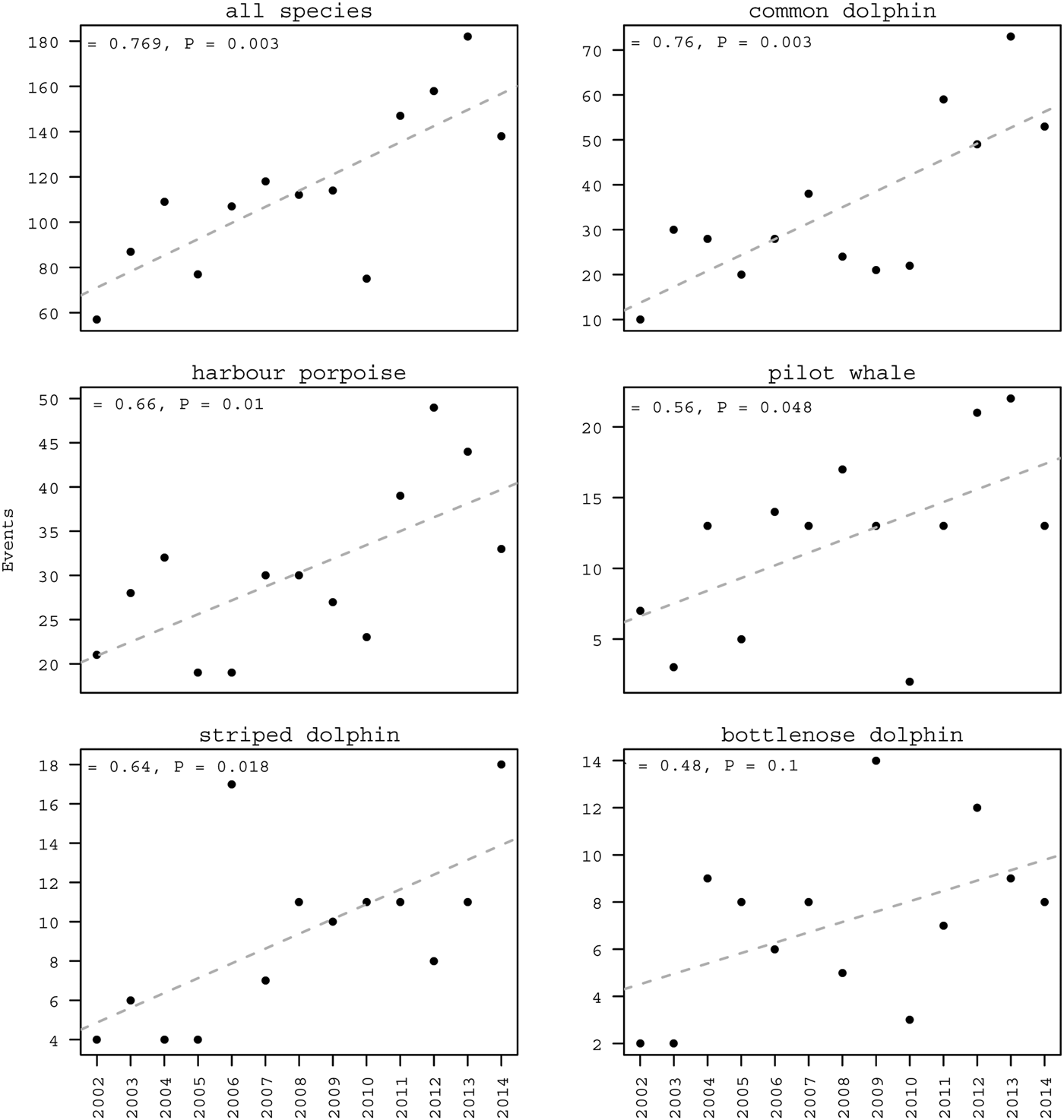
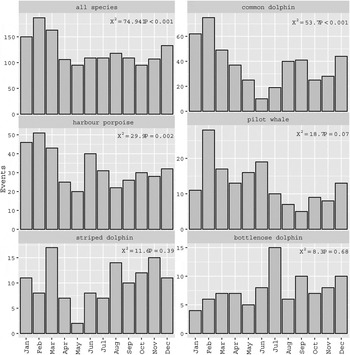
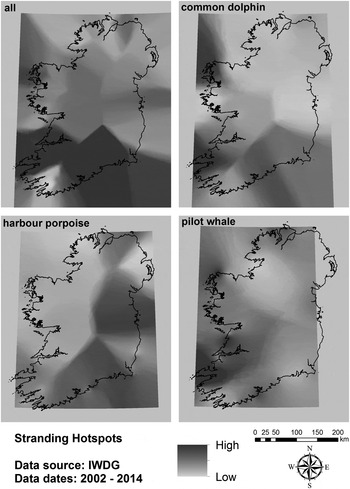
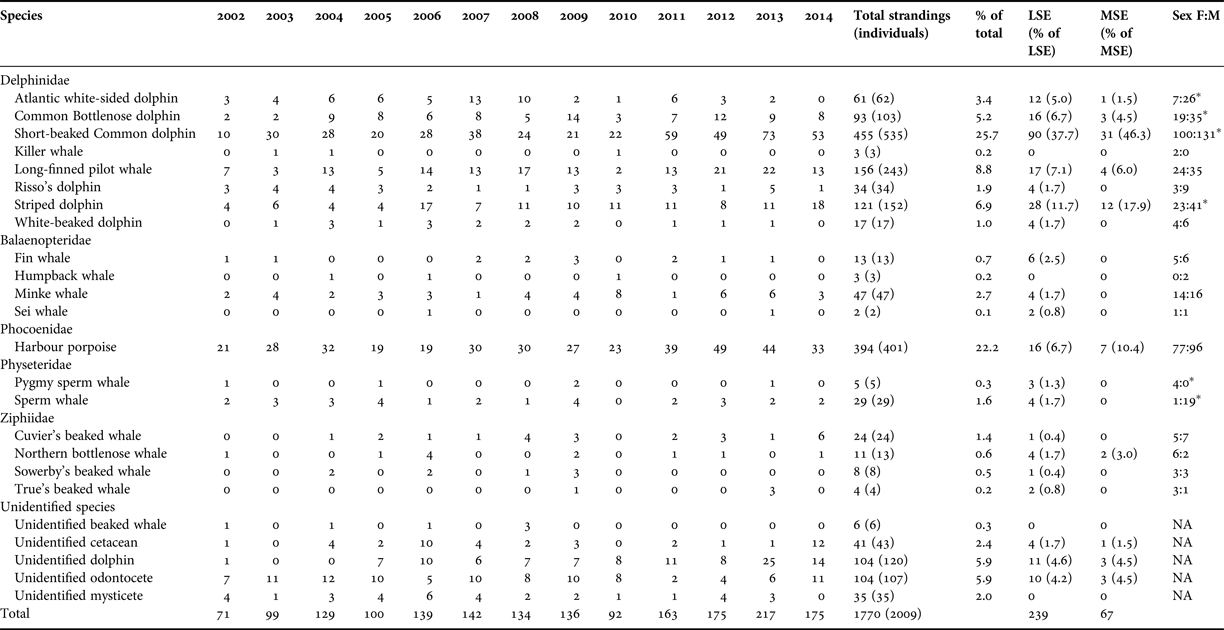
After omitting inaccurate records, a total of 1770 cetacean strandings occurred on the Irish coast between 2002 and 2014, consisting of 2009 individual animals (Table 1). A total of 1481 strandings were identified to species-level, leaving 291 (16.4%) unidentified species. Only strandings identified to species-level were included in the analysis. A total of 19 cetacean species were recorded, with common dolphin the most frequently stranded species (25.7%) followed closely by harbour porpoise (22.2%). The addition of long-finned pilot whale (8.8%), striped dolphin (6.9%) and bottlenose dolphin (5.2%) made up the five most frequently reported species (68.8% of the total). The minke whale (2.7%) was the most frequently reported mysticete species. Of the 20 cetacean species reported to the IWDG through their sightings and strandings networks during this period, the pygmy sperm whale (Kogia breviceps) (N = 5) was the only species reported through the strandings network that has never been observed in Irish waters. The annual pattern for all strandings differed significantly from an even spread between years (χ2 = 133.31, d.f. = 12, P < 0.001), with the number of records highest in 2013 (N = 217) and lowest in 2002 (N = 71) (Table 1). There was a significant increasing linear trend in the annual number of strandings records (r = 0.769, P = 0.003) (Figure 1). The monthly strandings pattern differed significantly from an even spread between months (χ2 = 74.941, d.f. = 11, P < 0.001), with a peak in strandings during the beginning of the year (Figure 2), however this was heavily influenced by the two most frequently reported species, common dolphin and harbour porpoise (Figure 3). Strandings occurred on all coasts but the majority were concentrated in the western and southern regions, which coincided with the locations where the four most commonly reported species stranded (Figure 4).
A regression line showing the relationship between the annual numbers of stranding events for all strandings identified to species-level, collectively and for the five most commonly reported species. The Pearson's correlation statistic and level of significance are presented for each plot.

The number of stranding events by month for all strandings identified to species-level, collectively and for the five most commonly reported species. The results of the Chi squared tests are presented for each plot.

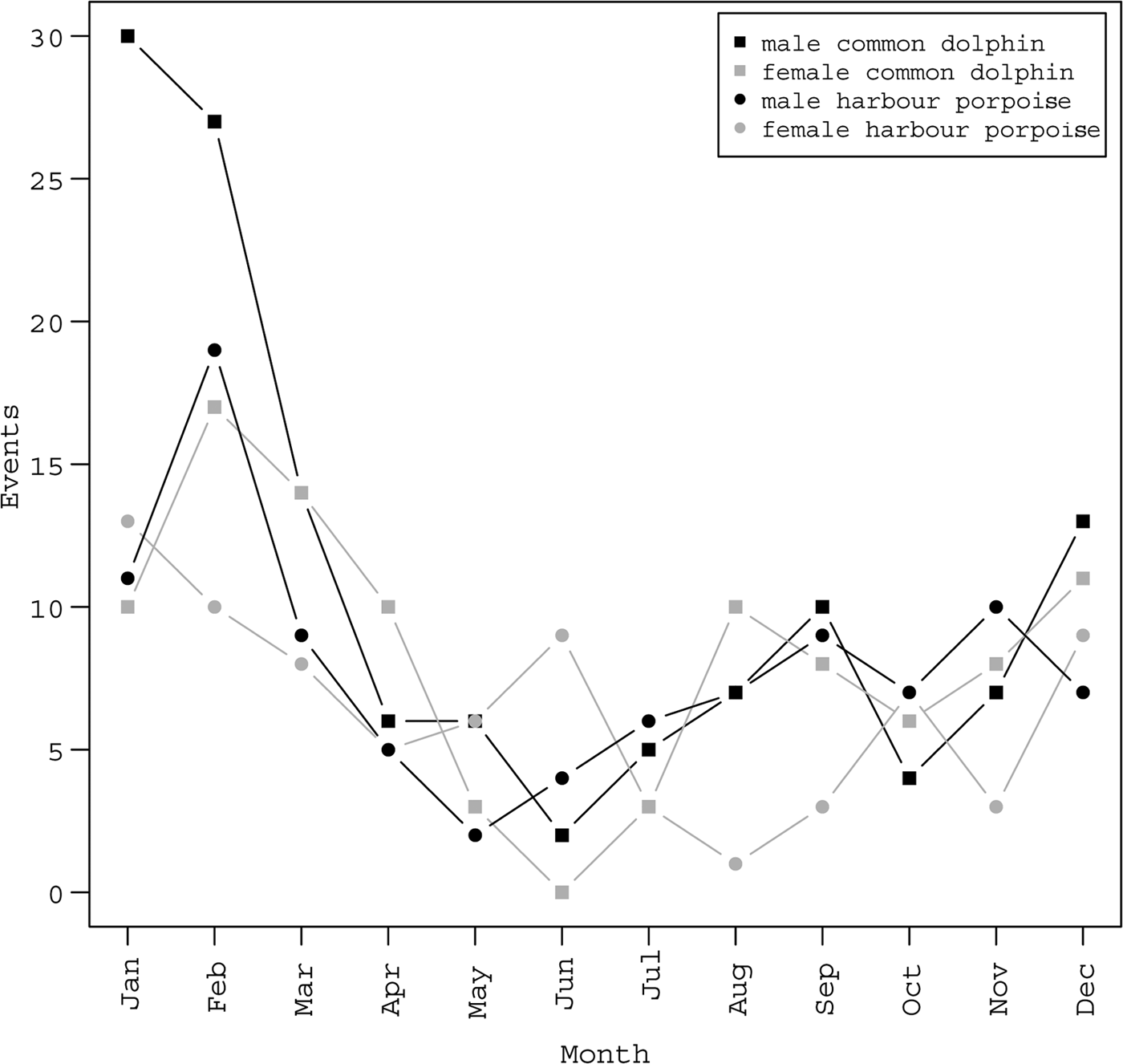
Monthly sex differences for stranded common dolphin and harbour porpoise, only single individual stranding events were included.

Stranding hotspot analysis maps of all stranding events identified to species-level collectively and for common dolphin, harbour porpoise and pilot whale.

Annual stranding events by species on the Irish coast from 2002–2014. Includes information on the number of live strandings (LSE) and mass stranding (MSE) events. Includes sex ratio of the identified species; this ratio excludes individuals where the sex was not confirmed; significant differences are highlighted (*).

Common dolphin
There were 455 common dolphin strandings. The annual pattern in strandings differed significantly from an even spread between years (χ2 = 114.5, d.f. = 12, P < 0.001), with the number of records highest in 2013 (N = 73) and lowest in 2002 (N = 10) (Table 1). There was a significant increasing linear trend in the annual stranding counts (r = 0.76, d.f. = 11, P = 0.003) (Figure 1). A significant increasing trend was also noted in the annual proportion of common dolphin strandings relative to all strandings (r = 0.58, d.f. = 11, P = 0.03). The number of strandings differed significantly from an even spread between months (χ2 = 53.7, d.f. = 11, P < 0.001), with more reports in the early months of the year, and fewer strandings reported during the summer months (Figure 2). Significantly more males stranded than females (χ2 = 4.16, d.f. = 1, P = 0.041) (Table 1), especially in January (χ2 = 10.0, d.f. = 1, P = 0.002) (Figure 3), but there was no significant difference in any other month. The mean length of carcasses was at its lowest in May (1.69 ± 0.3 m) and at its greatest in June (1.97 ± 0.2 m); however, there was no significant difference between months (H = 11.65, d.f. = 11, P = 0.391). Strandings were recorded in highest densities on the western and southern coasts with two areas, the Mullet Peninsula in Co. Mayo (~54°10′58″N 10°04′39″W) and the Dingle Peninsula in Co. Kerry (~52°12′11″N 10°00′47″W), considered hotspots (Figure 4).
Harbour porpoise
There were 394 harbour porpoise stranding records. Reports were highest in 2012 (N = 49) and lowest in 2005 and 2006 (N = 19) (Table 1). The annual pattern in strandings differed significantly from an even spread between years (χ2 = 34.1, d.f. = 12, P < 0.001). There was a significant increasing linear trend in the annual stranding counts (r = 0.66, d.f. = 11, P = 0.01) (Figure 1) but there was no apparent trend in the proportion of strandings reported, relative to all strandings (r = − 0.36, d.f. = 11, P = 0.227). The monthly pattern in strandings differed significantly from an even spread between months (χ2 = 29.9, d.f. = 11, P = 0.002), with strandings peaking early in the year in January, February and March with a second smaller peak in June (Figure 2). There was no overall difference in the sex ratio of stranded harbour porpoises (χ2 = 2.09, d.f. = 1, P = 0.149) (Table 1), and this was consistent when considering sex ratio patterns within each month (Figure 3). The mean body length of measured carcasses was at its lowest in June (1.15 ± 0.4 m) and at its greatest in December (1.44 ± 0.2 m); however, there was no significant difference between months (H = 15.575, d.f. = 11, P = 0.158). Strandings occurred on all coasts but the highest concentration of records occurred on the south-east and eastern coasts (Figure 4).
Long-finned pilot whale
There were 156 pilot whale stranding records. Reports were highest in 2013 (N = 22) and lowest in 2010 (N = 2) (Table 1). The annual pattern in strandings differed significantly from an even spread between all years (χ2 = 39.2, d.f. = 12, P = 0.001). There was a significant increasing linear trend in the annual stranding counts (r = 0.56, d.f. = 11, P = 0.048) (Figure 1); but there was no evidence of an increase in the annual proportion of strandings reported, relative to all strandings (r = 0.102, d.f. = 11, P = 0.741). There was no significant seasonal difference in the number of strandings (χ2 = 18.7, d.f. = 11, P = 0.07) (Figure 2) nor was there any evidence of a bias in the sex ratio (χ2 = 2.051, d.f. = 1, P = 0.152). Higher concentrations of pilot whale strandings were found on the western seaboard (Figure 4).
Striped dolphin
There were 122 striped dolphin strandings. Reports were highest in 2014 (N = 18) and lowest in 2002, 2004 and 2005 (N = 4) (Table 1). The annual pattern in strandings differed significantly from an even spread between all years (χ2 = 26.5, d.f. = 12, P = 0.009). There was a significant increasing linear trend in the annual strandings counts (r = 0.64, d.f. = 11, P = 0.018) (Figure 1), but there was no evidence of an increase in the annual proportion of strandings reported, relative to all strandings (r = 0.247, d.f. = 11, P = 0.415). There was also no evidence of a seasonal pattern in the number of strandings (χ2 = 11.6, d.f. = 11, P = 0.39) (Figure 2). Significantly more males stranded than females (χ2 = 5.063, d.f. = 1, P = 0.024) and whilst there was evidence of small concentrations of striped dolphin strandings on the western and southern coasts, this species showed a more cosmopolitan pattern around the coast compared with the other four species reviewed (Figure 4).
Bottlenose dolphin
There were 93 bottlenose dolphin strandings. Reports were highest in 2009 (N = 14) and lowest in 2002 and 2003 (N = 2) (Table 1). The annual pattern in strandings differed significantly from an even spread between all years (χ2 = 21.8, d.f. = 12, P = 0.04). There was a general increasing trend in the counts of strandings, although this was not significant (r = 0.48, d.f. = 11, P = 0.1) (Figure 1). There was no pattern in the annual proportion of strandings reported, relative to all strandings (r = 0.074, d.f. = 11, P = 0.811). Strandings were highest in July (N = 12) and lowest in January (N = 4) (Figure 2), but the monthly pattern in the number of strandings did not differ significantly from an even spread between months (χ2 = 8.3, d.f. = 11, P = 0.68). Significantly more males stranded than females (χ2 = 4.741, d.f. = 1, P = 0.03) and strandings were mainly reported from the western and south-western coasts with highest concentrations north and south of the Shannon Estuary (~52°31′07″N 9°51′37″W) (Figure 4).
Sex ratio of other species
There were significant differences in the sex ratio of stranded individuals for three additional species. Male Atlantic white-sided dolphins (Lagenorhynchus acutus) (χ2 = 10.939, d.f. = 1, P < 0.001) and sperm whales (Physeter macrocephalus) (χ2 = 16.2, d.f. = 1, P < 0.001) stranded more than females, whilst the converse was true for pygmy sperm whales (χ2 = 4.0, d.f. = 1, P = 0.045) (Table 1). For all other species the sex ratio was even.
Live stranding events (LSEs)
There were 239 LSEs where the animal(s) were alive when found on the beach. These data do not take into account whether or not the animal(s) were refloated or subsequently died. Of these, 214 were identified to species-level. The majority were common dolphins (N = 90), representing 37.7% of the total number of LSEs (Table 1). There were LSEs recorded on all coasts but particularly high densities occurred near the Mullet Peninsula, Co. Mayo where 18 LSEs occurred (14 common dolphin, two striped dolphin, one Risso's dolphin and one unidentified dolphin), and on the Dingle Peninsula, Co. Kerry where 34 LSEs occurred (13 common dolphin, four striped dolphin, three pilot whale, three bottlenose dolphin, two Atlantic white-sided dolphin, one pygmy sperm whale, one Cuvier's beaked whale, one northern bottlenose whale, one harbour porpoise and five unidentified small odontocetes) (Figure 4).
Mass stranding events (MSEs)
There were 67 MSEs involving two or more individuals of the same species, 60 of these were identified to species-level. The majority of MSEs were of common dolphins (N = 31), representing 46.3% of the total, followed by striped dolphins (N = 12), which accounted for 17.9% of all MSEs (Table 1). Pilot whales accounted for the two largest MSEs, one of 30–40 individuals in 2002 on the Dingle peninsula, Co. Kerry and one of 33 individuals in 2010 on Rutland Island, Co. Donegal, off the north-west coast. There were 13 MSEs on the Mullet Peninsula, Co. Mayo (eight common dolphin, four striped dolphin and one Atlantic white-sided dolphin) and 12 on the Dingle Peninsula, Co. Kerry (six common dolphin, two pilot whale, two bottlenose dolphin, one harbour porpoise and one unidentified dolphin); however, given that the area of the Mullet Peninsula (~33 km long) is much smaller than the Dingle Peninsula (~60 km long), the Mullet Peninsula is considered to be the more prominent hotspot (Figure 4).
DISCUSSION
There has been a significant linear increase in the number of cetacean strandings recorded on the Irish coast between 2002–2014. The four most frequently reported species, i.e. common dolphin, harbour porpoise, long-finned pilot whale and striped dolphin, all showed significant linear increases in strandings over the last 13 years and as such, are the main drivers for the overall increase in strandings. Bottlenose dolphins, the fifth most frequently reported stranded species, also showed an increase but this was not statistically significant. The long-term trend of increasing stranding records across all species could be a result of one, or a combination of, factors; these include: (1) an actual increase in strandings where populations have remained relatively static; (2) an increase in abundance of cetaceans in the area (perhaps as a result of a shift in geographic range), and the number of animals stranding are proportionally stable with respect to an increasing population; (3) changes in environmental conditions (e.g. prevailing winds) which influence the probability of a carcass stranding; (4) an increase in recording effort where more strandings have been reported over time. Each of these points will be discussed below, with respect to the long-term trends reported and, where relevant, to the other findings, including those pertaining to the spatial data.
Assessing effort bias in the data
The number of stranded animals recorded represents a minimum measure of at-sea mortality; for example, Peltier et al. (Reference Peltier, Dabin, Daniel, Van Canneyt, Dorémus, Huon and Ridoux2012) tagged and released 86 bycaught common dolphins and 14 bycaught harbour porpoises, but only eight were discovered by the French stranding scheme (four common dolphins and four harbour porpoises). It may be that certain individuals/species strand more easily and thus skew the data; as such, any assumptions made regarding cetacean populations and their ecology based on strandings data, must be made with caution. It is often the case that many patterns found in strandings data are often attributed to an increase in reporting effort rather than an increase in strandings (see Berrow & Rogan, Reference Berrow and Rogan1997; Evans et al., Reference Evans, Thresher, Warneke, Bradshaw, Pook, Thiele and Hindell2005; Danil et al., Reference Danil, Chivers, Henshaw, Thieleking, Daniels and St. Leger2010). In the present study, to reduce this effect, data prior to the launch of the ISCOPE initiative in 2002 were omitted; this was deemed to be a point where reporting effort was more consistent over time. In support of this assumption, since 2002, there has been a marked increase in multiple reporting of the same stranded carcass as compared with previous years (MOC personal observation), suggesting that in a lot of cases, where strandings have occurred, they have been reported and that any increase in effort actually pertains to repeat reports of the same stranding. Therefore, patterns discussed here can, with greater confidence, be attributed to actual patterns in the strandings data rather than due to reporting bias.
Trends in inter-annual strandings
For most years the number of species recorded was very consistent, ranging from 12 to 15 species per year (O'Connell & Berrow, Reference O'Connell and Berrow2008, Reference O'Connell and Berrow2009, Reference O'Connell and Berrow2010, Reference O'Connell and Berrow2013, Reference O'Connell and Berrow2014a, Reference O'Connell and Berrowb, Reference O'Connell and Berrow2015). Therefore, increases in the number of strandings are unlikely to be attributable to new species being recorded or previously rare species being recorded more frequently; rather, it is more likely attributable to an increase in the number of strandings of those species that are most frequently recorded. Berrow & Rogan (Reference Berrow and Rogan1997), using data collected between 1901 and 1996, reported that harbour porpoises accounted for the largest number of strandings overall (27%), while common dolphins only accounted for 16% of all strandings. In the present study, these figures are now 23% and 25%, respectively, which suggests that the increase in common dolphin strandings is real and that more are stranding relative to other species. Indeed, common dolphins were the only species to demonstrate a significant change in the proportion of strandings relative to all strandings identified to species-level, giving further support to this conclusion.
Trends in the seasonal pattern of strandings
Of the five most frequently stranded species, only harbour porpoise and common dolphin showed a significant difference in the monthly pattern of strandings. Harbour porpoise showed two distinct peaks, one early in the year (Jan–Mar) and a second smaller peak in June. Mean body length of stranded harbour porpoises was at its lowest during June, suggesting neonates were over-represented. A similar bimodal pattern was found in the Netherlands in March to April and August representing the highest occurrence of harbour porpoise strandings (Camphuysen et al., Reference Camphuysen, Smeenk, Addink, van Grouw and Jansen2008). Harbour porpoise weaning occurs early in the year as the female prepares to give birth; she can be simultaneously lactating and pregnant (Read & Hohn, Reference Read and Hohn1995). Therefore, this peak may be caused by increased mortality of recently weaned individuals that fail to fend for themselves. The second peak in June coincides with the peak calving period (Read & Hohn, Reference Read and Hohn1995) and it is likely to be attributed to mortality of harbour porpoise neonates and possibly mothers who may be in poor condition postpartum; Camphuysen et al. (Reference Camphuysen, Smeenk, Addink, van Grouw and Jansen2008) found this to be the case in the Netherlands, with a higher proportion of adults stranding in the first peak and a higher proportion of neonates stranding in the second peak. Common dolphin strandings peaked during January and February and this is consistent with trends from stranding schemes in the UK, Spain and France, which often attribute these mortalities to fisheries bycatch (López et al., Reference López, Santos, Pierce, González, Valeiras and Guerra2002; Leeney et al., Reference Leeney, Amies, Broderick, Witt, Loveridge, Doyle and Godley2008; Mannocci et al., Reference Mannocci, Dabin, Augeraud-Véron, Dupuy, Barbraud and Ridoux2012; Authier et al., Reference Authier, Peltier, Dorémus, Dabin, Van Canneyt and Ridoux2014).
The seasonal pattern found in harbour porpoise strandings could, to some extent, reflect the relative abundance of this species off the Irish coast. Harbour porpoise sighting records reported to the IWDG sightings scheme peak in June through to September (Berrow et al., Reference Berrow, Whooley, O'Connell and Wall2010). However, these data were derived largely from public sightings, which are heavily influenced by recording effort with most records submitted during the summer months. When corrected for effort at a number of land-based sites around the Irish coast, the abundance of harbour porpoise off the west coast peaked in the summer and winter, while elsewhere around the country abundance was similar during the summer, autumn and winter, with a consistent decline during spring (Berrow et al., Reference Berrow, Whooley, O'Connell and Wall2010). The stranding records are not affected by reporting effort in the same way as the sightings records, suggesting that they may be a more accurate source of data when considering species occurrence. Culloch et al. (Reference Culloch, Anderwald, Brandecker, Haberlin, McGovern, Pinfield, Visser, Jessopp and Cronin2016) conducted year-round visual monitoring of marine mammals in Broadhaven Bay off the north-west coast of Ireland and found seasonal patterns in the occurrence of common dolphin and harbour porpoise that reflect the seasonal patterns in strandings presented here. More broadly, the five most commonly recorded species to strand are amongst the most frequently recorded species during ship-based and aerial surveys in the North Atlantic (Hammond et al., Reference Hammond, Macleod, Berggren, Borchers, Burt, Cañadas, Desportes, Donovan, Gilles, Gillespie, Gordon, Hiby, Kuklik, Leaper, Lehnert, Leopold, Lovell, Øienm, Paxton, Ridoux, Rogan, Samarra, Scheidat, Sequeira, Siebert, Skov, Swift, Tasker, Teilmann, Van Canneyt and Vázquez2013), which further suggests that strandings records reflect their relative abundance. Peaks in common dolphin strandings during the winter reported from the French (Authier et al., Reference Authier, Peltier, Dorémus, Dabin, Van Canneyt and Ridoux2014), Spanish (López et al., Reference López, Santos, Pierce, González, Valeiras and Guerra2002) and Portuguese coasts (Silva & Sequeira, Reference Silva and Sequeira2003) was thought to reflect the higher relative abundance of this species at sea at this time of the year.
The increase in strandings of harbour porpoises and common dolphins during the earlier part of the year coincided with peak fishing effort in Irish waters (Marine Institute, 2009). While harbour porpoise are generally thought to be more at risk from bycatch in set gillnets (Tregenza et al., Reference Tregenza, Berrow, Hammond and Leaper1997; Caswell et al., Reference Caswell, Brault, Read and Smith1998), bycatch of common dolphin by trawl fisheries is much more prevalent (Morizur et al., Reference Morizur, Berrow, Tregenza, Couperus and Pouvreau1999). In the UK, Kuiken et al. (Reference Kuiken, Simpson, Allchin, Bennett, Codd, Harris, Howes, Kennedy, Kirkwood, Law, Merrett and Phillips1994) and Leeney et al. (Reference Leeney, Amies, Broderick, Witt, Loveridge, Doyle and Godley2008) identified trawl fisheries as major contributors to common dolphin strandings. Similarly, López et al. (Reference López, Santos, Pierce, González, Valeiras and Guerra2002) found that bycatch from trawl fisheries accounted for the highest proportion of common dolphin strandings in Spain. Berrow & Rogan (Reference Berrow and Rogan1997) suggested a peak in common dolphin strandings in Ireland between 1991 and 1992 was likely caused by interactions with fisheries. During January 2013, 13 common dolphins were found stranded over a 1-week period along the north-west coast. Post-mortem examinations were carried out on five of the animals, all of which showed lesions consistent with bycatch from a trawl fishery (Anon, 2013). This peak in strandings during January and February, coupled with an overall increase in strandings (as a proportion of all strandings identified to species level), is a major cause for concern and warrants further investigation. If bycatch is found to be the main driver behind this increased mortality, mitigation measures need to be put in place, particularly since common dolphins are listed on Annex IV of the EU Habitats Directive (EC, 2002).
There was evidence to suggest that male common dolphins were over-represented during the winter, and particularly in January, which may indicate (seasonal) sexual segregation within the population. A similar pattern in seasonal sex ratios was evident in bycaught animals in Spain (López et al., Reference López, Santos, Pierce, González, Valeiras and Guerra2002; Fernández-Contreras et al., Reference Fernández-Contreras, Cardona, Lockyer and Aguilar2010), likewise Westgate & Read (Reference Westgate and Read2007) found a male bias in stranded and bycaught common dolphins from the western North Atlantic, leading the authors to conclude that sexual segregation was apparent in the population. A further explanation may be that male common dolphins are more likely to be bycaught due to more aggressive feeding behaviour around trawls. What this skewed sex ratio means for the overall population of common dolphins is unclear, but Mannocci et al. (Reference Mannocci, Dabin, Augeraud-Véron, Dupuy, Barbraud and Ridoux2012) suggested that bycatch represents a serious threat to the population viability of the common dolphins in the Bay of Biscay and the same is possible in Ireland.
There were increases in the number of strandings of pilot whales and striped dolphins but, for both species, there was no increase in the proportion of strandings relative to all strandings recorded to species-level. Long-finned pilot whales showed two seasonal peaks, the first in February and March and the second in May and June. Leeney et al. (Reference Leeney, Amies, Broderick, Witt, Loveridge, Doyle and Godley2008) found distinct winter peaks in long-finned pilot whale strandings in south-west UK; however, Evans (Reference Evans1980) found that sightings of long-finned pilot whale in Ireland peaked in April, June and October, suggesting that the strandings patterns identified in the current study may, in part, represent the species’ occurrence in south-west Irish waters. The presence of one female sperm whale in the stranding records is of interest as female sperm whales and calves are not thought to occur at these high latitudes (Berrow & O'Brien, Reference Berrow and O'Brien2005). However, given the lack of a standardized post-mortem examination process in Ireland, it is possible that the one female record was incorrectly sexed since male sperm whales often have prominent mammary slits leading inexperienced recorders to identify a young male as a female (Davison, N. personal communication 2016).
Distribution of strandings
Although tides, currents and wind can all play a major role in where carcasses are distributed along the coast, the species patterns found in this study generally coincide with sightings data in Irish waters (Wall et al., Reference Wall, Murray, O'Brien, Kavanagh, Wilson, Ryan, Glanville, Williams, Enlander, O'Connor, McGrath, Whooley and Berrow2013). Common dolphins, striped dolphins and long-finned pilot whales generally stranded on the southern and western coasts of Ireland, which is where these species occur in higher abundance (Evans, Reference Evans1980; Wall et al., Reference Wall, O'Brien, Meade and Allen2006). With respect to harbour porpoise, there are four Special Areas of Conservation (SACs) designated under the EU Habitats Directive in Ireland, three in the Republic; Roaringwater Bay and Islands, Co. Cork, the Blasket Islands, Co. Kerry and Rockabill to Dalkey Island, Co. Dublin and one in Northern Ireland; Skerries and Causeway, Co. Antrim. These sites were selected because they had elevated densities of harbour porpoise relative to other areas, as based on sightings data. The current study also identified these areas as important stranding hotspots for harbour porpoises, which highlights the potential worth of strandings data when making management decisions. Likewise, bottlenose dolphins generally stranded on the western and south-western coasts where the two designated SACs for this species are located: the Lower River Shannon SAC, which is home to a resident population of ~120–140 animals (Berrow et al., Reference Berrow, O'Brien, Groth, Foley and Voigt2012) and the West Connaught Coast SAC in West Galway/North Mayo which is an important site for an inshore population of bottlenose dolphins (O'Brien et al., Reference O'Brien, Berrow, Ryan, McGrath, O'Connor, Pesante, Burrows, Massett, Klötzer and Whooley2009; Mirimin et al., Reference Mirimin, Miller, Dillane, Berrow, Ingram, Cross and Rogan2011). The coasts adjacent to the Shannon Estuary in particular, had high numbers of bottlenose dolphin strandings; however, a study by Mirimin et al. (Reference Mirimin, Miller, Dillane, Berrow, Ingram, Cross and Rogan2011), found that some of these stranded animals did not belong to the two known coastal populations found in Ireland but were part of an offshore group which Louis et al. (Reference Louis, Viricel, Lucas, Peltier, Alfonsi, Berrow, Brownlow, Covelo, Dabin, Deaville, de Stephanis, Gally, Gauffier, Penrose, Silva, Guinet and Benoit2014) suggested could be a second ecotype of North Eastern Atlantic bottlenose dolphins. These animals occur in the pelagic waters off the western seaboard of Europe and were presumably carried to the coast post mortem by onshore winds and currents.
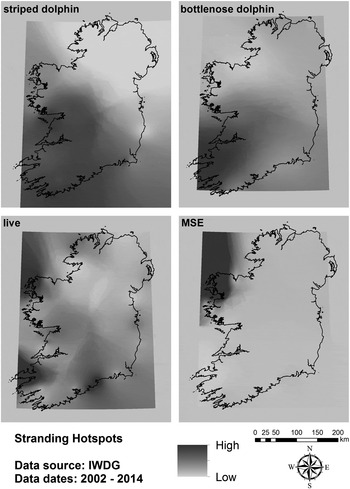
The spatial analysis highlighted two hotspots for LSEs and MSEs: the Mullet Peninsula, Co. Mayo and the Dingle Peninsula, Co. Kerry (Figure 5). Collectively, common and striped dolphins accounted for the majority of LSEs (50%) and MSEs (60%); as such, the location of the two hotspots was strongly influenced by these species. Post-mortem examination of fresh carcasses would almost certainly increase the number of records of live strandings in the database, as it is relatively straightforward to identify whether or not an animal stranded live if the carcass is fresh. Without post-mortem examination of the carcasses it is very difficult to determine why these areas are prone to LSEs and MSEs. If the animals were healthy then it is more likely that the topography of the area could be the reason why they stranded alive, and in some cases this may also explain why MSEs occur. Both peninsulas contain characteristics that are associated with MSEs; gently sloping sandy beaches with strong tides and a small entrance surrounded by land (Brabyn & McLean, Reference Brabyn and McLean1992). For unknown reasons (e.g. foraging, navigational error, sick/injured individual(s)), animals enter bays such as these and get into difficulties when the tide recedes. In the present study, the species that live stranded and were involved in MSEs were usually pelagic species. Coastal species, such as bottlenose dolphins, are highly unlikely to live or mass strand in these environments, with other studies showing that these species regularly forage in these types of environments without stranding (Sargeant et al., Reference Sargeant, Mann, Berggren and Krützen2005). However, pelagic species, such as common and striped dolphins, could very quickly become disorientated when the tide recedes, resulting in a LSE. The two peninsulas are relatively small in area and very accessible, with good reporting histories which makes them ideal locations for further study of LSEs and MSEs in Ireland and, more broadly, Europe. Given the frequency of live strandings in these areas, we recommend resources and equipment used for responding to LSEs should be prioritized for these areas; for example, the application of tracking technology to quantify the success of refloating live stranded cetaceans and/or obtaining tissue samples from freshly dead individuals which is critical for certain analyses.
Stranding hotspot analysis maps of all stranding events identified to species-level for striped dolphin, bottlenose dolphin, live stranding events (LSE) and mass stranding events (MSE).

CONCLUSION
The increase in strandings of common dolphin and harbour porpoise identified in the present study has also been noted in other parts of Europe, including France (common dolphin) (Authier et al., Reference Authier, Peltier, Dorémus, Dabin, Van Canneyt and Ridoux2014), Germany (harbour porpoise) (Siebert et al., Reference Siebert, Gilles, Lucke, Ludwig, Benke, Kock and Scheidat2006), the Netherlands (harbour porpoise) (Camphuysen et al., Reference Camphuysen, Smeenk, Addink, van Grouw and Jansen2008), the UK (common dolphin) (Leeney et al., Reference Leeney, Amies, Broderick, Witt, Loveridge, Doyle and Godley2008) and Spain (common dolphin) (López et al., Reference López, Santos, Pierce, González, Valeiras and Guerra2002). Demonstrating an increase in stranded cetaceans is useful information; however, identifying the underlying cause is the ultimate goal. In many cases this can prove to be extremely difficult without additional data. Distinguishing the cause of mortality events, whether from natural occurrences or anthropogenic influences, or a combination of both, is essential for proper conservation management. The present study highlights the urgent need for further investigation into the potential impact of anthropogenic interactions with cetaceans. Similarly, if natural causes are identified as the prime cause in the apparent increase in strandings, then these data can help build a clearer picture of a species’ ecology and can be taken into account when decisions are being made regarding the conservation and management of the species in question.
Potential approaches to improve our understanding of these patterns in strandings on Irish coastlines include regular, standardized post-mortem examinations of suitable carcasses to establish the cause of death, which is easily achievable with the appropriate resources and training. This should include trained veterinary pathologists and sample storage facilities, which would greatly improve both the quality and value of data obtained. Fisheries bycatch is a major issue for cetaceans worldwide (Lewison et al., Reference Lewison, Crowder, Read and Freeman2004; Read et al., Reference Read, Drinker and Northridge2006) and the evidence presented here suggests it might also be an issue in Ireland, particularly for common dolphins (Anon, 2013; Murphy et al., Reference Murphy, Pinn and Jepson2013). Given the evidence of bycatch as a potential cause of common dolphin strandings, a regular presence of fisheries observers on vessels involved in pelagic trawl fisheries is also recommended.
The two strandings hotspots identified in this study would be suitable locations to concentrate stranding response resources. The hotspots could also appeal to students and/or collaborating scientists, to access stranded animals for further studies including life-history characteristics and tracking and tagging studies. Identifying the major causes of death for different species would build on current knowledge and could provide a better baseline for trying to estimate population sizes and mortality rates and, in many cases, the fresher the tissue samples, the more accurate the data are and the more likely it is that a trained individual can attribute a cause of death with greater confidence.
The framework of a good strandings scheme is already largely in place in Ireland. The existing network of knowledgeable volunteers and coordination needs to be augmented with a standardized post-mortem procedure to understand and explain trends in strandings in Ireland. Boelens et al. (Reference Boelens, Gray and Parsons2004) listed recording stranded cetaceans as a potential Marine Environmental Impact Indicator in Ireland, but to understand what these patterns indicate requires an understanding of the underlying causes. This would also make the stranding scheme comparable to those run in other parts of Europe, opening up the possibility for an analysis of the health of cetacean populations on a much larger geographic scale than is currently available. The information from an improved strandings scheme is essential if these data are to be used in Ireland's assessment of whether or not a favourable conservation status of cetaceans is achieved and maintained.
ACKNOWLEDGEMENTS
The IWDG would like to thank all those people who have reported stranded cetaceans to the IWDG and to the network of volunteers who visit, record and sample cetaceans during all years of the scheme. The IWDG Stranding Scheme has been part funded by the Department of Arts, Heritage and the Gaeltacht since 2011 and the IWDG are grateful for their support. We also thank Eugene McGovern and Rory Scarrott for GIS assistance.