The present paper examines the development of receptive lexical skills in students attending classrooms with various proportions of English language learners (ELLs). In recent decades, there has been a significant increase in the number of ELLs: between 1979 and 2005, the number of children in US schools who spoke a language other than English at home grew from 3.8 million to 10.6 million (US Department of Education, 2007). The increase in the number of children from diverse language backgrounds presents challenges to the educational system as insufficient English skills prevent students from attaining higher levels of academic achievement (Amselle, Reference Amselle1996; August & Hakuta, Reference August and Hakuta1997; Guerrero, Reference Guerrero2004; Snow, Burns, & Griffin, Reference Snow, Burns and Griffin1998). Our ability to address these challenges critically depends on the understanding of factors related to language development in ELLs. Furthermore, a comprehensive approach to this problem requires a better understanding of language development in monolingual students from classrooms with various numbers of ELL peers. Thus, in the present paper, we examined the growth of receptive vocabulary in both English monolingual and ELL students from the same classrooms.
The focus of our study is on preschool students. There is convincing evidence that disadvantages in oral language at preschool age have extensive and long-lasting effects on the child's future development. Early language skills provide the basis for literacy, social skills, and achievement across academic subjects (Dickinson & McCabe, Reference Dickinson and McCabe2001; Cunningham & Stanovich, Reference Cunningham and Stanovich1997; Dionne, Tremblay, Boivin, Laplante, & Perusse, Reference Dionne, Tremblay, Boivin, Laplante and Perusse2003; Pianta, Reference Pianta1999; Tabors, Snow, & Dickinson, Reference Tabors, Snow, Dickinson, Dickinson and Tabors2001). Vocabulary knowledge in particular has been shown to play a significant role in academic achievement for both monolingual populations (Dickinson & Smith, Reference Dickinson and Smith1994; Freebody & Anderson, Reference Freebody and Anderson1983; Harmon, Reference Harmon1999; Scarborough, Reference Scarborough, Neuman and Dickinson2001) and ELLs (August, Carlo, Dressler, & Snow, Reference August, Carlo, Dressler and Snow2005; Ucceli & Paez, Reference Ucceli and Páez2007). Researchers have pointed out that access to a rich vocabulary is critical to explicit uses of language as well as language comprehension. A meta-analysis conducted by Scarborough (Reference Scarborough, Neuman and Dickinson2001) also revealed that the sizes of both receptive and expressive vocabulary are significantly related to later reading development. Thus, it is essential to gain a better understanding of the factors related to vocabulary development in preschoolers.
EXAMINING ENGLISH LANGUAGE LEARNING IN PRESCHOOL CHILDREN
Until recently, the discussion of educational issues related to English language learning has focused primarily on school-aged children and on different instructional settings and language services they receive (e.g., Cummins, Reference Cummins1981; Cummins, Bismilla, Cohen, Giampapa, & Leoni, Reference Cummins, Bismilla, Cohen, Giampapa and Leoni2005; Genesee, Lindholm-Leary, Saunders, & Christian, Reference Genesee, Lindholm-Leary, Saunders and Christian2005; Hakuta, Butler, & Witt, Reference Hakuta, Butler and Witt2000). Although this work provides important insights into the dynamics of second-language acquisition, it is not clear to what extent the findings can be extrapolated to preschool children. In addition to developmental differences between preschool and school-aged children, there are potentially significant differences in educational contexts, with many preschools not offering special language services to children who are not native speakers of English.
In contrast to the body of work on school-aged ELLs, there have been relatively fewer studies on preschool ELLs. Researchers have repeatedly emphasized the need for a more systematic examination of second-language acquisition in younger learners (August et al., Reference August, Carlo, Dressler and Snow2005; Espinosa, Reference Espinosa2002; Tabors, Reference Tabors1997). As suggested by Snow (in Tabors, Reference Tabors1997) and Pearson (Reference Pearson, Suárez-Orozco and Páez2002), the relative paucity of research on preschool language learners may be due to the assumption that young children acquire second language quickly and effortlessly through daily exposure. Yet the available evidence has raised doubts about the validity of this assumption (Genesee, Paradis, & Crago, Reference Genesee, Paradis and Crago2004; Paez, Tabors, & Lopez, Reference Páez, Tabors and López2007; Tabors, Reference Tabors1997; Wong-Fillmore, Reference Wong-Fillmore, Clarke and Handscombe1983).
Much of the earlier evidence on ELL preschoolers was based on case studies involving a few children or a single classroom (e.g., Clarke, Reference Clark1999; Hakuta, Reference Hakuta1976, Letts, Reference Letts1991; Saville-Troike, Reference Saville-Troike1987; Tabors, Reference Tabors1997). These studies have revealed common patterns of English learning in preschoolers: children generally proceed through a series of stages, beginning with a silent period in which they appear to comprehend some English without being able to use language productively. The course of language acquisition in ELLs is generally similar to that of younger monolingual speakers (Genesee et al., Reference Genesee, Paradis and Crago2004). Even at preschool age, children acquiring English as a second language do not master it in a matter of months. Their English language learning is instead a more gradual process than previously thought, with many difficulties along the way (Tabors, Reference Tabors1997; Van Lier, Reference Van Lier1999). These findings have been confirmed by more recent large-scale investigations. For example, a study involving a large sample of children drawn from different classrooms showed that after spending a year in the preschool program, ELL students performed significantly below the monolingual population norms (Paez et al., Reference Páez, Tabors and López2007).
Although the studies of language growth in ELL preschoolers have often focused on commonalities among children, they have also demonstrated the existence of variability among these students. Individual differences in preschool ELLs have been revealed even in the studies involving small samples (Tabors, Reference Tabors1997). The results of larger scale investigations also contain evidence of high variability, including large standard deviations in vocabulary scores (Paez et al., Reference Páez, Tabors and López2007). Given this evidence, it is critical to identify factors potentially associated with individual differences. The overview of current research has led investigators to underscore that understanding what causes substantial variability among ELL students is one of the key tasks faced by contemporary researchers (Genesee et al., Reference Genesee, Paradis and Crago2004, Reference Genesee, Lindholm-Leary, Saunders and Christian2005).
THE RELATION BETWEEN CAREGIVER INPUT AND ENGLISH LANGUAGE LEARNING
In explaining variability in the rates of language acquisition, investigators have pointed out the role of learner characteristics, such as motivation, extraversion, and language aptitude (Dulay & Burt, Reference Dulay and Burt1974; Genesee et al., Reference Genesee, Paradis and Crago2004; Ranta, Reference Ranta and Robinson2002; Wong-Fillmore, Reference Wong-Fillmore, Fillmore, Kempler and Wang1979, Reference Wong-Fillmore, Clarke and Handscombe1983). However, in addition to considering the role of individual learner characteristics, it is important to understand the role of environmental factors. At present, there is a substantial body of research on the relation between language growth and linguistic environment in monolingual children (for a review, see Hoff, Reference Hoff2006) and a relatively small, although growing, number of comparable studies on young ELL students (e.g., Gutierrez-Clellen & Kreiter, Reference Gutierrez-Clellen and Kreiter2003; Patterson, Reference Patterson2002; Pearson, Fernandez, Lewedeg, & Oller, Reference Pearson, Fernandez, Lewedeg and Oller1997).
Language growth in monolingual English speakers
Research conducted on monolingual children shows that vocabulary acquisition is dependent on input, specifically, on the amount of caregiver language (Goodman, Dale, & Li, Reference Goodman, Dale and Li2008; Hart & Risley, Reference Hart and Risley1995; Hoff, Reference Hoff2003; McCartney, Scarr, Philips, & Grajec, Reference McCartney, Scarr, Philips and Grajec1985; Naigles & Hoff-Ginsberg, Reference Naigles and Hoff-Ginsberg1998; Smolak & Weinraub, Reference Smolak and Weinraub1983). Hart and Risley (Reference Hart and Risley1995) conducted a large-scale examination of the conversations between parents and children. The results revealed large differences in the amount and types of input provided by parents. These differences in input were related to differences in children's vocabularies, with greater amounts of input associated with larger vocabularies. Similar results were reported in longitudinal investigations where lexical growth in children was found to be related to the amount of maternal speech (Huttenlocher, Haight, Bryk, Seltzer, & Lyons, Reference Huttenlocher, Haight, Bryk, Seltzer and Lyons1991). In addition, the relative frequency of maternal use of particular words was related to the order of acquisition of those words in children. Thus, exposing young language learners to a large amount of verbal input that includes repeated usage of words facilitates the growth of their lexical skills.
Studies of parent–child interaction involving monolingual speakers also indicate that lexical growth is related to the syntactic structure of parental speech (Naigles & Hoff-Ginsberg, Reference Naigles and Hoff-Ginsberg1998; Tardif, Shatz, & Naigles, Reference Tardif, Shatz and Naigles1997). At the early stages of language acquisition, children's word learning appears to benefit from hearing well-formed sentences, in which individual words are embedded in basic grammatical relations (Furrow, Nelson, & Benedict, Reference Furrow, Nelson and Benedict1979). Researchers have used the term “motherese” to describe the style of verbal interaction with very young children that is characterized, among other features, by short and simple sentences (Gleitman, Newport, & Gleitman, Reference Gleitman, Newport and Gleitman1984; Hoff-Ginsberg & Shatz, Reference Hoff-Ginsberg and Shatz1982; Snow & Ferguson, Reference Snow and Ferguson1977). Processing these simple structures reduces cognitive demands on the analysis of verbal input and thus may facilitate the identification and comprehension of individual words.
In addition to investigating parent–child interactions, research on language acquisition in English monolinguals involved examining teacher–child interactions. This research points to the role of school input in language development. A national study of early child care found that the amount of language directed at a child by caregivers in a child care setting was positively related to language development, although child care experiences accounted for a small proportion of variance in children (National Institute of Child Health and Human Development Early Child Care Network, 2000). In addition, several studies examined children's language skills in relation to the type of input provided by preschool teachers. Results indicated that vocabulary growth in preschoolers was related to the amount of analytical talk provided by teachers during everyday conversations and book reading (Dickinson & Smith, Reference Dickinson and Smith1994; McCartney, Reference McCartney1984).
Language growth in ELLs
Compared to work with monolinguals, there is a relatively limited number of studies that examined the relation between language growth in ELL students and linguistic input they receive; this research produced somewhat mixed results. Several studies that focused on parental input showed that the total amount of exposure to a particular language at home is related to vocabulary growth in that specific language (De Houwer, Reference De Houwer, Fletcher and MacWhinney1995; Pearson et al., Reference Pearson, Fernandez, Lewedeg and Oller1997; Umbel, Pearson, Fernandez, & Oller, Reference Umbel, Pearson, Fernández and Oller1992). In contrast, a study of Spanish/English bilingual toddlers by Patterson (Reference Patterson2002) showed that children's vocabulary size in a given language was not related to the overall exposure to that language, although it was related to the frequency of reading. Furthermore, a study of vocabulary skills in older (fifth-grade) Latino ELLs suggested that their proficiency in English did not depend on the use of English at home, whereas proficiency in Spanish required parental support (Duursma et al., Reference Duursma, Romero-Contreras, Szuber, Proctor, Snow and August2007).
With respect to school input, a few available studies with ELLs involved children of kindergarten age and older. In a study of second-grade students, Gutierrez-Clellen and Kreiter (Reference Gutierrez-Clellen and Kreiter2003) did not find any significant relation between exposure to English (vs. Spanish) at school and children's language development. However, it should be noted that the study had methodological limitations, as acknowledged by the investigators themselves. The main measure of input was the percentage of time of exposure to each of the two languages reported by teachers. The authors point out that there is a need for a more detailed measure of language input at school. In another study involving kindergarten students, Uchikoshi (Reference Uchikoshi2006) examined whether watching educational programs predicted children's vocabulary growth. The results indicated that the amount of TV watching at school was not related to children's vocabulary. However, Uchikoshi's work suggests that preschool experiences might influence English vocabulary growth as children who had been enrolled in a preschool exhibited higher English vocabulary scores in kindergarten than those who had stayed at home.
In sum, there has been relatively little work with ELL preschoolers exploring the relation between their vocabulary growth and the features of linguistic input they receive, especially at school. Yet, for many young ELL children, the preschool classroom is the primary source of English. Thus, it is important to investigate the role of classroom variables as potential factors in lexical development of these students. The work with monolingual children provides information potentially relevant for this investigation, in identifying the measures of input that may be related to language acquisition in preschoolers.
PRESENT STUDY: RELATION OF INPUT TO LEXICAL GROWTH IN ELL AND MONOLINGUAL PRESCHOOLERS
To interpret the skill level of ELL students in relation to the language input they receive at school, it is useful to compare their skills to those of native speakers of English who receive similar input. It has been pointed out in the literature that there is currently a lack of comparable data for monolinguals and second-language learners (De Houwer, Reference De Houwer, Fletcher and MacWhinney1995). In some studies, comparisons are made to population norms, which is somewhat problematic given the unique experiences of language minority students. In the present research, ELL and monolingual children were examined using the same data collection procedure. Furthermore, the direct comparison between ELLs and monolingual speakers was facilitated by both types of students in the present study coming from the same preschool classrooms.
We investigated receptive lexical skills in preschool children over 1 school year, exploring several factors potentially associated with variability in their vocabulary growth. For both ELL and monolingual students, we examined the relation between their language growth and the features of teachers’ input, including the overall amount of speech, number of different word types, and number of words per utterance. These variables have been studied in work on parent–child interactions in monolingual populations and have been shown to affect children's lexical skills (e.g., Hart & Risley, Reference Hart and Risley1995; Hoff, Reference Hoff2003). Here we extend the investigation to ELL students and to caregiver input provided in the school context.
Several researchers have noted that the aspects of input that are related to language growth may vary depending on the stage of language learning (Barnes, Gutfreund, Satterly, & Wells, Reference Barnes, Gutfreund, Satterly and Wells1983; Hoff-Ginsberg, Reference Hoff-Ginsberg1985). Because young ELL students differ from their monolingual peers in terms of English skills, it is likely that there may be differences in the pattern of relationship between a particular aspect of input studied and the growth of lexical skills in these two groups of participants. For example, the overall amount of input, containing multiple repetitions of common words, may be more important for ELLs than for monolingual students who have already mastered basic English vocabulary, whereas the lexical diversity of input may be more important for monolingual students who are acquiring lower frequency words. In the present study, we explore this possibility by examining the role of each measure of teacher input as a potential predictor of growth in both groups of students.
METHOD
Participants
The study involved 104 students recruited from 10 preschool classrooms in the greater Boston area and their teachers (one teacher per classroom). The teachers were female, nine were Caucasian and one was African American, and all of them were native speakers of English. The students were approximately equally distributed between the two gender groups (50 girls, 54 boys). The average age of the students at the first testing point was 56 months (SD = 4.4 months). Children's language status was determined based on the information reported by each parent in the consent form. The child was classified as monolingual English speaker if the parents and the child spoke only English at home; the child was classified as ELL if the parents and the child primarily spoke language other than English at home. Across the participating classrooms, the average proportion of ELL students was 24% (SD = 21%, range = 5–50%). Thus, the present study included classrooms where monolingual English speakers comprised a majority or at least half of the class. The study sample included 29 ELL participants (14 males, 15 females); 8 participants identified Japanese as a first language, 7 identified Spanish, and 7 identified Vietnamese; the remaining languages (Portuguese, Cambodian, Chinese, Korean, and French) were represented by one or two students.
The participating schools were all private, but they varied in the socioeconomic status (SES) backgrounds of the families they served. SES was determined at the class level as the percentage of students eligible for free or reduced lunch. Based on this indicator, there were three classrooms that could be characterized as low SES, three as middle SES and four as high SES (with the percentage of students eligible for free or reduced lunch being above 60% in the low-SES group, about 20% in the middle-SES group, and below 6% in the high-SES group). The ELL participants were distributed relatively evenly across different SES levels, as indicated by the chi-square test that showed no differences in the number of ELLs across the three SES groups, χ2 (2, N = 29) = 3.74, p > .05.
Procedure
Conducting child assessment. Each child was tested twice: in the beginning of the academic year and then again at the end of the same academic year. At both testing points, children's language skills were assessed using the Peabody Picture Vocabulary Test—Third Edition (PPVT-IIIB; Dunn & Dunn, Reference Dunn and Dunn1997). The PPVT is a standardized receptive vocabulary test in which the child is asked to pick one of four pictures that matches the item verbalized by the experimenter (Dunn & Dunn, Reference Dunn and Dunn1997). Items are ordered in sets of 12 based on increasing age-normed difficulty. At the first testing, the procedure started with the same set for all children (Set 2, which is indicated for 4-year-olds). At the second testing, different children started at different items, depending on the basal set determined in the first testing. The testing was stopped when the child reached the ceiling criteria, that is, indicated eight incorrect items out of a set of 12. Each testing session lasted about 20 min, with designated breaks for the child. The child's score was calculated by subtracting the total number of errors the child made from the number of the last item in the ceiling set.
Collecting samples of teacher speech. In addition to child data, we collected language samples from preschool teachers. In the middle of the school year, the teacher in each classroom was audiotaped for 1.5-hr period that included both a group instruction (circle time) and snack time. The ratio of circle time to snack time was approximately 2:1 across teachers. Prior research has shown that these activities are conducive to teachers engaging in conversations with the class as a whole and provide reliable indicators of teachers’ speech patterns in preschool classrooms (e.g., Klibanoff, Levine, Huttenlocher, Vasilyeva, & Hedges, Reference Klibanoff, Levine, Huttenlocher, Vasilyeva and Hedges2006). During audiotaping, the teacher wore a lapel microphone that was wirelessly connected to a recording device. Although there was unavoidable variability in class schedules, we aimed to obtain recording from different teachers during comparable activities. The investigator was present to ensure that the recording took place during the appropriate time.
Even though ideally one should obtain speech samples across several days, we were limited by practical constraints imposed by school administration, and carried out audio taping on a single day. In each classroom, this day was identified by the teacher as a typical school day with no special projects or activities planned. It should be pointed out that studies examining teachers’ and parental input have commonly utilized the practice of collecting 45- to 90-min speech samples during a single observation (e.g., Hoff, Reference Hoff2003; Huttenlocher, Vasilyeva, Cymerman, & Levine, Reference Huttenlocher, Vasilyeva, Cymerman and Levine2002; Weizman & Snow, Reference Weizman and Snow2001). Furthermore, investigators who have conducted multiple observations have pointed out the stability of caregiver speech over time (Huttenlocher, Vasilyeva, Waterfall, Vevea, & Hedges, Reference Huttenlocher, Vasilyeva, Waterfall, Vevea and Hedges2007; Nelson & Bonvillian, Reference Nelson and Bonvillian1973; Smolak & Weinraub, Reference Smolak and Weinraub1983).
Coding teacher speech. Teacher's speech was transcribed from audiotapes by breaking the audio flow into distinct utterances based on intonation and pauses. The transcripts were put into the Codes for Human Analysis of Transcripts transcription system and then analyzed using the Child Language Analysis computer program (MacWhinney, Reference MacWhinney1995). We obtained measures indicating the quantity, diversity, and structure of teacher speech. As a measure of input quantity, we used the total number of words (tokens) produced by the teacher during the 90-min period of observation. The only types of words that were excluded from the token count were animal noises (e.g., baa), letters of the alphabet (except for a and I), and interjections (e.g., ouch and uh-oh). As a measure of lexical diversity, we calculated the number of different words (word types) in each transcript. In counting word types, each unique word was included only once, no matter how many times it was used by the speaker (in contrast, word tokens included repetitions of the same word).
As a measure of structural complexity, we calculated the average number of words per utterance in teacher speech. To compute this measure for each teacher, we divided the total number of words by the total number of utterances in the transcript. Note that some utterances may consist of single words (e.g., Great!) or isolated phrases (e.g., Big boy), whereas others consist of sentences of various lengths (e.g., Finish your snack or Jenny drew a beautiful picture and even wrote her name on it). Generally, the number of words per utterance has been used as a rough indicator of structural complexity of speech (Hoff, Reference Hoff2003; Parker & Brorson, Reference Parker and Brorson2005) because more complex structures, such as multiclause sentences, tend to have more words than simpler structures.
RESULTS
In examining the results, we aimed to determine the extent of variability in vocabulary growth over a course of 1 preschool year and explore factors potentially associated with this variability. In preliminary analyses, we considered several factors that have been identified in the literature as associated with vocabulary differences among children. One obvious factor is whether the child is a monolingual speaker of English or an ELL student (Oller & Eilers, Reference Oller and Eilers2002; Pearson et al., Reference Pearson, Fernandez, Lewedeg and Oller1997). Further, English acquisition in ELLs may be partly affected by how similar their language is to English (e.g., Dulay & Burt, Reference Dulay and Burt1974; Genesee et al., Reference Genesee, Paradis and Crago2004). Another factor potentially associated with variability in the growth of vocabulary skills is gender (e.g., Bauer, Goldfield, Reznick, Reference Bauer, Goldfield and Reznick2002; Kramer, Delis, Kaplan, O'Donnell, & Prifitera, Reference Kramer, Delis, Kaplan, O'Donnell and Prifitera1997). Finally, we considered whether lexical growth may be related to the presence of various numbers of ELLs in the classroom. Peers have been shown to play a role in language development (Hoff, Reference Hoff2006; Oller & Eilers, Reference Oller and Eilers2002), and it is possible that having more English monolingual classmates may benefit lexical growth in preschoolers. Thus, in preliminary analyses, we examined how children's performance (both their starting level and the growth over the school year) varied as a function of their language background, gender, and percentage of ELLs.
Following the preliminary analyses, we addressed our main research questions by examining how children's language growth was related to the features of the linguistic input they received from teachers in their preschool classrooms. Specifically, we examined whether the total number of words, word types, and the average number of words per utterance in teacher speech were significant predictors of the change in children's PPVT scores. All analyses utilized multiple linear regression procedures. To account for the nesting of students within classrooms, we used the Huber–White adjustment of variance (Huber, Reference Huber1967; White, Reference White1982) in our regression models. This correction does not affect parameter estimates, but tends to make statistical tests more conservative by increasing the size of estimated standard errors.
Preliminary analyses
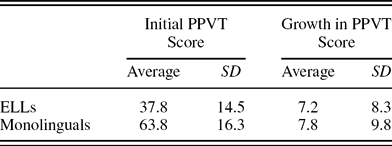
We first examined the performance of ELL students as a function of their language background. As indicated above, our sample of ELLs represented diverse native languages. In the present analysis, we looked at the three most represented groups, Spanish, Japanese, and Vietnamese speakers. A dummy code was created for each language and entered into the regression model, which was run separately for the starting level of vocabulary (initial PPVT score) and the growth (change between final and initial PPVT scores). This analysis showed no differences among ELLs in either starting scores or growth (both ps > .05). Thus, in subsequent analyses, we combined all ELL students rather than separating them by native language. Table 1 presents a summary of descriptive statistics for the whole sample of ELL students as well as for monolingual participants from the same classrooms.
Descriptive statistics on students' PPVT scores
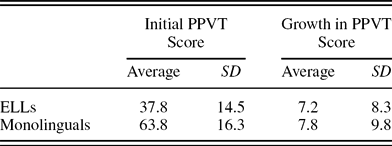
Note: PPVT, Peabody Picture Vocabulary Test; ELLs, English language learners.
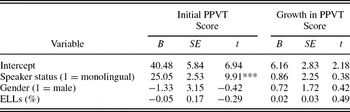
Next, we ran the analysis using the entire sample of 104 students (using ordinary least-squares regression and adjusting variance estimates to account for clustering). Separate models were constructed to predict the starting level and the growth of PPVT scores. Two dichotomous variables, language status (monolingual vs. ELL) and gender, were entered into the models as individual-level predictors. One continuous variable (percentage of ELLs per class) was entered as a classroom-level predictor. We found a significant difference between monolingual English speakers and ELLs in the initial PPVT scores. As shown in Table 2, holding other variables constant, the initial raw scores of monolingual students were about 25 points higher than the initial raw scores of ELLs. At the same time, there was no significant difference between these two groups of students in the amount of growth over the school year. Gender and percentage of ELLs were not significant predictors of either initial scores or growth over a school year.
Multiple regression results predicting initial PPVT and PPVT growth for the whole sample

Note: Standard errors are adjusted using the Huber–White estimator with class ID as the clusters. PPVT, Peabody Picture Vocabulary Test; ELLs, English language learners.
***p < .001.
Thus, consistent with previous findings, preliminary analyses revealed differences among children at the start of the study as a function of their language status. When we converted results to standardized scores, we found that the initial score for the monolingual English speakers was on average 102 (population mean is 100) and the initial score for the ELL students was on average 81, more than 1 SD below the population mean. Language status accounted for 35% of variance in initial PPVT scores. Although we were able to account for a sizeable portion of the variance in the initial scores, language status was not related to lexical growth over the year. On average, children in our sample showed an increase of about 7.6 points in raw PPVT scores over the preschool year. This increase reflects the growth in performance that is expected developmentally. At the end of the school year, the standard score was 103 for the monolingual English speakers and 81 for the ELL participants.
It should be noted that, although the average PPVT growth was similar for the monolingual and ELL groups, there was a substantial individual variability in both groups in how much children changed, ranging from an increase of 44 points to a decrease of 9 points. As this variability was not explained by the factors considered in the preliminary analysis, in the next set of analyses we examined the characteristics of caregiver input (specifically, measures of teacher speech) to determine if they could account for some of the observed variability in the growth of receptive lexical skills.
Variability among teachers
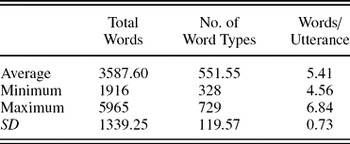
Table 3 presents the descriptive statistics for the total number of words, word types, and words per utterance produced by the teachers. It should be noted that there were some differences between the characteristics of teacher speech during different activities. For example, the total number of words and the number of words per utterance were generally greater during circle time than during snack. The data presented in Table 3 and subsequent analyses are based on samples of speech collected during the whole observation period. Because the proportion of time spent on different activities was similar across teachers, it provided us with a common framework to compare teachers to one another.
Teacher input statistics

As with children's lexical growth, we found substantial variability among teachers on the measures of linguistic input. Some teachers produced three times as many words as others in the same period of observation and during comparable activities. Furthermore, the differences were not only in how talkative the teachers were. There were structural differences in speech addressed to children, as measured by the number of words per utterance in teachers’ speech. There were also substantial differences in the number of word types produced during comparable observation periods, with some teachers using more than twice as many different words than others in talking to children.
It is interesting to note that even when guiding children through similar activities, teachers varied greatly in lexical choices. For example, when discussing a story about animals, one of the teachers asked children a variety of questions involving mostly common words (e.g., “What do we wanna say about the lion? He ate a lot. It made him what? It made him sleepy. Is it a sleeping time?”). Another teacher used a much more diverse and challenging vocabulary in discussing with children an animal story (e.g., “Another name for a pig is a hog. Can you make a hog sound? Look, why is he surprised? He hopped on a horse and the horse is galloping.”) Exposing children to a diverse lexicon could facilitate the growth of vocabulary even in those students who have already mastered the basics of English language and learned common words—a possibility that we investigate in the next set of analyses.
Input measures as predictors of children's PPVT growth
The main focus of the present study was on examining the relation between children's vocabulary growth and the features of language input provided by teachers. Because we were interested in comparing this relation for monolingual and ELL students, at the first stage of analysis, we entered language status into the regression model along with input measures to determine if there was an interaction between these variables. The results showed that two of the input variables interacted with children's language status (the interaction was marginally significant for the total number of words, p = .068, and highly significant for the number of words per utterances, p < .001). These findings suggest that the effect of input on PPVT growth varies depending on whether the child is an English monolingual or ELL student.
Thus, in a follow-up analysis, we looked at the relation between the measures of teacher input and PPVT growth, separately for English monolingual students and ELLs. It should be noted that given a relatively small sample size, particularly for the ELL subsample, we did not include all three input predictors in the same model (which would have reduced the power of the analysis for each individual predictor). Rather, in the first regression model, we included the amount of speech (i.e., tokens) and sentence complexity (i.e., words per utterance) as predictors of PPVT growth, and in the second model, we replaced sentence complexity with the measure of lexical diversity (i.e., types). This analytic approach allowed us to accomplish two goals. First, we were able to maintain an acceptable ratio between the number of predictors and observations.Footnote 1 Second, this approach allowed us to examine the effects of two variables that are often viewed as measuring the quality of input (word types and words per utterance) while controlling for the overall amount of input.
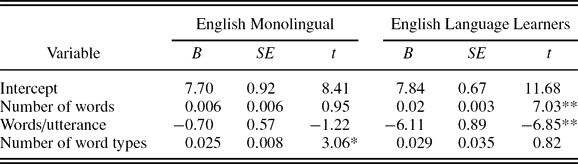
In the first model, we found that neither the amount of speech nor sentence complexity was significantly related to the growth of PPVT scores in monolingual English-speaking students. In contrast, both measures were significantly related to the growth of PPVT scores in ELL students (see Table 4). Note that the pattern of relations was different for each measure of input. Specifically, the total number of words the teacher produced was significantly and positively related to the PPVT growth of ELLs, indicating that higher amounts of teacher speech correspond to higher rates of growth on PPVT. At the same time, the number of words per utterance was significantly and negatively related to PPVT growth: when teachers have relatively long utterances, their ELL students exhibit lower rates of growth on PPVT.
Multiple regression results predicting Peabody Picture Vocabulary Test growth for monolingual English-speaking and English language learning preschool students as a function of teacher input
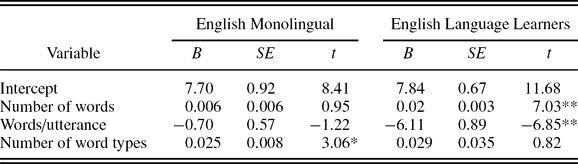
Note: Standard errors are adjusted using the Huber–White estimator with classroom ID as the clusters.
*p < .05. **p < .01.
The effect sizes were medium for the total number of words (η2 = 0.065, Cohen d = 0.5) and large for the number of words per utterance (η2 = 0.237, Cohen d > 0.8). The two measures together accounted for 24% of variance in the vocabulary growth of preschool ELL students in our sample. The teacher input variables remained significant predictors of language growth in ELLs even after accounting for SES differences. SES was not a significant predictor of children's lexical growth (p > .05) and explained only 1.4% of the variance in PPVT growth.
In the second regression model, we examined the role of lexical diversity (i.e., number of word types) in the PPVT growth in monolingual and ELL students while controlling for the overall amount of input (i.e., number of word tokens). The results showed that the number of word types was significantly and positively related to the PPVT growth in English monolingual students but not in the ELL students (see Table 4). The effect size for the relation between the lexical diversity of teacher speech and the receptive vocabulary growth in monolingual students was relatively small (η2 = 0.031, Cohen d = 0.3).
DISCUSSION
Investigators have emphasized the need for a better understanding of factors associated with individual differences in language growth of preschool-age ELLs and English monolingual students (e.g., Genesee et al., Reference Genesee, Paradis and Crago2004; Snow et al., Reference Snow, Burns and Griffin1998; Uchikoshi, Reference Uchikoshi2006). Previous studies have examined the role of child characteristics as well as home-related factors (De Houwer, Reference De Houwer, Fletcher and MacWhinney1995; Patterson, Reference Patterson2002; Ranta, Reference Ranta and Robinson2002; Wong-Fillmore, Reference Wong-Fillmore, Clarke and Handscombe1983). In the present study we focused on another potential source of variability in preschool students: teacher input. Most existing studies concerning language input within the school setting involved monolingual English speakers (e.g., Dickinson & Smith, Reference Dickinson and Smith1994; Huttenlocher et al., Reference Huttenlocher, Vasilyeva, Cymerman and Levine2002). The present study extended this work as we compared the lexical growth of ELL students and native English speakers from the same classrooms in relation to the type of teacher input they received.
Initial vocabulary skills and growth in monolingual and ELL students
Our analyses of receptive lexical skills indicated that the PPVT scores of monolingual English speakers were more than 1 SD above the scores of ELLs. This finding is consistent with prior research demonstrating large skill differences between monolingual and ELL students (Oller & Eilers, Reference Oller and Eilers2002; Pearson et al., Reference Pearson, Fernandez, Lewedeg and Oller1997). Snow and colleagues (Reference Snow, Burns and Griffin1998) have indicated that ELLs are generally behind their English-speaking peers in English vocabulary upon entering first grade. Comparable difficulties have also been shown in other language measures. For example, a sample of bilingual children scored about 2 SD below the monolingual population mean in oral language subtests of the Woodcock Language Proficiency Battery (Tabors, Páez, & López, Reference Tabors, Páez and López2003). Our study provided further evidence of the disparity between ELL and monolingual speakers by comparing children from the same classrooms rather than relying on population norms.
Although the initial lexical skills varied as expected for monolingual and ELL students, the average rate of vocabulary growth did not vary as a function of language status. Previously, similar findings were reported for older children (August et al., Reference August, Carlo, Lively, Lippman, McLaughlin and Snow1999; Umbell et al., Reference Umbel, Pearson, Fernández and Oller1992). Here, we demonstrated this phenomenon in very young children; essentially, the gap in vocabulary that existed between English-speaking and ELL preschoolers in the beginning of the school year remained unchanged at the end of the year. Based on prior research, one would not expect ELL preschoolers to catch up with English-speaking children in 1 year (Hakuta et al., Reference Hakuta, Butler and Witt2000; Snow et al., Reference Snow, Burns and Griffin1998). A recent longitudinal investigation has pointed to a relative stability of students' language skills relative to one another (Snow, Porche, Tabors, & Harris, Reference Snow, Porche, Tabors and Harris2007). Yet, when considering young ELLs as a group, one could expect that their initial differences with monolingual peers would reduce somewhat following a year in an English-speaking school environment.
Because many ELL students had very low scores at the beginning of the school year, their learning task could be viewed as somewhat easier than the task of monolingual speakers. That is, ELLs could increase their scores in vocabulary by acquiring high-frequency words. In contrast, native English speakers have already mastered basic vocabulary and would need to acquire less frequent and more complex elements of language to increase their scores. However, it appears that despite the differential difficulty of the learning tasks, ELLs were not able to reduce the existing performance gap. A possible explanation is that monolingual speakers received additional English exposure through their home environment and therefore may have gained the experience necessary to grow at a higher end of the scale.
The relation between language growth and teacher input measures
Even though there was no difference in average growth between monolingual speakers and ELLs as a group, it should not be interpreted as indicative of the lack of individual differences among our participants. There was substantial variability in growth both among monolingual and ELL students. In exploring the possible sources of differences in children, we focused on the features of teachers’ linguistic input provided in the preschool classroom. The teachers in our sample exhibited a large variability in the amount, lexical diversity, and structural characteristics of speech. Thus, we were able to examine whether differences in input among teachers were related to differences in language growth among students. This examination produced distinct patterns of findings with respect to English monolinguals and ELLs.
Predictors of PPVT growth in English monolingual students. The teacher variable that predicted the growth of PPVT in monolingual students was the number of different word types, which is a measure of lexical diversity. In classrooms where teachers used more diverse vocabularies, English-speaking students showed a greater increase in receptive lexical skills compared to other classrooms. This finding is consistent with studies showing a positive relation between vocabulary growth in monolingual children and the richness of lexical input provided by parents, in particular the parents’ use of low-frequency words (e.g., Hoff, Reference Hoff2006; Weizman & Snow, Reference Weizman and Snow2001). Generally, caregivers who produce a relatively small number of word types tend to use common, high-frequency words, whereas caregivers who produce a large number of word types are more likely to use rare words (Huttenlocher et al., Reference Huttenlocher, Vasilyeva, Waterfall, Vevea and Hedges2007). The exposure to diverse vocabulary in the classroom could be essential for the preschoolers who have acquired basic vocabulary and for whom a further vocabulary growth requires the acquisition of less frequent words.
Two other measures of teacher speech we examined did not contribute to the explanation of the variance in lexical growth in monolingual students. This finding may be somewhat surprising given that previous studies have found that both the overall amount and complexity of parental speech were related to vocabulary growth in English-speaking monolinguals (e.g., Hart & Risley, Reference Hart and Risley1995; Hoff, Reference Hoff2003; Huttenlocher et al., Reference Huttenlocher, Haight, Bryk, Seltzer and Lyons1991). However, that prior research involved younger children and, as pointed out by several investigators, certain features of input play a greater role at the earlier stages of language learning (Barnes et al., Reference Barnes, Gutfreund, Satterly and Wells1983; Hoff-Ginsberg, Reference Hoff-Ginsberg1985). The overall amount of speech may be a relevant measure of input when children begin building their vocabulary with high-frequency words. However, this quantitative measure may not capture the differences in input relevant to later lexical growth because some teachers may talk a lot but use relatively simple vocabulary. In contrast, the diversity of caregiver vocabulary may be a particularly relevant measure of input at this stage, which is supported by our findings.
Predictors of PPVT growth in ELLs. In contrast to monolingual speakers, the rate of lexical growth in ELL students was related to the total number of teachers’ words and the average number of words per utterance, but not related to the number of different word types. The finding that the overall amount of speech produced by teachers predicted the PPVT growth in ELLs should not be surprising. Based on parental reports, all the ELLs in our study spoke languages other than English at home and thus preschool was one of their main sources of English. The relation between the total number of words produced by the teacher and lexical growth in ELLs is consistent with the findings of previous studies that examined vocabulary growth in monolingual English speakers at the early stages of language learning in relation to parental input (Hart & Risley, Reference Hart and Risley1995; Hoff-Ginsberg, Reference Hoff-Ginsberg1991). This suggests that the mechanisms underlying the acquisition of English vocabulary in preschool ELLs may parallel those in younger monolingual speakers. As with the parents of monolingual speakers, the preschool teachers serve as the primary providers of English input to ELL students as they start building their vocabulary.
The negative relation between the number of words per utterance in teacher speech and vocabulary growth in ELL students highlights the significance of the structural characteristics of linguistic input. The number of words per utterance (or a similar measure of mean length of utterance) has been used as measure of structural complexity of speech (e.g., Hoff, Reference Hoff2003; Huttenlocher et al., Reference Huttenlocher, Vasilyeva, Cymerman and Levine2002). It has been suggested that during early word learning children may benefit from hearing short simple utterances (Berko-Gleason, Reference Berko-Gleason, Snow and Ferguson1977; Furrow et al., Reference Furrow, Nelson and Benedict1979). Some studies indicated that longer parental utterances were related to larger vocabularies in children (Hoff, Reference Hoff2003), but this positive relation may be partly because longer utterances were also associated with richer vocabulary in parental input.
Hoff (Reference Hoff2006) acknowledges that processing longer and more complex utterances may present challenges for language learning. She suggests though that very young children may filter out input that is too complex. Processing limitations (e.g., limits on working memory capacity) have been cited as potential facilitators of language learning at the earliest stages (Johnson & Newport, Reference Johnson and Newport1989; Newport, Reference Newport1990). By not processing the whole utterance, children may simplify the task of analyzing incoming speech. However, the ELL students in our sample may not have the advantage of the cognitive filter that younger children may possess. Because our study participants were on average 4.5 years old, they would be capable of holding in memory longer utterances than 2-year-olds. As a result, remembering and having to deconstruct longer utterances may complicate their task of word learning. Thus, the exposure to a large amount of input, in which basic words and structures are likely to be repeated multiple times, and the structural simplicity of sentences may be critical to the initial progress of ELL students.
It is interesting that, unlike English-speaking monolinguals, the ELLs in our study did not appear to benefit from the increased lexical diversity of teachers’ input. This could be related to children's word learning being concentrated on high-frequency words at the earlier stages of language acquisition. Thus, the exposure to a diverse lexical input, which is likely to include rare words, may not be as beneficial to young ELL learners as it is to their monolingual peers who have already mastered the basic English vocabulary.
In summary, this research adds to the growing body of work exploring contextual factors associated with language learning. Researchers studying English monolingual and ELL students have emphasized the importance of considering features of classroom environment, but very few studies have looked directly at the relation between specific characteristics of teacher speech and vocabulary growth in preschoolers. Our study suggests that the pattern of this relation may differ for monolingual and ELL students. The differences we observed may be because these student groups varied in what they already knew and what language tasks they faced at the time of the study. There were also differences in effect sizes: the relation between teacher input and the lexical growth was particularly strong for ELL preschoolers. This could be the case because our monolingual participants have been receiving their English language input both at school and at home, whereas ELLs in our study were exposed to English primarily at school.
LIMITATIONS AND FUTURE DIRECTIONS
The present study had several limitations that can be addressed in subsequent research. The key limitation was a relatively small sample size and a related fact that the participants were drawn from only 10 classrooms. This reduced the statistical power of the analysis and prevented us from using multilevel modeling in our analytical approach. Significant relations between measures of teacher input and lexical growth were found in a relatively small sample of ELLs, which points to the potentially robust nature of this phenomenon. Yet, further work involving a larger number of participants should allow researchers to systematically investigate factors that may moderate the relation between teacher input and language growth in ELLs. In particular, it would be important to have a larger number of participants from different language backgrounds (Spanish-speaking families, Chinese-speaking families, etc.) so that researchers could have a greater statistical power to explore both the role of home language and cultural factors that may play a role in English language learning.
Further, the present study has focused on one aspect of linguistic input: teacher speech. It is important to consider other contextual factors that may influence language development in ELL as well as monolingual preschoolers. These include other school-related variables, such as the overall quality of the curriculum and classroom size (Gutierrez-Clellen & Kreiter, Reference Gutierrez-Clellen and Kreiter2003; Oller & Eilers, Reference Oller and Eilers2002; Pianta, La Paro, Payne, Cox, & Bradley, Reference Pianta, La Paro, Payne, Cox and Bradley2002) as well as family-related variables, such as the frequency of book reading at home (e.g., De Houwer, Reference De Houwer, Fletcher and MacWhinney1995; Uchikoshi, Reference Uchikoshi2006). In the present study we considered two additional variables that could be related to classroom language environment (SES and percentage of ELL students) and found that teacher input remained a significant predictor of growth in ELL students even when controlling for these factors. Although this result suggests interesting possibilities about the relative importance of different environmental factors, a more detailed examination of school and home environment would be needed to provide a comprehensive picture of children's exposure to English and the role of different input sources.
Another contextual factor that should be taken into account is a potential influence of peers. Examining this factor will contribute to a better understanding of language development for both ELLs and monolingual English-speaking students attending linguistically mixed preschool classrooms. After all, preschool is a critical time in the development of the language abilities not only for ELLs but for monolingual speakers as well. Therefore, it is important to determine how the integration of children with different levels of English proficiency may affect their language skills. In the present study the highest proportion of ELLs per classroom was 50%, but it may be useful to examine classrooms with a greater range of variability in ELL representation and to determine whether children's vocabulary growth depends on the linguistic composition of the classroom.
Although our study has certain methodological limitations and thus the findings should be viewed as suggestive rather than definitive, it outlines a potentially productive direction for future research. The examination of contextual factors associated with variability in language learning prior to children's entry into elementary school may have critical implications for our ability to improve students' long-term academic outcomes. The present study is a first step in examining the direct relation between teacher input and language development in monolingual and ELL students from the same classrooms. Future research may do well to extend the line of investigation delineated in the present study by carrying out empirical work involving larger samples and exploring multiple sources of language input. This line of research may lead to the development of an integrated contextual model of language growth, and to the design of more effective preschool curricula and teacher training programs.