Introduction
Affiliation with prosocial peers is thought to provide a buffer against the development of youth antisocial behavior (Hektner et al. Reference Hektner, August and Realmuta2000; Deater-Deckard, Reference Deater-Deckard2001; Simonoff et al. Reference Simonoff, Elander, Holmshow, Pickles, Murray and Rutter2004; Kendler et al. Reference Kendler, Jacobson, Myers and Eaves2008). It is thus not surprising to learn that several antisocial behavior interventions target peer affiliations (Feldman et al. Reference Feldman, Caplinger and Wodarski1983; Kazdin, Reference Kazdin1987; Tremblay et al. Reference Tremblay, Pagani-Kurtz, Masse, Vitaro and Pihl1995; Huey et al. Reference Huey, Henggeler, Brondino and Pickrel2000). Multi-systemic therapy, for example, is a well-regarded and highly disseminated treatment (Curtis et al. Reference Curtis, Ronan and Borduin2004) that, among other aims, seeks to increase association with prosocial peers and decrease association with antisocial peers, thereby removing sources of reinforcement for antisocial behaviors and replacing them with reinforcement for prosocial activities.
Given this relationship, it is important to identify the processes underlying the association between prosocial peer affiliation and youth antisocial behavior. The above treatment studies clearly point to an effect of socialization, such that prosocial peers can positively influence children's behavior. In day-to-day life, however, children both select and are selected by each other as friends. Indeed, there is ample empirical evidence that children with antisocial behavior seek out and/or attract peers who are similarly inclined to engage in antisocial behaviors (Quinton et al. Reference Quinton, Pickles, Maughan and Rutter1993; Granic & Patterson, Reference Granic and Patterson2006; Kendler et al. Reference Kendler, Jacobson, Myers and Eaves2008). Although partially a function of their shared interests, there is also evidence that the affiliation of antisocial children with delinquent peers is the result of their rejection by prosocial peers because of their disruptive behaviors (Hektner et al. Reference Hektner, August and Realmuta2000; Deater-Deckard, Reference Deater-Deckard2001).
Taken together, these results indicate that both socialization and selection (or more specifically, rejection) contribute to the negative association between prosocial peer affiliation and child antisocial behavior. However, we still know very little about the etiologic mechanisms by which these processes influence child antisocial behavior. One possibility is that prosocial peer affiliation may exert its influence through a gene–environment interaction (G × E) process, whereby prosocial peer affiliation suppresses or deactivates genetic influences on antisocial behavior. Although researchers have discussed the notion that protective experiences might promote resilience to genetic risk (Lahey & Waldman, Reference Lahey, Waldman, Lahey, Moffitt and Caspi2003; Shanahan & Hofer, Reference Shanahan and Hofer2005; Rutter et al. Reference Rutter, Moffitt and Caspi2006), these discussions have been largely theoretical to date (for an exception, see Feinberg et al. Reference Feinberg, Button, Neiderhiser, Hetherington and Reiss2007). We thus have little empirical insight into the pervasiveness of ‘G × E protection’ or the moderators that are most important.
The ability to identify G × E, including ‘G × E protection’, with any certainty hinges in part on a meaningful consideration of the gene–environment correlation (r GE), or genetically influenced exposure to particular ‘environmental’ experiences (Plomin et al. Reference Plomin, DeFries and Loehlin1977; Scarr & McCartney, Reference Scarr and McCartney1983). It may well be the case, for example, that what seems to be the suppression of genetic risk for antisocial behavior in the presence of prosocial peer affiliation instead reflects the rejection of children at genetic risk for antisocial behavior by their prosocial peers. In other words, what appears to be the moderation of genetic risk by environmental experience could reflect r GE processes. Researchers studying these processes should thus use analytic techniques that circumvent possible r GE confounds.
The current study sought to do just this, clarifying whether prosocial peer affiliation reduces genetic influences on antisocial behavior while controlling for the effects of selection (i.e. r GE). We specifically examined whether prosocial peer affiliation moderated the etiology of childhood antisocial behavior in a sample of 500 twin pairs, and conducted a series of analytic checks of those results to ensure that any positive G × E findings were indeed reflective of moderation by prosocial peer affiliation per se.
Method
Participants
The Michigan State University Twin Registry (MSUTR) includes several independent twin projects (Burt & Klump, Reference Burt and Klump2013). The 500 twin pairs examined here were assessed as part of the Twin Study of Behavioral and Emotional Development in Children (TBED-C) within the MSUTR. Recruitment procedures are outlined in detail in Burt & Klump (Reference Burt and Klump2013). To be eligible for participation, neither twin could have a cognitive or physical condition (e.g. significant developmental delays) that would preclude completion of the roughly 4-h assessment (as assessed by parental report during the initial telephone screen).
Our final sample was broadly representative of the area population and of recruited families more specifically (see Burt & Klump, Reference Burt and Klump2013, for detailed information). In brief, participating families endorsed ethnic group memberships at rates comparable to area inhabitants (e.g. Caucasian: 86.4% and 85.5%, African-American: 5.4% and 6.3% for the participating families and the local census respectively). Moreover, participating twins did not differ from non-participating twins in their average levels of conduct problems, emotional symptoms or hyperactivity (Cohen's d = −0.047, 0.010 and −0.076 respectively; all p ⩾ 0.29).
The twins (47.0% female) ranged in age from 6 to 10 years, although a few (n = 14 pairs) were age 11 by the time the family participated (mean age = 8.2 years, s.d. = 1.46). Zygosity was established using physical similarity questionnaires administered to the twins' primary caregiver (Peeters et al. Reference Peeters, Van Gestel, Vlietinck, Derom and Derom1998). On average, the physical similarity questionnaires used by the MSUTR have accuracy rates of at least 95%. Approximately half of the twin pairs (n = 251) were monozygotic (MZ). Of the (dizygotic) DZ pairs, nearly all (n = 227) were same-sex. Our conclusions were identical with and without the 22 opposite-sex pairs, and thus they were retained for analysis.
Measures
Child antisocial behavior
Mothers and fathers completed the Child Behavior Checklist (CBCL; Achenbach & Rescorla, Reference Achenbach and Rescorla2001) separately for each twin. Parents rated the extent to which a series of statements described each twin's behavior over the past 6 months using a three-point scale (from 0 = never to 2 = often/mostly true). We used the well-known rule-breaking scale (RB; 17 items; e.g. breaks rules, cheats or lies, steals), as prior research has linked peer influences specifically to non-aggressive antisocial behaviors (as opposed to physically aggressive behaviors, which may or may not be committed in the company of others) (Moffitt, Reference Moffitt1993, Reference Moffitt, Lahey, Moffitt and Caspi2003; Burt, Reference Burt2009b ; Burt & Klump, Reference Burt and Klump2012). Consistent with manual recommendations (Achenbach & Rescorla, Reference Achenbach and Rescorla2001), analyses were conducted on the raw RB scores.
Maternal-reported RB data were available for 996 twins, and paternal-reported RB data were available on 862 twins. Consistent with the cross-informant correlations of 0.2 to 0.3 found in meta-analyses of informant effects (Achenbach et al. Reference Achenbach, McConaughy and Howell1987), maternal and paternal RB data were moderately correlated (r = 0.34, p < 0.01). When only one informant-report was available, that report was used for analyses. When both informant-reports were available, data were averaged to create an RB composite. The use of this combined informant approach is thought to allow for a more complete assessment of twin symptomatology than the use of either informant alone (Achenbach et al. Reference Achenbach, McConaughy and Howell1987). RB data were available for all twins following the creation of the composite. RB data were log-transformed prior to analysis (skews before and after transformation were 2.38 and 0.42 respectively).
Prosocial peer affiliation
Parents reported on each of their twins’ peer group affiliations using the Friends Inventory (Walden et al. Reference Walden, McGue, Iacono, Burt and Elkins2004). Parents were instructed to provide ratings for each of their twins' entire peer groups, with items scored using a four-choice response format (ranging from 1 = ‘none of my child's friends are like that’ to 4 = ‘all of my child's friends are like that’). Item ratings were summed to yield a prosocial peer affiliation score (five items; e.g. ‘My child's friends get good grades’; α = 0.92 for maternal and paternal informant-reports). Maternal reports were available for 98.9% of the twins, and paternal reports were available for 84.9% of the twins. As for RB, maternal and paternal informant-reports were combined to create a composite score. Following the creation of the composite, peer data were available for 998 twins.
Teacher reports of prosocial peer affiliation were also available on 64% of the sample (teacher data collection is ongoing)Footnote 1 Footnote †, thereby allowing us to preliminarily evaluate the validity of our parental reports. When examining participants with Friends Inventory data from all three informants, teacher reports of prosocial peer affiliation were correlated 0.21 (p < 0.05) with parental reports of prosocial peer affiliation, an association that is statistically equivalent to that between maternal and paternal reports (r = 0.26, p < 0.05). Similarly, mother and twin reports of prosocial peer affiliation were correlated 0.38 (p < 0.05) in an independent sample of 222 twins assessed in late childhood/early adolescence. In short, extant data indicate that parents are able to provide a reasonable assessment of twin prosocial peer affiliation.
One additional item, also administered to parents as part of the Friends scale, was used to determine the extent to which the twins' peer groups overlapped (ranging from 1 = all or nearly all of the twins' friends overlap to 4 = none of the twins’ friends overlap). Consistent with the observation that twins tend to share friends, 54% of twins shared ‘all or nearly all’ of their friends. Of those twins that did not share all of their friends, most (83%) shared ‘many but not all’ of their friends, 15% shared ‘a few’ friends, and 2% did not share any friends. As expected, the extent to which twins shared their friends moderated the similarity in their prosocial peer affiliation. Those twins who shared all or nearly all of their friends were experiencing very similar levels of prosocial peer affiliation (r = 0.82) whereas those who shared many or only a few friends were less similar in their prosocial peer affiliation (r = 0.56 and 0.39 respectively).
Analyses
Twin studies leverage the difference in the proportion of genes shared between MZ twins (who share all of their segregating genes) and DZ twins (who share roughly half of their segregating genes) to estimate additive genetic (A), shared environmental (i.e. environmental factors that make twins similar to each other; C) and non-shared environmental (i.e. factors that make twins different from each other, including measurement error; E) contributions to a given phenotype. More information on twin studies is provided elsewhere (Neale & Cardon, Reference Neale and Cardon1992).
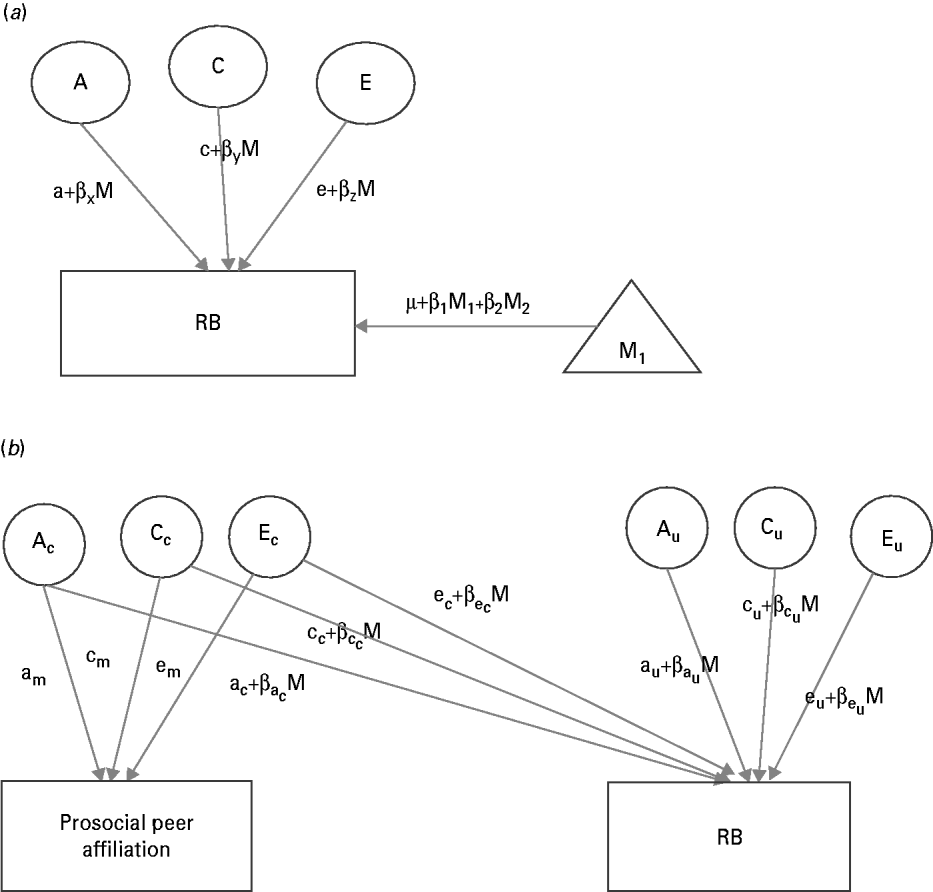
For our primary analyses, we evaluated how prosocial peer affiliation might moderate the etiology of RB using the ‘extended univariate G × E’ model (van der Sluis et al. Reference van der Sluis, Posthuma and Dolan2012), an extension of the univariate G × E model (Purcell, Reference Purcell2002). Using the extended univariate G × E model (Fig. 1 a), the variance decomposition of RB was modeled as a function of prosocial peer affiliation. To circumvent possible r GE confounds, the moderator values of both twins were entered in a means model of each twin's RB. Moderation was then modeled on the residual RB variance (i.e. that which does not overlap with prosocial peer affiliation). The first and least restrictive of these models allows for both linear and non-linear moderation of A, C and E contributions to RB. We then fitted a series of more restrictive moderator models, constraining the linear and non-linear moderators to zero and evaluating the reduction in model fit.
(a) The extended univariate G × E model. (b) The bivariate G × E model. A, C and E represent genetic, shared environmental and non-shared environmental influences respectively. For ease of presentation, the co-twin variables and paths are omitted here, although they are estimated in the models. In the extended univariate twin model (van der Sluis et al. Reference van der Sluis, Posthuma and Dolan2012), interactions with the linear moderator are added to the genetic and environmental paths, and are estimated separately for each component of variance (i.e. β xM, β yM and β zM for a, c and e paths respectively). The non-linear moderators are not shown. In the bivariate G × E model (Purcell, Reference Purcell2002), AC and AU respectively represent genetic influences on rule-breaking (RB) held in common with the moderator (prosocial peer affiliation; labeled M above) and those unique to RB. Interactions with the moderator are added to these common and unique genetic influences. Only the latter are thought to index ‘true’ G × E.

The extended univariate G × E model is fairly flexible. Twins are not required to be concordant on the value of the moderator (although they can be), and the moderator can be either continuous or categorical but should include zero. The moderator was examined continuously here, although it was floored at zero prior to analysis (and thus ranged from 0 to 10). Purcell (Reference Purcell2002) also recommends that unstandardized estimates be presented for all G × E models, as standardized or proportional estimates can obscure absolute changes with the moderator. We thus standardized our log-transformed RB score to have a mean of zero and a standard deviation of one to facilitate interpretation of the unstandardized parameter estimates.
Mx, a structural equation modeling program (Neale et al. Reference Neale, Boker, Xie and Maes2003), was used to fit models to the transformed raw data using full-information maximum-likelihood raw data techniques. When fitting models to raw data, variances, covariances and means are first freely estimated to get a baseline index of fit (minus twice the log-likelihood; −2lnL). Model fit for the more restrictive biometric G × E models was then evaluated using four information theoretic indices that balance overall fit (through −2lnL) with model parsimony: Akaike's Information Criterion (AIC; Akaike, Reference Akaike1987), Bayesian Information Criterion (BIC; Raftery, Reference Raftery1995), the sample-size adjusted BIC (SABIC; Sclove, Reference Sclove1987) and the deviance information criterion (DIC; Spiegelhalter et al. Reference Spiegelhalter, Best, Carlin and Van Der Linde2002). The lowest or most negative AIC, BIC, SABIC and DIC among a series of nested models is considered best. Because fit indices do not always agree (they place different values on parsimony), we reasoned that the best-fitting model should yield lower or more negative values for at least three of the four fit indices (as in Hicks et al. Reference Hicks, South, DiRago, Iacono and McGue2009).
Confirmatory analyses
To evaluate the robustness of our primary G × E results, we conducted four sets of confirmatory analyses.
Analysis 1
van der Sluis et al. (Reference van der Sluis, Posthuma and Dolan2012) recommended that researchers confirm positive findings of etiological moderation using the bivariate G × E model (see Fig. 1 b; Purcell, Reference Purcell2002) because the extended univariate G × E model is unable to disambiguate moderation of the covariance between the moderator and the outcome from moderation that is unique to the moderator (only the latter of which represents ‘true’ G × E). The bivariate G × E model overcomes this limitation because the moderator is entered twice: once as a variable that is allowed to correlate with the outcome and once as the moderator. Although useful for ensuring that positive univariate G × E results index true etiological moderation, the bivariate G × E model suffers from issues of identifiability (Rathouz et al. Reference Rathouz, Van Hulle, Rodgers, Waldman and Lahey2008). Given these problems, we restricted our core G × E analyses to the extended univariate model, and made use of the bivariate model to confirm those results.
Analysis 2
We also sought to confirm that our results persisted to individual informant-reports of RB and prosocial peer affiliation. We thus reran our primary G × E analyses separately by informant, examining whether evidence of moderation persisted to maternal and paternal informant-reports respectively.
Analysis 3
We sought to evaluate whether the effects of prosocial peer affiliation on RB were in fact a function of (reverse-scored) delinquent peer affiliation. In other words, prosocial peer affiliation may influence RB by limiting (or, in its absence, promoting) opportunities to affiliate with delinquent peers. We empirically examined this possibility by allowing prosocial and delinquent peer affiliation (as assessed by five items on the Friends Inventory; e.g. ‘My child's friends steal things'; α = 0.95) to simultaneously moderate the etiology of RB through a two-moderator model (Purcell, Reference Purcell2002).
Analysis 4
As a final check, we sought to address the well-known observation that MZ twins share friends more often than do DZ twins. In these data, for example, 67.9% of MZ twins shared all or nearly all of their friends versus 40.7% of DZ twins. To evaluate whether this differential sharing of friends influenced our results, we repeated our primary analyses on those twin pairs who shared all or nearly all of their friends (267 pairs, of which 168 were MZ).
Results
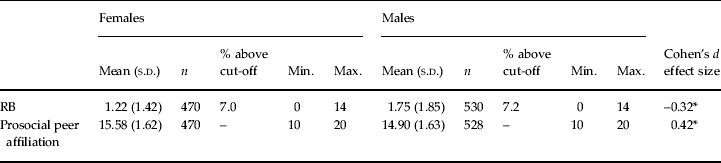
The mean levels of RB and prosocial peer affiliation varied significantly across sex (see Table 1), such that boys evidenced higher rates of RB and lower rates of prosocial peer affiliation than girls (both p < 0.05). Although prosocial peer affiliation was not significantly associated with twin age (r = –0.05, n.s.), RB demonstrated a small negative association with age (r = –0.08, p < 0.05). As such, sex, age, and their interaction were regressed out of the data prior to analysis (McGue & Bouchard, Reference McGue and Bouchard1984). RB was negatively associated with prosocial peer affiliation (r = −0.22, p < 0.001).
Descriptive statistics

RB, Rule-breaking; Min., minimum; Max., maximum; s.d., standard deviation.
Percentage above cut-off refers to the proportion of participants who scored in the marginal or clinically significant range on the RB scale by either mother or father report, as defined in the Child Behavior Checklist (CBCL) manual (Achenbach & Rescorla, Reference Achenbach and Rescorla2001). RB could conceivably range from 0 to 34. Prosocial peer affiliation could conceivably range from 5 to 20. Means were compared across boys and girls using independent samples t tests.
* p < 0.01.
Primary analyses
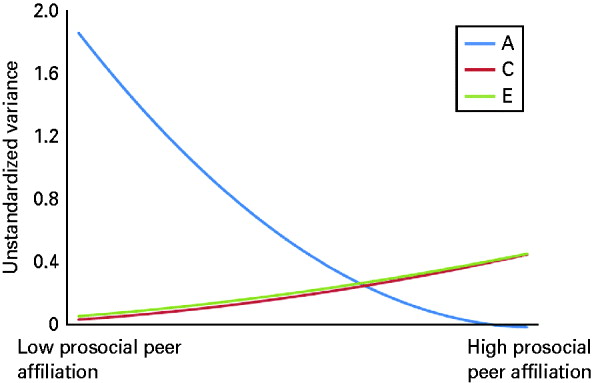
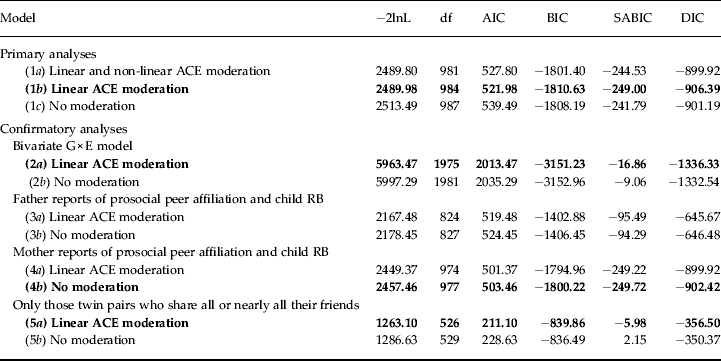
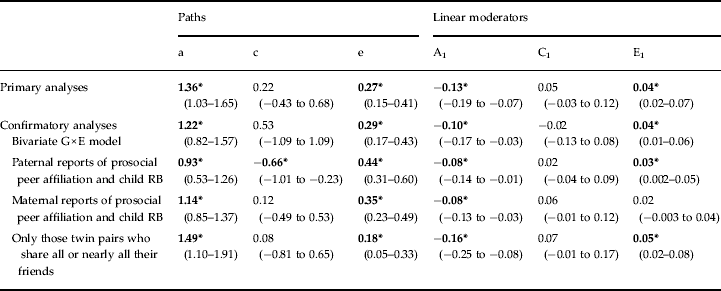
There was clear evidence of linear moderation of RB by prosocial peer affiliation (see Table 2)Footnote 2 . These results imply that the etiology of RB varies with prosocial peer affiliation, and does so independently of any r GE processesFootnote 3 . We made use of the estimated paths and moderators from the linear moderation models (see Table 3) to calculate and plot (see Fig. 2) the unstandardized genetic and environmental variance components at each level of prosocial peer affiliation. Non-shared environmental effects were observed to increase slightly, if significantly, with increasing prosocial peer affiliation. Genetic variation, by contrast, was observed to decrease with increasing levels of prosocial peer affiliation, such that genetic influences on RB at high levels of prosocial peer affiliation were several-fold smaller than those at low levels of prosocial peer affiliation.
Etiological moderation of rule-breaking (RB) by prosocial peer affiliation. A, C and E represent genetic, shared and non-shared environmental influences respectively. These estimates index the absolute (unstandardized) changes in genetic and environmental variance in RB by prosocial peer affiliation in the best-fitting model (model 1b in Table 2). The specific path estimates are presented in Table 3.

Fit indices

df, Degrees of freedom; AIC, Akaike's Information Criterion; BIC, Bayesian Information Criterion; SABIC, sample size-adjusted BIC; DIC, deviance information criterion. A, C and E represent genetic, shared environmental and non-shared environmental influences respectively.
The best-fitting model for a given set of analyses is highlighted in bond font, and is indicated by the lowest AIC, BIC, SABIC and DIC values for at least three of the four fit indices.
Unstandardized path and moderator estimates for full linear ACE moderation models

A, C and E (upper and lower case) respectively represent genetic, shared and non-shared environmental parameters on rule-breaking (RB). Bold font and an asterisk indicate that the estimate is significant at p < 0.05. Primary analytic results are presented at the top of the table. Because low prosocial peer affiliation was dummy coded as 0, the genetic and environmental contributions to RB at this level can be obtained by squaring the path estimates (i.e. a, c and e). At each subsequent level, linear moderators (i.e. A1, C1, E1) were added to the paths using the following equation: unstandardized variancetotal = [a + A1(prosocial peer)]2 + [c + C1(prosocial peer)]2 + [e + E1(prosocial peer)]2. The variance component estimates calculated this way are presented in Fig. 2. Confirmatory analytic results are presented in the lower part of the table. Note that, for the bivariate G × E model, only the moderators of the unique (i.e. RB specific) genetic and environmental influences are presented (the moderators of the common genetic, shared and non-shared environmental influences were uniformly non-significant).
Values in parentheses are 95% confidence intervals.
Confirmatory analyses
Do our findings of moderation persist to the bivariate G × E model?
We sought to further confirm the above results using the bivariate G × E model (Purcell, Reference Purcell2002), as recommended by van der Sluis et al. (Reference van der Sluis, Posthuma and Dolan2012). The results (presented in Tables 2 and 3) indicate that the above results index actual genetic moderation of RB by prosocial peer affiliation rather than moderation of the covariance between RB and prosocial peer affiliation, bolstering confidence in our primary results.
Do our results persist to individual informant-reports?
To confirm that our results were not unduly influenced by our use of RB and prosocial peer affiliation composites, we reran our primary G × E analyses separately by informant. Although the linear moderation model did not provide a particularly good fit to the data relative to the no moderation model (Table 2), inspection of the path and moderator estimates (Table 3) suggest that this is due to the small and largely non-significant C and E moderators. Indeed, the A moderators were statistically significant and similar in magnitude to those reported above. We thus conclude that our results are largely robust to informant considerations.
Do the above results stem from an absence of affiliation with delinquent peers?
To confirm that our primary G × E results were a function of prosocial peer affiliation itself rather than a reflection of low delinquent peer affiliation, we fitted a two-moderator model to the data, in which we allowed prosocial and delinquent peer affiliation to simultaneously moderate the etiology of RB. The best-fitting model (results not shown) was one in which A and E contributions to RB were uniquely moderated by prosocial peer affiliation (the moderators were estimated at –0.11 and 0.06 respectively; both p < 0.05), whereas shared environmental contributions to RB were uniquely moderated by delinquent peer affiliation (the C moderator was estimated to be 0.11; p < 0.05; see Burt & Klump, Reference Burt and Klump2012, for a more detailed exploration of the delinquent peer affiliation results). There is thus little empirical support for the proposition that the moderation of genetic influences by prosocial peer affiliation is a function of reverse-scored delinquent peer affiliation.
Does the differential sharing of peers by MZ and DZ twins influence our results?
As a final check on our results, we sought to evaluate whether our finding of genetic moderation was influenced by the fact that MZ twins share peers more often than DZ twins. We therefore repeated analyses on those pairs who shared all or nearly all of their friends. The results are very much in line with those reported earlier (see Tables 2 and 3). We thus conclude that the higher level of peer similarity seen for MZ compared to DZ twins does not seem to be substantively influencing our results.
Discussion
The aim of the current study was to evaluate whether prosocial peer affiliation served to suppress genetic influences on non-aggressive antisocial behavior. The results robustly supported this possibility: genetic influences on RB were observed to be several-fold larger in those with low levels of prosocial peer affiliation than in those with high levels of prosocial peer affiliation. In other words, RB seems to be primarily genetic in origin at low levels of prosocial peer affiliation, but primarily environmental in origin at high levels of prosocial peer affiliation. Confirmatory analyses further revealed that these results were independent of delinquent peer affiliation, and persisted when restricting our analyses to those twins who shared all or nearly all of their friends. Moreover, the moderation of genetic influences could not be explained by r GE. Such findings collectively suggest that prosocial peer affiliation acts as a potent moderator of genetic influences on non-aggressive antisocial behaviors.
These results are notably consistent with those of the only similar study conducted to date. Hicks et al. (Reference Hicks, South, DiRago, Iacono and McGue2009) examined whether several different environmental risk factors, including reverse-scored prosocial peer affiliation, moderated the etiology of a broad substance abuse/externalizing composite in a large sample of late-adolescent twin pairs. Their results revealed that genetic influences on adolescent externalizing were significantly more pronounced in those with low levels of prosocial peer affiliation. The current study replicated and extended these results to the developmental period of childhood, an important advance given that childhood-onset antisocial behavior is thought to represent a more severe and persistent form of the disorder (Moffitt, Reference Moffitt1993).
Despite this consistency with prior work, there are limitations to the our study. First, the current sample consists largely of healthy families from middle-class backgrounds. Clinically meaningful levels of RB were thus relatively low in our data (roughly 7%). Future research should seek to extend the current findings to higher-risk samples. Second, although our sample is only moderately sized by current twin study samples, previous power analyses (Purcell, Reference Purcell2002) suggest that it is more than adequate for the G × E models used here. Nevertheless, analyses incorporating sex would probably be unwieldy and underpowered in this sample. It thus remains unclear whether the G × E interactions identified here vary across sex, although it is worth noting that heritability estimates for antisocial behavior in general do not vary significantly across sex (Burt, Reference Burt2009a ,Reference Burt c ).
Conclusions
The findings of the current study have several important implications. First, delinquent and prosocial peer affiliation do not seem to function as mirror images of one another at the etiologic level, at least during childhood. Prosocial peer affiliation was found to moderate genetic influences on RB whereas delinquent peer affiliation moderated only the shared environmental component of variance. Although it is unclear how to account for these differences, it may be that affiliation with delinquent peers during childhood stems primarily from social rejection/limited social opportunities (Hektner et al. Reference Hektner, August and Realmuta2000; Deater-Deckard, Reference Deater-Deckard2001). By adolescence, however, genetic influences largely account for the link between delinquent peer affiliation and RB (Rowe & Osgood, Reference Rowe and Osgood1984; Cleveland et al. Reference Cleveland, Wiebe and Rowe2005; Button et al. Reference Button, Corley, Rhee, Hewitt, Young and Stallings2007; Harden et al. Reference Harden, Hill, Turkheimer and Emery2008; Beaver et al. Reference Beaver, DeLisi, Wright and Vaughn2009; Hicks et al. Reference Hicks, South, DiRago, Iacono and McGue2009). As an example, Kendler et al. (Reference Kendler, Jacobson, Myers and Eaves2008) examined retrospectively reported conduct disorder and delinquent peer affiliation at ages 8–11, 12–14 and 15–17 years. Shared environmental contributions to peer deviance influenced conduct disorder, but only during late childhood and mid-adolescence (r C = 0.92, 0.51 and 0.00 at ages 8–11, 12–14 and 15–18 years respectively; Kendler et al. Reference Kendler, Jacobson, Myers and Eaves2008). These findings have collectively been interpreted to suggest that, although socialization may underlie the association between peer deviance and antisocial behavior during childhood, their association in adolescence stems more from selection processes (Kendler et al. Reference Kendler, Jacobson, Myers and Eaves2008). The current results circumstantially support this possibility, while also suggesting that it does not extend to prosocial peer affiliation.
Second, our findings of latent G × E also have key implications for molecular genetic research (Kendler, Reference Kendler2005). The suppression of genetic influences by prosocial peer affiliation implies that efforts to identify genetic main effects may be hampered by genetic suppression in particular environmental contexts. Moreover, the sheer magnitude of the reduction in genetic influences seen here further implies that efforts to identify the genes underlying G × E should be extended beyond small numbers of specific candidate genes. In particular, molecular G × E research to date has focused on the moderation of a single polymorphism within a single gene. The results are thus so specific that they are likely to represent only a very small part of the overall causal pathway in complex biobehavioral phenomena (such as RB). Future molecular genetic research should seek to examine G × E for multiple genes in concert, perhaps using genome-wide association studies (GWAS).
Next, empirical studies of G × E have all but exclusively focused on the activation of genetic vulnerabilities by environmental risk factors. This conceptualization of G × E is based primarily on the diathesis–stress model, in which a biological vulnerability (the diathesis) interacts with environmental events (stressors) in the onset of a particular disorder. Although this particular manifestation of G × E has received extensive empirical support (see Hicks et al. Reference Hicks, South, DiRago, Iacono and McGue2009, for one example), other manifestations are also possible. Indeed, from a biological standpoint, it seems unlikely that genotypic expression would be altered only in response to deleterious experiences. Positive or protective experiences may also modulate the expression of genetic risk (note that protective factors are specifically conceived of as positive or prosocial aspects of the environment rather than just the absence of risk; for example, the absence of parental criticism does not equate to the presence of parental praise). We would specifically expect protective experiences to promote resilience to genetic risk (sometimes referred to as ‘social context as compensation’; Shanahan & Hofer, Reference Shanahan and Hofer2005). In other words, ‘G × E protection’ could serve to suppress genetic influences on a given disorder by reducing the consequences of inherited genetic risk (Lahey & Waldman, Reference Lahey, Waldman, Lahey, Moffitt and Caspi2003; Shanahan & Hofer, Reference Shanahan and Hofer2005; Rutter et al. Reference Rutter, Moffitt and Caspi2006). Although a provocative idea, to date very little empirical research has examined this proposition. The current study did just this, and found compelling evidence that (at least one) protective aspect of the social environment promotes resilience to genetic risk. Future research should continue to explore the role of protective experiences in modulating genetic risk for psychopathology.
Finally, the results of the current study also help us to understand how socialization with prosocial peers protects against the development of antisocial behavior. Rather than solely reflecting a main effect of the environment, prosocial peer affiliation seems to suppress genetic influences on antisocial behavior. And because prosocial peer affiliation is thought to reduce antisocial behavior through the reinforcement of prosocial inclinations and activities (Huey et al. Reference Huey, Henggeler, Brondino and Pickrel2000), these results could imply that behavioral reinforcement may act to shape the biology underlying those behaviors. Consistent with this possibility, prior work has linked behavioral reinforcement conditioning to dopaminergic neurons in the midbrain and prefrontal cortex (Schultz et al. Reference Schultz, Dayan and Montague1997; Dayan & Balleine, Reference Dayan and Balleine2002; Schultz, Reference Schultz2002). Future work should thus explore the possibility that prosocial peer affiliation may (de)activate genes in the dopaminergic system and, moreover, may accomplish this moderation through simple reward and reinforcement learning.
Acknowledgments
This project was supported by R01-MH081813 from the National Institute of Mental Health (NIMH), awarded to Drs Burt and Klump. The content is solely the responsibility of the authors and does not necessarily represent the official views of the NIMH or the National Institutes of Health (NIH). We thank all participating twins and their families for making this work possible.
Declaration of Interest
None.