Opera's vanishing acts: methods and meanings
In the twenty years that Cambridge Opera Journal has been publishing, the study of opera has undergone one transformation after another. If there is a guiding thread amid the resulting heterogeneity, that thread may be heterogeneity itself, or more precisely the recurrent experience of a break with homogeneity. Opera, we have come to understand, is not a species of musical composition that branches, tree-like, into the subordinated extensions of a libretto and various productions. (In the language of Deleuze and Guattari, already in motion here, opera is not arborescent but rhizomatic.Footnote 1) No: opera is a densely multi-mediated form, if form it is, of theatrical presentation in which no element has absolute priority. Operas are not ‘works’ in the same sense (but even this is a changing sense) that symphonies and quartets are. Operas are engines of performativity that may metamorphose indelibly as a result of particular performances or productions. And as with form, so with content. We have come to feel comfortable with opera not only as musical theatre but also, and precisely because it is both musical and theatrical (and literary, and gestic, and ritualistic, and cinematic, and technological, and …), with opera as the theatre of the heteroclite: an embodied force (as in illocutionary force) that pushes the boundaries of norm and normality, social and cultural regulation, sexual identity and orientation, narrative distance and dramatic immediacy, historical and linguistic particularity. Opera is a glorious and impure mixture of this and that: a mêlée. And so, nowadays, is the study of it.
Which leaves us where? One possible consequence of this operatic outbreak of particularity is a loss of meaning, in the sense that meaning, as such, presumes a degree of continuity and transmissibility from one event to another. To some degree, this loss is its own kind of gain, an invitation to absorb oneself in and to enjoy the minute particulars of life in (and as) opera. But when this revelry in the particular carries over into intellectual ventures, it runs the risk of mistaking myopia for understanding, absorption for insight. Precisely because opera tends, and its study has been tending, towards a kind of phantasmagoria, a swirl of sounds and images irreducible to any social, historical or material reality, it is important to disengage from the fantasy without entirely relinquishing it so as to perceive the fantasmatic scene against a horizon of provisional coherences.
Both the ends and the means of doing so were articulated memorably by that great theorist of phantasmagoria, Walter Benjamin. All one has to do is think ‘opera’ where he refers to literature: ‘What is at stake is not to portray literary works in the context of their age, but to represent the age that perceived them – our age – in the age during which they arose. It is this that makes literature the organon of history; and to achieve this, and not to reduce literature to the material of history, is the task of the literary historian.’Footnote 2 This task of representation requires that the past be mediated through concepts that come to belong to it, to have always belonged to it, only, and inevitably, after the fact. (And yes, inevitably: because there is no such thing as ‘the past’ until it has been mediated by a present that both repeats and recasts it.) The result is an archaeology of knowledge, not in Michel Foucault's celebrated sense of the term, but of its mirror reversal: a digging up of the remnants of the present in the past.
The following essay is an attempt to illustrate the kind of historiography that Benjamin's formulation points to: history without historicism. Just for that reason, the essay also proposes to stand on its own as a study of a particular opera, Wagner's Tannhäuser. Or rather, since heterogeneity is our theme, what follows is a study of no particular opera, for of course there is not one. Late in life Wagner famously quipped (but with a straight face) that he still owed the world Tannhäuser and the debt is still outstanding. Nothing that follows seeks to pay up. This essay was, as a simple matter of fact, inspired by one particularly bleak staging of the opera's Paris version and more particularly of its third act, replete with a formerly impassioned Elisabeth now barely able to walk as she dragged herself off stage, a Wolfram haggard and unshaven as he memorialised her, a Tannhäuser stony faced and convulsive as he expired, and a Venus particularly dignified when she returned to offer the rejected hero a place of refuge.Footnote 3
But the remarks to come are not about this instance. Instead they tacitly construe a more general Tannhäuser that the instance happened to make apparent and available, as any instance might have done, though not always to the same end. The exact wording is important here: I did not refer to the more general Tannhäuser but to a more general Tannhäuser, one member of the Tannhäuser family. This is not an essay about an opera but about the persistent possibility of an opera, in particular about an opera situated at the intersection of a historically sensitive modern production and an important vicissitude of nineteenth-century culture.
The reading that results floats among all four versions of Tannhäuser as prepared by Wagner: the original Dresden version of 1845, its revision of 1847, the original Paris version of 1861, and its revision of 1875.Footnote 4 In one sense the reading floats free, as a production might; it is as much an approach to the culture through the opera(s) as it is the converse, and the meanings it invokes shift their historical location at will or at need. In another sense the reading is irreducibly contingent; the possibility of making it is clearly indebted, perhaps essentially so, to the expansion of the roles of both Venus and the Venusberg in the Paris versions. Wagner's decision to let the seams show in Paris by composing the Venusberg bacchanal in a post-Tristan style irrevocably historicises any version of the opera regardless of which one (or which mix) is being performed on a given occasion. The changes of 1861 and 1875 do not so much represent a reconception or elucidation of an original as they make the conception of a certain Tannhäuser, as Benjamin said of a past that has become ‘citable in all its moments’, a citation à l'ordre du jour.Footnote 5 Benjamin was talking about redemption, but then, so was Wagner.
The plural identity of Tannhäuser raises with particular sharpness the issue that any understanding of opera as a fundamentally unfinished form must take on board: how do staging and performance affect meaning? Add it, remove it, change it, supplement it, represent it, trope on it, argue with it, reveal it or obscure it? Or rather, since the answer to each of these possibilities is ‘yes’, when, how and to what end? The literary critic Frank Kermode once wrote that all narrators are unreliable. The only question about them is: in what way?Footnote 6 In the same spirit one might say that all operas lack a definitive version; they are all Tannhäusers and the only question about them is: in what way? The account in this essay depends on an understanding of Tannhäuser as a work of singular bleakness, a self-accusatory allegory that defaults on its own supposed logic of redemption. (And yes again: when all is said and done, still a work, just always a work still owed, and with interest.) But of course the opera can be realised otherwise. So just what, here, are we ‘understanding’? Does this, or any, hermeneutic of opera have an object other than itself?
Take Wolfram's ‘Hymn to the Evening Star’. It was Wagner's most popular piece in the nineteenth century. Listeners in the theatre, the recital hall and the parlour clearly took it (and its arrangements; there is – was – no ‘the’ Hymn) at face value, as put there by Wolfram whether or not it was put there by Wagner (and if it was, so what?). Those who enjoyed it found the hymn both beautiful and edifying. How can one justify claiming that it not only can but should be heard otherwise?
One answer is: you can't. On the principle that context determines text, the hymn is edifying, period, at least in practice and probably in intent; it is without ambiguity or remainder and to realise it otherwise is to argue with Wagner and his age. (That will not stop opera companies from arguing, but for some reason it is supposed to settle scholarly arguments.) But another answer is: the question is mistaken, and so is the principle behind it. On the counter-principle that text conditions context, the question of why the nineteenth century heard the hymn as unproblematically edifying is probative, a hermeneutic window, whereas the simple statement that it is, or is not, edifying is inert.
If the era followed Wolfram, and perhaps Wagner, in idealising both his own suffering and Elisabeth's, if it followed Wolfram, and certainly Wagner, in eroticising that suffering, there must have been something serious at stake, something into which ‘the’ opera Tannhäuser compellingly tapped. Perhaps (and we have to venture a ‘perhaps’ here; there is no rule to follow) the hymn's lush aestheticising of suffering is a means of acknowledging and becoming reconciled with a social or cultural or even economic principle that demands the very privation the hymn deplores. Perhaps whatever higher value the hymn supposedly embodies is accessible only through its absence. What follows is an amplification of this ‘perhaps’.
Economies of redemption
For the later nineteenth and early twentieth centuries, Tannhäuser's combination of religiosity, art-worship and adoration of a nearly gratuitous feminine self-sacrifice made for a very intoxicating brew. The question addressed by this mixture of tropes is precisely the question of mixture itself, a question posed by the need to isolate, police, contain or at least manage a threatening Otherness native to the presumed homogeneity of Europe's exemplary culture, which for Wagner of course meant German culture. For Wagner (and many others) this was often an inner Orient, the pagan-Eastern clamour of aggressive seductiveness lodged within the harmony of Christianised song. It is an Otherness identified with both unrestrained sexuality and uncontrollable modernity, two temptations that are at bottom, in this context, the same thing. Venus and her later counterpart Kundry not only exemplify this condition; they are well aware of it, like it (Venus) or not (Kundry).
A key feature of Wagner's lifelong critique of modernity involves what in Marxian terms would be called exchange value. The moment that the commodity form becomes possible, permitting a price to be put on anything (and anyone), real value is irrevocably lost. In the pre-modern world of authentic value, as Wagner imagines it, exchange in the sense of equivalent substitution is an impossibility, and it leads only to tragedy where it is tried. Precious things, and above all precious persons, cannot be displaced into ersatz forms. Or, in the language of Wagner's own paradigmatic instance, a Freia is always worth more than her weight in gold.
Tannhäuser pivots on just this problem. The hero begins by seeking to renounce Venus in favour of Elisabeth, whom he has already replaced by Venus, and so fully that he seems virtually to have forgotten Elisabeth altogether. (In both Act I and Act III Tannhäuser is reminded of Elisabeth's existence by the lyrical invocation of her name. Her off-stage death, even in its sacrificial aspect, is the metaphorical equivalent of his forgetfulness. Like her name, her body, when it is finally borne before him on its bier, turns out to be a relic, the signifying trace of a spirit known only in absentia.) Once reunited with Elisabeth, however, Tannhäuser discovers that his original act of substitution has locked him permanently in a system of debasing exchanges. In the pivotal song contest of Act II, which is addressed to Elisabeth as interlocutor, Tannhäuser finds that he can conceive of love only in Venerian – not to say venereal – terms. Elisabeth is no longer his original beloved; she has become a substitute for the Venus who replaced her. Later, in despair at the Pope's refusal of his penance, Tannhäuser once again attempts to substitute Venus for Elisabeth, and then, once again reminded of the latter, tries one last time to reverse the substitution. But he dies – unceremoniously, almost hurriedly – in the act. I hear the conclusion that follows as the bleakest in all of Wagner. The final return of the Pilgrims' chorus celebrates a redemption that, in dramatic and musical terms, has not happened except as a cruel joke. As we will see below, the ending of the opera is a far cry from the familiar ending of the concert version of its overture.
These issues can usefully be explored with a theoretical concept drawn from the French theorist Jean-Joseph Goux, who – borrowing the term from Marx – proposes a cultural theory of what he calls the general equivalent.Footnote 7 For Marx, the general equivalent is the standard by which the value of different commodities can be measured and thus compared; the traditional instance is gold. Goux, so to speak, generalises on the theory of the general, and expands the concept of the general equivalent to cover the fields of culture, language and the psyche.
According to Goux, the general equivalent that forms the measure of universal value within one of these fields must itself be excluded from the field it covers. (The theory resembles several others that root cultural formation in strategic exclusion: Giorgio Agamben's argument, indebted to Carl Schmitt, that sovereignty depends on a state of exception exempt from its own rules, and Jacques Derrida's argument, indebted to Walter Benjamin, that the law is excluded from the law.Footnote 8) The general equivalent must be held in reserve rather than be expended or circulated; in the traditional and now long-gone gold standard, the gold sits in a vault while paper notes referring to it circulate as the basis of commerce. The general equivalent is what makes symbolic exchange possible, but only at the cost of permanently withholding the underlying realities from the symbolic playing field.
Goux identifies four general equivalents, which are supposed to constitute a historical survey as well as a theoretical profile. In addition to gold, or more broadly real capital, which rules over the economy, there are the phallus, the father and language, which rule, respectively, over the object, the subject and the sign. And they rule, or the theory says they must, only as long as they remain absent presences. They rule by being held in reserve, under the auspices, respectively, of castration, law, and authoritative speech, the elements that constitute what Jacques Lacan calls the symbolic order or, alternatively, the big Other.Footnote 9
This theory is highly suggestive, but there are some obvious problems with it, beginning with its unreflective attitude towards its controlling framework, Lacanian psychoanalysis. For a theory meant to have wide generalising powers, Goux's account of the general equivalent is far too embedded in a particular, historically limited or situated discourse. The theory forms part of the cultural situation that it seeks to explain. It seeks generalising power by gathering the Lacanian triad of father, phallus and language under the broader aegis of the standard of value, a concept of wider range, but it is not clear whether to do this is to go far enough. To a significant degree, the theory itself becomes a general equivalent, something that, on its own terms, can happen only if the possibility of questioning – that is, of contextualising, rereading, metaphorising – its Lacanian premises is excluded from the outset.
To this theory, then, go two revisions meant to ripple across a genuinely wider range of concepts and phenomena. First, the exclusion of the general equivalent from its own field of coverage is not a given or achieved condition, nor can it be taken as a matter of principle as with the psychoanalytic father or phallus. Rather the exclusion is the outcome of a social or symbolic drama, defined in contingent terms, that must be regularly repeated, staged, in order to maintain the consistency (and prevent changing the consistency) of the cultural field.Footnote 10 Thus the exclusion is never stable, never complete, and so never beyond question; yet it is impossible to cancel except by anarchic violence or chaos.
Second, other general equivalents than Goux's tetrad are possible, one of which – heterosexual love – took centre stage in the nineteenth century, particularly in the works of Wagner, which were influential in its dissemination. The formula of exclusion is clear enough in general here: Wagner takes sexual consummation as the standard of human happiness and even human definition, but almost always either denies it to his characters (who embrace death instead) or grants it under conditions of transgression that render it ‘impossible’ (Siegmund and Sieglinde, Siegfried and Brünnhilde).
As a supplement to its allegorical presence in the operas, the Wagnerian general equivalent exerted its logic of inclusion-by-exclusion in concert performances of Wagner's music without voice. In the nineteenth century, probably the most potent example was a work that, though still quite popular today, has long since lost the radical force it had at the time, the overture to Tannhäuser. Up to perhaps the era of the First World War, the distinction between early and later Wagner was not drawn as sharply as it would be later. Wagner was often taken as all of a piece, and the music of Tannhäuser in particular was venerated for its amalgam of sensuous and spiritual power.
Willa Cather's story ‘A Wagner Matinée’ (c. 1902) reflects both these tendencies, and it is suggestive that its fictional concert begins with the Tannhäuser overture. ‘When the horns drew out the first strain of the Pilgrims' chorus’, the narrator reports,
my aunt Georgiana clutched my coat sleeve … With the battle between the two motives, with the frenzy of the Venusberg theme and its ripping strings, there came to me an overwhelming sense of the waste and wear we are powerless to combat; and I saw again [her] tall, naked house on the prairie, black and grim as a wooden fortress.Footnote 11
The waste and wear find their answer in the narrator's subsequent reflections (between this overture and the Prelude to Tristan und Isolde), which place him in a spiritual condition closely modelled on that of Wolfram in Act III of the opera:
The overture closed, my aunt released my coat sleeve, but she said nothing … When [as a boy] I had fallen ill with a fever in her house she used to sit by my cot in the evening – when the cool night wind blew in … and I lay watching a certain bright star that burned red above the cornfield.Footnote 12
The narrator's mixture of personal recollection, narrative awareness and musical observation would not have surprised Franz Liszt, who as early as 1850 had written of the Overture that it could express itself fully even to those listeners who did not know the opera: its narrative was crystal clear.Footnote 13 And that narrative can be, should be, paraphrased as a dramatisation of the exclusion that creates a general equivalent. Cather's story does exactly that through its veiled protagonist, the narrator's aunt, the waste and wear of whose life on the prairie has excluded her from both music and romantic love for thirty years. Yet true to the logic of inclusion by exclusion, it is precisely the waste and wear that make the Wagner matinée a shattering epiphany for aunt and nephew alike; the privation is transcendent and – therefore – the transcendence is privative.
The expense of spirit – modernity and its costs
In its genre affiliations and its setting, Tannhäuser does seem to rely on one of Goux's general equivalents, that of the symbolic father (the paternal law, the Lacanian name-of-the-father) as the ruler over the human subject. Cather's story, written during the height of American Wagnermania, strangely invokes Wagner's own name in that role. Tannhäuser ostensibly recalls the names of the Emperor and Pope, but the opera's reliance on the paternal principle is actually much more diffuse, and therefore more pervasive. The force of the Father accrues to the absence of his – its – effective embodiment. As a national opera set in the Middle Ages, with real historical figures among its characters, Tannhäuser associates authenticity with ancestry and mobilises the prestige of the national patrimony against a debased modernity. The opera's world is one in which only ‘primal’ things reign – love, desire, temptation, sacrifice, redemption; there is no technology and the only commodity is song. As a mythological opera, Tannhäuser personifies the side of human subjectivity ruled by paternal law in the figure of Venus, who, herself unruly, is confined by the Venusberg over which she nominally presides. And as a religious opera, or rather an opera of religiosity that deploys the imagery of sin and redemption as signs of authenticity in keeping with its Romantic medievalism, Tannhäuser stakes its action on a patriarchal principle, nowhere more forcibly than in the Pilgrims' chant of the Overture with its booming ecclesiastical brasses.
These medieval and national elements coalesce to find their modern antagonists in the sensuous orchestration and chromatic harmony of the Venusberg music, which both mocks and seeks to obliterate the severe piety of the Pilgrims' chant. The famous history of Wagner's revisions of this music underscores the force of the symbolism. Originally composed in 1843, two years before the opera's first version was finished, the Venusberg music as revised and enlarged for Paris in 1861 was pushed to, and perhaps beyond, the outer limits of available chromaticism. The performance was a famous fiasco, but the point here is the self-conscious act of modernisation. As a dramatic device, the Venusberg may look like a pagan survival, but what it represents, and the music that represents it, is as ultramodern and as decadent as possible. The mother goddess attacks the father's law not on the basis of ancient priority, as the primeval origin of all things, but on the basis of advanced technique and canny, up-to-date invention.
But this age-old antagonism at the level of the general equivalent, this ramped up version of the argument between Sarastro and the Queen of the Night in Mozart's The Magic Flute, is only a part of the story, and not the most important part. After all, the legend Wagner chooses concerns the failure of the Catholic Church; the paternal law proves inadequate quite independently of anything Venus does or does not do. The fervour and grandiosity of the redemptive Pilgrims' chant does not refer to the church or to any worldly institution; its referent is the selfless intercession of Elisabeth, who absolves Tannhäuser when the Pope will not. Redemption comes from feminine sacrifice, the famous (or infamous) Wagnerian surrogate for sacrificial death on the cross.
In Tannhäuser this sacrifice takes a particularly stark and severe form. Elisabeth does not receive any on-stage apotheosis to compensate her for the self-abnegation that saves her lover's soul. Unlike her sisters Senta, Brünnhilde, Isolde, even Kundry, whose silent presence in the third act of Parsifal speaks volumes, Elisabeth dies unobserved, as if wedded to the invisible instead of to Tannhäuser. Her final prayer, in Act III, is as much an expression of utter despair as an act of piety and she leaves the stage a broken woman. She is rewarded only by Wolfram's solo hymn to the evening star, which follows immediately, celebrating her sacrifice with music of grave lyrical beauty before she can actually have died. The song's professed intention is to narrate Elisabeth's death as a sacred allegory, and thus to give it the meaning that it seeks. But at the last minute the intention misfires; this song, too, ends in deep despair. It is less a proclamation of Elisabeth's death than a quasi-mystical speech-act that brings this death about in being uttered.Footnote 14
There is no worldly reason for the death itself, which follows a purely symbolic mandate, not a narrative one. Elisabeth dies because her love has turned into the wish to die, an irrepressible manifestation of a death drive very like the one Freud would name Thanatos a century later. She dies because of her belief that only her death can redeem Tannhäuser, a spiritual arithmetic not in the canon of any known church. In the event, Tannhäuser's salvation consists only in his own decidedly abject death, and there is no certainty that the moral drawn by the chorus of witnessing pilgrims – that faith in God is never misplaced – is more than ironically true.
Elisabeth seems to be seeking a state of pure subjective destitution, as Slavoj Žižek names the mode of sacrifice that accepts anonymity and therefore repeats its existential loss at the symbolic level.Footnote 15 By forgoing recognition or memory, the subject of sacrifice surrenders not only life or treasure but also the very meaning of that surrender. In a literal sense Elisabeth is denied this fate. Wolfram's song assures her symbolic survival in the very moment of her loss; it is the knowledge of her act that redeems her beloved; and her sacrifice passes into communal legend as soon as it happens. None of this, however, has formed any part of her intention; it almost contradicts her deepest intention, as her final action makes clear. When she is about to depart for the last time, and Wolfram asks if he can accompany her, she does not answer. Her sacrifice is meant to be absolute. It is only, perhaps, the necessity of dramatic presentation that recalls her to the symbolic, inevitably limiting the absoluteness of her act simply by making it known.
Tannhäuser's supposed redemption goes the other way: he grasps at a name, makes a final public gesture, but dies in the wink of an eye, uncomforted, unaware that the symbolisation that would relieve his destitution (to which he was ‘destined’ by the Pope, in another violent speech-act) has reached its destination. The irony is redoubled by the forbearance of Venus, who genuinely loves the artist-hero and has offered to forgive him without reservation – a very Christian gesture. He only fails to reunite with her because Wolfram holds him back, and it is by no means clear that Wolfram is doing him a favour. One might say from a sacralising standpoint that only the utter abnegations of Act III make redemption meaningful. But we see none of the meaning, only the two dead bodies and the broken witness between them, as the hapless trio is enveloped with the symbolic apparatus of miracle and hymn.
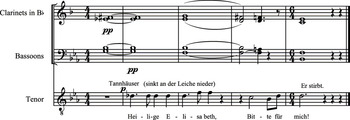
Like Elisabeth's, Tannhäuser's death has no efficient cause; it is a symbolic death, not in the sense that it symbolises something, especially not redemption, but in the sense that it materialises Tannhäuser's becoming dead to (and in) all available symbolic systems. Both the music and the action limn this destitution ruthlessly. Tannhäuser's turn towards redemption occupies a scant four bars as he sings ‘Heilige Elisabeth, bitte für mich’ (Holy Elisabeth, pray for me) and promptly expires, accompanied (until ‘mich’) only by slowly resolving dissonances on clarinets and bassoons (Ex. 1). His supplication falters a little at the key word ‘bitte’, which trails after the downbeat. As Tannhäuser dies, the approaching pilgrims lower their torches to the earth and douse them, and although the dawn that replaces their light obviously signifies impending salvation, it does not dawn for Tannhäuser, nor for Elisabeth, over whose corpse he has fallen. When the accompanying dissonances resolve at his last word, they too fall somewhat short: they carry Tannhäuser only to the third of the resolving chord, leaving a faint but perceptible question mark to hover over his supplication. And the resolution is itself problematic: it goes to B flat major (quickly becoming a B-flat-major seventh), whereas the opera ends in E flat. In other words, Tannhäuser, never the most successful of pilgrims, ends his journey somewhere amid the dominant. The grand conclusion for orchestra and chorus goes home without him.
Tannhäuser, Act III.

That this conclusion has been, so to speak, taken on faith for so long (and perhaps by Wagner, too) testifies to the power of its religious rhetoric within Western culture. But the power of the rhetoric is not a vindication of it. The high voices of young pilgrims heard at the close, whether sung by women or, as Wagner wanted, by boys, may represent a redeemed form of the first voices heard in the Venusberg, the voices of the Sirens. (But is there a strange, ironic echo of that song in the dissonant wind texture to which, or of which, Tannhäuser has died?) The substitution frames the whole opera as a union of alpha and omega, and it is reminiscent of the redemption of the Venusberg that Wagner claimed to have installed in the Overture to the Dresden version, which remains the concert standard. But the final chorus lacks the sirens' mystery (spun from an ambiguous five-note signature chord). The chorus of young pilgrims is too transparent. The same might even be said of Wolfram's Abendsternlied, a soliloquy in the form of a song, and presented as such – the belated last entry in the song contest: Tannhäuser hears Wolfram's harp. For all its exquisiteness, this is a song of defeat and is itself defeated. It is, more exactly, a song that becomes exquisite in defeat, which (so the intimation goes) may be the best any symbolic act can do, which is to say: not enough.
In the opera, then, insofar as we set it in this context, the exclusionary ritual takes the double form of Elisabeth's and Tannhäuser's deaths: the one a substitution of sacrificial love for sexual consummation, the other the substitution of a funeral rite for a marriage ceremony. That which would have been Elisabeth's by right as Tannhäuser's bride is alienated into the form of Venus and expunged; whereupon the depletion this represents for Elisabeth is enacted in its symbolic equivalent, her death as a subject of desire. Her sacrifice becomes exalted by reference to the general equivalent that it postulates, the happiness of the romantic loving couple. The reference is completed in Tannhäuser's abject end, but there the exaltation meets its limit, as the audience is asked to celebrate a non-reunion and non-communion that in the Wagnerian context looks like an advance travesty of the end of Tristan and Isolde.
Redemption in absentia: the Overture (I)
In the Overture, insofar as it glosses or encapsulates and hence helps disseminate the opera as thus understood, the exclusion also takes two forms, one programmatic, the other formal. Given that the opera is based above all on Elisabeth's sacrifice, it is nothing short of astonishing that the Overture makes no allusion to her whatsoever, either in its music or in the programme that Wagner wrote for the Zurich première in 1853. The musical material of the Overture consists entirely of the Pilgrims' chant and the Venusberg medley, the emblematic stuff of Tannhäuser's experience apart from Elisabeth. Formally speaking, the movement from sin to redemption consists of the retransition from the medley to the chant, so that the long gradual crescendo on the latter fulfils on its second audition the promise it offered on the first.
Wagner's programme associates the fading of the medley and approach of the chant, not with the spirit of renunciation and its victory over merely natural feeling, and not with a person at all, but with the purely natural passage from darkness through dawn to a radiant sunrise. In the aftermath of the bacchanal a rustle in the air lingers in the Venusberg:
over which night still spreads. – But already the morning twilight arises: from the far distance the Pilgrims' song can be heard approaching. As this song comes ever more near, as the day encroaches ever more on the night, that rustle and whir in the air lifts itself up … so that when at last the sun rises in splendour, and the Pilgrims' song … proclaims salvation won, this wave swells into a dizzying rush of sublime rapture [zum wonnigen Rauschen erhabener Entzündung].Footnote 16
Taken as a prefiguration of events in the opera, this image of daybreak refers to the moment of redemption through sacrifice; Tannhäuser dies over Elisabeth's open coffin just as the light of morning (Morgenrot) begins to brighten. But neither the programme nor the Overture represents this all-important moment. The programme elides it into the cyclical return of day from night; the salvation evoked is generic, not specific, linked to diurnal rhythm more than to narrative action. (The opera narrativises the traditional association of sunrise and salvation by marking it with the ritual extinction of the torches.) The Overture moves seamlessly from heralding the pivotal moment via the approach of the Pilgrims' chorus to celebrating the ‘sublime rapture’ of the chorus's arrival; the music gives us the transfiguration without the death. In both the narrative of the programme and the music of the Overture, the metaphor of sunrise as salvation, like the earthly relationship of Tannhäuser and Elisabeth, is suspended; its sensory form appears in the absence of its referent. Both textually and musically the sunrise does not so much signify the redemptive action as replace it. The symbol excludes what it symbolises; it removes any hint of Elisabeth's body or her name, much less of her gift of death. In so doing, it immediately generalises her role in the drama. The exclusion converts Elisabeth from a person to a principle, as she herself will ultimately do. It establishes from the outset the condition of numinous absence to which she returns in the opera by her invisible death: the condition by which, in the end, and again by an absence both narrative and musical, visible in death alone, she embodies the general equivalent of loving marriage.
The exclusion of Elisabeth in the register of content finds its counterpart – of which more later – in the expulsion of Venus in the register of form. In the Overture this more audible exclusion (not of but by the general equivalent) consists of the return of the Pilgrims' chant essentially unchanged after the passage through Venusberg. The return tries to realise the imperial fantasy of coming home from a Beyond that has left one untouched. Here the abjection of sexuality is what makes redemptive love possible – the agent in each case being an archetypal woman – so that the bliss of the excluded consummation is reregistered (not sublimated, but carried over, retranscribed) as the bliss of redemption. The fact that Elisabeth herself is not represented in the Overture is revealed by this outcome as mandatory. As the bride Tannhäuser can never have, and just for that reason his true bride, Elisabeth is also the true image of the general equivalent based on heterosexual love. The result is not simply that she cannot appear. Rather, what must appear is her non-appearance. The mixture of edification and libidinal energy that, as a consequence, swells up with the returning Pilgrims' chant is the very quality that Wagner's music was both praised and damned for eliciting, in its sacred-profane appeal and its readiness to assume cultic value.
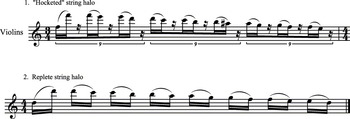
The change that does occur in the reprise of the Pilgrims' chant comes from within. The rapid string figuration that haloes the theme and swirls around its crescendo is far more intense, more ecstatic, the second time around. This figuration is the immediate location or source of the sacralised libidinal energy that invests the music at this point, and what is essential about it is that it has, and must have, nothing whatever to do with the Venusberg medley. The effect of this requirement is audible on both sides: we can hear it not only in the imperturbability with which the Pilgrims' chant returns and overwhelms the acoustic space, but also in the disintegration that overtakes the medley, which collapses abruptly into stray wisps of sound, as if to confess that it had never been very substantial in the first place. All that is left of it is an agitated murmur on the strings, which Wagner's programme identifies with the trembling of the air associated with Venus. When the chant intervenes on this erotic residue, the strings immediately appropriate it for the ecstatic halo, which persists and intensifies throughout the reprise.
In his programme, Wagner retrospectively interprets this turn of events by claiming that the Venusberg also rejoices in the music of salvation. But his claim is not borne out in the music of the Overture, in which the haloing strings are also part of the first statement of the Pilgrims' chant; they precede the tremulous evocation of Venus but they do not segue into it. When they segue out of it, the impression of continuity quickly proves illusory. The transitional moment in the Overture is a trope of transcendence, not of conversion, despite Wagner's perhaps wishful impulse not to leave the Venusberg wholly behind.Footnote 17
The original string figuration is a series of closely spaced but separate two-note phrases, a kind of dizzy hocket; it belongs to the sphere of a finitude that has not yet been transcended. The returning figuration runs the two-note phrases together into an indistinct blur, the more so as the violins mount in register and the tempo quickens. (Ex. 2 shows samples of both phrasings.) In its growing indistinctness, its reach for a purely vibratory presence, the second string halo marks the breakthrough of, or to, the infinite.
For Germans of Wagner's generation, this breakthrough describes the historical transition from the classical to the Christian era. As August Wilhelm Schlegel famously described it, the ‘sensual religion’ of the Greeks:
wanted only to acquire external, transitory blessings; immortality … stood in the dark distance like a shadow, a pale dream of this alert, bright day of life. In the Christian view everything is reversed: The contemplation of the infinite has destroyed the finite; life has become a shadow world and a nighttime, and only in the hereafter does the eternal day of essential existence dawn.Footnote 18
The logic of reversal identified by Schlegel turns life in the Christian West into an ironic re-enactment of the classical underworld. In the course of filling the world with hope of an eternal day, the contemplation of the infinite dooms the temporal night to hopeless longing: ‘Such a religion must awaken to clear consciousness the presentiment that slumbers in all feeling hearts that we yearn for, a bliss unattainable here, that no external object will ever be able to entirely fill our souls.’Footnote 19
Tannhäuser, overture.

Tannhäuser is a Christian drama not in its faith (it has little enough of that) but in its melancholy. The conclusion of the original Overture is its most fervid moment, far more so than anything in the desolate third act, which itself concludes via the hocketed version of the string halo, finite to the last. But even in the Overture the peak moment of fervour is melancholic at the root. It is founded on the widening fissure between the contemplative gravity of the theme and the hectic yearning of the string halo. The texture of the music embodies the means by which finitude would be destroyed – if only it could be.
Besides, the weight and extension of the chant as the Overture's reprise of it swells to a climax simply obliterates all traces of the Venusberg music. The chant triumphs not because it satisfies a longing that the Venusberg cannot, but because its longing is greater. After hearing this music, no one should be surprised by the second repudiation of Venus near the end of the opera. (For anyone familiar with concert performances of the Overture, its shadow falls even over the final, 1875 Paris version of the opera, the overture of which omits the reprise to segue into the Venusberg ballet.) There is an edge of violence in the claims of this chant to sanctity. Closing the gap in the string figuration closes the opera's issue before it has even been raised. The reprise exercises in full the force of expulsion lacking, or only latent, in the first statement. The difference comes through directly in the orchestration: after building to a substantial climax with the melody on three unison trombones, the first statement ends by rounding off to the Overture's quiet beginning, with the melody sounded warmly on the horns, whereas the reprise progresses steadily towards a concluding passage of maximum grandeur with the addition of three unison trumpets to reinforce (or re-enforce) the trombones.
Going home: the Overture (II)
This mode of ‘transcendence’ – I don't know how to hear it without the scare quotes but I can't avoid the word – is again the result of a passage through the Beyond that is thought to be necessary but also thought, or dreamed, to leave those who make the passage untouched. In this model of cultural formation, the idealising exclusion of the general equivalent is correlative with the rejecting exclusion of a cultural Other; the general equivalent arises not only from a force of exclusion but also as one. The second, rejecting exclusion measures and mirrors the authority of the first, idealising one, the distinguishing mark of which is a sacrifice made without regret or reservation. The passage intact through the Beyond is the dramatic form assumed by this relationship.
We can return to The Magic Flute for a point of reference: compare Tannhäuser's journey to the ordeal by fire and water of Tamino and Pamina, who emerge from the encounter neither sopping nor singed. But likewise remember Papageno, who fails every test but gets the girl anyway, and the last word.Footnote 20 Given the authority of Sarastro, the general equivalent in The Magic Flute can probably be identified with the familiar figures of the father and the phallus – precisely the forms of the general equivalent that become inadequate in Wagner. In their place arises what Kierkegaard, in Either/Or, called (not without irony) ‘the aesthetic validity of marriage’.Footnote 21Tannhäuser, just begun when Kierkegaard's book was published in 1843, might be said to form the mythographic counterfoil to the domestic drama traced in Either/Or. But the choice presented to Tannhäuser, conventional wisdom aside, is not an either/or. It is not even a choice.
The logic of rejecting exclusion behind Tannhäuser's rite of passage equates the unvarnished, unrationalised sexual desire of a man for a woman with sexuality in general. Kierkegaard's spokesman says of this impulse pretty much what Wagner's Venus does, the cautionary ‘little’ excepted: ‘The sensual is the instantaneous. It seeks instant satisfaction, and the more refined it is, the better it knows how to make the moment of pleasure into a little eternity.’Footnote 22 But whereas Kierkegaard treats this ‘experimental eroticism’ as a phase of immaturity to be surmounted, Wagner in Tannhäuser (and elsewhere, with differing valuations) identifies it as the Beyond of the culture of Europe. Venus and the Venusberg are his most explicit representations of this eroticised Otherness prior to Klingsor's garden, which they resemble not only in being exotic and seductive but in having a fixed locale, forming an elsewhere that is both out of bounds and deep within them, banished from the map yet somehow unavoidable.
Thus understood, sexuality becomes the object of obsessive interest to modern European subjectivity. Candid sexuality becomes the antagonist and counterpart of the binding force of a married love that is supposed, nonetheless, to include it. More on this soon – and on the strangeness of an inclusion that works, as the general equivalent must do, precisely by the idealising mode of exclusion, just as the standard of marriage must work, for Kierkegaard, by redefining love as edification: ‘Marriage has an ethical and religious factor; being in love has not. For this reason marriage is based on resignation; being in love is not.’Footnote 23
The odd fact that Venusberg turns out to be somewhere in Germany makes perfect sense in this context. Germania was the Beyond of Rome and the source of Rome's downfall; it is the natural home for the goddess who symbolises primordial desire, the goddess whom Christian Europe cannot expunge, whom no degree of civilisation can refine away. She can be rejected or excluded only by her self-abnegating alter-ego, and only if that alter-ego acts unseen and unheard, both in the opera and in the Overture. In other words, Venus can be excluded only through the countervailing exclusionary action that creates the general equivalent by which she is found wanting.
The mechanism of this dual exclusion requires independent examination. When I perform (vicariously) the act of casting-out that mirrors and confirms the idealising exclusion of the general equivalent, I create a distribution of feeling that Žižek would describe as excremental.Footnote 24 I find what I have cast out to be alien, or cold, or repugnant, or noxious. Yet some part of it has been gratifying to me, has even been a part of me, and it may therefore summon me back to it, ask me to reincorporate it despite its noxiousness. Meanwhile, when I embrace as precious that which is left behind when the casting-out is complete, I make that chosen object a sign or embodiment of my own identity. I do this despite my understanding that this treasured external sign is governed by the general equivalent of language, and therefore belongs to another: an Other, capital O, the Lacanian big Other. Yet, in a complement to my ambivalent attitude towards that which I have cast out, I may find nonetheless that there is something in the treasured object that is stale, repellent, dirty, or cold. I may not quite be able to get from the pleasure it gives me to the rapture I want from it.
In the case of the Tannhäuser Overture, the first of these outcomes depends on Wagner's being able to cast a chill over the Venusberg music, showing it up as a bit threadbare, suggesting a certain cheap theatrics behind its charm. The focal point for this negation is a lyrical episode that briefly relieves the bacchanalian frenzy. This interlude suggests the appearance of Venus herself; it entwines two solo lines, a melody for clarinet that we will hear later as the goddess tries to persuade Tannhäuser not to leave her, and a rising arabesque for violin. The clarinet theme is unapologetically exquisite, as it is when Venus sings it; this goddess is no mere cliché of a femme fatale, but a complex subject who really loves Tannhäuser and is wounded by his abandonment of her. But the violin arabesque, repeated once too often, risks sounding like the sentimental work of a cheap fiddle. And the whole passage, ambivalent though it is, points up the curious lack of eroticism in the music around it, which is more festive than lascivious, more suggestive of a Bavarian carnival than of a Roman orgy.
The second outcome, the embrace of the treasured object or sign, depends on Wagner's success, or the listener's compliance, in submerging the conventionality of the Overture's ecclesiastical rhetoric to keep it from sounding like fabricated piety. An important focal point here is a passage of chromatic harmony in the Pilgrims' chant that imbues it with a touch of strangeness and even longing without impeding its broad sacerdotal effect.
Given its nineteenth-century reception, the Tannhäuser Overture seems to have had the power to model both of these exclusionary vicissitudes – the casting out and the treasuring, in all their ambivalence – on a broad cultural scale. The overture's continued popularity with devotees of concert music suggests that it has not altogether lost that power even today. After all, we have not lost the knack of medievalising: not a bit of it.
But the return of the Pilgrims' chant is not as unequivocal as it seems. Nor would it be even if it lacked its touch of chromatic wavering; we might still want to ask why it has to shout so loud. Most such passages tend to go awry, no matter what claims they make for themselves. They go awry because the Beyond is not really ‘outside’ culture at all but is rather the matrix of culture itself, which is as much, or more, a space of hybridisation as it is of stabilised customs and values. Homi Bhabha's investigation of the location of culture, leading to the conclusion that it is above all an inter- or interim space, can be read to suggest that culture as such is a hybrid condition that in effect precedes the pure forms that it hybridises.Footnote 25 Bhabha is thinking particularly of encounters between Europe and its former colonies, and of the present day. But the question of hybridisation belongs to the long history of modernity, extending back at least to the sixteenth century, and the division of home and beyond is as pertinent within the nominal boundaries of culture as it is between cultures. That is precisely the case with the Tannhäuser Overture and one of the key reasons for its success in its own day and since. As Kierkegaard might have said, we have all been there – elsewhere, even if, especially if, we have never left home.
Elisabeth with Venus: the general remainder
Once we say as much, we are immediately confronted with the question of where we are at the end of the opera's third act, with the principals lying dead and the Pilgrims' chorus a dramatic event rather than an orchestral powerhouse. Is it the world we are supposed to know or has it become a Parsifal-like wasteland?
When music openly stages cultural encounters, especially intercultural encounters, it often dramatises (and sometimes criticises) the historical contingency of the model meant to contain the Beyond. The mechanism of containment stands exposed, even if just a little, no more immune from re-examination and reassessment than its object is. The result is to defer or decline the ideological closure that the work and its model nominally seek; the encounter leaves behind a remainder that cannot be contained.Footnote 26 Opera would increasingly engage and struggle with this paradigm through the early twentieth century; notable instances include, among others, Berlioz's Les Troyens, Saint-Saëns's Samson et Dalilah, Massenet's Thaïs and Hérodiade, Verdi's Aida and Otello, and Debussy's Pelléas et Mélisande. Tannhäuser would not ordinarily be grouped with these operas but it is nonetheless an early instance of the type. Like the others, and more relentlessly than most, it seeks a high degree of ideological closure, only to find that the very act of seeking puts the closure at risk, or at a distance, or in brackets. Tannhäuser too discovers that there is always a remainder; it even puts that remainder on stage in the person of the second, the returning Venus, a figure installed in the earliest stages of revision. In this instance the remainder is a fragment recaptured from the sexual general equivalent, and only its troubling presence gives the final product of the home culture, the Pilgrims' chant at the end, its specific cultural value.
To see why, and just what value is involved, it is necessary to get beyond the standard notion that what is at stake in this opera is a contrast between sacred and profane love, or, in other words, spiritual and sexual love: or rather, to see that, as Wagner, at least, conceived it, the first opposition is not – not supposed to be – identical with the second. In his essay on performing the opera, Wagner distinguishes Venus from Elisabeth by saying that the former only enjoys with Tannhäuser, while the latter both enjoys and suffers with him. This distinction correlates with that between artifice and nature, Venusberg being a Baudelairean artificial paradise, as opposed to the wholly natural, wholly human world that Elisabeth and Tannhäuser are in principle meant to share. Venus's world is also the world of performance itself, being all bacchanal, show, seduction and illusion, whereas Elisabeth's world is that of inwardness and the perception of the unseen.
For Wagner, the key to performing Tannhäuser is to transcend performance, to transcend theatricality, itself. ‘That actress alone can satisfy my aim’, he explains, ‘who is able, with the finest organs of a truly feminine sensibility [Empfindung], to empathise with Elisabeth's exquisitely painful [wunderbar schmerzliche] situation from the first vehemently awakening bud of her inclination [Neigung] towards Tannhäuser through all the phases of its growth to the final blossoming of the death-perfumed flower [todesduftigen Blume]’ expressed in her Act III prayer. Because ‘only the highest dramatic and especially the highest vocal art will make it possible to communicate this sensibility effectively’, the soprano should be admonished that mere ‘juggling tricks’ will do nothing but bungle her effort. (The singer of Elisabeth, in effect, should not try to act like Venus.)Footnote 27 As for the tenor who plays Tannhäuser, Wagner lays the same requirement on him with even greater stringency: ‘I must especially demand of the singer of Tannhäuser a compete surrender and forgetting of his previous status as an opera singer; as such he dare not even think about the possibility of a solution to the problem posed to him.’Footnote 28
The Beyond that is supposed to be excluded, therefore, is not one of sexuality per se, but of a sexual connoisseurship divorced from human relationships and rooted in artifice, display and representation: an alienated sexuality that, for Wagner, is a product of alienated modernity. From this perspective, the sexless idealisations celebrated by the other participants in the song contest are as bad as the oversexed indulgences of the Venusberg. After rejecting both and in turn being rejected at Rome, Tannhäuser becomes ‘nothing but rage [nur noch Grimm] against a world that denies him the right to exist [das Recht des Daseins] in the utmost sincerity of his feelings [Empfindungen]’.Footnote 29 When he seeks out the Venusberg for the second time he expects no pleasure; in despair, he acts out of sheer spite. The news of Elisabeth's sacrificial offering rescues him from this crazy recidivism by literally making Venus disappear.
The spiritual form of European (read: Germanic) culture thus secures itself against the Beyond of an unrestrained and vacuous form of desire which, perhaps, is sexual only in the first instance; a more generalised promiscuity of desire is its root condition, expressed in the frenzy of the bacchanal. This is especially marked in the 1875 revision of the Paris version, where, as noted earlier, the already enriched and extended bacchanal spills over into the action instead of being contained within the closed circle of an overture that ends with the return of the Pilgrims' chant.
But there is a problem. Wagner can find no way to avoid throwing out the baby with the bathwater; sexual pleasure and desire, nominally to be retained in the enjoyment phase of genuine love, refuse to migrate from their contaminated surroundings, cannot be evoked apart from them. The force of sexuality can neither be rationalised, nor integrated formally, nor reconciled with human aspiration in a broader sense. It can only be forgotten, encrypted amid contamination in the double sense of being encoded by it and buried under it. In Tannhäuser the appeal of Venus comes early: it is not only in the first act, but is a first act, and nothing more – as its failed attempt to return in Act III, at the last minute, attests. Eros is less refuted than obscured by the Elisabeth-dominated ethos of Acts II and III. In the Dresden version of 1845, the erotic is concentrated in Venus's attempt to keep Tannhäuser with her; in 1847 it is doubled by Venus's return; in the Paris versions it is doubled again, in advance, by the aching, exquisite conclusion of the Bacchanale, which threatens to derail the whole opera with its unchecked chromatic longings. And in certain latter-day performances it has been doubled yet again, in the most literal possible way, in the person of a single soprano (Birgit Nilsson, Gwynneth Jones) playing both Elisabeth and Venus.
Regarded as the composer of Tannhäuser, then, and despite his best intentions, Wagner is a nineteenth-century version of the idealising courtly Minnesänger that his hero confronts in the song contest. Wagner is a second Wolfram. Thus for Tannhäuser and Elisabeth, as for the majority of men and women in Wagner's redemptive unions, the most potent force is a sexual relationship that never occurs, except perhaps in the music that celebrates its very deferral. From Senta and the Dutchman through Tristan and Isolde, erotic power accrues to the deferral itself. Even in the Ring, the greatest consummation (at the close of the cycle; the one that counts) is incorporeal and posthumous.
With Senta, Isolde and Brünnhilde, the vehicle of this transition is death, which functions powerfully as a symptom of cultural impossibility and at the same time as an age-old metaphor for the very consummation its onset denies at the level of theatre. Again, the music provides what the drama pre-empts. But with Tannhäuser and Elisabeth, as later with Parsifal and Kundry, a second element supervenes, namely religiosity, which tends to undo this symptomatic and metaphoric effect and substitutes a sensualised, masochistically charged piety, a voluptuous pleasure in penitent abjection, or what Wagner in his essay aptly calls a death-perfumed flower. The final tableau of the opera, whether we take it at face value or not, simply represents the price we have to pay to enjoy – precisely that: enjoy – the sensuous desolations of Elisabeth's prayer, Wolfram's song, and Tannhäuser's Rome narrative: a trinity of ecstatic miseries. Thus although at the formal level the passage through the Beyond leaves the home culture unscathed, at the level of effect, the illocutionary level, the passage reproduces in displaced and exacerbated form the very kind of artificial paradise it seeks to contain.