PD is a chronic, progressive and disabling neurological condition (Sturkenboom et al., Reference Sturkenboom, Graff, Borm, Veenhuizen, Bloem, Munneke and Nijhuis-van der Sanden2012), delivering a broad range of adverse experiences for the PwP (Uebelacker, Epstein-Lubow, Lewis, Broughton, & Friedman, Reference Uebelacker, Epstein-Lubow, Lewis, Broughton and Friedman2014). It is the second most common, age-related neurodegenerative disease after Alzheimer's (AD) and, currently, there is no cure (Jenkinson et al., Reference Jenkinson, Dummett, Kelly, Peters, Dawson, Morley and Fitzpatrick2012). Onset is commonly between 55 and 60 years of age (Dauer & Przedborski, Reference Dauer and Przedborski2003).
The primary care-giver of the PwP, typically the ageing partner (Roche, Reference Roche2009), has crucial first-hand knowledge. This includes their observations relating to impairment of balance and movement, speech and communication, limb rigidity, tremor, decline in cognitive abilities, responses to medication and, critically, emotional disturbances (Jenkinson et al., Reference Jenkinson, Dummett, Kelly, Peters, Dawson, Morley and Fitzpatrick2012). If captured, this knowledge can play a pivotal role in the diagnosis, care and management of the PwP (Naismith, Pereira, Shine, & Lewis, Reference Naismith, Pereira, Shine and Lewis2011).
Informal Primary care-giving
Informal, primary care-giving is complex, diverse and dynamic. Care demands change and evolve in both predictable and unpredictable ways (Blum & Sherman, Reference Blum and Sherman2010). Adelman, Tmanova, Delgado, Dion and Lachs (Reference Adelman, Tmanova, Delgado, Dion and Lachs2014) argue that some diseases result in more care-giver challenges than others, and engagements with health professionals should be tailored to the individual care-giver.
care-giving in Chronic Illness
Chronic illness refers to a health problem that lasts for a protracted period of time, with little potential for cure. Some researchers have shown that the burden among people living with chronic illness is different from the burden of acute illness (May, Montori, & Mair, Reference May, Montori and Mair2009), due to the unpredictable course of illness (Wilkinson & Lynn, Reference Wilkinson and Lynn2005), and the unrelenting and expanding demands on the primary care-giver (Sav et al., Reference Sav, McMillan, Kelly, Kendall, Whitty, King and Wheeler2013). This often leads to exhaustion and self-neglect, and poor physical and psychological wellbeing in the care-giver (Adelman et al., Reference Adelman, Tmanova, Delgado, Dion and Lachs2014).
This chronic burden is often exacerbated by challenging engagements with health professionals who have little understanding of the impact of continual and unyielding care-giving (Sav et al., Reference Sav, McMillan, Kelly, Kendall, Whitty, King and Wheeler2013). While the literature extensively covers care-givers’ burden, quality of life and stress, the potentially problematic engagement between primary care-givers and health professionals in the context of chronic illness, has yet to be fully understood.
In the literature focusing on care-giving for chronic neurological diseases, most past studies reporting on the primary care-givers of patients with AD, dementia and PD, have found adverse physical and emotional consequences on the care-giver (Bartolo et al., Reference Bartolo, Luca, Serrao, Sinforiani, Zucchella and Sandrini2010). While all aspects of life for a care-giver and care-recipient can be affected by a chronic illness, the experience of care-givers of individuals with chronic neurological conditions seem to differ (Audulv, Packer, & Versnel, Reference Audulv, Packer and Versnel2014) due to the multiplicity of symptom complexities in combination with the fluctuating and unpredictable course of the illness (Lloyd, Reference Lloyd2000). This is complicated by cognitive challenges, mobility difficulties, pain, fatigue, or seizures (Bruce, Paley, Underwood, Roberts, & Steed, Reference Bruce, Paley, Underwood, David Roberts and Steed2002). Sorrell (Reference Sorrell2007) has argued that health professionals should be alert to these salient differences in their engagements with care-givers of those with chronic neurological illnesses, from an individual care and justice position, on fiscal grounds, and for the advocacy and support for these care-giving partners. A qualitative study, conducted in Western Australia by Bruce et al. (Reference Bruce, Paley, Underwood, David Roberts and Steed2002), found the communication breakdown and attitudinal barriers between care-givers of those with chronic neurological diseases and General Practitioners (GPs) were significant, often due to time constraints and the GPs’ focus on medical issues.
Engagement Experiences in Parkinson's and Alzheimer's
care-givers’ contributions in the management of AD are increasingly being recognised. Three individuals are generally acknowledged and consulted, namely, the care-recipient, the care-giver and the health professional (Gomez-Gallego, Gomez-Amor, & Gomez-Garcia, Reference Gomez-Gallego, Gomez-Amor and Gomez-Garcia2012). While the complexities of these interactions may not be fully appreciated, the contribution of informal care-givers in the care and management of the individual with AD is inherently recognised.
AD is primarily a cognitive disorder. Movement deficits are rare and, if present, develop later in the course of the disease (Chang, Reference Chang2012). By contrast, PD is primarily a movement disorder in which cognitive impairment such as memory problems develops early (Aarsland, Bronnick, Larsen, Tysnes, & Alves, Reference Aarsland, Bronnick, Larsen, Tysnes and Alves2009) and frank dementia may develop later (Hely, Reid, Adena, Halliday, & Morris, Reference Hely, Reid, Adena, Halliday and Morris2008). Compared to care-givers of individuals with AD, on a daily basis, partners of PwP have to contend with a profile of rapidly fluctuating and erratic motor symptoms often exacerbated by medication side effects (Willis, Sterling, & Racette, Reference Willis, Sterling and Racette2010), such as tremor, rigidity and hypermobility (Widerfors & Birgersson, Reference Widerfors and Birgersson2000). Fluctuations of non-motor features, such as pain, fatigue and emotional disturbances further complicate the care and management of the PwP by the partner (Storch et al., Reference Storch, Schneider, Wolz, Stürwald, Nebe, Odin and Ebersbach2013). Finally, the fear of falls in PD is also a significant concern for the PwP and care-giver (Davey, Wiles, Ashburn, & Murphy, Reference Davey, Wiles, Ashburn and Murphy2004). Given this complexity and variability, HPPs rarely see the full extent of the PwP's symptomatology during a consultation. It is the co-resident care-giver who witnesses these unpredictable fluctuations. As such, primary care-givers of PwP may play a more critical role in the diagnosis and management of the PwP, and may have a greater need for support services and advocacy from HPPs. Thus, exploring this engagement experience is essential.
Many PD researchers (Beaton, Essue, Hull, & Gillespie, Reference Beaton, Essue, Hull and Gillespie2011) argue that the wellbeing of informal care-givers of PwP should be assessed, on a regular basis, to facilitate early intervention, if required. Indeed, deterioration in the care-giver's health can ultimately determine whether the PwP is placed into residential care (Secker & Brown, Reference Secker and Brown2005). However, studies have noted that informal care-givers of PwP, including partners, have feelings of being neglected, undervalued (Birgersson & Edberg, Reference Birgersson and Edberg2004), and unsupported (McLaughlin et al., Reference McLaughlin, Hasson, Kernohan, Waldron, McLaughlin, Cochrane and Chambers2011) by HPPs. Birgersson and Edberg (Reference Birgersson and Edberg2004) concluded that it was vital that care-givers are a focus, and are ‘informed, addressed and consulted’ (p. 626) by HPPs, while Jicha (Reference Jicha2011) argued that establishing a strong relationship between HPPs and primary care-givers was crucial in the management of PD.
The general literature on care-giving provides little doubt that engagements between primary care-givers and health professionals are often problematic. It is surprising, therefore, that few studies have examined these engagement experiences (Adelman et al., Reference Adelman, Tmanova, Delgado, Dion and Lachs2014). In the PD literature, in particular, only cursory features of these partner-HPP engagement experiences have been described (Birgersson & Edberg, Reference Birgersson and Edberg2004), and have not been the focus of enquiry. We are specifically interested in whether the engagement experiences of primary care-givers, reported in the AD context by Carpentier and Grenier (Reference Carpentier and Grenier2012), are observable in the PD healthcare environment, and what meaning care-givers give to their engagement experiences with HPPs.
A qualitative methodology is needed to reveal the lived experiences of a phenomenon (Liamputtong & Ezzy, Reference Liamputtong and Ezzy2007). IPA is a useful qualitative method for examining how participants make sense of their experiences (Smith & Osborn, Reference Smith and Osborn2007). Using IPA, this study aimed to investigate the engagement experiences between partners of PwP and HPPs. By asking partners to describe their experiences of this engagement, we hoped to capture the meaning they gave to engagement experiences. The study asked, ‘What are the key factors influencing these engagement experiences in partners of PwP, and how do they experience these factors?’
Methods
Participants
Fifteen spousal care-givers of PwP were purposively recruited using criterion sampling through the local Parkinson's association, a press release, a carers’ group and by snowballing contacts. In criterion sampling, criteria are carefully selected to define participants who are able to provide comprehensive and rich data related to the specific research issue (Liamputtong & Ezzy, Reference Liamputtong and Ezzy2007). All individuals in this study met the criteria of being the primary, informal and co-habiting care-giver for a PwP for the past 12 months or more.
Procedure
Following Ethics Committee approval, participants were interviewed (by MB) using in-depth, semi-structured interviews (see Appendix A, available online as supplementary material at http://dx.doi.org/10.1017/BrImp.2015.19) conducted either at the University of Western Australia, or in their home or work place. Written, informed consent was obtained at the time of interview. The interview schedule was constructed to address the research question. Our primary emphasis was on the meaning spousal care-givers gave to their engagement experiences with HPPs, and was guided by a study by Carpentier and Grenier (Reference Carpentier and Grenier2012) who used a narrative approach to examine and better understand the processes involved in successful engagement between informal and formal care systems in the AD context. They described subtleties of behaviour underpinning engagement, such as recognition and trust, which the researchers argue is central to care-giving. Guided by their analysis, the line of questioning in the semi-structured interviews was designed to elicit accounts of these engagement experiences (see Appendix A).
During these individual interviews, partners were asked to report retrospectively on their engagement experiences with HPPs. Data collection and analysis occurred concurrently. The sample grew until no new information was revealed from the interviews: a threshold in qualitative research called saturation (Fossey, Harvey, McDermott, & Davidson, Reference Fossey, Harvey, McDermott and Davidson2002). This occurred after 15 interviews. Interviews were conducted between March and August, 2013, and lasted 40–90 mins. Participants were re-approached, in a process called member checking or respondent validation, in order to validate the researchers’ interpretations and/or revise partners’ scripts, thus enhancing procedural and interpretive rigour (Kitto, Chesters, & Grbich, Reference Kitto, Chesters and Grbich2008). Twelve of the original 15 agreed to be re-interviewed, between November, 2013 and January, 2014. This process follows guidelines for qualitative research papers by Kitto et al. (Reference Kitto, Chesters and Grbich2008), and Tate and Douglas (Reference Tate and Douglas2011).
Analysis
Each interview was digitally recorded. Verbatim transcription of interviews (by MB) was followed by a detailed analysis based on the principles of IPA, and focused on the subtle nuances reported by partners in their engagements with HPPs (Smith & Osborn, Reference Smith and Osborn2007). Transcripts were read repeatedly alongside interview notes to achieve a sense of the data, and a deeper understanding of participants’ perceptions of engagement (Colaizzi, Reference Colaizzi, Valle and King1978; Sanders, Reference Sanders2003). Excerpts that most vividly captured the engagement experiences (Moustakas, Reference Moustakas1994) of partners’ lived experiences of their engagements with HPPs were identified. These were considered in light of existing literature and grouped into categories. In a method of peer/expert checking (Creswell, Reference Creswell2007), excerpts and categories were presented to co-authors for review and analytical discussion to form agreement on links between data and categories. The identified categories were then grouped into significant themes, as a comprehensive interpretation of partners’ experiences (Creswell, Reference Creswell2007). Extracts were selected to illustrate the themes identified.
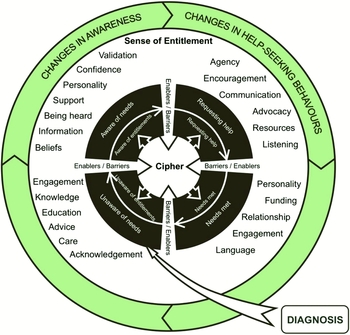
A second stage in the data analysis process was the creation of a process model (Figure 1). As the data analysis unfolded, we arrived at a point where we plotted the key themes and categories onto a graphic model. The process model evolved through trial and error, ongoing review of all data and discussion, separating components and unpacking, referring back to themes and refining, to accommodate all the data. We felt that if all the data mapped onto, or could be incorporated into, that model our interpretation had validity. The process model also captured the dynamic and cyclic nature of the partners’ experiences over time, which was not apparent in the description of the themes.
Needs and entitlements model for partners of people with Parkinson’s.

Validity Checks
Content Development of Interview Questions
Before interviewing began, a peer consultation process was organised by the corresponding author (RSB). This involved postgraduate peers, and the corresponding author, brain storming interview questions that would promote the disclosure of participants’ experiences of engagement with HPPs. We asked the postgraduate peers to generate questions de novo, and then distilled their comments in conjunction with our own thoughts of the interview process. Their suggestions converged closely on the questions we had drafted. This outcome confirmed the validity of our questions.
IPA Analysis
Continuous reflexivity and review of the interpretations being formed were comprehensively journaled. They were also discussed with co-authors in order to fully capture the voice of partners (Fossey et al., Reference Fossey, Harvey, McDermott and Davidson2002).
Process Model
To confirm the validity of the process model that emerged, 12 partners were asked to review it during member checking. All partners, without exception, validated the process model by locating their current position in the cyclic process, and finding the relevant initiatives required to support and fulfil their needs.
Expert Review
Additionally, a clinical psychologist with 17 years’ experience working in a PD context, was the last person interviewed, and provided another level of expert review. She was referred to us by a previously interviewed HPP, that is, by the process of snowballing (Liamputtong & Ezzy, Reference Liamputtong and Ezzy2007). The clinical psychologist was interviewed via telephone. This provided a level of checking beyond that of the co-researchers’ own analytical processes. It offered a second perspective on the data and the interpretations being formed, and constitutes what is often labelled triangulation of data. This refers to the use of a combination of researchers, methods, data sources and theories, and addresses the problem of different results being obtained by different researchers and methods (Liamputtong & Ezzy, Reference Liamputtong and Ezzy2007). A central theme around partner's psychological entitlement was emerging from the data, thus expert review was sought to determine if the expert's interpretation of partners’ engagement experiences matched what we were making of the data.
The clinical psychologist was a key informant due to her expertise in making routine assessments of partners’ internalised feelings in her daily professional role. She provided a validity check by reviewing our analysis. During the telephone interview with the clinical psychologist, we performed our validation check in two ways. First, we delivered the scheduled interview (see Appendix B), during which she detailed her own information-rich observations and insights about participants’ feelings, which were crucial for the understanding of the engagement process. Second, towards the end of the telephone interview, and after the scheduled interview was delivered, we wanted to check our process model's validity and our initial interpretations of partners’ reports on this point of perceived lack of entitlement. The psychologist was asked for her perspective on our initial interpretations of partners’ reports, and the pros and cons of the process model which was described to her.
Findings and Interpretations
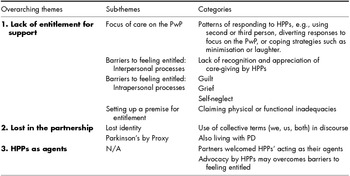
All participants lived in Perth and were English speaking. There were 11 females and 4 males, aged 37–84 (65.1 ± 13.3) years. Duration of PD ranged from 2 to 24 years (9.2 ± 6.5) years. The partners in this study provided rich, often emotionally charged accounts of their engagement experiences with HPPs. Three major themes, some with sub-themes, emerged (Table 1), guiding the interpretive discussion of the research questions. The three themes identified are not discrete, but rather interrelated.
Categories, Major Themes and Sub-themes

Theme 1: Lack of Entitlement for Support
The most pervasive theme to emerge was care-givers’ entrenched sense of a lack of entitlement for their own individualised social and emotional care and support. In the context of this study, the term entitlement refers to a psychological sense, and is reflective of the suggestions by the expert reviewer (clinical psychologist), that a sense of entitlement is lacking in the partners she consults. Much of the partners’ discourse in this study related to psychological states, participants’ attitudes, schemas, sense of self and identity.
Sub-theme: Focus of care on the PwP
The lack of entitlement often arose from the participant's belief that the PwP was the focus of care; this was not about the spouse needing, or being entitled to, care and attention. This position extended into the engagement experiences with some HPPs. Sylvia expressed that a focus on her husband was legitimate:
‘It's always him (neurologist) and Jack, and he doesn't ask me how I feel . . . it didn't occur to me that he should ask me, but I guess the primary care as far as he's concerned is Jack’. (SP05: 60-year-old female; carer for 10 years)
The lack of entitlement and lack of focus on the partners was further perpetuated by the lack of opportunity for support in the health care system in which the partner and PwP were immersed. This was expressed by Sylvia:
‘The only time I could write anything about living with a person with Parkinson's is when Jack participates in research . . . and I would write, you know, I would write exactly how I feel’. (SP05: 60-year-old female; carer for 10 years)
Paul expressed this as an internalised and rationalised ‘expectation’:
‘I’ve no expectation that there’ll be any focus on me, and that expectation is met’. (SP09: 58-year-old male; carer for 14 years)
This expectation was echoed by Cathy, suggesting that the focus should be her husband's needs, with her needs, sadly, at the ‘bottom of the pile’. Psychological tension, role conflict and cognitive dissonance were associated with the resignation to not being entitled to support. Despite her own vulnerability, her intense emotional pain, and unmet needs, Cathy used laughter to cope with the emotional intensity with a stranger.
‘He (neurologist) does ask how are we going, but I don't bring up my own stuff there, I’m not thinking about him helping me . . . because I just feel it's about Keith . . . and I always get put in the bottom of the pile. Nobody helps me (laughs)’. (SP01: 46-year-old female; carer for 10 years)
Claudia pointed out that there was only one target for the specialist's empathy:
‘They certainly talk to Doug quite a lot and empathize with him . . . but there's not a lot of me in that interview’. (SP02: 75-year-old female; carer for five years)
Patterns of responding
The lack of entitlement was revealed not only in what partners said explicitly, but how they chose to answer the questions. The care-givers in this study displayed habitual patterns of responding to the interviewer's questions, which revealed their internal schemas, and how they construed their role. These patterns, into which partners fell, included the use of the second or third tense in speech (i.e., ‘you’ or ‘they’ instead of ‘I’), internal coping mechanisms, such as nervous laughter, minimisation or participants continually turning their responses to focus on the PwP. Despite repeated reminders from the interviewer about whether she feels heard, Cathy seamlessly switched focus to her husband:
‘I can agree that partners don't feel heard, but I must say what I think from my feeling is that what Parkinson's patients need most is that feeling of hope’. (SP01: 46-year-old female; carer for 10 years)
Some partners were very aware that they were not being listened to, and expressed an inner tension in their discourse. The interesting dynamic here was the presence of a contradiction. On one hand, they expressed a cautious feeling of being entitled, while on the other they communicated strong emotions around feeling isolated and neglected. However, there was a failure by them to feel sufficiently entitled to ask for help. Paul cautiously expressed this tension, exemplified by his hesitant and disparaging language:
‘I just feel like, at times, that . . . just a little bit sometimes I’m out there on my own. That sounds a little wet . . . but I wouldn't mind somebody else saying, ‘How are you going with this?’ I guess, um, yes, I wouldn't mind a bit more acknowledgment . . . that life is more difficult, and I’m the person going alone through these things. I’d like these people (HPPs) to actually show a bit more interest in me, but I kind of close down or ignore it when they do’. (SP09: 58-year-old male; carer for 14 years)
This sense of a lack of entitlement expressed by partners is salient as it also touches on the themes and sub-themes that follow.
Sub-theme: Barriers to feeling entitled
What emerged from partners’ discussions around their engagement experiences were clear barriers to feeling entitled, and events that diminished any expectation of feeling legitimately entitled to individualised care and support. These included interpersonal issues, such as being dismissed by HPPs, and intrapersonal processes, such as being passive and silent.
Interpersonal processes
The barriers to feeling legitimately entitled were often sustained by problematic interpersonal interactions with some HPPs. Time pressures, dismissive attitudes and indifference were reported in the engagement with some consulting specialists. The provision of practical and functional resources for the PwP, and the lack of partner support and encouragement to ask for help, re-inforced the belief that the focus of support was only on the PwP. This often resulted in clear distress at not knowing whom to ask for help, especially when the partner was experiencing a crisis. Jenny felt totally dismissed by Carlos's neurologist:
‘He ignored me pretty much; and if I sort of put my two cents worth in, he didn't even look at me, didn't acknowledge it, nothing. There were a couple of times he shut me down’. (SP08: 50-year-old female; carer for six years)
Claudia, who was in the process of formulating her own needs, described a doctor's dismissal of her plea for support as the primary care-giver. Despite her own health issues, her husband was not currently seen as severe enough, and she was not sick enough to expect help:
‘I did say to the GP, ‘What did one have to do to be a carer?’ The GP sort of laughed at me, ‘I don't think you’re quite up to that yet. You need to do quite a bit more.’ I’ve got low back pain and things, which slows me down a bit as well. I think when one person is sick and the other person isn't actually sick, that it's difficult to get a lot of support’. (SP02: 75-year-old female; carer for five years)
Phyllis described experiencing indifference from the HPPs with whom she was engaged, which created a barrier to her feeling entitled to any support. This was complicated by Phyllis taking on some of the responsibility for the lack of entitlement she felt, ‘I probably didn't know enough’:
‘They have their own views and agenda on whatever it was . . . they really weren't interested. I often would feel annoyed because I’d think I’m an educated person and it's a bit belittling if they’re not prepared to listen. I probably didn't know enough, and she (specialist) was not prepared to talk about it and let me know’. (SP06: 83-year-old female; carer for six years)
Time pressures on HPPs were potent barriers to feeling entitled to personal support, although the PD Nurse Specialists seemed more readily available:
‘So it was a very quick interaction. It's just an appointment you would have to see a doctor who hasn't got much time. It was a very basic relationship, whereas with the Parkinson's nurses, they’re always there on the phone if you need help’. (SP04: 79-year-old female; carer for 10 years)
‘Yeah, time . . . they don't have time to deal with us, you know. Unless I interject and I say, ‘Excuse me, can I ask you a question?’ . . . other than that he doesn't ask about me’. (SP05: 60-year-old female; carer for 10 years)
Intrapersonal processes
Internalised feelings and ongoing barriers to feeling entitled to support were often embedded in their own intrapersonal processes. Some participants felt so overwhelmed from the physical, mental and emotional exhaustion of their new role as care-giver, they did not know to whom to turn for support. As a result, they became passive and silent, unable or unwilling to articulate their needs, resulting in their engagement with HPPs being seriously compromised, even when in crisis. Cathy described her situation:
‘I couldn't say I have received it (support) in any way . . . you kind of . . . you just get on with it . . . nobody really knows, actually knows how bad things are . . . you do just feel isolated and you have no-one to turn to . . . so I walked away and that put me off telling anyone my problems, I just deal with them, but at the moment as I say, I am battling a bit’. (SP01: 46-year-old female; carer for 10 years).
Another potent intrapersonal barrier for partners asking HPPs for help involved the inner tensions associated with their sense of loss and grief, due to the transformation and the raw emotional reactivity in the engagement experiences with their partner as the PD progresses. This tension was exacerbated by the need to make sacrifices by denying themselves support and self-care. Cathy described the multiple stabs of grief and the resulting ambivalence she experienced:
‘I married this man . . . he was muscular and big and huge and handsome and then I go home and then this little man shuffles in my door . . . I think if I let go and felt sorry for myself, I’d never get up again. Yeh, and it's not only once (grief) . . . I think every time you realise you take another step, you go through the whole process over and over again. I lock a lot of that stuff out and just get on with life . . . that probably isn't very helpful for me (laughs) but it's one of my coping strategies’. (SP01: 46-year-old female; carer for 10 years)
What was also common to partners’ experiences was that these inner tensions associated with grief, were often accompanied by strong feelings of resentment and resulting guilt. This presented an obstacle to help-seeking from HPPs. Cathy seemed trapped between the tension of high expectations and accompanying guilt:
‘Oh . . . so guilty about the fact that I still need him to do physical jobs or I still need him to be the man he used to be . . . I mean it's not that he doesn't want to, he actually can’t, so there's a whole lot of guilt . . . in my head’. (SP01: 46-year-old female; carer for 10 years)
Subtheme: Setting up a premise for entitlement
Buried under the psychological distress and tensions described above, care-givers often felt the need to construct a premise for receiving legitimate support. Asking for help was logically framed within the need for support of a physical nature. They expressed an emotional discourse that related to ageing, illness or physical limitations, or when reaching a threshold of coping. On these grounds, partners could now fall into a category that entitled them to care and support:
‘They’ve been paying for me to have one massage a fortnight. And the next fortnight I have physio, because I have neck and shoulder problems. A lot of it is caused by wheeling Elliot with a manual wheelchair’. (SP03: 65-year-old female; carer for eight years)
Similarly, Claudia's inner tension was expressed by using her age and physical limitations as a legitimising factor for asking for help, with the implication that she could no longer manage because of her age:
‘I just needed it to validate that I did need things. I am getting a bit older and just doing things . . . I’m not as good at doing things as I was’. (SP02: 75-year-old female; carer for five years)
Echoing this notion, Phyllis felt she could not ask for support unless it was accompanied by a physical manifestation of need. She acknowledged and enjoyed the crucial importance of receiving social interaction with paid carers, justified by her physical (not emotional) need for them. Her speech was subtle:
‘Well, the importance is physically if he's a strain . . . to dress Sam. They (paid carers) also brighten the day because they come in and they’re chirpy and nice and chatty and they’re all lovely . . . it's nice to share the time with them’. (SP06: 83-year-old female; carer for six years)
Cathy expressed this premise in the context of physical coping, rather than the emotional needs of a friend, who was pushed to a physical collapse before being eligible for help:
‘You almost fall in a heap. That's how Candice says she got help . . . just couldn't manage, you know. She said she went to the hospital with Percy and she just physically broke down and that's when they . . . the doctor realized she needs help’. (SP05: 60-year-old female; carer for 10 years)
Similarly, Pamela felt entitled to support only if she was pushed to a point of not coping:
‘I don't feel that I’m entitled, but I think I would if I felt that I wasn't coping, but I don't feel as though I’m . . . where I am at the moment, I’m not entitled’. (SP14: 67-year-old female; carer for four years)
Theme 2: Lost in the Partnership: Where is the Me outside of We?
Partners perceived that they were submerged in the care-giving partnership, and this produced a profound impact on many aspects of their lives. Paul delivered a thoughtful discourse on his experiences of not being seen, or expecting to be seen, as an individual lost in a partnership:
‘I feel at times I wouldn't mind being acknowledged a bit more . . . but I don't bring it up in conversations and, um . . . the conversations are objective about the management decisions for Jocelyn's condition, and, um, not a lot about me, only in terms of what, um . . . can I do this? Can I do that? I don't think I’m noticed as an individual beyond that . . . and I’m peripherally the resource to help make things better. That's why I’m there . . . I’m not treated as a cipher, but there's not, there's no personal focus on me’. (SP09: 58-year-old male; carer for 14 years)
Sub-theme: Lost identity
The complex tensions described above also appeared to permeate and endanger the partners’ own sense of identity, beyond the partnership. This acted as a powerful barrier to feeling a sense of entitlement. Pamela declared:
‘I’m losing the ‘me’’. (SP14: 67 year old female; carer for four years)
Partners’ powerful discourse was rich in collective terms such as we, our, us, partnership, two heads, team, and both of us. The term We was ubiquitous in the partners’ descriptions of their lived experiences of engagement with HPPs:
‘There's a suite of things you need. You need a neurologist . . . we’ve got a good one, and that's great’. (SP09: 58-year-old male)
‘We’ve got some brilliant professionals. She (physio) does miracles with him and last week was the first time we got up since before Christmas’. (SP04: 79-year-old female; carer for 10 years)
Partners were so enmeshed in the We, that they lost their sense of identity and entitlement, and it was a hard space from which to move. The only context in which their needs could be articulated was within the We. However, as the We was fortified, the Me became subsumed and partners lost sight of the attention to which they were entitled, making it more difficult to call out for their own emotional support.
Subtheme: Parkinson's by Proxy
Not only was the partner's identity submerged within that of the PwP, participants expressed a shared perception of living with Parkinson's 24/7, claiming that they also suffered from the disorder:
‘I mean Shaun has got Parkinson’s, but I’m living with it just as much as he is in a way’. (SP04: 79-year-old female; carer for 10 years)
‘The Parkinson's is affecting both of us 24/7, no holidays, no breaks, no relief from the Parkinson’s. We’re both impacted by the Parkinson’s, just differently. The condition is dictating to you how much you do’. (SP02: 75-year-old female; carer for five years)
The term Person(s) with Parkinson's by Proxy (PwPP) seemed to fit their experience. Partners’ needs may be experienced differently to that of the PwP but, none-the-less, they, too, are defined by PD, with unmet emotional needs and psychological pain which are distressing and burdensome.
This submerged persona caused tensions. While Claudia also expressed living with PD 24/7, there was a subtle resentment about differential treatment between two people who were essentially both living with the condition. While she had developed depressive symptoms, the needs assessment would still be focused on her husband, whom she referred to in the third person:
‘The focus should be on us as a couple, we’re both living with the Parkinson’s, and if one of us is not coping, the attention and focus should be the same . . . if the person with the Parkinson's developed depression, they would be getting full support’. (SP02: 75-year-old female; carer for five years)
Theme 3: Health Professionals as Agents
Participants argued that they needed health professionals to intervene. Wilma believed it was crucial that health professionals realised her needs:
‘This is where it's most essential . . . having someone say, ‘this is what I’m going to do (for you),’ or ‘this is what I’ve organized’ . . . someone to listen to you’. (SP03: 65-year-old female; carer for eight years)
Other participants described having someone in their corner: advocating for their support. Instead of partners having to be their own agent, health professionals had noticed what was needed, and as a result, organised, facilitated and implemented that support. During the member-checking visit, Wilma added:
‘It's better for the health professional to take responsibility for providing that support by becoming an agent, rather than the partner having to ask, especially if they find it difficult to ask for help and support, which is a common barrier especially when they don't feel entitled’. (SP03: 65-year-old female; carer for eight years)
When HPPs intervened on behalf of care-givers this clarified and validated the partners’ needs, especially when the partner did not feel entitled to support, or were unable to articulate their needs. This was conveyed by Raymond:
‘You want a third party to do it. Sometimes I get so frustrated, like ‘Christ, she’s driving me up the wall’ . . . the stress of endless worry, waiting for the next catastrophe to happen. When she nearly killed herself (attempted suicide), I cried for 2 days, and asked myself, ‘why am I doing this?’ . . . I need someone to say to her (PwP), independent of me, ‘Yes, I think you should go into care’ . . . you don't want to be blamed’. (SP11: 84-year-old man; carer for 20 years)
Participants described relief when HPPs noticed what was needed and implemented that support. Paul described a concrete example where a nurse acted as an agent to make life easier for him:
‘She said, ‘You need to consider getting some home help and there are ways we can do this, and I can facilitate this.’ Jody (nurse) put focus on what I’m . . . on me, which is specifically aimed at making life easier for me’. (SP09: 58-year-old male; carer for 14 years)
Overall, participants wanted HPPs to act as their agents. It was clear in partners’ discourse that some were nervously calling out for help but felt that they did not know what support or services were available, or how to access that help. Phyllis expressed her need for HPPs to be proactive, especially in the early years after Sam's diagnosis:
‘When you’re under pressure early in the piece, you don't know much about the illness, you do need them to be proactive really. Not just answer your questions, but really to be proactive and say, ‘well, how are you managing here, or what can we do there?’ They insisted that I got a little care on my own’. (SP06: 83-year-old female; carer for six years).
Phyllis was relieved that others understood and supported her need to place Sam into residential care, and were advocating for her:
‘My doctor was constantly saying, ‘It's time to put him into care’. My children were saying, ‘It's time to put him into care’, so when I did put him in, I didn't feel so bad’. (SP06: 83-year-old female; carer for six years).
For someone who seemed to be managing, it appeared that Sylvia needed someone else to give her permission even to think about her own needs and point out to her that she was entitled to support. Because someone was prepared to act as an agent, Sylvia was able to take advantage of the available support, and was prepared to learn from her experience:
‘I didn't think about it (support) until one of the girls said, ‘Sylvia, go on this (respite)’, I said, ‘I don't need it. Jim's okay’. But I found it very, very helpful because I met other carers. They give you ideas. They share how they’re going, and they’re all at different stages. So I learn from them, so I know what to expect’. [SP05: 60-year-old female].
Process Model
As the study evolved, a comprehensive process model was developed (Figure 1). Its utility lies in identifying initiatives for intervention. The PwPP's entry point onto the process model's roundabout is at the point of diagnosis of PD, although some partners identified a prodromal phase before diagnosis where they felt confused about what was happening, or in ‘no-man's land’ (SP13: 68-year-old female). At diagnosis, many PwPP seemed generally unaware of their needs and of their entitlements to their own, individual care and support. We posit that the partner's unique, clockwise progression through the various stages depends on the availability of enablers or the presence of barriers.
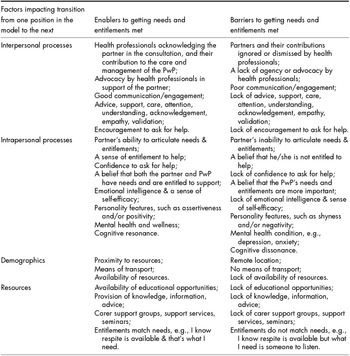
Our process was to construct the barriers and enablers (Table 2), theoretically, as a point of pivot in the Model of Needs and Entitlement. That is, each barrier needs to be taken as a point of reflection in terms of how it can be turned around to act as an enabler. If, for example, a partner has a barrier felt through a built up frustration like, ‘I need to vent’, then an enabler is providing that venting opportunity. Previous researchers (Carpentier & Grenier, Reference Carpentier and Grenier2012) have concluded that the relationship between care-giver and health professional needs to be based on a shared acknowledgment and appreciation of identities and expertise. However, if it is not, it needs to be addressed as a barrier. Thus, overall, our question in positing the process model is how each barrier can be turned around.
Barriers and Enablers of Progression Through the Needs and Entitlements Model (Figure 1) for Partners of People with Parkinson’s

If partners are provided with enablers such as helpful engagement experiences, information, education, advice, or other supports or how to consider their needs within the partnership, it is likely that they will become aware of their needs and entitlements and progress to the next stage of the process model. However, these clockwise progressions of being aware of needs and entitlements do not necessarily occur at the same time. It is possible that a PwPP may be aware of her/his needs but unaware of entitlements, or vice versa. It is also possible that a PwPP is aware of his/her needs, but the entitlements available do not meet their needs, for example, practical help may be available, but may not be addressing their need for deep emotional support. Here, is a critical space to observe mismatches between service provision and needs.
If barriers are present, and/or there is an absence of enablers for needs and entitlements at any point in the process model, it is possible for the PwPP to slip into the central position of cipher, a position of feeling like a nobody, unheard and unseen, a position commonly described in the care-giving literature (McLaughlin et al., Reference McLaughlin, Hasson, Kernohan, Waldron, McLaughlin, Cochrane and Chambers2011). It is also possible to exit from this position, and step back on to the roundabout, if provided with enablers, such as the health professional advocating for the PwPP, or the PwPP becoming able to articulate his/her own needs.
The outer circle of the process model provides a broad overview indicating how interventions that create changes in awareness can change help-seeking behaviours. Because PD is a neurodegenerative disease with no cure and progressive decline, the process described by this process model is continuous and cyclic. There is no exit point, as the PwPP's needs and entitlements are continually changing with the progression of the PD, so the work of the HPPs is also ongoing.
Member Checking of Process Model
All 12 spousal care-givers re-interviewed could find their own position on the process model, providing validating comments about its utility:
‘I feel like I’m stuck here at the moment (pointing to second quadrant). It's not that I’m unaware of the entitlements because we’ve had a health professional that I’ve been seeing. I’ve had a bit of depression . . . things are getting a bit stretchy . . .’ (SP09: 58-year-old male; carer for 14 years)
Paul confirmed a cyclic process was true in his care-giving journey:
‘The sense of it is clear, around you go and it keeps happening. It's the right way to characterise what goes on. I hadn't thought of it that way. Because a shift is happening slowly, sometimes you don't notice it until you’re back into the first quadrant on the roundabout’. (SP09: 58-year-old male; carer for 14 years)
Pointing to the first quadrant, the memories of his early experience after his wife's diagnosis seemed to resonate with what he was being presented with:
‘Lack of understanding or knowledge. My god, what does this mean? Until we engaged with PWA, we were floundering a little bit and were unaware of these enablers’. (SP09: 58-year-old male; carer for 14 years)
Rosie related to the concept of cipherdom, and gave a personal experience of the concept:
‘Yes a cipher, automaton, a non-entity, out of focus, like salad dressing, you’re not supposed to see it. A phantom or shadow’. (SP13: 68-year-old female; carer for three years)
Her discourse echoed the findings of Birgersson and Edberg (Reference Birgersson and Edberg2004), where partners’ narratives described their experiences of support during their visits to an outpatient clinic for PwPs. Partners reported that the focus was always on the PwP, which meant feeling neglected and uncertain. We noted Rosie talked in the third person as though trying to distance herself from her own experience:
‘They’ll know they need something but wouldn't have any idea what they need because they’re not sleeping properly, they’re not eating properly, they’re full of anxiety, I would have thought that a time might arise where people might get stuck’. (SP13: 68-year-old female; carer for three years)
Another partner, Mary, identified her position on the process model:
‘A position where you choose to stay until you reach a level of personal need’. (SP15: 71-year-old female; carer for two years).
Interestingly, when the interviewer was leaving Mary's home, her husband, the PwP, asked the first named author if she had got what she wanted from Mary about how he was going. This reflects the pervasive assumption that the focus of attention is automatically on the PwP, and further explains the continual return of partners’ discourse to issues related to the PwP.
Expert Review
The expert's interview confirmed our interpretation that participants often have internalised feelings about perceived, illegitimate care needs. She suggested, for example, in her experiences with partners that they often had a willingness simply to put up with dismissive attitudes and indifference about their needs from professionals. Her data mapped closely onto the pervasive lack of entitlement and the sense of being alone and neglected that was expressed by partners:
‘I don't think there's a lot of recognition of what partners do . . . they internalise a lot of feelings, they feel very guilty . . . they don't feel they have a right, so they’re lonely . . . and no-one understands that . . . they could be going to appointments . . . but it's not about them really . . . what they then do is feel incredibly guilty for complaining . . . guilty for making it about them at all . . . guilty because they’re not the person who's got the problem’.
Finally, when we described our initial interpretations of partner's reports and the process model, the psychologist agreed that they aligned with her experiences of partners of PwP, that a sense of entitlement is lacking in the partners she consults, and that they had ‘unmet psychological needs’ in respect of this. She further detailed and elaborated examples of this congruence based on her experiences.
Discussion
The aim of this enquiry was to achieve an in-depth understanding of partners’ experiences of their engagement with HPPs. Partners’ discourse revealed subtleties of meaning and deeper perceptions of the engagement experiences with HPPs that have not been identified before in the PD context. The major and unique contribution of the current enquiry, including the validation we found in our expert check, has been to identify the sense of not feeling entitled, as a need and a potential target for support-based interventions for spousal care-givers of PwP. This sense of a lack of entitlement was also a potent barrier to help-seeking.
Partners’ deeply embedded sense of a lack of entitlement for their personal care and support both fuelled, and was fuelled by, a lack of focus on the care-giver by HPPs, and was echoed by partners’ experiences of ‘being in the shade of support’ (Birgersson & Edberg, Reference Birgersson and Edberg2004; p. 623). Reflecting our findings was another by-product of the lack of focus described by McLaughlin et al. (Reference McLaughlin, Hasson, Kernohan, Waldron, McLaughlin, Cochrane and Chambers2011), namely, a lack of opportunity to discuss with the healthcare team their changing role, information about the stage and progression of PD and the resources available to them. Feeling informed and prepared protected partners against harmful health consequences from their role (Carter, Lyons, Stewart, Archbold, & Scobee, Reference Carter, Lyons, Stewart, Archbold and Scobee2010). These findings also echo those reported in AD (Carpentier & Grenier, Reference Carpentier and Grenier2012). Similarly, Bartolo et al. (Reference Bartolo, Luca, Serrao, Sinforiani, Zucchella and Sandrini2010) reported care-givers of chronic neurological patients as receiving little support from the healthcare system, describing them as ‘second victims’ (p. 818) of the disease.
While many partners talked of negative experiences with HPPs, some provided examples of when an HPP had acted as a powerful agent of support for them. In the PD literature, Davey et al. (Reference Davey, Wiles, Ashburn and Murphy2004) and Aragon et al. (Reference Aragon, Ramaswamy, Campbell, Jones, Tugwell, Taggart and Gay2007) wrote that the expert advice and support delivered by the PD Nurse Specialists was greatly appreciated by the care-giving partners: a finding consistent with our study. Partners acknowledged that it made life easier for them and that they felt validated as an individual with their own distinct needs, as opposed to being part of an enmeshed relationship with the PwP. We conclude that PwPP need more than just instrumental or functional help for the PwP, and that there is a significant role for psychological intervention in addressing their unmet psychological pain.
A number of clinical implications flow from the findings. The lack of entitlement experienced by spousal care-givers of PwP in their engagement with HPPs was novel in the current study. This, and other needs, could be discussed in partner-based group therapy sessions or individual support contexts to encourage assertiveness, empowerment and better communication. The issues that partners see as barriers to having their needs met, must also be reported to dedicated teams of HPPs, to those producing educational material, or planning care-giving programmes and policies, and should be incorporated into training initiatives to optimise the health of the PwPP and the PwP.
The process model developed in this enquiry could be used to facilitate assessment and identify which initiatives are required to support the partners, whose needs and entitlements are continually changing with the progression of the PD and their unique pathway through the various stages on the roundabout.
A number of caveats need to be observed in generalising the findings from this study to similar groups or settings (Lim & Zebrack, Reference Lim and Zebrack2004). Factors such as age, gender, income and health problems need to be considered. The broad age range (37–84 years) contributed a wide range of needs within the engagement experiences with HPPs. Carter et al. (Reference Carter, Lyons, Stewart, Archbold and Scobee2010) compared the difference in negative aspects of strain and modulators of strain in younger and older spousal care-givers of PwP, and revealed several important differences. Whether the broad age range (37–84 years) of partners interviewed in this study influences the engagement experience reported, warrants further research with more age-specific sampling. This has the potential to validate further the findings across samples. It is also possible that only partners willing to voice their needs volunteered to participate. However, their keen motivation to relate their stories meant that the data were rich, and diverse experiences were expressed and captured in the themes (Birgersson & Edberg, Reference Birgersson and Edberg2004). Future research could also examine the efficacy of providing specific enablers of progression through the process model to the point of having needs met, even if only transiently.
Conclusion
The care-giving literature has previously not reported the lack of entitlement theme that is significant and clear in this PD context. This may be due to a lack of research focusing on care-givers’ engagement experiences with health professionals. It will be important in future research to determine if such a theme is present in other care-giving contexts, as well as to explore the engagement experience from the perspective of HPPs.
The process model developed during this study provides a basis for developing support initiatives for spousal care-givers of PwP. We recommend further research of the engagement experience from the perspective of HPPs, focused on their recognition of partners’ becoming lost in the partnership, professionals’ perceptions of their ‘agency’, and instrumental factors such as the HPPs teamwork required to optimise the health of the PwP. A parallel, qualitative analysis is currently underway to analyse the data obtained from a purposive sample of HPPs, in order to investigate and reveal their perspectives, attitudes and beliefs of their engagement experience with partners of PwP, including issues that have emerged from this study.
Acknowledgements
We thank our co-researchers (the participants) for their valuable insights, honesty and trust. It has been our privilege to share in your experiences. We will do our utmost to represent your experiences with authenticity and honesty.
Supplementary Material
Supplementary material available online at http://dx.doi.org/10.1017/BrImp.2015.19.