Introduction
Post-traumatic stress disorder (PTSD) is a chronic psychiatric condition following the experience of traumatic events. Around 5% of men and 10–12% of women are estimated to experience PTSD at some point in their lives, with far higher rates (60–80%) among rape victims (Solomon & Davidson, Reference Solomon and Davidson1997). The primary psychological symptoms of PTSD according to DSM-5 criteria are intrusions, avoidance, negative alterations in cognitions and mood, and alterations in arousal and reactivity (APA, 2013). Intrusions, the first of these and the hallmark of PTSD, are persistent, spontaneous, involuntary thoughts pertaining to traumatic events (Brewin, Reference Brewin2001b ; Hellawell & Brewin, Reference Hellawell and Brewin2004). Intrusions tend to be primarily visuospatial and somatic in nature, involving decontextualized (Michael et al. Reference Michael, Ehlers, Halligan and Clark2005), fragmentary, visual re-living of aspects of the trauma (Hackmann et al. Reference Hackmann, Ehlers, Speckens and Clark2004).
Intrusions are thought to be a product of maladaptive memory (Van der Kolk et al. Reference Van der Kolk, McFarlane and Weisaeth1996). Elevated peri-traumatic glucocorticoid (Roozendaal, Reference Roozendaal2000, Reference Roozendaal2002) and noradrenaline (Roozendaal et al. Reference Roozendaal, Quirarte and McGaugh2002) levels produce incomplete encoding of traumatic events which creates traces lacking contextual, verbal and temporal information, with strongly encoded visuospatial and autonomic content (Brewin et al. Reference Brewin, Dalgleish and Joseph1996; Brewin, Reference Brewin2001a , b; Hellawell & Brewin, Reference Hellawell and Brewin2004). This content is subsequently consolidated into long-term traces that are resistant to top-down voluntary recall and susceptible to spontaneous, involuntary recall of decontextualized visuospatial aspects of the trauma (Brewin, Reference Brewin2013), producing the ‘here and now’ reliving that characterizes intrusions (Ehlers et al. Reference Ehlers, Hackmann and Michael2004).
Preventing the development of such maladaptive trauma memories is therefore highly desirable in preventing the later development of PTSD symptoms in trauma victims. Previous research has examined this possibility using cognitive-behavioural procedures following analogue trauma. The performance of a visuospatially demanding task (Tetris) following the viewing of aversive video footage has been shown to reduce the reported number of intrusive memories of the footage subsequently reported by participants (Holmes et al. Reference Holmes, James, Coode-Bate and Deeprose2009, Reference Holmes, James, Kilford and Deeprose2010). While such an approach is very promising as a preventative strategy in PTSD, its practical utility is limited if victims have suffered physical injuries or are otherwise unable to engage with the task.
An alternative approach is to attempt to prevent the development of maladaptive memory traces by interfering with their consolidation. Since long-term potentiation (LTP) is thought to be the molecular basis of memory consolidation (Bliss & Collingridge, Reference Bliss and Collingridge1993; Jones et al. Reference Jones, Errington, French, Fine, Bliss, Garel, Charnay, Bozon, Laroche and Davis2001), interventions that inhibit LTP may prevent consolidation of traumatic memory. The ‘tag-and-capture’ model of LTP (Frey & Morris, Reference Frey and Morris1997) posits that two temporally dissociable forms of LTP underlie long-term consolidation of memory traces. Early LTP involves a transient (several hours) increase in co-excitability of neurons activated by learning, but does not lead to persistent (>24 h) memory trace retention in the absence of late-phase LTP, where synaptic connections encoding the memory trace are selectively strengthened. This late-phase LTP is critically sleep-dependent, with long-term memory stabilization depending upon replay of events during sleep (Stickgold, Reference Stickgold2005; Ji & Wilson, Reference Ji and Wilson2007; Rasch et al. Reference Rasch, Büchel, Gais and Born2007). Indeed, sleep deprivation following analogue trauma events reduces their psychological impact (Cohen et al. Reference Cohen, Kozlovsky, Matar, Kaplan, Zohar and Cohen2012; Porcheret et al. Reference Porcheret, Holmes, Goodwin, Foster and Wulff2015), but may be difficult to implement clinically. As N-methyl d-aspartate receptor (NMDAR) is critical in both phases of LTP (Sajikumar & Frey, Reference Sajikumar and Frey2004) and memory consolidation generally (Shimizu et al. Reference Shimizu, Tang, Rampon and Tsien2000), post-trauma NMDAR antagonism may prevent the consolidation of long-term maladaptive memory traces, reducing PTSD symptomatology.
Nitrous oxide (N2O) is promising in this respect, as alongside its opioid and GABAergic activity (Emmanouil & Quock, Reference Emmanouil and Quock2007) it is antagonistic at the NMDAR (Jevtović-Todorović et al. Reference Jevtović-Todorović, Todorovć, Mennerick, Powell, Dikranian, Benshoff, Zorumski and Olney1998, Reference Jevtovic-Todorovic, Wozniak, Benshoff and Olney2001) is well tolerated, has rapid onset and offset kinetics and can be administered very easily (Amey et al. Reference Amey, Ballinger and Harrison1981). For these reasons it is currently widely used as a pre-hospital analgesic by emergency services (O'Sullivan & Benger, Reference O'Sullivan and Benger2003). It could thus be readily implemented as a potential first-line preventive treatment in the aftermath of trauma to prevent the formation of maladaptive trauma memories. However, N2O shares with other NMDAR antagonists the ability to produce profound dissociation and may interfere with the consolidation of ‘protective’ temporal, contextual and verbal aspects of traumatic experiences. Persistent dissociation during and after traumatic events is a key predictor of later development of PTSD (Briere et al. Reference Briere, Scott and Weathers2014). N2O administered after a traumatic event may therefore produce paradoxical worsening of PTSD symptoms through increases in dissociation. Opportunistic studies with ketamine, a more potent NMDAR antagonist and dissociative than N2O, have shown deleterious effects on the development of PTSD following its use in an emergency setting (Schönenberg et al. Reference Schönenberg, Reichwald, Domes, Badke and Hautzinger2005, Reference Schönenberg, Reichwald, Domes, Badke and Hautzinger2008). However, a recent randomized control trial has shown efficacy of ketamine in the treatment of chronic PTSD (Feder et al. Reference Feder, Parides, Murrough, Perez, Morgan, Saxena, Kirkwood, Aan Het Rot, Lapidus and Wan2014). Experimental models of post-trauma N2O do not currently exist and are required in order to properly assess its therapeutic and harmful potential.
In the current study, we therefore sought to examine the effects of N2O on consolidation of distressing intrusive memories in a laboratory model of trauma. In line with previous research using behavioural tasks (Holmes et al. Reference Holmes, James, Coode-Bate and Deeprose2009; Holmes et al. Reference Holmes, James, Kilford and Deeprose2010; James et al. Reference James, Bonsall, Hoppitt, Tunbridge, Geddes, Milton and Holmes2015), we hypothesized that 50% N2O (Entonox, British Oxygen Company, UK) following an aversive ‘trauma film’ would interfere with consolidation of memories of the film, evidenced by a greater reduction in the frequency of self-reported intrusive thoughts related to the film over the subsequent week compared to inhalation of medical air. However, acknowledging the potential for a deleterious effect of N2O, putatively due to its potent dissociative properties, we hypothesized that its effects on intrusive memories would interact with post-film levels of dissociation, producing less benefit in those with higher dissociation levels post-film.
Method
Participants and design
Fifty-two participants (24 women) took part in the study. Inclusion criteria were age 18–65 years, normal physical health, normal or corrected to normal colour vision. Exclusion criteria were self-reported historical or current diagnosis of mental health issues; a history of trauma, memory impairments, pregnancy or breastfeeding, regular (>1 times per month) recreational use of drugs other than alcohol and caffeine (including N2O or other NMDAR antagonists), vitamin B12 deficiency and pneumothorax. All procedures were approved by the UCL research ethics committee.
Stimuli and apparatus
Trauma film
The emotional video consisted of two clips taken from the film ‘Irreversible’ (Studio Canal, France). The scenes depicted a violent rape (scene 1, 15 min long) and a man being beaten to death in a club (scene 2, 4 min long). The use of these clips was based on pilot data showing a greater number of intrusions following this clip than previously used multiple short scenes (Soni et al. Reference Soni, Curran and Kamboj2013).
Subjective assessments
To assess levels of dissociation, the Clinical Administered Dissociative States Scale (CADSS; Bremner et al. Reference Bremner, Krystal, Putnam, Southwick, Marmar, Charney and Mazure1998) was used. The Beck Depression Inventory (BDI; Beck et al. Reference Beck, Steer and Carbin1988) was used to assess levels of depression, the Distress Tolerance Scale (DTS; Simons & Gaher, Reference Simons and Gaher2005) to assess participants’ individual capacity for managing distressing experiences and the Dissociative Experiences Scale (DES) as assess naturalistic levels of dissociation (Carlson & Putnam, Reference Carlson and Putnam1993). Acute emotional responses to the film were assessed with a set of six visual analogue scales (VAS) measuring levels of disgust, fear, anger, sadness, happiness and distress. These were anchored with the descriptors ‘not at all’ and ‘extremely’. A single-item VAS was also used to asses drug-induced nausea. After the first night of sleep following the film, participants also completed an short online survey where they reported how many hours they had slept and their quality of sleep compared to normal (better than normal, around the same, or worse than normal).
Memory assessment
Participants logged intrusions in a diary via an online Qualtrics interface (Qualtrics, USA). Participants received daily email/smartphone prompts for 7 days (starting on the day of the trauma film) to record the number of intrusive memories related to the trauma film they had experienced that day. The diary prompt defined intrusions as ‘A spontaneously occurring memory. By spontaneous we mean memories of the film that suddenly pop into your mind automatically. We do not mean times when you deliberately think about it. The spontaneous memories may pop into your mind when you are doing or thinking about something completely unrelated. The main thing is that you didn't mean to think about the film but recalled something about it out of the blue.’ Participants briefly reported the content of the intrusion and the number of occurrences of the intrusion that day. Logged ‘intrusions’ that were unrelated to the film were not counted.
A cued recall task was used to assess explicit memory of the trauma film. This consisted of ten questions about occurrences in each film. Participants were scored 2 for a correct answer, 1 for a partially correct answer and 0 for an incorrect answer to each question.
Heart rate variability (HRV)
HRV reflects the interplay between sympathetic and parasympathetic influences on the heart and indicates the autonomic nervous system's response to threat (Porges, Reference Porges1997). Heart rate data (RR intervals) were recorded using a BodyGuard 2 ECG device (FirstBeat Technologies, Finland). HRV was acquired at a sampling rate of 1000 Hz and expressed as the standard deviation of successive RR intervals (SDNN). A 5-min epoch prior to viewing the trauma film, and a 5-min epoch after the film served as pre-film (baseline) and post-film indices of autonomic arousal. The recording during the entire film (peri-film) along with the pre- and post-film epochs were used in the statistical analysis of arousal effects.
Drug administration
Drug was medical 50% N2O in oxygen (Entonox) and was administered via an Ultraflow demand valve regulator (BPR Medical Ltd, UK). Participants in the placebo group were fitted with an inhalation mask connected a cylinder of medical air (British Oxygen Company) with transparent polyethylene tubing. Gas cylinders were not visible to participants in order to maintain the single blind. All participants inhaled the appropriate gas for 30 min in total.
Procedure
Day 1
After completing a telephone screening to assess eligibility, participants attended the study centre for the first day of testing and completed informed consent and the DES, DTS and BDI before being fitted with the ECG device and viewing the trauma film. After this, participants were fitted with inhalation masks connected to an Entonox (N2O) or air cylinder and completed the baseline CADSS before gas administration began. After 10 min of equilibration to the gas, the CADSS was repeated to assess any acute changes in dissociation. Ten minutes after cessation of gas inhalation, the CADSS was completed once more. Participants were finally briefed on the completion of the intrusion diary, which they were required to complete on a daily basis until the next testing day. Participants completed the sleep survey remotely the morning after day 1. Testing commenced between 10:00 and 16:00 hours. There were an equal number of participants in each group who were tested in the morning and afternoon.
Day 8
Participants returned to study centre and completed the cued recall task at approximately the same time as they commenced testing on day 1. After this they were debriefed and reimbursed at a rate of £7.50 per hour of participation.
Data handling
Heart rate data were imported into Kubios (Tarvainen et al. Reference Tarvainen, Niskanen, Lipponen, Ranta-aho, Karjalainen, Vander, Sloten, Verdonck, Nyssen and Haueisen2009) for Matlab (The MathWorks Inc., USA) and artefact correction was performed using pre-defined settings. All data were analysed using R (R Core Development Team, 2014) and IBM Statistical Package for the Social Sciences (SPSS) version 22 for Windows (IBM Corp, USA). For general linear models, assumptions were checked though inspection of histograms and scatterplots of standardized residuals against predicted values in models. Group differences on trait variables at baseline were assessed using independent-samples t tests and χ2 tests.
Intrusion counts were modelled using Poisson generalized linear mixed models (GLMMs) in SPSS and the glmer function of the lme4 package (Baayen et al. Reference Baayen, Davidson and Bates2008). Satterthwaite approximations were used to determine the degrees of freedom and robust covariance estimation to assess model effects. Model specification was based upon a priori hypotheses, with Group, Day, Gender, post-film CADSS and Group×Day and Group×CADSS terms entered as fixed effects of interest. These were selected because (1) the time-course of intrusions was of primary interest to the study, (2) gender and dissociation predict PTSD-like symptomatology following traumatic events and (3) dissociation was hypothesized to interact with Group, due to the highly dissociative nature of N2O. A random intercept per participant was specified to account for dependencies caused by repeated measurements on the same participants. For exploratory analyses on heart rate and sleep data, generalized linear models were used to model total intrusion counts, since no hypotheses were made concerning the effects of these variables on intrusions over time. Poisson models were fit using maximum likelihood estimation, with a log link function. Model fit was assessed by minimizing the finite-corrected Akaike's Information Criterion (AICc). In these models, k > 2 main effects and interactions were assessed with sequential Bonferroni-adjusted contrasts. Outlier removal was based upon model-based residuals and influence diagnostics, as recommended by Baayen et al. (Reference Baayen, Davidson and Bates2008) and Bates (Reference Bates2010). These tests, alongside tests for overdispersion and fulfilment of regression assumptions, were conducted using custom scripts written in R. One extreme outlier was found and removed using these tests (a female in the N2O group) and excluded from all analyses.
Missing data
One participant's whole data (a male in the Air group) was lost due to technical failure, leaving a final N=25 per group. For the cued recall (N = 4), HRV (N = 7) and sleep (N = 2) data, some data records were lost due to technical failure. As the proportion of data lost was small and Little's test demonstrated that the data was missing completely at random (χ2 187 = 177.94, p = 0.671), these data records were imputed using the EM algorithm in SPSS. Analysis was conducted with and without these imputations, and the results were not affected in any meaningful way. Reported results therefore include imputed values.
Results
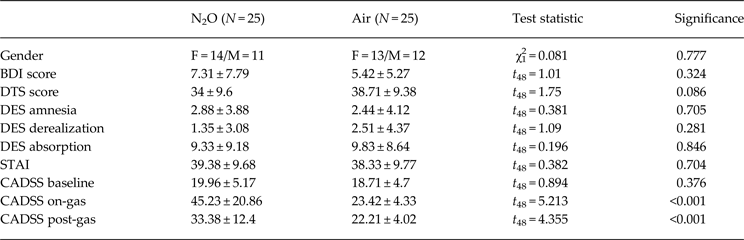
Fifty participants aged between 18 and 41 years (mean ± s.d.: 24.4 ± 4.9) contributed data to the analyses. Descriptive statistics for baseline and trait measures are given in Table 1. The groups did not differ in any of these measures at baseline.
Descriptive statistics for baseline subjective measures with associated tests of significance. Data represent mean ± s.d

BDI, Beck Depression Inventory; DTS, Distress Tolerance Scale; DES, Dissociative Experiences Scale; STAI, State-Trait Anxiety Inventory; CADSS, Clinical Administered Dissociative States Scale.
Acute responses to trauma film
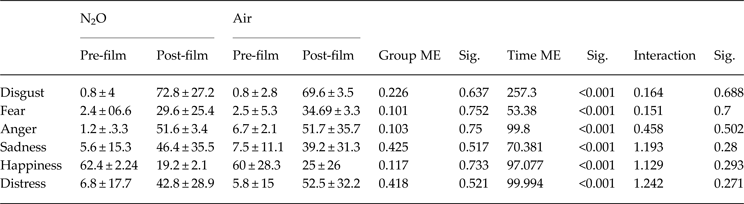
The ability of the trauma film to produce intense negative affective responses and reduction in positive affect was assessed using 2 (Group) × 2 (Time: pre-film/post-film) ANOVAs on each of the VAS items. Inferential and descriptive statistics for these tests are presented in Table 2. The film produced marked increases in negative and decrease in positive affect and these changes did not differ between groups.
Acute emotional responses to trauma film. Statistics represent mean ± s.d. F values are given below their respective effects in the 2 × 2 ANOVA.

ME, Main effect. For all effects, degrees of freedom are 1, 48
Primary analysis
Drug effects on intrusive memory
Mean daily intrusion frequency over the week following the trauma film were low in both groups (N2O: 1.155 ± 1.068; Air: 1.068 ± 0.858). A t test on these data showed no significant differences between the absolute number of experienced intrusions between the N2O group and the Air group (t 48 = 0.458, p = 0.649). However, as previously observed in studies using the trauma paradigm, intrusion frequency was highest in the first few days after the video (Soni et al. Reference Soni, Curran and Kamboj2013) and declined over the course of the week (James et al. Reference James, Bonsall, Hoppitt, Tunbridge, Geddes, Milton and Holmes2015).
For the primary mixed model analysis the AICc for the full model (1261.1) was significantly lower than an intercept-only comparison model (1359.73), indicating an improvement in overall complexity-penalized model fit following the addition of the predictors (F 16,36 = 10.051, p < 0.001).
Significant effects of Day (F 6,315 = 16.141, p < 0.001) and Gender (women > men; F 1,30 = 16.131, p < 0.001) and critically a Group×Day (F 6,315 = 2.382, p = 0.029) and a Group×Dissociation (F 1,13 = 5.602, p = 0.034) interaction were found. A Wald test on the variance of the intercept was highly significant (variance = 0.371, Z = 3.095, p = 0.002).
The Day effect represented a significant reduction in intrusions from day 1 to day 2 (β = −0.775, 95% CI −1.289 to −0.262, t 315 = 2.971, p = 0.003) and all subsequent days (all β’s < −0.112, t's > 2.83, p < 0.005).
The Group*Day interaction reflected that this reduction in intrusions between day 1 and day 2 (β = −1.33, t 315 = −2.767, p = 0.007, 95% CI −2.32 to −0.341), day 1 and day 3 (β = −1.655, 95% CI −2.93 to −0.38, t 315 = −2.924, p = 0.007) and all subsequent days (all β’s < −1.89, t's > 4.35, p's < 0.0005) was significant only in the N2O group. In the Air group, there was no significant reduction in intrusions between day 1 and day 2 (β = −0.396, 95% CI −1.451 to 0.66, t 315 = −0.739, p = 0.461) or day 3 (β = −0.958, 95% CI −1.994 to 0.078, t 315 = 2.082, p = 0.08). A significant reduction in intrusions (compared to day 1) was not observed in the Air group until day 4 (β = −1.453, 95% CI −2.298 to −0.608, t 224 = 4.331, p < 0.001). The reduction in the frequency of intrusions was therefore faster following post-encoding N2O than air (see Fig. 1).
Faster reduction in intrusion frequency in following post-encoding nitrous oxide (N2O). Bars represent mean + s.e.m. Denoted significance is for simple contrasts of each day against day 1 intrusion frequency. **p < 0.01, ***p < 0.001. The vertical dotted line indicates the first night of sleep following encoding of the trauma film.

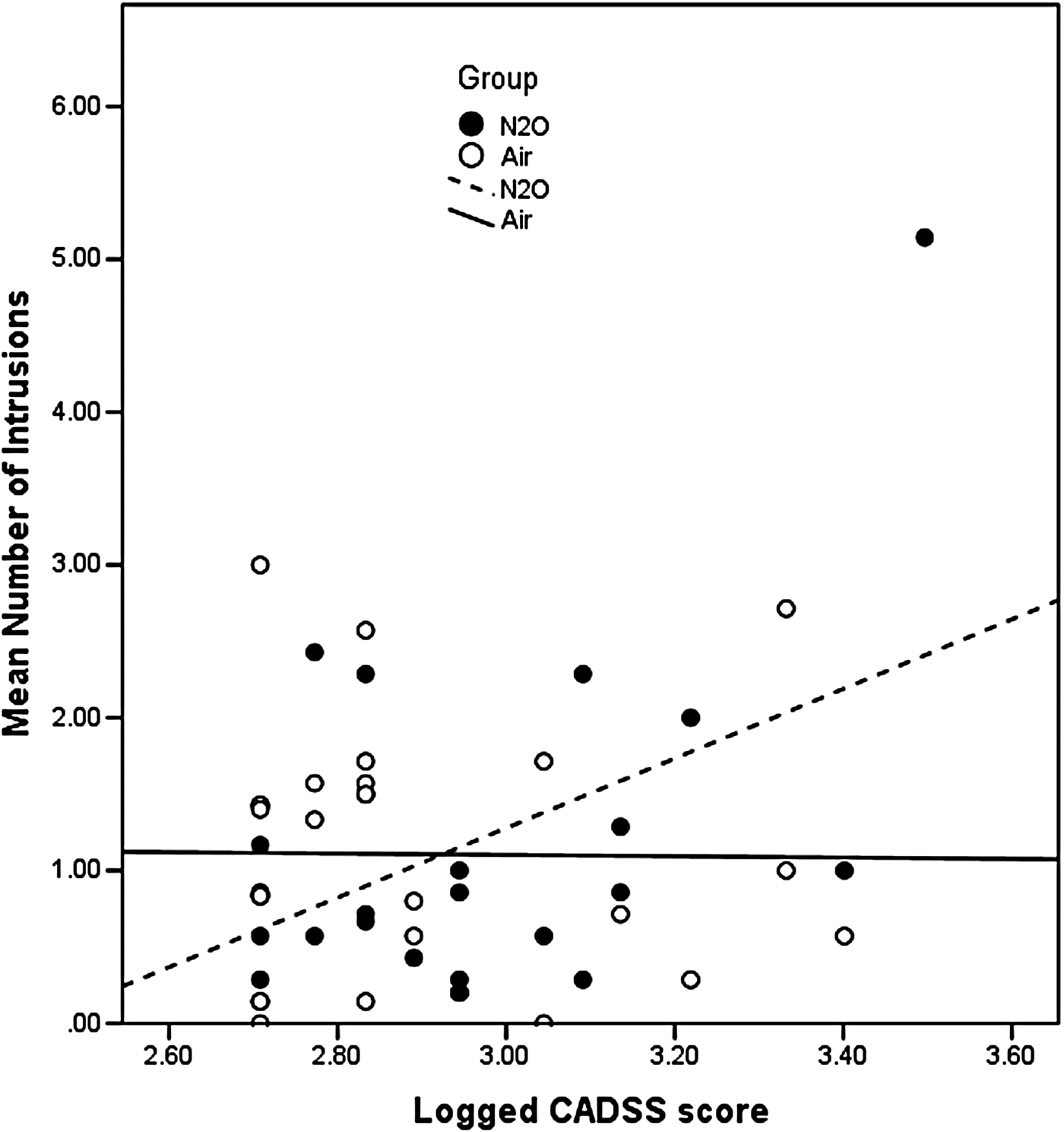
The Group × CADSS interaction represented a significant positive predictive relationship between post-film dissociation levels and intrusion frequency in the N2O group (β = 0.085, 95% CI 0.008–0.162, t = 2.367, p = 0.034) but not in the Air group (β = −0.006, 95% CI −0.083–0.0071, t = 0.198, p = 0.849) indicating a potential baseline-dependency of the effects of N2O-induced dissociation on intrusion frequency (see Fig. 2).
Differential predictive power of pre-gas dissociation on intrusion frequency between groups. Nitrous oxide (N2O) group = solid circles; Air group = clear circles; CADSS, Clinical Administered Dissociative States Scale.

Cued and free recall
The groups did not differ in correct recall of events in scene 1 (t 48 = 0.696, p = 0.49) or scene 2 (t 48 = 1.014, p = 0.316). However, correct recall was relatively low for scene 1 (N2O group: 11.36 ± 3.4; Air group: 11.94 ± 2.4) and lower still for scene 2 (N2O group: 8.52 ± 4.13; Air group: 7.52 ± 2.7).
Drug-induced dissociation and nausea
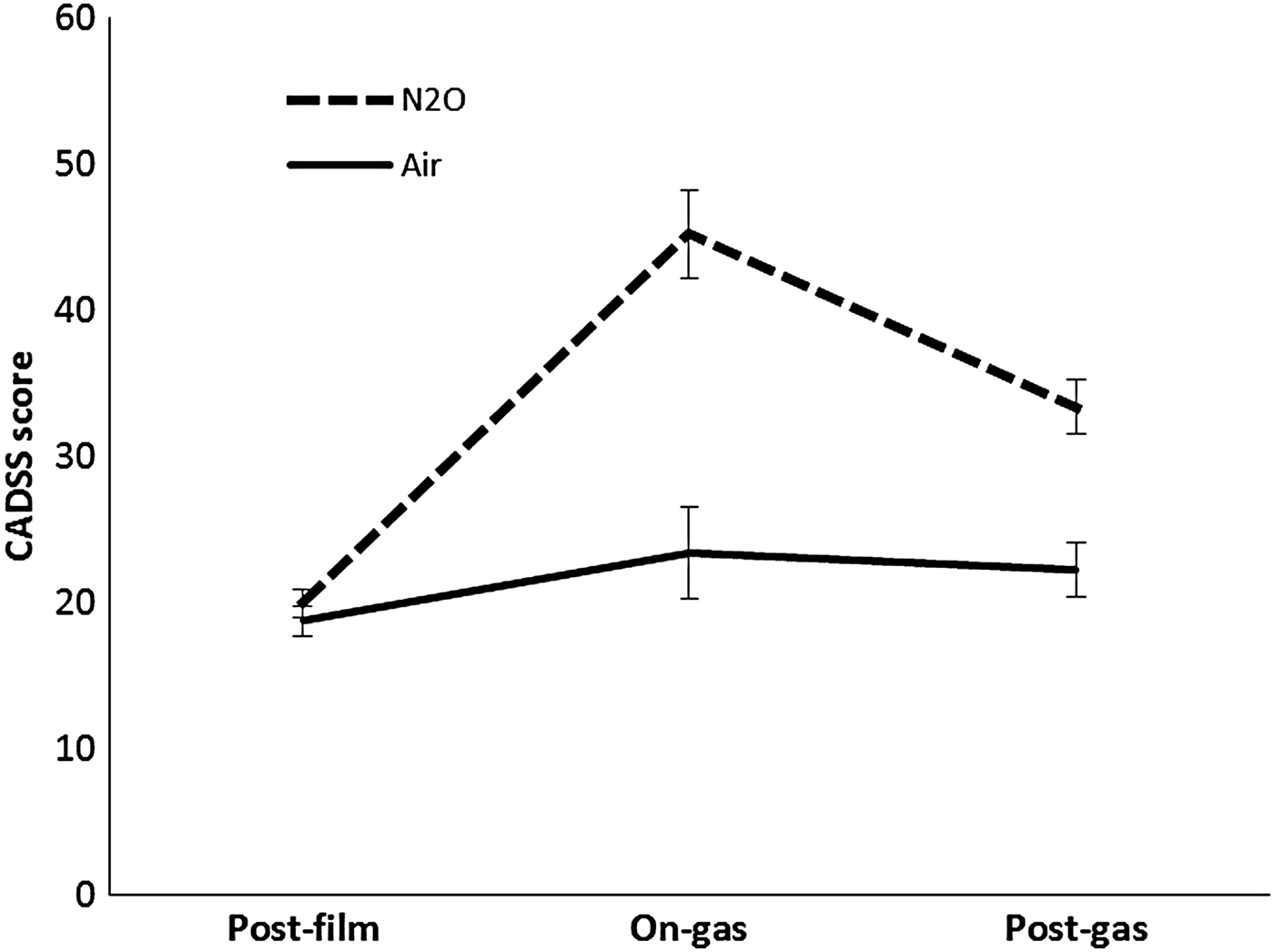
A 3 (baseline, on-gas, post gas) × 2 (Group) mixed ANOVA on CADSS scores found main effects of Group (F 1,48 = 23.9, p < 0.001, η p 2 = 0.332), Time (F 2,96 = 39.242, p < 0.001, η p 2 = 0.45) and a Group × Time interaction (F 2,96 = 18.37, p < 0.001, η p 2 = 0.277). The groups did not differ in dissociation at baseline (F 1,48 = 0.8, p = 0.376, η p 2 = 0.016), but the N2O group were significantly more dissociated than the Air group during gas administration (F 1,48 = 25.212, p < 0.001, η p 2 = 0.344) and 5 min after cessation of inhalation (F 1,48 = 17.756, p < 0.001, η p 2 = 0.27). These data are shown in Fig. 3. There was no effect of Group (F 1,48 = 2.069, p = 0.157, η p 2 = 0.041), Time (F 2,96 = 1.467, p = 0.237, η p 2 = 0.03) or interaction (F 2,96 = 1.77, p = 0.186, η p 2 = 0.036) on self-rated nausea.
Changes in dissociation following nitrous oxide (N2O) and Air. Bars represent s.e.m. CADSS, Clinical Administered Dissociative States Scale.

Exploratory analyses
HRV
A 2 (Group) × 3 (Time: pre-film, peri-film, post-film) mixed ANOVA on SDNN data found a highly significant main effect of time (F 2,96 = 39.12, p < 0.001, η p 2 = 0.449), driven by an increase in SDNN post-film, compared to peri-film (t 48 = 6.702, p < 0.001, r = 0.7) and pre-film baseline (t 48 = 7.966, p < 0.001, r = 0.75) epochs. There was no interaction between Time and Group (F 2,96 = 0.165, p = 0.848, η p 2 = 0.003) and no main effect of Group (F 1,48 = 3.179, p = 0.081, η p 2 = 0.062).
Sleep
As sleep is critical for memory consolidation (Gais & Born, Reference Gais and Born2004; Stickgold, Reference Stickgold2005) and N2O may affect sleep quality (Lahti et al. Reference Lahti, Methuen, Roine, Seppa, Sinclair, Partinen and Alho2011), we examined whether drug-related changes in sleep were responsible for the observed drug effects on intrusion frequency. The groups did not differ in the hours of sleep after watching the film (t 48 = 0.987, p = 0.328, r = 0.14). Critically, modelling total number of intrusions (sum over the week) as a function of Group, hours of sleep and their interaction found no effect of hours of sleep (β = −0.071, 95% CI −1.70 to 0.027, p = 0.155) nor an interaction between Group and hours of sleep (β = 0.007, 95% CI −0.146r to 0.161, p = 0.924). A χ2 test on rated sleep quality (better than normal, the same as normal, worse than normal) found no group differences in proportions of participants experiencing enhanced or disturbed sleep (χ2 2 = 0.487, p = 0.923).
Drug guess
A χ2 of Group against drug guess (N2O, placebo, don't know) found that participants could generally tell which gas they received, owing to the strong effects of N2O (χ2 2 = 33.44, p < 0.001). Twenty-two participants in the N2O group guessed correctly, with none guessing ‘placebo’ and three said ‘don't know’. Three participants in the Air group guessed N2O, 19 guessed Air and 3 said ‘don't know’.
Discussion
The current study tested whether a 30-min inhalation of, N2O could reduce intrusion frequency if administered following an experimental analogue of trauma. Although the total number of intrusions experienced between the N2O and Air groups did not differ significantly, the time-course of intrusion frequency showed clear differences, with the N2O group experiencing a markedly faster drop-off in intrusion frequency than the Air group. Intrusion frequency in the N2O group showed an exponential reduction while the Air group experienced a more gradual, linear reduction in intrusive thoughts over the week.
This difference was most pronounced between day 1 (the day of the trauma film) and day 2 (the day after; see Fig. 1). These findings are consistent with a ‘tag and capture’ model of LTP, resulting in a sleep-dependent consolidation-impairing effect of N2O via antagonism of NMDARs. In the current study, it is unlikely that N2O-induced NMDAR antagonism had any direct effect on late-phase LTP, due to the rapid offset of central activity upon cessation of inhalation, but may have affected late-phase consolidation via inhibition of downstream plasticity-related protein synthesis during early LTP (i.e. reducing the level of ‘tagging’ of trauma-film related representations).
Whether this mechanism underlies the current effects are unclear, as N2O is not purely selective for the NMDAR and it is possible that its GABAA or opioid activity may have contributed to, or even be responsible for, the observed effects (McGaugh, Reference McGaugh2004). However, mechanistic considerations are important determining whether and when N2O (or indeed other drugs that interfere with consolidation) may be useful in reducing the development of maladaptive fear memory. The primary limitation of secondary prevention strategies targeting memory is that they are severely time-limited. In many scenarios, it may not be possible to provide medical care to victims immediately after trauma. However, interventions may be efficacious for several hours after traumatic events. It has been shown, for example, that delayed behavioural interventions can retroactively strengthen memory traces via a putative late-LTP mechanism (Dunsmoor et al. Reference Dunsmoor, Murty, Davachi and Phelps2015) hours after original learning. The extent of this ‘window of opportunity’ remains to be established, although it is likely to be bounded on the upper end by the onset of sleep. However, recent research into the potential of behavioural interventions (James et al. Reference James, Bonsall, Hoppitt, Tunbridge, Geddes, Milton and Holmes2015) and NMDAR antagonism (Das et al. Reference Das, Freeman and Kamboj2013) during memory reconsolidation following retrieval and destabilization suggest that such interventions could be employed in a potentially non time-limited manner.
Importantly, self-reported sleep length and quality were not found to be affected by N2O. Thus the effects cannot simply be attributed to altered sleep following N2O. Interestingly, we found that hours of sleep following encoding did not predict intrusion frequency. The measures of sleep quality employed here were necessarily crude, however, and there is now a body of evidence suggesting that specific phases of sleep (particularly slow-wave) (Diekelmann & Born, Reference Diekelmann and Born2010) are key for consolidation. We are unable to say whether such specific oscillatory elements of sleep were affected by N2O in the current study. Future research may benefit from the use of electroencephalography to assess the potential mechanisms of interventions that putatively target memory consolidation. Similarly, the observed effects are unlikely to be attributable to differential stress responses to the film, as HRV did not differ between groups and subjective responses to the film were equivalent. However, further research may benefit from more direct measures of glucocorticoid responses in the trauma film paradigm, given the known interactions between glucocorticoids, sleep and memory consolidation (Payne & Nadel, Reference Payne and Nadel2004).
Limitations
There were no group differences in absolute intrusion frequency in the current study, which could be interpreted as evidence for a lack of effect of N2O on intrusive memories. However, intrusion frequency in the current study was generally low. Indeed this is quite typical of the trauma film paradigm (Bisby et al. Reference Bisby, Brewin, Leitz and Curran2009; Holmes et al. Reference Holmes, James, Coode-Bate and Deeprose2009; Soni et al. Reference Soni, Curran and Kamboj2013). The nature of the data (count) and high proportion of low counts can obscure potentially clinically significant effects and reduce the sensitivity of simple between-group analyses. This highlights the fact that, although the current study drew upon a well validated and replicated paradigm (Bisby et al. Reference Bisby, Brewin, Leitz and Curran2009; Holmes et al. Reference Holmes, James, Coode-Bate and Deeprose2009; Holmes et al. Reference Holmes, James, Kilford and Deeprose2010; James et al. Reference James, Bonsall, Hoppitt, Tunbridge, Geddes, Milton and Holmes2015) the intrusive memory effects we produced were far milder than those following true traumatic events. This can produce problems with regards to ‘room for improvement’ from baseline rates. Thus while one might normally expect an attenuation of effects when moving from an experimental model in healthy volunteers to a clinical intervention, the opposite may be true in the case of this paradigm, where baseline intrusion frequency is higher in the latter.
In the absence of absolute group differences in numbers of intrusions, if the current findings are replicated in a clinical sample, speeding the reduction of intrusion frequency could still be clinically important, as shortening disease course may prevent the development of secondary comorbid psychiatric disorders such as depression and suicide, which are rife among people with a diagnosis of PTSD (O'Donnell et al. Reference O'Donnell, Creamer and Pattison2004).
In the current study, N2O also produced pronounced dissociation and higher levels of post-film dissociation, prior to drug predicted more subsequent intrusions in the N2O group. This is problematic for a post-trauma intervention, as dissociation has been associated with the development of chronic PTSD (Murray et al. Reference Murray, Ehlers and Mayou2002; Halligan et al. Reference Halligan, Michael, Clark and Ehlers2003). The exact mechanism by which dissociation may lead to increased intrusions is unclear, but it may reduce the availability of attentional and cognitive resources for encoding and consolidation of temporal and contextual information (Van der Kolk & Fisler, Reference Van der Kolk and Fisler1995; Verwoerd et al. Reference Verwoerd, de Jong and Wessel2008) surrounding traumatic events. The dissociative profile of N2O might therefore attenuate the beneficial effects of weakening the consolidation of trauma memory, or in extreme cases of dissociation, may even produce worsening of symptoms. Caution is therefore required in translating the current findings to the clinic, as there is scope for aggravation of PTSD-like symptomatology.
The applicability of the current findings to individuals following real-life trauma remains to be established, as the current study produced only a mild trauma analogue in a healthy sample. Given the current results, further research with N2O is required to replicate these effects in a clinical sample and establish the potential benefits and dangers of its use following traumatic events. As N2O is an effective and portable analgesic, it is already very widely used by emergency services for pre-hospital pain management (Fisher et al. Reference Fisher, Brown, Cooke, Committee, Association, Wales and Ireland2006). Given the current results, it is possible that this practise has unintended (beneficial or deleterious) effects on maladaptive memory formation in the post-trauma period. Prospective studies of the development of maladaptive memory following traumatic events where N2O (or indeed other NMDAergic analgesics, such as ketamine) has been administered as a first-line analgesic will be useful in determining the extent of such effects.
Conclusion
The current study provides the first evidence, to our knowledge, that N2O may speed the reduction in intrusion frequency following encoding of stressful events through consolidation-dependent mechanisms. Although much further work is required to establish clinical efficacy, these findings suggest that N2O, or the use of non-dissociative amnestic is a promising avenue for first-line intervention in trauma.
Acknowledgements
This research has was funded internally via UCL.
Declaration of Interest
None.