Introduction
While the median (10–90% quantiles) lifetime morbid risk for schizophrenia has been reported to be 0.72% (0.31–2.71%) (Saha et al. Reference Saha, Chant, Welham and McGrath2005), the prevalence of subclinical psychotic symptoms or psychotic experiences (PEs) is much higher in both a meta-analysis (7.2%) (Linscott & van Os, Reference Linscott and van Os2010) and in global epidemiological survey data (12.5%) (Nuevo et al. Reference Nuevo, Chatterji, Verdes, Naidoo, Arango and Ayuso-Mateos2012). PEs are of public health importance not only as risk factors for clinical psychosis (Werbeloff et al. Reference Werbeloff, Drukker, Dohrenwend, Levav, Yoffe, van Os, Davidson and Weiser2012), but also due to increasing evidence supporting their association with a variety of adverse health outcomes (Moreno et al. Reference Moreno, Nuevo, Chatterji, Verdes, Arango and Ayuso-Mateos2013; Oh & DeVylder, Reference Oh and DeVylder2015), including co-occurrence with non-psychotic psychiatric disorders (Kelleher et al. Reference Kelleher, Keeley, Corcoran, Lynch, Fitzpatrick, Devlin, Molloy, Roddy, Clarke, Harley, Arseneault, Wasserman, Carli, Sarchiapone, Hoven, Wasserman and Cannon2012; DeVylder et al. Reference DeVylder, Burnette and Yang2014), particularly depression (Ohayon & Schatzberg, Reference Ohayon and Schatzberg2002; Varghese et al. Reference Varghese, Scott, Welham, Bor, Najman, O'Callaghan, Williams and McGrath2011; Saha et al. Reference Saha, Scott, Varghese and McGrath2012). Some researchers have suggested that PEs may be a non-specific marker of a wider array of non-psychotic mental disorders (Varghese et al. Reference Varghese, Scott, Welham, Bor, Najman, O'Callaghan, Williams and McGrath2011), calling into question the demarcation between affective disorders and psychosis (Stochl et al. Reference Stochl, Khandaker, Lewis, Perez, Goodyer, Zammit, Sullivan, Croudace and Jones2015). Further, regardless of the true nature of the relationship between PEs and affective symptoms, PEs do appear to be indicators of elevated clinical and functional severity of depression in the general population. One study among German adolescents and young adults showed that PEs modified the clinical and functional severity of depression (and anxiety), such that individuals with co-occurring depression and PEs had a poorer course of illness, more outwardly observable illness behavior, higher rates of substance use, a greater severity of co-occurring symptoms, and a higher likelihood of being in treatment, compared with those with depression alone (Wigman et al. Reference Wigman, van Nierop, Vollebergh, Lieb, Beesdo-Baum, Wittchen and van Os2012). It is especially important to understand the functional significance of PEs in the context of depression given that depression may be the primary driver of treatment-seeking behavior among individuals with PEs (Kobayashi et al. Reference Kobayashi, Nemoto, Murakami, Kashima and Mizuno2011). However, as yet, to our knowledge, this has not been explored among adults in the general population.
Given this prior evidence for the broad clinical significance of PEs among young people with depression, there is a notable need for further epidemiological data on the nature of the association between depression and PEs and its relevance for public health, particularly in general population samples of adults. Thus, the aims of the current study were (a) to assess the association between depression (subtypes or severity) and PEs among adults, and (b) to assess whether depression with PEs is associated with more pronounced decrements in health status compared with depression alone in 44 low- and middle-income countries using community-based data from the World Health Survey (WHS). We hypothesized that PEs would be associated with depression, across all levels of depression severity, and that they would be linked to greater functional impairment across domains relevant to mental health (i.e. cognitive, social, sleep and self-care) as well as to an increased presentation of observable illness behavior.
Method
The survey
The WHS was a cross-sectional survey undertaken in 2002–2004 in 70 countries ‘to strengthen national capacity to monitor critical health outputs and outcomes’ (Ustun et al. Reference Ustun, Chatterji, Mechbal, Murray, Murray and Evans2003). Single-stage random sampling was carried out in 10 countries, while stratified multi-stage random cluster sampling was used in the other 60 countries. Survey details are available from the World Health Organization (WHO) (http://www.who.int/healthinfo/survey/en/). In brief, adults aged ⩾18 years with a valid home address were eligible to participate. Kish tables were used to ensure that all household members had an equal chance of being selected. To ensure comparability across countries, the survey questionnaire was subject to standard translation procedures. Face-to-face interviews and telephone interviews were conducted by trained interviewers. The individual response rate (ratio of completed interviews among selected respondents after excluding ineligible respondents from the denominator) ranged from 63% (Israel) to 99% (Philippines) (Moussavi et al. Reference Moussavi, Chatterji, Verdes, Tandon, Patel and Ustun2007). Sampling weights were created using the population distribution as reported by the United Nations Statistical Division to adjust for survey non-response. Ethical boards at each study site provided ethical approval for the survey with all participants providing written informed consent.
Psychotic symptoms
Questions on positive psychotic symptoms occurring in the past 12 months were taken from the Composite International Diagnostic Interview (CIDI) 3.0 (Kessler & Ustun, Reference Kessler and Ustun2004) and assessed delusional mood, delusions of reference and persecution, delusions of control and hallucinations (see online Supplementary Table S1). Respondents who endorsed at least one type of psychotic symptom were coded as having PEs. Previous research has indicated that there is a high concordance between the psychosis module and clinician ratings (Cooper et al. Reference Cooper, Peters and Andrews1998).
Severity of depressive symptoms
The severity of depressive symptoms was established based on the individual questions of the World Mental Health Survey version of the CIDI, which assessed the duration and persistence of depressive symptoms in the past 12 months (Kessler & Ustun, Reference Kessler and Ustun2004). Following the algorithms used in a previous WHS publication (Ayuso-Mateos et al. Reference Ayuso-Mateos, Nuevo, Verdes, Naidoo and Chatterji2010), four mutually exclusive groups were established based on the International Classification of Diseases (ICD)-10 Diagnostic Criteria for Research (ICD-10-DCR) (World Health Organization, 1993) where criterion B referred to symptoms of depressed mood, loss of interest and fatigability. The algorithms used to define the four groups were the following:
-
(1) Depressive episode group. At least two criterion B symptoms with a total of at least four depressive symptoms lasting 2 weeks most of the day or all of the day.
-
(2) Brief depressive episode group. Same criteria as depressive episode but did not meet the 2-week duration criterion.
-
(3) Subsyndromal depression. At least one criterion B symptom with the total number of symptoms being three or fewer. The criteria of duration of at least 2 weeks and presence of symptoms during most of the day had to be met.
-
(4) No depressive disorder group: None of the above.
Health status and function
Health status was assessed with the use of 14 health-related questions pertaining to seven different domains. Specifically, there were four domains that assess functioning relevant to mental, psychological or behavioral health: (a) self-care; (b) cognition; (c) interpersonal activities (i.e. social function); and (d) sleep and energy. Three additional domains assess functioning relevant to physical health, which were not necessarily expected to be associated with PEs but were included for completeness and as control outcomes: (a) mobility; (b) pain and discomfort; and (c) vision. These domains correspond to frequently used health outcome measures including the Short Form 12 (SF12) (Ware et al. Reference Ware, Kosinski and Keller1996), the Health Utilities Index Mark 3 (Feeny et al. Reference Feeny, Furlong, Boyle and Torrance1995) and the EUROQOL 5D (Kind, Reference Kind and Spiker1996), and have been used as indicators of functional health status in prior studies with these data (Nuevo et al. Reference Nuevo, Chatterji, Verdes, Naidoo, Arango and Ayuso-Mateos2012, Reference Nuevo, Van Os, Arango, Chatterji and Ayuso-Mateos2013). Each domain consisted of two questions that assessed health function in the past 30 days. The actual questions can be found in online Supplementary Table S2 in the Supplementary material. Each item was scored on a five-point scale ranging from ‘none’ to ‘extreme/cannot do’. For each separate domain, we used factor analysis with polychoric correlations to obtain a factor score which was later converted to scores ranging from 0 to 100 (Nuevo et al. Reference Nuevo, Van Os, Arango, Chatterji and Ayuso-Mateos2013), with higher values representing worse health function. One additional outcome variable assessed observable illness behavior. This rating was based on the interviewer's subjective impression of the presence of mental health problems (coded as yes or no) at the conclusion of the interview.
Control variables
The control variables used in the analysis were selected based on past literature and included sex, age, wealth, education, alcohol consumption and anxiety (Ayuso-Mateos et al. Reference Ayuso-Mateos, Nuevo, Verdes, Naidoo and Chatterji2010; Nuevo et al. Reference Nuevo, Chatterji, Verdes, Naidoo, Arango and Ayuso-Mateos2012; Saha et al. Reference Saha, Scott, Varghese and McGrath2012). Country-wise wealth quintiles were created using principal component analysis based on 15–20 assets depending on the country. Education was based on the highest level of education attained (no formal education, primary education, secondary or high school completed, and tertiary education completed). Alcohol consumption was first assessed by the screening question ‘Have you ever consumed a drink that contains alcohol (such as beer, wine, etc.)?’ Respondents who replied negatively were considered lifetime abstainers. If the respondent replied affirmatively, then he/she was asked how many standard drinks of any alcoholic beverage he/she had on each day of the past 7 days. The number of days in the past week on which four (female) or five (male) drinks were consumed was calculated, and a total of 1–2 days and 3 days or more in the past 7 days were considered infrequent and frequent heavy drinking, respectively (Koyanagi & Stickley, Reference Koyanagi and Stickley2015). With the exception of lifetime abstainers, all other respondents were considered to be non-heavy drinkers. Anxiety was assessed by the question ‘Overall in the past 30 days, how much of a problem did you have with worry or anxiety’, with none, mild, moderate, severe, and extreme as the answer options. Those who answered severe and extreme were considered to have anxiety (Koyanagi & Stickley, Reference Koyanagi and Stickley2015).
Statistical analysis
From the 69 countries for which data were publicly available, 10 were excluded due to an absence of sampling information. Countries with >25% of the data on depression and/or PEs missing were also excluded from the analysis. After restriction to low- and middle-income countries, the sample size was 195 479 (44 countries) of which 102 211 (20 countries) and 93 268 (24 countries) came from low-income and middle-income countries, respectively, according to the World Bank classification in 2003. With the exception of China, Comoros, Ivory Coast, India and Russia, these data are nationally representative. We excluded those with a self-reported lifetime diagnosis of psychotic disorders such as schizophrenia (n = 2085) to preclude the possibility that the associations observed in our study are confounded by psychotic disorders (Wigman et al. Reference Wigman, van Nierop, Vollebergh, Lieb, Beesdo-Baum, Wittchen and van Os2012).
Statistical analyses were performed with Stata 13.1 (Stata Corp LP; USA). Age–sex-adjusted prevalence estimates of depression types by country were calculated using the United Nations population pyramids for the year 2010 (http://esa.un.org/wpp/Excel-Data/population.htm) as the standard population. Country-wise multivariable logistic regression models were constructed to assess the association between any type of depressive episode (i.e. depressive episode, brief depressive episode, or subsyndromal depression) and at least one PE, adjusting for age (18–34, 35–59, ⩾60 years) and sex. An overall estimate was obtained by combining the estimates for each country into a random-effect meta-analysis.
Multivariable logistic regression analysis was undertaken using the pooled sample with types of depression as the exposure variable and PEs (delusional mood, delusions of reference and persecution, delusions of control, hallucinations, and at least one PE) as the outcomes. We conducted individual analyses for the different types of PEs as previous research has shown that associations with depression may differ by type of PE (Armando et al. Reference Armando, Nelson, Yung, Ross, Birchwood, Girardi and Fiori Nastro2010).
We conducted separate multivariable linear regression analyses for each of the seven health function domains using the health status scores ranging from 0 to 100 as the outcome, and a three-category variable based on a combination of depression and PEs [(a) no depression and no PEs; (b) any type of depression without PEs; (c) any type of depression with at least one PE] as the exposure variable, as well as an additional logistic regression analysis using observable illness behavior as the outcome. We used depression without PEs as the reference category, as our main aim was to assess the difference in terms of functional outcomes between depressed individuals with and without PEs. Individuals with PEs only without depression (n = 16 303) were excluded from these outcome analyses in order to specifically focus on the clinical and functional significance of PEs in the context of depression. We hypothesized that depression with PEs would be associated with greater impairment across all mental health outcomes (cognitive, social, self-care, and sleep function, and interviewer-rated mental health problems).
All pooled regression analyses were adjusted for sex, age, wealth, education, alcohol consumption, anxiety and country. Adjustment for country was conducted by including dummy variables for each country (Nuevo et al. Reference Nuevo, Chatterji, Verdes, Naidoo, Arango and Ayuso-Mateos2012). Morocco was not included in the pooled regression analyses as it lacked information on anxiety. Taylor linearization methods were used in all analyses to account for the sample weighting and complex study design. Results from linear and logistic regression analyses are presented as coefficients and odds ratios (ORs), respectively, with 95% confidence intervals (CIs). The level of statistical significance was p < 0.05.
Information on PEs and depression was missing from 5.9 and 1.2% of the analytical sample, respectively. To determine whether the effects of missing values resulted in biased estimates, multiple imputation procedures (10 additional samples) were performed using Stata's ICE program (Royston, Reference Royston2004). As similar results were obtained from both the imputed and non-imputed analyses, only the results of the latter (complete case analysis) are presented.
Ethical standards
All procedures contributing to this work comply with the ethical standards of the relevant national and institutional committees on human experimentation and with the Helsinki Declaration of 1975, as revised in 2008.
Results
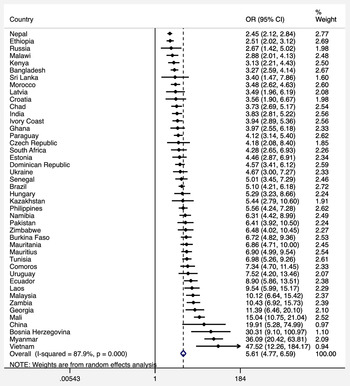
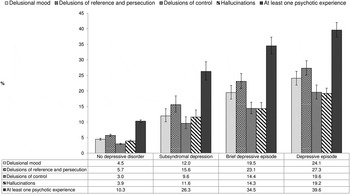
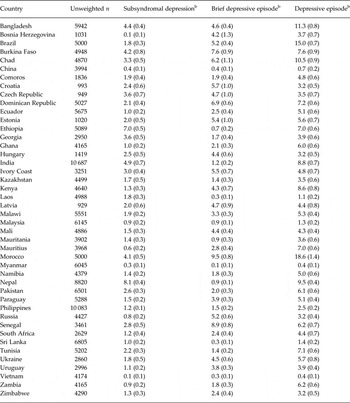
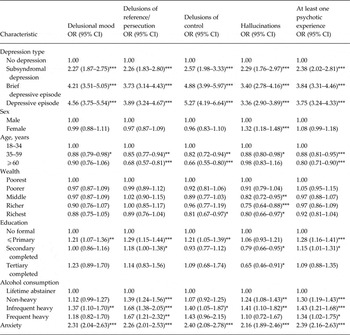
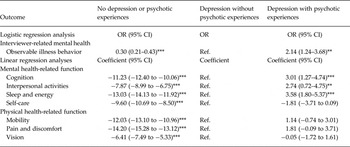
The overall mean age was 38.3 (s.d. = 16.0) years and 50.6% of the respondents were female. The prevalence of delusional mood, delusions of reference and persecution, delusions of control, hallucinations, and at least one PE were 6.8, 8.4, 4.7, 5.7 and 14.1%, respectively. The country-wise age–sex-adjusted prevalence of different types of depression is presented in Table 1. Overall, the age–sex-adjusted prevalence of subsyndromal depression, brief depressive episode and depressive episode were 2.7, 3.0 and 7.1%, respectively. Fig. 1 illustrates the country-wise associations between any type of depression and at least one PE, which were statistically significant in all countries. The overall estimate based on a meta-analysis was OR 5.61 (95% CI 4.77–6.59). For all types of PEs, a greater severity of depression was significantly associated with a higher prevalence of PEs (Fig. 2). This is also shown in the multivariable logistic regression analyses where all types of PE were significantly associated with subsyndromal depression (OR 2.26–2.57), brief depressive episode (OR 3.40–4.88) and depressive episode (OR 3.36–5.27) (Table 2). Finally, compared with depression without PEs, depression with PEs was associated with a significant decrement in hypothesized mental health indicators, specifically in observable illness behavior and the functional domains of cognition, interpersonal activities and sleep/energy (Table 3), but not with self-care or any of the physical health indicators (i.e. mobility, pain and discomfort, or vision).
Country-wise association between any depression (independent variable) and at least one psychotic experience (dependent variable) estimated by logistic regression adjusted for age and sex. Any depression referred to depressive episode, brief depressive episode, or subsyndromal depression, and was based on past 12-month symptoms. Psychotic-experiences also referred to those that occurred in the past 12 months. The overall estimate was obtained by combining the estimates for each country into a random-effect meta-analysis. OR, Odds ratio; CI, confidence interval.

Prevalence of psychotic experiences by type of depressive episode. Both psychotic experiences and depression were based on symptoms in the past 12 months. Bars denote 95% confidence intervals. Prevalence estimates are based on weighted samples.

Age–sex-adjusted prevalence of different types of depression by country a

Data are given as weighted percentage (standard error) unless otherwise indicated.
a All age–sex-adjusted weighted estimates were calculated using the United Nations population pyramids for the year 2010.
b The different types of depression are based on symptoms in the past 12 months and are mutually exclusive categories.
Association between different types of depression and psychotic experiences a

OR, Odds ratio; CI, confidence interval.
a Models are adjusted for all variables in the Table and country.
* p < 0.05, ** p < 0.01, *** p < 0.001.
Association between depression/psychotic experience groups and health status a

OR, Odds ratio; CI, confidence interval; Ref., reference category.
a All health outcome scores ranged from 0 to 100 with higher scores indicating worse health status. Depression referred to depressive episode, brief depressive episode, or subsyndromal depression. Models are adjusted for age, wealth, education, alcohol consumption, anxiety and country.
** p < 0.01, *** p < 0.001.
Discussion
Main findings
Depression was strongly associated with PEs across all 44 of the countries studied, across each individual type of PE, and across all levels of depression severity. Further, the presence of PEs was indicative of greater clinical and functional impairment among respondents with depression, as hypothesized, in terms of (a) cognition; (b) interpersonal relations; (c) sleep; and (d) observable illness behavior. In contrast, PEs were not associated with impairment in self-care or any indicator of functioning related to physical health (i.e. mobility, pain/discomfort, and vision).
Strengths and limitations
The strength of this study is its very large sample size and the use of mostly nationally representative multi-country data with a focus on low- and middle-income countries, where there is no prior research on this topic. The results of our study should nonetheless be interpreted in the light of several potential limitations. First, the survey relied on self-reports, which can be affected by reporting bias (e.g. social desirability, recall). Second, despite its widespread use in past studies, the WHO-CIDI psychosis screen does not assess all types of PEs. In our study, the association between different types of PEs and depression subtypes was strikingly similar, although previous studies (with adolescents and younger adults) showed that some types of PEs (e.g. persecutory ideation and bizarre experiences) are more strongly associated with depression than others (Armando et al. Reference Armando, Nelson, Yung, Ross, Birchwood, Girardi and Fiori Nastro2010), while some negative PEs have also been associated with depression (Barragan et al. Reference Barragan, Laurens, Navarro and Obiols2011). Next, residual confounding may exist since we could not adjust for factors such as substance use due to a lack of data (although we did adjust for alcohol use). Therefore, their confounding and independent effects remain unknown, although prior research has shown that PEs are indicators of higher levels of substance use among those with depression, at least in adolescents and young adults (Wigman et al. Reference Wigman, van Nierop, Vollebergh, Lieb, Beesdo-Baum, Wittchen and van Os2012). Furthermore, the ORs obtained in our study should not be interpreted as relative risks especially when at least one PE is the outcome since the prevalence exceeded 10% (Katz, Reference Katz2006) in the overall sample and also in some countries [e.g. 44.5% (Nepal), 32.4% (Brazil), 24.1% (India)]. Finally, the cross-sectional design limits the potential for causal inferences.
Association between depressive symptoms and PEs
Our finding of an association between the severity of depression and PEs concurs with the results from the two existing adult population studies (Ohayon & Schatzberg, Reference Ohayon and Schatzberg2002; Saha et al. Reference Saha, Scott, Varghese and McGrath2012), supporting the generalizability of these prior findings across numerous low- and middle-income countries. We expanded on prior studies by additionally showing that all subtypes of depression were associated with higher odds for each subtype of PE, with even subsyndromal depression being associated with 2.26–2.57 times higher odds for reporting one or more PEs when compared with those without any depression. The relationship between PEs and depression may be explained by factors such as shared familial or genetic links, as well as a shared vulnerability for both conditions such as childhood adversities (Varghese et al. Reference Varghese, Scott, Welham, Bor, Najman, O'Callaghan, Williams and McGrath2011), stress (DeVylder et al. Reference DeVylder, Koyanagi, Unick, Oh, Nam and Stickley2016), impaired cognitive, social and emotional functioning (Weiser et al. Reference Weiser, van Os and Davidson2005), as well as certain personality traits (Grant et al. Reference Grant, Chou, Goldstein, Huang, Stinson, Saha, Smith, Dawson, Pulay, Pickering and Ruan2008; Schroeder et al. Reference Schroeder, Fisher and Schafer2013). In one longitudinal study of a clinical sample consisting of young people, an improvement in depression was associated with a diminution of PEs, suggesting that there may be a direct and possibly bi-directional causal relationship between depression and psychosis (Yung et al. Reference Yung, Buckby, Cosgrave, Killackey, Baker, Cotton and McGorry2007). More specifically, it has been suggested that depression may act to worsen the evaluation of PEs, which, in turn, may result in more depressive symptoms, greater anxiety and stress. Across time, this may result in biological changes that further underpin the continuation and aggravation of PEs (Yung et al. Reference Yung, Buckby, Cosgrave, Killackey, Baker, Cotton and McGorry2007). Given this, an important task for future research will be to examine the association between PEs and depression longitudinally.
Clinical and public health implications
The co-occurrence of depression and PEs was associated with significantly impaired function in the domains of cognition, interpersonal activities, and sleep/energy, and observable illness behavior, when compared with those with depression alone. Notably, these associations were robust to adjustment for potential demographic and clinical confounders, including alcohol use and anxiety. These findings generally concur with those from one previous general population study of adolescents and young adults, in which PEs were likewise an indicator of greater observable illness behavior, as well as several other clinical and functional outcomes (Wigman et al. Reference Wigman, van Nierop, Vollebergh, Lieb, Beesdo-Baum, Wittchen and van Os2012). To our knowledge, no prior studies have specifically reported greater functional impairment in terms of sleep disturbance, cognition and interpersonal activities (i.e. social function) associated with the co-occurrence of depression and PEs. These diverse functional impairments suggest that the presence of PEs indicates broad functional significance among people with depressive symptoms, which is not restricted to any particular domain. Cognitive difficulties and social impairment are targeted in evidence-based treatments for psychosis, such as cognitive remediation therapy (Wykes et al. Reference Wykes, Huddy, Cellard, McGurk and Czobor2011) and social skills training (Kurtz & Mueser, Reference Kurtz and Mueser2008), both of which may be appropriate for individuals reporting subthreshold PEs in the context of depression. Sleep disturbance has long been recognized as a core diagnostic feature of depression (Breslau et al. Reference Breslau, Roth, Rosenthal and Andreski1996), and more recently, as a potential etiological factor for psychosis (Fisher et al. Reference Fisher, Lereya, Thompson, Lewis, Zammit and Wolke2014). Depression treatments that target sleep disturbance have been shown to have rapid effects on mood (e.g. complete sleep deprivation, ketamine and deep brain stimulation) and may also provide a potential avenue for the treatment of severe depression with co-occurring PEs, pending further research (Freeman et al. Reference Freeman, Sheaves, Goodwin, Yu, Harrison, Emsley, Bostock, Foster, Wadekar, Hinds and Espie2015). Finally, the lack of an association with physical health outcomes tentatively suggests that the additional impairment indicated by PEs may be specific to domains related to mental or behavioral health. The lack of an association between PEs and impaired self-care, on the other hand, was contrary to our hypothesis and should be explored further in future studies.
Conclusions
This study adds further evidence to the current literature that it may be inappropriate to consider psychosis and affective disorders as distinct entities (Wigman et al. Reference Wigman, van Nierop, Vollebergh, Lieb, Beesdo-Baum, Wittchen and van Os2012; Stochl et al. Reference Stochl, Khandaker, Lewis, Perez, Goodyer, Zammit, Sullivan, Croudace and Jones2015). The coexistence of PEs is common even in subthreshold levels of depression, where they are indicators of elevated clinical and functional significance. When either depression or PEs are detected, assessing for the other may be important for treatment planning, as the co-occurrence of these conditions is associated with a decrement in health status.
Supplementary material
For supplementary material accompanying this paper visit http://dx.doi.org/10.1017/S0033291716001422.
Acknowledgements
A.K's work was supported by the Miguel Servet contract financed by the CP13/00150 and PI15/00862 projects, integrated into the National R + D + I and funded by the Instituto de Salud Carlos III – General Branch Evaluation and Promotion of Health Research – and the European Regional Development Fund (ERDF-FEDER). These funders had no role in: design and conduct of the study; collection, management, analysis and interpretation of the data; and preparation, review or approval of the manuscript.
Declaration of Interest
None.