





1. Introduction
Decades of research have demonstrated that the way options are presented and choices are structured can significantly influence individuals’ decisions (Kahneman and Tversky, Reference Kahneman and Tversky1984; Schwarz, Reference Schwarz1999; Smith et al., Reference Smith, Goldstein and Johnson2013; Tversky and Kahneman, Reference Tversky and Kahneman1981). A prominent example is the default effect, where individuals are more likely to stick with a preselected option than choose an alternative (Jachimowicz et al., Reference Jachimowicz, Duncan, Weber and Johnson2019; Johnson et al., Reference Johnson, Shu, Dellaert, Fox, Goldstein, Häubl and Weber2012). The default effect has been widely implemented across diverse domains, including opt-out organ donation systems (Johnson and Goldstein, Reference Johnson and Goldstein2003), automatic enrollment in green energy programs (Berger et al., Reference Berger, Kilchenmann, Lenz, Ockenfels, Schlöder and Wyss2022), preselection of healthier food options on menus (Radnitz et al., Reference Radnitz, Beezhold, Pilato, Drury, Fruchter, Murphy and Loeb2023), and boosting retirement contributions through default enrollment schemes (Madrian and Shea, Reference Madrian and Shea2001). Policymakers, behavioral scientists, and market advisors widely recognize the power of the default effect in shaping decisions and frequently use it to nudge individuals toward socially desirable outcomes (Hallsworth, Reference Hallsworth2023; He et al., Reference He, Kang and Lacetera2021; Madrian, Reference Madrian2014; Thaler and Sunstein, Reference Thaler and Sunstein2021). This study contributes to our understanding of whether laypeople are aware of the default effect and whether they can use it strategically to influence others’ decisions. Specifically, we investigate whether individuals can set defaults in a way that maximizes their rewards in a structured default-setting game, and whether their beliefs about the underlying mechanisms of the default effect shape their default-setting choices.
1.1. Are people aware of the impact of defaults?
Zlatev et al. (Reference Zlatev, Daniels, Kim and Neale2017) found that individuals often exhibit ‘default neglect’, which refers to a failure to strategically set defaults to maximize outcomes. In a series of 11 experiments involving over 2,800 participants, individuals were assigned the role of a choice architect (CA) and asked to encourage a decision maker (DM) to choose either a job offering higher pay or one with more vacation days. Each CA was presented with 2 scenarios, each with one of the jobs preselected as the default, and was asked to choose one that would nudge the DM toward a specific target job (e.g., the higher paying job). A default-aware individual would select the scenario where the target job (e.g., the higher paying one) was preselected, increasing the likelihood that DMs would choose it. However, the results revealed that participants performed no better than chance, selecting the optimal default only about 50% of the time. Notably, even after 20 rounds of the task and observing DM responses, participants showed no improvement in their default-setting strategy, failing to use it effectively to increase their rewards.
These findings are unexpected as they conflict with common intuitions, existing research, and theoretical explanations of the default effect. Defaults are widely used in daily life, from restaurant menus and online shopping platforms to phone settings, insurance coverage, and Internet plans. Defaults are also frequently implemented across sectors such as business, education, health, and government, either to nudge individuals toward socially beneficial outcomes (He et al., Reference He, Kang and Lacetera2021; Thaler and Sunstein, Reference Thaler and Sunstein2021) or steer them toward options that disproportionately benefit the default setters (Posner et al., Reference Posner, Simonov, Mrkva and Johnson2023). This aligns with survey findings showing that most behavioral scientists believe laypeople understand the power of defaults and are capable of using them to influence others’ decisions (Zlatev et al., Reference Zlatev, Daniels, Kim and Neale2017). While some have argued that the default effect is underutilized despite its ubiquity in daily life (Zlatev et al., Reference Zlatev, Daniels, Kim and Neale2017, Reference Zlatev, Daniels, Kim and Neale2018), this underuse may reflect more than mere default neglect. For example, default effects and other choice architecture tools are found not to be as effective as often assumed, particularly when accounting for publication bias (Maier et al., Reference Maier, Bartoš, Stanley, Shanks, Harris and Wagenmakers2022) or when implemented in real-world contexts (DellaVigna and Linos, Reference DellaVigna and Linos2022). Moreover, defaults could potentially crowd out support for more structural policy interventions and solutions (Hagmann et al., Reference Hagmann, Ho and Loewenstein2019; but see Ghasemi et al., Reference Ghasemi, Almasi, Khaki, Fallahi, Solhirad and Newell2025a), and may be perceived as ethically questionable or manipulative (Bruns and Perino, Reference Bruns and Perino2023). These factors may lead default-aware individuals to intentionally avoid deploying defaults, not due to ignorance but due to broader practical and ethical considerations.
The idea of default neglect also contradicts evidence showing that people often understand how defaults work and use them effectively (Altmann et al., Reference Altmann, Falk and Grunewald2025; Leong et al., Reference Leong, Yin and McKenzie2020). For example, Jung et al. (Reference Jung, Sun and Nelson2018) found that people hold accurate beliefs about the default effect in real-world domains, such as organ donation and retirement savings. Across 3 experiments, the majority of participants consistently predicted that individuals are more likely to select an option when it is preselected as the default. Furthermore, by reanalyzing Zlatev et al.’s (Reference Zlatev, Daniels, Kim and Neale2017) data, Jung et al. (Reference Jung, Sun and Nelson2018) showed that CAs could learn to set better defaults when they observed that DMs frequently accepted them. While this learning did not lead to perfect performance, it indicates that people are not entirely default unaware.
This view is further supported by McKenzie et al. (Reference McKenzie, Leong and Sher2021), who found that individuals could use defaults to influence others. When asked to imagine preferring a particular restaurant, individuals were more likely to choose a message that made their preferred option the default (e.g., ‘I’ll meet you at Restaurant X at noon. If you’d rather meet at Restaurant Y, let me know’.). McKenzie et al. (Reference McKenzie, Leong and Sher2021) argued that the suboptimal default selection observed by Zlatev et al. (Reference Zlatev, Daniels, Kim and Neale2017) was largely due to the complexity of their task. When participants were presented with simplified versions of Zlatev et al.’s (Reference Zlatev, Daniels, Kim and Neale2017) scenarios in 2 follow-up experiments, significantly more of them were able to select the optimal default. Similarly, Zlatev et al.’s (Reference Zlatev, Daniels, Kim and Neale2017) study 3 found substantially higher rates of optimal default selection in a preselection default task than in the arguably more difficult stay-or-switch task (79% vs. 47%), suggesting that default awareness may depend on task structure and complexity.
1.2. Psychological mechanisms underlying default effects
Several theoretical mechanisms have been proposed to account for why defaults exert such a strong influence on choice (Jachimowicz et al., Reference Jachimowicz, Duncan, Weber and Johnson2019; Johnson and Goldstein, Reference Johnson and Goldstein2003; Madrian and Shea, Reference Madrian and Shea2001; Smith et al., Reference Smith, Goldstein and Johnson2013). One mechanism is effort cost, where individuals tend to accept the default because switching requires time and cognitive effort (Schulze et al., Reference Schulze, Aka, Bartels, Bucher, Embrey, Gureckis and Newell2025), such as completing extra forms to opt out of organ donation. Another mechanism is loss aversion, where defaults are seen as the status quo, making individuals more reluctant to override them due to the tendency to overweight potential losses relative to gains (Tversky and Kahneman, Reference Tversky and Kahneman1991). Beyond these mechanisms, the implicit recommendation mechanism highlights the social and communicative nature of defaults (Krijnen et al., Reference Krijnen, Tannenbaum and Fox2017; McKenzie et al., Reference McKenzie, Liersch and Finkelstein2006; Szollosi et al., Reference Szollosi, Wang-Ly and Newell2025). In this view, defaults serve as a form of implicit and strategic communication between a default setter and a decision maker. The default setter tends to select their preferred option as the default, thereby revealing their preferences to decision makers. In turn, decision makers interpret the default as an implicit recommendation from the default setter (Johnson and Goldstein, Reference Johnson and Goldstein2003; McKenzie et al., Reference McKenzie, Leong and Sher2021). That is, people treat defaults not just as the easier or safer option but as a socially meaningful signal.
Supporting this implicit communication, McKenzie et al. (Reference McKenzie, Liersch and Finkelstein2006) showed that individuals who supported organ donation were more likely to favor opt-out policies and saw policymakers who did so as pro-donation. From this perspective, decision makers are not merely loss-averse or cognitively lazy recipients of information; rather, they act as rational agents who interpret and integrate choice-related cues, including the preference, intent, and credibility of the CA, into their decision-making process (Ghasemi, Reference Ghasemi2024; Ghasemi et al., Reference Ghasemi, Almasi, Khaki, Fallahi, Solhirad and Newell2025a).
1.3. The current study
Altogether, recent empirical and theoretical developments point to mixed evidence regarding default neglect. Understanding the extent of default awareness is crucial not only for informing rational theories of decision making but also for shaping practical interventions. If individuals truly neglect defaults, then educational or behavioral strategies may be needed to encourage effective use of choice architecture in contexts such as the workplace, classrooms, healthcare systems, and digital platforms.
Thus, this study aims to further investigate whether individuals are able to set the defaults strategically in a simple default-setting game, where they take on the role of a CA (referred to as the ‘Informant’ in the game) for a series of DMs (referred to as the ‘players’ in the game). In each round, individuals were presented with a sure option and a chance option, with varying expected values, and were asked to set one as the default for a DM whose interests may or may not align with their own. Building on similar game-based paradigms used in prior research to test how people deploy choice architecture techniques in social contexts (e.g., Ghasemi et al., Reference Ghasemi, Harris and Newell2025b), this format isolates the strategic use of defaults from real-world confounds. It minimizes the influence of personal preferences (e.g., setting defaults that reflect one’s own choice rather than the task’s instructions; McKenzie et al., Reference McKenzie, Leong and Sher2021) or social norms (e.g., choosing defaults that are socially approved, like salad over fries), particularly when decisions are observed (Leong et al., Reference Leong, Yin and McKenzie2020).
Experiment 1 assessed whether individuals, acting as choice architects (CAs), could strategically set default options for players with aligned or misaligned interests to maximize their own outcomes. Experiment 2 examined whether CAs could override or retain an already preselected default in a way that served their interests, even when switching came at a hypothetical cost. Experiment 3 explored whether participants not only use defaults strategically as CAs but also recognize when others do so and are able to make meaningful inferences from others’ default-setting behavior. Specifically, participants observed default choices made by another default setter for a series of players with either aligned or conflicting interests and were asked to infer which option was likely more valuable. A default-aware individual would (a) assign the higher EV option as the default when another person’s gain aligns with their own, and the lower EV option when interests diverge; (b) selectively retain or override preset defaults based on whether doing so enhances personal benefit; and (c) infer that a chosen default reflects strategic intent, such that a defaulted option is judged as better when it is selected for a DM aligned with the default setter, and the nondefault is judged as better when interests are misaligned. At the end of each experiment, participants reported their beliefs about the effectiveness of defaults and the role of 3 key mechanisms (i.e., implicit recommendation, cognitive effort, and loss aversion) in driving the default effect.
The current study builds on mixed evidence in the literature on default neglect and default awareness by examining how individuals can set informative defaults. We first test whether people can use defaults strategically to benefit others with aligned interests. Going beyond recent related work (e.g., Altmann et al., Reference Altmann, Falk and Grunewald2025), we also examine whether individuals can deliberately set misleading defaults to disadvantage others with conflicting interests. In addition to default setting, the study assesses other forms of default awareness, including whether participants selectively accept or override preset defaults to maximize their own outcomes. It also examines whether participants can infer choice-related information by observing the default-setting behavior of another CA, which reveals the extent to which they assume others act strategically. Finally, we examine how individuals’ beliefs about the impact of defaults and their underlying mechanisms relate to both their general beliefs about default effects and their own strategic behavior.
2. General method
2.1. Participants
In Experiment 1, 161 participants from the Iranian general population were recruited through social media. After excluding 1 individual who failed the single attention check, the final sample consisted of 160 participants (mean age = 28.5, SD = 8.15), including 77 females, 58 males, and 3 who preferred not to disclose their gender. In Experiment 2, 188 undergraduate students from the UNSW participant pool completed the study. Participants who failed 2 or more of the 4 attention checks (n = 27) were excluded, leaving a final sample of 161 students (mean age = 19.9, SD = 3.85), with 104 identifying as female, 55 as male, and 2 either self-describing or choosing not to specify their gender. Experiment 3 included 167 undergraduate students from UNSW. Eighteen participants who failed more than 1 of 3 attention checks were excluded, resulting in a final sample of 149 participants (mean age = 19.0, SD = 2.04), including 108 females, 40 males, and 1 participant who preferred not to answer. To ensure the robustness of our findings, we repeated main analyses under varying exclusion criteria based on participants’ performance on attention checks. The key results remained consistent in every case (see Table S1 in the Supplementary Material).
2.2. Design and materials
This study comprised 3 experiments investigating how individuals strategically set defaults in social decision-making contexts. In each experiment, participants were introduced to a default game where they took on the role of a CA (referred to as the ‘Informant’ during the experiment). Their task was to set either a sure card or a chance card as the default option for a series of hypothetical players across multiple rounds. Each round presented participants with a choice between a sure card worth $50 or a chance card worth $100, with the chance card’s winning probability varying across rounds: 5%, 10%, 50%, 90%, and 95%. This resulted in 2 rounds where the chance card had a lower expected value than the sure card (e.g., 5% chance to win $100), 2 rounds where it had a higher expected value (e.g., 95% chance to win $100), and 1 round where the expected values were equal (e.g., 50% chance to win $100).
Participants were informed that the players were either their teammates, with whom they had aligned interests; their opponents, with whom they had conflicting interests; unknown players whose affiliations were not disclosed; or neutral players whose outcomes had no effect on the participant’s earnings. Participants were told that while the players would be unaware of the exact value and probability of the chance card, they, as informants, would have full knowledge of both. Their role was to set the default option, either the sure or the chance card, for each player in each round in a way that would maximize their own hypothetical earnings.
The key objective of the experiments was to determine whether participants could strategically set the default to maximize their profits. The optimal strategy involved choosing the card with the higher expected value (e.g., the chance card when it had a 90% or 95% probability of winning, and the sure card when the chance card had a 5% or 10% probability) for teammates, and the lower expected value card for opponents. The default options selected for unknown and neutral players served as reference points. The selected probability levels were designed to ensure a clear difference in expected value, making it easy to identify the optimal choice. While we acknowledge that identifying the optimal choice also depends on the decision-maker’s utility function, the large expected value differences in our design (e.g., $5 vs. $50, $95 vs. $50) should be robust to modest variations in risk preferences. These large differences also allow us to attribute any potential default insensitivity to default neglect rather than to a lack of ability to calculate expected values. Importantly, while these expected value differences were obvious to participants acting as CAs, they were told that decision makers (players in the game) do not observe the probability or value of the chance card. As a result, from the perspective of a hypothetical decision maker, the choice is between a sure card with a known expected value and a chance card with an unknown expected value, with one of these options being preselected.
In Experiment 1, participants made default selections for teammates, opponents, and unknown players (neutral players were introduced in subsequent experiments—see next). Participants were instructed that if a teammate won money, the same amount would be added to their own earnings, whereas if an opponent won, the amount would be deducted. The outcomes of unknown players remained ambiguous, as their group affiliation was not disclosed. Importantly, participants were informed that all players would perceive them as supportive teammates, regardless of their actual relationship.
Experiment 2 expanded on the first by introducing a between-subjects manipulation of the initial default. Participants were randomly assigned to 1 of 2 conditions: in one, the sure card was set as the initial default in each round; in the other, the chance card was the initially set default. Participants, again in the role of informants, were asked to review the preset default and decide whether to switch it. Each switch incurred a $10 cost, deducted from an initial budget of $200. All earnings and costs across experiments were hypothetical. Additionally, this experiment introduced a fourth player type: neutral players, whose winnings had no impact on the informant’s earnings.
In Experiment 3, participants completed 2 blocks in counterbalanced order, taking on the roles of both informant and observer. The informant block was structurally similar to Experiments 1 and 2: participants selected default options for 4 player types (teammate, opponent, unknown, and neutral) across rounds with varying chance card expected values. In the observer block, participants were shown trials in which a hypothetical informant had already selected a default option for a player. The observer’s task was to infer which of the 2 cards (the default or the alternative) had a higher value.
2.3. Procedure
In each experiment, participants first reviewed the game instructions and completed a brief comprehension quiz. Feedback was provided for any incorrect responses, and participants were required to correct their answers before moving on. They could also revisit the instructions if needed. In Experiment 1, participants completed 15 trials consisting of 5 card pairs shown once for each player type. On each trial, they were shown a player (e.g., a teammate) and asked to select 1 of the 2 cards (e.g., a sure card worth $50 vs. a chance card with a 10% chance to win $100) to set as the default option for that player. The order of trials in the experimental blocks was fully randomized across all experiments. No feedback was provided during the experimental phase, and participants were not informed about whether their defaults were accepted or whether any outcomes resulted in gains or losses. Example trials from all 3 experiments are presented in Figure 1.
Example trials from each experiment. In Experiment 1 (left), participants acted as informants and selected a card (sure or chance) to set as the default for a specified player. In Experiment 2 (middle), participants were shown a preset default (in this example, the sure card) and could either keep it or switch to the other card at a small cost. In Experiment 3 (right), only the observer block is shown: Participants viewed a default selection made by a hypothetical informant and judged which card they believed was more valuable based on the selected default and the player’s identity.

Figure 1. Long description
The figure is divided into three vertical panels labeled Experiment 1, Experiment 2, and Experiment 3.
Experiment 1 (Left Panel):
- Top: A green silhouette of a person labeled Player: Teammate.
- Middle: Text asks, ‘As the informant, which card would you like to set as the default for this player?’
- Bottom: Two card options with radio buttons. The top card is a ‘Sure Card’ worth $50. The bottom card is a ‘Chance Card’ with a 50% chance to win $100.
Experiment 2 (Middle Panel):
- Top: A red silhouette of a person labeled Player: Opponent.
- Middle: Text asks, ‘Which card do you want to set as the default for this player? You can either keep the default option as it is or change it, incurring a $10 cost.’
- Bottom: The ‘Sure Card’ is highlighted in a light blue box with a filled radio button, indicating it is the current default. The ‘Chance Card’ is below it with an empty radio button.
Experiment 3 (Right Panel):
- Top: A gray silhouette of a person labeled Player: Unknown.
- Middle: Text states, ‘The informant has selected the following option as the default for this player.’
- Bottom: The ‘Sure Card’ is shown at the top. Below it, the ‘Chance Card’ is highlighted in a light blue box with a filled radio button. At the very bottom, text asks, ‘Which card do you consider to be more valuable? Sure card / Chance card.’
Experiment 2 consisted of 20 trials, with each of the 5 card pairs shown once for each of the 4 player types. In this experiment, at the start of each round, 1 of the 2 cards was preselected as the default. For half of the participants, the sure card was always preselected; for the other half, the chance card was preselected. Participants could choose to keep or override the default, but each switch reduced their own budget of $200 by $10.
Experiment 3 introduced a within-subjects design in which participants played 2 roles. In the informant block, they followed the same task as in previous experiments, selecting default options for different player types over 20 trials. In the observer block, participants were presented with 8 trials (two pairs for each player type) where a default card had already been selected by an informant. Each trial displayed a sure card worth $50 and a chance card with its value hidden using a shaded rectangle. Participants had to decide which of the 2 cards they thought was more valuable, based only on the default selection and the type of player.
After completing the experimental tasks, participants answered questions assessing their understanding of default settings and the mechanisms underlying the default effect. First, they estimated the percentage of players they believed would stick with the default option they had set. They were then told that many players tend to keep the preselected option and were presented with 3 possible explanations: that the default is seen as an implicit recommendation, that changing the default requires effort, and that players are motivated by avoiding losses rather than seeking gains. These explanations reflect 3 well-established mechanisms proposed in the literature to explain the default effect: implicit recommendation, cognitive laziness, and loss aversion. Participants rated how well each explanation described the default effect on a 100-point scale (0 = completely incorrect; 100 = completely correct). Experiment 1 was conducted in Farsi, while Experiments 2 and 3 were administered in English (see Supplementary Material for all the experimental materials).
3. Results
In this section, we first tested whether participants strategically used defaults to serve their own interests. We then examined the overall optimality of their choices, their willingness to override preset defaults at a cost, and their ability to infer optimal choices based on others’ default selections. Finally, we assessed participants’ beliefs about the mechanisms driving the default effect. Additional analyses are provided in the Supplementary Material, where we examine participants’ first trial as well as trials restricted to unknown players.
3.1. Strategic default selection
Figure 2 shows the probability of participants selecting the chance card as the default option for each player type, across varying levels of the chance card’s expected value. When the chance card had a lower expected value ($5 or $10) than the sure card (fixed at $50), participants were less likely to set it as the default option for their teammates and more likely to set it as the default for their opponents. In contrast, when the chance card offered a higher expected value ($90 or $95), this pattern reversed: Participants were more likely to select it as the default for their teammates and less likely to do so for their opponents. Interestingly, Figure 2 suggests that participants may have been slightly more willing to help teammates than to harm opponents. While both strategies were equally optimal in terms of points earned, the data show a somewhat steeper rise in default setting for teammates at high expected values than the corresponding drop for opponents. This asymmetry may reflect a stronger motivation to help than to harm, even in strategic contexts. Default selections for unknown and neutral players fell in the middle and varied less across expected values. Overall, the pattern indicates that individuals strategically set the default option to maximize their gain.
Predicted probabilities of choosing the chance card as the default, plotted by player type and the expected value of the chance card. The expected value of the sure card was fixed at $50. For Experiment 2, items were combined across both experimental groups: one in which the default was initially set to the sure card, and one in which it was set to the chance card. For Experiment 3, only trials where participants acted as informants (selecting defaults for others) were included. Probabilities and 95% confidence intervals were estimated from generalized linear models with participant-clustered standard errors.

Figure 2. Long description
A three-panel figure labeled A, B, and C, representing Experiment 1, Experiment 2, and Experiment 3. All panels share a y-axis titled P(selecting the chance card as default) ranging from 0.0 to 1.0 and an x-axis titled Chance Card Expected Value with categorical points at $5, $10, $50, $90, and $95.
* Panel A (Experiment 1): Three data series are shown. The Teammate series (green squares) shows a sharp increase from 0.15 at $5 to 0.9 at $95. The Opponent series (red diamonds) shows a sharp decrease from 0.8 at $5 to 0.15 at $95. The Unknown series (light gray circles) shows a slight downward trend from 0.55 to 0.4. All lines intersect near the $50 mark at a probability of 0.5.
* Panel B (Experiment 2): Four data series are shown. Teammate (green) and Opponent (red) follow the same steep increasing and decreasing trends as Panel A. The Unknown series (gray) remains relatively flat near 0.5. A fourth series, Neutral (blue triangles), shows a slight increase from 0.4 at $5 to 0.6 at $95.
* Panel C (Experiment 3): Similar to Panel B, four series are present. The Teammate (green) and Opponent (red) trends are even more pronounced, starting near 0.05 and 0.9 respectively and crossing at $50. The Neutral (blue) series increases from 0.4 to 0.6, while the Unknown (gray) series decreases from 0.55 to 0.35.
Vertical error bars representing 95 percent confidence intervals are present for all data points.
To examine how participants’ default choices varied as a function of player identity and the expected value of the chance card, we conducted generalized linear models (GLM) separately for each experiment. The dependent variable in all models indicated whether the participant selected the chance card (coded as 1) or not (coded as 0). Each model included fixed effects for player type (i.e., unknown, teammate, opponent, and neutral), the expected value of the chance card ($5, $10, $50, $90, and $95), and their interaction. All categorical predictors were sum coded. Reported coefficients represent average marginal effects on the log-odds scale, and we also presented predicted probabilities on the response scale to aid interpretation. The statistical significance of main effects and interactions was evaluated using Type III likelihood ratio tests. This approach was applied consistently across all experiments.
In Experiment 1, the results showed that as the expected value of the chance card increased, participants were more likely to select it as the default when the recipient was a teammate (b = .042, SE = .004, p < .001). For instance, the probability of choosing the chance card for teammates rose sharply from .14 to .88 as its expected value increased from $5 to $95. In contrast, higher expected values were associated with a decrease in the likelihood of choosing the chance card for opponents (b = –.034, SE = .004, p < .001) and unknown players (b = –.008, SE = .003, p = .003). When the expected value of the chance card increased from $5 to $95, participants showed a sharper decrease in selecting it as the default for opponents (dropping from .80 to .15) than for unknown players (from .56 to .39).
In Experiment 2, we analyzed combined data from 2 groups: one in which the default was initially set to the sure card and another where it was set to the chance card. The results revealed that increases in the expected value of the chance card were associated with higher log odds of selecting it for both teammates (b =.059, SE = .004, p < .001) and neutral players (b = .009, SE = .002, p < .001). When the expected value was $5, the probability of selecting the chance card was .06 for teammates and .40 for neutral players. At an expected value of $95, these probabilities rose to .93 and .60, respectively. The increase in the expected value of the chance card was not associated with differences in selection rates for unknown players (b = .001, SE = .002, p = .54). However, as in Experiment 1, increases in the expected value were linked to a decrease in the likelihood of selecting the chance card for opponents (b = –.029, SE = .003, p < .001). Participants chose the chance card as the default about 70% of the time when its expected value was lower than the sure card, but this dropped to around 18% when its expected value was higher than the sure card.
The model for Experiment 3 included only trials in which participants acted as informants. The pattern of results aligned with those observed in the previous experiments. Increases in the expected value of the chance card corresponded with a higher likelihood of selecting it for teammates (b = .063, SE = .005, p < .001) and neutral players (b = .010, SE = .003, p < .001). In contrast, selection of the chance card decreased as its expected value increased for opponents (b = –.046, SE = .004, p < .001) and unknown players (b = –.010, SE = .003, p < .001). While the probability of selecting the chance card increased from .05 to .94 for teammates as its expected value rose from $5 to $95, it decreased from .87 to .10 for opponents.
Across all 3 experiments, we found robust evidence that participants set default options in strategically optimal ways. They were less willing to set a low-EV chance card as the default for teammates, where doing so could reduce their own earnings, but more inclined to do so for opponents, where it could be personally advantageous. This pattern reversed when the chance card had a high expected value. For neutral players, default selections were generally moderate, but participants still tended to select the chance card more often as its expected value increased. Unknown players, however, elicited more cautious defaults, with participants opting for the chance card less often as its value increased, possibly due to uncertainty about how these players might impact their earnings.
3.2. Optimal default selection
We next examined how often participants selected the optimal default option, that is, the card that would maximize their own earnings given the player type and the relative expected value of the options. For each experiment, trials in which no objectively optimal choice could be determined (e.g., when expected values were equal or the player type was unknown or neutral) were excluded from the analysis. To estimate the average optimal default rate and its 95% confidence interval, we fit intercept-only logistic regression models (GLMs) with clustered standard errors by participant. We then used chi-square goodness-of-fit tests to assess whether the observed optimal default rates were significantly different from chance (50%).
In Experiment 1, participants selected the optimal default in 83.6%, 95% CI [80.1, 86.6] of eligible trials. A chi-square goodness-of-fit test confirmed that this proportion was significantly above chance, χ 2(1) = 497.36, p < .001. In Experiment 2, the proportion of optimal defaults was 84.9%, 95% CI [81.8, 87.5], also significantly above chance, χ 2(1) = 624.7, p < .001. This pattern held across both experimental groups: participants in the default chance condition selected the optimal default in 86.9%, 95% CI [82.7, 90.2] of trials, χ 2(1) = 351.12, p < .001, and those in the default sure condition did so in 82.8%, 95% CI [78, 86.8] of trials, χ 2(1) = 274.31, p < .001. In Experiment 3, participants selected the optimal default in 86.8%, 95% CI [84, 89.2] of eligible trials, significantly above chance, χ 2(1) = 967.13, p < .001. When acting as informants, participants chose the optimal default in 90.4%, 95% CI [87.5, 92.8] of trials, χ 2(1) = 777.99, p < .001, while in their role as observers, they identified the better option in 79.5%, 95% CI [75.2, 83.3] of trials, χ 2(1) = 206.71, p < .001.
Across all experiments, participants consistently selected defaults that aligned with their own financial interests, demonstrating clear default awareness rather than default neglect. They strategically used default options to influence others’ decisions in ways that maximized their own outcomes. Experiment 3 showed that participants not only used defaults strategically when setting them but also interpreted others’ default setting behaviors to infer the optimal option, suggesting they assume others are default aware too.
3.3. Default setting versus default switching
The goal of Experiment 2 was to test whether participants would still use defaults strategically when the initial default was preset and they had the opportunity to switch it at a cost. Participants were randomly assigned to 1 of 2 groups: in the default sure condition, the sure card was initially selected as the default, while in the default chance condition, the chance card was preselected. Acting as informants, participants could switch the default in each round, but each switch reduced their own earnings. However, even with this cost, the expected values of the options remained significantly different, ensuring that the optimal choice could still be clearly identified.
To clarify the payoff structure, we review a few examples. When the chance card with an expected value of $10 is preselected, a CA paired with a teammate can either keep the default (payoff = $10) or switch to the sure card, which after the $10 switching cost yields a payoff of $40. By contrast, when paired with an opponent in the same situation, keeping the default produces a payoff of −$10, while switching to the sure card results in −$60. In this scenario, a default-aware CA would override the default and set the sure card when playing with a teammate, but would retain the low-value chance card when playing against an opponent. Similarly, when the chance card has an expected value of $90 and the sure card is preselected as the default, keeping the default for a teammate yields a payoff of $50, whereas switching produces a payoff of $80 ($90−$10). For an opponent, keeping the sure card gives −$50, while switching to the higher value chance card results in −$100. A default-aware CA would keep the sure card when playing against an opponent but would override the default and set the chance card when paired with a teammate to maximize their payoff.
To test whether participants strategically overrode the preset defaults depending on player type and expected value, we ran a logistic regression predicting the selection of the chance card as default from player type, chance card EV, default group, and all interactions. This analysis explicitly included the default group factor, rather than collapsing across it as in previous analyses. As Figure 3 shows, participants in the default-chance group, compared to those in the default-sure group, were 33% more likely to select the chance card as the default (b = 1.75, SE = .16, p < .001).
Predicted probabilities of selecting the chance card, plotted by player type, expected value of the chance card, and default group (default sure vs. default chance). The expected value of the sure card was fixed at $50. This figure illustrates how participants’ selection of the chance card varied depending on the initial default and the identity of the player, revealing patterns of strategic default override behavior. Estimates and 95% confidence intervals were derived from generalized linear models with participant-clustered standard errors.

Figure 3. Long description
A multi-panel line graph with two horizontal panels. The y-axis is labeled P (selecting the chance card as default) ranging from 0.0 to 1.0. The x-axis is labeled Chance Card Expected Value with categorical points at dollar 5, dollar 10, dollar 50, dollar 90, and dollar 95. A legend at the bottom identifies four player types: Unknown (light gray circles), Teammate (dark green squares), Opponent (dark red diamonds), and Neutral (blue triangles).
Left Panel: Default Chance.
* Teammate: Starts low at 0.1, rises sharply after dollar 10, and plateaus near 1.0 at dollar 90.
* Opponent: Starts high at 0.8, remains steady until dollar 10, then drops sharply to 0.2 by dollar 90.
* Neutral: Shows a steady linear increase from 0.7 to 0.9.
* Unknown: Remains relatively flat, fluctuating slightly around 0.7 to 0.8.
Right Panel: Default Sure.
* Teammate: Remains near 0 until dollar 10, then rises steeply to 0.9 at dollar 90.
* Opponent: Starts at 0.6, remains steady until dollar 10, then drops to 0.15 by dollar 90.
* Neutral: Starts near 0.1 and increases gradually to 0.3.
* Unknown: Remains flat near 0.2 until dollar 50, then rises slightly to 0.3.
All data points include vertical error bars representing 95 percent confidence intervals.
Importantly, a Type III likelihood ratio test revealed that the expected value of the chance card interacted with player type in predicting the outcome variable, χ 2(3) = 765.02, p < .001. Participants were more likely to select the chance card for teammates (b = .064, SE = .005, p < .001) and neutral players (b = .014, SE = .003, p < .001) as its expected value increased, and less likely to do so for opponents (b = –.030, SE = .004, p < .001). For unknown players, increases in the expected value of the chance card were not significantly associated with selecting it (b = .002, SE = .003, p = .533). This pattern was consistent across both default groups, as the 3-way interaction between player type, the expected value of the chance card, and default group was nonsignificant, χ 2(3) = 1.54, p = .673. Overall, these results indicate that participants were not simply following defaults passively. Instead, they weighed both the value of the options and the social context to make strategic decisions, even when doing so required overriding a preset default at a cost.
3.4. Inferring the optimal default
Focusing specifically on the observer block of Experiment 3, we examined whether participants could infer the objectively superior option based on default selections made by a hypothetical informant. We conducted a logistic regression predicting whether observers selected the chance card as the better option, using player type, the informant’s selected default (sure vs. chance), and their interaction as predictors.
As Figure 4 shows, observers’ judgments were strongly influenced by both who the default was set for and which card was selected. Relative to unknown players, the chance card was judged as more valuable when defaulted for teammates (b = 1.92, SE = .280, p < .001) and neutral players (b = 1.08, SE = .227, p < .001), but as worse when defaulted for opponents (b = –.569, SE = .241, p = .018). On the other hand, the chance card was judged as less valuable when the sure card was defaulted for teammates (b = –1.98, SE = .313, p < .001) and neutral players (b = –.788, SE = .224, p < .001), but more valuable when defaulted for opponents (b = 1.29, SE = .228, p < .001), all compared to unknown players. For instance, participants judged the chance card to be more valuable than the sure card in 83% of cases when it was defaulted for a teammate, compared with 28% when defaulted for an opponent. In contrast, when the sure card was defaulted, the chance card was judged more valuable in 9% of cases for a teammate and 73% for an opponent.
Estimated probability of choosing the chance card as more valuable when observing others' default selections in Experiment 3. In these trials, participants viewed default selections made by a hypothetical informant for different players and were asked to judge which card was worth more. These data reflect participants’ ability to infer the optimal option based on the default choices made by others. Error bars represent 95% confidence intervals calculated using participant-clustered standard errors.

Figure 4. Long description
The figure consists of two side-by-side bar graphs. The y-axis for both is labeled P (selecting the chance card as more valuable) with a scale from 0.0 to 1.0. The x-axis is labeled The player the Informant selected the default for, with four categories: Unknown (light gray), Teammate (green), Opponent (red), and Neutral (blue).
Left Panel: Informant's selected default equals Chance.
* Unknown: Probability is approximately 0.41.
* Teammate: Probability is highest at approximately 0.82.
* Opponent: Probability is approximately 0.28.
* Neutral: Probability is approximately 0.67.
Right Panel: Informant's selected default equals Sure.
* Unknown: Probability is approximately 0.43.
* Teammate: Probability is lowest at approximately 0.09.
* Opponent: Probability is highest at approximately 0.73.
* Neutral: Probability is approximately 0.25.
All bars include vertical error bars representing 95 percent confidence intervals.
Observers’ judgments reflected a clear sensitivity to both the informant’s default choice and the social identity of the player. These patterns suggest that observers were not only default aware but also assumed that others use defaults intentionally, allowing them to extract meaningful information from others’ choices in a socially strategic way.
3.5. The perceived mechanisms of default
How strongly did our participants believe in the overall effectiveness of defaults, and what did they think were the main drivers of default effects—implicit recommendations, cognitive effort, or loss aversion?
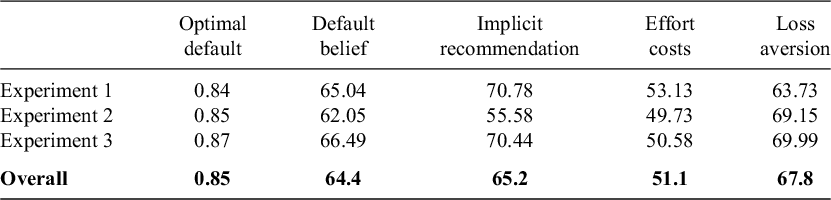
Table 1 shows that participants believed that the majority of players (62–66%) would select the default options they had set. To assess perceived mechanisms, participants were asked to rate how accurately each explanation describes why defaults are effective, using a 100-point scale where 0 indicated ‘completely incorrect’ and 100 indicated ‘completely correct’ (see Supplementary Material for complete wording of these questions). On average, participants rated loss aversion (M = 67.8) and implicit recommendation (M = 65.2) as the most influential drivers of default effects, with effort costs receiving a lower average rating (M = 51.1).
Average optimal default rates and perceived default mechanisms across experiments

Table 1. Long description
The table consists of six columns and five rows.
Column headers from left to right are: Blank, Optimal default, Default belief, Implicit recommendation, Effort costs, and Loss aversion.
Row 1: Experiment 1. Optimal default 0.84. Default belief 65.04. Implicit recommendation 70.78. Effort costs 53.13. Loss aversion 63.73.
Row 2: Experiment 2. Optimal default 0.85. Default belief 62.05. Implicit recommendation 55.58. Effort costs 49.73. Loss aversion 69.15.
Row 3: Experiment 3. Optimal default 0.87. Default belief 66.49. Implicit recommendation 70.44. Effort costs 50.58. Loss aversion 69.99.
Row 4: Overall. Optimal default 0.85. Default belief 64.4. Implicit recommendation 65.2. Effort costs 51.1. Loss aversion 67.8.
Optimal default values represent proportions. All other values are average ratings on a scale from 0 to 100.
Note: The first column reports the proportion of trials in which participants selected the optimal default (i.e., the option that maximized their own earnings). The remaining columns show average ratings (on a 0–100 scale) of participants’ belief in the effectiveness of defaults (‘default belief’) and the extent to which they perceived 3 mechanisms, implicit recommendation, effort costs, and loss aversion, as driving the default effect.
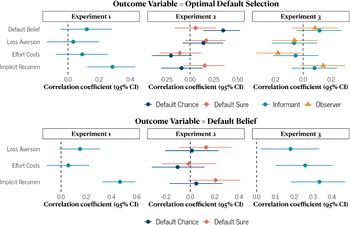
Next, we examined how participants’ beliefs about the mechanisms underlying the default effect related to their performance in the task and their overall belief in the power of defaults. As shown in the top panel of Figure 5, individuals’ ratings of the mechanisms were not strongly associated with their ability to select the optimal default. However, the bottom panel reveals a different pattern: Participants who rated the implicit recommendation mechanism more highly were more likely to believe that people follow defaults. This association was found to be significant in Experiments 1 and 3, but not in Experiment 2. In Experiment 3, belief in the other 2 mechanisms (i.e., effort costs and loss aversion) was also correlated with belief in the effectiveness of defaults. One explanation for the null findings in Experiment 2 may be that, unlike the other experiments, the defaults were initially set by the game rather than by the participants themselves. As a result, participants may have seen these defaults as less meaningful or intentional, diminishing their perceived relevance of the mechanisms behind the default effect.
Associations between perceived mechanisms of the default effect and participants’ performance and beliefs across experiments. The top panels show the correlations between participants’ ratings of default-related mechanisms (loss aversion, effort costs, and implicit recommendation), as well as their belief in the power of defaults, and their actual performance in selecting the optimal default. The bottom panels display correlations between the mechanism ratings and participants’ belief in the effectiveness of defaults. Each point represents a correlation coefficient between the variable on the y-axis and the outcome variable (optimal default selection in the top panel; default belief in the bottom panel). Colors and shapes indicate experimental conditions, and error bars reflect 95% confidence intervals.

Figure 5. Long description
The figure consists of two rows of three panels each.
Top Row: Outcome Variable equals Optimal Default Selection.
- Experiment 1: Shows positive correlations for Default Belief, Loss Aversion, Effort Costs, and a strong positive correlation for Implicit Recomm.
- Experiment 2: Compares Default Chance (blue circle) and Default Sure (red diamond). Default Sure shows higher positive correlations for Implicit Recomm and Default Belief compared to Default Chance.
- Experiment 3: Compares Informant (teal circle) and Observer (orange triangle). Observer shows higher positive correlations for Default Belief and Implicit Recomm, while Informant shows a negative correlation for Loss Aversion.
Bottom Row: Outcome Variable equals Default Belief.
- Experiment 1: Positive correlations for Loss Aversion and Effort Costs, with a very strong positive correlation for Implicit Recomm near 0.5.
- Experiment 2: Default Sure shows higher positive correlations for Loss Aversion and Implicit Recomm than Default Chance.
- Experiment 3: All three mechanisms (Loss Aversion, Effort Costs, and Implicit Recomm) show distinct positive correlations between 0.2 and 0.4.
Legend: Blue circles represent Default Chance, red diamonds represent Default Sure, teal circles represent Informant, and orange triangles represent Observer. Horizontal lines through each point indicate 95 percent confidence intervals, and a vertical dashed line marks the zero correlation point.
4. General discussion
The aim of this study was to examine individuals’ awareness of the default effect and their ability to use it strategically to serve their own interests in a simple decision-making game. Across all experiments, CAs consistently demonstrated default awareness by setting defaults that aligned with their personal gains in over 80% of eligible trials across all experiments and conditions. They selected the option with the higher expected value (EV) as the default for DMs whose gains benefited them (e.g., teammates) and the lower EV option for those whose gains would be costly (e.g., opponents). This finding aligns with recent research showing that CAs tend to select informative defaults when their interests align with DMs and noninformative ones when their interests diverge (Altmann et al., Reference Altmann, Falk and Grunewald2025). However, our study uniquely reveals that CAs can go beyond noninformative choices, actively setting misleading defaults to deceive opponents, demonstrating an even stronger form of default awareness.
Furthermore, when the sure or chance card was preselected as the default, participants showed clear signs of default awareness by strategically overriding or accepting the default based on both the potential payoff and the identity of the DMs. For example, when the chance card was preselected, participants often accepted it as the default for teammates only when its expected value was high, but frequently switched to the sure card when its value was low, even when switching incurred a cost. Participants in Experiment 3, when acting as observers, used both the CA’s decisions and the DM’s identity to infer which option was objectively better. For instance, when the chance card was defaulted by a hypothetical CA for a teammate, they were more likely to judge it as a more valuable card than the sure card. However, when the same default was set for an opponent, they were less likely to do so. This indicates a strong form of default awareness and a belief that others also use defaults strategically.
Moreover, participants consistently believed that defaults would strongly shape others’ choices, estimating that over 60% of individuals would select the defaulted option. This contrasts with Zlatev et al.’s (Reference Zlatev, Daniels, Kim and Neale2017) Study 3, in which most participants did not believe that preselection would substantially boost uptake. However, in both the current study and Zlatev et al., beliefs about the strength of the default effect were not reliably associated with optimal default selection. As discussed by Zlatev et al., this dissociation may reflect the use of intuitive default-setting processes that participants are not fully aware of. Perhaps more plausible possibilities are that default beliefs operate as a threshold rather than a continuous driver of behavior, such that once defaults are believed to be effective enough, further variation in belief strength has little impact on default setting, or that post hoc belief measures do not capture and thus do not accurately reflect the beliefs guiding behavior during the task (Newell and Shanks, Reference Newell and Shanks2014, Reference Newell and Shanks2023). In addition, a single belief question about overall default uptake may be a limited index, as strategic default setting may depend on perceived trust and higher order reasoning. The present data cannot distinguish between these explanations. Future research could address this by measuring a broader range of strategies and by assessing beliefs in ways that more closely parallel default-setting behavior (e.g., by estimating default uptake separately for aligned and misaligned DMs).
When asked about the mechanisms underlying the default effect, participants rated implicit recommendation and loss aversion as the most influential mechanisms driving the default effect, while effort costs were considered less impactful. Although these perceived mechanisms were not significantly associated with participants’ own default-setting behavior in the experimental tasks, stronger endorsement of these mechanisms, particularly implicit recommendation, was associated with stronger beliefs in the power of defaults. It is important to note that the item designed to capture loss aversion was intended to reflect the idea of losing an endowed default (i.e., the psychological cost associated with giving up a preselected option). However, it is possible that participants interpreted the item more broadly, as referring to the loss of potential rewards when switching away from the default. While this ambiguity cannot be resolved with the current data, future work could disentangle these interpretations to better understand how individuals conceptualize loss aversion in the context of defaults.
Altogether, in contrast to the findings of Zlatev et al. (Reference Zlatev, Daniels, Kim and Neale2017), our results suggest that individuals can act as highly strategic default setters who are aware of the influence defaults exert on others’ choices. These findings are consistent with theoretical perspectives that suggest the default effect partly arises because decision makers infer implicit recommendations from trustworthy default setters (Krijnen et al., Reference Krijnen, Tannenbaum and Fox2017; McKenzie et al., Reference McKenzie, Sher, Leong and Müller-Trede2018; Newell and Shanks, Reference Newell and Shanks2023; Szollosi et al., Reference Szollosi, Wang-Ly and Newell2025). This view is consistent with the information leakage account (McKenzie and Nelson, Reference McKenzie and Nelson2003; Sher and McKenzie, Reference Sher and McKenzie2006), which conceptualizes the default effect as a form of rational, strategic communication between 2 agents. The CA signals their preference by preselecting an option, and the DM interprets this default as a cue or recommendation. Supporting this framework, studies have found that individuals are less influenced by default effects and other choice architecture techniques, such as framing and anchoring when the CA is perceived as untrustworthy (Druckman, Reference Druckman2001; Keren, Reference Keren2007), insufficiently knowledgeable (Altmann et al., Reference Altmann, Falk and Grunewald2025; Leong et al., Reference Leong, McKenzie, Sher and Müller-Trede2017), misaligned in interests (Altmann et al., Reference Altmann, Falk and Grunewald2025; Ghasemi et al., Reference Ghasemi, Almasi, Khaki, Fallahi, Solhirad and Newell2025a), or when the choice design fails to convey meaningful information (Harris et al., Reference Harris, Jenkins, Ma and Oh2021). The fact that individuals can infer choice-relevant information, such as the CA’s preferences, from how options are presented implies that CAs are likely capable of conveying such information through a strategic default setting in the first place.
While Zlatev et al. (Reference Zlatev, Daniels, Kim and Neale2017) portrayed default awareness as simply the ability to harness one’s own biases to influence others and default neglect as the inability to do so, our findings both contradict their conclusion and challenge their interpretation. We argue that default setting is a rational, strategic behavior rather than a matter of becoming aware of and exploiting cognitive biases (Lejarraga and Hertwig, Reference Lejarraga and Hertwig2021). Similarly, sticking with a default is not necessarily a failure of rationality but an appropriate response by DMs who infer choice-related information from the choice architecture. If selecting an optimal default is a rational act on the part of the CA, then accepting it can likewise be a rational behavior for a DM who trusts the default setter (Altmann et al., Reference Altmann, Falk and Grunewald2025; Ghasemi et al., Reference Ghasemi, Harris and Newell2025b; Krijnen et al., Reference Krijnen, Tannenbaum and Fox2017; McKenzie, Reference McKenzie2004; Szollosi et al., Reference Szollosi, Wang-Ly and Newell2025).
Finally, while participants in all 3 experiments achieved impressive optimal default selection rates (84–87%), they still fell short of a perfect 100%. We agree with Zlatev et al. (Reference Zlatev, Daniels, Kim and Neale2018) in viewing default (un)awareness as a spectrum, with default neglect marking the lower end at 50% (in binary choice tasks). However, we argue that a 100% optimal default rate is an unrealistic benchmark for real-world default awareness. Even when people are fully aware of the optimal choice, some level of noise is inevitable. For example, a participant might misjudge which option has the higher expected value or accidentally click the wrong option. Individuals may also refrain from using defaults if they doubt their efficacy, see them as ethically problematic, or find other techniques more valuable (Bruns and Perino, Reference Bruns and Perino2023; Hagmann et al., Reference Hagmann, Ho and Loewenstein2019; Maier et al., Reference Maier, Bartoš, Stanley, Shanks, Harris and Wagenmakers2022). Moreover, implementing defaults outside the laboratory is often limited by real-world barriers such as financial, legal, or organizational constraints. Consequently, suboptimal default use might be explained by these practical concerns rather than an inherent lack of default awareness.
Overall, the current study clarifies the scope of default awareness in simplified decision settings by showing that it can take different forms. These include selecting an optimal default, switching an already-set default, inferring information from others’ default choices, and using defaults strategically when interests are both aligned and misaligned. In addition, by measuring participants’ beliefs about the impact of defaults and their underlying mechanisms, the study provides insight into what may drive default awareness.
4.1. Limitations and future directions
One limitation of the current study is that some aspects of the design are necessarily artificial. For example, participants were explicitly told that they would be perceived as supportive teammates and were directly instructed to maximize teammates’ earnings and minimize opponents’ earnings. Participants also completed multiple trials with clearly defined incentives, which may not reflect the one-off or ambiguous nature of real-world default setting. This controlled setup allowed us to isolate whether participants were capable of using defaults in ways that align with their interests, without the added complexity of social inferences.
However, in real-world settings, such clarity is rare. Choice architects often operate in more complex environments where incentives might not be explicit, and where interests between choice architects and decision makers may be aligned, misaligned, or only partially aligned. In addition, default-setting decisions are often shaped by social inferences, social norms, trust, reputational concerns, impression management, fairness considerations, and decision makers’ prior knowledge and preferences. In such contexts, choice architects may avoid setting the optimal default not because they are unaware of its influence, but because they are balancing these competing considerations. Moreover, apparent instances of default neglect in real-world settings may sometimes reflect people acting on their own preferences rather than responding to task-specific instructions (McKenzie et al., Reference McKenzie, Leong and Sher2021). Accordingly, the present findings are best interpreted as demonstrating that people are capable of using defaults strategically under clear and controlled conditions, rather than as evidence about how often such behavior occurs outside the laboratory. Future work could extend these findings to more naturalistic contexts by introducing real incentives, uncertainty about goal alignment, and reputational consequences, and by examining how these factors shape default-setting behavior.
Another important consideration concerns the absence of data on DMs’ choices. In the current studies, CAs did not observe whether decision makers accepted or rejected the default. This simplified design allowed us to examine whether people set defaults based on the expectation that preselection increases uptake. Accordingly, ‘optimal’ default selection in this study reflects behavior that is optimal given participants’ beliefs about default effectiveness, rather than direct evidence that defaults would influence DMs in this specific setting. While incorporating DM choices and feedback would make the task more realistic, it would also introduce additional processes such as learning, belief updating, strategic adjustment, and higher order reasoning, particularly when interests between CAs and DMs are misaligned. In such cases, changes in default-setting behavior may reflect responses to observed outcomes rather than default awareness per se. Future research could extend the present work by examining DM behavior in this paradigm, as well as how feedback shapes default-setting strategies over time.
An additional avenue for future research is to more directly separate preselection from explicit recommendation. In the current study, participants preselected an option without making any explicit recommendation, consistent with the idea that defaults act as implicit recommendations. Future work could compare conditions in which choice architects recommend an option, preselect an option, or do both. Such a design can clarify whether strategic behavior relies on understanding the unique influence of preselection itself, or whether similar patterns emerge when influence is exerted through explicit advice.
Finally, in the current study, participants were explicitly instructed to set a ‘default’, which may have made preselection more salient and drawn attention to its potential influence. In many real-world settings, however, preselection is not described in this way, and individuals are often not prompted to think in terms of defaults when trying to increase uptake of an option (e.g., parents setting meal choices). An open question is whether people can use defaults spontaneously, without such prompts, and whether similar patterns would emerge when preselection is not explicitly labelled or is introduced more indirectly. For example, participants could be asked to recommend an option or communicate with another decision maker without any mention of preselection (McKenzie et al., Reference McKenzie, Leong and Sher2021; Zlatev et al., Reference Zlatev, Daniels, Kim and Neale2017). Studying such more implicit forms of default use is challenging in controlled laboratory settings, and observational or qualitative approaches may be better suited to address this question in future work.
Supplementary material
The supplementary material for this article can be found at http://doi.org/10.1017/jdm.2026.10046.
Data availability statement
All corresponding data, analysis codes, and materials are available at https://osf.io/3jtru/.
Author contributions
Conceptualization, investigation, methodology, writing—review and editing: O.G., A.G., R.H., M.A., T.A., E.G., M.S., B.N. Data curation, formal analysis, project administration, writing—original draft: O.G. Validation: A.G., R.H., M.A., T.A., E.G. Supervision: O.G., B.N.
Funding statement
This study received no external funding.
Competing interest
The authors declare none.
Ethical standards
The UNSW Human Research Ethics Committee approved this study (approval number iRECS3704). Participants provided consent prior to the start of the experiment and were debriefed about the research aims and goals at the end of the study.
Use of generative AI tools
Generative AI (ChatGPT, developed by OpenAI) was used to assist with proofreading and statistical analysis during the preparation of this manuscript. All final writing and analyses were conducted and verified by the authors.




 Open access

