




No CrossRef data available.
Article contents
Relative infection levels and taxonomic distances among the host species used by a parasite: insights into parasite specialization
Published online by Cambridge University Press: 13 December 2004
Abstract
Parasites often exploit more than one host species at any stage in their life-cycle, but the extent to which these host species are used varies greatly. Parasites typically achieve their highest prevalence, intensity and/or abundance in one host species (the principal host), whereas infection levels in auxiliary hosts range from relatively high to very low. The present study examines what influences the distribution of parasite individuals among their different host species, using metazoan parasites that use freshwater fish as their definitive or only host. Specifically, I test the hypothesis that differences in relative infection levels by a parasite among its auxiliary hosts are proportional to the taxonomic distance between the respective auxiliary hosts and the parasite's principal host. Taxonomic distance among hosts is a surrogate measure of their similarity in terms of ecology, physiology and immunology. Using data on 29 parasite species and 6 fish communities, for a total of 47 parasite-locality combinations, it was found that taxonomic distance between the auxiliary hosts and the principal host had no real influence on infection levels in auxiliary hosts, measured as either prevalence, intensity or abundance. The analysis revealed differences in the degree of specialization among major groups of parasites: in terms of abundance or intensity, auxiliary hosts were less important for cestodes than for nematodes and copepods. The lack of an effect of taxonomic distance may indicate that ecological similarity among host species, arising from convergence and not from relatedness, is more important than host phylogeny or taxonomy. Although the results are based on a limited number of parasite taxa, they suggest that parasites may be opportunistic in their colonization of new hosts, and not severely constrained by evolutionary baggage.
Information
- Type
- Research Article
- Information
- Copyright
- © 2004 Cambridge University Press
INTRODUCTION
Although they are often quite specific, parasites often exploit more than 1 host species at any given stage in their life-cycle (Poulin, 1992, 1998a). Typically, the extent to which these different host species are used varies greatly. For instance, if a parasite species utilizes 6 different fish species within a lake, it probably only reaches high levels of infection in 1 or 2 of these fish species, and is less abundant in the other host species (e.g., Dechtiar, 1972; Leong & Holmes, 1981). The parasite population is thus unevenly distributed among its host species. From an ecological or epidemiological perspective, the uneven use of different host species, assuming that it reflects the reproductive success of parasites in these different hosts, can have major implications for parasite population dynamics. The relative flow of parasites through certain host species will be much greater than that through other host species, and the local maintenance of the parasite will depend mainly on one or a few key host species. From an evolutionary perspective, the uneven distribution of parasites among different host species also has important ramifications. Because the relative probabilities of ending up in different host species are markedly different, we can expect natural selection to favour specific adaptations mainly for the host species that is most likely to be encountered by a parasite. This can shape the co-evolutionary process between hosts and parasites.
One of the fundamental questions yet to be addressed by parasitologists is what influences the distribution of parasite individuals among their different host species. Given that the abundance of a consumer in a habitat can be considered as a measure of its efficiency of resource exploitation (Morris, 1987), infection level by a parasite can be seen as a measure of its efficiency of host exploitation; variation in infection levels by a parasite among its different host species may also reflect parasite specialization. Typically, infection level (measured as prevalence, intensity and/or abundance) is highest in 1 host species, the principal host, and lower among the auxiliary host species (sensu Dogiel, Petrushevski & Polyanski, 1961); yet it often varies greatly among the auxiliary hosts. The principal host may or may not be the original host species, the one in which the parasite first evolved, but it is currently the one used by the majority of individuals in the parasite population. Why are infection levels in some auxiliary hosts almost as high as in the principal host, whereas they are so low in other auxiliary hosts? Clearly not all auxiliary hosts differ from the principal host to the same extent. Some auxiliary hosts will not only have an exposure to parasites similar to that of the principal host (because of similarity in diet, for instance), but they will also offer similar living conditions (types of immune defences, nutrient quality and availability, etc) to the parasites. In contrast, other auxiliary hosts will differ greatly from the principal hosts with respect to these characteristics.
Here, I test the general hypothesis that the differences in relative infection levels by a parasite among its auxiliary hosts are proportional to the taxonomic or phylogenetic distance between the respective auxiliary hosts and the parasite's principal host. Similarity in ecology, physiology and immunology between 2 host species is likely to reflect their taxonomic or phylogenetic affinities (Brooks & McLennan, 1991). When a parasite colonizes a new host species, the ecological and physiological barriers it encounters are probably only as high as the taxonomic distinctness of the new host species relative to the original one, and this may be reflected in the prevalence and intensity of infection the parasite achieves in the new host. The specific objective of this study is to determine whether the levels of infection achieved by metazoan parasites in their different freshwater fish hosts decrease with increasing taxonomic distance from the principal host.
METHODS
Data on host use by parasites were obtained from 6 Canadian freshwater systems, either large lakes or rivers, in which all major fish species have been surveyed for parasites. Only fish species for which at least 10 individuals have been examined per locality were included, because estimates of parasite infection level are inaccurate for smaller samples. Also, only parasite species occurring in at least 4 different fish host species in 1 locality were included. In all cases included, parasites occurred as egg-producing adults in all host species, indicating that the hosts were all physiologically suitable for parasite development. The parasites considered all use fish as definitive or only hosts in their life-cycle, and belonged to 5 large groups: nematodes, acanthocephalans, cestodes, trematodes, and copepods. Prevalence of infection, or the percentage of fish examined of a given host species that were infected by a particular parasite species, was available for all localities. A second measure, intensity of infection, or the mean number of parasites of a given species per infected fish, was only available for some of the localities. In these localities, parasite abundance, or the mean number of parasites of a given species per fish including uninfected fish, could also be obtained as the product of prevalence and intensity of infection.
For each parasite species included at each locality, I identified the principal host of the parasite, i.e. the fish species in which the parasite achieves its highest prevalence, intensity or abundance, depending on which measure is being considered. In the vast majority of cases, the fish species in which a parasite attained its highest prevalence was also the one in which intensity and abundance were highest, so the identity of the principal hosts rarely changes according to which infection measure is being used. Other host species are referred to as auxiliary hosts (sensu Dogiel et al. 1961). Prevalence, intensity and abundance are in each case expressed as relative values, i.e. expressed as a proportion of the value observed in the principal host. Thus, the value for the principal host is always 1, and values for auxiliary hosts are less than 1. The use of relative values allows the comparisons of prevalence, intensity and abundance values that vary greatly in absolute terms among the different parasite species.
The taxonomic distance between the principal host and each auxiliary host was computed as the path length linking the 2 host species in a Linnean taxonomic tree where each branch length is set equal to 1 unit of distance (see Fig. 1). This type of taxonomic distance measure is commonly used in biodiversity studies that take into account the taxonomic distinctness of species in an assemblage (Izsák & Papp, 1995; Ricotta, 2004). Fish species were placed within a taxonomic hierarchy with 6 levels above the species, i.e. genus, subfamily, family, order, superorder and subdivision, based on the comprehensive fish taxonomy of Nelson (1994). All species in the present analysis belonged to the subdivision Euteleostei; the greatest distance between an auxiliary host and the principal host was thus 12 units when they belonged to different superorders, and the shortest distance between the 2 hosts was 2 when they were congeners (Fig. 1). As there is no phylogenetic framework presently available that encompasses all 46 fish species included here, this taxonomic approach allows a good approximation of the true distances between different host species.

Fig. 1. Hypothetical taxonomic tree for the 10 host species (A–J) of a parasite, illustrating how taxonomic distances between auxiliary hosts and the principal host (host B) are calculated. The distances, shown at the bottom of the figure, correspond to the path length in the tree linking two host species, with each unit between taxonomic levels set to a length of one unit. Thus, the taxonomic distance between the principal host and a congeneric species (host A) is equal to 2 units, whereas that between the principal host and host species belonging to a different superorder (species I or J) equals 12 units.
Each host-parasite-locality combination was treated as an independent set of observations. Clearly, some host and parasite species occur in more than 1 locality, and will be counted more than once; however, a preliminary analysis in which average values for each parasite species were used instead did not generate different results, so here only the full analysis using all data points is shown. Relative prevalence, relative intensity and relative abundance are proportions, and thus these data were arcsin-transformed prior to analyses (though raw data are used in the figures). The influence of parasite higher taxonomy (5 groups: trematodes, cestodes, nematodes, acanthocephalans and copepods) and taxonomic distance between the auxiliary hosts and the principal host (6 groups, corresponding with distances of 2, 4, 6, 8, 10 and 12 units) on measures of infection was evaluated using two-way ANOVAs. Principal hosts (taxonomic distance of zero) were excluded from the ANOVAs because including them created a spurious significant effect: by definition (see above) they are the hosts with the highest values of prevalence, intensity or abundance. The present analysis focuses on how these measures vary among auxiliary hosts only.
RESULTS
Across all 6 localities, there were a total of 47 parasite species–locality combinations, including 20 for which data on intensity and abundance of infection were also available (Table 1). These associations involved 29 parasite species, each present in 1 to 4 localities (Table 1). Overall, there were 285 host–parasite species associations for analyses of prevalence (47 involving principal hosts and 238 involving auxiliary hosts), and 110 host–parasite species associations for analyses of intensity and abundance (20 involving principal hosts and 90 involving auxiliary hosts).

Some of the lowest values of relative prevalence, relative intensity and relative abundance were observed in auxiliary hosts that were taxonomically distant from the principal host (Fig. 2). However, this tendency was very weak because of substantial variability in the data. In the case of relative prevalence, taxonomic distance between the auxiliary hosts and the principal hosts had no significant influence on infection levels in auxiliary hosts (F4,209=1·566, P=0·185). There were also no differences among parasite groups (F3,209=0·703, P=0·551) and no significant interaction between parasite group and taxonomic distance among hosts (F19,209=0·701, P=0·816).

Fig. 2. Mean (+S.E.) prevalence, intensity and abundance of infection by metazoan parasites in their auxiliary host species, as a function of the taxonomic distance between the auxiliary hosts and the principal host. Values are relative, i.e. expressed as a proportion of the value observed in the principal host. Numbers on bars indicate the numbers of host–parasite species associations in each category.
For relative intensity and relative abundance, a two-way ANOVA could not be computed because there were too many empty cells in the parasite-group-by-taxonomic-distance matrix, and thus separate one-way ANOVAs were used instead. The taxonomic distance between the auxiliary hosts and the principal hosts had no significant influence on either relative intensity (F5,89=0·916, P=0·475) or relative abundance (F5,89=1·062, P=0·387). However, for both measures, there were significant differences among parasite groups (relative intensity: F4,89=3·207, P=0·017; relative abundance: F4,89=3·744, P=0·007). These differences can be seen in the way that relative intensity and relative abundance differ among auxiliary hosts (Fig. 3). For groups like nematodes and copepods, intensity and abundance values in the 2 or 3 most important auxiliary hosts were not as low as in trematodes, cestodes or acanthocephalans, where intensity and abundance drop more sharply compared with the principal host.

Fig. 3. Prevalence, intensity and abundance of infection by 5 groups of metazoan parasites in their fish hosts, as a function of host rank. Host species are ranked from the one in which prevalence, abundance or intensity is highest (principal host, rank 1) to the host species in which it is lowest. Values shown are means expressed as a proportion of the value observed in the principal host. Lines that stop before others indicate that there were not enough data to compute reliable mean values beyond that point.
If, instead of being treated as a categorical variable (6 groups corresponding with distances of 2, 4, 6, 8, 10 and 12 units), taxonomic distance is treated as a continuous variable, and if each of the 3 measures of infection level is regressed against it, we obtain marginally significant negative relationships (relative prevalence: P=0·046; relative intensity: P=0·062; relative abundance: P=0·016). However, taxonomic distance only explains a very small percentage of the variance in these measures (r2=1·7%, 3·9%, and 6·4%, respectively), and is thus of almost no importance.
DISCUSSION
The main objective of this study was to determine whether the levels of infection achieved by parasites in their different fish hosts decrease with increasing taxonomic distance from the principal host. The answer appears to be no. The prevalence, intensity or abundance of a parasite in one of its auxiliary hosts is only marginally significantly related to the extent of the taxonomic gulf that separates this host species from the parasite's principal host. Because taxonomic distances among host species are surrogate measures of the inherited similarity among hosts, the results suggest that the latter is not a key determinant of parasite success on different hosts. These results are based on a very limited number of parasite taxa, however, and the conclusions should be revisited once more data become available.
This result may also indicate that ecological similarity among host species, arising from convergence and not from relatedness, is more important than host phylogeny or taxonomy. For instance, adult helminths may colonize new hosts and achieve similar levels of infection in these new hosts mainly because these hosts have diets similar to that of the original host, and are thus exposed to similar numbers of helminth larvae. In Lake of the Woods, Ontario, Canada, the nematode Contracaecum brachyurum and the acanthocephalan Echinorhynchus salmonis both attain comparably high prevalences in pike Esox lucius, walleye Stizostedion vitreum, and burbot Lota lota (Dechtiar, 1972). These fish all belong to different superorders, but ecologically they are much closer: all 3 are predators sitting at the top of the food chain. This pattern is not always very strong, and often taxonomically close host species tend to harbour similar prevalences and intensities of parasites. Nevertheless, the overall pattern is one in which the level of infection attained by a parasite in an auxiliary host species is not determined or constrained by the taxonomic distinctness of this host relative to the parasite's principal host. This suggests that many parasites may be opportunistic in their colonization of new hosts, and less burdened by evolutionary baggage than is often believed. Successful colonization of new hosts is not necessarily restricted to closely related host species, even if this is implied in many co-evolutionary studies (but see Skerikova, Hypsa & Scholz, 2001; Radtke, McLennan & Brooks, 2002). On shorter time-scales, parasites can even switch to distantly related, recently introduced fish species and achieve higher infection levels in these new hosts (Rauque, Viozzi & Semenas, 2003). Thus, host switches across large taxonomic distances not only occur relatively frequently, but the present results suggest that they are not necessarily accompanied by a reduction in the efficiency of host exploitation.
In the study of ecological specialization, a common pattern is that jacks of all trades are often masters of none (Futuyma & Moreno, 1988; Thompson, 1994). In other words, the ability to exploit many host species is often associated with a lower average efficiency of host exploitation, whereas specialists exploiting a single host species may do so with greater efficiency because they are specifically adapted for that host. Among helminths parasitic in freshwater fish, there is some evidence that average infection levels achieved by a parasite decrease as the number of host species in which it is found increases (Poulin, 1998b; but see Barger & Esch, 2002). Here, it is not the average infection levels achieved by generalist parasites that were investigated, but the relative infection levels they achieve in each of their host species. The finding that taxonomic distance among host species does not have a great influence on relative infection levels suggests that what happens to the average infection level achieved by parasites that add new hosts to their repertoire has little to do with the taxonomic affiliation of these new hosts.
An interesting pattern to emerge from this study is the difference in intensity and abundance of infection between the different groups of parasites, as reflected in the distribution of relative intensity and relative abundance among auxiliary host species. As one moves from the principal host toward hosts with lower ranks, relative infection levels drop more sharply in cestodes, and to a lesser degree trematodes and acanthocephalans, than in nematodes and copepods. There appears to be a greater degree of specialization in cestodes, i.e. a greater proportion of their population is found in one or two main host species, compared to nematodes or copepods. For example, the abundance of nematodes in their main auxiliary host is, on average, about 75% that in the principal host, whereas in cestodes and acanthocephalans it is about 25%. For a given number of suitable host species, cestode individuals have a higher probability than nematodes or copepods of ending up in one or two main host species. The similar patterns observed for nematodes and copepods also suggest that mode of transmission (ingestion of infected intermediate host for the former, direct contact with skin for the latter) has little bearing on the patterns of host use by a parasite.
This type of ecological specialization has implications for the measurement of host specificity. Clearly, in the set of host species used by a parasite, not all hosts are equal. Rohde (1980, 1994) proposed an index of specificity that takes into account the distribution of parasites among their various host species. Such an ecological index provides more information on parasite specialization than the mere number of host species used. Recently, Poulin & Mouillot (2003) have developed another index of specificity, one that takes a phylogenetic perspective: this index measures the average taxonomic distance among the various host species used by a parasite. This index too provides additional information on host specificity. The results of the present study suggest that taxonomic distances among host species and measures of relative infection levels are not tightly associated. Still, there may be a trade-off between the average taxonomic distances among the host species of a parasite and its average infection level (Poulin & Mouillot, 2004), suggesting that the ecological and phylogenetic component of host specificity are not always independent of each other. The determinants of parasite specialization are likely to be complex, and it will take a combination of phylogenetic and ecological approaches to untangle them.
R.P. is supported by a James Cook Research Fellowship from the Royal Society of New Zealand.
References
REFERENCES
ARAI, H. P. &
MUDRY, D. R.
(1983).
Protozoan and metazoan parasites of fishes from the headwaters of the Parsnip and McGregor Rivers, British Columbia: a study of possible parasite transfaunations.
Canadian Journal of Fisheries and Aquatic Sciences
40,
1676–1684.CrossRefGoogle Scholar
ARTHUR, J. R.,
MARGOLIS, L. &
ARAI, H. P.
(1976).
Parasites of fishes of Aishihik and Stevens Lakes, Yukon Territory, and potential consequences of their interlake transfer through a proposed water diversion for hydroelectrical purposes.
Journal of the Fisheries Research Board of Canada
33,
2489–2499.CrossRefGoogle Scholar
BANGHAM, R. V.
(1955).
Studies on fish parasites of Lake Huron and Manitoulin Island.
American Midland Naturalist
53,
184–194.CrossRefGoogle Scholar
BARGER, M. A. &
ESCH, G. W.
(2002).
Host specificity and the distribution–abundance relationship in a community of parasites infecting fishes in streams of North Carolina.
Journal of Parasitology
88,
446–453.Google Scholar
BROOKS, D. R. &
McLENNAN, D. A.
(1991).
Phylogeny, Ecology, and Behavior: A Research Program in Comparative Biology.
University of Chicago Press,
Chicago.
DECHTIAR, A. O.
(1972).
Parasites of fish from Lake of the Woods, Ontario.
Journal of the Fisheries Research Board of Canada
29,
275–283.CrossRefGoogle Scholar
DOGIEL, V. A.,
PETRUSHEVSKI, G. K. &
POLYANSKI, Y. I.
(1961).
Parasitology of Fishes.
Oliver and Boyd,
Edinburgh.
FUTUYMA, D. J. &
MORENO, G.
(1988).
The evolution of ecological specialization.
Annual Review of Ecology and Systematics
19,
207–233.CrossRefGoogle Scholar
IZSÁK, J. &
PAPP, L.
(1995).
Application of the quadratic entropy index for diversity studies on drosophilid species assemblages.
Environmental and Ecological Statistics
2,
213–224.CrossRefGoogle Scholar
LEONG, T. S. &
HOLMES, J. C.
(1981).
Communities of metazoan parasites in open water fishes of Cold Lake, Alberta.
Journal of Fish Biology
18,
693–713.CrossRefGoogle Scholar
NELSON, J. S.
(1994).
Fishes of the World, 3rd Edn.
John Wiley and Sons,
New York.
POULIN, R.
(1992).
Determinants of host specificity in parasites of freshwater fishes.
International Journal for Parasitology
22,
753–758.CrossRefGoogle Scholar
POULIN, R.
(1998 a).
Evolutionary Ecology of Parasites: From Individuals to Communities.
Chapman and Hall,
London.
POULIN, R.
(1998 b).
Large-scale patterns of host use by parasites of freshwater fishes.
Ecology Letters
1,
118–128.Google Scholar
POULIN, R. &
MOUILLOT, D.
(2003).
Parasite specialization from a phylogenetic perspective: a new index of host specificity.
Parasitology
126,
473–480.CrossRefGoogle Scholar
POULIN, R. &
MOUILLOT, D.
(2004).
The relationship between specialization and local abundance: the case of helminth parasites of birds.
Oecologia
140,
372–378.CrossRefGoogle Scholar
RADTKE, A.,
McLENNAN, D. A. &
BROOKS, D. R.
(2002).
Resource tracking in North American Telorchis spp. (Digenea: Plagiorchiformes: Telorchidae).
Journal of Parasitology
88,
874–879.Google Scholar
RAUQUE, C. A.,
VIOZZI, G. P. &
SEMENAS, L. G.
(2003).
Component population study of Acanthocephalus tumescens (Acanthocephala) in fishes from Lake Moreno, Argentina.
Folia Parasitologica
50,
72–78.CrossRefGoogle Scholar
RICOTTA, C.
(2004).
A parametric diversity measure combining the relative abundances and taxonomic distinctiveness of species.
Diversity and Distributions
10,
143–146.CrossRefGoogle Scholar
ROHDE, K.
(1980).
Host specificity indices of parasites and their application.
Experientia
36,
1369–1371.CrossRefGoogle Scholar
ROHDE, K.
(1994).
Niche restriction in parasites: proximate and ultimate causes.
Parasitology
109,
S69–S84.CrossRefGoogle Scholar
SKERIKOVA, A.,
HYPSA, V. &
SCHOLZ, T.
(2001).
Phylogenetic analysis of European species of Proteocephalus (Cestoda: Proteocephalidea): compatibility of molecular and morphological data, and parasite-host coevolution.
International Journal for Parasitology
31,
1121–1128.CrossRefGoogle Scholar

Fig. 1. Hypothetical taxonomic tree for the 10 host species (A–J) of a parasite, illustrating how taxonomic distances between auxiliary hosts and the principal host (host B) are calculated. The distances, shown at the bottom of the figure, correspond to the path length in the tree linking two host species, with each unit between taxonomic levels set to a length of one unit. Thus, the taxonomic distance between the principal host and a congeneric species (host A) is equal to 2 units, whereas that between the principal host and host species belonging to a different superorder (species I or J) equals 12 units.
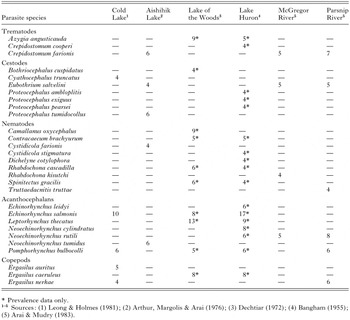
Table 1. Parasite species included in the analyses, and numbers of host species exploited by these parasites in each of the six localities

Fig. 2. Mean (+S.E.) prevalence, intensity and abundance of infection by metazoan parasites in their auxiliary host species, as a function of the taxonomic distance between the auxiliary hosts and the principal host. Values are relative, i.e. expressed as a proportion of the value observed in the principal host. Numbers on bars indicate the numbers of host–parasite species associations in each category.
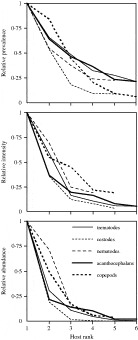
Fig. 3. Prevalence, intensity and abundance of infection by 5 groups of metazoan parasites in their fish hosts, as a function of host rank. Host species are ranked from the one in which prevalence, abundance or intensity is highest (principal host, rank 1) to the host species in which it is lowest. Values shown are means expressed as a proportion of the value observed in the principal host. Lines that stop before others indicate that there were not enough data to compute reliable mean values beyond that point.
 You have
Access
- 79
- Cited by