I. INTRODUCTION
After the dramatic advances in the nanoscience over the past 15 years, particularly in synthetic methods of nanoparticles (NPs), a transition from studying NPs as model objects to the development of advanced materials based on NPs was made. Reference Lohse and Murphy1 However, for the evolution of nanomaterials into viable commercial products there required further development of cost-effective reproducible synthetic procedures, providing narrow NP size distributions and control over mean size and the chemical composition of NPs. Reference Lohse and Murphy1 In spite of the great number of known synthetic procedures, the majority of them are just empirically chosen conditions for the synthesis of different kinds of NPs. Reference Wang, Richards, Shields and Buhro2 So far, it is impossible to predict the result of the synthesis of NPs exclusively on the basis of experimental conditions, in contrast to modern organic synthesis. It is clear that only the understanding of growth mechanisms of NPs allows one to develop the effective synthetic strategies to generate large quantities of NPs that are monodisperse, pure, and well-characterized. Unfortunately, only few studies were focused on the kinetics and regularities of the growth of NPs in comparison with diverse empirical synthetic procedures, Reference Wang, Richards, Shields and Buhro2 however, substantial advance has been achieved in this direction during the recent years, as evidenced by reviews. Reference Wang, Richards, Shields and Buhro2,Reference Finney and Finke3
Quantitative studies of the growth kinetics of NPs of precious metals (M = Au, Ag, Ir, Pt, Pd, Ru, and Rh) Reference Wang, Richards, Shields and Buhro2–Reference Georgiev, Bojinova, Kostova, Momekova, Bjornholm and Balashev14 showed that the formation of primary metal particles is limited by the rate of reduction of the metal precursor and proceeds according to the mechanism (1–2), known as the two step Watzky–Finke kinetics model. Reference Watzky and Finke6 The mechanism includes the steps of nucleation (1) and autocatalytic growth (2).
 $$n{{\rm{M}}^{Z + }} \to {\left( {{{\rm{M}}^0}} \right)_n},\,\,{k_1}\quad ,$$
 $${\left( {{{\rm{M}}^0}} \right)_n} + {{\rm{M}}^{Z + }} \to {\left( {{{\rm{M}}^0}} \right)_{n + 1}},\;{k_2}\quad .$$
The first step includes slow homogeneous reduction of M z+ species to M0 atoms followed by their rapid aggregation to form nuclei, (M0) n . The second step involves the surface metal atoms possessing catalytic activity. It is well known also that primary particles can participate in secondary processes such as Ostwald ripening and aggregative growth, to give secondary NPs of larger size, Reference Wang, Richards, Shields and Buhro2–Reference Richards, Rath and Buhro5,Reference Finney and Finke7–Reference Finney, Shields, Buhro and Finke9 but in the present work we will not consider secondary processes.
Our previous studies of the formation of AgNPs
Reference Tatarchuk, Sergievskaya, Korda, Druzhinina and Zaikovsky10
in reverse micelles of oxyethylated surfactants showed that an increase in hydrazine concentration
 $\left( {{c^\prime }_{{{\rm{N}}_2}{{\rm{H}}_4}}} \right)$
, ionic strength (I), temperature (T), and initial size of micelles can be used to accelerate the rates of both steps, whereas an increase in the stability of the initial form of silver inhibits them. The background salts have a positive effect on the rate of nucleation, whereas their effect on the growth rate is small and has probably a negative trend. For the case of the formation of AuNPs, it is known that an increase in
 ${c^\prime }_{{{\rm{N}}_2}{{\rm{H}}_4}}$
, T, and initial size of micelles also accelerates both steps,
Reference Tatarchuk, Sergievskaya, Druzhinina and Zaikovsky11,Reference Georgiev, Bojinova, Kostova, Momekova, Bjornholm and Balashev14–Reference Personick and Mirkin16
however, there are no quantitative data on the effect of precursor form on process kinetics. The most widespread and easily available gold precursor for the investigation of growth kinetics
Reference Tatarchuk, Sergievskaya, Druzhinina and Zaikovsky11–Reference Georgiev, Bojinova, Kostova, Momekova, Bjornholm and Balashev14
and synthesis
Reference Langille, Personick, Zhang and Mirkin15–Reference Zalesskiy, Sedykh, Kashin and Ananikov17
of AuNPs is HAuCl4, other initial forms of gold are rarely used, for example, for HAuBr4 only a few works dealing with synthesis are available.
Reference Bhargava, Booth, Agrawal, Coloe and Kar18,Reference Eustis and El-Sayed19
It is known that the replacement of halide ion in background salts of surfactants during the synthesis of NPs can cause changes to their shape,
Reference Langille, Personick, Zhang and Mirkin15,Reference Personick and Mirkin16
so it was interesting to reveal how the change of precursor (HAuCl4 → HAuBr4) will affect the growth kinetics and properties of the final AuNPs. Because of this, the goal of the present work is the quantitative kinetic study of the growth of AuNPs during the reduction of HAuBr4 by hydrazine in reverse micelles of oxyethylated surfactant and the determination of the factors that affect the rates of nucleation (1) and autocatalytic growth (2) steps.
II. EXPERIMENTAL PROCEDURE
A. Materials
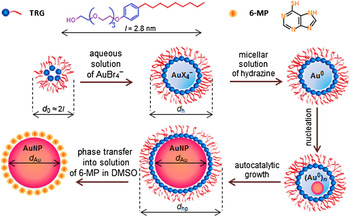
Crystalline HAuBr4 xH2O was synthesized from metallic gold (+99.99%) according to the literature data. Reference Mironov, Sokolova and Makotchenko20 Chemically pure grade HBr and hydrazine as concentrated aqueous solutions, pure grade n-decane and dimethyl sulfoxide (DMSO), surfactant Tergitol NP 4 (TRG; +99%), and 6-mercaptopurine monohydrate (6-MP; 96.00%) from Sigma were used. The chemical structures of TRG and 6-MP are shown in Fig. 1.
Schematic illustration of the formation process of AuNPs in reverse micelles of TRG and its subsequent phase transfer into solution of 6-MP in DMSO.

Standard solutions of HAuBr4, the surfactant, and 6-MP were prepared by dissolving the weighed amounts of solid HAuBr4⋅xH2O in the aqueous solution of 3M HBr, liquid TRG in decane, and solid 6-MP in DMSO. Standard solutions of HBr and N2H4 were obtained by diluting the concentrated reagent solutions with water, their concentrations were determined by acid-base titration. The hydrogen ion and bromide ion concentrations used were sufficiently high to avoid any significant hydrolysis of AuBr4 –. Reference Elding and Groning21 Because of the high rate of AuIII reduction by N2H4, the kinetic runs were carried out with the hydrazine solutions partly or completely neutralized with HBr. Micellar solutions of AuIII and reducer were made by injection and solubilization of the aqueous solution of HAuBr4 or (N2H4 + HBr) with the volume V s (mL) into the organic solutions of the surfactant with the volume V o (mL).
B. Kinetics procedure
Experiments were carried out at fixed temperature (T), solubilization capacity (V s/V o), and total concentration of the surfactant (c TRG) within the ranges T = 298−313 K, V s/V o = 0.005−0.013, c TRG = 0.09−0.25 M, respectively. The total concentration of Au in the dispersed aqueous phase was close to c′Au = 0.057M (for dependencies on reagent concentration and T at V s/V o = 0.005), to 0.034M (for dependence on reagent concentration at V s/V o = 0.01; for dependencies on V s/V o and c TRG), or to c Au = c′Au V s/V o, calculated for the volume of micellar solution.
UV–vis spectroscopy in the region of 300−650 nm was used to study the kinetics of the growth of AuNPs with the help of Shimadzu UV-1700 (Shimadzu, Japan) instrument in cells with the optical path length l = 1 cm. Measurements in the region <300 nm are impossible because of the strong absorption by TRG. The micellar solutions of HAuBr4 and reducer (N2H4 + HBr) were thermostated to the desired temperature. The zero point of the reaction time (t = 0) was the moment when the solutions were mixed in the cell in the volume ratio of 1:1. A current optical density (A t) of the reaction mixture was measured at λ = 525 nm for the period of time sufficient for the reaction to be completed. The reference solution was a dry (V s = 0) micellar solution of TRG in decane. In course of the runs, the reaction mixture of micellar solutions remained homogeneous and transparent. The kinetic data were processed mathematically to calculate the observed rate constants using the standard ANALYSIS package of Microsoft Excel according to the procedure described in detail previously. Reference Tatarchuk, Sergievskaya, Korda, Druzhinina and Zaikovsky10 The standard deviations of the mean values are used as the measurement errors at the number of measurements N.
C. Phase transfer of AuNPs
The micellar solution of AuNPs (c′Au = 0.057M,
 ${c^\prime }_{{{\rm{N}}_2}{{\rm{H}}_4}}$
= 2.512 M, c′HBr = 2.658M, с
TRG = 0.25 М, V
s/V
o = 0.005, T = 298 K) and the solution of 6-MP in DMSO (с
6-МP = 3.2 × 10⁻⁴ М, T = 298 K) were mixed in the volume ratio of 1:2.5. The phase transfer was observed by the blue coloration of the DMSO phase and a corresponding almost complete loss of color from the decane phase when two layers separated out (Fig. S1). Solution of extracted particles in DMSO was stable for about a day, after that the precipitation of deep blue powder was observed. It was washed by decantation with ethanol and dried in air.
D. Methods and measurements
UV–vis spectra of micellar solutions of HAuBr4 and AuNPs and the solutions of the AuNPs extracted in DMSO were recorded using SHIMADZU UV-1700 spectrophotometer.
Dynamic light scattering (DLS) at T = 293 K and 90 Plus spectrometer (Brookhaven Inst) were used to measure the hydrodynamic diameter of TRG micelles (d hm) and AuNPs in the micellar solution during the synthesis (d hp). Dust was removed from the solutions by multiple passing through a Teflon filter with 0.45 μm pores. The standard deviation for measured diameters did not exceed 0.2 nm for the number of measurements N ≥ 20. The size of initial micelles was governed with the help of the V s/V o parameter in agreement with the known relation d hm = d 0 + b·V s/V o, Reference Tatarchuk, Sergievskaya, Korda, Druzhinina and Zaikovsky10,Reference Tatarchuk, Sergievskaya, Druzhinina and Zaikovsky11,Reference Bulavchenko, Batishcheva, Podlipskaya and Torgov22 where b is the empirical constant and d 0 is the hydrodynamic diameter of “dry” micelles (Fig. 1) in the absence of dispersed aqueous phase (V s = 0). In fact, diameter d 0 = 5.6 nm measured for the solution of 0.25 M TRG in decane corresponds to the double length of TRG molecule, Reference Schonfeld23 because for V s = 0 the micelles do not have an aqueous core. The diameter of the aqueous cores of micelles (d c) and the metal cores of AuNPs (d Au) was calculated on the basis of measured values from d c = d hm − d 0 and d Au = d hp − d 0 assuming the spherical shape of micelles.
Transmission electron microscopy (TEM) images were obtained using JEM-2010 (JEOL, Japan) instrument at an accelerating voltage of 200 kV. A sample was prepared by evaporating a drop of colloidal solution of particles extracted from micellar solution in DMSO on a 200 mesh copper grid covered with a “holey” carbon film. Local energy dispersive x-ray (EDX) analysis of NPs was performed using EDAX spectrometer (EDAX Co) with Si–Li detector.
IR spectra were recorded within the range 4000–400 cm−1 using the Fourier transform spectrometer SCIMITAR FTS 2000 in KBr tablets for 6-MP and AuNPs powder.
Atomic absorption and ICE 3000 Series (Thermo Scientific) instrument were used to determine the concentration of AuIII in aqueous solutions.
III. RESULTS AND DISCUSSION
A. AuNP formation in TRG micellar solution
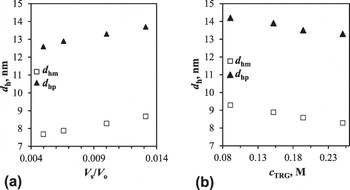
TRG is a commercial oxyethylated surfactant similar to Triton N 42 used by us previously in the studies of the growth kinetics of Ag Reference Tatarchuk, Sergievskaya, Korda, Druzhinina and Zaikovsky10 and AuNPs. Reference Tatarchuk, Sergievskaya, Druzhinina and Zaikovsky11 In nonpolar organic solvents, TRG forms reverse micelles that are able to solubilize the aqueous solutions of reagents (Fig. 1). The properties of reverse micelles based on oxyethylated surfactants, the changes in their structure during solubilization of aqueous solutions, and NP growth were described in detail in Ref. Reference Tatarchuk, Sergievskaya, Korda, Druzhinina and Zaikovsky10. During the synthesis of NPs, the redox reaction between HAuBr4 and N2H4 in the aqueous cores of the micelles gives gold atoms Au0 and the products of hydrazine oxidation. Atoms from different micelles through intermicellar exchange (Fig. S2) gradually agglomerate to a finite number of nuclei (Au0) n , each of them localized in a separate micelle. The total process is nucleation process (1). Later on, the growth of nuclei (2) proceeds through the reduction of gold precursor directly on the surfaces of nuclei. Gold ions for the growth of (Au0) n are delivered by other micelles. During the growth process, AgNPs not only displace the dispersed aqueous phase from the micelles containing them but also “stretch” the initial size of these micelles. Diameter d hp for the grown AuNPs, measured directly in micellar solutions by means of DLS, exceeds d hm for the initial micelles (Fig. 2). Such discordance between the size of nanoreactor and the particle formed in it has already been observed by other researchers Reference Arcoleo and Turco Liveri24,Reference Tovstun and Razumov25 and by us in the case of AuNPs and AgNPs and oxyethylated surfactant. Reference Tatarchuk, Sergievskaya, Korda, Druzhinina and Zaikovsky10,Reference Tatarchuk, Sergievskaya, Druzhinina and Zaikovsky11,Reference Tatarchuk, Sergievskaya, Bulavchenko, Zaikovsky, Druzhinina, Korda, Gevko and Alexeyev26 The larger size of NPs with core–shell structure Au@TRG is not due to the multilayer adsorption of TRG molecules or any other reasons of that kind but exactly due to the size of the metal core.
Effect of (a) V s/V o and (b) 1/c TRG on d hp and d hm at T = 298 K.

The TEM images of Au@6-MP NPs extracted from the micellar solution in DMSO after one of the kinetic experiments (T = 298 K, c′Au = 0.057 M,
 ${c^\prime }_{{{\rm{N}}_2}{{\rm{H}}_4}}$
= 2.512 M, c′HBr = 2.658 M, V
s/V
o = 0.005) are presented in Fig. 3. The metal cores of the particles are spherical, their average diameter is d
Au = 7.4 ± 0.7 nm (N = 30). These data are in good agreement with the value d
Au = d
hp − d
0 = 12.8 − 5.6 = 7.2 nm, determined by means of DLS in situ in the micellar solution of AuNPs before phase transfer in DMSO.
Characteristics of AuNPs extracted from the micellar solution into the solution of 6-MP in DMSO: (a, b) TEM images, (c) size distribution, and (d) EDX data. Experimental conditions in the kinetic run: c'Au = 0.056 M,
 ${c^\prime }_{{{\rm{N}}_2}{{\rm{H}}_4}}$
= 2.512 M, c'HBr = 2.658 M, c
TRG = 0.25 M, T = 298 K, V
s/V
o = 0.005.

B. Optical characteristics and the kinetics of AuNP growth process
The changes in the spectrum of reaction mixture during AuNP growth are presented in Fig. 4. The gold precursor absorbs light in the region of 350–550 nm [the electronic absorption spectrum of AuBr4 – in micellar solution has a band at λmax = 401 nm, spectrum 0 (Ref. Reference Makotchenko, Malkova and Belevantsev27)], its reduction occurs very rapidly. Absorption within the region of 500–650 nm is mainly due to the growth of AuNPs, so the optical density increases with time monotonously (spectra 1–27). The absorption spectra of micellar solutions of AuNPs contain the surface plasmon resonance (SPR) band with maximum at λmax = 525 nm, its position remained the same during the whole process. It is well known that at particle sizes <20 nm, there is no strong dependence of the absorption spectra on particle size, and absorption depends only on the total metal concentration, [Au0], in the solution but not on the particle size. Reference Takiyama28–Reference Link and El-Sayed30 This fact was experimentally proved by the dependence of absorbance of micellar solution A versus [Au0] after a complete reduction of AuBr4 − by N2H4. The dependence at λmax = 525 nm was linear and not influenced by V s/V o, therefore, it was also independent of the size of the micelles (Fig. S3), its slope gave the molar extinction coefficient for Au0 equal to ε0 = (4.41 ± 0.02) × 103 M−1·cm−1 (N = 9). This value is in good agreement with the molar extinction coefficient determined by us previously for AuNPs obtained by the reduction of HAuCl4 by hydrazine (ε0 = (4.46 ± 0.03) × 103 M−1·cm−1, Ref. Reference Tatarchuk, Sergievskaya, Druzhinina and Zaikovsky11).
(a) Evolution of spectrum of the reaction mixture within the reaction time from 0.8 (1) to 63.2 min (27) through the intervals of about 2.4 min (insert: kinetic curve at λ = 525 nm, circles – experiment, line – calculation); (b) current molar fractions of Au0, AuI, and AuIII calculated at definite moments of time of the process. c′Au = 0.034 M, c′HBr = 1.926 M,
 ${c^\prime }_{{{\rm{N}}_2}{{\rm{H}}_4}}$
= 1.456 M, T = 298 K, c
TRG = 0.25 M, V
s/V
o = 0.010, l = 1 cm.

The data presented in Fig. 4(a) allow us to estimate the current molar fraction of gold forms Au0 and AuIII by solving the system of two equations of the kind A t ′/(lc Au) = ε0′α0t + ε3′α3t and A t ″/(lc Au) = ε0″α0t + ε3″α3t for wavelengths λ′ = 525 nm and λ″ = 401 nm, respectively. Molar extinction coefficients ε0′, ε0″ for Au0 and ε3′, ε3″ for AuIII are determined independently from the spectrum of the micellar solutions of AuNPs and AuBr4 – (Fig. S3). As far as α0t + α3t < 1, the reaction mixture contains also AuI (any species of AuI do not absorb light within the visible range Reference Brown, Donner, Hall, Wilson, Wilson, Hodgson and Hatfield31 ); its current fraction in the micellar solution (taking into account material balance c Au = [Au0] t + [AuI] t + [AuIII] t ) can be estimated as α1t = 1 − α0t − α3t . The change in the fraction of gold forms during the growth of AuNPs [Fig. 4(b)] shows that the reduction of AuIII to Au0 proceeds through the formation of intermediate AuI, Reference Tatarchuk, Sergievskaya, Druzhinina and Zaikovsky11–Reference Streszewski, Jaworski, Pacławski, Csapó, Dekany and Fitzner13,Reference Eustis and El-Sayed19 which is rapidly accumulated during the first minutes of reaction, therefore, the reduction of AuI to Au0 proceeds slower than the reduction of AuIII to AuI. Reference Langille, Personick, Zhang and Mirkin15,Reference Personick and Mirkin16
The sigmoidal shape of the kinetic curves [Fig. 4(a) insert] is consistent with the two-step autocatalytic mechanism of particle growth,
Reference Watzky and Finke6–Reference Georgiev, Bojinova, Kostova, Momekova, Bjornholm and Balashev14
according to which the rate of nucleation step 1 is limited by the slow reduction of gold precursor. Under the pseudo-first-order conditions (c′Au « c′HBr,
 ${c^\prime }_{{{\rm{N}}_2}{{\rm{H}}_4}}$
), the mechanism of the growth of AuNPs during the reduction by hydrazine can be represented by Eqs. (3)–(7).
Nucleation:
 $${\rm{AuBr}}_4^ - + x{{\rm{N}}_2}{{\rm{H}}_4} \to {\rm{AuBr}}_2^ - + \left( {{\rm{products}}\;{\rm{of}}\;{{\rm{N}}_{\rm{2}}}{{\rm{H}}_{\rm{4}}}\;{\rm{oxidation}}} \right),\;{k_1}\quad ,$$
 $${\rm{AuBr}}_2^ - + x{{\rm{N}}_2}{{\rm{H}}_4} \to {\rm{A}}{{\rm{u}}^{\rm{0}}} + \left( {{\rm{products}}\;{\rm{of}}\;{{\rm{N}}_{\rm{2}}}{{\rm{H}}_{\rm{4}}}\;{\rm{oxidation}}} \right),\;{k_2}\quad ,$$
 $$n{\rm{A}}{{\rm{u}}^0} \to {\left( {{\rm{A}}{{\rm{u}}^0}} \right)_n},\;{\rm{fast}}\quad {\rm{.}}$$
Autocatalytic growth:
 $${\left( {{\rm{A}}{{\rm{u}}^{\rm{0}}}} \right)_n}{\rm{ + AuBr}}_4^ - + x{{\rm{N}}_2}{{\rm{H}}_4} \to {\left( {{\rm{A}}{{\rm{u}}^{\rm{0}}}} \right)_n}{\rm{ + AuBr}}_2^ - + \left( {{\rm{products}}\;{\rm{of}}\;{{\rm{N}}_{\rm{2}}}{{\rm{H}}_{\rm{4}}}\;{\rm{oxidation}}} \right),\;{k_3}\quad ,$$
 $${\left( {{\rm{A}}{{\rm{u}}^{\rm{0}}}} \right)_n}{\rm{ + AuBr}}_2^ - + x{{\rm{N}}_2}{{\rm{H}}_4} \to {\left( {{\rm{A}}{{\rm{u}}^{\rm{0}}}} \right)_{n + 1}}{\rm{ + }}\;\left( {{\rm{products}}\;{\rm{of}}\;{{\rm{N}}_{\rm{2}}}{{\rm{H}}_{\rm{4}}}\;{\rm{oxidation}}} \right),\;{k_4}\quad .$$
In micellar solution, reactions [Eqs. (3) and (4), Eqs. (6) and (7)] have effective rate constants k i * (i = 1–4) depending on fixed concentrations of N2H4, HBr, TRG and V s/V o. Taking into account the material balance condition [AuI] t ′ + [AuIII] t ′ = c′Au−[Au0] t ′, concentrations c′Au = c Au·V o/V s, [Au0] t ′ = [Au0] t ·V o/V s and the relations between the constants k 3* > k 4* » k 1* > k 2* (AuIII is reduced more rapidly than AuI, and the rate of catalytic routes is higher than the rate of noncatalytic ones), the rate law for Au0 in the micellar solution appears as (8), and the observed rate constants are k g1 = k 2*k 3*/(k 3* + k 4*) and k g2 = k 4*k 3*/(k 3* + k 4*).
 $${{{\rm{d}}\left( {{c_{{\rm{Au}}}} - {{\left[ {{\rm{A}}{{\rm{u}}^0}} \right]}_t}} \right)} \mathord{\left/ {\vphantom {{{\rm{d}}\left( {{c_{{\rm{Au}}}} - {{\left[ {{\rm{A}}{{\rm{u}}^0}} \right]}_t}} \right)} {{\rm{d}}t}}} \right. \kern-\nulldelimiterspace} {{\rm{d}}t}} = - \left( {{k_{{\rm{g}}1}} + {k_{{\rm{g}}2}} \cdot {c_{{\rm{Au}}}}} \right) \cdot \left( {{c_{{\rm{Au}}}} - {{\left[ {{\rm{A}}{{\rm{u}}^0}} \right]}_t}} \right) + {k_{{\rm{g}}2}} \cdot {\left( {{c_{{\rm{Au}}}} - {{\left[ {{\rm{A}}{{\rm{u}}^0}} \right]}_t}} \right)^2}\quad .$$
The differential kinetic equation [Eq. (8)] is consistent with the empirical rate law (9) in terms of absorbance by Au0 measured in micellar solution. Empirical parameters a 1 and a 2 are interconnected with experimental rate constants k g1 and k g2 as a 1 = −(k g1 + k g2 c Au) and a 2 = k g2/(lε0).
 $${{{\rm{d}}\left( {{A_{\max }} - {A_t}} \right)} \mathord{\left/ {\vphantom {{{\rm{d}}\left( {{A_{\max }} - {A_t}} \right)} {{\rm{d}}t}}} \right. \kern-\nulldelimiterspace} {{\rm{d}}t}} = {a_1} \cdot \left( {{A_{\max }} - {A_t}} \right) + {a_2} \cdot {\left( {{A_{\max }} - {A_t}} \right)^2}\quad .$$
Unlike the known method, Reference Watzky and Finke6 the kinetic data were processed not according to the integral form of Eq. (8), which requires a special program, but using the standard Microsoft Excel software and the linear regression equation [Eq. (10)], where a 0 = ln(A max − A 0), A 0 = A t at t = 0, x 1 = t, x 2 = ∫(A max − A t )dt is the numerical integral within the range 0 to t. Reference Tatarchuk, Sergievskaya, Korda, Druzhinina and Zaikovsky10,Reference Tatarchuk, Sergievskaya, Druzhinina and Zaikovsky11
 $$\ln \left( {{A_{\max }} - {A_t}} \right) = {a_0} + {a_1}{x_1} + {a_2}{x_2}\quad .$$
The observed rate constants were calculated as k g2 = lε0 a 2 and k g1 = −{a 1 + a 2exp(a 0)}. Relative standard deviation for k g2 varied in the runs from 0.2 to 1.8%, the average value was about 1%. For k g1, which is calculated as a combination of the three found parameters a 0, a 1, and a 2, this error was larger than 50% in many cases (Tables S1−S5 in Supplementary material). Large errors for the nucleation rate constant are a known fact in the literature. Reference Watzky and Finke6–Reference Tatarchuk, Sergievskaya, Druzhinina and Zaikovsky11
C. Effect of reagent concentrations and chemical mechanism of the process
For c′HBr >
 ${c^\prime }_{{{\rm{N}}_2}{{\rm{H}}_4}}$
, the dependencies of the observed rate constants k
g1 and k
g2 on the concentrations of reagents (Table S1-S2) are described by general [Eq. (11)], where x = [N2H5
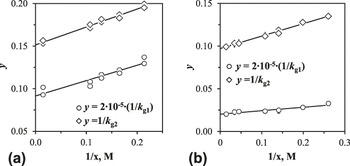
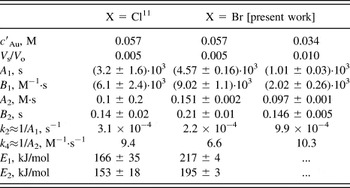
+]′/([Br−]′[H+]′), j = 1 and 2 (Fig. 5). The parameters of the equation are presented in Table I.
 $${1 \mathord{\left/ {\vphantom {1 {{k_{{\rm{g}}j}}}}} \right. \kern-\nulldelimiterspace} {{k_{{\rm{g}}j}}}} = {A_j} + {B_j}\left( {{1 \mathord{\left/ {\vphantom {1 x}} \right. \kern-\nulldelimiterspace} x}} \right)\quad .$$
Concentration dependencies of the observed constants at (a) c′Au = 0.056 M, T = 298 K, c TRG = 0.25 M, V s/V o = 0.005 and (b) c′Au = 0.034 M, T = 298 K, c TRG = 0.25 M, V s/V o = 0.010.

Parameters of Eq. (11), estimated rate constants, and effective activation energies of the growth of AuNPs during the reduction of AuX4 − by hydrazine (c surfactant = 0.25 M).

We observed similar dependencies of rate constants on reagent concentrations previously studying the growth of AuNPs during HAuCl4 reduction by hydrazine. Reference Tatarchuk, Sergievskaya, Druzhinina and Zaikovsky11 This kind of dependencies is well explained by mechanism (12–16); now we can state that it is general (common) for AuX4 − reduction (X = Cl, Br). The mechanism takes into account the acid-base equilibrium for hydrazine (12) and assumes that reactions (1) and (2) include the equilibrium formation (13) and (15) and subsequent redox decomposition (14) and (16) of the complex forms of AuIII and AuI with hydrazine. In this situation, reactions (14) and (16) proceed both in the dispersed aqueous phase (k 1 and k 2) and on the surface of growing particles (k 3 and k 4).
 $${{\rm{N}}_2}{{\rm{H}}_4} + {{\rm{H}}^ + } \leftrightarrow {{\rm{N}}_2}{\rm{H}}_{\rm{5}}^{\rm{ + }},\;{\rm{\ }}{K_{H1}}\quad ,$$
 $${\rm{AuX}}_4^ - + {{\rm{N}}_2}{{\rm{H}}_4} \leftrightarrow {\rm{Au}}\left( {{{\rm{N}}_2}{{\rm{H}}_4}} \right){{\rm{X}}_3} + {{\rm{X}}^ - },\;{K_{{\rm{c}}3}}\quad ,$$
 $${\rm{Au}}\left( {{{\rm{N}}_2}{{\rm{H}}_4}} \right){{\rm{X}}_3} \to {\rm{AuX}}_2^ - + {{\rm{X}}^ - } + {4 \mathord{\left/ {\vphantom {4 3}} \right. \kern-\nulldelimiterspace} 3}{{\rm{H}}^ + } + {2 \mathord{\left/ {\vphantom {2 3}} \right. \kern-\nulldelimiterspace} 3}{\rm{NH}}_4^ + + {2 \mathord{\left/ {\vphantom {2 3}} \right. \kern-\nulldelimiterspace} 3}{{\rm{N}}_2},\;{k_1}\;{\rm{and}}\;{k_3}\quad ,$$
 $${\rm{AuX}}_2^ - + {{\rm{N}}_2}{{\rm{H}}_4} \leftrightarrow {\rm{Au}}\left( {{{\rm{N}}_2}{{\rm{H}}_4}} \right){\rm{X}} + {{\rm{X}}^ - },\;{K_{{\rm{c}}1}}\quad ,$$
 $${\rm{Au}}\left( {{{\rm{N}}_2}{{\rm{H}}_4}} \right){\rm{X}} \to {\rm{A}}{{\rm{u}}_0} + {{\rm{X}}^ - } + {\rm{NH}}_4^ + + {1 \mathord{\left/ {\vphantom {1 2}} \right. \kern-\nulldelimiterspace} 2}{{\rm{N}}_2},\;{k_2}\;{\rm{and}}\;{k_4}\quad .$$
The effective rate constants k i * and the observed constants k gj can be shown to be k i * = k i K 1 x/(1 + K 1 x) at i = 1 and 3, k i* = k i K 2 x/(1 + K 2 x) at i = 2 and 4, k g1 = k 2 F(x) and k g2 = k 4 F(x), where F(x) = K 1 K 2 x/{K 1 + K 2 k 4/k 3 + (1 + k 4/k 3)K 1 K 2 x}, K 1 = K c3/K H1, K 2 = K c1/K H1. In addition, the parameters of Eq. (9), taking into account that i = 2 at j = 1 and i = 4 at j = 2, acquire the content as in Eqs. (17) and (18).
 $${A_j} = \left( {{1 \mathord{\left/ {\vphantom {1 {{k_i}}}} \right. \kern-\nulldelimiterspace} {{k_i}}}} \right)\left( {1 + {{{k_4}} \mathord{\left/ {\vphantom {{{k_4}} {{k_3}}}} \right. \kern-\nulldelimiterspace} {{k_3}}}} \right)\quad ,$$
 $${B_j} = \left( {{1 \mathord{\left/ {\vphantom {1 {{k_i}}}} \right. \kern-\nulldelimiterspace} {{k_i}}}} \right)\left( {{{{K_{{\rm{H}}1}}} \mathord{\left/ {\vphantom {{{K_{{\rm{H}}1}}} {{K_{{\rm{c}}1}}}}} \right. \kern-\nulldelimiterspace} {{K_{{\rm{c}}1}}}}} \right)\left\{ {1 + \left( {{{{k_4}} \mathord{\left/ {\vphantom {{{k_4}} {{k_3}}}} \right. \kern-\nulldelimiterspace} {{k_3}}}} \right)\left( {{{{K_{{\rm{c}}1}}} \mathord{\left/ {\vphantom {{{K_{{\rm{c}}1}}} {{K_{{\rm{c}}3}}}}} \right. \kern-\nulldelimiterspace} {{K_{{\rm{c}}3}}}}} \right)} \right\}\quad .$$
We did not find any data on the compounds of gold with hydrazine but copper complexes are known: CuII(N2H5)Cl3 and CuI(N2H4)Cl. Reference Brown, Donner, Hall, Wilson, Wilson, Hodgson and Hatfield31 Hydrazine is a potential ligand similar to ammonia which forms complexes with AuIII and AuI as Au(NH3)X3 and Au(NH3)X. Reference Mironov and Tsvelodub32–Reference Elding and Olsson35 Relying on the fact that the complex compounds of AuIII possess higher stability than the complexes of AuI, Reference Mironov33,Reference Hiskey and Atluri36 and using the data on equilibrium constants for processes like (13) and (14) in aqueous media for AuCl4 − and AuCl2 − participated by ammonia instead of hydrazine (logK c3 ≈ 6.7 and logK c1 ≈ 4.3 Reference Mironov and Tsvelodub32,Reference Mironov33 ), we may assume that k 3 » k 4 and K c3 » K c1. Therefore, we may accept that A j ≈ 1/k i, B j ≈ (1/k i)(K H1/K c1), and A j/B j ≈ K c1/K H1. These relations allow us to estimate the values for k 2 ≈ 1/A 1 and k 4 ≈ 1/A 2 (Table I). A satisfactory agreement between independent estimates for K c1/K H1 as A 1/B 1 and A 2/B 2 provides indirect confirmation of the assumptions. The results obtained (Table I) show that the rate of AuI reduction to Au0 on the surface of particles exceeds the rate of the similar process in solution. An increase in the stability of the complex form of gold [logβ2(AuBr2 −) = 8 > logβ2(AuCl2 −) = 5.5 (Ref. Reference Hiskey and Atluri36)] causes a decrease in the rates of both steps, but the upper limit of the ratio of rates remains constant (k 4∙c′Au)/k 2 ≈ 2 × 10³. The equal ratios of the rates of nucleation and growth steps also explain the close sizes of AuNPs: d Au = 7.7 ± 1.4 nm (N = 70, AuCl4 − → Au0) Reference Tatarchuk, Sergievskaya, Druzhinina and Zaikovsky11 and d Au = 7.4 ± 0.7 nm (N = 30, AuBr4 − → Au0). So, the initial form of precursor AuX4 − in the case of X = Cl, Br does not affect the size of the final NPs synthesized in reverse micelles of oxyethylated surfactant with hydrazine used as the reducing agent.
D. Temperature effect
The average values of k g1 and k g2 obtained at different temperatures simultaneously increase with rising T. The dependencies are linear like lnk gj = lnZ j − E j /RT (Fig. 6) with parameters lnZ 1 = 79 ± 2, E 1 = 217 ± 4 kJ/mol for the process in dispersed aqueous solution and lnZ 2 = 80 ± 1, E 2 = 195 ± 3 kJ/mol for the autocatalytic process on the AuNP surface, N = 5. The reported uncertainties are 1 standard deviations from the mean of the average effective constants reported (i.e., not the random errors for a constant in any single run).
Temperature dependencies of the observed constants at c′Au = 0.056 M,
 ${c^\prime }_{{{\rm{N}}_2}{{\rm{H}}_4}}$
= 2.512 M, c′HBr = 2.658, c
TRG = 0.25 M, V
s/V
o = 0.005.

Independent of the initial form of AuX4 − (X = Cl, Br), the sensitivity of the steps of nucleation and surface growth to temperature is approximately the same. The observed activation energies are higher in the case of X = Br, which correlates with the stability of the initial forms of gold. Measurement accuracy is insufficient for unambiguous consideration but in both cases we observe a trend of decreasing observed activation energy when passing from the dependencies for k g1 to dependencies for k g2 (Table I). A similar sensitivity of the steps of nucleation and growth to temperature and close values of effective activation energies for both steps were mentioned in previous works on the growth of Ir, Reference Watzky and Finke6 Ag, Reference Tatarchuk, Sergievskaya, Korda, Druzhinina and Zaikovsky10 and AuNPs. Reference Tatarchuk, Sergievskaya, Druzhinina and Zaikovsky11
E. Micelle size effect
It is known that the kinetics of NP growth is sensitive to changes in the properties of water as a solvent in the aqueous phase. Reference Tatarchuk, Sergievskaya, Korda, Druzhinina and Zaikovsky10,Reference Tatarchuk, Sergievskaya, Druzhinina and Zaikovsky11 As far as water in micelles is structured due to the hydrogen bonds of H2O molecules with each other and with the polar groups of the surfactant, the properties of micellar water differ from the characteristics of «bulk» water and change depending on the ratio [H2O]/[surfactant] in the system. Varying V s/V o or 1/c TRG, it is possible to govern the relative content of water in micelles and, as a consequence, the size of aqueous cores and micelles, in general, according to the equation d h − d 0 = d c = γ[H2O]/[TRG] = γc′w(1/c TRG)(V s/V o), where γ is the empirical constant, c′w ≈ 56 M is the concentration of H2O in water and in diluted aqueous solutions. Reference Tatarchuk, Sergievskaya, Korda, Druzhinina and Zaikovsky10,Reference Tatarchuk, Sergievskaya, Druzhinina and Zaikovsky11,Reference Bulavchenko, Batishcheva, Podlipskaya and Torgov22 The performed experiments showed that an increase in parameters, V s/V o and 1/c TRG (with other conditions kept constant), causes an increase in d hm and d hp (Fig. 2), as well as an increase in k g1 and k g2 (Fig. 7, Tables S4-S5). A similar effect in the size of initial micelles on the rates of nucleation and growth stages was observed by us previously in the studies of the formation of Ag Reference Tatarchuk, Sergievskaya, Korda, Druzhinina and Zaikovsky10 and AuNPs. Reference Tatarchuk, Sergievskaya, Druzhinina and Zaikovsky11
Dependencies of the observed constants (a) on V
s/V
o at c
TRG = 0.25 M and (b) 1/c
TRG at V
s/V
o = 0.010; c′Au = 0.034 M, T = 298 K,
 ${c^\prime }_{{{\rm{N}}_2}{{\rm{H}}_4}}$
= 2.10 M, c′HBr = 2.20.

IV. CONCLUSIONS
The kinetic mechanism for the growth of gold NPs during the reduction of AuX4 − (X = Cl, Br) by hydrazine in the reverse micelles of nonionic oxyethylated surfactant includes the two steps of slow, continuous nucleation and fast, autocatalytic surface growth. Both steps are limited by the reactions of gold precursor reduction. The rate of nucleation is limited by the reduction in aqueous pseudophase, which consists of the droplets of aqueous solution in the cores of reverse micelles, and the growth rate is limited by reduction catalyzed by the surface atoms of AuNPs growing inside the micelles.
The stoichiometric mechanism of AuX4 − reduction is common for X = Cl, Br and includes the formation and subsequent redox decomposition of intermediate complex forms, AuIII(N2H4)X3 and AuI(N2H4)X. The observed rate constants increase with an increase in such parameters as the concentration of reducing agent, temperature, and size of initial micelles. The replacement of the initial gold form for more stable one (AuBr4 −) causes a decrease in the absolute rates of nucleation and growth routes but does not affect the rates ratio and the size of the final AuNPs synthesized in the micelles of oxyethylated surfactant.
AuNPs synthesized in micelles can be transferred from solution without changing the size and shape of their metal cores by extraction in DMSO in the presence of 6-MP. The resulting hydrophilic powder consists of the particles having protective shells that are composed of 6-MP.
Supplementary Material
To view supplementary material for this article, please visit http://dx.doi.org/jmr.2015.121. Supplementary data associated with this article (chemical structures of TRG and 6-MP; UV–vis and IR data for AuNPs extracted from micellar solution; the dependencies of absorbance of micellar solutions A versus c Au for HAuBr4 and AuNPs; observed rate constants for different conditions) can be found in the online version.
ACKNOWLEDGMENT
This study was supported by the Russian Foundation for Basic Research (Project 12-03-00091).