Introduction
Worldwide, about 40 million people suffer from trematode infections, most commonly caused by members of the trematode families Echinostomidae, Fasciolidae, Heterophyidae and Opisthorchiidae (Abdussalam et al., Reference Abdussalam, Käferstein and Mott1995; Keiser & Utzinger, Reference Keiser and Utzinger2009; WHO, 2011) associated with the consumption of raw or undercooked fish products (Chai et al., Reference Chai, Murrell and Lymbery2005; Grundy-Warr et al., Reference Grundy-Warr, Andrews, Sithithaworn, Petney, Sripa, Laithavewat and Ziegler2012; Pinlaor et al., Reference Pinlaor2013; Kim et al., Reference Kim, Oh, Dai, Yang, Ha and Hong2017). Infections caused by species within the genera Metagonimus, Clonorchis, Haplorchis and Opisthorchis usually manifest themselves in mild symptoms including abdominal pain, fever and weight loss (Traverso et al., Reference Traverso2012; Pozio et al., Reference Pozio, Armignacco, Ferri and Gomez Morales2013; Pornruseetairatn et al., Reference Pornruseetairatn2016). However, chronic opisthorchid infections may cause injuries to the common bile duct, eventually leading to cholangitis, choledocholithiasis, pancreatitis and cholangiocarcinomatosis (Watanapa & Watanapa, Reference Watanapa and Watanapa2002; Sithithaworn & Haswell-Elkins, Reference Sithithaworn and Haswell-Elkins2003; Chai et al., Reference Chai, Murrell and Lymbery2005; Rim, Reference Rim2005; Toledo et al., Reference Toledo, Esteban and Fried2012). The highest prevalence of these trematode infections is in south-east and east Asia (EFSA, 2010), but sporadic cases occur in Europe, as well. In Italy, Armignacco et al. (Reference Armignacco2008) reported two outbreaks of Opistorchis felineus (Rivolta, 1884) in humans from 2007 and recites two former cases from 2003 and 2005 published by Crotti et al. (Reference Crotti, D'Annibale and Crotti2007). In 2010, a further 45 O. felineus cases were confirmed in Italy (Traverso et al., Reference Traverso2012). Human infections have also been reported from Greece (Tselepatiotis et al., Reference Tselepatiotis, Mantadakis, Papoulis, Vassalou, Kotsakis and Samonis2003) and Germany (Bernhard, Reference Bernhard1985; Sänger et al., Reference Sänger, Möller, Lafrenz and Ziegler1991). Opisthorchiasis was documented earlier in Lithuania (before 1901), Poland (before 1937), Romania (before 1957) and Spain (before 1932), but no cases have been reported since then (Erhardt et al., Reference Erhardt, Germer and Hörning1962). Apart from opistorchiid and heterophyid metacercariae, also genera within the family Cyathocotylidae (Holostephanus spp., Mesostephanus spp., etc.) parasitize the musculature of fish, but zoonotic cases caused by them have not been reported yet. The genus Holostephanus Szidat, 1936 within the family Cyathocotylidae Poche, 1926 currently includes 12 species distributed in Europe and Asia: H. luehei (type species), H. anhinga, H. calvusi, H. corvi, H. curonensis, H. dubius, H. ibisi, H. ictaluri, H. lutzi, H. metorchis, H. nipponicus and H. phalacrocoraxus (Seo et al., Reference Seo, Guk, Chai, Sim and Sohn2008). According to Gibson et al. (Reference Gibson, Jones and Bray2002), the Holostephanus genus is present in Europe and Asia. Recent findings of Holostephanus flukes in Europe are documented from the Czechia (Moravec & Scholz, Reference Moravec and Scholz2016), from Finland (Näreaho et al., Reference Näreaho, Eriksson-Kallio, Heikkinen, Snellman, Sukura and Koski2017), from France (Gettová et al., Reference Gettová, Gilles and Šimková2016), from Poland (Kanarek et al., Reference Kanarek, Sitko, Rolbiecki and Rokicki2003; Sulgostowska, Reference Sulgostowska2007; Mierzejewska et al., Reference Mierzejewska, Kvach, Stańczak, Grabowska, Woźniak, Dziekonska-Rynko and Ovcharenko2014), from Slovakia (Ondračková et al., Reference Ondračková, Dávidová, Blazek, Gelnar and Jurajda2009) and from Russia (Kvach et al., Reference Kvach, Boldyrev, Lohner and Stepien2015). The primary intermediate hosts of Holostephanus trematodes are freshwater snails of species belonging to the families Bithyniidae (Parafossarulus spp., Bithynia tentaculata) and Viviparidae (Lioplax spp.) (Erasmus, Reference Erasmus1962; Stang & Cable, Reference Stang and Cable1966; Dubois, Reference Dubois1983; Gibson et al., Reference Gibson, Jones and Bray2002; Seo et al., Reference Seo, Guk, Chai, Sim and Sohn2008). Various freshwater fish species act as second intermediate hosts harbouring the Holostephanus metacercariae in the muscles. Erasmus (Reference Erasmus1962) isolated the cysts of H. luehei from three-spined stickleback (Gasterosteus aculeatus Linnaeus, 1758), while Seo et al. (Reference Seo, Guk, Chai, Sim and Sohn2008) recovered H. metorchis metacercariae from topmouth gudgeon (Pseudorasbora parva Temminck & Schlegel, 1846). The natural definitive hosts are usually fish-eating aquatic birds and mammals (Yamaguti, Reference Yamaguti1939; Gibson et al., Reference Gibson, Jones and Bray2002). Besprozvannykh (Reference Besprozvannykh2003) successfully reared the species H. nipponicus in chicks, and Seo et al. (Reference Seo, Guk, Chai, Sim and Sohn2008) conducted similar experiments with H. metorchis, suggesting birds as suitable final hosts. Their fate in mammals is poorly described (Erasmus, Reference Erasmus1962); however, Chandler (Reference Chandler1950) reported a natural infection of a dog with Mesostephanus longisaccus (also a member of the family Cyathocotilidae). There are no records of human infection by Holostephanus species up to now, but due to the common occurrence of metacercariae in muscle tissue of European fish, it is important to evaluate infectivity to mammals and, thereby, their zoonotic potential.
We examined common carp (Cyprinus carpio Linnaeus, 1758) reared in a farm located in the north-eastern part of Hungary and isolated numerous metacercariae from muscle tissue of the fish. We performed a morphological characterization of the Holostephanus metacercariae isolated from the muscle tissue of common carp and investigated their infectivity to mammals using rodents (mice and hamsters) as models. We tested the survivability of metacercariae exposed to various physico-chemical conditions to model the effect of different food preparation techniques (freezing, frying, cold and hot smoking, marinating, pickling, salting) and to determine which processes may kill the parasites (Beldsoe & Oria, Reference Beldsoe and Oria2006; Borges et al., Reference Borges, Skov, Bahlool, Møller, Kania, Santos and Buchmann2014; Onsurathum et al., Reference Onsurathum2016). The European Food Safety Authority (EFSA, 2004, 2010) and the Food and Agriculture Organization (1998) prepared a description about the risk assessment of fish-borne parasites in fishery products and, furthermore, made recommendations on how to prepare them safely.
Materials and methods
Sample collection
Metacercariae isolated from the muscle tissue of ten specimens of two-summer-old common carp obtained from a freshwater fish farm in the north-eastern part of Hungary. The fish were collected by the fish farm personnel using cast-nets or seine nets and then transported to the Institute for Veterinary Medical Research laboratory alive in tanks with oxygenated water. The average weight of the examined fish was 448.7 ± 130.5 (standard deviation (SD)) g and their average length was 25.7 ± 2.1 (SD) cm.
Artificial digestion
Fish were anaesthetized by adding clove oil to the fish tank water, whereafter fish were decapitated. The muscle tissue (fillets) of the fish (average weight 119.4 g, range 80,189 g) was removed, cut into smaller fragments and used for isolation of the metacercariae by a mechanical (compression between two glass plates) or an enzymatic incubation for 40 min in 0.5% pepsin solution (2 l tap water, 10 g of 1:10,000 NF powder-based pepsin and 16 ml of 25% hydrochloric acid) at a temperature of 40°C while stirring. The intact cysts were pipetted into Petri dishes containing 0.9% physiological saline, counted and examined for viability (presence of dynamic motions) and the dark excretory system under a stereomicroscope (Zeiss, Oberkochen, Germany).
Morphological examination
Metacercariae were placed on a slide with a pipette in a drop of 0.9% physiological saline, cover-slipped and photographed with an Olympus BH2 photomicroscope (Shinjuku, Tokyo, Japan) at 4×, 10× and 20× magnification. Morphometric characters (body length and width, size of pharynx, oral and ventral suckers and length of caecal branches) were recorded based on 15 specimens and the morphological description of the metacercariae obtained (Erasmus, Reference Erasmus1962).
Experimental infection of mammals
Infection experiments of albino mice and Syrian hamsters were designed to determine the zoonotic potential of the Holostephanus trematode species. All metacercariae used for this experiment were isolated from the muscles of ten two-summer-old common carp specimens originating from the fish farm with the most severely infected fish stock. In addition, as positive control we used Metagonimus metacercariae collected from River Danube fishes. Trematodes belonging to this genus are well documented zoonotic parasites with an ability to develop in the mammalian intestine (Kang et al., Reference Kang, Cho, Chai, Lee and Jang1983; Chai et al., Reference Chai, Kang, Choi, Guk, Yu and Lee1998; Shimazu, Reference Shimazu2002; Kudo et al., Reference Kudo, Ota, Saka, Ikeda, Tomihisa, Itoi and Oyamada2014).
In the first experiment (3 October–12 October 2017), two laboratory albino mice (mice ‘A’ and ‘B’) were orally intubated and infected with 50 metacercariae each pipetted from the saline solution, and then the top of their head was marked with a blue felt-tip pen. The negative control animals (two additional mice) were not marked. Mouse ‘A’ was euthanized on 10 October, while mouse ‘B’ on 11 October, in compliance with the European regulations on animal protection.
In the second experiment (8 July–20 July 2018), four Syrian hamsters (animals ‘C’, ‘D’, ‘E’ and ‘F’) were inoculated, the first two with 50 and the latter two with 100 trematode larvae. Hamster ‘C’, a grey-coated male, and hamster ‘D’, a black female, were not marked as their coat colour clearly differentiated them from the other hamsters. Hamsters ‘E’ and ‘F’ were marked by clipping the hair in a small area on the crown of the head. Hamsters of the control group were also left unmarked. In order to demonstrate the suitability of the hamster infection model we included two hamsters as positive controls. They were inoculated with 50 Metagonimus sp. metacercariae each. The hair of these hamsters was clipped on the crown of the head, in the mediodorsal region and at the tailhead. Hamster ‘C’ was euthanized with CO2 gas on 13 July, hamsters ‘D’, ‘E’ and the negative control animals on 16 July, while hamster ‘F’ and the two Metagonimus-infected hamsters on 20 July.
Following euthanasia, the intestines of the animals were isolated and each divided into three segments (anterior and middle segment of the small intestine and the large intestine) and placed into Petri dishes containing physiological saline. Then all intestinal segments were cut open longitudinally and mucosal lining with intestinal content scraped into the dish, whereafter the material was sedimented in 500 ml decanter glasses. After 30 min, the intestinal contents and the scrapings collected from the intestinal wall were examined under stereomicroscope. The laboratory mice and the golden hamsters were purchased from Ökomester Ltd. (Budapest, Hungary) after the permissions necessary for the experiment had been obtained (permission number PEI/001/1792–4/2014).
Sensitivity of metacercariae to physico-chemical treatments
Metacercariae isolated by artificial digestion were placed between two slices of fish muscle (1 × 1 cm wide and 3 mm thick). These double-layer fillets each contained ten metacercariae and were placed into six-well cell-culture plates (one sample per well) and then subjected to different heat and chemical treatments. The treatments were started at 10:00 a.m. on the experimental days and different examination time points were designated (minutes: 1, 5, 10, 15, 20, 30; hours: 1, 2, 3, 4, 6, 12; days: 1, 2, 4, 8, 10, 12, 14, 16, 18, 20, 22, 24, 26) (Borges et al., Reference Borges, Skov, Bahlool, Møller, Kania, Santos and Buchmann2014). At each examination time point, the double fillets were opened with a pair of forceps, whereafter the wells were examined with a Zeiss stereomicroscope. The numbers of surviving and dead metacercariae were recorded. The intact structure and movement of the metacercariae within the capsule were used as viability criteria. Dead metacercariae were characterized by an amorphous body, granular, vesicular morphology or complete lack of motion. All treatment assays were repeated four times.
Thus, four double fillets, each with ten metacercariae, were used for each treatment type, and thus altogether 40 metacercariae per treatment were included in the statistical analysis. The control group also included 40 metacercariae evenly distributed in four double fillets, which were kept in 0.9% physiological saline at 5°C.
We investigated how physical (freezing, heat) and chemical (acetic acid and saline solutions) treatments (procedures commonly applied in the industry) affected the survival of metacercariae. The freezing experiment was performed at −18°C because most household freezers work at this temperature. The double fillets with metacercariae were kept in plastic plates without the addition of physiological saline, and then they were thawed at 27°C for 20 min to record viability of metacercariae. To imitate cold- and hot-smoking procedures, the fillet sandwiches were placed in wells (without saline) and then they were subjected to heat treatment at 20, 40 and 60°C temperature, in an INCO CO2 Incubator (Memmert, Büchenbach, Germany).
To model the effect of acetic acid (e.g. pickled fish), the double fillets were treated with 5% and 10% vinegar at room temperature. Four sandwiches were also treated with 10% sodium chloride (NaCl) solution to determine the outcome of conservation (e.g. canned fish).
Procedures used for the statistical analysis
Surviving and dead metacercariae were recorded at the predetermined examination time points, and after reaching 100% mortality these data were summed up. The effectiveness of the different procedures within a treatment type (physical experiments on −18°C, +20°C, +40°C and +60°C and chemical experiments with 5% and 10% acetic acid, 10% NaCl) was compared with the help of survival curves. We compared each curve within a treatment type following pairwise multiple comparisons with Bonferroni correction in the case of significant difference among the curves. The ‘survdiff’ function (‘survival’ package) from R version 3.6.1. (R Core Team, 2015) was used to calculate chi-square distance and the corresponding P-value (Harrington & Fleming, Reference Harrington and Fleming1982). Only treatment types with a P-value threshold of <0.05 were considered as having a significant effect on the survival of metacercariae. Each metacercaria was a replicate. Since four fillets were used for each treatment type, a preliminary survival analysis was carried out in order to detect the effect of fillets on the survival or death of metacercariae (fillet effect) in each heat or chemical treatment group.
Results
Identification
After manual isolation and artificial digestion, the presence of numerous trematode metacercariae was recorded in the musculature of ten two-summer-old common carp specimens from the north-eastern fish farm (fig. 1). Cysts were detected in all common carp specimens; thus, the prevalence of infection was 100% and the mean intensity of infection was 144.6 ± 55.1 (SD) metacercariae per individual.
Intact cyathocotylid metacercariae in the muscle. Scale bar: 400 µm.

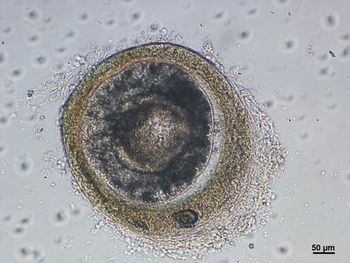
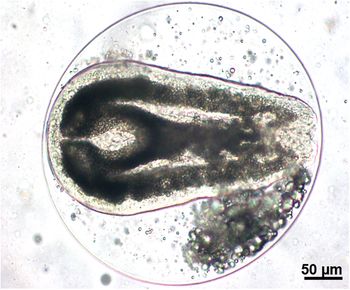
The species identification of encysted metacercariae was done by morphometric examinations. Light microscopic examination revealed that the cysts of the trematode species detected in the muscles of infected common carp specimens belonged to the prohemistomulum type of metacercariae. This type is characterized by a round or oval body protected by a thick outer wall and a thin inner membrane (fig. 2). They have real ventral suckers but the pseudosucker is missing. The trematode species belonging to this type are further characterized by the presence of a dark excretory system densely enmeshing the body (Gibson et al., Reference Gibson, Jones and Bray2002; fig. 3). The dimensions of easily detectable morphological traits (body length and width, pharynx, oral and ventral sucker, caecal branches) were determined with the help of a scale built in the ocular lens of the microscope. Based on the study of Erasmus (Reference Erasmus1962), we recorded and compared the parameters of a total of 15 cysts. The body surface of encysted metacercariae was smooth and spikes were not found on it. Body length was 324.7 ± 35.6 (SD) μm and body with 245.3 ± 52.2 (SD) μm. The oral sucker was 32.3 ± 7.3 (SD) μm long and 32.3 ± 7.3 (SD) μm wide. After a short prepharynx, the oral sucker was closely followed by the small-sized pharynx, which was 39.3 ± 4.6 (SD) μm long and 33.4 ± 4.8 (SD) μm wide. The ventral sucker was 75 ± 9.3 (SD) μm long and 75 ± 9.3 (SD) μm wide. The length of the caecal branches was 274.7 ± 33.1 (SD) μm. The recorded characteristics were highly similar to those described by Erasmus (Reference Erasmus1962) as the main feature of Holostephanus sp. metacercariae. Additional sequence analysis of the internal transcribed spacer (ITS) region was executed, which confirmed the identity of metacercariae – namely, all of them were members of the Cyathocotylidae family, most probably species of Holostephanus genus; however, identification to species level was problematic as very few sequence data were available in the database of Genbank (National Center for Biotechnology Information) during the analysis (‘Extensive monitoring of Digenean trematodes in European fresh water aquacultures’, unpublished manuscript).
Cyathocotylid metacercaria from carp muscle (Cyprinus carpio) following manual isolation. The figure shows the outer, thick wall typical of prohemistomulum metacercariae. Scale bar: 50 µm.

Cyathocotylid metacercaria after artificial digestion. Scale bar: 50 µm.

Infection experiments with mammals
The two albino mice and the four Syrian hamsters were euthanized and their intestines examined 7–12 days after oral inoculation. Trematodes were neither detected in any of the inoculated animals nor the non-infected control animals, and the mucous membranes of the intestines were intact and healthy. At the same time, a zoonotic potential was demonstrated for the Metagonimus species used as positive control: 22 sexually mature trematodes were isolated from the midgut of one inoculated hamster and five from the large intestine of the other.
Survival (viability) experiments
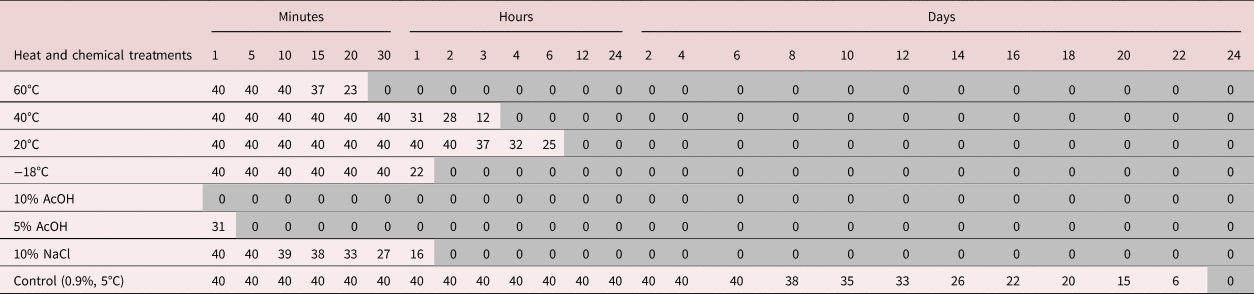
The survival analysis did not detect significant differences among the survival of metacercariae in fillets within each heat and chemical treatment group (DF = 3, P > 0.05); thus, ‘fillet effect’ was omitted from the further analysis of data. The survival analysis has showed that there were significant differences among the different heat (χ2 = 389, DF = 4, P < 0.01) and chemical treatments (χ2 = 238, DF = 3, P < 0.01). According to the pairwise multiple comparisons with Bonferroni correction, the differences between any of the treated groups and the untreated groups were significant (tables 1 and 2). The number of surviving metacercariae in the case of each treatment are presented in table 2 and figs 4 and 5.
Pairwise comparison of different heat and chemical treatments: χ2 and P-values (pairwise multiple comparisons with Bonferroni correction, degrees of freedom = 1).

C, control (0.9%, 5°C); AcOH, acetic acid; NaCl, sodium chloride.
Number of live metacercariae found at the different examination time points during the different heat and chemical treatments.

Numbers with grey shading indicate the total mortality of metacercariae. AcOH, acetic acid; NaCl, sodium chloride.
Number of survived metacercariae in different examination time points exposed to different heat treatments and those of the control group.

Number of survived metacercariae in different examination time points exposed to different chemical treatments and those of the control group.

Heat treatments at +60°C can be considered the most effective for killing the metacercariae, as they resulted in 100% mortality after just 30 min. The second most effective heat treatment type was that of −18°C, where all metacercariae died after 2 h of exposure (tables 1 and 2, fig. 4).
However, during the chemical treatments, exposure to 5% and 10% acetic acid killed the metacercariae within a few minutes; the 10% acetic acid was significantly more effective than other chemical treatments. Furthermore, the effect of the treatment with 10% NaCl was significantly lower than that of the acetic acid treatments, as during exposure to 10% NaCl solution the mortality of all metacercariae occurred 2 h later (tables 1 and 2, fig. 5).
Discussion
Common carp reared in fish farms in the north-eastern part of Hungary were recently reported infected with metacercariae in the muscle tissue, and due to the well-known zoonotic potential of muscle-dwelling metacercariae (Healy, Reference Healy1970; Abdussalam et al., Reference Abdussalam, Käferstein and Mott1995; Fried et al., Reference Fried, Graczyk and Tamang2004; Phan et al., Reference Phan, Ersbøll, Bui, Nguyen, Murrell and Dalsgaard2010), we found it relevant to elucidate the identity and zoonotic potential of the reported parasites from Hungarian carp. Metacercariae were isolated and characterized morphologically and, based on the taxonomical characteristics provided by Erasmus (Reference Erasmus1962), it was established that they belong to the genus Holostephanus within the digenean trematode family Cyathocotylidae. Sequence data of the ITS region also confirmed the identification (under publication). We then investigated if the metacercariae were infective to rodents (mice and hamsters), but none of the Holostephanus metacercariae established or matured in these mammals. Another well-known fish-borne zoonotic trematode species (Metagonimus sp.) established in the control experiments, suggesting that the model was suitable to elucidate zoonotic potentials. The present study could, therefore, not confirm that the metacercariae from common carp are zoonotic. We also investigated methods to inactivate the Holostephanus metacercariae. Numerous studies on parasite elimination methods for parasites in fish and shellfish have been published (Fan, Reference Fan1998; Abdallah et al., Reference Abdallah, Hamadto, El-Hayawan, El-Motayam and Ahmed2009; Borges et al., Reference Borges, Skov, Bahlool, Møller, Kania, Santos and Buchmann2014; Kim et al., Reference Kim, Oh, Dai, Yang, Ha and Hong2017). At the same time, it is important to mention that the resistance of different trematode species may vary. Rácz & Zemankovics (Reference Rácz and Zemankovics2002) subjected Metagonimus yokogawai metacercariae collected from River Danube fishes to freezing at −26°C, desiccation and acetic acid treatment. In their experiments, the first cysts died after 24 h and the last ones after 27 h after freezing. In contrast, during storage at room temperature without water the survival time of M. yokogawai cysts was a maximum of 2–3 h. With regard to resistance to acetic acid, it was found that 100% mortality of the trematode larvae occurred within a few minutes in 10% acetic acid and after 30 min in 5% acetic acid. Fattakhov (Reference Fattakhov1989) demonstrated that at −28°C, −35°C and −40°C Opisthorchis metacercariae survived for 20, 8 and 2 h, respectively. At variance with this finding, Borges et al. (Reference Borges, Skov, Bahlool, Møller, Kania, Santos and Buchmann2014) found that the metacercariae of Cryptocotyle lingua, a trematode of northern distribution, died after just 2 h at −20°C, and after 1 h at −40°C. In 2007, infection with the trematode Opisthorchis sp. of two humans was reported in Italy, and in a further 18 cases the coprological examination was positive for trematode eggs. The consumed fish (Tinca tinca and Coregonus sp.) had been stored at −10°C for three days, then pickled in the mixture of vinegar and wine for 24 h. Based on the findings that the zoonotic Opisthorchis metacercariae survived this treatment, the Italian Ministry of Health published official guidelines in 2008 recommending that cyprinids intended for human consumption should undergo thorough frying or freezing at −20°C for seven days before consumption (Armignacco et al., Reference Armignacco2008; Traverso et al., Reference Traverso2012). While Opisthorchis viverrini cysts were reported to die within 24 h in 13.6% NaCl solution (Kruatrachue et al., Reference Kruatrachue, Chitramvong, Upatham, Vichasri and Viyanant1982), the metacercariae of Haplorchis taichui were able to survive for 14 days at room temperature and for 21 days in the refrigerator in pla som fish food (sour fish) stored in 15% salt solution (Kaenjampa et al., Reference Kaenjampa, Tangkawattana, Smith, Sukon and Tangkawattana2017).
The European households most often use the heat treatment procedure. In the present experiment studying the survival of Holostephanus metacercariae, heat treatment at 60°C was effective but only at a 30 min exposure time. In contrast, the freezing of fish at −18°C required 120 min to be effective, which corresponded to the effect of 10% NaCl solution. Of all the treatment methods used, exposure to acetic acid was the most effective, as it caused total mortality of the parasite larvae after 5 min when using the 5% solution and after just 1 min when the 10% acetic acid solution was used. It seems that all of the treatments were effective in six hours; however, it should be noted that the pre-treatment (digestion by pepsin solution) might cause metacercariae to be more sensitive to the physical and chemical effects. However, the digestion was necessary as ‘the cysts of Holostephalus are much harder, making it almost impossible to isolate the metacercariae without chemical action’ (Kvach et al., Reference Kvach, Ondračková and Jurajda2016, p. 259). Moreover, several recent studies applied this methodology in their viability experiments (Rácz & Zemankovics, Reference Rácz and Zemankovics2002; Borges et al, Reference Borges, Skov, Bahlool, Møller, Kania, Santos and Buchmann2014).
We conducted infection experiments with small mammals to study the zoonotic potential of metacercariae isolated from the muscles of infected common carp specimens, as we could not find data on the zoonotic potential of Holostephanus species in the current international literature. The inoculated mice and hamsters were euthanized and their intestines examined after 7–12 days; however, mature parasite stages were not found, which suggests that this trematode parasitizing the muscles of fish might not have zoonotic potential. In the positive control hamsters, the Metagonimus trematode developed to the mature stage, which supports that small mammals can be suitable model organisms for the study of the zoonotic potential of trematodes. Despite the negative experimental results, the definitive host of Holostephanus trematodes is suggested to be a higher vertebrate species, as it follows from the general developmental cycle of this group of digeneans (Erasmus, Reference Erasmus1962; Dubois, Reference Dubois1983). Mammalian species are presumably not susceptible to Holostephanus species. To date, no zoonosis attributable to Holostephanus species has been reported in the literature (Seo et al., Reference Seo, Guk, Chai, Sim and Sohn2008). The negative result of the small mammal infection experiments in the present study is consistent with this; however, the evolutionary distance between humans and rodent species should naturally be taken into consideration when making such a statement. Moreover, the complete lack of history of human infection in the scientific literature also supports the non-zoonotic nature of these trematodes. There are only a few studies that acknowledge Holostephanus species to parasitize mammals. Gibson et al. (Reference Gibson, Jones and Bray2002) mention avian and mammalian definitive hosts in their comprehensive work, which is in conformity with the findings of Chandler (Reference Chandler1950), who reported the natural infection of a dog with M. longisaccus, a species also belonging to the Cyathocotylidae family, thus providing an example of when a mammal is successfully infected with a trematode of this family. However, the culinary practice and preservation methods commonly used in Hungary and in most European countries can prevent the survival and possible transfer of metacercariae present in fish fillets.
Financial support
This work was supported by the European Union's Horizon 2020 Research and Innovation Programme (ParaFishControl; grant number 634429); the European Regional and Development Fund and the Government of Hungary within the project GINOP-2.3.2-15-2016-00025; the ÚNKP-18-3 New National Excellence Program of the Ministry of Human Capacities (grant number ÚNKP-18-3-I-ELTE-410); and by the Higher Education Institutional Excellence Programme (NKFIH-1150-6/2019) of the Ministry of Innovation and Technology in Hungary, within the framework of the fourth thematic programme of the University of Debrecen.
Conflicts of interest
None.
Ethical standards
The authors assert that all procedures contributing to this work comply with the ethical standards of the relevant national and institutional guides on the care and use of laboratory animals.