Implications
This study clearly shows advantages of pelvic v. achilles suspension when utilizing production regimes where nutritional resources are limited. These benefits would apply to numerous segments within the global beef industry. Pelvic suspension reduced the need for longer ageing (7 v. 14 days) and significantly reduced the variation in tenderness, and improved cooking yields. This would be a significant advantage for both the meat industry and the consumers.
Our study indicates that the best combination of factors for a production system based on limited nutritional and housing inputs would involve pelvic suspension coupled with no or limited finishing feeding.
Introduction
Beef production systems often include strategies to improve tenderness and reduce the variation in meat quality, since these traits are recognized globally as being important to consumers (Koohmaraie, Reference Koohmaraie1996). Currently, more emphasis is being placed on sustainable beef production systems that utilize more pastures or forages and less high-energy concentrate feeding. However, with this type of feeding there is a greater risk for variable meat quality (Bowling et al., Reference Bowling, Riggs, Smith, Carpenter, Reddish and Butler1978). Therefore, it is important to investigate whether post mortem tenderization methods can offset some of the needs for high-cost nutritional regimes.
Sweden utilizes various beef production systems. Summers often involve grazing and winters require indoor housing and feeding. Nutritional regimes are largely based on forage feeding with little or no concentrate feeding. To avoid the cost of housing, animals could go to slaughter directly from pasture at the end of the grazing period. An alternative is to house the animals and finish them on either good silage or a more concentrated diet. Increasing feed intensity results in fatter carcasses at constant carcass weights (Steen and Kilpatrick, Reference Steen and Kilpatrick1995). However, consumers not only indicate a preference for leaner product but also expect it to be tender, juicy and flavourful with the latter two traits being strongly related to fat content (Huffman et al., Reference Huffman, Miller, Hoover, Wu, Brittin and Ramsey1996).
Tenderness and other beef meat quality attributes vary considerably due to cattle rearing system, slaughter age and other factors such as breed, gender and physical activity of the animals (Harper, Reference Harper1999). Traditionally, the extensive production systems have been blamed for higher risk for large variation in carcass quality. One way to reduce the variation in tenderness is the use of pelvic suspension (Wahlgren et al., Reference Wahlgren, Göransson, Linden and Willhammar2002; Maher et al., Reference Maher, Mullen, Moloney, Reville, Buckley, Kerry and Troy2005). Ahnström et al. (Reference Ahnström, Enfält, Hansson and Lundström2006) improved instrumental tenderness and reduced variation in instrumental tenderness of semimembranosus from young bulls by as much as 24% by using pelvic suspension compared to conventional achilles suspension. Hostetler et al. (Reference Hostetler, Landmann, Link and Fitzhugh1970) and Bouton et al. (Reference Bouton, Fisher, Harris and Baxter1973) also showed that pelvic suspension increased sarcomere length and improved tenderness in beef. Pelvic suspension has clearly showed positive effects on tenderness in different beef categories such as heifers (Mooney et al., Reference Mooney, Joo, Kim and Troy1999), steers (Derbyshire et al., Reference Derbyshire, Lues, Joubert, Shale, Jacoby and Hugo2007), bulls (Wahlgren et al., Reference Wahlgren, Göransson, Linden and Willhammar2002) and cows (Enfält et al., Reference Enfält, Lundesjö Ahnström, Svensson, Hansson and Lundström2004).
The major aim of this work was to evaluate the combined effects of finishing grazing heifers on a forage-based diet with limited high-energy inputs just before slaughter and the benefits of using pelvic suspension and ageing time as effective tenderness interventions post slaughter on tenderness and other meat quality factors.
Material and methods
Cattle background
The animals were a sub-sample from a larger study concerning the effect of feed intensity and slaughter age on production traits (Hessle et al., Reference Hessle, Nadeau and Johnsson2007). The subgroup was composed of 35 heifers with at least 75% Charolais breeding.
Slaughter ages and feeding regimens
During the grazing period, all heifers were kept together on semi-natural grasslands (described by Hessle et al. (Reference Hessle, Nadeau and Johnsson2007)) without supplemental feeding. Two-thirds of the heifers (n = 22) were slaughtered directly from pasture at 18 months of age, whereas one-third (n = 13) was finished indoors and then slaughtered at 22 months of age. During the indoor finishing period, the heifers were fed ad libitum intake of silage combined with 2 kg of mixed grain (65% oat and 35% barley) per animal per day.
Slaughter, chilling and carcass suspension
The animals were slaughtered at a commercial plant. Carcasses were electrically stimulated (80 V for 30 s) 30 min after exsanguination. The left side from each carcass was hung by the obturator foramen of the pelvic bone while the right side was suspended by its achilles tendon. Pelvic suspension was made with a rope attached around the cranial branch of pubis. Carcasses were chilled at 2 to 4°C for 2 days. The potential for cold shortening was minimized by electrical stimulation and mild chilling. During commercial cutting, the fore- and hind-quarters were separated between ribs 10 and 11.
Quality measurements
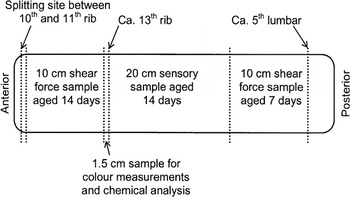
A 50 cm section of M. longissimus dorsi was removed from both sides of all carcasses at 48 h post mortem from rib 11 posteriorly to the last lumbar vertebrae (see Figure 1 for sampling sites). Muscles were vacuum packaged and aged for an additional 5 days at 4°C. The longissimus pH was measured using a probe electrode (Knick SE104; Knick, Berlin, Germany) attached to a pH meter (WTW pH 340; Wissenschaftlich-Technische Werkstätten GmbH, Weilheim, Germany). A 1.5-cm-thick slice of longissimus was removed (see Figure 1) for colour measurements and chemical intramuscular fat (IMF) analysis. Two 10-cm-thick samples for shear force measurements were removed from the longissimus and vacuum packaged. One sample was aged 7 days in total and the other was aged 14 days in total prior to freezing at −20°C. A 20-cm sample for sensory analyses was removed, vacuum packaged and aged 14 days before freezing.
Sample locations from the longissimus muscle for technological and sensory evaluation of meat from Charolais heifers.

The entire M. semimembranosus and M. adductor muscles were removed the day after slaughter from both sides from heifers slaughtered at 22 months of age. The muscles were vacuum packaged and aged at +4°C. Seven days after slaughter, the pH was measured as described above. A 10-cm-thick sample was removed from both muscles for shear force measurements, and frozen at −20°C 14 days after slaughter. These muscles were evaluated because of their economic value and location in the carcass region where pelvic suspension has significant impact.
Warner–Bratzler shear force
Instrumental tenderness was measured on longissimus, semimembranosus and adductor samples using the Warner–Bratzler shear force method described by Honikel (Reference Honikel1998) with modifications as indicated below. Peak force (N) and total energy (Nmm, the area under the curve) were recorded. Warner–Bratzler samples were thawed vacuum packaged overnight at 4°C and then the sealed bag was placed in a water bath (20°C) for 1 h to standardize the sample temperature and its resulting juice loss. The samples were re-vacuum packaged and the samples were cooked in the bag in a water bath for 2 h at 70°C. The weight of the meat samples was recorded before freezing, after thawing and after cooking to calculate the thawing and cooking losses. The cooked meat samples were stored at 4°C until evaluated for shear force the following day. From each sample, 40-mm-long strips with a 100-mm2 (10 × 10) cross-sectional area were removed with the fibre direction parallel to the longitudinal dimension of the sample. Twelve strips from each sample were sheared perpendicular to the fibre axis using a texture analyser HD 100 (Stable Micro Systems, Godalming, UK) equipped with a Warner–Bratzler shear force blade with a rectangular hole of 11 mm × 15 mm. The blade was 1 mm thick and had a speed of 0.83 mm/s when cutting through the samples. Averages were calculated for all strips from each sample and used for statistical analyses.
Sensory analysis
The sensory samples from the longissimus muscle were thawed overnight at 4°C. They were wrapped in aluminium foil and cooked in a conventional oven at 125°C to an internal end-point temperature of 70°C. A descriptive test (conventional profiling (ISO, 1985)) was performed by a seven-member panel. The panellists were experienced at assessing beef and trained in accordance with ISO 8586-1 (1993) before profiling. The samples were tempered to room temperature and served in coded Petri dishes in replicates as rectangular, 3.8-mm-thick slices. The crust and outer layer of the connective tissue were removed before presentation to the panel. The sensory attributes of acidity, fat taste, meat taste, juiciness, tenderness, bite resistance and visible marbling were judged on an intensity scale from 0 to 100. The assessments were performed in duplicate in a room with separate booths for each judge and a normal white light according to ISO 8589 (1988). The PSA programme (PSA system/3 2.9.1994) was used for data collection. Unsalted wafers and water were available for use between samples.
Chemically determined intramuscular fat
Samples (1.5-cm thick and frozen at day 7) were partially thawed, chopped into small pieces, and mixed. Duplicate sub-samples were analysed for IMF by the SBR method (NMKL, 1989) after hydrolysis with HCl diethyl ether and petroleum ether for extraction. Values for the duplicates were averaged.
Colour measurements
On day 7, a freshly cut sample was bloomed for 1 h in room temperature and evaluated using a Minolta chroma meter CR300 (Minolta, Osaka, Japan) with an 8 mm aperture and a 0° viewing angle with the specular component included. A white tile (L* = 97.47, a* = −0.20, b* = 1.79) was used for standardization as per the manufactures recommendations. CIE L* (lightness), a* (redness) and b* (yellowness) values (Illuminant D-65) were obtained from three scans from each steak and averaged for statistical analysis.
Statistical analysis
Statistical evaluation was performed using the MIXED procedure of SAS (version 9.1; SAS Institute Inc., Cary, NC, USA). For the carcass and fat traits, slaughter age (18 and 22 months) was included in the model as a fixed effect. For the meat quality traits, the suspension method and slaughter age and their interaction were fixed effects with animal as a random effect. Differences due to ageing were evaluated with the same model but with ageing time added (7 or 14 days). For the sensory evaluation, the random effect of panel member was also included. Differences between least-squares means were evaluated with the pdiff option.
Results
Carcass traits
Carcasses from heifers slaughtered at 22 months (Table 1) were heavier (P = 0.001), more muscular (P = 0.001) and were fatter (P = 0.001) than heifers slaughtered at 18 months. IMF also increased with slaughter age (P = 0.003).
Carcass quality traits in Charolais heifers slaughtered at 18 and 22 months of age

IMF = intramuscular fat.
1Significant values are formatted in bold (P < 0.05).
2Conformation: classification according to the EUROP grading system, 9 = R+; 7 = R−, a higher number means greater muscling.
3Fat class: classification according to the EUROP grading system, 10 = 4−; 6 = 2, a higher number means thicker fat cover.
4Chemically determined intramuscular fat percentage in longissimus.
Technological meat quality
pH, colour and water loss
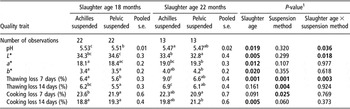
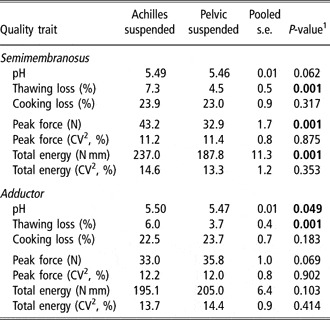
For muscle pH in the longissimus (Table 2) there was an interaction effect between slaughter age and the suspension method (P = 0.036). Muscle pH was slightly lower in the pelvic-suspended sides (5.51) compared to the achilles-hung sides (5.53, P = 0.013) at 18 months, but with no difference between suspension methods at 22 months. The suspension method also affected the pH of the adductor muscle where the pelvic-suspended sides had a pH of 5.47 v. 5.50 for achilles-hung sides (P = 0.049). The same effects tended to occur for semimembranosus samples (P = 0.062, Table 4).
Colour, pH and loss values from longissimus muscle from Charolais heifers slaughtered at 18 and 22 months of age

L* is the lightness, a* is the redness and b* is the yellowness values.
1Significant values are formatted bold (P < 0.05).
a–cMeans within a row with the same superscript letter are not different (P > 0.05).
Longissimus muscles from heifers slaughtered at 22 months of age and hung by the pelvic bone were slightly darker (lower L* values, P = 0.018) than longissimus from the achilles-suspended side (Table 2). Slaughter age influenced both a* and b* values, where heifers at 22 months of age had more red (P = 0.012) and more yellow (P = 0.020) meat than those at 18 months.
Although significant, the pH and colour differences due to pelvic suspension were small and likely of no practical significance.
Thawing losses for the longissimus were affected by the suspension method (Table 2). Muscles from both 18- and 22-month-old heifers that were aged 7 (P = 0.001) or 14 days (P = 0.004) had lower thawing loss for pelvic-suspended compared to achilles-suspended sides. Cooking losses were higher for the achilles-suspended sides aged 7 days from heifers slaughtered at 18 months (P = 0.025), compared to the other groups where no differences could be found. For samples aged 14 days, there were no differences in cooking losses between suspension methods within age group.
Thawing losses for the adductor and semimembranosus muscles followed a trend similar to the longissimus muscle, with lower losses in meat from pelvic-suspended sides compared to achilles-suspended sides (P = 0.001 in both muscles). No differences in cooking losses occurred for either muscle (Table 4).
Warner–Bratzler shear force measurements
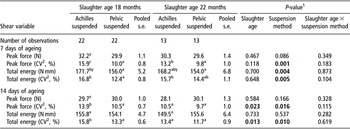
The longissimus samples aged 7 days from the 18-month group hung by the pelvic bone required less total energy (P = 0.011) to shear compared with the achilles-suspended group. A lower peak force (P = 0.033) and therefore more tender meat was also found in these samples (tendency to overall effect, P = 0.086, Table 3). Although differences were not significant between the suspension groups slaughtered at 22 months of age, the trend for lower total energy to shear was apparent within the pelvic suspension group. Finishing for 4 months had no effect on longissimus shear forces (Table 3).
Shear variable traits in longissimus from Charolais heifers slaughtered at 18 and 22 months of age and suspended by the achilles tendon or the pelvic bone

1Significant values are formatted in bold (P < 0.05).
2CV: coefficient of variation within sample.
a–cMeans within a row with no superscript or the same superscript letter are not different (P > 0.05).
x,yMeans within a column and variable with the same superscript letter do not differ between ageing times (P > 0.05).
When evaluating the effects of 7 v. 14 days of ageing for the longissimus (Table 3), samples from achilles-suspended sides aged 14 days were more tender with reduced peak force and total energy compared to those aged 7 days. However, the pelvic-suspended sides aged 7 days were just as tender as those aged 14 days. The coefficients of variation for both peak force and total energy decreased with pelvic suspension at both 7 and 14 days of ageing for longissimus samples except from heifers slaughtered at 22 months of age and aged 14 days (Table 3).
Semimembranosus samples from pelvic-suspended sides (slaughter age 22 months, Table 4) were 24% lower in peak force (P = 0.001) and 21% lower in total energy (P = 0.001) compared with samples from achilles-suspended sides. No differences were found in shear force between the two suspension methods for the adductor muscle. The coefficients of variation within samples were not affected by the suspension method for either semimembranosus or adductor.
Meat quality traits in semimembranosus and adductor from Charolais heifers (n = 13) slaughtered at 22 months of age and suspended by the achilles tendon or the pelvic bone

1Significant values are formatted in bold (P < 0.05).
2CV: coefficient of variation within sample.
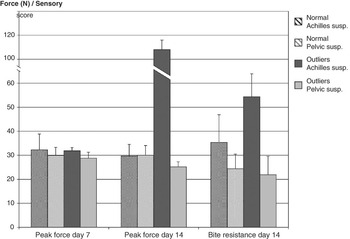
Two longissimus samples from carcasses hung by the achilles tendon and aged 14 days had total energy and peak force values that were two and three times higher, respectively, compared to the other samples in the same group. These outlier samples had peak force means over 100 N, whereas the other samples in the same group had a mean value of 30 N with s.d. = 5. The samples aged 7 days or pelvic suspended from the same animals did not show these deviations. The results from these two outliers were excluded from the study, but are presented as overall means in Figure 2 to show the magnitude of differences.
Overall means (with s.d.) for outliers (n = 2) and normal samples (within 2 s.d.; n = 22) for peak shear force samples aged 7 and 14 days. Bite resistance samples aged 14 days from achilles- and pelvic-suspended sides of longissimus from Charolais heifers slaughtered at 18 months of age.

Sensory meat quality
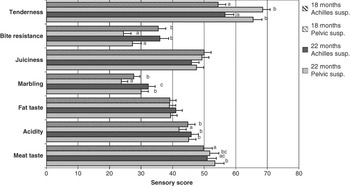
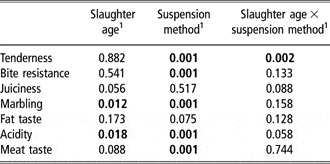
Sensory analysis performed on longissimus samples showed that the suspension method strongly (P = 0.001) affected all sensory traits except juiciness (P = 0.517) and fat taste (tendency, P = 0.075) (Figure 3 and Table 5). Muscles from pelvic-suspended sides had higher tenderness, lower bite resistance, stronger meat taste and less visible marbling than meat from achilles-suspended sides at both 18 and 22 months. For longissimus tenderness, an interaction was found between slaughter age and suspension method (P = 0.002), where the difference between pelvic and achilles suspension was larger at 18 months than at 22 months (Figure 3).
Sensory characteristics of longissimus samples aged 14 days from Charolais heifers with slaughter age 18 and 22 months and achilles and pelvic suspension (least-square means with standard error). Sensory scores within an attribute with the same letter are not different (P > 0.05). P-values for each trait can be found in Table 4.

P-values for sensory characteristics of longissimus samples from Charolais heifers for the effect of slaughter age, suspension method and the interaction slaughter age × suspension method (Figure 2)

1Significant values are formatted in bold (P < 0.05).
The increased feeding period from 18 to 22 months increased sensory marbling (P = 0.012) and acidity (P = 0.018) scores (Figure 3 and Table 5). Carcasses hung by the pelvic bone had smaller scores for visible marbling at 18 and 22 months compared to achilles suspension, and lower acidity scores for pelvic- v. achilles-suspended sides at 18 months.
Discussion
Tenderness parameters were clearly improved in pelvic-suspended compared to achilles-suspended sides. Sensory tenderness was higher, and bite resistance and shear variables were lower, although the differences were not always significant. Notably, there was a decrease in the coefficient of variation for Warner–Bratzler shear variables in longissimus as an effect of pelvic suspension after both 7 and 14 days of ageing. In addition, there were lower thawing and cooking losses, which would benefit processors using this meat to manufacture other value-added products as well as food service and consumers at home.
The response of the pelvic suspension on shear force and total energy in the longissimus was relatively low, as pelvic-suspended sides slaughtered at 18 months were 7% lower in shear force and 9% lower in total energy compared to the achilles-suspended counterpart. The semimembranosus had a more pronounced response with 24% (shear force) and 21% (total energy) lower values for the pelvic-suspended sides. This agrees with earlier studies where Mooney et al. (Reference Mooney, Joo, Kim and Troy1999) and Ahnström et al. (Reference Ahnström, Hansson, Wiklund and Lundström2005) reported a stronger response for semimembranosus compared to longissimus in heifers. The larger effect in semimembranosus is probably dependent on longer sarcomeres and a more elongated muscle compared to longissimus as shown by Ahnström (Reference Ahnström2008). The adductor muscle had numerically (not significant) higher shear data for samples suspended by the pelvic bone v. the achilles tendon, which agrees with results from Ahnström et al. (Reference Ahnström, Hansson, Wiklund and Lundström2005). In contrast to the longissimus muscle, the coefficients of variation for both the adductor and semimembranosus muscles were not reduced, most likely due to their greater inherent toughness and collagen contents.
Ageing does not influence tenderness uniformly in all meat. Novakofski and Brewer (Reference Novakofski and Brewer2006) found that meat that was tough at 2 days post mortem decreased in shear force during ageing until 14 days much more than meat that was tender already at 2 days post mortem. The most tender meat at 2 days post mortem even had a higher shear force after ageing. This could be a reason for the weak responses in shear force in our study, as the shear force levels in this study are low compared to other beef samples run at the same instrument. Maher et al. (Reference Maher, Mullen, Moloney, Buckley and Kerry2004) suggested that meat with shear force levels below 50 N would be considered as being tender. This is, of course, depending on the protocol followed for analysis and also the calibration of the instrument (Wheeler et al., Reference Wheeler, Shackelford, Johnson, Miller, Miller and Koohmaraie1997).
Increasing the ageing time from 7 to 14 days did not produce any improvements in instrumental tenderness for pelvic-suspended sides. Similar results were shown for tender stretched longissimus by O’Halloran et al. (Reference O’Halloran, Ferguson, Perry and Egan1998). However, samples from achilles-suspended sides apparently responded to ageing with lower shear force at 14 v. 7 days. This agrees with the results from Gruber et al. (Reference Gruber, Tatum, Scanga, Chapman, Smith and Belk2006), who found improvements in longissimus tenderness for achilles-suspended samples aged 21 days.
The effect of pelvic suspension is in our study combined with the effect of electrical stimulation. Pelvic suspension has, however, been shown to be effective in the prevention of shortening in un-stimulated young bull carcasses in chilling conditions similar to ours (Sørheim et al., Reference Sørheim, Idland, Halvorsen, Frøystein, Lea and Hildrum2001). These authors also showed decreased variation in tenderness between samples after pelvic suspension. The additive effects of electrical stimulation and pelvic suspension are low but never negative (Fisher et al., Reference Fisher, Nute, Fursey and Cook1994; Eikelenboom et al., Reference Eikelenboom, Barnier, Hoving-Bolink, Smulders and Culioli1998). Derbyshire et al. (Reference Derbyshire, Lues, Joubert, Shale, Jacoby and Hugo2007) also demonstrated positive effects of electrical stimulation and pelvic suspension, as well as the combination of the two treatments. The positive effects of pelvic suspension can be of special advantage for smaller slaughterhouses that do not use electrical stimulation (Derbyshire et al., Reference Derbyshire, Lues, Joubert, Shale, Jacoby and Hugo2007).
Two outliers occurred for both peak force and sensory tenderness of the longissimus at 14 days of ageing for only the achilles-suspended sides (Figure 2). Pelvic suspension apparently was effective in decreasing the variation in tenderness traits, a commonly accepted benefit of this post mortem intervention technology (Wahlgren et al., Reference Wahlgren, Göransson, Linden and Willhammar2002; Maher et al., Reference Maher, Mullen, Moloney, Reville, Buckley, Kerry and Troy2005). The reason for the finding of outliers in our study is not obvious. Maher et al. (Reference Maher, Mullen, Moloney, Reville, Buckley, Kerry and Troy2005) produced super-contracted samples using hot-boning and fast chilling and obtained very tough, contracted meat at 2 and 7 days of ageing while the 14 days samples did respond to ageing and showed a decrease in shear force levels. In our study, we did not see any indications of abnormal contraction in the 7 days samples but only in the ones aged 14 days. This could be due to physical differences within the longissimus due to anatomical location, to chance, or to some unusual contraction phenomenon that needs to be further studied. This type of extreme shear force values might be frequent but generally considered to be outliers and therefore omitted. It is of special interest that pelvic suspension effectively eliminates this problem. In the study by Ahnström et al. (Reference Ahnström, Enfält, Hansson and Lundström2006), two young bulls with extremely high shear force (approximately 120 N) in semimembranosus with achilles suspension showed a reduction in shear force by approximately 60 N after pelvic suspension. We have not found any explanation for these extreme values, but they are effectively eliminated by pelvic suspension. Since all carcasses in our studies were electrically stimulated, it can be concluded that this method alone was not sufficient for producing meat with a consistent tenderness.
For the evaluated sensory traits in our study, only visible marbling was higher after finishing for 4 months (Figure 3). This is contradictory to Harrison et al. (Reference Harrison, Smith, Allen, Hunt, Kastner and Kropf1978), who reported that all sensory traits improved after a longer rearing period, and to Vestergaard et al. (Reference Vestergaard, Therkildsen, Henckel, Jensen, Andersen and Sejrsen2000) who found that extensively fed young bulls gave better panel scores for tenderness, taste and juiciness after a finishing period of 10 weeks compared with animals slaughtered directly from pasture. Our study confirms the results by Hoving-Bolink et al. (Reference Hoving-Bolink, Hanekamp and Walstra1999), where a significant increase in IMF content did not result in better sensory characteristics. Generally, high marbling scores improve flavour and juiciness of beef as Harrison et al. (Reference Harrison, Smith, Allen, Hunt, Kastner and Kropf1978) found for grain-fed beef. However, Bruce et al. (Reference Bruce, Stark and Beilken2004) concluded that pasture-finished beef had the highest overall quality because of increased tenderness and juiciness despite the fact that the pasture-finished beef had a lower IMF content.
Of special interest, in the present study, was the lower amount of visible marbling in meat from pelvic-suspended heifers. This may be due to a stretching of muscle fibres on the adipose tissue, resulting in less-obvious visible marbling. Since some consumers prefer to buy meat with low marbling even though the taste of meat with higher marbling is preferred (Grunert, Reference Grunert1997; Ngapo and Dransfield, Reference Ngapo and Dransfield2006), use of pelvic suspension could also have an advantage in juiciness and flavour in addition to its greater tenderness. The lower visible marbling in pelvic-suspended sides at 22 months compared to the achilles-suspended sides could also explain the lower L* values after pelvic suspension. We found higher a* and b* values at 22 months of slaughter compared with 18 months, which is in line with other investigations (Lynch et al., Reference Lynch, Buckley, Galvin, Mullen, Troy and Kerry2002), whereas the suspension method did not affect a* and b* values.
We found an effect of suspension method on pH, with slightly lower pH-values after pelvic suspension in longissimus at 18 months and in adductor at 22 months. This is contradictory to Mooney et al. (Reference Mooney, Joo, Kim and Troy1999) who showed no differences in pH due to pelvic suspension and Wahlgren et al. (Reference Wahlgren, Göransson, Linden and Willhammar2002) who reported slower pH decrease in pelvic-suspended sides but no differences in ultimate pH. Our finding is difficult to explain, but that might be due to the fact that the carcass was shackled for about 15 min early post mortem. During this time, the free leg (which was eventually suspended by the pelvic bone) is usually kicking and contracting to various degrees. During electrical stimulation the carcass was hanging by both legs. The lower pH in the non-shackled leg is in contrast to results by Smulders et al. (Reference Smulders, Hiesberger, Hofbauer, Dogl and Dransfield2006), who found the opposite effect of shackling and also lower shear force in longissimus from the shackled side at the earlier storage times (2 and 9 days after slaughter) but not later. The positive effect of pelvic suspension on lowering freezing loss has earlier been reported by Derbyshire et al. (Reference Derbyshire, Lues, Joubert, Shale, Jacoby and Hugo2007).
Conclusion
Our data clearly show the advantages of pelvic v. achilles suspension when utilizing production regimes where nutritional resources are limited. These benefits would apply to numerous segments within the global beef industry. Not surprisingly, there were interactions between production schemes and processing protocols. Pelvic suspension reduced the need for longer ageing (7 v. 14 days), significantly reduced the variation in tenderness and improved cooking yields, which would be a significant advantage for both the meat industry and the consumers.
This study indicates that the best combination of factors for a production system based on limited nutritional and housing inputs would involve pelvic suspension coupled with no or limited higher terminal energy rations to cattle.
Acknowledgements
The authors are grateful for the help provided by Dr Ingemar Hansson and Ms Gertrud Andersson during sampling and analysis. All staff at Götala research station are duly thanked for care of the animals and sampling at the slaughterhouse.