




No CrossRef data available.
Article contents
Differential phenoloxidase activity between native and invasive gammarids infected by local acanthocephalans: differential immunosuppression?
Published online by Cambridge University Press: 05 December 2003
Abstract
Manipulative endoparasites can alter the behaviour and the physiology of their intermediate hosts in ways that increase the probability of successful transmission to the final host. This requires that the parasite is able to circumvent its host's immune defence. Successful immune evasion may depend on host–parasite coevolutionary history and the appearance of new hosts invading the local host population may promote local parasite maladaptation. To test this hypothesis, we examined the effect of 2 acanthocephalan parasites, Pomphorhynchus laevis and Polymorphus minutus, on the immunity of their local and new invasive gammarid intermediate hosts, respectively Gammarus pulex and Gammarus roeseli. We found that infection by each parasite was correlated with a decrease, at different degrees, of the standing level of immune defence in local hosts – measured as the phenoloxidase (PO) enzyme activity – whereas invasive hosts infected by P. laevis had their PO-enzyme activity enhanced. These results suggest that these acanthocephalans evade their local host immune response through immunosuppression but cannot evade the immune response of their new invasive host. The potential role of this maladaptation on the success of invasive species is discussed.
Information
- Type
- Research Article
- Information
- Copyright
- 2003 Cambridge University Press
INTRODUCTION
Endoparasite fitness crucially depends on survival within the host body cavity, which is mainly based on the parasite capacity to evade the host immune defence (Loker, 1994; Damian, 1997). Such an interaction with the host immune system is assumed to result from long co-evolutionary processes between the host and the parasite (Zambra-Villa et al. 2002). Consequently, infection of novel hosts might be compromised, as the parasite may not manage to evade successfully the new host immune system. This may have important implications for parasite maintenance when successful competitors invade native host populations.
Biological invasions provide an interesting context to study such host–parasite relationships. Differential migration rates between parasites and their hosts can cause local parasite maladaptation. For instance, a high host gene flow compared to that of the parasite may prevent local adaptation of the parasite (Gandon et al. 1996). Recent empirical data are in favour of differential migration rate between introduced species and their parasites (Torchin et al. 2003). In addition, Torchin, Lafferty & Kuris (2002) showed that invasive species (in a marine environment) are less affected by local parasites compared to populations in their native range. More specifically, Dunn & Dick (1998), studying parasitism in native and invasive species of gammarids (Crustacea, Amphipoda), found that native species are more often infected by local parasites than invaders, suggesting that parasites may not be adapted to the new hosts.
Gammarus pulex and Gammarus roeseli are two gammarid species that occur in sympatry in rivers of Burgundy (eastern France). Pomphorhynchus laevis and Polymorphus minutus are two acanthocephalan parasites that commonly use G. pulex as an intermediate host before being transmitted via predation to their definitive host, respectively fish and water birds (Crompton & Nickol, 1985). These parasites also infect G. roeseli in Burgundy (Bauer et al. 2000). The gammarids are orally infected when ingesting parasite eggs released in the faeces of the definitive host. At its infective stage (acanthor), the parasite passes through the gut wall of the crustacean host to occupy its haemocoel. There, the parasite changes into acanthella stage, and finally cystacanth stage that alters the behaviour of the intermediate host to favour predation by the definitive host (Bakker, Mazzi & Zala, 1997; Bethel & Holmes, 1973; Cézilly, Grégoire & Bertin, 2000). Prior to this, however, the cystacanth will face the host immune response within the host haemocoel. While G. pulex is a native species in France, G. roeseli is a recent colonizer (around 80 years) of Central European origin (Karaman & Pinkster, 1977; Jazdzewski, 1980; Roux, Roux & Opdam, 1980), and shares the same local parasite community as G. pulex. This increases the probability for local acanthocephalans to end up in this new host. However, unlike the observation in G. pulex, P. laevis does not alter the behaviour of G. roeseli, possibly because they are maladapted to this new host (Bauer et al. 2000). Survival of local acanthocephalans within G. roeseli will also depend on their capacity to evade the immune response of this new host with which they share a short co-evolutionary period. It is therefore predicted that parasite maladaptation to invasive hosts, in terms of immune evasion, should provide a strong advantage to invaders over native competitors.
Here, we compared, using animals collected in the wild, one of the most important components of the immune system of G. pulex and G. roeseli facing acanthocephalan parasites. Immunity of crustaceans, like other invertebrates, is innate and parasite infections activate multiple systemic responses, including phagocytosis and encapsulation by haemocytes (Ratcliffe et al. 1985; Hoffmann, Reichhart & Hetru, 1996; Gillespie, Kanost & Trenczeck, 1997), and accompanying melanization reactions (Söderhäll, Cerenius & Johansson, 1996; Söderhäll & Cerenius, 1998). These latter are based on the prophenoloxidase (proPO) cascade, which is a common and generalized response to invasion by a parasite (Söderhäll & Cerenius, 1998). The operation of the cascade is indicated by the phenoloxidase (PO)-enzyme activity in the haemolymph and can be monitored by measuring the rate of conversion of a phenol substrate into quinone, which then polymerizes to form melanin. Endoparasites evading the PO response through molecular mimicry are not expected to affect the standing level of PO-enzyme activity of the host haemolymph. In contrast, the PO-enzyme activity should be down-regulated when endoparasites immunosuppress the host. We therefore measured the PO-enzyme activity in G. pulex and G. roeseli, using a correlative approach, in relationship with the infection by P. laevis and P. minutus parasites.
MATERIALS AND METHODS
Gammarid sample and measures
Gammarids used in this study were collected in July 2002 in the river Tille at Les Maillys (Burgundy, eastern France). At this site, G. pulex and G. roeseli live in sympatry and both are presumably exposed to the local acanthocephalan parasites P. laevis and P. minutus. Gammarids were sampled using the kick-sampling method described by Hynes (1954). Two samples were collected for the PO-enzyme activity test: in the first one, around 50 animals from each species were collected randomly. Then, owing to the low parasite prevalence found in these samples, individuals infected by acanthocephalan parasites were actively sought, until around 20 infected hosts were found for each species. This sample will therefore not reflect the actual parasite prevalence. Parasitized individuals can be distinguished from non-parasitized ones because acanthocephalans can be seen through the transparent crustacean cuticle as bright orange or yellow dots. The animals were then transferred according to gammarid species into pots filled with water from the river and provided with oxygen. The pots were kept at low temperature on ice packs during the travel to the laboratory. In the laboratory all animals were kept in aquaria under standard conditions (15 °C) fed with dead leaves before being used for the trial. Measurements described below were made within the 24 h following sampling.
For the study, each individual was isolated in a 1·5 ml Eppendorf tube kept on ice, sexed and measured by linear dimensions (distance from fourth coxal plate basis to individual dorsal limit) using a stereoscopic microscope Nikon SMZ-10A and a video-analysis system VTO 232 from Linkam scientific instruments (Bollache, Gambade & Cézilly, 2000). A haemolymph sample was collected for each individual to measure PO-enzyme activity (see below). Animals were then dissected in Ringer's solution under a stereoscopic microscope to count and identify the acanthocephalan species in their body cavity. To control for a potential interaction between host reproduction and parasite effect, we recorded whether females were gravid (with eggs in their ventral incubating pouch or marsupium). This control was needed, because Plaistow, Troussard & Cézilly (2001) showed that P. laevis was able to depress lipid reserves only in reproductive females (i.e. when energetic demand is stronger). Therefore, a decrease in PO activity in reproductive infected females could indicate a general decrease in body condition, and not a direct parasite effect.
Haemolymph collection and PO activity
Haemolymph extracts were taken by perfusing the haemocoel of chilled gammarids with 250 μl of ice-cold sodium cacodylate buffer (0·01 M Na-cacodylate, 0·005 M CaCl2, pH 6·5). For this, the telson of the gammarids was removed with dissecting scissors to create a hole out of which haemolymph was collected. Gammarids were injected with sodium cacodylate buffer through the second tergite behind the head, using a 1 ml disposable syringe (Clinipak U-40 Insulin, Pharma-Plast) and the perfused liquid (buffer plus haemolymph) was collected through the posterior hole into 1·5 ml Eppendorf tubes. Samples were immediately frozen in liquid nitrogen and then stored in a freezer (−80 °C). For the PO assay, the samples were thawed on ice and 20 μl were placed into microtitre plate wells containing 140 μl of cold distilled water, 20 μl of cold saline phosphate buffer (PBS: 8·74 g NaCl; 1·78 g Na2HPO4.2H2O; 1000 ml distilled water; pH 6·5). Then 20 μl of cold L-dopa solution (4 mg per ml of distilled water) were added into each well and the reaction allowed to proceed for 40 min at 30 °C in a microtitre plate reader (Versamax, Molecular Devices). Readings were taken at 490 nm and analysed using SOFTmax®PRO 4.0 software (Molecular Devices). Enzyme activity was measured as the slope (Vmax value) of the reaction curve during the linear phase of the reaction (Barnes & Siva-Jothy, 2000) within a time-scale between 5 and 30 min after the reaction mix was made.
Statistics
As, in our sample, G. pulex was the only host harbouring the two acanthocephalan parasites, P. laevis and P. minutus, we tested the effect of these two parasites on the PO activity using an analysis of covariance (ANCOVA) model including parasite infection, sex of the host as categorical factors, host size as covariate, and the second order interactions between these factors. We used a backward stepwise procedure to remove non-significant factors or interactions (P>0·05).
As P. laevis was the only acanthocephalan found in both gammarid species, G. pulex and G. roeseli, we first tested the effect of the infection by the parasite on the level of PO activity (Vmax values) of the two host species together. Then the effect of P. laevis was analysed in each host species separately. In all analyses, we used an ANCOVA including a factor ‘species’ in addition to the other factors and covariates used in the above tests. Similarly to the above tests, we used a backward-stepwise procedure to remove non-significant interactions. To analyse the effect of reproductive status in females (gravid vs non-gravid), the same type of analysis was made, excluding males and adding a reproductive status as categorical factor.
Statistical analyses were done on transformed dependent variables to meet the assumptions of normality. Vmax values were natural-log transformed for analyses involving both gammarid species together or G. roeseli alone and square root transformed for analyses involving G. pulex alone. All the statistical analyses were done using JMP 3.2 software (SAS Institute, 1997).
RESULTS
We used data from 73 G. pulex (32 males and 41 females) and 59 G. roeseli (31 males and 28 females). While the resident intermediate host G. pulex was infected by both species of acanthocephalans (19 infected by P. laevis and 15 infected by P. minutus), G. roeseli was infected by P. laevis only (20 individuals).
Effect of P. laevis and P. minutus on the PO-enzyme activity of G. pulex
The size of gammarids within each host species had a large effect on the level of PO activity measured (Table 1). This could be due to the method used to collect haemolymph: large gammarids provided more haemolymph and consequently had higher level of PO activity compared to small individuals. Low PO-enzyme activities were associated with acanthocephalan infection (Fig. 1, Table 1), but the enzyme activity was lower in G. pulex infected by P. laevis than in G. pulex infected by P. minutus (Fig. 1, Table 1). However, the variance in PO activity did not differ between uninfected and acanthocephalan-infected individuals (variances on square-root transformed data were 7·32 (n=39) and 4·19 (n=34), respectively; O'Brien's ANOVA testing the equality of variances: F1,71=2·32, P=0·13). The gammarid PO-enzyme activity was higher in females than in males. However, the slopes of the regression between enzyme activity and gammarid size differed significantly between sexes (Table 1), with large females having higher PO-enzyme activity than large males (results not shown).

Fig. 1. Values of PO activity (Vmax values in units per minute) corrected for size in Gammarus pulex, according to sex and infection status by Pomphorhynchus laevis and P. minutus. Correction for size was made by using the residuals of the regression square-root of size against PO activity. The numbers within the columns are sample size. Note that this representation using residuals is just for an easy reading, avoiding the confounding size data. For the statistical analysis (Table 1), size was used as covariate in an ANCOVA analysis.

Effect of the infection by P. laevis on the PO-enzyme activity of G. pulex and G. roeseli
Size again had a large effect on the level of PO activity (Table 2), for the same reason mentioned above. The 2 gammarid species had different levels of PO activity, with G. roeseli having around 2/3 the enzyme activity of G. pulex in uninfected individuals (Table 2A; Fig. 2). This, despite that G. roeseli was larger on average than G. pulex (Wilcoxon, Z=−2·07; P=0·039). Infection by P. laevis influenced the level of PO activity in both host species, but in different ways (Fig. 2) (The factor ‘infection’ and the interaction ‘species*infection’ were both significant, see Table 2A). While the infection was associated with a low PO activity in the local host G. pulex (Fig. 2, Table 2B), it was associated with a high enzyme activity in the invading host G. roeseli (Table 2C, PO activity (untransformed data)=18·99±2·26 and 32·58±9·26 for uninfected and infected hosts, respectively). In females, reproductive status had no significant effect on the level of PO activity: the stepwise procedure never included this factor in the analysis, neither in interaction with the infection status or alone (the significant factors retained were the same as those described in Table 2A, the factor ‘sex’ being removed). Reproductive females therefore had similar levels of PO activity compared with non-reproductive ones.

Fig. 2. Values of PO activity (Vmax values in units per minute) corrected for size in Gammarus pulex and G. roeseli, according to sex and infection status by Pomphorhynchus laevis. Correction for size was made by using the residuals of the regression natural-log of size against PO activity. The numbers within the columns are sample size. Note that this representation using residuals is just for an easy reading, avoiding the confounding size data. For the statistical analysis (Table 2), size was used as covariate in an ANCOVA analysis.
Table 2. Analysis of covariance following a stepwise regression (backward elimination procedure) for PO values as a function of infection by Pomphorhynchus laevis, host species, host sex and host size (covariate) ((A) Model including Gammarus pulex and G. roeseli (PO values natural-log transformed). (B) Model with G. pulex only (PO values square-root transformed). (C) Model with G. roeseli only (PO values natural-log transformed).)

While males and females of G. roeseli had a similar general level of PO activity, they responded differently to the infection by P. laevis (Table 2C, Fig. 2). Infection induced no significant effect in males (one-way ANOVA: F1,26=0·21, P>0·60) while it is associated with an increase in females (F1,29=3·98, P=0·05). There was also a significant interaction between infection by P. laevis and the size of G. roeseli for the level of the PO activity (Table 2C). In fact, the positive relationship between size and level of PO activity was stronger in infected than in uninfected individuals (results not shown). In G. pulex, as seen earlier, the relationship between PO activity and size co-varied differently according to gender of the crustacean (Table 2B).
DISCUSSION
The main result from our study is that the level of PO-enzyme activity was lower in individuals of the local host G. pulex infected by the acanthocephalan parasites P. laevis and P. minutus, while the infection of the invading host G. roeseli by P. laevis was associated with a higher PO-enzyme activity. Independently of parasite infection, we also observed that the local gammarid species had a higher general level of PO-enzyme activity than the invasive one. However, this latter result can hardly be interpreted as it may result from fundamental differences in the biology of the two species.
Considering G. pulex alone, the PO-enzyme activity of infected and uninfected gammarids by the 2 acanthocephalan parasites could suggest that the parasites successfully infected hosts with poor immune defence while immunocompetent hosts may have successfully cleared the infection. But several lines of results are not in accordance with this hypothesis. First, individuals infected by P. laevis and P. minutus showed different levels of PO-enzyme activity. Second, the variance was not different between infected and uninfected G. pulex, while a strongly-reduced variance would be expected in infected individuals in the case of infection of immunodeprived hosts by parasites. Finally, the PO-enzyme activity has been found to be enhanced in parasitized G. roeseli. We therefore believe that the 2 species of parasites immunosuppress to different degrees their local host G. pulex, to evade its immune response. Such a mechanism was recently shown to explain the low levels of immune response in mosquitoes infected by malaria parasites (Boëte, Paul & Koella, 2002), and is also known in several other parasite–invertebrate systems (Christensen & LaFond, 1986; Strand & Pech, 1995). One possible explanation for the decrease of PO activity could be that parasites induce a general decrease in individual quality, including immune function. Our results in females do not support this hypothesis: previous results showed that lipid reserves are decreased in reproductive females infected by P. laevis relative to non-reproductive ones (Plaistow et al. 2001), but we failed to find evidence of any effect of reproductive status on the PO activity. It is therefore unlikely that the decrease in immunocompetence is directly due to a general decrease in body condition.
It is likely that the acanthocephalan P. laevis did not manage to efficiently interact with the immune system of G. roeseli, which mounted an immune response through the increase of PO-enzyme activity. P. laevis parasites could be maladapted to immunosuppress the new invader host, G. roeseli. This suggestion would be in the line with the inability of P. laevis to manipulate G. roeseli's behaviour (Bauer et al. 2000), and also in line with the observations of Hynes & Nicholas (1958), who described that acanthocephalans infecting a ‘wrong’ amphipod host species are more frequently melanized and have an impeded development. Such a maladaptation of the local parasites to new hosts may give an advantage to invasive species when colonizing new areas and could have helped G. roeseli to successfully colonize Burgundy's rivers.
Another important result revealed by this study is that sex of the host had an important effect on the standing level of PO-enzyme activity. Males of G. pulex tend to have lower PO-enzyme activity than females and this difference is increased when the gammarids become bigger. Interestingly, P. laevis prevalence and abundance was found to be higher in males than in females in G. pulex (Outreman et al. 2002), and our observation may explain this difference in parasite load. Such a difference between males and females may result from different strategies of investment to immunity by males and females according to the pay off in terms of fitness. Females would possibly gain more fitness through increased longevity by investing more into immunity, while males would gain fitness by increasing mating rates (Rolff, 2002). Furthermore, large male gammarids are the most successful in pairing with females (Bollache et al. 2000; Bollache, Gambade & Cézilly, 2001). Consequently, these large males may achieve higher mating rates than smaller ones. Mating has been found recently to decrease general immune defence in insects (Rolff & Siva-Jothy, 2002). Higher mating rates could have lead to the relatively low PO-enzyme activity in large G. pulex males. We did not find any sex difference in the level of PO-enzyme activity in G. roeseli in the absence of parasites, but immune responses to parasite infection were dependent of the host gender. Immune responses of females to P. laevis infection were stronger than these of males. For the same reason as mentioned above for G. pulex, it might be more beneficial for females than for males to invest in immunity (Rolff, 2002).
In conclusion, this correlative study suggests that the acanthocephalan parasites P. laevis and P. minutus immunosuppress their intermediate gammarid hosts. However, local parasites would be maladapted to immunosuppress new invasive intermediate hosts. This maladaptation of the local parasites to new hosts may have provided a considerable advantage to invaders over native competitors. G. roeseli has been reported to be infected by P. laevis in Czechoslovakia and Hungary, in its native area (Moravec & Scholz, 1991; T. Rigaud, personal observation). Future studies will allow comparisons of the immune evasion capacity of parasites from native versus non-native origins, and therefore formally test the maladaptation hypothesis.
We thank J. Moreau for his help in the field, F. Cézilly, J. Rolff and M. Siva-Jothy for critical reading of this manuscript. Special thanks to M. T. Siva-Jothy for allowing us to use his spectrophotometer. This study was funded by an ATIP grant from the French CNRS to T. R., and a grant from the program “Invasions Biologiques” of the French Ministère de l'Ecologie et du Developpment Durable (# 01121). Y. M. was funded by a Marie-Curie fellowship.
References
REFERENCES
BAKKER, T. C. M.,
MAZZI, D. &
ZALA, S.
(
1997).
Parasite-induced changes in behavior and color make Gammarus pulex more prone to fish predation.
Ecology 78,
1098–1104.CrossRefGoogle Scholar
BARNES, A. I. &
SIVA-JOTHY, M. T.
(
2000).
Density-dependent prophylaxis in the mealworm beetle Tenebrio molitor L. (Coleoptera: Tenebrionidae): cuticular melanization is an indicator of investment in immunity.
Proceedings of the Royal Society of London, B 267,
177–182.Google Scholar
BAUER, A.,
TROUVÉ, S.,
GRÉGOIRE, A.,
BOLLACHE, L. &
CÉZILLY, F.
(
2000).
Differential influence of Pomphorhynchus laevis (Acanthocephala) on the behaviour of native and invader gammarid species.
International Journal for Parasitology 30,
1453–1457.CrossRefGoogle Scholar
BETHEL, W. M. &
HOLMES, J. C.
(
1973).
Altered evasive behavior and responses to light in amphipods harboring acanthocephalan cystacanths.
Journal of Parasitology 59,
945–956.CrossRefGoogle Scholar
BOËTE, C.,
PAUL, R. E. L. &
KOELLA, J. C.
(
2002).
Reduced efficacy of the immune melanization response in mosquitoes infected by malaria parasites.
Parasitology 125,
93–98.CrossRefGoogle Scholar
BOLLACHE, L.,
GAMBADE, G. &
CÉZILLY, F.
(
2000).
The influence of microhabitat segregation on size assortative pairing in Gammarus pulex (L.) (Crustacea, Amphipoda).
Archive of Hydrobiology 147,
547–558.Google Scholar
BOLLACHE, L.,
GAMBADE, G. &
CÉZILLY, F.
(
2001).
The effects of two acanthocephalan parasites, Pomphorhynchus laevis and Polymorphus minutus, on pairing success in male Gammarus pulex (Crustacea: Amphipoda).
Behavioural Ecology and Sociobiology 49,
296–303.CrossRefGoogle Scholar
CÉZILLY, F.,
GRÉGOIRE, A. &
BERTIN, A.
(
2000).
Conflict between co-occurring manipulate parasites. An experimental study of joint influence of two acanthocephalan parasites on the behaviour of Gammarus pulex.
Parasitology 120,
625–630.Google Scholar
CHRISTENSEN, B. M. &
LaFOND, M. M.
(
1986).
Parasite-induced suppression of the immune response in Aedes aegypti by Brugia pahangi.
Journal of Parasitology 72,
216–219.CrossRefGoogle Scholar
CROMPTON, D. W. T. &
NICKOL, B. B.
(
1985).
Biology of the Acanthocephala.
Cambridge University Press,
Cambridge.
DAMIAN, R. T.
(
1997).
Parasite immune evasion and exploitation: reflections and projections.
Parasitology 115 (Suppl.),
S169–S175.CrossRefGoogle Scholar
DUNN, A. M. &
DICK, J. T. A.
(
1998).
Parasitism and epibiosis in native and non-native gammarids in freshwater in Ireland.
Ecography 21,
593–598.CrossRefGoogle Scholar
GANDON, S.,
CAPOWIEZ, Y.,
BUBOIS, Y.,
MICHALAKIS, Y. &
OLIVIERI, I.
(
1996).
Local adaptation and gene-for-gene coevolution in a metapopulation model.
Proceedings of the Royal Society of London, B 263,
1003–1009.CrossRefGoogle Scholar
GILLESPIE, J.,
KANOST, M. R. &
TRENCZECK, T.
(
1997).
Biological mediators of insect immunity.
Annual Review of Entomology 42,
611–643.CrossRefGoogle Scholar
HOFFMANN, J. A.,
REICHHART, J. M. &
HETRU, C.
(
1996).
Innate immunity in higher insects.
Current Opinion in Immunology 8,
8–13.CrossRefGoogle Scholar
HYNES, H. B. N.
(
1954).
The ecology of Gammarus duebeni Lilljeborg and its occurence in freswater in western Britain.
Journal of Animal Ecology 23,
38–84.CrossRefGoogle Scholar
HYNES, H. B. N. &
NICHOLAS, W. L.
(
1958).
The resistance of Gammarus spp. to infection by Polymorphus minutus (Goeze, 1782) (Acanthocephala).
Annals of Tropical Medicine and Parasitology 52,
376–383.Google Scholar
JAZDZEWSKI, K.
(
1980).
Range extension of some gammaridean species in European inland waters caused by human activity.
Crustaceana S6,
84–107.Google Scholar
KARAMAN, G. S. &
PINKSTER, S.
(
1977).
Freshwater Gammarus species from Europe, North Africa and adjacent region of Asia (Crustacea Amphipodea). II. Gammarus roeseli-group and related species.
Bijdr Dierk 47,
148–159.Google Scholar
LOKER, E. S.
(
1994).
On being a parasite in an invertebrate host: a short survival course.
Journal of Parasitology 80,
728–747.CrossRefGoogle Scholar
MORAVEC, F. &
SCHOLZ, T.
(
1991).
Observation of the biology of Pomphorhynchus laevis (Zoega in Müller, 1776) (Acanthocephala) in the Rokytna River, Czech and Slovak Federative Republic.
Helmintologia 28,
23–29.Google Scholar
OUTREMAN, Y.,
BOLLACHE, L.,
PLAISTOW, S. &
CÉZILLY, F.
(
2002).
Patterns of intermediate host use and levels of association between two conflicting manipulative parasites.
International Journal for Parasitology 32,
15–20.CrossRefGoogle Scholar
PLAISTOW, S. J.,
TROUSSARD, J. P. &
CÉZILLY, F.
(
2001).
The effect of the acanthocephalan parasite Pomphorhynchus laevis on the lipid and glycogen content of its intermediate host Gammarus pulex.
International Journal for Parasitology 31,
346–351.CrossRefGoogle Scholar
RATCLIFFE, N. A.,
ROWLEY, A. F.,
FITZGERALD, S. W. &
RHODES, C. P.
(
1985).
Invertebrate immunity: basic concepts and recent advances.
International Review of Cytology 97,
183–350.CrossRefGoogle Scholar
ROLFF, J.
(
2002).
Bateman's principle and immunity.
Proceedings of the Royal Society of London, B 269,
867–872.CrossRefGoogle Scholar
ROLFF, J. &
SIVA-JOTHY, M. T.
(
2002).
Copulation corrupts immunity: A mechanism for a cost of mating in insects.
Proceedings of the National Academy of Sciences, USA 99,
9916–9918.CrossRefGoogle Scholar
ROUX, A. L.,
ROUX, C. &
OPDAM, Y.
(
1980).
Répartition écologique et métabolisme respiratoire de Gammarus roeseli Gervais 1835.
Crustaceana S6,
1165–1196.Google Scholar
SAS INSTITUTE (
1997).
JMP Statistics and Graphic Guide.
Cary,
USA.
SÖDERHÄLL, K.,
CERENIUS, L. &
JOHANSSON, M. W.
(1996).
New direction in invertebrate immunology. In
The Prophenoloxidase Activating System in Invertebrates (
ed. Söderhäll, K., Iwanaga, S. & Vasta, G.), pp. 229–253.
SOS Publications,
Fair Haven.
SÖDERHÄLL, K. &
CERENIUS, L.
(
1998).
Role of the prophenoloxidase-activating system in invertebrate immunity.
Current Opinion in Immunology 10,
23–28.CrossRefGoogle Scholar
STRAND, M. R. &
PECH, L.
(
1995).
Immunological basis for compatibility in parasitoid–host relationships.
Annual Review of Entomology 40,
31–56.CrossRefGoogle Scholar
TORCHIN, M. E.,
LAFFERTY, K. D. &
KURIS, A. M.
(
2002).
Parasites and marine invasions.
Parasitology 124 (
Suppl.),
S137–S151.CrossRefGoogle Scholar
TORCHIN, M. E.,
LAFFERTY, K. D.,
DOBSON, A. P.,
MCKENZIE, V. J. &
KURIS, A. M.
(
2003).
Introduced species and their missing parasites.
Nature, London 421,
628–630.CrossRefGoogle Scholar
ZAMBRA-VILLA, S.,
ROSALES-BORJAS, D.,
CARRERO, J. C. &
ORTIZ-ORTIZ, L.
(
2002).
How protozoan parasites evade the immune response.
Trends in Parasitology 18,
272–278.CrossRefGoogle Scholar

Fig. 1. Values of PO activity (Vmax values in units per minute) corrected for size in Gammarus pulex, according to sex and infection status by Pomphorhynchus laevis and P. minutus. Correction for size was made by using the residuals of the regression square-root of size against PO activity. The numbers within the columns are sample size. Note that this representation using residuals is just for an easy reading, avoiding the confounding size data. For the statistical analysis (Table 1), size was used as covariate in an ANCOVA analysis.
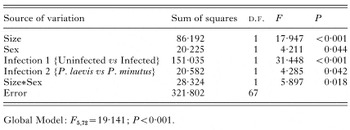
Table 1. Analysis of covariance following a stepwise regression (backward elimination procedure) for Gammarus pulex PO values (square-root transformed) as a function of infection by Pomphorhynchus laevis and P. minutus, host sex and host size (covariate)

Fig. 2. Values of PO activity (Vmax values in units per minute) corrected for size in Gammarus pulex and G. roeseli, according to sex and infection status by Pomphorhynchus laevis. Correction for size was made by using the residuals of the regression natural-log of size against PO activity. The numbers within the columns are sample size. Note that this representation using residuals is just for an easy reading, avoiding the confounding size data. For the statistical analysis (Table 2), size was used as covariate in an ANCOVA analysis.
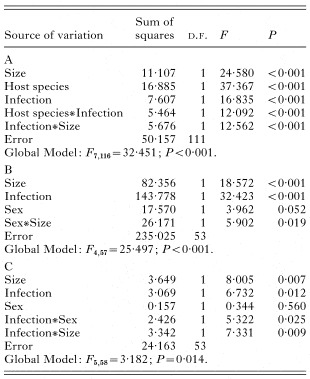
Table 2. Analysis of covariance following a stepwise regression (backward elimination procedure) for PO values as a function of infection by Pomphorhynchus laevis, host species, host sex and host size (covariate)
 You have
Access
- 63
- Cited by