Introduction
How do the Korean voters reach an electoral decision? In advanced democracies the economic voting model has been one of the most prominent models for voting behavior; however, for South Korea it was not until after the democratic opening in the 1990s (hereafter referred to only as Korea). Even then, the voting pattern in Korea was primarily captured by the regional cleavage in which the home province of a party's presidential or National Assembly candidate played a crucial role in elections.Footnote 1 But since the late-1990s, with the IMF crisis being a turning point, the economy has been one of the most, if not the most, important determinant in vote choice among Koreans.
The economic voting model, often called the rational economic model, has been especially useful in explaining variances in voting behavior ascribed to short-term effects vis-a-vis long-term factors such as social cleavage or partisanship. Basically, this model assumes that voters are self-interested agents and that their behaviors are rational in terms of politics (see, e.g., Downs, Reference Downs1957; Key, Reference Key1966). While the economic voting model has been extensively employed in the context of advanced democracies, fewer studies have been conducted in an East Asian context in general and in Korea in particular. Moreover, our knowledge of why such measures of economic assessments such as pocketbook versus socio-tropic or retrospective versus prospective help determine one's voting choice is still insufficient.
Empirical evidence on the effects of economy on vote choice in Korea is inconclusive, mixed, or limited in major points. On the one hand, Kim (Reference Kim1993) found no significant impact of economic issues among candidates in the 1992 presidential election, albeit regionalism being a dominant factor. Similarly, Pak's study (Reference Pak1993) of the 14th presidential election uncovered only limited/weak evidence of prospective economic considerations in voting decisions. Later studies (e.g., K.Y. Lee, Reference Lee1998; H.W. Lee, Reference Lee2000), on the other hand, concluded that the economy played a role, albeit minor, in voter decision-making in the 1997 presidential election, but only when the influence of regional cleavage was weak. What is noticeable from the literature is that the impact of economy on voter choice has not been systematically investigated. Thus, it is unclear if the impact of economy on electoral outcomes persists when using alternative measures of economic evaluations: prospective vs. retrospective, pocketbook vs. sociotropic. An additional test is warranted first to see whether there is a relationship between economic evaluations and vote choice; if a relationship exists, what dimension/scope of the economy remains significant as an important electoral determinant after possibly confounding factors are taken into account.
This study is aimed at explaining the determinants of electoral choice in the recent Korean election, the 16th presidential election held in 2002.Footnote 2 We can locate our work within the context of the renewed interest in the economic voting model: economic self-interest. The economic self-interest approach, usually labeled instrumental, favors economic needs and security to account for political behavior (Downs, Reference Downs1957; Fiorina, Reference Fiorina1981; Aldrich, Reference Aldrich1976; Feldman, Reference Feldman1982; Markus, Reference Markus1988).
Korea is an excellent case for testing those hypotheses. Korea had achieved a miracle in its economic development, altering its status from a less developed nation to a newly industrializing state within the past 40 years. Alongside of this rapid economic transformation was social mobilization. Several studies (Hibbs, Reference Hibbs1982; Lewis-Beck, Reference Lewis-Beck1980; Lewis-Beck and Bellucci, Reference Lewis-Beck and Bellucci1982; Powell and Bingham, Reference Powell and Bingham1982) report that successful economic performance leads to a stable government and political order. Some researchers even suggest that sustained economic performance can build trust in the political system. However, in Korea dramatic and sustained economic growth has not been translated into or accompanied by comparable growth in such political trust.
In this study, we take an empirically grounded first step toward tracing the impact of voters’ evaluations of the economy on vote choice. A particular emphasis of our research will be given to an investigation of the relative effects of different dimensions of the economy on voting behavior, namely whether one form of assessment (e.g., perceived personal financial situations vs. national-economic conditions) can have similar consequences for electoral participation as others.
The paper unfolds as follows. We begin with a brief review of the literature on the economics–vote model. Then we will introduce the 2003 Asian Barometer Survey study. First, we empirically investigate characteristics of voters’ perceptions of the economy, and then we evaluate the influence of the economy on vote choice. Our particular interest of investigation lies in addressing how well each dimension of economic evaluation is conducive to electoral participation: vote choice. Lastly, we will discuss the findings and implications of this study.
Previous research
The literature offers concrete evidence of the role of economic conditions in explaining voting behavior across and between the advanced and developing worlds; however, the consensus among researchers in this area is not unanimous (see, e.g., Lewis-Beck and Paldam, Reference Lewis-Beck and Paldam2000; Hellwig, Reference Hellwig, LeDuc, Niemi and Norris2010; Aguilar and Pacek, Reference Aguilar and Pacek2000; although Anderson, Reference Anderson2007 claims that we have reached the end of economic voting as a scholarly pursuit). Some initial studies undertaken mainly in the United States point to the impact of economic conditions on congressional and presidential voting (Monroe, Reference Monroe1979; Meltzer and Vellrath, Reference Meltzer and Vellrath1975; Tufte, Reference Tufte1978) and popularity ratings (Kernell, Reference Kernell1978). Other studies report that there is little evidence of economic well-being making an impact on political behavior (Fiorina, Reference Fiorina1978, Reference Fiorina1981; Feldman, Reference Feldman1982; Rosenstone, Reference Rosenstone1982). For instance, Fiorina (Reference Fiorina1978), employing national election surveys from 1956 to 1974, suggests that personal financial situation does not affect the decision to vote. In a later effort, Rosenstone (Reference Rosenstone1982: 33), in a detailed examination of the 1974 Current Population Survey, reports that individual economic adversity (as measured by unemployment) has a marginal statistical significant relationship with voter turnout.
Within the context of the economy–voting relationship, a factor involves the scope of economic evaluations: personal economic grievances or the broader national economy (collective economic conditions) in a voting model (e.g., Nadeau et al., Reference Nadeau, Niemi and Yoshinaka2002; Listhaug, Reference Listhaug and Thomassen2005; Kinder and Kieweit, Reference Kinder and Kieweit1979; Lewis-Beck, Reference Lewis-Beck1989; Lewis-Beck and Lockerbie, Reference Lewis-Beck and Lockerbie1989). The term for giving priority to evaluations of government's management of the national economy in a voting decision is sociotropic or macroeconomic, whereas pocketbook or egocentric voting concerns itself with personal economic experiences (Nannestad and Paldam, Reference Nannestad and Paldam1997). According to the so-called pocketbook hypothesis, the concept of self-interest, more specifically economic self-interest, has been the basis of much theorizing by political scientists (Downs, Reference Downs1957; Kramer, Reference Kramer1971; Markus, Reference Markus1988; Lewis-Beck, Reference Lewis-Beck1989). In line with rational choice models, the view that people are rational utility maximizers has been reinforced by the use of economic models in the study of political behavior (Tyler, Reference Tyler, Lau and Sears1986), thus making political action a consequence of personal costs and benefits of choices available to the actor.
Self-interest, more precisely selfishness, is a cornerstone of utility maximization in microeconomic theory. In accordance with the self-interest paradigm, when applied to the formation of political attitudes and behavior, any action undertaken or choice made by the individual is motivated in order to maximize his/her utility. Advocates of rational behavior thus argue that individuals evaluate their past, current, and future circumstances and calculate what serves their best interests (Page, Reference Page1978; Sears et al., Reference Sears, Lau, Tyler and Allen1980). Such calculations influence preferences (Kinder and Sears, Reference Kinder and Sears1981; Lau et al., Reference Lau, Brown and Sears1978; Sears et al., Reference Sears, Hensler and Speer1979). Individuals may prefer and support a certain type of government (i.e., democracy), candidate, or party because it satisfies their best interests.
In a sociotropic model, voters respond not so much to their own economic circumstances but rather to the state of the national economy and the incumbent party's performance in that area. Kinder and Kieweit's (Reference Kinder and Kieweit1979, Reference Kinder and Kieweit1981) analyses found strong support for the collective grievance explanation, when measures of people's perceptions of the economy and party competence in handling the economy influenced the vote choice over and above the effects of party identification. Moreover, not only do personal economic grievances fail to have any direct impact on the vote choice, but also there is little evidence that people related their perceptions of the national economy to their own economic well-being.
Micro-evidence of economic voting in cases of pocketbook vs. sociotropic voting is more complicated than a simple choice. According to Feldman's study (Reference Feldman1982), personal perception and political behavior depend upon how the individual interprets the nature of the problem and where he or she assigns responsibility. That is, voters in the US are likely to attribute their personal well-being to their own hard work, and they will, in turn, connect their personal financial situation to a political evaluation of government economic performance only when they believe the government is partially responsible for their financial well-being.
Theories of voting behavior also disagree on whether voters vote retrospectively or prospectively.Footnote 3 Under pure retrospective voting, elections are referenda on the governing party's performance in office. Voters reward good performance and punish bad performance. This is often referred to as the ‘reward–punishment’ hypothesis. A retrospective voter evaluates the candidates by looking at what they have done to improve economic conditions, national and personal. Thus, according to the retrospective voting model, voters evaluate an incumbent's past performance on economic issues, and vote against the incumbent if conditions worsened during his or her term in office (Key, Reference Key1996; Fiorina, Reference Fiorina1981).
By contrast, in the prospective view, the expected future relative performance of contestants for office is all that matters. A prospective voter, thus, evaluates the candidates by looking at what they will do. The prospective voting model then suggests that even if voters consider a candidate's past performance, they look primarily at his or her future promise for managing economic concerns. In this sense, a prospective voter is forward-looking.
In a comparative analysis, Lewis-Beck and Lockerbie (Reference Lewis-Beck and Lockerbie1989) using the 1983 Euro-Barometer Survey of Great Britain, France, West Germany, and Italy analyzed the relative impact of retrospective and prospective evaluations to turnout and protest. Their study found that neither personal situation nor retrospective collective evaluations (whether the overall economy had gotten better or worse in the past year) were related to turnout. However, prospective evaluations were related to turnout only when favorable; that is, individuals indicated a greater willingness to vote if the future looked bright. There was also no evidence found of either a pocketbook or retrospective behavior in terms of protests. More recent studies in new democracies, however, find some support for prospective voting. Hsieh et al. (Reference Hsieh, Lacy and Emerson1998) tested the retrospective and prospective voting in Taiwan using the first popular 1996 presidential election data. In their study, the authors discovered prospective voters overshadowing their retrospective counterparts. More precisely, Taiwanese voters evaluated candidates based on their prospects for handling the economy in the future.
As noted above, the empirical evidence weighing these models is mixed and controversial. In a macro-context, based on rational choice models, it is reasonable, for example, for people to believe that their economic well-being depends on the condition of the national economy and that it might be detrimental to their welfare in the short-run. Therefore, studies have found that national levels of support for the political system are higher when domestic economic conditions are favorable and that individuals who assess economic performance favorably are more inclined to be supportive of a political system. This paper thus re-examines the relationships between economic determinants and vote choice: how voters judge satisfactory performance, national economic considerations versus pocketbook evaluations.
Data and method
An empirical part of the study uses the first wave of the Asian Barometer Survey (ABS) conducted in 2003.Footnote 4 The ABS contains, among other topics, economic evaluations (collective, personal, retrospective, prospective), regime evaluations, democratic legitimacy, indicators of social trust, trust in government institutions, political involvement, and vote choice. If the economic voting hypothesis holds, we would expect to find that the impacts of the economy on vote choice are statistically significant, even after other factors are adjusted for. What is less clear though is which measure/scope of economic evaluations determines what type of party/candidate support in what way.
Dependent variable: The dependent variable is vote choice, which is relatively straightforward. The ABS asked a typical party/candidate choice, ‘Which party (or candidate for president if it was presidential race) did you vote for (in the most recent national election. . .)?’ For this study, we investigate the sources of partisan/candidate vote, which include only those parties that garnered the support of 10% or more of the survey respondents. The distribution of respondents in the survey is: Lee Hoi-Chang, the opposition party in GNP (33.7%); Roh Moon-Hyun, the incumbent party in MDP (44.2%); other parties (2.6%); and No Answer (19.6%).Footnote 5 As happens quite often in East Asia, we notice the significant number of respondents who did not choose a candidate (Lee, Reference Lee2007).
Independent variables: (economic evaluations): Collective economic evaluations and personal assessments of economic conditions appear to be important determinants of system support, support for the incumbent government, and vote choice in general (Kieweit, Reference Kieweit1983; Lewis-Beck, Reference Lewis-Beck1980, Reference Lewis-Beck1986, Reference Lewis-Beck1989; Lipset, Reference Lipset1960). When individuals experience adverse economic conditions, they seek redress from the government, and thus they vote. The ABS asked a typical sample about economic assessments in a list of six items, tapping collective, macro- or socio-tropic economic conditions that seek evaluations of national performance, and pocketbook or egocentric evaluations of economic performance that measure some aspect of individuals’ economic experiences. Also included in the survey were questions that tap voter's assessments of past performance on and future expectations about national economic conditions and individual economic status. The economic variables are coded so that the high ends on each item are more financially better off and economic conditions good.
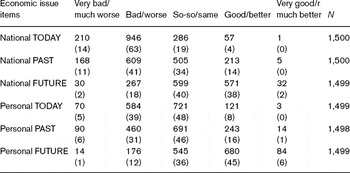
Table 1 shows how respondents in Korea perceived national and personal economic performance over the previous five years, at present, and anticipated economic performance over the next five years. Immediately noticed from the table is that retrospective perceptions of the national economy are quite negative. About half the respondents believed the national economy got worse, only slightly more than one-third believed it stayed the same, and 14% believed it got better. Retrospective evaluations of respondents’ own economic well-being are much more concentrated: 37% of respondents believed they were worse off, 46% believed they remained the same, and 17% believed they were better off.
Perceptions of the economy

Notes: Cell entries are number of respondents, with row percentages in parentheses. Row percentages may not sum to 100 due to rounding. Questions asked: ‘How would you rate the overall economic condition of our country today?’ (National TODAY); ‘How would you describe the change in the economic conditions of our country over the past five years?’(National PAST); ‘What do you think will be the state of our country's economic condition five years from now?’ (National FUTURE); ‘As for your own family, how do you rate your economic situation today?’ (Personal TODAY); ‘How would you compare the current economic condition of your family with what it was five years ago?’ (Personal PAST); ‘What do you think the economic situation of your family will be five years from now?’ (Personal FUTURE).
Source: Asian Barometer Survey.
Prospective evaluations reveal quite different patterns. The respondents are very optimistic. On the national economy, only 20% of respondents believed the economy will get worse five years from now, 40% believed the economy will stay the same, and 40% of respondents believed the economy will get better. On the pocketbook evaluations, 13% of respondents believed their own financial situations will get worse, while 36% believed they will stay the same, and slightly more than half of respondents believed they will be better off. Present evaluations of both national and personal economic situations are the worst: 77% and 44% of respondents rated the national and their own economy bad respectively; 19% and 48% of respondents, the same; and 4% and 8% of respondents believed the economy is good.
As Table 1 illustrates, there are obvious discrepancies among various types/dimensions of economic evaluations: Koreans are more optimistic about the future and display hope for improvement in the future compared to the past. Moreover, their assessments of personal well-being are more concentrated than their evaluations of the national economy. Furthermore, the table reveals that the number of people negatively responding to questions regarding TODAY's evaluations is much larger than the number offering either ‘positive’ retrospective or ‘optimistic’ prospective evaluations. Such discrepancies are interesting and suggest a line of research into how people form expectations of the economy. We further pursue that here.
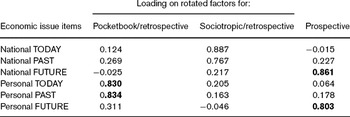
Based on exploratory factor analysis used to test a priori specified hypotheses about the underlying structure of items, Koreans seem to divide their perceptions of the economy into three areas/dimensions that may be theoretically related, as shown in Table 2. Two items – one's economic condition TODAY and PAST – display the primary loading on the first factor; another two items – national economic condition TODAY and PAST – display the primary loading on the second factor; and the remaining two items measure the extent to which the respondents felt about future (prospective) economic conditions of the country or self.
Factor loadings of six economic issue items

Note: The loadings are a factor pattern matrix from a varimax rotation. The factors have Eigenvalues of 1.0 or greater.
This pattern of factor loadings seems to suggest that the first factor reflects the pocketbook/retrospective dimension; the second factor, the socio-tropic/retrospective dimension; and the third factor, the prospective dimension of economic conditions in Korea. Each dimension runs on a five-point scale from bad/worse to good/better and was constructed by standardizing, equally weighing, and combining respective two items. The correlations among these three scales are modest. The correlation between pocketbook and sociotropic is 0.42; between sociotropic and prospective, 0.26; between pocketbook and prospective, 0.32. These summative indices will be used to measure each dimension in the subsequent analysis.
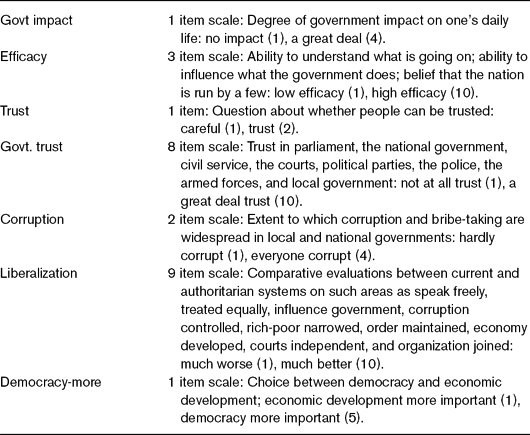
Control variables: Several control variables were created on the basis of survey questions described in the appendix. Note that we do not formulate an extensive theory or estimate additional causal models for the relationship between economic voting and these control factors, because we are interested in them only to eliminate spurious effects. Included in this analysis are trust (government institutions and general), regime evaluations (corruption and liberalization), psychological involvement (efficacy, perceived government impact), democratic legitimacy (economy vs. democracy),Footnote 6 and two demographic characteristics (age and education).
Findings
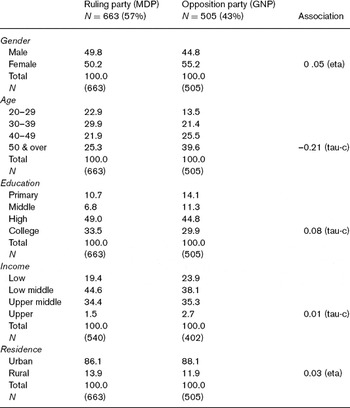
Are candidate/party supporters distinct in social backgrounds? Descriptive analysis gives mixed results. As shown in Table 3, the sizes of the etas and taus indicate that there are few significant differences in candidate identifiers between selected groups. In general, women, respondents with some high school education, respondents in the middle class, and respondents who reside in urban areas were incumbent as well as opposition supporters, although the difference is not as great. The only exception in vote choice came from the age variable. While there was no clear winner for incumbent supporters from each age category, the age–vote linkage for the opposition party displayed in a linear fashion, namely the older voters were more likely to vote for the opposition candidate, Lee.Footnote 7
Demographic attributes of vote choice (%)

Note: MDP stands for Millennium Democratic Party; GNP Grand National Party.
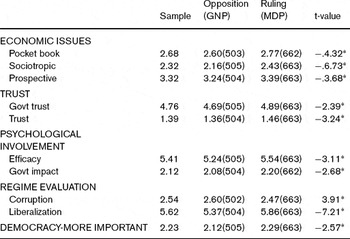
The question, ‘If opinions of the incumbent supporters differ substantially from those of the opposition supporters, and how?’ was tested by computing the average scores for the two groups separately for each issue/orientation category. Table 4 presents the mean scores for ten opinion scales for the total sample, MDP supporters and GNP supporters. Reported also are the significance levels as established by a two-tailed difference-of-means tests between MDP and GNP.
Orientational differences between candidate/party supporters on selected issues (mean scale scores)

Notes: ECONOMIC ISSUES = 1, bad/worse,5, good/better; Efficacy = 1, low, 10, high; Liberalization = 1, less liberal, 10, more liberal; Corruption = 1, less corrupted, 4, a great deal corrupted; Govt trust = 1, not at all trust, 10, a great deal trust; Govt impact t = 1, not at all, 4, a great deal impact; DEMOCRACY = 1, economy more important, 5, democracy more important; Trust = 1,careful, 2, trust.
On the ten orientation scales, as shown in the table, supporters of the incumbent party score above the total sample mean in nine of them. We also notice MDP supporters and GNP supporters exhibited significant differences at the 0.05 level in their opinions on all ten items: the supporters of the incumbent party, MDP, compared to their opposition counterparts, were more likely: (a) to rate the economic conditions (both national and personal) have been better and will be good; (b) to show a relatively high degree of trust in government institutions and to consider most people can be trusted; (c) to believe they are capable of understanding politics and competent enough to participate in a political act; (d) to feel a greater impact of government policies on their daily lives; (e) to consider democracy as more important than economic development; (f) to believe that levels of corruption in governments, national and local, are relatively low; (g) to be confident about the country having been more liberalized than during the authoritarian government.
For our purposes, the most important empirical test is to explore the connections, if any, between economic issues and vote choice. Specifically, we are testing to see which dimension of economic assessment is more likely to lead to support for an incumbent or opposition candidate. To some extent, orientation differences between MDP and GNP supporters might be spurious, that is the consequences of underlying factors such as voters’ perceptions of corruption. Voters may be concerned about issues other than the economy as they go to the polls, and thus no direct causal relation exists between economic evaluations and voting.
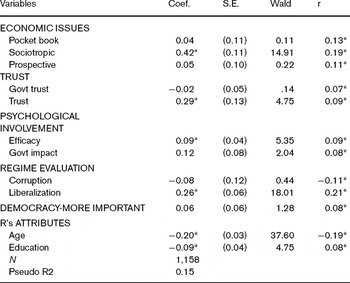
Table 5 reports the results of a multivariate analysis that examines how citizens make their vote choice. Since the dependent variable is dichotomous, logistic regression is used to estimate the model. Reported are unstandardized coefficients (b) for all variables as well as standard errors for the variables with p<0.05. Also reported in the table are Wald values and bivariate correlation coefficients. Multivariate analysis is used to verify the patterns that emerged in the bivariate analysis. In the model, the coefficients of all the control variables except education are in the expected direction.
Logistic regression on vote choice

Notes: * Significant at <0.05.
Several conclusions can be drawn from the results in Table 5. First, it is rather surprising and clear that only sociotropic evaluations are statistically significant as an explanation of voter choice; that is, people who believe the national economy has improved during the past five years are more likely to vote for the incumbent party candidate, Roh Moo-Hyun.Footnote 8 By contrast, pocketbook and prospective evaluations of the economy, both national and personal, are not statistically significant when one takes other factors into account. One explanation of this result may be that voters who believe the economy has improved during the past five years are more willing to risk a vote for Roh. Given the fact that a Korean president is directly elected to a five-year term with no possibility of re-election, voters who voted for Roh may have rationalized doing so by responding that he is best suited to handle the economy because the economy has not worsened over the past five years.Footnote 9 Put it differently, it appears that retrospective voting took place in the belief that the then ruling party, New Korea Party (changed name to GNP in 1997) had been responsible for an unprecedented economic crisis (IMF), albeit voters were not sure if either party candidate could handle the future economy. After all, the opposition candidate, Lee Hoi-Chang, was the NKP candidate of the 1997 presidential election in the midst of Asian economic crisis.Footnote 10
Second, although prospective evaluations of the economy are proposed to have an effect on one's choice of voting, it is not of statistical significance. Evidence suggests that to the extent that voters vote economically, they rely more on retrospective/sociotropic evaluations than pocketbook or prospective assessments. Prospective evaluations are likely a function of retrospective evaluations, but results in this study suggest that beliefs about a candidate's (party's in this case) past performance are more closely related to vote choice than uncertainty about his future performance in the economy.
Third, in the case of other determinants, the coefficients clearly show that evaluations of government institutions, perceived impacts of government policies, subjective beliefs about corruption, democracy vs. economy are not statistically significant as explanations of the vote, everything else being equal. By contrast, the coefficients for trust in others, efficacy, and perceived liberalization appear statistically significant as predictors of voter choice, even after taking into consideration voters’ evaluations of the economy: voters who believe that people can be trusted feel more efficacious, believe the nation is more liberalized are more likely to choose Roh over Lee.
It is also proposed that the effects of economic conditions on vote choice would be mediated by demographic factors, most notably by age and education. In fact, age is the most robust and statistically significant predictor of voting behavior. It does, however, surprise us to see education has an inverse effect on vote choice: the more educated were likely to vote against the incumbent party (Roh in MDP). This seems counter-intuitive at first glance. The original assumption was that highly educated voters would give more weight to the ‘progressive’ end of government policies, which would result in voting for the incumbent party, being more progressive. The findings attest, however, that the more educated are inclined to choose the opposition party (more conservative) candidate, regardless of partisan ideology, as a political protest.
On balance, sociotropic evaluations of the candidates’ abilities to solve economic problems appear to better explain patterns of economic voting than pocketbook or prospective evaluations among Korean voters. It is noteworthy that pocketbook evaluations of the economy carry little weight as a predictor of voter choice. This seems unlikely, however, since Table 1 shows that a significant number of voters believe their own personal financial well-being worsened over the past five years, yet more voters voted for the incumbent party candidate, Roh.
The results reported in Table 5 support Kiewiet's (Reference Kieweit1983) contention that rational voters vote for the conditions of the national situation rather than for their own well-being. At least in Korea's 16th presidential election, voters appear to care more about national conditions than their personal well-being. For elections in other countries, the findings presented here suggest that economic conditions matter even in such a country as Korea where economic performance has been generally good by international standards. Korea is not the first place one would expect to find widespread economic voting. Yet the economy did and still does matter. The results here also confirm the wave of work demonstrating that sociotropic evaluations mean at least as much to voters as pocketbook evaluations of the economy. Voters form evaluations on how political candidates/parties shaped the overall economy of the nation.
Conclusion
This study began with the following questions: Does the economics-vote choice hypothesis hold in Korea?; If so, which one is more important, pocketbook evaluations or sociotropic evaluations, for the Korean public to show their choice of a candidate in the 2002 presidential election? We found that the overall economy is salient for Koreans to shape their political choices. In other words, voting behavior in Korea depends on how she or he thinks the national economy has been for the past five years. Apparently, in the Korean presidential election, voters’ evaluations of the incumbent party's performance in the overall economy may have proven significant as a predictor of voter choice. If Koreans perceived the national economy had been better since perhaps the last presidential election, they were likely to form positive attitudes toward the incumbent party candidate.
Interestingly though, voters’ perceptions of their own personal financial situations did not matter much. Throughout the study, we learned that Koreans who enjoy better personal financial well-being do not necessarily show their choice for the incumbent party candidate. This implies that even if Koreans have been economically much better off since the Asian financial crisis in the late 1990s, they still feel insecure about their economic situations, the overall economy, which might have capitalized on their voting behavior. In short, a Korean voter can best be described as a retrospective sociotropic voter who evaluates the candidates by looking at what they have done rather than what they will do. But unlike retrospective pocketbook voters, they care about national economic conditions.
Data analysis suggests that a multidimensional model of the economic voting model is more applicable to capture the underlying pattern of the economy–vote choice linkage. We believe that a multidimensional model of economic voting is even more important in dealing with sudden shifts in the economy that are taking place in newly industrializing and democratizing societies, such as Korea. It could thus be argued that future efforts to model individual voting behavior in rapidly industrializing countries must take into account economic evaluations (macro-micro, national-personal or sociotropic-egocentric) to avoid a serious specification error.
About the authors
Aie-Rie Lee is Professor of Political Science at Texas Tech University. Her areas of specialization include comparative political behavior with an emphasis on East Asia, political development, democratization, political economy, and gender politics. Her work has appeared in such journals as Comparative Political Studies, Social Science Quarterly, International Journal of Public Opinion Research, Asian Survey, Studies in Comparative International Development, Asian Affairs, Policy Studies Journal, Journal of East Asian Studies, Journal of Northeast Asian Studies, Energy Sources, and Women and Politics.
Yong U. Glasure is currently a Professor of Economics at the University of Houston-Victoria. Dr Glasure has published more than 30 articles in various refereed journals, such as Resource and Energy Economics, Energy Economics, Journal of Energy and Development, Energy Sources, Atlantic Economics Journal, Asian Survey, Journal of Northeast Asian Studies, and Asian Affairs. His research interests include the distribution of stock returns, fiscal policies and behavior of economic agents, and East Asian political economy in such areas as public opinion, environmental policy, trade relations, energy policy, economic and political participation issues, economic reform, and the process of economic and political democratization.
Appendix: Measurements and survey questions of control variables