East German industry faced profound challenges after German reunification in 1990. Practically overnight, about twelve thousand companies were thrown into the deep end of capitalist competition after forty years of socialist centralized economy, often with outdated machinery and production techniques. This led to a scenario in which either the Treuhand—an institution charged with administering the nationalized industry and agriculture after the collapse of the German Democratic Republic (GDR)—or private investors broke up industrial trusts into smaller companies or sold them for parts. The restructuring cost millions of East Germans their jobs, and 3,718 companies were liquidated. If a company survived, it was often due to the heavy involvement of the national or regional government. Only 6 percent of the production capital remained in Eastern German ownership.Footnote 1
Political change is a particular problem for small and medium-sized enterprises (SMEs), which may lack the financial resources and political clout to survive tectonic shifts in the political economy. In the 1,588 cases where it was possible, the Treuhand returned SMEs to previous ownership. A number of founder families had left the GDR for the West following socioeconomic persecution during Soviet reparation or industrial nationalization campaigns in the 1940s, 1950s, and 1970s. Some of these companies—for instance, Zeiss-Opton Optics and the hair-product company Wella—had set up new businesses upon arrival in West Germany. After reunification, they reclaimed their property and incorporated the reprivatized East German companies into their western businesses.Footnote 2 Others, among them the furniture and interior manufacture specialist Deutsche Werkstätten Hellerau (DWH), survived without such personal connections. This survival, as the article will show, is largely due to the capacity to preserve a unique identity despite heavy institutional pressures to conform in a distinct economic sphere shaped by both commercial and political forces: state socialism.
In the GDR, DWH, like many of its contemporaries, faced a conflict between the need for sociopolitical legitimacy and the search for distinction.Footnote 3 In a market economy, the search for distinction is essential for building a profitable position and does not necessarily conflict with sociopolitical legitimacy. In a planned economy, by contrast, the survival of a firm depends less on its capacity to meet the preferences of a particular segment of the market than on its conformity with centralized directives. Planned economies are highly constrained environments that set clear rules and regulations for firms, even planning innovation.Footnote 4 They are also marked by a high degree of centralized organization, taking business decisions away from the firm and placing them into the hands of partisan managers, regional administration, and national government. Political principles overrule savvy economics, and the regimes reward adherence to the ruling party line with access to resources. In these circumstances, as the case of DWH indicates, distinction may be maintained only at the expense of endangering political support.
Twentieth-century Germany offers a unique laboratory for studying the impact of political change on firms. Within the span of one hundred years, German companies found themselves subjected to radical institutional change, moving from the quickly industrializing Second Empire to Weimar's economically unstable democracy, on to the racialized war economy of the Nazi dictatorship, and the postwar split into ordoliberalism in the Federal Republic of Germany (FRG) and centralized socialist economy in the GDR. Historians of German big industry, such as Siemens, IG Farben, and Thyssen-Krupp, have followed business adaptation processes to varying state and economic systems on the level of organizational behavior.Footnote 5 In comparison, the historical SME literature is in its infancy.Footnote 6 Prominent German business historian Hartmut Berghoff has aptly pointed to the merits of including SMEs and family businesses, the so-called Mittelstand, in mainstream German economic history.Footnote 7 Not only do SMEs constitute the vast majority of German businesses (depending on the applied definition, 90 percent or more of all German companies), but the Mittelstand also embodies the core economic and sociocultural values that the German Model is known for: focused long-term business strategies, a high level of specialization, concentration on core competences, leadership continuity, highly skilled labor through the system of vocational training, and a high degree of mutual trust and loyalty between management and staff.
The Mittelstand business DWH, founded by Karl Schmidt in 1898, remained under his leadership until 1946, when the Soviet occupation authorities expropriated him and replaced him with managing directors, and the company successively integrated into the nationalized planned economy.Footnote 8 Like SMEs in West Germany, DWH had at that point survived three major economic crises (hyperinflation, the Great Depression, and the postwar collapse), yet now faced a period of dismantlement and reparations unique in scale and duration to the eastern zone of occupation. In the following decades, its obstinate refusal to yield to political pressures that, in the eyes of its members, threatened the very identity of the organization had helped the firm preserve technical competences and a distinctive brand that eventually enabled a successful transition to a market economy. When reunification came about in 1990, DWH successfully emerged from the rubble of the bankrupt GDR economy as one of the global market leaders in customized interiors.
After a brief overview of the foundation and expansion of DWH between 1898 and 1945, the article looks at three important phases in the company's history under East German economic development to examine how DWH struggled to maintain its identity while navigating these environmental shifts. The phases develop as follows: introduction of socialism, expropriation, centralization, and relative isolation from capitalism (restrictive socialism, 1945–1961); increasing importance of export trade (opening socialism, 1962–1989); and sudden reintroduction of market principles, albeit with state subsidies (managed capitalism, 1990–1996).
This study, then, places identity processes squarely into their historical context, with special attention to the structural particularities of the East German planned economy, and contrasts organizational identity with the regime's guidelines and expectations. It uses historical methods to analyze organizational reactions and evaluate results, with an eye not only to managerial decision-making, but also to the firm's relations with the government and political stakeholders in the GDR economy. The source base consists of published firm histories and archival evidence collected at the Saxony State Archive in Dresden, and the Bundesarchiv and the Werkbund Archiv der Dinge in Berlin. It includes correspondence, economic directives, furniture designs, and internal company communication. Interviews with former and current company management have provided additional insights into the strategic decision-making under political pressures and management-employee relationships.
Our analysis explains how, over the years, DWH managed to cling to its identity—manifested in a modern product aesthetic, superior craftsmanship and technical skills, and a relentless drive to innovate—even when doing so openly challenged governments’ institutional pressures, by adopting what we refer to as a “mixed-conformity” strategy. This strategy was based on an ongoing negotiation with political authorities to fend off requests (about, for instance, product aesthetics) that—in the eyes of its members—would have threatened the very identity of the organization, while highlighting the benefits of its pursued identity for other areas of political concern (for example, efficient production, a steady source of foreign currency).
This observation is interesting because it is counterintuitive to long-standing tenets of neo-institutional theory that traditionally suggest that alignment to institutional pressures favors firms in accessing valuable resources, thus achieving sustainability and long-term performance.Footnote 9 In the case of DWH, instead, mixed-conformity strategy enabled the firm to preserve the integrity of the distinctive competences and reputation—rooted in its historical identity and heritage—that ultimately enabled it to overcome multiple economic and political shocks.
Organizational Identity
Organizational identity has become one of the central concepts in the study of how organizations evolve and interact with their environment. Stuart Albert and David Whetten first defined the concept in 1985 as those features of an organization—goals, values, competences, and/or symbols—that its members claim and believe to be central, distinctive, and enduring about it.Footnote 10 Scholars distinguish between organizational identity—as a self-reflective and inherently comparative answer to the fundamental question, Who are we as an organization?—and organizational culture, as a more general set of norms, beliefs, and values that shape how members act and interact within the organization.Footnote 11 While members’ understanding of the organizational identity often reflects some cultural elements—typically a set of values that members perceive as core and distinctive—not all cultural norms and beliefs contribute to shape their collective sense of self.Footnote 12 At the same time, this collective sense of self may include referents that are not part of the organizational culture, such as organizational images, status, social categories, or material features.Footnote 13
Organizational identity research explores how firms balance conflicting tensions between conformity and differentiation in the market, as well as broader questions pertaining to the relationship between an organization's identity and its institutional environment.Footnote 14 This research has shown how understandings of identity induce members to invest in resources and technologies that they see as essential to what the organization is and stands for, and to select strategies that are consistent with these understandings.Footnote 15 A stream of consistent choices will eventually be reflected in external views held by competitors and customers in the form of a corporate brand or reputation. In this respect, organizational identity offers a concept that bridges different levels of analysis (individual, organization, market) while accounting for both internal beliefs (organization members’ shared values and principles) and external associations.Footnote 16
Management scholars have long discussed how identity “is a useful concept for addressing managerial choices and dilemmas that may otherwise paralyze the organization.”Footnote 17 Past studies have widely investigated how consensual claims and beliefs about the identity of the organization may either promote or delay strategic change, yet research on organizational identity has been conducted under the assumption that the institutional, legal, and political environment in which the organization operates is relatively stable.Footnote 18 A question that has so far received only cursory attention, however, is how organizational identity interacts with changing political environments. In the case of DWH, this question addresses directly what behavior was necessary to strike a balance between the need to maintain a sense of continuity and integrity in “who we are” as an organization and how DWH organization was perceived externally, while maintaining control over the managerial decision-making and ensuring firm survival. From a historical perspective this raises an additional question: What were the payoffs of adaptation, and what were the costs of differentiation in the socialist economy? We argue that, although it rejected complete assimilation in socialism, DWH eventually avoided marginalization through an integrative strategy of mixed conformity, mobilizing its organizational identity as a resource to navigate the economic directives of the centralized planning process, while at the same time striving to preserve its integrity.
Deutsche Werkstätten Hellerau: Historical Overview
Deutsche Werkstätten emerged in the midst of the workshop movement at the turn of the nineteenth century, a larger cooperative movement in furniture making. Dedicated to eliminating the artificial distinction between fine and applied arts, the first Vereinigte Werkstätten für Kunst im Handwerk GmbH opened in 1898 in Munich. It attracted leading artists of the Munich Jugendstil, who, as Owen Harrod aptly observes, “working in collaboration and often, effectively, in friendly rivalry, would reinvent the German interior.”Footnote 19 That same year, cabinetmaker Karl Schmidt (1873–1948) founded the Dresdner Werkstätten in Hellerau near Dresden, Saxony, on a much smaller scale with a loan of three thousand marks. The company grew quickly by incorporating similar businesses in the vicinity, eventually joining forces with the Werkstätten company in Munich under the new name of Deutsche Werkstätten für Handwerkskunst GmbH, Dresden und München in 1907. At that time the company counted 250 employees. It eventually incorporated in 1913. A network of company-owned retail stores in Dresden, Munich, Hamburg, Berlin, Cologne, Frankfurt, and Vienna as well as connections to global distributors allowed Deutsche Werkstätten to spread its interpretation of modernity around the globe.
Schmidt successfully developed a cohesive organizational identity around his own core principles: quality materials, honest construction, progressive traditionalism, craftsmanship, and education of specialized workers. Respect for materials became a key part of his entrepreneurial vision. By developing innovative and resourceful ways of using materials, DWH came to represent ideas about conservation and environmental responsibility inherent in modernism.Footnote 20 Schmidt described the company's social purpose in 1899: “On the one hand we want to create rich and refined room interiors in a modern style only, on the other also room furnishings, furniture, and ornament for the middle class, which are not dependent on empty appearances and do not imitate the rich and splendid with inappropriate means in an unreliable way.”Footnote 21 DWH's vision integrated neatly with the turn-of-the-century applied arts movements, which challenged a quickly industrializing production culture that brought forward shoddy or kitschy products. DWH based its organizational identity on truthful aesthetic style and honest production values.Footnote 22 To integrate social responsibility and modern vision, the company collaborated with some of the most gifted visionary architects and designers of the time: Richard Riemerschmid, Bruno Paul, Heinrich Tessenow, and many more who followed.
In its first decade, the company's name became increasingly associated with Maschinenmöbel, a label that indicated the mechanized mode of production and typification—a term that is often falsely rendered into English as “standardization.”Footnote 23 Aesthetically, Riemerschmid's furniture design invoked arts and crafts principles, such as honesty in construction and truth to materials. Decorative elements connecting the components reminded the observer of the modern construction of such machines as locomotives or steamships. This connection came quite naturally for the company; from 1902 onward, it procured contracts not only for naval interiors for the expanding German navy, but also for passenger ships.Footnote 24
Between 1911 and 1913, Bruno Paul's famous Typenmöbel, designed for the Vereinigte Werkstätten in 1908, inspired Das deutsche Hausgerät series which included pieces from some twenty different artists.Footnote 25 Distilled and idealized references to Biedermeier neoclassicism joined with sober, typified furniture elements on an evolutionary path to modernist timelessness. In its second decade, the company developed furniture programs that, in scale and popularity, rivaled those of market leaders and won the company prestigious prizes at international crafts fairs and world expositions.Footnote 26 The middle class quickly bought into the vision of efficient modernity that this serially produced, yet hand-finished, furniture promised. Items were suited for mass production while a vast range of pieces and finishes allowed for individualization, maintaining the level of culture that contemporary applied arts discourse expected, and typification became DWH's golden ticket to industrial modernity.
After World War I, the company developed its aesthetics alongside interwar modernist movements that introduced New Objectivity (Neue Sachlichkeit) and continued the increasingly abstract references to the Biedermeier era. Ornamental elements faded into the background, and practical simplicity came to dominate. In 1925, the company developed its first prefabricated house for a middle-class clientele, preceding by two years the famed Weißenhofsiedlung exhibition, where renowned architects such as Le Corbusier tackled modern housing challenges in similar ways. At the dawn of World War II, then, the visionary founder and the designers, architects, and craftsmen with whom Schmidt surrounded himself had propelled DWH to the forefront of the modernist movement. The fact that few companies outside the Werkstätten movement were able to provide quality modern furniture for house and garden, let alone the house itself, at middle-class prices, Harrod argues, shows that DWH was more influential than the Bauhaus avant-garde in modernizing mainstream domestic culture in Germany and beyond.Footnote 27
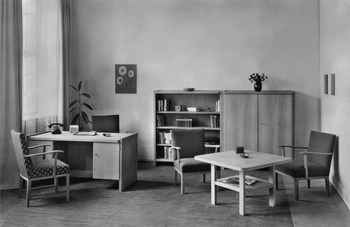
The next evolutionary step in DWH's production culture came with Adolf Schneck's furniture program Die billige Wohnung in 1927. The pieces in this series were void of ornamentation and simply finished; customized production lines reduced handwork to a minimum. The assembly-line type mechanization offered the opportunity to produce efficiently in bulk, rendering the furniture affordable to the middle class. While craftsmanship took a back seat to technological innovation with Die billige Wohnung, the company's commitment to quality materials remained intact; for instance, the chairs were made of solid oak. Using the same principles of mass production, yet less austere in its aesthetic, the 1935 Die wachsende Wohnung line continued the concepts of both Paul's typification and Schneck's mass-production designs (Figure 1). The modularity of add-on furniture allowed customers to start with a small investment and add pieces as their incomes increased, which kept them loyal to the company over a longer period. With simple aesthetics, restrained usage of raw materials, and affordable furniture for the middle class, DWH production culture fit in with Third Reich social and economic policy.
Bruno Paul's Wachsende Wohnung, 1935. (Source: Reproduced by permission © PR Deutsche Werkstätten)

Marginalization under Restrictive Socialism, 1945–1961
At the end of the war, Dresden came under Soviet occupation and, as a wartime producer of military equipment—including airplane parts and parts of the infamous V-2 weapon—DWH fell under the Allied demilitarization policy. Between July and November 1945, Germany's most modern furniture production facilities and machines were completely dismantled; even lamps and lightbulbs were shipped to the Soviet Union.Footnote 28 Afterward, the remaining staff started rebuilding business with repair services and the production of small-use items, such as chairs and wooden boxes, slowly equipping the stripped company with machinery and tools. Amid a changing political climate, Walter Heyn, who had joined DWH in 1924 and been member of its board of directors since the mid-1930s, fled to the West, where he founded the Deutsche Werkstätten Fertigungsgesellschaft in Hamburg (later relocated to Munich).Footnote 29 Soon thereafter, the Soviet Military Administration in Germany (SMAD) dissolved the Deutsche Werkstätten Hellerau GmbH and expropriated the assets of Schmidt and his partners in 1946. In 1951, GDR economic policy converted DWH into a nationalized business (Volkseigener Betrieb [VEB]), which de facto established full state control over the company.Footnote 30 Like the majority of East German companies, DWH delivered part of their production as war reparations to the Soviet Union until 1953.
A source that allows insight into the company's struggle to stay true to its founder's vision after nationalization is an unpublished booklet from 1953, Möbel und Innenräume (Furniture and Interiors). The booklet pictures a number of DWH designs as solutions to the problem of furnishing public buildings during GDR reconstruction.Footnote 31 The first secretary of the Socialist Unity Party (Sozialistische Einheitspartei Deutschlands [SED]) Central Committee, Walter Ulbricht, stopped the booklet's publication on grounds that the depicted DWH furniture contradicted the new cultural guidelines issued by the Bauakademie, the central agency responsible for construction in the GDR.Footnote 32 Ulbricht's criticisms were in keeping with the dominant cultural discourse of the time. In July 1950 at the Third Party Congress, the SED announced a cultural reorientation to align with the Soviet Union. A German interpretation of cultural Stalinism, a mixture of realist and folkloric elements, was to find application in all artistic areas including literature, film, architecture, and the applied arts.Footnote 33 Following this announcement, politicians and practitioners engaged in a dispute, the Formalism Debate (ca. 1950–1953), over the aesthetics of German socialism. Eventually, the political leadership silenced former Bauhaus members and other disciples of German interwar modernism who had pleaded for functional aesthetics—one of the pillars of DWH's approach to furniture design. Henceforth, companies whose production range was based on the applied arts, such as DWH, were put under pressure to produce in the historicist, heavily ornamented style to represent German cultural heritage and to turn to mass production to support the reconstruction effort.
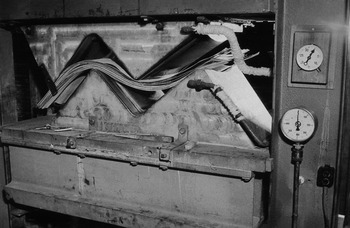
The DWH company board—composed of long-term employees, including the technical director Erich Menzel and director Friedrich Wurzler—had decided as early as 1946 to reject the “suggestions” of political authorities.Footnote 34 They elected instead to pursue a strategy that would allow DWH's expert knowledge of materials and processing technologies, gained over multiple decades of vocational training and innovation, to find application in special designs for public buildings and to continue small serial production of exemplar modern furniture.Footnote 35 Menzel, for instance, helped to develop an innovative technology for a veneer wood press, which pressed layers of veneer into solid shapes, and applied it to a newly designed steam-shaped wood seminar chair (see Figure 2). The design for the chair was inspired by the metal industry, where shaping had minimized wastage and production time. Applied to the wood industries, where cutting, planing, and milling usually produced waste, this cutting-edge technology, when applied to wood materials with the required elasticity, resulted in more than double the number of chairs per cubic meter of material (130 chairs versus only 56 chairs when using carpentry techniques).Footnote 36 The seminar chairs eventually were mass-produced by another company to satisfy the large demand.Footnote 37
Steam veneer wood press, 1951. (Source: Reproduced by permission © PR Deutsche Werkstätten)

The achieved conservation of raw materials and labor met the requirements of the socialist centralized economy in an exemplary fashion, yet the modern style of the simple three-joined shaped-piece chair did not follow the new official ornamented style. Notwithstanding the aesthetic discrepancies, DWH's in-house architect Selman Selmanagić pointed out that the division of labor—that is, the development of exemplary furniture pieces by a market leader, such as DWH, outsourced for mass production to specialized facilities—achieved a synergy between socialist economics and quality design. In line with the founder's original vision of honest production and responsible modern living, Selmanagić argued in 1953 that this strategy would be “the best way to provide workers with comfortable, functional, beautiful, and, most importantly, affordable furniture.”Footnote 38 Selmanagić was a Bauhaus-educated architect and member of the KPD (Communist Party of Germany) underground during the Third Reich who, since the end of World War II, also collaborated with DWH on projects he oversaw as the newly appointed director for cultural and recreational buildings in the Office for Urban Planning of Greater Berlin. He had the political credentials to be critical, at least between the lines, of the regime's economic and cultural policies without having to fear personal persecution.Footnote 39 His compromise explored an alternative way to combine the company strength with the political vision for the new East German state.
This attempt to mobilize DWH's identity and reputation for socially conscious production ethics in response to political pressures was the company's first documented attempt at “mixed conformity.” By this term, we refer to a strategy for sociopolitical legitimation that addresses some concerns of political actors—such as, in this case, affordable furniture for workers—in exchange for the allowance to transgress other requirements—in this case, product aesthetics—that may threaten the organization's sense of distinctiveness and continuity.
The initiative backfired, however, and DWH became the target of criticism in the government-censored media.Footnote 40 Retail stores, either in response to the negative press coverage or in following political directives, boycotted DWH furniture.Footnote 41 The national retail business (Handelsorganisation [HO]) now refrained from selling DWH products—not for technical or economic reasons, but because of their aesthetic divergence from governmental policies. In fact, the Council of Ministers—that is, the GDR government—codified the new socialist aesthetic in a resolution about “the new tasks in interior design and furniture industry” on January 21, 1954, intertwining cultural and economic policy. On the heels of the January 1954 resolution came the introduction of E-Stellen, short for Entwicklungsstellen, centralized product development departments manned by state-approved architects and designers. DWH's production manager Kant led the local E-Stellen, where he was required to implement central orders from the Bauakademie.Footnote 42 Nevertheless, in a stern refusal to abandon its traditional ways, DWH continued the practice of working with renowned modern architects and designers, such as Selmanagić and Franz Ehrlich. Moreover, the company unofficially resumed collaborative relations with architects residing in the Federal Republic.Footnote 43 Product aesthetics, then, had become the site of a much broader identity struggle, as DWH's attempts to preserve its organizational identity clashed with the new government's efforts to reshape the national one. DWH's recalcitrant attitude toward the centralized organization of the design process eventually resulted in a lack of sociopolitical legitimacy, which endangered the company's survival.
Eventually, and reluctantly, the company began to manufacture according to the new stylistic requirements implemented by the Bauakademie.Footnote 44 Yet, among employees, identification with and loyalty to the firm and its modern aesthetic was deep-seated. After new designs conforming to policy had been put on display for the company's workers to critique in April 1954, an internal report noted that, generally speaking, staff still preferred modern furniture and rejected the state-prescribed trims and ornamentations on backrests, legs, and plinths.Footnote 45 It is thus clear that the fulfillment of cultural norms in the GDR was highly problematic for DWH leadership and workers, who still identified with the modern product range that the company was known for. Pride stood in the way of fully submitting to the official cultural diktat. By the end of the year, Kant summed up the sentiment, “Our artistic collaborators and the product development department are trying to develop furniture in reference to the cultural heritage, yet only under the foundational consideration of modern living. The aim of this development has to be maintaining, or rather regaining, the good domestic culture of Deutsche Werkstätten.”Footnote 46
Walking this fine line between assimilation and rejection became increasingly problematic in DWH's relationship with the Bauakademie and its director, Jacob Jordan. As the chairman for furniture on the GDR Artistic Advisory Board, Jordan had veto power over all designs in the national furniture industry. In an Aussprache, a meeting to “talk things out,” Jordan met with DWH's management and its freelance designers in December 1954. The minutes of the conversation show that he criticized each DWH piece in regard to its functional, material, and aesthetic value under the new cultural policy maxim. He likened some of the sample furniture to “bourgeois” Third Reich designs produced by an alleged Nazi supporter in Berlin, “the elegant furniture store Reiner on Kurfürstendamm”; thus ideologically questioning and stigmatizing DWH's identity. Finally, Jordan accused the company of cheap showmanship (Effekthascherei) with “formalist” designs. Könitzer, head of the national light industry coordination unit for wood products, supported Jordan's point of view, which enraged Selmanagić, who had then just joined the conversation. Selmanagić disputed the artistic board's right to an opinion on the aesthetics of DWH furniture because in his eyes the members were lacking the necessary professional qualifications. He openly accused the Bauakademie of playing power politics, manipulating the artistic board, and attempting to sabotage DWH in order to dominate GDR domestic culture. Engaging Selmanagić, Könitzer threatened to use his connections to the Central Committee against him and the company: “First and foremost, comrade Ulbricht personally will take care that Deutsche Werkstätten can never again build such boxes [solche Kisten].” Mutual attacks and accusations of being class enemies escalated the already heated exchange until Könitzer left in the middle of the conversation and Jordan adopted a more pacifying tone.Footnote 47
With a line drawn in the sand, it was evident after this meeting at the end of 1954 that the GDR regime and the economic apparatus viewed DWH as a rival for the leadership in East German domestic culture. Company director Wurzler drew the obvious conclusions from the official threats and sabotage that the company had experienced at the hands of retail and economic policies. Wurzler fled to the Federal Republic in 1955, where he took over one of the West German Deutsche Werkstätten businesses in Munich. After Wurzler's departure, Menzel, a longtime employee, member of the board, and DWH technical director since the late 1940s, moved into the position of managing director and secured a certain degree of continuity in the company's production culture.
The targeted attacks on DWH only added to other structural changes that fundamentally affected its business strategy. Economic centralization, which reorganized the furniture industry in horizontally and vertically organized local industrial trusts, or combines (Kombinate), from the late 1950s onward, further constrained DWH's independence, as strategic planning increasingly moved outside the company. In 1958, VEBs such as DWH were further integrated into their districts through the Association of Nationalized Companies (Vereinigung Volkseigener Betriebe [VVB]), at first a purely administrative body created to coordinate the diverse ownership forms in the furniture industry.Footnote 48 The state erratically expropriated and nationalized privately owned industry in successive waves—the last expropriations happened in 1972.Footnote 49 This deepening of integration added another layer of bureaucracy that managed capacity coordination, specialization, and standardization, yet also further hampered independent product development and increased pressures for conformity.Footnote 50
Integration into Opening Socialism, 1961–1989
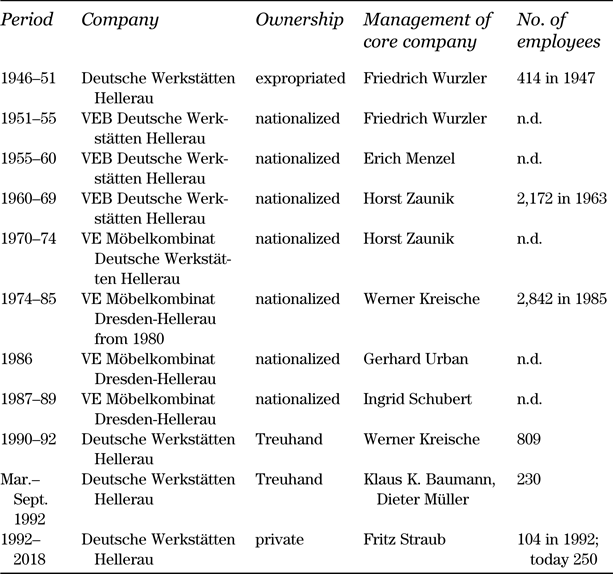
By the end of the 1950s, DWH had maneuvered itself into a situation where insistence on its history and heritage, and its determination to stay true to its traditional product aesthetic in the face of adverse circumstances, had become an existential risk. Under Menzel's leadership from 1955 onward (see Table 1), the company acquiesced to the overwhelming demands of the centralized planning and organization of industry as a survival technique. Nevertheless, the company kept two lifelines that connected it to its original organizational identity: export and innovation.
Deutsche Werkstätten Hellerau Ownership and Management, 1946–2018

Sources: Deutsche Werkstätten Hellerau papers, 11764, Sächsisches Staatsarchiv, Dresden (SStA); Thomas Nabert, Möbel für Alle: Die Geschichte der sächsischen Möbelindustrie (Leipzig, 2014), 197, 230, 276, 279, 282, 346. DWH provided some of the names and some are from our own research in central historical documents to determine firm leadership; others emerged from Nabert.
As early as 1957, DWH design garnered attention in the West, not least thanks to its own connections established at the Leipzig Fair and efforts to contact West German firms.Footnote 51 The company explored opportunities for direct representation in the West, to a certain degree circumventing the central organization of the export trade via the East German trade board Deutscher Innen- und Außenhandel (DIA).Footnote 52
However, in the hostile Cold War environment of the late 1950s, commercial activity in the FRG carried risks for DWH. For instance, in 1960, the West German Deutsche Werkstätten in Munich, Hamburg, and Cologne—former sister companies—opposed DWH's participation in the most important furniture fair in the West, the Internationale Möbelmesse (IMM) in Cologne. Maintaining that they were the rightful successors in title to the Deutsche Werkstätten brand, they threatened to sue for de-recognition of DWH's branding as a Werkstätten company. The VVB Möbel deemed this a real legal threat and recommended that DWH exhibit under the names of its suppliers and subcontractors. Rather than giving up on the brand and its identity, DWH withdrew from fair participation.Footnote 53 The West German Werkstätten companies’ rejection, however, gave DWH the impetus to explore western markets beyond the FRG. The same year, it received small orders and requests for sample pieces from London and established an increasingly successful collaboration with British distributors.Footnote 54 Proactive recruitment of customers outside of the GDR was part of the company's strategy to have at least a limited level of control over the kinds of furniture it would be asked to produce.
In 1963, Ulbricht's New System of Economic Planning and Management (NES), which was followed by the slightly adjusted Economic System of Socialism (ESS), between 1967/68 and 1970, introduced limited market principles to counter a decade and a half of mismanagement in the light and consumer industries. The NES also acknowledged the limits of socialist economic thinking at a moment when the GDR wanted to reenter the world market, after a period of extreme isolation following the construction of the Berlin Wall in 1961, and allowed firms more independence.Footnote 55 Export trade became increasingly significant to procuring the foreign currency necessary to modernize East Germany's capital stock. DWH's export contacts enabled the company to ameliorate its relationship with the state. Despite the hostilities DWH had encountered in 1960, it reemployed the Werkstätten brand and worked hard for a share of the West German export market. The western Werkstätten eventually opened up to cooperation in 1966, and the Munich and Frankfurt Werkstätten were granted exclusive rights to represent DWH furniture in the Federal Republic.Footnote 56
Adaptation to western tastes was paramount if the GDR furniture industry wanted to become competitive in western Europe. At this moment, DWH's noncompliance with the E-Stellen policy, contrary to most East German furniture companies, and continued practice of working with renowned designers turned into a clear advantage. Market research showed that modular wall units for the living room—shelving systems capable of integrating a range of elements, such as glass cabinets, a bar, a desk, or even seating or sleeping furniture—had become very successful on the West German market. The integrated Schrankwand furniture had almost completely pushed furniture sets with free-standing singular pieces out of the market. Known for its expertise in modular furniture, DWH received the official commission to develop a model that would meet the requirements of the western export markets, as well as those of the GDR domestic furniture market, and fit in the small prefab apartments of East Germany's government housing program. The resulting shelving system, Möbelprogramm Deutsche Werkstätten (MDW), designed by architect Rudolf Horn in 1967, became a success.Footnote 57
MDW's modular design could easily be mass-produced and, with its board construction, incurred comparatively low storage and transport costs, which also made it ideal for export. With this modular furniture program, DWH connected to the tradition and spirit of Bruno Paul's 1935 Wachsende Wohnung design, and moved beyond the production of furniture sets.Footnote 58 Yet the quality of the materials that the VVB and the Bauakademie provided was low: subpar varnishes and finishes as well as low-quality plastic fittings and mountings. Instead of wooden veneers, at this time the woodworking industries used paper foils with wood-grain prints, which were then finished with varnishes to create the appearance of polished wood. For DWH this meant that it was impossible to keep up its usual quality standards. Nevertheless, MDW was in high demand in Sweden, where the company sold a thousand Schrankwände in 1972 alone.Footnote 59 Multiple redesigns in the 1970s and 1980s guaranteed the longevity of MDW's success. It remained in production until the collapse of the GDR in 1990.
Although Ulbricht's economic program ultimately failed in 1970, export to the West remained an integral part of GDR economic policy because it was the only way to obtain foreign currency for much-needed raw materials and machinery to modernize and rationalize production. This goal found expression in yet another centralization in 1970, which created ever-larger combines that eventually replaced the VVB structures.Footnote 60 The VE Möbelkombinat Deutsche Werkstätten Hellerau—a newly formed regional industrial trust of twenty-five furniture producers and suppliers, including approximately twelve thousand workers in Saxony, with DWH as its core company—became one of the largest and most influential furniture trusts in the GDR.Footnote 61 Between 1960 and 1985 the volume of furniture export from the GDR to the FRG increased from DM 4.7 million to DM 257.8 million, temporarily accounting for more than 50 percent of GDR furniture exports overall. At the height of GDR furniture exports, between 1979 and 1983, they comprised 17.1 percent of all consumer product exports.Footnote 62 This growth resulted from a range of economic planning and administrative stimulus measures, such as massive investments in new technologies, focus on key markets, increase in storage capacities, and shortening of model life spans in so-called export promotion companies (Exportförderbetriebe), among them DWH, beginning in August 1974.Footnote 63 At this point, the SED regime was more tolerant of DWH because of its export success. The company thus continued the strategy of mixed conformity by following the push to develop inexpensive mass-produced furniture, while at the same time retaining its own distinctive aesthetic. No longer was it under pressure from the political leadership to conform to official design doctrine; rather, it was invested with trust in leading the GDR furniture industry out of a backward-looking aesthetic and into the future of a conservative modernism that was gaining the upper hand in western Europe.
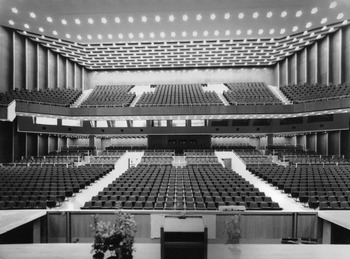
With MDW the company seemed to give in to the pressure from economic authorities to focus on mass production. Yet that is not the entire picture. In fact, DWH sustained a department for interior customization, the Sonderfertigungsabteilung Innenausbau, throughout the existence of the GDR. The Sonderfertigungsabteilung was where specialized woodworking techniques, research, and innovation continued. For a few years, the political leadership's blacklisting of the company had hampered the initial specialization on larger public building projects. However, after the course changed in the 1960s, DWH once more gained important contracts for customizing building interiors. Most prominent among the projects were the interiors of the Hotel Unter den Linden in Berlin (1966), the Kulturpalast in Dresden (1969), (see Figure 3), the concert hall Gewandhaus in Leipzig (1980–1981), and the Semperoper in Dresden (1985–1986).Footnote 64 Furthermore, the Sonderfertigungsabteilung successfully procured contracts in the West. Most of the jobs abroad were in southern West Germany, where DWH customized interiors, such as the Nibelungenhotel in Worms, and office buildings.Footnote 65 The Sonderfertigungsabteilung staff usually completed the projects in situ, a travel privilege that allowed the company to develop knowledge about western standards and technology.
Kulturpalast Dresden, 1969. (Source: Reproduced by permission © PR Deutsche Werkstätten)

With the Sonderfertigungsabteilung and the investments received as an Exportförderbetrieb, DWH had more access to higher quality materials and modern woodworking technology than other companies in the industry at a time when ill-managed five-year plans hampered progress and severely outdated machinery stock in the GDR. Yet still DWH could not service projects where specific materials or necessary advanced technology was unavailable in the GDR. For instance, the company had to decline a request from a western design office to produce sample furniture for the 1989 IMM Cologne furniture fair, “not because of the carpentry work, but because of the surface technology and the necessary materials. The wooden boards available in the GDR are not suitable for the [requested] direct application of varnishes.”Footnote 66 After forty years of planned economy, DWH existed in an outdated and underequipped industrial context, yet the company continued to be competitive and known for its technical expertise and woodworking knowledge in the European market.
Assimilation into Managed Capitalism, 1990–1996
Reunification completely altered the context for East German industries. Overnight, an economic system that had not required individual companies to make strategic decisions or necessitate risk-taking turned into a highly competitive, market-driven economy. For the second time in less than fifty years, East German businesses encountered radical systemic change. Privatization began on the eve of the economic and monetary unity on July 1, 1990, when the VE Möbelkombinat Dresden-Hellerau and its twenty-two thousand employees split up into twenty-five constituent firms, which were turned into seventy-four independent GmbH iA. With the introduction of the deutsche mark in the summer of 1990 the price of GDR products rose, resulting in a negative trend in aggregate demand for East German goods.Footnote 67 In particular, it pushed low-end furniture production into a midlevel price range, costing companies like DWH their competitiveness on the international market. As European socialism continued to crumble over the next year, supply systems for critical materials and components within the Council for Mutual Economic Assistance (Comecon) fell apart. And lastly, the Comecon export market collapsed, eliminating the last remaining market for the GDR furniture industryFootnote 68 However, the collapse of these economic structures, which from the beginning had reflected political constraints rather than economic logic, also offered an opportunity for companies like DWH: free export market choice and the freedom to specialize production to allow for economies of scale. No longer able to rely on favorable cost conditions, however, these companies had to find a differentiated position in their respective markets.
The industrial restructuring was overseen by the Treuhand, a government agency entrusted with administrating the denationalization process in the territory of the former GDR.Footnote 69 Over the years, the agency has received harsh criticism for lack of transparency, corruption, job depletion, and misuse of funds for unsuccessful restructurings. With the outdated production infrastructure—during the first half of the 1980s aggregate investment in East Germany had dropped sharply, further exacerbating the deterioration of machinery—departments that operated economically obsolete capital needed to be shut down, and politically motivated product lines had to be terminated.Footnote 70 However grim the bottom line of increasing unemployment numbers, approximately one-fourth of the twelve thousand small firms previously nationalized were transferred back to the original owners.Footnote 71 Of course, this was not possible in the case of DWH because Schmidt had died in 1948, shortly after the expropriation. Former company director Werner Kreische followed requests by DWH employees that he lead through the privatization phase, and the Treuhand employed him until investors were found.Footnote 72 All that differentiated DWH from others was a valuable firm identity based on core competencies that had survived the egalitarianism of state socialism.
In fact, the Treuhand recommended the company as an “altes Traditionsunternehmen”—a company with a long tradition—to Fritz Straub, a West German manager with experience in the pharmaceutical industry, where he had worked for Hoechst, who was interested in investing in the former GDR. After having seen some sixty companies over the span of six months, most of which Straub remembers as “depressing” and full of “desperate employees,” he stopped in his tracks when he walked past the Sonderfertigungsabteilung at DWH.Footnote 73 The stubborn refusal of the company management to betray their organizational identity and conform to political directives had salvaged a core set of skills and a production culture—along with a legacy of products and a meaningful brand—that could now be put to new valuable uses.
Together with three other investors, Straub built a restructuring plan around the Sonderfertigungsabteilung, specializing in customized interior carpentry, which the Treuhand accepted. Of 809 employees at the point of privatization in late June 1990, only 264 remained by the end of September 1992 when Straub and his partners took over the company. In return for DM 10 million in financial aid (the so-called Anschubfinanzierung), the investors had to guarantee the jobs of eighty-five employees—among them seventy highly skilled carpenters—and the training of forty apprentices for the next three years.Footnote 74 The management decided to concentrate on high-quality workmanship. Based on the structural economic considerations laid out above and the low-quality furniture that DWH built at the time—in spite of post-1990 efforts to modernize machinery and update furniture designs under Kreische's leadership—the decision was made to move away from its long history as a serial furniture producer, as this approach no longer seemed tenable in the new competitive landscape.Footnote 75 The new strategy, then, selectively tapped into the pool of competences and brand associations that had endured multiple disruptions as successive generations of managers and workers had clung to what they believed characterized the company—even when it had meant dangerously challenging political authorities. It did so by refocusing on elements that the new manager saw as having the potential to distinguish the company in the current market conditions. It should be mentioned that it is not uncommon for acquisitions to result in the new management introducing changes that threaten and undermine the identity of the organization, generating tensions and resistance, often at the expense of commercial performance.Footnote 76 By contrast, the case of DWH exemplifies how new management may successfully restructure an acquired company around a plan that is respectful of both its identity and its heritage and leverages longstanding competences and brand associations.
With the expertise of the Sonderfertigungsabteilung Innenausbau and the highly skilled workforce that remained after the takeover, DWH focused on integrating into the western economy by drawing on its legacy in customized interiors. With privatization in 1992, DWH received contracts for customized ship interiors, building on the tradition during the heyday of German shipbuilding in the Second Empire when the company's clients had included the German navy, HAPAG, and Norddeutsche Lloyd.Footnote 77 This time around, the first contracts came from the restoration of eight historical Elbe steamships for the White Fleet, followed by the building of two decks of two new Elbe liners. Collaborations with freelance designers and architects remained a key to DWH's success in interior customization. But more importantly, the company's commitment to product development gained new salience. The creation of a new department, the “Project Workshop” in 1995, institutionalized this expertise.
It soon became clear that if DWH wanted to be competitive beyond eastern Germany, it needed to expand its repertoire beyond woodworking, and in the late 1990s the company began to hire engineers to begin working with modern interior design materials, such as glass, metal, plastics, and rock.Footnote 78 Proximity to research centers, like the Technical University in Dresden, allowed the company to build expert knowledge, and most of today's 250 employees are engineers, with the number of carpenters stable at 70. Expert knowledge is central to the success of the company. With an unusually high participation rate in the German apprenticeship scheme—about 10 percent of the company's employees in the early 2000s—DWH continued its tradition of recognizing that a highly competent workforce is a competitive advantage.Footnote 79
The company itself ascribed its success in a completely new situation for both the western management and the eastern workforce—“without financial help, without clever consultants, without the helping hands of the government”—to brand recognition and its focus on core competencies.Footnote 80 Under Straub's leadership, and as a sign of respect for what the founder had created in Hellerau, the company recovered Schmidt's legacy as a marketing anchoring device—the embodiment of the core values of the firm—and a means to inscribe the company into German economic history.Footnote 81 DWH has made a name for itself as one of the foremost interior building companies worldwide and is contracted for the interiors of luxury yachts, hotels, and residences. The preservation of its core ideals and distinctive competencies enabled the company to survive the radical systemic changes that it experienced over the course of 120 years.
Conclusion
DWH offers a well-documented case study enabling history and business scholars alike to examine how organizations maintain a sense of continuity and distinctiveness in the face of institutional and environmental shifts, such as those introduced by the radically changing political and economic systems in Germany, that demanded changes that threaten the identity of the organization.
Our study makes three distinct contributions. From a historical perspective, it offers value in illuminating part of a history that we know little about: the organizational behavior of companies under state socialism. Literature on businesses in the socialist economy had heretofore highlighted the negative effect of state planning on innovation, tested the value of path dependency in explaining company development, and followed German firms across the shocks of political and economic system change. Often the emphasis has been on state policy, yet our study indicates that we can learn more about managerial decision-making and the relationship between managers and political authorities under socialism by examining struggles over conformity and differentiation, as companies attempted to reconcile political demands and an imperative to act in continuity with their identity and tradition.
DWH's story is one of conflict between the company's own identity and institutional pressures for aesthetic, ideological, and economic conformity under state socialism. Tracing the company's behavior across fifty years, what emerges is a pattern of mixed conformity as a delaying tactic to navigate these pressures while exploring alternative solutions. This strategy recognizes the multiple concerns of sociopolitical actors (cultural-aesthetic, ideological, economic) and tries to pitch one against the other to buffer sociopolitical pressures by conforming to some (identity-consistent) demands, while violating other (identity-threatening) ones. By addressing some political concerns, DWH strove to preserve a degree of sociopolitical legitimacy while also attempting to escape official requirements that would jeopardize the very identity of the organization. Shifting priorities of the regime helped this strategy to succeed until a new systemic change relaxed political pressures entirely. At that time, by having relentlessly pursued the preservation of organizational identity in the face of pressures to conform, DWH had maintained a core set of competences and a culture that ultimately ensured its survival after reprivatization, as its history and aesthetic legacy became an important resource in building a new future.
Had DWH given in completely to the sociopolitical and cultural pressures during the first centralization in the 1950s and to the standardization efforts in the 1960s, the company likely would have collapsed along with, or shortly after, the socialist system. Instead, holding on to its modern aesthetic and investing in the Sonderfertigungsabteilung, the company preserved knowledge (e.g., superior craftsmanship skills and the capacity to produce tailor-made solutions) and a strong brand that allowed it to reposition itself toward interior customization after the collapse of the GDR in a way that maintained continuity with its organizational past and let the company reclaim the legacy of its founder.
This observation is novel and important. It challenges current beliefs in institutional theory: namely, that lack of conformity and sociopolitical legitimacy will ultimately deprive an organization of the resources and/or latitude of action it needs to survive. Furthermore, it points instead to a viable strategy, available to organizations confronting a complex set of sociopolitical demands and expectations, to shield themselves from pressures to modify features that would threaten their identity by conforming to others that are better aligned with the organizations’ historical trajectories and future plans.
Further, our analysis illustrates how the tension between sociopolitical pressures to conform and organizational identity may offer an impulse to the entrepreneurial search for new avenues for growth and development in other fields and markets, as organizational members try to keep their distinctive identity despite the lack of conformity—an identity-driven innovation path of sorts. This observation is important because it points to identity not only as an inertial force—inducing resistance to changes that threaten what the organization is and stands for—but also as a generative force, energizing members to search for innovative solutions that enable them to preserve the integrity of a collective sense of self when hard pressed to relinquish distinctive organizational features.
Finally, this article makes a contribution to business history, by bringing organizational identity theory to bear on historical analysis, forging productive analytical connections between different micro-organizational and macroeconomic levels. This approach allows us to see how a strong organizational identity helps to preserve distinctive competences and reputation in the face of environmental pressures for adaptation, ensuring a company's long-term survival through repeated political disruptions.