Introduction
Neuropsychiatric symptoms (NPS) are common in Alzheimer's disease (Zhao et al., Reference Zhao2016). Their importance as an intrinsic aspect of prodromal stages of dementia that can precede the onset of cognitive symptoms is increasingly being recognized both in clinical practice and research (Mortby and Anstey, Reference Mortby, Anstey and Pachana2015). Mild behavioral impairment (MBI) has been proposed as a later-life at-risk state for incident cognitive decline and dementia in those who have at most mild cognitive impairment (MCI) (Ismail et al., Reference Ismail2016).
MBI is characterized by later life acquired, sustained, and impactful NPS of any severity that cannot be better accounted for by other formal medical and psychiatric nosology. MBI is an “at-risk” state for incident cognitive decline and dementia, and for some, MBI is the index manifestation of neurodegeneration, observed in advance of cognitive impairment (Ismail et al., Reference Ismail2016). The genesis of the MBI concept originated with work by Taragano which recognized NPS as the early manifestations of Frontotemporal Dementia (Taragano et al., Reference Taragano2009). Following on from this original work, the NPS Professional Interest Area (PIA) of the International Society to Advance Alzheimer's Research and Treatment (ISTAART), a subgroup of the Alzheimer's Association (AA) formalized the assessment of later life onset NPS within a newer construct of MBI as predictive of all cause dementia, and clarified the relationship between MBI and MCI (Ismail et al., Reference Ismail2016). The operationalized criteria for MBI require the emergence in later-life behavioral changes in at least one of the following domains: decreased motivation (e.g. apathy, aspontaneity, indifference); affective dysregulation (e.g. anxiety, dysphoria, changeability, euphoria, irritability); impulse dyscontrol (e.g. agitation, disinhibition, gambling, obsessiveness, behavioral perseveration, stimulus bind); social inappropriateness (e.g. lack of empathy, loss of insight, loss of social graces or tact, rigidity, exaggeration of previous personality traits); and abnormal perception or thought content (e.g. delusions, hallucinations). Importantly, the construct of MBI describes a population which does not have dementia and is precluded by formal psychiatric diagnosis (Ismail et al., Reference Ismail2016).
To meet criteria for MBI, the preceding behaviors must be of sufficient severity to produce at least minimal impairment in interpersonal relationships, other aspects of social functioning, or ability to perform in the workplace. Individuals with MBI generally maintain independence in activities of daily living, requiring at most minimal assistance. According to MBI criteria, individuals can have comorbid conditions, but the behavioral or personality changes may not be attributable to another co-existing formal psychiatric disorder (e.g. generalized anxiety disorder, major depression, manic, or psychotic disorders), traumatic or general medical causes, or the physiological effects of a substance or medication, nor may they meet clinical criteria for a dementia syndrome (e.g. Alzheimer's disease, frontotemporal dementia, dementia with Lewy bodies, vascular dementia, other dementia). However, MCI can be concurrently diagnosed with MBI (Ismail et al., Reference Ismail2016).
To date, little is known about the prevalence or impact of MBI among individuals with subjective concerns of cognitive decline (SCD). SCD as reported by the affected person or informant is associated with an increased risk for future progression to MCI and dementia (Donovan et al., Reference Donovan2014; Gifford et al., Reference Gifford2014). Given NPS are linked to cognitive decline and disease progression (Donovan et al., Reference Donovan2014), an important research question is clarifying the role of NPS in SCD. This is particularly the case as the concept of MBI recognizes another population that may be at risk of developing dementia, which so far has received little attention. Early detection may lead to treatment of distressing symptoms or possibly even approaches to the prevention and treatment of dementia by providing a better understanding of the very early consequences of neurodegenerative disease (Ismail and Mortby, Reference Ismail, Mortby, Chiu, Shulman and Ames2017).
It is well established that NPS are associated with higher levels of caregiver burden in dementia (Allegri et al., Reference Allegri2006; Fischer et al., Reference Fischer, Ismail and Schweizer2012; Dauphinot et al., Reference Dauphinot, Ravier, Novais, Delphin-Combe, Mouchoux and Krolak-Salmon2016). There are comparatively little data on the specific prevalence of NPS in MCI or SCD, and their impact on caregiver burden in these populations. Improving our understanding of the interplay between MBI, states without dementia such as SCD and MCI, and caregiver burden could have significant implications for improving quality of life, functional outcomes, and resource utilization (Ismail et al., Reference Ismail2015).
This study aims to address the above mentioned gaps in the literature by using operationalized MBI criteria to (1) investigate the prevalence rates of MBI in a memory clinic population; (2) determine whether there are differences in prevalence estimates of MBI between patients presenting with SCD or MCI; and (3) determine the association of MBI with caregiver burden.
Methods
Participants
Participants were enrolled in the Prospective Study for Persons With Memory Symptoms (PROMPT) registry. The PROMPT Registry was established in July 2010 and gathers information on patients seen in the University of Calgary's Cognitive Neurosciences Clinic offered at two urban tertiary care centers. Participants included in this study attended the Cognitive Neurosciences Clinics between January 2010 and September 2015. Patients were referred for assessment of suspected impairment in cognitive or behavioral function. Their evaluation included a detailed medical history, neurological examination, caregiver interview, and cognitive testing.
This study only included participants with MCI (n = 163) or objectively normal cognition who were categorized with SCD (n = 119). A diagnosis of dementia was an exclusion criterion, as was presence of psychiatric conditions (e.g. schizophrenia, bipolar disorder, major depression). MCI was diagnosed using the International Working Group Criteria (Winblad et al., Reference Winblad2004). According to these criteria, a person is considered to have MCI if cognitive performance was more than 1.5 SD below the normative expectations. Patients not meeting criteria for MCI who reported cognitive problems were classified as SCD. Informed consent was obtained from all participants, and the Research Ethics Board of the University of Calgary approved the study.
Measures
Patients completed a cognitive assessment battery which included the Montreal Cognitive Assessment (MoCA) (Nasreddine et al., Reference Nasreddine2005) and Folstein Mini-Mental State Exam (MMSE) (Folstein et al., Reference Folstein, Folstein and McHugh1975). NPS were assessed using the informant-rated Neuropsychiatric Inventory Questionnaire (NPI-Q) (Kaufer et al., Reference Kaufer2000), which was completed by a family member or close informant. The NPI-Q assesses the presence and severity of ten NPS (delusions, hallucinations, agitation/aggression, dysphoria/depression, anxiety, irritability, disinhibition, euphoria, apathy, aberrant motor behavior) and two neurovegetative domains (sleep and night-time behavior change, and appetite/eating change). Symptom severity is scored on a scale from 1 (mild) to 3 (severe). Caregiver burden was assessed using the 22-item Zarit Caregiver Burden Interview (Zarit et al., Reference Zarit, Orr and Zarit1985), which has demonstrated utility in SCD and MCI as well as in dementia (Stagg and Larner, Reference Stagg and Larner2015). A Zarit Caregiver Burden Score (ZCBS) was calculated for all patients with a range of 0–88.
Socio-demographic measures
Patients’ age, sex, and education were obtained as part of the general medical history. Information on medical co-morbidities (based on physician-made diagnoses) were obtained from the patient, caregiver, and review of medical records.
Mild behavioral impairment
MBI was assessed in accordance with the ISTAART-AA research diagnostic criteria (Ismail et al., Reference Ismail2016). Ten NPS domains from the NPI-Q were used to operationalize the five ISTAART-AA MBI domains of decreased motivation (NPI-Q apathy/indifference); emotional/affective dysregulation (NPI-Q depression/dysphoria, anxiety, elation/euphoria); impulse dyscontrol (NPI-Q agitation/aggression, irritability liability, aberrant motor behavior); social inappropriateness (NPI-Q disinhibition); and abnormal perception or through content (NPI-Q delusions, hallucinations). Presence of at least one behavior comprising a specific domain meant the domain criteria was met. The neurovegetative domains of sleep and appetite changes, as described in the NPI-Q, are not reflected in the ISTAART-AA MBI criteria. MBI was stated to be present if at least one of the five domains were present. Of note, a modified reference range was used to ascertain MBI as the NPI-Q has a reference range of one month, while MBI requires six months of new-onset symptoms.
Statistical analyses
Sample characteristics were described using descriptive statistics and frequency distributions and appropriate non-parametric tests (Bootstrapping, χ 2, Mann–Whitney U, and Kendall Tau) were conducted as necessary. ZCBS was investigated for its association with socio-demographic variables, MCI or SCD classification, NPS, MBI, and each individual MBI domain using Mann–Whitney U and Kendall Tau tests. Additional analysis of caregiver burden and its associations to MBI and MCI was done by grouping the population into four distinct categories: (1) SCD without MBI; (2) MCI without MBI; (3) SCD with MBI, and (4) both MCI and MBI. The ZCBS scores of categories 2–4 were first individually compared with the ZCBS score of category 1, and then compared with each other. Mann–Whitney U tests and bootstrap means were used to estimate non-parametric mean difference and the associated 95% confidence intervals (95%CI). Since the observed distribution of ZCBS was positively skewed and distinctly non-normal, bootstrapping was used to estimate the population mean and its confidence interval from our sample. Bootstrapping is a non-parametric approach in which the original data is randomly sampled with replacement and the parameter of interest estimated in each sample. Statistical inferences (e.g. standard errors, confidence intervals) are derived based on the distribution of the parameter estimates obtained from the bootstrap samples. This approach is known to be more robust to the impact of non-normal distributions on parameter estimation and statistical inference. Cliff delta (d) was used as a measure of effect size for the group comparisons (Cliff, Reference Cliff2014). Generalized linear model (with a log link function) was adopted to examine the associations between ZCBS and MBI/MCI, while controlling for age, sex, and education. Rate ratios and confidence intervals were reported and model fit was assessed based on Pearson χ 2 and Akaike information criterion. Results were considered statistically significant with a two-sided p-value of less than 0.05. All analyses were conducted in SAS v9.4 (SAS-Institute-Inc., 2014).
Results
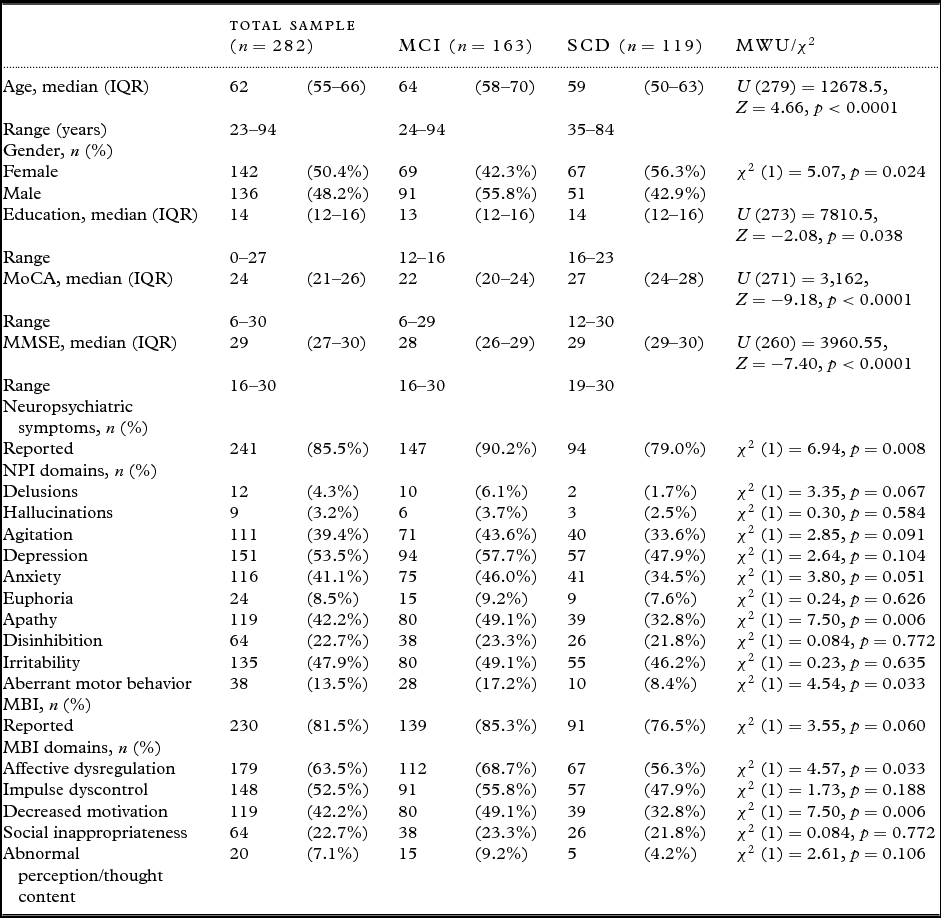
Sample characteristics are presented in Table 1. MCI was diagnosed in 57.8%, and SCD was diagnosed in 42.2% of patients included in this study. The diagnostic groups differed significantly by age (U (279) = 12678.5, Z = 4.66, p < 0.0001), sex (χ 2 (1) = 5.07, p = 0.024), and education (U (273) = 7810.5, Z = −2.08, p = 0.038). They also differed in terms of cognitive test performance on the MoCA (U (271) = 3,162, Z = −9.18, p < 0.0001) and MMSE (U (260) = 3960.55, Z = −7.40, p < 0.0001), where MCI patients had lower median scores compared to SCD patients for both the MoCA (22 vs. 27) and MMSE (28 vs. 29). NPS were reported in 85.5% of the total population and were significantly more prevalent in patients with MCI (90.2%) than in SCD patients (79.0%; χ 2 (1, n = 241) = 6.94, p = 0.008).
Sample characteristics

Abbreviations: SCD = subjective cognitive decline; MCI = mild cognitive impairment; MoCA = montreal cognitive assessment; MMSE = Mini-Mental State Exam; NPI = neuropsychiatric inventory; MBI = mild behavioral impairment; MWU = Mann–Whitney U; χ 2 = chi-square test. Underlined p-values are significant.
Prevalence of MBI in a memory clinic population
Among the 282 patients included in this study, 81.5% met the operationalized MBI criteria (Table 1). In descending order, the prevalence of the various MBI domains were as follows: affect dysregulation (63.5%), impulse dyscontrol (52.5%, decreased motivation (42.2%), social inappropriateness (22.7%), and abnormal perception or thought content (7.1%).
Overall, no statistically significant differences were found between the MCI and SCD groups for MBI though there was a trend for a higher prevalence in MCI (85.3%) compared to SCD (76.5%; (χ 2 (1) = 3.55, p = 0.06). There were significant differences between the two groups for two MBI domains, specifically affective dysregulation (68.7% vs. 56.3%; χ 2 (1, n = 179) = 4.57, p = 0.03) and decreased motivation (49.1% vs. 32.8%; χ 2 (1, n = 119) = 7.50, p = 0.006) that were both more prevalent in the MCI group.
Association of cognitive status and MBI with caregiver burden
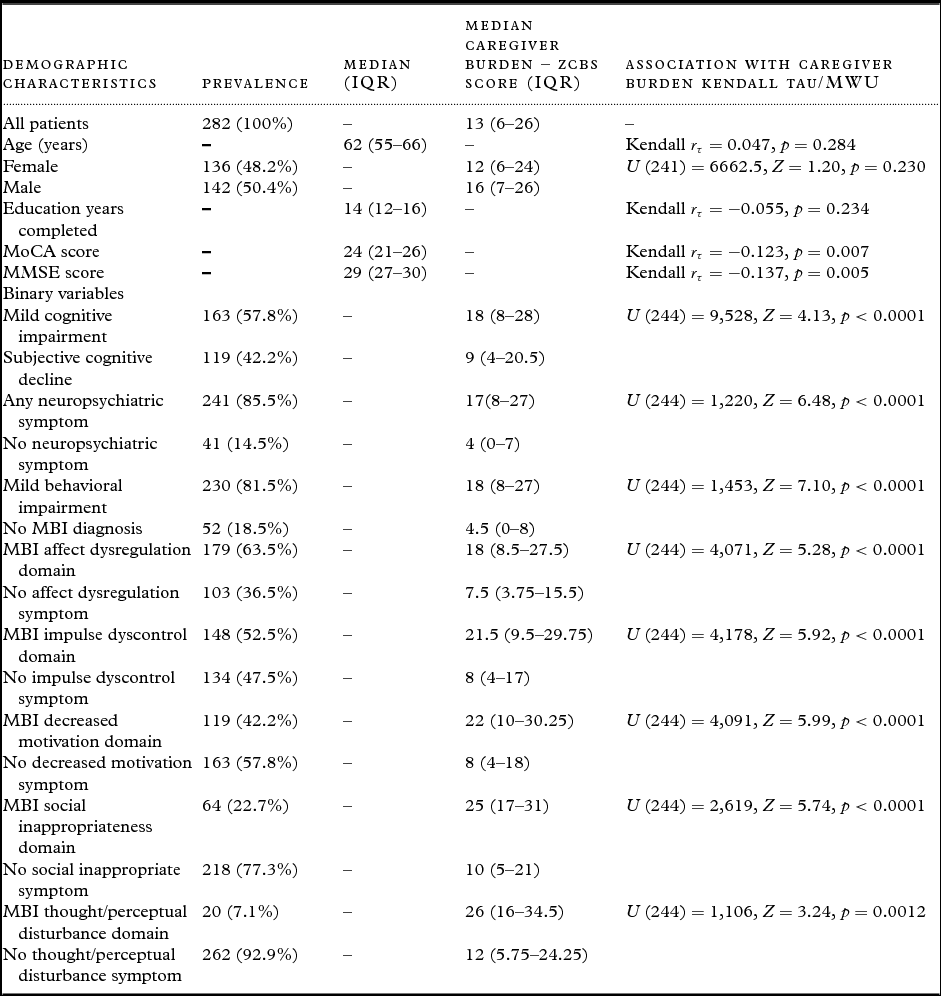
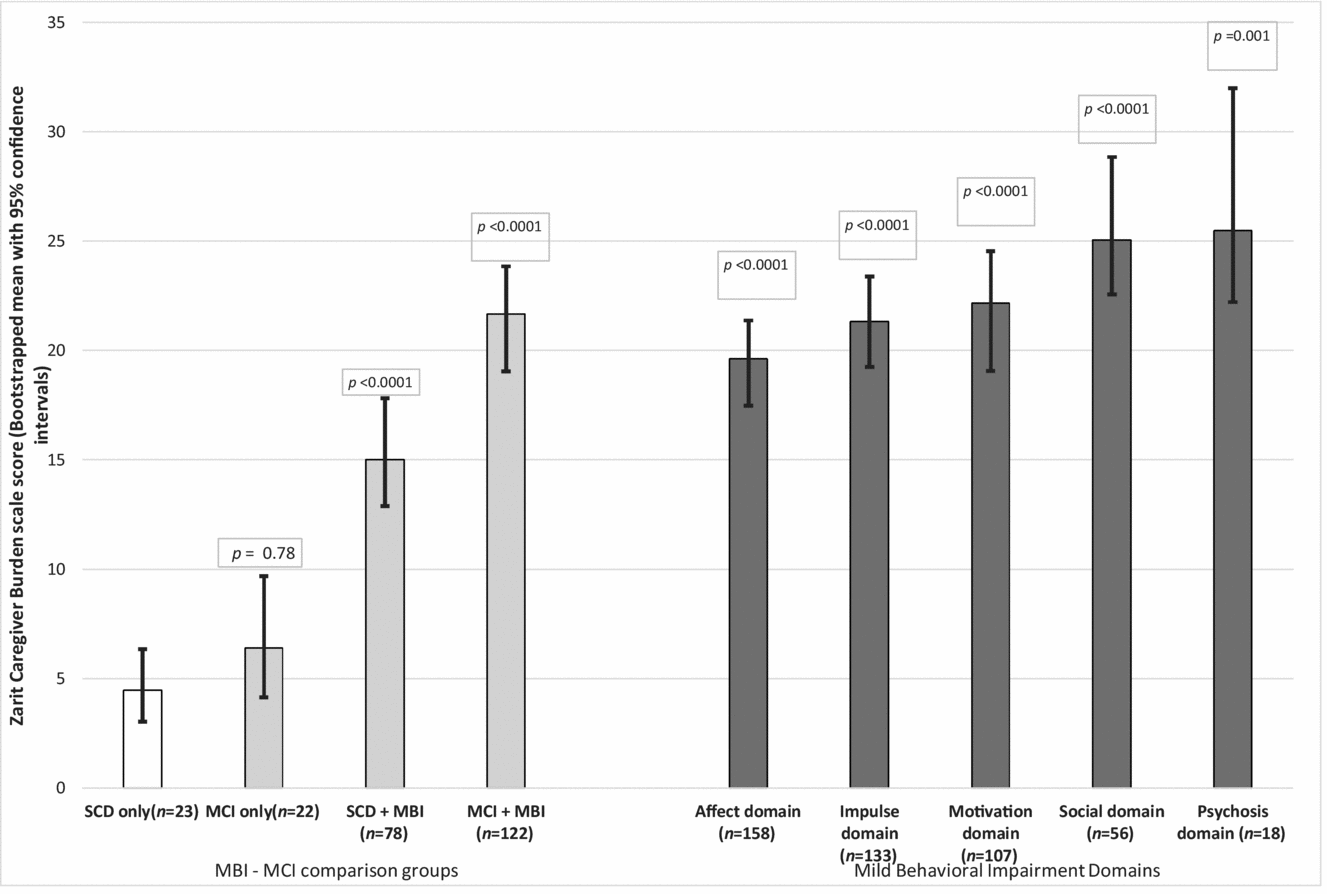
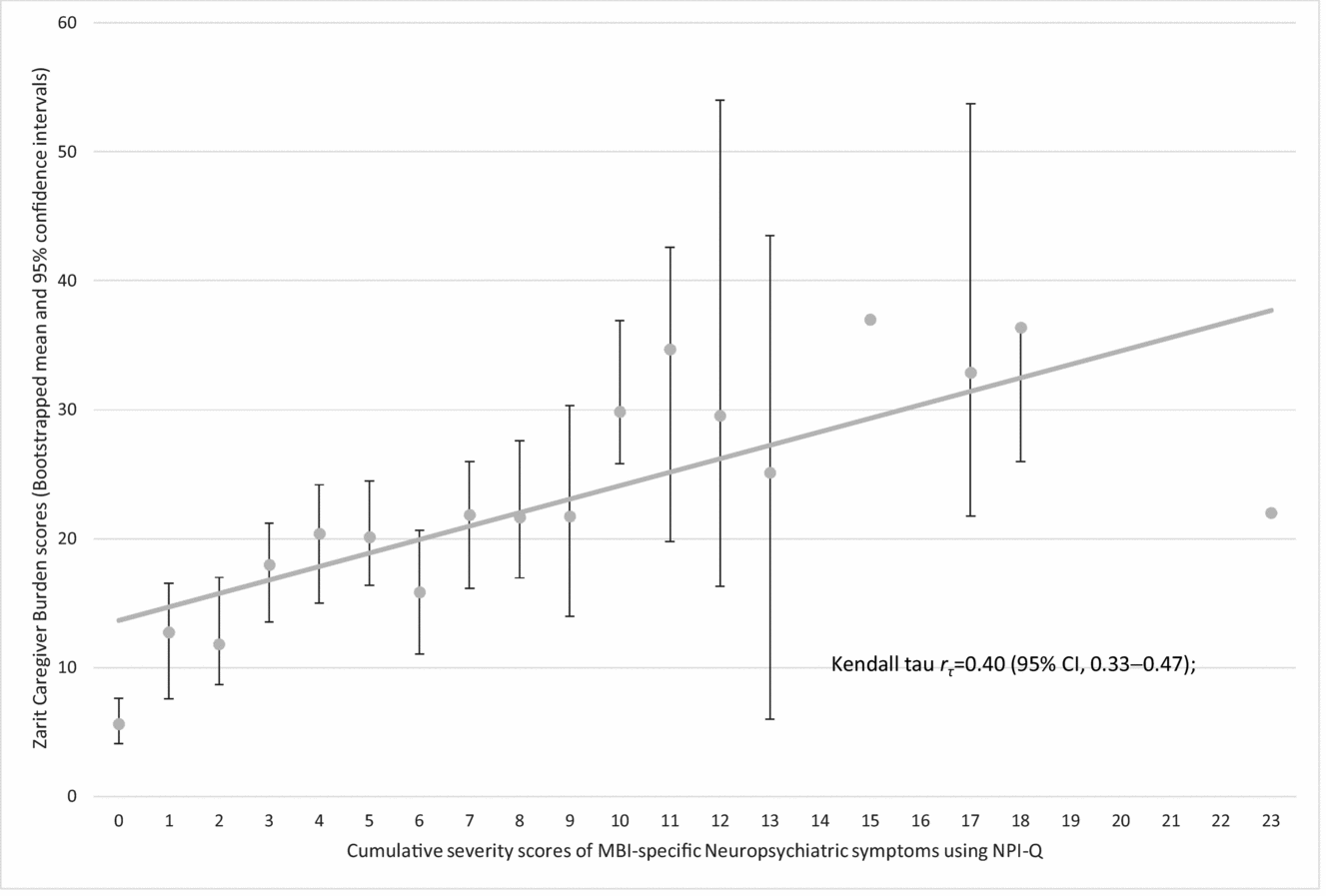
Caregiver burden scores were significantly higher in patients with MBI versus those without (U (244) = 1,453, Z = 7.10, p < 0.0001) (Table 2). Across the entire sample, the presence of each MBI domain individually was directly associated with greater caregiver burden: affective dysregulation (U (244) = 4,071, Z = 5.28, p < 0.0001), impulse dyscontrol (U (244) = 4,178, Z = 5.92, p < 0.0001), decreased motivation (U (244) = 4,091, Z = 5.99, p < 0.0001), social inappropriateness (U (244) = 2,619, Z = 5.74, p < 0.0001), and abnormal perception or thought content (U (244) = 1,106, Z = 3.24, p = 0.0012). The bootstrapped mean ZCBS for the MBI domains were affective dysregulation – 19.6 (95%CI = 17.5–21.4), impulse dyscontrol – 21.2 (95%CI = 19.3–21.3), decreased motivation – 22.2 (95%CI = 19.1–24.6), social inappropriateness – 25.1 (95%CI = 22.6–28.9), and abnormal perception or thought content − 25.5 (95%CI = 22.2–32.0) (Figure 1). Additional analysis of the association of caregiver burden with MCI and MBI are also presented in Figure 1. The bootstrapped mean ZCBS of the four sub-groups stratified based on diagnostic classifications were – SCD only (no MBI) – 4.5 (SD = 0.69; 95%CI,3.0–6.4), MCI only (no MBI) – 6.4 (SD = 1.48; 95%CI = 4.1–9.7), SCD+MBI – 15.0 (SD = 1.23; 95%CI = 12.9–17.8), and MCI+MBI – 21.7 (SD = 1.06; 95%CI,19.1–23.9). Relative to the SCD only group, the caregiver burden was significantly higher for the MBI+MCI group (U (144) = 251.5, Z = 6.24, p < 0.0001), d = 0.82, followed by the SCD+MBI group (U (100) = 365, Z = 4.31, p < 0.0001, d = 0.59). In contrast, the MCI only group did not demonstrate significantly higher caregiver burden than the SCD only group (U (44) = 240, Z = 0.29, p = 0.78, d = 0.05). Furthermore, the caregiver burden for the SCD+MBI group was significantly higher than the MCI only group (U (99) = 448, Z = 3.42, p = 0.0006, d = 0.48, but significantly lower than the MCI+MBI group (U (199) = 6,260, Z = 3.76, p = 0.0002, d = 0.32). Importantly, caregiver burden was also significantly higher (Kendall rτ = 0.40, 95%CI = 0.33–0.47, p < 0.0001) with increasing cumulative severity of MBI-specific NPS (Figure 2).
Prevalence of variables and their associations with caregiver burden

Abbreviations: MoCA = montreal cognitive assessment; MMSE = Mini-Mental State Exam; MBI = mild behavioral impairment; MWU = Mann–Whitney U; Kendall rτ = Kendall Tau correlation test. Underlined p-values are significant.
Zarit caregiver burden scale scores for MCI, SCD, MBI, and the five individual MBI domains.

Dose–response relationship between cumulative severity of MBI-specific neuropsychiatric symptoms and caregiver burden (bootstrapped mean Zarit caregiver burden scores with 95% confidence intervals).

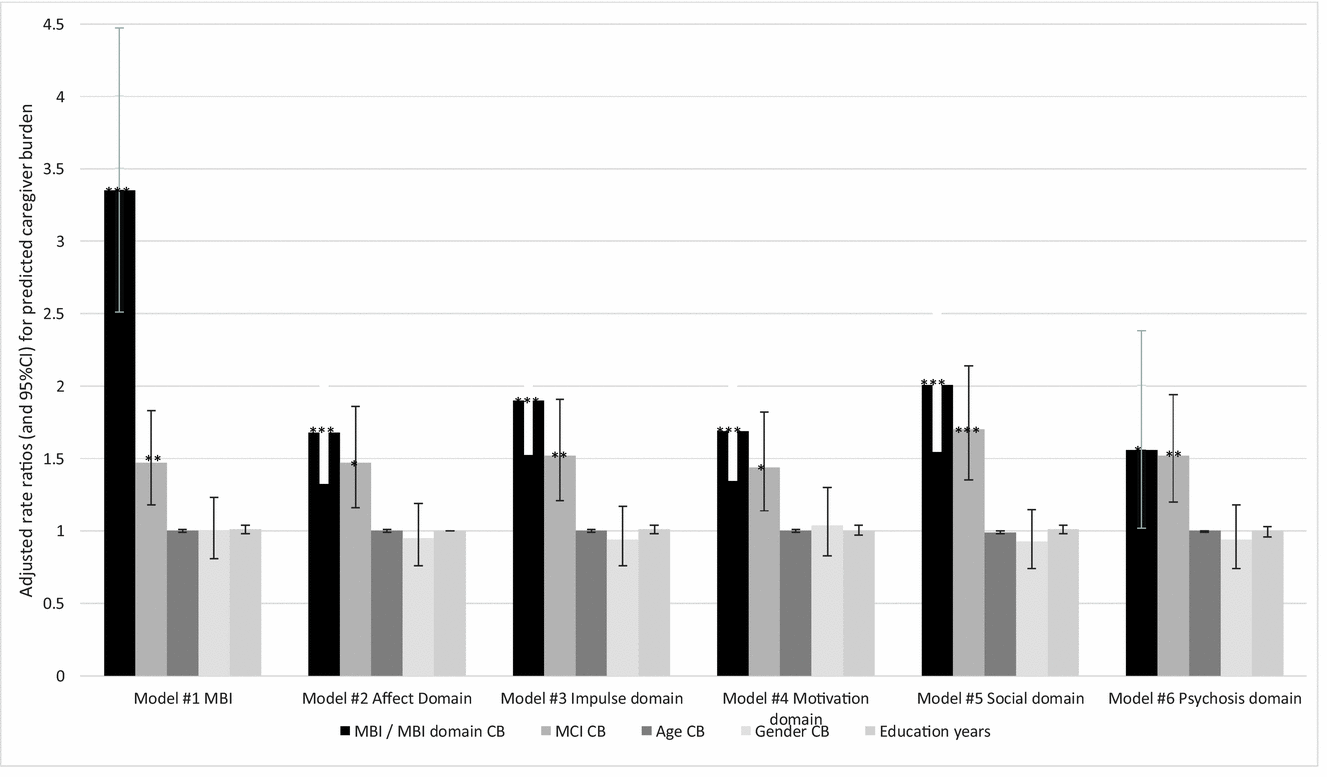
Negative binomial regression models were used to assess the association of MBI and the five MBI domains with ZCBS while controlling for age, gender, education, and MCI diagnosis (Figure 3). ZCBS was 3.35 times (95% CI, 2.51–4.47) higher (p < 0.0001) in patients with MBI (compared to no MBI) and 1.47 times (95%CI = 1.18–1.83; p < 0.001) higher in patients with MCI (compared to no MCI), with all other factors held constant. Age (1.0, 95%CI = 0.99–1.01, p = 0.44), sex (1.0, 95%CI = 0.81–1.23, p = 0.98), or education years (1.01, 95%CI = 0.98–1.04, p = 0.64) were not significantly associated with ZCBS.
Six separate negative binomial regression models predict that MBI and its five domains have higher adjusted ratios of caregiver burden (CB) when compared with MCI, age, gender, and educational years. ***p-value < 0.0001, **p-value < 0.001, *p-value < 0.05.

Discussion
This study is one of the first to determine the prevalence of MBI in a clinical sample (as operationalized in the ISTAART-AA criteria, using the NPI-Q) and investigate its association with caregiver burden. Our four primary findings were (1) there was a high prevalence of MBI in this memory clinic population of patients with MCI or SCD; (2) MBI prevalence was numerically higher in MCI versus SCD but did not meet the threshold for statistical significance though both decreased motivation and affective dysregulation domains were significantly more prevalent in MCI; (3) MBI with or without MCI was associated with higher scores on a caregiver burden scale; and (4) cumulative severity of MBI symptoms had a dose–response relationship with caregiver burden.
MBI was common in our memory clinic pre-dementia population with SCD or MCI with a prevalence of 81.5%. Using a similar methodology and the NPI to estimate MBI, prevalence of MBI was determined to be 34.1% in a population-based sample of older adults (Mortby et al., in press). Prior literature has shown that NPS are more common in clinical versus community samples (Monastero et al., Reference Monastero, Mangialasche, Camarda, Ercolani and Camarda2009; Ismail et al., Reference Ismail2017b). In fact, in our non-dementia sample, an MBI diagnosis was made more often than that of MCI. This suggests that neuropsychiatric comorbidity along with cognitive symptoms increase the likelihood of seeking clinical care, and that MBI is a relevant and important aspect of how and why patients present to memory clinics.
While there was no statistically significant difference in the prevalence of MBI between SCD and MCI, it was more common in MCI. Previous studies have consistently demonstrated increasing NPS burden with declining cognition and function (Fernandez-Martinez et al., Reference Fernandez-Martinez, Molano, Castro and Zarranz2010; Zhang et al., Reference Zhang, Wang, Li and Yu2012). It is unclear whether there is in fact no difference or if our study was underpowered to show a 10%–15% difference in prevalence. Assessment of MBI domains, however, did reveal significant differences between the groups. The affective dysregulation and decreased motivation domains were statistically more likely to be present in patients with MCI. These findings might indicate a difference in the timing of the onset of MBI domains in early neurodegenerative disease with a later emergence of changes in motivation, drive, and emotional regulation. Evidence suggests that apathy (Lanctôt et al., Reference Lanctôt2017) and anxiety (Gulpers et al., Reference Gulpers, Ramakers, Hamel, Köhler, Voshaar and Verhey2016) predict cognitive decline and dementia. Depression is a more heterogeneous concept (Ismail et al., Reference Ismail2017b), and while there is extensive evidence that depression precedes cognitive impairment (Saczynski et al., Reference Saczynski, Beiser, Seshadri, Auerbach, Wolf and Au2010; Luppa et al., Reference Luppa, Luck, Ritschel, Angermeyer, Villringer and Riedel-Heller2013), some data indicate that depressive symptoms may accompany cognitive impairment (Richard et al., Reference Richard2013). Evidence also suggests a relationship between executive dysfunction in MCI and the presence of NPS. A study of 1,779 participants with MCI in the National Alzheimer's Coordinating Center demonstrated that executive dysfunction was linked to NPS, specifically anxiety and depression (Rosenberg et al., Reference Rosenberg, Mielke, Appleby, Oh, Leoutsakos and Lyketsos2011). One can speculate that anxiety and depression may be neuropsychiatric manifestations of executive dysfunction in a pre-dementia population. This is certainly in keeping with the overall conceptualization of NPS as early markers of neurodegenerative disease (Ismail et al., Reference Ismail2017a) and may explain the later emergence of affective dysregulation in our population with a higher prevalence in MCI versus SCD. To our knowledge, there is little evidence on the relative emergence of NPS and MBI domains. Longitudinal studies are required to clarify the timelines and role of individual MBI domains on cognitive and functional outcomes over time, and the predictive nature of MBI domains on different dementia subtypes. A longitudinal study in a dementia population demonstrated that anosognosia as well as apathy and agitation are factors that should be considered in assessing quality of life ratings by patients and caregivers (Conde-Sala et al., Reference Conde-Sala2016). The assessment of anosognosia may help in clarifying the association between MBI and caregiver burden.
We found important associations between MBI and a measure of caregiver burden. First, the presence of MBI was associated with greater burden scores with co-morbid MCI+MBI patients showing higher scores than SCD+MBI patients. Second, SCD patients who were also diagnosed with MBI had a significantly higher caregiver burden score than patients who had MCI without MBI. Third, in our total population, MCI was associated with a significantly higher caregiver burden score than SCD, but this association was driven primarily by the presence of MBI as suggested by the non-significant difference in caregiver burden score between MCI and SCD in the group of patients without MBI.
The association of NPS and caregiver burden is well documented in dementia (Fischer et al., Reference Fischer, Ismail and Schweizer2012). In MCI, evidence suggests less caregiver burden than in AD dementia (but more than in normal controls) with the presence of NPS related to greater burden (Ryan et al., Reference Ryan, Weldon, Persad, Heidebrink, Barbas and Giordani2012). There appears to be a dose–response relationship between the cumulative severity of MBI symptoms and reported caregiver burden. Similarly, there is evidence for a dose–response curve between symptom severity in AD dementia and caregiver distress (Tun et al., Reference Tun, Murman and Colenda2008). The aging, demographics, and memory study (ADAMS) demonstrated a dose–response effect of NPS on caregiving time in both pre-dementia (Cognitive Impairment No Dementia) and AD dementia participants (Okura and Langa, Reference Okura and Langa2011). Those with no NPS received an average of 10.2 hours of active help and 10.9 hours of supervision per week from informal caregivers. Those with one or two NPS received an additional 10.0 hours of active help and 12.4 hours of supervision per week, while those with three or more NPS received an additional 18.2 hours of active help and 28.7 hours of supervision per week (p < 0.001).
Each of the five MBI domains individually had a significant association with the measure of caregiver burden. Even though affective dysregulation was the most frequent MBI domain present in the population, it had the lowest median caregiver burden score of the five domains, while the inverse was true for the abnormal perception or thought content domain. Comparable findings are present in the dementia literature. An Argentinian study of memory clinic patients with Alzheimer's disease dementia showed that psychotic symptoms were most predictive of caregiver burden (also measured with the Zarit), while there was little predictive value of apathy or depression (Allegri et al., Reference Allegri2006). Similarly, a predominantly apathetic subgroup of AD dementia patients had the least caregiver distress compared to more symptomatic groups (Tun et al., Reference Tun, Murman and Colenda2008). Systematic reviews have demonstrated a differential association between specific NPS and caregiver burden (Fischer et al., Reference Fischer, Ismail and Schweizer2012), while others state that the evidence is yet inconclusive (Feast et al., Reference Feast, Moniz-Cook, Stoner, Charlesworth and Orrell2016). The ADAMS study described a symptom hierarchy. The presence of irritation (14.7 additional hours) was associated with the greatest number of additional hours of active help, while aberrant motor behaviors (17.7 additional hours) and disinhibition (17.5 additional hours) were associated with the greatest number of additional hours of supervision (Okura and Langa, Reference Okura and Langa2011).
There are a number of strengths and limitations of this study. The PROMPT registry enrolls patients who have been referred to a tertiary care academic memory clinic for cognitive concerns. Approximately, 97% of referrals are enrolled in the registry. Thus, our study reports on a representative sample of patients who present for specialist care in our clinic. Additionally, clinic data gathering is systematic with respect to cognitive screening instruments and informant-rated scales, improving data quality. However, patients managed in primary care or in facilities may not be represented by those patients referred to our academic memory clinic and our results may not be applicable to them. Similarly, our results should not be generalized to population-based samples, as the relatively high prevalence of MBI we found could be related to the setting of our study – tertiary care academic memory clinic. SCD was a diagnosis of exclusion, made in those with cognitive complaints, but not meeting criteria for MCI, as opposed to more rigorous criteria. Further, it is possible that functional impairment is present in the SCD population, driving the caregiver burden, but it has not been assessed in this study. However, by definition, MBI is precluded by functional impairment, as this would result in a dementia diagnosis. Further exploration is needed for this important question. We have also not well characterized the caregivers. For both the SCD and MCI group, the caregiver that completed the informant questionnaires was the family member or friend who accompanied the referred patient to the clinic appointment. For the majority of participants, this was a spouse or child. The median ZCBS scores seen observed were generally low indicating no or little caregiver burden, though the presence of certain MBI domains did show median scores suggesting mild to moderate burden (Hébert et al., Reference Hébert, Bravo and Préville2000). The clinical importance of the median scores observed will require additional research, in particular longitudinal studies. Another limitation is that the NPI-Q may not capture MBI and its symptoms accurately. For example, the NPI-Q has a one-month reference range of symptoms since the onset of cognitive impairment, but is silent on the overall duration of symptoms, while MBI criteria stipulate later life acquired NPS of six months duration. Thus, the use of the NPI-Q may overestimate the prevalence of MBI, as evidence by our very high prevalence estimates. Further, the NPI was designed for use in a dementia patient population. Given the variability in performance of NPS rating scales (Ismail et al., Reference Ismail2013), it may not be entirely representative of and appropriate for prodromal populations. The recently published MBI checklist (www.MBItest.org) was developed specifically to reflect the ISTAART-AA MBI criteria. The MBI-C is a 34-item instrument which can be completed by a patient, close informant, or clinician. It is explicit on the natural history of NPS (later life emergence, sustained for at least six months), and was designed for MBI case detection and monitoring the emergence of MBI symptoms over time (Ismail et al., Reference Ismail2017a). Further studies using the MBI-C, as well as comparison studies between the MBI-C and the NPI-Q are required to help frame the results of this study and address the question of cognitive outcomes over time. For example, NPS trajectories from baseline in MCI participants of the Alzheimer's Disease Neuroimaging Initiative were assessed on their ability to predict the development of dementia. The group with moderate level of NPS at baseline, as measured by the NPI-Q, and had an increasing burden of NPS over time were the most likely to develop dementia. In contrast, those with low-grade sustained symptoms or those with symptoms that resolved were less likely to develop dementia (David et al., Reference David, Lin and Porsteinsson2016). Longitudinal data are needed to evaluate the predictive utility of MBI for cognitive decline and dementia.
Conclusion
In a non-dementia memory clinic population with SCD and MCI, we assessed the prevalence of MBI in accordance with the ISTAART-MBI criteria, operationalized using the NPI-Q. The prevalence of MBI was high. Though more common among MCI patients, this difference was not statistically significant. MBI domains of decreased motivation and affective dysregulation were statistically more likely in MCI. There was a strong and direct relationship between the presence of MBI and greater caregiver burden. Further, a dose–response relationship exists between cumulative MBI symptom severity and caregiver burden. In the absence of MBI, caregiver burden was not significantly different between MCI and SCD, but in the presence of MBI patients with MCI had a significantly higher caregiver burden than SCD. Patients with SCD and MBI had a significantly higher caregiver burden than MCI without MBI. These findings have potential implications for ambulatory practice. MBI is more common than MCI, which highlights the importance of assessing NPS in prodromal populations. The presence of MBI is associated with a higher risk of burden in family members of memory clinic patients. Further studies are required to determine if MBI symptoms are modifiable, and if so, whether their management affects caregiver burden over time. Longitudinal research is needed to assess for changes in MBI and specific MBI domains, and their association with other factors linked with cognitive and functional outcomes. This may inform targeted strategies for treating affected patients and potentially preventing cognitive and functional decline.
Conflict of interest
None.
Description of authors’ roles
F. Sheikh wrote the paper, analyzed the data, carried out statistical analyses, prepared the figures, and was involved in designing the study and its statistical components. Z. Ismail designed the study, wrote the paper, did clinical assessments for data collection, consented patients, and supervised all aspects of the study. F.Sheikh supervised throughout the study. E. Smith was involved in designing the study, writing the paper, did clinical assessments for data collection, consented patients, and supervised aspects of the study, along with supervising the PROMPT registry database. M. Mortby assisted in writing the paper. P. Barber, A Cieslak, K.Fischer, R. Granger, A. Mackie, B.Menon, P.Mueller, D.Patry, D.Pearson, J. Quickfall, and E.Tse were involved in data collection and patient consent to build the PROMPT registry database. D. Hogan and C.Maxwell assisted in writing the paper, data collection, and patient consent. Tolulope Sajobi and Meng Wang were involved in designing the statistical components, supervising statistical analysis, and performing the multivariate analysis for this study.
Acknowledgments
We would like to acknowledge the support of the Ron and Irene Ward foundation, the Taylor family foundation, the Clinician Engagement Grant from the Addiction and Mental Health Strategic Clinical Network of Alberta Health Services, and the Alzheimer's Society of Calgary, via the Hotchkiss Brain Institute. M. E. Mortby is supported by the Australian National Health and Medical Research Council (NHMRC) and Australian Research Council (ARC) Dementia Research Development Fellowship #1102028.