Introduction
Oropharyngeal dysphagia in intensive care is increasingly being studied in view of the increased risk of morbidity and mortality,Reference Macht, Wimbish, Clark, Benson, Burnham and Williams1 the length of hospitalisation and the economic cost it generates.Reference Macht, Wimbish, Bodine and Moss2,Reference Ickenstein, Riecker, Höhlig, Müller, Becker and Reichmann3 Research into the risk factors for dysphagia presenting in intensive care, and the screening or diagnostic methods, is also being conducted.
Normal swallowing allows removal of the nasogastric tube, resumption of oral feeding and transfer out of an intensive care unit, while swallowing disorders can complicate management and delay discharge. Oropharyngeal dysphagia is a complication described in different medical conditions (e.g. stroke, chronic obstructive pulmonary disease (COPD), ENT cancer). It can occur in certain physiological conditions, especially in geriatric populations. It can also be caused by medical and surgical management methods. In intensive care units, various factors have been identified as risk factors for oropharyngeal dysphagia, such as orotracheal intubation (referred to as post-extubation dysphagia),Reference Rassameehiran, Klomjit, Mankongpaisarnrung and Rakvit4 prolonged invasive ventilation,Reference Partik, Pokieser, Schima, Schober, Stadler and Eisenhuber5,Reference Tolep, Getch and Criner6 the presence of a tracheostomyReference Hafner, Neuhuber, Hirtenfelder, Schmedler and Eckel7 or polyneuropathy.Reference Brunello, Haenggi, Wigger, Porta, Takala and Jakob8
With the recent emergence of the coronavirus disease 2019 (Covid-19) pandemic, it is estimated that more than 38 million people have been infected with severe acute respiratory syndrome coronavirus 2 (SARS-CoV-2), some of whom required intensive care in the face of rapid ventilatory failure.Reference Huang, Wang, Li, Ren, Zhao and Hu9 Dyspnoea is reportedly present in 55 per cent of cases, with a progressive deterioration of the ventilatory mechanics associated with the development of acute respiratory distress syndrome, which can lead to death. The incidence of acute respiratory distress syndrome in these patients reaches 16.5–31 per cent.Reference Li and Ma10 It is estimated that 965 000 patients may have required mechanical ventilation in 2020 as a result of this infection. Initial data show that the durations of intubation, sedation and hospitalisation in intensive care are long, with patients intubated for more than a week.Reference Grasselli, Zangrillo, Zanella, Antonelli, Cabrini and Castelli11 After this early phase, the management of acute respiratory distress syndrome associated with Covid-19 may be confronted with neurological complications in two-thirds of cases,Reference Helms, Kremer, Merdji, Clere-Jehl, Schenck and Kummerlen12 such as resuscitation-related delirium or the presence of encephalopathy.
The direct consequences of SARS-CoV-2 (respiratory and neurological disorders), but also the indirect consequences (orotracheal intubation, invasive or non-invasive mechanical ventilation, tracheostomy, decubitus complication, neuromyopathy acquired in the intensive care unit), seem to predict the presence of oropharyngeal dysphagia, particularly in the geriatric population. However, no study has reported the prevalence of swallowing disorders among patients hospitalised in intensive care units or in conventional services related to Covid-19. This absence in the literature may be related to the complexity of the diagnosis or screening.
Given the severity of pathology in patients admitted to intensive care, the length of stay and of intubation, and the related complications, patients with Covid-19 appear to be at risk of developing dysphagia in the intensive care unit after acute respiratory distress syndrome. It therefore seems necessary to assess the prevalence of dysphagia in this population. The main objective of this study was, hence, to evaluate the prevalence of dysphagia in intensive care unit in patients with Covid-19. The secondary aim was to determine the different factors predictive of the presence of oropharyngeal dysphagia in such patients.
Materials and methods
A cohort, observational, retrospective study was conducted of patients admitted to the intensive care units at the Rouen University Hospital Centre in France, in the context of the SARS-CoV-2 epidemic. This study was approved by the local ethics committee of Rouen University Hospital (approval number: E2020-86).
Patients needing ventilation and intubation, admitted to intensive care units between March and June 2020, and testing positive for SARS-CoV-2, were included. Tracheostomised or deceased patients were not excluded.
The clinical data collected were: age, sex, body mass index, history of cardiovascular, pulmonary or neurological diseases or oropharyngeal dysphagia, presence of diabetes, intensive care unit admission severity score (‘IGS2’ = (Indice de Gravité Simplifié 2) Simplified Severity Index 2), severity of lung damage on computed tomography (CT) chest scans, type of ventilation, presence of ventilator-associated lung disease, duration of intubation, use of curare, failure of orotracheal extubation, presence of a tracheostomy, Medical Research Council Scale for Muscle Strength score, presence of a post-intensive care unit treatment lung infection, oropharyngeal dysphagia screening results (if conducted), type of intensive care unit feeding, hospital discharge, duration of intensive care unit hospitalisation, and total length of hospitalisation. The data were retrieved from medical records. If patients were transferred to another hospital, the data from that institute were also retrieved.
Screening tests were carried out by physiotherapists specialised in intensive care unit management. The methods of analysis consisted of: clinical observation of the oropharyngeal sphere, ingestion of food products such as compote and water, oxygen saturation monitoring, and laryngeal auscultation. Oropharyngeal dysphagia was characterised by the presence of a direct or indirect cough, oxygen desaturation of greater than 3 per cent, a change in voice quality, drooling, oral residue, and the presence of multiple swallowing.
The data were analysed with Medistica© Pvalue.io software. Statistical significance was determined as p-values of less than 0.05. The quantitative variables are described in terms of means and standard deviations (SDs). Qualitative variables are described in percentages. Chi-square and Fisher exact tests were used to analyse the qualitative variables. The Mann–Whitney test was used to analyse associations between the quantitative and qualitative variables.
Results
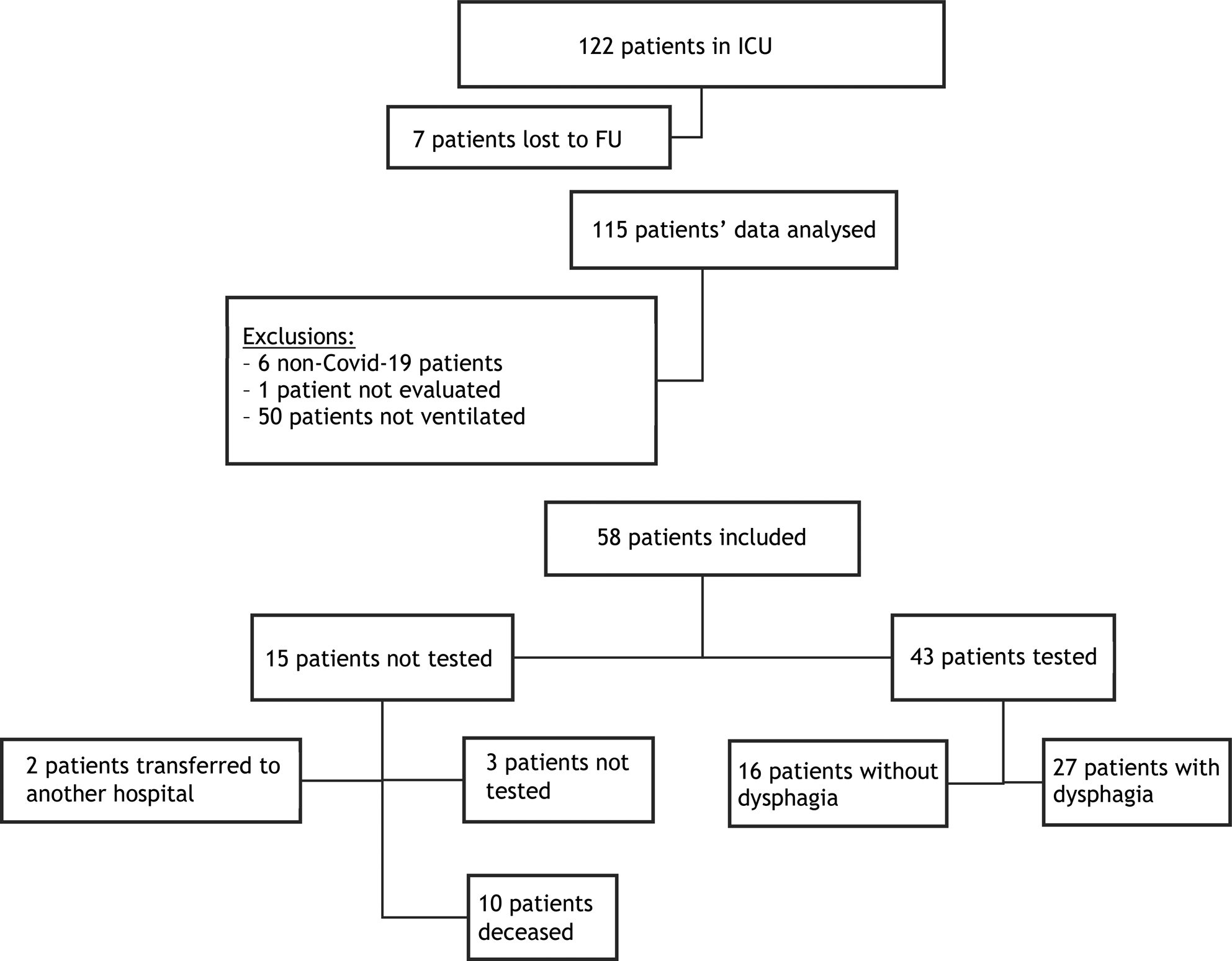
Over four months, 122 patients were hospitalised in intensive care units at Rouen University Hospital for SARS-CoV-2 infection, and 58 were intubated and ventilated. Of these patients, 43 were assessed (Figure 1). Ten patients died before being extubated, two patients were transferred to another intensive care unit outside of the region and were not assessed, and three patients left without assessment.
Flow chart of intensive care unit (ICU) patients included in the study. FU = follow up; Covid-19 = coronavirus disease 2019

The mean (± SD) post-extubation assessment time was 2.03 ± 1.93 days. After clinical assessment, 13 patients had a contraindication to further testing, with a very high risk of post-extubation dysphagia.
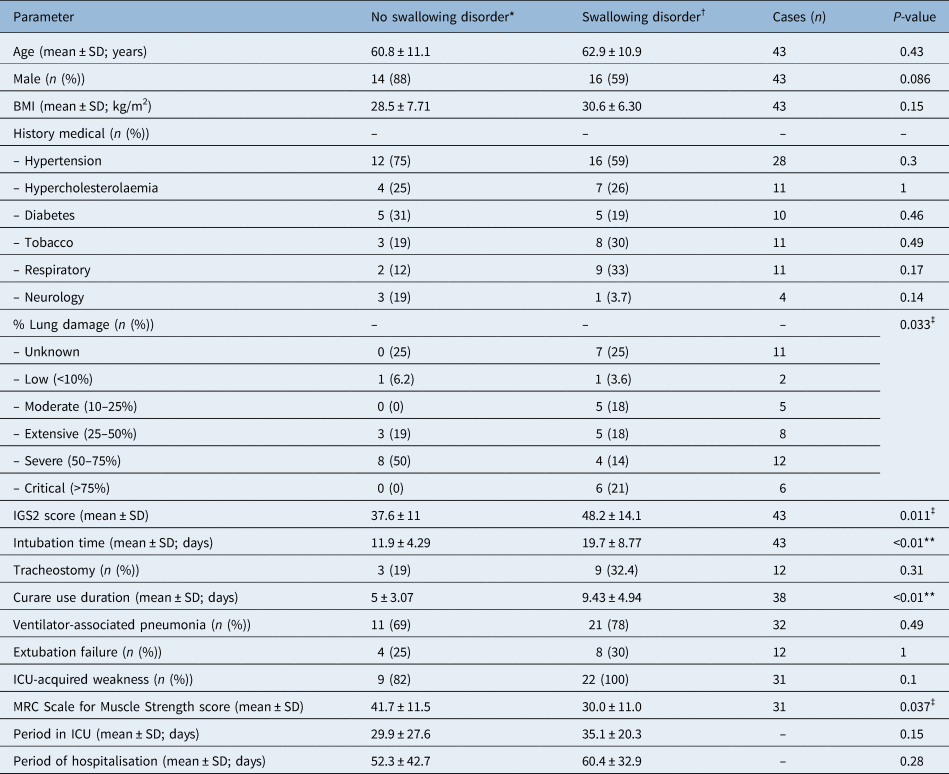
Screening revealed post-extubation dysphagia in 62.7 per cent of intubated patients. Univariate analysis indicated a significant association between the presence of a swallowing disorder and: severity of the initial pathology (p = 0.011), duration of orotracheal intubation (p < 0.01), duration of curare use (p < 0.01), degree of muscle weakness (p = 0.037) and initial severity of pathology indicated on CT (p = 0.033) (Table 1).
Univariate analysis findings of patients screened for dysphagia

*n = 16; †n = 27. ‡p < 0.05; **p < 0.01. SD = standard deviation; BMI = body mass index; IGS2 = (Indice de Gravité Simplifié 2) Simplified Severity Index 2; ICU = intensive care unit; MRC = Medical Research Council
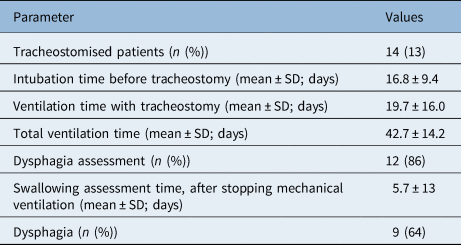
Patients whose ventilatory weaning was difficult benefitted from a tracheostomy (i.e. 29 per cent of intubated patients). The mean duration of intubation before tracheostomy was 16.8 ± 9.4 days. The mean duration of ventilation via tracheostomy was 19.7 ± 16.0 days. The mean total duration of mechanical ventilation was 42.7 ± 14.2 days. The mean assessment time for these patients was 5.7 days after stopping mechanical ventilation.
Of the 14 tracheostomised patients, 1 patient died before any evaluation was performed and 1 patient was transferred to another hospital beforehand. Of the 12 patients evaluated, 9 had dysphagia (Table 2).
Characteristics of tracheostomised patients and prevalence of dysphagia in this population

SD = standard deviation
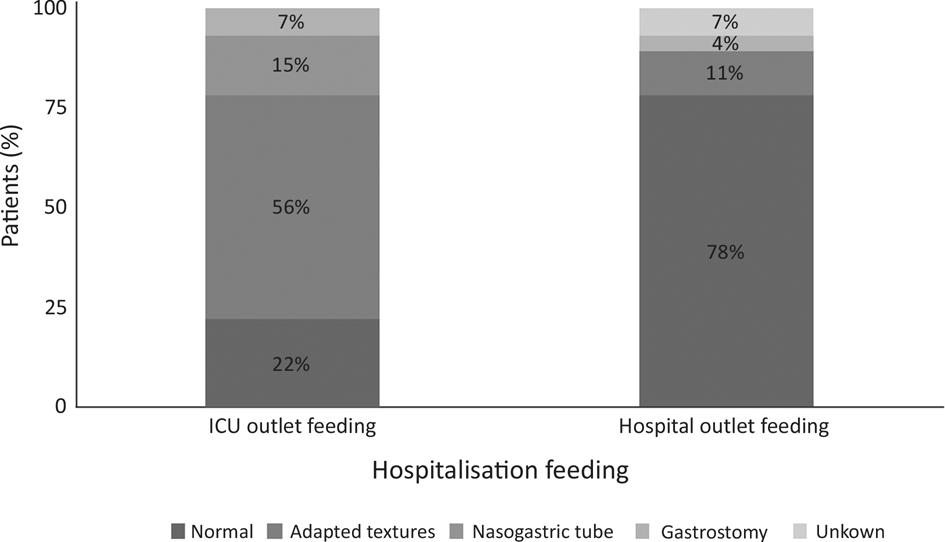
The presence of dysphagia was not significantly associated with the length of hospitalisation in intensive care, nor with the total length of hospitalisation. It should be noted that post-extubation dysphagia persisted for 78 per cent of discharged patients, but only 22 per cent had post-extubation dysphagia at discharge. At the end of intensive care unit treatment, 22 per cent of patients with dysphagia returned to normal diet, 56 per cent had an adapted oral diet and 22 per cent were still exclusively tube feeding (Figure 2). No inhalation pneumopathy following intensive care management was reported.
Feeding modalities after intensive care unit (ICU) admission and at the end of hospitalisation.

Discussion
For the SARS-CoV-2 population, intubation significantly prolongs the average length of intensive care unit treatment and hospitalisation. With a mean assessment time of 2.03 ± 1.93 days, 74.1 per cent of patients were intubated and 62.7 per cent of them had post-extubation dysphagia, representing 45 per cent of the intubated cohort. Significant associations were found between the presence of a swallowing disorder and: the severity of the initial pathology, the degree of muscle weakness and the initial severity indicated on CT. Tracheostomised patients had an oropharyngeal dysphagia prevalence of 75 per cent. Post-extubation dysphagia detection in this population would improve management and decrease intensive care unit hospitalisation length. The current pandemic leaves many unknowns regarding the clinical and functional consequences of this infection. This study is the first to specifically investigate swallowing disorders in patients admitted to intensive care units with SARS-CoV-2 infection.
The main evaluation criteria of this study are based on bedside screening. The lack of a universally validated dysphagia screening tool in the intensive care unit population leads to sensitivity problems. These assessments do not allow evaluation of the frequent silent aspirations following orotracheal intubation for the management of acute respiratory distress syndrome,Reference Scheel, Pisegna, McNally, Noordzij and Langmore13 a population close to that of this study. Consequently, the reported prevalence of swallowing disorders is probably underestimated by the methods used. However, faced with the increases in patient hospitalisation and the constraints linked to preventive measures, medical and paramedical staff have managed to adapt during this epidemic. Considering the risk–benefit balance, bedside screening remained the best alternative. Indeed, it revealed a significant proportion of dysphagia cases, and, given the ease of use, it could be repeated for re-evaluation and adaptation of food management.
The timeframe for assessment after extubation was not validated, and this may have influenced the post-extubation dysphagia prevalence results. Assessment times vary according to aetiology and duration of intubation. Relevant data are lacking in the literature, but it is customary to wait 24 hours when intubation has lasted for more than 72 hours.Reference Scheel, Pisegna, McNally, Noordzij and Langmore13–Reference Marvin, Thibeault and Ehlenbach16 This is in line with our study results, where the average assessment time was 2.03 days post-extubation.
Some of the post-extubation dysphagia risk factors assessed in the current study varied from those usually reported in the literature. Skoretz et al.Reference Skoretz, Flowers and Martino17 found that risk factors for post-extubation dysphagia included lengthy intubation duration, prolonged intensive care unit treatment time, multiple intubations, poor pre-intensive care unit admission functional status, hypercholesterolaemia or congestive heart failure. Other factors are also mentioned, although more frequently rejected, including: age,Reference Brodsky, Gellar, Dinglas, Colantuoni, Mendez-Tellez and Shanholtz18,Reference Brodsky, Huang, Shanholtz, Mendez-Tellez, Palmer and Colantuoni19 gender,Reference Brodsky, Gellar, Dinglas, Colantuoni, Mendez-Tellez and Shanholtz18–Reference Omura, Komine, Yanagigawa, Chiba and Osada21 and co-morbiditiesReference Macht, Wimbish, Clark, Benson, Burnham and Williams1,Reference Skoretz, Flowers and Martino17,Reference Barker, Martino, Reichardt, Hickey and Ralph-Edwards20,Reference Macht, King, Wimbish, Clark, Benson and Burnham22,Reference Ajemian, Nirmul, Anderson, Zirlen and Kwasnik23 such as hypertension, kidney disease, diabetes, COPD and smoking.Reference Skoretz, Flowers and Martino17,Reference Barker, Martino, Reichardt, Hickey and Ralph-Edwards20
Other parameters that are usually not significantly related to post-extubation dysphagia have been assessed because of the unknown nature of this pathology, and in particular the pulmonary severity of SARS-CoV-2 related impairment. Patients with severe disease were more likely to have an unfavourable clinical course, with prolonged hospitalisation and more frequent recourse to orotracheal intubation.Reference Zhao, Zhong, Xie, Yu and Liu24–Reference Guillo, Bedmar Gomez, Dangeard, Bennani, Saab and Tordjman26 Guillo et al.Reference Guillo, Bedmar Gomez, Dangeard, Bennani, Saab and Tordjman26 showed that 68 per cent of patients with parenchymal involvement of greater than 25 per cent were intubated or had died within three weeks of follow up. The search for potential associations with dysphagia thus seemed relevant.
Nevertheless, in our study, the delay between the initial CT scan and the onset of symptoms was not analysed, and the sensitivity of the CT scan is better after at least 5 days following symptom onset. A risk of data minimisation is therefore possible if the CT scan is carried out too early.
The current study revealed significant associations between dysphagia and: more severe lung damage, and the prolonged duration of both curare use and mechanical ventilation. There was also an association with the degree of muscle weakness, whereby all dysphagic patients had a Medical Research Council Scale for Muscle Strength score of less than 48 out of 60, indicating intensive care unit acquired neuromyopathy. In addition, this study found a significant association between the Simplified Severity Index 2 score at admission and the presence of post-extubation dysphagia. This factor has generally been rejected as a risk factor by different studies.Reference Macht, Wimbish, Clark, Benson, Burnham and Williams1,Reference Brodsky, Gellar, Dinglas, Colantuoni, Mendez-Tellez and Shanholtz18,Reference Macht, King, Wimbish, Clark, Benson and Burnham22 The initial severity of the pathology may be associated with more urgent, and, in turn, more difficult, intubation.
The prevalence of dysphagia in our study is high, with the condition affecting 62 per cent of the population who underwent swallowing analysis. The meta-analysis by Skoretz et al.Reference Skoretz, Flowers and Martino17 reported a prevalence for post-extubation dysphagia of approximately 25 per cent. The prevalence in this study was therefore higher. This could be explained by the severity of the initial acute respiratory distress syndrome associated with SARS-CoV-2, leading to an increase in intubation time. Hur et al.Reference Hur, Price, Gray, Gulati, Maksimoski and Racette27 reported that 72.5 per cent of patients intubated for SARS-CoV-2 pneumonia were intubated for more than 7 days, and 90 per cent of the 486 patients remained in hospital for more than 10 days. In the current study, the mean duration of intubation was 17 days, with a significant association between the duration of orotracheal intubation and the presence of dysphagia.
• Dysphagia in intensive care units is frequent and underestimated, despite morbidity and mortality risks, particularly after extubation
• Bedside screening for dysphagia in the context of severe acute respiratory syndrome coronavirus 2 (SARS-CoV-2) pneumonia may underestimate its prevalence
• There is a lack of validated screening tools for post-extubation dysphagia in the intensive care unit
• Post-extubation dysphagia in SARS-CoV-2 pneumonia patients seemed dependent on: severe pathology, prolonged orotracheal intubation and curare use, and muscle weakness
• Post-extubation dysphagia did not seem dependent on: age, weight, sex, medical history or intensive care unit duration
• Reported dysphagia prevalence was higher than in other acute respiratory distress syndromes, but was transient with good recovery
In conclusion, the prevalence of Covid-19-related oropharyngeal dysphagia in the intensive care unit is higher than in other patients with acute respiratory distress syndrome, particularly in post-extubation periods, but the condition seems to improve quickly. Nevertheless, our results demonstrate that oropharyngeal dysphagia should be assessed in patients with SARS-CoV-2 infection using systematic screening, to optimise nutritional management and reduce the risk of early complications.
Competing interests
None declared