He realized, as every hireling must, … that he belongs to another, whose will is his law.
Howells, A Hazard of New Fortunes (1889), 353The opposition in human nature of the two ideas of solidarity and personality may be … illustrated by describing as an expression of the former the sense of the sublime, of the grand, of … the instinct of infinity, and on the other hand as an expression of the personality, the desire of being circumscribed, shut in, and bounded, the aversion to vague limitations, the sense of coziness … or what may be called the instinct of finity.
Bellamy, The Religion of Solidarity (1873), 25The crisis of the self and some uses of it
William Dean Howells's novel A Hazard of New Fortunes, published in 1889, enjoyed tremendous success. Critics praised the author's social vision of ‘humanitarianism and co-operation’.Footnote 1 After reading it, Howells's friend William James reported that he could ‘hardly recollect a novel that ha[d] [so] taken hold of [him]’; A Hazard of New Fortunes was a ‘d-d humane book’.Footnote 2 Set in New York, the novel probes the relationships among a group of people engaged in the publication of a new magazine. Each of the male characters struggles to preserve a sense of selfhood and self-mastery. The owner of the magazine, a natural-gas millionaire, belongs to the category of men ‘who have made money and do not yet know that money has made them’.Footnote 3 The literary editor, a middle-aged man who took on the job in the hope of furthering his literary aspirations, becomes increasingly aware of a loss of self-direction. As he tries to comply with the whimsies of the owner of the magazine, he quickly realizes, ‘as every hireling must’, that he is a puppet in the hands of ‘another, whose will is his law’.Footnote 4 The selfish and ambitious artistic editor quickly loses his self-confidence and self-respect as he becomes aware of his profound lack of authenticity. Reflected through the critical eyes of the woman who does not reciprocate his love, he perceives the splintering of his self into a multiplicity of conflicting social masks.Footnote 5
Soon a best-seller, the novel chronicled the weakness and divisiveness of the self and the profound erosion of the conception of selfhood that had structured social and economic activities and individuals' self-perception in antebellum America. Howells's diagnosis was unambiguous. The crisis of the unitary and sovereign self was a by-product of industrial capitalism, an economic order that deprived many of the conditions that throughout the nineteenth century had been associated with citizenship and selfhood: ownership of means of production, or of one's labour.Footnote 6 Only one solution was left – to relinquish at once laissez-faire economy and the illusion of the self-directed simple self.
In America at the start of the twentieth century anxiety concerning the erosion of the unitary and masterful self was widespread and widely experienced across social classes.Footnote 7 Not only intellectuals and middle-class people, but also the artisans and workers who lost their craft identities, sometimes experienced an ‘uncanny sense of unsubstantiality’ or a disturbing sense of fragmentation.Footnote 8 In what appeared to be the absence of a strong unifying principle, the self could splinter into a cluster of contradictory social roles or into a series of inconsistent behaviours. Mental physiologists revealed that heredity, instincts and reflex-arc automatisms controlled many acts previously thought to be controlled by consciousness.Footnote 9 Rapidly multiplying cases of pathological or artificially induced ‘dissociation’ (split personality, hysterical symptoms or posthypnotic states) as well as states obtained by means of occult practices (automatic writing, trance and projection of the double) displayed a self that was split by deep fault lines and appeared to be at the mercy of powers sometimes perceived to be ‘alien’ to the personality of the subject experiencing those conditions.Footnote 10 These phenomena contributed to the structuring of the experience of selfhood at the turn of the twentieth century.
In response to that perceived ‘collective crisis of identity’ scores of moralists and preachers taught others how to regain self-mastery and wholeness in a new social and economic order.Footnote 11 To other commentators, instead, the decline of the isolated individuality appeared to open up the possibility for a full socialization of life and for new forms of cooperation. Both social actors who saw industrial capitalism as an end in itself and those who perceived it as one stage in the transition to socialism gladly gave up the burden of the individuated, well-bounded self and explored new forms of subjectivity. They relocated agency from the individual to the social group and spread the self over social networks, depicting it as a ‘permeable entity with indistinct boundaries’.Footnote 12 Among these theorists of the ‘social self’, some resorted to the language of the emerging science of sociology and conceptualized the self as a product of associations, even of ‘social institutions’.Footnote 13 Others, instead, cast the ‘social’ self in decidedly religious, even mystical, frameworks. They linked the overcoming of what the social visionary Edward Bellamy identified as an ‘instinct of finity’ or of personality, and the prevailing of the opposite instinct of ‘infinity’ and ‘solidarity’, to experiences of ecstasy and mystical unification. In such states, those mystical writers revealed, individuals could not only step out of the confines of their individualities but also participate in the life of a larger truer self and sympathize with their fellow human beings in new ways.Footnote 14 Ultimately, both the theorists of a secular social self and the more mystical or religious writers perceived that the inner division of the self and its loose boundaries made the human being intrinsically social.
This article revisits the question of the social and political valence of William James's account of the self by locating it in these realms of discourse and practice.Footnote 15 James worried about the lack of self-mastery, general weakness and ‘lack of inner harmony’ of the modern self, which he diagnosed as effects of the hectic life prevalent in modern America.Footnote 16 He found troubling symptoms of those conditions in himself: in his fear of becoming insane, for example, in the antagonism among his various social selves,Footnote 17 and in his early bouts of depression and, later, of neurasthenia.Footnote 18 Like William Dean Howells, a close friend, and Edward Bellamy, a writer whom James much admired, James perceived that the breakdown of the autonomous, well-bounded self opened up new possibilities both for the individual and for society. James also realized that the crisis of the traditional self and the new social order made it necessary to rethink the relationship between the individual and society. As did many of his contemporaries, so James addressed what he perceived to be a fundamental tension: that between the claims of society and those of the individual, between a new tendency toward a full socialization of life and individuals' desire to retain autonomy and moral agency. Other authors have fully explored the issue of James's political orientation and the linked question of his reaction to the shift from proprietary capitalism to ‘corporate’ capitalism. Some find that James resolutely opposed capitalism and its institutions, whereas others conclude that James, like other pragmatists, created a ‘framework’ for the ‘acceptance’ of corporate capitalism. Despite their widely diverging conclusions, the work of these historians is important and innovative. Instead, I suggest that ultimately the terrain on which James addressed the all-important issues of the proper modes of human interaction, and of the autonomy of the individual vis-à-vis ever more powerful social and economic institutions, was not primarily that of politics or of political economy. It was that of psychology (normal, ‘abnormal’ and ‘supernormal’), of metaphysics and of mysticism. Located at the intersection between those fields of inquiry and areas of experience, James's account of the self negotiated the relationship between the individual and society in a way that reconciled individual autonomy and agency with the full socialization of the individual demanded by the new social order.
After a quick review of James's political views and the topology of the self that he delineated, this essay makes two main claims. First, the Jamesian self and the techniques of self-cultivation that James promoted, especially techniques for the unification of the divided self, were instrumental to the creation of a strong citizenry that could participate in political action and initiate effective social change in a pluralistic, democratic society. Second, James redefined the boundaries separating the individual self from society, and those separating different individuals within society. Especially in the last, politicized decade of his life he envisioned an open self surrounded by uncertain and leaky contours. The permeable boundaries of the individual self made it possible to imagine a type of social interaction essentially different from the intersections of the solitary isolated trajectories of the economic individuals of classical liberal thought. Such a social interaction was rooted in intimacy and solidarity. This vision of society, I suggest, was deeply steeped in religious and occult practices and owed much to mystical-cum-political discourses of the time. It ultimately found its enabling conditions in the complex metaphysics that James articulated in the final years of his life. In that context James crafted his ‘mystical’ version of the social self and created the conditions of possibility for a deeply communal life fully compatible with the claims of individualism.
James in the political spectrum
James was a politically engaged thinker even though the exact nature of his political vision is difficult to capture. He sometimes described himself as a ‘mugwump’, locating himself among those who in 1884 bolted the Republican Party, condemning in the name of civic virtue the presidential nomination of the ‘corrupt’ James G. Blaine.Footnote 19 The mugwumps, as Robert B. Westbrook observes, perceived themselves as individuals endowed with a superior culture, character and moral sensibility, and they believed that ‘they were entitled by virtue of these credentials to political leadership’. With them James, who came from a family of ‘inherited wealth’, shared a concern that democracy might turn wrong and a desire to steer it along safer lines, by placing government and the choice of political leaders in the hands of an educated elite.Footnote 20 With the mugwumps James fought his main (according to some, his only) political battle: a passionate struggle against the new imperialistic turn taken by the United States in the mid- and late 1890s.Footnote 21 In those years James grew tremendously concerned about the US's interventions in Venezuela, Cuba and the Philippines. When the US invaded the Philippines in the wake of the Spanish-American war, he vigorously protested. Joining strength with other eminent mugwumps and with the newly founded ‘Anti-Imperialist League’, James passionately denounced the annexation of the Philippines as ‘the most incredible, unbelievable, piece of sneak-thief turpitude that any nation ever practiced’.Footnote 22 With that act of ‘piracy’, James wrote, the United States had ‘once for all regurgitated the Declaration of Independence’ and betrayed the ‘old American soul’.Footnote 23
James, however, was a ‘singular mugwump’ and his political self-definition leaves considerable room for interpretation.Footnote 24 James T. Kloppenberg sees James as a proto-‘social democrat’, but observes that the ‘traces of James's political preferences are too faint to provide more than a tentative outline of his ideas’.Footnote 25 Other scholars, instead, ascribe to James more precise political sympathies. For some he was committed to ‘radical participatory democracy’ and to ‘communitarian liberalism’, while for others James supported ‘populism’ and ‘petty-producerism’.Footnote 26 Deborah J. Coon, instead, argues that chiefly in response to mounting American imperialism James became an anarchist. James confessed such feelings to William Dean Howells, revealing that, in the face of recent events, he found himself to be growing ‘more individualistic’, even ‘anarchistic’.Footnote 27 Coon argues that such claims must be taken at face value and documents James's intellectual affinity with a tradition of ‘communitarian anarchism’.Footnote 28 She also stresses that James's opposition to American imperialism was often expressed in terms that suggested a parallel hostility to the institutions of capitalism. To James the rhetoric of ‘big national destinies’, deployed by McKinley and Roosevelt to justify the annexation of the Philippines, deprived the ‘Filipinos’ of their just aspiration to ‘self-control’ and self-government, in the same way as ‘trade-combines’ and ‘department-stores’ threatened the self-directedness of the individual.Footnote 29 James's anarchism, Coon argues, stemmed from his passionate defence of self-governance both for the individual and for ethnic groups.
If for Coon and others James strenuously resisted capitalism and the rational bureaucracy of the corporations, other scholars instead depict James as an ally of capitalism. Lewis Mumford started that trend in the mid-1920s when he accused James's pragmatism of ‘acquiescing’ to modern industrialism and to the world of finance. For Mumford, James's pragmatism emanated the unpleasant ‘smell of the Gilded Age’.Footnote 30 More recently, making a virtue of what for Mumford was a sin, James Livingston praises James and other pragmatists for creating a ‘frame of acceptance’ for ‘corporate capitalism’, a ‘hybrid’ form of capitalism that embraced at once both the older proprietary capitalism and socialism.Footnote 31 Livingston argues that James and his pragmatist friends plotted a path that allowed them to ‘navigate’ the transition ‘from proprietary to corporate capitalism’. Since these thinkers ‘recognized’ that ‘the development of capitalism’ created the ‘necessary condition of a passage beyond class society’, Livingston concludes that James was a ‘socialist’.Footnote 32
These divergent conclusions suggest that, although not a sterile exercise, the task of pinpointing the exact nature of James's political affiliation may ultimately elude us. I suggest that we shift our attention from the question of James's political affiliation to the modes of social engagements that he proposed. Here, James scholars seem to find common ground. Most agree that James's much-celebrated ‘individualism’ was tempered by a complementary emphasis on solidarity and community.Footnote 33 In one of James's own favourite works, an address that he presented to student audiences, he stressed that when we look at other people from the position of the ‘external spectator’, as we ordinarily do, we are bound to remain blind to the inner significance of their lives.Footnote 34 That ‘ancestral blindness’ was the source of many conflicts, including the mounting tensions between labour and capital. James (notoriously) ascribed these tensions, in part, to the inability of workers and capitalists to ‘sympathize’ with the point of view of the other. Yet, James continued, sometimes the vision of the inner secret of other people's lives comes on us, suddenly, as in a mystical revelation. In these sudden experiences we step out of ourselves, away from our external point of view, and become able to commune with a larger life: the life of the universe, the life of nature or the life of other people. From this displaced, ecstatic position we become able to appreciate intimately other people's ideals and feelings, and feel a deep sympathy for them. In such moments, James continued, the self ‘is riven and its narrow interests fly to pieces’.Footnote 35
In another address to students, James confessed to have experienced one such sudden sympathetic ‘flash of insight’. One day he was travelling on a train towards Buffalo lost in his thoughts when suddenly ‘the sight of a workman doing something on the dizzy edge of a sky-scaling iron construction’ brought him ‘to [his] senses’: ‘I perceived, by a flash of insight, that I had been steeping myself in pure ancestral blindness, and looking at life with the eyes of a remote spectator.’ He suddenly realized that the lives of labourers struggling to build a railway bridge or a fireproof tower, or toiling ‘on a freight-train, on the decks of a vessel, in cattle-yards and mines’, were replete with courage and meaning. The ‘scales fell from my eyes’, he continued, and ‘a wave of sympathy greater than anything I had ever before felt with the common life of common men began to fill my soul’.Footnote 36
To be sure, James's newly acquired sense of vision retained some shortsightedness. Despite the sudden revelation that hit him in the train, James continued to be remarkably blind to the inner meanings of other people's lives, especially those of the workers. Workers, as Cotkin notes, ‘fell from [James's] pantheon of true heroes … because they lacked ideality’ and because ‘they selfishly desired material comfort and security’.Footnote 37 Not surprisingly some commentators of the time, including John Dewey, depicted James ‘as an aristocrat’ who had ‘no real intimation’ of the labour problem.Footnote 38 These limitations, however, did not prevent James from drawing an honestly meant social lesson from his discussion of the ‘ancestral blindness’. It was a lesson of democratic tolerance, respect for individuality and non-interference with other people's ‘own peculiar ways of being happy’. He made it central to his ‘pluralistic, individualistic philosophy’.Footnote 39 Yet implicit in his discussion was also another social message: an invitation to go beyond ‘tolerance’ and to practise a form of solidarity and intimacy. James was inviting his student audiences to sympathize with other people and engage with them in more intimate ways.Footnote 40 That invitation was central to James's anti-imperialism. As Robert Beisner observed, while other anti-imperialists emphasized the economic circumstances that backed up US expansionistic politics, James ‘psychologized’ imperialism. American imperialism for him stemmed from a predatory ‘war’ instinct that was intrinsic to human nature, combined with the staggering inability of American politicians to engage with the inner lives and ideals of the Filipinos. American leaders, James complained, had framed the relationship between the US and the Philippines as a relationship between ‘two corporations’: ‘a big material corporation against a small one’.Footnote 41 Such business relationships excluded a priori the consideration of the minds of the people involved and resulted in the inability to consider the Filipinos as ‘psychological quantities’.Footnote 42 To remedy that situation, James invited American politicians and his fellow citizens to handle things ‘psychologically’ and to try to ‘connect with the “Philippine soul”’.Footnote 43
How does James's invitation to deep mental connection, sympathy and solidarity square with his self-description as an individualist? Today, from the vantage point of new forms of solidarity and cosmopolitanism which, as David Hollinger suggests, enable people to reconcile loyalty to larger social groups with loyalty to their own individualities and personal perspectives, it may be hard for us to see that those two goals might have appeared antagonistic at the turn of the twentieth century.Footnote 44 And yet many philosophers, psychologists, psychiatrists and biologists of the time found that individualism did not easily square with solidarity and cooperation.Footnote 45 James himself, as we will see, was concerned that many of the available plans for solidarity and altruism required the annihilation of the individual. That has led some scholars to argue that James's individualism implied a denial of ‘community’,Footnote 46 and others to conclude that, because of his strong emphasis on the sociability of humans, James was no individualist. How, then, did James approach the tension between individualism and communitarianism?
Looking at the topology of the Jamesean self, at its inner structure and the nature of its boundaries, will help us discern some answers to those questions.
Topologies of the self (1): the divided self
In common with other psychologists of the time, James challenged the dogma of the unity and simplicity of the self. In The Principles of Psychology (1890), the only text in which James ever dealt systematically with the notion of the self, he split the self into two parts: the Ego, or the principle of felt personal identity, and the Me, or ‘empirical self’.Footnote 47 He immediately split the Me into a variety of sub-selves. These included the ‘material self’ (our body, our clothes, our house, our children, our family and our friends, our ‘lands and horses, and yacht and bank-account’), a person's various ‘social selves’ and a spiritual self.Footnote 48 The ‘social self’ consisted in ‘the recognition which [a man] gets from his mates’. A ‘man has as many social selves as there are individuals who recognize him and carry an image of him in their mind’. The existence of different social selves within one person depended on the fact that one tended to show ‘different sides’ of oneself to different people (to one's ‘children’ and ‘club-companions’, to one's ‘customers’, employee or employers).Footnote 49 The spiritual self, instead, was the felt centre of self-activity. James famously identified the ‘feeling of the central active self’ with certain perceived motions in the head, and especially motions of the glottis, neck and the eyeballs.Footnote 50 These various selves, including a person's various potential social selves, could occasionally live peacefully next to each other, each practising its own social role in a sort of ‘harmonious division of labor’. More frequently, however, they would be at odds.Footnote 51 People were expected to negotiate the relationships between their various sub-selves and organize them in such a way as to avoid competition and tension.
Like the Me, the second pole of the self, the Ego or the principle of personal identity was not immune from division. While acknowledging the feeling that each person had of their personal unity, James insisted on combining that perceived unity with metaphysical disunity and pluralism. He identified the Ego with the ‘present thought’ that an individual had. At any moment, James acknowledged, we are able to distinguish between thoughts that belong to us and thoughts that do not. The former are pervaded by a feeling of ‘warmth and intimacy’ which does not accompany the latter. In sorting out thoughts that belong to it, James wrote, the self resembles the owner of a herd of cattle let loose for the winter on some wide Western prairie. As spring comes, the cattle-herder is able to collect all the ‘beasts’ that belong to him, picking out those ‘on which he finds his own particular brand’.Footnote 52 This irreverent metaphor did justice to the ‘common sense’ intuition that ‘there must be a real proprietor’, something which actually unifies the self.Footnote 53 It simultaneously posited that plurality and division were intrinsic to the self, making the self into a ‘mixture of unity and diversity’. Not only did the herd consist of a plurality of animals; even the ‘herdsman’, who came and performed the act of collecting the animals, dissolved into a plurality of things, a series of ‘herdsmen’. Each of them inherited his ‘title of ownership’ from its predecessor, thus standing as the ‘legal representative of all past predecessors’. James redefined the economic relationship of ‘ownership’ that had been constitutive to much of the nineteenth-century American rhetoric of personal identity. Each current self (each ‘passing Thought’), he proposed, was born a free ‘owner’ but died an ‘owned’, since it ended as a property ‘possessed’ by the subsequent self.Footnote 54 Self-ownership – self-possession – became an internalized and transient relation, ever to be reconfigured among shifting terms.
As has amply been discussed by other scholars, the Jamesian self was cut by even deeper lines of division.Footnote 55 Sometime in the late 1880s James visited the Salpêtrière, the Parisian hospital that Charcot had made into the most famous museum of living ‘hysterics’. Among the spectacular symptoms displayed by Charcot's patients, James was fascinated by a relatively modest one: localized forms of anaesthesia including blindness to certain objects and the related symptom of contraction of the field of perception. One of Charcot's younger associates, Pierre Janet, had developed the theory that hysterical symptoms were always correlated with forms of somnambulism involving a ‘dédoublement’ of the personality. He suggested that hysteria was made possible by a weakness of psychological ‘synthesis’, a defect in the subject's power to ‘gather … his psychological phenomena, and assimilate them to his personality’.Footnote 56 Hysterical subjects were therefore incapable of sustaining a coherent personal identity. Janet led James through the wards of the Salpêtrière and James adopted his theory of hysteria.Footnote 57 James summarized it as follows: ‘the hysterical woman abandons part of her consciousness because she is too weak nervously to hold it together’. Meanwhile, the ‘abandoned’ parts may float around or solidify into secondary, ‘parasitic’ or ‘subconscious’ selves.Footnote 58
In the 1880s and early 1890s James studied both pathological and artificially induced dissociations in a series of experiments on automatic writing, hypnotic trance and posthypnotic suggestion. For example, in the late 1880s he conducted experiments designed to test the hypothesis that in automatic writing the automatic hand could be the site of a type of local anaesthesia similar to hysterical anaesthesia.Footnote 59 During the experiment, the right hand of the subject was placed on a planchette, an instrument normally used in spiritualist seances, in such a way that the subject could not see it. James pricked the ‘automatic’ hand several times. While the hand complained in writing (‘Don't you prick me any more!’), the subject observed that his hand ‘felt asleep’. James concluded that the consciousness of the subject was split into two incommunicable consciousnesses: a ‘mouth-consciousness’ and a ‘hand-consciousness’ or ‘automatic consciousness’.Footnote 60 In 1886, as a member of the Committee on Hypnotism created by the newly founded American Society for Psychical Research (ASPR), James performed a series of experiments on ‘selective blindness’. This condition could be artificially induced through hypnotic suggestion in certain subjects who would become temporarily ‘blind’ to specific visual stimuli. The ASPR committee's experiments repeated, with some variations, experiments previously performed by Binet, Janet and others. These experiments confirmed that the hypnotic blindness was ‘false’. The images that the hypnotic subject failed to see were ‘felt’ or ‘apperceived’ by somebody else, a secondary consciousness (self), which seemed to alternate with the waking consciousness.Footnote 61
James was familiar with other experiments with posthypnotic suggestion performed by his friend Edmund Gurney, a leading British psychical researcher. Gurney would hypnotize his subject and ask him or her to perform a complex task, such as the solution of an arithmetical problem. He would then immediately wake the subject, place his or her hand on the planchette, and keep the subject's ‘normal self’ busy with conversation and other tasks. After a little while, the planchette would write down the correct solution of the problem that the subject had been asked to solve, or an answer closely approximating it. Gurney concluded that far from being ‘automatic acts’ (reflex actions), the answers written by the automatic hand revealed the presence of an active consciousness, a ‘latent’ secondary self or consciousness ‘segregated’ from primary consciousness yet ‘simultaneous’ with it.Footnote 62 From his own and Gurney's experiments James drew the conclusion that the ‘secondary’ consciousness could not only ‘alternate’ with the waking consciousness, but could also ‘coexist’ with it.Footnote 63
Like other psychologists of the time, James wondered whether that type of inner division was confined to the realms of the artificial and the pathological.Footnote 64 Pierre Janet, for example, denied what to many seemed to follow directly from his investigations. He saved, at least temporarily, the unity of the normal self and posited a link between dissociation and hysteria.Footnote 65 Other experimental psychologists had no such hesitations. Thus Théodule Ribot, whom James met in Paris in 1882, stated unambiguously that the unity of personality stemmed not from a metaphysical underlying principle but from an empirical process. This process, largely biological, recapitulated the evolutionary processes that led to the emergence of a central consciousness in higher animals. It began with multicellular organisms consisting of physically juxtaposed identical cells, each endowed with its autonomous psychic life. Then the process went through the stage of ‘colonial organisms’, polyps and Hydrae for example, in which a new centralized consciousness made its first appearance.Footnote 66 This higher consciousness, which could temporarily harness for common goals the autonomous consciousnesses of the members of the colony, came to symbolize for Ribot the precarious unity of the human self, which required a constant effort of ‘coordination’. Thus division was a constitutive feature of human nature.
James agreed with Ribot. The unity of personality was the result of empirical processes and did not pre-exist those processes. In the mid-1890s he used the analogy with colonial organisms (‘polyzoism/polypsychism’) to represent the condition of dissociation found in pathological cases and challenged Janet's reluctance to extend dissociation to healthy individuals.Footnote 67 James wrote that he knew a ‘non-hysterical woman’ who could fall into trance and display telepathic powers.Footnote 68 Her case clearly proved that dissociation could be found in at least some healthy people.Footnote 69 Pierre Janet questioned that claim. In a private letter he urged James to subject the woman to a thorough examination of her vital parameters – hysteria was most likely present but had gone undetected.Footnote 70 James's answer to Janet has not survived, but he did not take up the suggestion or change his mind. By the early 1900s he had come to look at the fault line separating a normal self from a subliminal self as a feature of the normal human self.Footnote 71
Topologies of the self (2): stretching the boundaries of the self
James liked to think of the present state of consciousness as a visual field with its centre and margins. The centre represents that of which we are actively conscious, while the margin (a ‘penumbra’, or ‘halo’) represents things of which we may be dimly aware or even unaware, but which, if we refocus our attention, could shift to a central position.Footnote 72 The topology of the field and the distribution of light and shade are transient and can be reversed. What is central can become peripheral and what is peripheral can become central and luminous.Footnote 73 James used the same metaphor to describe the self. At any moment the self has a centre and a periphery. The centre is occupied by our ‘hot’ beliefs, those which are sources of energy and which direct our activities. We identify our individual selves with the centre of the field, but changes can occur. Thus during the course of our life we may suddenly find that the inner balance has shifted. We then discover that what was central no longer has any importance and that we are now ready to identify our innermost self with what was once marginal. The metaphor was suggestive because it allowed one to visualize the ‘indetermination of the margins’ of consciousness and of the self.Footnote 74
James asked where the self ends, echoing a question that Madame Merle asked Isabelle Archer, the heroine of Henry James's Portrait of a Lady (1882).Footnote 75 What do the boundaries of the self look like? How far do they stretch? To James these were the important questions raised by automatic writing and other psychic phenomena.Footnote 76 As a member of the Society for Psychical Research, James had come to know very well the work of F. W. H. Myers, one of the society's founding members. Myers took telepathy and hypnotism at a distance to indicate that the subliminal self of an individual could have ‘direct relations of intercourse … with the consciousness of other men’.Footnote 77 Projection of the double, bilocation, phantasms appearing to entire groups of people and ‘traveling clairvoyance’, or ‘telaesthesia’, in dreams and crystal-gazing suggested that the subliminal self was by no means confined to the region occupied by the body and its immediate surroundings. This self could actually step out of the body and invade physical space. Mediumistic trance and cases of what would once have been interpreted as demonic possession seemed to indicate that the subliminal self might also communicate with spirits of the dead and a ‘cosmic environment’.Footnote 78 James was sceptical of Myers's spiritualist conclusions.Footnote 79 That did not prevent him sitting outside Myers's hotel room in Rome, where Myers was dying. James had a pencil in hand ready to jot down otherworldly messages. As a psychical researcher James investigated ‘veridical hallucinations’, mediumistic trance and telepathy, the only psychic phenomenon the reality of which James took to be adequately supported by empirical evidence.Footnote 80 He also investigated an episode of clairvoyance that resulted in the solution of a case of accidental death. He knew a few respectable people who believed they had managed to project their ‘doubles’.Footnote 81 In February of 1906 he had uncanny fearful experiences with dreams. He woke in the middle of the night with the distinct impression that he had been dreaming somebody else's dreams and that dreams dreamt by somebody else had been ‘telescoping’ into his own dreams. Was he telepathically ‘getting into other people's dreams’? Or was he experiencing ‘an invasion of double (or treble) personality’, and ‘losing hold of [his] “self”’?Footnote 82 James was famous among his closest friends for conducting experiments on himself with nitrous oxide, chloral, amyl nitrite, hashish and other anaesthetics that appeared to lower the threshold separating the normal waking self from the subliminal self.Footnote 83 These and similar experiments conducted by some of his acquaintances, such as the self-taught philosopher and mystical writer Benjamin Paul Blood, also seemed to indicate that the self could communicate with a larger mental region, a region of consciousness separated from ‘our normal waking consciousness’ only by ‘the filmiest [sic] of screens’.Footnote 84 Mystical ecstasies, which James studied extensively, supported that conclusion. The subliminal self was not enclosed but, as James surmised when discussing Myers's achievements, seemed to have ‘windows of outlook and doors of ingress’ through which it could open up to ‘an indefinitely extended region of the world of truth’.Footnote 85 The dogma of the isolated impermeable self was untenable: the boundaries of the self were permeable and leaky.Footnote 86
The unification of the self: how to make strong citizens
Josiah Royce observed in 1901 that supporters of ‘extremer forms of ethical individualism’ often found it convenient to resort to ‘realistic’ theories of the self. These theories made the self into a substance logically, ontologically and psychologically independent of the existence of other selves. Realistic theories of the self, Royce went on, were attractive to ethical and political individualists because they preserved in a direct way ‘the dignity’, ‘the freedom’ and ‘the rights of the Self’.Footnote 87 Despite his self-proclaimed individualism, however, James never essentialized the self. He depicted a metaphysically weak self, menaced by inner division, surrounded by porous boundaries and only precariously whole. This was a self that seemed hardly compatible with the claims of individualism. Yet James transformed the weak and divided self into a tool that people could use in order to achieve renewed strength and agency.
James repeatedly lectured his contemporaries on the need to fight inner enemies: inward division, loss of self-mastery, resignation and a sense of weakness. At this juncture his account of the self intersected with the so-called ‘New Thought’, which some of its proponents regarded as both a philosophy of life and conduct and a mode of healing. It also met a range of medical and religious practices for the cultivation of the self.Footnote 88 Mind curers, mental hygienists and followers of the New Thought all advertised techniques that would enable ordinary individuals to eliminate inner division and obtain confidence, energy, inner harmony and self-mastery. James was intensely fascinated by the culture of self-help and thoroughly familiar with many of the practices recommended by mental healers and spiritual therapists.Footnote 89 For example, around 1906 he tried breathing exercises recommended by a yogi teacher, the Swami Vivekananda, whom James had met in 1896.Footnote 90 Through such exercises individuals could learn how to control breathing and thus develop powerful forms of self-mastery. James practised breathing exercises ‘somewhat perseveringly’ around 1906, hoping to bring his insomnia under control. The exercises unfortunately failed to produce any ‘soporific effect’. James found that they ‘got terribly against the grain with me’, perhaps because he was ‘so rebellious at all formal and prescriptive methods’. He seemed persuaded that in some cases such exercises could indeed increase ‘vital tone and energy’ and wake up ‘different levels of will-power’.Footnote 91 James was also familiar with the New Thought meditation technique known as ‘entering the silence’, a practice which consisted in averting thought from the external world and ‘draw[ing] the diffused powers of thought’ until they were focused on the soul and the divine Spirit. This technique, as the New Thought leader Horatio W. Dresser advertised it, would heal inner division and lead to the ‘development of spiritual poise’, ‘spiritual self-control’ and the ‘ability wisely to direct one's thought forces’.Footnote 92 While James did not personally seem to have found meditation congenial,Footnote 93 he nevertheless closely followed the activity of Dresser, who had been a student of his at Harvard and acknowledged James's influence on the development of the New Thought.Footnote 94 James was also a vocal supporter of Horace Fletcher, a mental hygienist specializing in dietetics. Fletcher had devised a system for curing dyspepsia that consisted in chewing each morsel of food thirty-two times. He had also found a way of escaping fear and anxiety. The trick consisted in believing that those negative emotions could be overcome. Once this was accepted it became easy to see that those emotions must and would be overcome. The method was advertised as a cure for pessimism, selfishness and violence and as a means to attain serenity, health and self-control.Footnote 95 As with other mental hygiene practices, James's experiments with prolonged chewing did not give the results he hoped.Footnote 96 Yet he was persuaded of the importance of Fletcher's techniques of self-mastery and inner unification. James carefully read books and pamphlets by several other mental hygienists and Christian preachers. For over twenty years he occasionally turned again with mixed results to mind-healers in order to deal with various ailments that afflicted him, including especially fatigue and his intractable insomnia.Footnote 97
James's account of the self was a contribution to such mental therapeutics. Perhaps the passages of Principles of Psychology that evoked the most enthusiastic popular response were those that advised his readers on how to cultivate good habits and eliminate bad ones. To James, as to most mental physiologists of the time, habits were concatenated series of automatic reflex action processes, mechanical actions which originated from what initially had been conscious purposeful actions and which had become ‘grooved’ in the brain.Footnote 98 James believed we are responsible for the habits that we acquire and ultimately, since habits are such an important part of our nature, for the type of person we are. We are constantly ‘fashioning our character’ and ‘spinning our own fates, good or evil, and never to be undone’. The physiology of habits explained why it was so difficult to get rid of an inveterate habit and to acquire a better one. At the same time the plasticity of the nervous system ensured that if one really tried one could fashion a new character and become a new person. One merely needed to strive ‘with as strong and decided an initiative as possible’ and ‘never suffer an exception to occur’ until the new habit set in. James exhorted his readers to cultivate the ‘faculty of effort’ and keep it ‘alive … by a little gratuitous exercise every day’. He stressed the importance of daily exercise of the ‘habits of concentrated attention, energetic volition, and self-denial in unnecessary things’.Footnote 99 James's moralizing indictment of impolite habits conveyed a tremendously hopeful message. Precisely because it was not metaphysically fixed once and for all, the self could be made and remade, woven and rewoven.
Central to James's therapeutics of the self was the goal of the integration of personality. For James this was not only a medical and a hygienic necessity but also a moral ideal, in much the same way as integration of mental faculties into a harmonious whole had been a crucial goal earlier in the century for scores of moral philosophers and educators.Footnote 100 Making the self whole was a moral duty. We all begin our lives in a chaos, James wrote in the early 1900s. Conflicting feelings and impressions are all mixed up. Each of us needs to sort out that confusion and to organize opposite tendencies in some ‘stable system’. That was what character formation was about. A person of character was a person who had managed to ‘straighten’ and ‘unify’ the self. The antithesis was represented by the ‘heterogeneous personalities’ or the ‘hysterical temperament[s]’: individuals whose inconsistent, zig-zag behaviour was socially disruptive as well as individually painful.Footnote 101 James toyed for a moment with the hypothesis that heterogeneity of impulses could be the result of heredity and that the divided self could be the powerless passive battlefield where ‘incompatible and antagonistic’ ancestral tendencies struggled with each other.Footnote 102 He quickly dismissed this theory, however, and instead suggested that heterogeneous personalities resulted from a failure in the normal evolution of character. Thus inner division could be more than a pathological mark; it could also indicate a moral failure, a failure of diligence and resolve in maintaining the self.
Sometimes the unification of the self could occur spontaneously, in ways inexplicable to individual consciousness. That happened in religious conversions, especially instantaneous conversions, which James regarded as the culmination of subliminal processes through which the divided self eventually found itself rearranged around a new centre of interest, and gained unity and inner peace.Footnote 103 Whether spontaneous or painfully cultivated, the unity of the self nevertheless remained precarious. Many of the techniques of unification that James explored were fundamentally techniques of ‘attention’, techniques that required the subject to focus attention on some object, content or movement. But, as Jonathan Crary has shown, practices of attention such as those involved in late nineteenth-century psychological therapy and hypnosis always produced marginality and distraction. In fact, they contributed to the fragmentation of the modern self.Footnote 104
Indeed, the unifying techniques with which James engaged ultimately generated residual materials. They reproduced some of the divisiveness they attempted to heal. Examples included both the attentive, consciously synthetic, practices of breathing and meditation such as the ‘method of concentration’ of the powers of mind preached by the Swami Vivekananda,Footnote 105 and the spontaneous processes underlying conversion, a process which James famously described as a unification of the divided self. Both involved a refocusing of attention, resulting in redefinition of the centre of the field of experience and selfhood and marginalization of previously central material. The ‘unified self’ required marginality and diversity; the topology of the field with a centre and margins remained constitutive of the self. As John McDermott aptly writes, for James the unified self remained a ‘bundle of relations’, a plurality of things.Footnote 106 Thus when James treated with hypnotic sessions a man suffering from split personality, he did not try to eradicate one of the two personalities. He instead attempted to ‘introduce’ the two personalities to each other so they could acknowledge each other's presence and live peacefully in the same body.Footnote 107 The therapy failed. James's account of the principle of personal identity, the Ego, further reveals how for him the unity of the self could only be temporary. The continuity linking the ‘present Thought’ to the previous Thought and to the next, which, as we saw, provided the foundation for the feeling of personal identity, was fundamentally illusory. It resembled the optical effect of ‘unbrokenness’ generated by the rapidly succeeding yet discrete images in a ‘magic lantern’.Footnote 108 As in the ‘dissolving views’ projected by a magic lantern, the perceived continuity of the self was largely performative: it was an effect of the performance, and it lasted only as long as the performance lasted.Footnote 109 Just as attention could not stay focused on the same object for more than a few minutes, so the unity of the self, the spectacle of continuity, required a sustained effort and had to be continually renewed.
George Cotkin has shown that much of James's public philosophy was an intervention into the budding discourse of heroism and strenuosity, as well as invitation to his contemporaries to increase their energy ‘as a mode of escaping the tedium vitae of modern life and entering into a heroic existence’.Footnote 110 The techniques for the cultivation and unification of the self that James explored were also a means of increasing the energy of the individual and of strengthening the self. In fact, they were the source of an individual's strongest sense of self. As a young woman who corresponded with James put it, ‘the fragmentariness and multiplicity of life are … the saving of the sense of selfhood’.Footnote 111 The laborious, hourly maintenance of the self, which was made necessary by the inner fragmentation and metaphysical weakness of the self, endowed the individual with self-directedness and self-determination.Footnote 112 Paradoxically, the inner divisiveness and metaphysical weakness of the self appeared to be the condition of possibility for a sense of self and for a form of agency stronger than those promised by traditional doctrines of the unitary, simple, well-bounded self.Footnote 113
Recent works on William James have shown that James's psychology was meant first and foremost to play an individual therapeutic function. Jeff Sklansky, for example, contends that James psychologized pressing social and economic problems and offered purely psychological solutions. Rather than providing his audiences with tools they could use to regain mastery over their ‘conduct’, James internalized the meaning of ‘self-mastery’, interpreting it as ‘mastery over one's thought’. He thus shifted emphasis from social change to individual reform and ultimately reconciled ‘mental autonomy with material dependence’. Sklansky concludes that ‘therein lay the ironic secret of [James's] … success … in a nation dominated by wage labor and finance capital’.Footnote 114 This conclusion is unquestionable. Yet I suggest that James's account of the self, regardless of its practical consequences or lack thereof, meant to offer more than a therapy for individual consumption. It was also a tool that James mobilized in hopes of creating or unveiling the conditions of possibility of a new type of political participation and a new form of society. James believed that the techniques of the cultivation of the self recommended by mental hygienists could play a social, as well as an individual, function. Thus, when Horace Fletcher gave a lecture at Harvard, James urged ‘member[s] of the Harvard union’ to attend it, on the grounds that the talk was ‘of fundamental importance both to the individual and to the State’ – Fletcher's ‘observations on diet’ might prove to have ‘revolutionary import’.Footnote 115 Likewise, for James, strengthening the self and making it whole were more than an individual moral duty; they were also social duties.
Strong, effective individuals were crucial to James's vision of social change. To James, famously, the world was ‘a real adventure, with real danger’. ‘Salvation’ could only result from each individual ‘agent’ doing ‘its own’ best in ‘a social scheme of co-operative work genuinely to be done’.Footnote 116 His friend Theodore Flournoy clearly perceived the point: James's meliorism, he observed, made people ‘into real entities, and real agents’ and awakened ‘them from “the slumber of nonentity” into which the vision of a perfectly complete, eternally saved universe puts them’. In that framework ‘salvation [could] come about only piecemeal and for each element individually’.Footnote 117 Indeed, for James individual initiative was the engine of social reform. Broad-range non-coercive social change could only be spontaneously initiated by individual actors. James made the point in ‘The Gospel of Relaxation’, an address given, probably in 1897, to an audience of young women, the graduating class of the Boston Normal School of Gymnastics. James tried to enlist his audience in ‘a cause … of paramount patriotic importance to us Yankees’. Americans, James complained, suffered from a national habit of ‘anxiety’, of ‘over-tension, jerkiness, breathlessness, intensity and agony of expression’, a ‘bad’ habit that impaired their efficiency and their spiritual life. How could they ‘tone down their moral tensions’ and eliminate a phenomenon that, before being physiological and psychological, was social? No social measures would work: the solution could only come through individual initiative. The principle of ‘imitation’, which James took to lie at the very root of the social fabric, ensured that once an individual or a few people had successfully practised ‘the gospel of relaxation’ and reformed their habits, others would follow. This way the new habit of relaxation would spread rapidly and society would be reformed.Footnote 118
Individual mental hygiene combined with the principle of imitation, however, resulted in something more than ‘social’ mental hygiene. ‘The notion that a people can run itself and its affairs anonymously’, James told another audience of ‘Collegiate Alumnae’, ‘is now well known to be the silliest of absurdities. Mankind does nothing save through initiative on the part of inventors, great or small, and imitation by the rest of us: these are the sole factors active in human progress.’Footnote 119 James tried to set such an example when he publicly denounced the annexation of the Philippines. ‘But every American has a voice or a pen and may use it’, he wrote in a letter to the editor of the Boston Transcript. James clearly hoped that his own example and that of a few others would soon be followed by more people, and that ‘one by one’ the anti-imperialists would ‘creep from cover’ and ‘the opposition will organize itself’.Footnote 120 The editor of the Transcript cautiously replied that citizens should avoid passing judgement on the president, who, possibly, acted on the basis of secret information of which citizens were ignorant. James counterattacked: ‘Your conclusion is that things must be left to drift by the individual citizen, since they are in the Administration's more knowing hands.’ But that was precisely ‘the fatal weakness of the whole situation’.Footnote 121 Citizens had to take matters in their hands. It was their duty to inform politicians of their opinions, hold them responsible and steer the actions of a government led by a ‘mad president’ and by juvenile politicians.Footnote 122 Such a task, for James, fell especially in the hands of an educated minority, the teachers and college students whom James lectured on the acquisition of good habits and the cultivation of the self. These men and women were responsible for identifying good political leaders and educating ‘statesmen to responsibility’. By engaging in exercises designed to fashion and strengthen the self, this educated elite could attain, even regain minute by minute, the strength that they needed in order to take initiative against the powerful political and economic forces which threatened to crush their autonomy. That way they could make themselves into strong political actors and could help American democracy catch a ‘healthier tone’.Footnote 123
Thus James's account of the self, while depriving the individual self of substantiality and metaphysical unity, was designed to give people, or at least some people, agency and ultimately the ability to ‘revitalize’ and regenerate American society.Footnote 124
The open self: ecstasy and community
In Western cultures conceptions of the self and practices of selfhood have often carried suggestions about how to reorganize social life and rethink the relationship between individual and community. As Jan Goldstein notes, however, it is less obvious how any particular conception can do so.Footnote 125 James's account of the self is a case in point. James never spelt out all the social and political implications of the self that he delineated. Instead, he alluded to them obliquely with metaphors and poetical language and by using quotations which would have evoked dense webs of meanings to his contemporaries. Yet the social significance of James's account of the self emerges clearly if we place James's texts and personal experiences, and the techniques of the self that he advocated, within the context of other late nineteenth-century doctrines and practices that more explicitly addressed issues at which James at times only hinted.
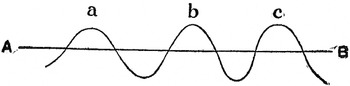
A good starting point is provided by an illustration that James used in his booklet Human Immortality (1898) (Figure 1).Footnote 126
The image is taken from W. James, Human Immortality: Two Supposed Objections to the Doctrine, Boston and New York, 1898.

This is an image that James borrowed from Gustav Theodor Fechner. Like Fechner, he used it to illustrate the idea of the threshold of consciousness. The sinusoidal wave represents a ‘wave of consciousness’. The horizontal line represents the threshold of consciousness, the boundary separating what we are conscious of (above the straight line) from what we are not conscious of (below the line). The horizontal line can move down or up as we become more alert (as more things enter our field of consciousness) or more drowsy. One feature of this graph has seldom been noticed: the graph illustrates not only the threshold of consciousness of one individual but also the fact that different ‘organisms’ could intermingle below the threshold of consciousness. James explained to his readers that for Fechner the wavelets ‘a’, ‘b’, and ‘c’ represented the consciousnesses of different ‘organisms’, different individuals. James continued by indicating that Fechner used that image to study the conditions under which a physical multiplicity (the physically many) could ‘contract into a psychical one’ – that is, could be psychically unified. If the threshold ‘sank low enough to uncover all the waves’ the consciousness (or consciousnesses) surfacing above the threshold line might also become continuous. Thus the image shows that these different individual consciousnesses, each of which took itself to be isolated from the others, might in fact not really be separated. They could be continuous below the threshold and could at times become aware of that continuity. Or, perhaps, they might be continuous in a larger span of consciousness, a ‘world-soul’.
In 1909, discussing his experiences as a psychical researcher, James wrote,
Out of my experience … (and it is limited enough) one fixed conclusion dogmatically emerges, and that is this, that we with our lives are like islands in the sea, or like trees in the forest. The maple and the pine may whisper to each other with their leaves … But the trees also commingle their roots in the darkness underground, and the islands also hang together through the ocean's bottom. Just so there is a continuum of cosmic consciousness, against which our individuality builds but accidental fences, and into which our several minds plunge as into a mother-sea, or reservoir.Footnote 127
Circumscribing and insulating the self from external influences was part of the individual process of adaptation to the ‘external earthly environment’. Yet the fence surrounding the self would remain ‘weak in spots, and fitful influences from beyond leak[ed] in, showing the otherwise unverifiable common connexion’.Footnote 128
This section of the paper and the next one suggest that James's insistence on the porosity of the boundaries of the self, which he especially emphasized in the last decade of his life, was instrumental to rooting the self in community. ‘Socializing’ the self was a goal that many of James's contemporaries pursued and which they sought to accomplish precisely by opening up the boundaries of the self. James was familiar with many emerging theories of the ‘social self’ and with the many ways in which such theories had been used to support social visions of community and cooperation.Footnote 129 In 1902, on board an ocean steamer crossing the Atlantic, he got to know closely the Midwest populist journalist Henry Demarest Lloyd, whose exposés of corporate corruption were among the earliest examples of muck-raking journalism. A neo-republican populist, Lloyd had made the theory of the social self central to his gospel of the ‘new morality’. He prophesied that monopolies and private ownership of public properties such as railways would disappear and preached a social vision in which ‘individual self-interest’ was to be replaced by ‘social self-interest’, egoism by altruism.Footnote 130 The theory of the social formation of personality, which distributed individuality over a network of social bonds, supported his vision of a cooperative society.
James was also well acquainted with idealistic theories of the social self, including, for example, that articulated by the British idealist Francis Herbert Bradley, ‘the bogey and bugbear of most of [his] beliefs’. Bradley's conception of the self was at the root of a social vision that privileged community over individuality. It succeeded in completely embedding the individual in society, but only at the cost of denying the reality of the self and dissolving it in the absolute mind.Footnote 131 Bradley's ‘complete repudiation of the reality of the self’ went hand in hand with his political opposition to individualism, his defence of a robust role for the state against liberal laissez-faire and ‘his tendency to think that one's nature is so bound up with one's community that purely personal interests are a myth or a disease’.Footnote 132
The renunciation of egoistic impulses was very explicit in numerous socialist utopias of the time, including William Dean Howells's vision of an ‘Altrurian’ society. Howells's novel A Traveler from Altruria (1894) and its sequel, Through the Eye of the Needle (1907), brought to completion the demise of the substantial, insular, self-determined self, the diseased condition of which he had diagnosed in A Hazard of New Fortunes. Altruria was a communistic society that admitted neither ownership of property nor self-ownership of labour, nor, indeed, of any form of individual selfhood. Life was based on renunciation of self-determination and of all self-seeking impulses, and on the extreme practice of ‘altruism’.Footnote 133 To James, Howells's utopia remained largely bourgeois. He had his reservations about the novelist's ability empathetically to portray ‘the inner joy and meaning of the laborer's existence’.Footnote 134 Nevertheless, these novels and other broadly defined socialist literature sharpened his awareness that cooperation required – to some extent at least – a weakening of the boundaries of the individual self or an embedding of selfhood within social relations.
For some of those socialist writers the regeneration of society rested on forms of selfhood rooted in religious or mystical experiences. James personally knew a few. His own father is a good case in point. An unorthodox follower of Swedenborg and of Fourier's utopian socialism, James Sr envisioned an ideal society (‘the regenerate society’) premised upon ‘the brotherhood of each man with each man in God’. In this society the individual would give up selfish tendencies – indeed, would relinquish ‘his’ very selfhood and recognize his membership in a large, cosmic, divine self.Footnote 135 To James Sr the pursuit of selfhood was the ‘source of all evils’ and to relinquish the illusions of selfhood and substantiality was to take the path to individual and social salvation. The ‘regenerate man’ was in essence ‘the social man’.Footnote 136
Ralph Waldo Trine, a self-educated mind-curer and a Christian socialist, provides yet another example. Trine declared that the individual self was illusory and he dissolved it into an ‘infinite spirit’ pervading everything. The realization of the insignificance of the individual self was to be the panacea for individual happiness and social health. By banishing all self-seeking attitudes and their petty concerns for their ‘diminutive’ individual selves, and by looking at themselves as parts of the infinite self, workers and the common people could effectively unite and bring about a peaceful solution to the grave tensions plaguing a capitalistic society. The result would be a cooperative, sympathetic society in which wealth would be justly redistributed among all members.Footnote 137
A third example deserves special consideration: the British mystical poet Edward Carpenter, an anarcho-socialist greatly popular with socialists of various persuasions, humanitarians, theosophists and spiritualists. In the early 1900s Carpenter articulated an ambitious theory of the self. Linking together insights from evolutionary theory, from Hindu religious traditions and from his own mystical experiences, Carpenter dissolved the individual self into a universal cosmic Self. He located three stages in the evolution of consciousness. The first, found in animals, children and some primitive societies, was characterized by the lack of any distinction between self and other.Footnote 138 The second stage was that of self-consciousness and civilization. It was marked by the opposition between self and other and by a morbid sense of the importance of the self. This stage, best instantiated by laissez-faire economies, was one of ‘competitive individualism’.Footnote 139 In the third stage all those divisions would be overcome and individual consciousness would evolve through love into ‘Cosmic Consciousness’ (the same phrase that James used in the 1909 passage quoted above). In a flash of mystical revelation, the experience of cosmic consciousness, the individual would suddenly perceive him- or herself to be just a part of the great Self of the universe.Footnote 140 Cosmic consciousness marked the inauguration of a stage of social harmony and offered the metaphysical and psychological framework for the socialist ‘brotherhood of workers’ that Carpenter expressly advocated.Footnote 141 Indeed, as the British Fabian socialist Beatrice Webb promptly observed, Carpenter's booklet provided the perfect embodiment of the ‘metaphysics of the socialist creed’.Footnote 142
Examples of social commentators who associated the demise of individual selfhood with mystical experiences of unification and the advent of social solidarity could be easily multiplied. James's correspondent Richard Maurice Bucke, a member of Walt Whitman's circle of friends and an asylum superintendent, associated the mystical stage of ‘Cosmic Consciousness’, a mystical unification with the infinite spirit, with the advent of a socialist millennium.Footnote 143 One generation earlier, the social visionary Edward Bellamy had posited a religious, even mystical, foundation for the social feelings of love of others and sympathy and for the instinct of solidarity, the desire to ‘los[e] ourselves in others or [to] absorb them into ourselves’. Through ecstatic experiences, he wrote, ‘we are wrapt out of ourselves’ and, stepping out of our ‘narrow, isolated, and incommodious individuality’, are able to commune with the ‘impersonal consciousness’ of the universe.Footnote 144
All these accounts of the self were somehow disappointing to James. They suffered from the defect that James imputed to other types of socialism: they annihilated the individual in the collective. James perceived that his father's account of the self reduced the ‘individual man’ to ‘nothing’.Footnote 145 Likewise, in a letter to a Fabian socialist friend he complained that Carpenter had ‘overdone the monistic business’, privileging the whole at the expense of the individual self.Footnote 146 Carpenter supported his social vision of community with the authority of mystical experiences. But mystical experiences, so James wrote, did not necessarily testify for ‘absolute unity’, for the absolute fusion of the individual self with a universal infinite all-embracing Self. They simply testified to the possibility of ‘more unity’, a claim perfectly compatible with the pluralistic viewpoint that there exist independent irreducible individual selves.Footnote 147 All the facts that Carpenter had described, James continued, could be accounted for by the ‘admission of a wider-span consciousness that envelops ours and uses ours’.Footnote 148 It was Carpenter's and other mystics’ ‘passing to the limit’ that James found objectionable.
Seeking community and cooperation, James insisted on maintaining pluralism. ‘The ideal life must always be individualistic’, James lectured his Fabian socialist friend. James famously rejected the extreme monism which underlay the dissolution of the self into the universal absolute self. He rejected the very idea of an absolute infinite self, both in its Western idealistic versions and in its Hindu formulations. Like his irreverent friend F. C. S. Schiller, James found that the all-enveloping absolute self, if imaginable at all, was to be regarded as a macroscopic case of ‘multiple personality’ – another ‘Sally Beauchamp’ – most probably endowed with telepathic powers.Footnote 149
While James could not accept Carpenter's or Trine's annihilation of the individual self in the cosmic whole, this literature and practices designed to help the self ‘step out’ of itself paved the way for his own understanding of self and society. His own experiences with nitrous oxide (and drunkenness), for example, had given him an ‘immense emotional sense of reconciliation’ of opposites, revealing that ‘the ego and its objects, the meum and the tuum, are one’.Footnote 150 Back to sobriety, he questioned the extreme Hegelian monistic conclusion that for an instant had seemed to him to be crystal clear. But he never challenged that ‘I and Thou’ could be ‘reconciled’ and could merge together in states of ecstasy. While at times he feared the possibility that his own self might be ‘invaded’ by foreign selves, like some of the mystical social visionaries discussed here he also realized that the ecstatic experiences of the open self could ground the possibility of a new cooperative life.Footnote 151 Thus the leaky contours of the self, a great source of anxiety, could also be optimistically imagined as a tool for the creation of a new type of society.
The ‘self-compounding of consciousnesses’: psychology, metaphysics and society
In emphasizing how individuals could communicate below the threshold of consciousness and how they could realize their interlinking continuity through experiences of ecstasy, illumination and transmarginal communication, James fashioned a psychological theory that promised to eliminate selfishness and isolation. His notion of the open self was tailored to allow not only for redemptive experiences with a divine self, but also for the sharing of experiences and sympathetic understanding and ultimately for cooperation and solidarity. This point has been missed by many scholars.Footnote 152 To see this clearly the discussion needs to take a rapid detour through a technical metaphysical problem that was central to the pluralistic metaphysics that James articulated in the last years of his life: ‘the self-compounding of consciousnesses’ or the ‘problem of the compounding of selves’.Footnote 153 In James's solution to that problem, the Jamesian self and the form of society that James promoted came together in a way that alleviated the tension that had run through his social vision: the tension between individuality and community.
In a series of public lectures at Oxford in May 1908, James described the problem to his audience: ‘I wish to discuss the assumption that states of consciousness … can separate and combine themselves freely’, and yet ‘keep their own identity unchanged while forming parts of simultaneous fields of experience of wider scope’.Footnote 154 The underlying question was: could ‘many consciousnesses be at the same time one consciousness?’ If so, how? Or how could individual, separate consciousnesses compound into a complex consciousness, without losing their individuality and self-perception? On a different level, how could different individual selves (you and me) ‘be confluent’ into a higher self (for example, the absolute self of idealist philosophers), in such a way that would allow each to retain its individuality, while being co-conscious of the others?
James had spent much ink trying to solve this problem. In Principles (1890) he had declared the problem insoluble and had sharply criticized those who attempted to solve it by claiming that higher sensations are ‘compound sensations’ (for example, the feeling of ‘lemonade’ is a compound of the feelings of ‘sugar’ and of ‘lemon’.) He insisted that, far from being ‘compounds’ of lesser sensations, higher sensations were just ‘new psychic facts’. Their unity existed as such only for an external ‘bystander’, namely the new mental state that unified them. In the years that followed he deployed this argument against monistic idealists including Royce and Bradley, who operated under the assumption that the absolute self was ‘constituted’ by the individual selves, each of which retained its own identity and self-perceptions.Footnote 155 James simply could not see how their claim could be compatible with the laws of logic.Footnote 156
In the Oxford lectures James attacked the problem of the compounding of consciousnesses one last time. He offered a spectacular and controversial solution. This consisted in giving up one of the fundamental principles of logic, the ‘principle of identity’, according to which, as James put it, a thing cannot be its ‘other’ and, if two things are distinct, they must also be disjoint. As James told his bewildered audience, if one gave up the axioms of logic and, following the lead of the French philosopher Henri Bergson, placed oneself ‘d'amblée’ into the flux of reality, one would perceive that no boundaries really separate any one bit of experience from its next. Concrete pulses of experience ‘compenetrate’ each other, ‘run into each other’ and ‘coalesce’ with each other at their margins. They ‘interpenetrate’ ‘where they touch’ and ‘telescope’ into each other (the very phrase that James had used to describe his own proto-ecstatic experience with dreams invasion).Footnote 157 Once the axiom of identity was abandoned, there was no real problem in seeing how successive pulses of consciousness could interpenetrate and be part of higher compounds without losing their distinctness and individual identity.Footnote 158 By analogy it was also easy to feel that different individual selves (you and I) could interpenetrate along their margins and freely compound themselves into larger wholes while retaining their individuality.Footnote 159 Neighbouring individual selves (or different ‘pulses of consciousness’) were thus not wholly separate well-bounded isolated things. They could be different without being ‘disjoint’. They could flow continuously into each other in ways that recalled the intimate biological process of ‘endosmosis’. That was exactly the conclusion James had drawn through his studies and (limited) personal experiences of mystical and psychic phenomena. Indeed, as Richard Gale suggests, James's final metaphysics can be seen as an expression of a particular type of mysticism – James's unpretentious ‘backyard’ mysticism. In this mystical-metaphysical framework, different selves could coalesce with each other by being ‘confluent’ in a higher but not all-embracing superhuman consciousness (the ‘mother sea of consciousness’, the ‘cosmic consciousness’ or perhaps a finite God). Or, they could merge together by virtue of concatenated relations of continuity from next to next (the type of ‘unity’ that James probably thought was supported by mystical authority).Footnote 160
To James, as to scores of other scientists, psychologists and cosmologists of the time, the problem of the compounding of consciousnesses was so important because it carried political implications.Footnote 161 It bore directly on the question of the nature of the relationships of the individual with society as well as on the question of the relationships among individuals in society. The point should come as no surprise; after all, James was quite explicit in his contention that his pluralistic metaphysics ‘frankly interpret[ed] the universe after a social analogy’.Footnote 162 In social or political terms, James reckoned the metaphysical problem translated into allowance of spontaneous communities in which individuals could retain their identities and individual perspectives yet develop a sympathetic insight into other people's perspectives. These were the pluralistic yet intimate communities that James dreamed of animating, at times by means of (mystical, or, perhaps, more earthly) love with other similarly minded women and men. These included, perhaps, Pauline Goldmark, the lovely young woman who made him so ‘happy’; or Henri Bergson, with whom James hoped to develop a ‘socially and intellectually endosmotic relationship’ (‘endosmosis’, as both of them well knew, involving the intimate exchange of bodily fluids); or a young Italian pragmatist friend, whom James met for the first time half-naked in a hotel room, in an attempt to start their friendship on an intimate tone.Footnote 163
These were also the communities which, James believed, promised the solution for all social conflicts. James, as we saw, identified the central source of the class tensions flaring between workers and capitalists in a lack of mutual ‘sympathetic’ understanding, a mutual blindness that flowed from the external position that each class (or nation) took vis-à-vis the other. And he took American imperialism to stem from the deaf insensitivity that made the dominating imperialists unable intimately to engage with the Filipinos. The problem of facilitating a mutual understanding through creating a common consciousness thus lay at the very centre of James's social thinking. His pluralistic metaphysics, allowing for the interpenetration of streams of consciousness or selves along their boundaries, showed how such understanding could arise, and how the otherwise ‘impenetrable’ values and secrets of other people could become intimately accessible to those sympathizing with them.Footnote 164 James's solution to the problem of the ‘self’-compounding of consciousnesses avoided depicting society as an aggregate of disjoint individuals and made individuals into linked parts of communities that they ‘freely’ created through spontaneous association. At the same time, it allowed for a defence of individual autonomy and rights. As James stressed, his metaphysics engendered ‘tolerance’ and ‘democracy’ and was incompatible with ‘slavery’.Footnote 165 The best examples of such a society were small groups of sympathetic individuals (small anarchistic communities, Deborah Coon suggests) who would spontaneously band together and cooperate in the creation of a better world.Footnote 166
At a time when philosophers and politicians resorted to monistic visions of the universe to legitimate aggressive forms of imperialism, James took great pains to emphasize that his solution was, instead, pluralistic.Footnote 167 The larger wholes of which an individual was part, including, for example, larger selves or concatenated communities, resembled more a ‘federal republic than an … empire or a kingdom’.Footnote 168 This federal analogy (doubtless disappointing to those who would like to press James to a more precise statement of his political position) embodied the two elements that James continually worked to accommodate into his social vision: individualist localism and community. Elsewhere, James was more daring in indicating political associations. He described his radically empiricist metaphysics as ‘the pluralistic, socialistic’ view that was predicated on the vision of a ‘co-operative universe’.Footnote 169
Utopias and conclusions
‘Utopias are the noblest work of man’, James wrote to William Dean Howells in November 1907 after reading Howells's utopian novel Through the Eye of the Needle.Footnote 170 Yet James would certainly have agreed with his correspondent the British novelist H. G. Wells that all utopias have an ‘incurable effect of unreality’:
that which is the blood and warmth and reality of life is largely absent; there are no individualities, but only generalized people. In almost every Utopia … one sees … a multitude of people, healthy, happy, beautifully dressed, but without any personal distinction whatever.Footnote 171
Shortly before dying James offered his own utopia. ‘I will now confess my own utopia’, he wrote in ‘The moral equivalent of war’: ‘I devoutly believe in the reign of peace and in the gradual advent of some sort of a socialistic equilibrium.’Footnote 172 The ‘socialistic future’ towards which he believed the country was drifting would never be one of softness.Footnote 173 It would retain the institutions of corporate capitalism and its economy would always involve hardiness and effort. Visions of ‘pacifist cosmopolitan industrialism’ were too weak and were bound to be met with the contempt not only of the huge party of ‘militarists’, but also of workers and everyone who had been trained to live a strenuous life. The foundation of the new socialistic state would still have to be provided by ‘manly’ ‘virtues’ such as intrepidity, contempt of softness, surrender of private interest and obedience to command.Footnote 174 Those ‘martial’ virtues and the war instinct, however, would be coopted for pacifist purposes. In the new state all the youthful population would be drafted into work for the country's industrial ‘army’.Footnote 175 Quoting a long passage from H. G. Wells, James prophesied to his wide non-academic audience that conscription into the industrial army would lift individuals to ‘a higher social plane’ and place them into ‘an atmosphere of service and cooperation’.Footnote 176 Requiring ‘our gilded youth’ to share other people's occupations and experiences, especially pain and hard labour, would enable them to ‘come back to society with healthier sympathies’.Footnote 177 Yet even in this socialist–industrialist utopia, one that came strikingly close to Edward Bellamy's 1888 vision of a collectivist society controlled by a coercive centralized power, James endeavoured to avoid the ‘effect of unreality’ resulting from the relinquishment of individuality. The proposed temporary enrolment in the industrial army promoted not only solidarity, but also the cultivation of strenuous virtues that would strengthen individuals and endow them with agency. In the end, James accepted a form of ‘corporate’ socialism. But he did so only when he found a way of reconciling socialism with strong individual agency and a strong sense of personal identity.
This article has suggested that the self that James delineated mirrored and furthered his attempts to transform American society and to create individualistic yet cohesive communities that he considered a panacea to social evils. While it denied the substantiality, the simplicity and the a priori unity of the self, those very features which nineteenth-century individualists had mobilized to defend the rights and priority of the individual, the Jamesian self provided the individual with a stronger form of agency and self-determination. Individuals were responsible for unifying their own self through strenuous effort, for continuously negotiating amiable relationships among their various social selves and for sustaining and creating afresh a stable self. This continuous effort of self-fashioning and self-sustaining is what made individuals into effective centres of initiative and social change and enabled them to cultivate, even renew minute by minute, the strength necessary to assert their independence from the big political and economic bureaucratic organizations that endangered their self-determination and spontaneity.
The mystical experiences of the loosely bounded self and the region of extra-marginal consciousness provided the ground for intimacy and for mutual, constructive understanding. They allowed for the spontaneous creation of sympathetic communities and, in the long run, for a broader piecemeal unification of society. Yet these ecstatic sympathetic experiences did not sacrifice individual selfhood to the goals of cooperation and solidarity, as did many socialist visions of the time. Like other contemporaries, James painted the self as divided, surrounded by uncertain porous boundaries. While he shared their anxieties concerning those features of the self, he also saw the potentialities that they offered both to the individual and to society. Paradoxically, James found that in the anti-essentialist, intrinsically divided, unstable and loosely bounded self lay the conditions of possibility of a fluid, responsive and pluralistic society, one that combined those aspects of individualism, anarchism, socialism and participatory democracy which James valued, yet pointed beyond existing political systems.