Introduction
According to the literature, the genus Bellevalia Lapeyr. (Hyacinthaceae) is represented in Sicily by B. romana (L.) Sweet and B. dubia (Guss.) Rchb. subsp. dubia (Borzatti de Loewenstern & Garbari, Reference Borzatti de Loewenstern and Garbari2003), which are rather common on the island (Pignatti, Reference Pignatti1982). Recently, a small population represented by few individuals was found on Lampione, a small island of the Pelagian Archipelago in the Sicilian Channel. This geophyte was previously collected by Di Martino (Reference Di Martino1958, Reference Di Martino and Zavattari1961) and erroneously identified as Muscari comosum L., while Kohlmeyer (Reference Kohlmeyer1960) correctly referred it to the genus Bellevalia without indicating the species. Bulbs of this population cultivated in the Botanical Garden of Catania flowered from February to March, usually producing three stems. This plant is well differentiated from the other species of the genus occurring in Sicily by its large inflorescence and flowers and its very long leaves. It rather shows closer relationships with some species recently described from Tunisia. They are Bellevalia dolichophylla Brullo & Minissale from Cap Bon and B. galitensis Bocchieri & Mossa, endemic to the island of La Galite. However, a number of vegetative and reproductive characters distinguish the Lampione population from both species (see below). It is described as a species new to science and named Bellevalia pelagica C.Brullo, Brullo & Pasta.
Materials and Methods
The morphological investigation was made on living material collected from the island of Lampione and cultivated in the Botanical Garden of Catania. For the karyological study, mitotic plates were obtained from the root tips of cultivated bulbs. The root tips were pretreated with 0.3% colchicine water solution for 3 hours, fixed in ethanol-acetic acid (3:1) for 6 hours and stained according to the Feulgen method (Brullo et al., Reference Brullo, Guglielmo, Pavone and Salmeri2008). The chromosome classification follows the nomenclature of Levan et al. (Reference Levan, Fredga and Sandberg1964).
Description
Bellevalia pelagica C.Brullo, Brullo & Pasta, sp. nov.Figs 1–3.
Bellevalia dolichophylla affinis, bulbo hemisphaerico, 2.5–3 × 3–3.5 cm, foliis 6–8, 50–70 cm longis, exterioribus 15–25 mm latis, scapis 3 (raro 2), racemis 52–60 floribus, in verticillis quaternis dispositis, bracteis 2–6 mm longis, perigonio 12–15 mm longo, lobis 6–7 mm longis, 4.5–5.5 mm latis, antheris 2.6–3.2 mm longis, filamentis staminorum late triangularibus, 2.5–3.5 mm longis, ovario 2.5–3 mm lato, stylo 5–5.5 mm longo, capsula subglobosa ab ea diversa. – Type: Sicily, Arcipelago delle Pelagie, Lampione, 16 iii 2006, cultivated specimen, Lo Cascio & Sferlazzo s.n. (holo CAT; iso CAT, FI).
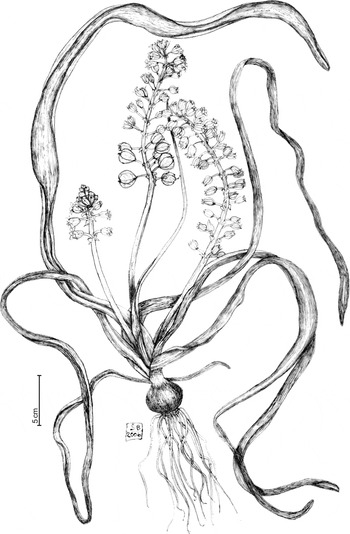
Habit of Bellevalia pelagica C.Brullo, Brullo & Pasta.

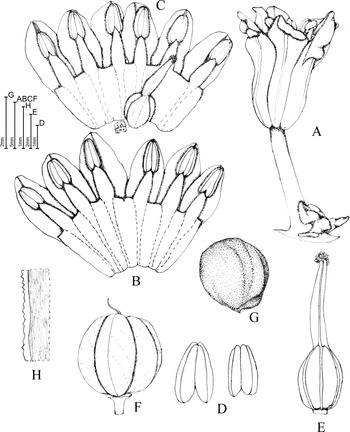
Morphological characters of Bellevalia pelagica: A, flower; B, open perigone; C, open perigone with pistil; D, stamens; E, pistil; F, capsule; G, seed; H, leaf margin.

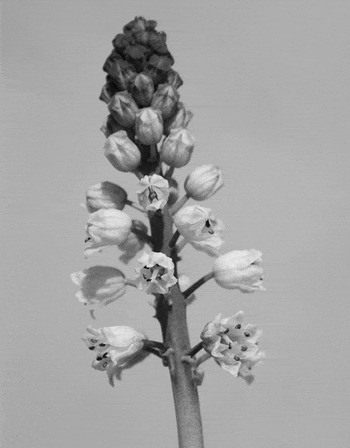
Raceme of Bellevalia pelagica from cultivated plant.

Bulb hemispherical, 2.5–3 × 3–3.5 cm, with outer tunics coriaceous, dark brown in colour. Leaves 6–8 in number, green, long linear-lanceolate, subequal, 50–70 cm long, longer than scape, strongly canaliculate, the outer ones 15–25 mm wide at the base, the inner ones narrower, 1–14 mm wide, with hyaline margin glabrous and smooth, cucullate at the apex. Stems 3, rarely 2, 28–35 cm long, greenish, tinged with violet in the upper part. Raceme cylindrical, with 52–60 flowers generally arranged in a whorl of 4. Bracts minute, green-violet, 2–6 mm long. Pedicels erect-patent, 6–11 mm long, shorter than perigone. Flower buds white with greenish-violet tinge. Perigone white tinged with purple-violet in the upper part and tinged with blue-violet at the base, turning pale yellow when dry, cylindrical-campanulate, 12–15 mm long, 5–7 mm in diameter; lobes 6–7 mm long, 4.5–5.5 mm wide, elliptic-ovate, rounded to obtuse at the apex. Stamens subequal or shorter than the perigone; anthers dark purple-violet to blue-violet, 2.6–3.2 mm long; filaments white, widely triangular, 2.5–3.5 mm long, decurrent along the perigone tube. Ovary ovoid, purple-violet, whitish-blue in the keels, 3.8–4 × 2.5–3 mm; style whitish to white-azure, 5–5.5 mm long; stigma capitate, white, papillose. Fruiting raceme cylindrical with patent pedicels. Capsule trigonous, subglobose, 13–15 mm in diameter and valves elliptical, with prominent veining, rounded at the base. Seeds subglobose, black-pruinose, 2.8–3.2 mm in diameter.
Phenology. Flowering: February–March; fruiting: March–April.
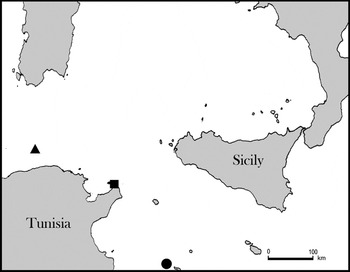
Distribution. Bellevalia pelagica is endemic to Lampione, a small islet 17.5 km west of Lampedusa in the Pelagian Archipelago (Fig. 4). The perimeter of the islet is c.750 m with a maximum altitude of 36 m a.s.l. Lampione is characterised by Eocene limestones and therefore is geologically well differentiated from the neighbouring Lampedusa which is primarily characterised by Miocene rocks. This makes Lampione much older than Lampedusa (Bonnefus & Bismuth, Reference Bonnefus and Bismuth1982; Grasso et al., Reference Grasso, Pedley and Reuther1985).
Geographical distribution of Bellevalia pelagica (circle), B. dolichophylla (square) and B. galitensis (triangle).

Habitat and ecology. This species grows in sunny flat places and slight inclines at the top of the islet where it colonises the crevices of the calcareous rocks. It is a member of a halo-nitrophilous community characterised by Atriplex halimus L., a shrub currently very scattered due to disturbance by huge seagull colonies. In this vegetation some ornithocoprophilous species are present, among them Malva veneta (Mill.) Soldano, Banfi & Galasso (Corti et al., Reference Corti, Lo Cascio, Masseti and Pasta2002, sub Lavatera arborea L.).
Conservation status. The population of Bellevalia pelagica is quite small and consists of c.60 individuals (Pasta, Reference Pasta and Corti2002; Sferlazzo, Reference Sferlazzo2003). Therefore, following IUCN (2001, 2003) methodology the following risk category is proposed: CR B2ab (ii,v); C2a (ii).
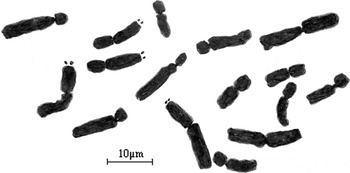
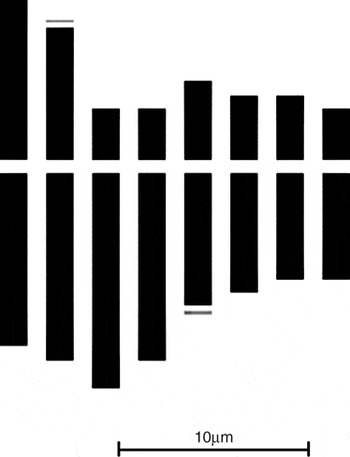
Karyology. A karyological investigation found that Bellevalia pelagica is a tetraploid species with 2n = 16 (Fig. 5). This number is very common in the genus Bellevalia, as emphasised by Bothmer & Wendelbo (Reference Bothmer, von and Wendelbo1981). Its chromosome complement is characterised by 4 metacentric pairs (2 of which have microsatellites), 2 submetacentric pairs and 2 subtelocentric pairs. The chromosome formula is: z = 2n = 4x = 16: 4m + 4ms + 4sm + 4st. On the whole, this species shows a very uniform karyogram, with a diploid arrangement (Fig. 6). Our hypothesis is that Bellevalia pelagica has an allotetraploid origin from the hybridisation of two ancestors no longer present on the islet.
Somatic metaphase plate of Bellevalia pelagica.

Idiogram of haploid chromosome complement of Bellevalia pelagica.

Discussion
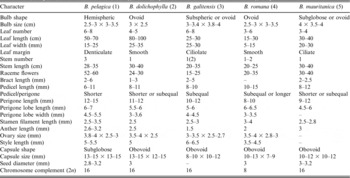
In the taxonomic infrageneric arrangement proposed by Feinbrun (Reference Feinbrun1940) and modified by Feinbrun-Dothan (Reference Feinbrun-Dothan1986), Bellevalia pelagica can be ascribed to Bellevalia sect. Bellevalia subsect. Romana Feinbrun. This section is characterised by a cylindrical fructiferous and flowering raceme, leaves longer than the stem, pedicels erect-patent and shorter than the flowers, bracts often well developed, capsule persistent with valves spherical to ellipsoid and rounded at the base, dehiscing at the apex. Within this subsection Bellevalia pelagica seems to be closely related to B. dolichophylla, a species described by Brullo & Minissale (Reference Brullo and Minissale1997) from Cap Bon (NE Tunisia), where it is very rare and localised in cliff crevices near the sea. In particular, these two species both have numerous and very long leaves which are glabrous at the margin and cucullate at the apex, the stems are well developed and are tinged with violet above, the racemes are lax with big flowers which are whitish tinged with blue-violet, the pedicels are erect-patent, the stamens are dark violet, the capsules are 13–15 mm wide, the seeds are subglobose and black-pruinose, and the chromosome complements are tetraploid (2n = 16). However, they are easily distinguished morphologically (Table 1). In particular, Bellevalia dolichophylla differs from B. pelagica in having an ovoid bulb, leaves which are less numerous but longer and wider, the stem is solitary, the raceme has fewer flowers, the perigone is shorter, and the capsule is obovoid. Bellevalia dolichophylla has 3 pairs of metacentric and 3 pairs of submetacentric chromosomes. Another species showing some affinities with Bellevalia pelagica is B. galitensis, which was described by Bocchieri & Mossa (Reference Bocchieri and Mossa1991) from the islet of La Galite (N Tunisia) where it grows in the arid rocky meadows. They are similar in the well-developed scapes, the numerous and very wide leaves, and the shape of the perigone, but Bellevalia galitensis has much shorter leaves, there are only 1–2 racemes which are few flowered, the perigone and anthers are shorter, the style is very long, and the capsule is shorter and obovoid (Table 1). All three species are clearly related to Bellevalia romana and B. mauritanica Pomel, both belonging to Bellevalia subsect. Romana. Bellevalia romana is widespread in the northern Mediterranean from S France to Greece (Heywood & Regueiro, Reference Heywood, Regueiro and Tutin1980; Pignatti, Reference Pignatti1982), and B. mauritanica in N Africa, from Algeria to Egypt (Cuenod, Reference Cuenod1954; Maire, Reference Maire1958). Table 1 gives the differences between Bellevalia romana, B. mauritanica and the previous three species. They differ mainly in the leaves, which are very narrow and a little longer than the stem, as well as in ecology, since they are linked normally to damp soils or mesophilous prairies.
Comparison of characters distinguishing species in the Bellevalia romana group

(1) Based on living material from locus classicus (Lampione – Sicily).
(2) Based on living material from locus classicus (Cap Bon – Tunisia).
(3) Based on literature data and herbarium specimens from locus classicus (La Galite – Tunisia).
(4) Based on living material from Caltanissetta (Sicily).
(5) Based on literature data and herbarium specimens from several localities in Tunisia.
According to Bothmer & Wendelbo (Reference Bothmer, von and Wendelbo1981), Garbari (Reference Garbari1968), Bocchieri & Mossa (Reference Bocchieri and Mossa1991), Brullo & Minissale (Reference Brullo and Minissale1997) and Peruzzi (Reference Peruzzi2003), the chromosome complement of Bellevalia romana is 2n = 2x = 8, while those of B. mauritanica, B. dolichophylla and B. galitensis are 2n = 4x = 16, as we found in B. pelagica. From their morphological characters, chromosome numbers, geographical distributions and ecological requirements, it is possible to hypothesise that all these species arose from a common ancestor. Bellevalia pelagica is closest to B. dolichophylla and rather less similar to B. galitensis and B. mauritanica. In vegetative and floral characters, as well as by its diploid chromosome complement, Bellevalia romana would appear to be taxonomically more isolated and nearest to the common ancestor. Bellevalia pelagica, B. dolichophylla and B. galitensis, characterised by tetraploid somatic numbers and showing isolated distributions, have possibly arisen as a consequence of geographic isolation leading to speciation.
Key to the species of Bellevalia subsect. Romana
1a. Leaves 50–100 cm long 2
1b. Leaves 15–40 cm long 3
2a. Leaves 6–8, 50–70 cm long, irregularly dentate at the margin; stems 3, with raceme 52–60-flowered; perigone 12–15 mm long; anther 2.6–3.2 mm long; capsule subglobose B. pelagica
2b. Leaves 4–5, 80–100 cm long, smooth at the margin; stem 1, with raceme 24–30-flowered; perigone 11–12 mm long; anther 2.5 mm long; capsule obovoid B. dolichophylla
3a. Bulb 2.5–3 cm long; leaves 5–15 mm wide, smooth at the margin; perigone with lobes 6–6.5 mm long B. romana
3b. Bulb 3–4 cm long; leaves 20–30 mm wide, ciliate or ciliolate at the margin; perigone with lobes 4.5–6 mm long 4
4a. Leaves 3–4, 30–40 cm long; raceme 30–40-flowered; capsule 10–12 mm long B. mauritanica
4b. Leaves 6–8, 25–30 cm long; raceme 15–25-flowered; capsule 8–10 mm long B. galitensis
Acknowledgements
Many thanks are due to M. C. Terrasi (Department of Botany, Catania) for the karyological investigations, and to D. Sferlazzo (ENEA, Lampedusa) and P. Lo Cascio (Nesos, Lipari) for the collection of the living material from which the type specimen was selected. The authors are also very grateful to the anonymous reviewers and to David Middleton for his careful editing.